
From Rwanda to Sudan, explore a continent of literature in this reading list.
Read MoreFollow Alice: Adventure With Purpose
By Trisha Pillay | Follow Alice
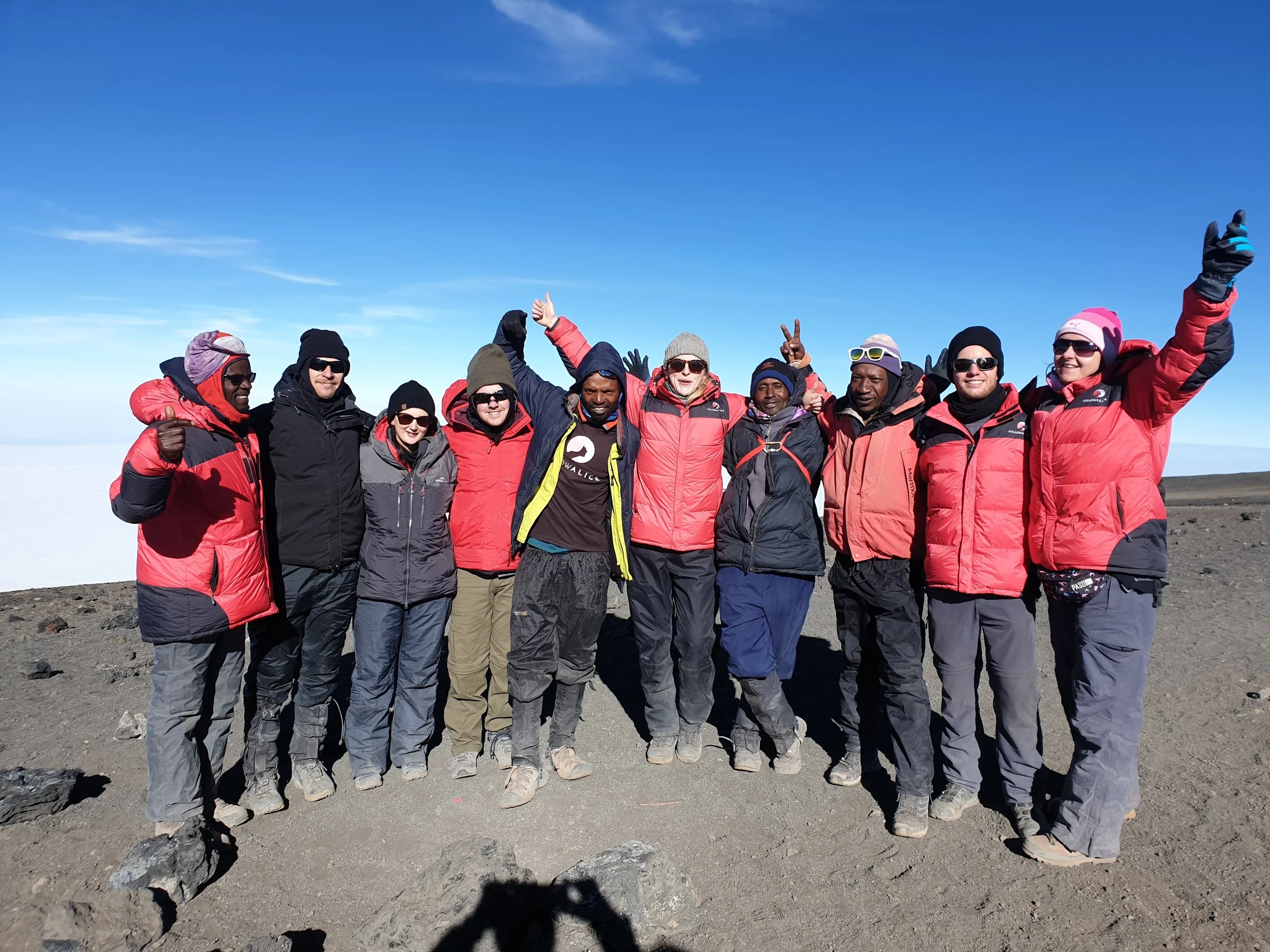
Group of trekkers on route to the summit of Mount Kilimanjaro with the Follow Alice team.
Some of the best things in the world are born from frustration: a bad meal that inspires a great chef; a long wait that sparks a better idea; and, in the case of Follow Alice, a Mount Kilimanjaro climb gone wrong that changed everything.
There’s a version of adventure travel that looks great in a brochure but feels hollow once you’re on the ground. It’s guides who don’t know the mountain, tour operators running trips they’ve never personally done and money that never makes its way back to the communities carrying your bags and cooking your food.
Follow Alice born on the side of a mountain
Follow Alice didn't start in a boardroom; it started on the slopes of Kilimanjaro. Co-founder Reto Bolliger had dreamed of climbing the mountain for years. But when he finally made it happen, the experience left him very disappointed. The company he'd booked through had outsourced everything to local operators who had little connection to the mountain and even less accountability to the people working on it. The tour felt impersonal, the logistics felt careless and most tellingly, the money wasn't going back to the people who deserved it most: the local guides, cooks and porters who made the climb possible.
Reto could see the gap clearly, and then, partway up that mountain, a porter named Chris Sichalwe started talking. Chris shared what life was really like on Kilimanjaro for the people doing the hard work behind the scenes: the inequalities, the unsafe conditions, the lack of fair pay and the sense that the people who knew the mountain best were the ones benefiting from it least. It was an honest, eye-opening conversation, the kind you only have when someone trusts that you actually care.
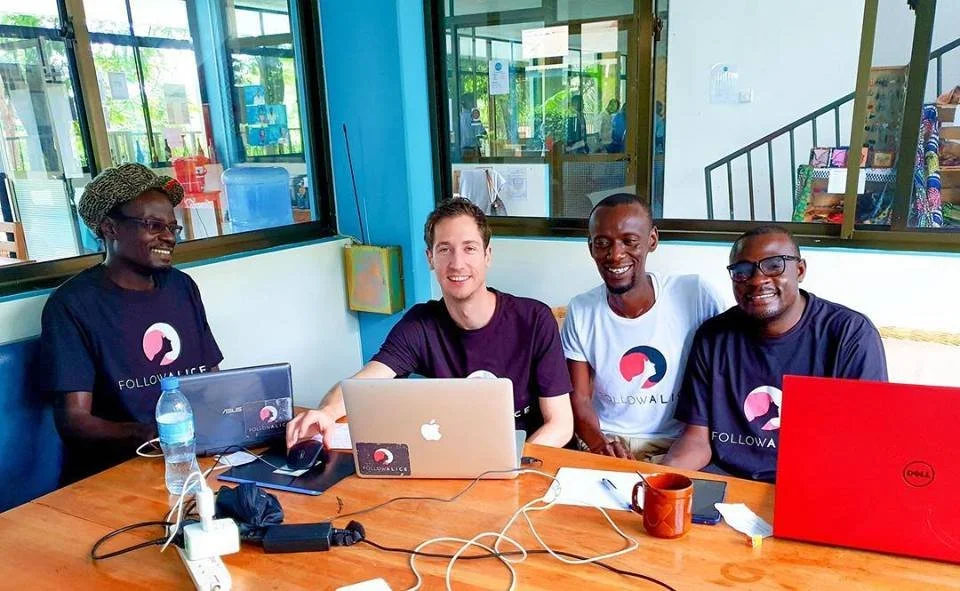
Reto, Chris and Rob Sichalwe joined another local leader to discuss operations in Tanzania.
Reto listened, and together with Daniel Louis, they decided to do something about it. That conversation became the seed of Follow Alice, a company built not just to run great adventures but to make sure the people at the heart of those adventures are respected, empowered and better off because of them.
Daniel with the Follow Alice team in Tanzania.
Fast forward to today, more than a decade later, and Chris Sichalwe is no longer a porter. He is the Director of Tanzanian Operations for Follow Alice. His journey from the trails of Kilimanjaro to the leadership of one of the company's most important operations is not a footnote in the Follow Alice story; it is the story.
Watch his story here: Chris’s Story | The Warm Soul Leading Follow Alice Tanzania
That progression says everything about the ethos of this company. Follow Alice is about sustainability and empowering local communities in every single place they operate, not as a side policy but as the entire point.
Follow Alice is now a boutique adventure travel company incorporated in both the U.K. and Tanzania, with a remote core team spread across the globe and on-the-ground crews that are 100% local. They operate across East Africa, South America, Asia and Iceland, running 50 adventures that have taken over 3,500 travelers to some of the world's most extraordinary places.
Watch Reto speak about Follow Alice: Meet Reto | The Vision And Founder Behind Follow Alice
View trips here: https://followalice.com/
What "responsible travel" actually looks like
The term responsible travel gets thrown around a lot. However, Follow Alice earns it by holding themselves to four honest questions for every trip they run:
Do our services offer local entrepreneurs genuine growth opportunities?
Does our business benefit the local community and economy?
Do we help protect or at least not harm the wildlife we encounter?
Do we help protect or at least not harm the natural environments we explore?
These aren't marketing talking points but a lens through which every itinerary, every partnership and every hire is evaluated. 70% of every trip price stays in the local economy, which is always channeled into fair wages, local empowerment and the partnerships that sustain communities long after the travelers have gone back home. Local teams don't just guide the adventures; they lead them, own businesses built around them and share in the revenue they generate.
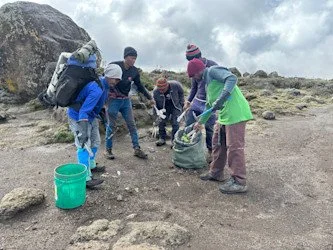
Follow Alice taking part in a Mount Kilimanjaro clean-up initiative in support of Leave No Trace principles.
Safety as the foundation
On Kilimanjaro and Mount Everest climbs, every Follow Alice guide holds a Wilderness First Responder (WFR) certification, an intensive program focused on trauma care, altitude illness, patient assessment and emergency response in remote environments. The qualifications are only part of it because the guiding philosophy matters too. Follow Alice chooses longer, safer acclimatization routes over rushed itineraries because getting people home safely matters more than getting them to the summit quickly. Every expedition carries comprehensive first-aid equipment, and guides are trained to make decisions based on client wellbeing rather than commercial pressure. Regular refresher training and emergency scenario drills help keep those skills current.
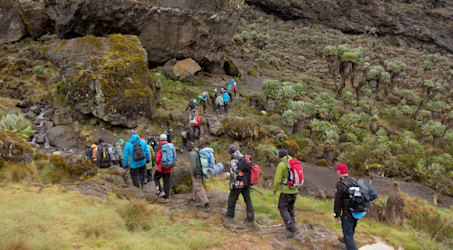
Trekkers making their way up Mount Kilimanjaro with the Follow Alice team.
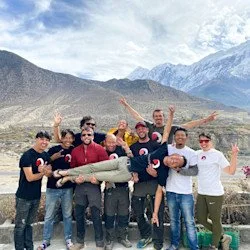
The Follow Alice team in Nepal take a picture with the Himalayas behind them.
The same approach extends across Follow Alice’s trips in East Africa. In Kenya and Zanzibar, the company works with trusted local teams who understand the rhythms of the places they operate in, right from the logistics of remote safari camps to the practical realities of coastal travel and changing weather conditions. The emphasis is on experienced local leadership, small groups and thoughtful planning rather than moving people through destinations as quickly as possible.
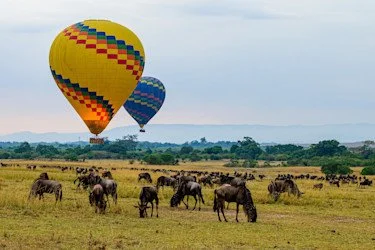
Balloon safari in Maasai Mara, Kenya, with wildebeests of the Great Migration beneath.
In Rwanda and Uganda, gorilla trekking is led in partnership with experienced local operators and park authorities who know these forests like the back of their hand and understand the responsibility that comes with taking visitors into one of the world’s most sensitive wildlife environments. Treks are paced carefully, group sizes remain small and the focus stays on respectful wildlife encounters that prioritize both traveler safety and gorilla conservation.
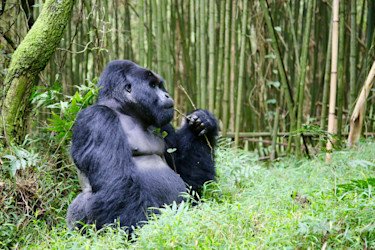
A silverback gorilla is captured chilling on a Uganda trekking experience.
In Iceland, trips are designed around guides and itineraries that respect how quickly conditions can change in the highlands, on glaciers and along the coast. Local knowledge matters in a landscape shaped by volcanic activity, shifting weather and long distances between services.
The people who make it happen
Follow Alice's guides are not interchangeable with service workers. They are storytellers, professionals and in many cases, business owners in their own right.
Khalfan Hamdun has guided travelers across the Serengeti for over three decades. Puru Sharma, who leads Nepal and Bhutan treks, studied law in the U.K. but kept coming back to the mountains and now personally curates every Himalayan adventure Follow Alice offers, ensuring Sherpas and local guides benefit through profit-sharing from every journey. In Uganda, guide Simon has become something of a legend among Follow Alice travelers, multiple testimonials singling him out by name.
Watch Puru in action: Everest Base Camp and the Three Passes Trek | Nepal | The Most Beautiful Trek in the World
Where Follow Alice goes
Follow Alice operates across some of the world's most iconic adventure destinations:
Africa: Kilimanjaro climbs via the Lemosho, Rongai, Machame and Northern Circuit routes; Tanzania and Kenya wildlife safaris; beach holidays in Zanzibar; and gorilla trekking in Uganda and Rwanda.
Asia: Everest Base Camp treks, peak climbing in Nepal, Annapurna Circuit, Manaslu Circuit, Meru Peak and cultural journeys through Bhutan.
South America: Inca Trail and alternative treks to Machu Picchu in Peru, as well as exploring the country’s capital, Lima.
Iceland: Seeing the Northern Lights in regions such as the Golden Circle, Akureyri and Snaefellsnes.
Each destination is personally tested by the Follow Alice team before it goes live. They walk every route, refine the logistics, stay in the accommodations and eat the food because no trip gets offered to travelers until the people behind it have experienced it themselves.
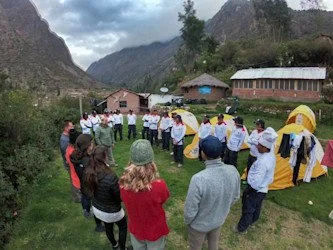
Follow Alice’s team training in Peru.
Travel that leaves things better
Follow Alice's sustainability commitments go beyond their guide partnerships. The focus is less on making broad sustainability claims and more on approaching travel thoughtfully:
Leave No Trace: Teams are trained to manage waste, protect wildlife corridors and tread lightly on fragile ecosystems.
Eco-conscious lodges: Accommodation is selected specifically for environmental responsibility.
Community cleanups: Local crews run trail cleanups, including a notable operation at Shira 2 Camp on Kilimanjaro.
Reforestation and NGO support: Travelers are given opportunities to contribute to local conservation, climb for charity and community projects.
Wildlife protection through tourism: The company actively supports the argument that tourism, done well, is one of the most powerful conservation tools available.
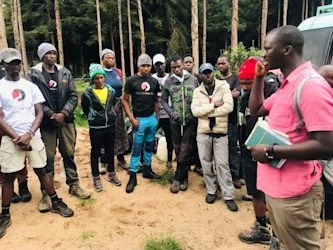
Follow Alice's team briefing for the KRTO clean-up initiative on Kilimanjaro
Why this matters in 2026
What matters now is not how often sustainability is mentioned but how it is reflected in the way trips are actually run. As more travelers look for experiences that feel responsible and meaningful, there is greater attention on who leads journeys, how local partners are involved and how tourism supports the places it moves through.
That is why platforms such as CATALYST PLANET are becoming more relevant. Their approach focuses on identifying operators built on long-term local relationships, experienced regional teams and a more grounded way of working in the destination. In a space filled with big claims, this kind of careful selection helps bring clarity to what is responsible.
Follow Alice has been included as part of this curated selection, reflecting a shared emphasis on working closely with local partners and shaping trips through established relationships on the ground rather than detached or one-size-fits-all models.
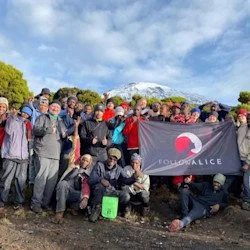
Follow Alice's team pose for a group photo.
Ready to Follow Alice?
The name Follow Alice comes from Lewis Carroll's Alice's Adventures in Wonderland, that little voice urging you to leap into the rabbit hole, to be curious, brave and open to the unexpected. The company's mantra is simple: come as a client, leave as a friend. If you're looking for an adventure that challenges you, connects you to real communities and leaves the places you visit better than you found them, Follow Alice is worth your attention.
Explore Follow Alice trips on the CATALYST PLANET Trip Finder, or visit www.followalice.com to browse their full range of adventures.
Follow Alice Contact: info@followalice.com
Follow them: @followalice on Instagram | YouTube | Facebook
Trisha Pillay
Trisha is an award-winning journalist and Head of Written Content at Follow Alice, with over 14 years of experience in storytelling and editorial media. Her work focuses on adventure travel, culture, and thoughtful storytelling that explores the connection between travel and everyday life.
The Galápagos Drug Route
By Carol Khorramchahi
A UNESCO wildlife sanctuary is being pulled into the Pacific cocaine trade, putting conservation and community life on the same collision course.
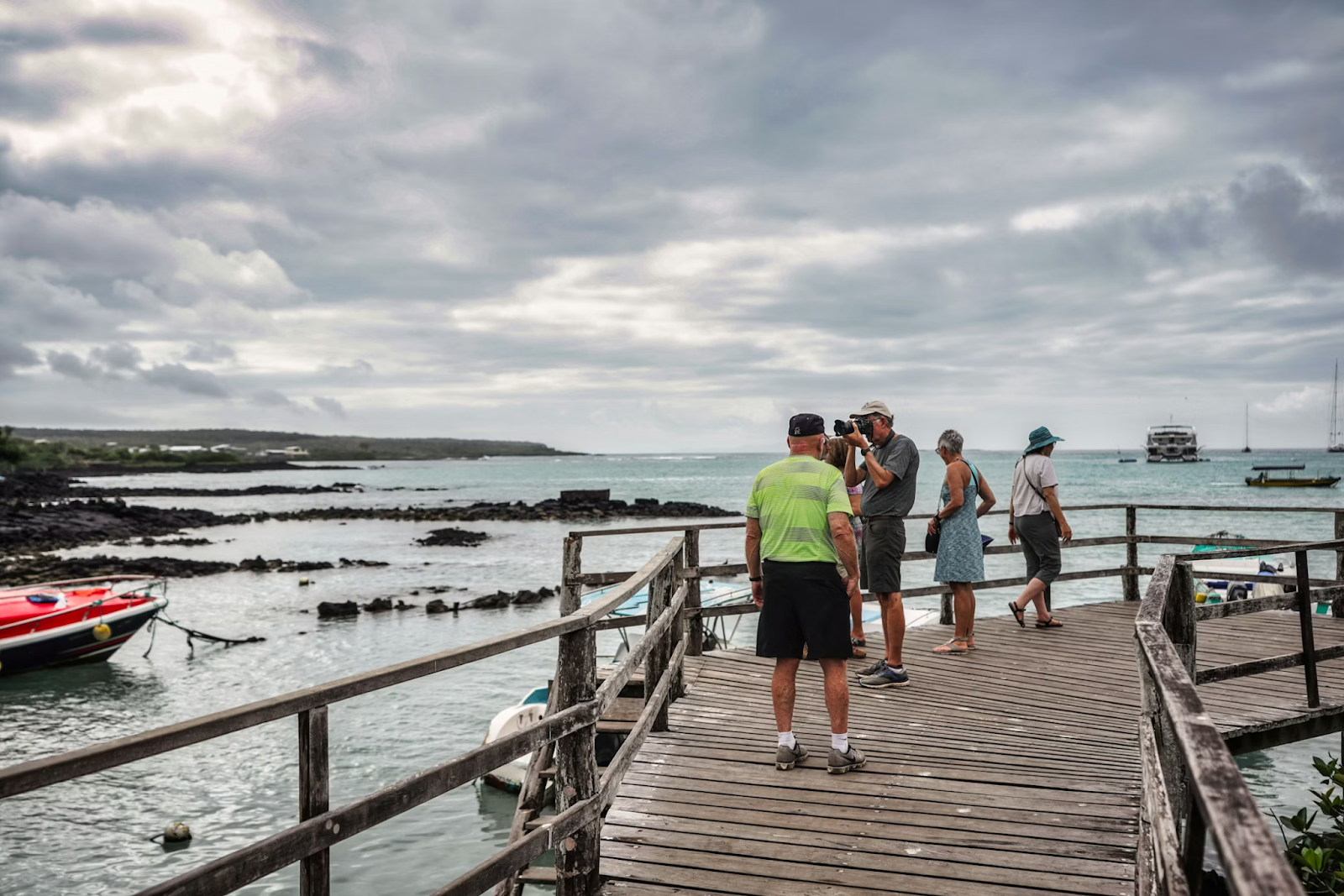
Boats docked in Santa Cruz, Ecuador. Andres Medina. Unsplash.
The Galapagos are marketed as a place outside the modern world, featuring blue water, strict park rules and animals that seem to have missed the memo about humans. UNESCO calls the islands a “living museum and showcase of evolution.”
That is the Galapagos most travelers recognize. But there is another Galapagos, quieter and more recent, shaped by the same geography that makes the islands famous. The archipelago sits deep in the eastern Pacific, far enough from the mainland to feel remote and close enough to ride along lengthy maritime routes that move north toward Central America and beyond. Trafficking networks do not need the Galapagos to be a city; they need it to be a waypoint.
In early 2026, Al Jazeera reported that the islands are increasingly being used as a refueling and staging zone for cocaine shipments moving through the Pacific, with authorities intercepting boats and searching for hidden storage points. The story lands hard because the Galapagos economy depends on tourism and regulated fishing, not on the shadow economy of organized crime. When trafficking pressure rises, the damage is not only criminal: It is social.
Part of the pull is simple distance. Long routes require fuel and logistics, and isolated stretches of ocean provide cover. A Pacific trafficking analysis by the U.N. Office on Drugs and Crime describes expanding transnational organized crime in the region and the importance of maritime routes for moving illicit drugs.
Another part is Ecuador’s wider security crisis, which is pushing criminal networks to innovate and spread. The International Crisis Group warns that Ecuador’s organized crime surge is tied to the country’s role in global cocaine flows and violent competition among criminal groups. That shift does not stay on the mainland: It radiates outward, including into strategic maritime zones.
The consequences in the Galapagos do not always look like those in Hollywood. They can look like corruption pressure on small businesses; fishermen being approached to sell information, fuel or services; authorities trying to police an enormous marine area with limited assets while also protecting one of the most sensitive ecosystems on Earth.
Officials are taking the threat seriously. In March 2025, the U.S. Embassy in Ecuador said Ambassador Art Brown visited the Galapagos and discussed security challenges, including illicit trafficking and illegal fishing, as part of coordination with local and national authorities. The U.S. Embassy has also emphasized the scale of maritime interdictions more broadly. The country’s Ministry of Defense said Ecuador seized 135 tons of drugs at sea in 2025, a record it framed as a major blow to trafficking networks.
The larger lesson is uncomfortable: Trafficking routes shift like water. When enforcement tightens in one corridor, networks test another. The Galapagos are now part of that map, and the challenge is no longer only protecting wildlife; it is protecting a community and a global treasure from being turned into infrastructure for a drug economy.
GET INVOLVED:
Support conservation and community protection efforts through the Galapagos Conservancy and the Charles Darwin Foundation. Follow organized crime and security analysis through the International Crisis Group Ecuador page and regional trafficking research through the UNODC

Carol Khorramchahi
Carol Khorramchahi is a student at Boston University, where she studies English and Psychology and minors in Journalism. She enjoys writing and reporting on stories that bring together culture, identity, and community, and has experience in both newsroom reporting and digital media. She is especially interested in thoughtful storytelling with a global lens.
The Small Thai Town With a Dark Wartime History
Just a few hours from Bangkok, Kanchanaburi, the infamous Thai bridge is home to one of the most brutal wartime projects ever carried out and cost 16,000 lives.
Read MoreRoute 66 Centennial in California
Cruise through some of California’s most iconic stops along Route 66.
Read MoreSailing Beneath the Northern Lights on Norway’s Arctic Coast
Sophia Michelen
A journey through Arctic Norway examines the Northern Lights from scientific, geographic, and cultural perspectives, including aurora research, Sami traditions, and the landscapes of the Norwegian coast.
Images by Sophia Michelen
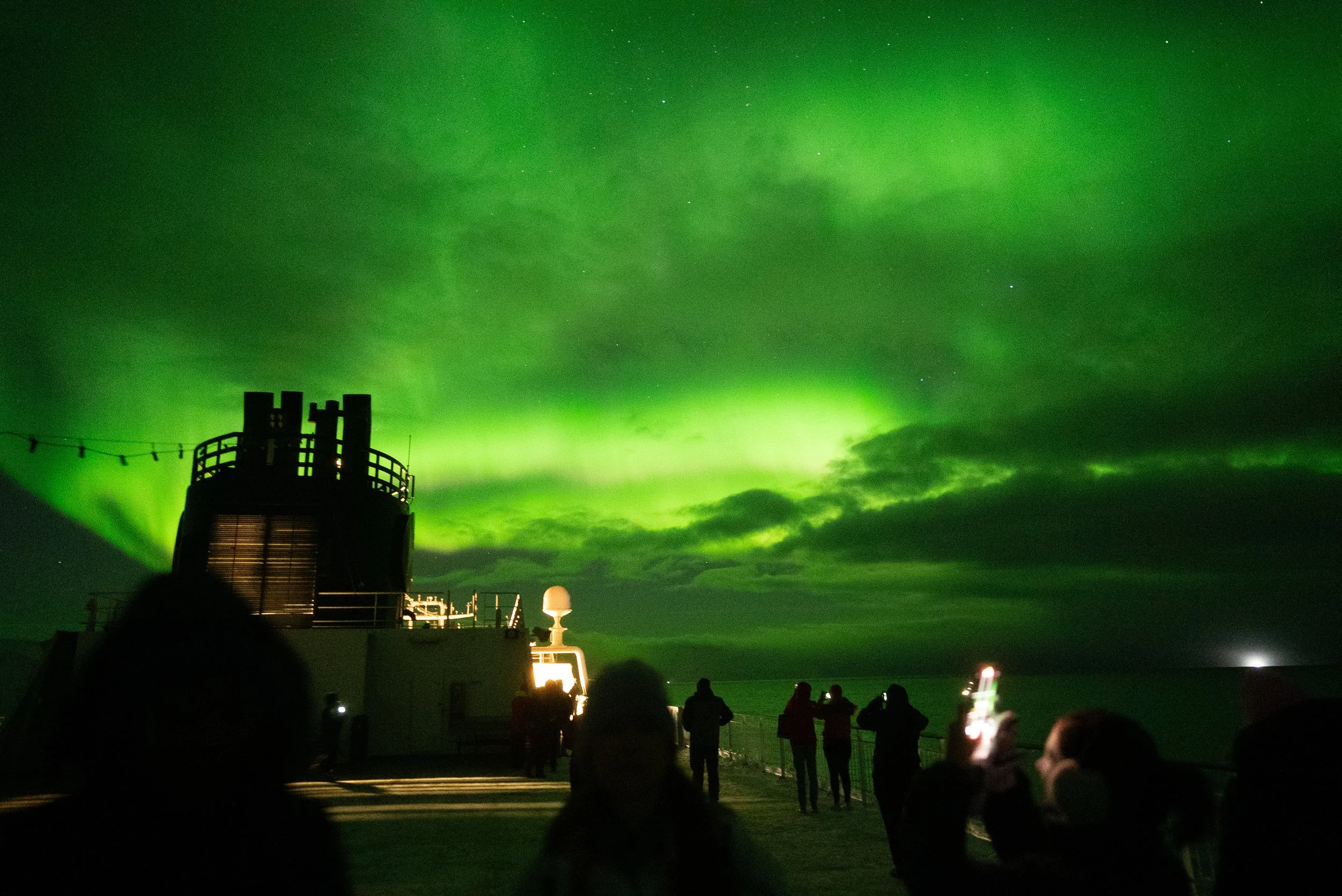
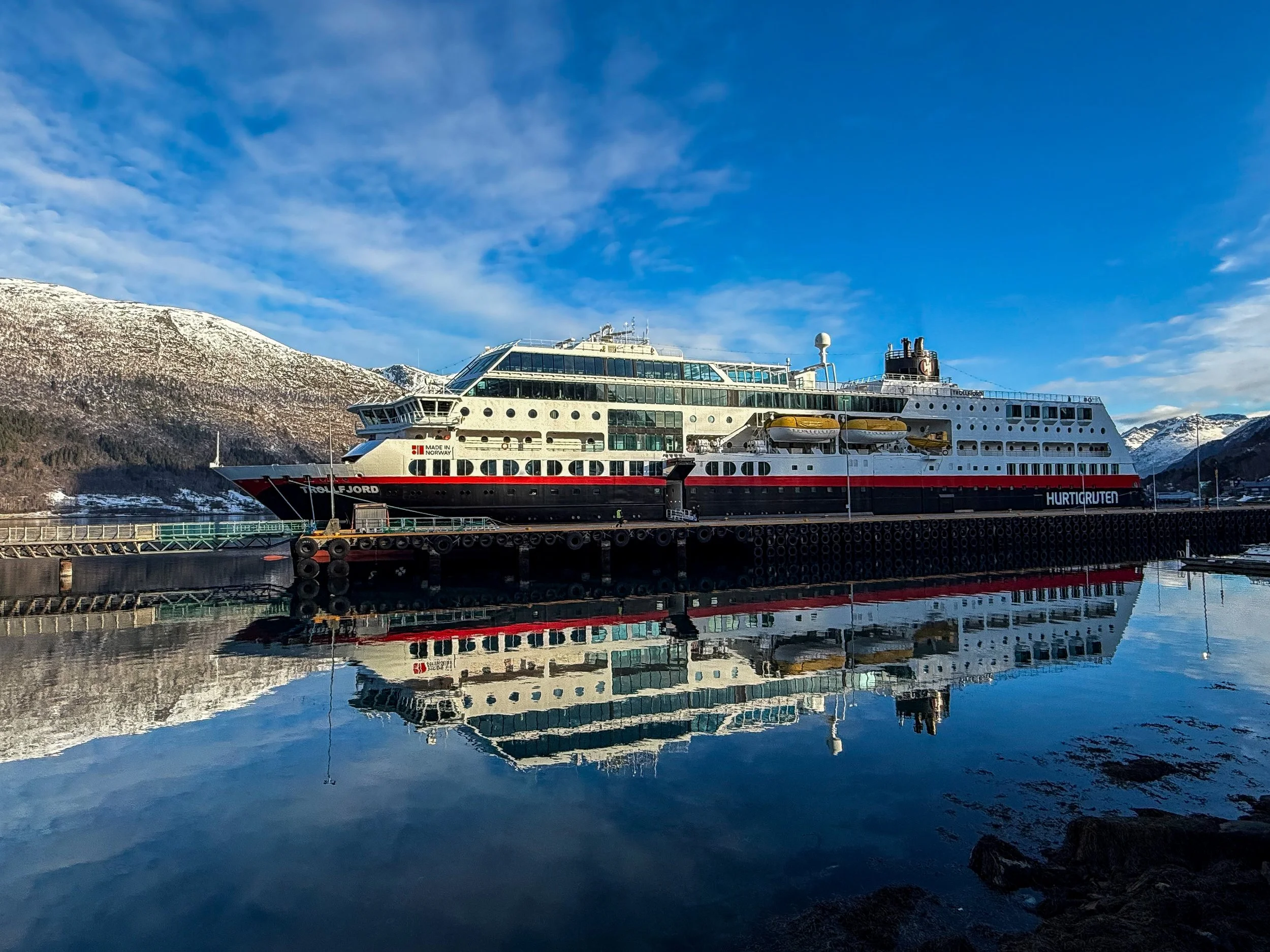
The deck lights are dimmed to red as the MS Trollfjord moves quietly through the Arctic night. Beyond the railings, the sea is black and nearly indistinguishable from the sky, and passengers stand in silence, watching. I am among them during the inaugural Hurtigruten Astronomy Voyage, sailing south from Troms along Norway’s northern coast aboard the North Cape Line. Over six winter nights, the ship travels through one of the world’s largest aurora hotspots: Troms, Finnmark, and Nordland, where long polar nights and clear Arctic skies create some of the best conditions on Earth for seeing the Northern Lights.
Above us, the first faint ribbon slowly appears. For centuries, the aurora has inspired mythology and speculation. Yet the phenomenon unfolding above the Norwegian coast begins far beyond the horizon, at the sun itself. “The aurora is the end of a chain of invisible processes,” explains astronomer Tom Kerss, Hurtigruten’s Chief Aurora Chaser, during a lecture earlier that afternoon. Charged particles carried by the solar wind collide with Earth’s magnetic field and are guided toward the poles. When those particles strike gases high in the atmosphere, they release energy in the form of light. From the deck of a ship moving through Arctic Norway, the science becomes something else entirely: a shifting curtain of green and pink rippling across the sky.
The Geography of the Lights
Northern Norway sits beneath the auroral oval, a ring-shaped zone around the magnetic poles where the lights appear most frequently. Long winter nights, minimal light pollution and open Arctic skies make the region one of the world’s most reliable places to witness the phenomenon.
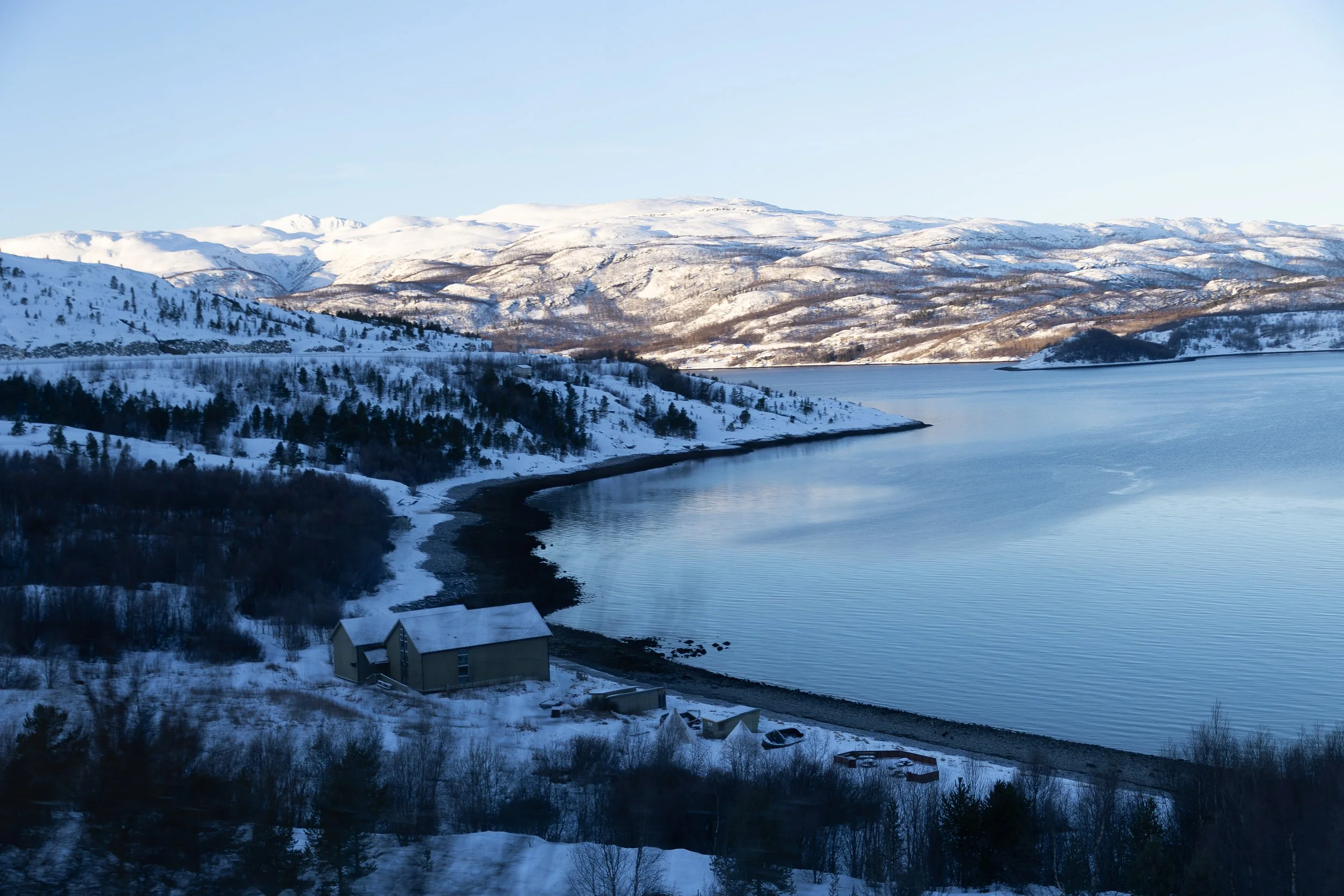
Traveling by sea also adds the advantage of mobility. Rather than waiting in a single location for the sky to clear, ships can move along hundreds of miles of coastline, navigating between weather systems and cloud cover. Along this stretch of Norway, the landscape unfolds gradually, with snow-covered mountains rising directly from the sea, small harbors tucked between fjords and villages that appear briefly along the shoreline before disappearing again behind headlands.
For Kerss, who has spent years studying and photographing auroras across the Arctic, Norway’s coast remains uniquely suited to observing the phenomenon. The lights themselves vary constantly, sometimes appearing as faint arcs barely visible against the stars and other times erupting into sweeping curtains of green stretching from horizon to horizon. On rare nights, red and violet hues ripple across the sky as oxygen and nitrogen react at different altitudes in Earth’s upper atmosphere. Even with the science explained, the moment when the sky begins to move feels almost surreal.
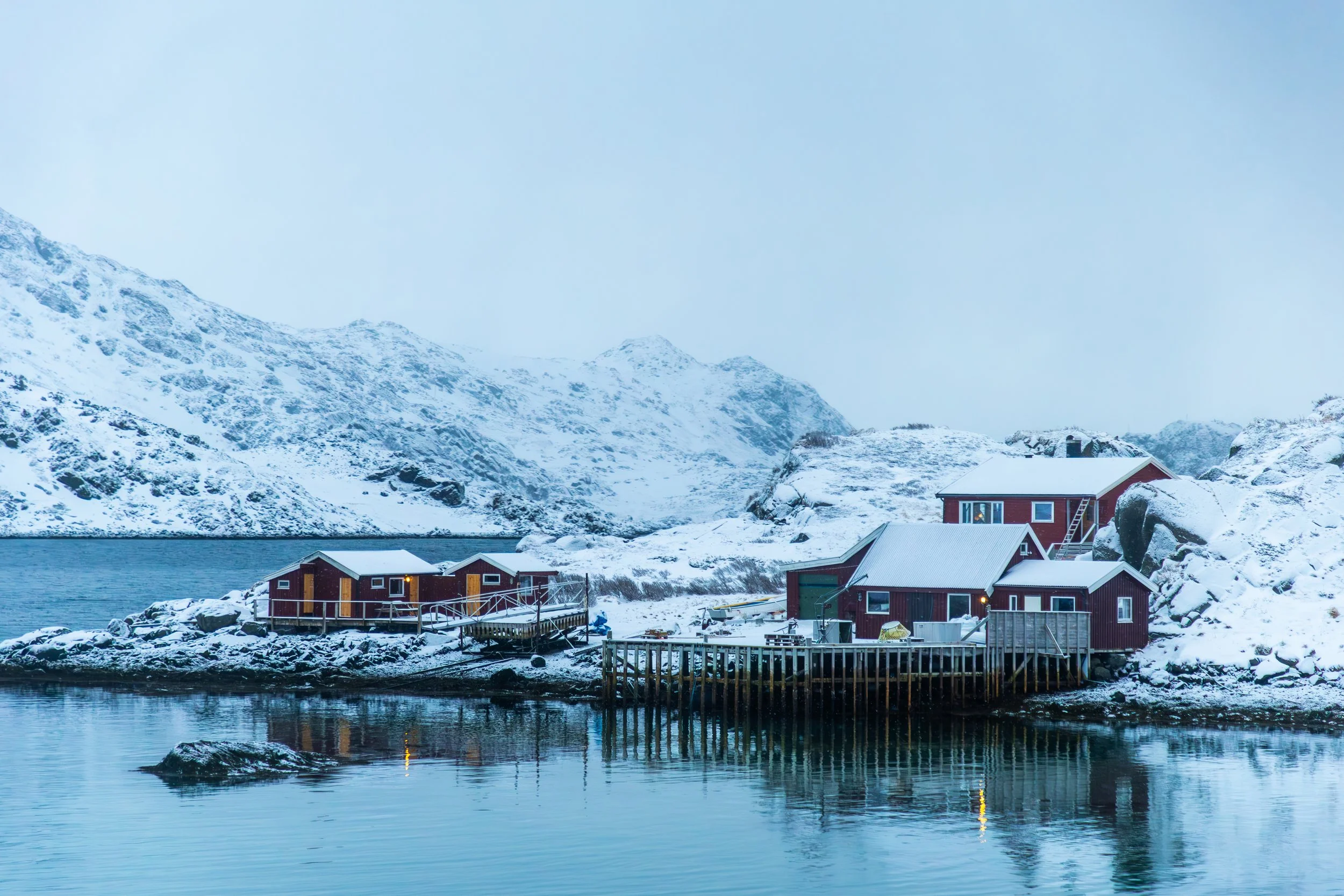
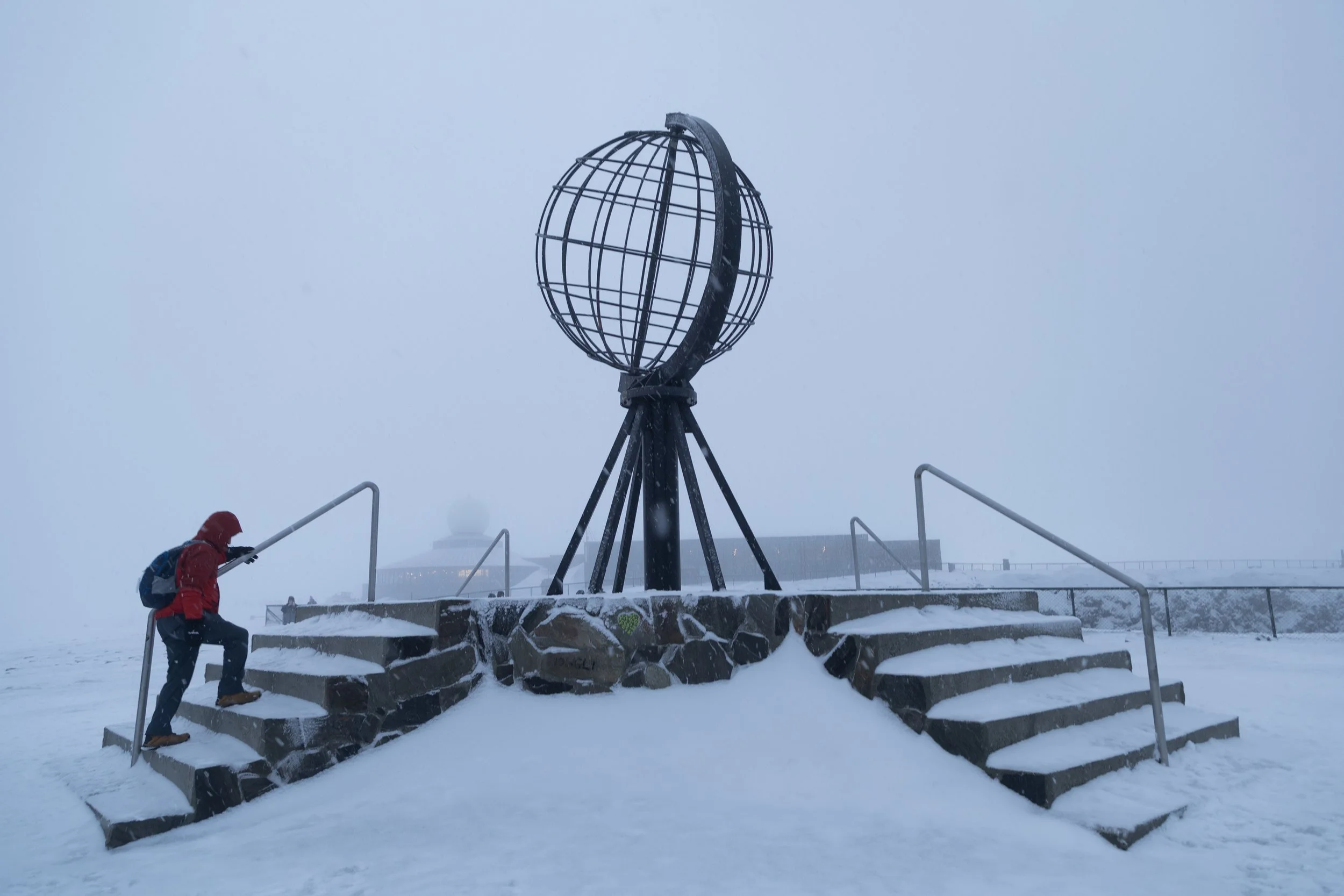
Life Along the Arctic Coast
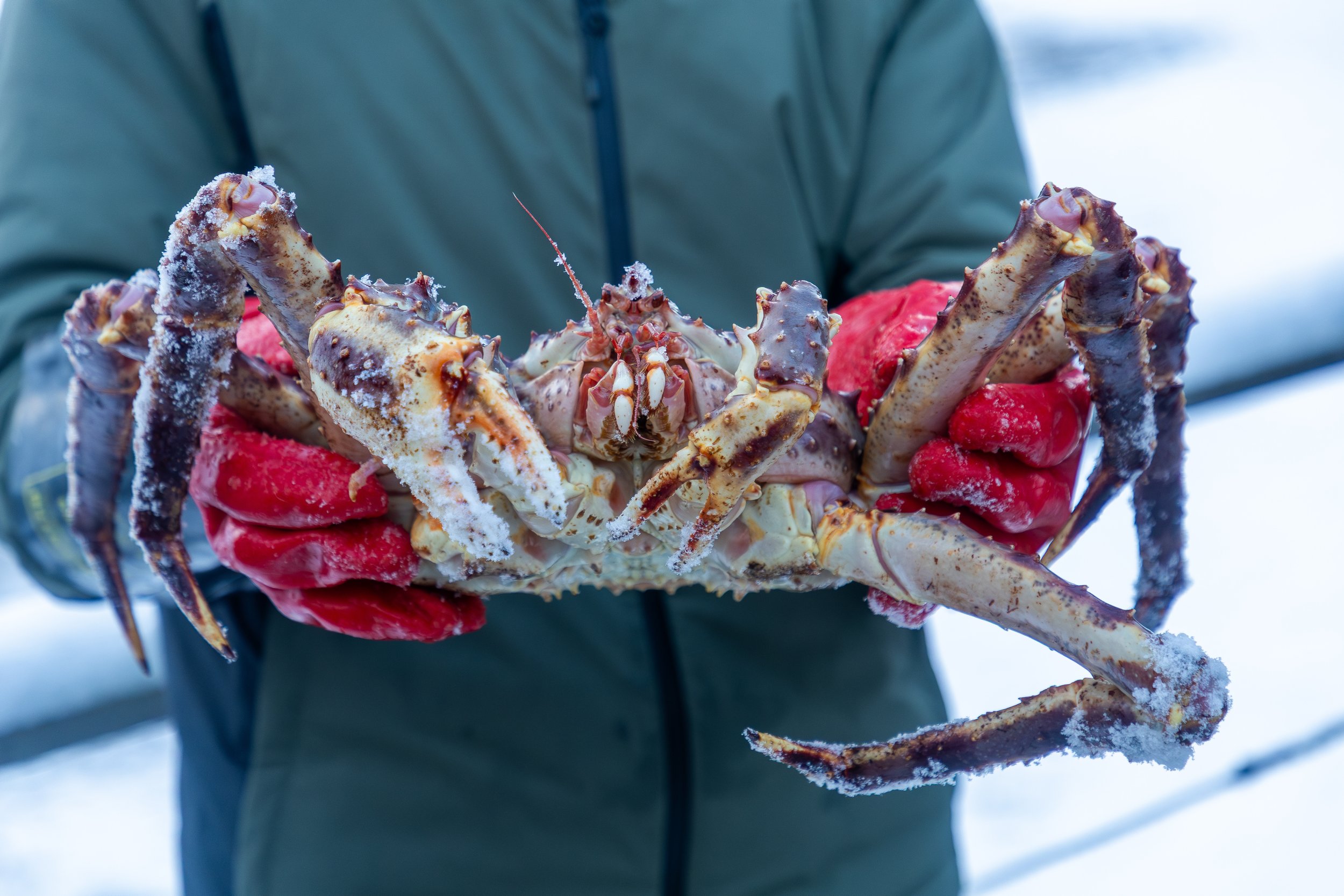
During the day, the voyage moves between small Arctic communities shaped by the sea. In Honningsvag, colorful wooden buildings cluster around a harbor where fishing boats remain central to the local economy. Offshore, the Barents Sea provides king crab, one of the region’s most recognizable delicacies. Originally introduced to these waters decades ago, the enormous crustaceans have become a defining part of northern Norway’s fishing culture. Visitors heading out onto the surrounding waters often end the excursion with a simple meal of fresh crab served with little more than bread and butter.
Further south, the landscape shifts again. Jagged mountain ranges rise sharply from the sea, their peaks dusted with snow even in early spring. The coastline twists through narrow fjords and open stretches of water, where the horizon seems to extend endlessly northward. Moving through these waters offers a sense of scale that is difficult to grasp from land alone.
Images by Sophia Michelen
Alta and the Study of the Aurora
One of the most significant stops along the route is Alta, often referred to as the city of the Northern Lights. For more than a century, scientists have traveled here to study the aurora.
In the late 1800s, Norwegian physicist Kristian Birkeland conducted pioneering research that helped explain the connection between solar activity and the lights visible in Earth’s polar regions. His work laid the foundation for modern aurora science and helped transform what had long been considered a mysterious phenomenon into a subject of scientific investigation.
Today, Alta remains one of the best places in the world to see the aurora. Its inland location, wide skies and relatively dry climate create ideal viewing conditions during the long winter months. Yet even here, scientific explanation has never entirely replaced the sense of wonder that accompanies the lights.
Indigenous Perspectives
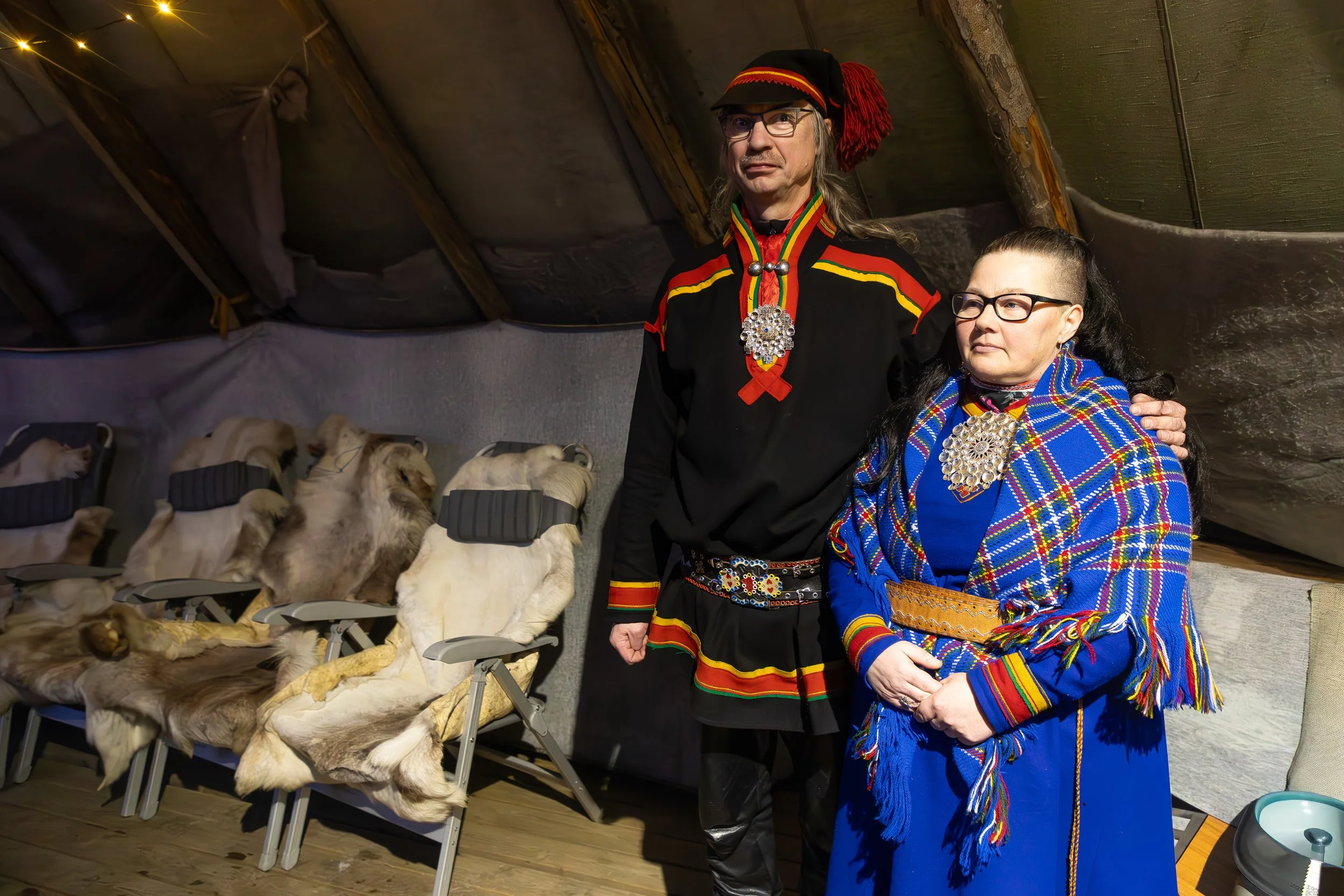
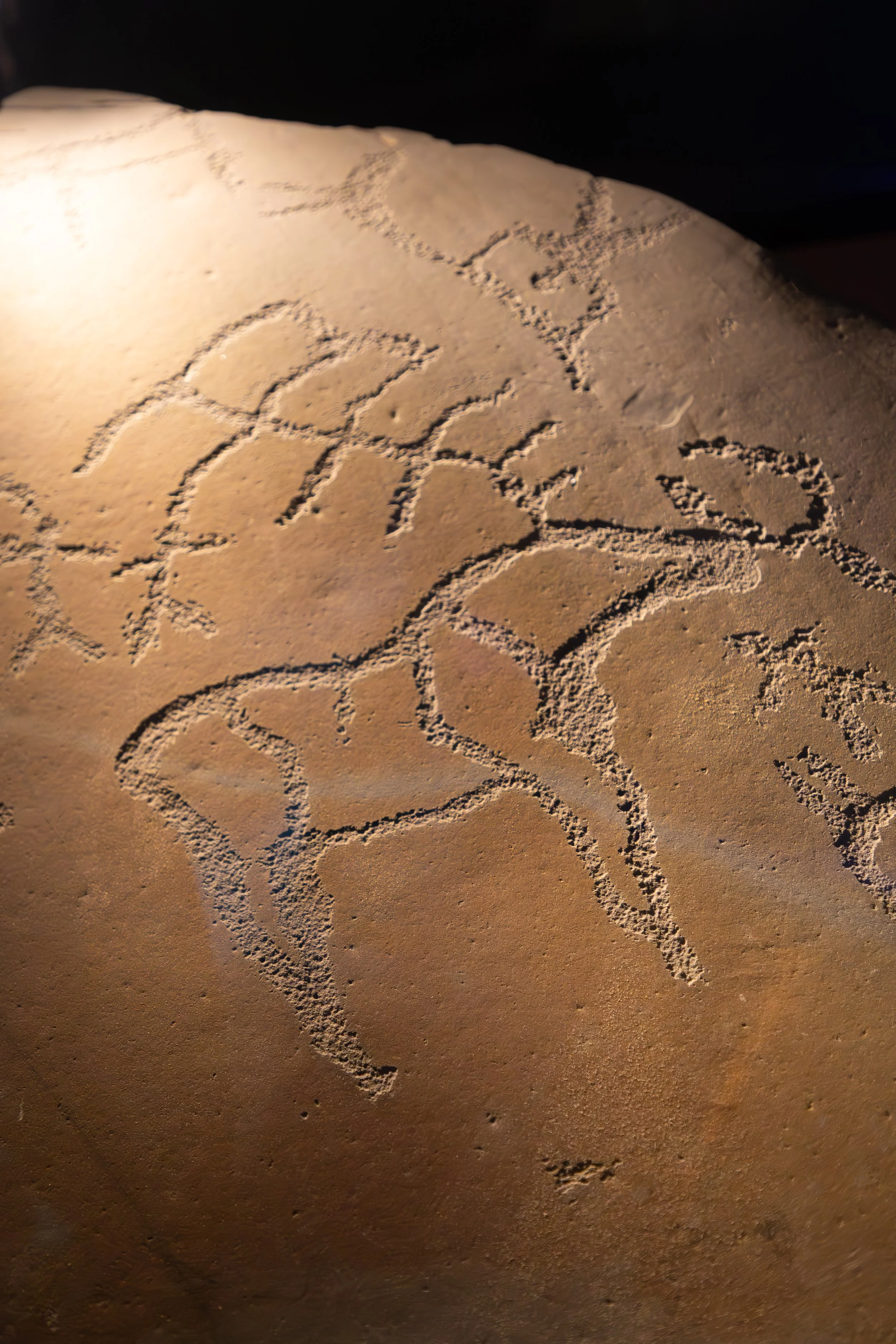
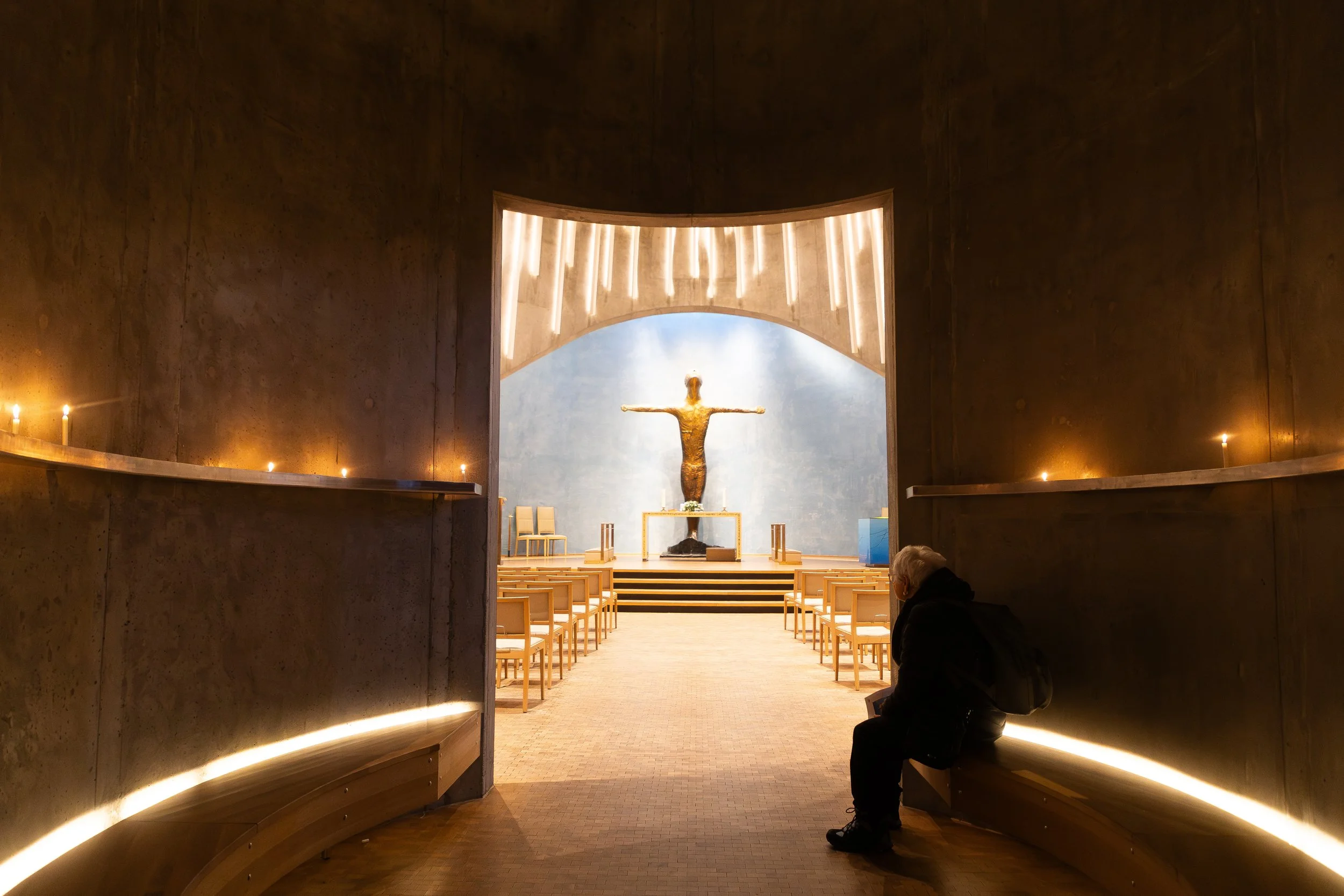
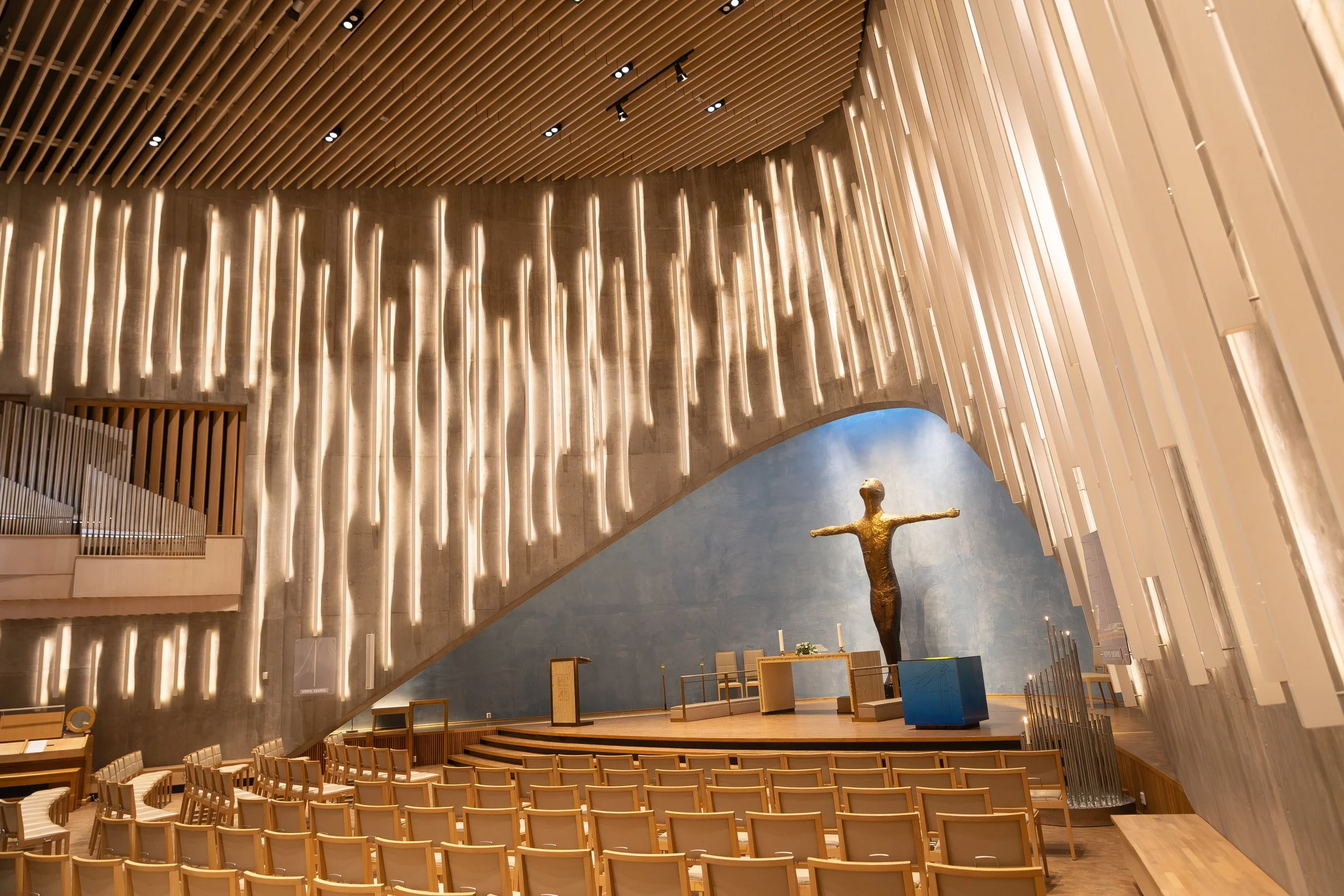
Long before scientists attempted to measure or photograph the aurora, the lights already held meaning for the Indigenous Sami people of northern Scandinavia. Their relationship with the Arctic landscape runs deep, shaped by centuries of reindeer herding, fishing and seasonal migration across tundra and forest. Their traditions reflect a worldview in which humans exist as part of a broader ecological system rather than separate from it.
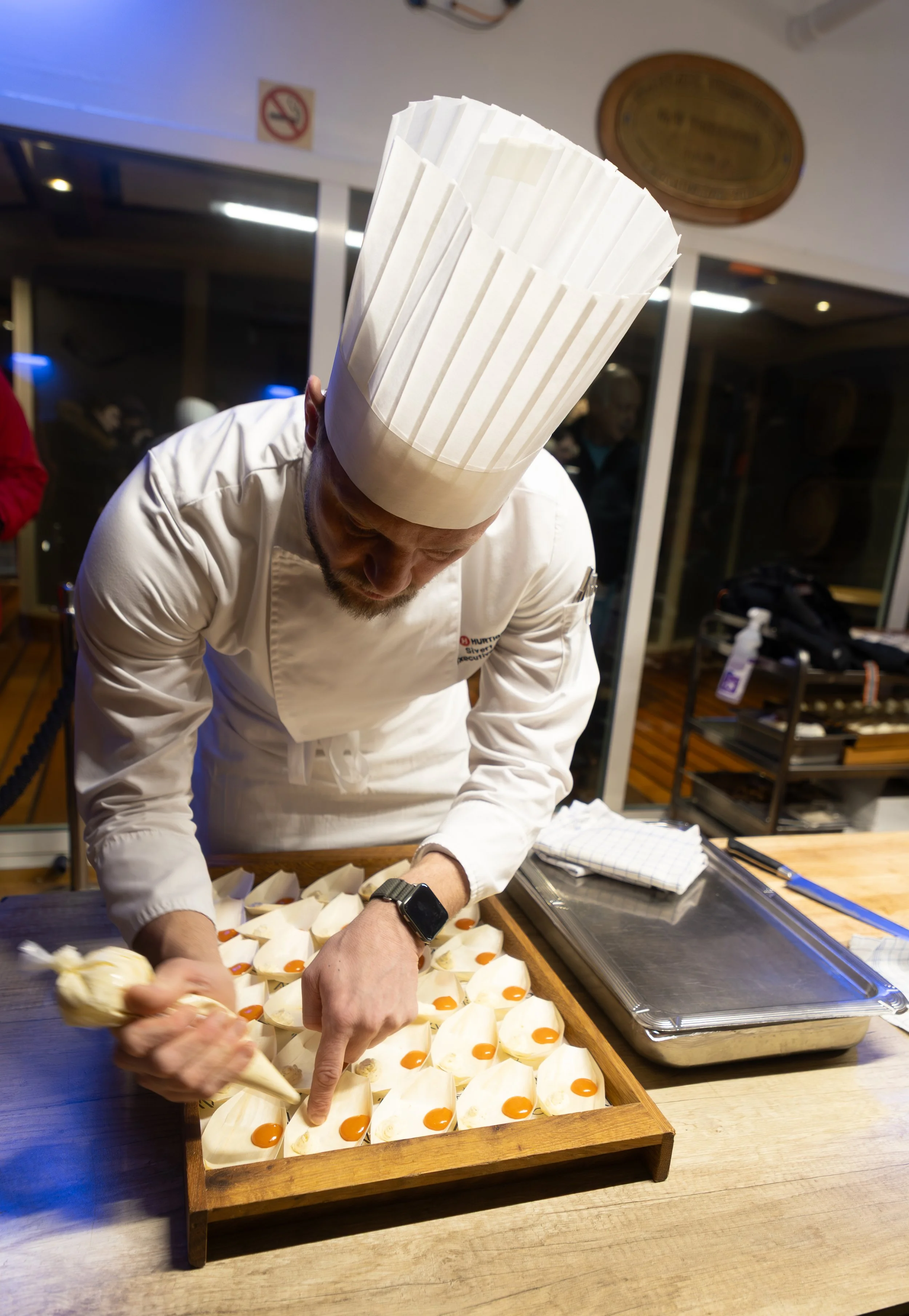
That connection is increasingly visible in the region’s culinary traditions. Sami food culture emphasizes careful use of local resources, from reindeer meat to wild berries and Arctic fish, and reflects a deep respect for the natural environment. On Hurtigruten voyages, Sami culinary ambassador Maret Ravdna Buljo introduces travelers to these traditions and the cultural values behind them, offering a glimpse into a way of life rooted in balance with the surrounding landscape. For many visitors, the experience provides a deeper understanding of how people have lived within this demanding environment for generations.

Images by Sophia Michelen
When the Sky Comes Alive
Late one evening, the ship slows as passengers gather again on the outer decks. The sky is clear, the stars unusually sharp in the cold Arctic air. At first, nothing happens. Then a pale band appears above the horizon. The light brightens gradually, stretching upward before folding into waves of luminous green. Within minutes, the entire sky seems to move. Curtains of color ripple and drift overhead, sometimes slow and graceful, other times flickering rapidly as if responding to an unseen current. The dark water below reflects faint streaks of color, doubling the spectacle.
Even with a scientific explanation in mind, the experience resists easy description. The aurora remains both predictable and mysterious, governed by solar physics yet endlessly varied in appearance. Standing on deck as the lights sweep overhead, it becomes clear to me why people have traveled north for centuries in search of this moment. Along Norway’s Arctic coast, the Northern Lights are more than a destination. They are a reminder that some of the most powerful natural phenomena unfold quietly, high above the horizon, waiting for those willing to look up.

Sophia Michelen
Sophia Michelen is a New York City–based photojournalist, travel writer and documentary producer whose work explores culture, environment and place through visual storytelling. She has reported from more than half of the world’s countries, with work appearing in publications including National Geographic Traveller India, Teen Vogue and Ms. Magazine. She is also a co-host of the PBS travel series America: The Land We Live In.
Berlin’s Punk Spirit: Interview With SO36
Take a look inside Berlin’s historic punk club and see what it takes to survive.
Read MoreA Day on the Amazon River
Kaitlin Murray
Explore the Indigenous villages, wildlife, and waterways along the Amazon River in Brazil as they adapt to tourism.
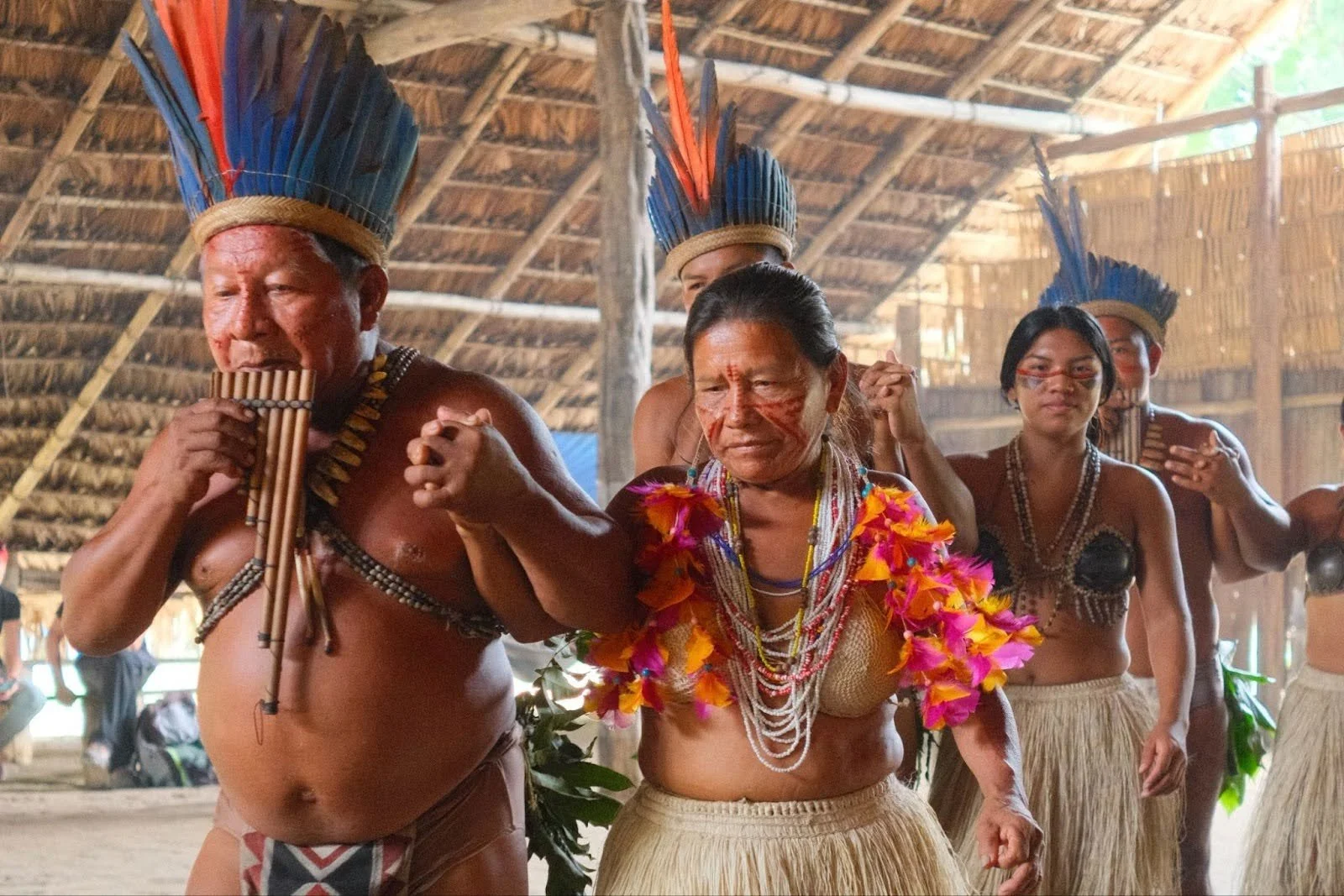
The Indigenous Desana people welcome visitors with a traditional dance. Kaitlin Murray.
Bouncing in a speed boat along the Rio Negro, the largest tributary of the Amazon River, I see the opaque dark waters extend in every direction. Leaving the busy port of Manaus, the capital city of the northwestern state of Amazonas, I look back at the skyline rising above the forest. Skyscrapers, freeways and shopping malls are the last things I expect to see in the middle of the Amazon rainforest. Before arriving in Brazil, most of what I had heard about the Amazon came from media coverage of illegal logging, deforestation or wildlife protection, not from stories about a bustling metropolis of more than two million people. Yet Manaus has existed for centuries, having been founded in the 17th century as a Portuguese fort and expanding rapidly during the rubber boom of the 19th century.
Despite its size, Manaus remains accessible only by air or river, with few roads connecting it, as the rainforest extends for long distances in every direction. Urban expansion in one of the most biodiverse regions on Earth carries far higher stakes, raising urgent concerns about deforestation, farmland expansion and river pollution from informal housing. While it may seem as though the city coexists with nature because of its location in the forest, the reality is quite the opposite. As our boat continues deeper into the trees along the river, I find myself contemplating this paradox: How can the traditional ways of life in the Amazon and urban expansion coexist, and what role is tourism playing in all of it?
As part of a river day tour, we participate in numerous activities that offer tourists a glimpse of the rainforest without trekking deep into the wilderness or traveling long distances. Our first stop is a visit with one of the river's most famous inhabitants, the pink river dolphin, commonly known as the boto. Listed as endangered, these dolphins are currently facing threats from river pollution and habitat destruction. I notice this reality as soon as we leave the main port, witnessing the extent of container ships, factories and speedboats on the water.
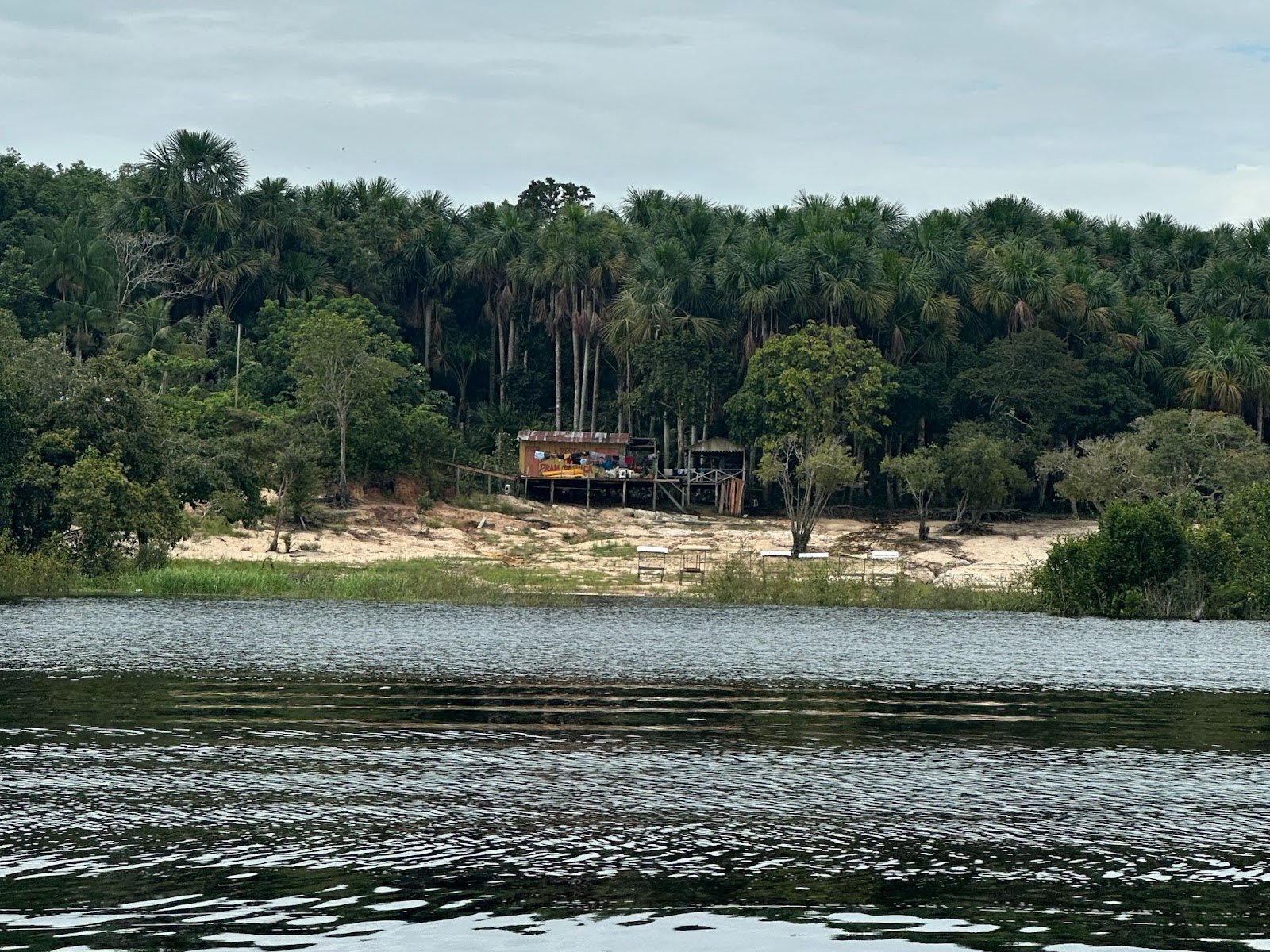
Stilt houses along the Rio Negro. Kaitlin Murray.
In the dark waters of the Rio Negro, their pink bodies appear almost orange-tinted as they rise to the surface to take fish offered by local fishermen. While these dolphins are considered wild and free to come and go from the shore, they have grown accustomed to being fed by the fishermen, who encourage visitors to jump into the water and swim alongside them. Floating in the dark waters, I feel a sense of awe, finding myself in the same river as numerous animals, including snakes, piranhas, pirarucus, manatees and otters. Looking into their eyes, I remember the Indigenous stories that our guide had recounted earlier: The dolphin is believed to transform into a man at night, walking into villages and seducing young women before returning to the river by dawn. It is also said that looking into their eyes will bring you nightmares for the rest of your life. These stories remain prevalent even amid growth and urbanization, as Indigenous communities continue to share them with younger generations and foreigners.
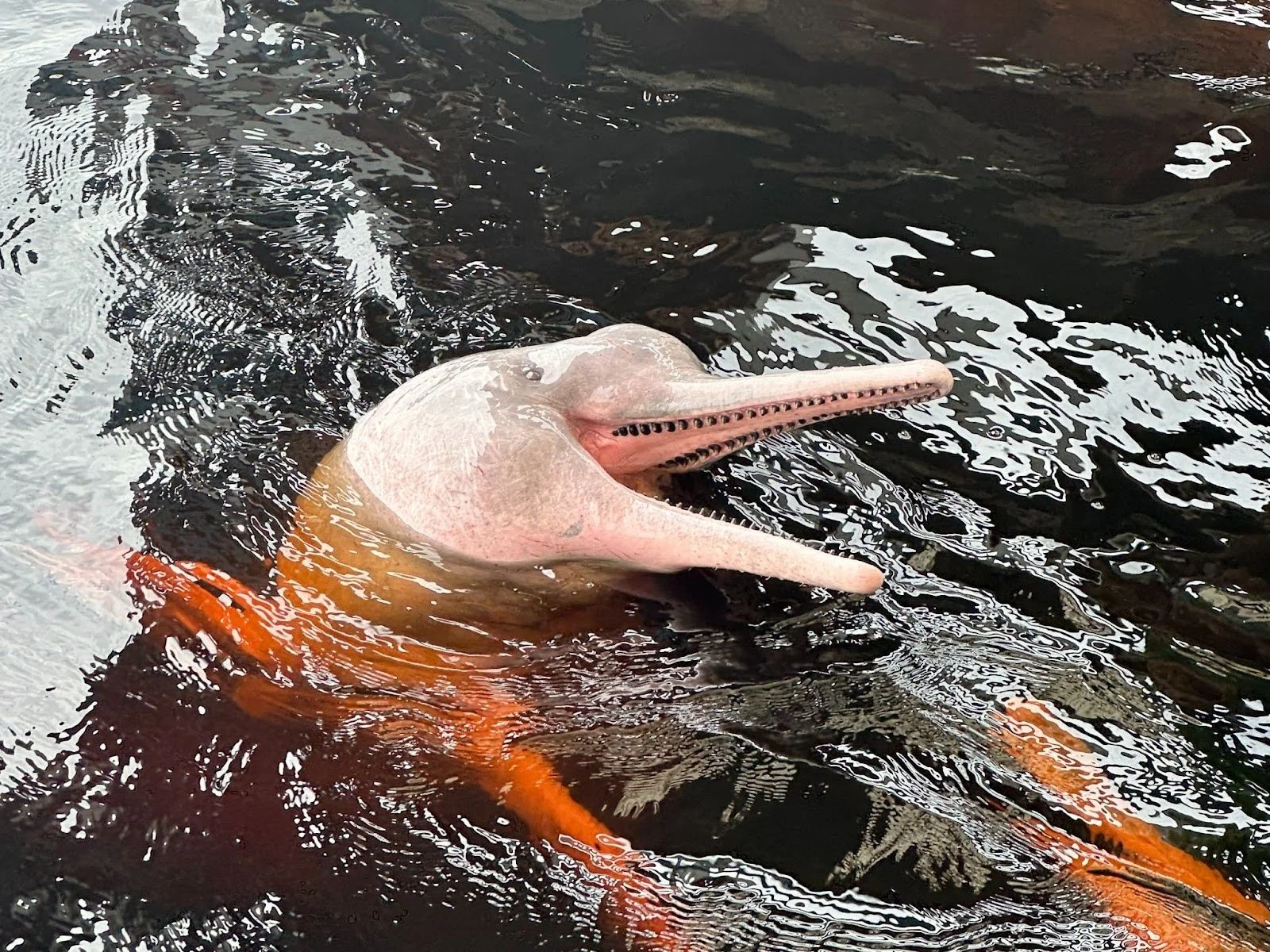
Pink dolphins in the Rio Negro. Kaitlin Murray.
Further along the river, the boat docks at an Indigenous village that now incorporates tourism into its economic model. Visitors are welcomed with performances and cultural demonstrations, and, in return, they are asked to purchase a handicraft or make a donation. As soon as we enter, the welcome performance takes place, held in a large wooden structure marking the communal space and the village boundary. Beneath it, men and women perform ritual dances in circles, accompanied by handmade musical instruments. Following the performance, the chief, in an elaborate feather headdress customary of the Desana people, shares stories about their cosmology and social structure. Afterward, we are taken to the kitchen, where we learn about local fruits and forest foods, such as Brazil nuts, tapioca, cassava, avocados and maniuara ants.
Speaking with the tribe's chief through our guide's translation, I learn that the community came from northern Brazil, nearly 600 miles away, and settled here for the city's economic prospects. Today, they benefit from tourism-related opportunities while maintaining their way of life, living in a traditional village hidden by trees to keep visitors out, yet still enjoying modern amenities, such as Wi-Fi, mobile phones and payment terminals. However, some families in the tribe have already moved elsewhere, unhappy with how tourism is exploiting their culture for profit.
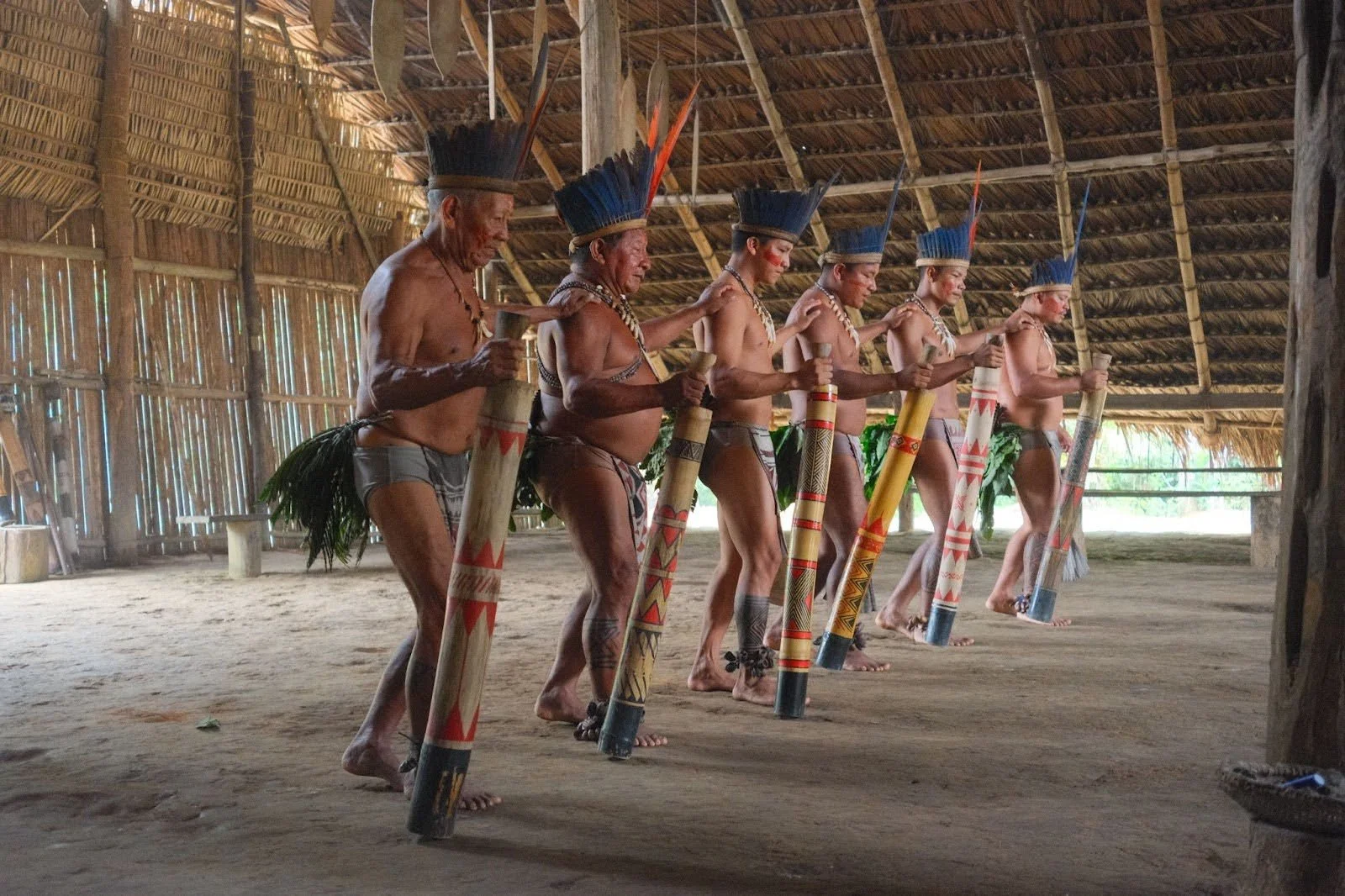
The Desana tribe welcomes visitors with a traditional dance. Kaitlin Murray.
Witnessing the adaptation of Indigenous communities to the world of cultural tourism is a double-edged sword. As an anthropology student, I have learned about the current dilemmas facing Indigenous communities around the globe, who struggle against being exoticized or profited from by international tourism companies. On the other hand, economic opportunities such as this can benefit communities in the long run, provided they generate sufficient revenue relative to the profits of tourism companies.
A short distance away, another floating barge on the water is the breeding ground of the pirarucu fish, which fishermen are raising to make money through river aquaculture. These are among the world’s largest freshwater fish, weighing up to 440 pounds and growing up to 10 feet. From the edge of the platform, their massive bodies glisten in the sun, the light reflecting off their red and green scales. The fish surface when fishing poles are dropped, as the local fishermen make a living off tourists playing a game of tug-of-war with them. It is fascinating to see how the fishermen's ingenuity has enabled them to earn extra income, living and working along the river in small villages with limited access to other opportunities.
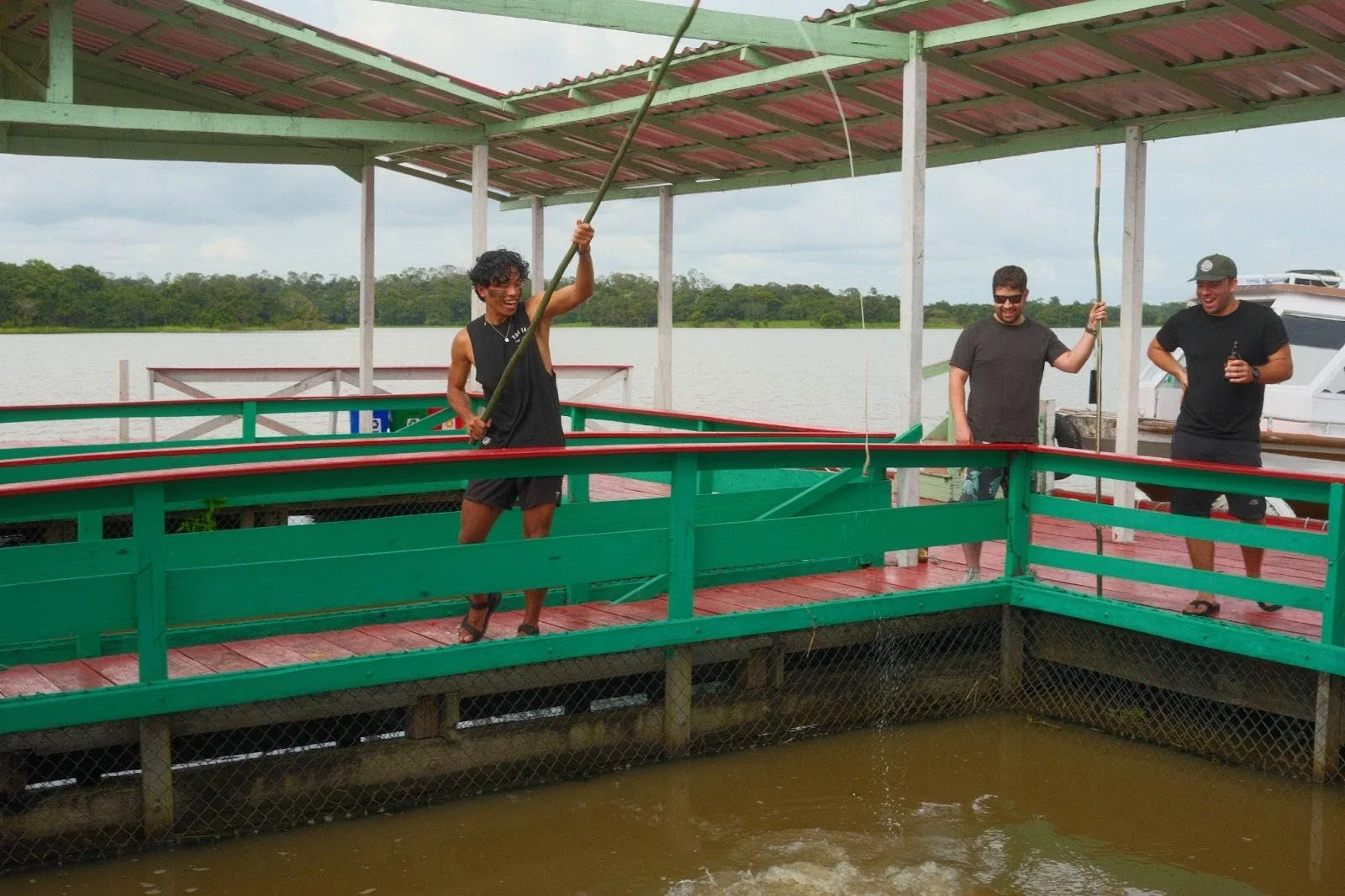
Fishing for pirarucu fish on the Rio Negro. Kaitlin Murray.
The final stop is one of the region’s most striking natural phenomena: the Meeting of the Waters. This is where the Rio Negro and the Solimoes River converge to begin the Amazon River. As the boat approaches, the contrast of the two rivers becomes immediately clear. The Rio Negro’s dark, tea-colored water hits the Solimoes’ light brown, milky water, creating what looks like milk pouring over black coffee. From above, the boundary of the two rivers is almost clear, as they don’t immediately mix due to differences in temperature, density and current.
Throughout my time in Manaus, I witness the ingenuity and changes that local people are creating in response to tourism and expansion, as they seek to balance the city with the natural world. Fishermen are supplementing their income by capitalizing on visitors’ encounters with the fish they raise. Indigenous communities are incorporating tourism without fully abandoning their way of life. Visitors can see pink dolphins while still allowing them to be wild.
Whether these shifts will ultimately protect the natural world and improve people’s livelihoods at no expense to another remains uncertain. As of now, it all appears to be balancing on a very fine line, with the potential to go either way. How will development and tourism threaten the rainforest and river ecosystems? Can the two co-exist together? At a time when an expanding metropolis sits in the heart of the most biodiverse place on Earth, the future of the city, the surrounding forest and the traditional ways of life may depend on whether urban development, tourism and Indigenous cultures can work together for the common good.
GETTING THERE:
Located deep within the Amazon rainforest in the northwest of Brazil, Manaus feels entirely cut off from the rest of the country. There are few roads leading out of the city, and distances between towns are vast. There are no trains or overland transport for visitors, as most local people use the river to get around. For travelers, the easiest way to reach Manaus is by flying into Eduardo Gomes International Airport, which connects the city to major hubs, such as Rio de Janeiro and Sao Paolo, as well as destinations across South and North America.
For those seeking a more local, budget-friendly adventure, river travel is an alternative. Ferry boats connect Manaus to other villages along the Amazon River, but the journey can take days. While it is an incredible way to experience the river, it is not recommended for first-time visitors or travelers seeking a comfort-oriented experience.
I journeyed with I’m Here Travels, a group tour company based in the Philippines that creates immersive, community-driven global experiences. They focus on crafting curated itineraries and authentic local experiences in more than 10 countries. In partnership with Compass Brazil, they designed a unique itinerary for us in Manaus to experience the best of the Amazon River and rainforest. Compass Brazil is a leading tour operator active across Brazil, helping travelers explore the country and make a positive impact on their destinations. They prioritize sustainable travel, ensuring that every experience is rooted in ethical principles and adheres to responsible travel guidelines.
Kaitlin Murray
Kaitlin Siena Murray is a travel journalist and global storyteller documenting cultures, historical places, and the people and social impact movements helping the world. Raised worldschooling across more than 129 countries with degrees in anthropology and history, her writing is driven by a commitment to global citizenship, capturing the diversity and beauty of the world through the lens of culture, history, and social change.
Extreme Adventure for Everybody: How Moab Is Redefining the Outdoors for Disabled Travelers
Carson Jelinek
By adapting rope swings, rock climbs, 4x4 tours and e-bike trails, Moab demonstrates that extreme adventure can be inclusive of disabled travelers, young children and all visitors.
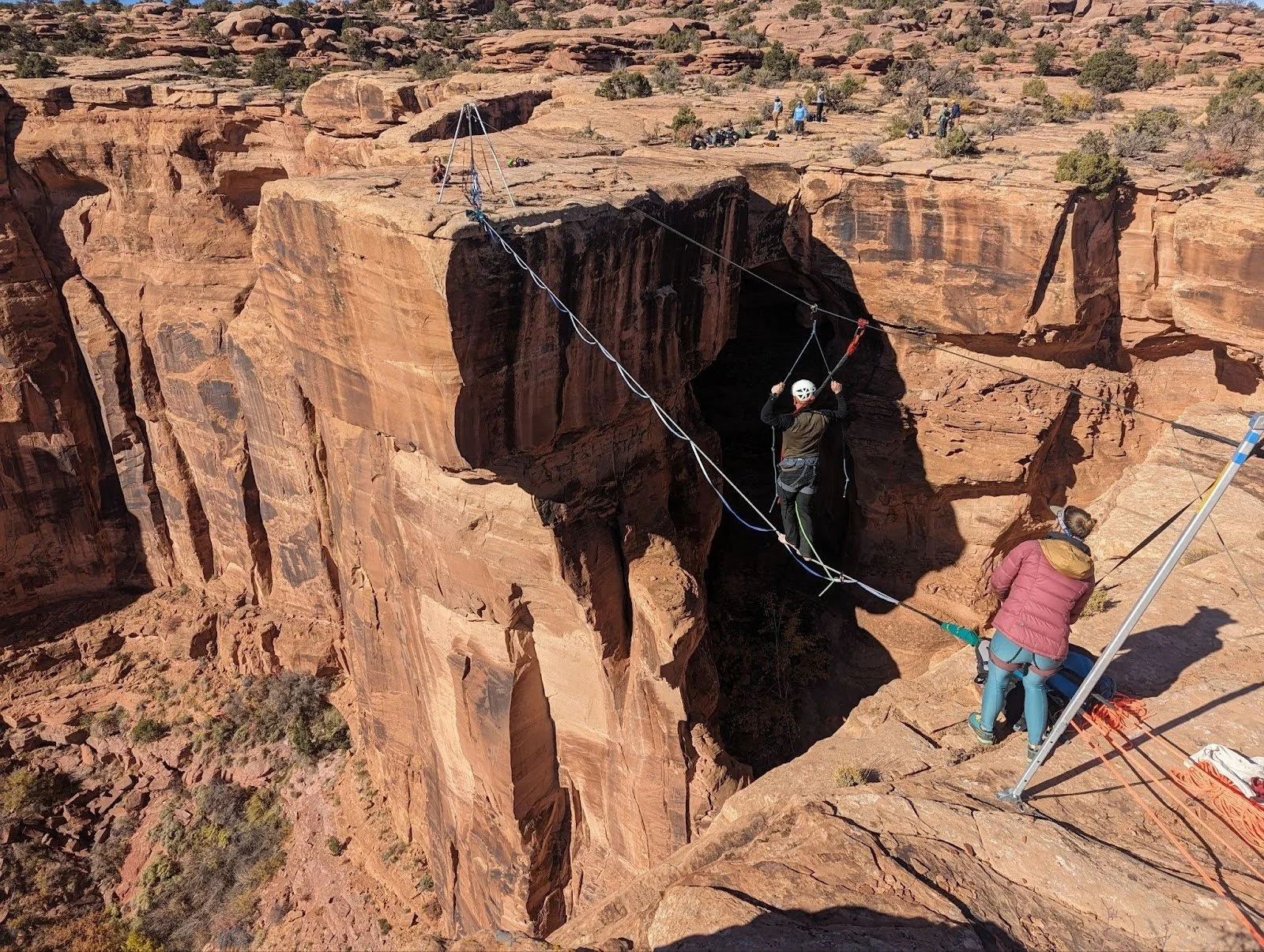
Elevate Outdoors Tour photo. Courtesy of Faith Dickey.
In the United States, millions of individuals with disabilities enjoy traveling, with over 25 million taking trips in recent years and contributing more than $50 billion annually to the travel economy. However, participation across abilities remains uneven. Research indicates that seven out of 10 individuals with disabilities reduce their travel due to accessibility challenges, and millions rarely leave home. Persistent barriers in transportation, lodging and infrastructure result in a majority of families with disabled members avoiding certain trips entirely. These obstacles are further intensified in adventure travel, where rugged landscapes and limited infrastructure frequently exclude those lacking conventional mobility.
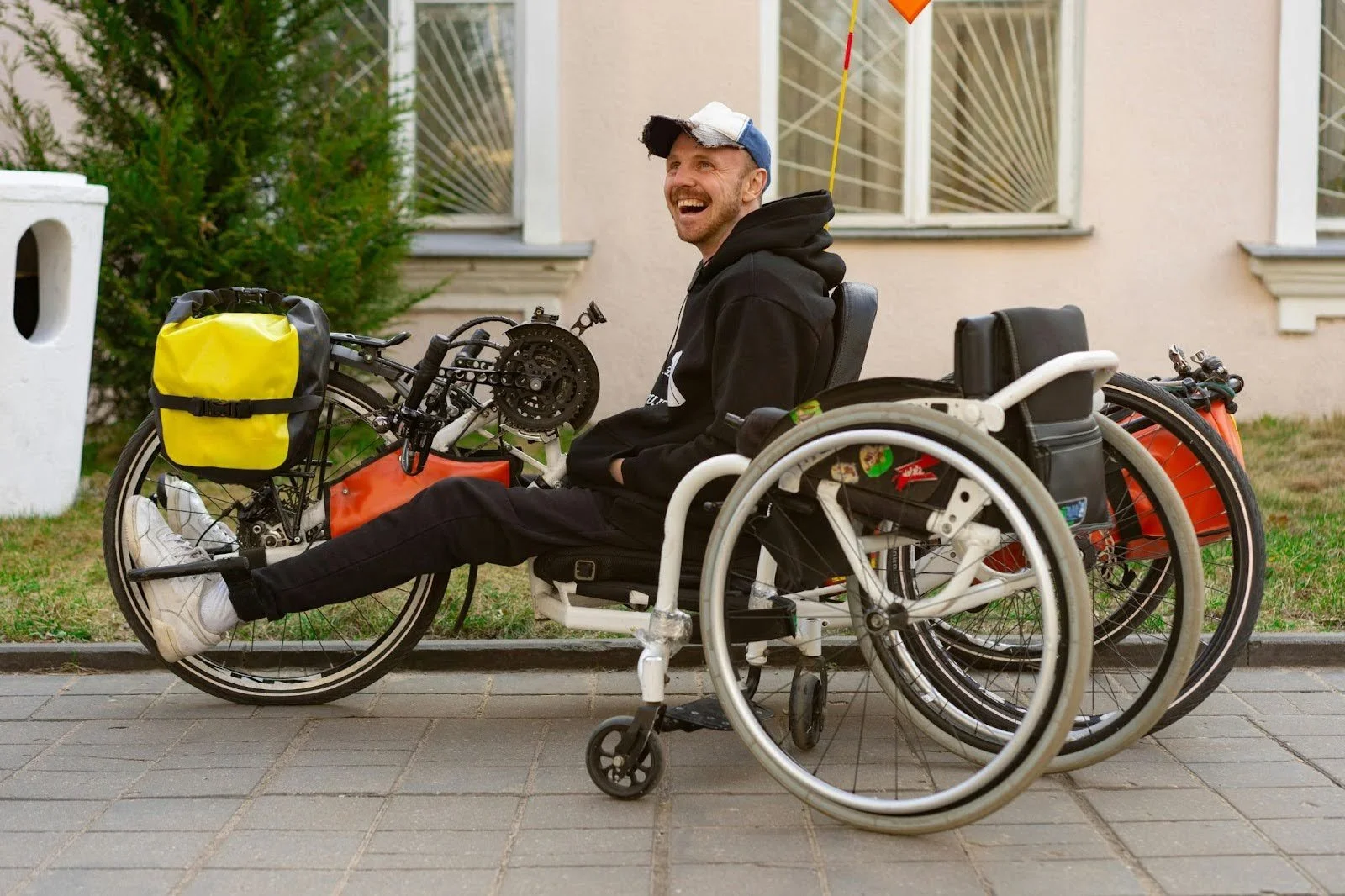
Man riding electric wheelchair. Mikhail Nilov. Pexels.
Moab, Utah, is one city advancing accessibility through policy initiatives. Starting March 1, the region will officially permit class 1 e-bikes on more than 200 miles of singletrack, including well-known routes such as Amasa Back and Klondike Bluffs. This decision positions Moab among the first major U.S. destinations to allow pedal-assist riders on its trails. Following an environmental assessment by the Bureau of Land Management, this policy represents a significant development in the cycling community. It not only serves experienced riders but also increases access to technical terrain for older visitors, individuals recovering from injuries and some disabled riders who depend on pedal assist to reach trails that would otherwise be inaccessible.
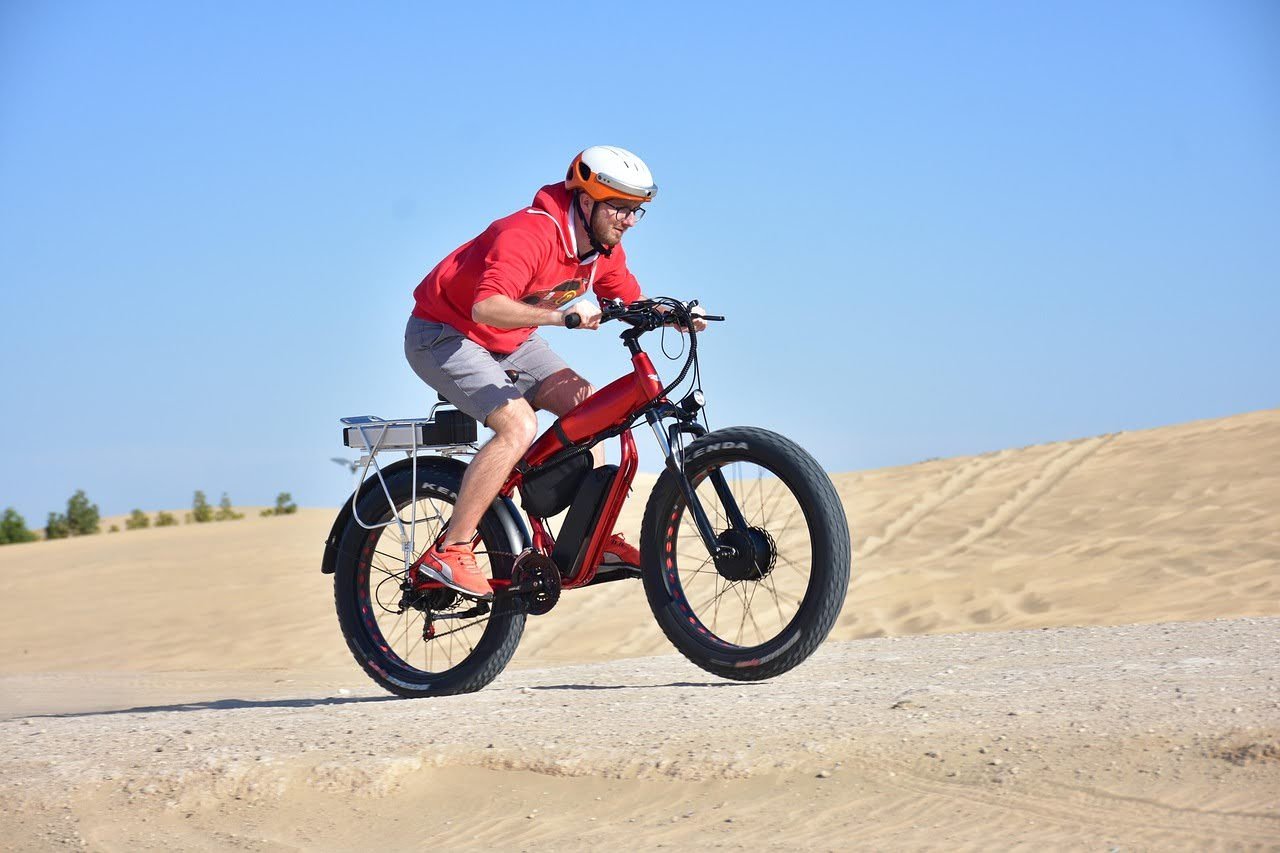
Electric bike in desert. Iztok Franko. Pixabay.
If you're looking for a thrilling off-road adventure that takes you to breathtaking sights across Moab, you can book with Mike Ballard and his company, Big Iron Tour Co. This off-road adventure company is veteran-owned and operated, and they recently installed wheelchair lifts on their 4x4 off-road vehicles so everyone can have fun. The vehicles range from 16-seat off-roaders, called “Man-O-War” and “Dreadnouight” to new-era Jeep Gladiators. Big Iron offers three tour packages: a two-hour tour, a four-hour tour and the most popular, the Sunset Tour. With the Sunset Tour, you scale the red rocks of the Moab and go on trails with several advanced obstacles, ending at a high vantage point to soak in the beautiful sunset.
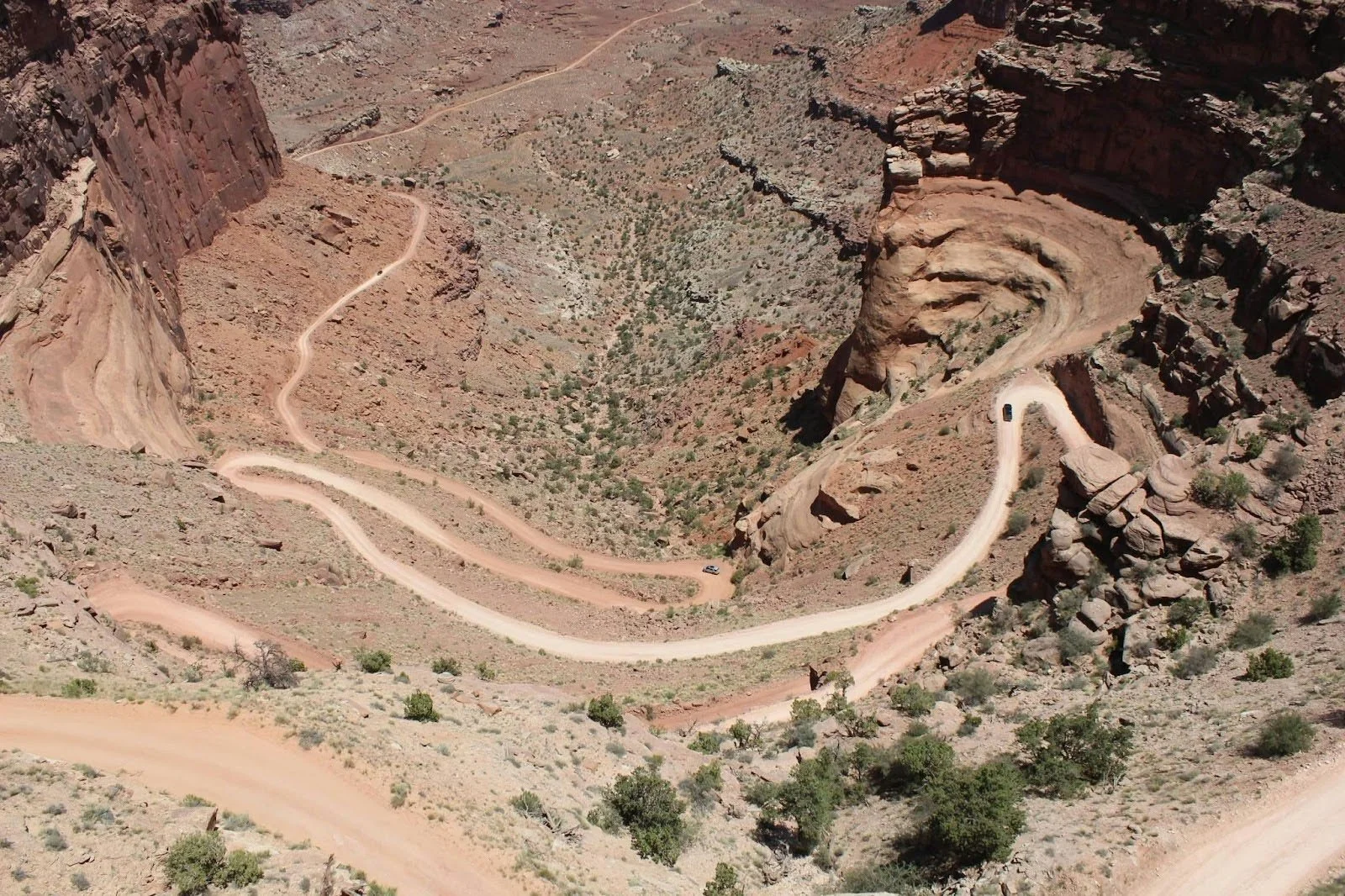
Desert road in Moab. J. Pexels.
The Moab Swingers tour offers the longest rope swing in the United States, spanning 500 feet. The attraction has appealed to families and younger visitors, as it is guided by experts, allowing activities previously limited to extreme athletes to be accessible to a wider demographic. The tour is led by cofounders Andy Lewis and Jimmy Peterson, lifelong friends and seasoned extreme-sports professionals. It includes an off-road excursion behind the prominent Moab rock formations, followed by a brief nature hike to the swing, culminating in an unforgettable experience as participants jump from the summit.
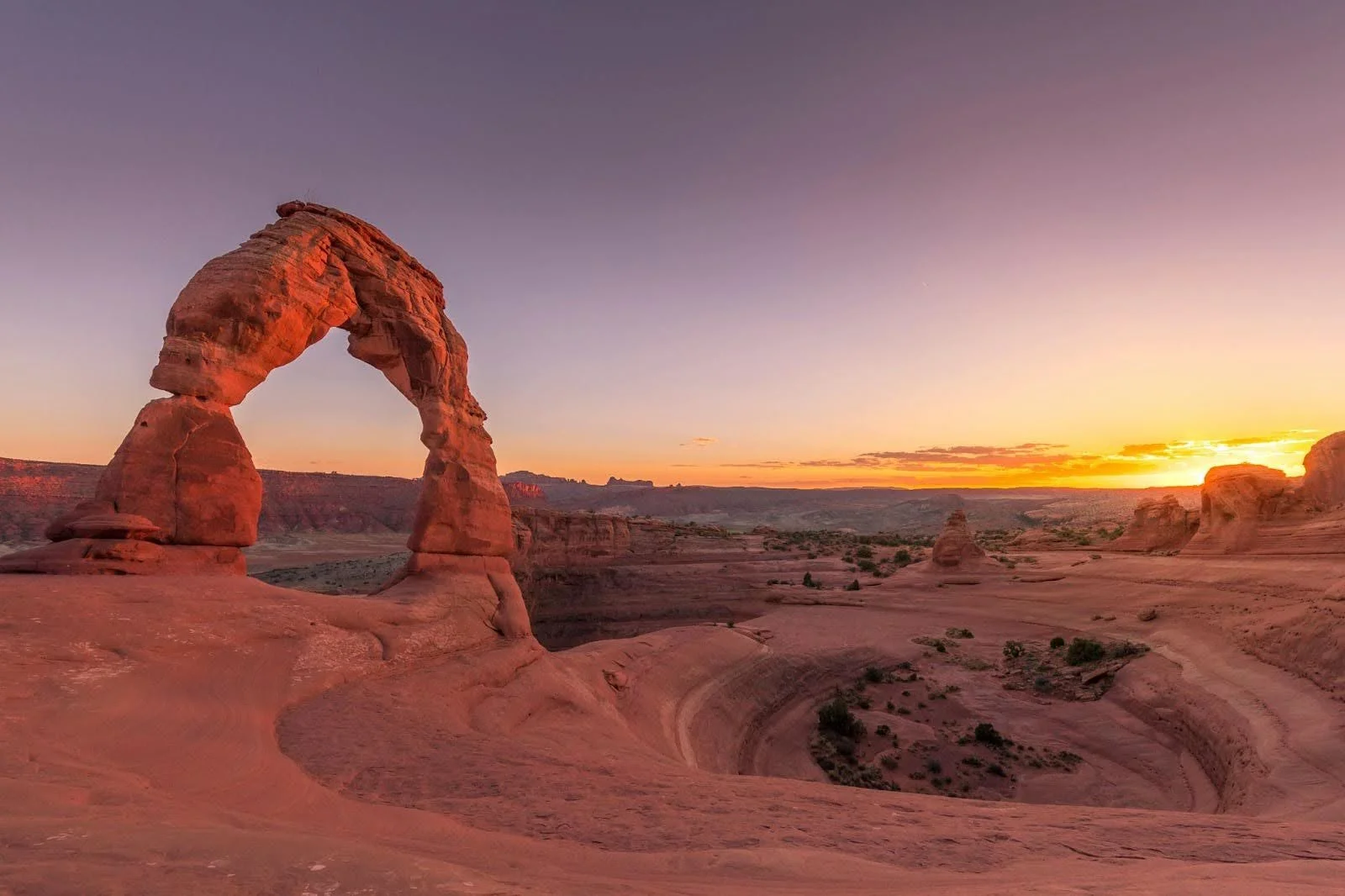
Sunset in Moab. Ken Cheung. Unsplash.
Red River Adventures, another tour company located in Moab, is known for its guided rafting, climbing, canyoneering and backcountry trips throughout Utah. To make experiences more accessible for people with disabilities, its guides have adapted rafting launches for wheelchair users and teamed up with groups that support blind, visually impaired and deaf participants. These adaptations demonstrate the Moab outdoor industry’s commitment to making high-risk recreation more accessible while preserving the core experience. Although not every canyon or climb can be changed, the company’s efforts are part of a larger trend in Moab of extreme adventure becoming more inclusive to a wider range of visitors.
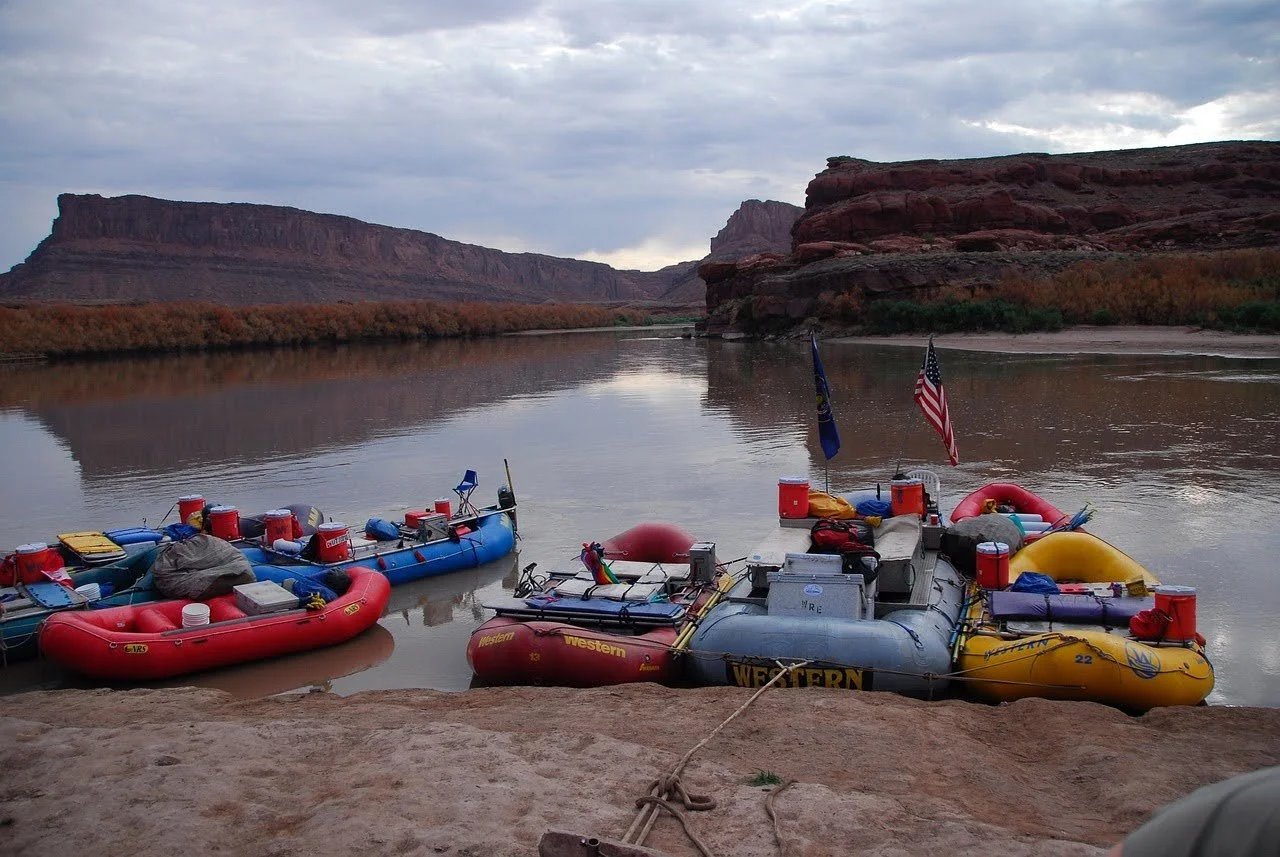
Rafting in Utah. Liz Hoffmaster. Pixabay.
Elevate Outdoors, started by professional highliner and guide Faith Dickey, is another company helping make Moab’s outdoor scene more inclusive. The company is known for advanced instruction in slacklining, climbing and canyoneering. Elevate Outdoors focuses on accessibility by offering personalized guiding and adjusting the pace of activities to each person’s needs. Instead of one-size-fits-all trips, they work closely with participants to customize routes, change technical systems and help people build confidence step by step. For disabled travelers or those recovering from injuries, this kind of attention can make challenging terrain feel possible. By combining strong safety standards with a focus on empowerment and helping people manage fear, Elevate Outdoors proves that even Moab’s toughest adventures can be made accessible with the right approach.
TRAVELING THERE:
Elevate Outdoors is a locally owned guiding service specializing in rock climbing, canyoneering and highlining, led by experienced outdoor professionals who focus on skill-building and personalized trips. Their team emphasizes inclusivity and works closely with clients to adapt experiences to different ability levels.
Big Iron Tours is a veteran-owned company offering guided off-road tours through Moab’s red rock landscapes. It offers knowledgeable local guides who share both the terrain and history of the area, and tours range from short scenic rides to more immersive backcountry experiences.
Red River Adventures is one of Moab’s more established outfitters, offering rafting, rock climbing and canyoneering trips guided by seasoned professionals with deep knowledge of the region. Their guides are a central part of the experience, focusing on safety while creating a more personal, small-group environment.
Moab Swingers is a niche adventure outfitter offering guided rope-swinging excursions, typically operated by a small team that facilitates group-friendly experiences in a more unconventional outdoor setting. The experience is less about technical skill and more about shared thrill and group energy.
The Bureau of Land Management Moab Field Office is staffed by land managers and public servants who oversee recreation in the area, providing essential guidance on trail access, e-bike use and responsible travel across Moab’s public lands.
Carson Jelinek
Carson is a 22-year-old writer and filmmaker studying film and media productions at Arizona State University. His work explores travel, culture, and the people behind the places, with a focus on stories that encourage curiosity and global understanding.
Raised by the Rainforest: The Story of KSTR
Carson Jelinek
Kids Saving the Rainforest is a Costa Rica-based nonprofit founded by two nine-year-old girls who wanted to protect their local rainforest.
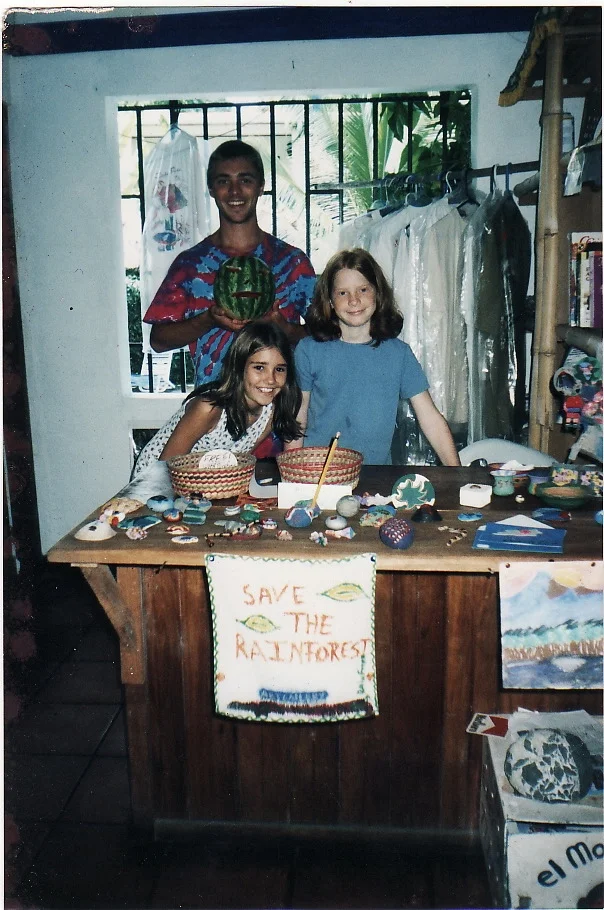
Janine Licare and Aislin Livingstone, founders of KSTR, at 9 years old, with their first volunteer. Courtesy of Kids Saving the Rainforest.
Kids Saving the Rainforest (KSTR) was founded in 1999 by two nine-year-old girls, Janine Licare and Aislin Livingstone. Growing up near the jungle of Manuel Antonio, Costa Rica, they saw firsthand the effects of deforestation and wanted to protect the rainforest and its wildlife. Their journey started small, by raising money on the side of the road for saplings to be planted in the nearby forest. Today, their focus is on reforestation and protecting sick, injured and orphaned wild animals, many of which return to the wild through a process of rescue, rehabilitation and release.
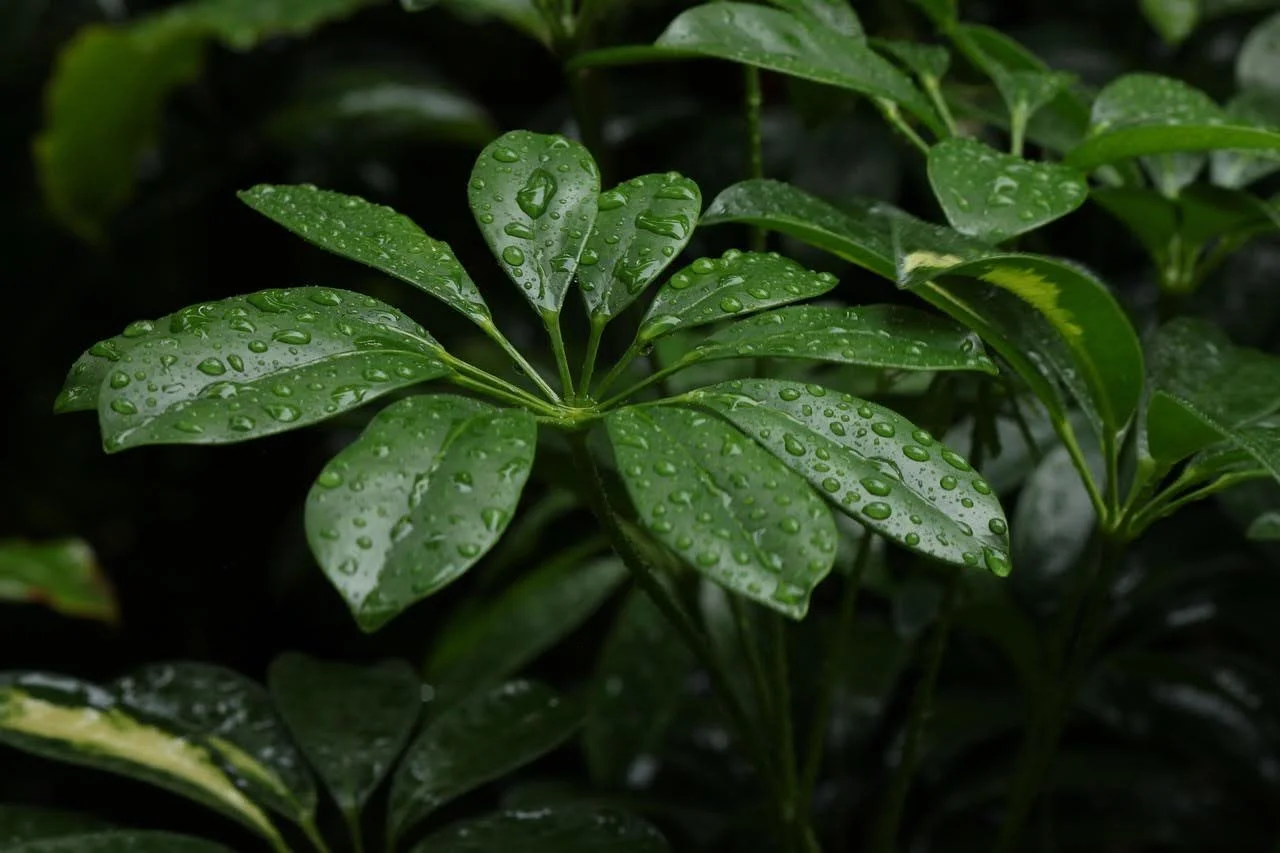
Rainforest foliage in Costa Rica. Chris Clementi. Pixabay.
For Licare and Livingstone, the rainforest surrounding their childhood homes served as a playground, classroom, and backyard. As they grew up among towering trees and diverse wildlife, they observed the increasing impact of development and environmental pressures on the forest. Rather than disregarding these challenges, they chose to take action. Hand-painting rocks to sell at their roadside stand, they initiated fundraising efforts through small but mighty creative means.
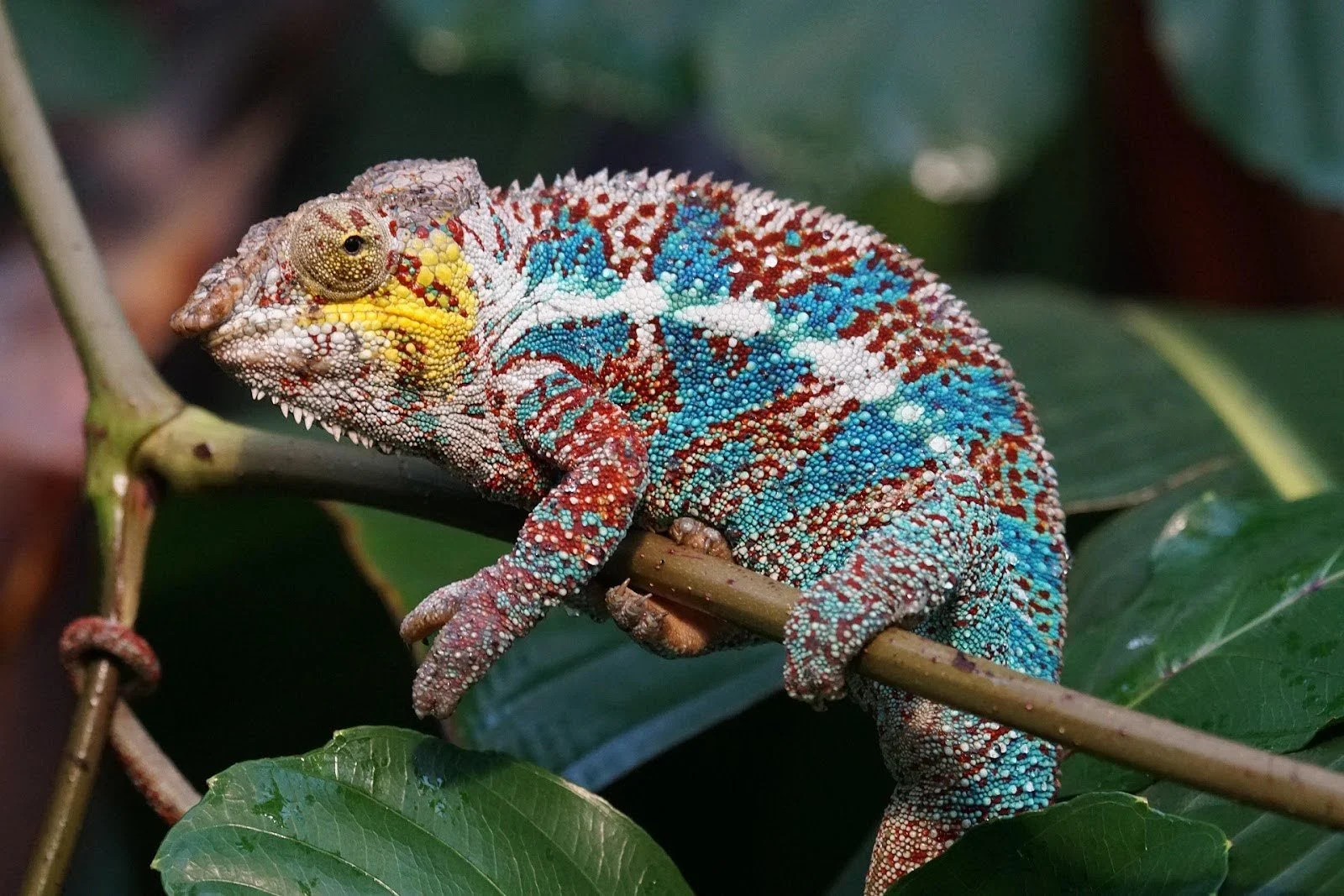
Chameleon on a branch. Marcel Langthim. Pixabay.
Very quickly, the scale of donations grew beyond what a casual family project could manage, and that is when local adults, including the kids' parents and community members, stepped in to help formalize the operation so that the money could be properly tracked and used for conservation. Over the next few years, KSTR transitioned from a hand-painted roadside stand into a formally registered nonprofit with a board of directors, a bank account and permission to work on conservation projects around Manuel Antonio.
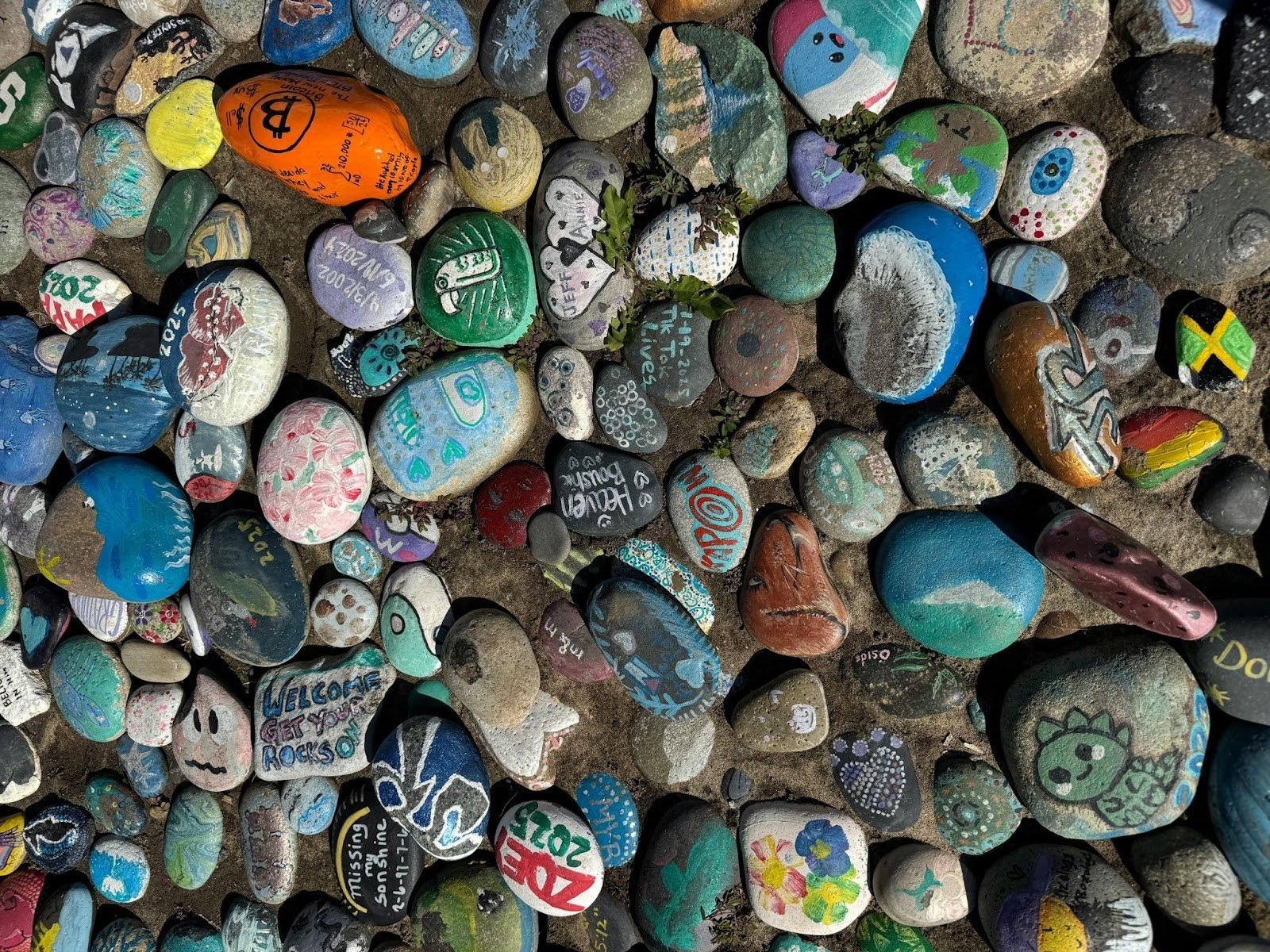
Hand-painted rocks. Petra Nesti. Pexels.
KSTR has since expanded their wildlife initiatives. Though they aim to eventually release rescued animals back into the wild, those that can’t return are given sanctuary for life on the property. Another project KSTR has prioritized is building wildlife bridges, which are designed to protect arboreal animals, such as squirrel monkeys, from environmental dangers, like power lines, car collisions and attacks by other species. Over 130 bridges have been built, and since their efforts began, the squirrel monkey population has more than doubled. This has now become a prime model for similar conservation efforts in other regions.
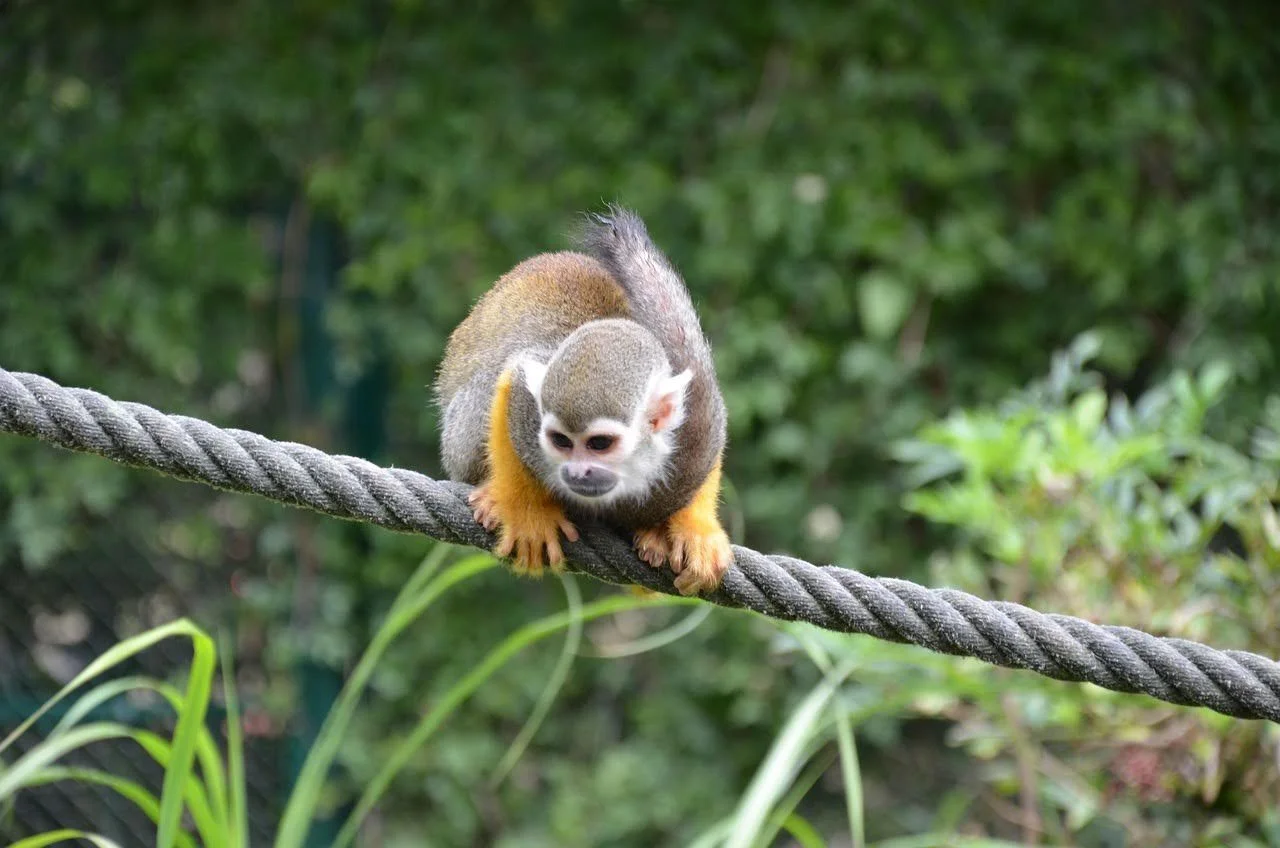
Squirrel monkey on a wildlife bridge. Flobrc. Pixabay.
Volunteers are what KSTR relies on to run its facilities and care for the wildlife in the area; in fact, the organization is completely funded by donations. People from around the world come to volunteer and help with all aspects of their work. A volunteer can expect to help with cleaning, building cages, working on trails, preparing food for the animals and observing behavior. As well, a key element of KSTR is education on biodiversity conservation, so all visitors and volunteers can learn more about the rainforest and how they can help.
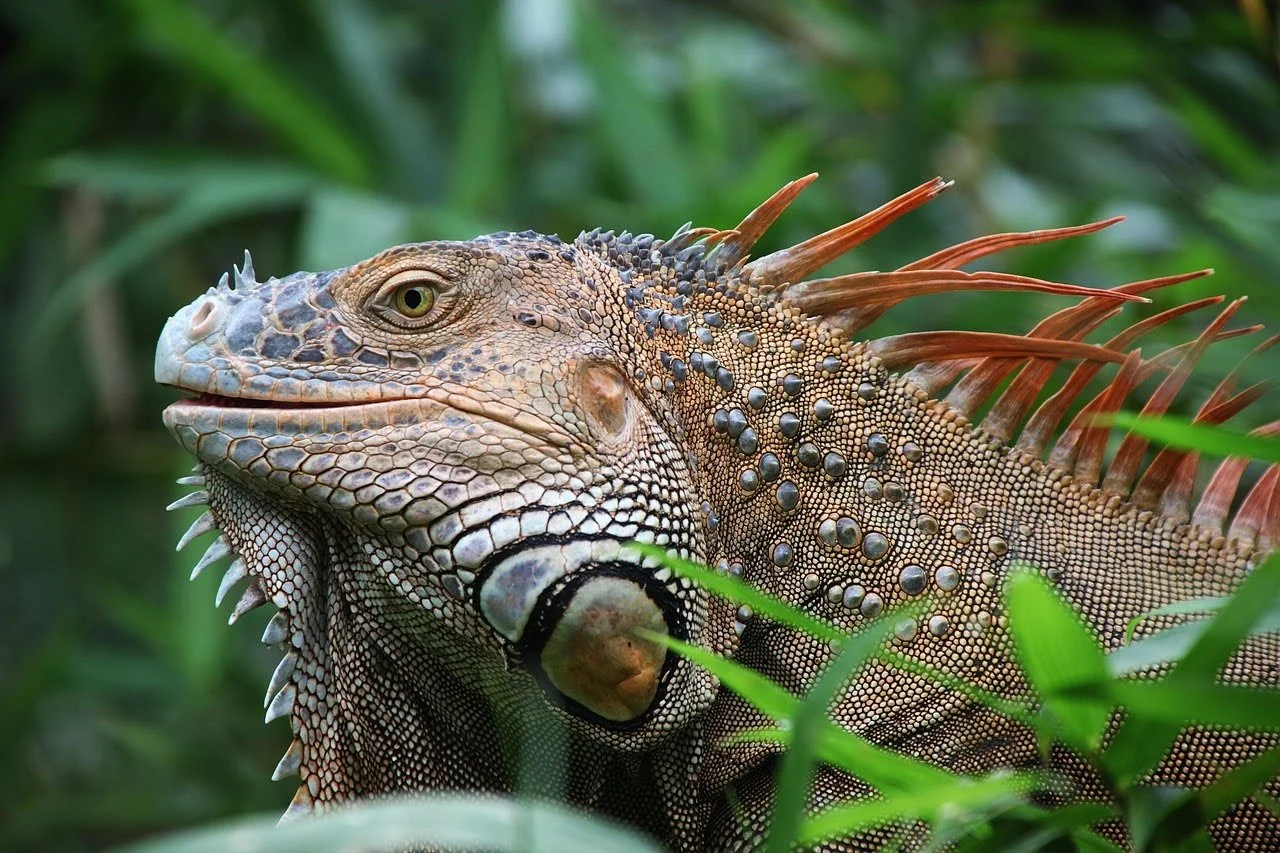
Iguana in Costa Rica. Steve Jurvetson. CC BY 2.0.
For many volunteers, the experience is more than just helping the animals. Time spent in the rainforest helps them see how wildlife, ecosystems and human development are all connected. Many people finish the program with a stronger appreciation for conservation and feel inspired to support environmental protection in their own communities.
GET INVOLVED:
You can get involved with KSTR by looking into their volunteer opportunities. Visitors can sign up to be full-day volunteers, where they will tour the facility and work directly with an animal caretaker. Another way to get involved is by being a long-term volunteer, and that ranges from a few days to a few months, depending on what you want to do. Typical daily duties include preparing food and distributing it to the animals, cleaning enclosures, offering enrichment, foraging for wild food and ultimately improving the animals’ quality of life. Along with this, the nonprofit offers internship positions as a zookeeper, in veterinary clinics and in media and marketing.
Carson Jelinek
Carson is a 22-year-old writer and filmmaker studying film and media productions at Arizona State University. His work explores travel, culture, and the people behind the places, with a focus on stories that encourage curiosity and global understanding.
The Victims of Agent Orange Making a Living Crafting Art
Ryan Yianni
On the outskirts of Ho Chi Minh City, victims of American bombing achieve financial independence through their unique artwork.
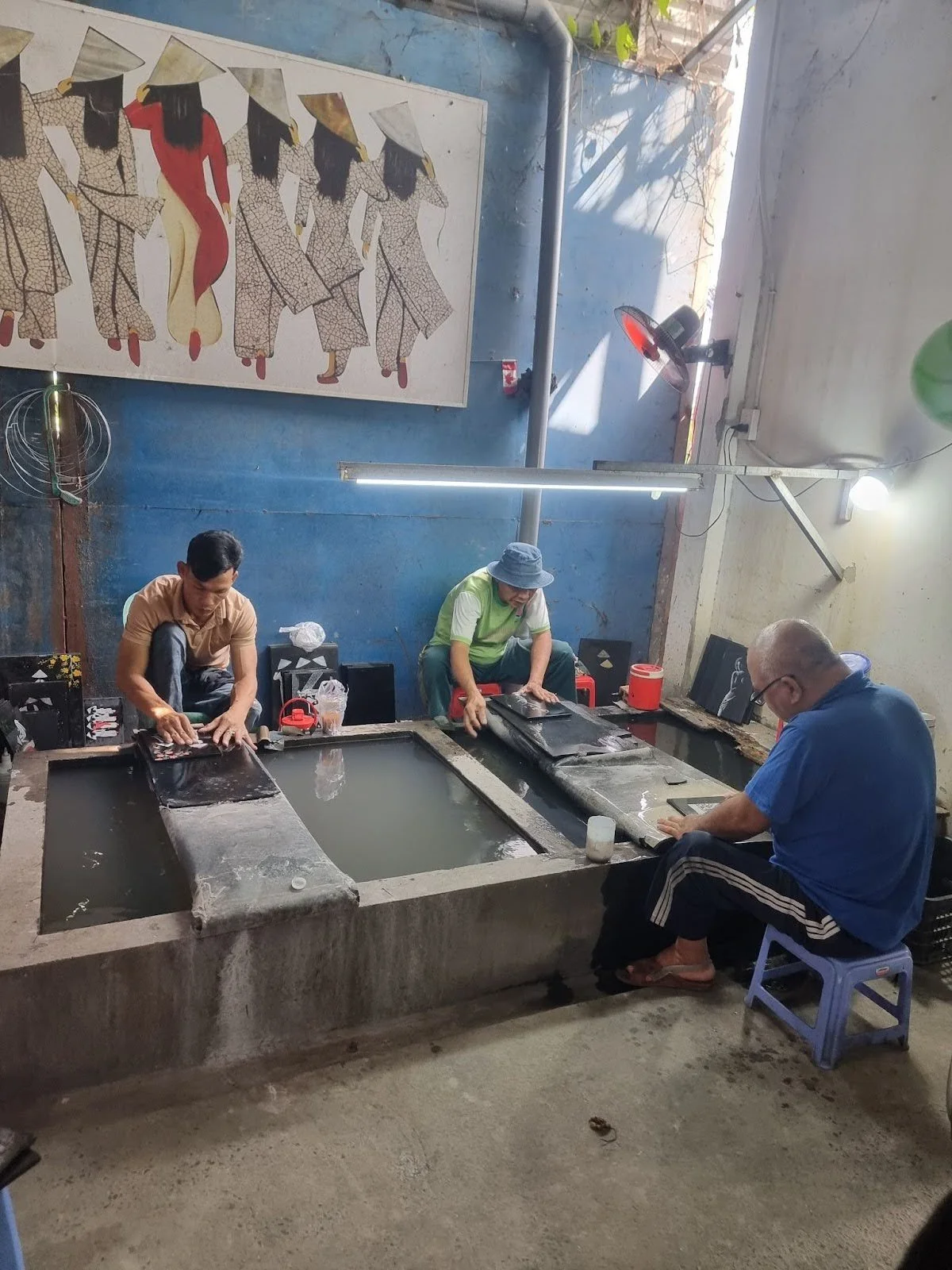
Artists working at Lang Viet Lacquers. Ryan Yianni.
If you ever find yourself in Ho Chi Minh City, it is almost a given that, at some point in your journey, you will travel to the Cu Chi Tunnels. Located just under 30 miles north of the country’s largest city, this famous spot along the Vietnam War-era network of underground tunnels has become a must-see attraction. There are a myriad of tour operators running daily trips to the tunnels, no doubt with some stops along the way. On my tour, our first visit was Lang Viet Lacquers, a small art factory on the outskirts of the city with a unique story.
Lang Viet Lacquers, situated in the city’s northwest, is a government-supported enterprise allowing victims of America’s brutal Agent Orange bombing campaign to achieve financial independence through lacquer painting, an art form that has existed in Vietnam and Southeast Asia for over 2,000 years. The stunning artwork consists of rich, almost reflective colors, with the addition of eggshell and mother-of-pearl to create bright, contrasting sparkles against the background.
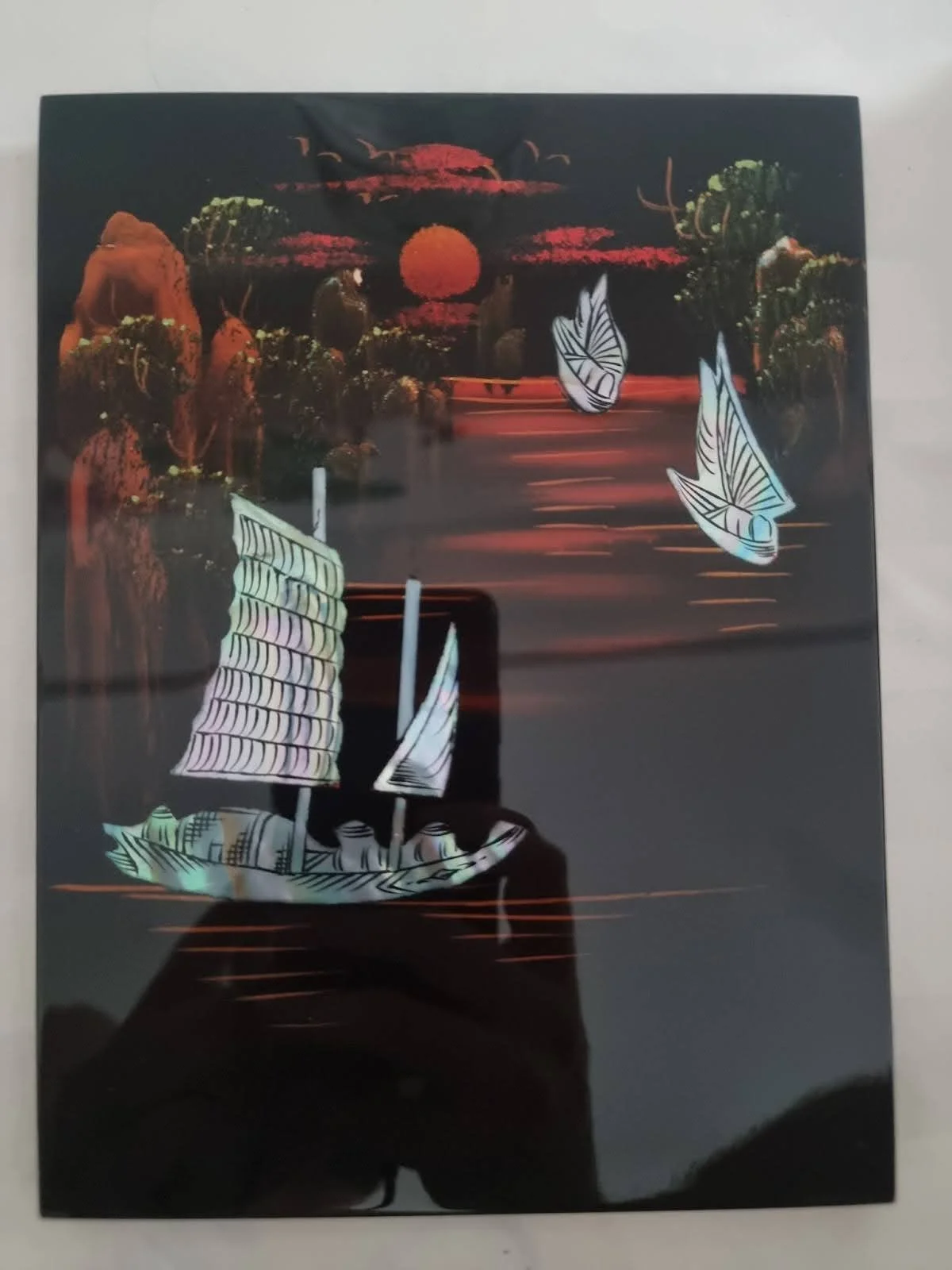
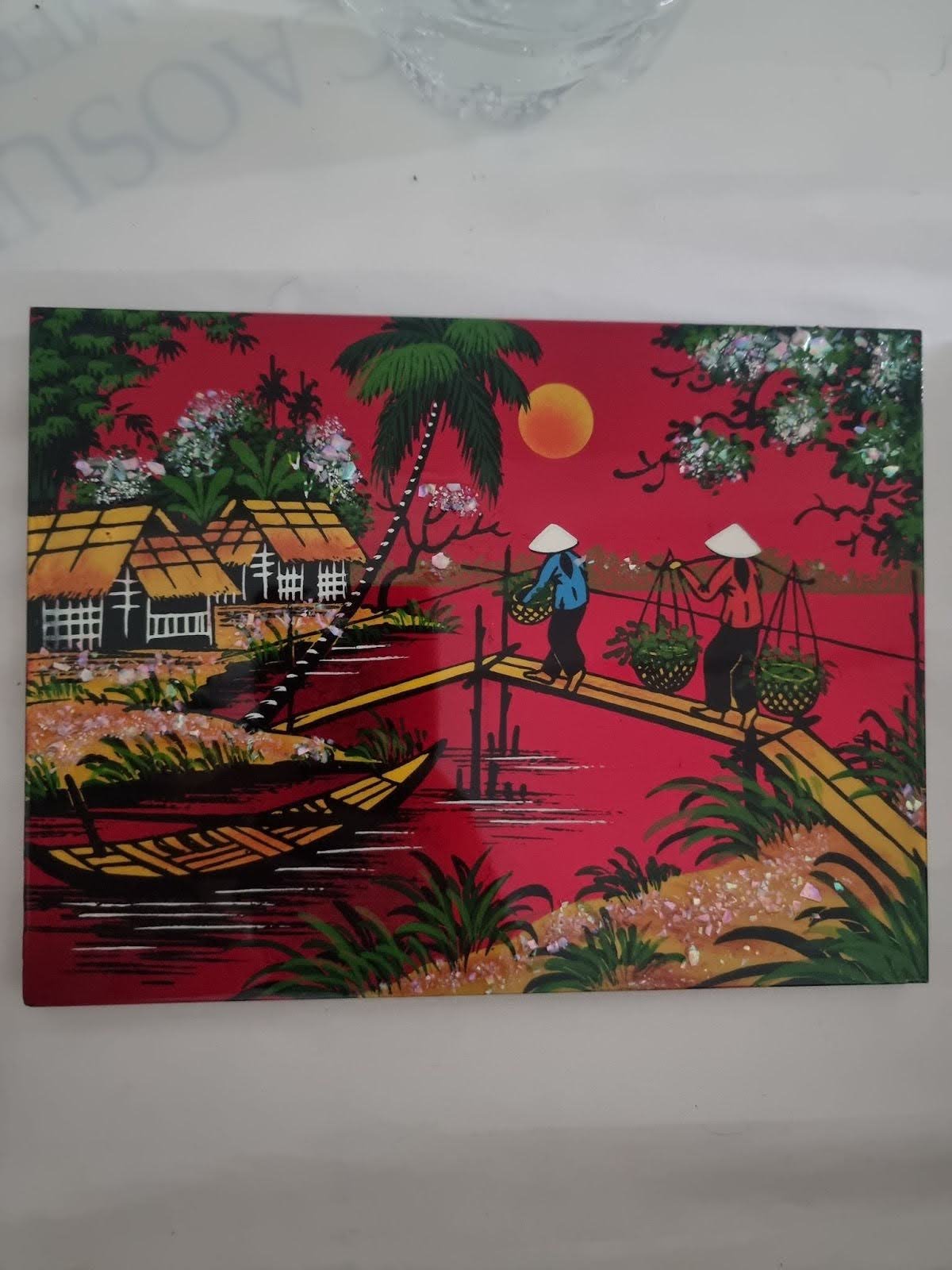
My two purchases from Lang Viet Lacquers. Ryan Yianni.
Arriving in the intense heat of the Vietnamese sun, we stepped off the coach and were ushered into the workshop, where we saw firsthand the artwork being created with painstaking care and detail. We were told how all the artists are victims of Agent Orange, the herbicide sprayed in large quantities over Vietnam by U.S. forces during the Vietnam War. These victims are not just war veterans; the devastating effects of Agent Orange were passed down to descendants of those affected, and the succeeding generations have suffered greatly in turn. For each work of art sold, the proceeds go directly to the artists, helping them achieve financial independence. Many of the injuries and conditions they suffer from mean they cannot work in the traditional sense, predominantly due to mobility or developmental issues, so this outlet allows them to maintain their freedom. In their shop, you are able to purchase a wide variety of items, from small souvenirs to large, wall-hung art, so there is something for everyone’s budget and luggage space.
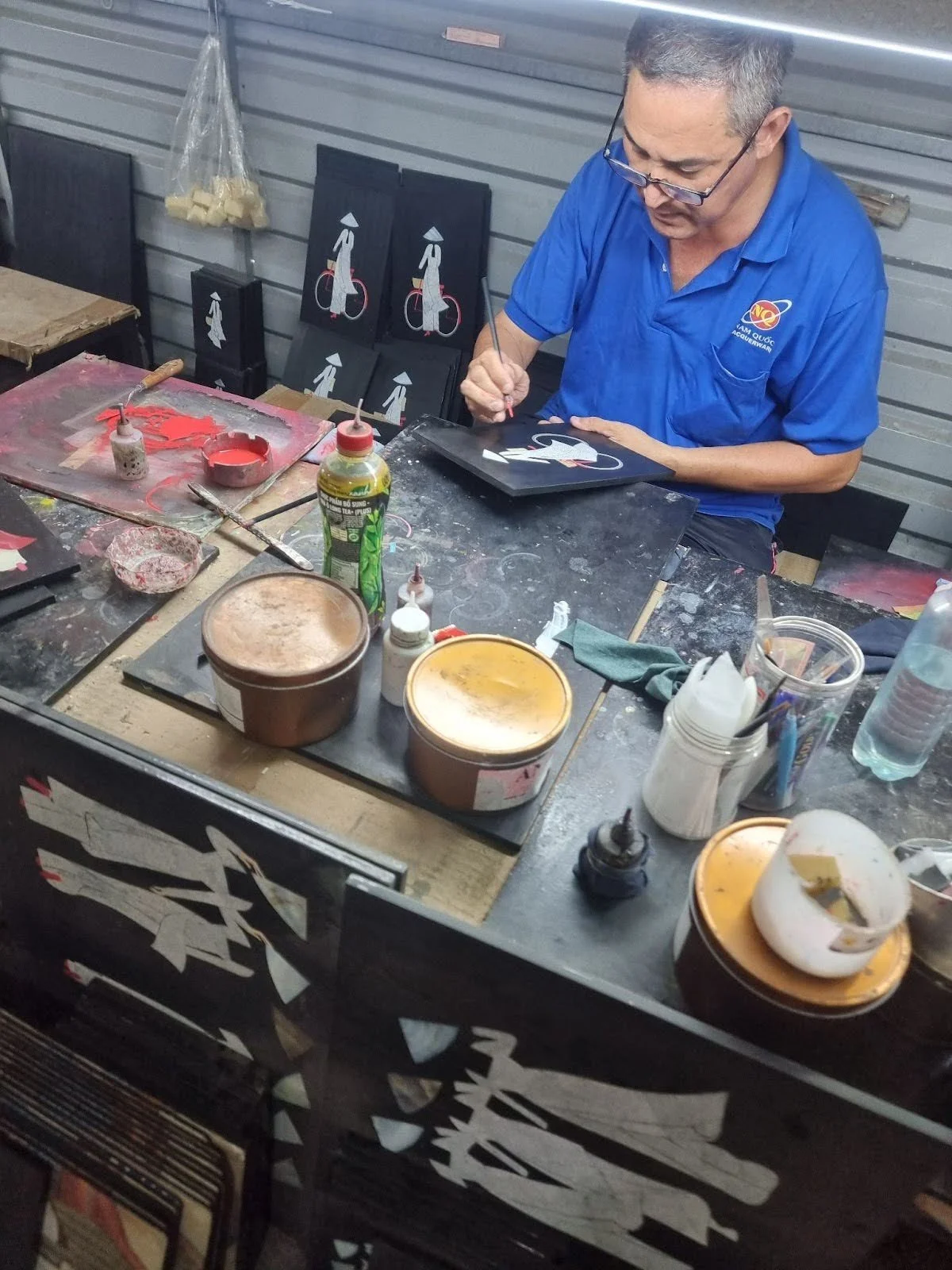
Artist adding finishing touches to painting. Ryan Yianni.
The actors behind Agent Orange initially claimed their intent to destroy the Vietnamese jungle and root out guerrilla forces deep in the overgrown countryside, but the effects were much more serious and long-lasting. Being sprayed across almost 3 million hectares, over 4 million Vietnamese were exposed to the chemical, and while those directly exposed suffered from health issues, such as multiple neurological disorders, increased cancer rates, heart disease and serious skin rashes and scarring, the effects of Agent Orange were also passed onto their children and grandchildren. Later generations of Vietnamese citizens whose parents and grandparents were victims of Agent Orange have suffered from cleft lip, heart defects, birth disorders leading to lack of limbs, increased cancer rates, congenital heart diseases and severe learning disabilities, to name a few. Studies have shown that Vietnamese exposed to Agent Orange also have a higher rate of dioxins in their bodies, which are highly toxic pollutants that can cause issues like chloracne, cancer, immune and reproductive problems, developmental issues and chronic illnesses.
One of the reasons for the continued effects of Agent Orange on the younger generations is the fact that these dioxins are still found in Vietnamese soil, water and food chain. It is consumed through contaminated crops and livestock, breathed in via dust and absorbed through the skin, meaning that Agent Orange has continued to plague Vietnamese civilians for decades after the last of the chemical was dropped on the country. Additionally, dioxins have a half-life of 7 to 11 years, meaning that the strength of the chemicals did not decrease until approximately 1980 and is still present today, although in lower quantities and intensity
Agent Orange also had a strong impact on Vietnamese wildlife: A post-war study found 24 species of birds and 5 species of mammals in an area of forest that had been heavily sprayed, compared to two non-sprayed forest areas that each had over 100 bird species and at least 30 mammal species. Studies have found that the rate of miscarriages and birth defects was significantly higher in women who had been exposed to Agent Orange. Research has also shown that U.S and Australian soldiers who were exposed to Agent Orange have a much higher risk of elevated blood pressure and tumors, among other health issues, while those soldiers exposed to the dioxins had a higher rate of soft-tissue sarcoma, a rare type of cancer found in muscle tissue. A 2021 study also found that American veterans exposed to the herbicide were almost twice as likely to develop dementia.
The United States began to deploy herbicidal agents in Vietnam in January 1962, with the launch of Operation Ranch Hand, although the first major operations did not begin until September, when mangrove forests on the Mekong River were targeted. The majority of Agent Orange usage was between 1966 and 1969, with an estimated 170 kilograms of dioxin dropped on Vietnam and even more sprayed onto the border areas of Laos and Cambodia. By 1971, the evidence of the harmful effects was beginning to be known, and the U.S. government halted all herbicidal spraying operations in Vietnam, with the remaining stock destroyed by 1977.
The use of Agent Orange was incredibly controversial at the time. The Federation of American Scientists urged the U.S. government not to use chemical and biological weapons unless used by the enemy first in 1964, concerned that the government was not discriminating between military and civilian targets. In 1966, a group of scientists led by John Edsall of Harvard University appealed to President Lyndon B. Johnson to ban the use of such weapons. The statement reads, “such tactics are barbarous because they are indiscriminate; they represent an attack on the entire population of the region where the crops are destroyed, combatants and non-combatants alike." Similar protests continued for the remainder of the war.
If you are able to visit Lang Viet Lacquers, it is well worth the trip. Being able to purchase some great souvenirs, along with helping those who have suffered the consequences of America’s brutal war, is a worthy highlight of a trip to Vietnam. I’m a big believer in leaving somewhere better than I found it, embracing local cultures and giving back to the communities I have discovered through my travels, and this is a great way to do all three.
GETTING THERE:
Lang Viet’s is located just nine miles north of the airport. You can book a Grab Bike from the center of Ho Chi Minh City near Ben Thanh Market, Saigon Central Post Office, Independence Palace or the Cathedral for about four dollars. It is also served by buses 13, 24, 74 and 94, which stop just outside the shop.
Ryan Yianni
Ryan is a lover of all things travel. After undertaking his first solo adventure in 2025, he has relocated to Australia from the UK. A history graduate from the University of the West of England, Ryan’s writing focuses on the historical issues faced by the places he has explored, looking at how the hardships of the past have been overcome and remembered.
Denmark’s Mons Klint: The Landscape That “Looks After Itself”
Salome Liptak
Only a short trip from Copenhagen, this UNESCO World Heritage Site offers an unparalleled glimpse into the 70-million-year-long saga of a unique ecosystem.
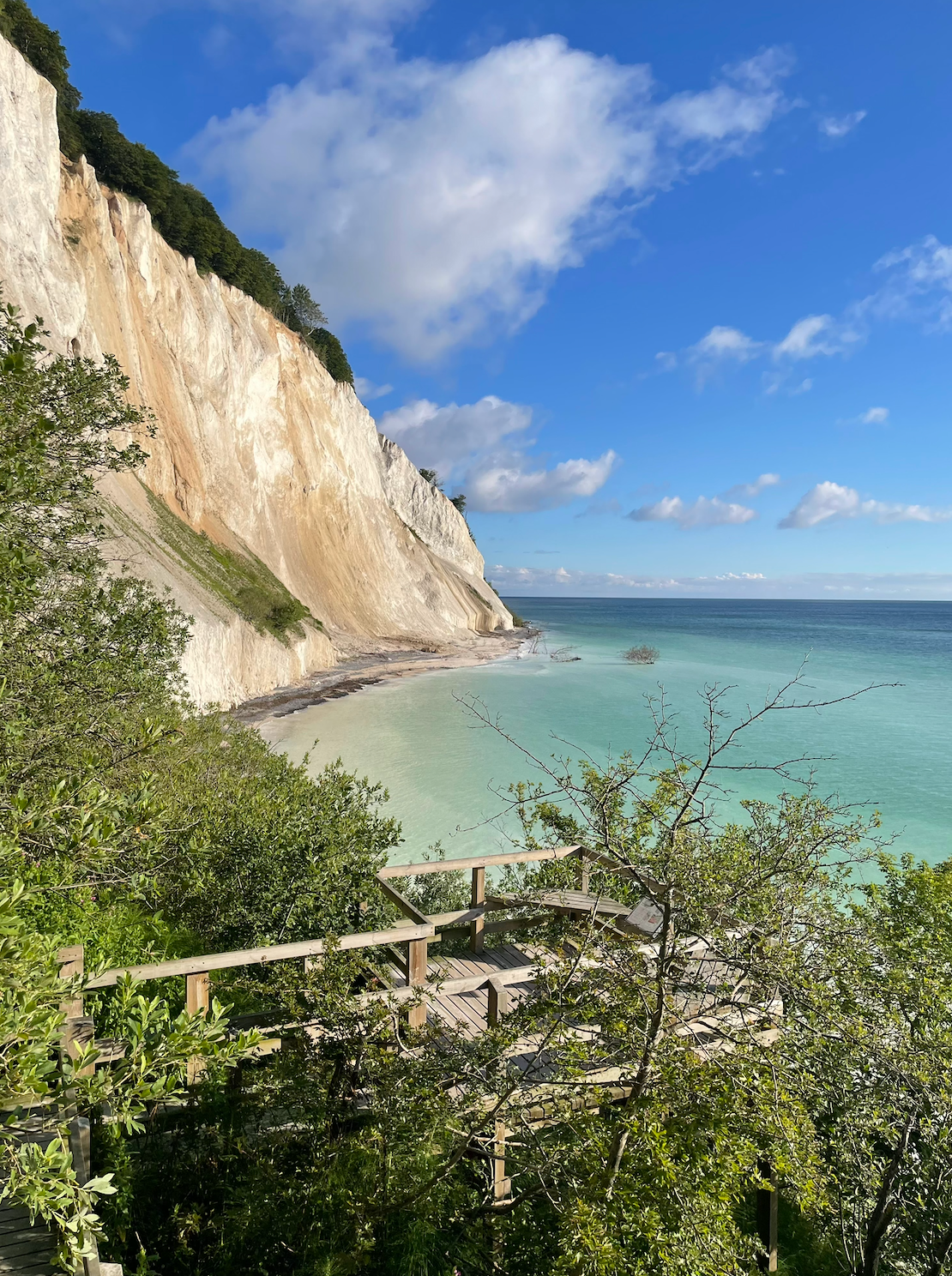
Chalk cliffs and the Baltic Sea. Salome Liptak.
On the eastern coast of Mon, a small island in Denmark, almost 4 miles of undulating chalk cliffs are a striking physical record of geological time. The cliffs, made up of 70-million-year-old seabed that was banked and compacted from the pressure of Ice Age glaciers, haven’t stopped changing since. Their soft chemical structure makes the cliffs “friable,” or easily eroded, which constantly exposes new layers of fossils. Because of this, the lapping waves of the Baltic have continued to sculpt the cliff face, and in turn, the cliffs’ minerals enrich the water close to the shore, giving it a distinct milky-turquoise color.
Alongside its historic cliffs, Mons Klint harbors a unique ecosystem. The area is the country’s sole habitat for the large blue butterfly, whose unique life cycle requires a specific diet of wild thyme and marjoram in the larval stage before it is found by a red stinging ant and carried back to its nest; after spending four seasons in the anthill, the butterfly finally pupates in July. The lime-rich soil of Mons Klint’s beech forests also makes it the perfect habitat for 18 out of 45 Danish species of orchid, many of which are particularly rare to find elsewhere in Denmark. Further, as an important roost for migratory birds, Mons Klint and its surrounding forests offer a rare glimpse into the rhythms of the more-than-human environment. In the words of The Danish Nature Agency, this is a forest that constantly adapts and “looks after itself.”
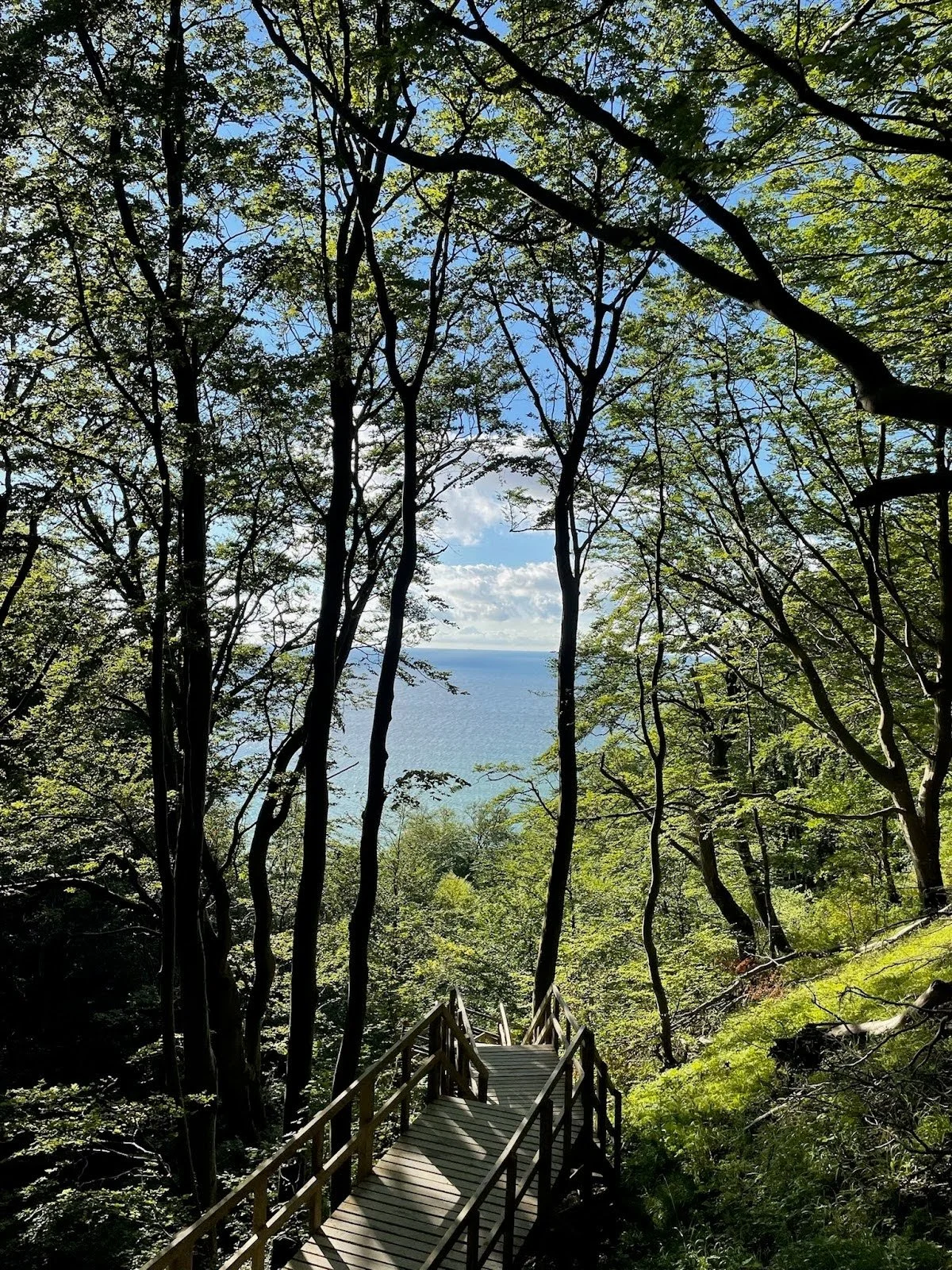
Stairs to the beach through the beech forest. Salome Liptak.
I first learned about Mons Klint when I was researching opportunities to get outdoors while interrailing in Europe. As trains mostly connect larger urban hubs, it can be hard to plan outdoor trips without renting a car. Thankfully, Mons Klint, as a popular destination for Danes, is accessible by public transport
Having since been added to the UNESCO World Heritage List in 2025, the site has also become a part of the island’s UNESCO biosphere reserve as well as Scandinavia’s first-ever Dark Sky Park. I was most excited to experience Mon’s extremely low light pollution levels, which make the Milky Way, Andromeda Galaxy, as well as comets and meteors visible to the naked eye at different times of year.

Milky Way. Salome Liptak.
Beyond stargazing, other outdoor activities, like hiking, fossil hunting, horseback riding, surfing and paddleboarding, are big draws for tourists. Guides for these activities in the park can be found on the Mons Klint GeoCenter website. It is most common to camp or stay in cabins and bed-and-breakfasts along the coast, with more budget-friendly options further inland. For international visitors travelling from Copenhagen, the nearby town of Borre is only two hours away by car or private bus and three to four hours on public transport routes, which can be mapped out online using Rejseplanen’s journey planner. If using public transport, the most direct route involves taking a Danske Statsbaner train to Vordingborg, then a bus to Mon’s biggest city, Stege. Here, a free bus will take tourists directly to the entrance of the 497 steps that lead to the base of the cliffs. It is also common to rent bikes from shops in Borre and Klintholm to ride into the park, as the wide, scenic roads along the coast and through Mon’s farmland make the ride an activity in its own right.
This being said, as more people discover the wonder of Mons Klint, it is of the utmost importance to protect the delicate ecosystem to which it is home. With rises in tourists, Mon locals have expressed concern for the wildlife, adopting the slogan “Don’t Mess with Mon” after incidents of tourists violating Leave No Trace principles, such as walking off marked trails or leaving trash behind. More information on Denmark’s specific ecological regulations and best practices is available through The Danish Nature Agency. The ever-changing landscape and ecological symbiosis that make up the wonder that is Mons Klint also make it sensitive to human interference. The geological drama that sculpted these cliffs is best enjoyed as a respectful observer, so it can continue to unfold for millions more years.
Salome Liptak
Salomé is a student at Sarah Lawrence College studying literature and writing. She is passionate about storytelling (both true and fictional) and its power to reflect the world as it is, or imagine what could be.
Surfing Morocco Responsibly: How Travelers Can Protect Culture and the Coast
Kara Karinauskaite
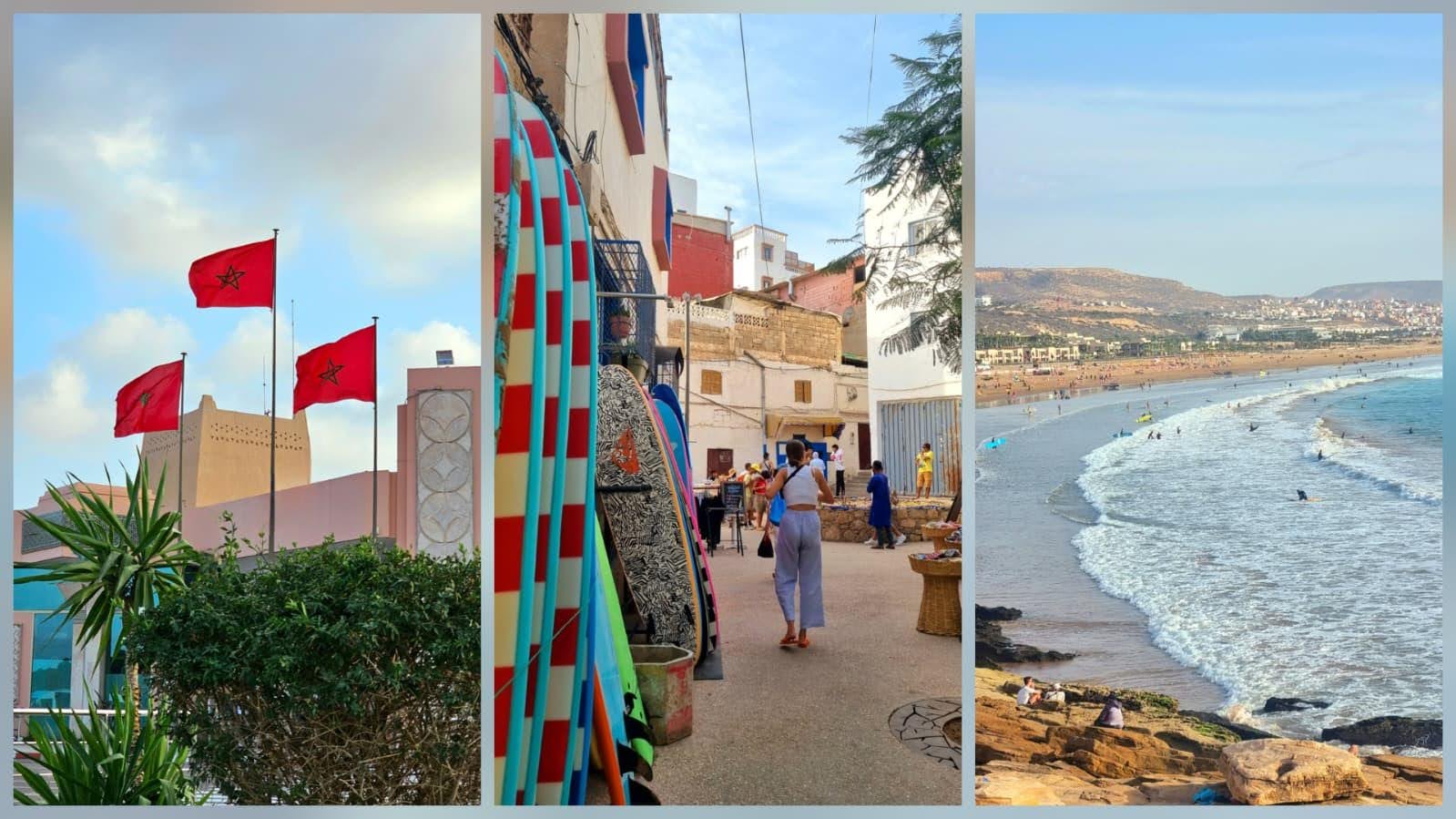
Taghazout, Morocco. Kara Karinauskaite.
Last November, I traveled to Taghazout, a small coastal town in Morocco. It was my second year in a row traveling to the country specifically to surf. Spending my days in the water and my evenings with local surfers put into perspective just how closely surf culture is tied to everyday life and the local economy.
While I was there, I learned that the Agadir tourism area, including Taghazout, recorded about 1.5 million tourist arrivals in 2025, compared with about 0.9 million tourists in 2015, showing how rapidly tourism in the region has grown over the past decade.
For generations, the people of Taghazout and the wider Agadir region have relied on fishing, argan oil production and trade as key sources of income, with the area’s Indigenous Berber heritage still evident in local culture and craftsmanship today. Taghazout has attracted international surfers and travelers since the 1960s, when its consistent waves and relaxed atmosphere caught the attention of visitors from around the world. This helped transform the local economy, leading to the development of surf camps, guesthouses and related services that now make surf tourism a major source of income alongside traditional livelihoods.
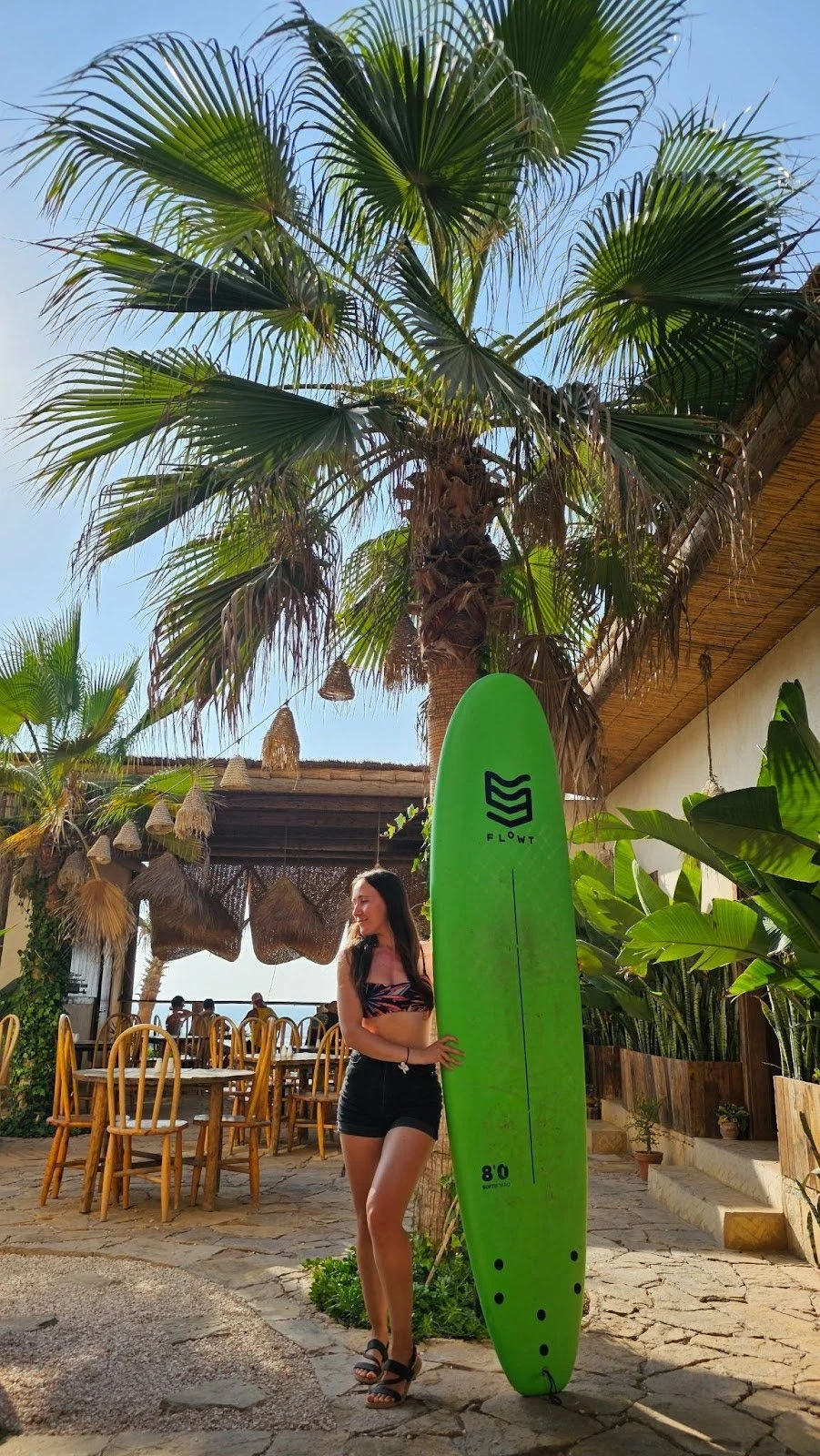
Surfing in Morocco. Kara Karinauskaite.
During my trips to Morocco, all of the surf instructors and trip guides I met were from the Agadir region, and having the direction of people who had surfed the coastline for many years made a real difference, as their deep knowledge of conditions, tides and safety spots provided me with the most well-informed surfing experience. They were always happy to talk with me about the area’s history, culture and how life in the village has changed with the growth of surf tourism, and they even took the time to teach me a few local phrases, making everyday interactions feel more personal. The surf instructors also invited us to visit their local hammam, a type of steam bath, which felt like an incredible privilege and offered a rare insight into everyday community life beyond the surf scene.
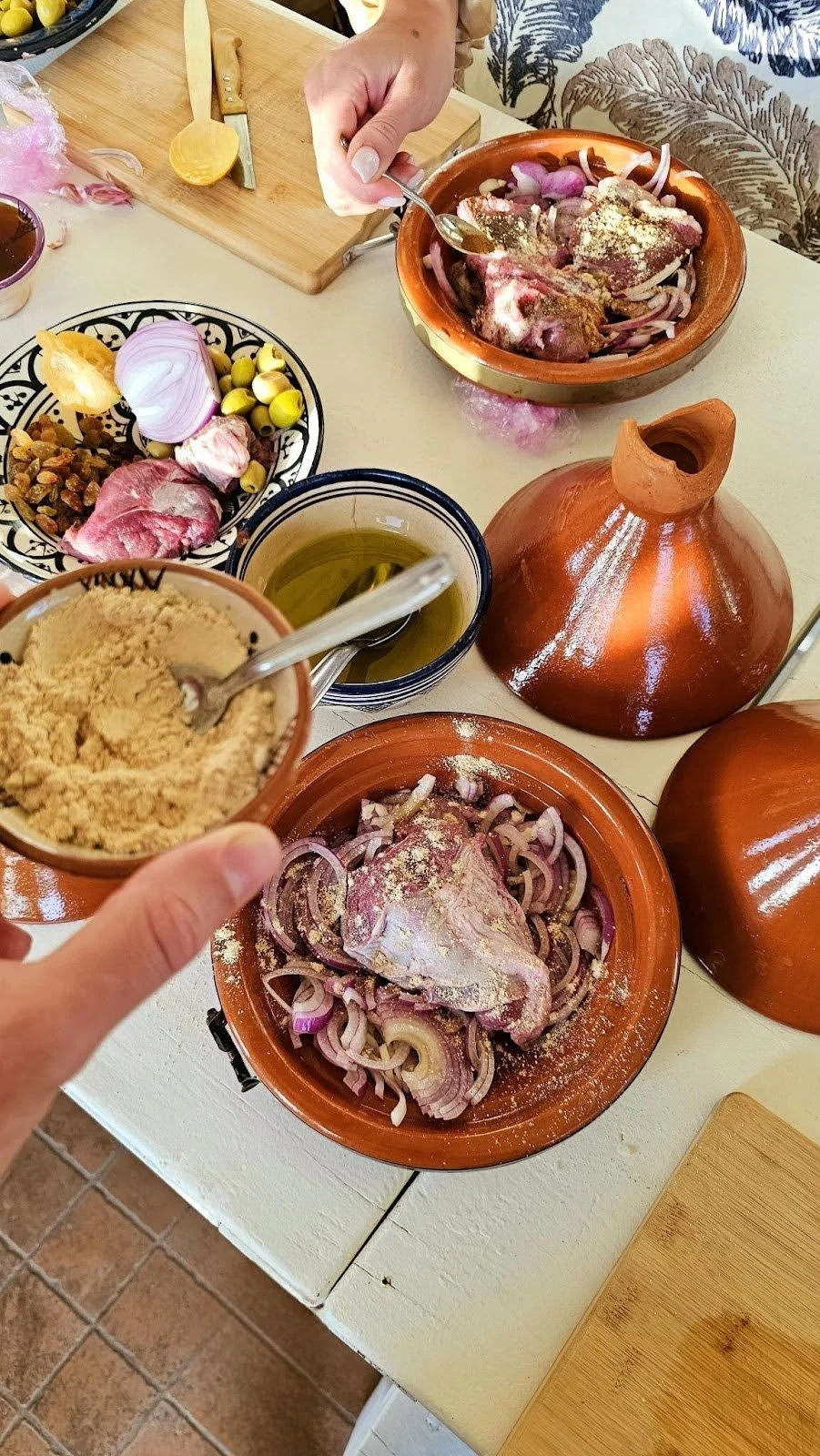
Learning local recipes at Blue Waves Morocco. Kara Karinauskaite.
While surf tourism supports an array of local businesses, such as instructors, board repairers, cafes and small guesthouses, it also increases pressure on beaches, water use and fragile coastal environments. During my visits, I learned from local instructors about practical ways to reduce these impacts.
Travelers can support the Taghazout area responsibly by choosing locally owned businesses, helping tourism income remain within the community. Respecting local culture is equally important, including dressing modestly away from the beach, asking permission before photographing people and learning a few basic words of Arabic or Amazigh. Being conscious of one’s environmental impact also makes a meaningful difference, such as by avoiding single-use plastics, taking part in beach cleanups and disposing of waste properly. Visitors can further help by conserving water through shorter showers, reusing towels and being mindful of water use in surf camps and accommodations. Protecting natural spaces by sticking to marked paths, avoiding walking on dunes and following local guidance when accessing beaches and surf spots helps preserve the coastline for both residents and future travelers.
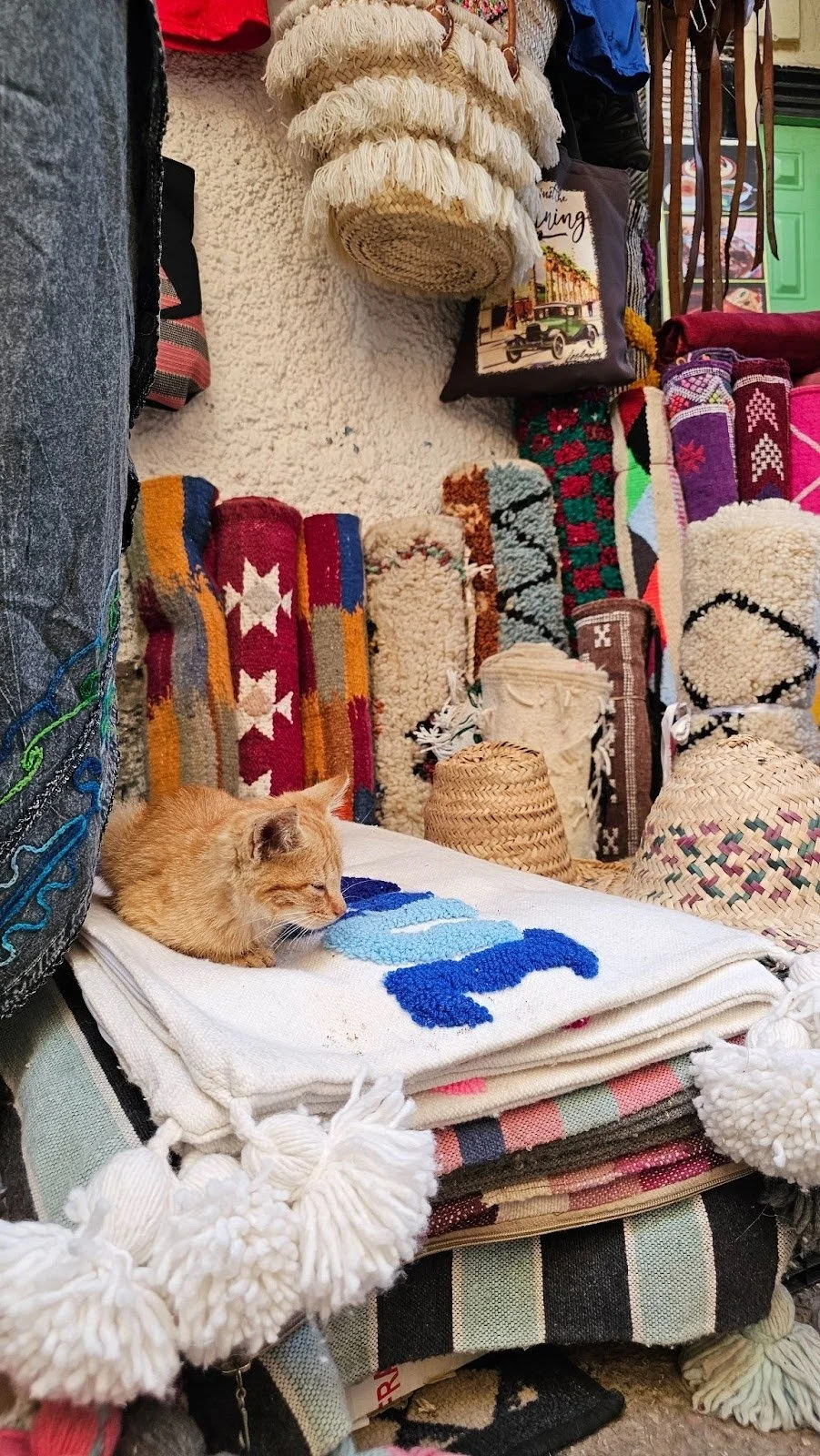
Local business in Morocco. Kara Karinauskaite.
Surfing in Taghazout has shown me how important responsible travel is for the future of its community. By supporting the local economy, respecting cultural practices and helping protect the coastline, visitors can contribute to a tourism that allows surf communities like Taghazout’s to continue benefiting from travel without losing the character and environment that define them.
GETTING THERE:
Blue Waves is a guesthouse in Anza, just a 15-minute drive from Taghazout, that is perfect for travelers who want to immerse themselves in surf culture. Local cooks and hospitality staff make the experience feel genuinely rooted in the community, and alongside its welcoming accommodations, it stands out for its use of locally made pottery and textiles.
Cafe Restaurant Surf Berbere and Dar Josephine are two eateries I particularly enjoyed in Taghazout. They attract visitors with their locally-inspired dishes and provide a warm atmosphere for dining. The town also has many small street-side restaurants offering traditional Moroccan food, which are worth exploring for a more everyday, locally-rooted experience.
Another place that should not be missed is Anza Souk, one of the largest markets in the area. Open on Wednesdays, it is a traditional market that offers a lively setting to buy spices, handmade pottery and other souvenirs.
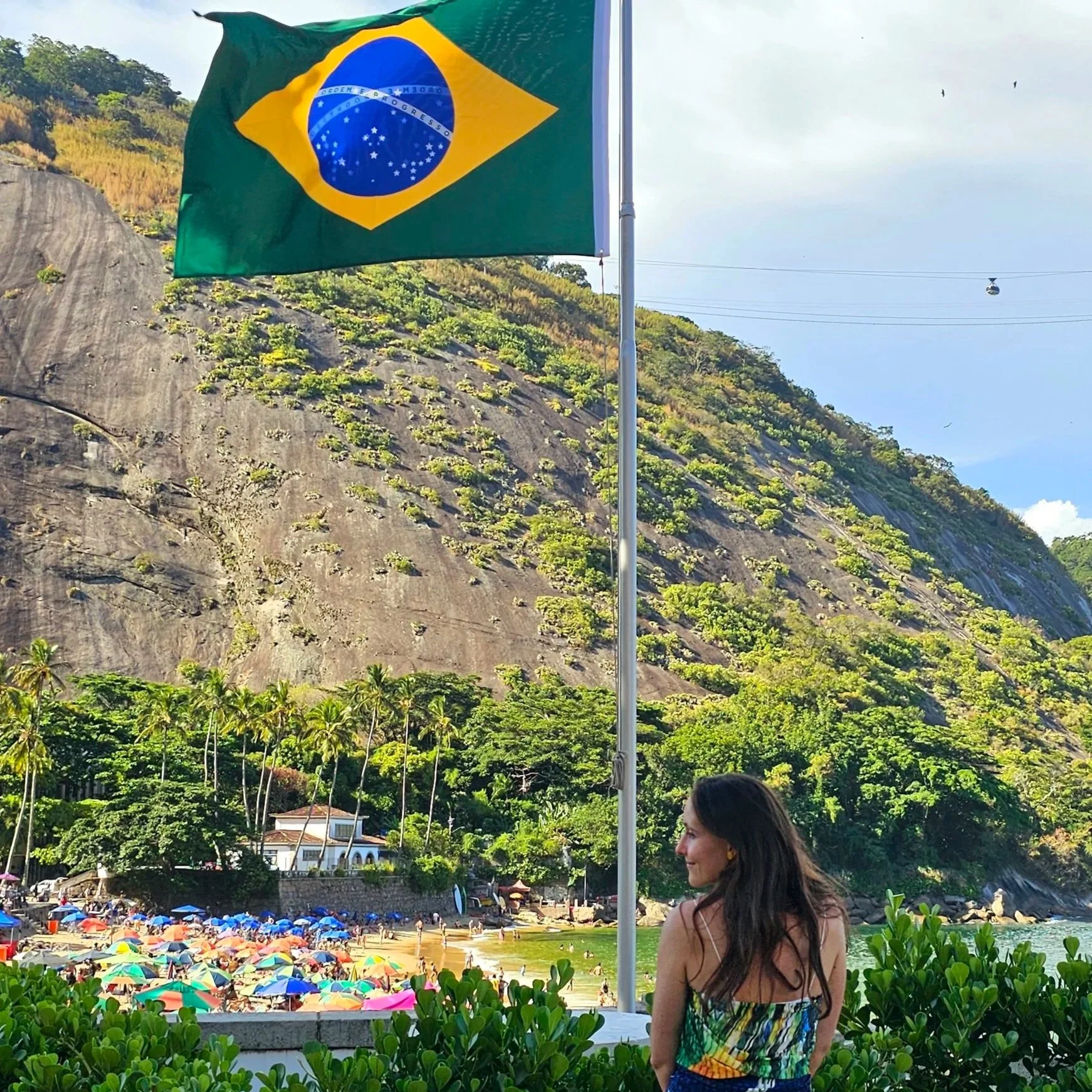
Kara Karinauskaite
Coming from a TV editing background, Kara has worked with broadcasters including the BBC and Discovery Channel. She is a passionate traveller and filmmaker who enjoys documenting meaningful travel experiences and connecting with people who share her interest in sustainable tourism, culture, and nature.
Haiti’s Gangs and the Disappearing Childhood
Carol Khorramchahi
In Port-au-Prince, childhood is being replaced by survival as gangs shrink the space for school, safety and ordinary life.
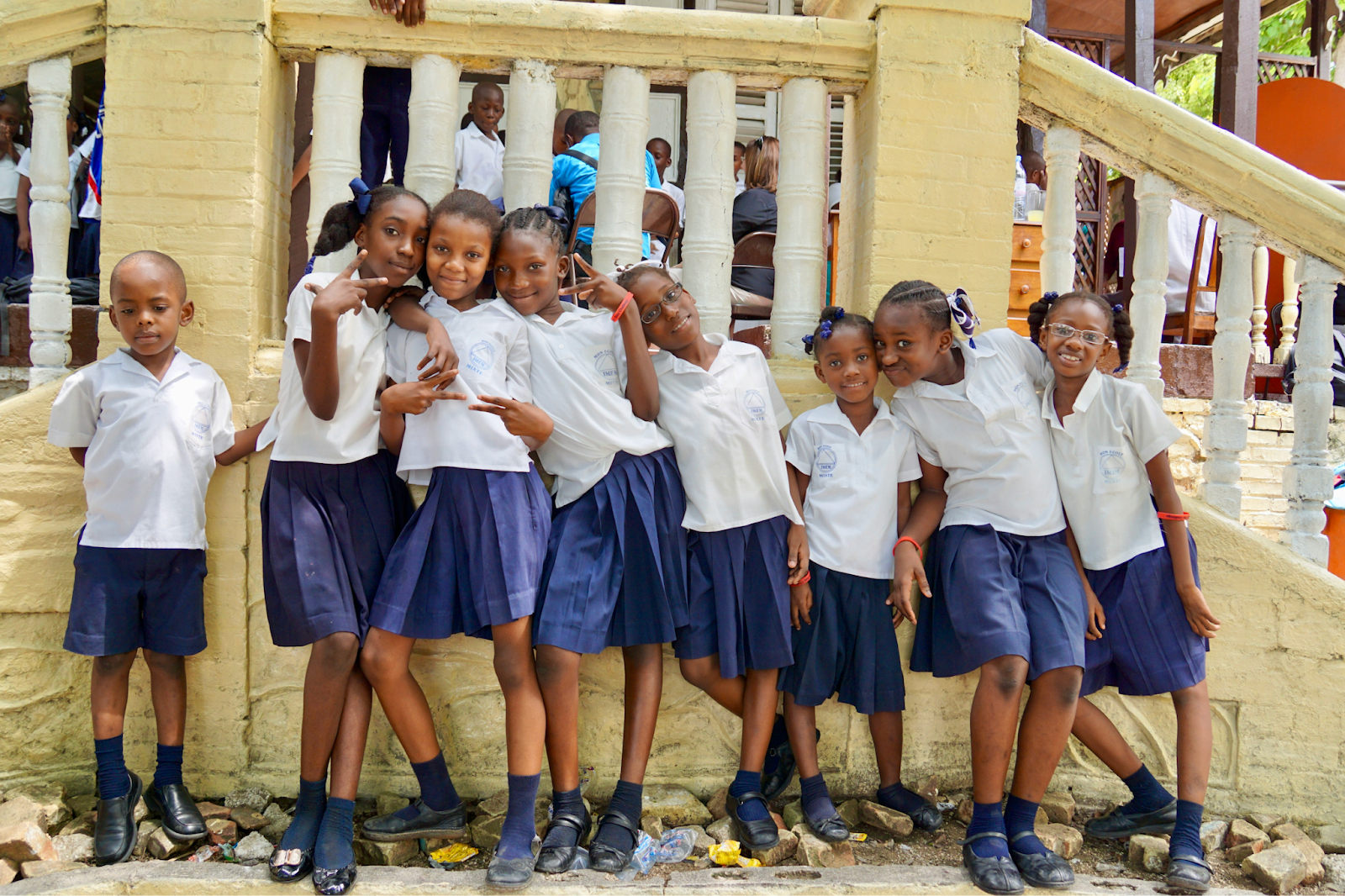
Haitian school children in Port-au-Prince. Heather Suggitt. Unsplash.
In Port-au-Prince, childhood does not end in one dramatic moment. Instead, it disappears in small, relentless ways: a school day that never starts because the road is unsafe; a playground that goes quiet as armed men control the neighborhood; a parent who learns to read the city by sound and timing, measuring risk in the distance between a home and a classroom.
Haiti’s gang violence has become a crisis for children, not only because kids are caught in the crossfire but because they are being absorbed into gang control itself. UNICEF says child recruitment in Haiti rose sharply in 2025, warning that armed groups increasingly rely on children to expand their reach. UNICEF Executive Director Catherine Russell described children’s rights as “non-negotiable,” calling for children recruited by gangs to be released and supported so they can return to learning and rebuild their futures.
The word recruitment can sound distant until you understand what it entails: a child is made to deliver messages; a boy is used as a lookout; a teenager is sent to collect extortion payments; a girl is trapped in exploitation because protection is offered as a bargain. A joint report from the U.N. Human Rights Office and the U.N. mission in Haiti describes child trafficking and exploitation as part of how gangs operate, not an exception. The report says most of Haiti’s active gangs are involved in child trafficking and outlines how children are lured with threats, hunger, drugs or the promise of safety.
For girls, the danger often includes sexual violence and coercion, which is widespread in areas under gang control. The U.N. High Commissioner for Human Rights, Volker Turk, warned that children in Haiti are being robbed of their childhoods and futures. He was not speaking only about trauma but also about the slow destruction of a society’s future workforce, caregivers and leaders.
Displacement has become the backdrop to this entire crisis. UNICEF reports the internal displacement of over 1.4 million people, more than half of whom are children. In displacement sites, privacy disappears, supervision becomes stricter and children are easier to target and harder to protect. Even when families escape immediate violence, instability follows them, and childhood narrows again.
School should be the strongest shield a child has, but in Haiti, it has been one of the first things to fall. UNICEF has warned that education is under attack, reporting that hundreds of schools have been destroyed or closed as violence spreads. When schools shut down, children do not simply lose lessons. They lose structure, meals, a safe space and a daily routine that keeps them visible to adults outside their household; gangs often fill the gap that is left behind.
Haiti’s crisis is typically described in the language of security and politics. Those words matter, but they can blur the most urgent reality. The stakes are not only territorial control or government capacity; they are a generation. When childhood becomes survival, the damage does not end when the shooting stops. It lives on in missed years of education, in trauma carried into adulthood and in a society that has been forced to raise its children in fear.
GET INVOLVED:
Support child protection and education work through UNICEF Haiti and Save the Children. For humanitarian updates and verified needs on the ground, follow ReliefWeb Haiti and the International Rescue Committee.
Carol Khorramchahi
Carol Khorramchahi is a student at Boston University, where she studies English and Psychology and minors in Journalism. She enjoys writing and reporting on stories that bring together culture, identity, and community, and has experience in both newsroom reporting and digital media. She is especially interested in thoughtful storytelling with a global lens.
Observe “Re-wilded” Asian Elephants in their Natural Habitat in Thailand
Salome Liptak
The Mahouts Elephant Foundation offers a unique opportunity for sustainable tourism while also contributing to Asian elephant conservation and Indigenous livelihoods.
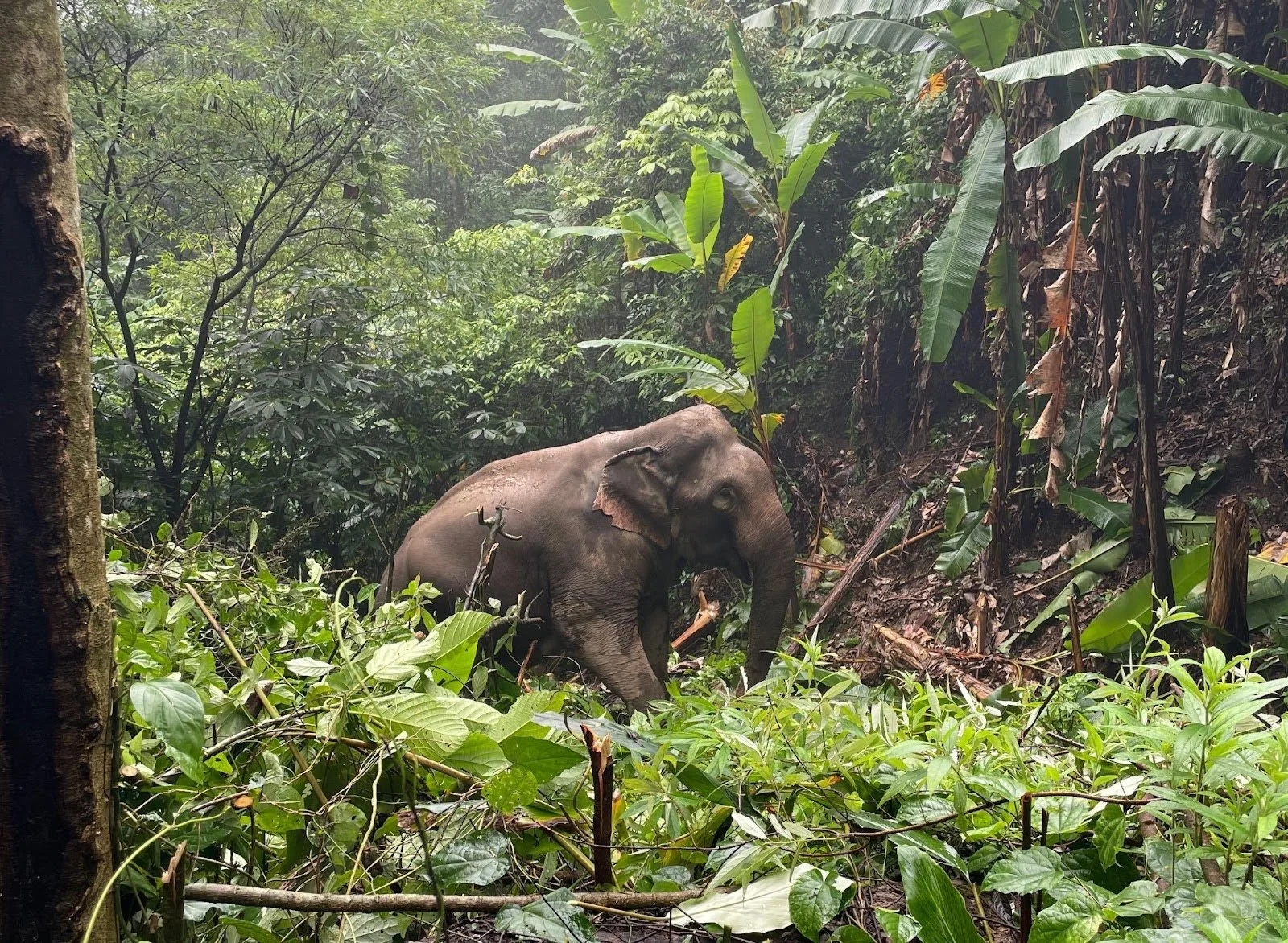
Asian elephant in cloud forest. Salome Liptak.
Deep in Thailand’s mountainous Western Forest Complex, a group of travelers observes Asian elephants as they sleep, forage and socialize in the lush cloud forest that is their natural home. Between the visitors and elephants stand the mahouts, or caretakers, who trek out to check on the animals anywhere from once a week to once a day, depending on their individual needs. The mahouts also act as expert guides for the travelers, tracking the elephants’ courses by the plants they crush in their wake and maintaining the safety of both the humans and animals present. Speaking in their Indigenous Karen language to translators, they can tell where the elephants will want to pass, instructing the visitors on where to move next.
This unique experience has been made possible by the Mahouts Elephant Foundation, a non-profit focusing on Asian elephant conservation and sustainable tourism, founded by Sarah Blaine and her family. Offering different trips with outdoor adventure, conservation education and volunteer focuses, the foundation prioritizes cultural immersion in the Karen community through host families sharing language, food and Indigenous craftsmanship. As a sustainable tourism organization, they utilize a multi-faceted and multi-disciplinary approach to fill the gap in elephant conservation efforts in Thailand.
Elephants have made up a large portion of Thailand’s tourism sector since 1989, when the government imposed a logging ban that left thousands of elephants and their mahouts unemployed. Taking care of an elephant is expensive, and mahouts and their families, who were suddenly destabilized by the economic crisis, were often unable to find new livelihoods that provided enough for them to continue caring for the animals. The majority of these mahouts belong to ethnic minorities, including refugees from Myanmar, and they were therefore especially economically vulnerable. Mahouts consider their elephants as members of their family, which makes the prospect of needing to sell one inconceivable. Despite this, many were forced to lease their elephants into the tourism industry, creating ethical concerns for the well-being of the animals and caretakers alike. The subsequent move to larger cities left mahouts separated from family members as they worked in unfamiliar and dangerous conditions.
Tourist camp practices range from the seemingly benign acts of elephant feeding and bathing to the more obviously unnatural training of elephants to paint, walk on their two hind legs and carry people. While these practices are on a spectrum of severity, all of them require a form of behavioral subjugation, wherein an elephant is trained to do what it would not do naturally. At its most violent, this process is referred to as “crushing” an elephant and involves separating young calves from their families, chaining them in small cells and systematically prodding and hitting them with sharp tools until they follow commands. Elephants are large, powerful animals that can be dangerous to humans, especially in these abusive conditions.
The mahouts, as the legal owners of the elephants, are essentially indentured in the tourist camps. They endure immense levels of stress from the responsibility of keeping the elephants from revolting and hurting tourists. Poverty, the separation from family and the trauma of facilitating or witnessing the crush have contributed to the mental health struggles of mahouts working in tourist camps. These ethical issues have called for reforms in the industry and caused a surge of elephant sanctuaries to open in Thailand, with various approaches and visions of what conservation looks like. Still, today, wild elephants are greatly outnumbered by captive ones, 75% of which are being used in the tourism entertainment industry in some form.
In the foundation’s own words, their mission to combine conservation and community collaboration “cuts off the supply of elephants to the tourism industry, stops the demand of tourists by offering ethical alternatives, brings a sustainable source of income to impoverished communities, and provides science-based evidence showing good elephant welfare.” Their model is unique in its integration of the humanitarian issues of the tourism industry with strict policies on ethical interactions with the elephants.
Elephants brought onto their projects are referred to as “re-wilded,” meaning that while the organization has legal and financial ownership, the animals continue to be looked after by their mahouts and live in the forest as they would naturally. There is no immediate contact between visitors and elephants, including feeding or bathing, with visitors always kept at a distance. The foundation’s conservation and behavioral research contributions are also unique, stemming from research director Liv Baker’s approach, which focuses on individual animal well-being beyond overall population statistics. This informs their trip policies, prohibiting behaviors that many other elephant sanctuaries in Thailand allow and questioning the right of human visitors to interact with the animals.
By fully collaborating with the Indigenous community, Mahouts Elephant Foundation has created a unique environment where conservation research exists alongside an ethical tourism experience. While guests are welcomed and thoughtfully cared for, they must remain conscientious of their role as visitors, staying mindful of the locals, elephants and landscape without thinking of themselves as an audience to be entertained.
GET INVOLVED:
Mahouts Elephant Foundation lets students, volunteers and adventurers hike through the cloud forest in Northern Thailand to observe re-wilded elephants in their natural habitat. For those looking to support the Karen people’s work to foster peace and security in their communities, visit the Karen Organization of Minnesota or check out the Karen cultural crafts for sale at Borderline Collective. Those interested in digging further into animal ethics and wellbeing can visit PAN Works for their extensive work with Asian elephants, as well as other members of the more-than-human community.
Salome Liptak
Salomé is a student at Sarah Lawrence College studying literature and writing. She is passionate about storytelling (both true and fictional) and its power to reflect the world as it is, or imagine what could be.
The Gray Area Between Animal Rides and Animal Rights
Nick Dauk
Camel rides and horse-drawn carriages in the tourism industry create moral dilemmas for travelers.
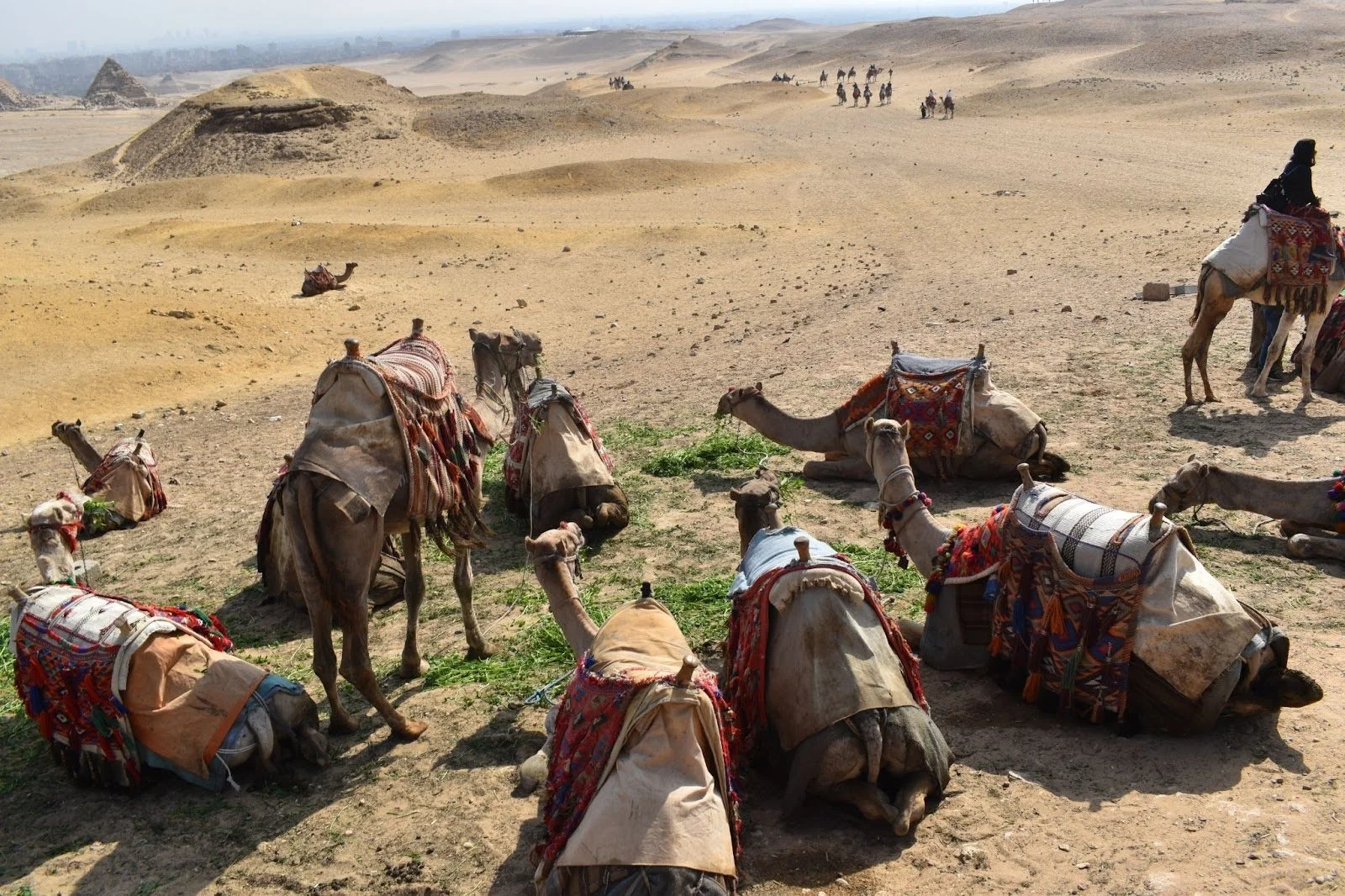
Camels used for tourist rides at the Pyramids of Giza. Nick Dauk.
Seven men stand above a dead horse, discussing the easiest way to move its carcass into a truck bed. This is the second expired equine my tour group has encountered in Egypt; the first, an unfortunate foal, was discarded like trash on the streets of Cairo. Sadly, this is a common sight for many international travelers and is the reason Luxor’s Animal Care in Egypt (ACE) charity veterinary hospital exists. The organization was founded by U.K. traveler Kim Taylor 25 years ago, after she observed the mistreatment of working horses and donkeys in Luxor.
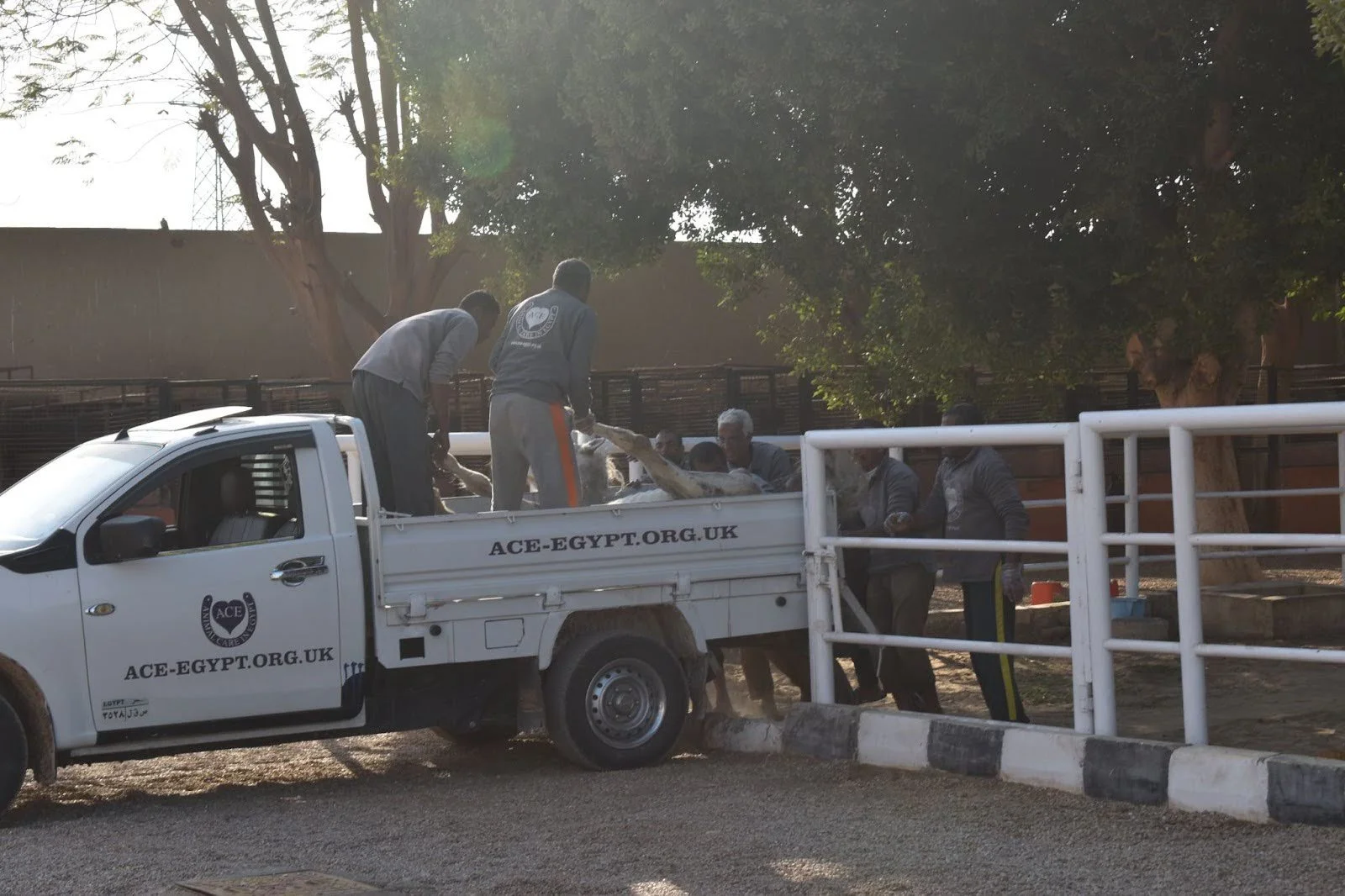
Luxor’s ACE veterinary staff loading a deceased horse into a pick-up truck. Nick Dauk.
In 2023, while I am on tour with Exodus Adventure Travels, I see horses pulling carriages through Luxor that get whipped, kicked and treated like machinery. The reality is that many of the animals working in Egypt’s tourism sector are irresponsibly cared for at best and grossly abused at worst. The issue is not unique to Egypt; elsewhere in the world, equines, elephants and other animals are also subject to mistreatment within a tourism context.
The ethics of animal welfare seem black and white in principle, but both the tourist and the tourism company are often guilty of harboring, even subconsciously, a murky gray scale. Listening to the voices of tourism companies, veterinarians and animal welfare advocates can help travelers draw the line in making ethically educated decisions when encountering animals in the tourism industry. “Animal advocacy is absolutely central to how responsible wildlife tourism should operate,” Head of Positive Impact at Jacada Travel, Natalie Lyall-Grant, tells me. In 2025, Jacada performed an audit of its wildlife-related activities and subsequently removed more than 40 animal experiences from its portfolio of tours. “We prohibit physical interactions with wild animals, refusing to sell attractions that exploit them for profit or forced performance,” Lyall-Grant adds.
Jacada is far from the only tour company to reassess animal encounters; a decade ago, companies like G Adventures and Intrepid Travel banned elephant rides on their tours. The Elephant Conservation Center (ECC) in Laos claims that traveler expectations have also shifted: more travelers are actively seeking out ethical wildlife experiences and pointedly rejecting activities like elephant rides. But even so, the fact is that animal mistreatment is often made less obvious to travelers.
Abuse and Mistreatment Are Often Hidden From Tourists
“Travelers increasingly want to do the right thing, but they’re rarely given the full picture,” says Emily Guice, Corporate Responsibility Officer for PETA. “They don’t see the open sores hidden under saddles, the stables saturated with urine and waste, or animals that are forced to work for hours without proper shade, food or water.”
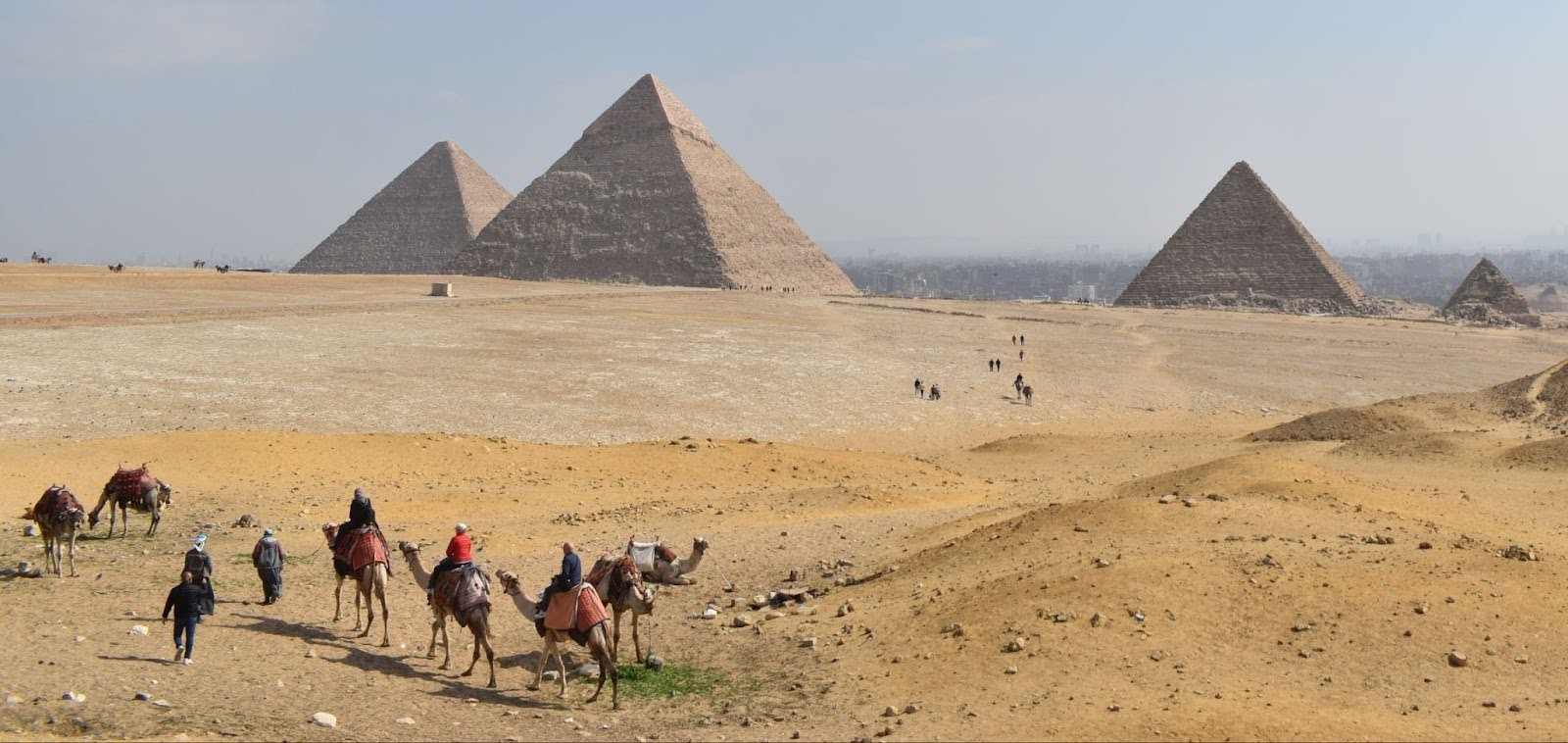
A group of camels used for tourism at the Giza Necropolis. Nick Dauk.
In 2019, PETA uncovered widespread abuse of both horses and camels in Egypt that continued through 2025. The animals were covered in wounds and emaciated, then dumped daily in a hidden graveyard near the pyramids when they expired. I hear these same claims when I visit Luxor’s ACE veterinary hospital. Jana, a German volunteer equine veterinarian, tells me that she regularly sees severe wounds and diseases that she typically doesn’t encounter in Europe. Speaking from a medical perspective, she believes that tourists should not purchase Luxor’s horse-drawn carriage rides, but she also doesn’t think that opting out instantly saves the animals’ lives. “You see a really skinny horse and assume the owners are so cruel, but they’re often just as skinny,” Jana says. “It’s not as easy of a decision as it seems, and I haven’t found a solution for myself yet.”
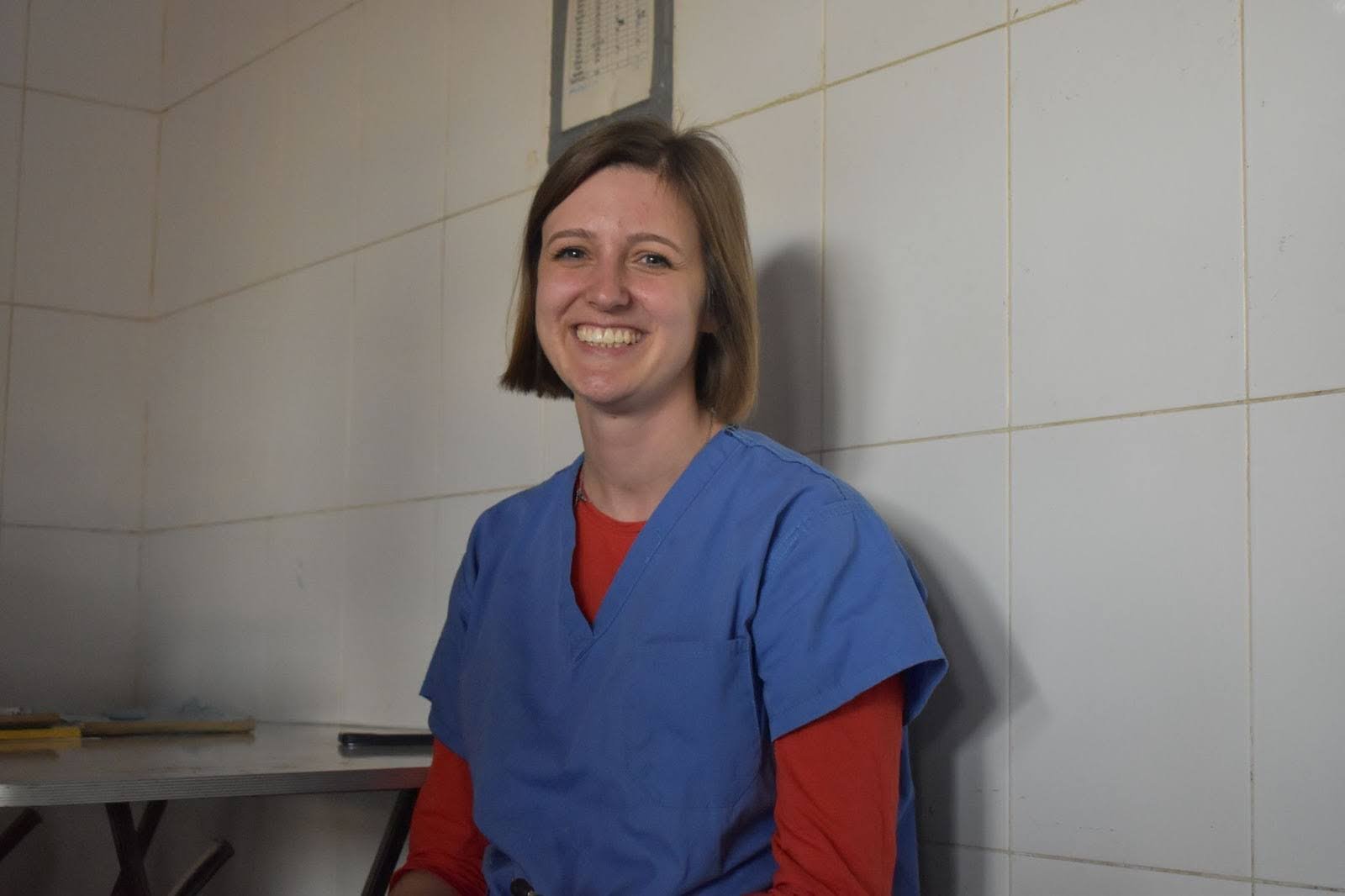
Jana, a German equine veterinarian at ACE in Luxor. Nick Dauk.
A spokesperson from Brooke, an international charity focused on the protection and welfare of working equines, agrees that the issue is complicated for the animal operators. “Most do the best they can within their resources, even if they lack the capacity, opportunity or motivation to make changes.” Yet, while purchasing these services may contribute to the animal’s care, the traveler still needs to understand their responsibility. “Demand drives practice, so ethical choices support better care. Consider if use of the animal is necessary, and how operators support their welfare during and outside of work.”
Other advocates like PETA take a different stance, noting that the need for change lies at a deeper level. “Jobs tied to animal exploitation are precarious by design,” Guice says. “When companies stop promoting animal rides, tourism doesn’t disappear; it shifts to ethical alternatives and opens the door to more sustainable tourism work.”
The Gray Area Between Animal Rides and Animal Rights
At no point did our Exodus tour guide offer or encourage us to ride any animal in Egypt, opting instead to include an ATV ride near Giza’s pyramids and free time to stroll Luxor’s markets on foot. However, Exodus, along with G Adventures, Intrepid Travel and Jacada Travel, does currently offer horseback riding on some Latin America tours. Travelers may find themselves in unfamiliar, sometimes uncomfortable positions where they’re encouraged to make a decision without knowing all of the details. “It really shouldn’t fall on the traveler to figure this out on their own. That’s our responsibility,” said Intrepid’s Leigh Barnes.
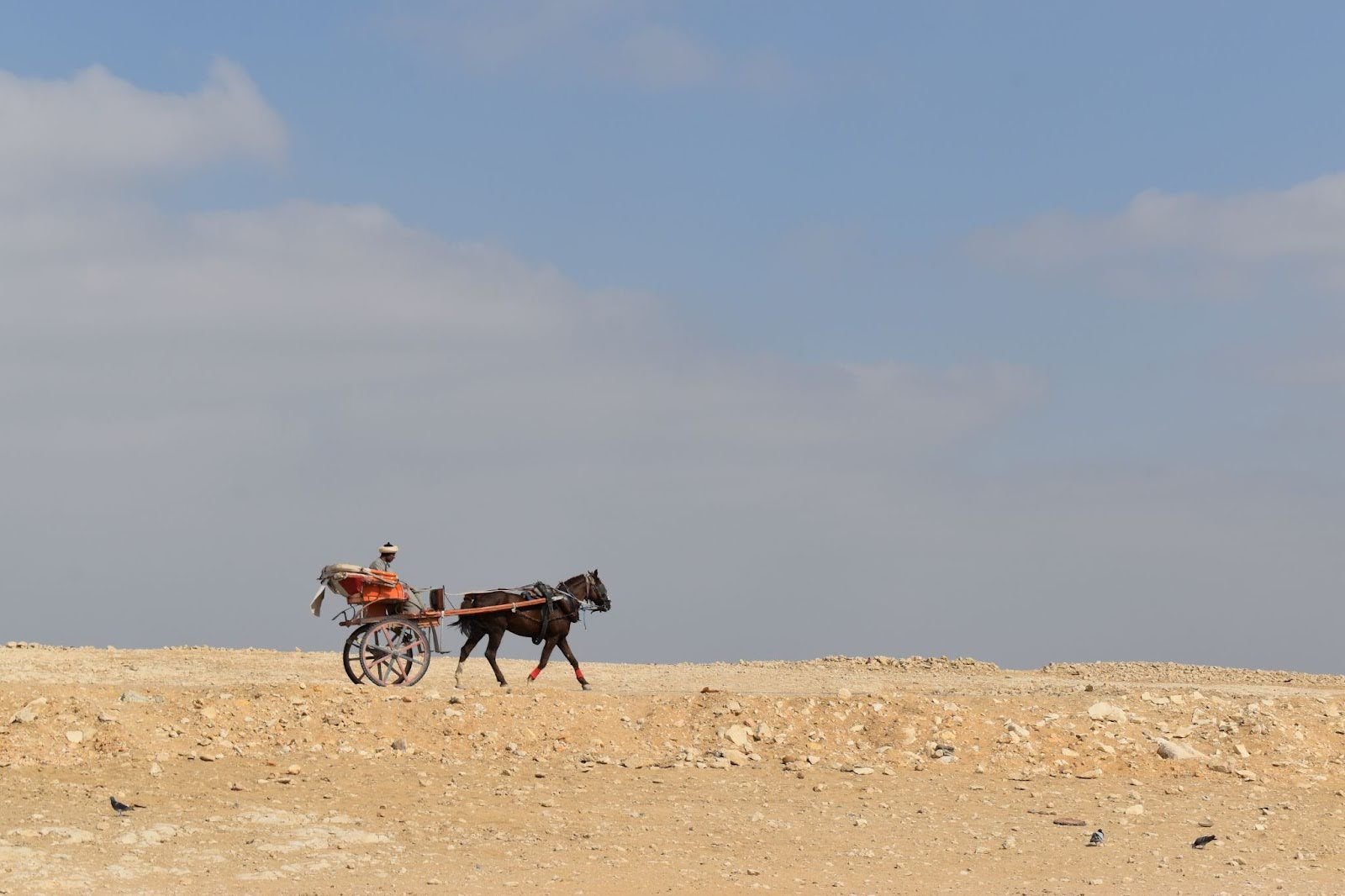
Horse cart and owner near the Great Pyramid of Giza. Nick Dauk.
Thankfully, those looking for alternatives to riding an animal can still achieve a memorable experience at many unforgettable destinations. In Giza, for instance, tourists have the option of riding the new electric buses to the pyramids. Ultimately, the responsibility does fall on both the tour company and the tourist. It’s the operator’s choice on who and how to partner with animal-focused activities, and it’s the traveler’s decision of how they choose to financially support these operators. “The future of animal-friendly tourism isn’t about finding the least harmful ride,” Guice says. “It’s about choosing experiences that let animals be animals, not attractions.”
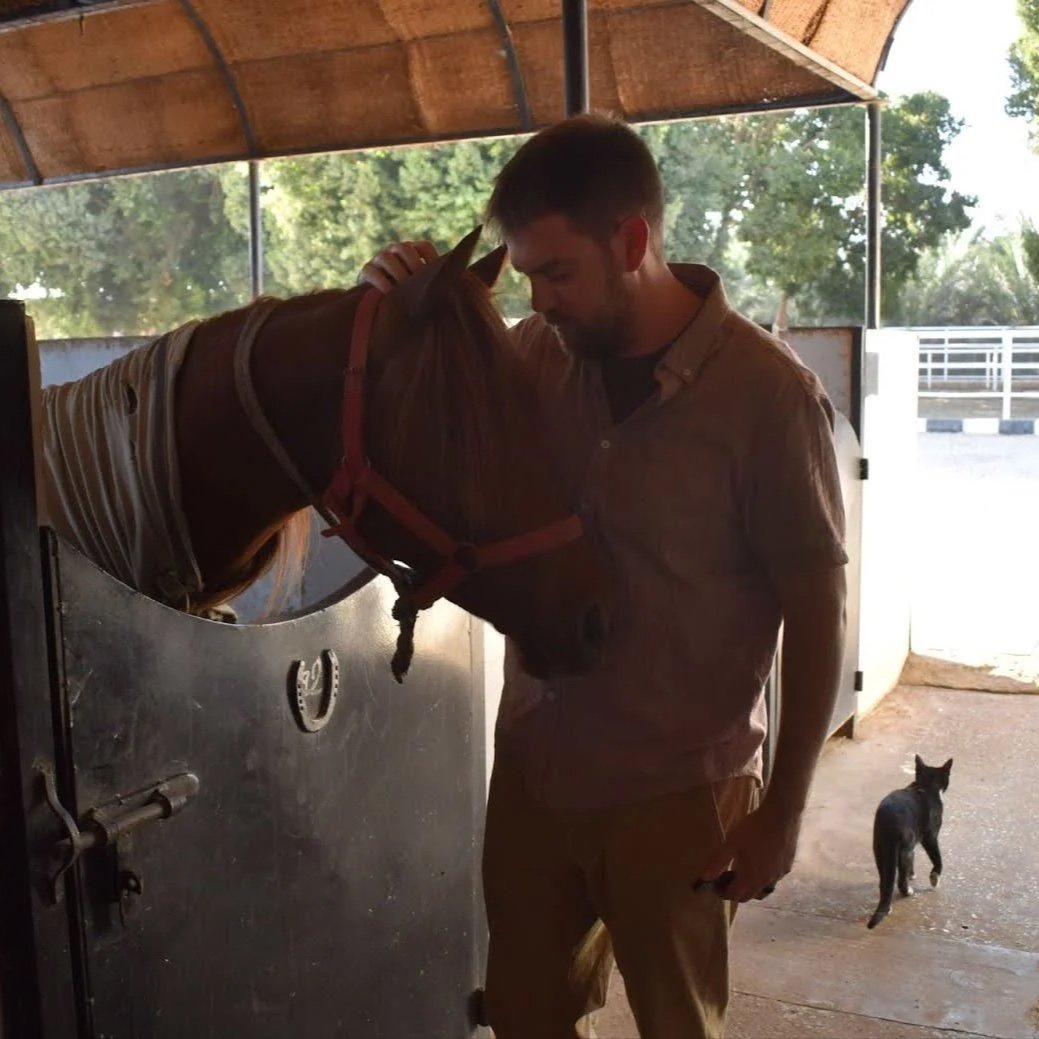
Nick Dauk
Based in Florida, Nick Dauk is a travel writer primarily focusing on tourism sustainability initialives, endangered wildlife, and vulnerable populations. His work has been featured in National Geographic, Afar, The National Post, and Euronews. When he's not photographing the wonders of the Arctic, the Amazon, or Africa, he's usually seeking out cultural, cuisine, and community-based stories across the Americas and Europe.
Iran at War: A Day in Tehran
Carol Khorramchahi
For civilians in Tehran, war isn’t a headline; it’s the sound of strikes at night, the scramble for safety and the fear of what comes next.
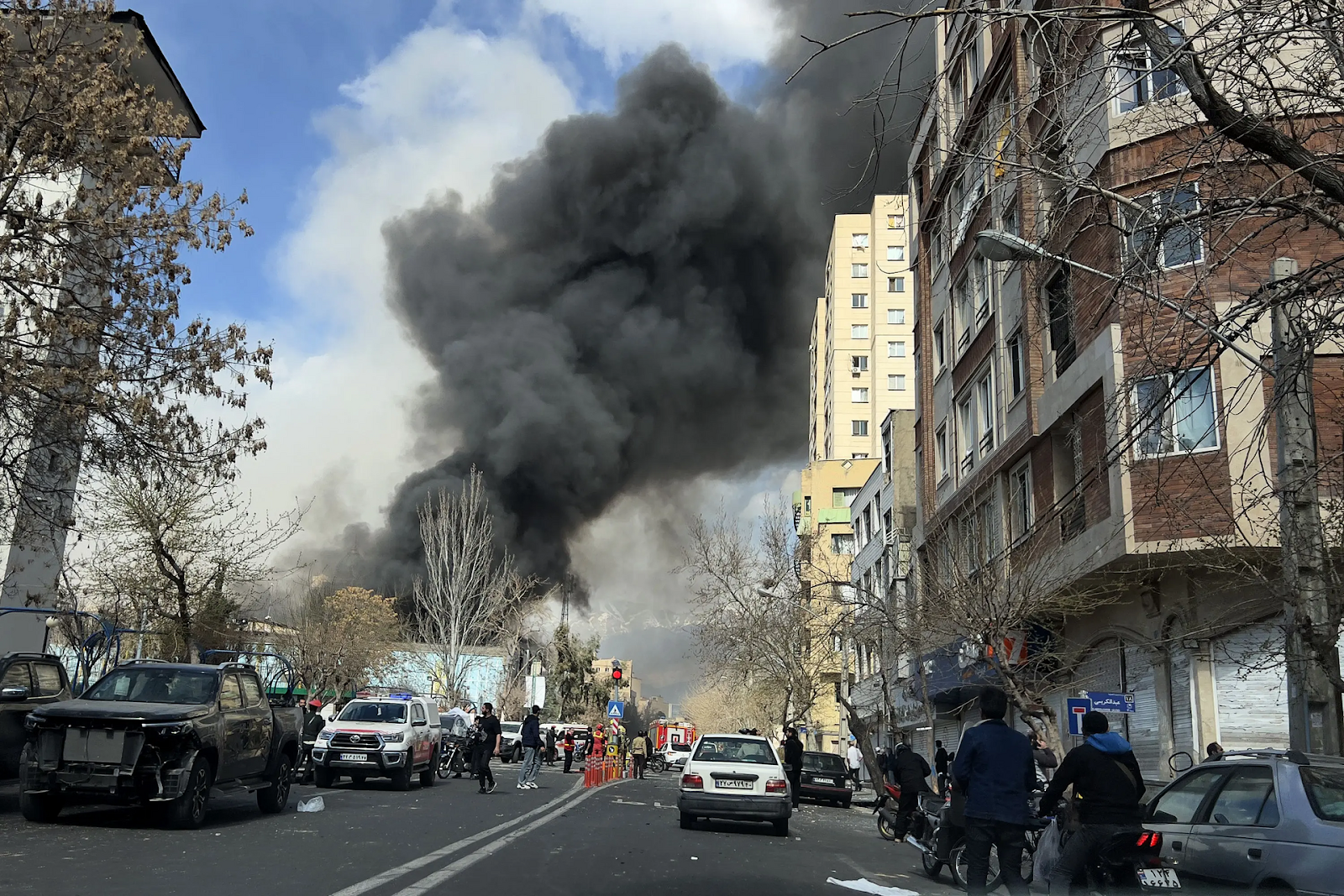
War in Tehran. Muhammad Ali Burno. CC BY 4.0.
For people in Tehran, war is not experienced through maps or military briefings. Instead, it’s felt in nights that don’t feel safe to sleep through, in the sudden rush to a hallway or bathroom when blasts shake the building, in the moment the lights flicker, and you don’t know if it’s a blackout or something worse.
In recent days, the scale of loss has been staggering. Iran’s U.N. ambassador said at least 1,332 Iranian civilians have been killed so far in the conflict, with thousands more injured. And while numbers can’t capture fear, they do show what Tehran residents already know: This is not a distant front line. This is a war reaching into neighborhoods, hospitals, schools and daily routines.
Iran’s Red Crescent reported that about 20,000 civilian buildings have been affected, along with over 70 healthcare facilities. In Tehran, that’s not just damage on paper; it’s what determines whether families can return home, whether clinics can operate and whether ambulances can move quickly when streets are congested or unsafe.
Some of the clearest snapshots of war in Tehran come from the voices of residents themselves. In one report, several Tehran residents described bright flashes turning night “into day,” and one woman told Al Jazeera that “the ground and the windows and our hearts were shaking,” adding that her family sheltered in the bathroom and asked not to be named for security reasons.
Hospitals are still running, but they are under strain. Tehran’s Gandhi Hospital was damaged after strikes hit nearby, and officials said medical facilities and schools had been impacted in multiple places. When healthcare sites are hit or even shaken by nearby blasts, the ripple effects are immediate: Patients get moved, surgeries are delayed and staff are forced to work in uncertainty.
Schools, too, have become part of the story. Reports described strikes that hit schools near Tehran and a wider pattern of attacks affecting education sites. Many parents now face a question that shouldn’t exist: Do you send your child to class when the situation can change overnight?
Even communication, something people rely on to find family, confirm safety and understand what’s happening, has become unreliable. NetBlocks has posted repeated social media updates showing Iran’s wartime internet blackout reaching extreme levels, with connectivity around 1% of ordinary levels during parts of the shutdown. When the internet collapses, it not only silences communities but also cuts off payment systems, disrupts work and makes it harder for people inside and outside Iran to reach each other.
As the threat grows, displacement has become another measure of fear. A U.N. estimate said 3.2 million Iranians have been displaced since the war began, alongside wrenching decisions families face, like whether to flee, where to go and whether leaving might mean not being able to return.
Underneath all of it is a question Iranians are likely arguing about quietly, even when they can’t say it publicly: What comes after this? Some will hope war brings political change. Others will fear that it brings only deeper repression and instability. Some will rally around the state. Others will blame it. Those divisions are visible in glimpses, like demonstrations framed as “defiance and resilience,” even as fear and exhaustion spread.
What’s certain is that for Tehran, war is no longer something “out there.” It is an atmosphere, felt in the noise overhead, the tension in ordinary errands, the uncertainty of school and hospital access and the desperate need to stay connected to the people you love.
GET INVOLVED:
Follow humanitarian updates through ReliefWeb and civilian protection statements from the International Committee of the Red Cross. Track internet shutdown reporting via NetBlocks and digital rights advocacy through Access Now. For human rights documentation, see the U.N. Human Rights Office and Amnesty International.

Carol Khorramchahi
Carol Khorramchahi is a student at Boston University, where she studies English and Psychology and minors in Journalism. She enjoys writing and reporting on stories that bring together culture, identity, and community, and has experience in both newsroom reporting and digital media. She is especially interested in thoughtful storytelling with a global lens.
Beyond the Pyramids: A Guide to Egypt
Carson Jelinek
Discover what else Egypt has to offer from its other natural wonders to its hearty cuisine.
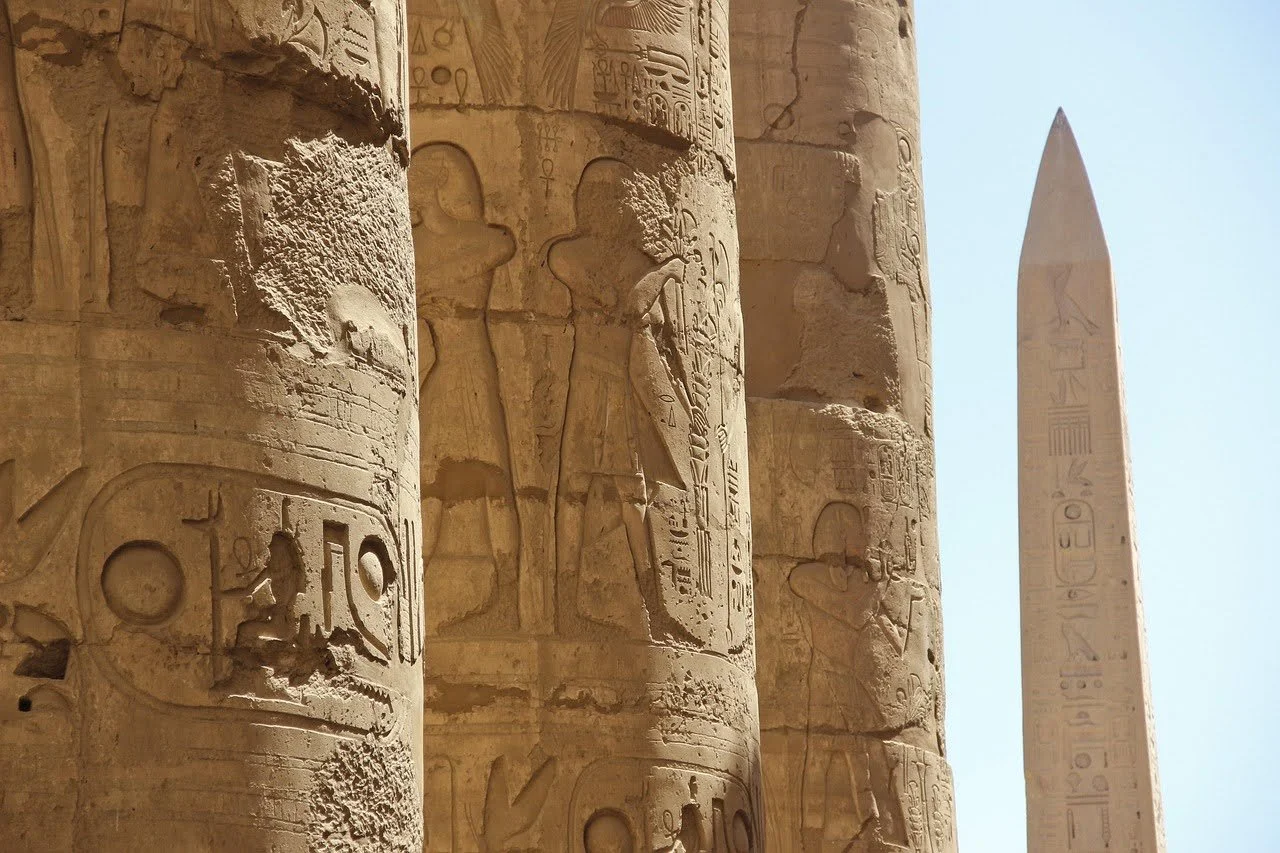
Columns in Egypt. imedias. Pixabay.
The pyramids are often the first things people picture when they think of Egypt, but they are just one part of the country’s rich heritage. With deserts shaped by wind, saltwater oases, colorful coral reefs in clear water and cities where ancient temples stand next to modern buildings, Egypt is much more than just one famous landmark. Visiting without seeing the pyramids lets you discover a deeper and more varied side of a timeless country.
Dock at Red Sea.. Irfan Mujagic. Pixabay.
One of Egypt’s natural wonders is the Sahara el Beyda, also known as the White Desert National Park. This protected national park is famous for its surreal, otherworldly white chalk formations, sculpted by wind erosion into shapes resembling mushrooms and animals. The desert is rich in fossils from an ancient sea and is a popular nighttime camping spot because of the golden sun that sets over it.
White Desert National Park. Xingchen Xiao. Pixabay.
Located near the Libyan border, the Siwa Oasis is a significant natural site characterized by hundreds of springs and thousands of olive and palm trees. The oasis is also home to the temple of the Oracle of Amun, a historical landmark once visited by Alexander the Great.
Feathertail rays in the Red Sea. Franziska Stier. Pixabay.
Stretching along the western shore of the Gulf of Aqaba and the eastern coast of the mainland lies the Red Sea Riviera. With over 1,000 miles of shoreline and clear, warm waters, this spot is perfect for diving, where travelers can observe colorful coral reefs and exquisite marine life. The Red Sea features a world-class ecosystem of over 2,000 different fish species, and 10% of which can’t be found anywhere else in the world. There are also more than 300 coral species, making it a prime spot for dugongs, spinner dolphins and various sharks.
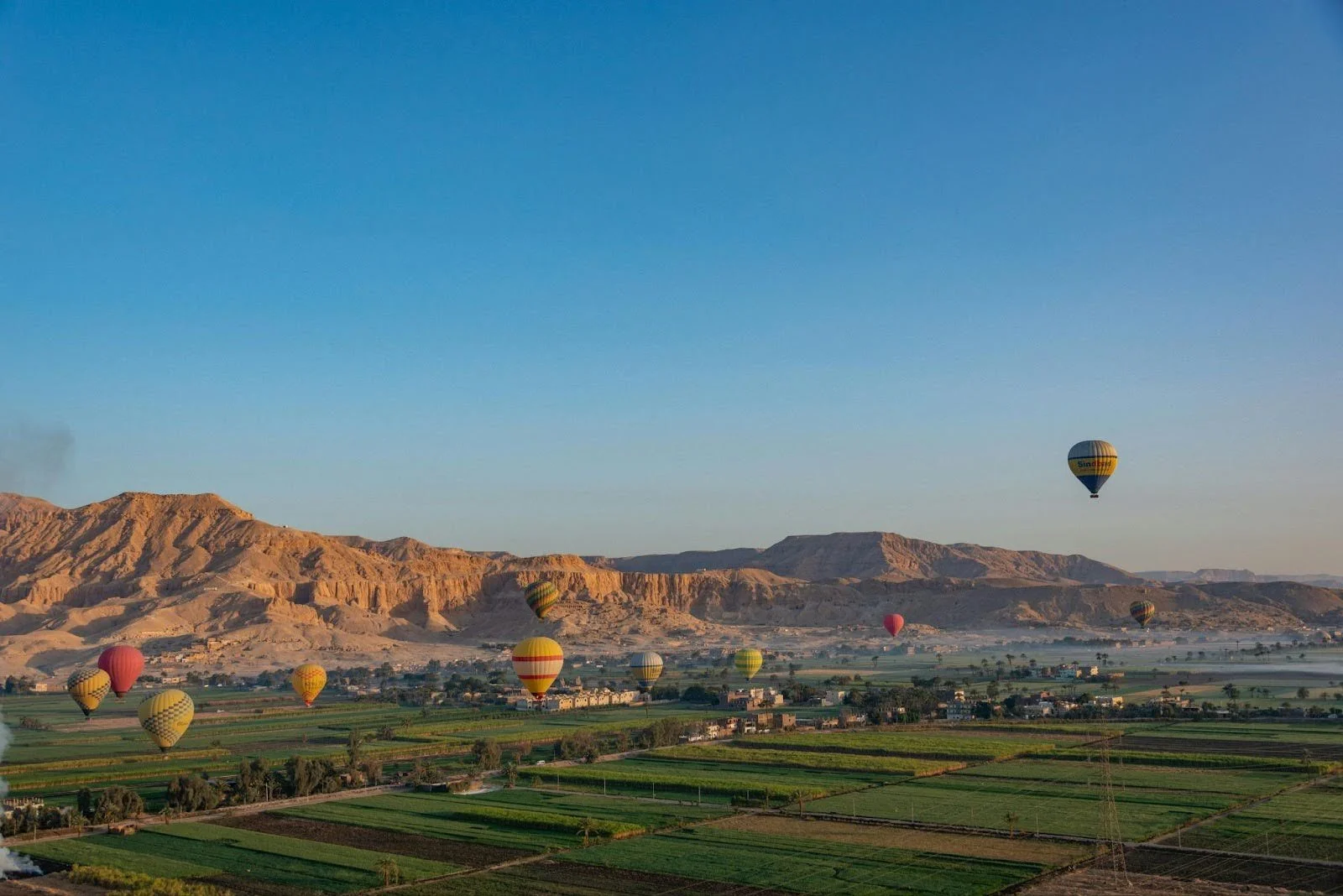
Hot air balloons in Luxor. Diego F. Parra. Pexels.
Luxor, Egypt, is renowned as the world's largest open-air museum, featuring extensive ancient Theban ruins, such as the Valley of the Kings, which contains the tomb of Tutankhamun. Visitors can also explore the city’s intricate temple complexes, like the Karnak and Luxor Temples. For a comprehensive perspective of the area, hot air balloon tours offer panoramic views of these historic sites.

Egyptian paella. koki_4ever. Pixabay.
Egyptian cuisine is characterized by flavorful dishes that prominently feature beans, legumes, rice and fresh herbs. Notable staples include koshari, which is a pasta, lentil and rice dish that serves as national street food, commonly consumed by students and office workers. Another significant dish is ful medames, a slow-cooked meal of mashed fava beans cooked in oil and spices, typically served with bread for breakfast. Both dishes are inexpensive, filling and widely available from street stalls and small local restaurants, making them an everyday option for a wide range of Egyptians.
Carson Jelinek
Carson is a 22 year old writer and filmmaker studying film and media productions at Arizona State University. His work explores travel, culture, and the people behind the places, with a focus on stories that encourage curiosity and global understanding.
How Drones are Protecting the Amazon
Carson Jelinek
With the Amazon nearing a critical ecological threshold, drones have emerged as innovative forest guardians.
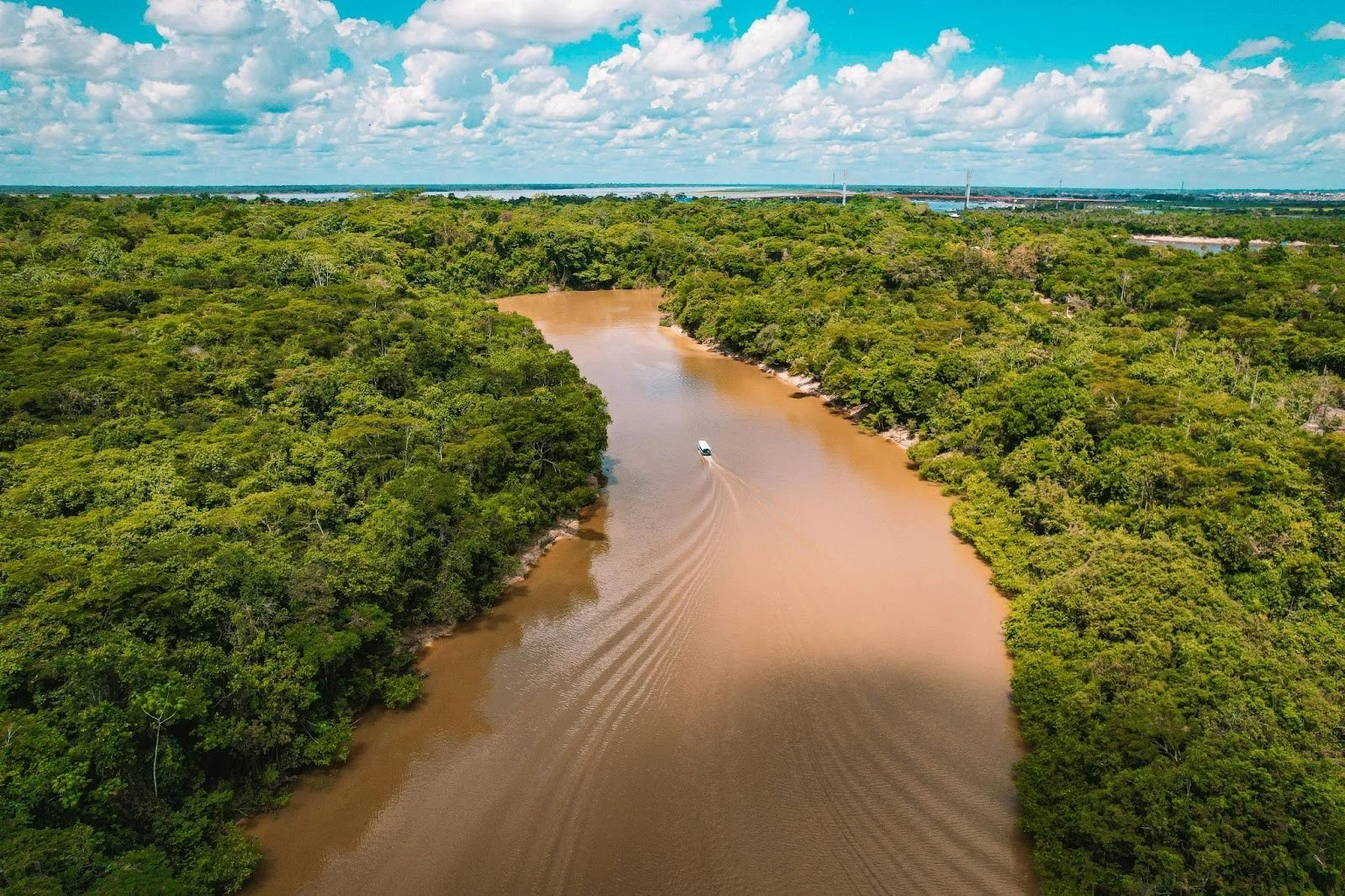
Amazon River. Nando Freitas. Pexels.
For 50 years, the Amazon Rainforest has experienced extensive deforestation due to illegal land grabbing, cattle ranching and agricultural expansion, particularly soy cultivation. There have been some signs of improvement, such as deforestation falling 30% at the end of 2024, but ultimately, activities have pushed the ecosystem to a critical tipping point. Illegal forest fires, for instance, increased in 2025, having been set to clear land and thus leaving the forest more vulnerable to future damage.
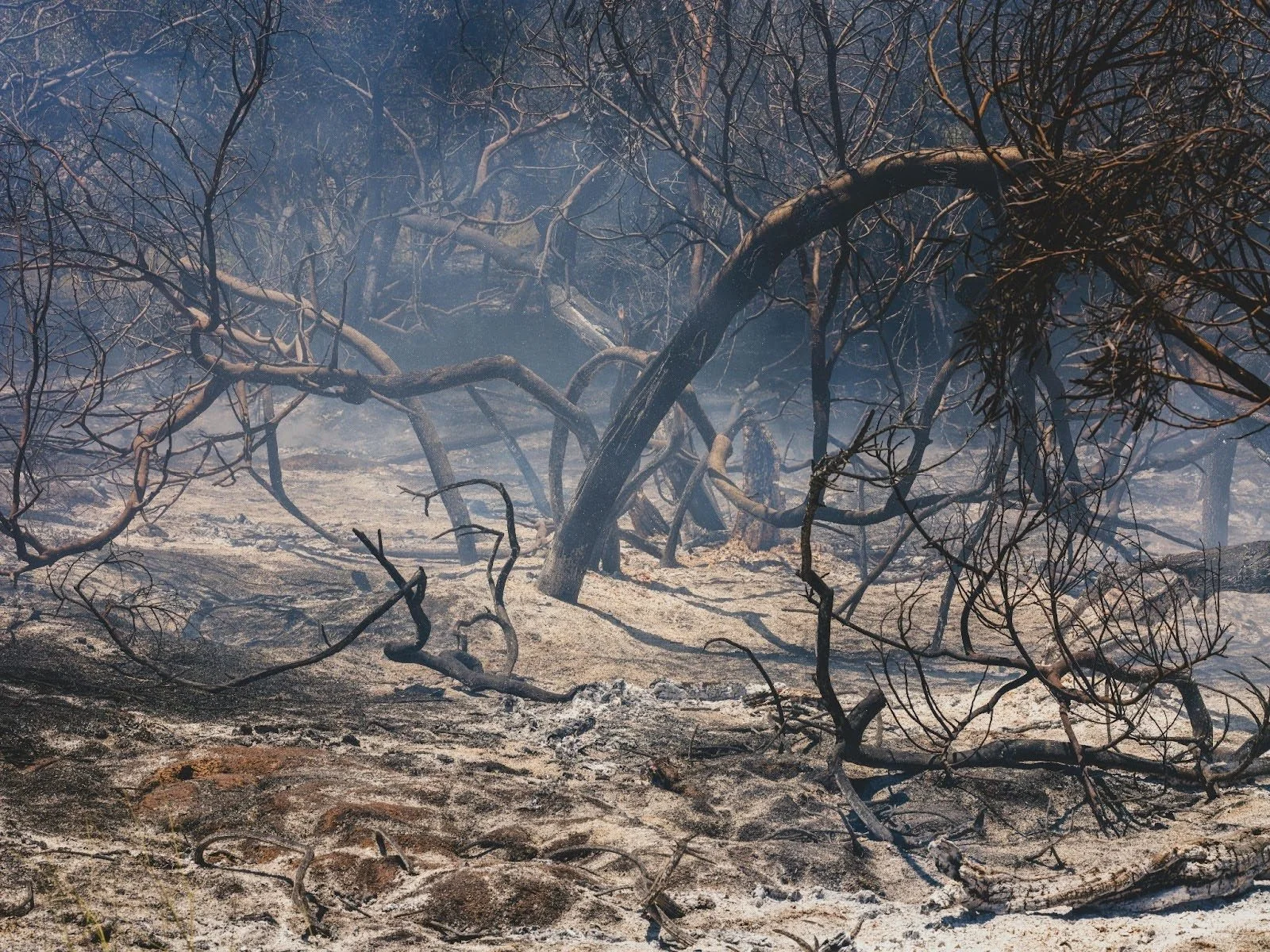
Aftermath of forest fire. Engin Akyurt. Pexels.
MORFO is a French-Brazilian climate tech startup working to restore ecosystems like the Amazon. The company operates in Rio de Janeiro, Brazil, and Montpellier, France, where they focus on science-based, nature-oriented solutions and reforestation led by drone imagery. The mission at MORFO is more than just planting trees; it is about making tropical forest restoration reliable, measurable and investible. The company currently has 24 ongoing projects and 2,000 hectares under active restoration with long-term monitoring and compliance.

DJI drone. ClickerHappy. CC0.
One of MORFO’s projects was an old gold mining site in the Amazon that had less than 1% vegetation cover at the start of their involvement. Local environmental authorities gave MORFO permission to help reforest the area, and now the site has reached 81% vegetation cover. The project, which started at about 10 hectares and has grown to nearly 100 hectares, has demonstrated how technology can accelerate forest recovery alongside regulatory approval.
Woodpile. Pok Rie. Pexels.
Additionally, Indigenous groups are increasingly employing drones to monitor their territories and detect illegal logging or other potential threats. Members of the Uru-Eu-Wau-Wau tribe, for instance, have utilized drone technology to identify the deforestation of 200 hectares of their land. As a result of this surveillance, they successfully intervened to halt further deforestation. The implementation of drones within tribal communities has facilitated the development of technological skills among village members, with each village seeking to train at least seven individuals in drone operation.
GET INVOLVED:
WWF Brazil and the Kaninde Association of Ethno-Environmental Protection: WWF has helped train Indigenous youth, including the Uru-Eu-Wau-Wau tribe, to use drones for patrolling.
Rainforest Foundation US: Donate to support Rainforest US and their working directly with Indigenous peoples, where technicians analyze high-resolution aerial images, GPS data and videos to detect illegal land clearing.
MORFO: Check out MORFO’s website to learn more about their organization, as well as other activities they do.
Carson Jelinek
Carson is a 22 year old writer and filmmaker studying film and media productions at Arizona State University. His work explores travel, culture, and the people behind the places, with a focus on stories that encourage curiosity and global understanding.
Do Greenlanders Really Need Saving?
Salome Liptak
Trump's continued pursuit of annexing Greenland has complicated international discussions of the territory's relationship with Denmark.

Protester holding Greenland’s flag. Peter Platou. Pexels.
Greenland, the autonomous territory of Denmark that is home to about 56,000 people, has been the subject of international debate during the second Trump administration. Trump first expressed interest in purchasing Greenland from Denmark in 2019, but now he has escalated to threats of tariffs against Denmark and its European allies, as well as military action against Greenland.
Greenland has had its own parliament for domestic governance since the 1979 Home Rule Act, and it achieved self-rule in 2009, when legislation outlining Denmark’s legal pathway to voluntary independence was passed. Current polls show that Greenlanders hope to utilize this pathway to complete independence from Denmark, but Greenland’s vast, remote landscape and low population make economic independence presently impossible. This is also a major factor for the healthcare access issues that concern Greenlanders of all viewpoints, since the most remote community clinics are typically understaffed and underresourced.
Several European leaders have expressed their disapproval of Trump’s threats and emphasized their solidarity with Greenland against foreign intervention. Greenland’s unique status as a territory has required careful wording when defending the island’s right to self-determination, including U.K. Prime Minister Keir Starmer’s affirmation that “the future of Greenland is for the people of Greenland and the Kingdom of Denmark alone.” French President Emmanuel Macron made a similar statement, choosing to affirm Greenlanders’ sovereignty while speaking in Indigenous Greenlandic.
Greenland’s post-colonial relationship with Denmark, as is true for many Indigenous groups around the world, remains complicated. Greenland, whose population is majority Inuit, bears several national wounds from Danish colonial rule, which only ended in 1953. These include social experiments that separated Inuit children from their families and put them in Danish foster families to assimilate in 1951, as well as the forced sterilization of Inuit women throughout the 1960s. While Denmark has made strides toward reparations with public apologies and payouts for those involved, this painful history has left its mark, and systemic discrimination continues to be an issue in Greenland’s healthcare, education and social services, all of which are funded by Denmark.
Trump’s current push to annex Greenland has taken a different tone than that of his first term, utilizing the Kingdom of Denmark's present sovereignty over Greenland to justify U.S. intervention. On Truth Social, he announced his plan to send the U.S. hospital ship USNS Mercy to Greenland “to take care of the many people who are sick, and not being taken care of there.” The post’s unsubstantiated claim, along with its AI-generated image of the Mercy, caused widespread confusion. It appears this plan may have originated with Jorgen Boassen, a Greenlandic Trump supporter who has been vocal about issues of healthcare access in Greenland’s rural clinics. In response, Greenland’s Prime Minister, Jens-Frederik Nielsen, noted that Greenland currently has a “public healthcare system where treatment is free for citizens,” providing more access to services than the current U.S. healthcare system, despite being flawed.
This new attempt at a humanitarian claim to Greenland only further complicates international discourse on Greenland’s sovereignty. For the majority of Greenlanders who oppose American acquisition of Greenland, Trump's threats of intervention on their behalf have only increased the obstacles they face in establishing independence, as they are reliant on Denmark for defense; if Greenland were to leave the realm of Denmark, it would likely be unable to defend itself from unwanted intervention. Many Greenlanders have expressed humor at the ironic effect Trump’s actions have taken, such as one viral video from the Danish public broadcast DRP3, where a man tells the camera, “Yes, Mr. President! You are a true peacemaker. Because your threats have actually brought Denmark and Greenland closer together than ever!”
While Denmark’s control leaves much to be desired for many Greenlanders and complete sovereignty remains a political goal, it is clear that intervention from Trump is both unwarranted under international legal norms and unwanted by the majority of Greenlanders.
Salomé Liptak
Salomé is a student at Sarah Lawrence College studying literature and writing. She is passionate about storytelling (both true and fictional) and its power to reflect the world as it is, or imagine what could be.