
The top art shows of the summer explore what it means to live in the modern world.
Read MoreIran at War: A Day in Tehran
Carol Khorramchahi
For civilians in Tehran, war isn’t a headline; it’s the sound of strikes at night, the scramble for safety and the fear of what comes next.
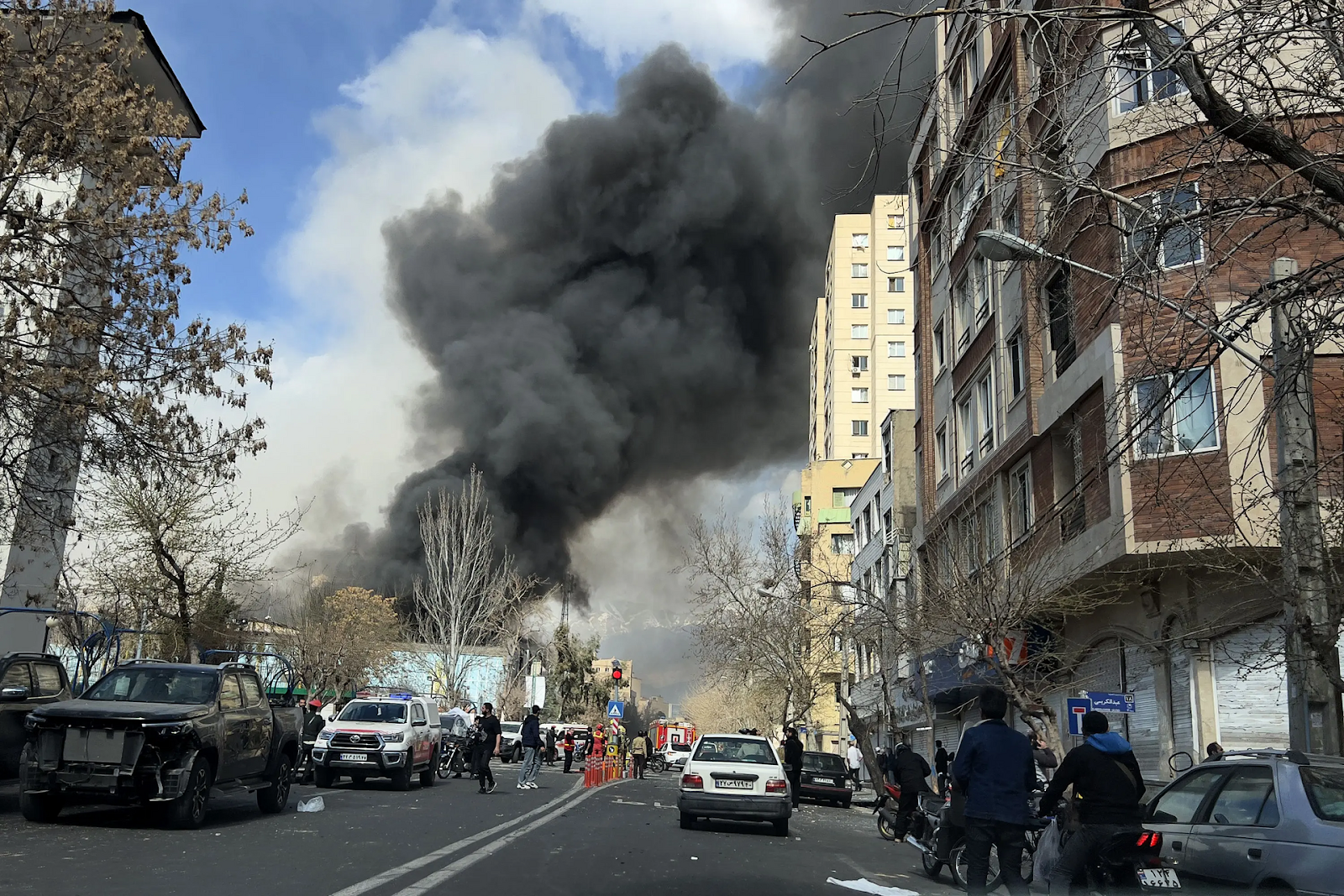
War in Tehran. Muhammad Ali Burno. CC BY 4.0.
For people in Tehran, war is not experienced through maps or military briefings. Instead, it’s felt in nights that don’t feel safe to sleep through, in the sudden rush to a hallway or bathroom when blasts shake the building, in the moment the lights flicker, and you don’t know if it’s a blackout or something worse.
In recent days, the scale of loss has been staggering. Iran’s U.N. ambassador said at least 1,332 Iranian civilians have been killed so far in the conflict, with thousands more injured. And while numbers can’t capture fear, they do show what Tehran residents already know: This is not a distant front line. This is a war reaching into neighborhoods, hospitals, schools and daily routines.
Iran’s Red Crescent reported that about 20,000 civilian buildings have been affected, along with over 70 healthcare facilities. In Tehran, that’s not just damage on paper; it’s what determines whether families can return home, whether clinics can operate and whether ambulances can move quickly when streets are congested or unsafe.
Some of the clearest snapshots of war in Tehran come from the voices of residents themselves. In one report, several Tehran residents described bright flashes turning night “into day,” and one woman told Al Jazeera that “the ground and the windows and our hearts were shaking,” adding that her family sheltered in the bathroom and asked not to be named for security reasons.
Hospitals are still running, but they are under strain. Tehran’s Gandhi Hospital was damaged after strikes hit nearby, and officials said medical facilities and schools had been impacted in multiple places. When healthcare sites are hit or even shaken by nearby blasts, the ripple effects are immediate: Patients get moved, surgeries are delayed and staff are forced to work in uncertainty.
Schools, too, have become part of the story. Reports described strikes that hit schools near Tehran and a wider pattern of attacks affecting education sites. Many parents now face a question that shouldn’t exist: Do you send your child to class when the situation can change overnight?
Even communication, something people rely on to find family, confirm safety and understand what’s happening, has become unreliable. NetBlocks has posted repeated social media updates showing Iran’s wartime internet blackout reaching extreme levels, with connectivity around 1% of ordinary levels during parts of the shutdown. When the internet collapses, it not only silences communities but also cuts off payment systems, disrupts work and makes it harder for people inside and outside Iran to reach each other.
As the threat grows, displacement has become another measure of fear. A U.N. estimate said 3.2 million Iranians have been displaced since the war began, alongside wrenching decisions families face, like whether to flee, where to go and whether leaving might mean not being able to return.
Underneath all of it is a question Iranians are likely arguing about quietly, even when they can’t say it publicly: What comes after this? Some will hope war brings political change. Others will fear that it brings only deeper repression and instability. Some will rally around the state. Others will blame it. Those divisions are visible in glimpses, like demonstrations framed as “defiance and resilience,” even as fear and exhaustion spread.
What’s certain is that for Tehran, war is no longer something “out there.” It is an atmosphere, felt in the noise overhead, the tension in ordinary errands, the uncertainty of school and hospital access and the desperate need to stay connected to the people you love.
GET INVOLVED:
Follow humanitarian updates through ReliefWeb and civilian protection statements from the International Committee of the Red Cross. Track internet shutdown reporting via NetBlocks and digital rights advocacy through Access Now. For human rights documentation, see the U.N. Human Rights Office and Amnesty International.

Carol Khorramchahi
Carol Khorramchahi is a student at Boston University, where she studies English and Psychology and minors in Journalism. She enjoys writing and reporting on stories that bring together culture, identity, and community, and has experience in both newsroom reporting and digital media. She is especially interested in thoughtful storytelling with a global lens.
As Tehran Burns, Civilians are Caught in the Crossfire
Despite facing government censorship, the voices of Iranian residents reveal the fear and grief they endure under Israeli attacks.
Read MoreThe Direction of Iran’s Woman, Life, Freedom Movement
With tensions high domestically and internationally, women both inside and outside of Iran are cynical that things will change.
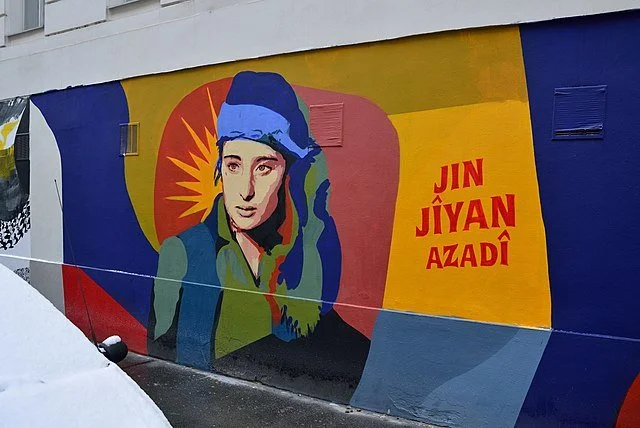
A mural in support of the Jin, Jiyan, Azadi (Woman, Life, Freedom) movement. Herzi Pinki. CC BY 4.0
For many in Iran, history can be broken up into two epochs: before 1979 and after. Women, in particular, find significance in this demarcation because Iran’s 1979 Islamic Revolution brought the expansion — and then constriction — of their rights. These tensions surrounding women’s role in Iranian society came to a head in 2022, when the widespread Woman, Life, Freedom movement put them on global display. But the Woman, Life, Freedom movement didn’t spawn out of nowhere, and it’s important to look at its past when considering its future.

Women at the 1979 International Women’s Day protests in Tehran. Mohammad Sayad. CC0
Prior to the Iranian Revolution, women saw their rights and opportunities gradually expand as part of the country’s modernization efforts. The state wanted to Westernize itself, and this manifested in women being mandated (sometimes violently) to not veil themselves, per a 1936 decree. But the revolution saw the nation shirk its Western influences — thanks in large part to women. While some mobilized public demonstrations, others acted as nurses and first responders. Few fought in guerilla conflicts, but many wore hijabs to protest the monarchy's 1936 ban on veils, linking modest dress with the revolution’s vision of a new Iran.
However, after the revolution succeeded and the pro-Western monarchy was overthrown for an Islamist theocracy, women’s roles became more limited. In an interview I conducted with Iranian Circle of Women’s Intercultural Network steering committee member Ruja Kia, she affirmed, “Adding the religious components of private life to the law of the land never makes things easier for women.”
The revolution placed nearly all Iranian state power in the role of “the supreme leader,” where it still remains today. As both a religious and political authority, the first supreme leader, Ayatollah Ruhollah Khomeini, sought to curb women’s post-revolution rights and professional opportunities in favor of a return to traditional domesticity. Further, after revolutionaries associated modesty with the new Islamic Republic, Khomeini mandated women to cover themselves with hijabs. What had once been a symbol of dissent and autonomy became a violently imposed law.
The 1979 hijab mandate notably came under international scrutiny in 2022, following the death of Mahsa Amini. Iran’s Guidance Patrol, or morality police, arrested Amini for an “improper hijab.” She died in their custody three days later — officially of a heart attack but allegedly of police brutality (In our interview, Ruja Kia also noted that Amini was Kurdish, an Iranian ethnic minority that often faces discrimination).
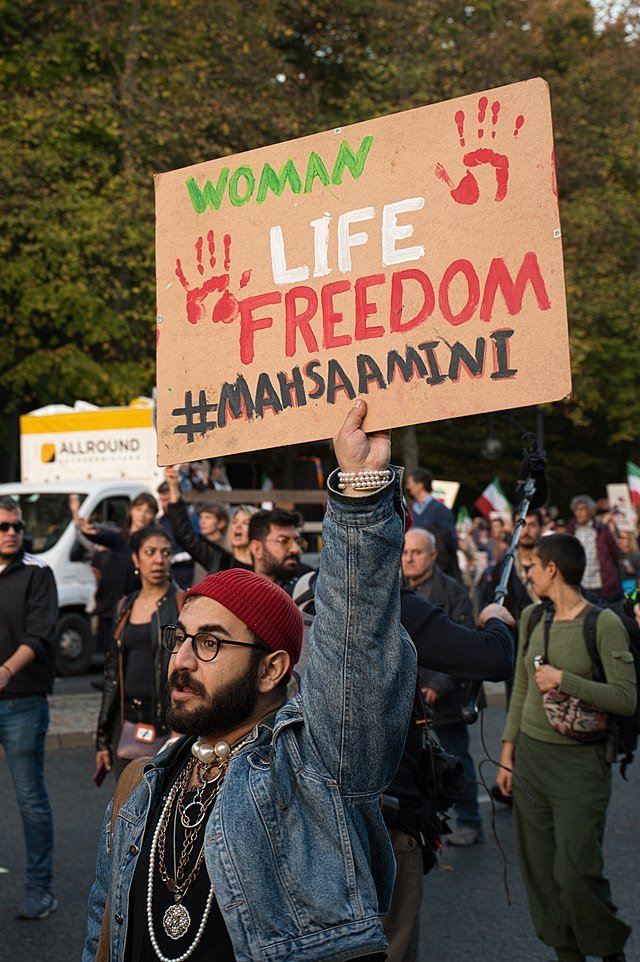
A man protests in support of the Woman, Life, Freedom movement following Amini’s death. Ilias Bartolini. CC BY 2.0
Amini’s death sparked mass protests — not only in Iran but also around the world. Internationally, the rallying cry was “woman, life, freedom,” a translation of the Kurdish feminist slogan “Jin, Jiyan, Azadi.” For its criticisms against the compulsory hijab, the morality police and the Islamic Republic in general, the Woman, Life, Freedom movement has been intensely repressed by Iran’s current supreme leader Ayatollah Ali Khamenei. Iranian security forces have killed more than 500 demonstrators and arrested thousands across the country.
“I say explicitly that these [Woman, Life, Freedom] riots and this insecurity were a design by the US and the occupying, fake Zionist regime [Israel],” Khamenei said in 2022, as reported by Al Jazeera. On a broader scale, Khamenei believes that the hijab is a religious and therefore, moral obligation. He further contended that gender equality is a Western plot designed to weaken Iran: “[The West] feel[s] that [Iran] is progressing towards full-scale power and they can’t tolerate this.” Because of and in spite of Khamenei’s deadly response, the Women, Life, Freedom movement gained international prominence, making the future of women’s rights in Iran an unavoidable and salient issue in the recent election.
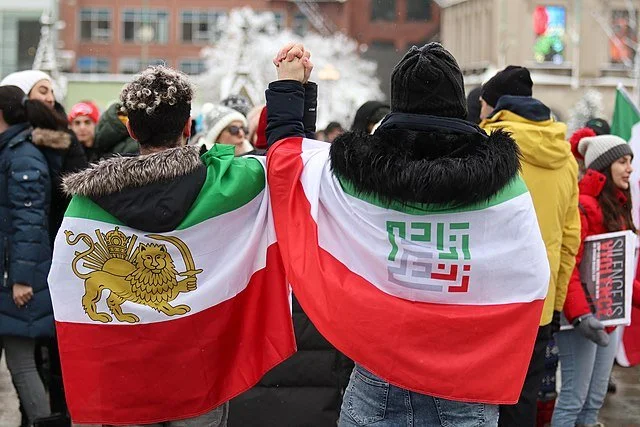
Two women attend a Woman, Life, Freedom protest wearing past versions of the Iranian flag. Taymaz Valley. CC BY 2.0
Masoud Pezeshkian, Iran’s newest president, campaigned on a reformist platform, asserting a desire to steer the nation toward greater peace. Now, after taking office in July, he has a chance to do so. For many nations that have tensions with Iran, having the moderate Pezeskian in office is cause for cautious optimism. Inside Iran’s borders, however, women are still reeling from the pushback Woman, Life, Freedom received two years ago and are thus more cynical about the promise of Pezeshkian’s election. “Although we might see more moderate approaches in bigger metropolitan areas, women across the rest of Iran will stay controlled by family customs and norms,” said Ruja Kia.
As the only reformist in a field of six candidates, Pezeshkian’s positions on women’s rights stood out as the most progressive. Frequently invoking his daughter, a chemist, and the memory of his late wife, a gynecologist, he spoke of increasing women’s presence in the professional sector: “A woman is not a servant at home,” Pezeshkian wrote on X.
Regarding the mandatory hijab, Pezeshkian has expressed support for relaxing the mandate: “The behavior of Iranian girls will not change. Just as the previous [1936 laws] could not forcibly remove the hijab from the heads of our women, you cannot force them to wear the hijab by passing a law,” he wrote in another X post. But some, like Kimia Adibi, the President of UC Berkeley’s Iranian Students’ Cultural Organization, believe that Pezeshkian’s words are empty promises. “[Pezeshkian’s] not actually pushing for women’s freedom and change because if he were, he never would’ve been allowed to run,” Adibi said to me. “Anyone who’s an actual radical reformist and believes in women’s freedom and not forcing the mandatory hijab… like, they’re not even going to make it to the candidacy level.”
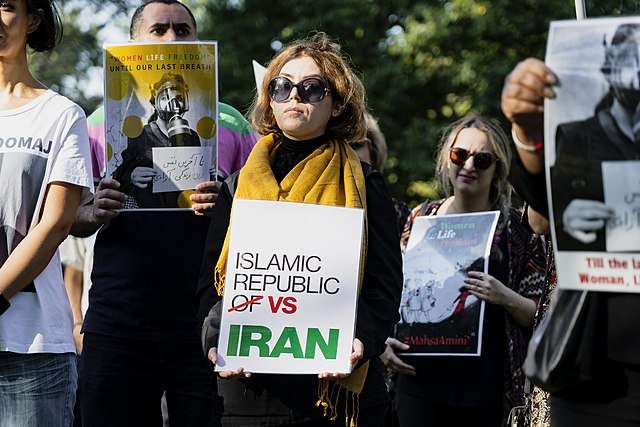
A woman at a Woman, Life, Freedom protest. Matt Hrkac. CC BY 2.0
Pezeshkian’s parliamentary record shows that he’s supported restrictions on women’s rights in the past, and alongside the posts he made calling for women’s rights, he also posted to X, “All of us move towards dignity and power according [...] to the general policies of the supreme leader.”
For Iranian feminists, the zeitgeist has not shifted. While it’s not impossible, they say, for Pezeshkian to achieve some reform — “little shifts,” as Adibi put it — so long as religion and politics remain married to an ultimate authority who violently rejects gender equality, women’s rights in Iran will not improve much under the new president.
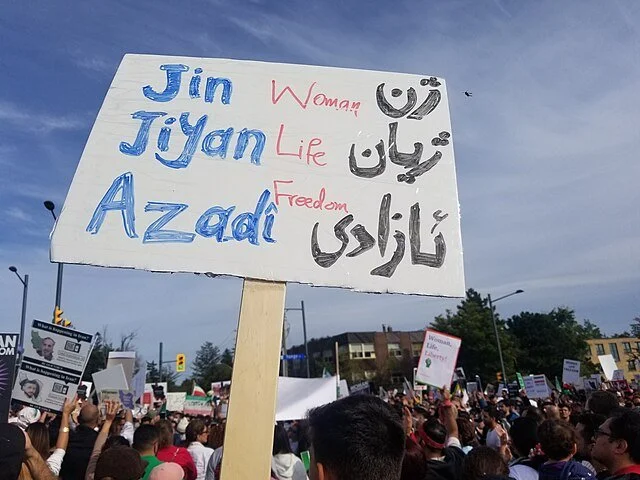
A Woman, Life, Freedom protest sign in Kurdish, English and Persian. Pirehelokan. CC BY 4.0
“I’ll speak for myself,” Adibi said, “but I think most Iranians are not super optimistic about the direction of women’s rights under this president. And they won’t be under the next president, or the next president, under however many presidents until the supreme leader is removed from power.”
When speaking with an admin from the Instagram account @irans.feminist.liberation, I found this feeling re-affirmed. “The future for women and minorities in Iran remains bleak,” she said, “unless there is significant internal pressure for change.

Bella Liu
Bella is a student at UC Berkeley studying English, Media Studies and Journalism. When she’s not writing or working through the books on her nightstand, you can find her painting her nails red, taking digicam photos with her friends or yelling at the TV to make the Dodgers play better.
Iran Under Fire: Protests Break Out Over Hijab Rules
The death of Mahsa Amini in the custody of morality police after being arrested for breaking hijab rules has sparked violent demonstrations across Iran.
Read MoreIran’s Shoddy ‘Satellite Cities’ Test Citizens’ Patience
Thanks to high rent prices and overpopulation, thousands of Iranians have been forced out of their hometowns. But the “satellite cities” built to hold them leave much to be desired.

An aerial view of Tehran, Iran. Hansueli Krapf. CC BY-SA 3.0
In the 1980s, Iran intentionally tried to grow its own population, aiming to increase its military strength amid the Iran-Iraq war. The 1979 Islamic Revolution had seen Iran’s old monarchy overthrown and a new republic built on Shiite Islam take shape. Student groups and leftist organizations rejoiced at the new rights promised to women; Islamist groups lauded the fact that their country was now a theocracy. But the new government wanted to ensure that the ideas of the revolution would last beyond one generation. So it encouraged polygamy, made birth control nearly impossible to find and lowered the age of marriage to 9 for girls and 15 for boys.
The plan worked—Iran’s population grew enormously. Forty years after the revolution, there are almost 50 million more people living in Iran. But these newcomers are not a new generation of happy, loyal citizens. They are people who the nation was not built to hold.
Overpopulation was not something Iran was completely unprepared for. Soon after the revolution, 17 new “satellite cities” were planned on the outskirts of the country's major cities. They had names like Pardis (“paradise” in Persian) and Parand ("silk"). They were to provide affordable places to live for people that the larger cities could not hold. But as Iran struggled with unrest and war, these cities wouldn’t begin to be built for decades. They remain half-finished even today.
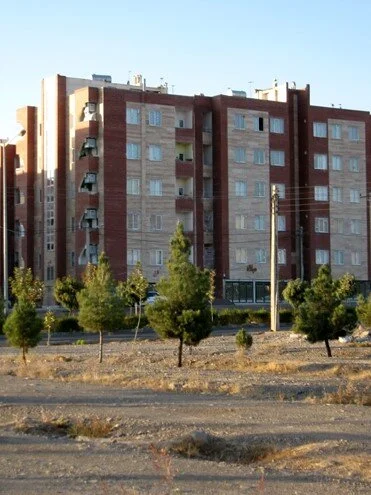
The Mehr housing project in Nishapur, Iran. Sonia Sevilla. CC BY 1.0
In 2007, the Iranian government developed a scheme it hoped would solve the overpopulation problem and make the satellite cities more livable: contract out free land to real estate developers who were willing to build low-income housing units. In this way around 2 million homes were planned to be built throughout Iran. But the Mehr housing project, as it was called, failed to deliver in the cities that needed housing the most. The 400,000 units built were poorly constructed and lacked essential utilities, like plumbing and clean water. The sterile white color that all the high-rises were painted with in Pardis says it all. These buildings didn’t seem like they were meant to be lived in, only passed through.
But the satellite cities are indeed lived in. In recent years, the overpopulation that plagues Iran’s largest cities has only gotten worse. The Financial Times reported in 2017 that the population of Tehran, Iran’s capital and largest city, “exceeds the optimum level by more than 70%.” The air is full of pollution, and the city’s roads are packed with traffic. But the last straw for many Tehranis is the cost of housing, which according to the New Yorker has more than doubled in the last three years. U.S. sanctions have contributed to this, as did former President Donald Trump’s decision to withdraw from the Iran nuclear deal. With nowhere else to go, droves of Iranians have moved to the satellite cities, where houses are cheaper. In 2019, the population of Parand was 100,000; a year later, that number had doubled.
The unfinished cities have been unable to provide jobs for their populations. Most of the people who make up Pardis must commute each day to work in Tehran. And, as the city lacks most forms of public transport, this means driving—sometimes up to three hours each way. The cities lack recreational areas, stores and the capabilities to provide health care and schooling to their growing populations. It’s no surprise that drug abuse and suicides are common in the cities.
Real estate prices remain high in congested Tehran, and more and more people are expected to leave. The people who make up these satellite cities, despite the lack of basic amenities, are grateful that they have a place to go at all. The Mehr housing project is not finished, and it is possible that in five years the livability of Tehran’s satellite cities will improve. But it is up to the Iranian government to ensure that these improvements do happen, and soon. The well-being of many Iranians depends on it.

Finn Hartnett
Finn grew up in New York City and is now a first-year at the University of Chicago. In addition to writing for Catalyst, he serves as a reporter for the Chicago Maroon. He spends his free time watching soccer and petting his cat.
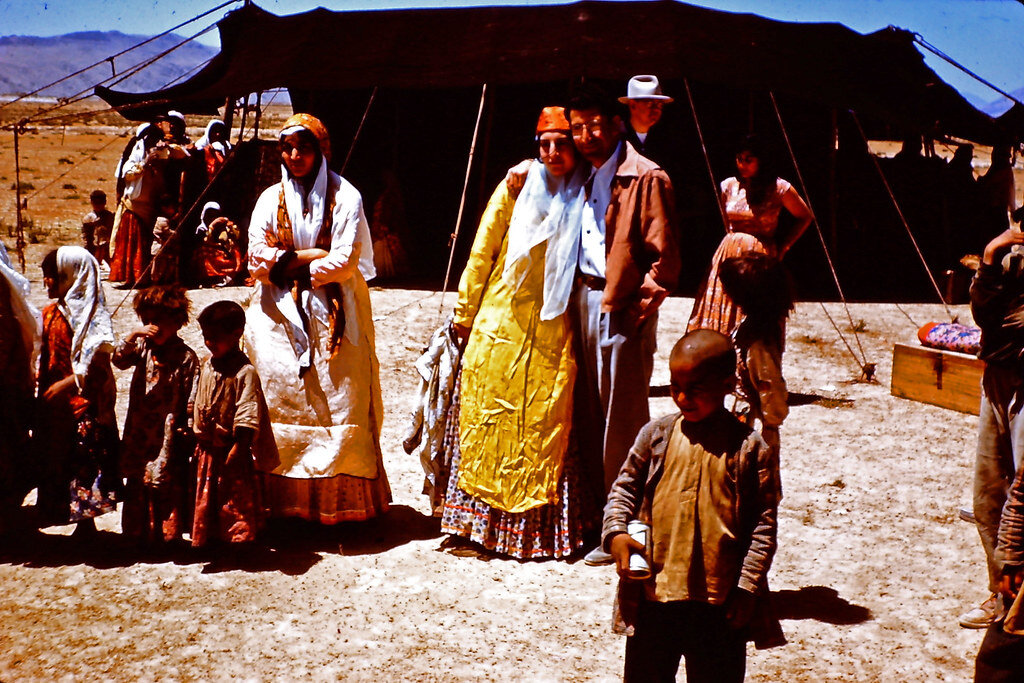
Iranian Children’s Day 2008. Unicefiran. CC BY-ND 2.0
Iran Fights for its Future as its Population Dwindles
After the Islamic Revolution in 1979, Iran’s population reached 55 million people as the government encouraged its citizens to have larger families. However, from the 1980s to 2012, Iran witnessed its fastest and largest fertility drop ever. This was largely due to Iran’s former supreme leader Ayatollah Khomeini who feared “the economy could not support a growing population after Iran’s war with Iraq.” Currently, if it continues on this trend, Iran will become the oldest country in the world by 2050 with a third of the population over 60 years old. This trend is due to government-imposed family planning strategies and economic issues which have led to a lower number of marriages.
Family Planning Implemented 50 Years Ago
Before the Islamic Revolution, the government pushed for families to increase the number of children they had. This led to an average of seven children per family, but after the 1980s and the post-Islamic revolution increased family planning policies, this dropped to what is now an average of 1.7 children. This was due to fears that the economy would not be able to handle the rapidly growing population after the Islamic Revolution. The government implemented a nationwide campaign with more sex education, free condoms, cheap contraceptives and slogans such as “fewer kids, better life,” along with the advice to wait three to five years to have more children. People suddenly had very easy access to sexual sterilization procedures in public hospitals at affordable prices and now women had more time to go to university, even outnumbering men there. Consequently, women had more time to focus on their own interests while men did not have to support quite as large a family.
Economic Issues Led to Fewer Marriages
Iran’s war with Iraq led to issues that were largely due to both countries taking out the other’s oil industry. Research shows that “the loss of oil exporting capacity in both countries was by far the most devastating economic blow of the war.” Other economic hardships arose from decreased amounts of imports and several cities were bombed, damaging major infrastructures and impacting normal life for citizens. These factors led Iran’s annual population growth rate to drop below 1% as of this year, while just two years ago the rate was 1.4%. About a decade ago, Iran’s government reversed course and began encouraging families after realizing they were headed toward a population decline. Economic challenges have led to fewer marriages, with the rate dropping 40% in a decade. In response, Supreme Leader Ayatollah Khamenei offered incentives such as increasing paid maternity leave for men and women and in 2015, two laws were passed restricting contraceptives and sterilization procedures.
What Now?
With the daunting current situation, Iran has focused on almost doubling its population to 150 million. Additionally, “vasectomies will no longer be carried out by state-run medical centers and contraceptives will only be offered to women who are at risk.” Of course, the option is still available at private hospitals, but the easy access the country has had to procedures and contraceptives has come to an end. This has met with some resistance from human rights groups such as Amnesty International, which stated that “women are not baby-making machines.” Ultimately, though, the previous family planning policies have started to reverse and action has been taken to increase Iran’s annual population growth rate. The government’s focus now is to change its headlines from a rapidly aging country to a young, fast-growing one.

Elizabeth Misnick
is a Professional Writing and Rhetoric major at Baylor University. She grew up in a military family and lived in Europe for almost half her life, traveling and living in different countries. She hopes to continue writing professionally throughout her career and publish her writing in the future.
U.N. Drops Saudi Arabia-Led Coalition From Blacklist Despite Recent Killings of Children
With no evidence that children are safe, the U.N. decided to remove the Saudi Arabia-led coalition in Yemen off a blacklist for violations of children’s rights.
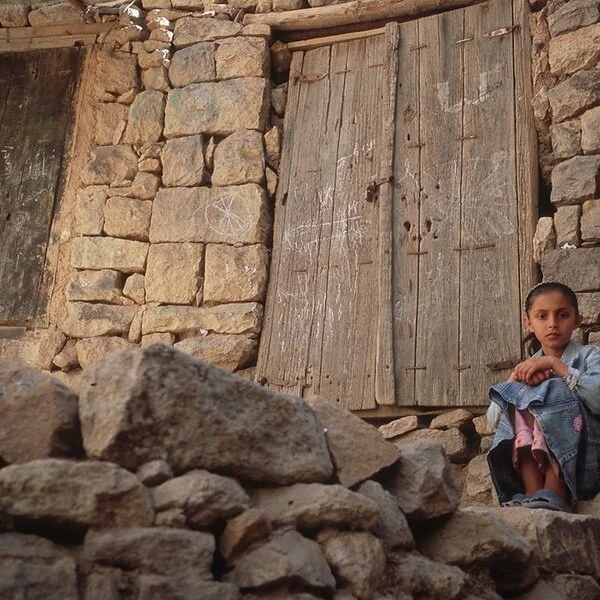
Child in Yemen among the rubble. Carl’s eye. CC BY-NC-ND 2.0
On June 17, the U.N. made the decision to remove the military coalition led by Saudi Arabia from one of its blacklists. The significance of this specific list, which focuses on children in armed conflict, is to shame groups that are guilty of violating the rights of children. Anyone can be placed on the list for a multitude of violations ranging from killing children to the recruitment of children for war. U.N. Secretary-General Antonio Guterres stated that the coalition’s removal was decided by efforts made to reduce the number of deaths and decrease the airstrikes that caused the killings over the previous three years.
However, there is a discrepancy in the decision. According to data released by the U.N., 222 children were hospitalized or killed as a result of these attacks last year. In addition, several hours after the U.N. announced its decision to remove the coalition, four children were killed in an attack in northwest Yemen.
The war in Yemen can be traced back to 2011. Following the Arab Spring, there has been unrest due to a failed political transition that led to terrorist attacks, a separatist movement and corruption. However, in 2014 a rebel group known as the Houthis, backed by Iran, ousted the government. What started out as a civil war transitioned into a conflict with neighboring countries as the Saudi Arabia-led coalition stepped in, attempting to help restore the government and defeat the Houthis.

Child of Yemen. Carl’s eye. CC BY-NC-ND 2.0
As of March 2020, it is estimated that 7,700 civilians have died in the war, largely due to airstrikes from the coalition. However, these are only verified deaths. Some statistics estimate it to be as high as 100,000 fatalities. On top of the conflict, Yemen has been experiencing one of the worst famines it has seen in over 100 years. The country is considered the poorest Arab nation, and the war has ruined the economy to the extent that many people, especially children, are considered malnourished.
There has been backlash over the U.N.’s decision to remove the coalition from the blacklist. From a video posted by Al Jazeera, protests have taken to the streets outside of the U.N. headquarters in Yemen to speak of their disapproval. The main concern is that the removal could leave children vulnerable to future attacks, as voiced by groups like Save the Children. Observers are also questioning the integrity of the blacklist itself, including Iran which said that “the U.N. is giving a free pass.” Iran claims that the Houthis and the Yemeni government have been responsible for the same number of deaths yet only the Houthis remain on the list.
Guterres has said that U.N. would monitor the coalition’s activity over the next year. If there is an increase in children’s casualties, the coalition would be placed back on the list.

Eva Ashbaugh
Eva is a Political Science and Gender, Sexuality, and Women's Studies double major at the University of Pittsburgh. As a political science major concentrating on International Relations, she is passionate about human rights, foreign policy, and fighting for equality. She hopes to one day travel and help educate people to make the world a better place.
Curves of Iran
“Curves are everywhere in Eastern culture: our writing, our architecture, our instruments, the way we dance; even the tone of our language is curved. The West was built on angles. The East was built on curves.”
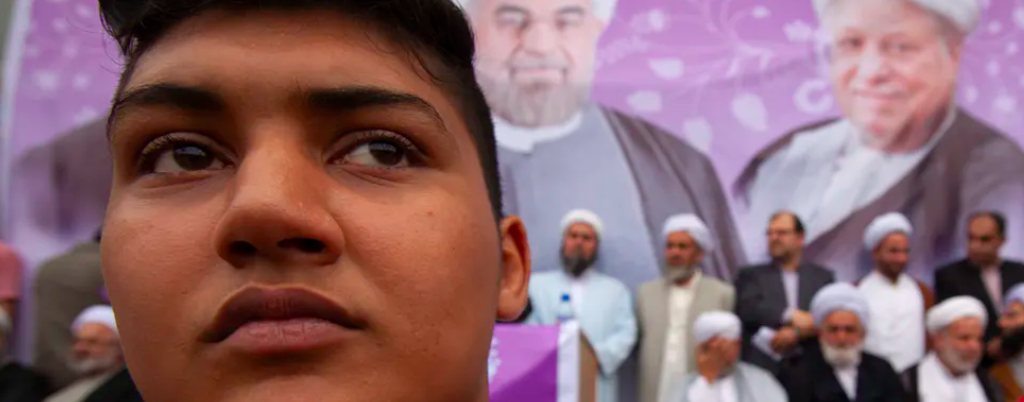
Within Iran’s lower classes, there is a highly conformist youth culture. Farzin Mahmoudzadeh, Author provided
How Iran’s Millennials Are Grappling With Crippling US Sanctions
In early January, after tensions between Iran and the United States escalated to the brink of war, President Donald Trump announced a detente of sorts, stating, “The United States is ready to embrace peace with all who seek it.”
It may have sounded like a conciliatory gesture, but the Trump administration went on to levy additional economic sanctions against the country only two days later.
As someone who has studied the lives of Iran’s working classes, I know just how damaging economic warfare has been. It’s hit young Iranians, who comprise a large portion of the population, particularly hard. High rates of inflation – on the order of 38.6% over the past 12 months – and a youth unemployment rate of 28.6% have drastically reduced their ability to purchase basic goods and feel any semblance of financial security.
Over the past 12 years, I’ve studied various groups of lower-class young people and their families in their homes, neighborhoods and workplaces, in shops, and in parks. I’ve also interviewed 44 youth between the ages of 15 and 29 who have been sidelined to the socioeconomic margins.
I wanted to know how they cope with prolonged insecurity and the constant threat of crisis.
Interestingly – and despite what you might see on the news – many don’t react by rebelling against authority or by regularly taking to the streets.
A central observation from my research and forthcoming book has been that, when faced with conditions of uncertainty, the young people I spoke with simply sought respect, acceptance and support from their communities. Life becomes a quest not for revolution, riches or vengeance, but for dignity.
A highly conformist culture
The desire for status and dignity is an integral part of Iranian society.
Most of the poor, younger city dwellers I studied try to achieve this through both their conduct and their dress. They want to be seen as classy, diligent and moral. In communities that value prestige and look down on poverty, this becomes their ticket to a better life.
So in an attempt to conceal their poverty, they’ll spend their limited income on the latest trends so they can attain a “modern” appearance, from having the latest smartphones to wearing brand-name shoes and shirts – or at least knockoffs.
In order to avoid being seen as lazy or delinquent, the young people I interviewed work diligently and avoid being associated with petty criminals, like drug dealers. Even though there’s rarely enough work to go around, they get creative. They work in the informal economy as shop apprentices, street vendors and seamstresses. Those who can’t find work take up unpaid work babysitting for family members or helping with a family business in an effort to appear hardworking. By doing this, they can assume a moral high ground – regardless of how little money they’re actually making.
As one local, middle-aged woman told me, “There’s something wrong with a kid who doesn’t work.”
These young men and women are adhering to a set of values prized by their communities and promoted by society through billboards, national television and official speeches.
The result is a relatively stable social order – and a youth culture that’s highly conformist.
This might come as a surprise to some, since some Western media outlets sometimes fixate on acts of rebellion.
In reality, deviance – especially among the lower classes – is rare. Many simply can’t afford the consequences of being shunned by those around them.
Rewards don’t need to be material
The quest for dignity is only part of the story. Like many young people around the world, most youth in Iran have dreams of a better future. But for those dealing with daily economic hardship, there’s a chasm between their goals and what’s possible.
“I wanted to get my bachelor’s degree and have a job where I sat behind a desk,” said Babak, a street vendor, “but I had to drop out of ninth grade in order to meet my family’s expenses.”
That gap may never be fully breached. But many young Iranians I met still feel as if it’s possible to – in the words of a mechanic’s apprentice – “bring themselves up.”
The young people I interviewed do this not by trying to game the system, but by following the rules: diligence, self-sufficiency, a smart appearance, and moral and sexual cleanliness. For this, communities reward them with jobs, small promotions, or even just more deference. The material benefits might be minimal, but people nonetheless feel validated and included in the broader fabric of the nation.
In other contexts, researchers have found that “looking the part” – performing what’s deemed to be attractive to society – matters to people’s life prospects. The youth I knew in Iran do the same. They might not fully escape poverty, but they can escape stigma.
To them, that matters.
The limits of virtue
Of course, not everyone in Iran can maintain an appearance of industry, class and virtue.
There are young people who are desperately poor, who can’t even scrape together enough money for a new pair of shoes. There are drug addicts. There are young women who have been outed as prostitutes.
Focused on only helping those they deem “deserving,” communities do little to lift up people who have fallen through the cracks. Friends and acquaintances are unwilling to recommend them for jobs, neighbors avoid connecting with them, families view them with shame.
It can all seem a bit Darwinian, with those deemed unfit becoming social pariahs.
And yet, there are many youth who persevere, who believe that living by the rules, day in and day out, is the right way to live. As Ibrahim, a laborer, emphasized, “I try to live in a good way. If people remember you as good, this is reason to be proud.” To youth like Ibrahim, living a worthy life means not simply accumulating material goods, but staying true to a moral code.
In the face of rising prices, dwindling jobs, and few prospects for socioeconomic change, the routines of daily life create space for those who have suffered most under the weight of suffocating sanctions to breathe – and, in many cases, grow.
Manata Hashemi is a Farzaneh Family Assistant Professor of Iranian Studies, University of Oklahoma.
THIS ARTICLE WAS ORIGINALLY PUBLISHED ON THE CONVERSATION
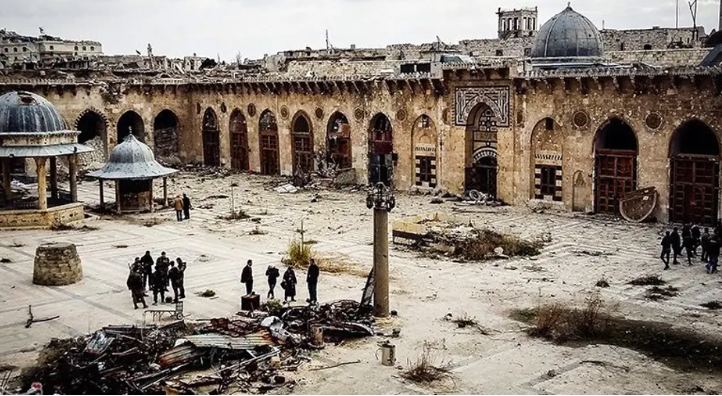
The Great Mosque of Aleppo, Syria, was destroyed in December 2016. Fathi Nezam /Tasnim News Agency, CC BY-NC-SA
Destroying Cultural Heritage Is an Attack on Humanity’s Past and Present – It Must Be Prevented
Since Sun Tzu wrote The Art of War in China in the sixth century BC, military writers have argued that to destroy the cultural heritage of your enemy is bad military practice. Many international agreements since have banned the destruction of cultural heritage in war. That is why there was a horrified reaction to President Trump’s recent threat to Iran’s cultural heritage following the assassination of General Soleimani.
Read MoreJourney Through Iran — Beyond the Curve
Follow these filmmakers on a 21 day expedition though Iran. From tiled adorned mosques to mountains tops, you might find the most fascinating part of this journey is the people themselves. The cities covered include Tehran, Shiraz,Yazd, Esfahan, Kashan in the south, and Tabriz and Lake Urmia in the North.
In Iran, a Lost Generation Raises its Voice
Over the past decade, Iranians at home and abroad in the United States have faced internal turmoil and external oppression—and with unrest once again brewing between America and the Middle East, upheaval threatens to return in full force.
Read MoreMirage of Persia
Csaba Labancz filmed this video compilation when he spent three weeks in Iran visiting most of the major cities and some unknown villages up in the Elburz mountains as well as some of the most remote places in the desert. This film is an essence of a country of ancient traditions, breathtaking landscapes, truly helpful and kind people and countless historical places.
IRAN: First Girl to Surf
Outfitted in hijab surfwear, Ireland's leading woman surfer, 26 year old Easkey Britton, headed to a remote area of Iran, a short strip of coast lying in a narrow swell window between Pakistan and the Gulf of Oman. She was the first woman to surf Iran, as far as we know. Of the experience she quoted Marie Curie, "Nothing in life is to be feared, it is only to be understood."