
Salome Liptak
The Mahouts Elephant Foundation offers a unique opportunity for sustainable tourism while also contributing to Asian elephant conservation and Indigenous livelihoods.
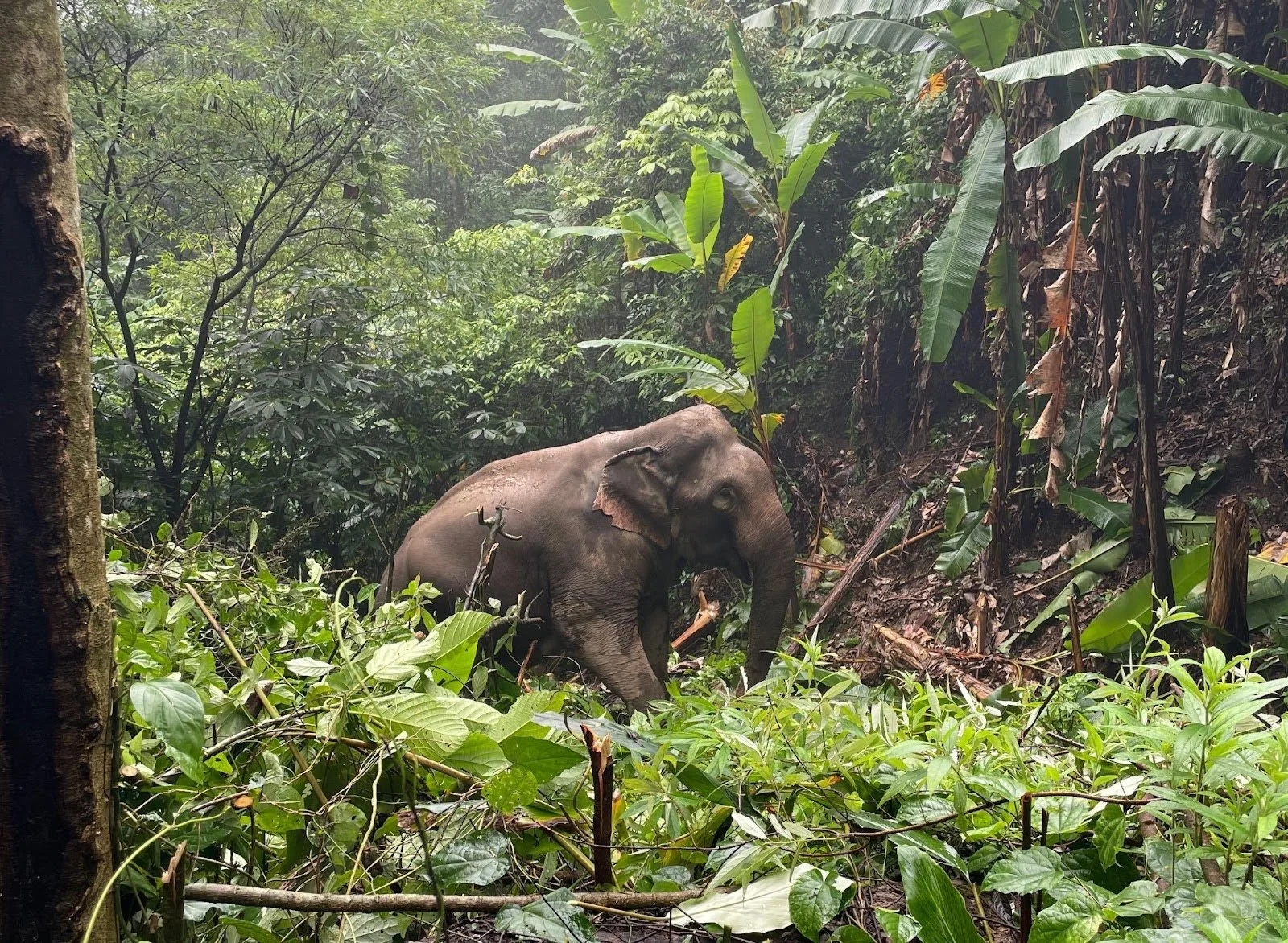
Asian elephant in cloud forest. Salome Liptak.
Deep in Thailand’s mountainous Western Forest Complex, a group of travelers observes Asian elephants as they sleep, forage and socialize in the lush cloud forest that is their natural home. Between the visitors and elephants stand the mahouts, or caretakers, who trek out to check on the animals anywhere from once a week to once a day, depending on their individual needs. The mahouts also act as expert guides for the travelers, tracking the elephants’ courses by the plants they crush in their wake and maintaining the safety of both the humans and animals present. Speaking in their Indigenous Karen language to translators, they can tell where the elephants will want to pass, instructing the visitors on where to move next.
This unique experience has been made possible by the Mahouts Elephant Foundation, a non-profit focusing on Asian elephant conservation and sustainable tourism, founded by Sarah Blaine and her family. Offering different trips with outdoor adventure, conservation education and volunteer focuses, the foundation prioritizes cultural immersion in the Karen community through host families sharing language, food and Indigenous craftsmanship. As a sustainable tourism organization, they utilize a multi-faceted and multi-disciplinary approach to fill the gap in elephant conservation efforts in Thailand.
Elephants have made up a large portion of Thailand’s tourism sector since 1989, when the government imposed a logging ban that left thousands of elephants and their mahouts unemployed. Taking care of an elephant is expensive, and mahouts and their families, who were suddenly destabilized by the economic crisis, were often unable to find new livelihoods that provided enough for them to continue caring for the animals. The majority of these mahouts belong to ethnic minorities, including refugees from Myanmar, and they were therefore especially economically vulnerable. Mahouts consider their elephants as members of their family, which makes the prospect of needing to sell one inconceivable. Despite this, many were forced to lease their elephants into the tourism industry, creating ethical concerns for the well-being of the animals and caretakers alike. The subsequent move to larger cities left mahouts separated from family members as they worked in unfamiliar and dangerous conditions.
Tourist camp practices range from the seemingly benign acts of elephant feeding and bathing to the more obviously unnatural training of elephants to paint, walk on their two hind legs and carry people. While these practices are on a spectrum of severity, all of them require a form of behavioral subjugation, wherein an elephant is trained to do what it would not do naturally. At its most violent, this process is referred to as “crushing” an elephant and involves separating young calves from their families, chaining them in small cells and systematically prodding and hitting them with sharp tools until they follow commands. Elephants are large, powerful animals that can be dangerous to humans, especially in these abusive conditions.
The mahouts, as the legal owners of the elephants, are essentially indentured in the tourist camps. They endure immense levels of stress from the responsibility of keeping the elephants from revolting and hurting tourists. Poverty, the separation from family and the trauma of facilitating or witnessing the crush have contributed to the mental health struggles of mahouts working in tourist camps. These ethical issues have called for reforms in the industry and caused a surge of elephant sanctuaries to open in Thailand, with various approaches and visions of what conservation looks like. Still, today, wild elephants are greatly outnumbered by captive ones, 75% of which are being used in the tourism entertainment industry in some form.
In the foundation’s own words, their mission to combine conservation and community collaboration “cuts off the supply of elephants to the tourism industry, stops the demand of tourists by offering ethical alternatives, brings a sustainable source of income to impoverished communities, and provides science-based evidence showing good elephant welfare.” Their model is unique in its integration of the humanitarian issues of the tourism industry with strict policies on ethical interactions with the elephants.
Elephants brought onto their projects are referred to as “re-wilded,” meaning that while the organization has legal and financial ownership, the animals continue to be looked after by their mahouts and live in the forest as they would naturally. There is no immediate contact between visitors and elephants, including feeding or bathing, with visitors always kept at a distance. The foundation’s conservation and behavioral research contributions are also unique, stemming from research director Liv Baker’s approach, which focuses on individual animal well-being beyond overall population statistics. This informs their trip policies, prohibiting behaviors that many other elephant sanctuaries in Thailand allow and questioning the right of human visitors to interact with the animals.
By fully collaborating with the Indigenous community, Mahouts Elephant Foundation has created a unique environment where conservation research exists alongside an ethical tourism experience. While guests are welcomed and thoughtfully cared for, they must remain conscientious of their role as visitors, staying mindful of the locals, elephants and landscape without thinking of themselves as an audience to be entertained.
GET INVOLVED:
Mahouts Elephant Foundation lets students, volunteers and adventurers hike through the cloud forest in Northern Thailand to observe re-wilded elephants in their natural habitat. For those looking to support the Karen people’s work to foster peace and security in their communities, visit the Karen Organization of Minnesota or check out the Karen cultural crafts for sale at Borderline Collective. Those interested in digging further into animal ethics and wellbeing can visit PAN Works for their extensive work with Asian elephants, as well as other members of the more-than-human community.
Salome Liptak
Salomé is a student at Sarah Lawrence College studying literature and writing. She is passionate about storytelling (both true and fictional) and its power to reflect the world as it is, or imagine what could be.