
Before Sudan died in 2018, scientists collected his sperm in hopes of developing an embryo that would carry on the species. In December 2019, eggs from Najin and Fatu were harvested and sent to the same lab as Sudan’s sperm. It is here that scientists toyed with the idea of in vitro fertilization (IVF) for rhinos.
Read MoreGlobal Pride Amid Rising Hostility Toward LGBTQ+ Communities
LGBTQ+ Pride has grown massively in scale and support since its emergence, but many cities around the world have either maintained or enacted threatening legislation undermining the event.
Read MoreCartoonists Under Fire: The Fight for Free Expression in India
Political cartoonists in India are facing legal threats and online abuse for criticizing the government, revealing how satire itself is now under siege.
Read MoreSweeps of Homeless Encampments in the US Intensify After Supreme Court Ruling
Since the Supreme Court ruling, Grants Pass v. Johnson, upended protections for the unhoused, sweeping of homeless encampments has drastically increased.
Read MorePeruvian Farmer Loses Climate Case, But Sets Global Precedent
Saúl Luciano Lliuya sued the German energy company RWE for damages to his home related to climate change. He lost, but the case is still considered a win for environmental activists.
Read MoreWear Once, Waste Always: The Hidden Toll of Festival Fashion
Festival fashion is fast, flashy and overwhelmingly disposable.
Read MoreGeneration Z Quits Vaping for the Congo
Rampant child labor in the Congo has ignited an ethical social movement among Generation Z.
Read MoreInternational Students Put at Risk by Harvard Ban
The Trump administration’s ban on admitting international students to Harvard leaves them in uncertainty amid First Amendment violations and poses concerns to all international students in the US.
Read MoreThe Mother Activists Searching for Justice in Mexico
In response to drug cartel violence and lack of government action, the Madres Buscadoras, “searching mothers”, of Mexico have taken an imperative step forward in searching for their disappeared loved ones.
Read MoreThe Hidden Climate Cost of Namibia and Botswana’s Oil Refinery
Energy independence for southern Africa could boost local economies, but oil refinery aspirations hold a hidden cost, contributing to greater climate issues.
Read MoreMexico’s Maquiladoras: The Border Factories Harming Female Workers
While a source of cheap labor, the maquiladora system is fraught with social and environmental issues.
Read MoreThe Impact of Authoritarianism on Food Insecurity in Chad
Food insecurity and the authoritarian regime in Chad have denied many individuals and communities access to fundamental human rights.
Read MoreHow Indigenous Knowledge Supports Conservation in Australia’s Outback
Across the arid regions that define the Australian Outback, Aboriginal groups’ deep connection with the land has led to enduring protection against species loss and environmental decay.
Read MoreCarbon Credits Aren’t as Green as They Seem
Carbon credits are a tool to reduce emissions, but they tend to carry more weight as a marketing tactic rather than a sustainable practice.
Read MoreDefining Gender and Biology: The Struggle For Transgender Rights
As more global governments define gender and biological sex as a singular identity, transgender communities face a potential loss of rights and social stigma from the U.S. and the U.K. to New Zealand.
Read MoreTrash to Treasure: A Tour Through Cairo’s Garbage City
Take a guided walk through Cairo’s Garbage City and discover how one community is turning waste into a way of life.
Read MorePreserving Heritage and Habitat: Indigenous Australian Rangers Redefine Ecotourism
Indigenous Australians are blending ancient traditions with modern science to preserve and protect endangered ecosystems and species.
Read MoreRefusing Silence: Afghan Women Fight Back Through Prose
In the face of censorship and exile, Afghan women are creating new paths to keep their writing alive.
Read MoreCalifornia’s Fashion Act: Fighting For Accountability
California’s Fashion Accountability Act is bringing environmental transparency to the trillion-dollar industry.
Read MoreAnti-American Sentiment Increases Caution for Traveling Americans
Julia Kelley
After introducing controversial war plans and import taxes, Donald Trump’s recent proposals have escalated negative attitudes toward American tourism worldwide.
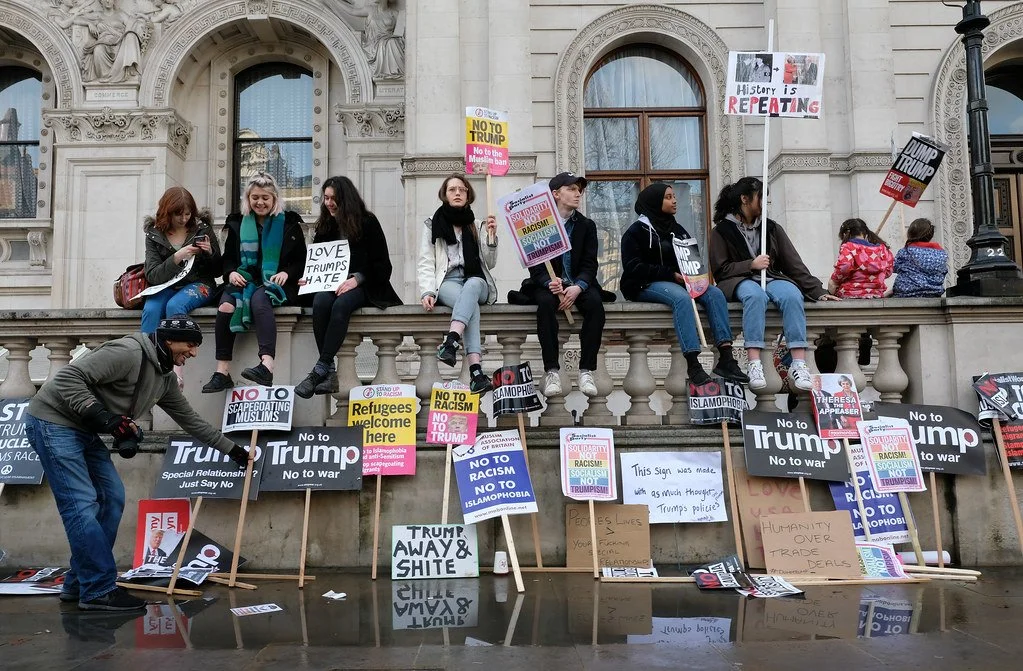
Anti-Trump Protest in London. alisdare1. CC BY-SA 2.0.
During the 20th century, the United States found itself a burgeoning political, economic and cultural world power, gaining increasing international influence. However, since President Donald Trump’s recent inauguration in January 2025, a string of controversial political and economic decisions has seen a subsequent drop in warm foreign sentiments toward the United States. In populations across the globe, those who perceive America as a positive influence number only 46%. Notably, Trump proposed that the U.S. “take over” and “own” Gaza in response to the Israel-Palestine conflict, resettling the population at the same time. These claims were met with widespread condemnation from countries in the Middle East, including Egypt, Saudi Arabia and Jordan, all of whom fiercely rejected the plans and saw them as a violation of the numerous peace agreements between the countries. This contributes to a revival of anti-American views in the Middle East since the beginning of the Israel-Palestine war, as many view the U.S. government as a domineering and pro-Israel force. Despite garnering support from Israel, Trump’s remarks have also been opposed by other powerful countries like China, the United Kingdom, Germany, Australia and Brazil, who consider the proposed relocation of Gaza’s citizens to be an extreme misstep in power.
More recently, Trump has introduced a vast set of tariffs that his administration affirms will secure the economy. Not only did this legislation drastically damage global markets, but many affected countries considered it a threat of global tariff war and an insult to the good relationships between foreign economies. Although the current U.S. tariff plans exclude Canada, an initial tariff placed on Canadian imports increased tensions between the two countries and resulted in a call to boycott American products, naming the U.S. as an enemy. American product boycotts have also been staged in Europe, with U.S. favorability falling across countries such as Denmark, Sweden, Germany and France. For example, the Danish Facebook group Boykot varer fra USA (Boycott products from USA) has amassed over 95,000 followers, while setting fires to Tesla cars has sprung up as part of the “Tesla Takedown” movement in Italy, a protest against Elon Musk’s involvement in international affairs. China has also seen a rise in anti-American perceptions, coinciding with Trump’s decision to place the largest tariff increase on the country at 104%.
In the wake of such turbulent politics, discontent toward America has grown. Overseas travel to the U.S. has declined exponentially in the last few months, seeing an overall drop of 12% in foreign visitors from the previous year. Regions that are usually strong sources of tourism show stark differences, with the number of Canadian tourists dropping by 32% and Mexican tourists by 17% as of March 2025. In many online forums, those from other countries are making their views of Americans known, presenting an overall negative reception of tourists. On a European Reddit forum, user @Iplaymeinreallife from Iceland said, “we want nothing to do with him [President Trump] or a country that would vote him into office a second time,” while user @Mapey from Latvia noted how, despite their initial love for America, they now “hate it to the bone as America stands for absolutely everything” they despise. Americans already face stereotypes while traveling abroad, generally characterized as loud, ignorant or entitled, but such labels are becoming more frequent. More than anything else, countries have replaced an admiration for the U.S. with widespread confusion and antipathy for Trump. In turn, this festering distaste finds itself projected onto American travelers and their experiences, disrupting their hoped-for escapism.
As a result of this U.S. resentment, international travel has become increasingly risky. In a survey done by Global Rescue, 72% of people noted that Americans traveling abroad will be perceived more negatively, while many had already encountered disputes. One California-based traveler described how they “experienced much more negativity,” while a Wyoming tourist reported having “numerous arguments about American policy” with people they did not know. Some travel agencies are also seeing drops in sales for international travel by Americans, and prospective tourists have begun flooding online travel forums with questions asking if it is safe to travel or if foreign countries will accept them. Many, in an effort to avoid the anti-American attitude altogether, have simply cancelled planned trips and tours. New strategies are being taken by those currently abroad as a way of curbing any possible anti-American sentiment, as noted in Rick Steves’ European forum. One poster, named Emily, describes how she has “made an effort to appear less American” while living in Austria, and another, named Volva, in the UK, says it is important not to start any political discussion. Despite where they are in the world, however, Americans abroad and international citizens alike note that rising political tensions have left a lasting impact on the country’s once-amiable image.
Julia Kelley
Julia is a recent graduate from UC San Diego majoring in Sociocultural Anthropology with a minor in Art History. She is passionate about cultural studies and social justice, and one day hopes to obtain a postgraduate degree expanding on these subjects. In her free time, she enjoys reading, traveling, and spending time with her friends and family.