
Kennedy Kiser
Political cartoonists in India are facing legal threats and online abuse for criticizing the government, revealing how satire itself is now under siege.
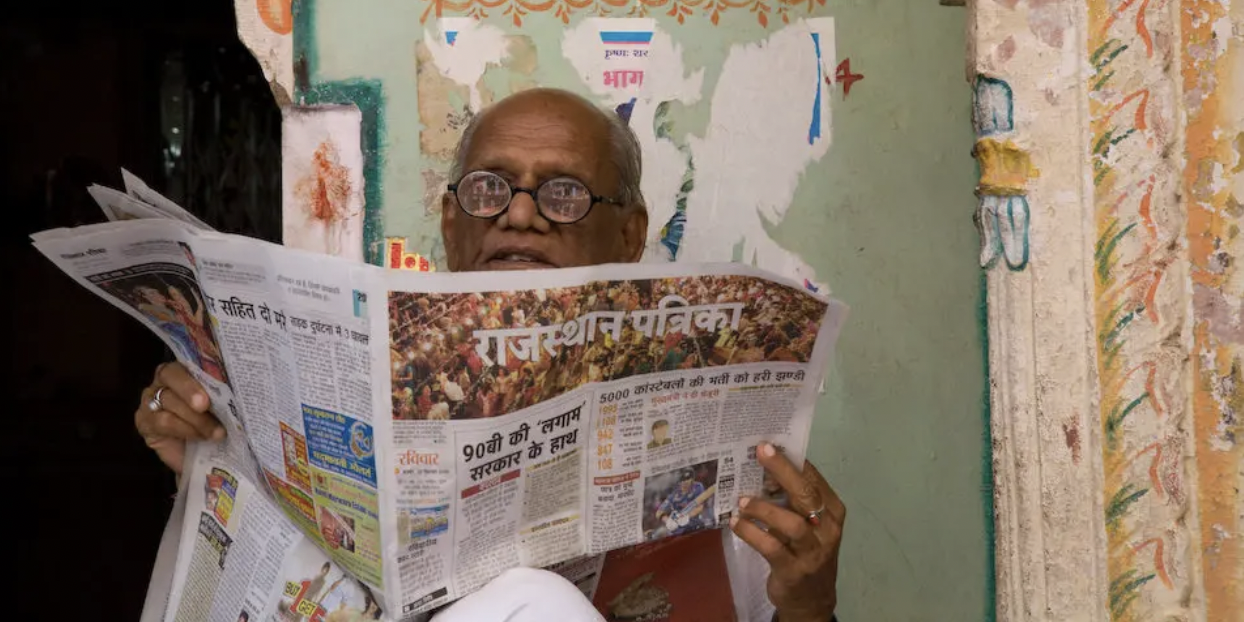
Man reading a newspaper in Jammu, India. Todd Gehman CC BY 2.0.
While they may look simple, political cartoons have become powerful tools of dissent in India. Artists like Aseem Trivedi and Rachita Taneja have faced sedition charges, legal threats and intense online harassment for using humor and illustration to criticize the government. What once felt like a lighthearted art form is now a frontline in the fight for free speech.
In 2012, Aseem Trivedi was arrested for drawing cartoons that challenged corruption and government abuse. One of his most controversial pieces showed the Indian Parliament as a toilet. Another altered the national emblem to include vicious animals, suggesting the state had lost its moral authority. These drawings led to accusations of sedition, a law rooted in British colonial rule and often used to punish dissent. While the charges were dropped, the case sent a message to other artists: political satire comes with a risk.
Rachita Taneja’s work tells a similar story. She created “Sanitary Panels,” a minimalist comic series that uses stick figures to explore feminism, justice and politics. In 2020, after one of her comics implied that India’s Supreme Court was aligned with the ruling party, the artist was charged with contempt of court. While she was not jailed, the case added pressure on artists already navigating a hostile climate.

Comic depicting the unequal burden of domestic labor on women. Neelabh Banerjee. CC BY 2.0.
These cartoonists are not alone. In recent years, Indian authorities have grown more aggressive toward journalists, comedians and critics. Cartoonists sit in a unique position because their work is visual, easy to share and difficult to ignore. A single image can spread rapidly, reaching people who might never read a long article or watch a news segment. That accessibility is part of what makes cartoons so effective — and threatening.
Online platforms have changed how cartoonists share their work. Social media allows them to bypass traditional newspapers, many of which now avoid content critical of the government. But visibility comes with a cost. Troll armies, doxxing and police surveillance are common. For many, every post is a choice between expression and security.
Despite this, political cartooning remains alive in India. Many artists continue to post daily, using humor to respond to current events. Their work often reflects public frustrations that mainstream media does not address. Even when targeted by lawsuits or hate campaigns, these cartoonists rarely stop. They may shift to pseudonyms or private groups, but their critiques continue.
Satire has always played a role in Indian democracy. The right to question authority is part of a healthy public discourse. When the government responds with charges and censorship, it suggests that criticism is landing where it hurts. Cartoonists expose gaps between what the government says and what it does. They draw attention to contradictions, abuses and broken promises.
The pushback they face is not just about individual drawings. It reflects a broader struggle over who controls public speech in India today. As political power tightens its grip on media courts, the space for dissent shrinks. Cartoonists are among the few who still find ways to resist — sometimes with just a few lines and a punchline.
Their work reminds us that freedom of expression is not guaranteed. It must be used, protected and defended. In India, that defense now includes the artists who draw what others are afraid to ask.
GET INVOLVED:
Want to support free expression in India? Here are a few ways to help:
Follow and Share: Amplify the work of Indian political cartoonists like Rachita Taneja (@sanitarypanels) and others using your platforms.
Support Press Freedom Organizations: Donate to or follow groups like the Committee to Protect Journalists or Pen International, which advocate for the rights of artists and writers facing censorship.
Stay Informed: Keep up with news on media freedom in India through independent outlets like The Wire, Scroll.in, or Article 14, which often cover cases mainstream media avoids.
Kennedy Kiser
Kennedy is an English and Comparative Literature major at UNC Chapel Hill. She’s interested in storytelling, digital media, and narrative design. Outside of class, she writes fiction and explores visual culture through film and games. She hopes to pursue a PhD and eventually teach literature! @kennedy_kiser