
As Kenya protests proposed Finance Bills, police respond with violent force, threatening freedom of speech.
Read MoreKenya Protests: The Cost of Dissent
The roots of Kenya’s political crisis are echoed as protests shake the nation.
Read MoreHow IVF Could Get Rhinos Off the Endangered Animal List
Before Sudan died in 2018, scientists collected his sperm in hopes of developing an embryo that would carry on the species. In December 2019, eggs from Najin and Fatu were harvested and sent to the same lab as Sudan’s sperm. It is here that scientists toyed with the idea of in vitro fertilization (IVF) for rhinos.
Read More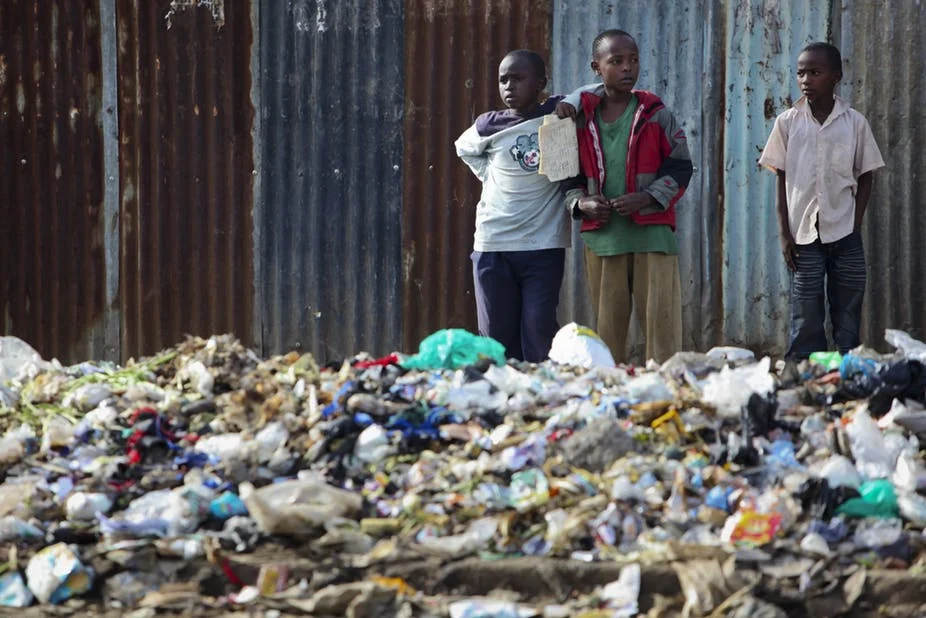
Nairobi’s current waste disposal system is fraught with major problems. EPA/Dai Kurokawa
How Nairobi Can Fix Its Serious Waste Problem
Uncollected solid waste is one of Nairobi’s most visible environmental problems. Many parts of the city, especially the low and middle-income areas, don’t even have waste collection systems in place. In high income areas, private waste collection companies are booming. Residents pay handsomely without really knowing where the waste will end up.
The Nairobi county government has acknowledged that with 2,475 tons of waste being produced each day, it can’t manage. Addis Ababa Ethiopia has a similar size population but only generates 1,680 tons per day.
Nairobi’s current waste disposal system is fraught with major problems. These range from the city’s failure to prioritise solid waste management to inadequate infrastructure and the fact that multiple actors are involved whose activities aren’t controlled. There are over 150 private sector waste operators independently involved in various aspects of waste management. To top it all there’s no enforcement of laws and regulations.
Nairobi’s waste disposal problems go back a long way and there have been previous efforts to sort them out. For example in the early 1990s, private and civil society actors got involved, signing contractual arrangements with waste generators. They often did this without informing or partnering with the city authorities.
More recently other strategies were put in place, some of which left parts of the city clean. They worked for a period, but unfortunately they weren’t sustainable because no institutional changes were made.
But there’s hope on the horizon with a new Nairobi Governor – Mike Sonko Mbuvi. He should learn from the mistakes of the past and put a new regime in place that addresses the structural problems that have plagued the city. This would include an improved improved collection and transportation plan that incorporates the private sector.
Learning from the past
In 2005 John Gakuo took over the management of city affairs as the Town Clerk. During his tenure (2005-2009) he made a deliberate effort to introduce new approaches.
When he took over the city only had 13 refuse trucks. They were able to collect a paltry 20% of the waste produced by the city. To overcome this, the authorities contracted private waste collection firms to collect, transport and dispose waste at Dandora dump site which is the biggest and the only designated site. This quickly boosted the total waste collected with levels oscillating between 45%-60%.
Other changes included:
The development of a proper waste collection and transportation schedule with market operators. This meant waste from open-air markets was brought to identified collection points on specific days.
A weighbridge to measure amounts of waste disposed at Dandora was introduced. An important way to know disposal levels vis-a-vis collection and generation.
Enforcement officers were deployed to prevent dumping in parts of the city that were notorious for waste accumulation.
Over 2,000 arrests were made, making residents aware that indiscriminate dumping was illegal and punishable under the city authority laws.
All these efforts paid off – for parts of the city. For example, the heart of the city, the Central Business District, was cleaned up and waste was brought under control.
But crucial elements that would have ensured that the changes were sustainable were left out. For example, no new physical infrastructure, like the construction of waste transfer centres and proper landfills, were built, nor was new equipment bought.
After Gakuo’s regime, the next one worth a mention is Evans Kidero’s regime (2013 - 2017). It can be credited for trying to fast-track the implementation of the Solid Waste Management Master Plan which assessed the waste management problem of Nairobi and developed projects that could be implemented to ensure a sustainable system was in place.
This ensured that while the private sector needed to help with waste collection and transportation, the government was key to institutionalising waste management services.
Thirty waste collection trucks were bought and serious investment was made into heavy equipment. And in an effort to streamline waste collection a franchise system of waste collection was rolled out. This involved dividing the city into nine zones to make it easier to manage waste.
The franchise arrangement gave private operators a monopoly over both waste and fee collections, but relied heavily on the public body for enforcement of the system.
The franchising system failed due to a lack of enforcement by the city. In addition, in-fighting broke out between the private waste collection firms that had individual contracts with waste generators and the appointed contractor.
But other changes introduced during this period were more successful and had longer lasting effect. For example new laws were introduced designed to create order in the sector. These included the solid waste management act in 2015. This classified waste and also created a collection scheme based on the sub-county system. It also put penalties in place.
In addition, in 2016, 17 environment officers were appointed and posted to the sub-counties to plan and supervise waste management operations alongside other environmental issues.
These changes planted the seeds of an efficient and working waste management system. But the regime fell down when it come to enforcement. This meant that the gains that had been made were soon lost.
What needs to be done
Expectations are high for the new regime that has taken over. It should look to fast-track the following programmes:
Implement an improved collection and transportation plan that incorporates private sector and civil society groups;
Establish a disposal facility to reduce secondary pollution from the city’s dumps;
Decommission the Dandora dump site;
Implement the re-use, reduction, and recycling of waste;
Establish intermediate treatment facilities to reduce waste and its hazards;
Create an autonomous public corporation;
Put in place legal and institutional reforms to create accountability;
Implement a financial management plan, and
Implement private sector involvement.
Nairobi can fix it’s waste disposal problems. All it needs is focused attention, good governance and the implementation of systems that ensure changes outlive just one administration.
This article was originally published on The Conversation.

LEAH OYAKE-OMBIS
Part-time lecturer and Director of the Africa Livelihood Innovations for Sustainable Environment Consulting Group, University of Nairobi

Upwardly mobile Kenyans live in planned, gated communities. Sometimes these abut the poorest of slum communities, this one in Loresho.
Unequal Scenes: Nairobi
“It has been estimated that the richest 10 percent of the population of Nairobi accrues 45.2 percent of income, and the poorest 10 percent only 1.6 percent,” according to a 2009 study on urban poverty by Oxfam.
Statistics on inequality and poverty are ubiquitous in the developing world. They are often underwhelming, however, in their impact. What does 45.2 of income look like? What does “urban poverty” look like? As, of course, every statistic is relative.
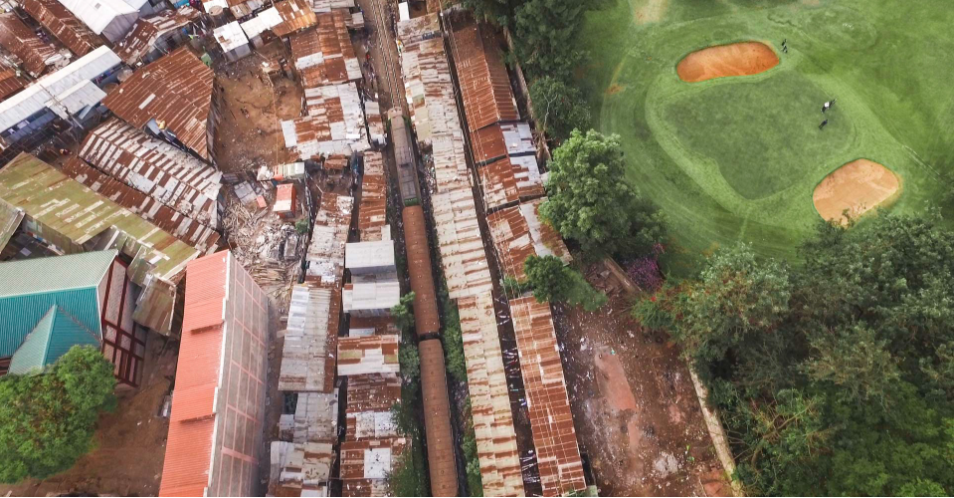
The Royal Nairobi Golf Club sits directly adjacent to Kibera slum. Twice a day, a passenger train barrels through the slum, less than a meter away from people's homes and businesses. Next door, people play the game surrounded by greenery.
In Nairobi, a city of chaos, dynamism, and incredible unequal growth, this is even more difficult to portray. Yes, it has easily the poorest urban slums I’ve ever visited. In Kibera, a hilly community, every drainage is choked with tons of raw sewage and rubbish. Children play on live train tracks, running through the middle of the slum. Government services, aside from electricity, are nonexistent. The houses are made from a mixture of mud, sticks, and tin.
But also, yes, the wealthy parts of Nairobi are more difficult to see. They are hidden behind gated communities, ensconced in shopping malls, or wrapped in dingy-looking apartment buildings. Moreover, researching these inequalities is made difficult by the lack of searchable data sets, a draconian drone flying environment, and Nairobi’s infamous traffic problems.
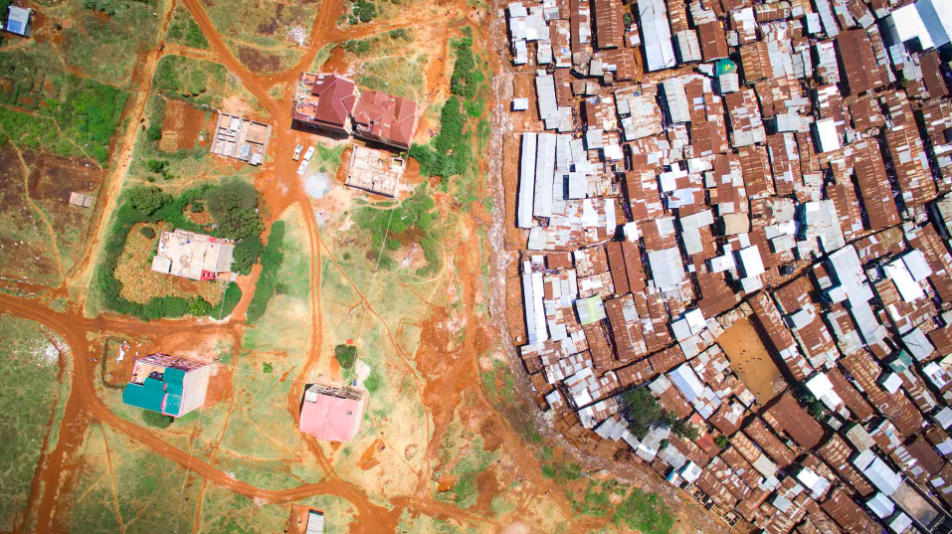
Kibera is constrained not only by infrastructure but also the natural environment. The "river" at the bottom of the slum drains thousands of tons of rubbish into the Nairobi Dam every year.
The Unequal Scenes I have found in Nairobi are a mixture of traditional “rich vs. poor” housing images, but also depictions of how infrastructure constrains, divides, and facilitates city growth, almost always at the expense of the poorest classes. During my time there, I focused on a planned road that will bisect Kibera, Nairobi’s largest slum. This road will cut the slum neatly in two, displacing thousands of people, and tens of schools and clinics that are in its way. This road will help alleviate the city’s traffic problem, but it may cause more problems than it will solve. Just to the south, a new road has already cut off part of Kibera, causing people to cross it illegally, resulting in many deaths. From interviews with residents, it is unclear whether or not the planned infrastructure upgrades have adequately taken into account the public opinion.
This dynamism contributes to make Nairobi one of the most fascinating cities I’ve ever been to.
Read more at http://www.thisisplace.org/shorthand/slumscapes/#nairobi-48752

The Southern Bypass road has already lopped a portion off of Kibera, in the quixotic search for a less congested city. Although there is an underpass (visible at the bottom), people often cross the road from above, resulting in many accidents.
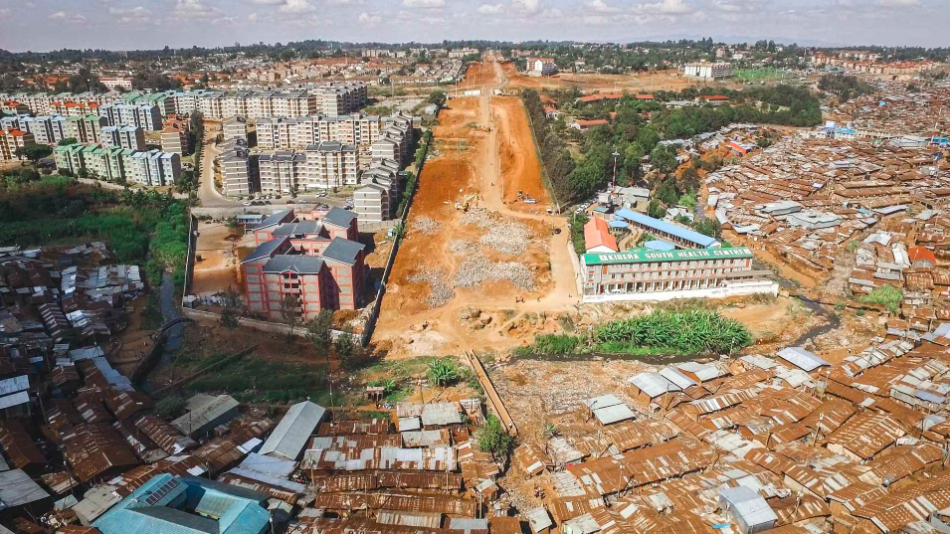
A planned road will bisect Kibera slum in Nairobi, displacing thousands of people.
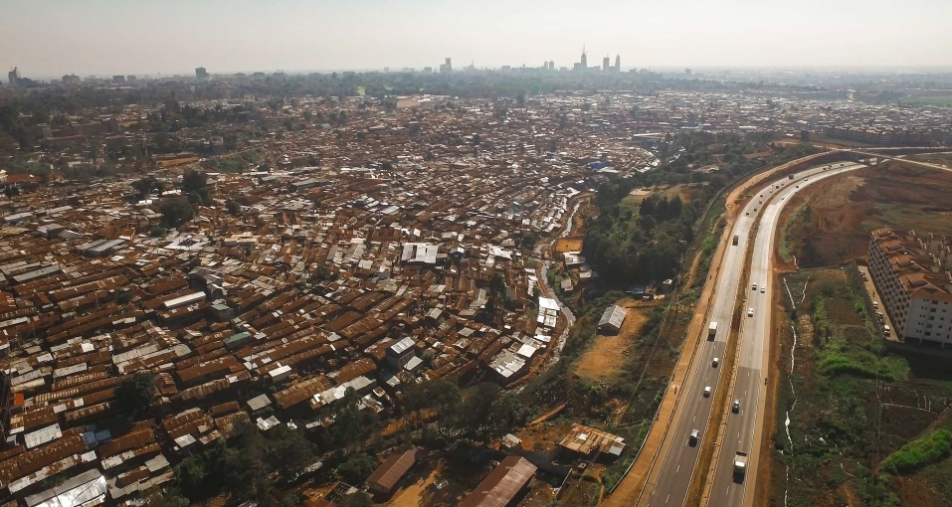
The Southern Bypass road follows the contours of the river and slum next to it. In the distance, you can see the construction beginning on the new road, which will connect Ngong Rd to Langata Rd.
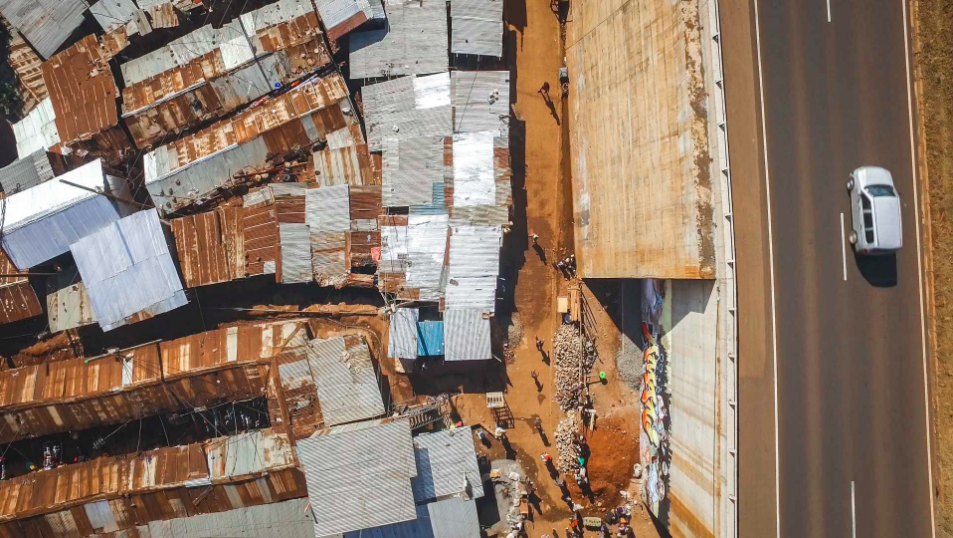
Cars glide over the brand new road, above the slum below.

The suburb of Loresho is home to the wealthy and the poor alike.
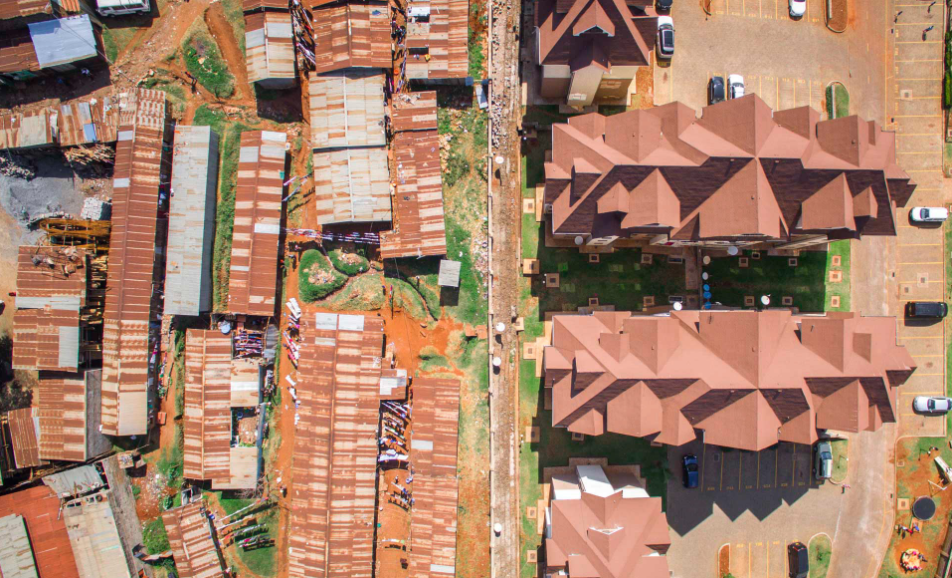
As in many places around the world, the rich and poor are separated by only a thin concrete barrier. But it represents much more than that.

These barriers, whether concrete or imaginary, represent an entire class separation, one that may not be surmounted for generations to come.
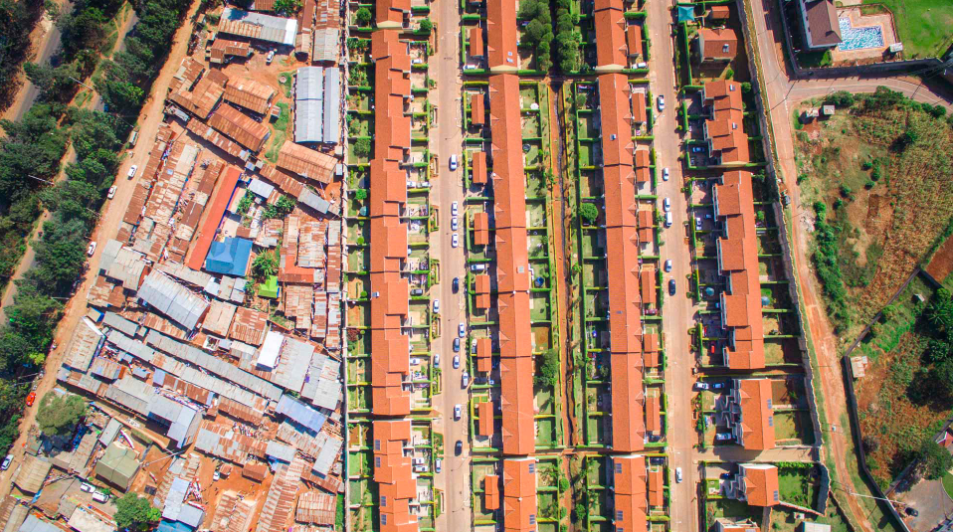
Amazing geometric patterns emerge from the air. "Straight" lines become slightly curved.
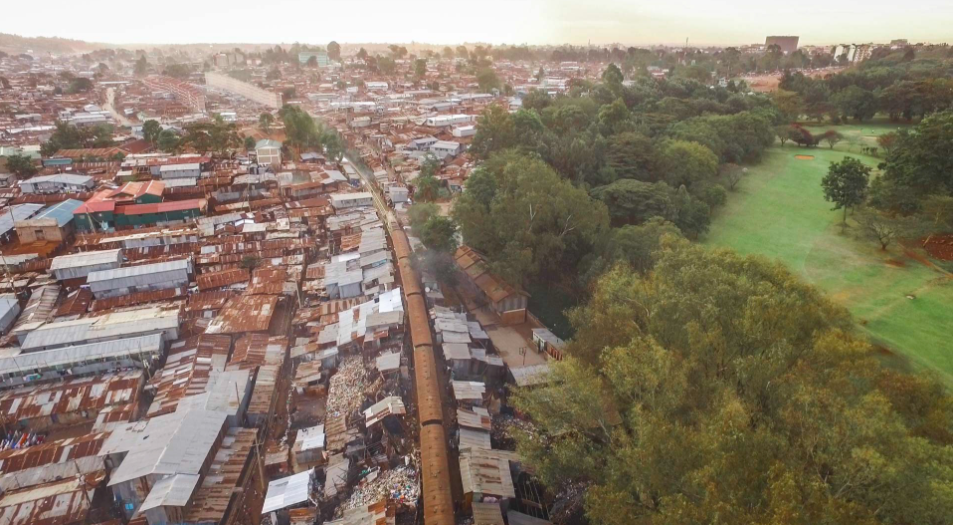
The train is a part of life to Kibera, a source of transportation, of annoyance, of time passing.
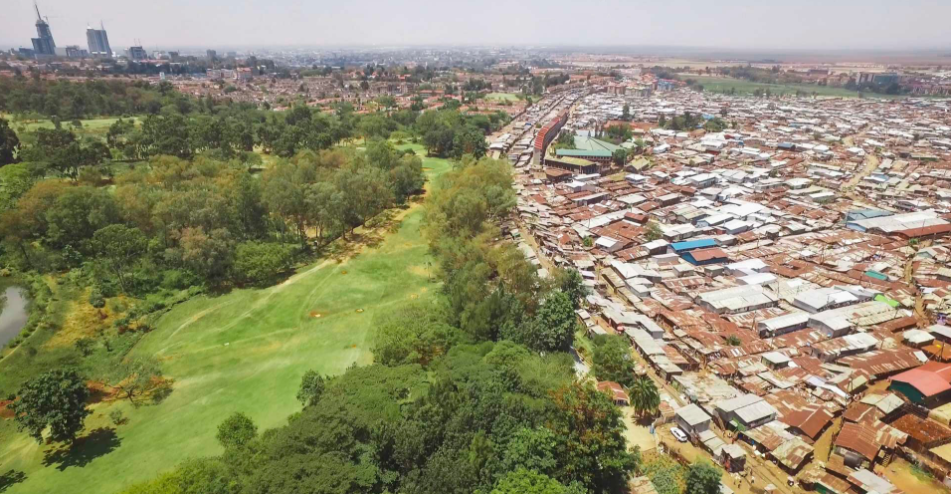
The chaos, noise, and density of the slum is neatly juxtaposed with the orderly calm green of the Royal Nairobi Golf Club, which opened in 1906.
THIS ARTICLE AND PHOTO SERIES WAS ORIGINALLY PUBLISHED ON UNEQUAL SCENES.
JOHNNY MILLER
Johnny Miller is a freelance documentary photographer and filmmaker based in Cape Town, South Africa. His 'Unequal Scences' project is meant to show the stark inequality seen in South Africa and in cities around the world. Check out his website and Facebook to find out more.
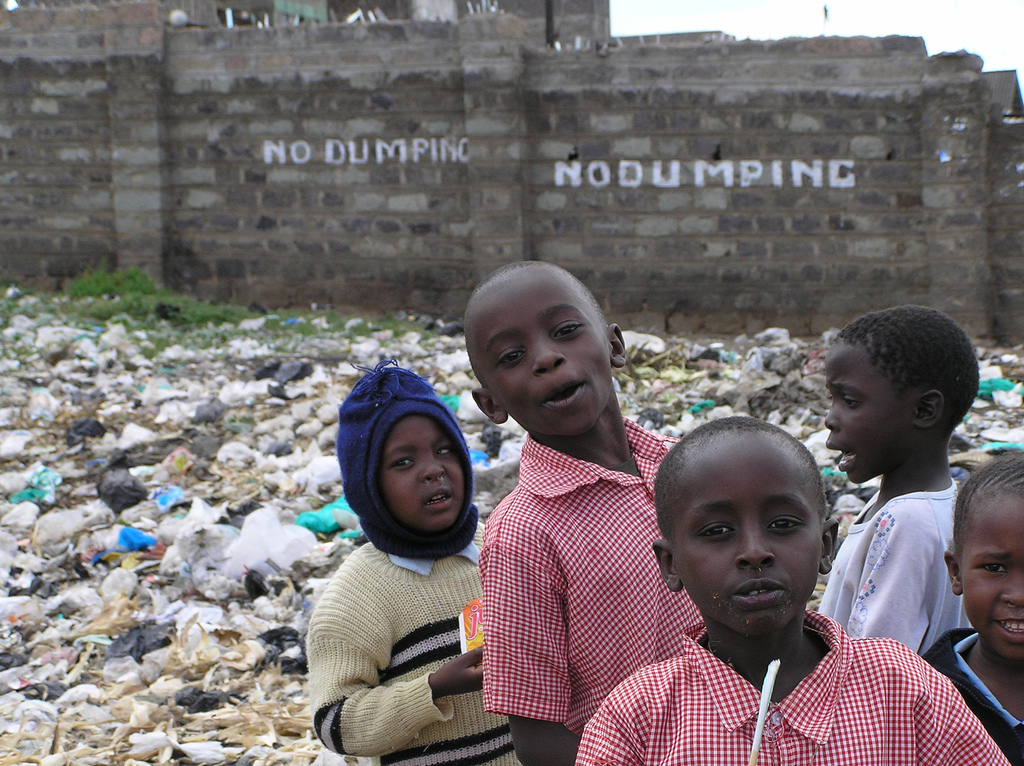
Kenyans Face Up to 4 Years In Prison For Using Plastic Bags
Beginning today, plastic bags will no longer be found in Kenya. If someone is found using one, then they will face a $38,000 fine or potential four-year jail sentence.
It’s officially the world’s harshest plastic bag deterrent.
A full ban on producing, selling, or using plastic bags went into law Monday after a court rejected challenges brought by two large plastic bag importers. The new law was successfully implemented on the third time around, after the first bag-ban in Kenya was proposed over 10 years ago.
Plastic bag pollution is a persistent problem in Kenya. It is not uncommon to see large piles of the single use bags littering the streets of urban centers, where vendors and customers frequently use them to sell and transport items.
Though the bags are convenient, the ultimate cost to the environment is astounding.
"Plastic bags now constitute the biggest challenge to solid waste management in Kenya,” said Kenya's Environment Minister Judy Wakhungu in an interview with the BBC. “This has become our environmental nightmare that we must defeat by all means.”
According to Wakhungu, plastic bags can last anywhere from 20 to 1,000 years in a landfill before they biodegrade. In the meantime, they pose environmental hazards to the communities they end up in.
Serious concerns were raised about the safety of bag disposal when rements of plastic bags were found in the stomach of cows who were to be slaughtered for human consumption. Leaching of plastics into beef destined for supermarkets pose a worrying health risk, according to local veterinarian Mbuthi Kinyanjui.
“This is something we didn’t get 10 years ago but now it’s almost on a daily basis,” he told the Guardian.
Scientists are concerned that the pile up of plastic bags is having a similar negative effect on the marine food chain, where plastic particles can easily make their way into the fish humans eat. The bags also threaten sea life not consumed by humans, such as dolphins, whales, and turtles.
In a country that uses an estimated 24 million plastic bags per month, many see the move as a victory for the environment.
However, some people in the business community worry that the ban will ultimately harm economic prosperity, and generally make life more difficult for the average Kenyan.
Kenya is a major exporter of plastic bags in Africa.
In an interview with the Guardian, spokesman for the Kenyan Association of Manufacturers Samuel Matonda said the ban would eliminate 60,000 jobs and cause 176 manufacturers to close.
“The knock-on effects will be very severe,” Matonda said. “It will even affect the women who sell vegetables in the market – how will their customers carry their shopping home?”
Right now, Kenyans discovered using bags will only have them confiscated with a warning. Soon, they could face the penalties of what is being called the “world’s toughest law against plastic bags.”
Several other African nations have already enacted similar bans or fines on plastic bag use, as have more than 40 countries around the world including China, France, and Italy.
THIS ARTICLE WAS ORIGINALLY PUBLISHED ON GLOBAL CITIZEN.

ANDREW MCMASTER
Andrew McMaster is an editorial intern at Global Citizen. He believes that every voice is significant, and through thoughtful listening we can hear how every person is interrelated. Outside of the office he enjoys cooking, writing, and backpacking.
Fight Volunteer’s Guilt
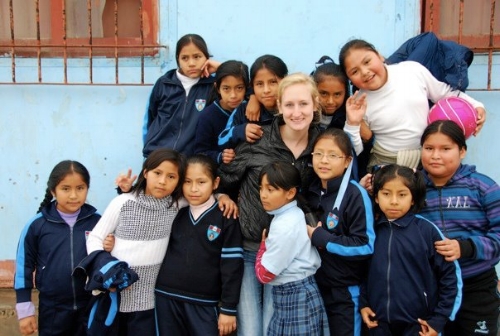
There is a feeling that all volunteers can relate to: post-volunteering guilt. It’s that feeling of returning home after an amazing experience working abroad, only to wonder “did I do enough?”. Did you spend enough time with the kids you were teaching? Build enough homes? Vaccinate enough dogs? Play enough games of soccer? The list can go on and on.
My husband, John, and I are experts at realizing this guilt. We have worked abroad in three different countries.; Teaching English, providing childcare, building houses…you name it. We met while both teaching in Lima, Peru for an organization called Tarpuy Sonqo. (tarpuysonqo.org – check it out if you’re heading to South America). He worked for six months building three houses, and developing a full curriculum for the 4th grade students. I spent the following two months continuing his teaching work. Our hearts were completely invested in our efforts, and of course we fell in love with every baby, kid and adult that we met along the way. (Another feeling that every volunteer can understand.)
When we returned stateside and started dating, our conversations were consumed with when we could return back to our classrooms in Pachecutec, the largest slum outside of Lima. We worried how our students were doing, if the projects we’d started were continuing, and if the volunteers we’d trained were maintaining our high standards. But with full-time jobs, eventually buying a house and adopting dogs, it was becoming unrealistic to return to Lima for more than a week or two. That wasn’t long enough to make the impact we had in mind.
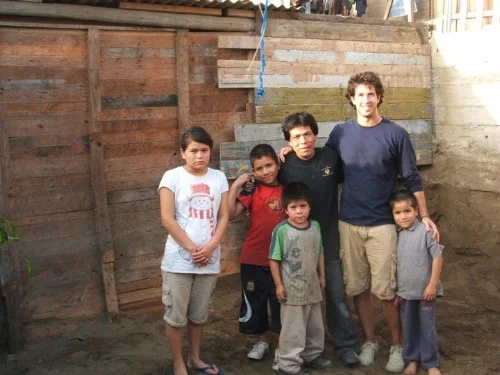
Instead – we decided to take the business we were already running, and use it as a tool to provide continued support to the causes close to our heart. My travel photography company – Kristen Emma Photography – quickly developed into a forever-fundraiser for international charities. Our new motto became “Capture the world to help the world”. We decided to give 25% of our sales back to charities local to where each of my photos were taken. Anything from South America was given back to Tarpuy Sonqo – and other photos donated to a select charity based on their continental location. Within a few months of art shows we were supporting teachers in Peru, dog adoptions in the UK (dogstrust.org.uk), prenatal medicine for women in India (villageclinic.org), AIDS research and meds in South Africa (aids.org.za), even penguin conservation through the Pew Charitable Trusts and my recent trip to Antarctica.
Not only were we thrilled to be helping our Peruvian students – but our clients were amazed! With the rise of charity companies, and the one-for-one model, people are always looking for products that give back to various causes. Adding the charitable aspect to our business model was good for the charities – but also good for our bottom line. That certainly wasn’t our goal, but it helped put food in our dogs’ mouths. :)
The lesson learned is that volunteers can use their guilt as motivation to keep helping. It’s not always possible to physically get back to their area of choice – but they can instead work to find methods of help in their everyday lives. Of course, not everyone has a business that they can use like we did – but there are other approaches to helping:
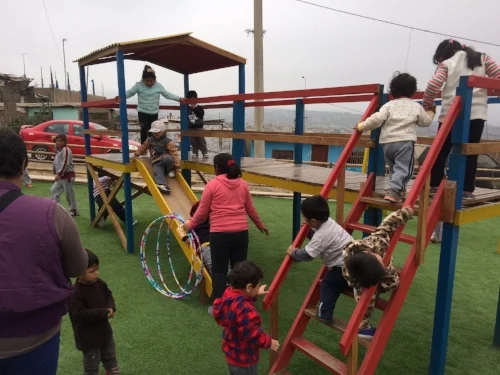
· Getting married? Set up a gofundme page for a charity, rather than asking for gifts. (John and I raised over $5000 for Tarpuy Sonqo. It built an entire park in the slums where we taught, and a jungle gym in a 2nd location. Exchange rates are always your friend. :)
· Birthday? Have your friends bring a non-perishable good instead of a present for you, and then donate it to the local food shelf. (You don’t really need another pair of earrings anyway.)
· Clean out your basement, sell what you don’t need on craigslist, and commit some of the proceeds to your volunteer location. (Those college books you’ve been holding onto could fund new books for your students in Kenya).
· Have friends who are looking to travel? Put them in touch with your volunteer coordinator. A lot of organizations will trade housing and food in exchange for a few hours of work per day. My company of choice is New Zealand-based International Volunteer HQ. They’ve got volunteer placements all around the world, and their credibility makes sure volunteers stay safe while having an incredible experience. Check them out at ivhq.org. They charge some fees, but its always cheaper than a hotel!
· Volunteer locally! There are an abundance of opportunities to help in your own neighborhood. If you speak another language, you can teach ELL classes at your community center. Any work you found abroad can definitely translate to your own community – teaching, childcare, food shelves, and homeless shelters.
In the short seven months since we developed our charitable mission, we’ve raised over $1500 for our partner charities. Although it may not sound like much, it’s $1500 more than they had before. We could have easily NOT raised any money, but what good would that do? Its important to remember that even just $10 raised is helpful to any of the thousands of organizations around the world.
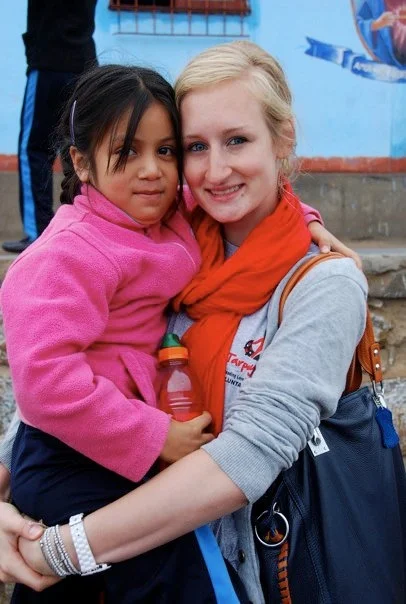

KRISTEN MACAULEY
Kristen is a Minnesota-based photographer, specializing in fine art travel photography. She has lived in three different countries, and traveled to all seven continents through her photography endeavors. Her goal is to use photography to show similarities between cultures, regardless of their location. In order to give back to the communities that she photographs, 25% of all sales are donated back to local charities around the world. See her work on Etsy or on her website.
The Fourth World (2012): Documenary on Slums
The award winning film Fourth World takes you inside slums on three continents to meet individuals caught up in the largest people migration in the history of the world. Understanding 'a billion people' is almost impossible, but meeting a handful of slum dwellers strips away the statistic and begins the process of building understanding. Journey with the filmmakers to Guatemala, Kenya and the Philippines to meet slum dwellers. Listen to published experts--leaders in their fields from three more continents--as they bring understanding to the 'why' of slums, and foreshadow what's going to happen if the world ignores this social powder keg much longer.
CONNECT WITH THE FOURTH WORLD
CHANGE HEROES: The Trip that Changed the Way to Give
Back in 2009, Taylor Conroy took a trip to Kenya and Uganda in pursuit of a vacation and means of getting himself involved. Little did he know that this decision would cause for him to start a movement; Change Heroes -a friend-funding platform which gives anyone the tools they need to raise $10,000 and build a school, library, or water well anywhere in the developing world. In this video, Taylor talks about that initial, innocent trip, which caused his life, and the lives of thousands of others, to change for the better, forever.
CONNECT WITH CHANGE HEROES
VIDEO: Change Heroes and Free The Children Help the World in 3 Hours
Watch what 22-year-old Evan Mula, from Boston, did with just a bit of time. He and 32 of his friends raised $10,000 in three hours to build a school in Kenya through Change Heroes and Free The Children. This is his trip to see that vision emerge in reality. Evan is able to demonstrate that anyone can change the world with just a bit of hard work. He now sets a standard for activists who work in Kenya.