
Julia Kelley
As more global governments define gender and biological sex as a singular identity, transgender communities face a potential loss of rights and social stigma from the U.S. and the U.K. to New Zealand.
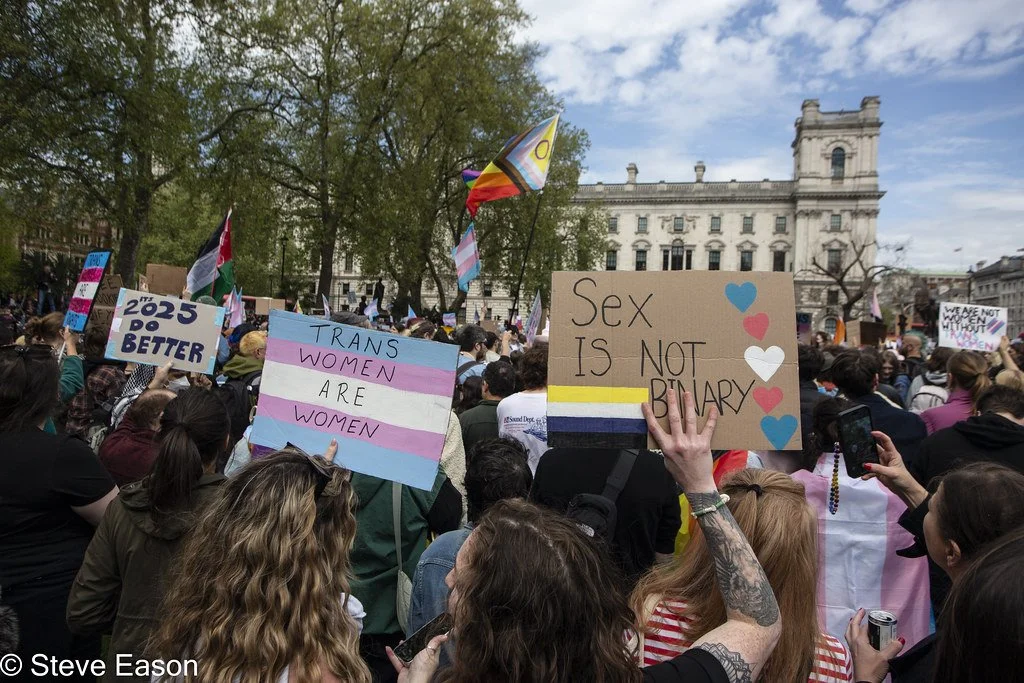
Trans Rights Rally. steven.eason. CC BY-NC 2.0.
Since the beginning of the 21st century, transgender communities have faced enduring struggles with maintaining legal protections. The term “transgender” refers to individuals whose gender identity is different from their assigned sex at birth. Moreover, “sex” is used to refer to the biological organs of one’s body, differing from “gender,” which describes cultural norms relating to the representation of male versus female. In a 2020 report conducted by the Equality and Human Rights Commission, researchers noted overall positive attitudes towards transgender people, but a lasting stigma in certain situations, including when transgender individuals use public toilets corresponding to their gender identity. Furthermore, in a 2022 Pew Research study, a majority of adults said that gender is determined by sex assigned at birth, reflecting attitudes that align sex and gender as one identity.
This discourse over gender identity and sexuality, begun by sociologists in the 1950s, has increasingly become politicized, with governments enforcing their own definitions of gender. During the recent 2024 U.S. presidential election, for example, then-candidate Donald Trump and Republican groups spent over $21 million on anti-trans and anti-LGBTQ television ads. This political position continued after he took office, as Trump issued an executive order in January 2025 only recognizing a person’s sex as assigned at birth. This declaration, stating its goal as defending women from “gender ideology extremism,” positions the gendered words “woman” and “man” to their corresponding terms of “female” and “male” as they correlate with reproductive cells.
This is not only an American issue, however, as other countries are following suit. On April 16, 2025, the United Kingdom Supreme Court unanimously ruled that a woman was to be defined by biological sex under the Equality Act 2010. The court decision came after a long legal battle brought by campaign group For Women Scotland against the Scottish government, arguing that sex-based protections should apply only to those born as female. Judge Lord Hodge, part of the Supreme Court, justified the ruling as bringing clarity in women’s and service providers’ spaces, including hospitals and refuges, and that the new interpretation does not remove protections already put in place for trans women. Although he added that this is not a victory for a specific group over another, LGBTQ+ allies have raised concerns about how this will affect transgender people and their rights. In an interview with The Guardian, Victoria McCloud, a transgender woman, noted that this decision will begin an “enhanced push for overt restriction on the rights of trans people,” describing how even using the bathroom as a trans individual in the U.K. could be risky. Moreover, experts warn that this explicitly excludes the transgender community from legal recognition of their gender identity, such as in single-sex spaces in school or sports teams. In response to such concerns, outrage has sparked across the country. At a protest at Parliament Square in London, thousands of trans rights protesters, activists, trade unions and community groups asserted “women are women,” while many spoke about their personal experiences as transgender individuals.
As a further blow to trans rights communities around the world, only weeks after the U.K. ruling, New Zealand’s populist party, New Zealand First, introduced a bill to define women and men by their biological sex. Party leaders defended the proposed legislation in its potential to “provide legal certainty” and “reflect biological reality” as the country drifts away from “woke ideology.” However, with New Zealand First being the smallest coalition partner in government, many of their bills do not end up becoming law, and other government officials disagree with this ideology. Nevertheless, trans rights activists strongly responded to the legislation by protesting in Dunedin, making known the public’s disdain for the bill.
GET INVOLVED:
Those looking to help support LGBTQIA+ and transgender communities can do so by engaging in conversations about gender identity and using correct pronouns, inclusive language and gender-neutral terms. Being outspoken about issues concerning the trans community, supporting those who have experienced discrimination, speaking out to local governments and learning about LGBTQ+ policies is also important. In addition, allies can check out nonprofits that provide legal support for trans rights, such as Advocates for Trans Equality or Transgender Law Center, or look into donating to other nonprofits, like Trans Youth Equality Foundation, Global Action for Trans Equality and Transgender Europe.

Julia Kelley
Julia is a recent graduate from UC San Diego majoring in Sociocultural Anthropology with a minor in Art History. She is passionate about cultural studies and social justice, and one day hopes to obtain a postgraduate degree expanding on these subjects. In her free time, she enjoys reading, traveling, and spending time with her friends and family.