
Sofia Stidham
Saúl Luciano Lliuya sued the German energy company RWE for damages to his home related to climate change. He lost, but the case is still considered a win for environmental activists.
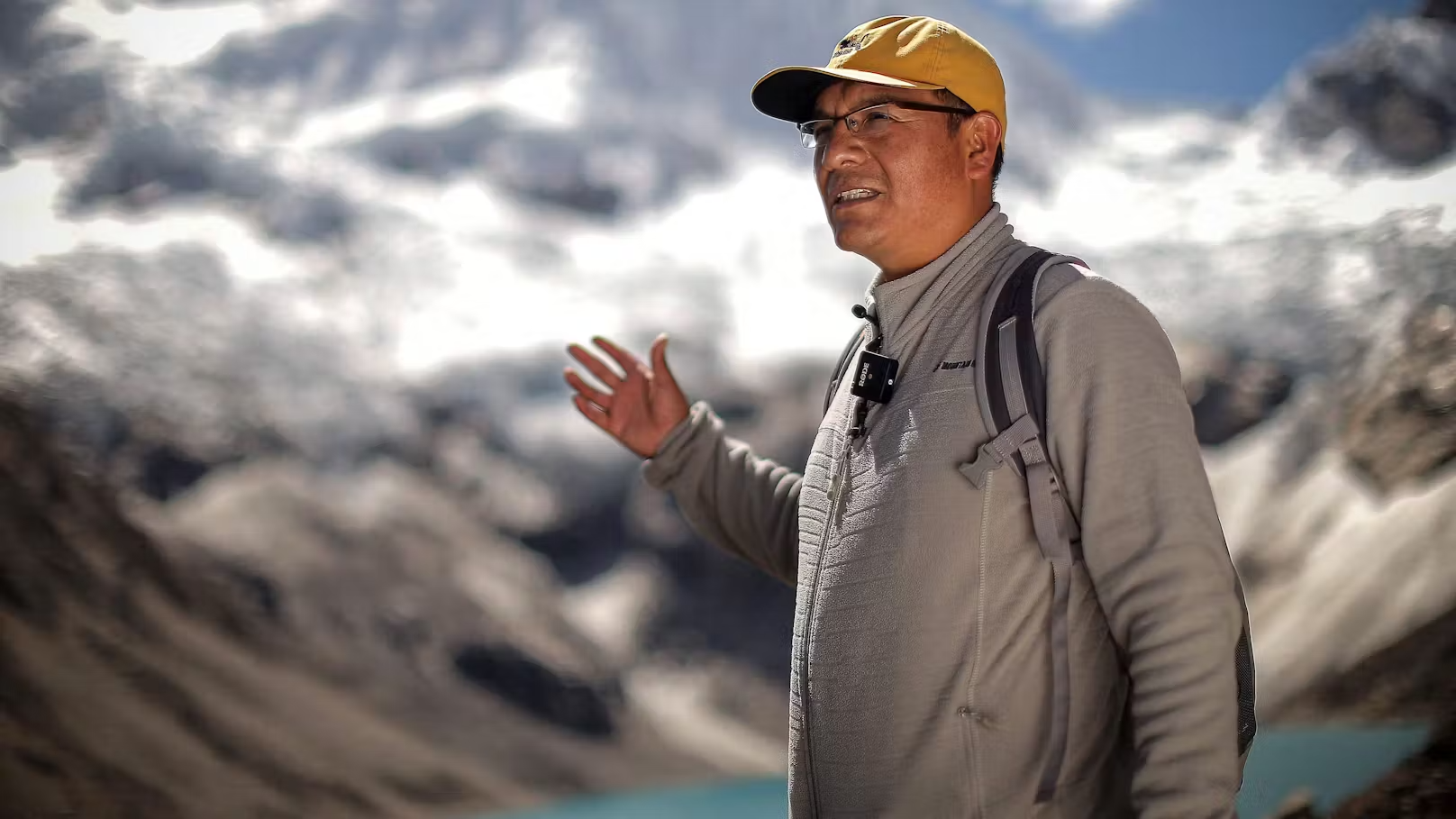
Peruvian farmer Saúl Luciano Lliuya. Luka Gonzales. CC BY 4.0.
After a decade-long legal battle, Peruvian farmer and mountain guide Saúl Luciano Lliuya saw his climate case lose against the German energy giant RWE on Wednesday, May 28, 2025, with no possibility of appeal. When melting glaciers in the Andes threatened to overflow Lake Palcacocha and flood his home, Mr. Lliuya filed a lawsuit of around $17,500 to hold the company accountable for a water defense system. Mr. Lliuya calculated this figure from 0.47% of the total construction cost, matching RWE’s share of global carbon emissions. The German court ultimately rejected Mr. Lliuya’s case on the basis that the probability of the lake flooding his hometown is 1% in the next 30 years.
However, the court simultaneously ruled that corporations could be held liable for their effects on the environment, and specifically that the German civil code for property law can be applied worldwide and held accountable internationally. Even though RWE does not operate in Peru, and is mainly situated in the U.S., Asia and Europe, the case demonstrates how carbon emissions and their legal consequences can transcend borders. Murray Worthy, a senior researcher at Zero Carbon Analytics, called Mr. Lliuya’s steps “a game changer” for future climate cases, explaining how his simple stand for his community was significant in attributing accountability to larger energy companies for global warming. As a result, German environmental NGO Greenwatch, who supported Mr. Lliuya, hailed the lawsuit’s conclusion as a win for climate activists.
The lawsuit also began to deconstruct the economic influence of the energy giant. Namely, Noah Walker-Crawford from the London School of Economics stated that “when climate cases against corporations move past major hurdles, it negatively affects the stock market value of the companies being sued.” Applying an intersectional lens, Al Jazeera’s Step Vaessen has also highlighted the case as integral to empowering the Global South, since it is the first time a complaint like this has happened against the Global North.
Furthermore, the lawsuit had a personal and positive impact on Mr. Lliyua. He stated: “When the German judges visited my home and the lake in 2022, it gave me hope — hope that our voices were being heard and that justice might be possible.” This momentum is cited to extend to a wider pattern of other climate cases. Following suit, states such as Massachusetts, Hawaii and Colorado have allowed climate lawsuits against oil companies to proceed, and the U.S. Supreme Court blocked a Republican attempt to prevent these from happening. On the other hand, the Department of Justice has recently sued Hawaii and Michigan for seeking damages from fossil fuel companies. This pushback indicates that climate litigation remains contested at a federal level.
Thus, although Mr. Lliuya’s case has been terminated, expert opinion shows that the ruling has set a precedent for corporations to take accountability for climate change. His lawsuit not only crossed countries but also continental borders, and as other states and countries take similar action, the question stands: who will be held accountable next?

Sofia Stidham
Sofia is a rising fourth-year English Literature student at the University of Edinburgh, having recently completed a year-long exchange at the University of Virginia. Outside of writing, she enjoys spending time with family and friends, going to concerts, curating her wardrobe, and zoning out on long walks. She hopes to pursue a career that allows her to channel her passion for writing into intersectional feminist advocacy.