
Julia Kelley
In response to drug cartel violence and lack of government action, the Madres Buscadoras, “searching mothers”, of Mexico have taken an imperative step forward in searching for their disappeared loved ones.
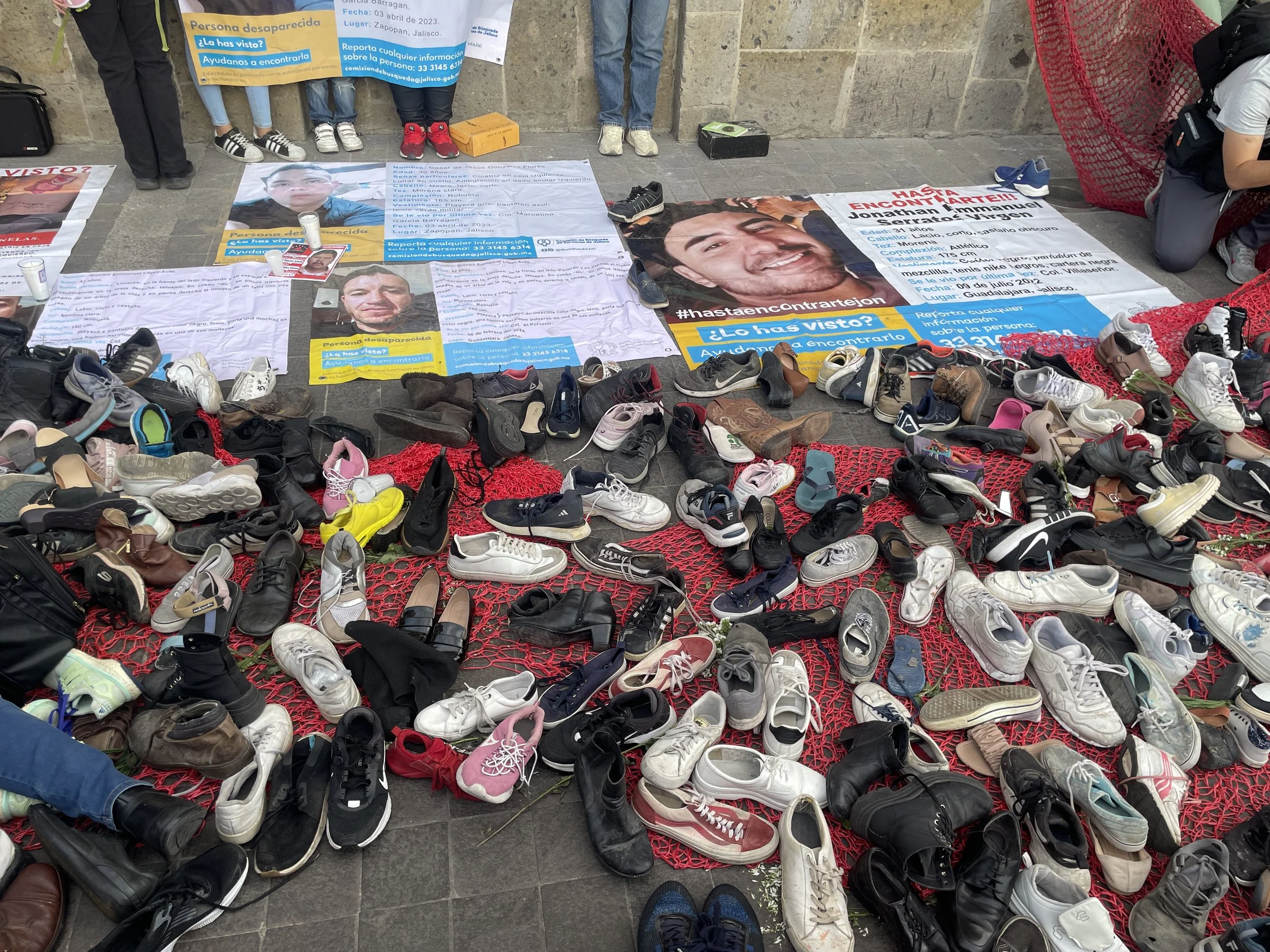
Vigil for Missing Persons in Mexico. Alequihdez. CC BY-SA 4.0.
As of May 2025, the Mexican government has acknowledged that over 128,000 people in the country have gone missing and remain unlocated. This harrowing number has grown since 1952, but drastically increased in 2006 when then-president Felipe Calderón introduced a war on cartels. Beginning in the 1950s, about six or eight major drug cartels in Mexico have competed for power. As they grew into more businesslike enterprises, they have brought violence at the expense of civilian life and peace. It was this increasing brutality that inspired President Calderón’s widespread crackdown on Mexico’s drug cartels, eventually bringing down 25 out of 37 drug kingpins. Despite this movement, cartel violence escalated, as many fragmented and turned into smaller, more violent criminal groups that made kidnappings worse. In March 2025, the extent of this human rights issue became even clearer with the discovery of a suspected drug cartel training camp at Izaguirre Ranch, in the Mexican state of Jalisco. Charred bones, shoes and clothing were among some of the items found, leading many to describe the area as an “extermination center.” This expedition was not led by police, however, but by a volunteer search collective called The Fighting Searchers of Jalisco, one of many “Madres Buscadoras” groups.
The Madres Buscadoras are women, often the mothers and sisters of those who have gone missing, who take on the role of searching for Mexico’s disappeared. Rosario Ibarra de Piedra, who formed the Comité ¡Eureka! in the 1970s, is regarded as the first “searching mother.” After her son, Jesús, a member of a communist guerrilla group, disappeared amid a conflict between revolutionary governments and guerrilla groups, Ibarra sought justice for him and other missing individuals. Since 2006, more and more searching mother groups have formed as a solution to Mexico’s worsening disappearance struggle. The Mexican government has tried to take steps to respond to this epidemic, such as with the 2017 General Law on Missing Persons, which addressed forced disappearances and established a National Search Commission. However, the law fell short due to inconsistent application by federal authorities, inadequate systems, insufficient forensic capacities and minimal penalties for offenders.
In the absence of support or justice from authorities, Madres Buscadoras groups have led a collective search for Mexico’s disappeared. Various cooperatives of women work together to share photos of missing persons, visit morgues, prisons, or psychiatric institutions or walk through neighborhoods, all in the name of finding answers for those they have lost. In an interview with the United Nations Human Rights, Diana Iris García, a member of the United Forces for Our Disappeared collective and mother to a disappeared son named Daniel Cantú Iris, noted how her “struggle is very, very painful” but that it is “a struggle based on love.” Another, Bibiana Mendoza, a member of the Hasta Encontrarte collective, described her difficult search for her missing brother to Amnesty International: “since I started my search, I have become stigmatized by the community … I have received many threats for searching for my brother too. I was summoned by the public prosecutor’s office and asked for my telephone number.” Faced with continual government inaction and public stigma, these mothers and sisters work alone in their search. Moreover, their activism has grown dangerous in its fight against cartel violence as well; members of these groups have been kidnapped, harassed and threatened due to their search efforts. Although they face fear, the Madres Buscadoras remain steadfast in the importance of their work and the love for their relatives that pushes their pursuit of change.
GET INVOLVED:
Those looking to help the Madres Buscadoras groups can look into different organizations that support them, including the Latin America Working Group, the United Nations Human Rights and Amnesty International, or websites for individual collectives, such as Madres Buscadoras de Sonoraor Madres Buscadoras de Jalisco. Many groups and family members have their own GoFundMes as well that you can find by searching the phrase “Madres Buscadoras.” You can also check out organizations that assist in fighting Mexico’s disappearance and violence epidemic, including the University Network for Human Rights, Peace Brigades International and the International Committee of the Red Cross.

Julia Kelley
Julia is a recent graduate from UC San Diego majoring in Sociocultural Anthropology with a minor in Art History. She is passionate about cultural studies and social justice, and one day hopes to obtain a postgraduate degree expanding on these subjects. In her free time, she enjoys reading, traveling, and spending time with her friends and family.