Salome Liptak
Trump's continued pursuit of annexing Greenland has complicated international discussions of the territory's relationship with Denmark.
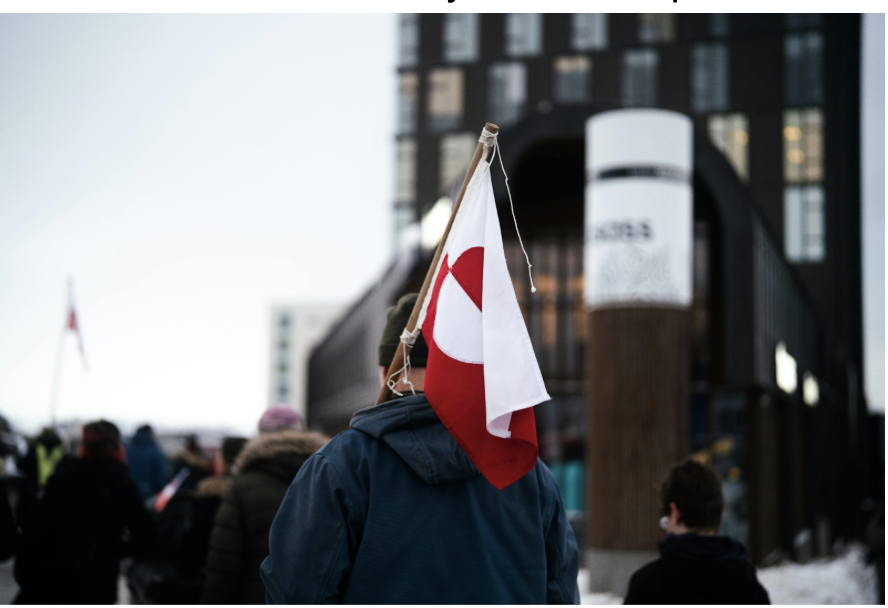
Protester holding Greenland’s flag. Peter Platou. Pexels.
Greenland, the autonomous territory of Denmark that is home to about 56,000 people, has been the subject of international debate during the second Trump administration. Trump first expressed interest in purchasing Greenland from Denmark in 2019, but now he has escalated to threats of tariffs against Denmark and its European allies, as well as military action against Greenland.
Greenland has had its own parliament for domestic governance since the 1979 Home Rule Act, and it achieved self-rule in 2009, when legislation outlining Denmark’s legal pathway to voluntary independence was passed. Current polls show that Greenlanders hope to utilize this pathway to complete independence from Denmark, but Greenland’s vast, remote landscape and low population make economic independence presently impossible. This is also a major factor for the healthcare access issues that concern Greenlanders of all viewpoints, since the most remote community clinics are typically understaffed and underresourced.
Several European leaders have expressed their disapproval of Trump’s threats and emphasized their solidarity with Greenland against foreign intervention. Greenland’s unique status as a territory has required careful wording when defending the island’s right to self-determination, including U.K. Prime Minister Keir Starmer’s affirmation that “the future of Greenland is for the people of Greenland and the Kingdom of Denmark alone.” French President Emmanuel Macron made a similar statement, choosing to affirm Greenlanders’ sovereignty while speaking in Indigenous Greenlandic.
Greenland’s post-colonial relationship with Denmark, as is true for many Indigenous groups around the world, remains complicated. Greenland, whose population is majority Inuit, bears several national wounds from Danish colonial rule, which only ended in 1953. These include social experiments that separated Inuit children from their families and put them in Danish foster families to assimilate in 1951, as well as the forced sterilization of Inuit women throughout the 1960s. While Denmark has made strides toward reparations with public apologies and payouts for those involved, this painful history has left its mark, and systemic discrimination continues to be an issue in Greenland’s healthcare, education and social services, all of which are funded by Denmark.
Trump’s current push to annex Greenland has taken a different tone than that of his first term, utilizing the Kingdom of Denmark's present sovereignty over Greenland to justify U.S. intervention. On Truth Social, he announced his plan to send the U.S. hospital ship USNS Mercy to Greenland “to take care of the many people who are sick, and not being taken care of there.” The post’s unsubstantiated claim, along with its AI-generated image of the Mercy, caused widespread confusion. It appears this plan may have originated with Jorgen Boassen, a Greenlandic Trump supporter who has been vocal about issues of healthcare access in Greenland’s rural clinics. In response, Greenland’s Prime Minister, Jens-Frederik Nielsen, noted that Greenland currently has a “public healthcare system where treatment is free for citizens,” providing more access to services than the current U.S. healthcare system, despite being flawed.
This new attempt at a humanitarian claim to Greenland only further complicates international discourse on Greenland’s sovereignty. For the majority of Greenlanders who oppose American acquisition of Greenland, Trump's threats of intervention on their behalf have only increased the obstacles they face in establishing independence, as they are reliant on Denmark for defense; if Greenland were to leave the realm of Denmark, it would likely be unable to defend itself from unwanted intervention. Many Greenlanders have expressed humor at the ironic effect Trump’s actions have taken, such as one viral video from the Danish public broadcast DRP3, where a man tells the camera, “Yes, Mr. President! You are a true peacemaker. Because your threats have actually brought Denmark and Greenland closer together than ever!”
While Denmark’s control leaves much to be desired for many Greenlanders and complete sovereignty remains a political goal, it is clear that intervention from Trump is both unwarranted under international legal norms and unwanted by the majority of Greenlanders.
Salomé Liptak
Salomé is a student at Sarah Lawrence College studying literature and writing. She is passionate about storytelling (both true and fictional) and its power to reflect the world as it is, or imagine what could be.