
Zoe Lodge
Facts and information behind modern elections face an escalating threat in the digital age.
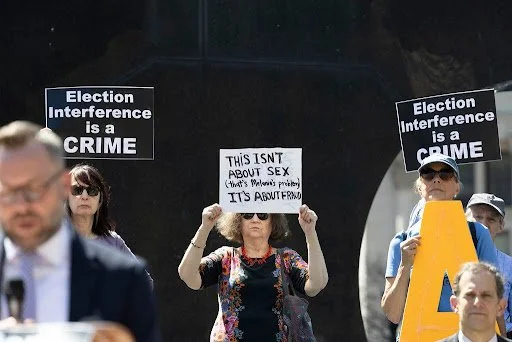
Americans protest election interference. Gina M. Randazzo. CC BY-NC-SA 2.0.
In the digital age, where information can travel across the globe in seconds, elections are increasingly under threat of misinformation. The U.S. intelligence community has flagged Russian interference in recent elections, but the weaponization of misinformation regarding electoral processes is not a uniquely American issue. From Kenya to the Philippines to Brazil, disinformation campaigns and coordinated online propaganda are being weaponized to shape political outcomes, silence dissent and erode public trust in democratic institutions. Election interference today is less about ballot boxes and counting and more about public information. False narratives, bot networks and troll farms are used to flood social media feeds with divisive content. The goal is not always to convince but often to confuse. When voters can’t distinguish fact from fiction, skepticism grows, and that’s where faith in democracy falters.
In the 2017 elections in Kenya, disinformation campaigns linked to Cambridge Analytica fueled ethnic tensions and contributed to political unrest. Citizens allegedly received targeted text messages and social media posts regarding campaigns with information they did not consent to be shared. Following the election, the losing candidate claimed that the election had been rigged in favor of his opponent, resulting in riots across the country that killed more than twenty people. In the Philippines, disinformation has become a political weapon, with coordinated networks of fake accounts being used to rewrite historical narratives, rehabilitate controversial figures and drown out dissenting voices. The Marcos Administration was able to reinstate power in the island nation in 2022 following careful rewriting of family history through social media campaigns and widespread public manipulation. Brazil, meanwhile, has grappled with the viral spread of conspiracy theories through encrypted messaging apps like WhatsApp, which played a pivotal role in shaping public opinion during the 2018 elections. Campaign groups and marketers have been known to scrape Facebook for phone numbers and send hundreds of thousands of politically charged messages at once to users across countries. Many of these efforts were utilized ahead of the 2018 election in the promotion and ultimate election of far-right candidate Jair Bolsonaro.
To combat the rise of disinformation campaigns working to kill truth, watchdog groups and journalists are exposing the networks behind misinformation, bringing light to the dark underbelly of digital propaganda. Organizations like Africa Check and the Philippines-based Rappler have become leaders in fact-checking and accountability in the particularly vulnerable regions. At a broader level, the International Fact-Checking Network works to coordinate standards across borders. Their efforts highlight the essential nature of investigative journalism in the digital era.
Concurrently, young people are stepping up with digital literacy campaigns aimed at empowering citizens to resist manipulation. In Kenya and Brazil, new initiatives are training the youth to spot fake news and navigate social media critically. These programs emphasize a vital truth: while regulation and oversight are necessary, building grassroots resilience is just as important in safeguarding democracy.
Tech platforms themselves face growing pressure to act. Companies like Meta, X (formerly Twitter) and TikTok have rolled out tools to flag misleading posts and limit disinformation, but some argue their enforcement is uneven and algorithms still prioritize sensational content. The fact-checking efforts are largely user-based, often in the form of “community notes,” where users can flag posts for misinformation and attach contradictory evidence. However, this can make fact-checking difficult to enforce. As well, the posts remain visible on the site for those who choose to ignore community notes and suggestions or if users post satirical or incorrect information in these fact-checking forums. Meta ultimately abandoned the “community note” system in January 2025, claiming political bias and appeasing President Donald Trump as he took office around that time.
Protecting elections from any form of interference is ultimately about more than just securing votes; it’s about preserving democracy itself. If unchecked, political disinformation risks normalizing government mistrust and making free and fair elections a thing of the past. Safeguarding election sanctity requires vigilance, widespread collaboration and the strong defense of truth. The growing network of watchdogs, journalists, activists and digitally savvy youth shows that global civil society is fighting back. The battle against disinformation and election interference is far from over, but it’s one the world cannot afford to lose.
GET INVOLVED:
Global citizens concerned about misinformation interfering with democratic processes can donate and get involved with fact-checking organizations around the world. Organizations like Africa Check take donations to help spread truth across the continent and verify information. VeraFiles is a fact-checking, truth-forward organization within the Philippines that takes subscriptions and submissions. The International Fact-Checking Network also takes donations.

Zoe Lodge
Zoe is a student at the University of California, Berkeley, where she is studying English and Politics, Philosophy, & Law. She combines her passion for writing with her love for travel, interest in combating climate change, and concern for social justice issues.