
Julia Kelley
For thousands of years, unique folk art has held a significant place in Mexican culture, defining not only the country’s complex history but also its proud national identity.
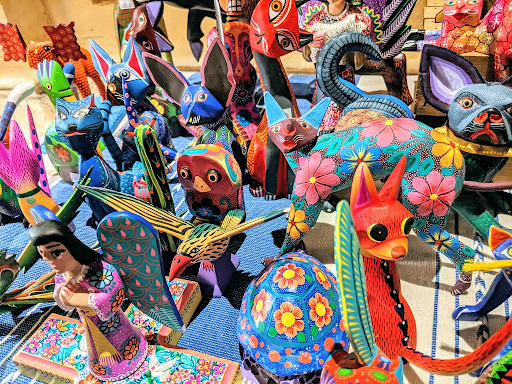
Alebrije figures. Edenpictures. CC BY 2.0.
As one of the most renowned artisanal cultures worldwide, Mexico’s colorful folk art acts as a prominent source of national identity and pride. These arts and crafts, known as Mexican artesania, are characterized as any handcrafted item, ranging from metalwork to ceramic sculptures, that are embellished with an array of vibrant decorative patterns and symbols and can be used decoratively or as a part of daily life. The unique tradition of Mexican folk art comes as a deep cultural and historical blend of both native and European influence; the Indigenous artistic practices of early Central and South American empires, like the Aztecs and Maya, combined with colonial Spanish religion and techniques to form what today represents Mexico’s long-established craft production.
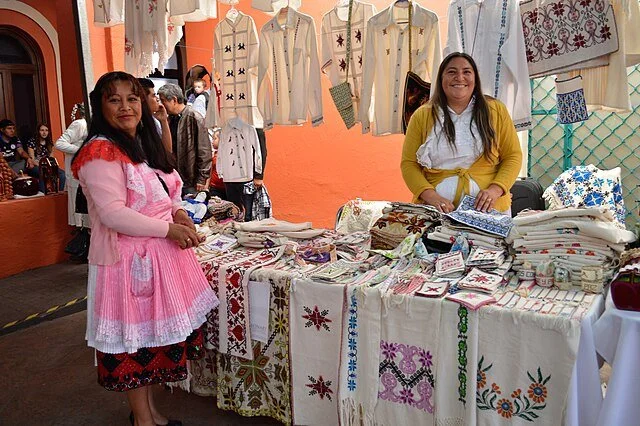
Mazahua textiles. Alejandro Linares Garcia. CC BY-SA 4.0.
Today, Mexican artesania not only serves a purely practical use through an item’s function but is also a strong cultural art that sees artisans making distinct designs through a thoughtful, creative process. Craftspeople utilize folk art to tell the story of Mexico’s history, its people and the land, therefore acting as an expression of national identity. Moreover, communities and ethnic groups create items with patterns and symbols particular to their respective cultures’ beliefs and customs. Traditional textiles are one such type of folk art that has, for over 2,500 years, helped Mexican communities distinguish themselves from one another across a hybrid of Indigenous symbols and modern techniques, including patterns made up of spirals, animals and geometric decorations. For example, Mazahua women are well known for creating wool and cotton textiles that get passed down from generation to generation. These pieces are characterized by images of plants, animals and families, and they are used in a variety of ways, from blankets to belts, to meet their society’s needs and promote their culture.
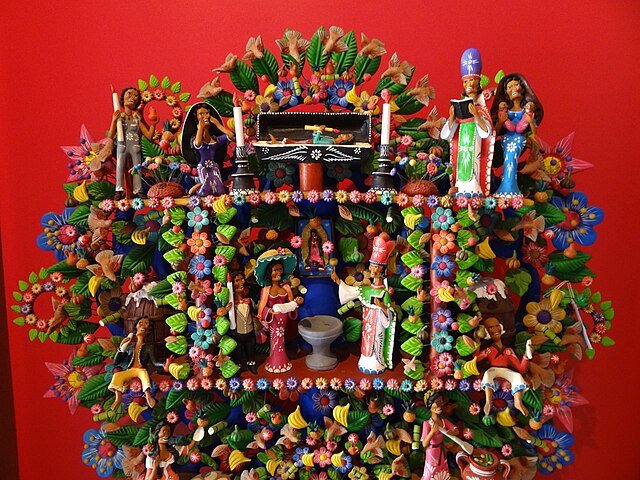
Tree of life sculpture. Adam Jones. CC BY-SA 3.0.
Spirituality is another integral part of Mexican folk arts. Many of these crafts describe the relationship between nature, life and death, drawing on ancient traditions to describe mysticism in a contemporary way. One type of ceramic artesania, which is one of the most common artisanal practices in the country, comes in the form of everyday pottery, like bowls and jars, also known as la loza corriente, that are adorned with animal and human designs for household ceremonies. These objects serve a deeply spiritual function for each family; the tree of life, for example, is an intricate clay candelabra that displays a symbol of devotion through figurines and vivid designs. These features, often including Catholic figures or skeletons, are meant to be read starting from the bottom up, telling either a biblical or traditional Mexican story, such as those related to holidays like the Day of the Dead. Huichol beading is another celebrated folk art associated with the Indigenous Huichol tribe. Craftspeople use a centuries-old single-layer beading process to create unique designs that portray their spiritual beliefs. These beadings, made up of colorful geometric shapes, can form all different types of objects, like clothing, sculptures or even prayer bowls, through dynamic scenes of natural and animal symbols.
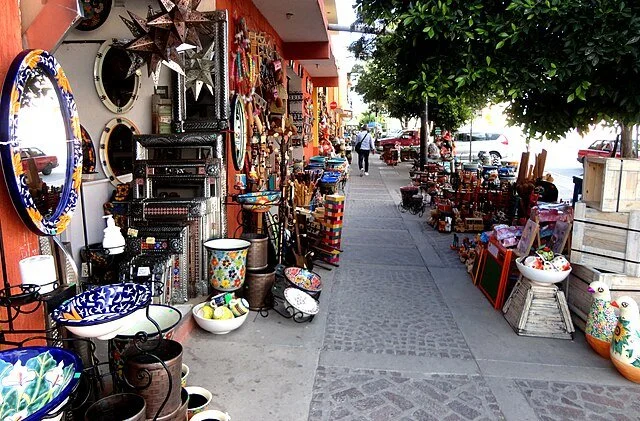
Avenue of Mexican artesania. Juan Carlos Fonseca Mata. CC BY-SA 4.0.
This deep culture of folk art not only connects modern Mexico with its Indigenous roots and European history but also reveals Mexico’s distinct identity that citizens continue to celebrate. Whether through everyday objects or decoration, different artesania today are imperative in representing communities’ culture and spirituality through a style that uniquely distinguishes Mexico.

Julia Kelley
Julia is a recent graduate from UC San Diego majoring in Sociocultural Anthropology with a minor in Art History. She is passionate about cultural studies and social justice, and one day hopes to obtain a postgraduate degree expanding on these subjects. In her free time, she enjoys reading, traveling, and spending time with her friends and family.