
Ashley McDermott
CopenPay is a traveler rewards program designed to encourage sustainability to reduce the environmental impact of tourism in Denmark's capital.
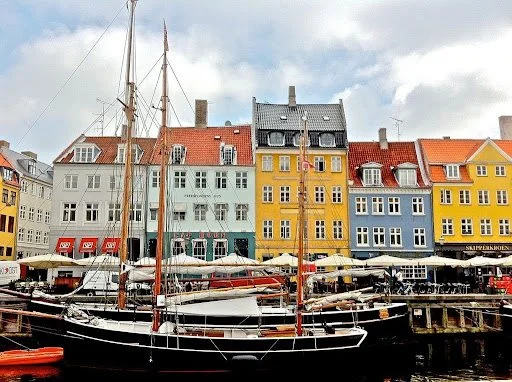
Boats docked in Copenhagen. Claus Miller. CC0.
If you arrived in Copenhagen by train from June 17 to Aug. 17, 2025, you could have earned a free meal, yoga session, bike rental or one-hour sauna session. For the second year in a row, the city ran its CopenPay program, an initiative designed to mitigate the environmental impacts of tourism by offering rewards to travelers for acting sustainably.
CopenPay operates on the premise that travelers are becoming more cognizant of their impact on the environment and local communities. The program's website cites a recent study showing that two-thirds of travelers hope to leave the places they visit in better condition than when they arrived. "Tourism must move from being an environmental burden to a force for positive change," says Soren Tegen Pedersen, CEO of Wonderful Copenhagen, the official tourism organization of the capital. "Luckily, there is a big willingness among tourists to contribute positively to the destinations they visit."
The initiative's pilot was successful, with a nearly 30% increase in bike rentals and several tons of litter collected over four weeks in summer 2024. 98% of participants said that they would recommend the program to other travelers. It has already become part of the EU’s transition pathway for tourism, an initiative designed to help the European Union’s tourism sector transition to more sustainable practices. Cities in Germany and Finland are preparing to launch their own version of CopenPay, and over 100 cities have expressed interest in adopting the program.
Despite the positive results from the first full summer of CopenPay, the initiative is not without its challenges. "Many of the participating attractions that were limited in the number of participants had to report 'sold out' very quickly," states Lina Holm-Jacobsen of VisitDenmark, the official tourism organization of Denmark. Rewards are also largely given based on trust, which, as stated on the CopenPay website, is "in line with Denmark's high-trust culture." Any city adopting the program would need to develop its own system for proving participation that fits local context and cultural norms.
This year, the program placed special focus on cutting tourism emissions by promoting train travel to Copenhagen and offering incentives to visitors who extended their stays to four days or more. However, CopenPay offers numerous other opportunities for participation in the program and a varied selection of rewards. For example, to help clean litter out of the harbour, travelers received a free kayak rental. Those who helped introduce beneficial insects on an organic strawberry farm earned a free ice cream. Many top Copenhagen attractions, including the National Museum, Kronborg Castle in Elsinore and the National Gallery of Denmark, all take CopenPay vouchers. Though receipt of many rewards is based on trust, some participants may be expected to show proof of participation, such as photos of the activity or train tickets.

Ashley McDermott
Ashley is a PhD candidate in Linguistic Anthropology at the University of Michigan. She is committed to making her research useful for the communities she works with. Her work explores how families navigate language use and language shift in Bishkek, Kyrgyzstan. When she’s not working on her research, you’ll find her adventuring with her toddler daughter, whose commentary keeps every day interesting.