
Julia Kelley
Spreading across Asia, Africa and Europe, youth-led protests have quickly risen over recent months through the use of social media and pop culture symbols, rattling governments in a passionate call for change.
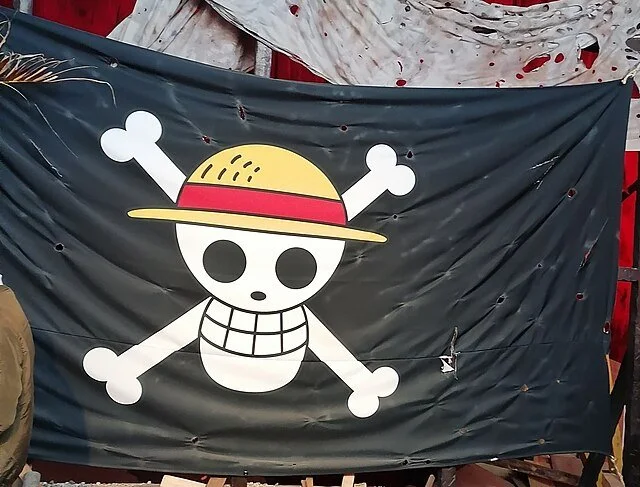
One Piece anime flag. Ferfive. CC BY 4.0.
Over the past few months, countries worldwide have been shaken by an outpouring of protests led by Gen Z. Young protesters have led these passionate campaigns for political change and accountability in response to federal mismanagement. But as demonstrations become larger and governmental reactions become more disappointing, activists have turned to social media to share awareness of their struggles and create solidarity, additionally pulling from pop culture to find symbols of revolution. Through creating connections with other young communities across the globe, Gen Z has strengthened these respective campaigns.
On Sept. 8, 2025, Gen Z protesters in Nepal effectively dismantled their government and led the induction of new leaders who echoed their demands for change. The transformation came as a result of youth-led demonstrations that lasted over 48 hours; during this time, widespread infrastructure destruction and 72 deaths made these the deadliest protests in Nepal’s recent history. Anger and disappointment with the government built up over months, as young activists became outraged by flagrant displays of wealth shown by the children of Nepalese politicians. To ordinary citizens, these children, nicknamed “nepo babies” on social media, represented the significant gaps in wealth and employment that have loomed over the population. Especially for Gen Z, who make up about 20% of Nepal’s population, finding jobs within the country has become extremely difficult, with unemployment rates reaching 20.8%.
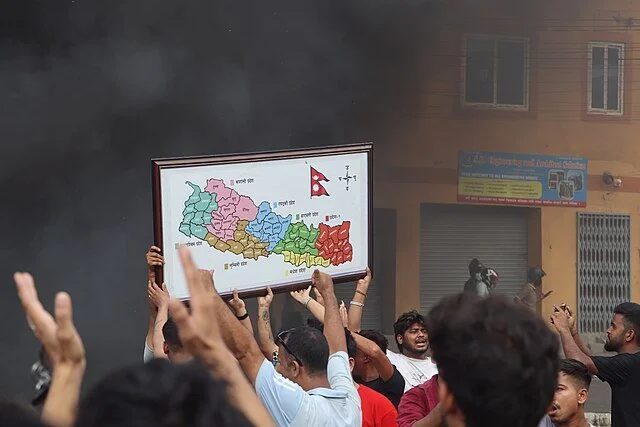
Gen Z protesters in Nepal. Himal Subedi. CC BY-SA 4.0.
On Sept. 4, in response to online movements discussing government corruption and “nepo kids,” the Nepalese government instituted a social media ban. This was recognized as censorship by Gen Z, who responded by immediately storming the country’s Parliament in the country’s capital city of Kathmandu. By Sept. 12, after Prime Minister Khadga Prasad Oli resigned, an interim leader had already been selected. Polls on Discord, a social media chat platform, chose Sushila Karki, a 73-year-old chief justice who is known for her anti-corruption opinions. These Nepalese protests not only signaled a revolutionary change for the country but also a significant shift toward social media as a mechanism for substantial change. In several other nations, particularly across Asia, more uprisings against extensive government corruption and socioeconomic inequality have become increasingly common. Gen Z has primarily led this call for action, with social media as a vital tool of protest.
Indonesia is one such country. At the end of August, protests broke out across the country as young activists called for reforms in the face of economic struggles; despite a 5% growth rate per year, the nation has one of the highest unemployment rates in Southeast Asia, making it difficult for young people to find jobs. In addition to this, the President, Prabowo Subianto, has established a free school lunch program that has required budget cuts and the letting go of thousands of government contractors, something that experts say Indonesia’s economy cannot handle, on top of the programs already facing implementation issues. On Aug. 25, demonstrations began on university campuses after the President gave more privileges to federal legislators, including raises, payment for trips overseas and a high monthly housing allowance, which itself was 10 times larger than the minimum national wage.
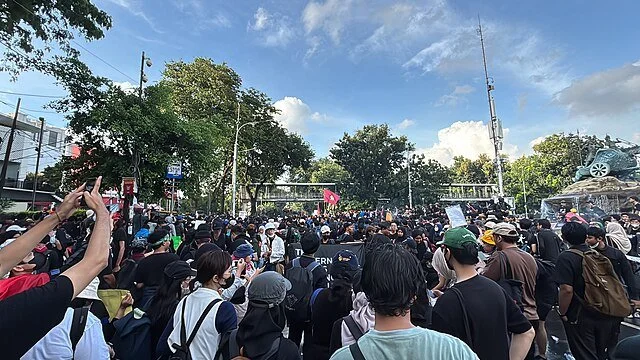
Indonesian student protest. David Wadie Fisher-Freberg. CC BY-SA 4.0.
Anger over economic gaps quickly spread throughout Indonesia. During a period of five days, Gen Z protesters relied on TikTok and other social media platforms to spread awareness of what was happening in their country, utilizing digital content, like live streams. About one month after these events, however, the Indonesian government requested data about live streams from this period of time, a request that TikTok denied. President Subianto suspended the app’s license within the country afterward on account of it violating operator obligations, raising concerns about citizens’ freedom of speech. In addition to social media usage, pop culture references have become a symbol of solidarity as well. A cartoon pirate flag, in particular, has come to represent protest in Indonesia as young people have become more dissatisfied with the government. The flag, which comes from a popular Japanese anime called One Piece, portrays a skull and bones, and is said in the show to display hope and a fight against authoritarianism.
This flag has become a symbol in the Philippines as well. At the end of September, young protesters engaged in demonstrations against government corruption and wasteful spending. Facing increasing environmental issues, the government has spent the last two years attempting to institute flood control projects. However, with over 1.089 trillion Philippine pesos spent, Greenpeace has found that Filipino officials and contractors have most likely taken the money for themselves, and much of the planned infrastructure has not even been built. These allegations came at a time when heavy monsoon rains and storms were wreaking havoc on millions of citizens nationwide, prompting even more anger. For Gen Z protesters, the One Piece Flag has become an important sign of protest and defiance, as they proudly wave the flag in a call for reform.
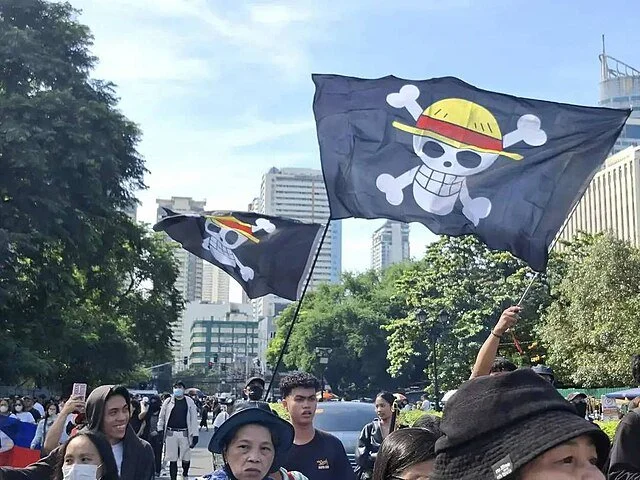
Protest in the Philippines. GeniusTaker. CC BY-SA 4.0.
In fact, Gen Z protests in many other countries have adopted the flag as their own symbol. Madagascar has been protesting since late September over power and water supply shortages; Moroccans are outraged over government spending on 2030 FIFA World Cup stadiums instead of healthcare systems; police brutality and frustration with the government have spurred those in Kenya; Serbians have been calling to address corrupt politicians. All of these countries’ protests have been largely youth-led and have featured the One Piece flag as a strong demonstration of resistance. The flag is only a recent example of pop culture being used in revolution, though; over the 21st century, activists have pulled from TV shows and movies to look for emblems of rebellion and hope for change. Taken from “The Hunger Games” movies, for example, the three-finger salute became a popular gesture of defiance in Thailand during a 2014 protest. Additionally, a scarlet cloak and white bonnet, pulled from “The Handmaid’s Tale,” were worn by American women in 2017 as a protest to anti-abortion legislation.
Gen Z has become a catalyst for this change. As disillusionment with government officials and chronic issues relating to corruption, economic disparity, threats to free speech and social inequality rise across the globe, young people have led the movement for large-scale reform. Social media, which is largely used by younger populations, has also increasingly been used by Gen Z to disseminate information about protests and form solidarity between countries thousands of miles apart. The viral hashtag #SEAblings is one example of this, seen on social media throughout Southeast Asian countries as a cry of support for Indonesian protests. As international governments, notably run by a majority of older people, struggle both to respond to grievances and control violent protests, youth-led demonstrations mark sharp generational differences in political beliefs and how activism is facilitated. In an increasingly digital world, the turn toward online programs is only beginning.
GET INVOLVED:
Those looking to help support protesters around the world can look into organizations such as CARE, which offers humanitarian aid to all the countries listed in this article, Peace Direct, an international charity that aims to help stop violence across the world, Freedom House, an organization dedicated to securing freedom in all countries, or Amnesty International, which helps support human rights worldwide. In concern of particular issues, you can check out Greenpeace, which campaigns for environmental protection, The Future of Free Speech, a group that aims to protect the freedom of speech, the Global Freedom of Expression, an initiative to defend the freedom of expression, or the Center for Global Development, which seeks to reduce poverty worldwide and drive economic research to ensure better policy and practice.
Julia Kelley
Julia is a recent graduate from UC San Diego majoring in Sociocultural Anthropology with a minor in Art History. She is passionate about cultural studies and social justice, and one day hopes to obtain a postgraduate degree expanding on these subjects. In her free time, she enjoys reading, traveling, and spending time with her friends and family.