
Julia Kelley
Undeterred by decades of water rights controversy, Ethiopia finally opened its monumental hydroelectric dam across part of the Blue Nile River, a project that has garnered fierce opposition from Egypt and Sudan.
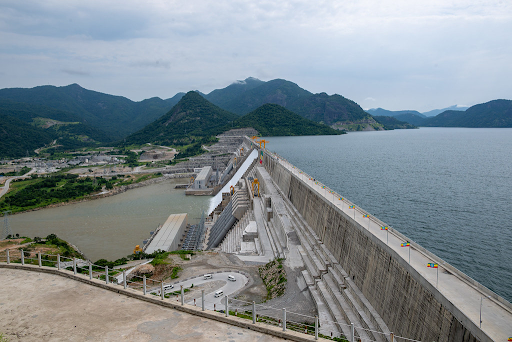
Inauguration of Grand Ethiopian Renaissance Dam. PMO Barbados. PD.
Ethiopia inaugurated its hydroelectric dam on Sept. 9, 2025, drawing both hopes for increased electricity production and controversy from neighboring countries. The $5 billion Grand Ethiopian Renaissance Dam (GERD) began in 2011 along the Blue Nile River and holds an estimated volume of 74 billion cubic meters of water, making it the largest hydroelectric power plant in Africa. Stretching 1.2 miles and standing at 476 feet, Prime Minister Abiy Ahmed goes further to call the dam “the greatest achievement in the history of the Black race.” Plans for dam construction have been under discussion since the early 1900s, with involvement from colonial powers like the United Kingdom and Italy, but accelerated in the 1950s after the Ethiopian Emperor Haile Selassie set out to find options for possible sites. Concerns with the idea also began at this time, as Egypt and Sudan questioned whether a dam would diminish available freshwater to their countries. Moreover, thanks to a 1959 treaty between Egypt and Sudan that allocated water usage rights between the two countries, they have held a majority of control over the Nile; Ethiopia, one of the many countries excluded from the treaty relying on the river’s water, rejected these agreements. It wasn’t until 2011, after years of changing Ethiopian governments, that the left-wing coalition Ethiopian People’s Revolutionary Democratic Front finally launched the project.
Despite contestations from nearby countries, the Ethiopian government has remained adamant on the dam’s potential benefits. Home to over 120 million people, the dam is not only seen as essential for economic growth but is also a means of extending available power to the entire nation. The dam has already reached its maximum at more than 5,000 megawatts of electricity, a production that puts the GERD in the top 20 biggest hydroelectric dams globally. Additionally, the Prime Minister states it will allow access to electricity for half the population who did not previously have it, while also expanding any surplus to the rest of the country. He has also asserted that, since it initially started filling in 2020, the dam has not obstructed any downstream water flow to neighboring countries. This was bolstered by independent research that has not yet found any major disruptions to river circulation. In a time of civil unrest, the government has also hailed the project as a hallmark of national pride and unity, a sentiment echoed by citizens who have already obtained increased electricity access. Many Ethiopians have invested in GERD through purchasing government-issued bonds, donating or running fundraising campaigns; with the government claiming the major construction to be entirely funded by domestic effort, many have designated it as a path toward African self-reliance and away from dependence on external nations.
Stating that the construction has violated international law, however, Egypt has maintained its unwavering critiques. Since ground broke in 2011, the country, which is downstream of Ethiopia, has affirmed that the dam breaches 20th-century water treaties. Additionally, the government warns that in times of drought, the GERD could limit the amount of water available or possibly encourage more dams to be built, threatening its population of 108 million people, all of whom depend on the river for a majority of their fresh water. Sudan, also reliant on the Nile’s water, has similarly expressed concerns about its day-to-day operations, as the nation is only approximately 62 miles from the structure, and potential water release complications could drastically impact its own dams. While the construction’s monumental size and production are expected to increase energy for Ethiopia, possible negative effects mean that other African nations could bear significant consequences. After their oppositions were sidelined, Egypt and Sudan allied to negotiate terms for the dam’s operations and suggested that it be filled within 12 to 21 years as a way of preserving the water supply. The proposal, as well as a petition for the interests and rights of the two countries, was shut down when Ethiopia filled the dam before its official inauguration. Many hoped that Ethiopian efforts would result in strengthened regional unity as a byproduct; however, it has only worsened, and intensified tensions have driven countries further apart.
With negotiations caught at a dead end, Egypt upholds its intentions of securing its water usage rights. In a statement dismissing Ethiopia’s seemingly unilateral decisions on the Nile, Egyptian President Abdel Fattah El-Sisi declared that his government is “obliged to take measures to protect [their] water interests in accordance with international law” if any damage happens. Egyptian Foreign Minister Badr Abdelatty additionally addressed the United Nations on Sept. 27 in a statement that condemned Ethiopia for violating international laws and proclaimed Egypt’s interest in using the U.N.’s judicial and arbitration mechanisms. Despite this, Ethiopia praises the dam’s ability to generate and extend substantial power access as a paramount milestone for the country and any future large projects.
GET INVOLVED:
Those looking to help support access to water from the Nile River can do so by checking out organizations such as the Nile Basin Initiative, a strategy to achieve socioeconomic development throughout the Nile basin, the World Bank Group’s Cooperation in International Waters in Africa, which runs projects dedicated to promoting economic growth and poverty alleviation through shared use of Nile water, or the IHE Delft Institute for Water Education, which also collaborates with Nile basin countries in different projects along the river. Additionally, you can look into organizations like the International Water Resources Association’s Egypt Chapter, which aims to support solutions for water management in Egypt, the International Water Management Institue, an organization in Ethiopia and Egypt, along with other African countries, that leads research on water management and socioeconomic development, Charity: Water, a group that helps improve access to water in Ethiopia, or the Stockholm International Water Institute’s Ethiopia Water and Landscape Governance Program, which helps improve government management of water resources in Ethiopia.
Julia Kelley
Julia is a recent graduate from UC San Diego majoring in Sociocultural Anthropology with a minor in Art History. She is passionate about cultural studies and social justice, and one day hopes to obtain a postgraduate degree expanding on these subjects. In her free time, she enjoys reading, traveling, and spending time with her friends and family.