
By Hafsah Khanam
Children are being kidnapped, maimed and drugged as trafficking networks force them onto India's streets to beg.
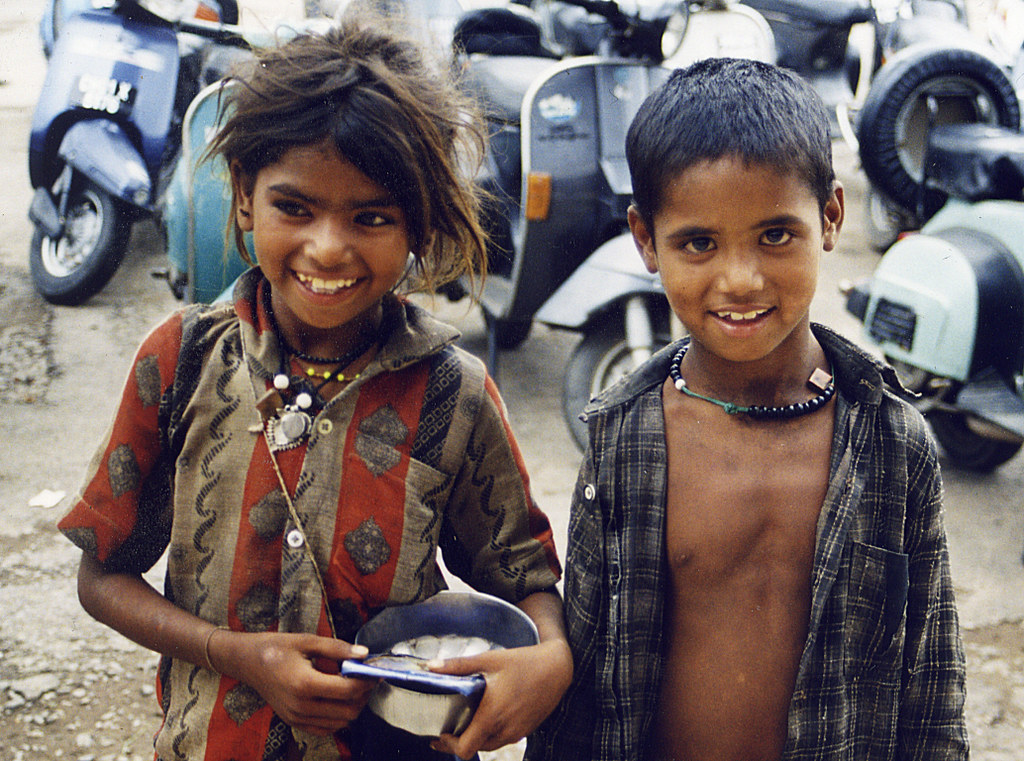
Two Indian children carrying a begging bowl. Dey Alexander. CC BY-NC-SA 2.0.
India grapples with a begging crisis, and children are among its most vulnerable victims. The problem is most common at busy markets, religious sites, railway stations, bus stops, metro station entrances and tourist spots. In particular, traffic lights and busy intersections are among the biggest hotspots, as children can easily approach drivers and passengers stopped in vehicles.
According to the 2011 census, India recorded a total of over 400,000 beggars and vagrants, of whom 45,296 were children under 15. Some reports push the number of child beggars as high as 300,000. The crisis is most severe in major cities, such as Delhi, Mumbai and Bangalore.
Multiple factors drive children onto the streets, including poverty, disability, displacement due to natural disasters and exploitation by organized begging rings.
Trafficking is one way by which children enter this system. In 2024, nearly 100,000 children were reported missing. In some cases, families living in deep poverty believe that they have no real choice but to sell their children to traffickers.
Begging mafias typically divide cities into fixed territories, assigning children to specific zones and collecting their daily earnings. Violence and intimidation are routinely used to enforce control. Many trafficked children are taught to beg and are deliberately drugged to look unwell, starved to appear malnourished or maimed and burned so that they draw greater sympathy, and thus more money, from the public.
Begging has, in fact, proved genuinely lucrative for some, which is why organized begging rings in major cities have effectively turned human misery into a full-scale business. For instance, Mumbai-based Bharat Jain, widely described as the world's wealthiest beggar, reportedly rakes in around 2,500 rupees ($30) a day and has amassed a net worth of approximately 75 million rupees (about $900,000). He even owns a luxurious two-bedroom apartment and rents out two shops, earning him an additional $360 a month.
Begging and giving alms are banned in two Indian cities, with legal action threatened against both beggars and those who offer them alms.
“The police don't think begging is an issue because they assume that the adult with the child is either family or a known person,” said Anita Kanaiya, CEO of The Freedom Project India, an organization fighting trafficking. “But for every 50 children rescued there will be at least 10 who are victims of trafficking.”
Already cut off from their family and community, such children are robbed of education and any prospect of a better future. Furthermore, many are sexually abused and end up addicted to drugs.
GET INVOLVED:
Here is how you can help fight child begging:
Use your voice and share this issue on social media.
Donate or volunteer.
The Kailash Satyarthi Children's Foundation was founded by a Nobel Peace Laureate, and it runs grassroots campaigns across India to combat child trafficking.
Plan India's Dreams on Streets project works directly with children forced to beg at Delhi's traffic signals, providing them with education, nutrition and psychological care.
Prerana's Sanmaan Project shields children found begging on the streets from abuse and exploitation, fighting to secure their right to education, safety and a dignified life.

Hafsah Khanam
Hafsah is an English grad student from India. When not curled up with a book and a steaming cup of chai, she can be found traveling, inhaling the nearest snack, and spending time with friends and family. She aspires to pursue a PhD.