
Julia Kelley
After years of government instability and censorship, Nepal’s Gen Z led an uprising that not only dissolved a corrupt parliament but also paved the way for political reconstruction.
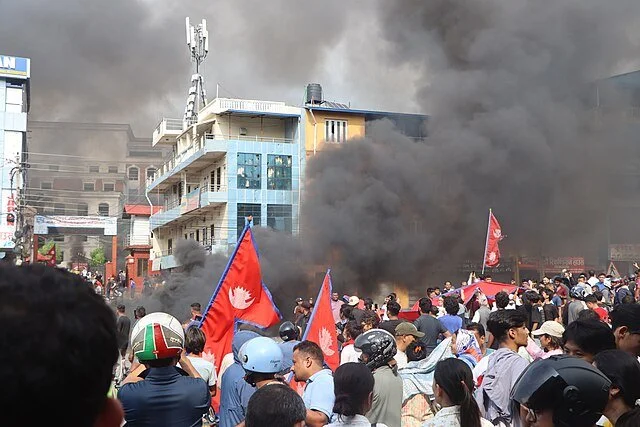
Gen Z protesters. Himal Subedi. CC BY-SA 4.0.
On September 8, 2025, protests led by Generation Z spread across Nepal in a passionate stand against political corruption. The demonstrations, the country’s deadliest in decades, with 73 confirmed deaths, overturned the country’s government within days. Despite being led by those primarily in their 20s and 30s, this widespread upheaval is only the latest clash between Nepalis and their government in the past decade. The country experienced major political shifts beginning in 2005 when then King Gyanendra took absolute power from elected officials. Stating that this was to combat the deadly years-long Maoist insurgency, his authoritarianism only led to increased national division. In 2008, after years of subsequent protests and political transformation driven by the cooperation of Nepalese political parties and Maoist rebels, elections for a Constituent Assembly officially abolished the country’s monarchy and established a federal democratic republic.
However, in the years following this reorganization, Nepal has had 13 different governments in a struggle to confront ongoing corruption and a difficult economy. Frustrated with politicians, many have turned their support back to the former King; in March of this year, thousands of protesters demanded the monarchy be reinstated in a confrontation that deepened discontent between the people and the government. These grievances have intensified with the younger generation’s “Gen Z Movement.” Resentment, compounded by insufficient government action, has worsened with a developing perception that elite officials have luxurious lives in a time when the majority of the country is financially struggling. Moreover, the term “nepo kids” went viral in early September in reference to the children of these same officials, who were posting videos on social media apps of lavish traveling or expensive purchases. In 2024, the rate of unemployment for Nepali youth between 15 and 24 years old was 20.8%, and many have struggled to find job opportunities, fueling the outrage spurred by “nepo kid” overextravagance.
Government authorities declared a ban across multiple social media platforms on September 4, citing a crackdown on cybercrime and other misuse. However, many across the country viewed this as retaliation for the rise in anti-corruption discourse online, especially after posts about nepo kids gained large traction. At a confluence of deep-rooted political instability and active censorship, Gen Z citizens sprang into passionate protests that forced the Prime Minister, K.P. Sharma Oli, out of office. Over 48 hours, protesters were met by police with a swarm of live ammunition, tear gas and rubber bullets during violent confrontations that destroyed government buildings and established institutions alike. The surge of young participants represented not only a culmination of political turmoil but a new generation of activists rejecting government corruption.
Days after demonstrations effectively dismantled the parliament, Nepali President Ramchandra Paudel announced that an interim government was to be run by Nepal’s first female prime minister, Sushila Karki, before elections are held on March 5, 2026. Karki, a former chief justice who was fiercely supported by Gen Z youth, was chosen after negotiations between army chief Ashok Raj Sigdel and protest leaders. In her first remarks as prime minister, she reflected sentiments held by the same young Nepalis who recommended her, dedicating her work “according to the thinking of the Gen Z generation” and their demands for “the end of corruption, good governance and economic equality.” In the six months before parliamentary elections, young demonstrators hold optimism for Karki in the hope that political transformation will bring about permanent change.
GET INVOLVED:
Those looking to help support Nepali citizens after their deadly protests can do so by looking into organizations such as the United Nations, which is offering support to those affected by the demonstrations, or GoFundMe, which has fundraisers for families affected by the upheaval. In addition, you can check out organizations that target poverty within Nepal and offer relief aid, including CARE, CHOICE Humanitarian and the APA Sherpa Foundation. Foundations like Himalayan Children’s Charities, the Nepal Youth Foundation and the Cooperative Youth Organization Nepal are groups that are also instrumental in empowering and assisting Nepal’s youth through education, community, health and mentorship initiatives.

Julia Kelley
Julia is a recent graduate from UC San Diego majoring in Sociocultural Anthropology with a minor in Art History. She is passionate about cultural studies and social justice, and one day hopes to obtain a postgraduate degree expanding on these subjects. In her free time, she enjoys reading, traveling, and spending time with her friends and family.