
Zoe Lodge
Only accessible for a few months each year, these trails offer unrivaled volcanic and geographic sights.
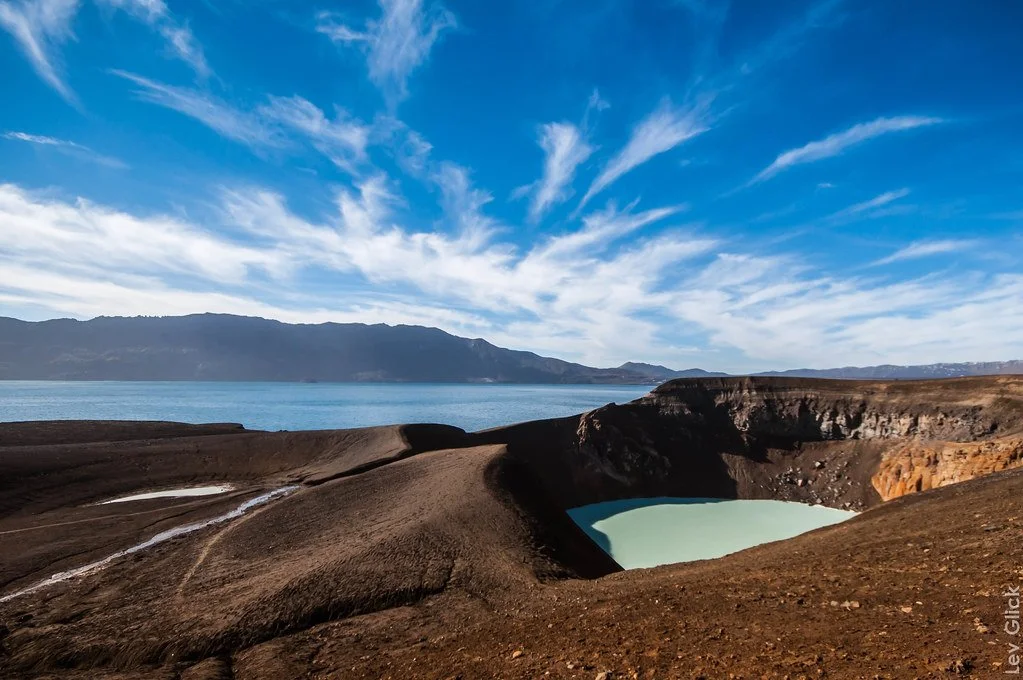
Lake Viti in Askja, Iceland. Lev Glick. CC BY NC-ND 2.0.
Most travelers to Iceland follow the typical tourist paths, visiting Reykjavik, the Blue Lagoon and the Golden Circle. But for those willing to venture farther during a mere few months each summer, the Highlands open up as a beautiful, often sparsely visited wilderness. Lava deserts stretch endlessly, hidden hot springs bubble in cold, hidden crevices, and volcanic peaks etch picture-perfect silhouettes against the horizon. Two of the most remarkable routes into this interior are the Laugavegur trail in the south and the Askja region in the northeast. Both offer incredible beauty yet demand careful preparation and a respect for landscapes that are as fragile as they are tough.
Laugavegur is sometimes described as Iceland’s signature multi-day hike. Stretching about 34 miles and typically taking 4-6 days to complete, the path spans from Landmannalaugar to Thorsmork in Iceland’s southern Highlands. It leads trekkers through mountains made of volcanic rock, black lava fields, steaming geothermal vents, glacial rivers and birch valleys. The path is only open from late June to early September, a narrow window, when mountain roads thaw enough to allow access. Even in midsummer, hikers must be prepared to face unpredictable storms, icy nights and river crossings that can turn dangerous in a matter of hours, depending on the weather. Huts along the way offer basic shelter but demand advance booking, and those who set out improperly prepared often find themselves challenged by the region’s volatile conditions.
Askja, by contrast, is even more remote. Located deep in the northeast Highlands, it can only be reached by rugged, unpaved mountain tracks that require high-clearance four-wheel drives and demand experience at volatile river crossings. The road is also only navigable from late June to early September based on weather conditions. The journey within itself is part of the adventure, with stretches of volcanic ash and desert leading to one of Iceland’s most dramatic features: the Viti crater, a geothermal lake formed by an eruption in the late 19th century. Hiking in Askja means stepping into an elemental world where services are scarce, fresh water is limited and the weather can shift from calm to violent in just a few minutes. There are limited accommodations in the region, and they must often be booked through tour companies, like the Akureyri Touring Club. For many, the reward is the solitude and natural grandeur that is largely unrivaled by any other sight on the planet.
Yet as interest in these regions grows, so too does the challenge of balancing adventure with conservation. The Highlands are ecologically delicate; moss that takes decades to grow can be destroyed with a single misstep, and volcanic ash plains are scarred by tire tracks that linger for generations. Local guides, mountaineering clubs and conservation groups work to preserve these places, enforcing rules that keep hikers on established paths, limit camping to designated sites and restrict off-road driving. Authorities closely monitor trail and road openings, delaying access until conditions are safe not only for visitors but also for the land itself. The short summer season, constricting as it may be for eager travelers, acts as a natural safeguard, allowing these fragile ecosystems the necessary months of recovery time each year. It’s also essential for visitors to ensure that they are properly equipped to explore the region with strong hiking boots, food and water that can be packed in and out, GPS systems, and weather-proof clothing.
For those who make the journey, entering Iceland’s Highlands is more than an escape from the crowded tourist loops; it is also an opportunity to engage with some of the planet’s most dramatic landscapes. The responsibility falls on travelers to prepare thoughtfully, respect the rules of access and support the local communities that act as custodians of this wild interior. To hike the Laugavegur trail or stand at the rim of Askja’s volcanic craters is to witness the Earth in its purest form. If visitors can balance wonder with care, the Highlands will remain not only a destination for adventure but also a testament to the resilience of Iceland’s natural world.

Zoe Lodge
Zoe is a student at the University of California, Berkeley, where she is studying English and Politics, Philosophy, & Law. She combines her passion for writing with her love for travel, interest in combating climate change, and concern for social justice issues.