
Ashley McDermott
After nearly one million Russian men fled conscription in 2022, the countries that received them are still grappling with the impacts of this influx three years later.
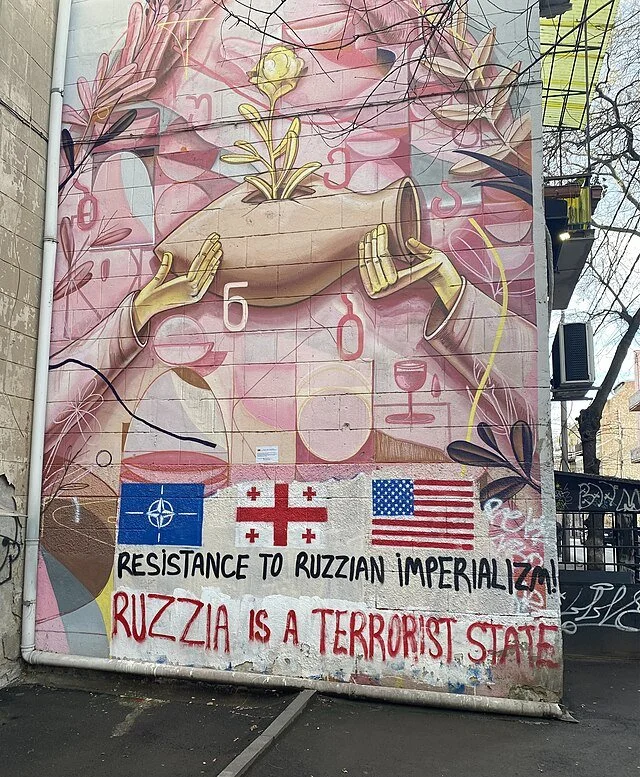
Anti-Russian graffiti in Tbilisi, Georgia. Dor Shabashewitz. CC BY 4.0.
Following Russia's full-scale invasion of Ukraine in 2022, nearly one million young men eligible for conscription fled the country, with Kazakhstan, Kyrgyzstan, Armenia and Georgia becoming unexpected hosts to an influx of Russian draft dodgers and dissidents. These individuals, self-identifying as “relokanty,” or the “relocated,” triggered housing shortages, inflation and heightened ethnic tensions while the predominantly financially privileged young ethnic Russians settled in. At the same time, local economies saw a boost as the migrants filled a gap in technical jobs and started their own businesses, with some relokanty even learning the local language and attempting to integrate into their new homes. Now, as economic growth decelerates and inflation remains higher than it was before the war, it appears that Central Asia was merely a transit point for migration to more sought-after destinations.
Most migrants arrived in two waves, the first following the invasion of Ukraine in February 2022 and the second after Russia’s call for conscription, or partial “mobilization,” in September 2022. The initial wave primarily consisted of anti-war activists and educated urban youth, notably including many young tech workers. In contrast, those fleeing mobilization in the second wave were economically and socially diverse, including non-Russians from Eastern Russia. Relokanty were drawn to Central Asia due to the relative ease of travel; Georgia allows Russian citizens to stay in the country visa-free for 12 months, and Kazakhstan, Kyrgyzstan and Armenia do not require visas or passports for Russian citizens, thanks to their inclusion in the Eurasian Economic Union.
Housing prices and inflation settled in the years following the two primary waves of relokanty migration, declining from highs that saw up to 300% increases in September 2022. By 2023, analyses of the receiving countries’ GDPs suggest that the relokanty had boosted local economies, outpacing the World Bank's forecast by nearly double, as Russian migrants started their own companies and offered existing businesses a pool of skilled workers, largely in the tech industry.
In Georgia, Russian relokanty established businesses in a “parallel economy,” catering specifically to the Russian migrant community and operating predominantly in Russian. Due in part to anti-Russian sentiment following the 2008 Russo-Georgian War, Russian is not widely spoken there. 79% of Georgians report a negative view of Russian economic activity in the country, an attitude evidenced in Tbilisi's anti-Russian graffiti, featuring messages such as "Good Russian? Go Home." However, despite the negative perception of the relokanty, Georgia registered 30,000 new businesses founded by Russians in 2022 and 13,000 in 2023.
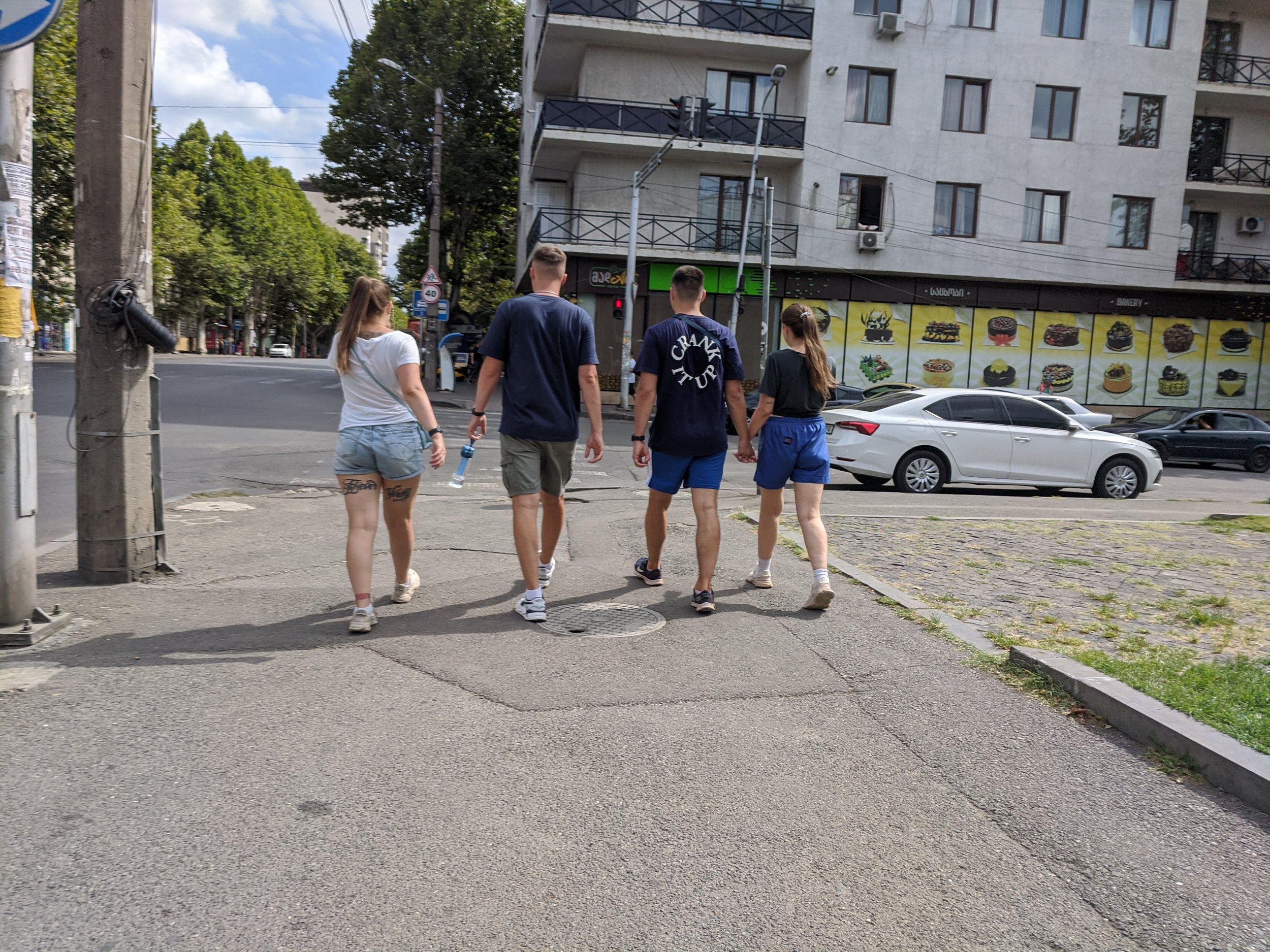
Russian migrant couples walking Tbilisi streets. OpusDEI. CC BY 4.0.
Despite the 2022-23 economic boost, the region cannot rely on the relokanty for long-term growth. The positive influence of relokanty on GDP is declining as they move on to what they view as more desirable destinations. Central Asia and the Caucasus were usually the first parts of a “step-wise” migration that led to Turkey, Israel and Serbia.
Surveys in 2023 showed only 14% of relokanty planned to stay in Georgia and 12% in Armenia. Though it is difficult to determine the exact number of relokanty who moved on, there appears to be a significant outflow. In Georgia, about 6,000 more Russians left than entered during the first half of 2023, followed by net drops of 14,000 and 11,000 in the third and fourth quarters. Similarly, since 2023, more Russian citizens have departed from Armenia and Kyrgyzstan than have arrived.
As a response, some receiving nations fought to retain these workers, with Kyrgyzstan targeting them through special “digital nomad” status and easing rules surrounding permanent residency. However, only about 1,000 of these visas were awarded as of 2023. Meanwhile, Kazakhstan placed restrictions on the migrants, requiring those who were not students or employed within Kazakhstan to leave the country after 90 days, potentially due to concerns over Russians working in the shadow economy.
Some Russian migrants, particularly those from the first wave who opposed Putin’s regime, have taken steps to integrate into their new environments. Yulia and Ilya Kuleshov, activists from St. Petersburg, founded the Krasnaya Krisha or Red Roof in Bishkek, Kyrgyzstan. Red Roof, described as a “Russian anti-war creative collective,” offered temporary housing to migrants and hosted events on topics such as decolonization. Advice given to Red Roof visitors included not calling Kyrgyzstan “Kyrgyzia,” the imperial term for the state.
Migrants such as the members of Red Roof may be the exception in Central Asia; however, whereas many as 12.8% of migrants support the Russian war, and 60% are neutral about the war, according to a 2023 poll. The government of Kyrgyzstan, in particular, grew increasingly sensitive to anti-war activism, detaining at least one member of Red Roof and intimidating the collective through visits from law enforcement.
Online discussions reveal tensions with some Kyrgyz activists, as well as relokanty calling out recent migrants for posts complaining about the region. Long stereotyped by Russians as backward or dangerous, they direct them to both respect the countries and learn more about the history of Russian and Soviet oppression in the region. Some migrants began learning local languages, while others, such as those in Armenia, rationalized their lack of desire to do so by considering their presence an economic gift.
The term relokanty itself is a way to distance Russian migrants from the large population of Central Asian migrants who come to Russia for work. “People kind of highlight the hypocrisy of, well, why is it when Russians come to Central Asia, all of a sudden, they’re relokanty, but when Central Asians move to Russia to work, they're migrants,” says Yan Matusevich, a researcher specializing in Russia-Central Asian migration, describing the pushback on social media about the term. In Russian, “migrant” has negative, racialized connotations and is associated with undocumented workers doing unskilled labor. Overall, most relokanty had no plans to adapt to local environments or remain in their new homes. Now, as economies lose their gains from the relokanty, they leave revitalized decolonial discourses, which may have lasting effects on the political landscape and civil society.
Ashley McDermott
Ashley is a PhD candidate in Linguistic Anthropology at the University of Michigan. She is committed to making her research useful for the communities she works with. Her work explores how families navigate language use and language shift in Bishkek, Kyrgyzstan. When she’s not working on her research, you’ll find her adventuring with her toddler daughter, whose commentary keeps every day interesting.