
Isabella Feraca
With overtourism on the rise and local protests spreading as a result, more and more European cities have begun to push back with official measures.
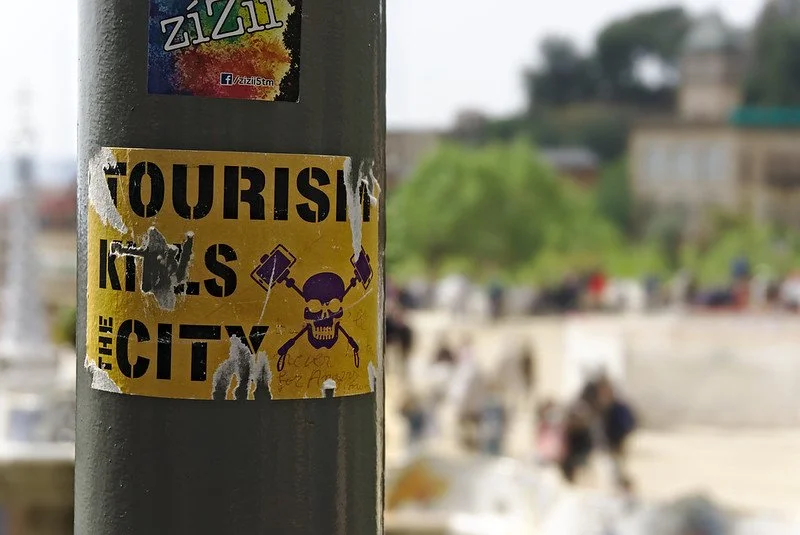
“Tourism kills the city” protest sticker in Barcelona, capital of the Catalonia autonomous community. Khairil Yusof. CC BY 2.0
With the summer holiday season underway, thousands of vacationers will be heading to popular European destinations in the coming months. However, many of them will be met not with warm welcomes but rather the growing frustrations of locals who say that overtourism is worsening their quality of life. Some of their key concerns include the effect of short-term rental properties on increasing housing costs, as well as the deterioration of local culture and charm that the influx of visitors creates. While these complaints are nothing new, they have garnered increased attention after protests erupted in Barcelona. These protests have become somewhat the face of the movement, notably with their use of water guns against tourists. Most recently, the tension has reached a boiling point with tangible responses seen in various cities, from taxes to employee walkouts.
Following the highly publicized protests in Barcelona, Catalonia will double its tourist tax for this year. The fees range from 2 euros to 7 euros (US$2.36 to US$8.25), depending on the type of accommodation booked by visitors. In addition to these costs, Barcelona also has maintained its own tourist tax, which will increase to $8 from the previous $4, as the Catalan government has given it the green light. Officials have opted to use some of these funds toward tackling climate change by installing solar panels and energy-efficient heat pumps across the city.
Similarly, in Italy, Venice has opted to maintain its day-tripper tax as we head into the city’s busiest season. The tax, first implemented in 2024, targets visitors who travel to the city without staying overnight, and it ranges from 5 to 10 euros ($5.89 to $11.79) per person. This year, the city’s mayor has extended it to apply to a total of 54 days from April 18 to July 27, which is nearly double the duration from last year. This increase speaks to the growing desperation of government officials to curb the negative consequences of overtourism. However, some local organizers claim it is not enough, pointing to data showing only a slight decrease in visitors for last year. With the increased efforts for the 2025 season, attention will be on Venice to see if these measures lead to the desired effects, especially as Mayor Luigi Brugnaro positions the city as a leader in tackling the issue. He commented, “Venice is the first city in the world that tries to manage the problem of overtourism. We obtained important results.”
Following in Venice’s footsteps, Norway is the most recent European country to implement a tourism tax after the country saw a record high number of people book accommodation there in 2024. At the start of June of this year, lawmakers introduced a bill allowing local officials to implement a 3% tax on overnight stays at their discretion. The government then plans to put the funds toward improving tourism infrastructure for both locals and visitors.
Alongside the influx of these taxes in Europe, additional fallout could be seen in Paris, where Louvre staff walked out on June 16. The spontaneous strike occurred as workers refused to take their posts in protest of “unmanageable crowds” and “chronic understaffing,” forcing the museum to close its doors for a few hours. The Louvre sees millions of visitors annually and has become known for its swarms of crowds and long wait times, especially for those looking to see the Mona Lisa. The walkout was a breaking point for staff and reflects a broader tension in Europe, just as the busy summer season kicks off. With pressure mounting from locals and institutions alike, all eyes are now on the region to see what future response will look like.

Isabella Feraca
Isabella is a junior at Carnegie Mellon University studying professional writing and music technology. In her free time, she can be found reading, making music, and playing shows with her band around Pittsburgh.