
Sofia Stidham
The recent Supreme Court-approved U.S. deportation of eight men to war-torn South Sudan led to legal, ethical and human rights debates.

South Sudanese civilian in the shadow of war. Steve Evans. CC BY-NC 2.0
On July 3, 2025, the Trump administration deported eight undocumented immigrants to a nation only one of them calls home: South Sudan. Since gaining its independence in 2011, South Sudan has only known conflict, enduring constant political turmoil underlain by ethnic tensions. Civilians have suffered numerous atrocities, from rampant killings and sexual assault to child abduction and famine. Their last civil war in 2013 led to around 400,000 excess deaths. Recent rising military action, including the bombing of a charity-run hospital in May 2025, has led to fears that the past will repeat itself. Nicholas Haysom, a top United Nations official, recently described South Sudan as “teetering on the edge of a relapse into civil war.” As a result, more than 9.3 million people in the country now need humanitarian aid.
Despite this widespread violence, the eight detainees, held together by U.S. shackles in shipping containers, were still sent from holding in Djibouti to South Sudan. Furthermore, federal court filings also reveal that this deportation was not an isolated incident; Trump has entered negotiations to use the war-torn nation for other third-country deportations. Maj. Gen. James Monday Enoka, police spokesperson of South Sudan, denied the country’s involvement in the U.S. plan, telling the Associated Press that any non-South Sudanese deportees would be “redeported to their correct country.”
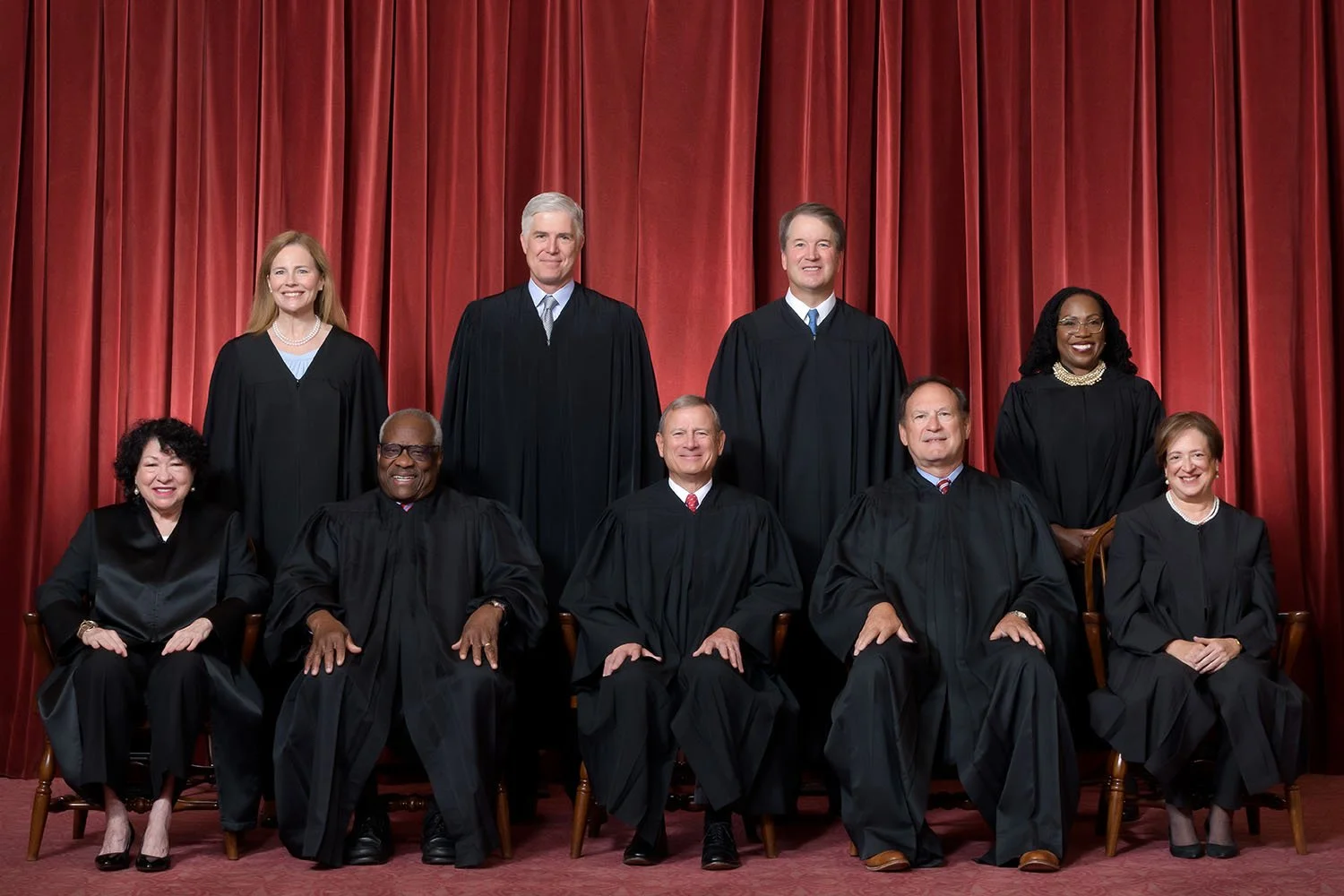
The current Supreme Court. Fred Schilling. PDM.
Yet, the controversial deportation didn’t go unchallenged. Months earlier, it had already become the subject of a heated legal battle. On April 18, 2025, the District Court of Massachusetts prevented the government from deporting the eight immigrants to South Sudan under a legal treaty called the “Convention Against Torture.” The law order required the government to give detainees 10 days’ notice before any action. After the Trump administration appealed, on July 3, the Supreme Court allowed the deportations to South Sudan to proceed without warning.
A statement from two of the three Supreme Court dissidents, Justice Sotomayor and Justice Jackson, condemned the government’s decision under not only an ethical lens but a legal lens. Justice Sotomayor wrote that in South Sudan, “they will be turned over to the local authorities without regard for the likelihood that they will face torture or death.” Justice Sotomayor also scrutinized the Trump administration’s deportation procedure as a violation of basic human and constitutional rights. She thus concluded that “the Government’s no-notice removals are undoubtedly illegal.”
Assistant Secretary Tricia McLaughlin, however, saw the ICE enforcement against the eight immigrants as a symbolic act on Independence Day. “This was a win for the rule of law, safety and security of the American people,” she said. The Department of Homeland Security highlighted how the detainees were violent criminals in their press release, specifying each of their offenses. But if the Trump administration can already circumvent legality and human rights in its treatment of undocumented immigrants under the guise of public safety, who knows what its next step will be?

Sofia Stidham
Sofia is a rising fourth-year English Literature student at the University of Edinburgh, having recently completed a year-long exchange at the University of Virginia. Outside of writing, she enjoys spending time with family and friends, going to concerts, curating her wardrobe, and zoning out on long walks. She hopes to pursue a career that allows her to channel her passion for writing into intersectional feminist advocacy.