Overpopulated Indonesia Fears Baby Boom Due to Coronavirus

After months of telling its citizens to stay at home, Indonesia is now facing fears of a potential baby boom.

Traffic in Bandung, Indonesia. Ikhsan Assidiqie. Licensed by Unsplash.

With the country under quarantine from COVID-19, many people have stopped going to clinics to get contraceptives out of fear of catching the virus. This projected increase in pregnancies comes after extensive efforts by the country to encourage smaller families, an action taken in order to fight against the concern of child malnutrition. This problem is so severe that government vehicles drove around the cities and pleaded with the public through loudspeakers: “You can have sex. You can get married. But don’t get pregnant. Dads, please control yourself. You can get married. You can have sex as long as you use contraception.”  

The National Population and Family Planning Board (BKKBN) is Indonesia’s government-backed family planning program tasked with helping married couples manage the creation of their families. BKKBN is widely successful and employs 24,000 counselors to help execute their mission, much of which includes distributing free contraceptives to the public. 

The agency recently determined that there had been a significant decrease in the use of contraception between March and April of 2020 and that about 10 million couples in the country no longer had access to a form of birth control. An increase in pregnancy rates is deeply concerning for the Indonesian government because the country is struggling to manage the current population size given its available space and resources. In order to try and alleviate some of these effects, the government has openly discouraged people from having large families for years and freely provided various forms of birth control. About half of those who use contraceptives receive monthly or trimonthly hormone injections, 20% use birth control pills and many use IUDs. Condoms remain unpopular, though, across the country. It is worth noting that abortion in Indonesia is only permitted if it is “to save the woman’s life.” There are many possible contributors to the drop in contraceptive use during this quarantine period, such as a fear of leaving the house to acquire contraceptives (especially from hospitals), closed contraception clinics and other closed health care providers. 

One significant consequence of Indonesia’s population struggles is child malnutrition, a problem that Indonesian President Joko Widodo promised to alleviate within 4 to 5 years. More severe cases of child malnutrition (especially when paired with poor hygiene) can result in child stunting, a condition where the child is more than two standard deviations below the median of child growth standards as determined by the World Health Organization. If children are experiencing stunting then they are more susceptible to pneumonia, diarrhea and a weakened immune system. Given that COVID-19 is known to be more fatal for those with compromised immune systems, this is an especially pertinent concern. Long-term effects include an increased chance of experiencing chronic diseases such as hypertension and a lowered IQ. According to the organization 1,000 Days Fund, a group dedicated to the elimination of stunting, children with stunting can miss about a year of school because of the sickness. While Widodo has found some success in lowering the number of child stunting cases in the past few years, this period of quarantining may prove to be a major setback.

BKKBN announced that Indonesia should expect about 420,000 more babies than the average 4.8 million in the upcoming year. One demography expert at the Indonesian Institute of Sciences, Dr. Augustina Situmorang, believes pregnancy spikes are most likely to occur in low-income families who relied on the previously-accessible birth control provided by BKKBN in addition to young women who lost their jobs, had to return to their hometowns, and then had to get married due to social pressures. 


Indonesia’s health care system is already working overtime and has suffered considerably from COVID-19, registering more than 33,000 cases and over 1,900 deaths. Nevertheless, the government is attempting some preventive measures to combat more potential pregnancies. This includes allowing access to multiple months of birth control pills at a time, making door-to-door deliveries of contraceptives along with emergency supplies, and hoping to distribute contraceptives to 1 million people on June 29, dubbed “National Family Day.” Going forward, the Indonesian government will have to move efficiently if it wants to limit the burden felt by the Indonesian health care system with future generations.

Phoebe Jacoby

is a Media Studies major and Studio Art minor at Vassar College who believes in the importance of sharing stories with others. Phoebe likes to spend her free time reading, drawing, and writing letters. She hopes to continue developing her skills as a writer and create work that will have a positive outward effect.

Academic Freedom: Repressive Government Measures Taken Against Universities in More Than 60 Countries

Universities around the world are increasingly under threat from governments restricting their ability to teach and research freely. Higher education institutions are being targeted because they are the home of critical inquiry and the free exchange of ideas. And governments want to control universities out of fear that allowing them to operate freely might ultimately limit governmental power to operate without scrutiny.

My recent report, co-authored with researcher Aron Suba for the International Centre for Not-for-Profit Law, has found evidence of restrictive and repressive government measures against universities and other higher education institutions in more than 60 countries.

This includes government interference in leadership and governance structures to effectively create state-run institutions that are particularly vulnerable to government actions. It also includes the criminalisation of academics for their work as well as the militarisation and securitisation of campuses through the presence of armed forces or surveillance by security services. We also found evidence that students have been prevented from attending university because of their parents’ political beliefs, while others have been expelled or even imprisoned for expressing their own opinions.

Some of the more shocking examples of repressive practices have been widely publicised, such as the firing of thousands of academics and jailing of others in Turkey. But much of what is happening is at an “administrative” level – against individual institutions or the entire higher education system.

There are examples of governments that restrict access to libraries and research materials, censor books and prevent the publication of research on certain topics. Governments have also stopped academics travelling to meet peers, and interfered with curricula and courses. And our research also found governments have even interfered in student admissions, scholarships and grades.

Repression, intimidation

Hungary provides a particularly glaring recent example of government interference with university autonomy. The politicised targeting of the institution I work at –- Central European University –- has been well documented. But the government has also recently acted against academic life in the country more broadly. It has effectively prohibited the teaching of a course (gender studies) and taken control of the well-regarded Hungarian Academy of Social Sciences.

What makes the Hungarian example especially disturbing is that it is happening within the European Union – with seemingly no consequences for the government. This is despite the EU Charter of Fundamental Rights which states that: “The arts and scientific research shall be free of constraint. Academic freedom shall be respected.” Meanwhile the Hungarian government still has all the privileges of being an EU member state, which includes receiving large sums of EU money.

Public demonstration in front of the Hungarian Academy of Science building against the removal of the Academy Science Research Institute’s autonomy. Istvan Balogh/Shutterstock

The inexplicable failure by the EU to enforce its own standards is particularly troubling and helps to normalise this behaviour. Indeed, there are clear signs such repressive practices are spreading. Anti-human rights legislation, policy and practice that begins in one country is frequently copied in another. Anti-civil society legislation recently adopted in Hungary and Israel, for example, which aims to stop protests and minimise the number of organisations receiving funds from abroad, was previously adopted in Russia.

Repressive practices against universities are starting to spread in Europe. Earlier this year it was reported that the Ministry of Justice in Poland planned to sue a group of criminal law academics for their opinion on a new criminal law bill.

Academics in distress

The freedom of academics and university autonomy is not entirely without scrutiny. There are some excellent organisations, such as Scholars At Risk and the European University Association who actively monitor this sector. But, at an international level, university autonomy is rarely raised when governments’ human rights records are being examined. And there is no single organisation devoted to monitoring the range of issues identified in our recent report.

Without proper monitoring, universities, academics and students are even more vulnerable because there is little attention paid to these issues. And there is little pressure on governments not to undertake repressive measures at will.

Thousands demonstrate in central Budapest against higher education legislation seen as targeting the Central European University. Drone Media Studio/Shutterstock

A global monitoring framework is needed, underpinned by a clear definition of university autonomy. The UN and EU institutions also need to pay more attention to the dangers that such attacks on universities pose to democracy and human rights. A stronger line against governments who are acting in violation of existing standards should also be taken.

Universities should be autonomous in their operations and exercise self-governance. These institutions are crucial to the healthy functioning of democratic societies. Yet academic spaces are closing in countries around the world. This should be a concern for all. The time for action is now, before this trend becomes the new norm.

Kirsten Roberts Lyer is a Associate Professor of Practice, Acting Director Shattuck Centre, Central European University.

THIS ARTICLE WAS ORIGINALLY PUBLISHED ON THE CONVERSATION

Gender Matters in Coastal Livelihood Programs in Indonesia

Significant investments have been made in improving the well-being of Indonesian coastal communities in recent decades. However, most of these programs have not tackled gender inequalities.

Projects based on comprehensive understanding of gender norms in coastal communities will contribute to improved community wellbeing. www.shutterstock.com

Our team studied 20 coastal livelihood programs implemented across the Indonesian archipelago from 1998 to 2017. Our aim was to see how gender issues were considered in project design and implementation.

The Indonesian government, international governments, international development and lending agencies and non-government conservation organisations funded these projects.

Most projects included women in activities to enhance or introduce new livelihoods. However, 40% of the projects were gender-blind with respect to the design and impact of their activities. This means that activities may have further entrenched processes that disadvantage women by limiting their ability to pursue their own livelihood goals.

Only two projects (10%) used an approach that sought to challenge entrenched gender norms and truly empower women.

We recommend future projects be developed with a comprehensive understanding of gender norms within coastal communities. Participatory approaches that address and challenge these norms should be implemented. This will more effectively contribute to improvements in community well-being.

What we found

Our study, which assessed livelihood programs from various regions throughout Indonesia – including Bali, Sulawesi and West Papua – found 95% of programs had directly or indirectly included women. They did so through activities such as providing training and equipment to support alternative sources of income – e.g. making fish or mangrove-based food products.

Only three of the 20 projects provided gender awareness training for staff members and community facilitators. Only one provided similar training at the community level. In addition, two projects included a gender quota for community facilitators (30-50% female).

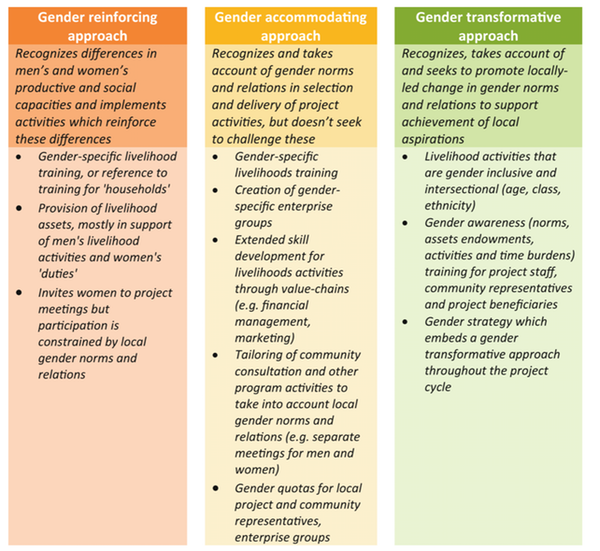
However, we found most projects applied either a “gender reinforcing” approach – reinforcing the existing gender norms and relations that underlie social and economic inequalities between men and women – or a “gender accommodating” approach – recognising these norms and relations but making no attempt to challenge them.

For example, many projects included separate “women’s activities”, such as handicrafts manufacture, or sought to increase household income by engaging women in income-generating enterprise groups. However, there was little consideration of how women would balance these activities with traditional caring and household roles, or of other ways women contributed to the household economy.

What we can do

Based on our findings, we recommend a “gender transformative” approach. Firstly, this approach involves mainstreaming gender issues across entire project cycles. Secondly, it involves working with coastal communities to identify and, where appropriate, challenge existing gender norms and social relations.

A core component of these projects is gender analysis. This is a process that identifies:

  • men’s and women’s activities within the home and community

  • differences in men’s and women’s access to, control over and use of livelihood resources

  • differences in participation in processes that govern management of natural resources

  • the gender norms and relations governing these differences

  • their impact on men’s and women’s livelihood opportunities.

For example, the Coastal Field School program included participatory activities that documented men’s and women’s daily activities. This activity highlighted the time women spent on caring and household duties and unpaid supportive contributions to “men’s activities”.

When undertaken in a participatory manner, this analysis helps communities to identify local, and broader structural, barriers to gender equality. They can then identify options and potential actions for overcoming these barriers. This creates a more equitable social and economic environment.

Summary of the characteristics of approaches to gender in development programs (based on Lawless et al. 2017), with examples of typical project activities drawn from our. study. Stacey et al (2019).

This process must be sensitively facilitated because it may confront traditional power hierarchies within communities. It also takes time, which must be factored into project cycles.

The use of gender-transformative approaches can improve the well-being of coastal communities by identifying and reducing barriers to equitable participation in social and economic life. This increases the ability of men and women to pursue enhanced or alternative livelihood opportunities.

Finally, recognising women’s contributions, building women’s confidence and giving women voice to participate in local community planning processes creates greater opportunities for issues of concern to women to be included in the development agenda.

Natasha Stacey is a Associate Professor, Research Institute for the Environment and Livelihoods, College of Engineering, IT and Environment, Charles Darwin University

Emily Gibson is a PhD Candidate, Research Institute for the Environment and Livelihoods, Charles Darwin University

THIS ARTICLE WAS ORIGINALLY PUBLISHED ON THE CONVERSATION