
In Chiapas, Mexico, Zapatista-run community radio stations preserve Mayan languages, report local issues and bypass state-controlled narratives.
Read MoreFemicides in Honduras
Honduras has one of the highest rates of femicides in the world, with more than 4,000 women killed between 2013 and 2025.
Read MoreTrump Pushes for Deportation to an Active War Zone
The recent Supreme Court-approved U.S. deportation of eight men to war-torn South Sudan led to legal, ethical and human rights debates.
Read MoreDissent in the Digital Age
How authoritarian regimes are weaponizing Internet use and the global resistance fighting back.
Read MoreMexico Maintains Deadly Reputation for Journalist Violence
Journalist murder cases only continue to rise in Mexico after a federal law was enacted to protect media workers from threats of violence, calling for reforms and increased federal support.
Read MoreHow AI Can Preserve Endangered Languages
As minority native languages worldwide disappear at a rapid rate, Indigenous scientists look to new AI language learning models and community participation as a way of preserving their cultures.
Read MoreBreaking Barriers: 7 International LGBTQ+ Activists
In the face of limited equality for LGBTQ+ individuals across the globe, these activists are dedicating their lives to raising awareness and making change in their home countries.
Read MoreThe Return of Child Marriage to South Asia
Families grappling with post-pandemic economic decline are turning to child marriages, undermining efforts to eradicate the practice.
Read MoreReclaiming the Chagos Islands: Unraveling the Colonial Legacy of Mauritius
The significant return of the Chagos Islands, after centuries of British control, serves as a poignant reminder of the legacy of colonialism and the ongoing hurdles that must be overcome.
Read MoreThe Ongoing Fight for LGBTQ+ Rights in Sri Lanka
As Pride Month approaches, 1.5 million Sri Lankans continue to fight against the longstanding criminalisation of homosexuality.
Read MoreGlobal Pride Amid Rising Hostility Toward LGBTQ+ Communities
LGBTQ+ Pride has grown massively in scale and support since its emergence, but many cities around the world have either maintained or enacted threatening legislation undermining the event.
Read MoreSweeps of Homeless Encampments in the US Intensify After Supreme Court Ruling
Since the Supreme Court ruling, Grants Pass v. Johnson, upended protections for the unhoused, sweeping of homeless encampments has drastically increased.
Read MoreGeneration Z Quits Vaping for the Congo
Rampant child labor in the Congo has ignited an ethical social movement among Generation Z.
Read MoreMexico’s Maquiladoras: The Border Factories Harming Female Workers
While a source of cheap labor, the maquiladora system is fraught with social and environmental issues.
Read MoreDefining Gender and Biology: The Struggle For Transgender Rights
As more global governments define gender and biological sex as a singular identity, transgender communities face a potential loss of rights and social stigma from the U.S. and the U.K. to New Zealand.
Read MoreWhat Happened to Australia’s ‘Stolen Generation’?
Zoe Lodge
A look into the history and consequence of removal practices against indigenous Australian youth, the “Stolen Generation.”
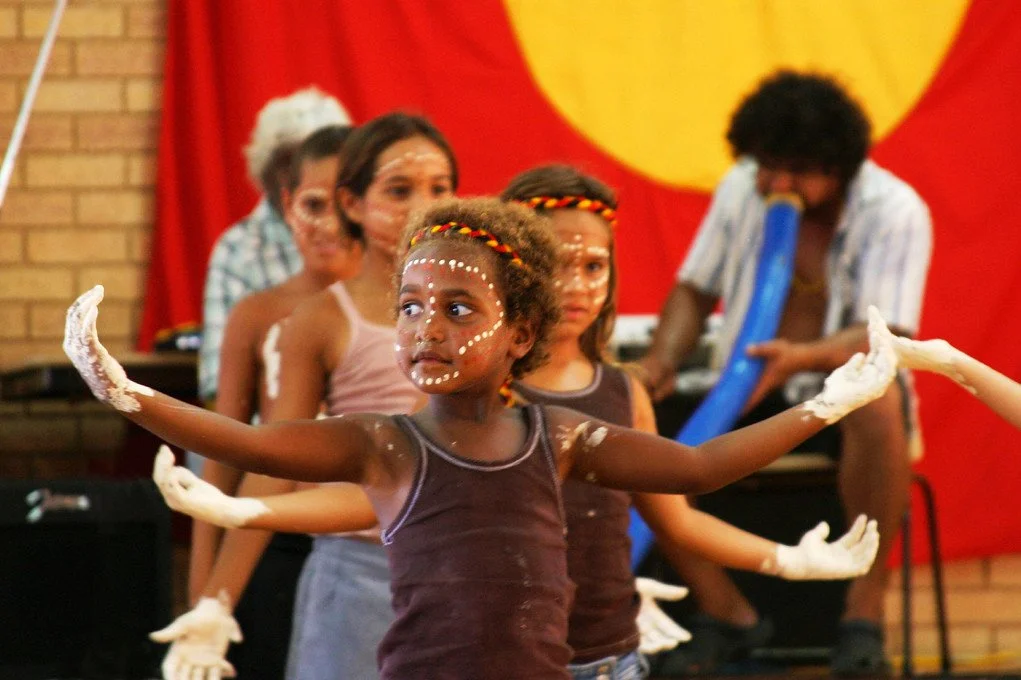
Indigenous Australian children. Mark Roy. CC BY-SA 2.0.
From the early 20th century until as late as the 1970s, Australia carried out a government-sanctioned campaign that forcibly removed Indigenous children from their families in a bid to assimilate them into white society. While much global attention has focused on the legacy of boarding schools for Indigenous children in North America, similar practices were inflicted on Aboriginal and Torres Strait Islander peoples under British colonial rule, often with the encouragement of the Roman Catholic Church and other Christian institutions. These efforts left generational scars, contributing to the systemic inequality and social fragmentation that persist into the modern day.
This dark chapter in Australian history is commonly referred to as the “Stolen Generation.” According to a report conducted by the U.S. Department of the Interior, which investigated comparable initiatives across the globe, roughly one in three Indigenous children in Australia were forcibly taken from their homes between 1910 and 1970. These children were placed in church- and state-run institutions or sent to live with white families that exemplified Western values, where they were stripped of their language, culture and identity. The underlying goal, both ideological and colonial, was to “civilize” these children by erasing their cultural roots and integrating them into a white-dominated society.
These practices were grounded in a racist belief system that deemed white Australian culture, rooted in Western European culture, inherently superior. Authorities at the time regarded the removal of Indigenous children as a moral duty and a practical solution to what was referred to as “the Aboriginal problem.” In reality, the result was a trauma that has rippled through generations. Children taken from their families frequently endured physical and emotional abuse, neglect, and, in many cases, sexual assault. They were often treated as cheap labor and denied access to adequate education and healthcare.
Although Australia never formally established a network of Indigenous boarding schools akin to those in the U.S. and Canada, the assimilationist mission was no less destructive. Despite making up only about 6% of Australia’s youth population, Indigenous children account for almost 50% of those in out-of-home care, which includes placement in foster care, group homes and with kinship carers. This gaping disparity emphasizes the lasting effects of these programs, leaving First Nations people to deal with dislocation, cultural loss and intergenerational trauma.
In recent years, the Australian government has taken steps to acknowledge and atone for these policies. A national apology was issued in 2008, followed by reparations exceeding $375 million for surviving members of the Stolen Generation. Additionally, individual states have contributed over $200 million in compensation funds for those affected. However, many argue that financial reparations, while important, cannot undo the profound harm caused by decades of systemic cultural erasure and displacement.
Australia’s history with its Indigenous populations is not unique. As the DOI report highlights, these tactics of domination and forced assimilation are not isolated but part of a broader colonial pattern seen across Canada, the United States and New Zealand. These initiatives, driven by the dual forces of governmental policies and religious institutions, sought to erase Indigenous culture in favor of Eurocentric ideals. From the earliest boarding schools in the United States and Canada to parallel programs in Australia and New Zealand, the common thread was the colonial power’s blatant disregard for the autonomy, culture and humanity of Indigenous communities, particularly through religious messaging and values. These institutions inflicted lasting harm, not only by physically removing children from their homes and subjecting them to abuse but also by obliterating the cultural traditions and languages that sustained Indigenous identities for generations.
GET INVOLVED:
One of the primary organizations focused on bringing justice to the First Nations people of Australia is ANTAR, which offers several ways to get involved, raise awareness and contribute to justice for the Indigenous people of Australia. Locals can volunteer with the organizations, and citizens worldwide can contribute to fundraising efforts or participate in global education and awareness campaigns. Other organizations with similar missions include Pay the Rent, IWGIA and the Aboriginal Legal Service.
Zoe Lodge
Zoe is a student at the University of California, Berkeley, where she is studying English and Politics, Philosophy, & Law. She combines her passion for writing with her love for travel, interest in combatting climate change, and concern for social justice issues.
Colombia: The Deadliest Nation for Environmentalists
Colombia remains the deadliest country for environmental defenders, with 79 of the 196 documented murders occurring there in 2024, largely targeting Indigenous and Afro-descendant communities.
Read MoreChild Slavery in Congo’s Cobalt Mines
The world’s high demand for cobalt mining has led to the exploitation of child labor in the Congo.
Read MoreBarring Basic Rights: Uganda’s Anti-Homosexuality Regulation
Modern anti-gay regulations continue to threaten the lives and safety of Ugandan LGBTQ+ individuals.
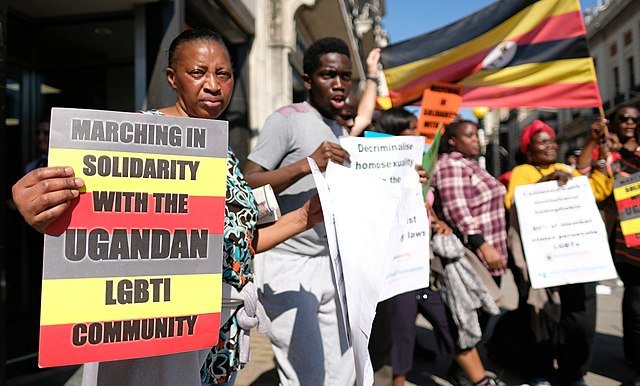
Group Marching in Support of Uganda’s LGBTQ+ Community. Alisdare Hickson. CC BY-SA 2.0.
Known for having one of the world’s harshest LGBTQ+ rights records, the Ugandan parliament has pursued longstanding efforts to diminish same-sex activity within the country. As a result of 19th-century British colonization, the severe criminalization of homosexuality set the stage for modern homophobic sentiments. This culminated in the Anti-Homosexuality Act of 2023, which was later upheld by the Ugandan parliament in April 2024.
The 2023 Anti-Homosexuality Act was signed into law by Ugandan President Yoweri Museveni in May 2023, enforcing strict restrictions against LGBTQ+ individuals. Implementing harsh penalties, the act demands life imprisonment for consensual same-sex activity and the death penalty in cases of “aggravated homosexuality,” a term that denotes any same-sex act that involves people under 18, older than 75, those with a disability, or when consent is not given or cannot be given. This act is not the first attempt to limit LGBTQ+ rights in Uganda. In 2010, the Ugandan parliament passed a bill introducing similarly anti-gay legislation that was eventually ruled illegal by the constitutional court due to its lack of necessary quorum. In 2021, however, the president succeeded in passing a sexual offenses bill that criminalized same-sex relationships and sex work in Uganda.
While the Ugandan government has praised such legislation as acting in the country’s best interest, the persistent condemnation of same-sex actions has negatively impacted the lives of LGBTQ+ Ugandans. This has not only promoted anti-gay views but has also threatened lives through the reduction of HIV prevention and perpetuation of societal abuse. In an interview with Amnesty International, Ugandan activist and founder of the gay and intersex rights organization Freedom and Roam Uganda (FARUG), Jacqueline Kasha described the new law’s impact on her community. She contends that advocacy and visibility for LGBTQ+ individuals have sharply diminished with the aggressive crackdown: “Several LGBTI persons have since gone underground which is now impeding all our efforts, especially in the health sphere in the fight against HIV, mental illness and economic disparities.” The 2023 Act has allowed anti-gay groups to accuse or arrest people with little evidence or reasoning. As such, LGBTQ+ individuals are vulnerable to attack when outside the safety of their homes, forced to hide their identities under the threat of violence. Furthermore, those in need of HIV services have become disproportionately vulnerable to health risks, driven away from receiving care due to fear of criminal punishment or discrimination.
The first case of “aggravated homosexuality” has already come into effect: 21-year-old Michael Opolot was arrested in August 2023 after allegedly participating in public sexual activity with another man reported to have a disability. While the new act permits this arrest, there has not been any evidence submitted by police to substantiate claims that the alleged victim is disabled and therefore could not give consent. Opolot’s case has provoked Ugandan activists to challenge the law's constitutionality, citing the act’s contradiction of citizens’ freedom from discrimination and rights to privacy and health. Moreover, they have noted that Opolot’s case demonstrates the senseless oppression of LGBTQ+ individuals. Ugandan activist Clare Byarugaba affirmed that this mistreatment not only violates human rights but also suppresses advocacy, as “activists, public health workers, and others face long prison sentences and hefty fines” for attempting to voice support.
As a result of such political, social and health persecution, the LGBTQ+ population in Uganda has been left unprotected and endangered by intimidating threats. Although Uganda’s government views the recent passing of anti-homosexual legislation as a “step forward” for the country, many in the LGBTQ+ community have experienced the opposite result in their daily lives. Several international organizations and governments have commented on the bill, with United States President Joe Biden describing the act as a “tragic violation of universal human rights,” and the Joint United Nations Programme on HIV/AIDS (UNAIDS) explaining that “criminalizing populations most at risk of HIV, such as the LGBTQ+ communities, obstructs access to life-saving health and HIV services.” Despite such international criticism, anti-homosexuality continues to loom largely over Uganda and LGBTQ+ existence within the country.
TO GET INVOLVED
Those looking to support LGBTQ+ communities in Uganda can do so by getting involved with organizations dedicated to supporting individuals inside the country as well as those who have fled. Such organizations include: Sexual Minorities Uganda (SMUG), an LGBTQ+ advocacy organization, Universal Coalition of Affirming Africans Uganda (UCAA - UG), a human rights organization advocating for human rights and marginalized people, and Global Black Gay Men Connect (GBGMC), a group collaborating with Uganda Key Populations Consortium (UKPC) and SMUG to launch an emergency response fund to support LGBTQ+ Ugandans.
Julia is a recent graduate from UC San Diego majoring in Sociocultural Anthropology with a minor in Art History. She is passionate about cultural studies and social justice, and one day hopes to obtain a postgraduate degree expanding on these subjects. In her free time, she enjoys reading, traveling, and spending time with her friends and family.
4B: Why are American Women Swearing Off Men?
American women are participating in the 4B Movement which originated in South Korea, swearing off dating, marriage and sex.
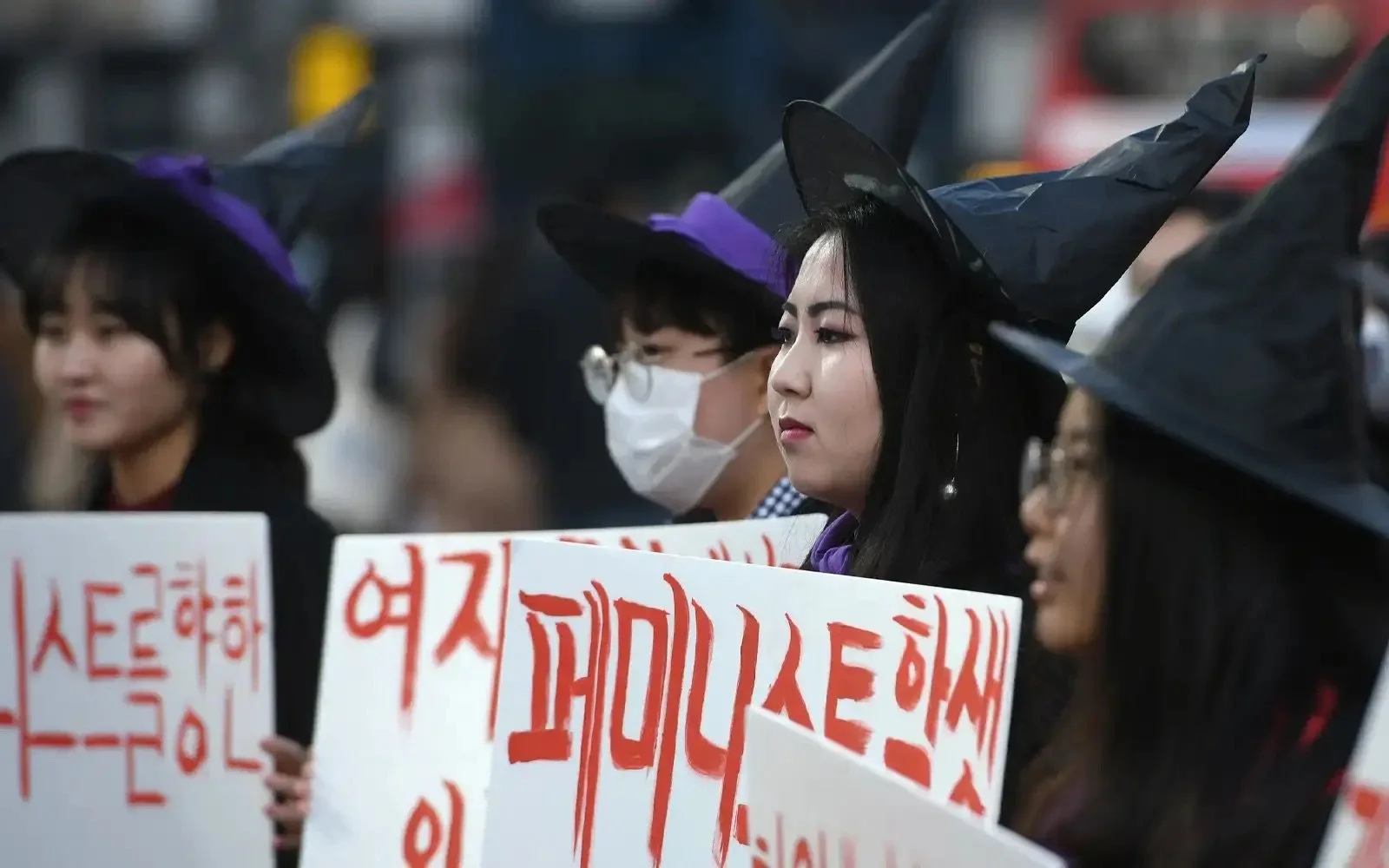
Women in South Korea at a 4B protest. Free Malaysia Today. CC BY 4.0.
In the wake of Donald Trump winning the 2024 U.S. Presidential Election, social media flooded with thousands of posts from women announcing that they were swearing off men as part of the 4B Movement. But what exactly is the 4B Movement, and what does it hope to accomplish?
Originating in South Korea, the feminist 4B Movement derives its name from its four tenets, which all start with the Korean prefix “bi” (or “no”) and denote a denial of something. Indeed, these four “Bs” are: don’t have children (bichulsan), don’t have sex with men (bisekseu), don’t date men (biyeonae) and don’t marry them either (bihon). The movement began in the mid-to-late 2010s as a protest against rising anti-woman sentiments among the nation’s men — especially following the hate-motivated stabbing of a young woman in Seoul in 2016. By withholding heterosexual attachments and exacerbating the nation’s flagging birth rates, South Korean women hope that the movement will provoke the nation’s leadership and male population into caring more about women’s rights. “I think a lot of women, through not participating in marriage and childbearing or relationships with men see a value in dropping the numbers to show through these statistics that women are not going to participate in [any] national agenda unless you listen to where women are coming from,” as Yale sociologist Meera Choi told The Times.
In South Korea, 4B is primarily a fringe movement. Its practices are so elusive and decentralized that the best estimate we have for its total number of participants is anywhere between 5,000 and 50,000, a wide range that highlights researchers’ uncertainty. However, since Nov. 5, 2024, some women in the United States have expressed a desire to introduce the movement mainstream in the West. Immediately following the 2024 U.S. Presidential Election, many expressed shock and fear that Donald Trump — a figure with a well-documented history of sexual misconduct — had again achieved the highest office in the country. Particularly, some were distressed by the sheer number of men that had turned out for Trump, believing their votes to represent endorsements of or even apathy toward Trump’s misogynistic behaviors (“Among men, who made up 47% of the electorate,” NBC News reported, “Trump won 55%”).
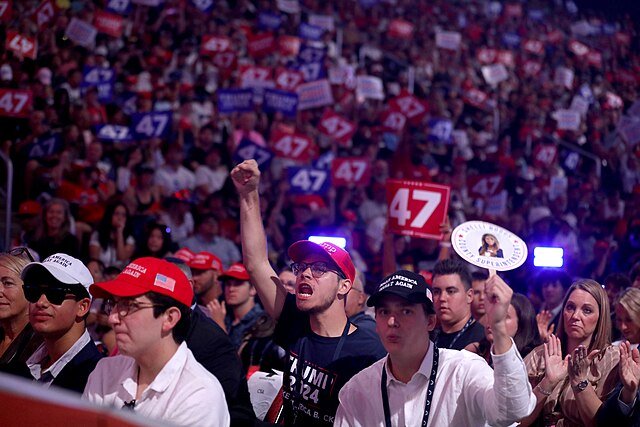
Trump supporters at one of his rallies in August 2024. Greg Skidmore. CC BY 2.0.
For these women, 4B’s appeal of sticking it to the government and an indifferent, if not overtly hostile, male population was immediate. “Young men expect sex, but they also want us to not be able to have access to abortion. They can’t have both,” Michaela Thomas told The Washington Post, referring to Trump’s first-term Supreme Court nominations who helped overturn Roe v. Wade. “Young women don’t want to be intimate with men who don’t fight for women’s rights; it’s showing they don’t respect us.”
4B’s popularity quickly caught on across social media. “Good luck getting laid, especially in Florida! [...] Me and my girlies are participating in the 4B Movement,” user @brielleybelly123 posted to TikTok. User @rabbitsandtea also posted on the platform: “Doing my part as an American woman by breaking up with my [R]epublican boyfriend last night and officially joining the 4B [M]ovement this morning.” Some liberal men have also expressed support for 4B. “The best way to show the importance of taking away women’s rights is to make sure men are affected as much as possible alongside them,” a Buzzfeed commenter wrote. As Instagram user @nosybystanders told her female fanbase: “Why exactly are you going to keep be[ing] subservient to a nation that [literally doesn’t] care about you?”
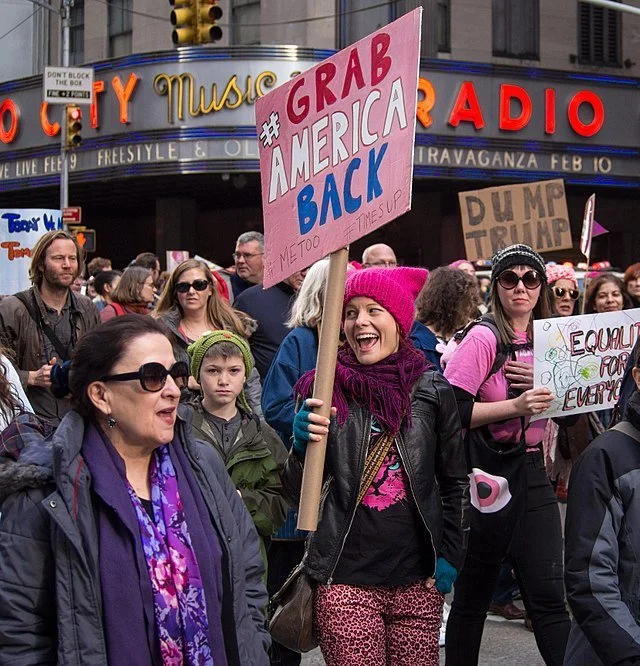
An anti-Trump women’s march following his election in 2016. Fabrice Florin. CC BY 2.0.
4B finds footing in an America currently experiencing a widening political gender gap. Young women are becoming more liberal as men drift further to the right and deeper into conservatism. In October 2024, a New York Times/Siena College poll found that “young women — those ages 18 to 29 — favored Vice President Kamala Harris for president by 38 points. And men in the same age group favored former President Donald J. Trump by 13 points. That is a whopping 51-point divide along gender lines, larger than in any other generation.” As Claire Cain Miller reported, this is partly because young women have been “politically galvanized” by “tthe triple punch of Hillary Clinton’s loss to Mr. Trump, the #MeToo movement and the overturning of Roe v. Wade.” On the other hand, young men feel increasingly “unvalued” by young women and “see former President Donald J. Trump as a champion of traditional manhood.” In terms of the 4B Movement, participants know firsthand how this male-harbored resentment can manifest in internet trolls’ hate comments.
Under @brielleybelly123’s video, @user813858060727 commented, “Thanks for not reproducing. You’re doing us all a favor.” Elsewhere, beneath a separate post under the 4B Movement hashtag, TikTok user @feronity commented, “Took a fu—kin new president just to stop being wh—res.” In the context of this vitriolic pushback — coupled with increased threats of “Your Body, My Choice” among young right-wing men — it becomes less surprising that women are joining the 4B Movement.
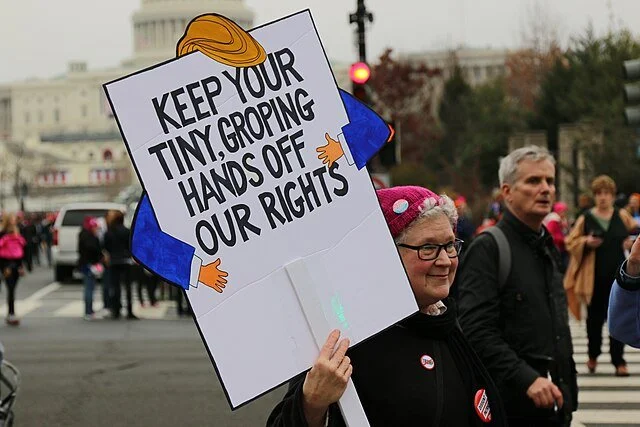
A protestor carrying an anti-Trump sign at the 2017 Women’s March. CC0.
Some of the online discourses surrounding women’s participation in the 4B movement are likely exaggerations: not every woman who posts about partaking in 4B is likely to completely follow through with its tenets, especially in the long term. For all of the buzz that it’s created in the U.S., 4B has never been among the top 100 trending hashtags on TikTok, signaling that hype for the movement has been largely sensationalized. But so long as Trump continues to campaign on misogynistic rhetoric and policies — and men continue to listen — the underlying sentiments of 4B will remain real, and so will their implications for increasingly fed-up women.
Bella Liu
Bella is a student at UC Berkeley studying English, Media Studies and Journalism. When she’s not writing or working through the books on her nightstand, you can find her painting her nails red, taking digicam photos with her friends or yelling at the TV to make the Dodgers play better. Bella is a student at UC Berkeley studying English, Media Studies, and Journalism. When she’s not writing or working through the books on her nightstand, you can find her painting her nails red, taking digicam photos with her friends or yelling at the TV to make the Dodgers play better.