
Julia Kelley
Journalist murder cases only continue to rise in Mexico after a federal law was enacted to protect media workers from threats of violence, calling for reforms and increased federal support.
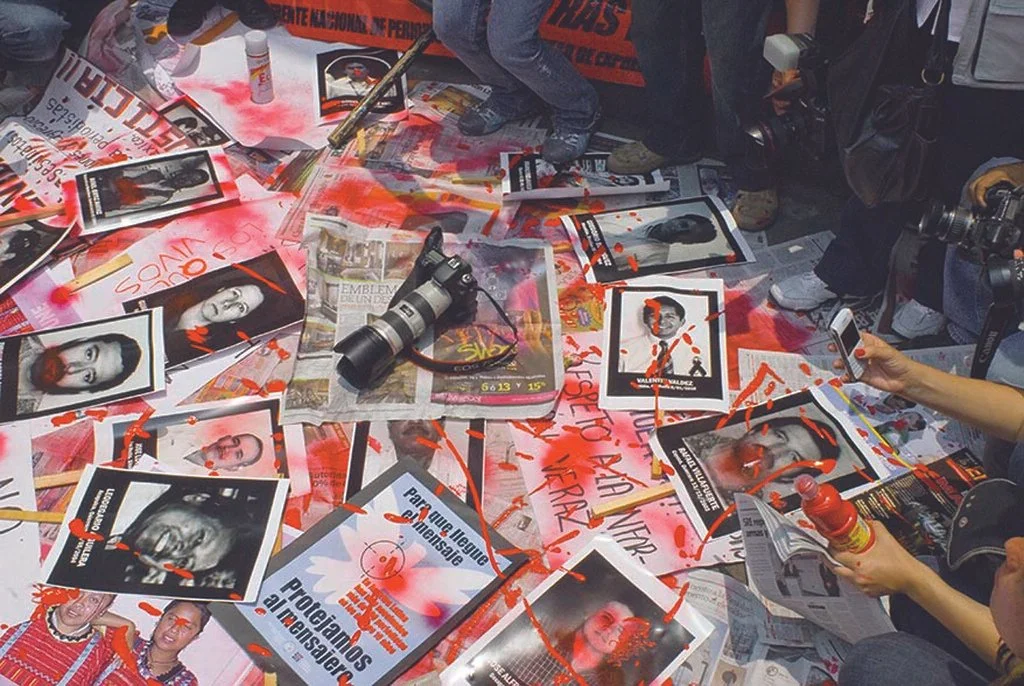
Journalists protesting rising violence. Knight Foundation. CC BY-SA 2.0.
2024 has been named the deadliest year for journalists, according to research gathered by the Committee to Protect Journalists, with at least 124 killed worldwide. Among other countries with high numbers, such as Israel and Sudan, Mexico ranked fourth in the number of deaths. Mexico has consistently ranked as one of the most dangerous countries in the Americas for journalists, often considered the most dangerous outside of a war zone.. In light of this pervasive danger, the Mexican government passed the Federal Mechanism for the Protection of Human Rights Defenders and Journalists in 2012, a law designed to implement protective measures for media workers in times of imminent danger.
Although Mexico has legally recognized press freedom since 1917, censorship from organized crime and government authorities has led to reporters’ harassment and life-threatening violence. Journalism has been imperative in bringing attention and information to critical issues in Mexico, such as drug cartels or social inequalities, which the government has failed to address. Enforcing the Federal Mechanism for the Protection of Human Rights Defenders and Journalists was thus necessary to maintain protection not only for education on social issues but also for protecting those who safeguard it. But, despite granting 762 requests for protection to journalists as of 2023, assaults on media workers are recurring, and a majority go unpunished. Attaining justice is even more difficult, as authorities are slow to respond to threats and perform unproductive investigations into such organized crime, rarely looking into who orders the attacks. Both organized criminal groups and officials, such as institutions and public servants, have been linked to many killings, demonstrating a blending of political violence and criminal organizations enforcing their own power.
The law, despite its optimistic mission, continues to inefficiently address the journalist murders. Most recently, on March 2, 2025, Mexican journalist Kristian Uriel Zavala was killed in an armed attack in Silao, Mexico, the third journalist to be murdered in the country this year. Zavala had been working with crime news outlets as a photojournalist, much like the additional two victims who had collaborated with media organizations to report on crime and violence within the country. Many other notable Mexican journalists have fallen victim to this systemic problem as well. Javier Valdez Cardenas, for example, was a renowned Mexican reporter who was fatally shot in a targeted attack in 2017. Not only did he receive several awards recognizing his work in reporting on organized crime and drug trafficking, but he also co-founded Riodoce, a magazine that focuses on discussing corruption and regional politics. His murderers were later found to be carrying out orders from Dámaso López Serrano, the former leader of a drug trafficking gang. Another, Ruben Espinosa, was a photojournalist working for an investigative magazine named Proceso and was well-known for covering social movements, as well as criticizing the governor of Veracruz in attempts to reveal political corruption. He was killed alongside five others in 2015 after receiving death threats. Although three suspects were found, one claimed to have been influenced during interrogations, and the other two maintained their innocence. The police refused to investigate any further, weakening an investigation that already shows inconsistencies. Today, the case remains open.
Those who work to expose and document such national issues remain vulnerable and unprotected. A call to reinforce the Federal Mechanism has been urgently advocated for, appealing for higher acceptance of protection requests in the face of present danger, guaranteed funding and closer collaboration between Mexico’s federal and state investigative bodies. As Artur Romeu declares in his statement as director of Reporters Without Borders, “These murders not only highlight the risks reporters face but also underscore the urgent need for real reforms in protection mechanisms.” Ongoing cases, such as with Zavala’s murder, exemplify the inadequacy of the current law and the ineffective actions being taken to fight a deeply rooted threat to human rights.
GET INVOLVED:
Those looking to help support the fight for press freedom in Mexico can check out organizations such as the Committee to Protect Journalists, Amnesty International, which has a joint investigation with CPJ into the effectiveness of the Federal Mechanism for the Protection of Human Rights Defenders and Journalists, or Reporters Without Borders, all of which focus on advocating and supporting media workers and reporting. Looking into groups such as the Freedom of the Press Foundation or the International Press Institute can provide more information on ensuring the freedom of the press around the world.
Julia Kelley
Julia is a recent graduate from UC San Diego majoring in Sociocultural Anthropology with a minor in Art History. She is passionate about cultural studies and social justice, and one day hopes to obtain a postgraduate degree expanding on these subjects. In her free time, she enjoys reading, traveling, and spending time with her friends and family.