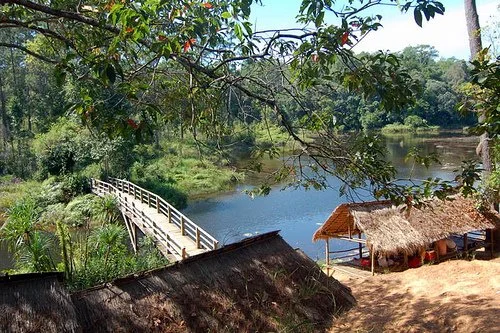
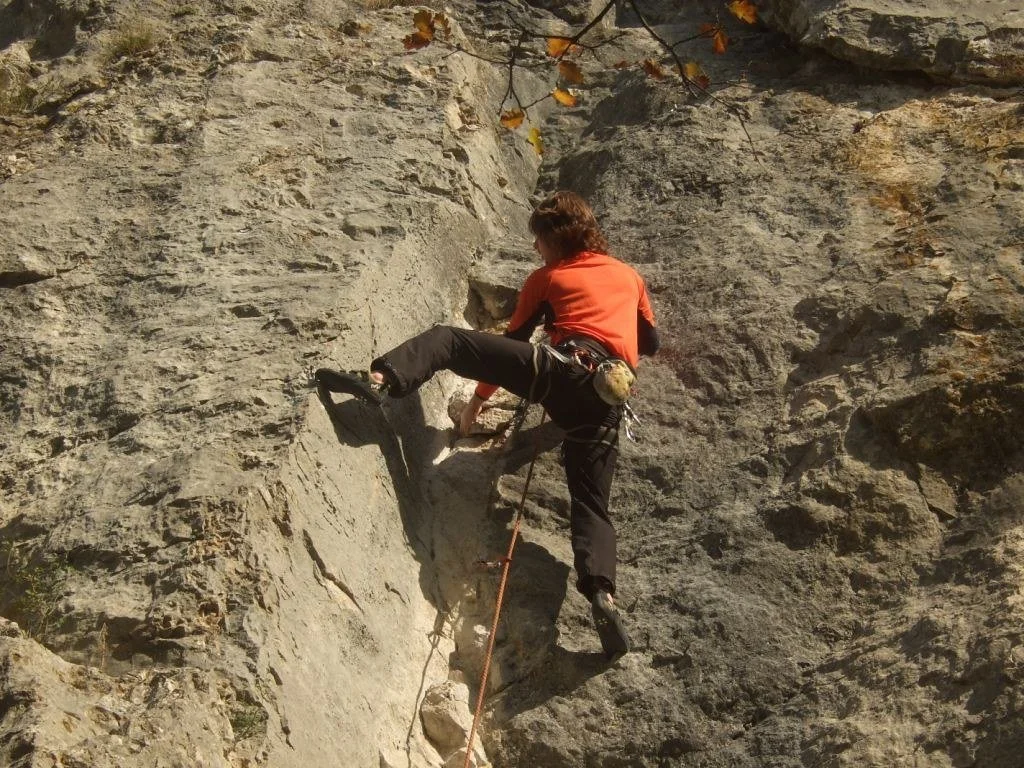
Van Reijin, a video creator based in the Netherlands, spent a week in Yangshuo, a region located in Southeast China. The closest city being Guilin in Guangxi province, it’s situated between the Li River and karst peaks. This beautiful area is famous throughout China and depicted on the 20 yuan bill. The landscape is surrounded by limestone, dolomite and gypsum mountains. Yangshuo is a popular destination for climbers and became a tourist hub in the 1980s. In the summer, people swim in the Li River and bike alongside it.
Indoor Skiing As Far Afield as Dubai
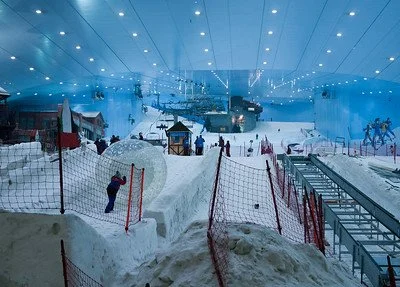
With massive, man made indoor ski resorts, skiing is no longer a winter-only sport.
Ski Dubai. Neekoh.fi. CC BY 2.0
In 1927, Vienna, Austria opened up the first indoor ski slope called Schneepalast. The slope was 65.6 feet tall, and the building was eventually destroyed, but the idea has stayed around. People have improved on it by creating larger and larger indoor ski slopes for people to enjoy not just during the normal skiing season, but also in warm temperatures where and when snow doesn’t fall. Indoor ski resorts are all over the world, with at least one on every continent. Ski Dubai in Dubai, United Arab Emirates was voted the best indoor resort back in 2016 and 2017, and it used to be the biggest, though Harbin Wanda Indoor Resort in Harbin, China surpassed Ski Dubai in 2017. Wintastar Shanghai in Shanghai, China is currently on track to being the largest once it is completed in 2022. There are also indoor slopes that are meant only for practice in the summer. These are training centers for athletes, without man-made snow and more akin to treadmills.
Though an indoor resort will likely never be as large as an outdoor one, Ski Dubai is one of the largest indoor ski resorts in the world. It is the first indoor ski resort in the Middle East, featuring a chairlift, a freestyle snowboarding area, an area for toboggans and snowball fights, an indoor zipline and five ski runs, including a black diamond run, the highest level of difficulty in skiing. Ski Dubai also has a penguin colony of Gentoo and King penguins that people can meet and interact with. Though not the only indoor ski resort with penguins, Ski Egypt has Gentoo and Chinstrap penguins, which is the most well-known. The entire area is extremely family friendly, which is why it continues to be one of the most popular attractions in Dubai.
King Penguins at Ski Dubai. Pranav Bhasin. CC BY-NC-ND 2.0
For an avid skier, indoor skiing might be a very interesting experience, but it doesn’t come close to skiing on an actual mountain. Having such a limited space can lose interest towards experienced skiers, but less experienced people tend to enjoy indoor resorts more. Another factor that could affect this is that skiing on fake snow is different than skiing on real snow.
Fake snow is stickier than real snow, and it’s much harder and more packed. Skiing on it isn’t as smooth as on real snow. The composition of real snow is around 10% ice and 90% air, but man-made snow is closer to 30% ice and 70% air. Of course, indoor ski slopes can’t exactly use real snow, so these resorts are made entirely of this kind of snow. However, since it is still snow, it will melt in heat. Indoor ski resorts have to be cold to maintain it. Ski Dubai stays at a constant -4Celsius, or 24.8 Fahrenheit. Therefore, despite being located in the desert, the inside of Ski Dubai is fairly cold and a stark contrast to the outside heat.
Katherine Lim
Katherine Lim is an undergraduate student at Vassar College studying English literature and Italian. She loves both reading and writing, and she hopes to pursue both in the future. With a passion for travel and nature, she wants to experience more of the world and everything it has to offer.
7 Sites of Mexico City’s Architectural Diversity, from Baroque to Brutalist
Mexico City is a flourishing metropolis with a plethora of historic and modernist architectural sites. Here are a few attractions scattered around the city.
Read More6 Secret Spots in Greece You Should Know About
Greece’s natural beauty and history extends far beyond the well-traveled islands of Santorini and Mykonos.
The isolated Vlacherna Monastery off the coast of Corfu.. Daniel Solabarrieta. CC BY-SA 2.0.
Though Greece has 6,000 islands and islets, only 227 of them are inhabited. Many are famous for picturesque beaches and nightclubs that welcome more than 34 million tourists every year. It is no surprise that the country is a favorite for travelers looking to explore the natural beauty of the Mediterranean, to learn more about the ancient civilization that once called the islands home or just to escape the monotony of everyday life. However, there is much more to the country than its white stucco buildings and tzatziki including cliffside monasteries, man-made lakes, and hidden fishing villages just waiting to be discovered.
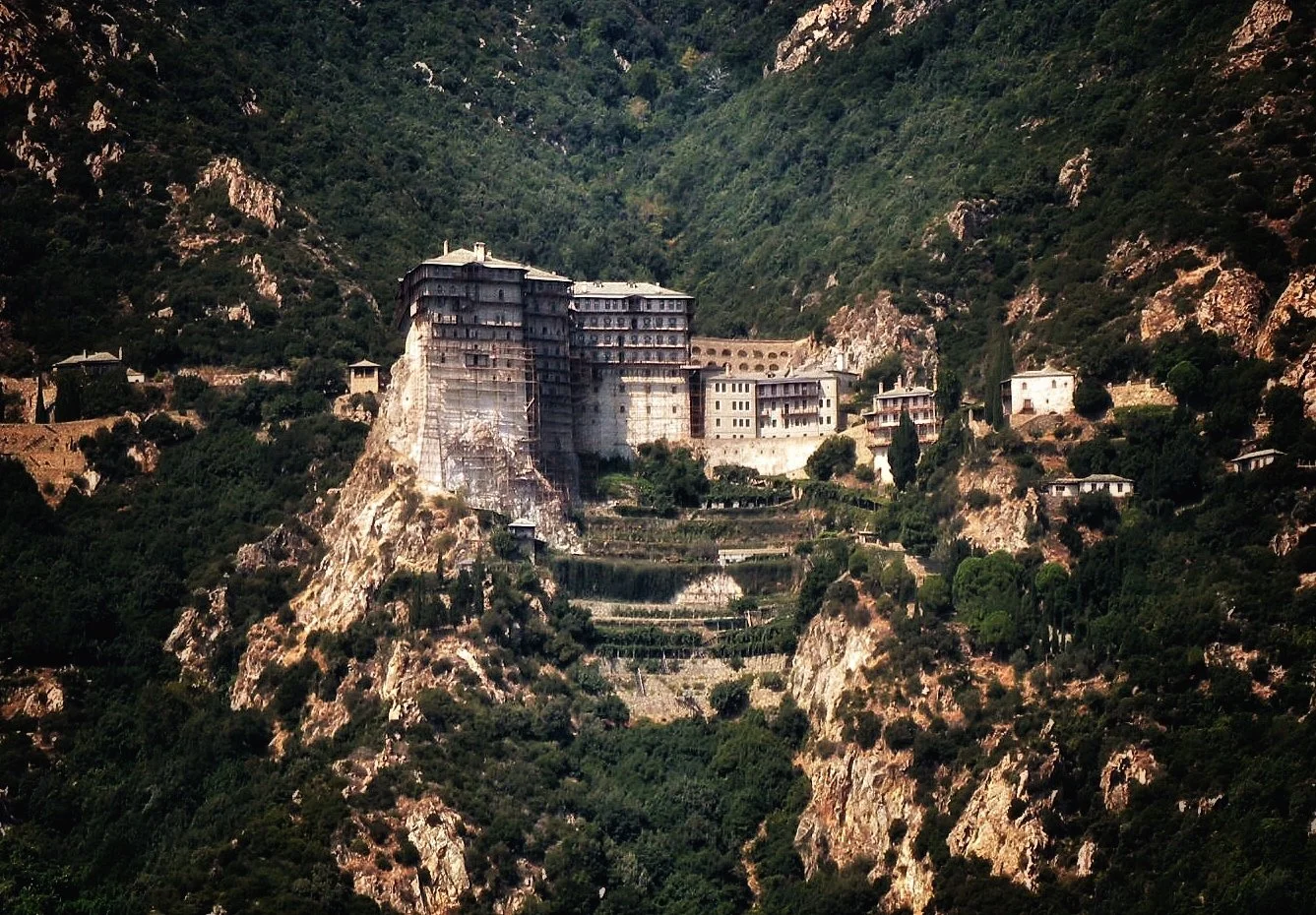
1. Monastery Republic of Mount Athos, Chalcidice
The holy monastery at Mount Athos. Maite Elorza. CC BY-NC-SA 2.0.
Located on the northern Greek peninsula of Chalcidice, Mount Athos is home to twenty ancient monasteries that date back to Byzantine times. Known to locals as the “Holy Mountain,” the recognized heritage site is off limits to women and children, but is home to approximately 1,400 monks. Its religious significance stems from legends that the rock face was once the location of a sanctuary of Zeus, but the mountain was also subjected to a number of attacks and attempted invasions over the years. The mountainous state officially became an autonomous region on October 3 ,1993and legally lies under the religious jurisdiction of the Patriarch of the Greek Orthodox Church from Constantinople.
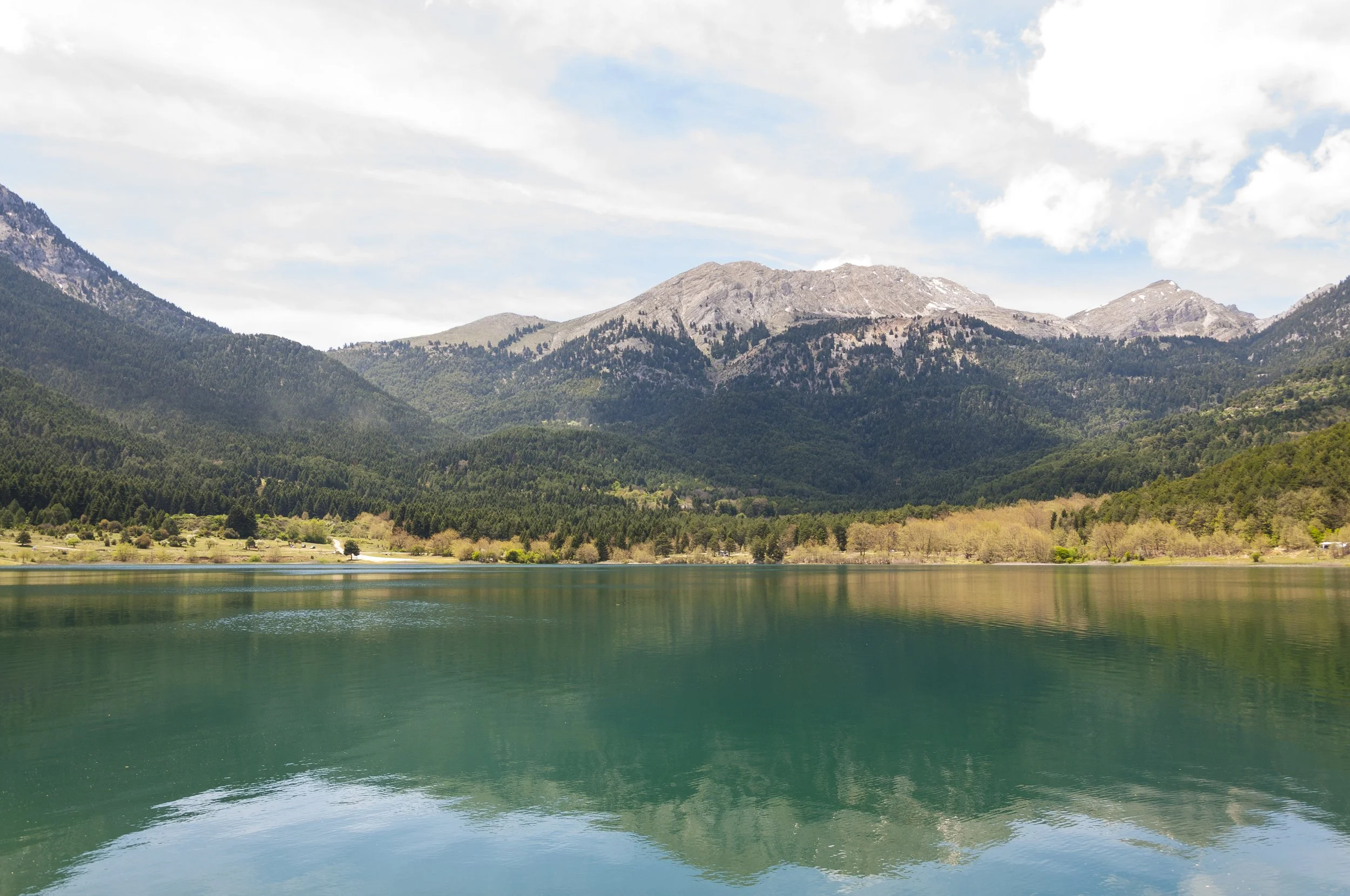
2. Lake Doxa, Corinthia
Artificial Lake Doxa in western Corinthia. Ava Babili. CC BY-NC-ND 2.0.
Surrounded by fir-tree covered mountains, the man-made Lake Doxa was built about fifteen years ago to help counter the high water levels. These tides also caused the Monastery of Agios to relocate at the center of the lake, and now appears as though it is floating on the water’s surface. The lake is in the village of Archaia Feneos which is located at the base of Mount Cyllene, the supposed birthplace of the god Hermes. According to popular Greek myth, there is also a subterranean canal underneath the lake that was dug by Hercules as one of his Twelve Labors.
3. Klima Fishing Village, Milos
The colorful fishing village of Klima. Ioana. CC BY-SA 2.0.
Located on the volcanic island of Milos, the tiny fishing village of Klima has an extensive history that stretches all the way back to around 3,000 BC. The island was occupied by Athenians, Macedonians and Romans over the next few centuries, each leaving their own architectural mark. Visitors can still see remnants of aqueducts, catacombs, theaters and even ancient gymnasiums. After its eventual liberation in the Greek Revolution, the population of Milos began focusing on agriculture and fishing, leveraging the unique volcanic soil and rocks to build garages and houses (known as “syrmatas”) that would protect them from bad weather. Many of the fishermen painted their doors and balconies with bright colors, giving the village its picturesque facade.
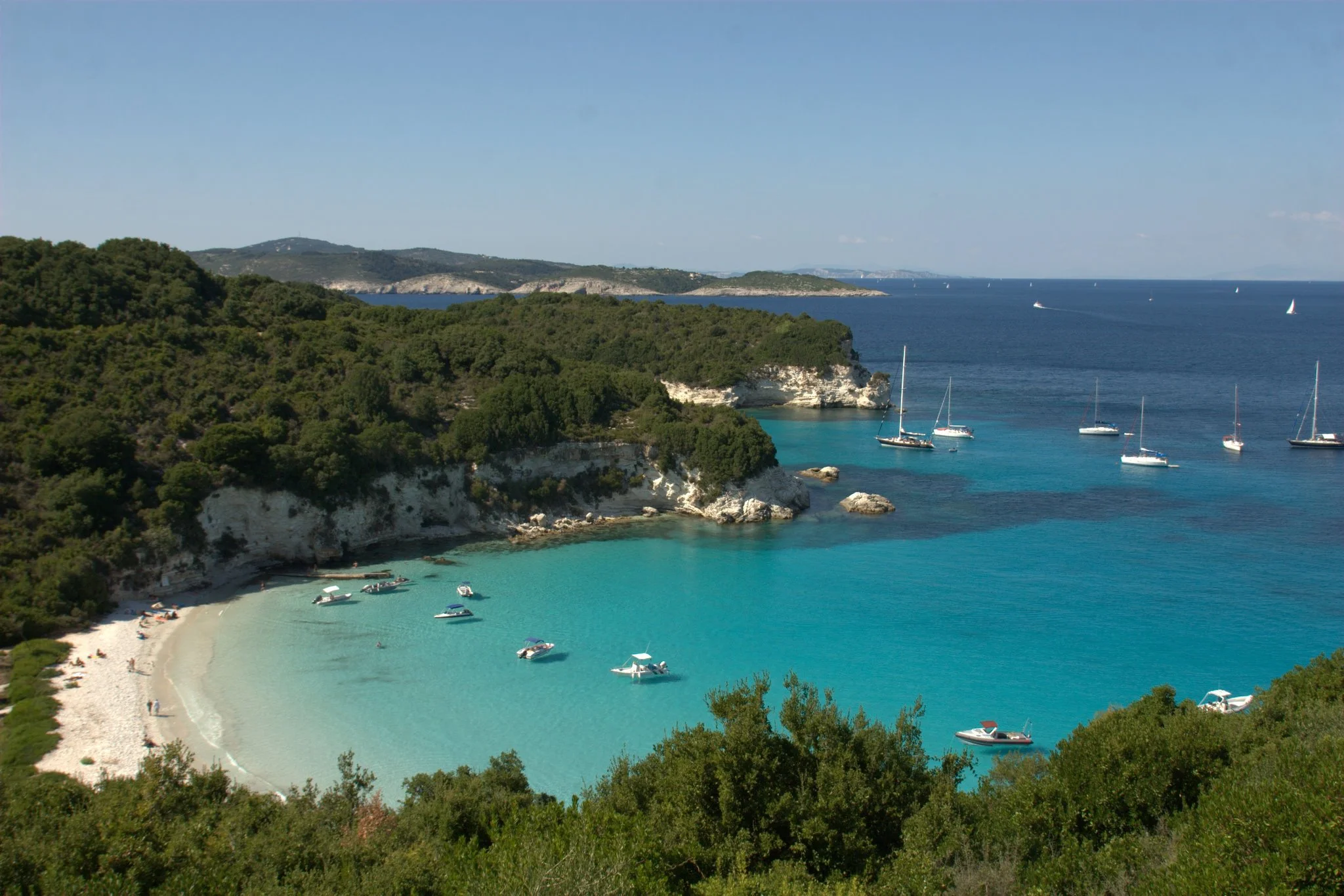
4. Voutoumi Beach, Antipaxos
The isolated Voutoumi beach on Antipaxos Island. Ari Bakker. CC BY 2.0.

As the smallest of the Ionian Islands, Antipaxos’ beaches are popular among locals from the neighboring islands of Paxi and Corfu but are relatively unknown to foreign tourists. Voutoumi beach is the largest of these and has some of the clearest waters in the Greek archipelago. It is also the preferred destination for private yachts because of its isolated location in a hidden cove on the north eastern side of the island. In fact, the pebble beach is so secluded that there aren’t any shops aside from a local tavern on a nearby hill that serves traditional Greek snacks. There are also a number of smaller coves that are easily reachable from Voutoumi by boat.
5. Melissani Cave, Kefalonia Island
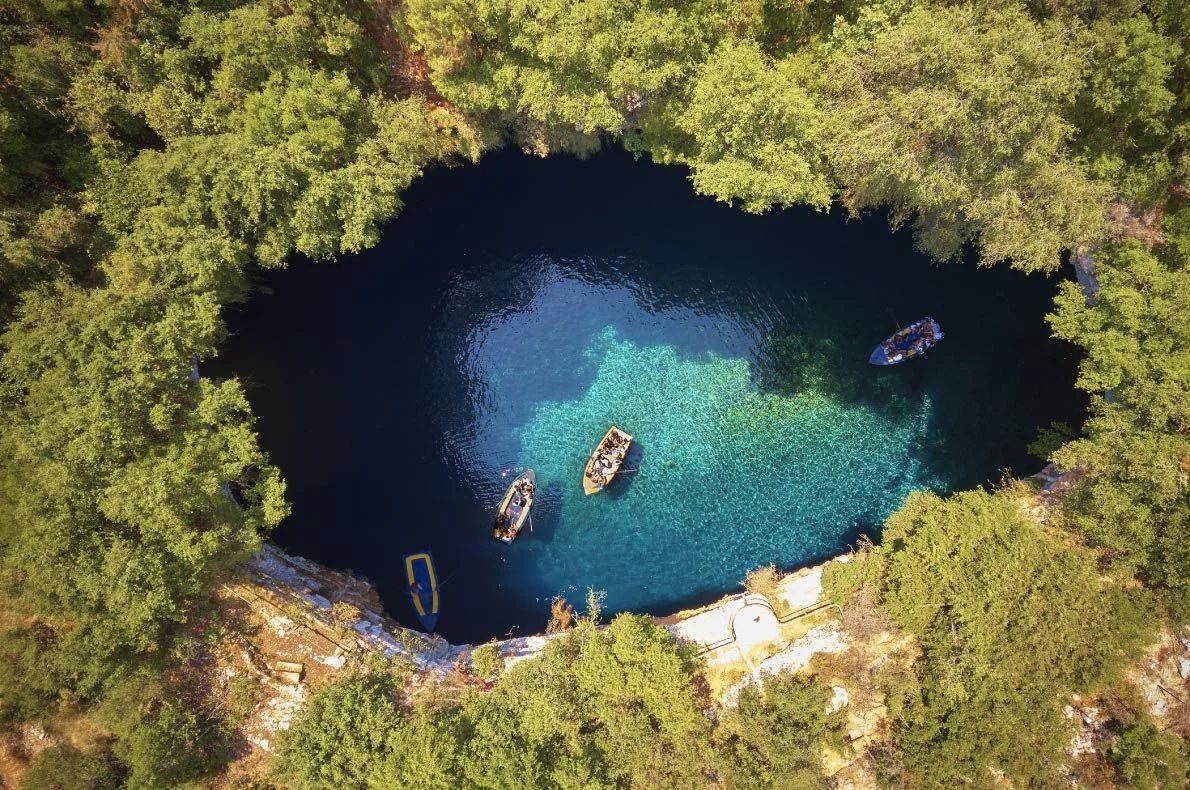
An overhead view of the Melissani Cave. jordeangjelovik. CC BY 2.0.
Kefalonia is conversely the largest of the Ionian Islands and is home to an underground grotto located 20 meters (roughly 60 feet) below the surface of the Earth. The Melissani Cave is made up of two rooms, one of which is bright and sun-lit while the other is fully roofed with dark stone stalactites. The chambers are connected by a pool of water that runs about 30 meters (about 90 feet) deep. Legend has it that the cave is named after the nymph Melissanthi who perished in these waters after being rejected by the satyr god Pan. Excavations carried out in the 1950s and 1960s discovered small terracotta statues in the cave depicting the myth and commemorating her unrequited love.
6. Ancient Greek Ruins, Delos
Ruins of the House of Cleopatra on the island of Delos. Bgag. CC BY-SA 2.0.
The island of Delos was once the religious epicenter of the Cyclades. It is now home to a large collection of archaeological ruins that commemorate Artemis and Apollo, the Olympian twins that are believed to have been born on the island. There are also beautifully preserved remnants of civilization from the archaic, classical and Hellenic periods in the form of ceramics, statues and mosaics. En route to the island’s highest point at the summit of Mount Cynthe is the ancient theater district and temples dedicated to the Egyptian deities Isis and Serapis. In fact, many foreign gods have dedicated shrines on Delos because it was a crucial trading port and hosted many sailors from overseas.
Tanaya Vohra
Tanaya is an undergraduate student pursuing a major in Public Health at the University of Chicago. She's lived in Asia, Europe and North America and wants to share her love of travel and exploring new cultures through her writing.
5 Tips for Haggling at a Souk in Morocco
At Moroccan souks and bazaars, haggling is a must-have skill for any shopper.
Read MoreSouth Africa’s Town of Penguins
The small port town Simon’s Town is full of amazing marine life, most notably the African Penguin colony that is just outside the town center.
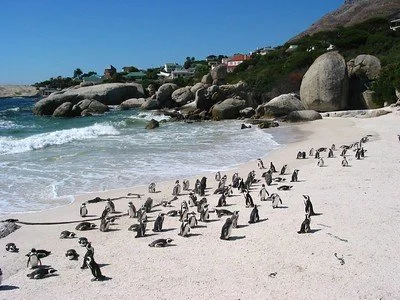
Jackass Penguins Simon’s Town SA. Donnie Ray. CC BY-NC-ND 2.0
Located on the southwestern coast of South Africa, Simon’s Town is a small village surrounded by both the ocean and the mountains. Being so close to Cape Town, Simon’s Town is a beautiful, small port city.
Simon’s Town is on a part of the Cape Peninsula known as False Bay. This area is a Hope Spot, an important and protected area for the ocean’s health. It is a valuable area for wildlife, with various species of birds and marine life coming to live off the area. Large marine creatures such as dolphins, whales, seals and sharks can be found near the town, some close enough to see while kayaking and others closer to Seal Island, 8 nautical miles away from the harbor.
However, much smaller than these other sea creatures is Simon’s Town’s famous attarction –the penguin colony. Penguins are found on every continent in the Southern Hemisphere, all the way from the Galápagos Islands at the equator to Antarctica. Here in this small town in South Africa, one colony of African penguins known as the Boulders Colony regularly comes ashore. Because of the colony, the town is also named Penguin Town. Breeding season for these birds is between February to August, so it is more common to see penguins during those months, but the birds will also come to land while they are molting. People can watch them from afar, and even swim alongside them, as long as they don’t get too close or chase them because the penguins will bite.
Simon’s Town (9). Joe Pyrek. CC BY-SA 2.0
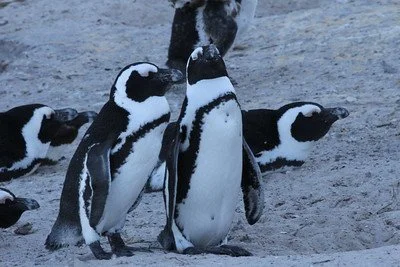
African penguins–also known as black-footed penguins, Cape penguins, and jackass penguins (the last one because of their unique braying-like sounds)–are an endangered species of penguins, with only around 140,000 penguins in the world. They are small birds, only growing between 24-27 inches and weighing around 8-9 pounds. In addition to the black backs and white fronts, they have a black, parabolic band across their chests, though chicks and juvenile members are brown and gray. The population of this species started declining in the 1980s due to commercial fishing and oil pollution. Though penguins do eat more than just fish, it is the largest part of their diet and commercial fishing has been taking all the species that the penguins eat. Luckily, commercial fishing has been banned in False Bay, so African penguins’ food supply belongs to them and the other sea creatures again. The oil pollution is another serious issue for the birds because the oil will destroy their waterproof feathers, making it hard for them to swim.
There are 27 breeding sites for African penguins, and each of them is a protected habitat, including Simon’s Town, though the town did have to erect fences and boardwalks to prevent the penguins from wandering too far inland and into people’s gardens and backyards. The entire area is a sanctuary for penguins, and keeping them from invading residents’ properties can help people respect the animals, as well as helping the number of penguins to increase.
Katherine Lim
Katherine Lim is an undergraduate student at Vassar College studying English literature and Italian. She loves both reading and writing, and she hopes to pursue both in the future. With a passion for travel and nature, she wants to experience more of the world and everything it has to offer.
VIDEO: Shadows of Bangkok
Bangkok, or Krung Thep, “The City of Angels”, is the capital of Thailand and home to more than 10 million people. The city is a composite of temples, factories, cultural sites, residences and shops. Emerging from political unrest in the 1990s and early 2010s, Bangkok has become a popular destination in its own right; gone are the days when travelers viewed the city as a simple pitstop on the way to Thailand’s beautiful beaches and islands. Escaping “from the typical travel videos that are usually made about Bangkok,” director and scriptwriter Jiajie Yu, based in Barcelona and Madrid, provides a glimpse into the everyday lives of Bangkok’s residents. He showcases “Bangkok in a cinematographic way,” introducing us to the quotidien and silent moments of a city that is usually portrayed as teeming with bright lights and action. Through “faces, alleys, sounds, and music,” Yu creates a subtle yet mesmerizing depiction of Bangkok.
The Islands of Hong Kong: Hidden Oases Next to a Bustling City
Hong Kong is known as an urban center, but just a short ferry ride away from downtown are traditional fishing villages and untamed beaches waiting to be explored.
Read MoreKyrgyzstan: From the Silk Road to the Celestial Mountains
A Central Asian country not known for its tourism, Kyrgyzstan boasts three Unesco World Heritage Sites. Each differs greatly in terms of its cultural significance, all providing different experiences for a traveler.
Wildlife in Kyrgyzstan. Charles Fred. CC BY-NC-SA 2.0.
Kyrgyzstan is known for its beautiful scenery; for example, there are two stunning canyons in Kyrgyzstan: the Fairy Tale Canyon and the Konorchek Canyons. The Kyrgyz people lived a nomadic lifestyle well into the 20th century, and aspects of this rich culture are still recognizable in architecture today. For example, a traveler to Kyrgyzstan can see a Bozui house—a type of architecture distinct to the Kyrgyz—and learn how it is built. In terms of the UNESCO World Heritage Sites, the three sites are deeply historically and culturally significant, as well as breathtaking.
1. The Chang'an-Tianshan Corridor of the Silk Road
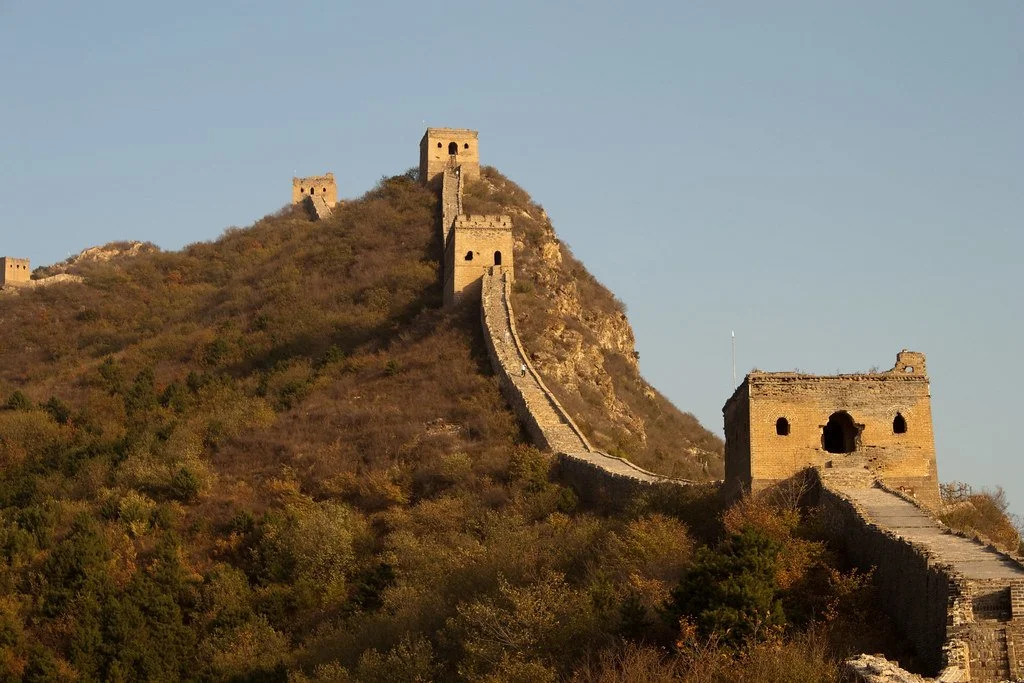
Section of the Great Wall of China in Kyrgyzstan. Matt Barber. CC BY 2.0.
The Chang’an-Tianshan Corridor is a section of the Silk Road, the most used collection of trade routes during ancient times, which primarily connected China with countries in Europe, the Middle East and East Africa. The Chang'an-Tianshan Corridor was named a UNESCO World Heritage Site in June of 2014, due to the historical significance of the Silk Road, which had been used until as late as the 16th century. The Chang’an-Tianshan Corridor in Kyrgyzstan is an especially interesting and important sector of the Silk Road due to its beauty, rocky terrain and historical significance. The Chang’an-Tianshan Corridor was used from the 4th through 16th century to transport mostly luxury goods, with its use beginning to facilitate trade between the Chinese and Roman empires. It was also very difficult to navigate due to its massive peaks and valleys—the climate of which ranges from snowy to arid to humid. In addition to natural sites, the corridor contains many cultural and historical destinations. Parts of the Chang’an-Tianshan Corridor run along the Great Wall of China. Additionally, there are several Buddhist temples, ancient palaces and tombs along the corridor.
2. The Sulaiman-Too Sacred Mountain
View of Sulaiman Too-Sacred Mountain from Osh. Christian Gawron. CC BY-SA 2.0.
Also located on the Silk Road, the Sulaiman-Too Sacred Mountain (located next to the city of Osh) was declared a UNESCO World Heritage Site in 2009. The Sulaiman-Too Sacred Mountain has been regarded for hundreds of years as a sacred destination, primarily in Islam, but also in religions and belief-systems that contain only some aspects of the Islamic faith. The mountain contains two reconstructed mosques from the 16th century, caves with ancient petroglyphs and many other sites for worship—17 of which are still in use today. One of the main non-Islamic groups which has historically worshiped at the Sulaiman-Too Sacred Mountain is the cult of the horse, which is reflected in much of the cave art.
3. The Tien-Shan Mountains
The Tien-Shan Mountains. Bruno Rijsman. CC BY-SA 2.0.
“Tien-Shan” in Chinese means “celestial.” The mountains may have gotten their name from their extremely high peaks; the highest points of the Tien-Shan mountains are also the highest points in all of Kyrgyzstan. The peaks in Kyrgyzstan were officially declared a World Heritage Site in 2016, although the parts of the mountains in China had been named a World Heritage Site in 2013. The Tien-Shan Mountains are mostly known for their diverse wildlife and for being home to several ethnic groups such as the Uyghur people and various Buddhist sects. While the oppression of the Uyghur people is not nearly as severe in Kyrgyzstan as it is in China, in recent years, there have been reports of violence from the Kyrgyz majority towards the Uyghur, as well as governmental interference in Uyghur political organizing. Despite Kyrgyzstan’s treatment of the Uyghur people, the Tien-Shan Mountains remain the home of many Uyghur people in the country. The mountains are covered in glaciers, many of which are threatened by climate change. This could change the entire geological landscape of the Tien-Shan mountains. Wildlife found on Tien-Shan include snow leopards and the Himalayan snowcock. Out of the three World Heritage Sites in Kyrgyzstan, the Tien-Shan Mountains is the most focused on the nature of Kyrgyzstan as opposed to the history featured in the other two sites.
Calliana Leff
Calliana is currently an undergraduate student at Boston University majoring in English and minoring in psychology. She is passionate about sustainability and traveling in an ethical and respectful way. She hopes to continue her writing career and see more of the world after she graduates.
12 Local Cuisines You Can Find Around the World
Tasting local foods is one of the most interesting things about travel. Learn about some hallmark culinary traditions of these diverse regions.
Meat and veggies simmering in a pan. LoKan Sardari. CC BY-NC-SA 2.0.
My favorite part of traveling is exploring and tasting local food dishes with culturally significant roots within the region I’m visiting. When I traveled to London, I explored the local pubs and decided fried fish wasn’t that bad. The local aspect of dishes excites me, and I would much rather dine in a family-owned restaurant than a tourist trap.
This serves as a bite-sized serving of the infinite variety of food on this massive planet—not a definitive recounting of the delicious and culturally significant dishes on Earth, but rather these regions serve as starting points that lead to culinary exploration.
1. Kanto Region - Japan
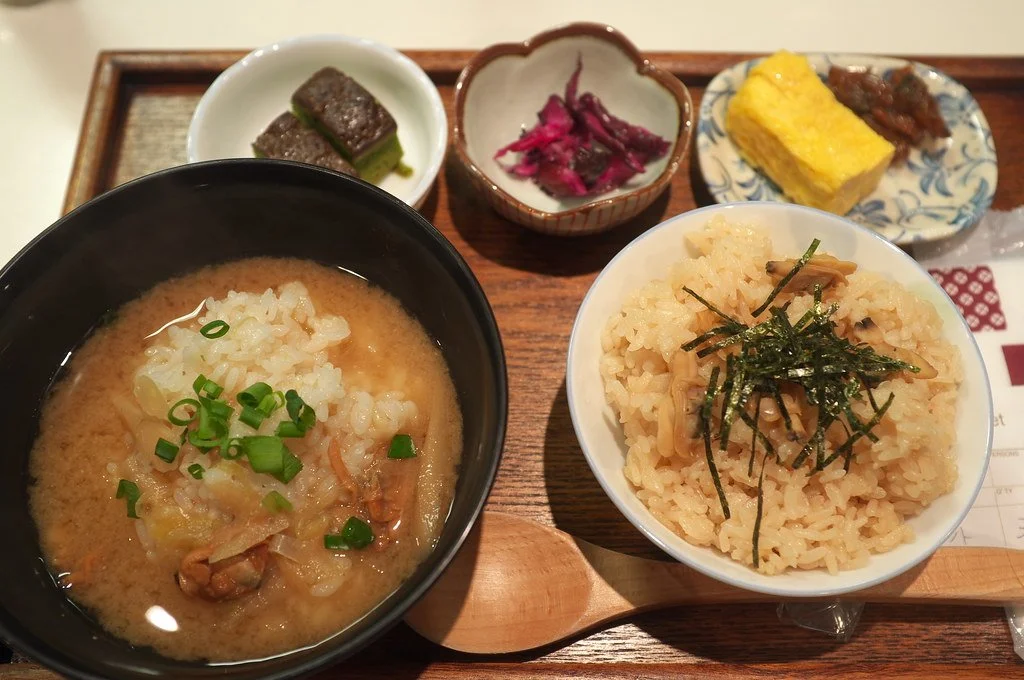
Fukagawa meshi and other side dishes. Nekotank. CC BY-ND 2.0.
Japan is divided into eight regions, each of which has its own culturally significant dishes. The Kanto region is home to the capital city of Tokyo, and the flavors are stronger than the other regions’ food. Fukagawa meshi is a dish that originated in the Edo period (approximately 1603-1867) and consists of clams and leeks cooked in a miso stew. The dish was a product of abundant fishing in the area and quickly became adopted by locals. The Kanto region became a hub for industry during the Edo period, and the cuisine naturally started evolving to incorporate other region’s influences.
2. New South Wales - Australia
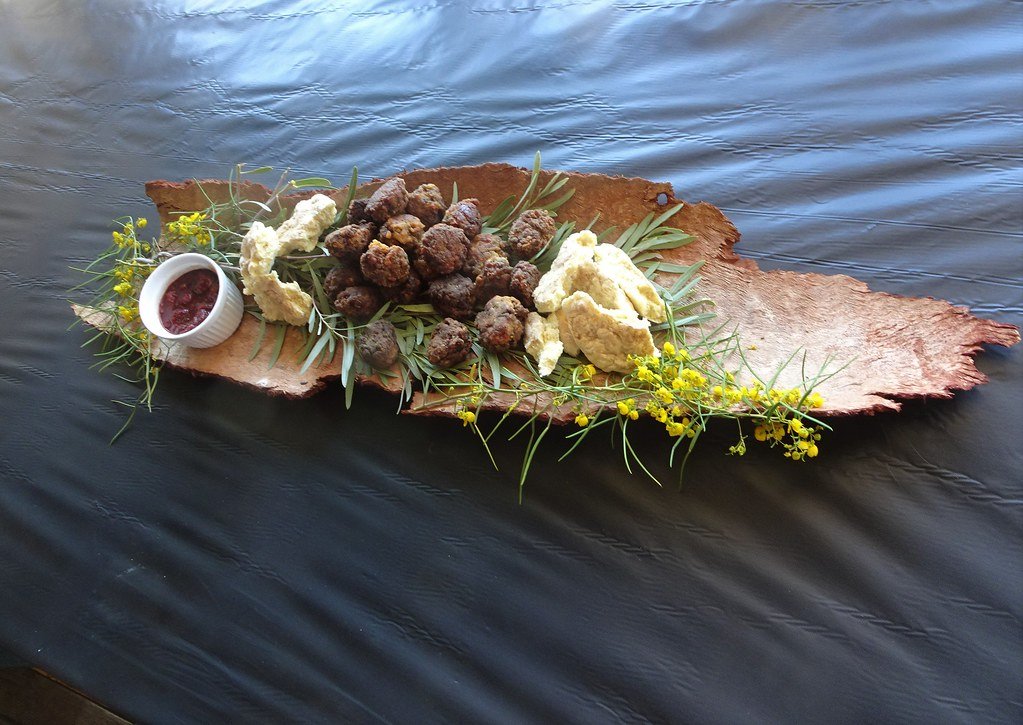
Kangaroo Meatballs with quandom jam. by denisbin. CC BY-ND 2.0.
Prior to the 18th century, the Indigenous population of Australia subsisted on hunting local wildlife, including kangaroos and wallabies. Once Australia became a continent-sized prison for the British Empire, the cuisine quickly modified to have influences of the colonizer diet. Today, Sydney cuisine reflects the multi-cultural population that lives there. Take-away foods and fast food are staples of Australian culture, and Sydney specifically is a melting pot of local and international foods. Fish and thick cut fries are common. The cuisine of Australia is heavily influenced by Western diets but still utilizes ingredients that Aussies connect with, including eating their national animal, the kangaroo—a dish low in fat, delicious, and popular in local restaurants.
3. Phobjikha Valley - Bhutan
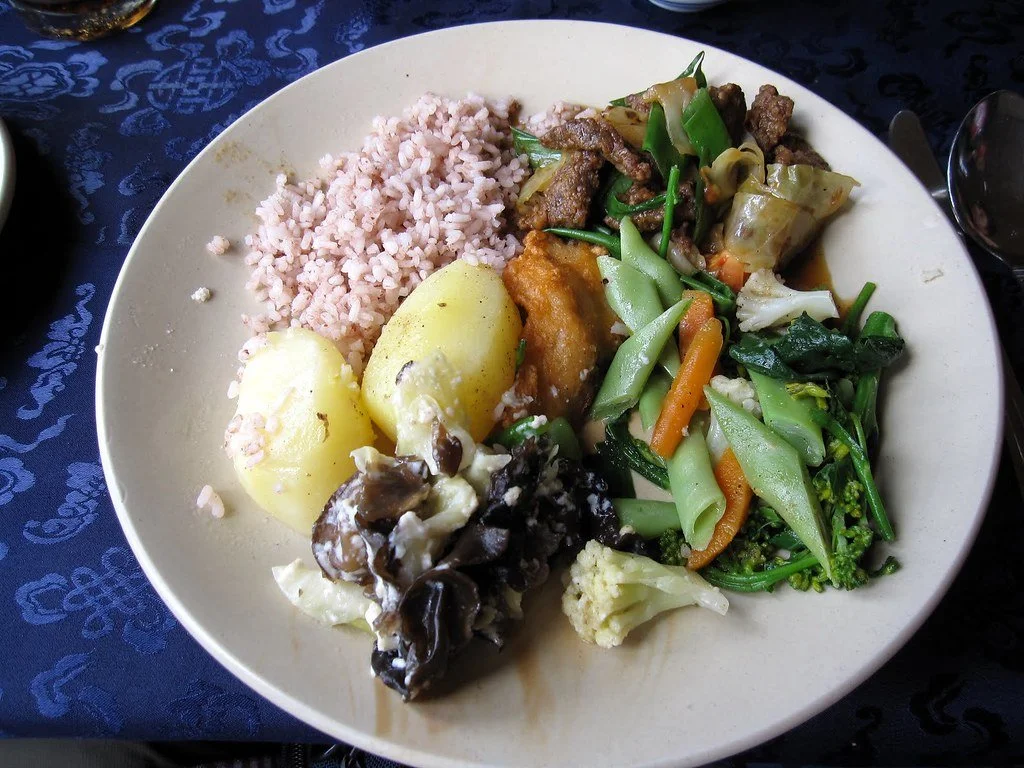
Bhutan dish with potatoes and vegetables. By rapidtravelchai. CC BY 2.0.
This region is home to many rich cultural events, such as the Black-Necked Crane Festival, which honors one of the region’s most culturally significant animals. This festival is held annually on Nov. 12, where cranes can be seen flying at high altitudes, accompanied by traditional dancers dressed in black-necked crane attire. The local cash crop is potatoes, which are the main ingredient in kewa datshi, a traditional dish prepared by thinly slicing potatoes and sauteeing with cheese, butter and chiles. The dish is relatively new to the region’s culture; in fact, potato consumption in Bhutan was near non-existent until the 1970s. Until then, it was mainly used as an export crop. Due to the region’s altitude and climate, insects do not interfere with the local’s potato crops, which eliminates the need for harmful pesticides.
4. Metsovo - Greece
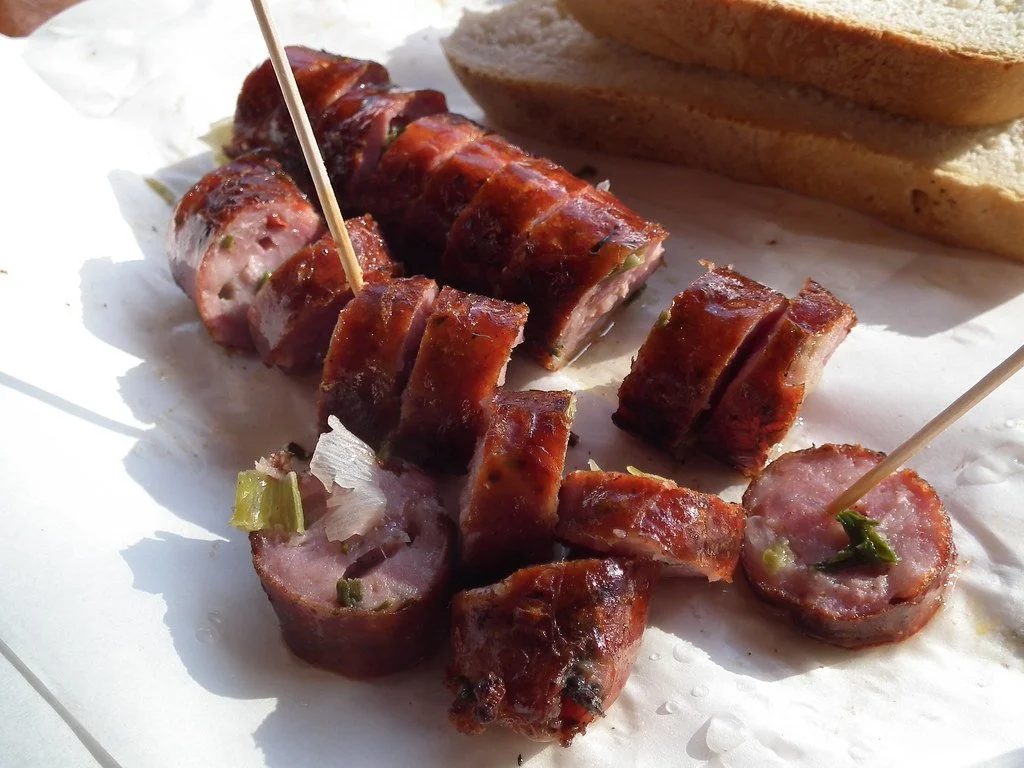
Skewered sausages. PACO POMARES. CC BY-NC-SA 2.0.
Situated to the north of Epirus, Greece, this gorgeous small town is home to some of Greece’s most delicious industries: wine and cheese. The history of this town is fascinating, with it being the center of production for sheep wool traded as far as Northern Africa during the 17th and 18th centuries. The region is most popular during the winter season for its spectacular mountains and beautiful streams. Venturing off the beaten path, one can find themselves entranced with gorgeous forests, filled with statues, 19th-century architecture and natural springs supplying fountains. The local cuisine has an emphasis on dishes with rich flavors like sausages and ruffage, as well as a nice glass of wine to pair with it. Extra virgin olive oil is a heavily used condiment that could be added to multitudes of things, including toasted bread and other dishes.
5. Chengdu - China
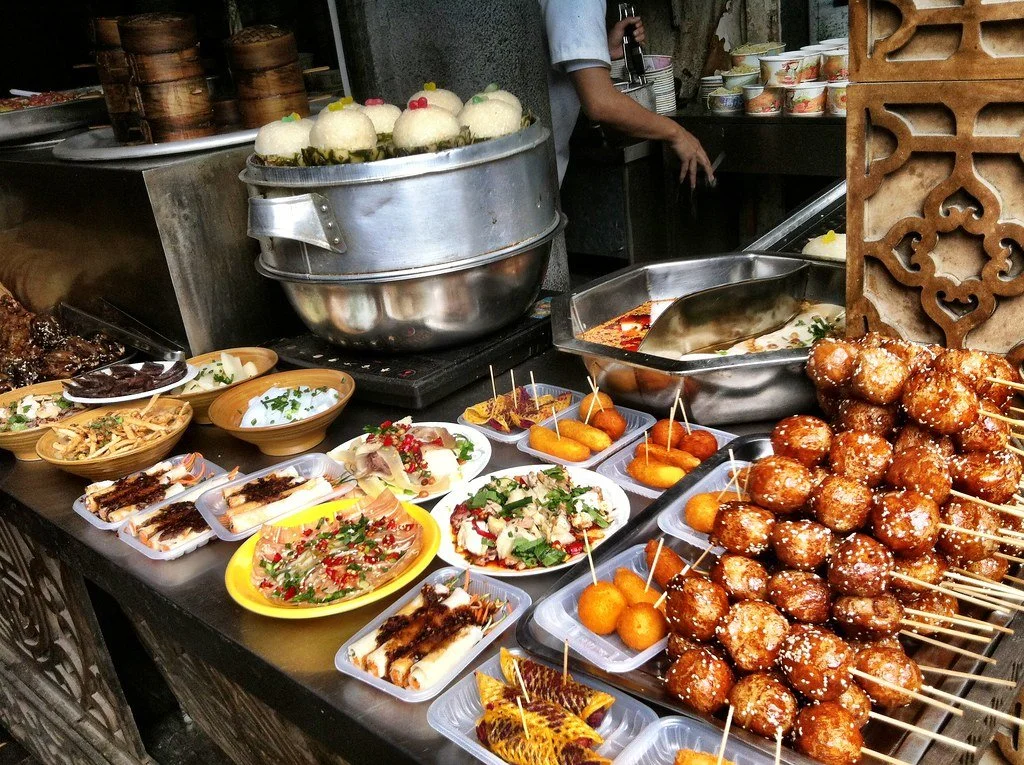
An assortment of Chengdu Food. sinosplice. CC BY-NC 2.0.
Chengdu, China is a so-called “Party City,” according to the Los Angeles Times. While it is true that Chengdu has more teahouses and bars than Shanghai, it’s also home to many local dishes, specializing in chiles and peppercorns. One dish, dan dan mein (which Chengdu is credited for making), utilizes both in order to achieve a very spicy broth. Chengdu’s local tea culture is also very important, since the city was once a starting point for the Silk Road, offering many opportunities to create and enhance cultural staples. Although not culinary-specific, the city is a hotspot for LGBTQ+ travelers and natives, combining influences from the local party scene and the Queer community.
6. Soca Valley - Slovenia
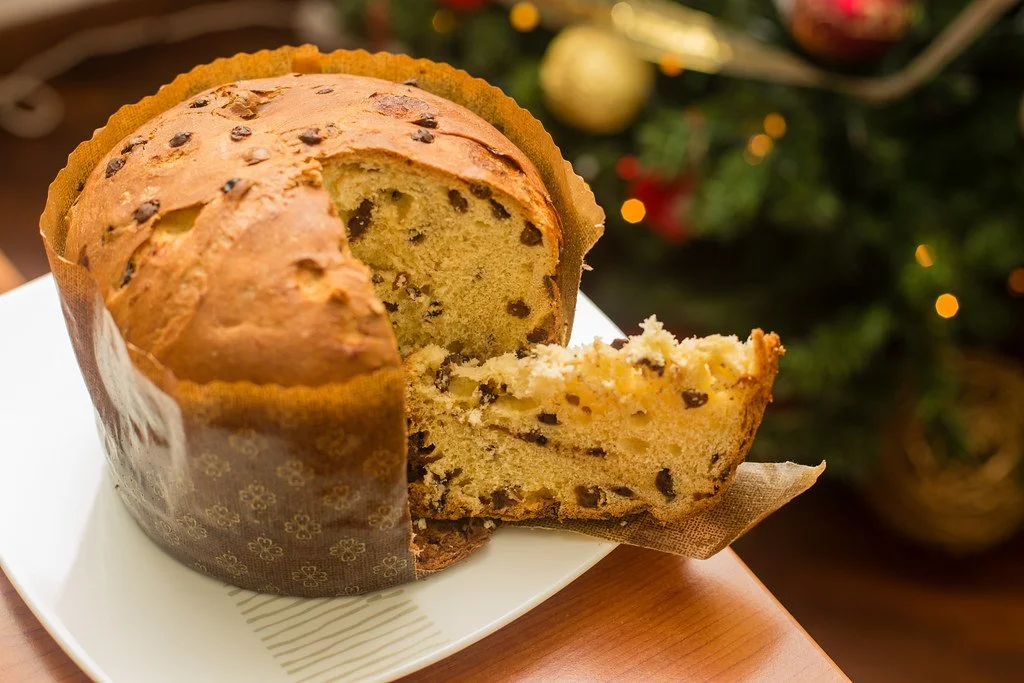
Panettone with chocolate chips. Nicola since 1972. CC BY 2.0.
Slovenia is right in the center of four surrounding cultural influences; the Balkans, Alpines, Mediterranean and Pannonian flavors are all present in Slovenia’s dishes, and each is broken down into distinct ‘genres’ of food. The Alpine mountains are home to the cows and sheep that graze and produce milk, used for cultural dishes like žganci (literally translated as mash). The expansive meadows let honey bees run rampant to produce fresh honey. To the east of Slovenia, there is a vast amount of wheat fields, used to prepare a litany of different dishes and thermal springs that allow for fresh drinking water. The most popular fish is sea bass, and according to popular sentiment in the region, “a fish must swim three times, in water, oil and wine.” By utilizing hard harvested salt, Slovenia’s population takes its local cuisine very seriously.
7. Cape Town - South Africa
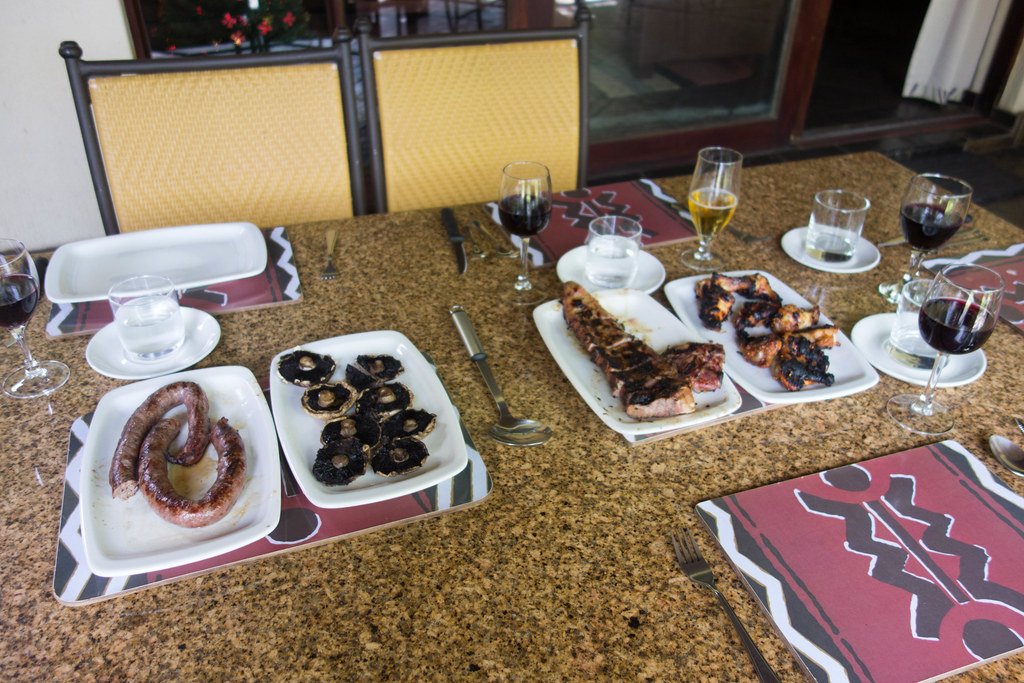
Braai at a meal. Kent Wang. CC BY-SA 2.0.
South Africa’s cuisine can be summed up with the term “melting pot,” since this region contains a mixture of Asian, European and Indigenous cultures within their food. Braai, an almost universally utilized meat preparation method in Southern Africa, is prepared by digging a firepit, providing meat and setting it ablaze. The practice is adjacent to America’s cultural touchstone of “barbecue,” although a key difference is that braai fires stay lit throughout the celebration as participants enjoy everyone’s company. Indigenous populations prioritized beef as a high-value food, and today, many South Africans still utilize foods from their Indigenous past. Colonialism severely altered the landscape of South African cuisine by bringing in an enslaved workforce from across Asia, which in turn brought their own cultural roots. The introduction of spices like nutmeg and allspice and the influence of European culture altered the cuisine further. Fermented beer is also popular, with a common practice being offering someone homemade beer as they enter your house.
8. Sicily - Italy
Italian cassatelle drizzled with chocolate. JohnDiP. CC BY-NC-SA 2.0.
Across the Mediterranean is the island of Sicily, a region known for its famous seafood dishes, sweets and, of course, pasta. The island restaurants have the opportunity to catch fish from the surrounding Mediterranean, specializing in tuna and freshly caught sardines. Pasta con le sarde is one of Sicily’s most popular dishes, utilizing fresh fennel seed that grows abundantly in Italy and the sardines from the surrounding sea. The dish also reflects the region’s multicultural influences, such as including raisins and pine nuts adapted from North American travelers. Sicily’s sweet side is also on full display, with cannoli being a centerpiece in Sicilian culture. Made with sweet ricotta filling, the crust of the cannolis is made from a fried pastry.
9. Andes - South America
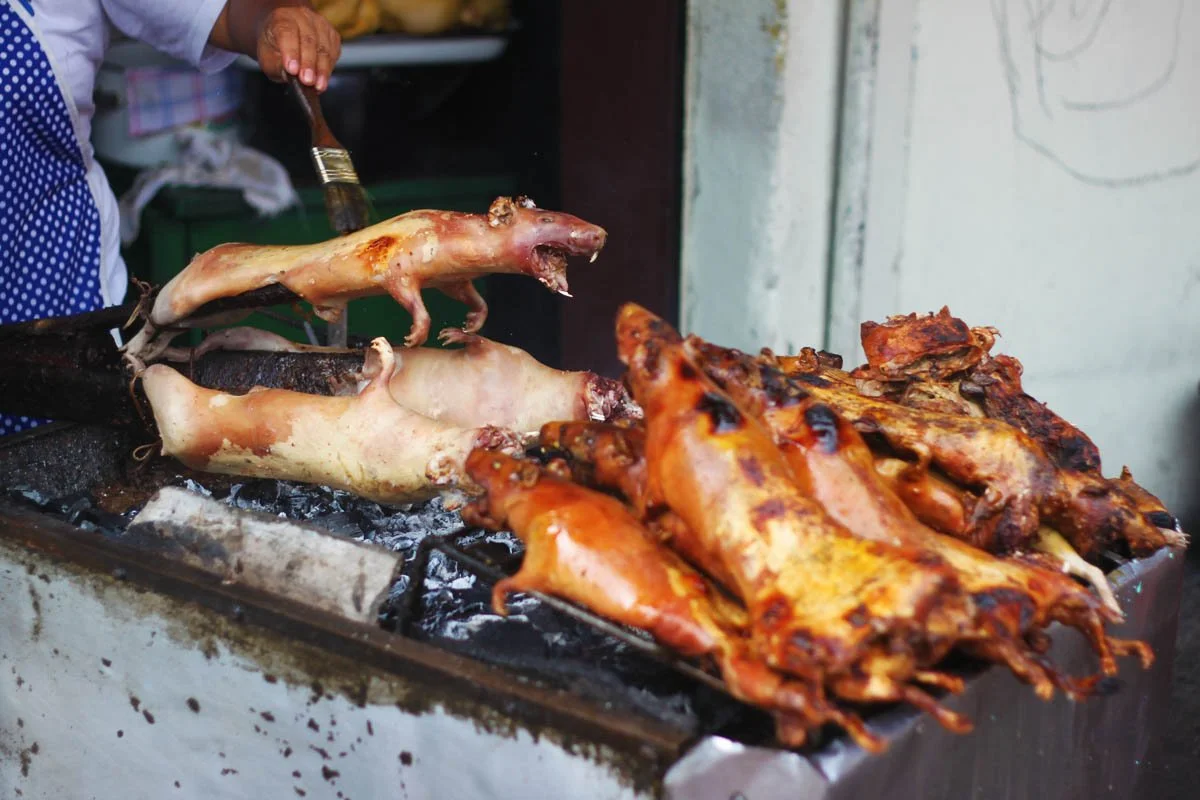
Cuy on skewers. Nestor's Blurrylife. CC BY 2.0.
The Andes Mountains are home to communities of Indigenous peoples who have worked to preserve traditional flavors and techniques. The foodstuffs of the Indigenous peoples were incredibly versatile. Corn and potatoes are still some of the most important aspects of Andes cuisine, accompanied by traditionally used meats such as llama and guinea pig. Another word for a guinea pig is “cuy,” which has been a staple in Peruvian culture since the Incas and is used on important occasions.
10. Prague - Czech Republic
The capital of the Czech Republic harbors many cultural influences within its dishes. Italian food has touched the landscape of cuisine in Prague, but there are still many delicious dishes with deep Czech roots. Czech cuisine doesn’t have lots of vegetables in its arsenal of ingredients, and the foods of Prague are “delicious, comforting, very filling and addictive.” Steak tartare, a dish that tops “Taste of Prague’s” list of snacks that pair well with beer, is raw minced beef served with an egg or condiments. Sausages are a very common food in Prague, as well as the greater Czech region, overflowing into Germany.
11. Central Ghana
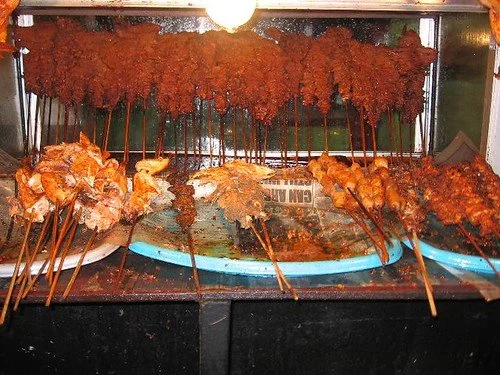
Western Africa’s recipes are still being prepared in deeply culturally important ways. Dishes are typically very starch heavy, accompanied by heavily seasoned meats, like beef, fish and the most dominant form of red meat in this region, goat. Traditionally, West Africans didn’t eat much meat and instead opted for dishes with natural oils, but now locals mix various meats together in different aspects of dishes. Suya is also a very popular street food, taking meat and mixing it with spices, resembling a kebab flavor on a stick. Prior to Ghana’s independence in 1954, residents boycotted colonial goods, including tinned meat and biscuits, in an effort to lower the cost of living. This action, along with a demonstration at the governor’s estate, set the stage for Ghana to be the first Sub-Saharan independent country. Ghana is not concerned about dictating a national food, rather it embraces the diversity of the many cultural influences within the country.
“Ghanaians expect to encounter diverse ethnic foods when traveling through different ecological zones within their country,” said researcher Brandi Miller in her paper, “Food and Nationalism in Independent Ghana.” “They welcome this difference and consider it a source of national strength and an indication of their unique national character, which embraces diversity.”
12. Tropics - South America
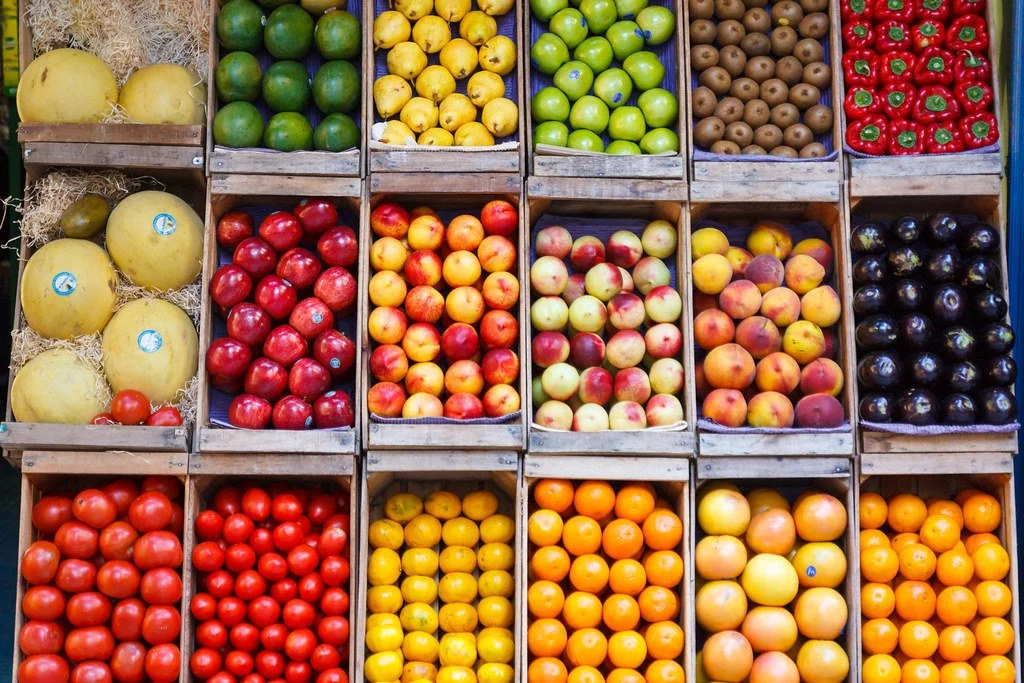
Fruit in a market. Nico Kaiser. CC BY 2.0.
On the beaches of South America, some so-called ‘exotic’ fruits are common staples of local culture. Pineapples, mangos, papayas and dozens others can be found in the tropical forests within the region. The climate allows for a dizzying variety of local agriculture to be used in recipes, such as tostones, which are popular Latin American twice-fried sliced plantains. The Amazon Rainforest is also utilized to enhance local flavors, utilizing meats from turtles and capybaras to use for local cuisine. Nearer to the coast, seafood dishes like ceviche are common to see enjoyed on a sunny day on the beach. Other than fish and fruits, there is a wide variety of vegetables that are grown in the tropics that influence local cuisine, including corn, beans and sweet potatoes.
Clayton Young
Clayton is an aspiring photojournalist with a Bachelor's in Liberal Studies with a minor in History from Indiana University - Bloomington. In his free time, he enjoys hikes, movies, and catching up on the news. He has written extensively on many topics including Japanese incarceration in America during World War II, the history of violence, and anarchist theory.
Discover Cambodia’s Beauty Despite Dark Political Past
Though still recovering from Pol Pot’s regime, Cambodia contains numerous sites and monuments worth traveling for.
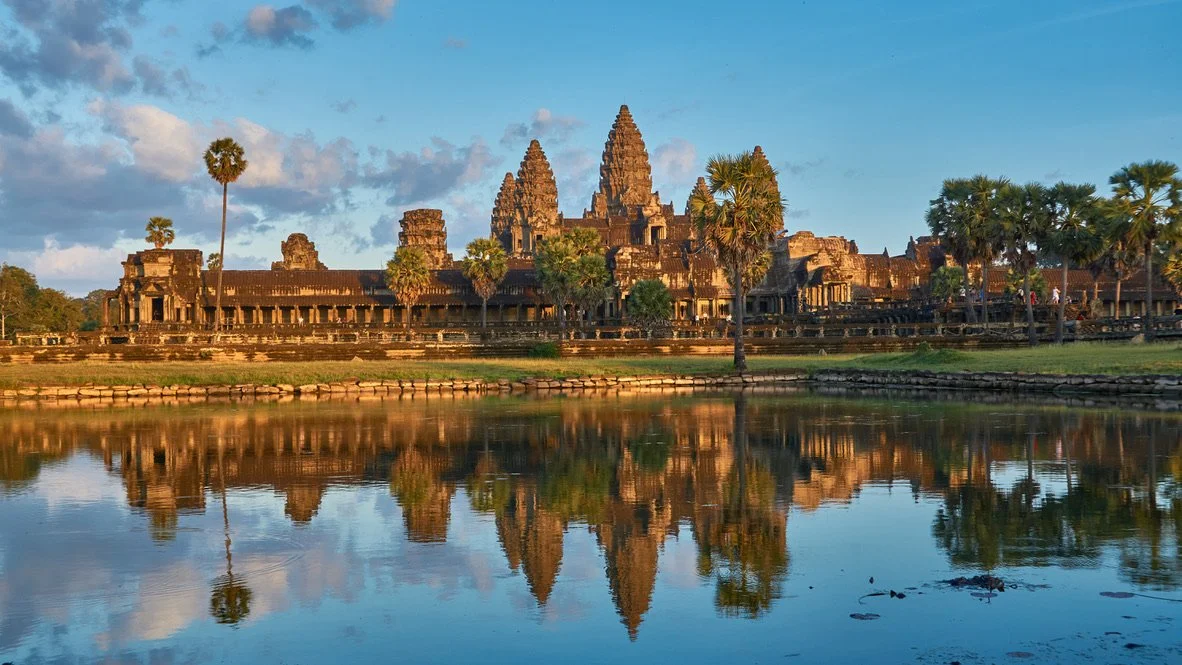
Angkor Wat Reflection. Radek Kucharski. CC BY2.0.
Cambodia is known for its massive and brilliantly crafted religious temples, vast untouched forests and vibrant city life. What some may not know is Cambodians have and are still recovering socially, economically and politically from one of recent history's most horrific events: the reign of the Khmer Rouge.
Under the rule of dictator Pol Pot, the Khmer Rouge was a Marxist regime created in 1975. Whether from execution, starvation, exhaustion and disease, more than 2 million civilians died during the genocide. Despite the defeat of the Khmer Rouge on January 7, 1979 by the Vietnamese military, Cambodians struggled to regain their political and economic prosperity. General poverty rates have lingered around 35% which is a great improvement from the 50% at the initial end of the events. Those who experienced the genocide are now be in their 50s, and thus Cambodians are still living with the traumatic experiences they went through.
With that said, the Southeast Asian country has shown great perseverance and progress towards a bright future. Now, Cambodian citizens celebrate their traditional cultures and welcome outsiders to experience the atmosphere and history of their country. Here are a few of the most popular spots.
1. Angkor Wat
Said to be the largest religious monument in the world, Angkor Wat is a vast Buddhist temple that touches over 400 acres of land and comprises over 1,000 buildings. Cambodia is home to this cultural wonder of the world and is a destination that provides both visual beauty and an introduction to Cambodia’s rich history and culture.
Angkor Wat has five lotus-like towers rising 65 meters up, being the first part of the temple visitors tend to notice. The awe-inspiring scenery continues with carvings throughout the inside of the temple. Celestial dancers, known as apsaras in Khmer (Cambodia’s national language), helped reintroduce Apsara dance in Cambodia. Carvings of war, spiritual journeys and everyday life explain Cambodia’s hardships and relationship with culture and religion. Ta Prohm, also known as the Tomb Raider Temple due to its appearance in the 2001 film, and Angkor Thom are other beautifully architected sights nearAngkor Wat.
2. Banteay Srei
Banteay in Angkor. Juan Antonio Segal. CC BY 2.0.
Known as the Temple of the Women, Banteay Srei is sacred in Angkor. Though it is much smaller in size than Angkor Wat, it contains some of Cambodia's most delicate carvings. Images of women holding lotus flowers and memorable stories of the Hindu religion are depicted here. Banteay Srei is still a place for women to visit and observe to feel inspired and appreciated, as well as a place where anyone can experience its beauty and history.
3. Bayon
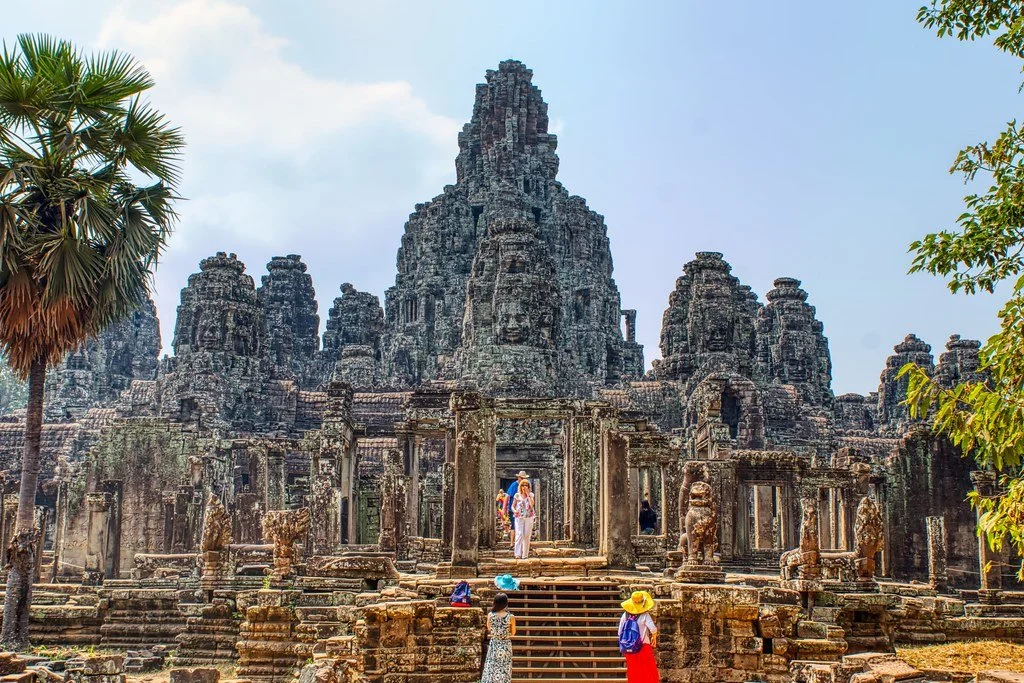
Bayon Temple Ruins in Cambodia. Uwe Schwarzbach. CC BY-NC-SA 2.0.
This Buddhist Temple is home to 216 smiling, peaceful faces carved into towers. Numerous other carvings can be seen representing the experiences of the Khmer people. Bayon temple allows visitors to understand the goals and journey of the Khmer Empire and is a great temple to visit if you are interested in Buddhism and appreciating Cambodia’s past.
4. Phnom Penh
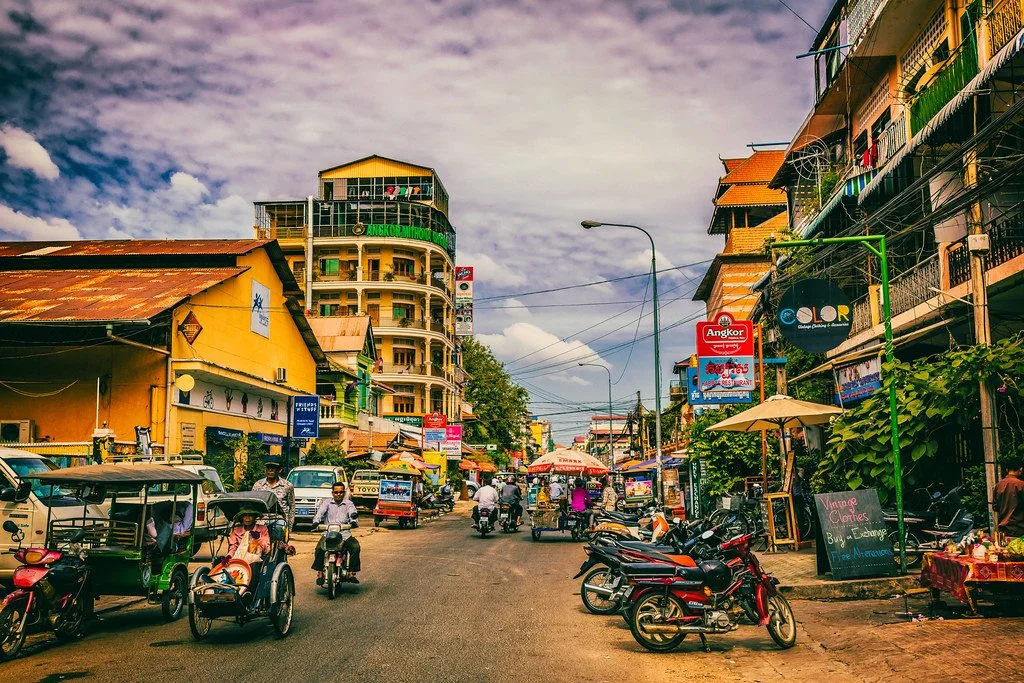
Bustling Phnom Penh. Baron Reznik. CC BY-NC-SA 2.0.
Phnom Penh is the capital of Cambodia andhome to vibrantly colored buildings, tight streets with motorbikes, friendly locals and more architectural beauty. A main mark of the Cambodian experience, Phnom Penh is affordable and easy-going—a great way to submerge yourself in the country's culture. here are some upscale restaurants and locations, but overall, Phnom Penh remains its gritty, lively and romantically chaotic self.
5. Krong Siem Reap
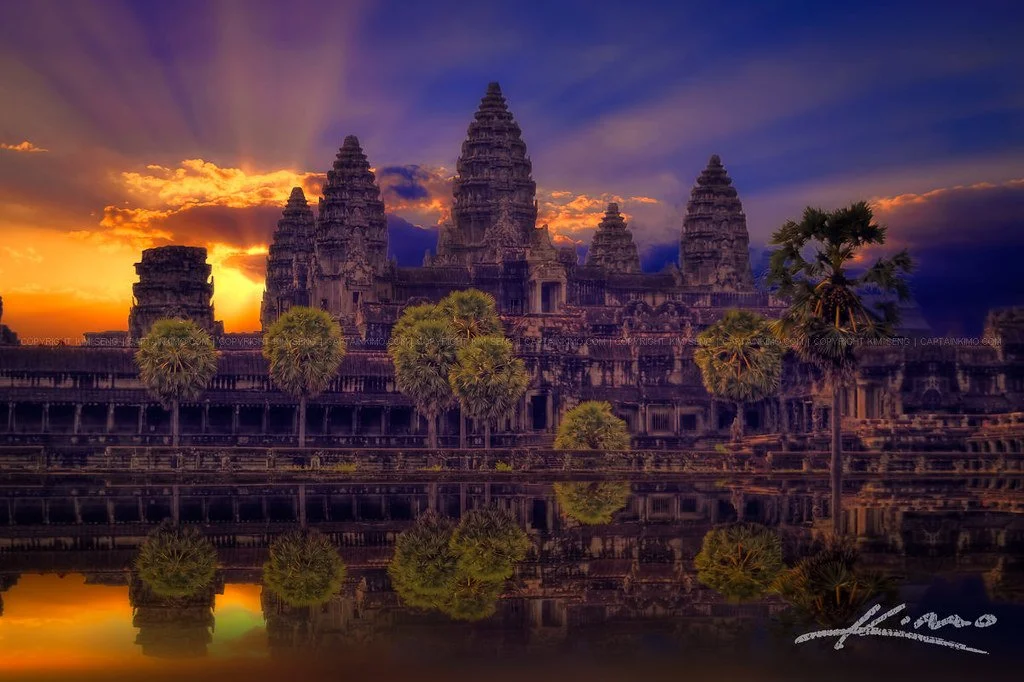
Angkor Wat in Krong Siem Reap. Kim Seng. CC BY-NC-ND 2.0.
Krong Siem Reap is another other major city destination in Cambodia. Krong Siem Reap is a staple of Cambodia’s religious history, being home to Angkor Wat, the ruins of Banteay Srei and Ta Prohm. Locals treat travelers as if they have been life-long friends, and travelers will get the chance to explore much of Cambodia’s Buddhist history as long as remaining respectful.
Krong Siem Reap is also known for its exquisite food scene. Cafes offer coffee, teas and delicious local food dishes with some even offering vegetarian and vegan-friendly options. Restaurants to grab an authentic and budgeted meal are around every corner.
6. Kirirom National Park
Kirirom National Park Rest Area. Arie. CC BY2.0.
Located mostly in Phnom Sruoch District, Kirirom National Park is covered with deep forestry and high elevation. Kirirom, meaning “Mountain of Joy,” is loved for its high elevation pine forests and many glistening waterfalls. Along with vast, isolated hiking trails, the endangered sun bears, pileated gibbons and tigers can be found living in the forests.
7. Koh Tonsay
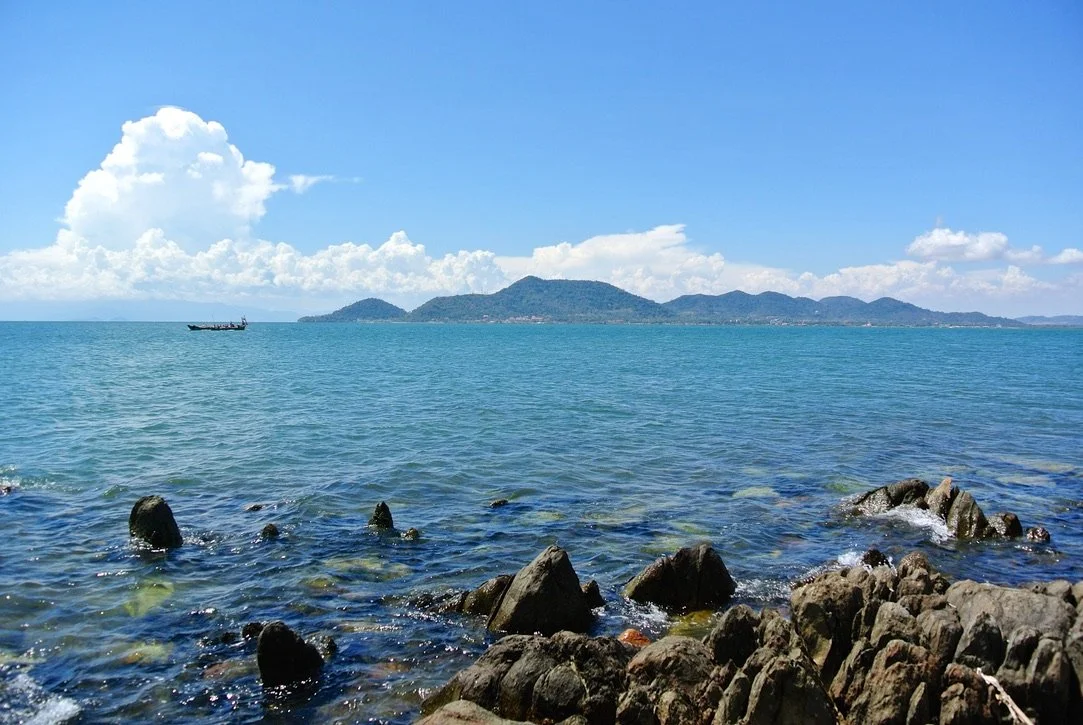
Located on the country's south coast in the Gulf of Thailand, Koh Tonsay can be translated as “Rabbit Island” and received its name because it houses the furry little creatures. It is a relatively quiet coast with a more rustic beach style. While tourists tend to visit other parts of the Cambodian coast more influenced by Chinese businesses, Koh Tonsay remains a sliver of true Cambodian land. It is not as flashy as some other beaches on the coast of Cambodia, but Koh Tonsay offers a unique and isolated beach experience.
8. Bousra Waterfall
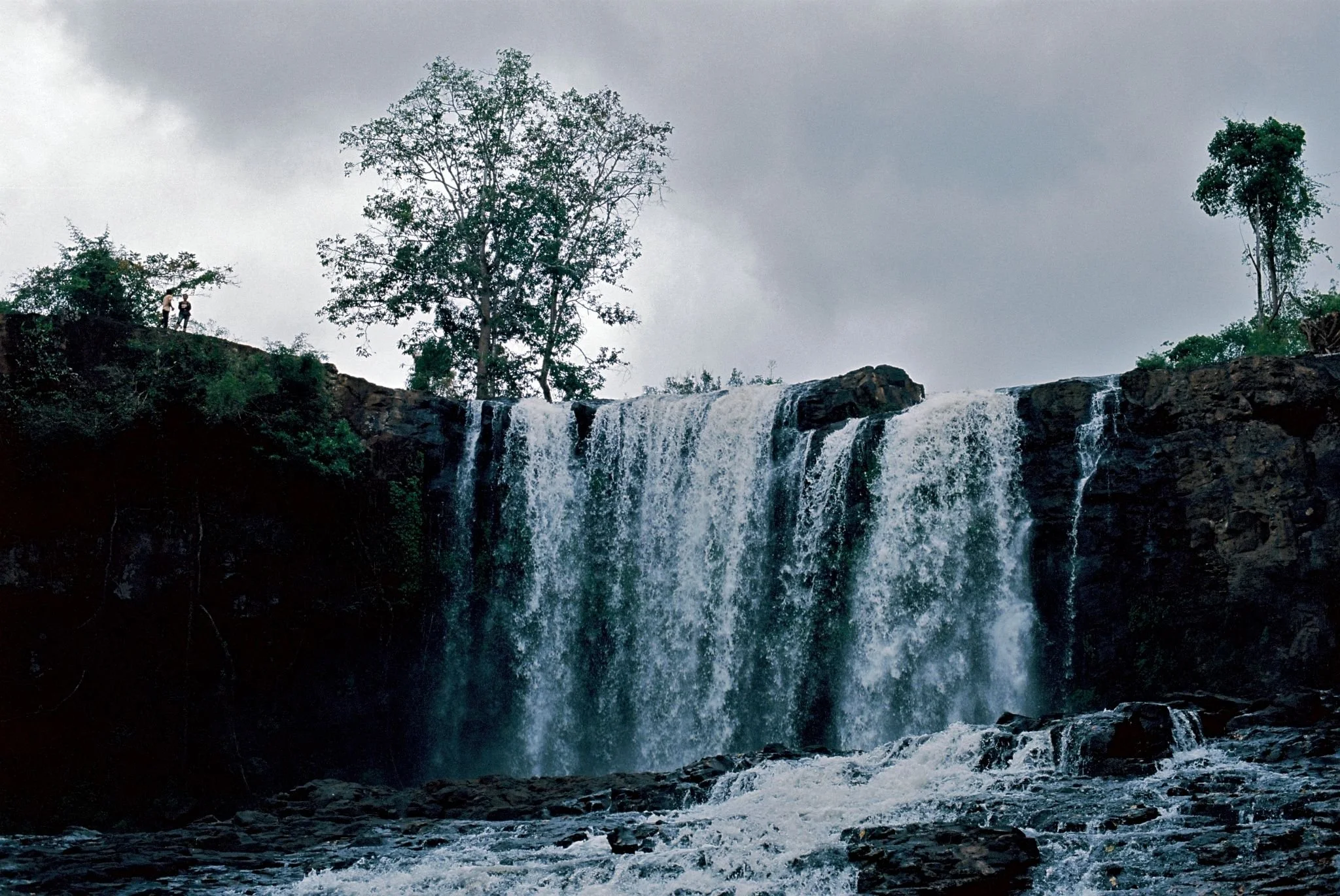
Bousra Waterfall. Lucien Tan. CC BY-ND 2.0.
Located just outside of Sen Monorom, the Bousra (also spelled Bou Sra and Busra) waterfall is a three-level natural wonder offering viewing platforms at different heights and access to its base, where visitors can get misted and explore the powerful waters.
Haleigh Kierman
Haleigh is a student at The University of Massachusetts, Amherst. A double Journalism and Communications major with a minor in Anthropology, she is initially from Guam, but lived in a small, rural town outside of Boston most of her life. Travel and social action journalism are her two passions and she is appreciative to live in a time where writers voices are more important than ever.
VIDEO: The Way of Manaslu, Nepal's Eighth Tallest Mountain
Arvīds Barānovs, award winning photographer and head of Eaglewood Pictures, explores Manaslu, a mountain within the Nepalese Himalayas. Manaslu, at 8,163 meters (26,781 feet), is the eighth highest mountain in the world. The mountain stands proudly over Budhi Gandaki valley. At the peak of the mountain, one can gaze upon the adjacent Annapurna mountain range and Tibetan plateau. As one climbs the mountain, they will encounter many small tea houses along the way. Climbers often stop there to have a cup of tea and eat dal bhat, a staple dish of rice and lentils. Manaslu is inhabited by the Tsum and Nubri peoples, whose ways of life are rooted in Buddhism and Tibetan culture. The local people live traditionally and farm barley, maize and oats, in addition to cultivating nuts and fruits.
Sandboarding: The Art of Surfing Sand Around the World
Requiring nothing but a board and steady nerves, sandboarding has become a popular new solo-extreme sport. Small and large competitions occur all over the world as the sport gains popularity.
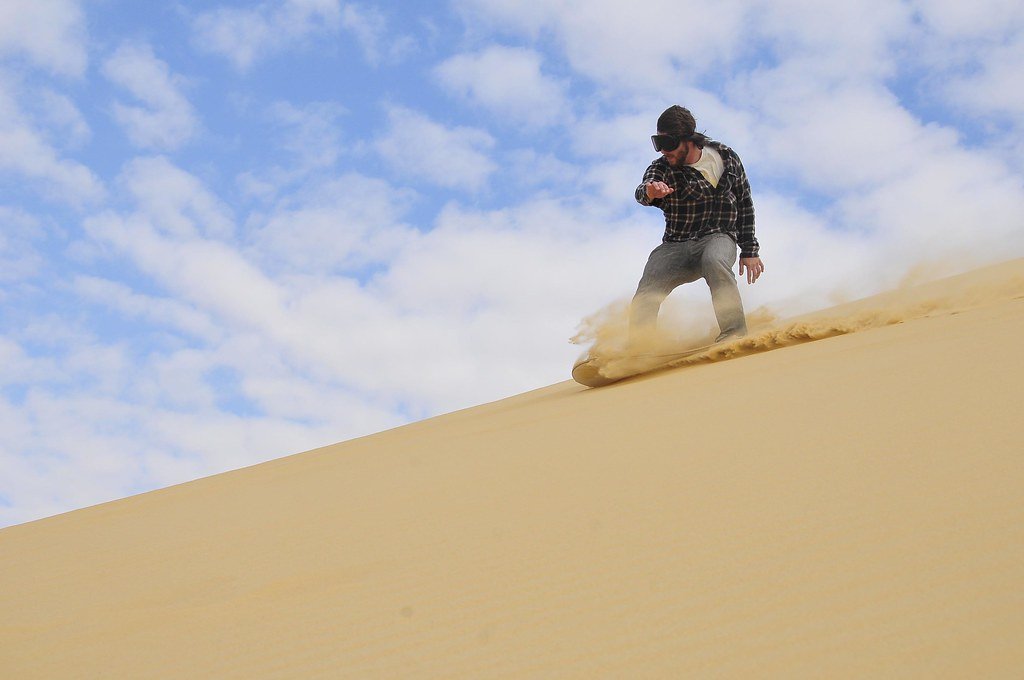
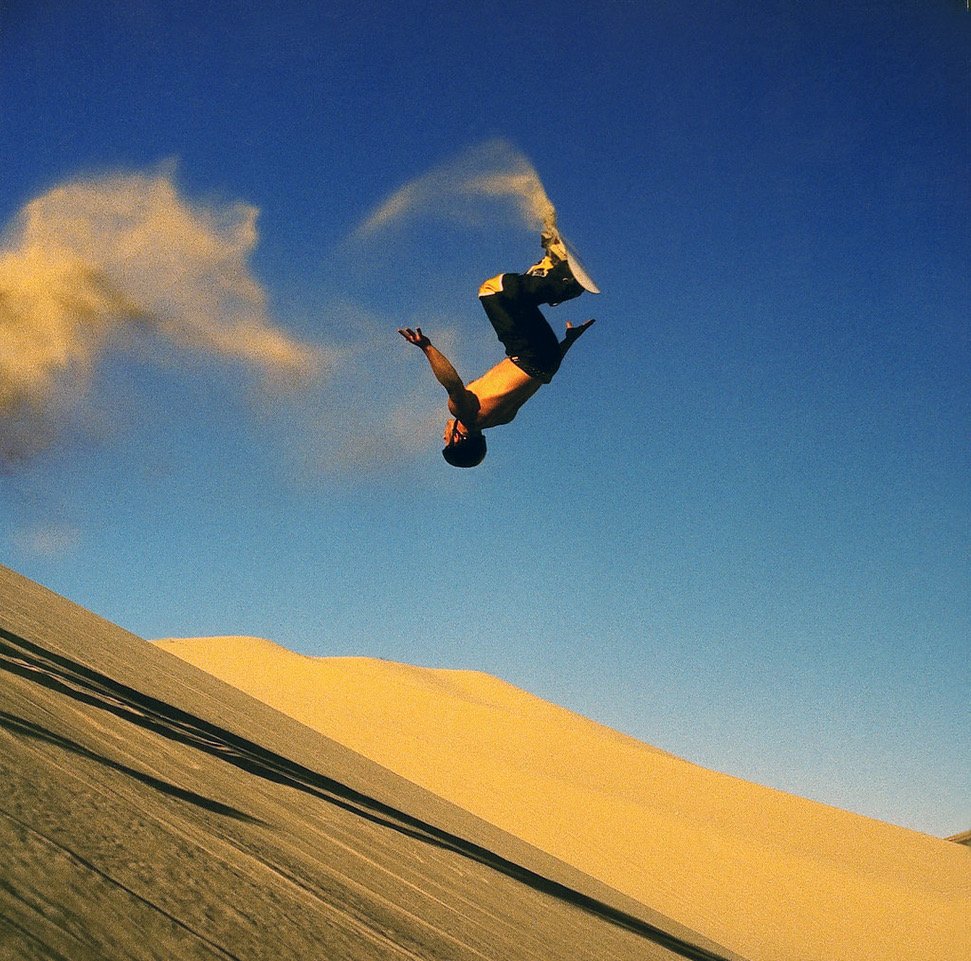
A man sandboarding in Egypt. Surfing The Nations. CC BY-NC-ND 2.0.
Sandboarding has gained popularity as an extreme solo sport, with competitions held at dunes around the world. The sport is perfect for adventurous athletes and travelers interested in seeing new places and seeking adrenaline-fueled fun, as it can be done anywhere with expansive sand dunes and the right equipment.
The sport itself is logistically simple: riders climb to the top of a sand dune and get on their board. Then, by jumping closer to the downward slope of the dune, pivoting to have their front foot ahead of them and leaning forward, the board will start to move and pick up speed as it makes its way down the slope—similar to snowboarding. Professionals will throw tricks like jumps and spins which have flooded YouTube over the years, and sandboarding courses have even installed bars and pipes for riders to test out, just like a skateboarder or snowboarder would find at parks or slopes.
Surfer Today describes sandboarding as “a blend between surfing, skateboarding and snowboarding.” Typically, sand boards are almost identical to snowboards, yet they tend to be lighter and either include no foot holdings or two straps for each of the rider’s feet with a latch that locks you to the board. No uniform is required unless you are competing professionally, and even then, experts and riders wear casual uniforms during competitions.
Pro-sandboarder Josh Tenge at Sand Master Park. OCVA. CC BY-ND 2.0.
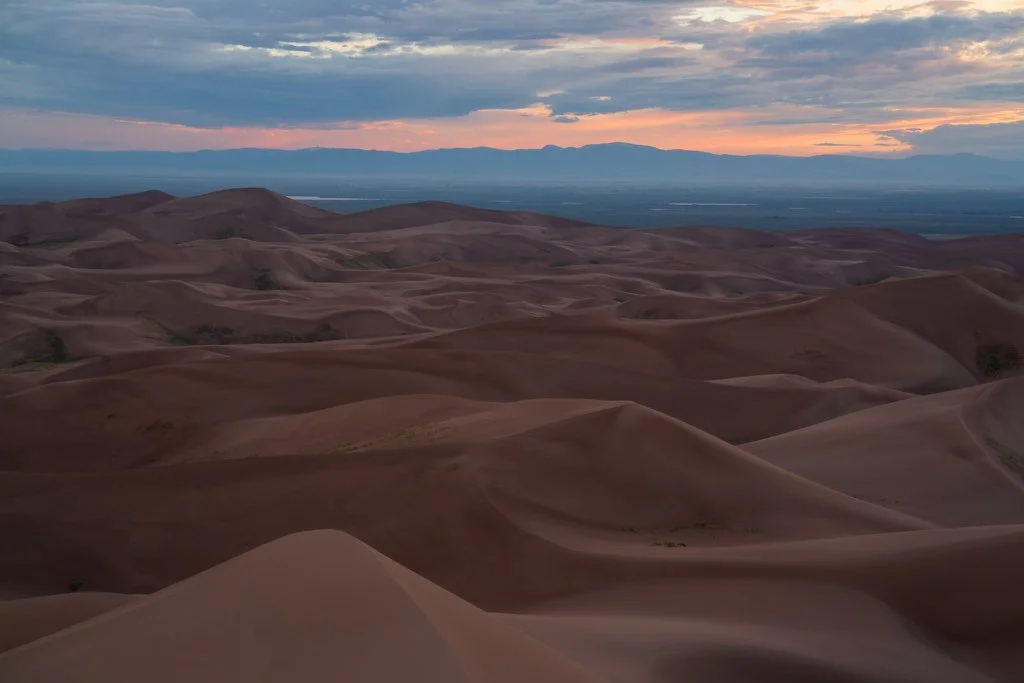
Sandboarding is also an accessible sport that can be done on a range of levels from beginner to expert. At the beginner and intermediate levels, the extreme sport becomes more of a daring passtime. Perfect for summer conditions due to the dryness of the sand, recreational sandboarding is done all around the United States and in other parts of the globe. In the United States, perfect sandboarding conditions can be found in places like Utah’s Coral Pink Sand Dunes Park, Sand Master Park in Oregon, Monahans Sandhills State Park in Texas and the Kelso Dunes in California. There are more great national parks and dunes spread across the United States that perfectly cater to sandboarding conditions, and finding a location nearest to you can be easily done with a simple search on the internet; lists on the best locations to sandboard are scattered across the web because of how popular the activity is.
Additionally, there are amazing places to sandboard across the globe that are perfect for a day trip to some of the world’s most famous dunes and deserts. South America is immensely popular for sandboarding—the World Cup is typically hosted here because of the massive dunes and numerous locations to be found in the continent. Some examples can be found in Peru, at both Cerro Blanco and Huacachina, while other South American spots ideal for the sport are located in Concon, Chile. Towards the Middle East and Africa, other famous deserts and dunes that are great for sandboarding include the Great Sand Sea in Egypt, the Namib Desert in South Africa and the Moroccan Sahara, known for its vast expanse of sandy hills.
The Great Sand Sea in Egypt. Virtualwayfarer. CC BY-NC 2.0.
Most parks do not make visitors pay to use the sand dunes, but occasionally visitors will have to pay an entrance fee—especially if the dunes they wish to ride are located in a national park. If participants wish to take lessons, the prices of those are somewhere between $50 for an individual lesson and $160 for a group lesson with six people that lasts for a few hours at the Sand Master Park in Oregon and may fluctuate depending on where in the world you are trying to board. Rentals are also available at certain locations, like Sand Master Park, and boards costing around $10 to rent for 24 hours. Additional costs can be applied if users wish to rent helmets and other protective gear.
Many people find that the sport just takes practice. The beauty of sandboarding is that it is less risky to try as a beginner because the conditions are better for falling off your board or slipping on your way down the dunes when compared to icy conditions of snowboarding or the hard concrete used for skateboarding.
It is also worth noting that some places require participants to provide their own board; not all locations will have a shop where those looking to sandboard can rent the equipment. Boards for sale online range from anywhere between $150-400, but it depends on brand and size. Cheaper boards can be found on sites like Amazon for anywhere between $40 to $80 if people are not looking to invest in the sport too heavily.
Some slopes even end with a splash in a pond or lake; riders will descend dunes to find a ramp at the bottom which launches them into refreshing, cool water. This is exemplified in Huacachina, Peru, where the dunes feed right into a pond at the center of the village. Huacachina is also listed commonly as one of the best places to sandboard in the world and was the host of the Sandboarding World Cup in 2019.
Dune that feeds to water at Huacachina. Flexbox. CC BY 2.0.
More advanced riders who wish to compete at higher levels have a multitude of competitions to choose from around the globe. Alongside the Sandboarding World Cup, which changes locations frequently, other competitive events include Sand Spirit in Germany, the Pan-American Sandboarding Challenge in Brazil, the Sand Master Jam in Oregon and the Sand Sports Super Show in California. Participants compete for titles and merchandise, all fighting to become champions in this extreme sport.
Sandboarding is a great activity to get adrenaline pumping, explore new areas of the world, and to remain active during travel. . For those looking to ride the craziest, most intense dunes in the world, Peru, Egypt, Japan and a plethora of other locations provide not only a fulfilling trip but host the correct conditions for riding. Perfect for both adventure and travel, the sport encourages riders to seek the most daunting dunes in the world and conquer them.
Ava Mamary
Ava is an undergraduate student at the University of Illinois, double majoring in English and Communications. At school, she Web Writes about music for a student-run radio station. She is also an avid backpacker, which is where her passion for travel and the outdoors comes from. She is very passionate about social justice issues, specifically those involving women’s rights, and is excited to write content about social action across the globe.
Before the Sex Pistols, There Was Peruvian Punk Rock
Western punk groups have taken credit for starting the punk movement, but a small group in 1960s Peru would say otherwise.
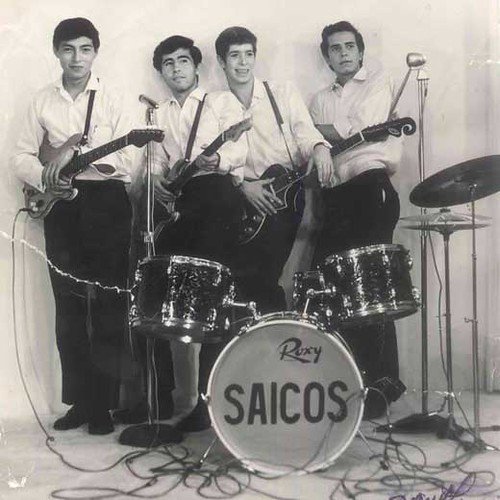
Peruvian punk band Los Saicos. TravelingMan. CC BY-NC-ND 2.0
Punk music has been used for decades as a means to express discontent about numerous topics, including politics and controversial events. But where does the genre come from? While it is easy to claim Western influences, like the Sex Pistols and The Clash to be the forefathers of the punk scene, the Peruvian rock band Los Saicos, formed in 1964, is a strong contender for the position of “Originators of Punk.”
In order to make comparisons between Los Saicos and Western punk bands, a definition of punk music is in order. Punk music consists of fast beats and often aggressive lyrics that seek to critique certain ideas or systems of power. A recent academic article discusses how the lyrics to the Sex Pistol’s “Anarchy in the U.K.” were a critique of the U.K.’s foreign policy in Ireland, a period known as The Troubles. The Los Saicos song “Demolición” lacks a specific reference to Peruvian politics at the time, but clearly expresses discontent with government infrastructure.
The members of Los Saicos were likely influenced by the political turmoil within Peru during their upbringing. Guitarist and vocalist Erwin Flores and drummer Francisco Guevara had just graduated high school and were grappling with unprecedented political strife, drastically affecting how they prosper as adults. The group was established in 1964, with “Demolición” being one of the country’s biggest songs that year. Amidst massive inflation under President Fernando Terry’s land redistribution policy, economic hardship increased for Peruvians. The lyrics are representative of a future that was promised to them with Terry’s liberal redistribution policies, but one that ultimately drowned with the Peruvian sol’s value. ‘Demolición’ expresses hatred at the government for promising a future and delivering inflation.
Los Saicos broke up in 1966, but its influence was picked up by garage rockers throughout Peru and abroad in the U.K. The punk genre’s grungy and generally angsty music did not necessarily originate from the members of Los Saicos, but they were critical in the genre’s explosion in popularity, especially in areas where there was a discontent with state functions.
“Nobody invented the wheel, we were obviously building off of what others have done,” said Flores in an interview.
The band’s desire to express themselves within a country in turmoil ranges across languages and generations, effectively changing how the music scene functioned as ‘angry’ music started becoming mainstream and profitable.
Clayton Young
Clayton is an aspiring photojournalist with a Bachelor's in Liberal Studies with a minor in History from Indiana University - Bloomington. In his free time, he enjoys hikes, movies, and catching up on the news. He has written extensively on many topics including Japanese incarceration in America during World War II, the history of violence, and anarchist theory.
The Surprising Popularity of Rock Climbing in Slovenia
Slovenia, a Central European country, holds a lesser-known secret: its rock climbing. Not only does Slovenia have many beautiful natural climbing sites, but it also has world-renowned rock gyms and some of the most acclaimed rock climbers in the world.
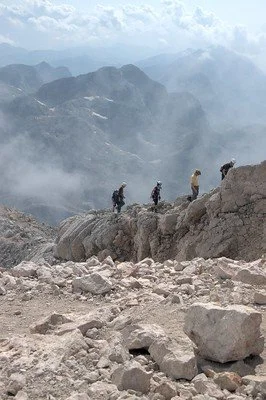
People climbing Mount Triglav in Slovenia. Derbeth. CC BY 2.0.
Formerly part of Yugoslavia, Slovenia can often be reduced down to its political turmoil. However, this Slavic country is incredibly mountainous and hilly, providing the perfect terrain for rock climbers of all skill levels. Slovenia has produced numerous renowned climbers and built a culture around the sport.
The most well-known Slovenian rock climber would have to be Janja Garnbret, who became the first woman to win gold in sport climbing at the Tokyo 2020 Olympics—the first year that sport climbing was featured at the Olympic games at all. While many people may find rock climbing intriguing and even do it in their free time, it wasn’t well known as a competitive sport until it became an Olympic event. However, competitive rock climbing has a large community, and a major facet of that community is in Slovenia, Garnbret’s home country. For example, Garnbret also placed first in the International Federation of Sport Climbing World Cup in September of 2021, which happened to be hosted in Kranj, Slovenia.
Garnbret follows in the footsteps of years of successful Slovenian women climbers, such as Martina Cufar, who made it on the podium at sixteen different world cup events between 1997 and 2002. Slovenia’s climbing history—specifically when it comes to women—goes back to the early 20th century with Pavla Jesih and Dana Kuraltova, two Slovenian women who climbed the famous Mount Triglav in 1925.
Slovenia’s rock climbing success isn’t by chance. An obvious source of the country’s enthusiasm for the sport is its spectacular mountains such as Mount Triglav. But the success of the Slovenian National Team today can also be attributed to how small the country is and thus how close knit the coaches and the team members are able to be. For example, Slovenian National Team coach Luke Fonda owns Plus Climbing gym in Koper, Slovenia, a gym which the team often practices at.
Climber in Koper, Slovenia. David Glanzer. CC BY 2.0.
In addition to Plus Climbing, rock gyms are plentiful in Slovenia, especially when compared to the country’s size. Some of the most famous gyms are First Ascent in Kranj and The Climbing Ranch in Vrbnje, which serious, competitive climbers from around the world strive to visit. In terms of Slovenia’s natural climbing sites, the country boasts stunning mountains such as Mount Triglav, Mount Viševnik and Mount Prisojnik. The mountains in Slovenia range from beginner to advanced level climbing, with Mount Triglav and Mount Viševnik being doable hikes for most travelers. Mount Prisojnik is known to have a range of trails and climbs—some good for beginners, and others that will be engaging for experienced climbers. Ultimately, Slovenia is a great option for an off-the-beaten-path visit in general, but is especially perfect for those interested in rock climbing, given its rich history and multitude of climbing sites.
RELATED CONTENT:
Ljubljana: The Green City of Slovenia
VIDE: In the Slovenian Alps, an Island on an Emerald Lake Beckons
PHOTO ESSAY: Getting Lost in Slovenia
Calliana Leff
Calliana is currently an undergraduate student at Boston University majoring in English and minoring in psychology. She is passionate about sustainability and traveling in an ethical and respectful way. She hopes to continue her writing career and see more of the world after she graduates.
5 Captivating Silk Road Sites to Visit in Central Asia
Stretching from China and the Far East to Europe and the Middle East, the Silk Road was once the world’s most important trade route.
Read MoreTurning Menaces Into Meals: 5 Invasive Species You Can Eat
Invasive species threaten naturally occurring ecosystems. However, locals and travelers are now being encouraged to eat these organisms, a practice allowing for sustainable eating and providing opportunities for adventurous dining.
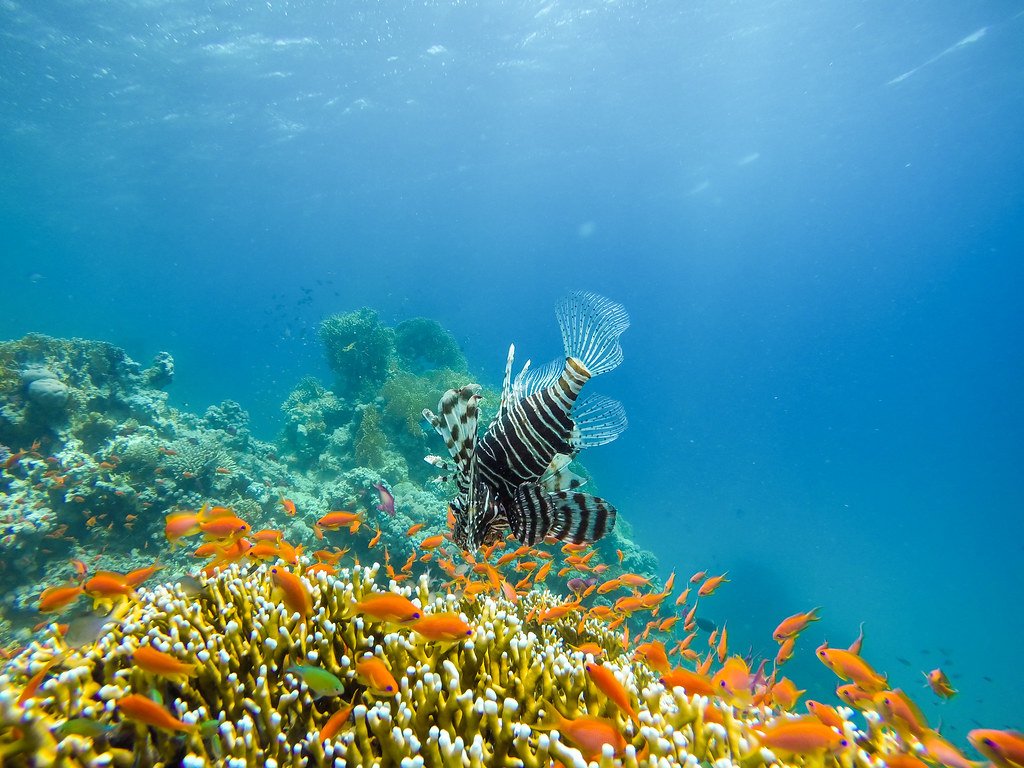
A King Lionfish. Niklas FliNdt. CC BY-SA 2.0.
By definition, invasive species are organisms that cause harm to environments they don’t originate from. When a new species is introduced to a naturally occurring ecosystem, they disrupt the balance of the environment and harm the pre-existing organisms in the area. Across the globe, invasive species wreak havoc on struggling ecosystems, but many people have found a possible solution to this environmental issue. In turning their most invasive organisms into food that locals and travelers can eat, countries around the world are creating opportunities for sustainable and adventurous eating, eliminating massive environmental threats along the way.
Eating sustainably is the practice of consuming food and drink that are good for both the consumer and the environment. In eating invasive species, locals and travelers are playing a part in removing harmful organisms in the places they live or visit. To become a sustainable and adventurous traveler, try eating any of these five invasive species on your next trip.
1. Kelp - Alaska
Barnacle Foods pickled kelp. Josefine S. CC BY-NC-ND 2.0
Invasive species aren’t just animals, they’re plants too. And kelp is one of the most invasive plants in the world; the Global Invasive Species Database (GISD) lists kelp among the top 100 worst invasive species around the globe. It originated in Japan and China but has since traveled through the waters of the Pacific where it now creates major problems for Alaskan marine life. However, a company called Barnacle Foods has created a way to harvest and consume this terrorizing plant: by pickling it.
Stationed in Southeast Alaska, Barnacle Foods is dedicated to harvesting kelp from the water and pickling it.. Set on remaining in Alaska, travelers can only visit their location by boat or plane, but Barnacle Food has made their product available online as well. In turning this invasive species into a beloved snack and by providing multiple recipes on their website for the pickled kelp’s usage, this food has become a great way to eat sustainably for the benefit of Alaskan marine life. It has also become a media sensation, the company gaining over 24,000 followers on Instagram and having been featured by magazines like the Specialty Food Association.
2. Wild Boar - Spain
Although wild boar are found commonly across Europe and the United States and have been flagged as invasive in both continents, they are a true pestilence in Spain. Spanish cities have declared war on these animals, which breed rapidly, disrupt traffic in cities and have become local hunter’s number one target. Additionally, wild boar love to dig up black truffles, and as a leader in black truffle trade, Spain is looking for any way to rid themselves of the species.
Wild boar is said to taste like a cross between beef and pork. In Spain, it is most popularly prepared by the shank or as a stew and typically slow cooked like pork to give the meat a tender, juicy flavor. A great meal for hungry travelers, wild boar is also a great way to eat sustainably on the road and help Spain fight against the pigs that have disrupted their trade and cities.
3. Lionfish - The Mediterranean
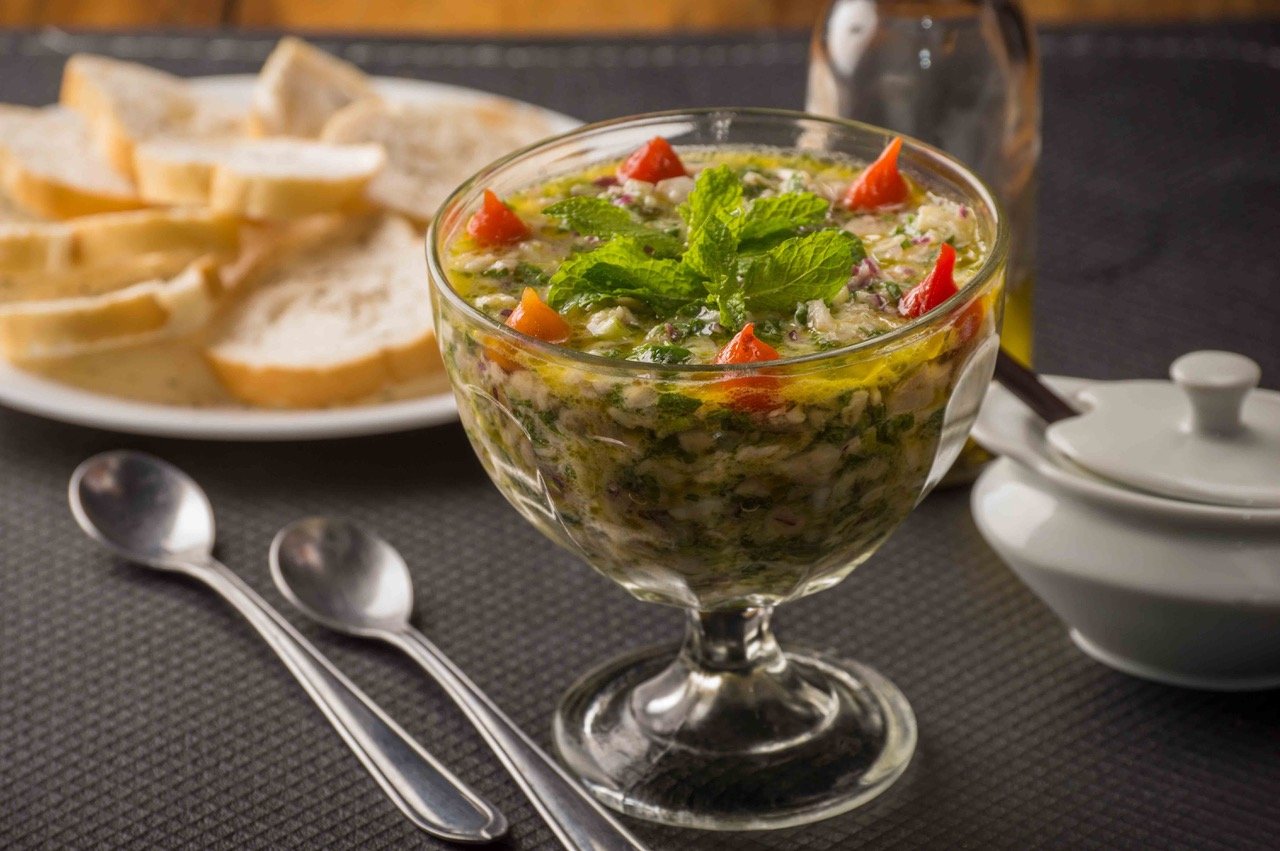
Lionfish ceviche served with bread. Leo Roza. CC BY 2.0.
Lionfish have completely overtaken the natural ecosystems in the Mediterranean Sea, but the countries that surround the affected water have started preparing and serving the fish in a multitude of ways. Although poisonous when alive, the lionfish becomes edible when killed, and the Mediterranean region has integrated the species into its culture of fresh, vibrant cuisine.
Becoming a staple in many countries around the Mediterranean Sea, lionfish can be prepared just like all other fish; you can fry it, bake it, pan sear it and even serve it raw. The most popular way travelers will find it served in the Mediterranean is as ceviche. Described as extremely buttery and tender, Lionfish are a menace in the ocean but a treat on the plate of any traveler.
This fish can be found at most restaurants near the Mediterranean Sea. ILionfish is served in the south of France, Italy, Greece, Tunisia, Libya and Spain.
4. Brown Hare - Ireland
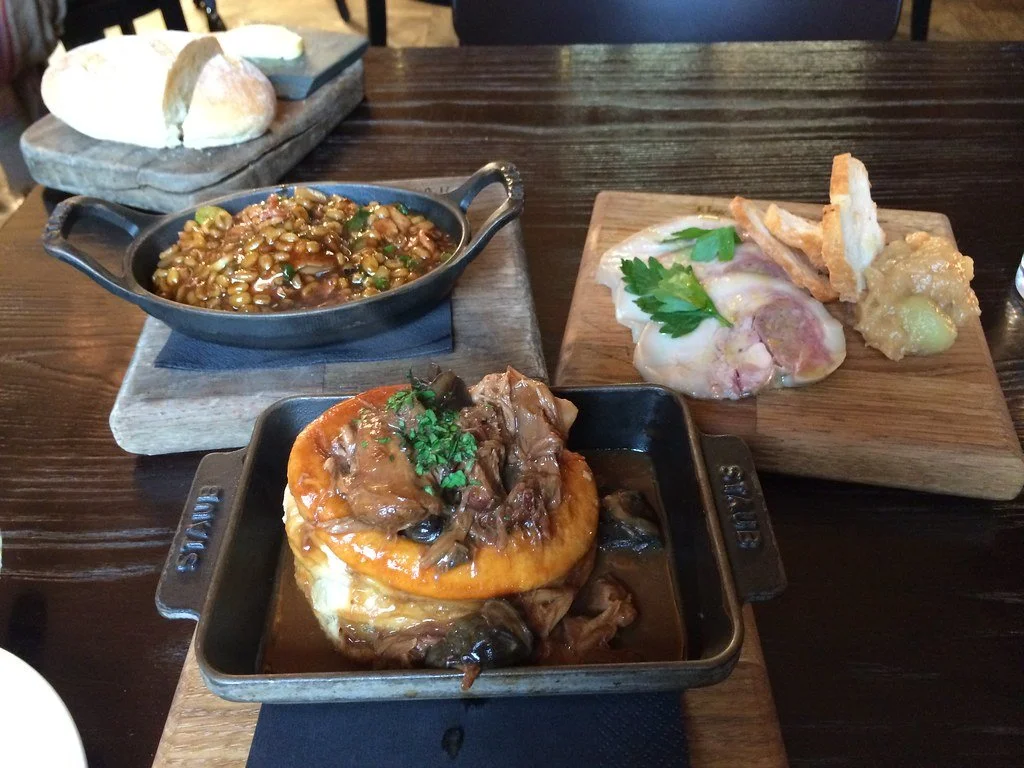
Jugged Hare. Kent Wang. CC BY-SA 2.0.
Introduced to Ireland in the mid-1800s, the brown hare, also known as the European hare, has threatened the Irish hare population for decades now. The overpopulation of the brown hare is stealing resources away from Irish hare and herbivores in the country, posing a threat to the ecological integrity of the land. Hunters are allowed to take down hares during the winter months, starting in September and ending in February, and the brown hare has become a major target.
Celtic myth considered it unlawful to eat hares, but modern times have called for different measures. The Irish Examiner says it's time for rabbit to become a part of more Irish menus due to the overpopulation and invasion of the species. Luckily, a dish that originated in France has become more widespread as the brown hare has infiltrated different parts of the globe. Civet of Hare, also known as jugged hare, has become a popular dish in Ireland and the UK—where the hare is also an invasive species in many parts. The dish is made by stewing the entire brown hare in a jug or container with a variety of vegetables and red wine, making the meat so tender it falls right off the bone. This is the perfect dish to warm you up during travel to Ireland, which is notorious for their abundant rainfall and moist climate.
5. Japanese Knotweed - Everywhere but Antarctica
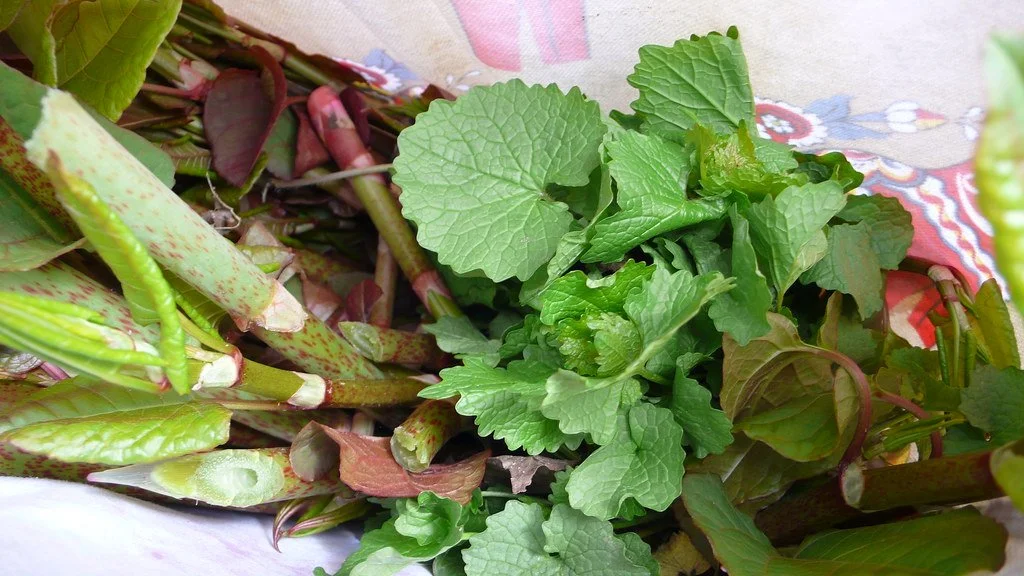
Knotweed ready to be cooked. K_Hargrav. CC BY 2.0.
Last on the list but certainly not least, Japanese knotweed is an invasive plant that is quite literally everywhere on the map. It is said to be found in every part of the globe except Antarctica. Growing at unbelievable rates and heights, it makes it difficult for animals in surrounding areas to walk through its dense brush and feed on other plants. It also blocks sunlight for plants lower to the ground, subsequently killing them.
However, knotweed is edible and an extremely versatile ingredient. The most popular way knotweed is eaten is when it is sauteed like spinach or other leafy greens. It can also be pickled, like kelp, or grilled and roasted in the same way asparagus would be. Bon Appitite published an article on how chefs from all over are using Japanese knotweed as an ingredient in new recipes and where travelers can try them.
Ava Mamary
Ava is an undergraduate student at the University of Illinois, double majoring in English and Communications. At school, she Web Writes about music for a student-run radio station. She is also an avid backpacker, which is where her passion for travel and the outdoors comes from. She is very passionate about social justice issues, specifically those involving women’s rights, and is excited to write content about social action across the globe.
In the Czech Countryside, a City Eaten Alive by Its Own Beauty
Since the fall of communism, Český Krumlov has transformed from relic to hotspot—but has it lost its authentic appeal along the way?
The Czech capital of Prague is known the world over for its storybook beauty, manifesting most dramatically in the towering gothic facade of the St. Vitus Cathedral and the sprawling tableau of red rooftops visible from atop Petřín Hill. Yet just over 100 miles away is another sparkling jewel in the Czech Republic’s crown: Český Krumlov, a city of only 13,000 residents whose 13th-century castle and picturesque riverbanks have brought it not only recognition as a UNESCO World Heritage site but also an increasing influx of tourists that now threatens its very identity.
Former Czechoslovakia’s communist regime, which lasted from 1948 to 1989 before it was ushered out by the Velvet Revolution, left much of Český Krumlov in disrepair. Yet the city’s neglected state lent it a sense of mystery and charm. In the years since, Krumlov—much like the country’s capital, Prague—has been transformed into a tourist wonderland, with historic buildings being renovated and revitalized and ensuing increases in tourist income bolstering the city’s economy.
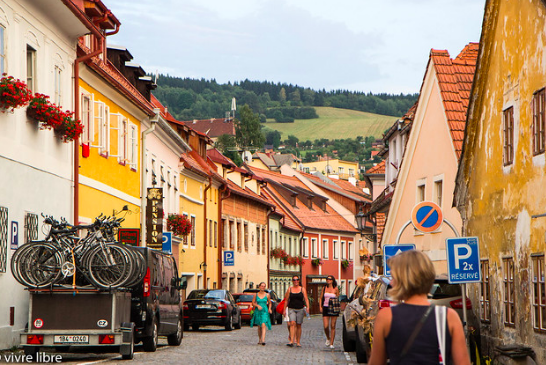
City streets. Hindol Bhattacharya. CC BY-SA 2.0
As the city has changed, so have the demographics of its visitors. In an interview with Radio Praha, Krumlov’s mayor, Dalibor Carda, explained that an initial boom of Austrian and German tourists after 1989 gave way to an influx of Americans, many of whom settled in the city indefinitely. Today, for locals—whether native-born or transplants—the off-season is a thing of the past, with tour groups flooding the city on a year-round basis. “[I]f you want to have a pristine Krumlov,” writes Jan Velinger in a piece for Radio Praha, “you have to get up very early to ever have its romantic streets, or overlooking castle, ramparts to yourself.” Fed up with the unrelenting crowds, locals have largely migrated to the outskirts of the city, resulting in an exodus of local businesses: Bakeries, hardware stores, and family-owned shops are now difficult to find, having been replaced with bars, restaurants, and hostels catering to short-term visitors.
One of Český Krumlov’s bars, popular among tourists. kellerabteil. CC BY-NC 2.0
In some respects, Český Krumlov has moved to mitigate the encroaching tendrils of tourism, notes reporter Chris Johnstone, pointing to a ban on advertising and the exclusion of cars and buses from the city center. Moreover, just this June, the city established a tariff on buses in an effort to regulate the influx—up to 20,000—arriving each year. The plan is the first of its kind in the Czech Republic, although Salzburg and other Austrian cities have imposed similar measures. Now, all buses rolling into Krumlov must book in advance, navigate to one of two designated stops, and pay the toll of CZK 625, approximately $28.
Tourism has inspired not only legislative changes, but also works of art—as in the case of “UNES-CO,” a 2018 project by renowned conceptual artist Kateřina Šedá. Responding to the profound impact of visitors on the distribution of local populations, Šedá conceived of a work that involved relocating a group of individuals and families to the heart of Český Krumlov for three months at the height of the tourist season. The participants were provided with starter apartments and jobs “on the basis of what Krumlov most needs,” which Šedá deemed to be “the pursuit of normal life.” The title played on the city’s status as a UNESCO World Heritage site and on the Czech words “unést” and “co,” meaning “take away” and “what,” as in “What do visitors get out of this place?” Šedá, whose work often involves social themes and who is famed for relocating an entire Czech village to London’s Tate Modern in 2011, stressed that the project was not intended to be a show for tourists, but rather a social experiment.
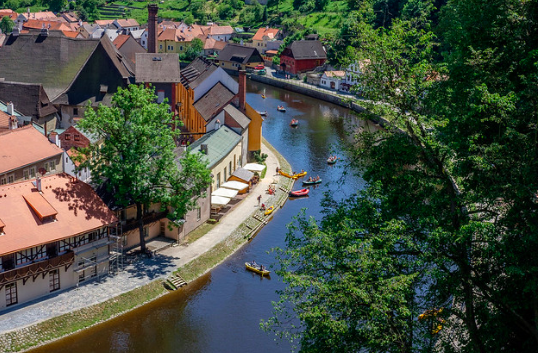
Houses along the banks of the Vltava River. P. N. CC BY-SA 2.0
On the opposite side of the artistic spectrum, Huawei—the Chinese electronics behemoth currently facing scrutiny from the U.S. for potential security issues—announced in January that it would build an exact facsimile of Český Krumlov at its headquarters. The Huawei campus, which lies just outside of Shenzhen in the city of Dongguan, will also count Granada, Verona, Paris, Budapest, and Bruges among its plethora of reconstructed European cities. “I heard about it when they started preparing it,” commented Cardo. “The fact that they [are] building it without at least contacting the city does not sit well with me.”
The Krumlov replica may well draw more Chinese tourists, who already represent the largest segment of visitors to the historic city. Yet for embittered locals, the mini-city could be a grimly apt representation of what their home has become: a mere palimpsest of its original iteration, and a cautionary tale depicting how capitalism and tourism can spur unwelcome transformation.
Talya Phelps
Talya hails from the wilds of upstate New York, but dreams of exploring the globe. As former editor-in-chief at the student newspaper of her alma mater, Vassar College, and the daughter of a journalist, she hopes to follow her passion for writing and editing for many years to come. Contact her if you're looking for a spirited debate on the merits of the em dash vs. the hyphen.
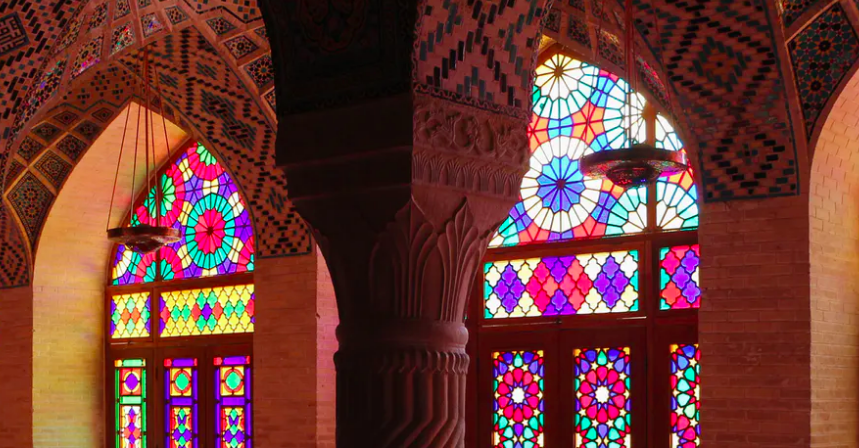
The Nasir ol Molk Mosque in Shiraz, Iran: Islamic architecture is one of the gems of Persian culture, as is its traditional music. Wikimedia Commons
Why Traditional Persian Music Should be Known to the World
Weaving through the rooms of my Brisbane childhood home, carried on the languid, humid, sub-tropical air, was the sound of an Iranian tenor singing 800-year old Persian poems of love. I was in primary school, playing cricket in the streets, riding a BMX with the other boys, stuck at home reading during the heavy rains typical of Queensland.
I had an active, exterior life that was lived on Australian terms, suburban, grounded in English, and easy-going. At the same time, thanks to my mother’s listening habits, courtesy of the tapes and CDs she bought back from trips to Iran, my interior life was being invisibly nourished by something radically other, by a soundscape invoking a world beyond the mundane, and an aesthetic dimension rooted in a sense of transcendence and spiritual longing for the Divine.
I was listening to traditional Persian music (museghi-ye sonnati). This music is the indigenous music of Iran, although it is also performed and maintained in Persian-speaking countries such as Afghanistan and Tajikistan. It has ancient connections to traditional Indian music, as well as more recent ones to Arabic and Turkish modal music.
It is a world-class art that incorporates not only performance but also the science and theory of music and sound. It is, therefore, a body of knowledge, encoding a way of knowing the world and being. The following track is something of what I might have heard in my childhood:
Playing kamancheh, a bowed spike-fiddle, is Kayhān Kalhor, while the singer is the undisputed master of vocals in Persian music, ostād (meaning “maestro”) Mohammad Reza Shajarian. He is singing in the classical vocal style, āvāz, that is the heart of this music.
A non-metric style placing great creative demands on singers, āvāz is improvised along set melodic lines memorised by heart. Without a fixed beat, the vocalist sings with rhythms resembling speech, but speech heightened to an intensified state. This style bears great similarity to the sean-nos style of Ireland, which is also ornamented and non-rhythmic, although sean-nos is totally unaccompanied, unlike Persian āvāz in which the singer is often accompanied by a single stringed instrument.
A somewhat more unorthodox example of āvāz is the following, sung by Alireza Ghorbāni with a synthesised sound underneath his voice rather than any Persian instrument. It creates a hypnotic effect.
Even listeners unfamiliar with Persian music should be able to hear the intensity in the voices of Ghorbāni and Shajarian. Passion is paramount, but passion refined and sublimated so that longing and desire break through ordinary habituated consciousness to point to something unlimited, such as an overwhelming sense of the beyond.
Beyond media contrived images
The traditional poetry and music of Iran aim to create a threshold space, a zone of mystery; a psycho-emotional terrain of suffering, melancholy, death and loss, but also of authentic joy, ecstasy, and hope.
Iranians have tasted much suffering throughout their history, and are wary of being stripped of their identity. Currently, economic sanctions are being re-applied to Iran’s entire civilian population, depriving millions of ordinary people of medicine and essentials.
Traditional Persian music matters in this context of escalating aggression because it is a rich, creative artform, still living and cherished. It binds Iranians in a shared culture that constitutes the authentic life of the people and the country, as opposed to the contrived image of Iran presented in Western media that begins and ends with politics.
This is a thoroughly soulful music, akin not in form but in soulfulness with artists such as John Coltrane or Van Morrison. In the Persian tradition, music is not only for pleasure, but has a transformative purpose. Sound is meant to effect a change in the listener’s consciousness, to bring them into a spiritual state (hāl).
Like other ancient systems, in the Persian tradition the perfection of the formal structures of beautiful music is believed to come from God, as in the Pythagorean phrase, the “music of the spheres.”
Because traditional Persian music has been heavily influenced by Sufism, the mystical aspect of Islam, many rhythmic performances (tasnif, as opposed to āvāz) can (distantly) recall the sounds of Sufi musical ceremonies (sama), with forceful, trance-inducing rhythms. (For instance in this Rumi performance by Alireza Eftekhari).
Even when slow, traditional Persian music is still passionate and ardent in mood, such as this performance of Rumi by Homayoun Shajarian, son of Mohammad-Reza:
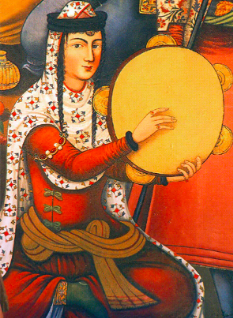
A Persian woman playing the Daf, a frame drum, from a painting on the walls of Chehel-sotoon palace, Isfahan, 17th century. Wikimedia Commons
Another link with traditional Celtic music is the grief that runs through Persian music, as can be heard in this instrumental by Kalhor.
Grief and sorrow always work in tandem with joy and ecstasy to create soundscapes that evoke longing and mystery.
Connections with classical poetry
The work of classical poets such as Rumi, Hāfez, Sa’di, Attār, and Omar Khayyām forms the lyrical basis of compositions in traditional Persian music. The rhythmic structure of the music is based on the prosodic system that poetry uses (aruz), a cycle of short and long syllables.
Singers must therefore be masters not only at singing but know Persian poetry and its metrical aspects intimately. Skilled vocalists must be able to interpret poems. Lines or phrases can be extended or repeated, or enhanced with vocal ornaments.
Thus, even for a Persian speaker who knows the poems being sung, Persian music can still reveal new interpretations. Here, for example (from 10:00 to 25:00 mins) is another example of Rumi by M.R. Shajarian:
This is a charity concert from 2003 in Bam, Iran, after a horrendous earthquake destroyed the town. Rumi’s poem is renowned among Persian speakers, but here Mohammad-Reza Shajarian sings it with such passion and emotional intensity that it sounds fresh and revelatory.
“Without everyone else it’s possible,” Rumi says, “Without you life is not liveable.”
While such lines are originally drawn from the tradition of non-religious love poems, in Rumi’s poems the address to the beloved becomes mystical, otherworldly. After a tragedy such as the earthquake, these lyrics can take on special urgency in the present.
When people listen to traditional music, they, like the singers, remain still. Audiences are transfixed and transported.
According to Sufi cosmology, all melodious sounds erupt forth from a world of silence. In Sufism, silence is the condition of the innermost chambers of the human heart, its core (fuad), which is likened to a throne from which the Divine Presence radiates.
Because of this connection with the intelligence and awareness of the heart, many performers of traditional Persian music understand that it must be played through self-forgetting, as beautifully explained here by master Amir Koushkani:
Persian music has roughly twelve modal systems, each known as a dastgah. Each dastgah collects melodic models that are skeletal frameworks upon which performers improvise in the moment. The spiritual aspect of Persian music is made most manifest in this improvisation.
Shajarian has said that the core of traditional music is concentration (tamarkoz), by which he means not only the mind but the whole human awareness. It is a mystical and contemplative music.
The highly melodic nature of Persian music also facilitates expressiveness. Unlike Western classical music, there is very sparing use of harmony. This, and the fact that like other world musical traditions it includes microtonal intervals, may make traditional Persian music odd at first listen for Western audiences.
Solo performances are important to traditional Persian music. In a concert, soloists may be accompanied by another instrument with a series of call-and-response type echoes and recapitulations of melodic phrases.
Similarly, here playing the barbat, a Persian variant of the oud, maestro Hossein Behrooznia shows how percussion and plucked string instruments can forge interwoven melodic structures that create hypnotic soundscapes:
Ancient roots
The roots of traditional Persian music go back to ancient pre-Islamic Persian civilisation, with archaeological evidence of arched harps (a harp in the shape of a bow with a sound box at the lower end), having been used in rituals in Iran as early as 3100BC.
Under the pre-Islamic Parthian (247BC-224AD) and Sasanian (224-651AD) kingdoms, in addition to musical performances on Zoroastrian holy days, music was elevated to an aristocratic art at royal courts.
Centuries after the Sasanians, after the Arab invasion of Iran, Sufi metaphysics brought a new spiritual intelligence to Persian music. Spiritual substance is transmitted through rhythm, metaphors and symbolism, melodies, vocal delivery, instrumentation, composition, and even the etiquette and co-ordination of performances.
A six-string fretted lute, known as a tār. Wikimedia Commons
The main instruments used today go back to ancient Iran. Among others, there is the tār, the six-stringed fretted lute; ney, the vertical reed flute that is important to Rumi’s poetry as a symbol of the human soul crying out in joy or grief; daf, a frame drum important in Sufi ritual; and the setār, a wooden four-stringed lute.
The tār, made of mulberry wood and stretch lambskin, is used to create vibrations that affect the heart and the body’s energies and a central instrument for composition. It is played here by master Hossein Alizadeh and here by master Dariush Talai.
Traditional Persian music not only cross-pollinates with poetry, but with other arts and crafts. At its simplest, this means performing with traditional dress and carpets on stage. In a more symphonic mode of production, an overflow of beauty can be created, such as in this popular and enchanting performance by the group Mahbanu:
They perform in a garden: of course. Iranians love gardens, which have a deeply symbolic and spiritual meaning as a sign or manifestation of Divine splendour. Our word paradise, in fact, comes from the Ancient Persian word, para-daiza, meaning “walled garden”. The walled garden, tended and irrigated, represents in Persian tradition the cultivation of the soul, an inner garden or inner paradise.
The traditional costumes of the band (as with much folk dress around the world) are elegant, colourful, resplendent, yet also modest. The lyrics are tinged with Sufi thought, the poet-lover lamenting the distance of the beloved but proclaiming the sufficiency of staying in unconsumed desire.
As a young boy, I grasped the otherness of Persian music intuitively. I found its timeless spiritual beauty and interiority had no discernible connection with my quotidian, material Australian existence.
Persian music and arts, like other traditional systems, gives a kind of “food” for the soul and spirit that has been destroyed in the West by the dominance of rationalism and capitalism. For 20 years since my boyhood, traditional Persian culture has anchored my identity, healed and replenished my wounded heart, matured my soul, and allowed me to avoid the sense of being without roots in which so many unfortunately find themselves today.
It constitutes a world of beauty and wisdom that is a rich gift to the whole world, standing alongside Irano-Islamic architecture and Iranian garden design.
The problem is the difficulty of sharing this richness with the world. In an age of hypercommunication, why is the beauty of Persian music (or the beauty of traditional arts of many other cultures for that matter) so rarely disseminated? Much of the fault lies with corporate media.
Brilliant women
Mahbanu, who can also be heard here performing a well-known Rumi poem, are mostly female. But readers will very likely not have heard about them, or any of the other rising female musicians and singers of Persian music. According to master-teachers such as Shajarian, there are now often as many female students as male in traditional music schools such as his.
Almost everyone has seen however, through corporate media, the same cliched images of an angry mob of Iranians chanting, soldiers goose-stepping, missile launches, or leaders in rhetorical flight denouncing something. Ordinary Iranian people themselves are almost never heard from directly, and their creativity rarely shown.
The lead singer of the Mahbanu group, Sahar Mohammadi, is a phenomenally talented singer of the āvāz style, as heard here, when she performs in the mournful abu ata mode. She may, indeed, be the best contemporary female vocalist. Yet she is unheard of outside of Iran and small circles of connoisseurs mainly in Europe.
A list of outstanding modern Iranian women poets and musicians requires its own article. Here I will list some of the outstanding singers, very briefly. From an older generation we may mention the master Parisa (discussed below), and Afsaneh Rasaei. Current singers of great talent include, among others, Mahdieh Mohammadkhani, Homa Niknam, Mahileh Moradi, and the mesmerising Sepideh Raissadat.
Finally, one of my favourites is the marvelous Haleh Seifizadeh, whose enchanting singing in a Moscow church suits the space perfectly.
The beloved Shajarian
Tenor Mohammad-Reza Shajarian is by far the most beloved and renowned voice of traditional Persian music. To truly understand his prowess, we can listen to him performing a lyric of the 13th century poet Sa’di:
As heard here, traditional Persian music is at once heavy and serious in its intent, yet expansive and tranquil in its effect. Shajarian begins by singing the word Yār, meaning “beloved”, with an ornamental trill. These trills, called tahrir, are made by rapidly closing the glottis, effectively breaking the notes (the effect is reminiscent of Swiss yodeling).
By singing rapidly and high in the vocal range, a virtuoso display of vocal prowess is created imitating a nightingale, the symbol with whom the poet and singer are most compared in Persian traditional music and poetry. Nightingales symbolise the besotted, suffering, and faithful lover. (For those interested, Homayoun Shajarian, explains the technique in this video).
As with many singers, the great Parisa, heard here in a wonderful concert from pre-revolutionary Iran, learned her command of tahrir partly from Shajarian. With her voice in particular, the similarity to a nightingale’s trilling is clear.
Nourishing hearts and souls
The majority of Iran’s 80 million population are under 30 years of age. Not all are involved in traditional culture. Some prefer to make hip-hop or heavy-metal, or theatre or cinema. Still, there are many young Iranians expressing themselves through poetry (the country’s most important artform) and traditional music.
National and cultural identity for Iranians is marked by a sense of having a tradition, of being rooted in ancient origins, and of carrying something of great cultural significance from past generations, to be preserved for the future as repository of knowledge and wisdom. This precious thing that is handed down persists while political systems change.
Iran’s traditional music carries messages of beauty, joy, sorrow and love from the heart of the Iranian people to the world. These messages are not simply of a national character, but universally human, albeit inflected by Iranian history and mentality.
This is why traditional Persian music should be known to the world. Ever since its melodies first pierced my room in Brisbane, ever since it began to transport me to places of the spirit years ago, I’ve wondered if it could also perhaps nourish the hearts and souls of some of my fellow Australians, across the gulf of language, history, and time.
THIS ARTICLE WAS ORIGINALLY PUBLISHED ON THE CONVERSATION
RELATED CONTENT:
Musical Styles Worth Exploring in Lusophone Countries
VIDEO: Reinventing Electronic Music With Dubai’s Cellist DJ
VIDEO: Mirage of Persia
DARIUS SEPEHRI
Darius is a Doctoral Candidate for Comparative Literature in the Religion and History of Philosophy at the University of Sydney.