
Mexico City is a flourishing metropolis with a plethora of historic and modernist architectural sites. Here are a few attractions scattered around the city.
Read More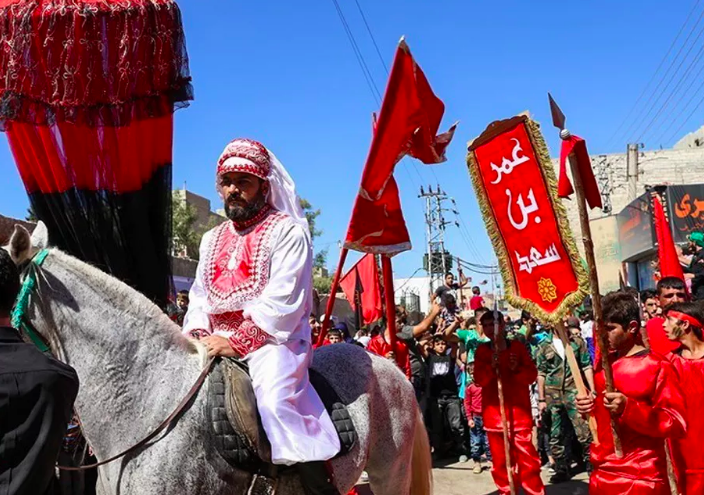
Ashura in Syria. Tasnim News Agency, CC BY-SA
What is Ashura? How this Shiite Muslim Holiday Inspires Millions
Tens of millions of Shiite Muslims from around the world will visit Iraq on Sept. 10 this year to see the shrines of Hussain, grandson of Prophet Mohammed, and his brother Abbas on the day of “Ashura.”
This annual pilgrimage marks the 10th day of Muharram, the first month of the Islamic new year. As the Islamic calendar is a lunar one, the day of Ashura changes from year to year.
Muslims visit the shrines to observe the martyrdom day of Hussain, who was killed in the desert of Karbala in today’s Iraq in A.D. 680. Shiite Muslims believe that Hussain was their third imam – a line of 12 divinely appointed spiritual and political successors.
Muharram may be an ancient festival, but as my research tracing the modern-day impact of Islamic pilgrimage shows, its meaning has changed over the centuries. What was once a commemoration of martyrdom today inspires much more, including social justice work around the globe.
Martyrdom of Hussain
The story of Muharram dates back 13 centuries, to events that followed the death of Prophet Mohammed.
After the prophet’s death in A.D. 632, a dispute emerged over who would inherit the leadership of the Muslim community and the title of caliph, or “deputy of God.” A majority of Muslims backed Abu Bakr, a close companion of the prophet, to become the first caliph. A minority wanted the prophet’s cousin and son-in-law, Ali. Those that supported his claim later came to be called Shiite Muslims.
Even if Ali was not made the caliph, Shiite Muslims would consider Ali their first imam – a leader divinely appointed by God. The title of imam would be passed on to his sons and his descendants.
Political leadership largely remained out of the hands of Shiite Imams. They would not be caliphs, but Shiites came to believe that their imam was the true leader to be followed.
By the time Ali’s second son, Hussain, came to be the third imam, divisions between the caliph and the imam had further deepened.
In A.D. 680, during the holy month of Muharram, a caliph of the Umayyad dynasty, Yazīd, ordered Hussain to pledge allegiance to him and his caliphate – a dynasty that ruled the Islamic world from A.D. 661 to 750.
Hussain refused because he believed Yazīd’s rule to be unjust and illegitimate.
His rejection resulted in a massive 10-day standoff at Karbala, in modern-day Iraq, between Umayyad’s large army and Hussain’s small band, which included his half-brother, wives, children, sisters and closest followers.
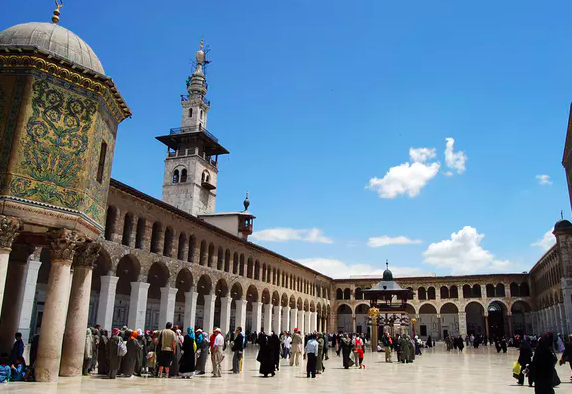
The Umayyad Mosque in Damascus. Alessandra Kocman, CC BY-NC-ND
The Umayyad army cut off food and water for Hussain and his companions. And on the day of Ashura, Hussain was brutally killed. Among the men, only Hussain’s sick son was spared. Women were unveiled – a violation of their honor as the family members of the prophet – and paraded to Damascus, the seat of Umayyad rule.
Passion plays and performances
This history is reenacted throughout the world on the day of Ashura.
In Iraq, millions of pilgrims fill the streets to visit the shrines, chanting poems of lamentation, and witness a reenactment of violence in Karbala and the capture of the women and children.
From New York and London to Hyderabad and Melbourne, thousands take part in Ashura processions carrying replicas of Hussain’s battle standard and following a white horse. This symbolizes Hussain’s riderless horse returning to the camp after his martyrdom.
Persian passion plays known as “taziyeh,” music dramas of the many martyrs and tragedies of Karbala, are performed across Iran and many other countries. Taziyeh performances are meant to evoke deep emotions of grief in the audience.
A powerful set of themes
Numerous historians and anthropologists have explored how communities across time and space have adapted the story of Karbala or the rituals around Ashūrā.
In the 16th century, a vast majority of the population across Persia, or today’s Iran, would be converted to Shiite Muslims. In this region, the passion plays evolved into a popular form of religious and artistic expression.
The character of Zainab, the Prophet Mohammed’s granddaughter, has also come to play a central role in remembrance of the Karbala story.
Scholars have drawn attention to speeches in which Zainab denounced the violence in Karbala and lauded Hussain’s “martyrdom.”
Today, Zainab is seen as a strong female model of resistance.
In the Iranian Revolution in 1979, the story of Karbala became a rallying point for opponents of the shah, who were fighting against the shah’s brutal and oppressive regime. They compared the shah to the caliph Yazīd and argued that ordinary Iranians had to stand up to an oppressor, just like Hussain had.
Zainab’s resistance to oppression helped emphasize the role of women in Islamic society.
Anthropologist Michael Fischer calls this the “Karbala paradigm” – a story that captures a powerful set of themes, including people standing up to the state and fighting for justice and morality.
Inspiring change?
Today the story of Karbala has become a powerful tool of fight for social justice in Muslim communities.
“Who is Hussain?,” a social movement with chapters in over 60 cities worldwide, carries out charitable activities and blood donations in the name of Hussain. Volunteers are encouraged to organize around events that will be meaningful in their communities and will tie into social justice issues that Hussain is believed to have fought for.
In 2018, local volunteers donated tens of thousands of bottles of water in Flint, Michigan in remembrance of Hussain and his companions, who were denied water for three days before they were killed.
As historian Yitzhak Nakash points out, the tragedy of Karbala gives Shiite Muslims a common narrative to pass on to the next generations. And commemorating it in multiple ways is an part of their unique identity.
NOORZEHRA ZAIDI is an Assistant Professor of History at the University of Maryland, Baltimore County.
THIS ARTICLE WAS ORIGINALLY PUBLISHED ON THE CONVERSATION
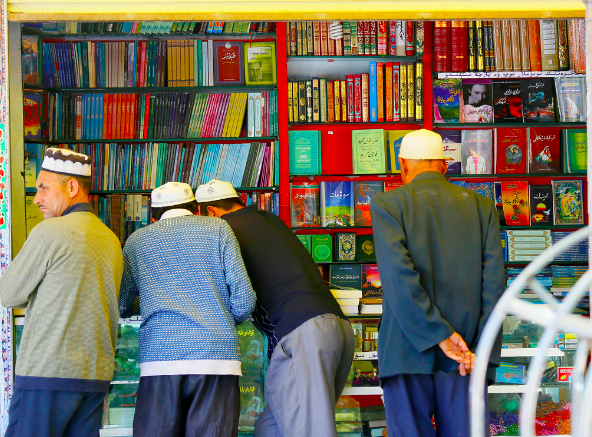
People of Xinjiang. Peter Chou Kee Liu. CC BY-NC-ND 2.0
China is Putting Muslims in Concentration Camps Because of an “Ideological Illness”
According to a UN report, China has declared Islam an “ideological illness”. One UN spokesperson claims there are approximately over a million Muslims currently in these camps. The UN report states “the evidence indicated that most of the detentions were taking place outside the criminal justice system, and targeted specifically Uyghur and other Muslim minorities, such as Kazakh”. But why is this happening? In the words of the Official Chinese Communist Party, “Members of the public who have been chosen for re-education have been infected by an ideological illness. They have been infected with religious extremism and violent terrorist ideology, and therefore they must seek treatment from a hospital as an inpatient”. The region of Xinjiang, in recent years, has faced attacks from extremist groups and because of this, have targeted the entire Uighur community in Xinjiang to prevent them from being further “infected by religious extremism and a violent terrorism disease.”
The region of Xinjiang is a highly populated by the “Turkic-speaking Muslim Uighur minority, who make up about eight million of its 19 million people”, according to a BBC article profiling the region. With the population being highly Muslim, the Chinese government has profiled that area in a subtle racist attempt to force the people of the area to renounce Islam and their practices. In a statement from the Communist Party, they state that “in order to provide treatment to people who are infected with ideological illnesses and to ensure the effectiveness of the treatment, the Autonomous Regional Party Committee decided to set up re-education camps in all regions, organizing special staff to teach state and provincial laws, regulations, the party’s ethnic and religious policies, and various other guidelines”. Furthermore, they say, “At the end of re-education, the infected members of the public return to a healthy ideological state of mind, which guarantees them the ability to live a beautiful happy life with their families”. It is disturbing to read words such as “disease” and “those infected” when it is in regards to innocent Uiguhr individuals. Using such diction creates a harmful and discriminatory connotation that the Uighur community is “sick” and “infectious”, a dangerously false narrative.
Although the camps have the intention of “[fighting] separatism and Islamic extremism”, they stem from a fear of an uprising in the Xinjiang area and has become a prejudice and gross abuse of human rights. Many of the people who were able to leave the concentration camps now are facing psychological ramifications and a complete lack of faith in the country that they are living. The camps are supposedly supposed to help threats and protect the people, yet they are harming them instead.
In many interviews from those who were in the concentration camp, they have mentioned that the “re-education” forces them to renounce Islam, renounce the Holy Quran, admit that the Uighur culture is backward in comparison to the Communist Party, and if the detainees refuse to cooperate, they are punished harshly. Some punishments include them not being fed, solitary confinement, or physical beatings. Recently, it has come out that there has been a death in one of the camps. A Uighur writer Nurmuhammad Tohti, died at the age of 70 because "he had been denied treatment for diabetes and heart disease, and was only released once his medical condition meant he had become incapacitated", according to his granddaughter, Zorigul. But even with the criticism and the death, the Chinese government still does not believe what they are doing is wrong.
China Daily, a popular media outlet, claimed that “Western critics of China's policies on human rights and religious freedom in the Xinjiang Uygur autonomous region seem to be divorced from the realities of the situation.” They stand in defense of their practices rather than understand how harmful they are and how they are creating a dogmatic perspective.
It is concerning to see how fear has created a ripple of harmful decisions and gross infringements on human rights. There is no reason for an entire community to reap the consequences of extremists actions when they are the innocents.
OLIVIA HAMMOND is an undergraduate at Emerson College in Boston, Massachusetts. She studies Creative Writing, with minors in Sociology/Anthropology and Marketing. She has travelled to seven different countries, most recently studying abroad this past summer in the Netherlands. She has a passion for words, traveling, and learning in any form.
.jpg)