
Mexico City is a flourishing metropolis with a plethora of historic and modernist architectural sites. Here are a few attractions scattered around the city.
Read MoreIslamic Architecture in Spain
While many can forget that Arab and North African Muslims controlled parts of Spain for almost 800 years, longstanding Spanish architecture is a testament to the Muslim reign. Arabesque patterns, Islamic motifs and sandy colors have been preserved in some of Andalusia’s most famous palaces and fortresses.

Great Mosque of Cordoba, Spain. Richard Mortel. CC BY 2.0.
Arab and North African Muslims conquered the Iberian Peninsula in the eighth century. Ruling for almost 800 years in Al-Andalus (currently Andalusia), Muslims inevitably left traces of their presence in the region. Everything from language and religion to architecture and art was adopted by Spain during the Muslim reign. Around 4,000 Spanish words which are still in use today originated from Arabic. The majority of these words are nouns related to food, animals, nature and science. For example, the Spanish word for “olive” is “aceituna” and is derived from the Arabic word “zaytünah.”
While aspects of the Arabic language can be found in Spanish, Islamic architecture is the true evidence of the Arab and North African Muslim reign in Spain. Certain sites in modern-day Andalusia make you feel like you’re in Morocco or Syria. Today, Islamic architecture is most prevalent in Cordoba, Seville and Granada—Spanish cities in Andalusia—with their palaces and holy sites.
Cordoba

Desert colored walls in the Great Mosque of Cordoba. Waqqas Akhtar. CC BY-NC-SA 2.0.
Cordoba was the capital of Al-Andalus when it was first conquered in 711 A.D. The Great Mosque of Cordoba is a testament to the Arabic and Islamic influence in the city. Elaborate building programs and agricultural projects were sponsored by Prince Abd al-Rahman I from Damascus, Syria. The prince imported plants from Damascus, some of which still stand in the yard of the Mosque of Cordoba today.
Previously operating as a mosque and church at different points in history, the captivating structure includes a hypostyle prayer hall, a beautiful courtyard with an extravagant fountain, a colorful orange grove, a walkway circling the courtyard and a minaret which is now a bell tower. Islamic calligraphy and verses from religious scriptures fill the sandy, red and white colored columns. Geometric shapes dominate the structure—in everything from design to entryways. One major Islamic motif that is evident in this structure is the horseshoe shaped “mihrab.” The mihrab identifies the wall that faces Mecca—Islam’s holiest city that features the home of God, the Kaa’ba—and indicates which direction to face while praying. The mihrab is decorated in gold and brown detailing. Above the mihrab sits a mesmerizing dome filled with pointed gold arches and radial patterns fill the ceiling.
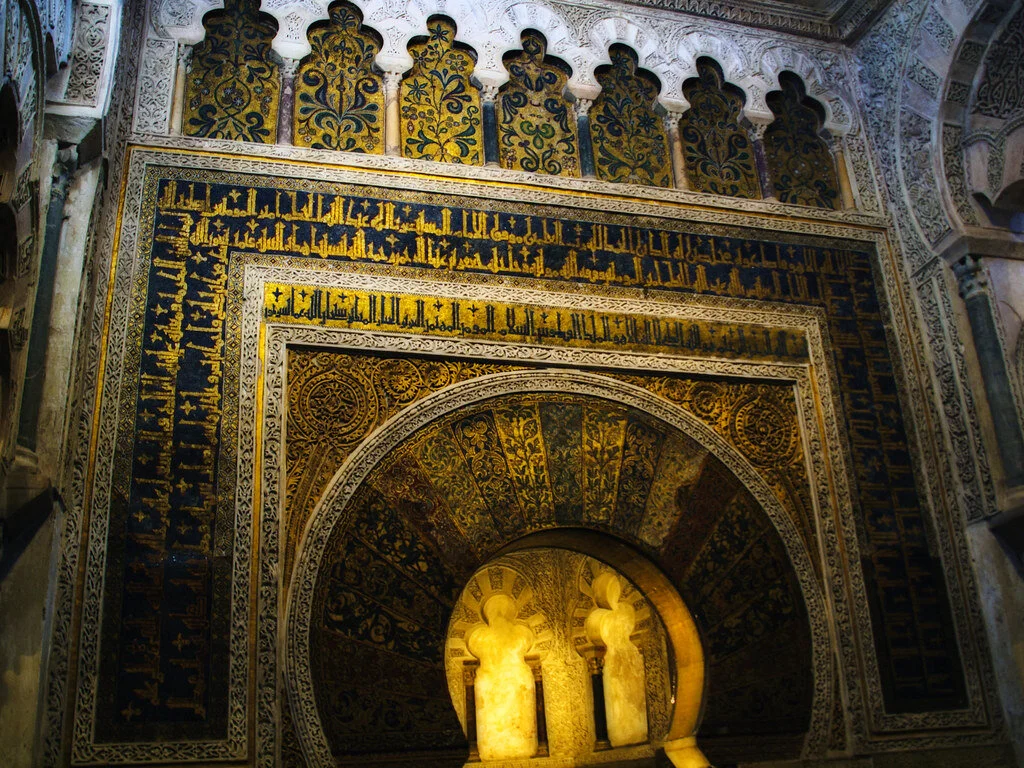
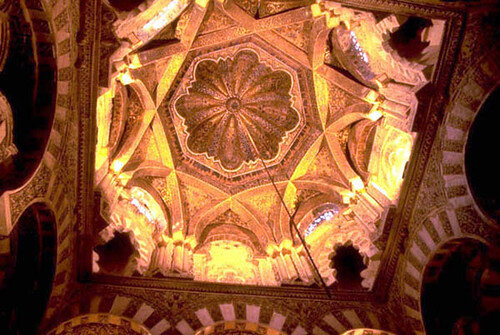
The dome above the mihrab in the Great Mosque of Cordoba. mitopencourseware. CC BY-NC-SA 2.0.
Seville

The Royal Alcazar in Seville is one of the world’s oldest palaces that is still in use today. This palace has been awarded status as a UNESCO World Heritage Site. The Alcazar was first built in the 11th century when the Arabs moved in and sought to create a secure, residential fortress. Since then, Alcazar has been home to the many monarchs who have taken control of Seville. The initially Islamic structure was renovated by its following rulers; however, the palace’s Islamic roots shine through as many of its Islamic components have been preserved.
One of the palace’s courtyards, the Patio del Yeso, was created in the 12th century when the region was still under Muslim control. The courtyard features a large pool in the middle—a common theme in Islamic architecture. Water is at the heart of Islamic architecture for both practical and spiritual reasons. Considering that the Arabs and North Africans came from dry climates and desert landscapes, it was important for them to have easy access to reliable sources of water. Furthermore, in Islam, water symbolizes life and purity. Water in gardens, specifically, symbolizes the sacred lake in paradise that is reserved for only the righteous.
Other recurring Islamic motifs that are found in the Alcazar include keyhole or horseshoe shaped arches, doors and windows; traditional Islamic plasterwork and latticework; Islamic writings; and a heavy presence of plants. The horseshoe arch is known as an “alfiz” and the Islamic-style window screens are known as “mashrabiya.” These, in addition to the icicle-like droppings from ceilings and domes, are common components of modern-day mosques and other traditional Islamic structures.
The gardens of the Alcazar were used not only for aesthetic purposes, but also for functional purposes. While the plants and trees were grown in the palace’s gardens for beauty, the plants were also used to feed members of the court. The gardens themselves were strategically structured to resemble what Muslims imagined paradise to look like based on the descriptions in the Quran.
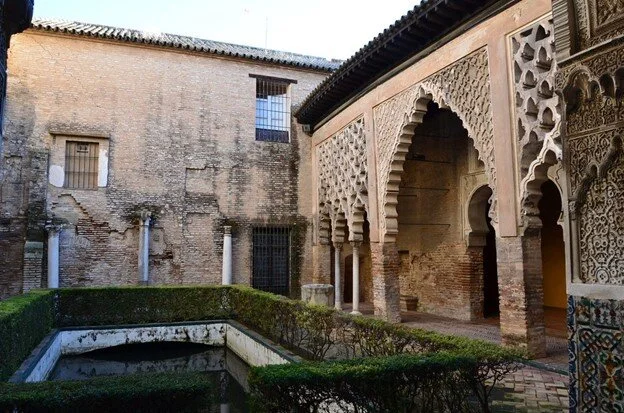
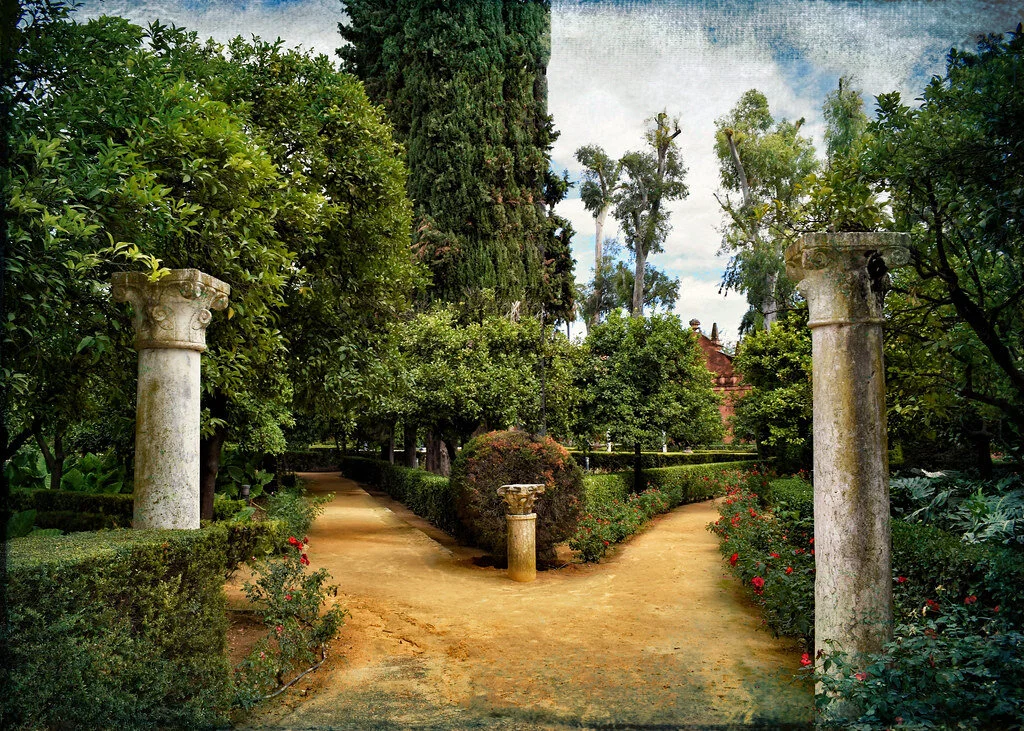
Garden in the Royal Alcazar, Seville. Jocelyn Erskine-Kellie. CC BY-SA 2.0.
Granada
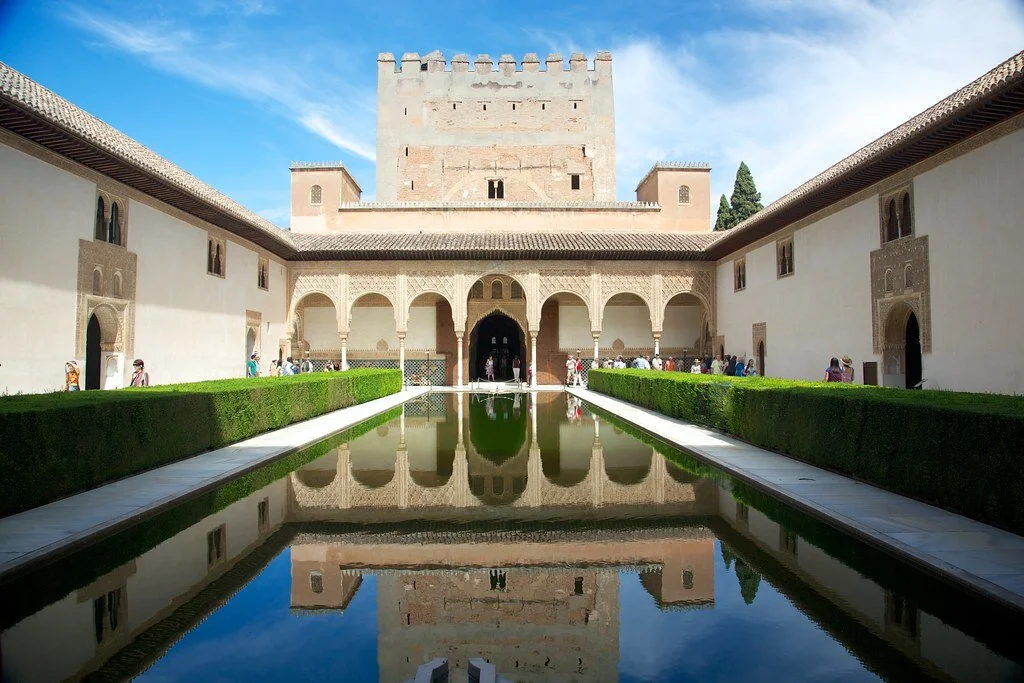
Alhambra Palace Fortress in Granada, Spain. Victor Wong. CC BY-NC-SA 2.0.
The Alhambra Palace in Granada is further evidence of the Islamic rule in Spain. The name Alhambra itself derives from the Arabic word “Al-Hamra” which means “red.” The palace was given this name for its reddish bricks and walls which can be seen from afar. Alhambra’s layout mimics that of many other palaces for Muslim princes. Three main floor plans dominate the site: the “mexuar” was open to all and the room where sultans received their subjects, the “diwan” is the throne room where receptions were held, and the “harem” is the prince's private quarters. Islamic inscriptions and verses from the Quran flood the walls, while the gold detailing accents the writings.
Mosaics and colored tiles in geometric and plant-like shapes, referred to as “alicatado,” are also in certain quarters. The mosaics are not only decorative but also contain strategically chosen tiles to cool the structure in the summertime. Plant motifs align with Islamic principles, as the depiction of human images is often frowned upon. The Fountain of the Lions in Alhambra is one of the most photographed features of the palace, with 12 lions spewing water in the middle of the courtyard. Other famous aspects of Alhambra which are covered in arabesque patterns and constructed to resemble the gardens in heaven, include the Generalife and El Partal, two of the quieter locations in the palace.
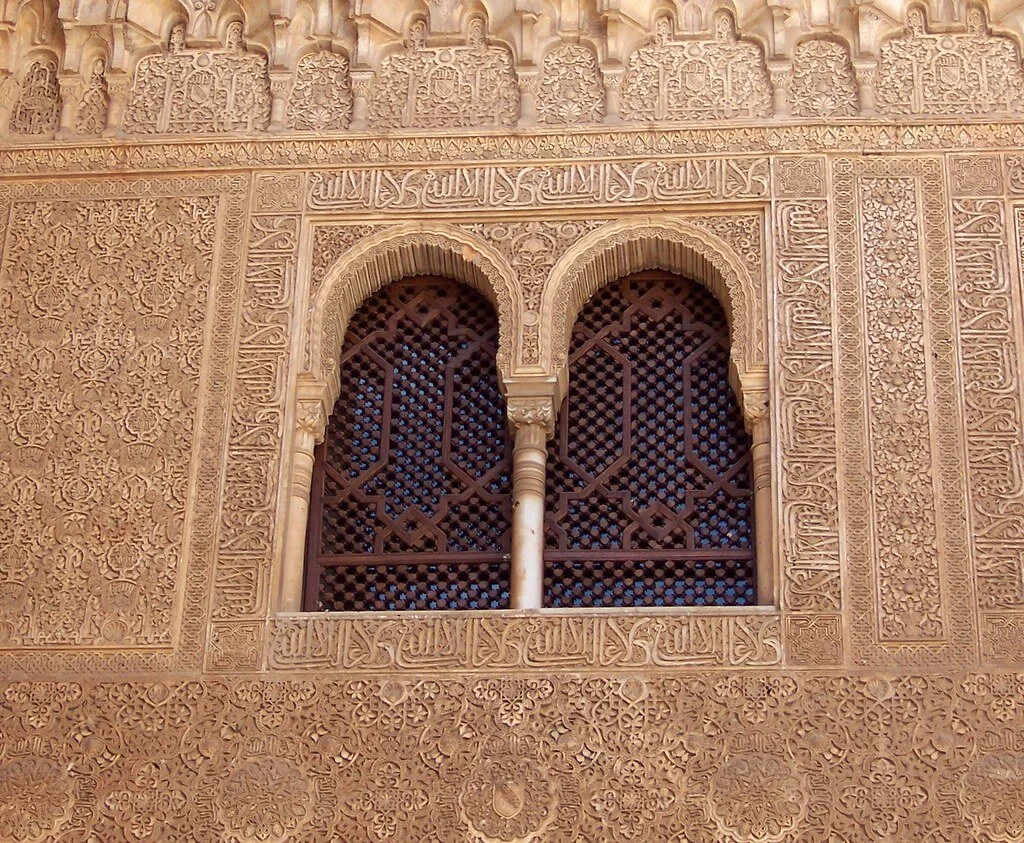
Keyhole shaped windows with arabesque patterns in Alhambra. Güldem Üstün. CC BY 2.0.
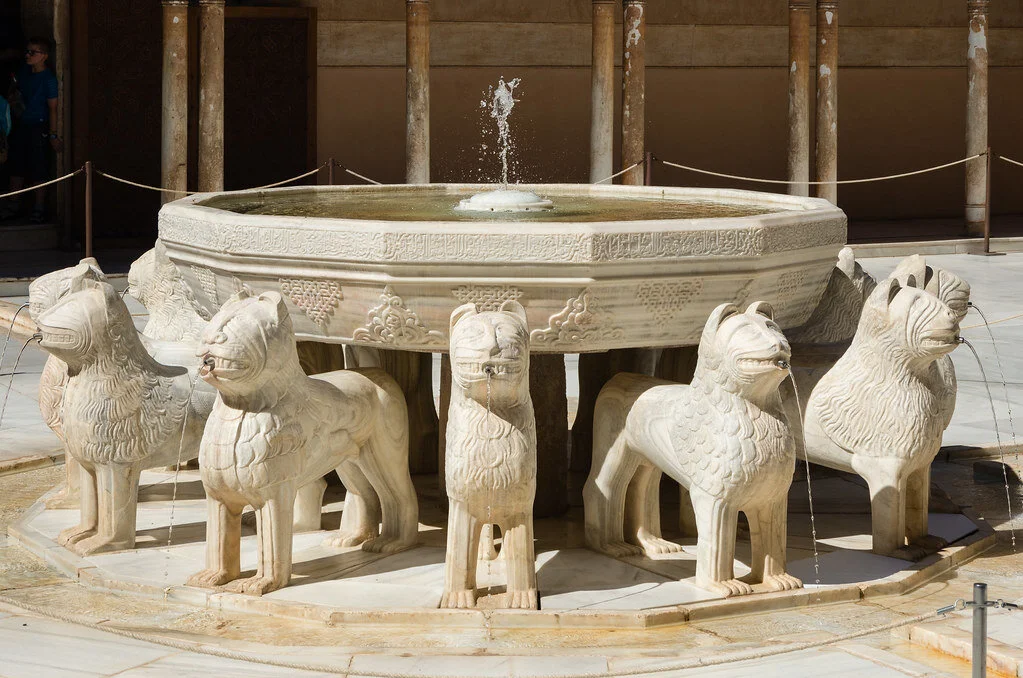
Fountain of the Lions in Alhambra. Alexandra Stevenson. CC BY-ND 2.0.
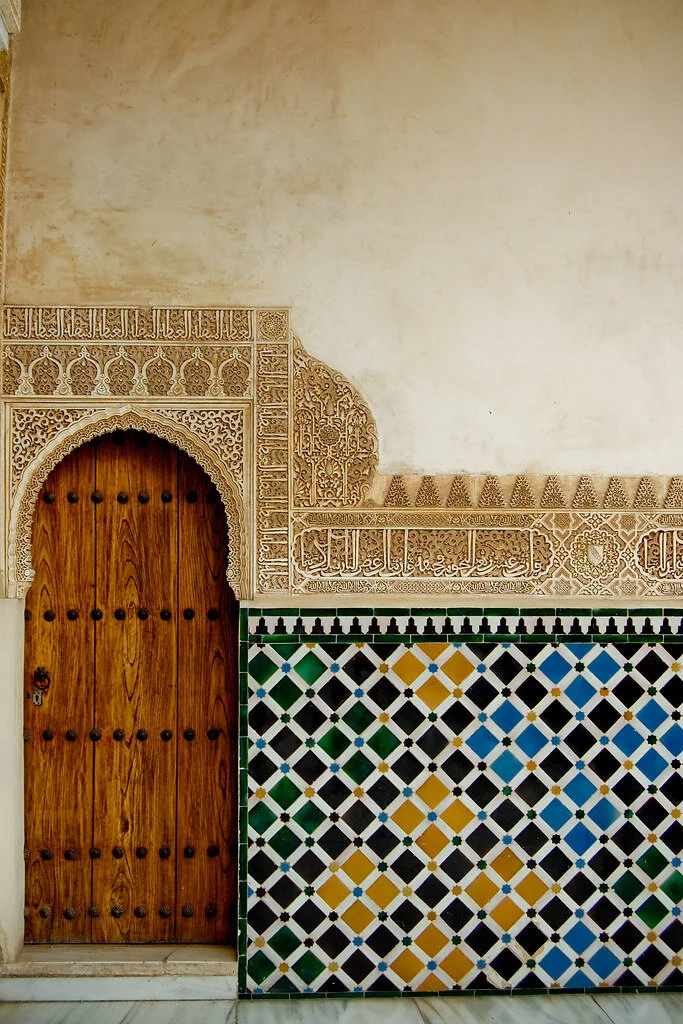
Geometric mosaics in Alhambra. Víctor. CC BY-NC-ND 2.0.
RELATED CONTENT:

Mia Khatib
Mia is a rising senior at Boston University majoring in journalism and minoring in international relations. As a Palestinian-American, Mia is passionate about amplifying the voices of marginalized communities and is interested in investigative and data-driven journalism. She hopes to start out as a breaking news reporter and one day earn a position as editor of a major publication..
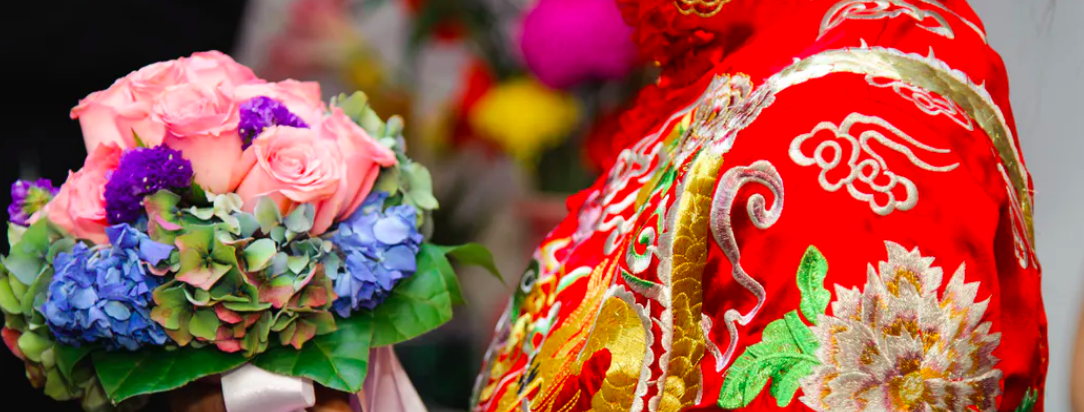
Chinese Brides Wear as Many as Five Dresses – Yet Provide Inspiration for a Sustainable Fashion Future
Across the Northern hemisphere flowers are blooming, days are warmer and birds are singing. In China, where I live, there is another highly visible indicator of the season: couples dressed in their wedding day finest are to be seen posing in the most picturesque spots around the country, with a photographer in tow.
Weddings in China have always been opulent – with elaborate, detailed embroidered dresses and a prolonged series of ritual events – but in recent decades, as the country positions itself as a global leader and incomes increase, they have become even more so. Increasing Chinese popular awareness of global wedding dress and cultural trends have added to this opulence, with ever-increasing mix between Western and local traditions.
Weddings are now so central to Chinese culture that the small district of Tiger Hill in Suzhou has become the centre of the wedding dress industry, reportedly producing up to 80% of the world’s wedding dresses. This surge in in the industry has been fed by a new generation of Chinese brides and grooms that have become not only brand-conscious but brand-reliant.
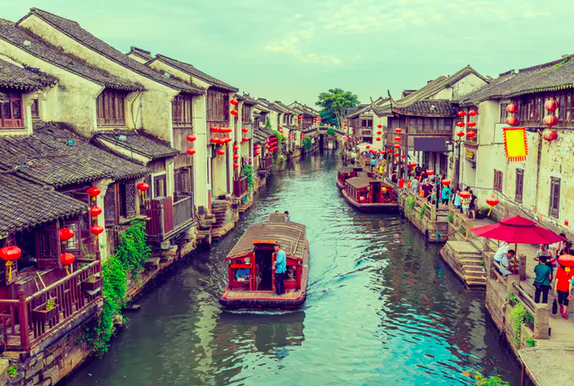
Suzhou, China. 4045/Shutterstock.com
In a time in which sustainability has become a key goal for the global fashion industry, this trend is a worry. Here, issues in fast fashion seen all over the world, from wastefulness in production to cheaply produced goods made with poor quality synthetic fabrics, are magnified. And the wedding dress is an apt symbol for the excesses of the industry – usually a phenomenally expensive item, only ever worn once.
But despite the increasing rampant consumerism seen in Chinese wedding dresses, China does offer some kernels of hope for a world – and an industry – increasingly concerned by sustainability.
Tiger Hill
The city of Suzhou has for centuries been known throughout China as the city of silk and embroidery. But as the modern wedding culture of today’s China evolved, Tiger Hill Bridal Market area has developed: first as a centre for wedding photography studios, a place of studios and equipment, and then as a centre of wedding dress production and distribution. Situated just a few hundred metres from one of Suzhou’s famous tourist destinations, Tiger Hill, (Hu Qiu in Chinese) has morphed into a treasure trove of lace, taffeta and beads.
Shops in Tiger Hill offer every kind of imaginable incarnation of what a wedding dress could be, from a Han-Dynasty fantasy garment to a red or white princess-style gown to replicas of dresses worn by famous royal brides. While many shops cater to private customers, wholesalers who distribute the dresses via digital platforms also represent a large section of the area’s clientele.
The district, like many in China, has undergone rapid transformation since the turn of the new millennium, fuelled by an increasing number of consumers with a growing disposable income and associated wedding budget. Tiger Hill Wedding Market is now the place to buy your wedding dress in China as well as around the world online. Brides-to-be can source dresses at all price ranges, from ¥100 to ¥100,000 (approximately £9 to £9,000).
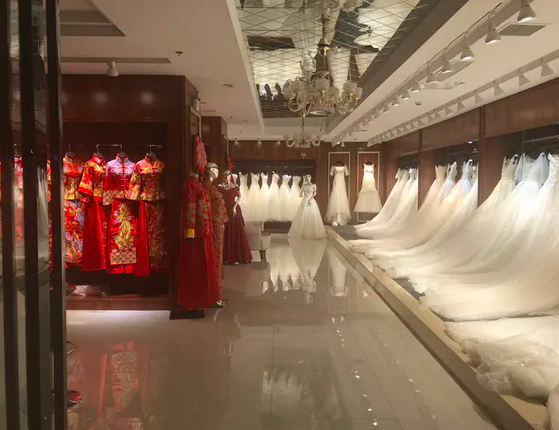
Shopping for dresses in Tiger Hill. © Sara Sterling, Author provided
But a key difference between Suzhou and other wedding dress markets is the prevalence of a rental culture, similar to the Western practice of suit and tuxedo rental for grooms and groomsmen.
This is a hangover from the pre-Deng Xiaoping Open era before the late 1970s, in which extravagant consumption practices were simply not available. And with a minimum of three dresses involved in the Chinese wedding day, it is no small wonder that renting remains well-established.
Multiple dresses
In the UK and other Western countries, it is becoming increasingly popular for brides to wear two versions of a bridal dress on the wedding day, with one reserved for the formal ceremony itself and the other for the evening reception, designed with comfort and ability to dance in mind.
But in China, brides wear up to five dresses. While two or possibly three dresses may have been standard in previous decades, this number has increased in recent years. The ideal bride in China is multi-dimensional, with dresses that represent not only different sections of the wedding day schedule, but different levels of the self. From a tightly fitted and hand-embroidered qi pao, to a voluminous white or cream-coloured dress reminiscent of the days of Marie Antoinette, brides aim to show themselves in different aspects throughout the day.
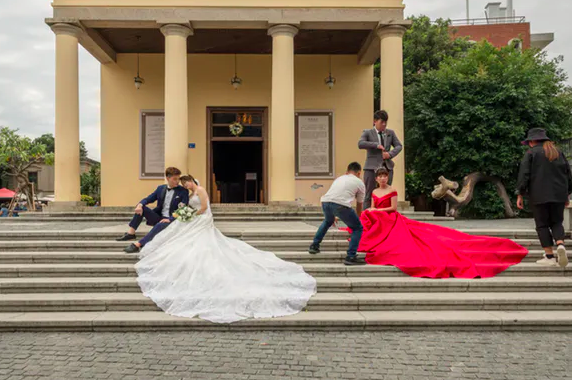
The photoshoot. Steve Heap/Shutterstock.com
There is one for the morning, when the bride is picked up by her groom after a series of verbal challenges and games. There is one for the walk into the banquet hall and arrival and one for the ceremony. Then another for the series of toasts as the bride and groom make their way around to the dozens of tables of well-wishers and red packet-givers, and perhaps even one more dress for the final hours of the evening.
This might sound over the top and rather wasteful. And indeed, increasing consumer demand for a larger number of dresses for each significant event of the wedding day has placed pressure on the wedding dress industry to produce a larger volume of dresses to meet these requests.
But it doesn’t have to be, especially if China doesn’t lose the tradition of renting these dresses. And with the price of rental dresses, or a rental dress package, costing up to tens of thousands of yuan, dress rental is still commonplace amongst Chinese brides, due to both economic necessity as well as the nature of the ceremony, with its multiple dress changes.
SARA STERLING is a Lecturer in Industrial Design at Xi'an Jiaotong Liverpool University.
THIS ARTICLE WAS ORIGINALLY PUBLISHED ON THE CONVERSATION