
Mexico City is a flourishing metropolis with a plethora of historic and modernist architectural sites. Here are a few attractions scattered around the city.
Read MoreLabor Cruelty Inside Dubai, the City of Gold
Ninety percent of Dubai's residents are migrant workers, many of whom are experiencing abuse from their employers.
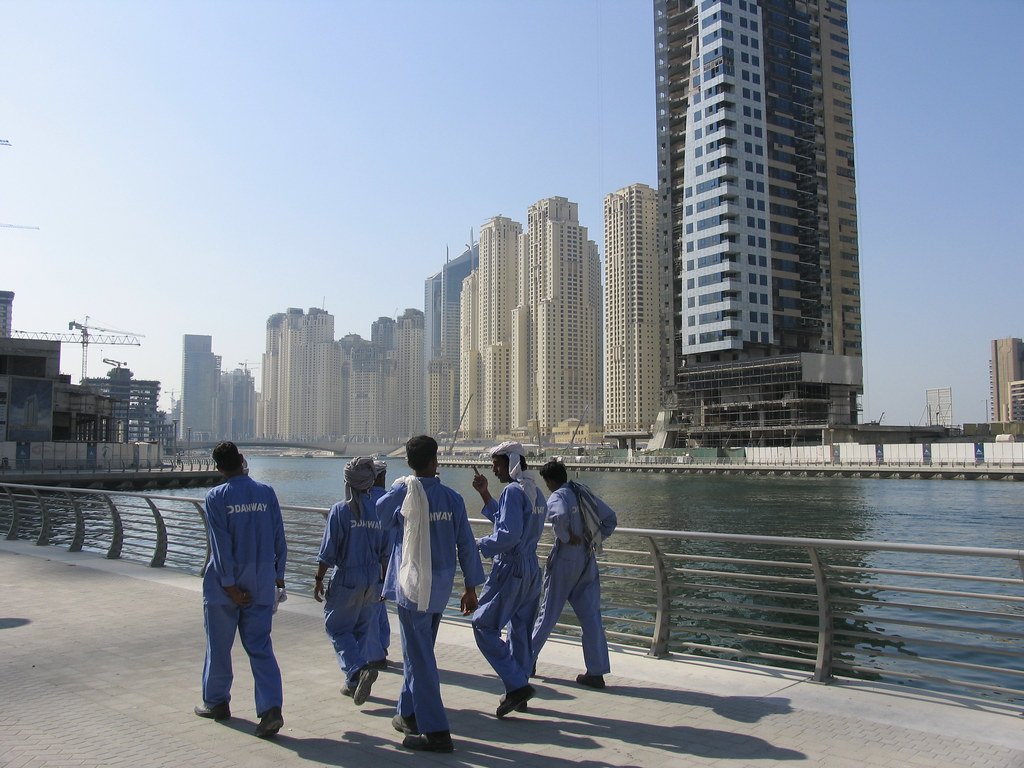
Dubai is known as the city of gold due to its rapid growth, from a global gulf port to a busy business city center. Migrant workers arrive from Asia, Africa and different parts of the Middle East through the sponsorship program kafala. The program gives employers the permits necessary to hire foreign labor workers and gives employers complete control over the legal status of whom they’ve hired. In some cases, this causes a power imbalance among the employer and employee relationship. In addition to being exploited through the sponsorship program, migrant workers have accused employers of various forms of abuse.
Migrant workers often arrive in Dubai in hopes of making a steady income to provide for their families back home. Dubai has a high demand for labor workers and provides better opportunities to migrant workers. Therefore, they take on jobs in construction or domestic work, such as nannying, housekeeping or other household services. At times, they’re promised a higher wage or a different job description; however, after arriving, that promise was broken. Migrant workers receive their wages on a monthly basis and are required to work weekends, with an average of 16-21 hour days. Overworked migrants cannot leave the job until their contract is terminated, as those are the conditions under the kafala sponsorship. If one decides to leave, the employer can have the worker sent to prison for six months, deported and/or fined $27,225 for not abiding by the contract.
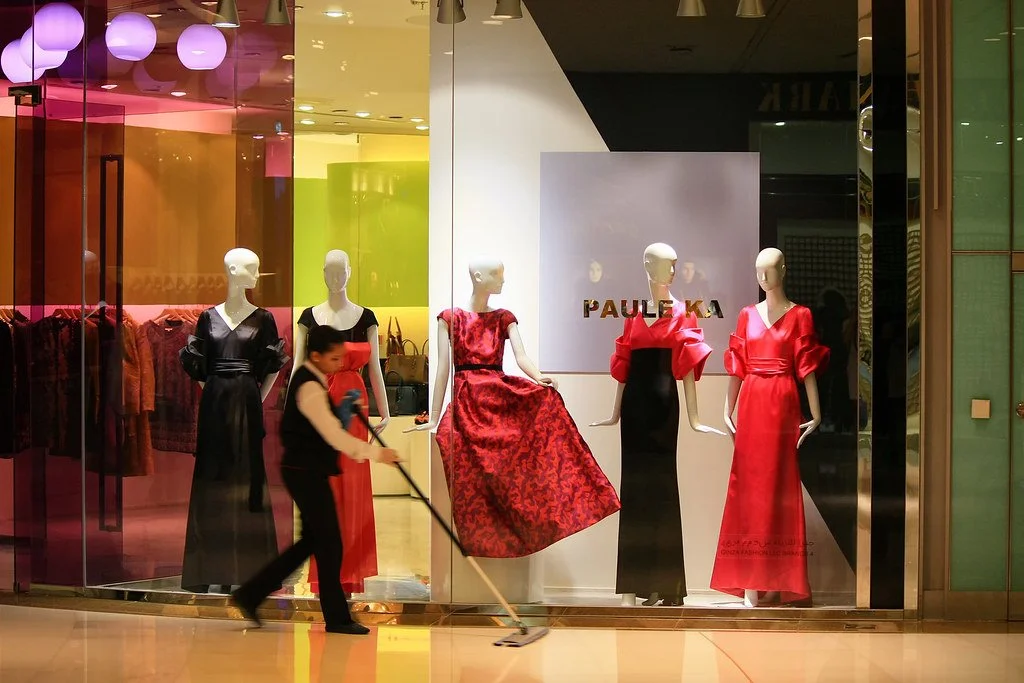
Migrant Worker Cleaning a Mall in Dubai. Iwona Rege. BY-ND 2.0
This very strict rule under the kafala sponsorship forces employees to continue working under very stressful conditions. Fear of what could happen to them binds them to their employer until the contract is completed. Due to these conditions, migrant workers have complained that employers have not paid them their wages, delayed the wages or have had their passports taken from them; preventing them from leaving. At Dubai’s Expo 2020, migrant workers claimed their employers violated UAE labor laws, with one interviewee saying, “the way they treat the staff is like slaves, I mean modern day slavery.” Women have reported being raped by their employer as well as family members for the home they work in. However, there has been no action taken against these accused employers.
With the pandemic, cases got worse as most employers did not pay the migrant workers their wages. The lack of income left workers stranded in Dubai with no money to fly back home or provide themselves with basic needs. A Sri Lankan embassy source based in Dubai said, “the two most common complaints from the worker are that employers don’t give them salaries and that they are harassed either physically, sexually or verbally.” The UAE has settled requirements that help protect migrant workers rights, yet there has been non-compliance and no way to ensure workers are not being abused and/or taken advantage of.
To Get Involved: The organization Migrant-Rights advocates the rights of migrant workers affected by the kafala sponsorship program. They also assist migrant workers who need assistance.
To learn more click here.
To support Migrant-Rights’ organization click here.

Jennifer is a Communications Studies graduate based in Los Angeles. She grew up traveling with her dad and that is where her love for travel stems from. You can find her serving the community at her church, Fearless LA or planning her next trip overseas. She hopes to be involved in international humanitarian work one day.
VIDEO: Indian National Labor Strike
In September 2020, India passed new agriculture laws that make it much more difficult for farmers to sell their produce at assured rates, as they allow for big corporations to bypass state-controlled markets and buy crops at much lower prices. Since then, various labor unions, political parties, and retail groups have banded together in a standoff against the government to protest this legislation. Strikes are happening in over 20,000 locations across the country; November 26 and 27 of 2020 had a record 250 million people take to the streets in protest, and the marching has not stopped. While farmers continue to hold out in the hope of agriculture legislation reform, it is difficult to get the most current information from the country due to massive communication disruptions. This video details the situation in December 2020, providing an intimate look into the lives, aspirations, and fears of the farmers most affected by the new laws.
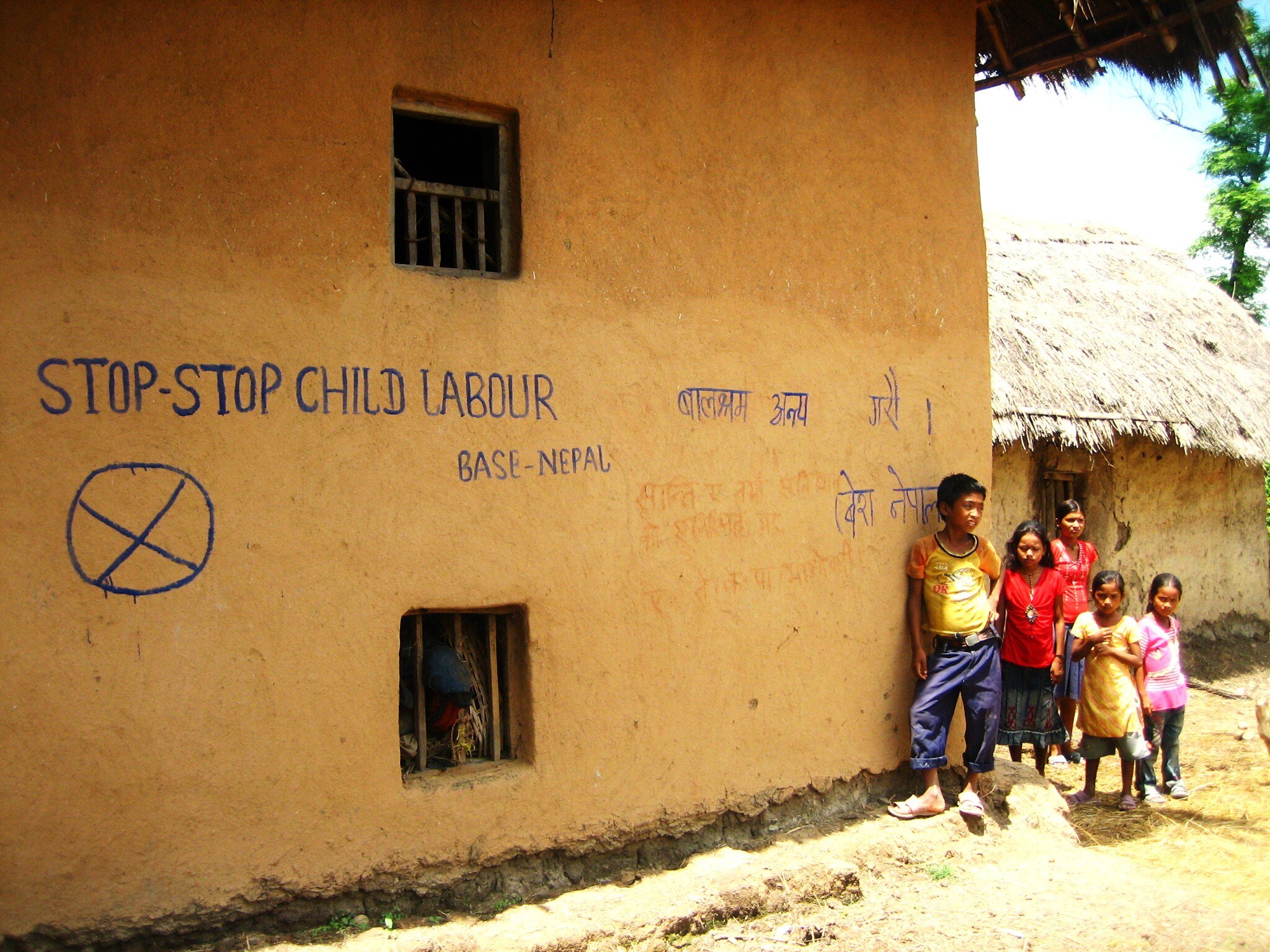
Children in a Nepalese village which has committed to ending child labor, a prominent form of modern slavery. The Advocacy Project. CC BY-NC-SA 2.0.
Modern Slavery Remains an Issue to Address in the 21st Century
More than 40 million people are victims of modern slavery today, roughly 1 in every 200 hundred people alive today. From sex trafficking to forced labor slavery abounds. Some classify the forced labor in the US for-profit prison system as slavery.
Read MoreDisaster in the Delta: Workers Accused of Profiting from Oil Spills in Nigeria
A new documentary reports that employees of Shell’s Nigerian subsidiary are encouraging attacks on pipelines to pocket funds intended for environmental cleanup.
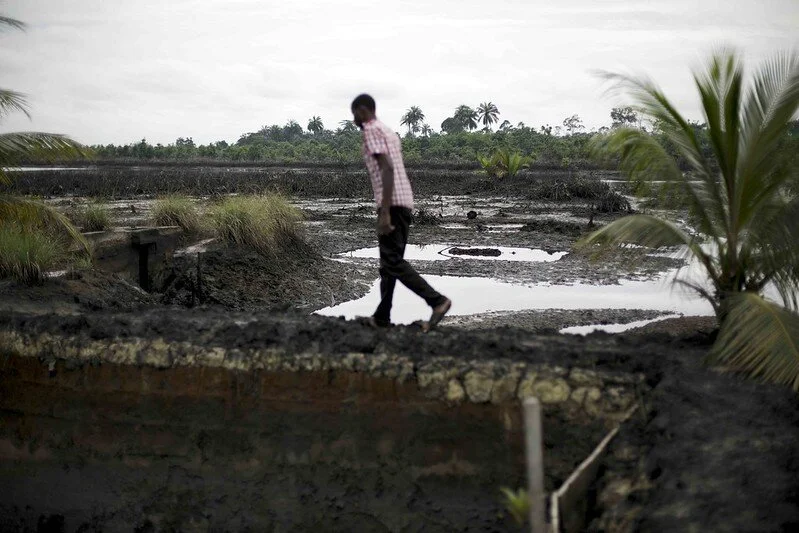
A man walks alongside land tainted by an oil spill near Kegbara Dere, Nigeria. Friends of the Earth International. CC BY-SA 2.0
As the largest oil producer in Africa, Nigeria has long struggled to balance the demands of multinational corporations with the needs of its own people. The country provides a clear example of the resource curse, as the government turns a blind eye toward endemic corruption in the oil and gas industries. The Niger Delta, home of Nigeria’s oil reserves, has become a land of lawlessness and environmental catastrophe with no clear end in sight.
For decades, Royal Dutch Shell has been in the crosshairs of both environmental and human rights activists over its role in the Niger Delta. Now, the Anglo-Dutch oil company is facing claims that its employees deliberately sabotaged its own pipelines to profit from environmental cleanup funds.
In a documentary released on Dec. 10, Dutch television program Zembla and environmental group Milieudefensie teamed up to investigate claims of malpractice by the Shell Petroleum Development Company of Nigeria (SPDC). This group is a joint venture between the state-run Nigerian National Petroleum Corporation, France’s Total, Italy’s Eni and Shell, which runs all operations.
Research focused on the village of Ikarama, where there have been 30 reported oil spills in the last 13 years alone. The region surrounding the community has become so polluted that agriculture and fishing barely yield any income for locals. Frustration with oil companies has mounted, leading some residents to vandalize pipelines to channel their frustration.
Per the report, Royal Dutch Shell’s employees saw an opening. They began to encourage local youths to sabotage pipelines so they could receive funds necessary for environmental cleanup. Workers for the oil titan received vast sums of money for “eco-friendly” measures, and members of the Ikarama community were hired to restore the land.
The SPDC denies responsibility for the oil leaks, instead blaming local criminals and gangs. The group said in a statement that, “As of now, we are not aware of any staff or contractor having been involved in acts causing oil spills in the Niger Delta.” The SPDC further claimed that it investigates all credible reports of misconduct and addresses situations as needed.
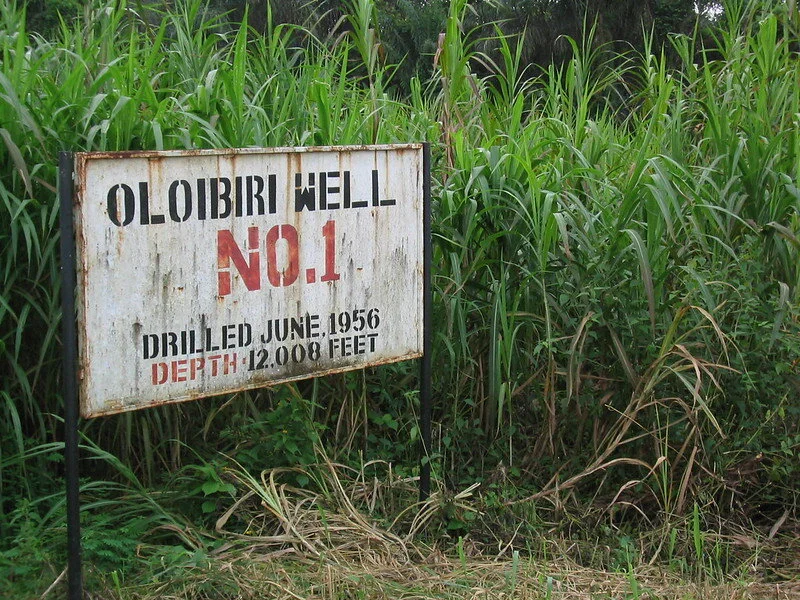
A sign points out Shell’s Oloibiri well, the first drilled in West Africa. Rhys Thom. CC BY-NC-ND 2.0
In the eyes of Cees van Dam, a professor of international business and human rights at the University of Rotterdam, the accusations are credible. “In the Netherlands,” he notes, “this would certainly be considered a criminal offense. Intentional destruction of property, intentional environmental pollution, these are serious issues that no single company would accept from its employees.”
Moreover, employees of the SPDC and residents of Ikarama attest to the claims addressed in the documentary. Saboteurs insist that they vandalize the pipelines “out of hunger” while a former Shell security guard said that supervisors and employees “split the money from the cleanup.”
Making matters worse, the former security guard said that “the recovery department from Shell sabotages the pipelines. If the cleanup will take seven months, they’ll stop after only three months.” In other words, the land remains in disarray even after remediation measures conclude.
In the documentary, Zembla claims that local employees and villagers were far from the only ones aware of the scheme. The SPDC, the Nigerian police and the Dutch embassy in Abuja also received word of the process from concerned locals. Then Dutch ambassador Robert Petri even visited Ikarama in 2018 and pledged to “take what is happening here … and we will share our experiences and information with both Shell and the government.” No further investigations have occurred.
As such, the process of intentional environmental degradation continues. As the alleged scheme moves into the spotlight, there is an opportunity for corruption in the Niger Delta to be extinguished. The region’s troubled past and present are intrinsically tied to the oil industry, but hope remains that a more transparent future may be just around the corner.

Stephen Kenney
Stephen is a Journalism and Political Science double major at the University of North Carolina at Chapel Hill. He enjoys sharing his passion for geography with others by writing compelling stories from across the globe. In his free time, Stephen enjoys reading, long-distance running and rooting for the Tar Heels.
Amid COVID-19, Garment Workers Are Asking Employers to #PayUp
While the COVID-19 pandemic has slowed down many sectors of the economy, online sales have spiked—as well as the vulnerability of many laborers working with little to no safety net.
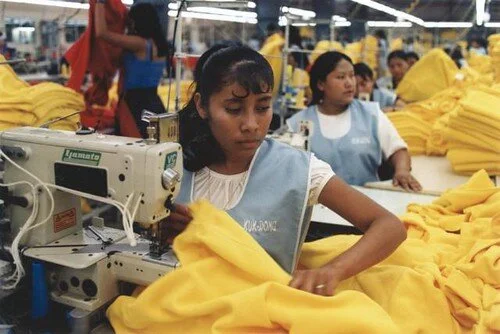
Sweatshop workers mass producing fabrics for below average wages. Marissa Orton. CC BY-SA 2.0.
Since the beginning of COVID-19 lockdowns, e-commerce has reaped significant monetary benefits. In the United States alone, online sales rose 43% in September, totaling $60.4 billion. Though online shops gained countless new customers, not all in the industry were celebrating.
Since March, many frontline workers have been laid off. For example, the American startup company Everlane, a clothing line that promises “radical transparency,” came under fire for terminating workers who attempted to start a labor union amid the pandemic. Despite founder Michael Preysman’s statement that the layoffs were “the hardest decision we’ve ever had to make,” non-management employees called them out. Those who held leadership positions in the company retained most of their salaries.
Across the globe, COVID-19 has weakened both the bargaining power and socioeconomic mobility of garment workers. Its consequences have been especially devastating for those in developing nations. In India, the closure of schools has led around 80,000 children to begin working as laborers. If unaddressed, the pandemic could set the country back decades on child exploitation. With limited options, families are often strong-armed by traffickers into believing their children will lead better lives in the big city. Many never see their families again.
As a European Trade Union Institute article reported, COVID-19 did not break labor rights; it only revealed how broken the system already was. In Leicester, England, predominantly female and migrant sweatshop workers from Eastern Europe, Bangladesh and Pakistan faced wages as low as $4.50 an hour, received threats and humiliation, and were even denied bathroom breaks.. A June report from Labour Behind the Label found that online fashion retailer Boohoo’s Leicester factory was operating at 100% capacity despite lockdown orders. In the same month, the company projected that its shares had increased by 22%.Some feel that fast-fashion workers are stuck in a lose-lose situation. A Bloomberg report found that the closure of roughly 1,090 garment factories in Bangladesh amounted to an economic loss of $1.5 billion. Workers were not entitled to unemployment benefits, rendering them even more vulnerable in the face of pandemic uncertainties. A Solidarity Center article found that because of social distancing measures, workers’ ability to unionize and collectively bargain for their rights was severely limited.
Not all hope is lost, however. COVID-19 has created opportunities for critical change. As online sales have gone up, so has social media usage. In March, after notable labels such as Nike, Gap and Levi’s had canceled billions of orders, the nonprofit organization Remake revealed the plight of garment workers through the #PayUp movement. Stores like H&M and Zara were pressured into compensating their suppliers for orders that had already been produced, passing that money on to workers. While the fight is far from over, garment workers’ future may become brighter as consumers take a longer glance at the fast-fashion industry
How To Get Involved:
The Awaj Foundation is a woman-led organization based on addressing gender-based violence in the garment industry. It supports workers from Bangladesh. For more information on ways to support it, click here.
Based in Los Angeles, the Garment Worker Center aims to restore agency and dignity back to workers currently strong-armed by sweatshop conditions. To learn more, visit its website here.

Rhiannon Koh
Rhiannon earned her B.A. in Urban Studies & Planning from UC San Diego. Her honors thesis was a speculative fiction piece exploring the aspects of surveillance technology, climate change, and the future of urbanized humanity. She is committed to expanding the stories we tell.
Cutting Ties: Saudi Arabia Announces Reforms for Migrant Workers
Saudi Arabia has begun lifting up its struggling migrant workers with its most recent initiative. However, what this decision truly means in terms of effective change remains uncertain.
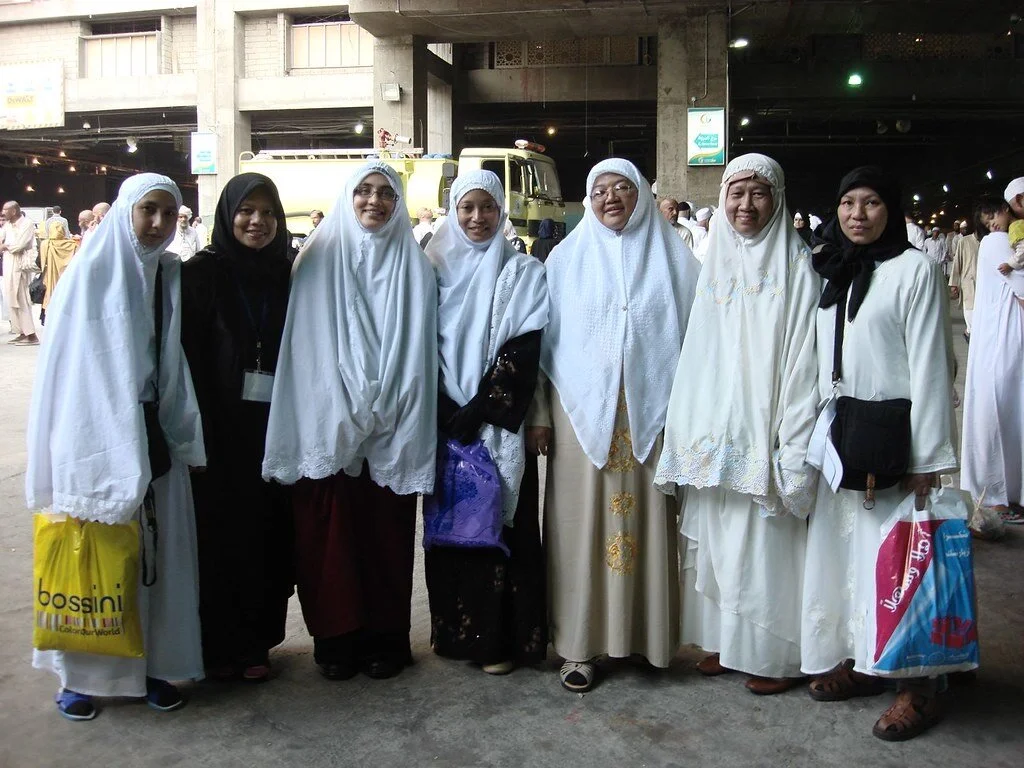
Saudi women. Mohd Azli Abdul Malek.CC By-NC-SA 2.0.
Saudi Arabia recently kick-started the “Labor Relation Initiative” that will eliminate policies tightly binding migrant workers to their sponsors. It is expected that the changes will begin in March 2021, potentially impacting up to one-third of the nation’s population. This initiative may be the beginning of the end of the notorious “kafala” system that has been under international scrutiny since its conception in the 1950s.
The kafala sponsorship system, which is currently practiced in most Persian Gulf states, began about 70 years ago to create a beneficial flow in the migrant labor force. Workers are assigned a sponsor, or “kafeel,” for their decided contract period. The sponsor may be a single person or a company. The sponsor has complete control over the worker’s ability to change jobs or enter and exit the country; written permission must be granted for any changes. Thus, the worker must report all related activity to the sponsor, and failure to do so will result in criminal punishment. The sponsor must then report all activity to the immigration authorities, and fund the worker’s entry and exit.
Essentially, the kafeel is the migrant’s legal tie to the country, leaving the worker no choice but to acquiesce. The kafala system has allowed kafeels to exercise excessive control over their workers, such as taking their travel documents; this is illegal, though, in some of the countries that practice the system. The kafala system has faced much criticism with claims that it is a gateway to modern slavery; there have been many reports of forced work and sexual abuse. However, it appears that the intense exploitation of workers over the years may potentially begin to close with Saudi Arabia’s new Labor Relation Initiative.
The initiative now allows workers to move their sponsorship to other jobs and to cross the border without permission of their kafeel. The policy is only one aspect of Crown Prince Mohammed bin Salman’s “Vision 2030,” in which he aims to increase international economic activity. Many are hopeful that this initiative will bring about substantial change for not only the current 10 million impacted workers, but also future generations who would benefit from the complete abolishment of the kafala system.
Others are wary of holding out hope, stating that ties to a sponsor would need to be completely cut in order for change to be sustained. At the moment, this limited reform has not clarified whether all migrant workers are shielded, nor whether sponsors can still report their workers for running away. Concerns over this unanswered portion of the policy bring much fear; a worker whose travel documents have been invalidated by their sponsor faces immediate deportation.
Maybe this initiative will end the process for good, or perhaps it is merely a camouflaged political scheme. Regardless, much hope remains that the injustices of the kafala system will be reduced.

Ella Nguyen
is an undergraduate student at Vassar College pursuing a degree in Hispanic Studies. She wants to assist in the field of immigration law and hopes to utilize Spanish in her future projects. In her free time she enjoys cooking, writing poetry, and learning about cosmetics.
Sri Lanka Strives Toward Gender Equality Through Economic Empowerment
Sri Lanka’s efforts to combat the gender gap allow women to support themselves and their communities.

Women selling produce at a market in Sri Lanka. imke.sta. CC2.0
Nicknamed the “pearl of the Indian Ocean” and famous for its spices, unique culture and lush ecosystems, Sri Lanka is also known for its advances in gender equality. The island nation became in 1960 the first country in the world to elect a female prime minister, Sirimavo Bandaranaike. Sri Lanka has also long provided free and compulsory education for men and women up to the university level.
Even so, high levels of gender-based violence are present throughout the country and the unemployment rate of women is twice that of men. Most women occupy low-paying positions in agriculture and the garment industry with little chance of economic mobility. Although well-respected in the Asia-Pacific region, Sri Lanka’s educational system often enforces traditional ideological and cultural beliefs, which can perpetuate negative stereotypes about women. A university-level education does not guarantee women positions of power, with large disparities between men and women in science, technology and political positions throughout the country. Additionally, a 26-year-long civil war (1983-2009) isolated Sri Lanka from the modern world, allowing traditional gender roles to thrive in war-affected areas.
Developing economic opportunities for women has the potential to overcome barriers to gender equality. Here are two organizations working to do just that:
Women receiving medical training provided by the Women’s Development Centre. Rajapaksa. CC2.0
The Women’s Development Center
This Sri Lanka-based nongovernmental organization has made incredible strides in supporting at-risk women, children and people with disabilities since its founding in 1986. With the goal of creating opportunities for marginalized groups, the group is on its way to “creating a just and secure society for women and children.” Although the organization has a multifaceted approach, social enterprises and economic empowerment remain its key goals. The social enterprise “Sthree”, meaning “woman” in Tamil and Sinhala, was founded in 2011 with the goal of empowering women and their local communities. The platform provides a market in Kandy for Sri Lankan women and disabled people to sell handmade products, such as saris, jewelry, decor, snacks and chutneys, recycled paper products and eco-friendly purses and handbags. Sthree also provides training and skill-building workshops for women and disabled individuals. Sthree is beginning to expand to an international clientele, even hosting an international exhibition and sale in Sweden in 2016.

A woman making brooms for a woman’s cooperative in Sri Lanka. Foley. CC2.0
Puthukkudiyiruppu Women Entrepreneurs’ Cooperative Society
The PTK Cooperative, initially founded by Krishnakumar Jeyaranjini and 14 other women in 2012, provides a platform for war-affected women to support themselves and their families economically. The business has expanded over the years, producing detergent, chili powder and rice flour. The organization has the backing of the International Labour Organization (ILO), which helps link it to buyers, markets and social enterprises. The organization enables collaboration between women from different ethnic groups and communities in Sri Lanka, helping to create social cohesion and tolerance. The organization continues to defy gender norms and stereotypes. “Often the words ‘woman’ and ‘detergent’ bring out gendered images of a woman washing clothes at home, not of a woman owning or running a successful detergent-producing enterprise,” said Simrin Singh, director of the ILO country office for Sri Lanka. “It is stories of our work empowering women like Jeyaranjini, building block by block, that are the essential inspiration so many other women in this country could use to break the barriers to their empowerment.”
Although Sri Lanka has made considerable progress toward gender equality in the last 50 years, many obstacles remain. Empowering women at a grassroots level helps provide women more economic agency while ensuring the well-being of generations to come.

Megan Gürer
Megan is a Turkish-American student at Wellesley College in Massachusetts studying Biological Sciences. Passionate about environmental issues and learning about other cultures, she dreams of exploring the globe. In her free time, she enjoys cooking, singing, and composing music.
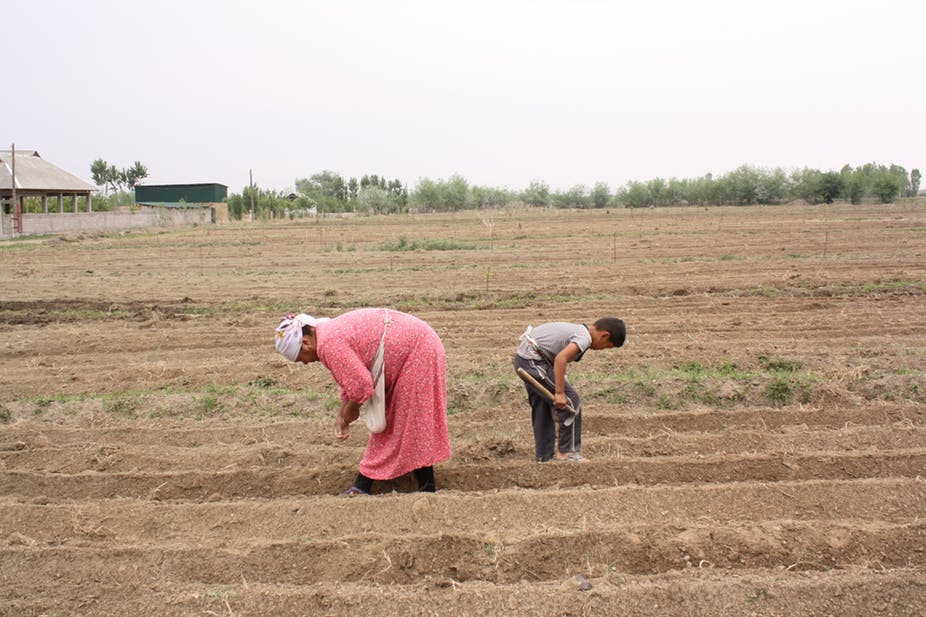
Kyrgyz women have gradually replaced men in various tasks, at home but also as migrant labourers. Asel Murzakolova, Author provided
Kyrgyzstan: Migrant Women Workers and a ‘Lost Generation’ of Children
Dilya-eje, a secondary school teacher in the border village of Samarkandek, Kyrgyzstan, often visits the houses of her neighbourhood to record the children who should attend school the next year. She always indicates the status of their parents in her notebook. More than half of the parents are labelled as migrants.
When men migrate, women take on the usual male roles: today most agricultural labour in the villages is done by women. But in Kyrgyzstan there are also a high number of women migrants. In 2016, women accounted for about 40% of total Kyrgyz labour migrants to Russia. Some are divorced or married women and some are very young girls who begin to earn money just after graduating from high school. Women migrating to Russia are usually employed in the service sector.
Because of these trends, traditional notions of femininity and masculinity are now often in conflict. Despite the fact that these women are sometimes the main source of income in their families, they have to face misogynistic behaviour – and violence.
‘A real woman is willing do housekeeping’
Labour migration is always accompanied by a dichotomy between economic benefits and social consequences.
According to a 2016 United Nations Population Fund (UNFPA) survey in Kyrgyzstan, migrant women face deep contempt when returning home.
Among 6,000 households interviewed, it was found that more than half of respondents (51% of women and 61% of men) believe that a “wife’s career is less important than the career of her husband”. Meanwhile, 43% of men and 38% of women felt that a “woman’s work has negative impact on family and children”. Most respondents agreed that “a real woman is willing do housekeeping - it is a pleasure for her”.
Women returning from labour migration also face problems of reintegration into the family and alienation of children. At the same time, studies have shown that remittances home are mostly spent on regular consumption, such as food, medicines and clothes. Large amounts of savings go towards buying the likes of homes or cars.
It is difficult to trace what part of the remittances are made by migrant women, but it should be noted that migrants from Kyrgyzstan transferred an average annual amount of a third of the country’s GDPbetween 2012 and 2014.
Independence and experience
Despite the negative public attitude to women’s labour migration, it helps many women to gain financial independence and gain experience of making their own choices of partner, budget, and investments which they could not do in traditional rural patriarchal communities from which they mostly come. Labour migration also remains the most accessible way of socialisation for them.
Migration transforms gender relations in modern Kyrgyz society, in which the Soviet emancipation of women, the renaissance of Islam and capitalism compete in forming a new national identity.
Today, such changes are perceived as a threat by many Kyrgyz men, some of whom turn to violence. This new environment has allowed the emergence of nationalistic Kyrgyz male groups called “Patriots”, who form “moral police” to pursue Kyrgyz women who lead what they regard as an immoral lifestyle in Russia.
According to the UNFPA survey, such actions are supported by a majority of the Kyrgyz population:
over half of the respondents support the work of nationalist organisations … stripping, raping them [the migrant women] and uploading their photos and ‘punishment’ videos for bad behaviour. At the same time, 22% of women and 26% of men do not consider it immoral for a man to create a new family in migration, if he continuously takes care of the first family left behind in his country of origin.
Criticism was only concentrated in the circle of the liberal minority.
“What the girls are blamed for is the result of poverty and marginalisation. But no one has the right to give a moral assessment of their behaviour. If these guys were real patriots, then they would … help them find jobs, look for housing”, claimed Nurgul Asylbekova, an United Nations Development Programme representative.
Beyond attacks, the underlining issue is a public conflict about what a Kyrgyz woman should be, and what it means to be a Kyrgyz man. It reveals a deep fracture in Kyrzgyz society.
Hostages of a patriarchal culture
The country as a whole has a high level of violence against women: nearly one-third of women and girls, age 15-49 face violence. In this context, violence against migrant women does not seem to be anything outrageous.
Husbands of migrant women are also hostages of patriarchal Kyrgyz culture. Childcare and household management lowers their social status in society. They also, experience pressure in their communities. As a result, public condemnation mixed with physical separation often leads to the disintegration of the women’s families.
Despite the fact that there are more than 15,000 registered NGOs in a country of six million people, none specifically addresses the problems faced by migrant women. Most migrant women who return home need employment, psychological aid and medical care.
It is obvious that female migration in Kyrgyzstan is not a temporary phenomenon. The teacher, Dilya-eje, uses her own definition for migrant children: “a lost generation”. Such a definition does not exist in the language of the government, international organisations and NGOs in Kyrgyzstan. Women’s migration is still an invisible phenomena. Yet an open public debate is needed to address the new gender order and the deep societal changes that are fostered by migration.
This article was originally published by The Conversation.

ASEL MURZAKULOVA
Asel Murzakulova is a Senior Research Fellow at the Mountain Societies Research Institute of the University of Central Asia.
CHINA: The Human Cost of Electronics
This short documentary reveals the hazards of the electronics industry in China profiling workers poisoned by chemicals and their struggle for compensation.
Thousands of young people in China enter export factories to make the West's favorite electronic gadgets, only to find they have contracted occupational diseases or worse, leukemia, by the age of 25.
The True Cost
'The True Cost' is a story about clothing. It's about the clothes we wear, the people who make them, and the impact the industry is having on our world. Check out the trailer for this groundbreaking documentary that pulls back the curtain on untold stories of workers along the supply chain, leading the viewer to consider: who really pays the price for our clothing?