
Visiting the caravan stopover Tash Rabat and the nearby glacial lake Chatyr-Kul can be demanding, but it is worth the journey to trek along the Silk Road on horseback.
Read MoreKyrgyzstan: From the Silk Road to the Celestial Mountains
A Central Asian country not known for its tourism, Kyrgyzstan boasts three Unesco World Heritage Sites. Each differs greatly in terms of its cultural significance, all providing different experiences for a traveler.
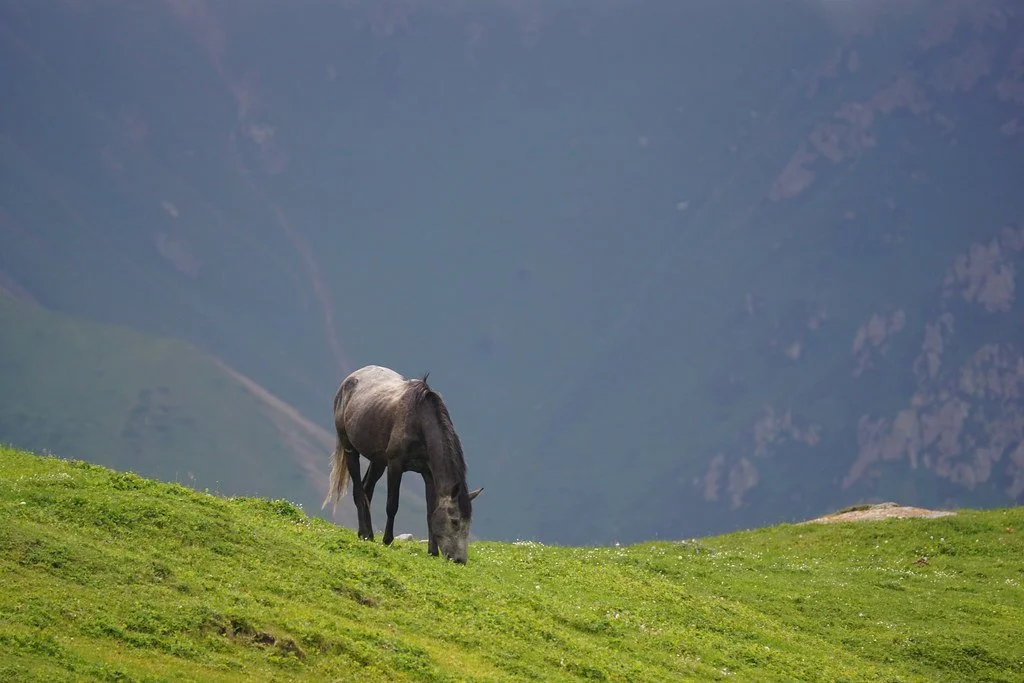
Wildlife in Kyrgyzstan. Charles Fred. CC BY-NC-SA 2.0.
Kyrgyzstan is known for its beautiful scenery; for example, there are two stunning canyons in Kyrgyzstan: the Fairy Tale Canyon and the Konorchek Canyons. The Kyrgyz people lived a nomadic lifestyle well into the 20th century, and aspects of this rich culture are still recognizable in architecture today. For example, a traveler to Kyrgyzstan can see a Bozui house—a type of architecture distinct to the Kyrgyz—and learn how it is built. In terms of the UNESCO World Heritage Sites, the three sites are deeply historically and culturally significant, as well as breathtaking.
1. The Chang'an-Tianshan Corridor of the Silk Road
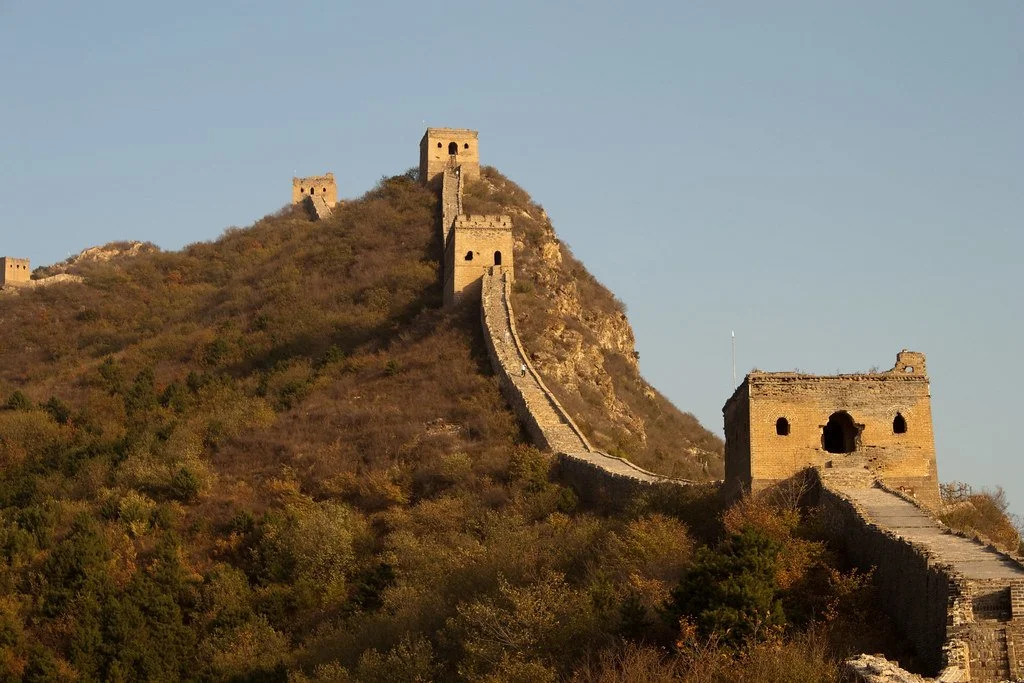
Section of the Great Wall of China in Kyrgyzstan. Matt Barber. CC BY 2.0.
The Chang’an-Tianshan Corridor is a section of the Silk Road, the most used collection of trade routes during ancient times, which primarily connected China with countries in Europe, the Middle East and East Africa. The Chang'an-Tianshan Corridor was named a UNESCO World Heritage Site in June of 2014, due to the historical significance of the Silk Road, which had been used until as late as the 16th century. The Chang’an-Tianshan Corridor in Kyrgyzstan is an especially interesting and important sector of the Silk Road due to its beauty, rocky terrain and historical significance. The Chang’an-Tianshan Corridor was used from the 4th through 16th century to transport mostly luxury goods, with its use beginning to facilitate trade between the Chinese and Roman empires. It was also very difficult to navigate due to its massive peaks and valleys—the climate of which ranges from snowy to arid to humid. In addition to natural sites, the corridor contains many cultural and historical destinations. Parts of the Chang’an-Tianshan Corridor run along the Great Wall of China. Additionally, there are several Buddhist temples, ancient palaces and tombs along the corridor.
2. The Sulaiman-Too Sacred Mountain

View of Sulaiman Too-Sacred Mountain from Osh. Christian Gawron. CC BY-SA 2.0.
Also located on the Silk Road, the Sulaiman-Too Sacred Mountain (located next to the city of Osh) was declared a UNESCO World Heritage Site in 2009. The Sulaiman-Too Sacred Mountain has been regarded for hundreds of years as a sacred destination, primarily in Islam, but also in religions and belief-systems that contain only some aspects of the Islamic faith. The mountain contains two reconstructed mosques from the 16th century, caves with ancient petroglyphs and many other sites for worship—17 of which are still in use today. One of the main non-Islamic groups which has historically worshiped at the Sulaiman-Too Sacred Mountain is the cult of the horse, which is reflected in much of the cave art.
3. The Tien-Shan Mountains

The Tien-Shan Mountains. Bruno Rijsman. CC BY-SA 2.0.
“Tien-Shan” in Chinese means “celestial.” The mountains may have gotten their name from their extremely high peaks; the highest points of the Tien-Shan mountains are also the highest points in all of Kyrgyzstan. The peaks in Kyrgyzstan were officially declared a World Heritage Site in 2016, although the parts of the mountains in China had been named a World Heritage Site in 2013. The Tien-Shan Mountains are mostly known for their diverse wildlife and for being home to several ethnic groups such as the Uyghur people and various Buddhist sects. While the oppression of the Uyghur people is not nearly as severe in Kyrgyzstan as it is in China, in recent years, there have been reports of violence from the Kyrgyz majority towards the Uyghur, as well as governmental interference in Uyghur political organizing. Despite Kyrgyzstan’s treatment of the Uyghur people, the Tien-Shan Mountains remain the home of many Uyghur people in the country. The mountains are covered in glaciers, many of which are threatened by climate change. This could change the entire geological landscape of the Tien-Shan mountains. Wildlife found on Tien-Shan include snow leopards and the Himalayan snowcock. Out of the three World Heritage Sites in Kyrgyzstan, the Tien-Shan Mountains is the most focused on the nature of Kyrgyzstan as opposed to the history featured in the other two sites.

Calliana Leff
Calliana is currently an undergraduate student at Boston University majoring in English and minoring in psychology. She is passionate about sustainability and traveling in an ethical and respectful way. She hopes to continue her writing career and see more of the world after she graduates.
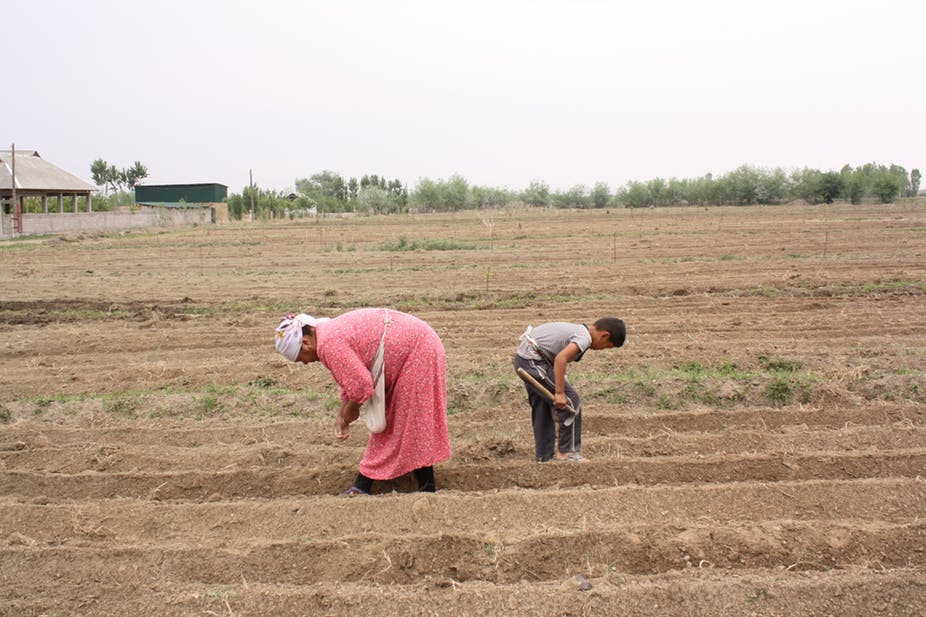
Kyrgyz women have gradually replaced men in various tasks, at home but also as migrant labourers. Asel Murzakolova, Author provided
Kyrgyzstan: Migrant Women Workers and a ‘Lost Generation’ of Children
Dilya-eje, a secondary school teacher in the border village of Samarkandek, Kyrgyzstan, often visits the houses of her neighbourhood to record the children who should attend school the next year. She always indicates the status of their parents in her notebook. More than half of the parents are labelled as migrants.
When men migrate, women take on the usual male roles: today most agricultural labour in the villages is done by women. But in Kyrgyzstan there are also a high number of women migrants. In 2016, women accounted for about 40% of total Kyrgyz labour migrants to Russia. Some are divorced or married women and some are very young girls who begin to earn money just after graduating from high school. Women migrating to Russia are usually employed in the service sector.
Because of these trends, traditional notions of femininity and masculinity are now often in conflict. Despite the fact that these women are sometimes the main source of income in their families, they have to face misogynistic behaviour – and violence.
‘A real woman is willing do housekeeping’
Labour migration is always accompanied by a dichotomy between economic benefits and social consequences.
According to a 2016 United Nations Population Fund (UNFPA) survey in Kyrgyzstan, migrant women face deep contempt when returning home.
Among 6,000 households interviewed, it was found that more than half of respondents (51% of women and 61% of men) believe that a “wife’s career is less important than the career of her husband”. Meanwhile, 43% of men and 38% of women felt that a “woman’s work has negative impact on family and children”. Most respondents agreed that “a real woman is willing do housekeeping - it is a pleasure for her”.
Women returning from labour migration also face problems of reintegration into the family and alienation of children. At the same time, studies have shown that remittances home are mostly spent on regular consumption, such as food, medicines and clothes. Large amounts of savings go towards buying the likes of homes or cars.
It is difficult to trace what part of the remittances are made by migrant women, but it should be noted that migrants from Kyrgyzstan transferred an average annual amount of a third of the country’s GDPbetween 2012 and 2014.
Independence and experience
Despite the negative public attitude to women’s labour migration, it helps many women to gain financial independence and gain experience of making their own choices of partner, budget, and investments which they could not do in traditional rural patriarchal communities from which they mostly come. Labour migration also remains the most accessible way of socialisation for them.
Migration transforms gender relations in modern Kyrgyz society, in which the Soviet emancipation of women, the renaissance of Islam and capitalism compete in forming a new national identity.
Today, such changes are perceived as a threat by many Kyrgyz men, some of whom turn to violence. This new environment has allowed the emergence of nationalistic Kyrgyz male groups called “Patriots”, who form “moral police” to pursue Kyrgyz women who lead what they regard as an immoral lifestyle in Russia.
According to the UNFPA survey, such actions are supported by a majority of the Kyrgyz population:
over half of the respondents support the work of nationalist organisations … stripping, raping them [the migrant women] and uploading their photos and ‘punishment’ videos for bad behaviour. At the same time, 22% of women and 26% of men do not consider it immoral for a man to create a new family in migration, if he continuously takes care of the first family left behind in his country of origin.
Criticism was only concentrated in the circle of the liberal minority.
“What the girls are blamed for is the result of poverty and marginalisation. But no one has the right to give a moral assessment of their behaviour. If these guys were real patriots, then they would … help them find jobs, look for housing”, claimed Nurgul Asylbekova, an United Nations Development Programme representative.
Beyond attacks, the underlining issue is a public conflict about what a Kyrgyz woman should be, and what it means to be a Kyrgyz man. It reveals a deep fracture in Kyrzgyz society.
Hostages of a patriarchal culture
The country as a whole has a high level of violence against women: nearly one-third of women and girls, age 15-49 face violence. In this context, violence against migrant women does not seem to be anything outrageous.
Husbands of migrant women are also hostages of patriarchal Kyrgyz culture. Childcare and household management lowers their social status in society. They also, experience pressure in their communities. As a result, public condemnation mixed with physical separation often leads to the disintegration of the women’s families.
Despite the fact that there are more than 15,000 registered NGOs in a country of six million people, none specifically addresses the problems faced by migrant women. Most migrant women who return home need employment, psychological aid and medical care.
It is obvious that female migration in Kyrgyzstan is not a temporary phenomenon. The teacher, Dilya-eje, uses her own definition for migrant children: “a lost generation”. Such a definition does not exist in the language of the government, international organisations and NGOs in Kyrgyzstan. Women’s migration is still an invisible phenomena. Yet an open public debate is needed to address the new gender order and the deep societal changes that are fostered by migration.
This article was originally published by The Conversation.


ASEL MURZAKULOVA
Asel Murzakulova is a Senior Research Fellow at the Mountain Societies Research Institute of the University of Central Asia.