
• Travel Features
  • Global Action
  • Take A Trip
  • Travel Guides
    • Podcast
    • Courses
    • Bookshop
  • About
  • Sign Up
Menu

CATALYST PLANET

  • Travel Features
  • Global Action
  • Take A Trip
  • Travel Guides
  • Discover
    • Podcast
    • Courses
    • Bookshop
  • About
  • Sign Up

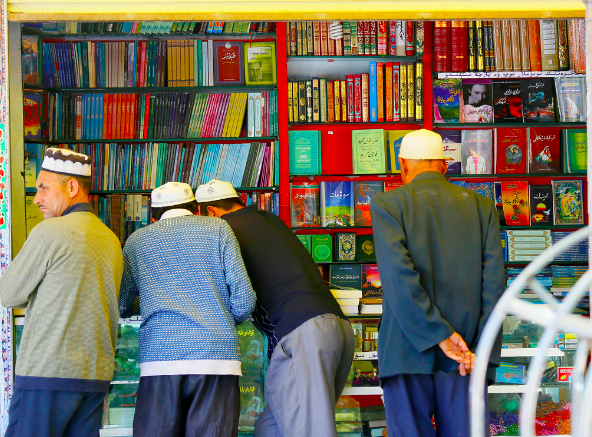
People of Xinjiang. Peter Chou Kee Liu. CC BY-NC-ND 2.0

China is Putting Muslims in Concentration Camps Because of an “Ideological Illness”

July 29, 2019

According to a UN report, China has declared Islam an “ideological illness”. One UN spokesperson claims there are approximately over a million Muslims currently in these camps. The UN report states “the evidence indicated that most of the detentions were taking place outside the criminal justice system, and targeted specifically Uyghur and other Muslim minorities, such as Kazakh”. But why is this happening? In the words of the Official Chinese Communist Party, “Members of the public who have been chosen for re-education have been infected by an ideological illness. They have been infected with religious extremism and violent terrorist ideology, and therefore they must seek treatment from a hospital as an inpatient”. The region of Xinjiang, in recent years, has faced attacks from extremist groups and because of this, have targeted the entire Uighur community in Xinjiang to prevent them from being further “infected by religious extremism and a violent terrorism disease.”

The region of Xinjiang is a highly populated by the “Turkic-speaking Muslim Uighur minority, who make up about eight million of its 19 million people”, according to a BBC article profiling the region. With the population being highly Muslim, the Chinese government has profiled that area in a subtle racist attempt to force the people of the area to renounce Islam and their practices. In a statement from the Communist Party, they state that “in order to provide treatment to people who are infected with ideological illnesses and to ensure the effectiveness of the treatment, the Autonomous Regional Party Committee decided to set up re-education camps in all regions, organizing special staff to teach state and provincial laws, regulations, the party’s ethnic and religious policies, and various other guidelines”. Furthermore, they say, “At the end of re-education, the infected members of the public return to a healthy ideological state of mind, which guarantees them the ability to live a beautiful happy life with their families”. It is disturbing to read words such as “disease” and “those infected” when it is in regards to innocent Uiguhr individuals. Using such diction creates a harmful and discriminatory connotation that the Uighur community is “sick” and “infectious”, a dangerously false narrative.

Although the camps have the intention of “[fighting] separatism and Islamic extremism”, they stem from a fear of an uprising in the Xinjiang area and has become a prejudice and gross abuse of human rights. Many of the people who were able to leave the concentration camps now are facing psychological ramifications and a complete lack of faith in the country that they are living. The camps are supposedly supposed to help threats and protect the people, yet they are harming them instead.

 In many interviews from those who were in the concentration camp, they have mentioned that the “re-education” forces them to renounce Islam, renounce the Holy Quran, admit that the Uighur culture is backward in comparison to the Communist Party, and if the detainees refuse to cooperate, they are punished harshly. Some punishments include them not being fed, solitary confinement, or physical beatings. Recently, it has come out that there has been a death in one of the camps. A Uighur writer Nurmuhammad Tohti, died at the age of 70 because "he had been denied treatment for diabetes and heart disease, and was only released once his medical condition meant he had become incapacitated", according to his granddaughter, Zorigul. But even with the criticism and the death, the Chinese government still does not believe what they are doing is wrong. 

China Daily, a popular media outlet, claimed that “Western critics of China's policies on human rights and religious freedom in the Xinjiang Uygur autonomous region seem to be divorced from the realities of the situation.” They stand in defense of their practices rather than understand how harmful they are and how they are creating a dogmatic perspective.

It is concerning to see how fear has created a ripple of harmful decisions and gross infringements on human rights. There is no reason for an entire community to reap the consequences of extremists actions when they are the innocents.


OLIVIA HAMMOND is an undergraduate at Emerson College in Boston, Massachusetts. She studies Creative Writing, with minors in Sociology/Anthropology and Marketing. She has travelled to seven different countries, most recently studying abroad this past summer in the Netherlands. She has a passion for words, traveling, and learning in any form. 



Tags China, Muslim, concentration camp, Asia, religious, religion, Islam, People's Republic of China, Human Rights
Comment

Xi Jinping, General Secretary of the Communist Party in the People's Republic of China. U.S. Department of State. Public Domain.

Government Control Over China Intensifies Under New General Secretary

February 19, 2019

“The Story of Yanxi Palace” is a Chinese TV drama set in the Qing dynasty that follows a  group of concubines as they compete for power in the imperial court. It premiered in the summer of 2018 and was viewed more than 15 billion times on iQiyi, China’s premier movie streaming service. Despite its massive popularity, the show was abruptly canceled by the Chinese state media for being too “lavish” and “nasty”. The paternal approach that the Chinese government takes to managing its citizens often leads it to become personally involved in even the most casual of affairs, and its oversight has expanded under its current leader, Xi Jinping.

Xi Jinping became General Secretary of the Communist Party in 2016, though he was thought by many to be its most influential member long before that. Shortly after taking power, Xi implemented a series of changes within the party itself. He pushed for an amendment that would remove term limits for General Secretaries, essentially keeping himself in power for the remainder of his life. The amendment was approved by nearly all of Xi’s constituents. Xi Jinping’s changes also included the creation of a “social credit” system which assigns Chinese citizens a score based on their day-to-day conduct in society. Teams of specially trained officials have been sent to monitor neighborhoods throughout the country and report thier findings to the goverment. The Party has also installed cameras at traffic intersections and subway stations equipped with facial recognition technology. This, in addition to a long-established internet firewall that renders sites like Facebook, Youtube and Twitter inaccessible to those on the mainland, have critics calling the current state of the country “Orwellian”.

The government’s tolerance for public scrutiny also appears to have tightened under Xi’s leadership (it was never “loose” to begin with). In March, reporter Liang Xiangyi became an internet sensation when she was seen cringing and rolling her eyes while a colleague asked China’s Foreign Minister a lengthy question about Xi Jinping's future plans for the country. The incident took place at an annual meeting of China’s National People’s Congress, a highly televised event in which questions from the media are often vetted. Shortly after the incident Liang disappeared amid rumors that she had been fired and her press privileges had been revoked. Buddhists, Christians, and Muslims living in China have also found themselves under increased scrutiny. While the Chinese constitution technically allows for freedom of religion, the Communist Party itself is officially atheist, and under Xi Jinping, the Party began promoting the idea of “sinicization” which calls for non-Chinese groups living in China to acclimate themselves to the overarching culture of the country. The government is now using this ideology to push for religious practitioners to merge their beliefs with Communist ideology. Those who resist are detained and forced to renounce their religions while temples, churches, and mosques are shut down, if not destroyed entirely.

It is often said that while the West favors freedom, China favors stability. However, “freedom” and “stability” are fairly broad ideas, and their benefits don’t always trickle down to those at the lower rungs of society. It remains to be seen who actually benefits from China’s proclaimed stability, and how these changes will be received by the country’s massive population.

JONATHAN ROBINSON is an intern at CATALYST. He is a travel enthusiast always adding new people, places, experiences to his story. He hopes to use writing as a means to connect with others like himself. 

Tags China, government, general secretary, global, leadership, Communism, People's Republic of China, International Affairs
Comment

Also check out...

Featured
Vietnam’s Floating Markets Are Disappearing
The Supernatural Role of Masks in Nigeria’s Yoruba Tribal Culture
Opening the World to Deaf Travelers with Lily Yu

Featured trips

Featured
Offer NGO Support While Visiting Quito
Experience Life as a Mongolian Nomad
Help Grow Organic Costa Rican Coffee

Sign up for the CATALYST newsletter

Sign up for our newsletter to get the scoop on international travel, global social impact insights, our latest podcast releases, and more from around the world, all delivered right to your inbox!

We respect your privacy.

Thank you!
Newsletter Sign Up | Advertise | Careers + Internships | Privacy Policy | Submissions | Contact Us

Copyright © 2025, MISSION MEDIA LLC. All rights reserved.