As More Developing Countries Reject Plastic Waste Exports, Wealthy Nations Seek Solutions at Home

Less than two years after China banned most imports of scrap material from abroad, many of its neighbors are following suit. On May 28, 2019, Malaysia’s environment minister announced that the country was sending 3,000 metric tons of contaminated plastic wastes back to their countries of origin, including the United States, Canada, Australia and the United Kingdom. Along with the Philippines, which is sending 2,400 tons of illegally exported trash back to Canada, Malaysia’s stance highlights how controversial the global trade in plastic scrap has become.

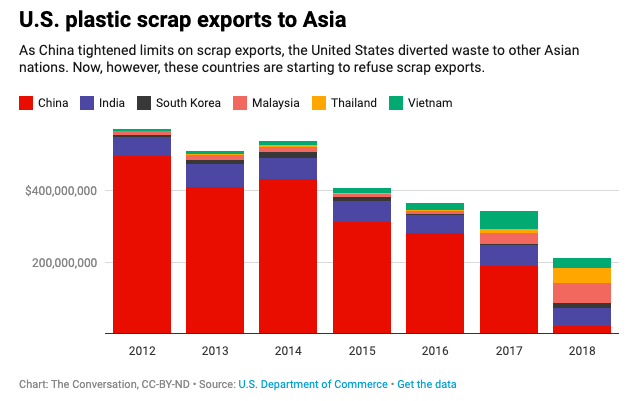
Malaysia, Thailand and Vietnam are all halting flows of plastics that once went to China but were diverted elsewhere after China started refusing it. They are finding support from many nations that are concerned about waste dumping and marine plastic pollution. At a meeting in Geneva in May 2019, 186 countries agreed to dramatically restrict international trade in scrap plastics to prevent plastics dumping.

As I show in my forthcoming book, “Waste,” scrap material of all kinds is both a resource and a threat. The new plastics restriction allows less-wealthy countries to exercise their sovereign right not to accept materials they are ill-equipped to handle. This narrows options for wealthy countries that used to send much of their plastic and paper scrap abroad, and is a small but symbolic step toward curbing plastic waste.

Single-stream recycling in the U.S. has increased resource collection, but it generates contaminated materials that cost more to recycle.

A trade with few rules

The Basel Convention, which governs the international waste trade, was adopted in 1989 in response to egregious cases of hazardous waste dumping on communities in Africa, the Caribbean and Asia. Many of its goals remain unfulfilled, including a ban on shipments of hazardous waste from wealthy to less-wealthy nations for final disposal, and a liability protocol that would assign financial responsibility in the event of an incident. And the agreement has largely failed to encompass newer wastes, particularly discarded electronics.

The new provision, proposed by Norway with broad international support, takes a more aggressive approach. It moves plastic scrap from one category – wastes that can be traded unless directly contaminated – to another group of materials that are not deemed hazardous per se, but are subject to the same trade controls as those classified as hazardous. Now these plastics can be shipped overseas for disposal or recycling only with the express consent of the importing country.

The United States signed the treaty in 1989, but never ratified it and is not bound by the treaty’s terms. However, Basel Convention member countries cannot accept any restricted waste imports from the United States unless they have reached a bilateral or regional agreement that meets Basel’s environmental provisions. The U.S. already has such an agreement with fellow OECD member countries.

Operation National Sword, China’s policy restricting imports of post-consumer scrap, was a major driver for updating the treaty. Before the ban China imported nearly half of the world’s scrap plastic and paper. Now scrap exporters in wealthy nations are struggling to find alternate markets overseas and boost domestic recycling.

Crisis and opportunity for US recyclers

Trends in the United States illustrate these wrenching shifts. Plastic scrap exports to China plummeted from around 250,000 tons in the spring of 2017 to near zero in the spring of 2019. Overall, U.S. exports of plastic waste to all countries fell from 750,000 tons to 375,000 tons over the same period.

Most U.S. waste and recycling policies are made at the local level, and the past year has been a transformative period. Without ready markets abroad for scrap, recyclers are raising prices, which in turn is leading some municipalities to reduce or eliminate curbside recycling programs. Many plastic products in groups 3-7, the least recyclable types, are being sent to landfills.

More positively, recycling authorities have launched public education campaigns, and investment in recycling infrastructure is on the rise. There is palpable energy at trade meetings around improving options for plastics recycling. Chinese companies are investing in U.S. pulp and paper recycling plants, and may extend into plastics.

The Oregonian✔@Oregonian

Here's what you can and can't #recycle in Portland.

23

5:06 PM - May 27, 2019

Twitter Ads info and privacy

22 people are talking about this

Green-leaning states and cities across the nation have passed strict controls on single-use consumer plastics. However, businesses are pushing back, and have persuaded some U.S. states to adopt preemptive measures barring plastic bag bans.

The greatest immediate pressure is on international scrap dealers, who are most immediately affected by the Norway Amendment and vocally opposed it. They are also under stress from the U.S.-China tariff wars, which could make it difficult for them to send even clean, commercially valuable scrap to China.

Waste or scrap?

Under the Norway Amendment, nations can still export plastic scrap if it is clean, uncontaminated and of high quality. The measure effectively distinguishes between waste – which has no value and is potentially harmful – and scrap, or discarded materials that still have value.

This bifurcation matters for the U.S. and other countries that formerly outsourced their recycling to China and are having trouble creating domestic demand for recovered plastics, because it makes a legitimate trade in plastic and other marginal scrap possible. However, there is still no guarantee that this scrap can be reprocessed without harm to workers or the environment once it has reached the importing country.

Nor will the Norway Amendment do much to reduce marine plastic pollution directly. Only a tiny fraction of ocean plastics originate from shipped plastic scrap from rich countries. Most come from items that are used and discarded on land and never enter a recycling system.

Curbing plastic pollution will require broader action, with a focus on coordinating scattered global initiatives and building up relevant international law. Implementing extended producer responsibility for plastics, which could require manufacturers to take plastic products back at their end of life and dispose of them in approved ways, would be a useful step. However, it should not supplant ongoing efforts to reduce production and use of plastics, which contribute to climate change as well as waste.

Solutions may come from the top down in European nations or the bottom up in the United States. But as one Asian country after another shuts the door on scrap exports, it is becoming increasingly clear that business as usual will not solve the plastic pollution challenge.

Kate O'Neill is an Associate Professor, Global Environmental Politics, University of California, Berkeley

THIS ARTICLE WAS ORIGINALLY PUBLISHED ON THE CONVERSATION

Following the Removal of Evo Morales, Anti-Indigenous Sentiment Explicit in Bolivia

In the aftermath of the ouster of former President of Bolivia, Evo Morales, many suspected a right-wing coup had taken place. Now, a month later, the status of Indigenous peoples in Bolivia hangs in the balance.

Read More

ClimbAID Fosters Growth in Refugee Children Through Rock Climbing

The organization started in 2016 and now has projects in Switzerland and Lebanon.

The physical and mental challenge of climbing can have many therapeutic benefits. Pablo Benedito. CC BY-NC 4.0.

ClimbAID, a non-profit organization that works with refugees, operates a moving rock wall in Lebanon. The project, A Rolling Rock, was unleashed in a pilot session in 2017 and has shown great promise. Using climbing as an alternative therapy is not all that new but is often limited due to lack of access to climbing areas. The prevalence of gyms and surge of support for indoor climbing and bouldering is making climbing more accessible, but only for those that can afford it. A Rolling Rock fixes this by bringing the climbing directly to the kids. Because it is bouldering it requires less gear than top-rope climbing allowing for lower costs. In addition, it removes barriers of transporting children without papers through military controlled regions.

One-third of Lebanon’s population is refugees. Since the Syrian war started in 2011, 1.5 million Syrian refugees remain in the country. Lebanon’s security is a balance of political and cultural importance. After their own 15-year civil war mostly spurred by unequal representation of the three main religious groups in the country, Lebanon found a solution that works only with equal populations of Sunni Muslims, Shiite Muslims, and Christians. It has functioned this way since the 1990s. The 2 million refugees now residing within Lebanon’s boarders are almost all Sunni Muslim, having fled Syria or Palestine. If the refugees can never return home, this would greatly upset the delicate balance currently supporting the government. Additionally, the country is facing an extreme economic downfall, much of which is blamed on Syrian refugees. The country even started deporting refugees for the first time this past May.

ClimbAID hopes that by providing an outlet for refugee children, most of whom are not in school, and to encourage common ground and bonding between different groups in Lebanon, that the xenophobia might begin to decrease. Additionally, climbing has been found to be beneficial in fighting mental health issues and trauma. A study done in 2005 found that climbing reduced symptoms of anxiety, depression, and PTSD. Climbing has been incorporated into wilderness-based therapy programs and small non-profits in the US such as Sacred Rok, an organization working in Yosemite Valley with at-risk youth. Their potential is still being researched but many studies have continued to release positive results.

ClimbAID’s program in Switzerland has seen good results as well. In 2018, they had on average six climbing sessions a week. They too have faced issues with decreases in government support to refugees. There is now a gap of social integration programs for refugees within Switzerland. Climbing can help fill the hole left by changes in governmental policies and can encourage bonding and German language skills.

Most importantly, though, ClimbAID provides a space where children that have been displaced, have experienced deep trauma, and now live well below the poverty line in a country where they are not completely welcomed, are accepted, where they can have fun, and a place where they can excel. This is extremely beneficial in building confidence and social skills that are necessary for having a promising future.

DEVIN O’DONNELL’s interest in travel was cemented by a multi-month trip to East Africa when she was 19. Since then, she has continued to have immersive experiences on multiple continents. Devin has written for a start-up news site and graduated from the University of Michigan with a degree in Neuroscience.

Why Don’t More Women Win Science Nobels?

All of the 2019 Nobel Prizes in science were awarded to men. 

That’s a return to business as usual, after biochemical engineer Frances Arnold won in 2018, for chemistry, and Donna Strickland received the 2018 Nobel Prize in physics

Strickland was only the third female physicist to get a Nobel, following Marie Curie in 1903 and Maria Goeppert-Mayer 60 years later. When asked how that felt, she noted that at first it was surprising to realize so few women had won the award: “But, I mean, I do live in a world of mostly men, so seeing mostly men doesn’t really ever surprise me either.”

The rarity of female Nobel laureates raises questions about women’s exclusion from education and careers in science. Female researchers have come a long way over the past century. But there’s overwhelming evidence that women remain underrepresented in the STEM fields of science, technology, engineering and math.

Studies have shown those who persist in these careers face explicit and implicit barriers to advancement. Bias is most intense in fields that are predominantly male, where women lack a critical mass of representation and are often viewed as tokens or outsiders.

When women achieve at the highest levels of sports, politicsmedicine and science, they serve as role models for everyone – especially for girls and other women. 

As things are getting better in terms of equal representation, what still holds women back in the lab, in leadership and as award winners?

Good news at the start of the pipeline

Traditional stereotypes hold that women “don’t like math” and “aren’t good at science.” Both men and women report these viewpoints, but researchers have empirically disputed them. Studies show that girls and women avoid STEM education not because of cognitive inability, but because of early exposure and experience with STEM, educational policy, cultural context, stereotypes and a lack of exposure to role models. 

For the past several decades, efforts to improve the representation of women in STEM fields have focused on countering these stereotypes with educational reforms and individual programs that can increase the number of girls entering and staying in what’s been called the STEM pipeline – the path from K-12 to college to postgraduate training.

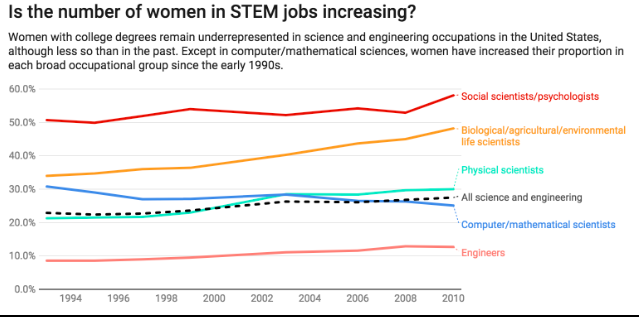
These approaches are working. Women are increasingly likely to express an interest in STEM careers and pursue STEM majors in college. Women now make up half or more of workers in psychology and social sciences and are increasingly represented in the scientific workforce, though computer and mathematical sciences are an exception. 

According to the American Institute of Physics, women earn about 20% of bachelor’s degrees and 18% of Ph.D.s in physics, an increase from 1975 when women earned 10% of bachelor’s degrees and 5% of Ph.D.s in physics.

More women are graduating with STEM Ph.D.s and earning faculty positions. But they encounter glass cliffs and ceilings as they advance through their academic careers.

What’s not working for women

Women face a number of structural and institutional barriers in academic STEM careers.

In addition to issues related to the gender pay gap, the structure of academic science often makes it difficult for women to get ahead in the workplace and to balance work and life commitments. Bench science can require years of dedicated time in a laboratory. The strictures of the tenure-track process can make maintaining work-life balance, responding to family obligations and having children or taking family leave difficult, if not impossible.

Additionally, working in male-dominated workplaces can leave women feeling isolatedperceived as tokens and susceptible to harassmentWomen often are excluded from networking opportunities and social events, left to feel they’re outside the culture of the lab, the academic department and the field.

When women lack a critical mass in a workplace – making up about 15% or more of workers – they are less empowered to advocate for themselves and more likely to be perceived as a minority group and an exception. When in this minority position, women are more likely to be pressured to take on extra service as tokens on committees or mentors to female graduate students.

With fewer female colleagues, women are less likely to build relationships with female collaborators and support and advice networks. This isolation can be exacerbated when women are unable to participate in work events or attend conferences because of family or child care responsibilities and an inability to use research funds to reimburse child care.

Universities, professional associations and federal funders have worked to address a variety of these structural barriers. Efforts include creating family-friendly policies, increasing transparency in salary reporting, enforcing Title IX protections, providing mentoring and support programs for women scientists, protecting research time for women scientists and targeting women for hiring, research support and advancement. These programs have mixed results. 

For example, research indicates that family-friendly policies such as leave and onsite child care can exacerbate gender inequity, resulting in increased research productivity for men and increased teaching and service obligations for women.

People haven’t really updated their mental images of what a scientist looks like since Wilhelm Roentgen won the first physics Nobel in 1901. Wellcome Collection, CC BY

Implicit biases about who does science

All of us – the general public, the media, university employees, students and professors – have ideas of what a scientist and a Nobel Prize winner looks like. That image is predominantly male, white and older – which makes sense given 97% of the science Nobel Prize winners have been men.

This is an example of an implicit bias: one of the unconscious, involuntary, natural, unavoidable assumptions that all of us – men and women – form about the world. People make decisions based on subconscious assumptions, preferences and stereotypes– sometimes even when they are counter to their explicitly held beliefs.

Research shows that an implicit bias against women as experts and academic scientists is pervasive. It manifests itself by valuing, acknowledging and rewarding men’s scholarship over women’s scholarship. 

Implicit bias can work against women’s hiring, advancement and recognition of their work. For instance, women seeking academic jobs are more likely to be viewed and judged based on personal information and physical appearance. Letters of recommendation for women are more likely to raise doubts and use language that results in negative career outcomes.

Implicit bias can affect women’s ability to publish research findings and gain recognition for that work. Men cite their own papers 56% more than women do. Known as the “Matilda Effect,” there is a gender gap in recognition, award-winning and citations

Women’s research is less likely to be cited by others, and their ideas are more likely to be attributed to men. Women’s solo-authored research takes twice as long to move through the review process. Women are underrepresented in journal editorships, as senior scholars and lead authors and as peer reviewers. This marginalization in research gatekeeping positions works against the promotion of women’s research.

When a woman becomes a world-class scientist, implicit bias works against the likelihood that she will be invited as a keynote or guest speaker to share her research findings, thus lowering her visibility in the field and the likelihood that she will be nominated for awards. This gender imbalance is notable in how infrequently women experts are quoted in news stories on most topics.

Donna Strickland, outside her lab at the University of Waterloo, won her Nobel in 2018 as an associate professor.Reuters/Peter Power

Women scientists are afforded less of the respect and recognition that should come with their accomplishments. Research shows that when people talk about male scientists and experts, they’re more likely to use their surnames and more likely to refer to women by their first names

Why does this matter? Because experiments show that individuals referred to by their surnames are more likely to be viewed as famous and eminent. In fact, one study found that calling scientists by their last names led people to consider them 14% more deserving of a National Science Foundation career award.

Seeing mostly men has been the history of science. Addressing structural and implicit bias in STEM will hopefully prevent another half-century wait before the next woman is acknowledged with a Nobel Prize for her contribution to physics. I look forward to the day when a woman receiving the most prestigious award in science is newsworthy only for her science and not her gender.

Mary K. Feeney is a Professor and Lincoln Professor of Ethics in Public Affairs and Associate Director of the Center for Science, Technology and Environmental Policy Studies, Arizona State University

THIS ARTICLE WAS ORIGINALLY PUBLISHED ON THE CONVERSATION
Saudi Women Protesting Driving Ban Remain Jailed, Details of Trial Unclear

In 2017, the driving ban was lifted for Saudi women. However, the women who vocally protested the ban have been jailed, subjected months of torture and unable to communicate with their families.

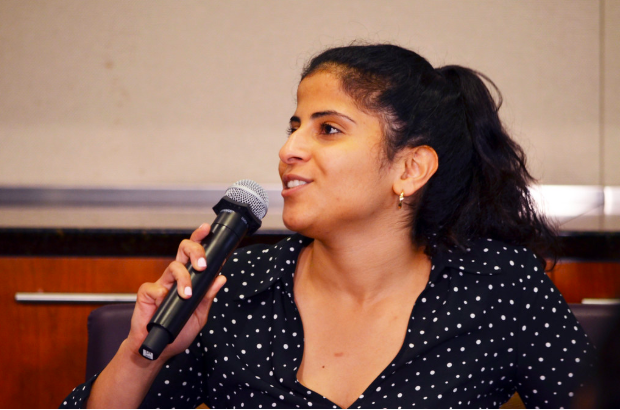
Lina Al-Hathloul speaking about the imprisonment of her sister, Loujain. POMED. CC BY 2.0

June 24th, 2018 marked the first day women in Saudi Arabia could legally obtain drivers licenses, following an announcement by King Salman in September that women driving would be considered acceptable under sharia law. By March of 2019, more than 70,000 Saudi women had received a license. Under the interpretation of sharia law enforced by the Saudi government, women are effectively minors, subject to guardianship by their fathers, husbands, or even their sons should their husbands pass away or become otherwise unable to fulfill the role of guardian. Women must receive permission to enroll in school, open bank accounts, sign contracts, or acquire a passport, to name a few of the many restrictions women face under guardianship laws.

Regarding the announcement of the end of the driving ban, Eman al-Nafjan writes in her blog, “Initially I was overwhelmed with my own powerlessness as a woman living in a patriarchal absolute monarchy. Were our efforts the reason the ban was lifted? Or was it a decision that had been made regardless of our struggles?” Dr. al-Nafjan is one of eleven women who was detained, subject to torture, solitary confinement, and threats of rape and death—more than once by Crown Prince Mohammed bin Salman himself—in 2018 as a result of their protests against the ban. The protests against the driving ban began in 1990, and have lead to the arrest, imprisonment, and severe punishment of many individuals. Of the eleven arrested in May-June 2018, some were released on bail. Al-Nafjan, as well as two other women, Loujain al-Hathloul and Nouf Abdulaziz, have borne the brunt of cruelty at the hands of the Saudi government, and as a result have received the most media attention. Their trials began in late March of 2019, however little is known of their current situation.

Nouf Abdulaziz, one of the women held in prison, writes in a letter sent during her detainment: “Hello my name is Nouf, and I am not a provoker, inciter nor a wrecker, nor a terrorist, nor a criminal nor a traitor.” The women imprisoned have sought justice for their fellow women, and we must honor their work by seeking justice on their behalf. There exists a clear duplicity in the West’s reaction to these human rights violations: although outwardly supportive of human rights, the U.S., France, and the U.K. have been complicit in the Saudi regime’s actions by maintaining close economic and security ties with Saudi Arabia. At the end of her letter, Abdulaziz implores her readers: “if what is happening does not please you, help our people to see clearly that our sister in the homeland is mistreated and she does not deserve other than her freedom, to maintain her dignity and to have the warmth in her parents [sic] arms, that has been taken away from her.” Many human rights organizations have spoken up on behalf of these activists, and Abdulzaziz, al-Hathloul, and al-Nafjan were awarded the 2019 PEN Freedom to Write Award for their work. 

In this vein, Amnesty International marked May 2018-May 2019 a “year of shame for Saudi Arabia” due especially to its treatment of women’s rights activists and the assassination of Jamal Khashoggi, a dissident Saudi journalist. Although Crown Prince Salman, accepting the position of Crown Prince in 2017, labeled himself a reformer, he immediately launched a campaign to repress dissenters of the regime. In this way, the worries expressed by Nafjan were prescient: the Saudi government lifted the driving ban in an effort to improve international opinion, as well as increase the number of women working in Saudi Arabia’s flagging private sector, not with genuine progressive intent. Those who most vehemently spoke up for the rights of women were made examples of for other dissenters. While ultimately a victory for the greater female Saudi population, the patriarchal regime insisted upon a last word—in the form of human rights violations against the very women who created the momentum for the lifting of the ban. 

HALLIE GRIFFITHS is an undergraduate at the University of Virginia studying Foreign Affairs and Spanish. After graduation, she hopes to apply her passion for travel and social action toward a career in intelligence and policy analysis. Outside of the classroom, she can be found, quite literally, outside: backpacking, rock climbing, or skiing with her friends.

Is There Hope for a Hong Kong Revolution?

Hong Kong may seem like an unlikely place for a revolution. In this relatively affluent and privileged city, young people might be expected to be more concerned with making money than with protesting in the streets. Yet day after day, demonstrators in Hong Kong risk injury and death confronting security forces backed by the massive power of the Chinese government.

Among their demands are democratic elections for the city’s Legislative Council and chief executive. Their desire for fundamental change has mounted, and they increasingly see their own lives as lacking meaning unless circumstances change.

Historians have long argued that revolutions are built not on deep misery but on rising expectations. Since the 18th century, societies, clubs and associations of intellectuals have been seedbeds of radical change in countries throughout the world. They provided leadership for the French Revolution in 1789, the European revolutions of 1848 and the Russian Revolution of 1905.

The situation in Hong Kong is revolutionary, too, although the history of past revolutions may not provide much hope of immediate change.

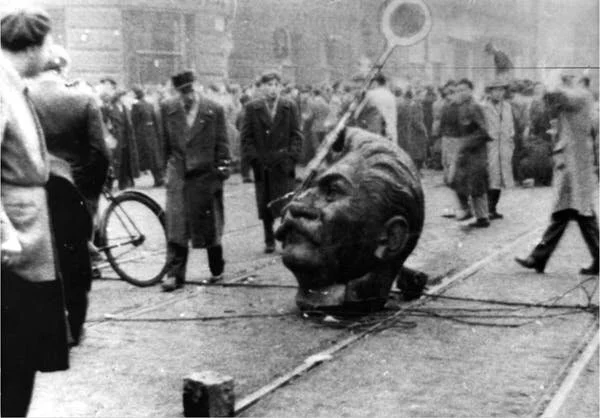
A view of the Hungarian Revolution before the Soviet tanks rolled in. Gabor B. Racz/Wikimedia Commons, CC BY-SA

A look at Hungary

The most compelling parallel to Hong Kong may be the Hungarian Revolution of 1956, which attempted to wrest power from a communist regime. It, too, began with a student uprising in favor of democratic elections.

Within a few days, the communist government resigned and a reformist administration was formed under Imre Nagy, who allowed noncommunists to enter political office. This went too far for communist leaders in the Soviet Union. The USSR invaded Hungary, overthrew Nagy’s regime and secretly put him to death.

As with the Hong Kong protests today, the United States gave little official support to the Hungarian Revolution and was unwilling to offer material assistance. Keeping peace in Europe was of vital importance to U.S. policy in 1956, just as good relations with China are now central.

The Hungarian example may provide little solace to the Hong Kong protesters – except, perhaps, if they consider its long-term consequences.

In October 1989, with Soviet influence in Eastern Europe collapsing, the democratic Republic of Hungary was declared on the 33rd anniversary of the 1956 revolution. Those who died during that revolution are now remembered as martyrs.

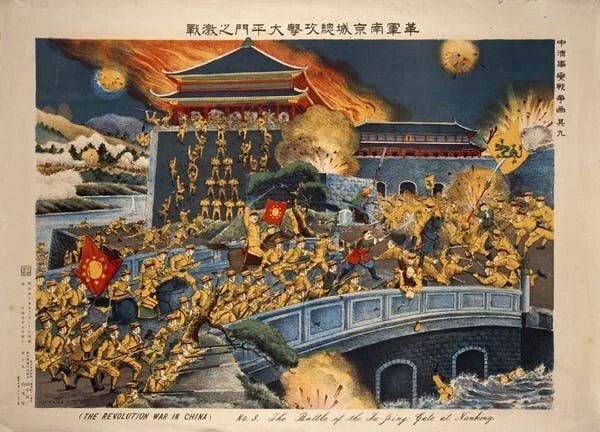
A contemporary print depicting the battle at the Ta-ping gate at Nanking, part of China’s Revolution of 1911. T. Miyano, Wellcome Library/Wikimedia Commons, CC BY

In China’s own history

Chinese history supplies a more heartening example of a successful student-led uprising: the Revolution of 1911. It was fomented by young men returning from study abroad, who formed political societies to “revive” their country, often disguised as literary discussion groups.

The 1911 Revolution mobilized networks of intellectuals and students throughout China, but it also drew on other social groups: military officers, merchants, coal miners and farmers. The revolution erupted in many parts of China simultaneously and had various outcomes, from utter failure, to the massacre of ethnic Manchus to declarations of Mongol and Tibetan independence. A provisional government emerged by the end of the year in Nanjing.

The Hong Kong protests, however, are too limited in geographical scope and social support to repeat the success of the 1911 revolutionaries.

The subsequent Chinese revolution in 1949, like the 1917 Russian Revolution, followed Leninist theory and was spearheaded by professional party insiders, not by intellectuals. The communists regarded mass protests as potentially counter-revolutionary and as threats to the new order.

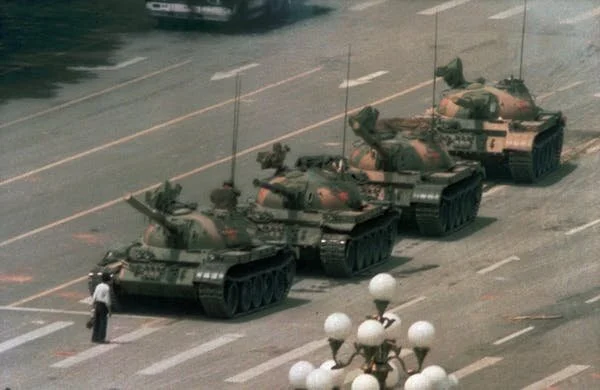
On June 5, 1989, a Chinese man stood alone to block a line of tanks in Tiananmen Square. AP Photo/Jeff Widener

What’s next?

The young protestors in Hong Kong seek to avoid the fate of the student demonstrators of Tiananmen Square in spring 1989. Three decades ago, hundreds, perhaps thousands, of protesters were massacred after the communist government invoked martial law. The pro-democracy agenda of the Tiananmen protesters was vague, and they relied on reformers within the party apparatus, who finally betrayed them.

The Hong Kong crowds are focused on specific changes and lack illusions about the party. They will go down fighting desperately, not standing with faint hope in front of tanks. That may give pause to the forces of repression. As the Communist Party of China and any student of history knows, martyrs are the fuel of future revolutions.

Paul Monod is a Professor of History at Middlebury College

THIS ARTICLE WAS ORIGINALLY PUBLISHED ON THE CONVERSATION
War and Climate Change in Yemen

 As climate change continues to take its toll globally, Yemen has begun to dramatically feel its effects. The water shortages have significantly aggravated the scope of the conflict, and vice versa. 

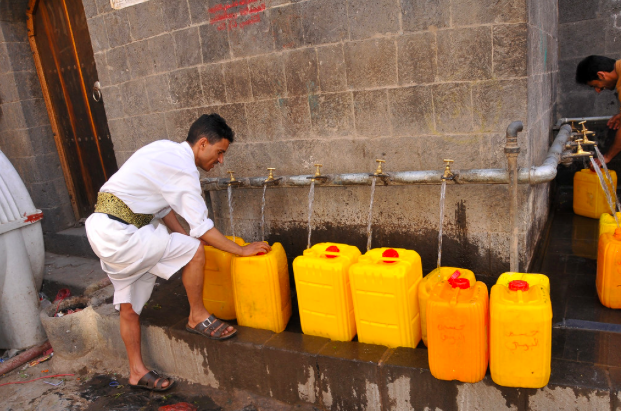
Locals Fill Bottles from Public Water Supply: Sana’a, Yemen. Water.alternatives. CC BY-NC 2.0$

Water scarcity in Yemen has become dire; 50% of Yemenis, nearly 15 million individuals, lack access to clean water, and experts have reported that the capital, Sana’a, runs the risk of consuming its limited water supply as soon as 2023. In 2017, a study noted the diminishment of the water table in Yemen by 6-7 meters per year. The rapidly-depleting water supply, coupled with limited access to available water represent just one of the many systemic issues facing Yemen that bear the potential to worsen significantly as a result of global climate change. As violence continues to escalate and humanitarian access to the crisis diminishes, Yemen increasingly lacks the tools it desperately needs to navigate a widespread cholera epidemic, as well as near-famine conditions for millions of its citizens. 

Conflict in Yemen broke out in 2014 following a counterinsurgency launched against the government of Yemen by Houthi rebels. The civil war quickly became a proxy war between Saudi Arabia, who is leading a coalition in support of the established Yemeni government, and Iran, sponsoring the Houthis. The Saudi government has carried out frequent airstrikes against Houthi-held territory, which includes Sana’a, and has instigated a blockade, driving millions of Yemenis to the edge of famine. Climate change and conflict have been mutually-reinforcing in their exacerbation of the state of water scarcity, famine, and disease in Yemen. Diminished water supplies have intensified the stakes of factional conflicts, especially in Sana’a, while Saudi opposition to Houthi insurgency has, at least temporarily, cut short past collaboration between the two states to introduce Saudi water desalination technology into Yemeni infrastructure.

Compounding the issue, the average temperature in Yemen is predicted to rise 3.3°C by 2060. Moreover, Yemen has been in the throes of a cholera epidemic that has lasted nearly four years. Without adequate access to humanitarian healthcare resources or a sound healthcare infrastructure, and with the incubation effects that occur as global temperatures rise, disease outbreaks such as the current cholera epidemic stand only to increase, both in frequency and intensity. 

Furthermore, as the conflict has rendered avenues for foreign aid from other nations and NGOs sporadic and inefficient, other groups with the aim of influencing Yemen’s population have begun to intervene. More specifically, the vacuum in humanitarian intervention has created openings for al-Qaeda recruitment among desperate members of the population, as the arm of al-Qaeda operating on the Arab Peninsula (AQAP) has performed services such as providing water and repairing wells. Given that the ultimate end of AQAP is recruitment, Yemeni affiliation with al-Qaeda will only further cycles of violence within Yemen and throughout the Middle East. Growing influence of AQAP has long-term destabilizing effects that will work against efforts to re-stabilize and recentralizes Yemen in the future. 

Future efforts to stabilize Yemen will be fraught by both conflict and climate change, especially given the mutually-reinforcing feedback loop that has arisen between the two. Climate conditions have exacerbated the violence and displacement, and in turn the ongoing war has destroyed infrastructure crucial to dealing with emergencies in healthcare, access to water, and famine that have come about, in large part, due to changing climate conditions. Currently there are over 300,000 internally displaced persons, and experts contend that not only violence, but also the cholera epidemic and diminishing water and food supply have produced the massive amount of migration within Yemen. There has been hope, however, regarding the precedent water scarcity maintains for bringing adversaries to the conference table. Though, given the scope of the war and the state of human rights in Yemen, conflict and climate conditions may very well get worse before they get better.

HALLIE GRIFFITHS is an undergraduate at the University of Virginia studying Foreign Affairs and Spanish. After graduation, she hopes to apply her passion for travel and social action toward a career in intelligence and policy analysis. Outside of the classroom, she can be found, quite literally, outside: backpacking, rock climbing, or skiing with her friends.

Chile Protests Escalate as Widespread Dissatisfaction Shakes Foundations of Country’s Economic Success Story

Chile’s capital city Santiago appears dynamic and bustling, complete with gleaming skyscrapers and a modern metro network. Against the backdrop of the snow-topped Andes mountains, the Costanera Tower – South America’s tallest building – symbolises the country’s open neoliberal economy and mass consumption society. 

But protests have rocked the country, challenging this image of stability and prosperity.

Following a government proposal to increase the price of metro tickets, students began to dodge metro fares in protest on October 14, jumping the turnstiles en masse and setting metro stations on fire. The protests soon spread within Santiago and to other Chilean cities, leading President Sebastian Piñera to declare a state of emergency and daily curfews on October 18. This legislation, which dates from the dictatorship era of the 1970s and 80s, allows the military to patrol the streets. 

But the move has led to an escalation of the protests, as thousands of Chileans disobeyed the curfews by marching peacefully against government policy and violent repression on a daily basis, calling for Piñera to resign.

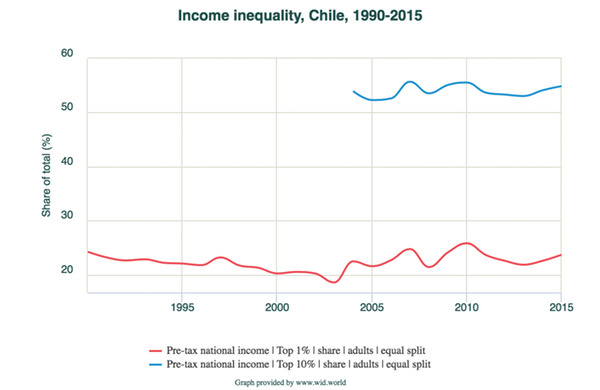
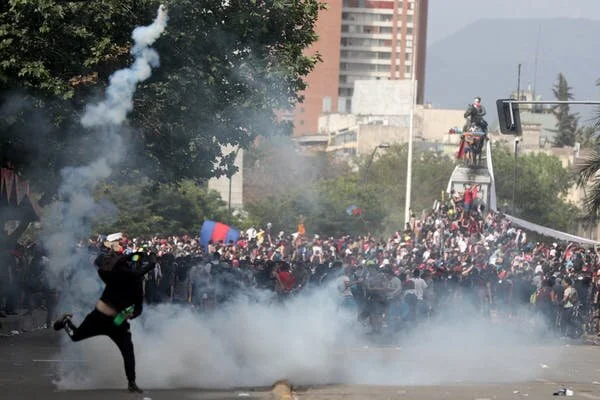
The images of soldiers and tanks on the streets, dispersing protesters with water cannon, tear gas, and physical violence, recall the images of military repression during the dictatorship of Augusto Pinochet between 1973 and 1990. The economic and ideological legacies of the Pinochet era as well as the nature of Chile’s transition to democracy are key to understanding the reasons for the protests. The anger of those on the streets is as much a reflection of the country’s high inequality as it is of these unresolved legacies.

Much of the media coverage of the protests has focused on the spectacle of looting, vandalism, and soldiers beating the protesters. Since the protests started, 18 people have died and there have been 3,000 arrests. But there are wider causes behind these events. The protests emerged in the middle of growing dissatisfaction with high levels of inequality and a high cost of living

Income inequality has not improved in Chile since the days of the military dictatorship. World Inequality Database

On the surface, Chile looks like an economic and political success story, as the country’s GDP growth has outpaced that of Latin America as a whole in recent years, but many Chileans are struggling. The metro fares have come to symbolise what they feel is the unjust distribution of income and social spending. 

Legacy of Pinochet era

Like the state of emergency, Chile’s social and economic policies also date from the dictatorship. Neoliberal reforms were introduced in the mid-1970s by Pinochet and his team of American-trained economists, known as the “Chicago Boys”. The reforms took place in the context of violent repression. Official investigations showed that 3,065 people were murdered by state agents during the dictatorship, 40,000 tortured, and hundreds of thousands forced into exile.

The 1970s reforms included the elimination of subsidies, welfare reform, and the privatisation of state-owned companies, the health sector, education and pensions. Pinochet’s reforms led to high levels of unemployment, declining real wages, and expensive social services, such as education. The impact is clear today in education, characterised by low levels of public spending and highly unequal access to good-quality schools and universities. Between 2011 and 2013 students organised mass demonstrations against Chile’s education policies, and dissatisfaction remains.

Chile turned from a military to a civilian government in 1990, following the 1988 referendum in which Pinochet was defeated. But due to the nature of the transition, social and economic policies changed very little. Pinochet negotiated his departure in such a way that the armed forces kept control of the political process, including his own appointment as a lifelong senator. The 1980 military constitution – which is still in place today – has allowed Piñera to declare the controversial state of emergency to deal with the protests. Although some of the military control structures have been dismantled since Pinochet’s death in 2006, the civilian governments on the right and the left have had a limited appetite to address the country’s inequalities.

Anger on the streets of Santiago. Fernando Bizerra Jr/EPA

In response to the protests, on October 22 Piñera suspended the planned fare increases and announced a spending package of reforms to address the protestors’ concerns. The fact that Chileans continue to protest around the country shows that many people feel these measures are too little, too late. 

Given the long historical roots of the inequalities, it’s unlikely that one-off extra spending can address the country’s structural problems. Even if the government’s intention has been to de-escalate the situation, its hardline response to the protests signals growing polarisation rather than a quick resolution to the issues.

Marieke Riethof is a Senior Lecturer in Latin American Politics, University of Liverpool

THIS ARTICLE WAS ORIGINALLY PUBLISHED ON THE CONVERSATION