
• Travel Features
  • Global Action
  • Take A Trip
  • Travel Guides
    • Podcast
    • Courses
    • Bookshop
  • About
  • Sign Up
Menu

CATALYST PLANET

  • Travel Features
  • Global Action
  • Take A Trip
  • Travel Guides
  • Discover
    • Podcast
    • Courses
    • Bookshop
  • About
  • Sign Up

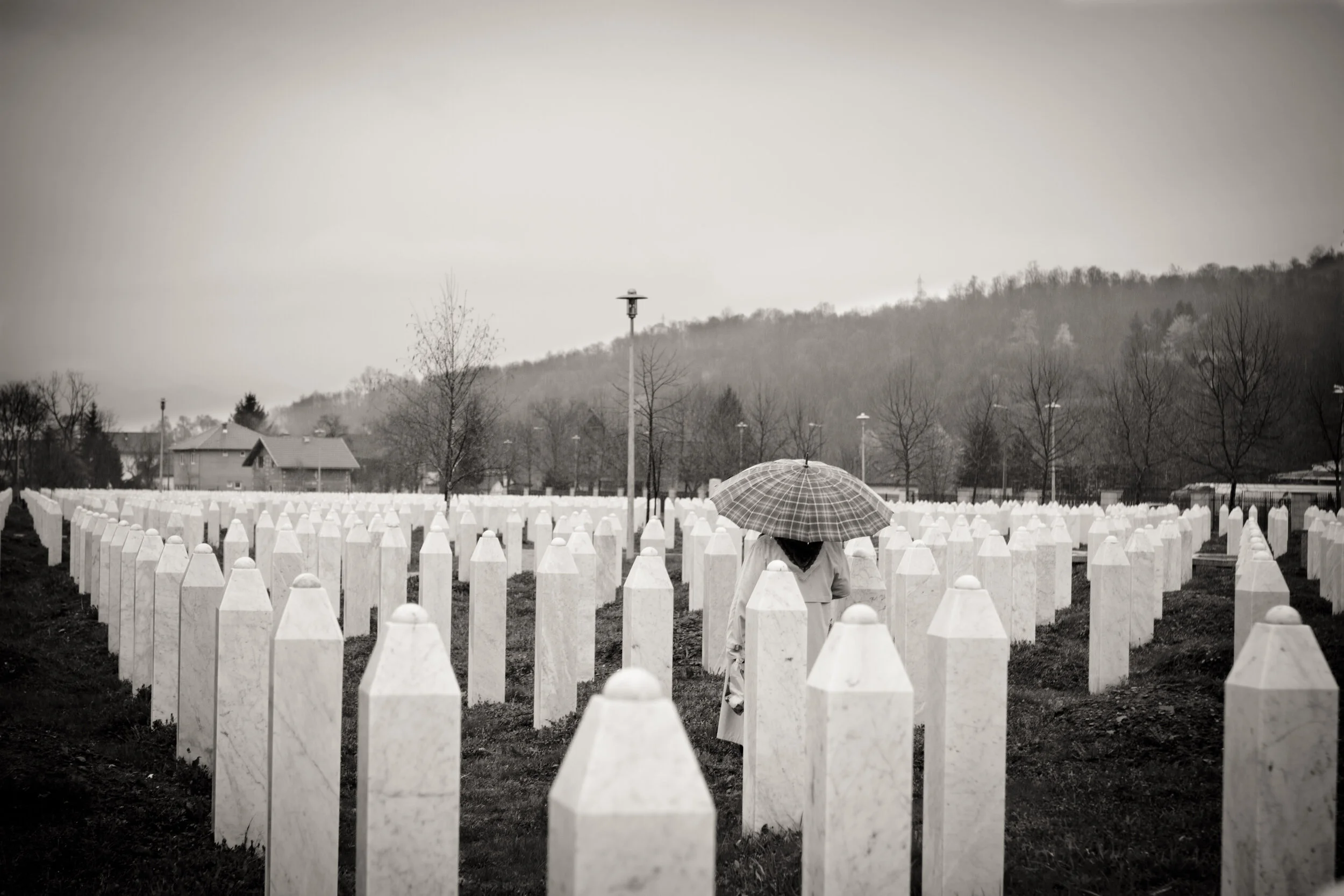
A person walking among graves in Srebrenica, Bosnia, the site of the Srebrenica massacre. matsj // CC BY-NC-ND 2.0

25 Years On, Bosnia Mourns Victims of the Srebrenica Massacre

July 13, 2020

On July 11, mourners gathered for a memorial service at the Srebrenica Genocide Memorial in Potocari, Bosnia, to commemorate the 25th anniversary of the Srebrenica massacre. The service, which included the burial of nine recently identified victims, comes as many Bosnians continue to mourn the loss of loved ones during the massacre.

The commemoration was not limited to the region around Srebrenica. Sarajevo, the capital of Bosnia-Herzegovina, played sirens throughout the city at noon on July 11 in memory of the victims of the massacre.

Serge Brammertz, chief prosecutor of the U.N. International Criminal Tribunal for the Former Yugoslavia until its shutdown in 2017, spoke on the importance of honoring the massacre’s victims - and of labeling the event as a genocide, something many Serbs refuse to acknowledge.

“To truly honor the memory of those lost 25 years ago, and to recognize the victims and survivors with us today, it is our responsibility to keep fighting for justice and truth and to call what happened in Srebrenica by its name, genocide,” Brammertz said.

The Srebrenica massacre was the killing of more than 8,000 majority-Muslim Bosniak men and the mass deportation of Bosniak women and children from the area around the town of Srebrenica during the Bosnian War in 1995. Units of the Bosnian Serb army led by Gen. Ratko Mladic carried out the atrocities. The massacre was formally classified as a genocide by the United Nations in 2004.

In the 25 years that have followed, not all who call Srebrenica home have felt like the racial tensions which brought about the massacre have been addressed. According to a 2018 poll, 66% of Serbs in Republika Srpska, Bosnia-Herzegovina’s Serb-run entity, deny the genocide.

Almasa Salihovic, a survivor of the massacre, discussed in an interview with Al-Jazeera about how there are those within the community who celebrate July 11 as “the day of liberation of Srebrenica” from the Bosniaks.

“That's what scares me the most,” Salihovic said. “Even if we don't have incidents in Srebrenica like physical fights, we still have these hidden attacks which is far more worse … You have people who would still do the same thing tomorrow if they have the chance and if we don't speak even more loudly than we do now, then I'm really not sure where this is going.”

This misinterpretation of the genocide is not limited to the massacre’s sympathizers in Bosnia-Herzegovina. Shortly after the commemoration events began throughout the country, Serbian Prime Minister Ana Brnabic publicly referred to the genocide as one of several “misunderstandings from the past.” The Serbian government has previously apologized for the massacre, but has not yet recognized the event as a genocide.


For the time being, Bosnia-Herzegovina continues to urge the international community to counter any denial of genocide. The European Union, the United States and a number of other countries have officially recognized the massacre as a genocide, while Russia, notably, denies the event’s scale. Additionally, efforts to identify victims of the massacre within Bosnia-Herzegovina and abroad are ongoing.

Jacob Sutherland

is a recent graduate from the University of California San Diego where he majored in Political Science and minored in Spanish Language Studies. He previously served as the News Editor for The UCSD Guardian, and hopes to shed light on social justice issues in his work.

Tags Bosnia, massacre, genocide, memorial, United Nations, muslim, liberation, Srebrenica, Russia, Europe
Comment

Graves at the memorial center Potocari, near Srebrenica. AP Photo/Amel Emric

Bosnia’s 25-year Struggle With Transitional Justice

November 26, 2019

The Bosnian war started 25 years ago this week.

Although bombs ceased falling in 1995, in many ways the people of Bosnia and Herzegovina (BiH) are as divided as ever. The past two decades have repeatedly shown that divisions exacerbated by the war continue to permeate politics. 

In fact, according to a 2013 public opinion poll, just one in six residents of BiH feels that the three ethnic groups that live there – the Bosniaks, Serbs and Croats – have reached reconciliation.

It would be easy to pass this sentiment off as what one former U.S. secretary of state called “ancient tribal, ethnic and religious rivalries.” But I believe it raises profound doubts about the ability of international justice to bring about a more peaceful world.

As I demonstrate in my book, “The Costs of Justice,” transitional justice – the process of dealing with human rights abuses committed by a previous regime – is an inherently political process made even more contentious by taking it out of the country. The fallout is not just a lack of reconciliation, but also the constant threat of violence. 

In BiH, more than 30 percent believe a renewal of armed conflict could be right around the corner.

The G word

Ongoing resentment in BiH was highlighted by two recent events. 

First was the fall election of a Serbian genocide denier, Mladen Grujicic, as mayor of Srebrenica – a town where more than 8,000 Bosniaks, or Bosnian Muslims, were systematically killed in 1995.

Next came the Bosniak response: a February request for the International Court of Justice (ICJ) to review its 2007 ruling that cleared the neighboring state of Serbia of complicity in genocide during the war. 

The war may be long over, but wounds are still oozing. 

Lack of reconciliation in BiH comes despite – or perhaps because of – a major international effort to ensure justice in the region. BiH, like other states of the former Yugoslavia, was under the jurisdiction of the International Criminal Tribunal for the former Yugoslavia (ICTY) at The Hague for more than two decades. 

The ICTY’s establishment in 1993 was greeted by human rights advocates as the harbinger of a new era of justice. At the time, transitional justice scholars preached its numerous benefits. These included deterring future rights violations, strengthening rule of law, increasing the legitimacy of a new regime and, perhaps most importantly, encouraging reconciliation within broader society.

There are many ways to address past rights abuses – from issuing apologies and providing victim compensation to holding truth commissions and launching criminal trials. The international community has historically focused on the latter – whether at Nuremberg, Tokyo or The Hague.

Criminal prosecutions are largely symbolic, but they are nonetheless important. They signal the end of impunity, or the ability to escape punishment, and the start of a more just order. The fact that post-conflict countries frequently lack institutions strong or independent enough to pursue criminal prosecutions on their own makes international mechanisms indispensable. Indeed, BiH’s inability to carry out its own criminal trials for a decade and a half points to a real need for international courts. 

But the very process of taking criminal prosecutions out of the domestic purview can ultimately be a blow to justice. Most locals, for instance, lose interest in trials that play out in faraway courtrooms, meaning trials fail to bring about the sorts of dialogue that might lead to mutual understanding. 

Formidable challenges of international prosecutions, from learning the intricacies of a foreign culture and political regime to collecting evidence essential for a successful prosecution, mean that international trials also take a long time to complete. And, of course, they are expensive. The ICTY cost more than US$1 billion, or between $10 million and $15 million for each person accused. Various countries, including the United States, footed the bill.

And yet, rather than improve relations in the region, the ICTY may have incited tensions. Each of the parties claimed they were unfairly targeted. Serbs were infuriated by their overrepresentation on the court’s docket. Croats couldn’t believe that any of their heroes were facing judgment. 

Little surprise then that only 8 percent of those polled in BiH in 2013 felt the ICTY had done a good job facilitating reconciliation. 

While international courts did little for reconciliation, they fundamentally sabotaged more organic forms of justice than could otherwise have happened at the local level. In the former Yugoslavia, political leaders who were struggling to balance international pressure for – and domestic opposition to – ICTY cooperation opted for half-baked local initiatives designed to satisfy both. The result was a watered-down truth commissionhere, an apology of questionable sincerity there. 

These half-measures ultimately replaced what might have been more earnest mechanisms had they not been established in the context of ongoing international trials. The recent Bosniak appeal to the ICJ, just like the key political victory of a Serb genocide denier, highlights the degree to which justice and historical memory remain politicized in BiH a quarter-century after the war began. 

The ICTY’s long shadow

The ICTY and subsequent tribunals demonstrated that international prosecutions can play an important role in ending impunity. But they must carefully balance the need of the international community to ensure accountability with the needs of a local populace to deal with past rights abuses on their own terms. 

Limiting international prosecutions to the most serious perpetrators is one way to reach this balance. Few in Serbia shed tears for the arrest of Slobodan Milosevic, a corrupt dictator. 

Even then, the recent experience of the International Criminal Court (ICC), established in 2002 as a permanent and global version of the ICTY, demonstrates this can be a tough sell. Numerous African states have accused the ICC of the same bias Yugoslavs attributed to the ICTY. They are threatening to withdraw as a result.

Back in Bosnia, the ICJ last month rejected the Bosniak request on the grounds it did not come from all three members of the country’s tripartite presidency. In other words, the very lack of reconciliation between Bosniaks, Serbs and Croats that prompted the initial appeal now makes that appeal impossible. It is ironic that Bosniaks still feel the need to turn to international justice mechanisms for redress. After all, international justice may bear some blame for the predicament they’re in today.

Brian Grodsky is an Associate Professor of Political Science, University of Maryland, Baltimore County

THIS ARTICLE WAS ORIGINALLY PUBLISHED ON THE CONVERSATION

Tags Bosnia, justice, ICTY, reconciliation, BIH, Serbs, Croats, ICJ, crime, criminal justice, Africa
Comment

Also check out...

Featured
Vietnam’s Floating Markets Are Disappearing
The Supernatural Role of Masks in Nigeria’s Yoruba Tribal Culture
Opening the World to Deaf Travelers with Lily Yu

Featured trips

Featured
Offer NGO Support While Visiting Quito
Experience Life as a Mongolian Nomad
Help Grow Organic Costa Rican Coffee

Sign up for the CATALYST newsletter

Sign up for our newsletter to get the scoop on international travel, global social impact insights, our latest podcast releases, and more from around the world, all delivered right to your inbox!

We respect your privacy.

Thank you!
Newsletter Sign Up | Advertise | Careers + Internships | Privacy Policy | Submissions | Contact Us

Copyright © 2025, MISSION MEDIA LLC. All rights reserved.