
As crime and violence have increased in Mexico and Central America, there has been a notable increase in asylum-seekers. More than ever, children are entering the United States with no trace of a guardian or parent.
Read MoreWhat Happens to Afghan Refugees Once They Flee?
People have been leaving Afghanistan for 40 years, hoping to escape conflict, violence, and poverty. The Taliban’s recent takeover has exacerbated the displacement and flight of Afghan people, but where do they go once they’ve left?
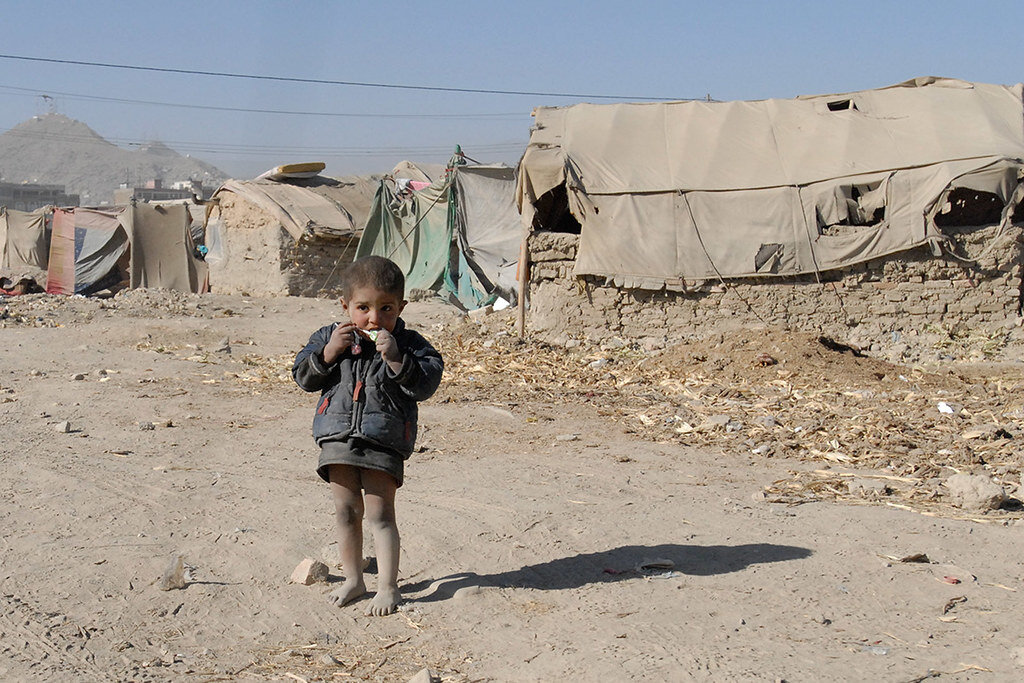
Why are people fleeing Afghanistan?
This year, 20 years after The Taliban was ousted from power in Afghanistan, the insurgent group regained control of the country. On August 15, Taliban forces took Kabul, the nation’s capital, with little resistance. Afghan President Ashraf Ghani fled the country, and the government collapsed, securing The Taliban’s position of power.
Following The Taliban’s seizure of Kabul and effective takeover of the country, tens of thousands of people fled Afghanistan, fearing their safety under Taliban rule.
Amnesty International reports that at present, there are over 2.6 million registered refugees from Afghanistan worldwide and more who haven’t been registered or who are asylum seekers (meaning they haven’t yet been legally recognized as refugees). People began leaving Afghanistan forty years ago, seeking refuge from conflict, violence and poverty. However, the recent Taliban takeover has escalated the amount of violence faced by people in Afghanistan and raised human rights concerns, especially over the treatment of women and girls.
The United Nations Refugee Agency predicts that up to half a million people could flee Afghanistan by the end of the year. As many as 125,000 people fled between August 16 and 26 during a multinational evacuation effort led by the U.S. military. However, more Afghans are still displaced and trying to escape Taliban rule.
What happens to Afghan refugees once they leave the country?
If Afghans can make it out of the country, what happens next varies. Those leaving via land borders often live in temporary refugee camps, like the ones set up by Iran and Tajikistan.
Pakistan and Iran have been the countries to take in the largest numbers of Afghan refugees in the past. However, this time, officials from both countries have said that they cannot take another large influx of refugees. Instead, they will be expected to stay in camps on the borders until they return to Afghanistan.
On August 16, the UNHRC issued a non-return advisory, meaning that no country can deport people to Afghanistan right now.
Some governments, such as Austria, Poland, Turkey and Switzerland, have made clear that they will not welcome any Afghan refugees and are upping border security to guard against anyone entering their countries illegally. However, other governments, such as France, Germany, Canada, Australia, the U.K. and the U.S., have pledged to host Afghan refugees and asylum-seekers.
United States
Axios reports that an expected 37,000 Afghan refugees will soon be entering the U.S., likely the first group of several. They will be sent to 46 states, excluding Hawaii, South Dakota, West Virginia and Wyoming, with California and Texas receiving the most people.
More than half of the Afghan refugees who have already arrived in the U.S. helped the U.S. officals and their families, some of whom hold Special Immigrant Visas. This next wave of 37,000 also includes many people regarded as U.S. allies, who either have an SIV or have applied for one.
Those refugees who are not eligible for an SIV can apply for other types of relief, such as asylum or a temporary visa. In additoin, they can still enter the U.S., even without a valid visa, if they have applied for humanitarian parole, which allows those facing an emergency or urgent humanitarian crisis to enter the country for a temporary period.
All Afghan refugees are eligible to apply for humanitarian parole and asylum, and they can also apply for a U.S. visa. However, those who have applied for either but have not yet completed the lengthy screening and interview process to receive clearance are being sent to third-party countries before they can enter the United States. Kosovo, Albania, North Macedonia and Uganda have agreed to temporarily host smaller numbers of refugees ultimately destined for the U.S.
When Afghan refugees arrive in the U.S., legal residents or U.S. citizens are tested for COVID-19 and then released to go to their destinations. Those who are not will be sent to military bases for processing, which includes a health screening and services such as help to apply for work authorization. After processing, these refugees are connected with a refugee resettlement agency.
Resettlement agencies, like RAICES in Texas, are funded by the U.S. Committee for Refugees and Immigrants. Resettlement agencies, using a $1200-per-person stiped, set up housing, including utilities and furniture, for the refugees, and enroll children in school and sign families up for social services programs such as Medicaid. The agencies also provide job skills training and help refugees with their job searches; they also help refugees adjust to their new homes through cultural orientation programs. In addition, some refugees qualify for monthly cash assistance, which the resettlement agencies also provide.
United Kingdom
The Home Office, the U.K.’s lead immigration department, has announced that any Afghans that worked for the U.K. government or British military can stay in the U.K. permanently. There are currently over 8000 Afghan refugees in the U.K., and many of those who were initially only granted temporary residency can now upgrade their immigration status and find permanent housing and jobs.
Right now, manyf Afghan refugees in the U.K. are living in hotels, but the government hopes to have them resettled more permanently soon. The government has developed two resettlement plans for Afghan refugees—the one currently in progress is known as Operation Warm Welcome, which provides support similar to that of U.S. resettlement agencies such as enrolling kids in school, registering refugees for healthcare and helping them to find housing. The second plan, the Afghan Citizens Resettlement Scheme, is a longer-term plan, aiming to take in an additional 20,000 refugees over the next few years.
The refugees who are not currently eligible for permanent residency can apply for a five-year visa; after the visa is up they can apply for permanent residence.
France
Between August 16 and 27, France evacuated over 2500 Afghans from Kabul, mainly activists. Many of these refugees left families behind in Afghanistan and now worry that they will be unable to reunite. France is notoriously slow at approving family reunification applications, with Afghans having to wait an average of three years before bringing their relatives. France’s president, Emmanuel Macron, has expressed concerns about a large influx of immigrants, saying that though France will continue to protect those who are most threatened under Taliban rule, “irregular migratory flows” need to be stemmed.
According to the European Resettlement Network, refugees who can enter France are granted a temporary, six-month leave to work and receive certain social services benefits. After that, all refugees are required to lodge an asylum claim, which, when approved, grants them official refugee status. After gaining refugee status, refugees may apply for French citizenship.
Challenges
Whether refugees are in camps or have found refuge in other countries, they often face challenges like unsanitary conditions, a lack of food and housing, and harassment from people around them. Though people leaving Afghanistan are safe from the more immediate dangers of conflict and violence, just leaving the country does not ensure their long-term well being.
Organizations like Refugees International and Amnesty International have put forth recommendations on how countries can best respond to the Afghan refugee crisis and better help refugees.
To Get Involved:
To learn how to support Women for Women International’s emergency relief fund, click here.
To get involved with the International Rescue Organization, click here.
To learn more about Afghan Aid, an organization that has been working in Afghanistan for nearly 40 years, click here.
Ways to help Afghan refugees are different depending on where you live, so consider looking into local and national organizations as well.

Rachel Lynch
Rachel is a student at Sarah Lawrence College in Bronxville, NY currently taking a semester off. She plans to study Writing and Child Development. Rachel loves to travel and is inspired by the places she’s been and everywhere she wants to go. She hopes to educate people on social justice issues and the history and culture of travel destinations through her writing.
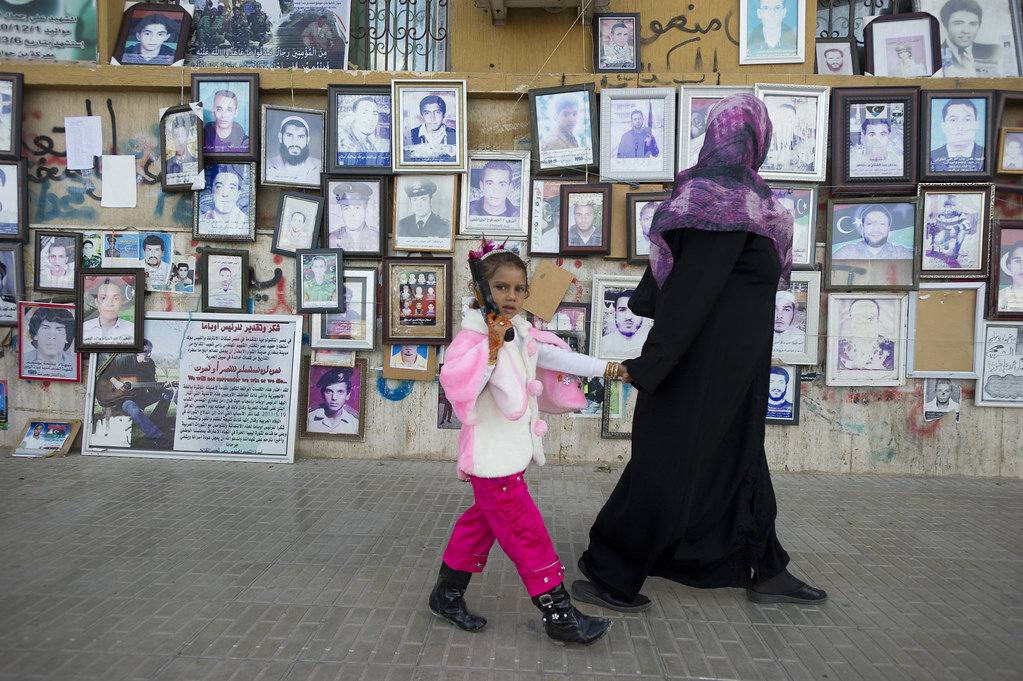
While playing with a toy gun, a child passes a memorial for civilians killed in the Libyan civil war. Teutloff Museum. CC BY-ND 2.0
Nearly a Decade of Strife in Libya
After the overthrow of then-leader Moammar Gadhafi in 2011, Libya has been in a constant state of political unrest. Since 2014, the Government of National Accord (GNA) and the Libyan National Army (LNA) have sought control over the country, sparking a destructive civil war. Based in the Libyan capital, Tripoli, the GNA is recognized by the United Nations. Allied with General Khalifa Hifter, the Benghazi-based LNA receives aid from Russia, France and the United Arab Emirates.
Libyan civilians have endured chaos, including shelling near the front lines, injuries from explosive devices and abductions for ransom. The United Nations High Commissioner for Refugees estimates that 1.3 million Libyans require urgent humanitarian assistance.
Armed Conflict and War Crimes
Weapons proliferation has been a major security concern in Libya, as allied countries provide the GNA and LNA with advanced military equipment. State-provided arms transfers make Libya a volatile battleground. Currently, the country has the world's largest uncontrolled ammunition supply, with an estimated 150,000 to 200,000 metric tons of uncontrolled munitions. Yacoub El Hillo, the U.N.’s resident and humanitarian coordinator in Libya, announced, “The increasing use of explosive weapons has resulted in unnecessary loss of life, displacement, destruction and damage to vital civilian infrastructure.” The Islamic State group has also used the country as a hub to coordinate broader regional violence, further complicating efforts to create a united government.
In April 2019, Khalifa Hifter’s forces attacked Tripoli, resulting in over 1,000 fatalities. As General Hifter continues his campaigns, the International Criminal Court (ICC) warns of potential war crimes, including mass murder, desecration of corpses and kidnappings. In a statement to the U.N. Security Council, chief prosecutor Fatou Bensouda accused the LNA of targeting innocent civilians: "Of particular concern to my Office are the high numbers of civilian casualties, largely reported to be resulting from airstrikes and shelling operations. Intentionally directing attacks against the civilian population or against individual civilians not taking direct part in hostilities is a war crime under the Rome Statute. Likewise, the Rome Statute prohibits the intentional directing of attacks against hospitals and other buildings protected under international law, such as those dedicated to religion or education, when they are not military objectives."
Civilian Victims and Internal Displacement
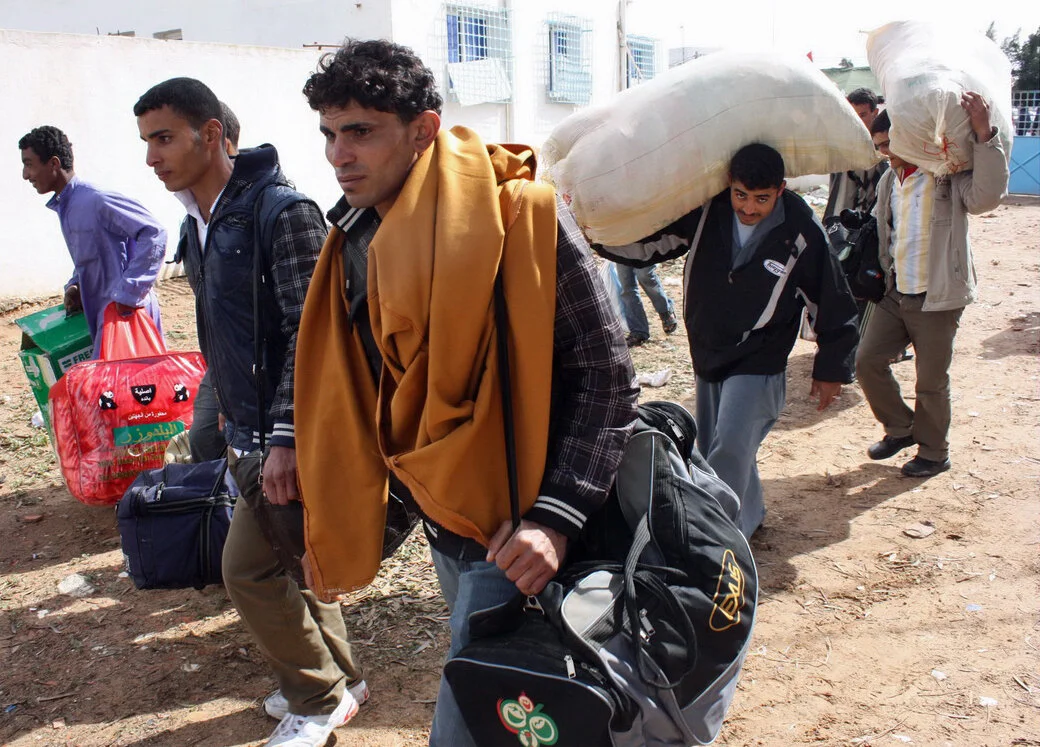
Displaced civilians flee their homes in Libya. Magharebia. CC BY 2.0
Due to ongoing conflict, nearly 400,000 Libyans have been forced to flee their homes and are now internally displaced. According to UNICEF, Libyan hospitals and schools serve as shelters for thousands of displaced civilians around Tripoli. Yet, with military forces continually targeting these makeshift shelters, Libyans face inadequate access to health care, essential medicines, food, safe drinking water and education. School has been suspended indefinitely for nearly 200,000 children, leaving them susceptible to abuse, human trafficking and violence.
Given the lack of eyewitnesses and credible reports, experts can only estimate the total number of fatalities since 2011. Small Arms Survey, a research-based organization, suspects that approximately 27,000 people have perished in the nine-year-long dispute.
Migrants, Refugees and Asylum-Seekers
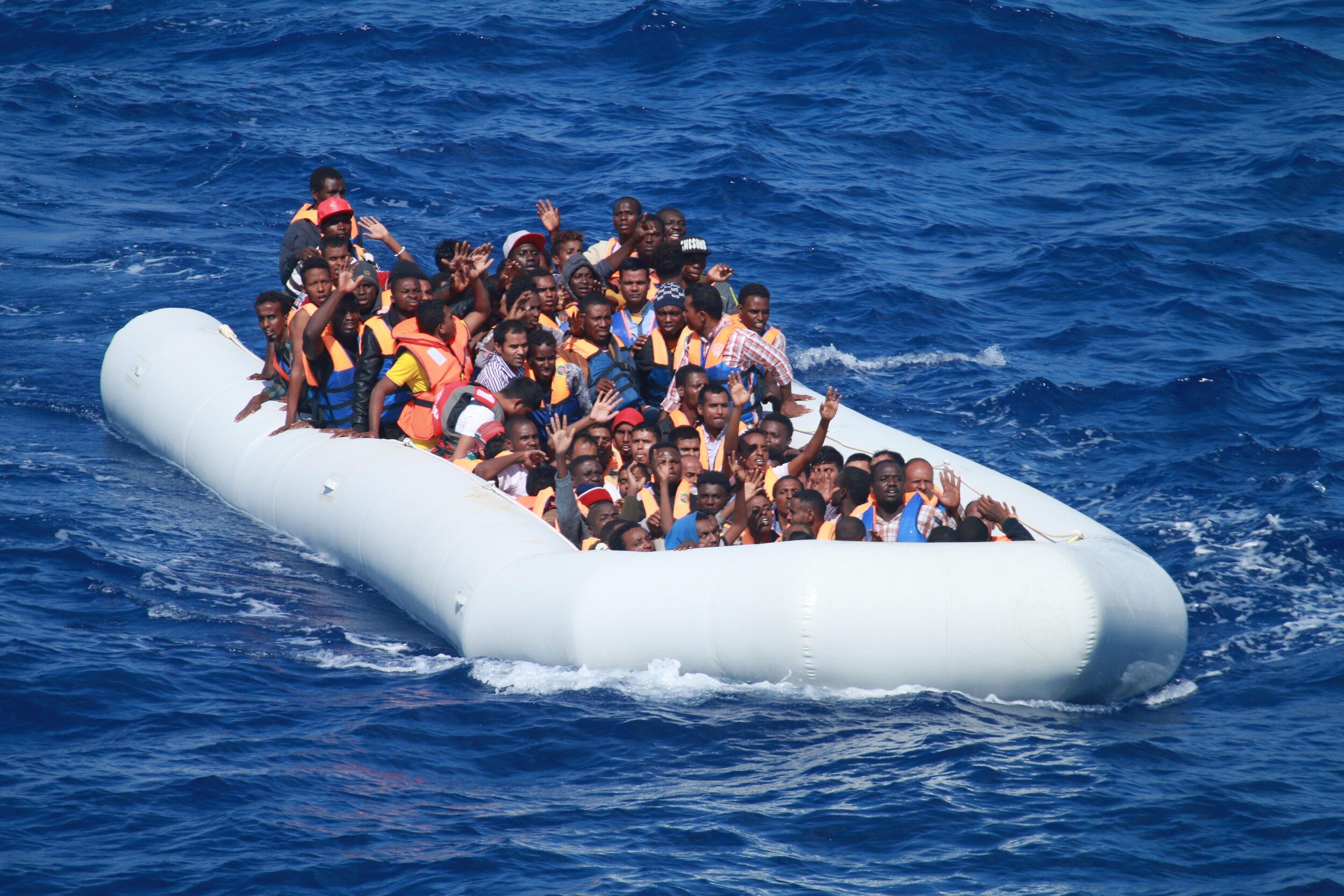
Migrants aboard an inflatable vessel in the Mediterranean Sea. Commander, U.S. Naval Forces Europe-Africa/U.S. 6th Fleet. Public Domain.
Within this war-torn nation, there are currently 654,000 migrants, refugees and asylum-seekers, mainly from sub-Saharan Africa. Approximately 90% of people crossing the Mediterranean Sea to Europe depart from Libya. Migrants and asylum-seekers who are captured at sea and returned to Libyan territory are detained in centers run by the GNA’s Interior Ministry, where many suffer inhumane conditions including sexual violence, extortion and forced labor. While the GNA manages formal migrant detention centers, smugglers and traffickers run numerous informal facilities. “Those interned there, mainly refugees, keep dying of diseases and hunger. They are victims of violence, rape and arbitrary treatment at the hands of militias,” said Julien Raickmann, Doctors Without Borders (MSF) chief in Libya. Since January, more than 4,000 migrants have been intercepted at sea and returned to Libya, while hundreds have disappeared altogether. Despite threats of detention, migrants and asylum-seekers still venture to Libya, hoping to reach Europe.
Humanitarian Relief
After nine years of instability, thousands of Libyan civilians and migrants face displacement, malnutrition and violence. The U.N. Office for the Coordination of Humanitarian Affairs (OCHA) launched the 2020 Humanitarian Response Plan, which pledges $115 million in relief efforts. Protection is at the core of this plan, as well as the provision of food, shelter, health care, water and sanitation. The U.N.’s refugee agency, UNHCR, will also work at 12 disembarkation points in Libya to aid and protect migrants, refugees and asylum-seekers. At detention centers, they will provide humanitarian assistance and mitigate maltreatment. These organizations seek durable solutions to prevent another decade of turmoil.

Shannon Moran
Shannon is a Journalism major at the University of Georgia, minoring in English and Spanish. As a fluent Spanish speaker, she is passionate about languages, cultural immersion, and human rights activism. She has visited seven countries and thirty states and hopes to continue traveling the world in pursuit of compelling stories.
The Border Restaurant That Makes Asylum Seekers Feel at Home
The Mexican border town of Tijuana is home to thousands of Haitians. Most are asylum-seekers, stuck in administrative limbo as they await potential entry to the United States. To help them feel more at-home, Fausta Rosalía—owner of a popular lunch spot—decided to switch up her traditional offerings of tacos and quesadillas to better serve the city’s new residents. Now, she’s cooking Haitian food in the hopes that a taste of home will make life a little bit easier for so many.