
The Mexican border town of Tijuana is home to thousands of Haitians. Most are asylum-seekers, stuck in administrative limbo as they await potential entry to the United States. To help them feel more at-home, Fausta Rosalía—owner of a popular lunch spot—decided to switch up her traditional offerings of tacos and quesadillas to better serve the city’s new residents. Now, she’s cooking Haitian food in the hopes that a taste of home will make life a little bit easier for so many.
Fighting to End Child Marriage in Lebanon
Ghassan Idriss knows firsthand the harmful effects of child marriage on society. Having married at a young age to a woman even younger than himself, Idriss and his wife faced struggles that so many other couples in his home country of Lebanon grapple with. Now, with three daughters of his own, Idriss is doing everything he can to educate those around him about the dangers of this antiquated institution. By hosting talks, he’s using his voice to spark change within his community.
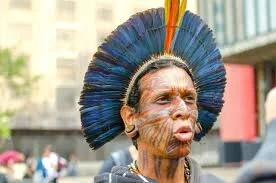
Rogerio Cavalheiro/Shuttershock
Brazil Tribe Wins as Hotel Group Cancels Plans for 500-Room Resort
On Monday November 18, Brazilian indigenous group Tupinambá de Olivença won a battle to prevent a luxury resort from being built on its land. Portuguese hotel group Vila Gale had been planning to build a 500-room resort on the Bahia coast — land the tribe used for gathering food. The Tupinambá land is popular among tourists for its beaches lined with coconut trees, making it a prime location for a resort, but pressure on Vila Gale caused it to withdraw its construction plans.
Despite Vila Gale’s attempt to deny the presence of indigenous people on the land meant for construction, a leaked document published in October shows just the opposite. In this letter, Embratur, a Brazilian tourism agency, asked the government not to classify the land as a reserve for indigenous people so that the resort could bring investments of $200 million and create 2,000 jobs.
In the aftermath of the letter being published, pressure from the Portuguese press, Portuguese political party Bloco da Esquerda, and anthropologist and Tupinambá expert Susana Viegas, Vila Gale canceled its plans.
The tribe is still awaiting the final sign-off from the Ministry of Justice and president Bolsonaro that would designate its land as a reserve . The president, however, has previously expressed his reluctance to designate more territory for indigenous groups.
Eben Diskin is a staff writer for Matador Network
THIS ARTICLE WAS ORIGINALLY PUBLISHED ON MATADOR NETWORK
A Cycling Guide Through Dubai
For endurance athlete Mark Beaumont, cycling holds a special place in his heart. After all, he holds the world record for cycling around the planet. So when Beaumont discovered there was a growing community for cyclists in Dubai, he had to check it out. Along with enthusiast Stewart Howison, Beaumont bikes through vast deserts, picturesque hills and city landscapes, discovering some of the most scenic biking trails in the world. Join this dynamic duo as they uncover parts of Dubai you’ve never seen before.
Health Needs in Migrant and Refugee Communities
Lack of access to health care, trauma, and poor living conditions all contribute to public health concerns of migrant populations.
Read MoreThe Incredible Athletes of Sierra Leone’s Amputee Soccer Club
Every player on the Sierra Leone Flying Stars Amputee Football team has lost limbs from land mines that were planted during the country’s violent civil war. Today they compete against disabled teams from around the world, and with each game help dispel the social stigma around those with disabilities.
Read MoreA Cafe Run by Heroes
The Sheroes' Hangout is a cafe in India that is operated entirely by acid attack survivors. Located a few minutes from the Taj Mahal, it is a place of self-growth and empowerment for its employees. While many of India's acid attack survivors struggle to find employment, Sheroes' Hangout offers them a job and a supportive community.
Is There Hope for a Hong Kong Revolution?
Hong Kong may seem like an unlikely place for a revolution. In this relatively affluent and privileged city, young people might be expected to be more concerned with making money than with protesting in the streets. Yet day after day, demonstrators in Hong Kong risk injury and death confronting security forces backed by the massive power of the Chinese government.
Among their demands are democratic elections for the city’s Legislative Council and chief executive. Their desire for fundamental change has mounted, and they increasingly see their own lives as lacking meaning unless circumstances change.
Historians have long argued that revolutions are built not on deep misery but on rising expectations. Since the 18th century, societies, clubs and associations of intellectuals have been seedbeds of radical change in countries throughout the world. They provided leadership for the French Revolution in 1789, the European revolutions of 1848 and the Russian Revolution of 1905.
The situation in Hong Kong is revolutionary, too, although the history of past revolutions may not provide much hope of immediate change.
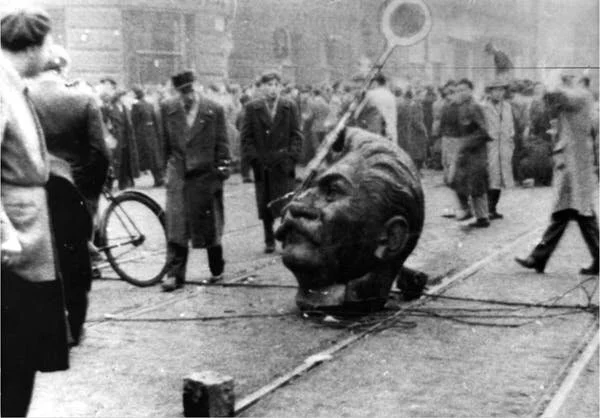
A view of the Hungarian Revolution before the Soviet tanks rolled in. Gabor B. Racz/Wikimedia Commons, CC BY-SA
A look at Hungary
The most compelling parallel to Hong Kong may be the Hungarian Revolution of 1956, which attempted to wrest power from a communist regime. It, too, began with a student uprising in favor of democratic elections.
Within a few days, the communist government resigned and a reformist administration was formed under Imre Nagy, who allowed noncommunists to enter political office. This went too far for communist leaders in the Soviet Union. The USSR invaded Hungary, overthrew Nagy’s regime and secretly put him to death.
As with the Hong Kong protests today, the United States gave little official support to the Hungarian Revolution and was unwilling to offer material assistance. Keeping peace in Europe was of vital importance to U.S. policy in 1956, just as good relations with China are now central.
The Hungarian example may provide little solace to the Hong Kong protesters – except, perhaps, if they consider its long-term consequences.
In October 1989, with Soviet influence in Eastern Europe collapsing, the democratic Republic of Hungary was declared on the 33rd anniversary of the 1956 revolution. Those who died during that revolution are now remembered as martyrs.
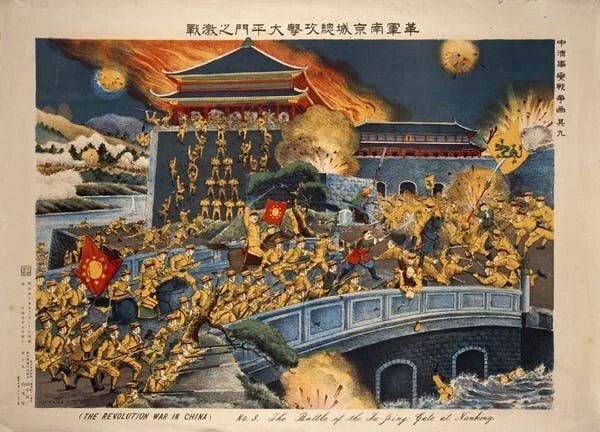
A contemporary print depicting the battle at the Ta-ping gate at Nanking, part of China’s Revolution of 1911. T. Miyano, Wellcome Library/Wikimedia Commons, CC BY
In China’s own history
Chinese history supplies a more heartening example of a successful student-led uprising: the Revolution of 1911. It was fomented by young men returning from study abroad, who formed political societies to “revive” their country, often disguised as literary discussion groups.
The 1911 Revolution mobilized networks of intellectuals and students throughout China, but it also drew on other social groups: military officers, merchants, coal miners and farmers. The revolution erupted in many parts of China simultaneously and had various outcomes, from utter failure, to the massacre of ethnic Manchus to declarations of Mongol and Tibetan independence. A provisional government emerged by the end of the year in Nanjing.
The Hong Kong protests, however, are too limited in geographical scope and social support to repeat the success of the 1911 revolutionaries.
The subsequent Chinese revolution in 1949, like the 1917 Russian Revolution, followed Leninist theory and was spearheaded by professional party insiders, not by intellectuals. The communists regarded mass protests as potentially counter-revolutionary and as threats to the new order.
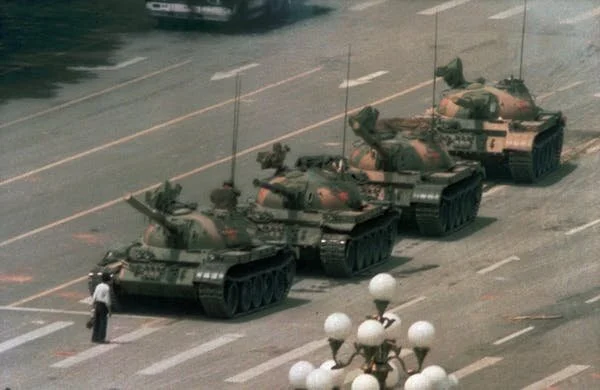
On June 5, 1989, a Chinese man stood alone to block a line of tanks in Tiananmen Square. AP Photo/Jeff Widener
What’s next?
The young protestors in Hong Kong seek to avoid the fate of the student demonstrators of Tiananmen Square in spring 1989. Three decades ago, hundreds, perhaps thousands, of protesters were massacred after the communist government invoked martial law. The pro-democracy agenda of the Tiananmen protesters was vague, and they relied on reformers within the party apparatus, who finally betrayed them.
The Hong Kong crowds are focused on specific changes and lack illusions about the party. They will go down fighting desperately, not standing with faint hope in front of tanks. That may give pause to the forces of repression. As the Communist Party of China and any student of history knows, martyrs are the fuel of future revolutions.
Paul Monod is a Professor of History at Middlebury College
THIS ARTICLE WAS ORIGINALLY PUBLISHED ON THE CONVERSATION
War and Climate Change in Yemen
As climate change continues to take its toll globally, Yemen has begun to dramatically feel its effects. The water shortages have significantly aggravated the scope of the conflict, and vice versa.

Locals Fill Bottles from Public Water Supply: Sana’a, Yemen. Water.alternatives. CC BY-NC 2.0$
Water scarcity in Yemen has become dire; 50% of Yemenis, nearly 15 million individuals, lack access to clean water, and experts have reported that the capital, Sana’a, runs the risk of consuming its limited water supply as soon as 2023. In 2017, a study noted the diminishment of the water table in Yemen by 6-7 meters per year. The rapidly-depleting water supply, coupled with limited access to available water represent just one of the many systemic issues facing Yemen that bear the potential to worsen significantly as a result of global climate change. As violence continues to escalate and humanitarian access to the crisis diminishes, Yemen increasingly lacks the tools it desperately needs to navigate a widespread cholera epidemic, as well as near-famine conditions for millions of its citizens.
Conflict in Yemen broke out in 2014 following a counterinsurgency launched against the government of Yemen by Houthi rebels. The civil war quickly became a proxy war between Saudi Arabia, who is leading a coalition in support of the established Yemeni government, and Iran, sponsoring the Houthis. The Saudi government has carried out frequent airstrikes against Houthi-held territory, which includes Sana’a, and has instigated a blockade, driving millions of Yemenis to the edge of famine. Climate change and conflict have been mutually-reinforcing in their exacerbation of the state of water scarcity, famine, and disease in Yemen. Diminished water supplies have intensified the stakes of factional conflicts, especially in Sana’a, while Saudi opposition to Houthi insurgency has, at least temporarily, cut short past collaboration between the two states to introduce Saudi water desalination technology into Yemeni infrastructure.
Compounding the issue, the average temperature in Yemen is predicted to rise 3.3°C by 2060. Moreover, Yemen has been in the throes of a cholera epidemic that has lasted nearly four years. Without adequate access to humanitarian healthcare resources or a sound healthcare infrastructure, and with the incubation effects that occur as global temperatures rise, disease outbreaks such as the current cholera epidemic stand only to increase, both in frequency and intensity.
Furthermore, as the conflict has rendered avenues for foreign aid from other nations and NGOs sporadic and inefficient, other groups with the aim of influencing Yemen’s population have begun to intervene. More specifically, the vacuum in humanitarian intervention has created openings for al-Qaeda recruitment among desperate members of the population, as the arm of al-Qaeda operating on the Arab Peninsula (AQAP) has performed services such as providing water and repairing wells. Given that the ultimate end of AQAP is recruitment, Yemeni affiliation with al-Qaeda will only further cycles of violence within Yemen and throughout the Middle East. Growing influence of AQAP has long-term destabilizing effects that will work against efforts to re-stabilize and recentralizes Yemen in the future.
Future efforts to stabilize Yemen will be fraught by both conflict and climate change, especially given the mutually-reinforcing feedback loop that has arisen between the two. Climate conditions have exacerbated the violence and displacement, and in turn the ongoing war has destroyed infrastructure crucial to dealing with emergencies in healthcare, access to water, and famine that have come about, in large part, due to changing climate conditions. Currently there are over 300,000 internally displaced persons, and experts contend that not only violence, but also the cholera epidemic and diminishing water and food supply have produced the massive amount of migration within Yemen. There has been hope, however, regarding the precedent water scarcity maintains for bringing adversaries to the conference table. Though, given the scope of the war and the state of human rights in Yemen, conflict and climate conditions may very well get worse before they get better.

HALLIE GRIFFITHS is an undergraduate at the University of Virginia studying Foreign Affairs and Spanish. After graduation, she hopes to apply her passion for travel and social action toward a career in intelligence and policy analysis. Outside of the classroom, she can be found, quite literally, outside: backpacking, rock climbing, or skiing with her friends.
Chile Protests Escalate as Widespread Dissatisfaction Shakes Foundations of Country’s Economic Success Story
Chile’s capital city Santiago appears dynamic and bustling, complete with gleaming skyscrapers and a modern metro network. Against the backdrop of the snow-topped Andes mountains, the Costanera Tower – South America’s tallest building – symbolises the country’s open neoliberal economy and mass consumption society.
But protests have rocked the country, challenging this image of stability and prosperity.
Following a government proposal to increase the price of metro tickets, students began to dodge metro fares in protest on October 14, jumping the turnstiles en masse and setting metro stations on fire. The protests soon spread within Santiago and to other Chilean cities, leading President Sebastian Piñera to declare a state of emergency and daily curfews on October 18. This legislation, which dates from the dictatorship era of the 1970s and 80s, allows the military to patrol the streets.
But the move has led to an escalation of the protests, as thousands of Chileans disobeyed the curfews by marching peacefully against government policy and violent repression on a daily basis, calling for Piñera to resign.
The images of soldiers and tanks on the streets, dispersing protesters with water cannon, tear gas, and physical violence, recall the images of military repression during the dictatorship of Augusto Pinochet between 1973 and 1990. The economic and ideological legacies of the Pinochet era as well as the nature of Chile’s transition to democracy are key to understanding the reasons for the protests. The anger of those on the streets is as much a reflection of the country’s high inequality as it is of these unresolved legacies.
Much of the media coverage of the protests has focused on the spectacle of looting, vandalism, and soldiers beating the protesters. Since the protests started, 18 people have died and there have been 3,000 arrests. But there are wider causes behind these events. The protests emerged in the middle of growing dissatisfaction with high levels of inequality and a high cost of living.
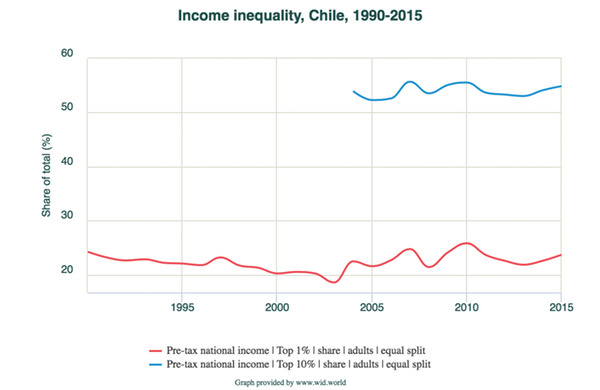
Income inequality has not improved in Chile since the days of the military dictatorship. World Inequality Database
On the surface, Chile looks like an economic and political success story, as the country’s GDP growth has outpaced that of Latin America as a whole in recent years, but many Chileans are struggling. The metro fares have come to symbolise what they feel is the unjust distribution of income and social spending.
Legacy of Pinochet era
Like the state of emergency, Chile’s social and economic policies also date from the dictatorship. Neoliberal reforms were introduced in the mid-1970s by Pinochet and his team of American-trained economists, known as the “Chicago Boys”. The reforms took place in the context of violent repression. Official investigations showed that 3,065 people were murdered by state agents during the dictatorship, 40,000 tortured, and hundreds of thousands forced into exile.
The 1970s reforms included the elimination of subsidies, welfare reform, and the privatisation of state-owned companies, the health sector, education and pensions. Pinochet’s reforms led to high levels of unemployment, declining real wages, and expensive social services, such as education. The impact is clear today in education, characterised by low levels of public spending and highly unequal access to good-quality schools and universities. Between 2011 and 2013 students organised mass demonstrations against Chile’s education policies, and dissatisfaction remains.
Chile turned from a military to a civilian government in 1990, following the 1988 referendum in which Pinochet was defeated. But due to the nature of the transition, social and economic policies changed very little. Pinochet negotiated his departure in such a way that the armed forces kept control of the political process, including his own appointment as a lifelong senator. The 1980 military constitution – which is still in place today – has allowed Piñera to declare the controversial state of emergency to deal with the protests. Although some of the military control structures have been dismantled since Pinochet’s death in 2006, the civilian governments on the right and the left have had a limited appetite to address the country’s inequalities.
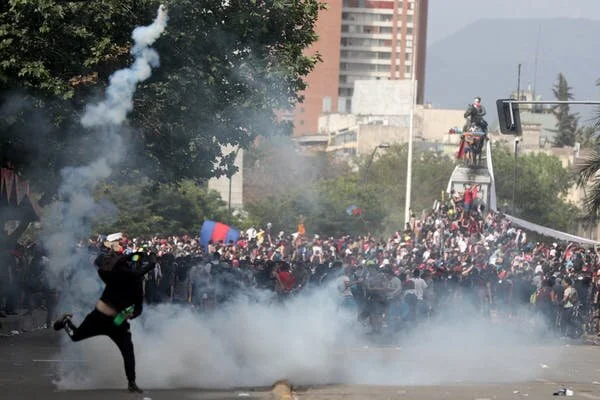
Anger on the streets of Santiago. Fernando Bizerra Jr/EPA
In response to the protests, on October 22 Piñera suspended the planned fare increases and announced a spending package of reforms to address the protestors’ concerns. The fact that Chileans continue to protest around the country shows that many people feel these measures are too little, too late.
Given the long historical roots of the inequalities, it’s unlikely that one-off extra spending can address the country’s structural problems. Even if the government’s intention has been to de-escalate the situation, its hardline response to the protests signals growing polarisation rather than a quick resolution to the issues.
Marieke Riethof is a Senior Lecturer in Latin American Politics, University of Liverpool
THIS ARTICLE WAS ORIGINALLY PUBLISHED ON THE CONVERSATION

Graves at the memorial center Potocari, near Srebrenica. AP Photo/Amel Emric
Bosnia’s 25-year Struggle With Transitional Justice
The Bosnian war started 25 years ago this week.
Although bombs ceased falling in 1995, in many ways the people of Bosnia and Herzegovina (BiH) are as divided as ever. The past two decades have repeatedly shown that divisions exacerbated by the war continue to permeate politics.
In fact, according to a 2013 public opinion poll, just one in six residents of BiH feels that the three ethnic groups that live there – the Bosniaks, Serbs and Croats – have reached reconciliation.
It would be easy to pass this sentiment off as what one former U.S. secretary of state called “ancient tribal, ethnic and religious rivalries.” But I believe it raises profound doubts about the ability of international justice to bring about a more peaceful world.
As I demonstrate in my book, “The Costs of Justice,” transitional justice – the process of dealing with human rights abuses committed by a previous regime – is an inherently political process made even more contentious by taking it out of the country. The fallout is not just a lack of reconciliation, but also the constant threat of violence.
In BiH, more than 30 percent believe a renewal of armed conflict could be right around the corner.
The G word
Ongoing resentment in BiH was highlighted by two recent events.
First was the fall election of a Serbian genocide denier, Mladen Grujicic, as mayor of Srebrenica – a town where more than 8,000 Bosniaks, or Bosnian Muslims, were systematically killed in 1995.
Next came the Bosniak response: a February request for the International Court of Justice (ICJ) to review its 2007 ruling that cleared the neighboring state of Serbia of complicity in genocide during the war.
The war may be long over, but wounds are still oozing.
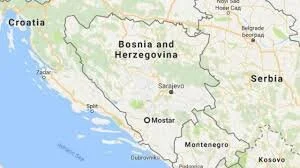
Lack of reconciliation in BiH comes despite – or perhaps because of – a major international effort to ensure justice in the region. BiH, like other states of the former Yugoslavia, was under the jurisdiction of the International Criminal Tribunal for the former Yugoslavia (ICTY) at The Hague for more than two decades.
The ICTY’s establishment in 1993 was greeted by human rights advocates as the harbinger of a new era of justice. At the time, transitional justice scholars preached its numerous benefits. These included deterring future rights violations, strengthening rule of law, increasing the legitimacy of a new regime and, perhaps most importantly, encouraging reconciliation within broader society.
There are many ways to address past rights abuses – from issuing apologies and providing victim compensation to holding truth commissions and launching criminal trials. The international community has historically focused on the latter – whether at Nuremberg, Tokyo or The Hague.
Criminal prosecutions are largely symbolic, but they are nonetheless important. They signal the end of impunity, or the ability to escape punishment, and the start of a more just order. The fact that post-conflict countries frequently lack institutions strong or independent enough to pursue criminal prosecutions on their own makes international mechanisms indispensable. Indeed, BiH’s inability to carry out its own criminal trials for a decade and a half points to a real need for international courts.
But the very process of taking criminal prosecutions out of the domestic purview can ultimately be a blow to justice. Most locals, for instance, lose interest in trials that play out in faraway courtrooms, meaning trials fail to bring about the sorts of dialogue that might lead to mutual understanding.
Formidable challenges of international prosecutions, from learning the intricacies of a foreign culture and political regime to collecting evidence essential for a successful prosecution, mean that international trials also take a long time to complete. And, of course, they are expensive. The ICTY cost more than US$1 billion, or between $10 million and $15 million for each person accused. Various countries, including the United States, footed the bill.
And yet, rather than improve relations in the region, the ICTY may have incited tensions. Each of the parties claimed they were unfairly targeted. Serbs were infuriated by their overrepresentation on the court’s docket. Croats couldn’t believe that any of their heroes were facing judgment.
Little surprise then that only 8 percent of those polled in BiH in 2013 felt the ICTY had done a good job facilitating reconciliation.
While international courts did little for reconciliation, they fundamentally sabotaged more organic forms of justice than could otherwise have happened at the local level. In the former Yugoslavia, political leaders who were struggling to balance international pressure for – and domestic opposition to – ICTY cooperation opted for half-baked local initiatives designed to satisfy both. The result was a watered-down truth commissionhere, an apology of questionable sincerity there.
These half-measures ultimately replaced what might have been more earnest mechanisms had they not been established in the context of ongoing international trials. The recent Bosniak appeal to the ICJ, just like the key political victory of a Serb genocide denier, highlights the degree to which justice and historical memory remain politicized in BiH a quarter-century after the war began.
The ICTY’s long shadow
The ICTY and subsequent tribunals demonstrated that international prosecutions can play an important role in ending impunity. But they must carefully balance the need of the international community to ensure accountability with the needs of a local populace to deal with past rights abuses on their own terms.
Limiting international prosecutions to the most serious perpetrators is one way to reach this balance. Few in Serbia shed tears for the arrest of Slobodan Milosevic, a corrupt dictator.
Even then, the recent experience of the International Criminal Court (ICC), established in 2002 as a permanent and global version of the ICTY, demonstrates this can be a tough sell. Numerous African states have accused the ICC of the same bias Yugoslavs attributed to the ICTY. They are threatening to withdraw as a result.
Back in Bosnia, the ICJ last month rejected the Bosniak request on the grounds it did not come from all three members of the country’s tripartite presidency. In other words, the very lack of reconciliation between Bosniaks, Serbs and Croats that prompted the initial appeal now makes that appeal impossible. It is ironic that Bosniaks still feel the need to turn to international justice mechanisms for redress. After all, international justice may bear some blame for the predicament they’re in today.
Brian Grodsky is an Associate Professor of Political Science, University of Maryland, Baltimore County
THIS ARTICLE WAS ORIGINALLY PUBLISHED ON THE CONVERSATION
Rescuing Animals From War Zones
Imagine being trapped in a cage as active comabt rages around you. That’s the terrifying reality for zoo animals living in war zones. Veterinarian Amir Khalil is saving as many as he can. He runs the rapid response unit of the animal rescue organization Four Paws and risks his life rushing into trouble spots around the globe, treating and evacuating shell-shocked, starving and injured animals.
Reclaiming Native American Art
There is a great demand for cultural art in today’s market, with everything from clothing to home goods and jewelry featuring Native American-inspired designs. Unfortunately, the majority of these products are counterfeit, using appropriated designs by non-Native artists. Now, Louie Gong is reclaiming his heritage through Eighth Generation, a company that merges the traditional works of Native artists with a modern aesthetic.
A Pageant for Survivors
Each year, Haifa, Israel, plays host to a beauty pageant. But the contestants aren't what you'd expect. Each one is a Holocaust survivor. And last year's winner—84 year-old Rita Berkowitz—is set to pass her crown on to the new queen. This pageant has had critics who claim that the event sensationalizes the suffering of the participants, but Rita doesn't see it that way. For her, the pageant is a way for survivors from all over Israel to come together and celebrate being alive.
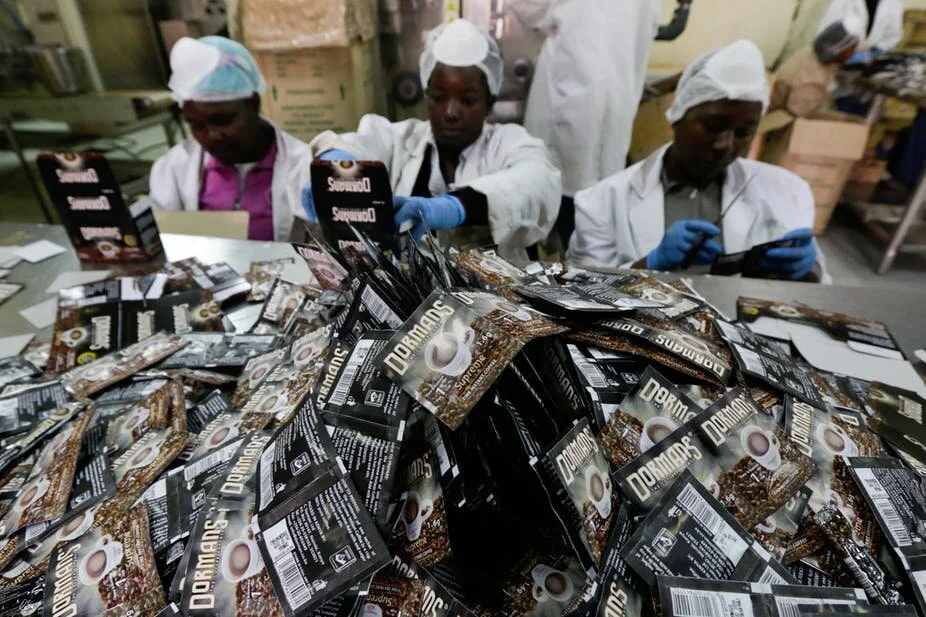
African Countries Can’t Industrialise? Yes, They Can
Narratives are essential. Humans are, after all, “helpless story junkies”. Business and economic success depend much more than is commonly acknowledged on getting the narrative right. And if there is a narrative where getting it right or wrong matters hugely, it is the narrative about Africa’s industrial development.
Africa is the poorest continent. It is likely to be the most affected by climate change. It is the continent where terrorist groups are spreading fast.
Therefore, African industrialisation is essential. Unfortunately, the dominant narrative is that Africa has been de-industrialising, even prematurely. In this narrative, it is also questioned whether Africa can ever industrialise. African countries have even been advised not to try. The World Bank’s “Trouble in the Making”report concludes that manufacturing is becoming less relevant for low-income countries.
Fortunately, a very different narrative is possible. In a recent paper, I argue that Africa can industrialise because of three factors. These are “brilliant” new technologies enabling digitisation, smart materials and 3D-printing; a more vibrantentrepreneurship scene; and Africa’s growing middle class (as measured by the share of households that earn between $11 and $110 per person per day), which supports the continent’s first generation of indigenous tech-entrepreneurs.
Consider therefore the following narrative: More than 300digital platforms, mostly indigenous, are operating across the continent. There are also more than 400 high-tech hubs, and more are being added. In addition, venture capital funding into African tech start-ups increased ten-fold between 2012 and 2018.
Moreover, manufacturing has more than doubled in size in real terms since 1980. And since 2000, manufacturing value added has grown at more than 4% a year. That is double the average between 1980 and 2000 (numbers from the Expanded African Sector Database).
As a result, total employment in manufacturing in 18 of the largest African economies (for which there is data) grew from roughly 9 million in 2004 to more than 17 million by 2014. That is an 83% increase in ten years. The proportion of labour in manufacturing for Africa as a region grew from roughly 5% in the 1970s to almost 10% by 2008.
So, how will these trends shape the future? I argue that they will result in three varieties of industrialisation.
Three varieties
The first variety can be labelled “acquiring traditional manufacturing capabilities”. This variety is implied by Overseas Development Institute researchers Karishma Banga and Dirk Willem te Velde. It will be experienced by countries and sectors where technological change is too fast and complex to benefit immediately. These countries and sectors will need time to first put complementary investments in place, while at the same time continuing to promote traditional labour-intensive manufacturing.
The second variety, “fostering sectors with the characteristics of manufacturing”, is elaborated in a recent UNU-WIDER book. Here it is argued that service sectors can take up “the role held by manufacturing in the past”. In many countries, services such as ICT and telecoms, tourism and transport, financial and farming services can lead to productive development.
The third variety, “resurgent entrepreneurship-led industrialisation” is based on my earlier work. I point to the growing list of achievements of African countries in terms of high-tech manufacturing. For example South Africa leads in advanced manufacturing in having one of the world’s largest 3D-printers, used to manufacture parts for the aviation industry.
Different combinations of these varieties will dominate in different countries. For example, Kenya is already experiencing the simultaneous development of high-tech financial services alongside growth in traditional manufacturing, such as food processing and textiles, as well as clusters of advanced manufacturing. While every country’s pathway will be a unique combination of these varieties, what they will have in common is that progress will require that they deal with the impact of new technology, especially digitisation, on manufacturing.
To ensure momentum is maintained, the narrative about industrialisation has to change. As Israeli historian Yuval Noah Harari pointed out, neither land – the core resource of feudalism – nor physical capital – the core resource of 20th-century capitalism – will be decisive for competitiveness in the future. Instead, data and data science, free information flows, ICT (data) skills, and decentralisation of decision-making will be the decisive factors.
What needs to be done
With an outdated story that gives up on manufacturing, Africa will fail to close the huge digital gap it still faces. The gap is reflected in the fact the continent contributes less than 1% of world’s digital knowledge production. To reduce this gap, African countries will have to start by expanding internet access and use. If internet use across the continent can be expanded to the same rate as in high-income countries, 140 million new jobs and US$2,2 trillion could be added to GDP.
What must be done to change the narrative? What do African governments need to do? The first is that its leaders need to start telling more stories about the future than about the past. Perhaps, like China’s leaders, they can even be inspired by science fiction. British best-selling author Neil Gaiman relates how China started to embrace science fiction after sending a delegation to
“the US, to Apple, to Microsoft, to Google, and they asked the people there who were inventing the future about themselves. And they found that all of them had read science fiction when they were boys or girls.”
Helping to imagine the future of African industrialisation, South African President Cyril Ramaphosa recently stressed that fact that Africa is one of the early adopters of mobile telephony and moreover that the continent needs to aspire to more:
We need to focus on the new technologies that are going to revolutionise the world, and we need to be ahead of the curve.
This is the right narrative. It is necessary, although not sufficient for African industrialisation. For this, words need to lead to actions. And some consistent actions, at least for a start, would be for African governments to refrain from creating stumbling blocks for their brave new tech-entrepreneurs, such as curbing access to the internet, restricting digital information flows, under-investing in science, technology, engineering and mathematics education, neglecting data-privacy legislation, and restricting the rights of women to work in manufacturing.
Wim Naudé is a Professorial Fellow, Maastricht Economic and Social Research Institute on Innovation and Technology (UNU-MERIT), United Nations University
THIS ARTICLE WAS ORIGINALLY PUBLISHED ON THE CONVERSATION
In Dr Seuss’ Children’s Books, a Commitment to Social Justice That Remains Relevant Today
On February 18, Random House announced the discovery of What Pet Should I Get?, an unpublished – and heretofore unseen – picture book by Dr Seuss. The announcement came 10 days after the same publisher revealed that it would publish Harper Lee’s “discovered” manuscript for Go Set a Watchman in the summer of 2015.
In What Pet Should I Get? – released this week – the very same siblings who first appeared in One Fish Two Fish Red Fish Blue Fish now struggle with the question of what pet they should choose.
While the siblings in What Pet Should I Get? may not be as familiar as Scout and Jem Finch, Dr Seuss’ new book is the latest addition to a body of work that remains just as committed to social justice as Harper Lee’s famous novels.
From Flit to Horton Hears a Who!
Such matters were not always the chief focus of Theodor Geisel (Dr Seuss’ real name).
In the late 1930s, using the pen name Dr Seuss, Geisel created cockamamie ad campaigns for Flit bug spray. During the early years of World War II, he contributed notoriously vicious caricatures of the people and leaders of Axis nations for the Popular Front tabloid PM. After joining famous Hollywood director Frank Capra’s Army Signal Corps unit in 1943, he co-created propaganda films under Capra’s tutelage.
However in the years after the war, Dr Seuss’ art underwent a radical thematic shift. With a flood of eager baby boomer readers, he decided he wanted to speak to the perspective of children.

A Flit advertisement proof from the 1930s, drawn by Dr Seuss. Special Collection & Archives, UC San Diego Library
A Flit advertisement proof from the 1930s, drawn by Dr Seuss. Special Collection & Archives, UC San Diego Library
The racist caricatures of Japanese civilians and soldiers that Dr Seuss published in PM had drawn on the social prejudice and aggression that Geisel believed lay at the heart of adult humor. So Geisel entrusted Dr Seuss’ postwar art to the belief that children possessed a sense of fairness and justice that could transform their parents’ world.
Geisel described his 1954 children’s book Horton Hears a Who!, in part, as an apology to the Japanese people his propaganda had demeaned during the war. In subsequent children’s books, he began addressing the major issues of the 20th century: civil rights in The Sneetches (1961), environmental protection in The Lorax (1971) and the nuclear arms race in The Butter Battle Book (1984).
The zany wisdom of Dr Seuss
In 1960, Geisel spelled out the stakes of his art:
In these days of tension and confusion, writers are beginning to realize that Books for Children have a greater potential for good, or evil, than any other form of literature on earth.
Like To Kill a Mockingbird, One Fish Two Fish Red Fish Blue Fish was published in 1960. And like Mockingbird, the conflicts, tensions and fears of that era are highlighted (albeit indirectly).
One Fish Two Fish Red Fish Blue Fish follows a brother and sister who encounter a series of increasingly fantastic creatures. Nonsensical skits and slapstick gags disrupt the children’s need to decide on a definitive taxonomy – numbers, colors, oppositions, emotional dispositions – for these animals.

A question nearly all children face. Random House
A question nearly all children face. Random House
The array of sorting mechanisms communicates the siblings’ attraction to different, ever-stranger living things. The book introduces more than a dozen creatures and each is outlandishly distinctive. Most importantly, the children value all of them because of their uniqueness.
Overall, this tale of inclusivity cultivated an appetite for diversity and a delight for change. It rejected the stereotypical ways of regarding persons and things through strict categorization.
Dr Seuss engaged 1960s unrest more directly in Green Eggs and Ham, also published in 1960. Using visual and verbal eloquence, Dr Seuss forces the the adult, Grinch-looking creature to confront his stubborn prejudice against green eggs and ham: the character is presented with a series of challenging questions designed to expose the absence of any foundation for his bias.
The adult remains stubborn in his intolerance until his much younger counterpart convinces him that there’s no more basis for his distaste for green eggs and ham than the dislike he’s taken to Sam-I-Am.
The 650 million children who have read Dr Seuss’ books have been exposed to new ways of viewing the world, of rethinking a social order often imbued in prejudice. But adults continue to use the themes of One Fish Two Fish Red Fish Blue Fish. It has inspired a CEO’s leadership manual, a Barnes & Noble e-readerand the name of a dating website. The book was quoted by Supreme Court Justice Elena Kagan in a dissenting opinion earlier this year.
In 1994, Johnny Valentine and Melody Sarecky even applied it to promote same-sex marriage in their children’s book One Dad, Two Dads, Brown Dad, Blue Dads.
An original sketch from What Pet Should I Get? discovered in Dr Seuss’ home office in La Jolla, California. Dr Seuss Enterprises
The pet shop that provides the setting for What Pet Should I Get? is inhabited by creatures that display striking resemblances to Horton, the Whos and the Sneetches, along with Sam-I-Am and the fish protagonists of One Fish Two Fish Red Fish Blue Fish. An offshoot of the social vision informing these narratives, What Pet Should I Get? won’t disappoint Dr. Seuss’ readers in the way the Atticus Finch disappointed some To Kill a Mockingbird fans.
As older readers relive their response to a universal question nearly all children face, What Pet Should I Get? will allow a new generation of readers to discover why Dr Seuss remains forever relevant.
Donald E Pease is a Professor of English, Dartmouth College
THIS ARTICLE WAS ORIGINALLY PUBLISHED ON THE CONVERSATION
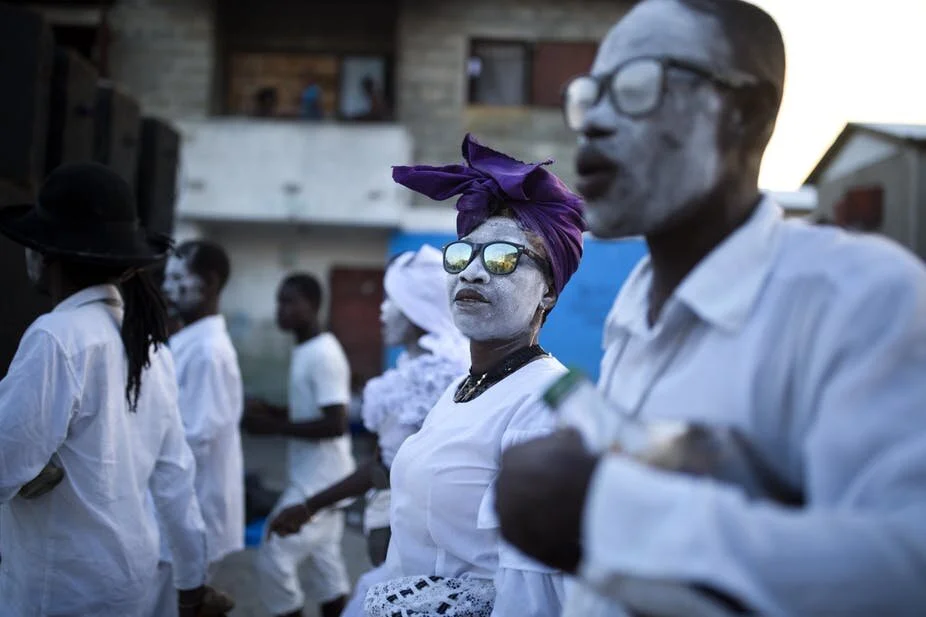
Voodoo believers walk during the annual Voodoo festival Fete Gede at Cite Soleil Cemetery in Port-au-Prince, Haiti. AP Photo/Dieu Nalio Chery
What is Haitian Voodoo?
For many in the West, Voodoo invokes images of animal sacrifices, magical dolls and chanted spells. But Voodoo—as practiced in Haiti and by the black diaspora around the world—is a religion based on ancestral spirits and patron saints.
Read More
Flavour, a popular Nigerian musician, can wear his dreadlocks in peace because they are seen as a temporary fashion statement. Elizabeth Farida/Wikimedia Commons
In Nigeria, Dreadlocks Are Entangled with Beliefs About Danger
A grown man wearing his hair in dreadlocks is bound to attract attention in Nigeria. And it’s not always positive attention. Many Nigerians, regardless of their education and status, view dreadlocked men as dangerous. The hairstyle sometimes even gets a violent reaction.
This bias is deeply rooted in traditional religious beliefs and myths, especially those of the Yoruba and Igbo people.
My book on the symbolism of dreadlocks in Yorubaland tries to explain what knotted hair means to Yoruba people, and where these ideas come from. Numbering around 40 million, Yoruba people predominantly occupy southwestern Nigeria. In West Africa, they are found in Benin Republic, Ghana, Togo, Sierra Leone, and Liberia. In the diaspora, they are significantly present in the US, Brazil, Cuba, Haiti and the Caribbean.
An affront to society’s orderliness
A popular phrase used by Yoruba people to describe dreadlocks is “a crazy person’s hair”. The language also has an idiom that shows how people feel about madness. A person will ask, “kini ogun were?” (what is the cure for madness?) and get the response, “egba ni ogun were” (whip is the cure for madness).
Mentally disturbed people often wear dreadlocks due to neglect. Because they are unpredictable, they are avoided as they roam the streets, and sometimes beaten. Their knotted hair show disharmony with the community; being unkempt and unruly, they are viewed as an affront to societal norm of orderliness.
Adult men with dreadlocks are viewed similarly. They are perceived as volatile and dangerous. Their untamed hair connotes wildness. Therefore, they are associated with the wilderness; uncultivated and unruly. In traditional Yoruba and Igbo worldview, unkempt hair is akin to the forest – mysterious, dark, and to be avoided.
There are exceptions: musicians and athletes who wear these hairstyles are “tolerated” as they are presumed to be assuming a persona that matches their brand. Essentially, theirs is a temporary fashion statement. And because they are famous and successful, they are protected from attacks on the streets.
Dark and frightening by tradition
The Yoruba thought system has it that some children are raised in the forest by gnomes and other mysterious beings. They come back into the community with supernatural powers, strange mannerisms, and sometimes knotted hair. Since they traverse the physical and spiritual worlds, it is believed that they can discern the destiny of others and can negatively influence them.
These knotted-haired people are avoided, more so when their dreadlocks are greying because “normal” adult Igbo and Yoruba males shave their heads completely, or they cut their hair very short. Deviating hairstyles are viewed suspiciously.
Unlike adult males, children born with knotted hair are revered and welcomed as a gift of the gods and not a product of the wild. Such children are called “dada” among the Yoruba in western Nigeria and the Hausa in the north. In south eastern Nigeria, the Igbo call them “ezenwa” or “elena”.
In Yoruba mythology, Dada is the son of Yemoja, the goddess of the sea, wealth, procreation, and increase. Dada is said to be one of the deified Yoruba kings. His younger brother is believed to be Shango, the god of thunder, who wears cornrows.
Children-dada are presumed to be spiritual beings and descendants of the gods by virtue of their dreadlocks. As such, their hair is not to be groomed and can only be touched by their mothers. They are the bringers of wealth, which is symbolised in both Yoruba and Igbo cultures by cowrie shells. They are celebrated. Feasts are held in their honour.
Their time on earth is special. It is marked by special rites that define different phases of life. In nearly all cases, their hair is shaved before puberty in order to integrate them into the community. The shaving ritual takes place at a river, where the shaved head is washed. The cut hair is then stored in a pot containing medicinal ingredients and water from the river. The concoction is believed to have healing properties and needed when they fall ill.
After the hair-shaving ceremony, the dada wears “tamed” hair in conformity with societal expectations. The child is still recognised as special and mysterious but is now integrated into society. The visible sign of their spirituality is no longer present. Any grownup, therefore, who still wears their dreadlocks is deemed to have been possessed by evil forces, or chose to do so malevolently; in either case, dangerous.
Challenges to the culture
Despite their negative associations, dreadlocks increased in Nigeria’s religious and popular cultures in the 1960s. Itinerant priests of the Celestial Church of Christ appear in white gowns and knotted hair. The famous musician and talented artist from Osogbo, Twin Seven Seven, performed on stage and television with his dreadlocks and white attire. He was the sole survivor of seven (considered a mysterious number in Yoruba tradition) sets of twins.
Yorubaland has the highest rate of twins in the world. Twins are considered spiritual beings, so they are also revered and celebrated. Being a twin, having knotted hair, and only wearing white clothes (like the gods or ghosts), further mystified Twin Seven-Seven in popular imagination and fanciful stories about him spread. For example, it was said that he was raised in the forest by spiritual beings, hence his creative imagination and hairstyle.
In the 1970s and 80s, other Nigerian musicians like Majek Fashekwere inspired by the fame of Jamaican reggae artists to begin styling their hair the same way. From the 1990s, Nigerian footballers joined in by wearing cornrows and dreadlocks.
Barring these exceptions, adults with unkempt hair are judged deviant beings who have become conduits for evil. Since it is difficult to differentiate between adults wearing dreadlocks as fashion statement from those with “evil dreadlocks”, people either flee from them or attack them out of fear and self preservation.
Augustine Agwuele is a Professor, Department of Anthropology, Texas State University
THIS ARTICLE WAS ORIGINALLY PUBLISHED ON THE CONVERSATION
The Amazing Bike Machines of Guatemala
Bike machines, or "bicimaquinas," are changing people's lives in San Andrés Itzapa, Guatemala. The unique stationary bicycles have been altered to function as human powered machines that can do everything from washing clothes, to blending and shelling nuts. Made of discarded, eco-friendly parts, they are the brainchild of locally run non-profit Maya Pedal. Not only are these machines functional and economical, they also contribute health benefits.
Escalations in Violence in Hong Kong Could Prove Perilous to Human Rights
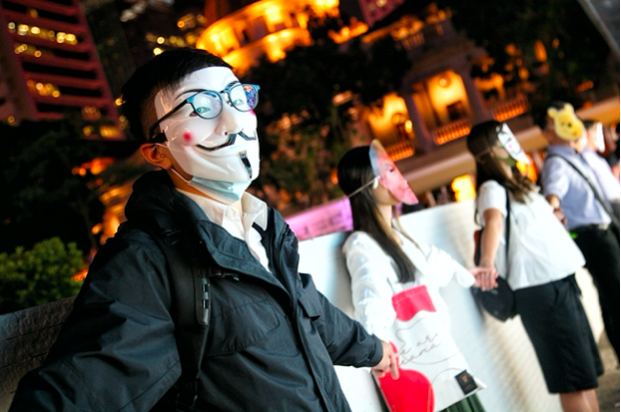
“A protestor wearing a Guy Fawkes mask in October 2019.” Honcques Laus. CC0.
Demonstrators have seemed to reach a stalemate against the government of Hong Kong, which refuses to accede to the demands of the protesters. Given the rapid escalations in violence and the willingness of the police to employ excessive force, a stalemate could have serious consequences for the state of human rights in Hong Kong.
Protests in Hong Kong began in late April 2019, in reaction to the raising of an extradition bill, which would have permitted the extradition of citizens of Hong Kong to mainland China. Pro-democracy protesters see the extradition bill as a significant acquiescence of Hong Konger’s sovereignty to mainland China, as Hong Kong remains a territory not technically under the direct purview of the Chinese government. The specific worry is that Beijing would use the extradition bill to suppress the growing pro-democracy sentiment among younger generations of Hong-Kongers by demanding that Hong Kong hand over its activists and successful con-China politicians. They represent a movement that has been developing since the late 1990s, focused on maintaining Hong Kong’s distance in relation to the Central People’s Republic in Beijing, with the eventual aim of bringing fully-democratic elections to Hong Kong.
Presently, the citizens of Hong Kong are allowed free speech and rights to free assembly and association, as outlined in the Basic Law. The government and election structure of Hong Kong is quasi-representative. There are 1,200 electors who ostensibly select officials: representatives of various economic sectors, business interests, and the affluent of Hong Kong. However, the central mainland government exercises a great deal of control over the political proceedings of Hong Kong; the incumbent Chief Executive Carrie Lam was openly favored by China’s President, Xi Jinping. While the extradition bill was removed from the table following the outbreak of protests, the potential for democracy in Hong Kong seems to hang in the balance, as demonstrated in Executive Lam’s unwillingness to accede to the demands of the protesters, and in Beijing’s continued support for Lam.
The protestors have issued a list of demands beyond the reneging of the proposed extradition bill, repealed in September, that includes investigation into police actions as well as amnesty for protesters in custody, complete universal suffrage, and Lam’s withdrawal from her post as Chief Executive of Hong Kong. The government of Hong Kong has issued a hardline stance, supported explicitly by Xi Jinping and the Central People’s Republic. In her refusal to acquiesce to demands, Lam pushes the protests in Hong Kong towards a path of greater uncertainty; given the perseverance demonstrated by the protesters, it seems that the situation will only continue to escalate.
Consequently, the first weeks of November have seen significant escalations in the protests in Hong Kong: on November 7th, a university student died after he fell from the top of a parking deck during a skirmish with the police. Monday November 11th saw major instances of violence, in which a police officer shot a protester at close range, and a pro-China counter-protester was set on fire by a group of demonstrators. Protesters and police alike have exhibited violent tactics since the inception of the protests. Police have not shied away from tear gas and rubber bullets, as well as employing excessive physical force towards protesters and members of the press. Demonstrators have also used tactics such as vandalism and violence against those believed to be pro-China.
However, equating police violence with the actions of the protesters carries dangerous human rights implications; the police act from a privileged position because of the backing they receive from both the government of Hong Kong as well as that of mainland China. The protesters have only the solidarity they experience among one another. Violence by protesters is the impetus of an individual working in conjunction with other individuals; excessive force against protesters by the police is a hit by the state in its entirety.
In this way, escalating patterns of police violence prove pernicious, because they undermine the human rights of Hong Kongers, and breed complications for a hypothetical future peace process. Instances of excessive violence towards the press prove especially destabilizing, because the suppression of information perpetuates the murkiness that allows the police to continue to carry out extreme, and in many cases illegal acts of retribution against demonstrators. As it stands, the violence in Hong Kong will only continue its escalation should the government of Hong Kong maintain its staunch refusal of concessions. A stalemate could have alarming consequences for the state of human rights in Hong Kong, as the police have already turned to violent tactics involving excessive uses of force, and the demonstrators have, in turn, only increased their fervor in furthering their demands.






HALLIE GRIFFITHS is an undergraduate at the University of Virginia studying Foreign Affairs and Spanish. After graduation, she hopes to apply her passion for travel and social action toward a career in intelligence and policy analysis. Outside of the classroom, she can be found, quite literally, outside: backpacking, rock climbing, or skiing with her friends.