
Much has been made about the wonders of Venice, but few ever venture deep enough across its less touristy, yet still historical hidden places. Beyond hundreds of canals and a diverse architectural style, a secret facet of Venetian life lives on, in which the journey of hand crafting gondola wooden oars and loomed fabrics remains rooted in ancient folk traditions.
Has the West Forgotten About Ebola?
Although the Ebola crisis has remained ongoing, it has received no tangible attention in Western media since 2015. A compelling explanation for this phenomenon rests in colonial associations of race and disease, and the way in which those associations have become implicitly present today.
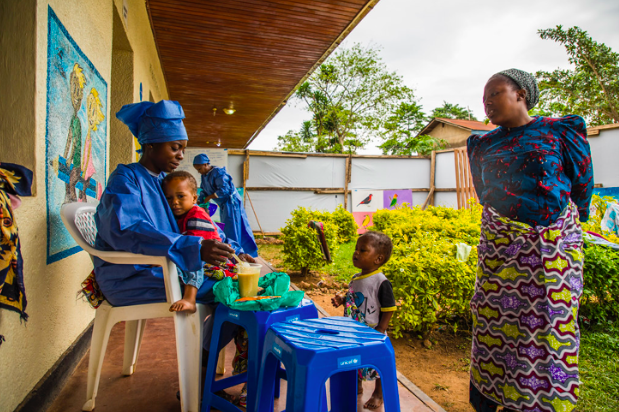
Nurses Caring for Children at the Height of the Ebola Epidemic. World Bank Photo Collection. CC BY-NC-ND 2.0
In 2014-2015, Guinea, Sierra Leone, and Liberia experienced 11,300 fatal cases of the Ebola virus. While not comparable to the scope of the incidence rate in Africa, the handful of fatalities in the West sparked panic about the growing global public health crisis of Ebola. Following the first fatality due to Ebola in the United States, the crisis reached national and international news.
In reality, the outbreak of Ebola, although it has diminished since 2015, is far from being over: nearly 3300 new cases, including 2171 fatalities, have resulted from the Ebola virus in the Democratic Republic of the Congo in the 12 months between October 2018 and October 2019 alone. Although incidence rates remain steady across Central and West Africa, concentrated especially in the DRC, with additional incidences possible in Tanzania, major media coverage in the West has dwindled to nearly nothing following 2015. The hypocrisy in media coverage in the West and especially the U.S. regarding Ebola is nuanced, and stems from a long history of biases that have developed and been reinforced throughout centuries.
That is to say, race has been implicitly coded over time into the way in which individuals conceive of hygiene, sanitation, and disease. Much of this coding arose from and became reinforced in colonialism: the colonized was marked “dirty, diseased.” In response, the colonizer labeled itself as a “savior.” Moreover, the concept of miasma, the leading Western theory of disease during the colonial era stipulated that disease originated from “foulness,” which—while not entirely incorrect, potentially misplacing correlation as causation— came to be shorthand for the treatment of the indigenous populations under the Western gaze. The concept of “foulness” was coded into the very identity of the colonized by the colonizer, as the status of the imperialist rested on the denigration of the colonized. It is these social relations which, then, are informative of the present social relations.
Consequently, centuries later, these attitudes have become baked into everyday life, translated over time from explicit positions into implicit biases. Even during the height of the crisis in 2014, attention has been brought to the phenomenon of the implicit white saviorism in the media reporting. The illustration in the West minimized the victims of Ebola in Liberia, Guinea, and Sierra Leone to numbers. In this way, the narrative implicated a diseased, “backwards” population in need of saving—implicitly posturing a parent-child relationship, rather than one of symmetrical foreign aid between states. This relationship creates an “us-other” distinction, such that when the virus reached the West the line between “us” and the “other” blurred. Once there were no longer instances of the Ebola virus in the West, the virus returned to its status of something belong to the “other,” directly reminiscent of the colonial attitudes regarding miasma and the colonizer’s role among the colonized.
Important to note, researchers have found that the cases in the most recent wave of Ebola in the Congo have disproportionately affected women. A dearth of medical research has found that the medical conditions of women, especially women of color, are minimized implicitly both in the medical profession and in general thought. This tendency towards minimization of marginalized groups further adds complexity to the issue of the asymmetry in coverage surrounding the Ebola outbreaks.
Certainly, this is not to say that anxiety over the proximity of the virus in the United States in 2015 is not partly explanatory of the brief surge and decline of Ebola’s salience in the media. However, the racialization in the framing of public health crises is crucial to understand the dynamics of outbreaks such as the one that has been ongoing. Although still a serious public health crisis, the Ebola virus largely disappeared from the media after its incidence in the West fell back to zero. This phenomenon has had concrete consequences: experts estimated that the incidence rate of fatal cases in the 2014-2015 crisis could have been reduced by 80% had response measures been instated two months ahead of when they were initiated. The responsiveness in public health crises is directly related to the salience of those crises: Westerners were simply less likely to label the Ebola outbreak a public health emergency until the virus was discovered in the West. The asymmetries in media coverage do not occur in a vacuum, however, and understanding their roots and implications is critical to their mitigation.

HALLIE GRIFFITHS is an undergraduate at the University of Virginia studying Foreign Affairs and Spanish. After graduation, she hopes to apply her passion for travel and social action toward a career in intelligence and policy analysis. Outside of the classroom, she can be found, quite literally, outside: backpacking, rock climbing, or skiing with her friends.
The Film Camp Giving Disabled Talent a Chance to Shine
For those with disabilities, finding a place in the film industry can feel isolating. The dearth of opportunity for disabled talent inspired the Halby family to create Zeno Mountain Farm, a camp dedicated to finding and celebrating the talent in everyone. Every summer, the camp creates a movie using an integrated cast and crew of those with and without disabilities. This year, they’re taking on their most ambitious project yet: a high school musical. At Zeno, everyone deserves an equal shot at the spotlight.
An Inuit Approach to Cancer Care Promotes Self-Determination and Reconciliation
For thousands of years, Inuit have adapted to the changes in their environment, and continue to find new and innovative ways to survive.
But life expectancy among populations in Inuit Nunangat (the traditional territory of Inuit in Canada) is an average of 10 years less than that of the general Canadian population.
Cancer is a leading cause of this disparity. Inuit experience the highest mortality rates from lung cancer in the world, and mortality rates of some other cancers continue to increase disproportionately.
Inuit communities tend to be self-reliant and are renowned for working together for a common goal, which is evident in their self-governance and decision-making activities. They have also endured a long history of cultural insensitivity and negative health-care experiences that span generations
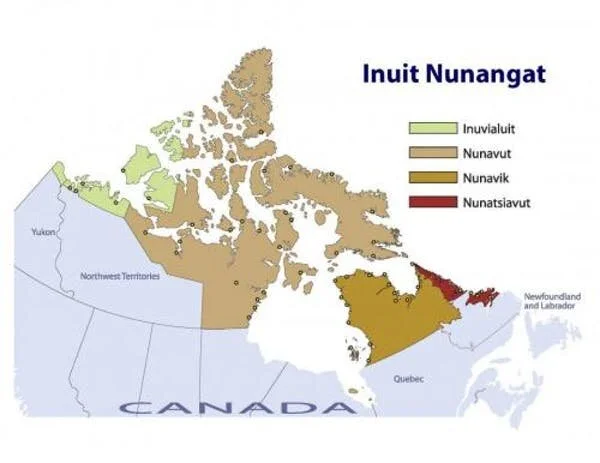
Map of Inuit Nunangat (Inuit Regions of Canada) (Inuit Tapiriit Kanatami)
The ways the Canadian health-care system interacts with Inuit populations plays an important part in this health disparity. And there is an urgent need for Inuit to be able to access and receive appropriate health care.
Elder Peter Irniq speaks about the remarkable Inuit capacity for survival in extreme conditions
In 2015, the Truth and Reconciliation Commission of Canada (TRC) report made 94 recommendations in the form of Calls to Action. Seven of these Calls to Action specifically relate to health. They explain the importance of engaging community members, leaders and others who hold important knowledge in the development of health care.
As members of a team of Inuit and academic health-care researchers, we have been working with health-system partners to support Inuit in cancer care. We focus on enhancing opportunities for Inuit to participate in decisions about their cancer care through the shared decision-making model, in a research project we call “Not Deciding Alone.”
We travel thousands of miles for cancer care
Our collective success in addressing the TRC Calls to Action will require health research to focus on addressing the health-care inequities experienced by Inuit, First Nations and Métis populations in ways that take action to promote self-determination.
This is important as current health-care models do not often support Indigenous values, ways of knowing and care practices.
Poor cultural awareness in our mainstream health-care systemsdiscourages Indigenous people from seeking care and engaging with health services. It increases the risk that Indigenous people will encounter racism when seeking care.
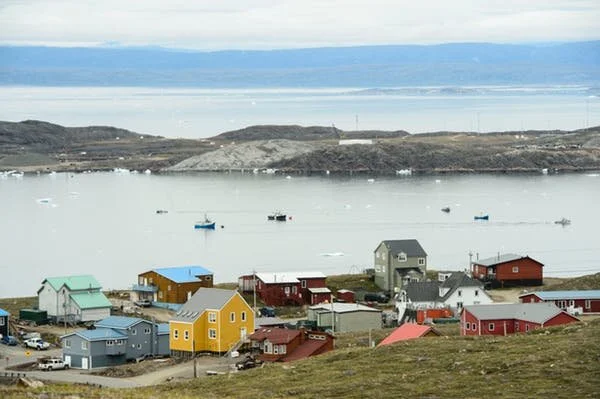
Small boats make their way through the Frobisher Bay inlet in Iqaluit on Aug. 2, 2019. THE CANADIAN PRESS/Sean Kilpatrick
There are many documented instances of our health-care system’s failure to provide appropriate health care to Indigenous people, due to unfair assumptions and demeaning and dehumanizing societal stereotypes.
These health system failures discourage people from seeking care, and have resulted in death, as in the case of Brian Sinclair,who died after a 34-hour wait in a Winnipeg hospital emergency room in September 2008.
There can also be significant physical barriers to care for Inuit. Critical health services such as oncology specialists and treatments are often located in urban centres such as Ottawa, Winnipeg, Edmonton, Montréal and St John’s, thousands of kilometres away from remote communities in Inuit Nunangat. This leaves many Inuit negotiating stressful urban environments, dealing with cultural dislocation and navigating complex health systems without the benefit of community support networks.
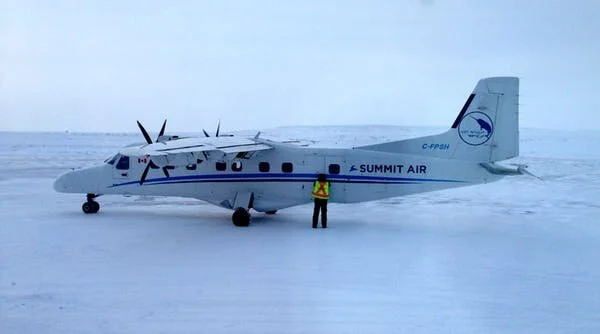
People must fly out of remote communities for cancer treatment. (Alex Hizaka), Author provided
During our research, an Inuit peer support worker explained what it can be like for those who travel far from their family and community for their care:
“People come with no idea of why, and we are having to bridge two worlds for them. Often patients have no idea why health-care providers tell them to get on a plane, and then they think they are coming for treatment for three days and then it becomes two weeks. It is a tough situation as often people have no money, no support. People need to be able to explain their situation and how it is for them. People need to know that they are not alone.”
Research shows that these geographical challenges significantly impact access to health care and are often exacerbated by language barriers. Together these factors may make people vulnerable to additional harms unrelated to the health conditions for which they seek treatment.
Patients and health-care providers work together
Shared decision-making is an important evidence-informed strategy that holds the potential to promote patient participation in health decisions
In this model, health-care providers and patients work togetherusing evidence-based tools and approaches and arrive at decisions that are based on clinical data and patient preferences— to select diagnostic tests, treatments, management and psycho-social support packages.
Shared decision-making is considered a high standard of carewithin health systems internationally and it has been found to benefit people who experience disadvantage in health and social systems.
Shared decision-making has also been found to promote culturally safe care, and has the potential to foster greater engagement of Inuit with their health-care providers in decision-making.
The concept of cultural safety was developed to improve the effectiveness and acceptability of health care with Indigenous people. Culturally safe care identifies power imbalances in health-care settings — to uphold self-determination and decolonization in health-care settings for Indigenous people.
The aim of a shared decision-making approach is to engage the patient in decision-making in a respectful and inclusive way, and to build a health-care relationship where patient and provider work together to make the best decision for the patient.
Most importantly, our approach has emphasized ways of partnering that align with the socio-cultural values of research partners and community member participants, both to develop tools and create approaches to foster shared decision-making. The term “shared decision-making” translates in Inuktitut to “Not Deciding Alone” and so that is the name of our project.
The results are outcomes that Inuit are more likely to identify as useful and relevant and that respect and promote Inuit ways, within mainstream health-care systems.
Self-determination through Inuit Qaujimajatuqangit
Our research uses the guiding principles of Inuit Qaujimajatuqangit — a belief system that seeks to serve the common good through collaborative decision-making — as the foundation for a strengths-based approach to promote Inuit self-determination and self-reliance.
Inuit Qaujimajatuqangit principles have been passed down from one generation to the next and are firmly grounded in the act of caring for and respecting others.
There is important learning taking place within academic and health-care systems that involves deepening understandings of what “patient-oriented care” means. We need to learn how to do research in partnership with those who are the ultimate knowledge users in cancer-care systems — patients.
In our work, Inuit partners and community members are leading the development of shared decision-making tools and approaches, building on their strengths and resiliency. Our research and health systems are beneficiaries of these partnerships that hold potential to create health care that is welcoming and inclusive for all.
With guidance and support from Inuit and more broadly, from Indigenous partners, we are learning how to take action on the TRC recommendations, and to make respect and kindness integral to best practice in research and health care.
Janet Jull is a Assistant Professor, School of Rehabilitation Therapy, Queen's University, Ontario
THIS ARTICLE WAS ORIGINALLY PUBLISHED ON THE CONVERSATION
The Spirit of Morocco: Music, Architecture, and Living Heritage
There is more to Morocco than the gorgeous sand dunes of Merzouga in the Sahara or the majestic Atlas Mountains of the Maghreb region. Morocco’s music can take you on a journey through Spain, with flavors of Berber, hints of Arabic, and the Saharan style. Its architecture is a show stopping feature of pisé buildings, the finesse of Moorish exiles, and a glimpse into the Islamic influence of the Idrisid dynasty. The people bring craftsmanship and skill to their communities, combining history and culture in a way only Morocco can do.
Read MoreMADAGASCAR: Nosy Lehibe
An epicenter of wildlife, Madagascar sits like The Garden of Eden about 300 miles off the coast of southern Africa. Best known for its lemurs and baobab trees, it is also home to more than 20 ethnic groups hailing from Africa and Indonesia. Explore Madagascar in this short video.
Read MoreOil Wars: The Significance of Small Battles for Land Rights Against Major Oil Companies
The complexity of the oil industry and the massive influence of big money over environmental and public health decisions often leaves the small battles to be squashed before they have seen the surface. But recent fights over land rights, have led to some large victories. Home owners, environmental groups, and tribes have all made strides against companies in their area; can these local battles gain headway on a national level?
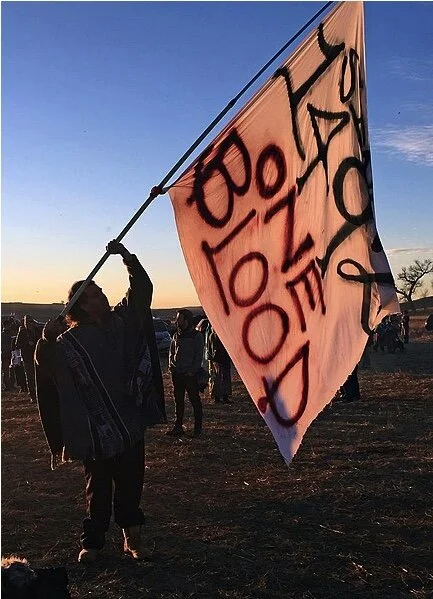
Flag at a protest for the construction of the Dakota Access Pipeline. Becker1999. CC-BY-2.0.
Oil has hit a cornerstone between immense support from Trump’s administration and increasing heat from environmental activists. Often oil companies are in the news when facing massive consequences for oil spills. But, people that live near drilling sites or along pipelines can face health effects and unfair treatment from corporate and government agencies every day.
The biggest culprits are often in rural areas where people are dependent on the land for their livelihood. For example, a pipeline being built from western Texas to the Gulf cuts straight through Hill Country and the ranches there. This is even true for areas designated as private conservation land that is supposed to be protected from any development. The building raises concerns for environmental, aesthetic, and public health reasons.
The same problem is found in West Virginia, where pipeline development cuts through private homes. If the owners refuse to sell their land, it can be taken legally through Eminent Domain. This will continue to become more popular in the next 15 years as there is an estimated 26,000 miles of new gas pipelines to be built. People are starting to sue to bring the problem to the Supreme Court. The increased danger of living next to a pipeline can lead to cancer, contaminated drinking water, and increased dangers if the line were to break or become damaged.
One of the biggest groups fighting against pipelines are native tribes. The Sioux gained attention at Standing Rock while fighting the production of the Dakota Access Pipeline. In the Upper Midwest, rights to Line 5 are being revoked on reservations. In Alaska, Inuit tribes are fighting drilling in the Arctic National Wildlife Reserve (ANWR) which has been opened up to drilling for the first time under the Trump administration.
The ANWR and the Arctic are thought to be some of the largest untapped oil reserves in the world. Climate change has increased access to areas of the region that couldn’t be reached before, yet the environmental risk of drilling and transporting in an extremely unique and fragile ecosystem has led to a lot of resistance. In the ANWR, drilling is thought to upset Caribou migration and breeding grounds, which the local people rely on as a food source and cultural significance.
In the US, it often seems like these fights always end in the same way, but in Ecuador and Canada tribes have main significant gains against drilling. In the Amazon, the Waorani won a landmark case against the Ecuadorian government that was trying to open the rainforest to mining. The government hoped to bring more cash into the country but would do so at a huge environmental and cultural cost. One that the Waorani wouldn’t allow. The area covered 7 million acres of Indigenous land. The Waorani said that is about more than the land but instead about a way of living that supports the lives of others.
In Canada, fights against seismic blasts to find offshore oil reserves had great success to protect the local ecosystem. The local Inuit of Clyne River joined with Greenpeace and grassroots environmental movements to bring it to national attention. Now Arctic off-shore blasting has seen its final days. There are great strides to be made by fighting the daily impacts of oil and gas drilling. If anything, increasing drilling and pipeline construction is continuing our dependence on one of the most carbon-dense energy sources in the world.
DEVIN O’DONNELL’s interest in travel was cemented by a multi-month trip to East Africa when she was 19. Since then, she has continued to have immersive experiences on multiple continents. Devin has written for a start-up news site and graduated from the University of Michigan with a degree in Neuroscience.

Birth Fate: Institutionalized Racism in New Zealand Prisons
New Zealand has the second highest incarceration rate in the Western World, beat only by the United States. Yet, there is an unequal distribution throughout prisons, with Maori making up majority of those incarcerated. The explanation lies in history.
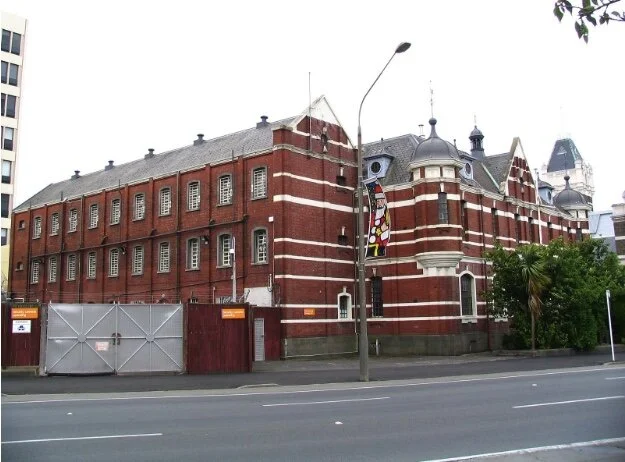
Historic prison in Dunedin, New Zealand. Benchill. BY-SA 3.0.
New Zealand has been praised for its efforts in incorporating aspects of indigenous culture into everyday life. Road signs are posted in both English and Maori. Students in school learn Maori history and culture. The All Blacks do the haka. But looking beneath the surface it is apparent that racism against the Maori culture still very much exists. This is no more evident as in the incarceration rates. Maori make up about 15 percent of New Zealand’s population but over 50 percent of the prison population. This difference has to be examined not just on a criminal justice level but also from a historical perspective.
A study from the University of Otago, found that there three main reasons behind the high incarceration rates for Maori people. They are structural racism, intergenerational trauma, and colonization. Of course these three are all intertwined with colonization being the cause for intergenerational trauma and structural racism. The biggest effects of colonization come from subordination and institutionalized change. Having a change in the value of wealth – to one of monetary and property value – and being on the losing end of that spectrum creates a never ending struggle. Maori justice system before colonization revolved around group accountability and following tikanga, the Maori just way of being. Prisons involve punishment and individual causation. Adapting to a system whose values are drastically different than your own and having to fight for your land and culture, has left the Maori at a disadvantage.
On an individual level, majority of inmates had been a victim to violence, had a mental health diagnosis or brain injury, did not have proper schooling, and/or had a parent who also had been in correctional facilities. Poverty on its own is a huge factor in crime statistics with first acts being committed out of necessity. Add on top of that, generational histories of crime, violence, and mental health, it is hard to break the cycle.
If you look both at the history of New Zealand and the history of the person, it is no surprise that institutionalized racism exists. The current government is working on reducing the number of people incarcerated but it is hard to tackle the problem when Maori representation at the government level is lacking. They are looking towards examples from Norway, with community correction facilities, and there are programs working to bring Maori values to prisons. But until more effort is done to correct inequalities in wealth, education, and healthcare it may be hard to have lasting change.
DEVIN O’DONNELL’s interest in travel was cemented by a multi-month trip to East Africa when she was 19. Since then, she has continued to have immersive experiences on multiple continents. Devin has written for a start-up news site and graduated from the University of Michigan with a degree in Neuroscience.

Investing in War: How Violence Has Turned into a Profitable Business
Violence finds its home most often in some of the poorest places. But money filtrates its way through often gathering in arms businesses and corrupt governments. In recent times, this has been true in many countries throughout Africa and the Middle East. Is the price of death worth it?
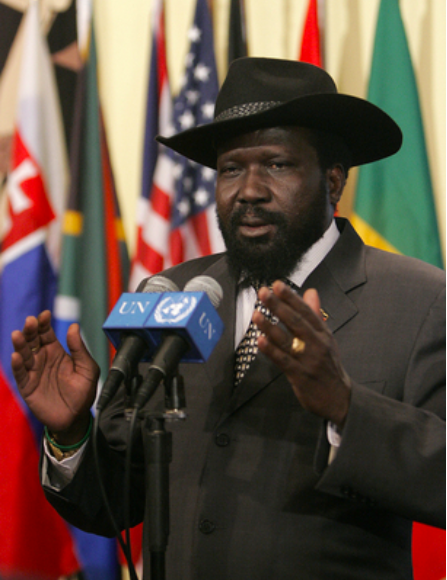
Salva Kiir, President of South Sudan. Jenny Rockett. CC BY-SA 1.0.
There is a moral question that has surfaced over the years on whether you would have to choose between the death of someone you loved or thousands of strangers. Most of the time it would be frowned upon if you picked one life at the expense of thousands. But not everybody agrees. That moral standard doesn’t translate when power is involved. Too often the death of innocent people is picked for monetary gain. This isn’t just found with governments often associated with corruption but also can be found in US foreign policy and even in the UN. Just look at the Rwandan Genocide and Iraqi War for example. The US tends to only involve itself in conflict in which it has another interest in, often oil or another economic benefit. In Rwanda, the UN actually left the country when violence broke out and only got re-involved once it reached international attention. After the genocide ended, the country got so much foreign aid that its capital city, Kigali, is being recreated as a post-modern enterprise focused solely on appearance and not reality. This pattern has continued throughout many conflicts. It is, quite frankly, the business of war.
This best current examples of this trend lie in South Sudan and Yemen. The rise of the Arab Spring lead to the intermingling of conflict, with wealthy monarchies fueling and funding neighboring battles. This is seen in both Syria and Libya. The most notable pairing though is the UAE in Yemen. Like most foreign involvement it is motivated by economic gain, namely control of the Red Sea coastline, and military prowess, as presence equals power. The UAE’s influence has led to the risk of starvation for 14 million people and a much more complex civil war. The leaders of militia groups are now benefiting greatly from foreign aid while the gap between rich and poor continues to spread.
South Sudan follows a similar pattern. The civil war has led to leadership on both sides of line pocketing millions and pursuing private business in real estate acquisitions and capital investments. South Sudan’s economy is completely dependent on oil leading to endless conflict over oil reserves and wealth distribution. The war has left over 5 million in need of aid yet little is being done to stop it. When those in charge get nothing but wealth, why save the people?
One of the biggest culprits of profiting from war lies in the companies controlling valuable natural resources. Often these companies are foreign owned and operated and give little thought to the violence surrounding it, focusing only on the influx of cash. These goals often coincide with a repressive regime. A study from the World Bank found that if one-fourth of the country's GDP is from primary commodity exports, the possibility of a civil war increases by 30%. Two examples of this are in Columbia and Tibet. Both areas have repressive governments with Tibet under illegal occupation of China. This has allowed for the expansion of foreign interest in mining in both countries, often with little regard to the surrounding area and the people that live there. In Columbia alone, 68% of displacements occurred in mining areas.
As long as money is involved and there are people, governments, and companies benefitting from war and violence, there is little motivation to change. If only we could learn that you don’t need to fight violence with violence, you fight by combatting the wealth of those with power.
DEVIN O’DONNELL’s interest in travel was cemented by a multi-month trip to East Africa when she was 19. Since then, she has continued to have immersive experiences on multiple continents. Devin has written for a start-up news site and graduated from the University of Michigan with a degree in Neuroscience.

The Swimming Sisters of Alcatraz
The waters between San Francisco and Alcatraz, a former prison, are rife with urban legend. Some say the water is too dangerous for swimming, but Mitali Khanzodé, 16, and her sister Anaya, 12, see the water as a place to make and break open water swimming records. Anaya currently holds the record as the youngest person to swim the span of the Golden Gate Bridge, which was previously held by her sister. Although the waters can be rough and extremely cold, both sisters cannot imagine a life where open water swimming isn’t part of their weekly routine.
Turning Plastic Trash Into Cash in Haiti
Plastic Bank is a global network of micro-recycling markets that empower the poor to transcend poverty by cleaning the environment. Operating in Haiti, the Philippines, Indonesia and Brazil, it works like this…. Locals collect plastic trash, bring it to recycling centers where it is exchanged for cash.
Read MoreLocation: Morocco / Ait Ben Haddou
Shot / Edit / Grade by Laurent Tixhon
Beyond The Kasbah
In Morocco, the word Kasbah is used to reference a bustling city center, a citadel, something kept apart from its rural counterparts.
Read MoreThe Sustainable and Empowering Bamboo Bikes of Ghana
The abundance of bamboo in Ghana led one company to produce sustainable bamboo bikes that are stronger than steel. In addition, they help their community by training young people in rural communities.
Read More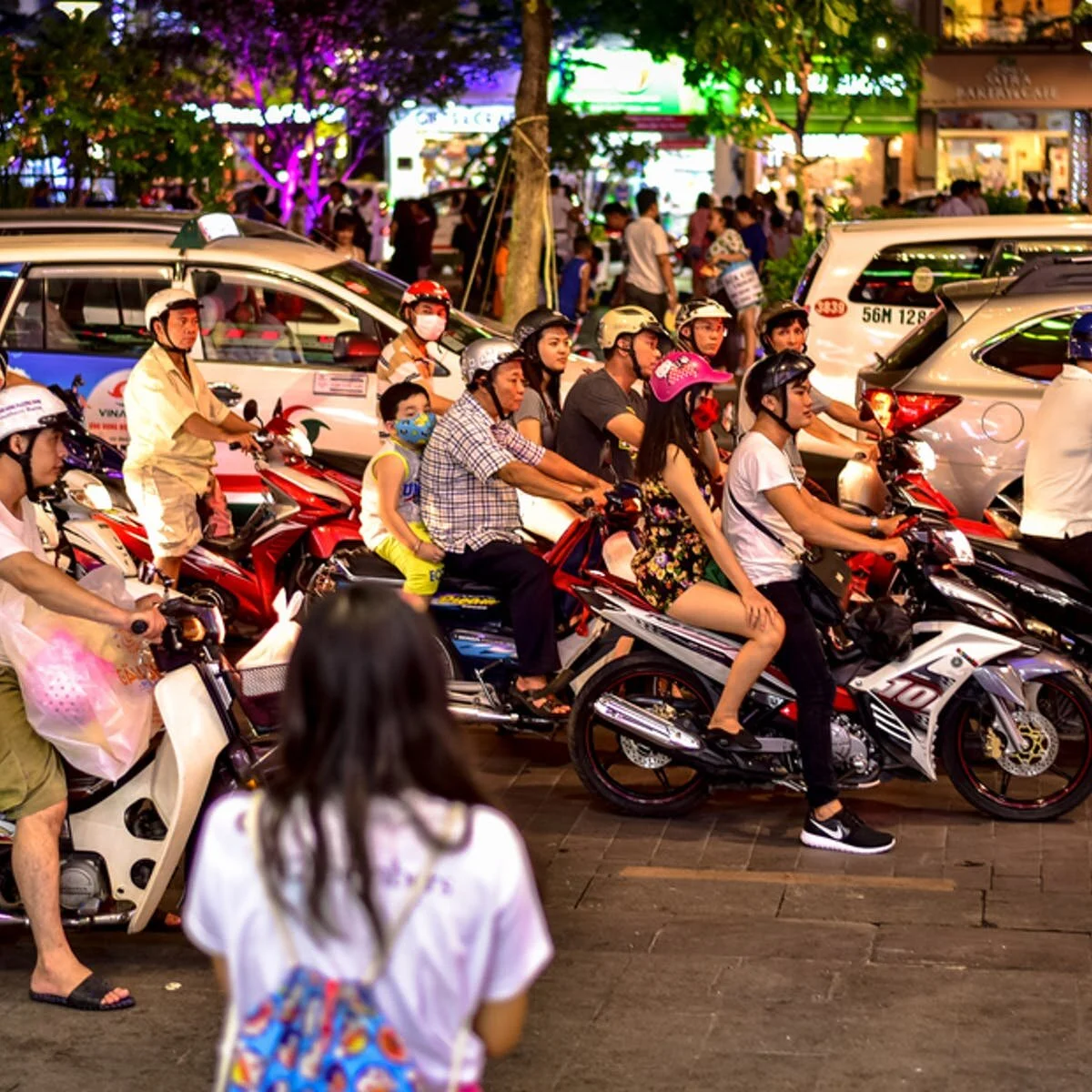
How Asia Transformed from the Poorest Continent in the World into a Global Economic Powerhouse
In 1820, Asia accounted for two-thirds of the world’s population and more than one-half of global income. The subsequent decline of Asia was attributed to its integration with a world economy shaped by colonialism and driven by imperialism.
By the late 1960s, Asia was the poorest continent in the world when it came to income levels, marginal except for its large population. Its social indicators of development, among the worst anywhere, epitomised its underdevelopment. The deep pessimism about Asia’s economic prospects, voiced by the Swedish economist Gunnar Myrdal in his 1968 book Asian Drama, was widespread at the time.
In the half century since then, Asia has witnessed a profound transformation in terms of the economic progress of its nations and the living conditions of its people. By 2016, as my analysis of UN data shows, it accounted for 30% of world income, 40% of world manufacturing, and over one-third of world trade, while its income per capita converged towards the world average.
This transformation was unequal across countries and between people. Even so, predicting it would have required an imagination run wild. Asia’s economic transformation in this short time-span is almost unprecedented in history. My new book, Resurgent Asia, looks at this phenomenal change.
Given the size and the diversity of the Asian continent, looking at the region as a whole is not always appropriate. So in my research, I’ve disaggregated Asia into its four constituent sub-regions – East, South-East, South and West Asia – and further into 14 selected countries described as the Asian-14. These are China, South Korea and Taiwan in East Asia; Indonesia, Malaysia, Philippines, Singapore, Thailand and Vietnam in South-East Asia; Bangladesh, India, Pakistan, and Sri Lanka in South Asia; and Turkey in West Asia. These countries account for more than four-fifths of the population and income of the continent. Japan is not included in the study because it is a high income country in Asia, and was already industrialised 50 years ago.
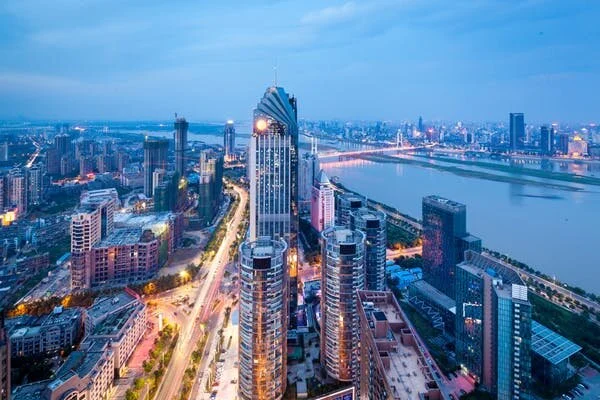
The bright lights of Shenzen, China. zhangyang13576997233/Shutterstock
It’s essential to recognise the diversity of Asia. There have been marked differences between countries in geographical size, embedded histories, colonial legacies, nationalist movements, initial conditions, natural resource endowments, population size, income levels and political systems. The reliance on markets and the degree of openness of economies has varied greatly across countries and over time.
Across Asia, the politics has also ranged widely from authoritarian regimes or oligarchies to political democracies. So did ideologies, from communism, to state capitalism and capitalism. Development outcomes differed across space and over time too. There were different paths to development, because there were no universal solutions, magic wands, or silver bullets.
Absolute poverty persists
Despite such diversity, there are common discernible patterns. Economic growth drove development. Growth rates of GDP and GDP per capita in Asia have been stunning and far higher than elsewhere in the world.
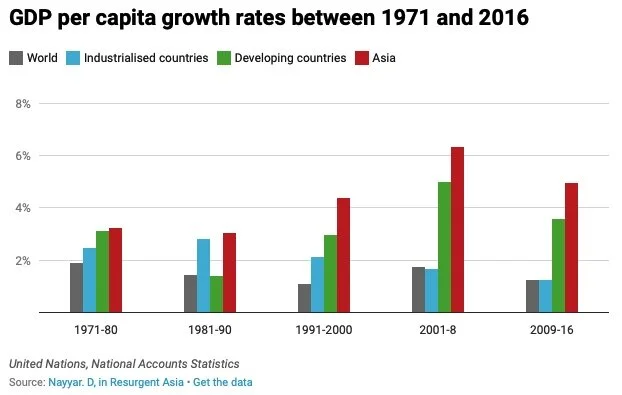
Rising investment and savings rates combined with the spread of education were the underlying factors. Growth was driven by rapid industrialisation, often led by exports and linked with changes in the composition of output and employment. It was supported by coordinated economic policies, unorthodox wherever and whenever necessary, across sectors and over time.
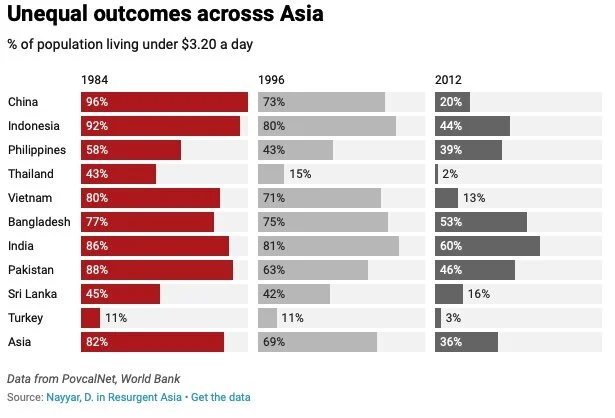
Rising per capita incomes transformed social indicators of development, as literacy rates and life expectancy rose everywhere. There was also a massive reduction in absolute poverty. But the scale of absolute poverty that persists, despite unprecedented growth, is just as striking as the sharp reduction of poverty that happened between 1984 and 2012, according to data from the World Bank.
The poverty reduction could have been much greater but for the rising inequality. Inequality between people within countries rose almost everywhere, except South Korea and Taiwan. Yet the gap between the richest and poorest countries in Asia remains awesome and the ratio of GDP per capita in the richest and poorest country in Asia was more than 100:1 in both 1970 and 2016.
The role of governments
Economic openness has performed a critical supportive role in Asian development, wherever it was in the form of strategic integration with the world economy, rather than passive insertion into it. For example, trade policy was liberal for exports but restrictive for imports. Government policies towards foreign investment have been shaped by industrial policy in the pursuit of national development objectives. While openness was necessary for successful industrialisation, it was not sufficient and facilitated industrialisation only when combined with industrial policy.
In the half-century economic transformation of Asia, governments performed a vital role, ranging from leader to catalyst or supporter. Success at development in Asia was about managing this evolving relationship between states and markets, by finding the right balance in their respective roles that also changed over time.
The developmental states in South Korea, Taiwan and Singapore coordinated policies across sectors over time in pursuit of national development objectives, using carrot-and-stick policy to implement their agenda, and were able to become industrialised nations in just 50 years. China emulated these developmental states with much success, and Vietnam followed on the same path two decades later, as both countries have strong one-party communist governments that could coordinate and implement policies.
It is not possible to replicate these states elsewhere in Asia. But other countries, such as India, Indonesia, Malaysia, Thailand, Bangladesh and Turkey, did manage to evolve some institutional arrangements, even if less effective, that were conducive to industrialisation and development. In some of these countries, the checks and balances of political democracies were crucial to making governments more orientated towards development and people-friendly.
The rise of Asia represents the beginnings of a shift in the balance of economic power in the world and some erosion in the political dominance of the West. The future will be shaped partly by how Asia exploits the opportunities and meets the challenges and partly by how the difficult economic and political conjuncture in the world unfolds.
Yet it’s plausible to suggest that by around 2050, a century after the end of colonial rule, Asia will account for more than one-half of world income and will be home to more than half of the people on earth. It will have an economic and political significance in the world that would have been difficult to imagine 50 years ago, even if it was the reality in 1820.
Deepak Nayyar is an Emeritus Professor of Economics, Jawaharlal Nehru University and Honorary Fellow, Balliol College, University of Oxford
THIS ARTICLE WAS ORIGINALLY PUBLISHED ON THE CONVERSATION
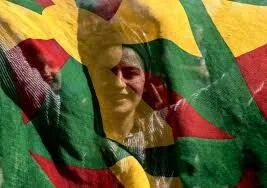
Hidden in plain sight: the Kurdish question in Turkey. Sedat Suna/EPA
Why the Kurdish Conflict in Turkey is so Intractable
The ramifications of Donald Trump’s decision to withdraw US troopsfrom the Turkish-Syrian border continues to have a seismic effect on the situation in northern Syria.
Faced with the Turkish invasion of northern Syria, the Kurdish-led Syrian Democratic Forces (SDF) who controlled the area were forced to make compromises. On October 13, they announced a deal with the Syrian army, which began moving troops towards the Turkish border. A five-day ceasefire was brokered by the US on October 18, during which Turkey agreed to pause its offensive to allow Kurdish forces to withdraw.
For many, the SDF proved itself to be the most effective force in the fight against Islamic State (IS). Turkey, however, considers the SDF as an extension of the Kurdistan Workers’ Party (PKK), which it, the US and EU label as a terrorist organisation.
But behind this lies a long history of Turkey denying the very existence of the Kurdish conflict, and the political and cultural rights of its Kurdish population. Understanding this history helps explain why the conflict is so intractable, and the impact it continues to have on Turkey’s foreign policy choices.
No room in the nation state
The Kurdish conflict cannot be understood without considering the question of power and exclusion. Its origins go back to the mid-19th century when the Ottomans attempted to end the 300-year-old autonomy of the Kurdish principalities in Kurdistan. This struggle for autonomy wasn’t resolved during the rule of the Ottoman era, and when it collapsed, all of the new nation states that eventually emerged – Turkey, Syria, Iraq and Iran – inherited their own Kurdish conflict.
The Turks and the Kurds fought a successful war of independencetogether in 1919 against the Allied forces. Nevertheless, when the new Republic of Turkey was established in 1923, Turkish identity was presented as its unifying force, at the expense of the society’s political, social and cultural differences.
Not only was political power further centralised in Ankara, but the domination of the ethnic, Turkish and Sunni majority became the norm. The decision to create a centralised and homogeneous nation state was implemented in a top-down and violent fashion. The seeds of the long-term problems that Turkish and Kurdish communities confront today were created by this decision.
Various Kurdish groups challenged this new social and political order with different revolts, uprisings, and resistance, but these were violently suppressed. Repressive policies of assimilation were later implemented to transform the Kurds into civilised and secular Turks.
A conflict buried
The Kurdish conflict laid buried for many years. Then, the most serious challenge to Turkey’s nation state project was initiated by the PKK in 1984, which embraced a political agenda called democratic autonomy. The violent struggle between Ankara and the PKK has resulted in a huge economic and human cost.
Peace talks which began in 2013 with the PKK’s jailed leader Abdullah Öcalan were widely considered to be the best chance for ending the conflict, but these collapsed in 2015. This led to increasing violence in the form of a destructive armed conflict in southeastern Turkey and a wave of bombings, including in Ankara and Istanbul.
The resolution of intractable conflicts is only possible when conflicted parties can confront their past and learn from it. In 2015, amid attempts by Turkish opposition parties to reopen peace negotiations with the Kurds, Turkish president Recep Tayyip Erdoğan insisted: “There is no Kurdish conflict”. Such positioning, which continues today, keeps the political dimension of the conflict in the background.
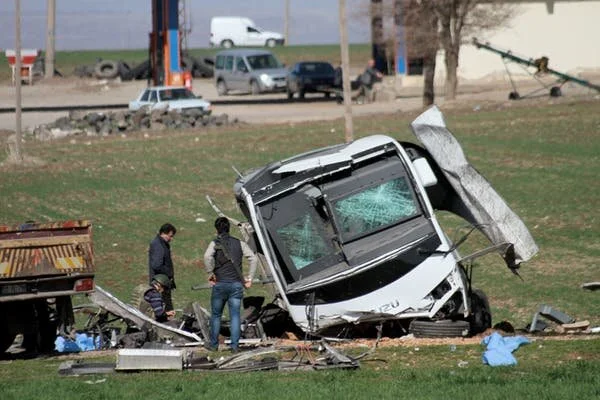
Aftermath of a bomb attacking a military convoy in Diyarbakir, Turkey. EPA
The state carefully controls what can and cannot be said about the conflict. Typically, words such as “terror” and “traitor” are used to criminalise those who criticise government policy towards the Kurds. A group of academics who signed a petition in 2016 calling for the resumption of peace talks were charged with making “terrorism propaganda”. The non-violent wing of the Kurdish movement – activists, politicians, political parties – has also been criminalised.
Blame game
Instead of confronting their failure to bring about peace, Turkish political elites have tried to apportion blame elsewhere. Erdoğan, for example, repeatedly refers to an invisible “mastermind” who orchestrates the PKK. Such rhetoric is deployed to play on the collective fear and anxiety about national security felt by parts of Turkish society.
Some have called this the “Sèvres syndrome” – referring to the 1920 Treaty of Sèvres that marked the end of the Ottoman empire and proposed to divide it into small states and occupation zones. The treaty was never implemented, and superseded by the 1923 Lausanne Treatywhich recognised the Republic of Turkey.
This syndrome – also referred to as “Sèvres Paranoia” – in essence reflects the collective fear that the Treaty of Sèvres will be revived and that the Turkish state is encircled by enemies who want to divide and weaken the country.
Today, this line of thinking is an integral part of Turkish political life and continues to influence public perception towards the external world. In a 2006 public opinion survey, for example, 78% of participants agreed that “the West wants to divide and break up Turkey like they broke up the Ottoman Empire”.
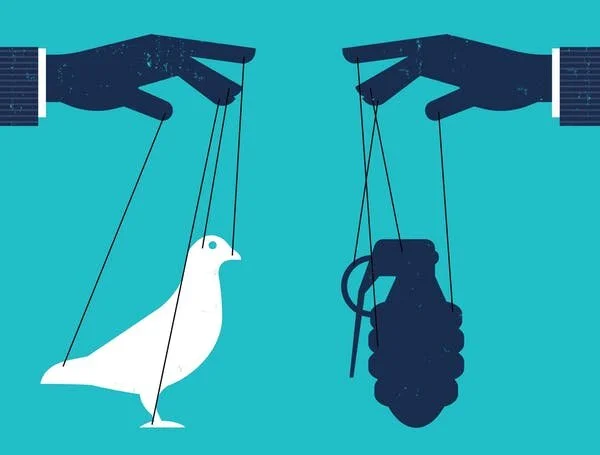
Driving Turkey’s choices. By kmlmtz66/Shutterstock
In this way, the Kurdish conflict has been used to mobilise Turkish society to act against its own collective interest: a peaceful and just society. Policies aimed at managing the conflict have been implemented mostly within a state of emergency, in ways that continue to undermine Turkish democracy. Not only has the tremendous economic and human cost of the conflict become a “normal” part of Turkish life, but the state has also been successful in actively keeping the political dimension of the conflict at bay.
For a long time, Turkey refrained from talking about the Kurdish issue by assuming that it would eventually fade away. But it didn’t and instead, the conflict has become more deeply entrenched. Time will tell whether the Turkish state will ultimately gain or lose by its latest military intervention in Syria. However, what’s clear is that the Kurdish conflict will get more complicated with this latest move, and both the Turkish state and Turkish society will no longer be able to ignore it.
Recep Onursal is a PhD candidate in International Conflict Analysis, University of Kent
THIS ARTICLE WAS ORIGINALLY PUBLISHED ON THE CONVERSATION
The Secret to Sriracha Hot Sauce’s Success
David Tran is the man to thank for the Sriracha Hot Chili Sauce you douse your scrambled eggs with every morning. You know the stuff. Red bottle with a green cap and a rooster on the front—plus five languages on the bottle—this simple sauce connects people from different cultures and backgrounds. “It never occurred to me that our hot sauce could get so much attention and acceptance from different people,” said Tran. Today, Tran oversees a hot sauce empire, but he comes from humble beginnings. He arrived in the United States from Vietnam 40 years ago as a refugee. So how did the founder of Huy Fong Foods turn his fresh, homemade hot sauce into an internationally-recognized brand and household staple? We visited his factory in Irwindale, California, to learn the secret to his sauce.
Panama Celebrates its Black Christ, Part of Protest Against Colonialism and Slavery
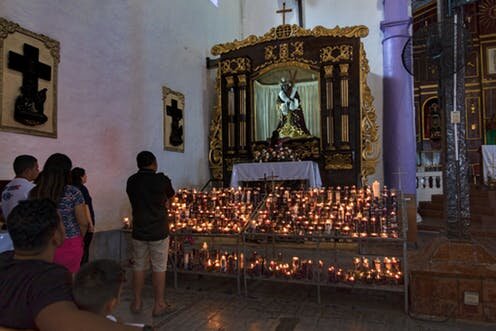
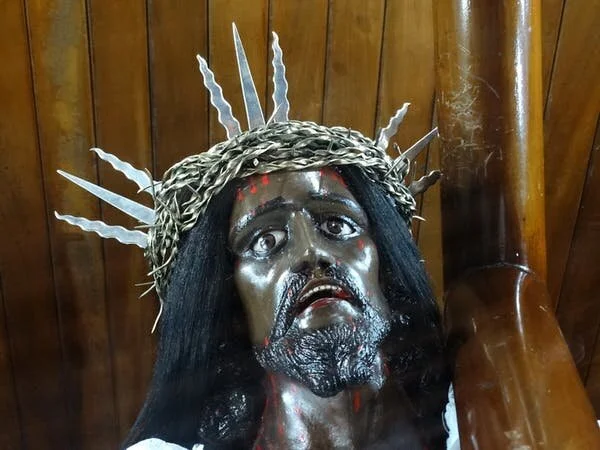
The life-sized wooden statue of the Black Christ in St. Philip Church in Panama. Dan Lundberg/Flickr, CC BY-SA
Panama’s “Festival del Cristo Negro,” the festival of the “Black Christ,” is an important religious holiday for local Catholics. It honors a dark, life-sized wooden statue of Jesus, “Cristo Negro” – also known as “El Nazaraeno,” or “The Nazarene.”
Throughout the year, pilgrims come to pay homage to this statue of Christ carrying a cross, in its permanent home in Iglesia de San Felipe, a Roman Catholic parish church located in Portobelo, a city along the Caribbean coast of Panama.
But it is on Oct. 21 each year that the major celebration takes place. As many as 60,000 pilgrims from Portobelo and beyond travel for the festival, in which 80 men with shaved heads carry the black Christ statue on a large float through the streets of the city.
The men use a common Spanish style for solemn parades – three steps forward and two steps backward – as they move through the city streets. The night continues with music, drinking and dancing.
In my research on the relationship between Christianity, colonialism and racism, I have discovered that such festivals play a crucial role for historically oppressed peoples.
About 9% of Panama’s population claims African descent, many of whom are concentrated in Portobelo’s surrounding province of Colón. Census data from 2010 shows that over 21% of Portobelo’s population claimAfrican heritage or black identity.
To Portobelo’s inhabitants, especially those who claim African descent, the festival is more than a religious celebration. It is a form of protest against Spanish colonialism, which brought with it slavery and racism.
History of the statute
Portobelo’s black Christ statue is a fascinating artifact of Panama’s colonial history. While there is little certainty as to its origin, many scholars believe the statue arrived in Portobelo in the 17th century – a time when the Spanish dominated Central America and brought in enslaved people from Africa.
Cristo Negro. Adam Jones/Flickr, CC BY-SA
Various legends circulate in Panama as to how the black Christ got to Portobelo. Some maintain that the statue originated in Spain, others that it was locally made, or that it washed ashore miraculously.
One of the most common stories maintains that a storm forced a ship from Spain, which was delivering the statue to another city, to dock in Portobelo. Every time the ship attempted to leave, the storms would return.
Eventually, the story goes, the statue was thrown overboard. The ship was then able to depart with clear skies. Later, local fishermen recovered the statue from the sea.
The statue was placed in its current home, Iglesia de San Felipe, in the early 19th century.
Stories of miracles added to its mystique. Among the legends in circulation is one about how prayers to the black Christ spared the cityfrom a plague ravaging the region in the 18th century.
Catholicism and African identity
Since its exact origins are unknown, so are the artistic intention behind the Jesus statue. However the figure’s blackness has made it an object of particular devotion for locals of African descent.
At the time of the arrival of Cristo Negro, the majority of the Portobelo’s population was of African descent. This cultural heritage is significant to the city’s identity and traditions.
The veneration of the statue represents one of many ways that the black residents of Portobelo and the surrounding Colón region of Panama have engendered a sense of resistance to racism and slavery.
Each year around the time of Lent, local men and women across Colón – where slavery was particularly widespread – dramatize the story of self-liberated black slaves known as the Cimarrones. This reenactment is one of a series of celebrations, or “carnivals,” observed around the time of Lent by those who identify with the cultural tradition known colloquially as “Congo.” The term Congo was originally used by the Spanish colonists for anyone of African descent. It is now is used for traditions that can be traced back to the Cimarrones.
During the carnival celebration, some local people dress up as the devil, meant to represent Spanish slave masters or complicit priests. Others don the dress of the Cimarrones.
Many of the participants in both the black Christ and carnival celebrations of Panama are Catholics as well. Together they participate to bring to light the Catholic Church’s complex relationship with Spanish colonization and slavery. Many Catholic leaders in the 16th to 18th centuries justified the enslavement of Africans and the colonization of the Americas, or at least did not object to it.
A revered tradition
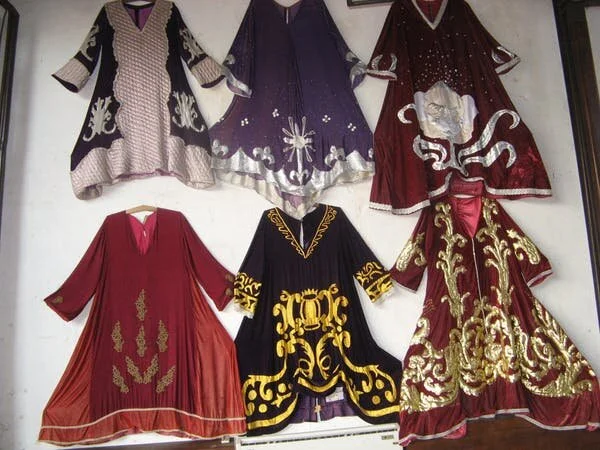
The different colored robes that are put on the statue of Cristo Negro. Ali EminovFlickr, CC BY-NC
Many people from throughout Panama have donated robes to clothe the statue. The colors of the robes donned by the statue varies throughout the year. Purple is reserved for the October celebrations, which likely reflects the use of purple in Catholic worship to signify suffering.
These robes draped on Panama’s black Christ are meant to representthose placed on Jesus when he was mockingly dressed in royal garb by the soldiers torturing him before his crucifixion.
Evoking this scene perhaps serves to remind the viewer of the deeper theological meaning of Jesus’s suffering as it is often understood in Christianity: Although Jesus is the Son of God prophesied to save God’s people from suffering and should thus be treated like royalty, he was tortured and executed as a common criminal. His suffering is understoodto save people from their sins.
Some pilgrims specifically come during the October festival to seek forgiveness for any sinful actions. Some wear their own purple robes, the color indicating a sign of their suffering – and, of course, that of the black Christ.
S. Kyle Johnson is a Doctoral Student in Systematic Theology, Boston College
THIS ARTICLE WAS ORIGINALLY PUBLISHED ON THE CONVERSATION
GREENLAND: Ilulissat Icefjord
Experience a beautiful timelapse trip to the Ilulissat Icefjord. This timelapse film project is made by photographer Bo Normander and timelapse expert Casper Rolsted.
For 27-Time Hopi High Cross-Country Champs, Running Is Tradition
Running isn’t simply a sport for the Hopi people. It’s a tradition with deep spiritual purpose. For centuries, Hopi runners carried messages to distant villages, and ran to springs to deliver prayers to bring rain. Rick Baker runs the cross country program at Arizona’s Hopi High Schoo, and his young athletes run the same dusty trails their ancestors blazed.
Read More
Fossil fuel industry sees the future in hard-to-recycle plastic
Fossil Fuel Industry sees the Future in Hard-to-Recycle Plastic
Plastic pollution and the climate crisis are two inseparable parts of the same problem, though they aren’t treated as such. Many countries have implemented plastic bag charges and plastic straw bans while action to phase out fossil fuels lags far behind, due in part to the inertia of the huge oil and gas companies that dominate the sector.
An investigation by The Guardian recently found that just 20 of these firms are responsible for 35% of global greenhouse gas emissions since 1965. How will they adapt as fossil fuel demand wanes with the rise of renewable energy and battery power? The answer is plastic – and that shift is already well underway.
Most of the plastic that exists today has been made in the last decade. The environment appears to be drowning in plastic for the same reason that global temperatures continue to rise – fossil fuels have remained cheap and abundant.

From filling up cars to plastic toy cars. Steinar Engeland/Unsplash, CC BY
Cheap plastic is made using chemicals produced in the process of making fuel. Petroleum refining transforms crude oil extracted from the ground into gasoline, producing ethane as a byproduct. A decade ago, the advent of fracking – hydraulic fracturing of oil or natural gas – made the raw materials for plastics significantly cheaper.
Fracking shale gas produces lots of ethane, which is turned into ethylene – the building block for many hard-to-recycle plastic products, like packaging films, sachets and bottles. Cheap polyethylene from fracking created a glut of plastic packaging on supermarket shelves that sociologist Rebecca Altman has called “frackaging”.
There are few facilities worldwide that can dispose of or recycle this kind of plastic efficiently. They’re expensive to set up and run and there’s little demand for using the recycled material to make new products. While packaging is the single largest source of plastic demand, most of that is thrown away as soon as it’s removed, with one third of it estimated to go directly to domestic waste and either incineration or landfill. In much of the world, a lot of it goes directly into the environment.
Reducing fuel consumption won’t necessarily solve the plastic problem. Global plastic production is expected to double in the next 15 years even as demand for gasoline wanes. In 2017, 50% of all crude oil produced worldwide was refined into fuel for transport, most as gasoline. Electric vehicles and more efficient forms of public transport mean gasoline demand is falling. The oil and gas companies who own these refineries are instead gearing up to turn what is now excess fuel into plastics for packaging.
Climate change in a bottle
As demand for gasoline continues to decline in future, more plastics will be made directly from crude oil. Petroleum companies now plan to convert up to 40% of the crude oil they intend to extract into petrochemicals. These are chemicals like acetylene, benzene, ethane, ethylene, methane, propane, and hydrogen, which form the basis for thousands of other products, including plastics.
The industry predicts petrochemicals will grow from 16% of oil demand in 2020 to 20% by 2040 largely to supply the feedstocks for making plastics. The environmental consequences of making even more plastic from crude oil will be significant. More plastic pollution will enter watercourses and the ocean, while amping up production will accelerate global emissions.
Read more: Plastic warms the planet twice as much as aviation – here's how to make it climate-friendly
That’s because making plastic releases carbon dioxide (CO₂). Both transporting the crude oil to make it and then disposing of the plastic by incineration generates emissions. Most of the estimated total natural capital cost of plastic pollution – USD$75 billion per year for the consumer goods sector alone – arises from CO₂ emissions linked to producing and transporting plastic.
Expanding plastic production and sending more plastic either directly to incineration or to waste-to-energy facilities - where plastics are turned into oil and used to generate electricity or heat – mean CO₂ emissions from plastic are expected to triple by 2050 to 309m metric tonnes. Incinerating mountains of plastic waste could become one of the largest sources of C0₂ emissions in Europe’s energy sector as fossil fuels are phased out.
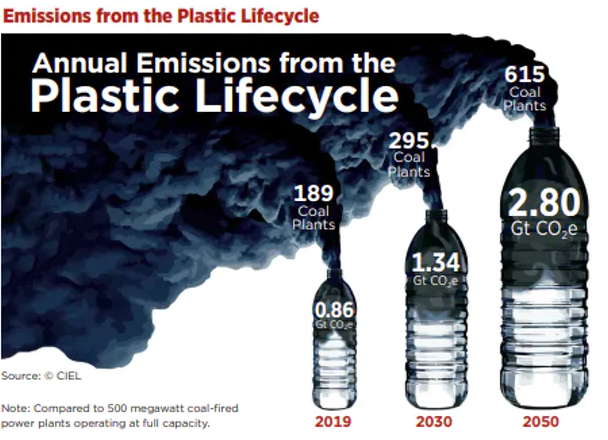
Annual plastic production and use currently emits as much CO₂ each year as 189 500 megawatt coal power plants. CIEL, Author provided
Halving the use of petroleum-based plastic packaging by 2030 and phasing it out altogether by 2050 could ensure CO₂ emissions targets are still met. Achieving net zero emissions from incinerating plastic packaging means eliminating all non-essential uses of petroleum-based plastic by 2035, following a peak in packaging and other single use, disposable plastics in 2025. Replacing traditional plastics with new materials made from renewable sources like corn starch could help, as could developing a new infrastructure for industrial plastic composting.
In a climate crisis, plastic waste doesn’t look like the world’s most pressing environmental problem. But considering plastic and climate as two separate issues is a mistake. Concern about plastic pollution isn’t distracting people from a more serious problem – plastic is the problem. If we see plastics as “solid climate change”, they become central to the climate crisis.
DEIRDRE MCKAY is a Reader in Geography and Environmental Politics at Keele University.
THIS ARTICLE WAS ORIGINALLY PUBLISHED ON THE CONVERSATION