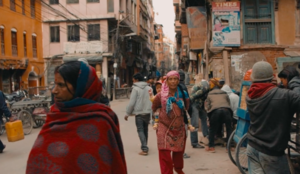
This video documents the faces of Kathmandu and architecture in Nepal’s capital city. On display is the daily life of people in Kathmandu and tourist sites. It is the largest city of Nepal and has a population of approximately 1 million people. Additionally, Kathmandu is also the biggest metropolis in the Himalayan hill region. The languages spoken are predominately Nepali and English.
Life While Traveling
"Life While Traveling" is a short film about the way we look to the world when we travel. It's about colors, shapes, textures and details that surrounds us every day, but we only realize when we are far from home.
A film by Joan Bosch
Deforestation threatens indigenous tribes living in the Peruvian jungle. Photo by Alexander Paul on Unsplash
Development and Deforestation Threatens Peru’s Indigenous Tribes
When we think of civilization, we think in Western terms: skyscrapers, factories, and automobiles. But as we progress, there is a growing need to live in tune with the natural world. While our affinity for the environments may seem relatively new, some civilizations have lived in such a way for centuries. The forests of Peru are home to 15 “uncontacted” tribes, groups who live in voluntary isolation and reject all connections to the outside world. However, the reverse is not true. Industrialization and deforestation threaten to take large pieces of territory from these indigenous peoples.
In December of 2017, the Congress of the Republic of Peru approved the construction of a road that would run along 172 miles of Peru’s eastern border with Brazil before connecting with the Interoceanic Highway, a 1600 mile stretch that links the two countries. The road was pitched as a way to jumpstart the economy in an area of Peru that was cut off from tourism and trade, but activists are worried. Clearing a way for the road would decimate 4 national parks and violate 5 protected areas belonging to the indigenous tribes. Activists also predict that the road will be a catalyst for more development, both legal and illegal. Drug traffickers are always looking for new opportunities to expand, and a road through the Amazon would provide just that.
Some smaller encounters are equally devastating to relations between the outside world and the indigenous tribes of the Peruvian forest. In April 2018, Sebastian Woodroffe, a Canadian scientist who traveled to Peru to study hallucinogenic medicine, was killed in an apparent lynching after he was accused of killing 81-year-old Olivia Arévalo, a local shaman to the tribal village of Victoria Gracia. Authorities launched an investigation after videos surfaced on social media of Woodroffe being dragged along the jungle floor by assailants. They later exhumed Woodroffe’s body from an unmarked grave. The incident has proven to be disastrous to public perception of the tribes.
When asked why they choose to remain isolated, members of these tribes often point to encounters their people had with colonists in the past and the violence and disease that resulted. Today, history seems to be repeating itself as modern society reaches further into an untouched and irreplaceable ecosystem.
JONATHAN ROBINSON is an intern at CATALYST. He is a travel enthusiast always adding new people, places, experiences to his story. He hopes to use writing as a means to connect with others like himself.
The Hawaiian Rain Dancers Who Summon Storms
On the island of Hawaii, the rain dancers of Waimea perform their art for the only audience that matters: their ancestors. When they call for rain and snow, they dance not to entertain, but to feed and nourish their land. Each performance is a physical manifestation of the spiritual world, a chance to connect with the natural land we inhabit. Practicing a centuries-old form of hula rarely seen in public, these dancers carry on generations of tradition with every graceful move and each handmade kapa garment.
Mombasa Cityscape
This video portrays the city of Mombasa, which is is a seaport city on the coast of Kenya, along the Indian Ocean. It is the country's oldest and second-largest city, with an estimated population of about 1.5 million people in 2017.
Working to Keep an Island Afloat
For most people, keeping track of one job is complicated enough—now, imagine juggling six. On the small island of North Ronaldsay off the northern coast of Scotland, that’s the case for many of the residents. With a population of just 50, everyone has to work a handful of jobs to keep the island afloat. Sarah Moore is part of North Ronaldsay’s trusted work force. She works as a mailwoman, home care worker, council clerk, airfield attendant, baggage handler and firefighter. Oh, and did we mention she also keeps a flock of sheep? Sarah moved to the island after searching for quiet from the big city. In North Ronaldsay, she feels like she has found her purpose as a part of something bigger than herself—a caring community.
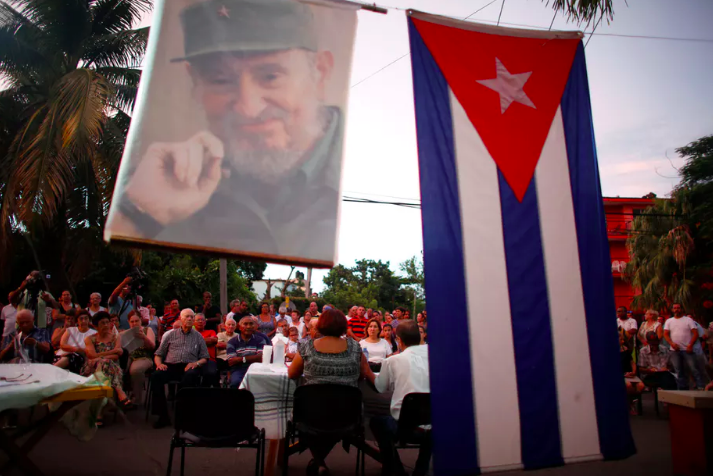
Cubans attend a public discussion to revamp the country’s Cold War-era constitution in Havana, in August 2018. Reuters/Tomas Bravo
Cuba Expands Rights but Rejects Radical Change in Updated Constitution
Cuba has rejected a proposal to legalize same-sex marriage in its new and revised constitution, a move that disappointed some gay rights activists.
An article that would have redefined marriage as a “union between two people” – rather than a “union between a man and a woman” – was eliminated from a proposed new constitution, which was written last year by the National Assembly, analyzed and debated in thousands of public meetings across the island and, on Feb. 24, approved by the Cuban people at referendum.
But marriage equality is not totally off the table in Cuba.
Marriage is now defined in the constitution as “a social and legal institution” and “one form of family organization.” In other words, same-sex marriage is not explicitly permitted – but it’s no longer strictly prohibited, either.
This is how social change works these days in Cuba, my home country and the subject of my academic research. Progress is no longer revolutionary. It comes slowly, and cloaked in moderation.
Slow change
In this way, Cuba has undergone a gradual and dramatic metamorphosis under the governments of Raúl Castro and his successor, President Miguel Díaz-Canel.
Thanks to a thaw in U.S.-Cuba relations under President Barack Obama, American tourists began visiting the communist country for the first time since the Kennedy administration placed a trade embargo on Cuba after Fidel Castro’s 1959 communist revolution.
Starting in 2008, Castro opened the economy to some foreign investment and allowed Cuban workers – once confined to government jobs – to start small businesses.
The new constitution – the fourth such update to Cuba’s founding document – creates official legal standing for Castro’s economic reforms, which had remained in legal limbo under a Cold War-era constitution that did not recognize private property or the business sector.
Cuban President Miguel Diaz-Canel with former President Raúl Castro, brother of Fidel Castro. AP Photo/Desmond Boylan
Many Cubans hoped the reform process would also expand civil liberties, bringing Cuban law more into line with its changing society.
LGBTQ rights groups, in particular, launched public awareness campaigns about sexual diversity. By late 2018, the path seemed to have been paved for gay marriage.
But religious groups fiercely opposed the move, and ultimately the government removed new language defining marriage as a “union between two people.”
Some hits, some misses
Still, the newly approved constitution does substantially expand social, political and economic rights in Cuba.
It limits Cuban presidents to two five-year terms. Previously, Cuba had no term limits. It also creates a prime minister position and strengthens local government, shifting power out of the executive. The criminal justice system in Cuba now operates on the presumption of innocence, not guilt.
Freedom of assembly, long restricted on the island, has also been expanded.
Previously, Cubans had the “right to meet, demonstrate and associate, for licit and peaceful purposes,” but only as part of a so-called “organización de masa” – the Cuban term for state-run groups. The new constitution removes the words “organizaciones de masa,” depoliticizing the freedom of assembly.
It remains to be seen whether the government will actually respect Cubans’ new right to form independent organizations – especially if those groups are political in nature.
“Spontaneous gatherings [in Cuba] are not seen positively and are always perceived to be the product of a foreign power,” wrote José Gabriel Barrenechea of La Trinchera, a blog for and by “young Marxists,” in a recent post.
Greater equality
Cuba’s prior constitution prohibited discrimination on the basis of race, skin color, sex, national origin and religious belief. Now gender, sexual orientation, gender identity, age, ethnic origin, disability and territorial origin have been added to the list.
The National Assembly stopped short of proposing any affirmative action policies, however, which would have been a more radical step toward equality.
The 1959 Cuban Revolution aimed to abolish all economic and racial differences among the Cubans, at least 36 percent of whom are Afro-Cuban. And Cuba’s inequality levels still remain well below other countries in the region.
But the recent economic reforms that increased prosperity for some have left certain minority groups – namely Afro-Cubans and the elderly – behind. Anti-discrimination statutes do nothing to close the widening wage gap.
The verdict is also mixed on how women fare under new laws.
Abortion, which unlike in the majority of Latin America and Caribbeanhas long been easily accessible in Cuba, is now officially protected in a provision guaranteeing women’s access to reproductive health services. And all forms of gender-based violence, not just domestic abuse and sexual assault, but also street harassment and workplace intimidation, are criminalized.
However, a popular constitutional guarantee that the government will provide free, universal child care and elder care to all working families women was eliminated.
This shifts the burden of care away from the government and onto the family. In a patriarchal society like Cuba’s, I believe women will inevitably assume these domestic duties.
Cubans evidently feared that other heralded rights would be lost, too.
In last year’s island-wide public meetings, people frequently requestedassurances that universal health care and free public education through the post-graduate level would be maintained.
They were.
Rights deferred
But some long-hoped-for rights remain elusive.
Independent media is still prohibited, a blow to the blogs and alternative news sites that have cropped up to fill the information vacuum of a country where all news sources are government-owned.
Some analysts have observed that, as in the case of gay marriage, language defining the role of the media in Cuba was loosened somewhat. And in December the government announced it would allow Cubans to access the internet on their smartphones.
This may leave the door open for greater press freedom in the future.
However, in my analysis, regional politics make that unlikely to occur any time soon.
For six decades, the U.S. government has tried to destabilize Cuban society by broadcasting anti-Communist messages on radio and TV broadcasts.
Now, the U.S. Office of Cuba Broadcasting has turned its attention to social media. The Trump administration in 2018 admitted that it tried to create fake Facebook accounts to foment dissent on the island, though it says the project “never got off the ground.”
This revelation will likely only strengthen the Cuban government’s resolve to limit Cubans’ access to information.
The constitutional reform process has confirmed that radical progress in Cuba will have to wait. But Cuba is changing, in zigs and in zags – just perhaps not as fast as some might hope.
MARIA ISABEL ALFONSO is the Professor of Spanish at St. Joseph's College of New York.
THIS ARTICLE WAS ORIGINALLY PUBLISHED ON THE CONVERSATION

For centuries, Dalits occupied the lowest rung of Indian society. Flickr user The Philosophy of photography - https://www.flickr.com/photos/matteo-gianni/109971376/. CC BY 2.0.
“Untouchables” Still Struggle for Equality in Indian Society
With 1.2 billion citizens India is the second most populous country in the world, and while today’s India is governed by a parliamentary system, for more than three millennia, India’s massive population lived under a rigid caste system that forced many Indians into occupational roles with no hope of advancement. Though modern India has officially done away with castes, the old system’s influence is still felt, particularly among those formerly identified as “untouchables”.
According to Hindu texts, the caste system was brought to India by the creator god Brahma. The top caste was occupied by Brahmins, India’s priests and teachers. Next came Kshatriyas, who were warriors and rulers. Below them, Vaisyas made up the middle class of merchants and traders while Sudras were unskilled workers or peasants. Dalits were “untouchables,” outcasts who existed outside of the caste system entirely and were often relegated to undesirable tasks like street sweeping, toilet cleaning, and disposing of dead animals. A person’s surname identified to which caste they belonged., While one could never hope to ascend to a higher caste in a single lifetime, it was believed that through dedication to one’s Dharma, or caste-specific duty, one could earn a higher position in the next life.
In 1950, the caste system was abolished, creating new opportunities for social mobility and intermingling between India’s various social groups. India even elected a Dalit president, K.R. Narayanan, who served from 1997 until 2002. Tensions remain, however, as Dalits, still identifiable by their surnames, continually find themselves subject to discrimination, harassment, assaults, and rapes. Many attacks go unreported, and local police tend to show leniency to the attackers.
India’s caste system has been likened to South African apartheid or the Jim Crow laws, both of which required many years of legislation and social pressure to affect changes which could be embraced by the general populace—if they were ever fully embraced at all. As India wrestles with its own history of social stratification, the future of its Dalits remains unclear. But it is clear that Dalits, who make up a quarter of India’s population, are an integral part of Indian history, culture, and society, and they won’t be leaving any time soon. Greater equality could be vital to India’s overall health as a country.
JONATHAN ROBINSON is an intern at CATALYST. He is a travel enthusiast always adding new people, places, experiences to his story. He hopes to use writing as a means to connect with others like himself.
VIDEO: Nepal Times
James Baker took this video to portray his adventures in the mystical land of Nepal. The video shows a cross-section through jungle, city, and mountains in Nepal.
In Japan, Repairing Buildings Without a Single Nail
In the past, making and developing metal was too costly for carpenters in Japan. So instead of using nails, carpenters called “miyadaiku” developed unique methods for interlocking pieces of wood together, similar to a giant 3D puzzle. Takahiro Matsumoto has been a miyadaiku carpenter for over 40 years. He runs his company in Kamakura, Japan, where he assesses and repairs damage sustained by the many ancient temples in his city. Using ancient techniques, he ensures that these spiritual structures stay standing for generations to come.
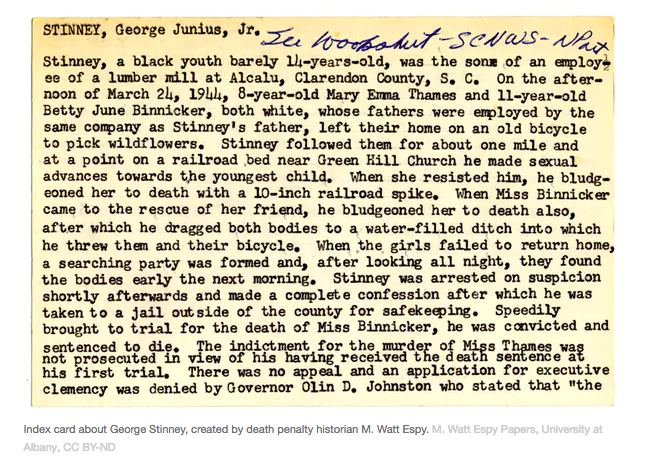
George Stinney, a 14-year old wrongfully executed for murder in 1944. M. Watt Espy Papers, University at Albany, CC BY-ND
The Death Penalty, an American Tradition on the Decline
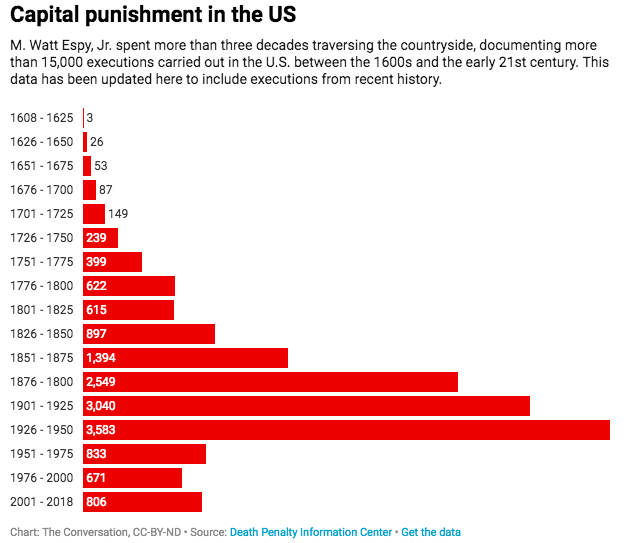
Capital punishment has been practiced on American soil for more than 400 years. Historians have documented nearly 16,000 executions, accomplished by burning, hanging, firing squad, electrocution, lethal gas and lethal injection. An untold number of others have doubtlessly occurred yet escaped recognition.
We helped create the University at Albany’s National Death Penalty Archive, a rich repository of primary source material encompassing the long and growing history of the death penalty.
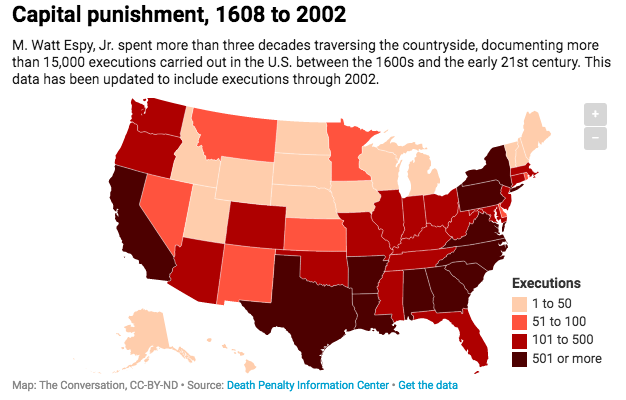
Capital punishment has long been and continues to be controversial, but there is no disputing its historical and contemporary significance. More than 2,700 men and women are currently under sentence of death throughout the U.S., although they are distributed in wildly uneven fashion. California’s death row, by far the nation’s largest, tops out at well over 700, while three or fewer inmates await execution in seven states.
Executions similarly vary markedly by jurisdiction. Texas has been far and away the leader over the last half century, with five times as many executions as the next leading state.
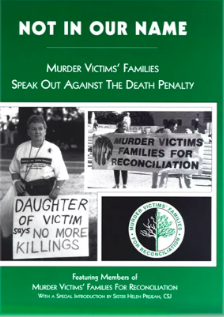
The book ‘Not in Our Name: Murder Victims Families Speak Out against the Death Penalty,’ published in 1997. Murder Victims' Families for Reconciliation Records, University at Albany, CC BY-ND
Prized archives
We established the National Death Penalty Archive to help preserve a record of the country’s past and current capital punishment policies and practices, and to ensure that scholars and the general public can gain access to this critical information.
The archive currently holds numerous collections from diverse sources, including academics, activists, litigators and researchers. We remain open to new donations of materials relating to capital punishment. The materials are stored in a climate-controlled environment and are accessible to the public.
One of our prized collections is the voluminous set of execution records compiled by M. Watt Espy Jr. Espy spent more than three decades, encompassing the 1960s into the 1990s, traversing the countryside, collaborating with others to uncover primary and secondary sources documenting more than 15,000 executions carried out in the U.S. between the 1600s and the late 20th century. Espy’s data set has since been updated to include information on executions through 2002.
The National Death Penalty Archive houses the court records, newspaper articles, magazine stories, bulletins, photographs and index cards created for each execution that Espy and his assistants painstakingly collected. These items vividly capture this unparalleled history of executions within the American colonies and the U.S.
Among those documented is the 1944 electrocution in South Carolina of George Stinney Jr., who at age 14 was the youngest person punished by death during the 20th century. Seventy years later, a South Carolina judge vacated Stinney’s conviction, ruling that he did not receive a fair trial.
In July, after the documents are fully digitized, the National Death Penalty Archive will make all of Espy’s materials available online.
Other papers
Another prized holding consists of nearly 150 boxes of materials from Eugene Wanger. As a delegate to the Michigan Constitutional Convention, Wanger drafted the provision prohibiting capital punishment that was incorporated into the state constitution in 1961.
For more than 50 years, Wanger compiled a treasure trove of items spanning the 18th through 21st centuries relating to the death penalty, including numerous rare documents and paraphernalia. Among the thousands of items in the extensive bibliography are copies of anti-capital-punishment essays written by Pennsylvania’s Benjamin Rush shortly after the nation’s founding.
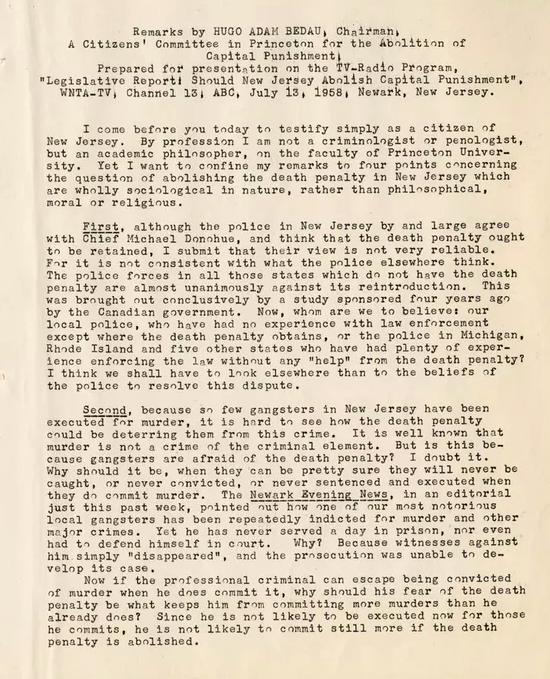
We also have collected the work of notable scholars. For example, the National Death Penalty Archive houses research completed by the late David Baldus, known primarily for his analysis of racial disparities in the administration of the death penalty; the writings of the late Hugo Adam Bedau, perhaps the country’s leading philosopher on issues of capital punishment; and the papers of the late Ernest van den Haag, a prolific academic proponent of capital punishment.
The National Death Penalty Archive additionally contains more than 150 clemency petitions filed on behalf of condemned prisoners, as well as materials relating to notable U.S. Supreme Court decisions, including Ford v. Wainwright, prohibiting execution of the insane, and Herrera v. Collins, in which the justices were asked to rule that the Constitution forbids executing an innocent person wrongfully sentenced to death.
Remarks by Hugo Bedau against the death penalty in 1958. Hugo Bedau Papers, University at Albany, CC BY-ND
On the decline
The recent history of capital punishment in the U.S. has been marked by declining popularity and usage. Within the past 15 years, eight states have abandoned the death penalty through legislative repeal or judicial invalidation.
The number of new death sentences imposed annually nationwide has plummeted from more than 300 in the mid-1990s to a fraction of that – just 42 – in 2018. Last year, there were 25 executions in the U.S., down from the modern-era high of 98 in 1999.
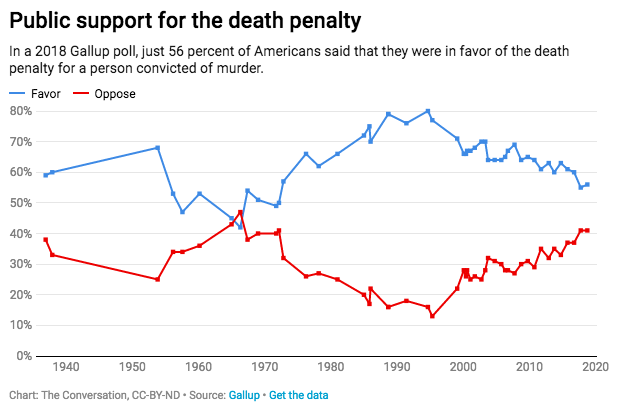
Meanwhile, public support for capital punishment as measured by the Gallup Poll registered at 56 percent in 2018, compared to its peak of 80 percent in 1995. Only a few counties, primarily within California and a few southern states, are responsible for sending vastly disproportionate numbers of offenders to death row.
What these trends bode for the future of the death penalty in the U.S. remains to be seen. When later generations reflect on the nation’s long and complicated history with the death penalty, we hope that the National Death Penalty Archive will offer important insights into the currents that have helped shape it.
JAMES ACKER is a distinguished teaching Professor of Criminal Justice at the University at Albany, State University of New York.
BRIAN KEOUGH is the Co-Director at the National Death Penalty Archive at University at Albany, State University of New York.
THIS ARTICLE WAS ORIGINALLY PUBLISHED ON THE CONVERSATION
From New York
Leonard Witte had the chance to travel around the world to capture some of the biggest cities of the world. He decided to create his own version for each city - this is number one! The film is a mixture of audiovisual moments he experienced and voices from real New Yorkers telling about their city.
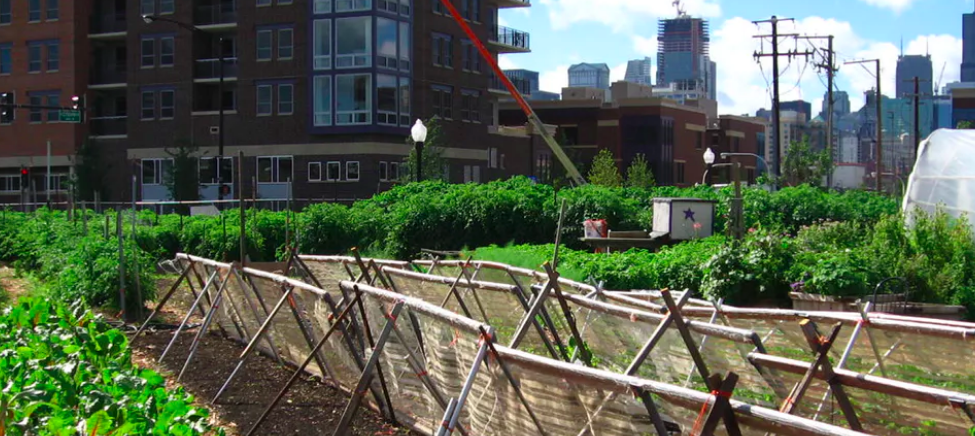
City Farm is a working sustainable farm that has operated in Chicago for over 30 years. Linda from Chicago/Wikimedia, CC BY
How Urban Agriculture Can Improve Food Security in US Cities
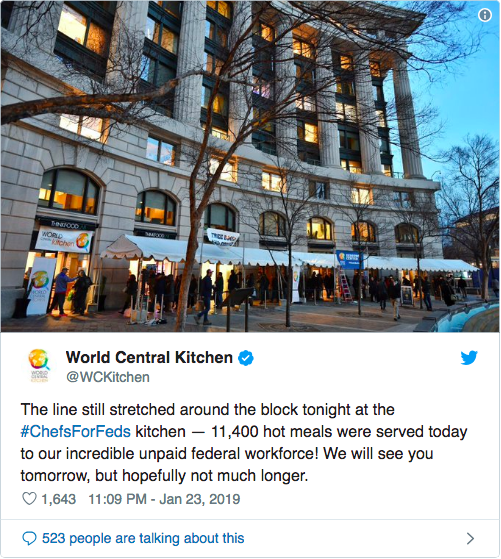
During the partial federal shutdown in December 2018 and January 2019, news reports showed furloughed government workers standing in line for donated meals. These images were reminders that for an estimated one out of eight Americans, food insecurity is a near-term risk.
In California, where I teach, 80 percent of the population lives in cities. Feeding the cities of the nine-county San Francisco Bay Area, with a total population of some 7 million involves importing 2.5 to 3 million tons of food per day over an average distance of 500 to 1,000 miles.
This system requires enormous amounts of energy and generates significant greenhouse gas emissions. It also is extremely vulnerable to large-scale disruptions, such as major earthquakes.
And the food it delivers fails to reach 1 of every 8 people in the region who live under the poverty line – mostly senior citizens, children and minorities. Access to quality food is limited both by poverty and the fact that on average, California’s low-income communities have 32.7 percent fewer supermarkets than high-income areas within the same cities.
Many organizations see urban agriculture as a way to enhance food security. It also offers environmental, health and social benefits. Although the full potential of urban agriculture is still to be determined, based on my own research I believe that raising fresh fruits, vegetables and some animal products near consumers in urban areas can improve local food security and nutrition, especially for underserved communities.
The growth of urban agriculture
Urban farming has grown by more than 30 percent in the United States in the past 30 years. Although it has been estimated that urban agriculture can meet 15 to 20 percent of global food demand, it remains to be seen what level of food self-sufficiency it can realistically ensure for cities.
One recent survey found that 51 countries do not have enough urban area to meet a recommended nutritional target of 300 grams per person per day of fresh vegetables. Moreover, it estimated, urban agriculture would require 30 percent of the total urban area of those countries to meet global demand for vegetables. Land tenure issues and urban sprawl could make it hard to free up this much land for food production.
Other studies suggest that urban agriculture could help cities achieve self-sufficiency. For example, researchers have calculated that Cleveland, with a population of 400,000, has the potential to meet 100 percent of its urban dwellers’ fresh vegetable needs, 50 percent of their poultry and egg requirements and 100 percent of their demand for honey.
Can Oakland’s urban farmers learn from Cuba?
Although urban agriculture has promise, a small proportion of the food produced in cities is consumed by food-insecure, low-income communities. Many of the most vulnerable people have little access to land and lack the skills needed to design and tend productive gardens.
Cities such as Oakland, with neighborhoods that have been identified as “food deserts,” can lie within a half-hour drive of vast stretches of productive agricultural land. But very little of the twenty million tons of food produced annually within 100 miles of Oakland reaches poor people.
Paradoxically, Oakland has 1,200 acres of undeveloped open space – mostly public parcels of arable land – which, if used for urban agriculture, could produce 5 to 10 percent of the city’s vegetable needs. This potential yield could be dramatically enhanced if, for example, local urban farmers were trained to use well-tested agroecological methods that are widely applied in Cuba to cultivate diverse vegetables, roots, tubers and herbs in relatively small spaces.
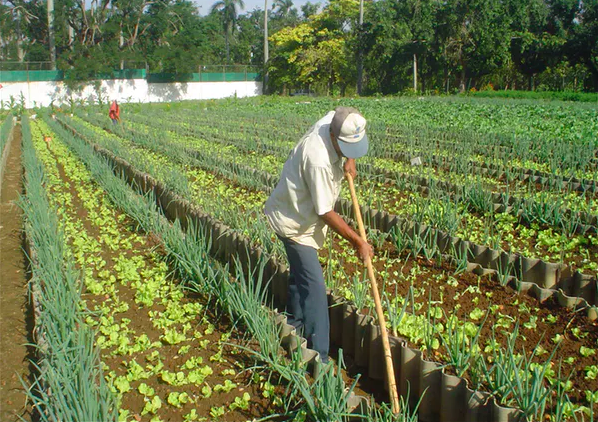
In Cuba, over 300,000 urban farms and gardens produce about 50 percent of the island’s fresh produce supply, along with 39,000 tons of meat and 216 million eggs. Most Cuban urban farmers reach yields of 44 pounds (20 kilograms) per square meter per year.
An organic farm in Havana, Cuba, that produces outputs averaging 20 kilograms (44 pounds) per square meter per year without agrochemical inputs. Miguel Altieri, CC BY-ND
If trained Oakland farmers could achieve just half of Cuban yields, 1,200 acres of land would produce 40 million kilograms of vegetables – enough to provide 100 kilograms per year per person to more than 90 percent of Oakland residents.
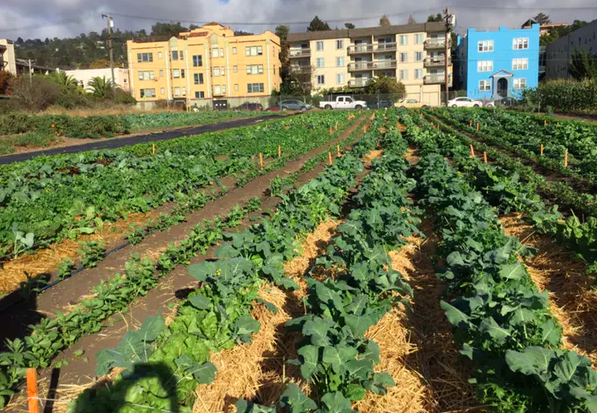
To see whether this was possible, my research team at the University of California at Berkeley established a diversified garden slightly larger than 1,000 square feet. It contained a total of 492 plants belonging to 10 crop species, grown in a mixed polycultural design.
In a three-month period, we were able to produce yields that were close to our desired annual level by using practices that improved soil health and biological pest control. They included rotations with green manures that are plowed under to benefit the soil; heavy applications of compost; and synergistic combinations of crop plants in various intercroppingarrangements known to reduce insect pests.
Research plots in Berkeley, Calif., testing agroecological management practices such as intercropping, mulching and green composting. Miguel Altieri, CC BY-ND
Overcoming barriers to urban agriculture
Achieving such yields in a test garden does not mean they are feasible for urban farmers in the Bay Area. Most urban farmers in California lack ecological horticultural skills. They do not always optimize crop density or diversity, and the University of California’s extension program lacks the capacity to provide agroecological training.
The biggest challenge is access to land. University of California researchers estimate that over 79 percent of the state’s urban farmers do not own the property that they farm. Another issue is that water is frequently unaffordable. Cities could address this by providing water at discount rates for urban farmers, with a requirement that they use efficient irrigation practices.
In the Bay Area and elsewhere, most obstacles to scaling up urban agriculture are political, not technical. In 2014 California enacted AB511, which set out mechanisms for cities to establish urban agriculture incentive zones, but did not address land access.
One solution would be for cities to make vacant and unused public land available for urban farming under low-fee multiyear leases. Or they could follow the example of Rosario, Argentina, where 1,800 residents practice horticulture on about 175 acres of land. Some of this land is private, but property owners receive tax breaks for making it available for agriculture.
In my view, the ideal strategy would be to pursue land reform similar to that practiced in Cuba, where the government provides 32 acres to each farmer, within a few miles around major cities to anyone interested in producing food. Between 10 and 20 percent of their harvest is donated to social service organizations such as schools, hospitals and senior centers.
Similarly, Bay Area urban farmers might be required to provide donate a share of their output to the region’s growing homeless population, and allowed to sell the rest. The government could help to establish a system that would enable gardeners to directly market their produce to the public.
Cities have limited ability to deal with food issues within their boundaries, and many problems associated with food systems require action at the national and international level. However, city governments, local universities and nongovernment organizations can do a lot to strengthen food systems, including creating agroecological training programs and policies for land and water access. The first step is increasing public awareness of how urban farming can benefit modern cities.
MIGUEL ALTIERI is a Professor of Agroecology at the University of California, Berkeley.
THIS ARTICLE WAS ORIGINALLY PUBLISHED ON THE CONVERSATION

The Ancient Hawaiian Art of Bark Cloth
Sabra Kauka finds great joy in making the past present. A cultural practitioner on Kauai, she teaches Hawaiian children the arts of their ancestors, including kapa. In this physically demanding process, bark from the wauke plant becomes clothing and blankets. Herself a student of the craft, Sabra is in awe that her ancestors created such beautiful textiles from tree bark—and she’s determined to help the next generation relearn and embrace this practice.
Students Across Europe Protest in Hopes of a Greener Future
After years of political gridlock surrounding climate change legislation, students emerge as a force for change.
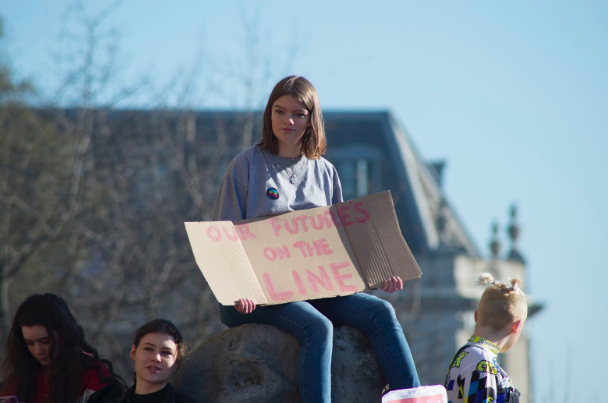
Photo of a student protester. By Josh Barwick on Unsplash.
Thousands of students across Europe left school on Friday, February 15 to protest the lack of action on climate issues in their countries. In what the New York Times called a “coordinated walk out for action on climate issues,” elementary, middle, high school, and undergraduate students came together to demand a greener future. In London, protestors held signs reading “The ocean is rising and so are we” and “Act now or swim later.”
The student-led movement for climate action that is currently taking Europe by storm began with 16-year-old Swedish activist Greta Thunberg. In September, Thunberg started skipping class to stage sit-ins at the Swedish parliament, demanding that her government seriously address climate change. Thunberg’s action inspired teens worldwide, some of whom created the global movement Youth Strike 4 Climate and began organizing protests and walkouts, using social media to coordinate efforts. According to the New York Times, demonstrations have been held in Belgium, Britain, France, Germany, Ireland, Sweden, and Switzerland, among others.
The New York Times writes that the new organization gained even more energy in October of 2018 when a report from the UN’s Intergovernmental Panel on Climate Change disclosed that the world has only twelve years to change its climate policy before the consequences of inaction such as food shortages, rising sea levels, floods and forest fires manifest themselves.
Thunberg remains a notable voice in the movement she inspired, and went on to speak at the global climate-change conference in Poland last December. “You say you love your children above all else — and yet you are stealing their future in front of their very eyes,” she told politicians at the conference. “Until you start focusing on what needs to be done rather than what is politically possible, there is no hope. We cannot solve a crisis without treating it as a crisis.”
In British schools, protesters received mixed reactions from teachers and staff. While some encouraged students, others threatened to punish them for skipping class. “My school was not supportive at the start. They said I would get detention for unauthorized absence,” Anna Taylor, the seventeen-year-old co-founder of the UK Student Climate Network told the New York Times.
Sixteen-year-old Bonnie Morely, who was attending the strike with friends from school, told the New York Times that a head teacher had taken down posters advertising the strike in her school’s common areas. “They’re treating us like we are doing something really wrong,” Morley said. “The future of our planet is looking really bleak, and all the politicians are asleep at the wheel. We have to wake them up, and I think thousands of kids on the streets will do just that.”
Like the teachers, European politicians displayed mixed reactions, with some supporting the students and others going so far as to suggest that the strikes were the product of a secret governmental organization.
According to the New York Times, a spokesperson for British Prime Minister Theresa May said that, “everybody wants young people to be engaged in the issues that affect them most so that we can build a brighter future for all of us. But it is important to emphasize that disruption increases teachers’ workloads and wastes lesson time that teachers have carefully prepared for.”
Thunberg tweeted in response: “British PM says that the children on school strike are ‘wasting lesson time.’ That may well be the case, but then again, political leaders have wasted 30 years of inaction. And that is slightly worse.”
“We don’t miss school because we’re lazy or because we don’t want to go to school,” Jakob Blasel, a high school student who assisted with the organization of an earlier protest in Berlin told the Washington Post. “We can’t go to school, because we have to strike. We have to deliver an uncomfortable message to our leaders that it can’t go on this way.”
Youth for climate is currently planning another round of protests and another global youth strike for March 15. The movement is growing and more students from nations across the world are expected to join.
Emma Bruce
Emma Bruce is an undergraduate student studying English and marketing at Emerson College in Boston. While not writing she explores the nearest museums, reads poetry, and takes classes at her local dance studio. She is passionate about sustainable travel and can't wait to see where life will take her.
A Beacon of Hope in Yemen
Just ten miles away from Yemen’s capital city, Dar al-Hajar is a manmade wonder that sits atop a mountain of rocks. Created by Imam Yahya in the 1930s, the palace was the summer home and royal residence for the then ruler of Yemen. The palace, which boasts traditional Yemeni architecture, is five stories high, has several balconies and its own water supply sourced from a deep well on the premises. In a country riddled with conflict and disaster, this palace has become a sanctuary for local residents and a beacon of hope for peace in the region.
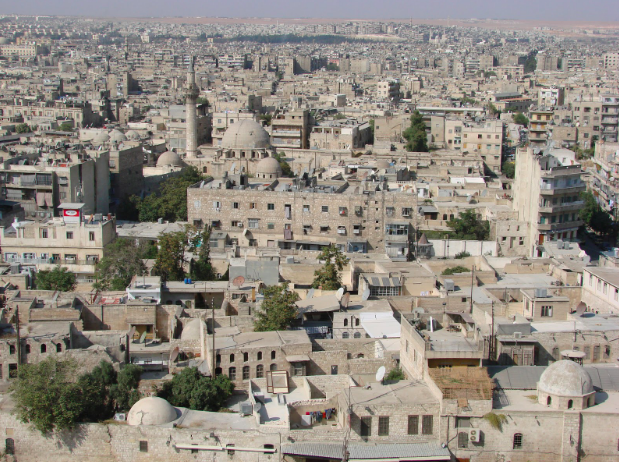
A view of Aleppo from above. CC by 2.0
Aleppo: The Struggle to Rebuild a City After Years of War
The Syrian Civil War has put Syria in the headlines since 2011. The War has devastated the entire country of Syria, and the United Nations Envoy for Syria estimates that 400,000 Syrians were killed in the Civil War. The war was fought between the Bashar al-Assad’s regime (backed by Russian and Iranian forces), ISIS, Kurdish Forces, and others (including Jaish al Fateh, Ahrar al-Sham, and Harakat Nour al-Din al-Zenki). Because of the violence of the Syrian Civil War, the United Nations estimates that 5 million refugees have fled Syria thus far.
One of the most significant battles in Syria during the Civil War has been the Battle of Aleppo, which lasted from 2012 to 2016. Aleppo is one of the largest cities in Syria. Its significance is partially historical, as Aleppo is one of the oldest continuously inhabited cities in the world due to its location on the end of the Silk Road. Before the Battle, Aleppo was controlled by rebel forces, which made Aleppo a target for Syrian President Bashar al-Assad, who was interested in controlling Aleppo due to its significance as an industrial powerhouse. Although the Syrian Civil war is ongoing, the Battle of Aleppo ended in december of 2016 when al-Assad’s forces gained control of the city.
In order to comprehend the damage inflicted on Aleppo during the war, the United Nations recently took satellite photos of Aleppo. The photos reveal that more than half of the buildings photographed have moderate to severe damage, and ten percent of historically significant sites show severe damage. Despite the damage, nearly 60,000 Syrian refugees have returned home now that Aleppo is controlled only by al-Assad. Although the Battle of Aleppo is over, there are still safety issues in the city; in early February of this year, an entire block of apartments collapsed killing 11 people, including four children. Much of the city lacks running water and electricity, and Syrian officials estimate that it will cost upwards of $10 billion to rebuild the city which held 2.3 million inhabitants before the war.
United States and European officials are reluctant to support efforts in rebuilding the city due to their distrust of president Bashar al-Assad. The president has been accused war crimes including using chemical weapons against civilians, and torturing his opponents. It is estimated that 5,000 Syrian civilians have died at the hands of his army. Despite international distrust of al-Assad, the United States has shied away from attempting to remove him from office because he is arguably the most promising chance for stability in Syria. Although the United States will not attempt a coup, former United States Secretary of State Rex Tillerson asserted in a speech that: "We will discourage economic relationships between the Assad regime and any other country” (including the rebuilding of Aleppo). The Battle of Aleppo may have ceased, but it will take years before Aleppo is restored to its formed status in Syria.
GINNY KEENAN is an NYU student currently studying abroad in London. She intends to major in journalism, and reads in her free time. She is always looking for new travel opportunities.
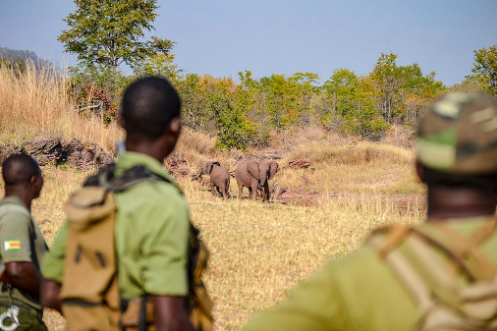
A group of rangers on patrol in Zimbabwe. Bumihillsfoundation.CC BY-SA 4.0
Wildlife War: Africa's Militaristic Approach to Animal Conservation
The plight of endangered elephants and rhinos in Africa is fairly well known to the world: Elephants are hunted by poachers for their tusks, which are carved into jewelry while rhinos are hunted for their horns which are believed in many cultures to carry medicinal value. The widespread poaching of these animals has pushed their population numbers back, causing a ripple effect in local ecosystems and presenting the possibility of extinction for the animals themselves. There is a very real chance that future generations may not grow up with these animals present as the current generation did. What is not as well known is that for years now, Africa has taken a militarized approach to prevent this outcome from becoming a reality, with armed conservation groups authorized to impose the harshest penalties on would-be poachers.
Poaching in Africa reached its zenith in the 1970s and 80s. In 1989 Kenyan President Daniel Arap Moi appointed famed paleoanthropologist Dr. Richard Leakey as head of Kenya’s Wildlife Conservation and Management Department, and Dr. Leaky created the first armed anti-poaching units. He then implemented a “shoot to kill” policy for dealing with poachers that drastically reduced environmental crime in the region. Several African nations followed suit and the practice of using arms to protect animals expanded throughout the continent, becoming more sophisticated over the years. Today conservation in Africa is a well known and a viable career path, with militarized conservation groups being trained by ex-soldiers from around the world. Nir Karlon, a former Israeli commando, manages the Maisha Group, a private security firm that focuses on preventing environmental crime in the Congo. In Zimbabwe, a nerve center of the African elephant population, Damian Mander of the Australian Royal Navy heads up the first all-female ranger team called “Akashinga” which means, “Brave Ones”. The group initially faced criticism from male conservationists who doubted that women would be able to perform the arduous physical tasks associated with the job. The Brave Ones, however, proved to be as capable as any man when it came to military conservation. New recruits to ranger units often go through several days of rigorous training before being offered a position. Some groups accept volunteers in unarmed positions, but most conservationists still carry weapons and are still authorized to use deadly force.
The job is not without risks. In the last decade, 1000 rangers have been killed while on duty. Death can come from the poachers they pursue or the animals they protect. Much of Africa’s poaching is carried out by crime syndicates and local militants who have found that ivory can be used as currency to buy weapons and fund campaigns. Encounters between conservationists and poachers have on occasion erupted into full-on firefights, and some critics have expressed concern that the rangers' methods may be too brutal. With this in mind, many ranger groups have made community outreach an even greater priority than battling poachers, as support from the locals will always be more effective than a gun. Education seminars at local schools help the rangers strengthen their relationships with people living in protected areas, with a long term goal of increasing awareness and surveillance of animal poaching in Africa.
JONATHAN ROBINSON is an intern at CATALYST. He is a travel enthusiast always adding new people, places, experiences to his story. He hopes to use writing as a means to connect with others like himself.
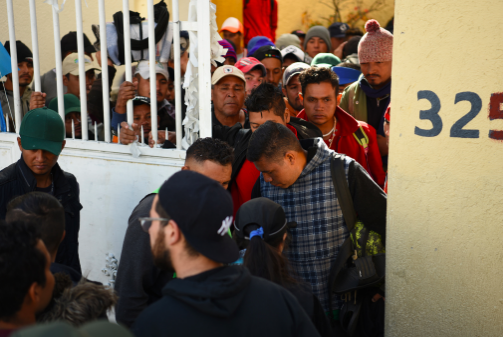
Asylum Seekers in Tlaquepaque, Jalisco. Daniel Arauz.
The Violence and Poverty Honduran Migrants are Fleeing
In November of 2018, a caravan was tear gassed by the US Border Patrol, and US immigration policies are increasingly strict along the southern border. Still, many Hondurans endure the 1000-mile journey from Central America to the United States in hopes of obtaining a more peaceful and prosperous life.
Honduras is described by the Human Rights Watch as a place in which “impunity for crime and human rights abuses is the norm”. Honduras has one of the highest murder rates in the world. One of it’s largest cities, San Pedro Sula, was known as the murder capital of the world until 2016. The high murder rate can be attributed to an increase in gang activity in recent years. Because of a crack down on the drug trade in Colombia, Honduras has taken a larger role in the cocaine trade. Honduras is now a major transit zone for cocaine. Now, Gangs such as Mara Salvatrucha (or MS-13) and Barro 18, terrorize locals in major cities. Some migrants understandably cite threats from gang members as their reason for leaving.
Certain viewpoints are ostracized by Honduran society, and activists and journalists are too often targeted by assassins. According to Global Witness, 111 Honduran environmental activists were murdered between 2002 and 2011. This shocking statistic led Global Witness to call Honduras “the most dangerous country to be an environmental activist. The vast majority of these cases go unsolved, including one high-profile case involving the murder of Berta Cáceres. Four government (or ex-government) officials have been tried for her murder, but the case was thrown away in 2018. Journalists face similar danger; between 2014 and 2016, 21 journalists were murdered, and only 9% of these murders were solved. Because of the high murder rate, officials find it difficult to keep up with cases, and many cases end up unsolved.
Women are especially susceptible to violence. According to the United Nations, one in five Honduran women experience physical or sexual violence. Femicide, the killing of women for their gender, is one of the highest in the world, accounting for 9.6% of the homicides in Honduras. Fewer than 3% of Femicide cases are resolved by the courts. Gender based hate crimes could explain the fact that women and children are migrating at higher rates than ever before.
According to the Carnegie Endowment for Peace, the Honduran people endure a government in which “[corruption] is the operating system of sophisticated networks that cross sectoral and national boundaries in their drive to maximize returns for their members”. No one better exemplifies corruption in Honduras than President Juan Orlando Hernández, a conservative, pro-business leader. Hernández almost lost the reelection in 2017, yet just as his opponent, Salvador Nasralla, was ahead in polls by 5 points, the Honduras Broadcast Commission (which was mostly staffed by Hernández appointees) ended the broadcast of the election. It was later announced that Hernández won the election. Hondurans suspected the election was corrupt, thus tens of thousands of Hondurans protested Hernández’s election only to be met with bullets, tear gas, and arrests. Organizations like the Organization for American States and the European Union found reasons to question the validity of the elections. The Organization for American States found “Deliberate human intrusions in the computer system” and “intentional elimination of digital traces”. On the 1 year anniversary of Hernández’s election, January 27, 2019, protests broke out again.
According to the World Bank Group, 66% of Hondurans are living in poverty; 1 in 5 Hondurans have an income under $1.50 a day. Honduras is also burdened with the highest level of income inequality in Latin America. The per capita income of the average Honduran is $4,563.80, meager compared to the $60,200 per capita income in the United States. Given the circumstances, it is not difficult to understand why migrants are headed for the United States. The immigration process is lengthy and many Hondurans don’t have the time to wait for the United States to grant them visas legally. The immense poverty and crime has left many Hondurans with little choice other than to attempt immigration into the United States.
GINNY KEENAN is an NYU student currently studying abroad in London. She intends to major in journalism, and reads in her free time. She is always looking for new travel opportunities.
Xi Jinping, General Secretary of the Communist Party in the People's Republic of China. U.S. Department of State. Public Domain.
Government Control Over China Intensifies Under New General Secretary
“The Story of Yanxi Palace” is a Chinese TV drama set in the Qing dynasty that follows a group of concubines as they compete for power in the imperial court. It premiered in the summer of 2018 and was viewed more than 15 billion times on iQiyi, China’s premier movie streaming service. Despite its massive popularity, the show was abruptly canceled by the Chinese state media for being too “lavish” and “nasty”. The paternal approach that the Chinese government takes to managing its citizens often leads it to become personally involved in even the most casual of affairs, and its oversight has expanded under its current leader, Xi Jinping.
Xi Jinping became General Secretary of the Communist Party in 2016, though he was thought by many to be its most influential member long before that. Shortly after taking power, Xi implemented a series of changes within the party itself. He pushed for an amendment that would remove term limits for General Secretaries, essentially keeping himself in power for the remainder of his life. The amendment was approved by nearly all of Xi’s constituents. Xi Jinping’s changes also included the creation of a “social credit” system which assigns Chinese citizens a score based on their day-to-day conduct in society. Teams of specially trained officials have been sent to monitor neighborhoods throughout the country and report thier findings to the goverment. The Party has also installed cameras at traffic intersections and subway stations equipped with facial recognition technology. This, in addition to a long-established internet firewall that renders sites like Facebook, Youtube and Twitter inaccessible to those on the mainland, have critics calling the current state of the country “Orwellian”.
The government’s tolerance for public scrutiny also appears to have tightened under Xi’s leadership (it was never “loose” to begin with). In March, reporter Liang Xiangyi became an internet sensation when she was seen cringing and rolling her eyes while a colleague asked China’s Foreign Minister a lengthy question about Xi Jinping's future plans for the country. The incident took place at an annual meeting of China’s National People’s Congress, a highly televised event in which questions from the media are often vetted. Shortly after the incident Liang disappeared amid rumors that she had been fired and her press privileges had been revoked. Buddhists, Christians, and Muslims living in China have also found themselves under increased scrutiny. While the Chinese constitution technically allows for freedom of religion, the Communist Party itself is officially atheist, and under Xi Jinping, the Party began promoting the idea of “sinicization” which calls for non-Chinese groups living in China to acclimate themselves to the overarching culture of the country. The government is now using this ideology to push for religious practitioners to merge their beliefs with Communist ideology. Those who resist are detained and forced to renounce their religions while temples, churches, and mosques are shut down, if not destroyed entirely.
It is often said that while the West favors freedom, China favors stability. However, “freedom” and “stability” are fairly broad ideas, and their benefits don’t always trickle down to those at the lower rungs of society. It remains to be seen who actually benefits from China’s proclaimed stability, and how these changes will be received by the country’s massive population.
JONATHAN ROBINSON is an intern at CATALYST. He is a travel enthusiast always adding new people, places, experiences to his story. He hopes to use writing as a means to connect with others like himself.