
Explaining the decades-long issues that surround Mindanao Island.
Read MoreBrain Stunting: The Invisible Effect of Malnutrition in the Philippines
Brain stunting, a detrimental cognitive effect of early childhood malnutrition, threatens to preserve economic inequality and injustice in the Philippines.
Read More7 Climate Activists Under Age 35
While Greta Thunberg may be the most well-known young climate activist, here are 6 more from around the world.
Read MoreDigital Illiteracy in the Philippines
Digital illiteracy and misinformation remain a serious barrier to democracy and freedom in the Philippines.
Read MoreEthics of Whale Shark Watching in the Philippines
Travelers must be aware and mindful of animal welfare when participating in whale-watching experiences in the Philippines.
Read More5 Remote Filipino Regions Not Named Boracay
Siquijor, Batanes, Camiguin, Tawi-Tawi and Calaguas are stunning destinations in the Philippines, boasting a variety of attractions in lesser-traveled areas.
Read MoreA Hidden Tribe in the Caves and Jungle of the Philippines
An Indigenous tribe in the island of Palawan, Philippines, continues to live between caves and the jungle, relying directly on nature’s resources to survive.
Read MoreIsland Hopping Off The Grid: 5 Filipino Islands You’ve Never Heard Of
From unspoilt beaches and heritage sites to surfing hotspots and sunset views, there is plenty to choose from in the Philippines without running into massive crowds.
Read MorePhoto Essay: On the Ground with Waves For Water in the Philippines
While the Philippine Islands were being struck by Super Typhoon Haiyan’s wrath, Jon Rose, Founder of Waves For Water, was already hatching his plan to help.
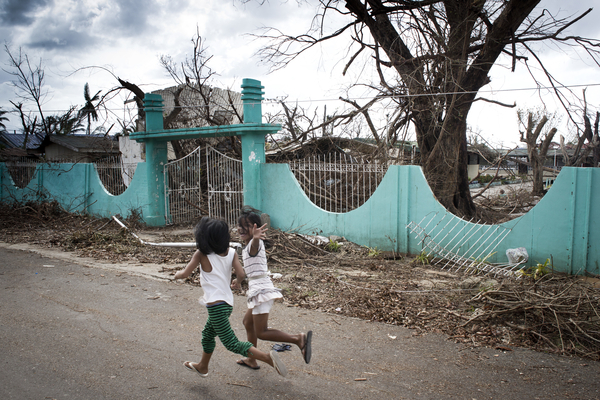
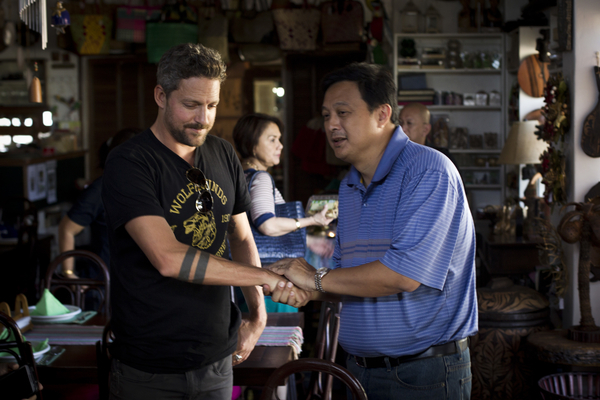
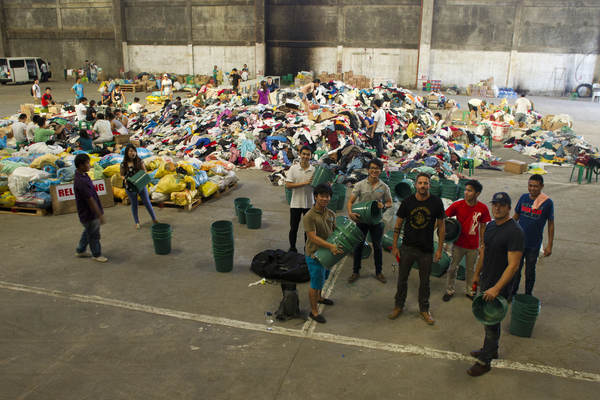
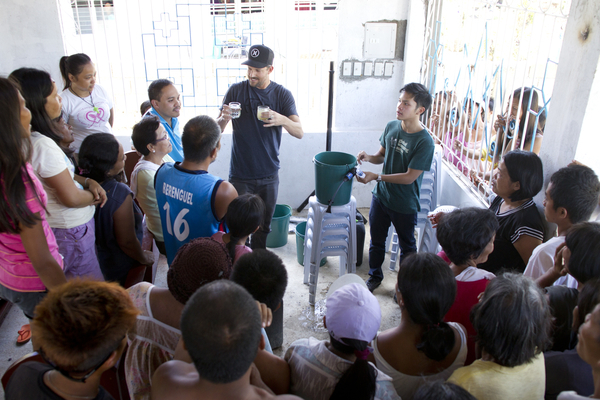
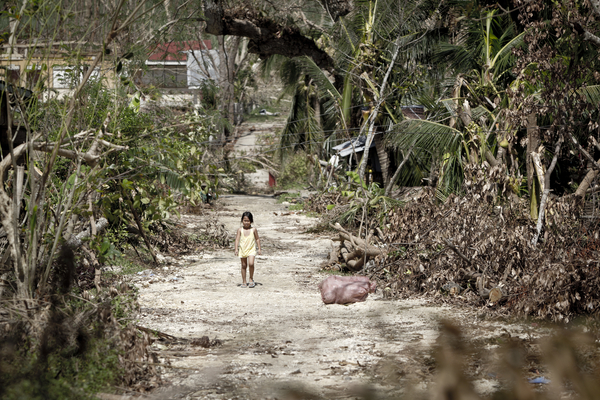
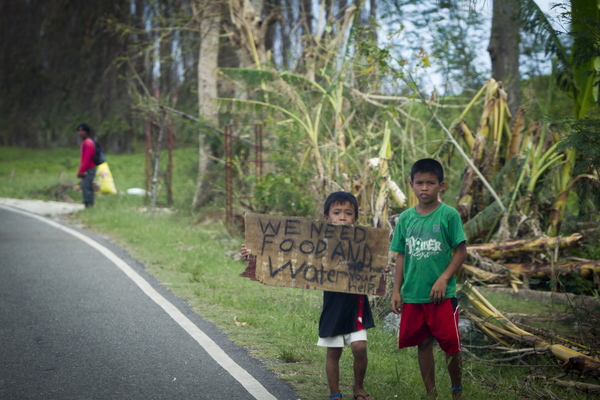
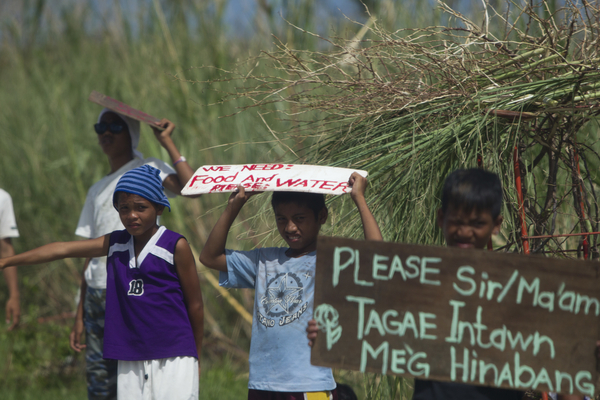
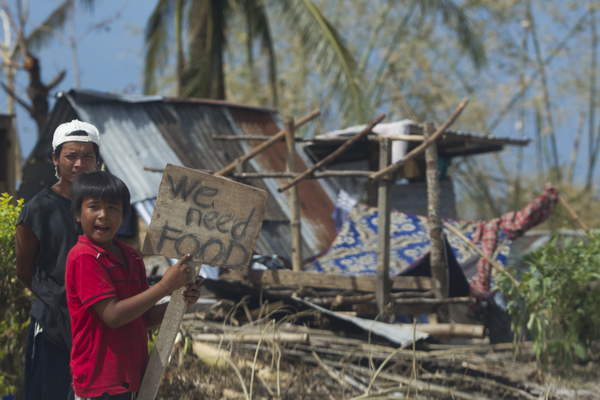
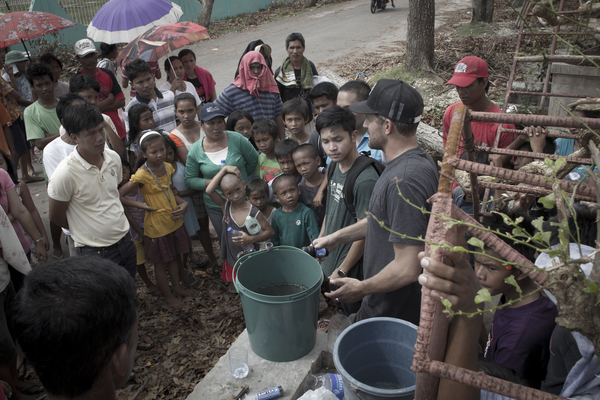
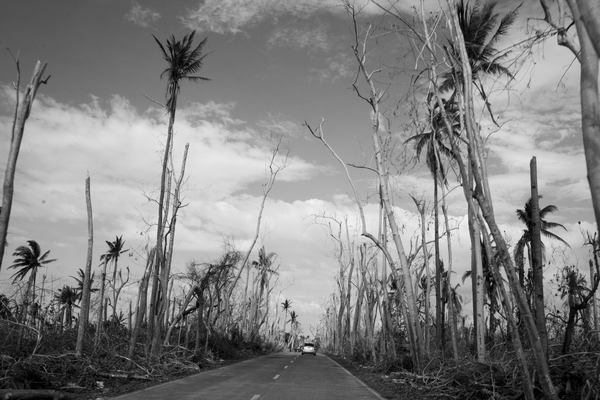
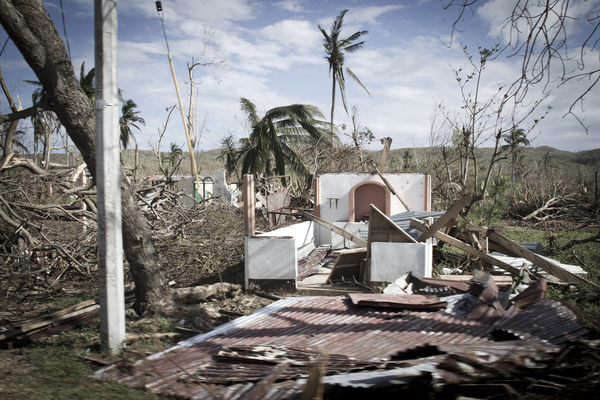
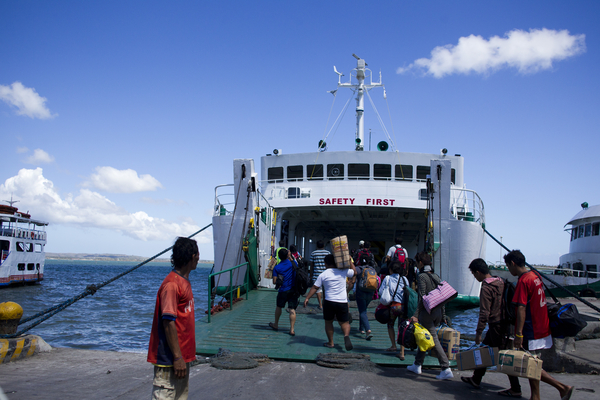
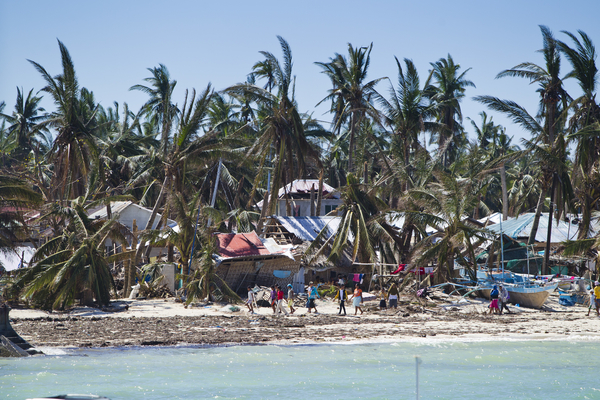
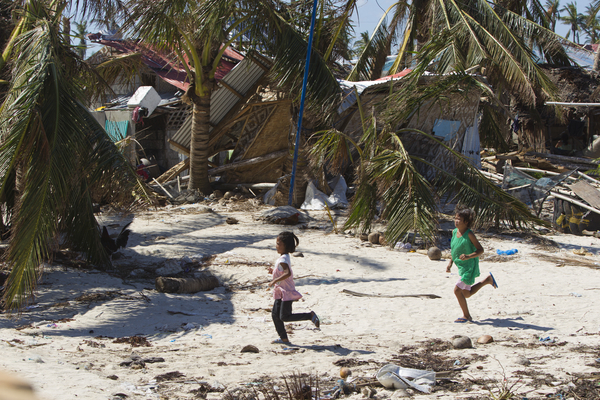
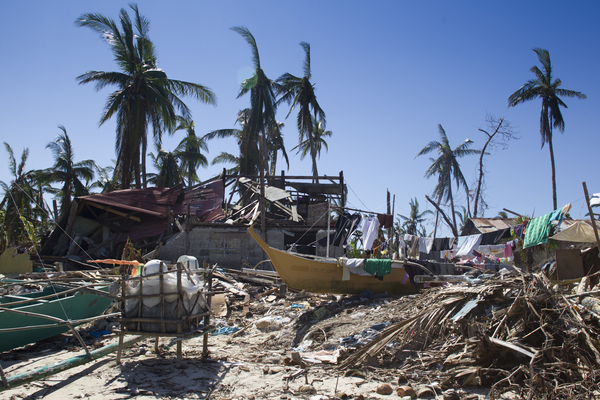
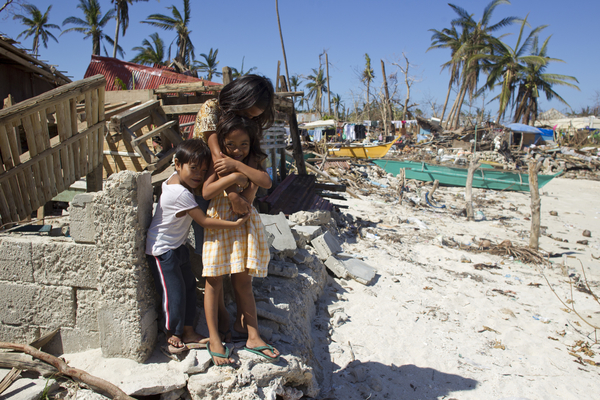
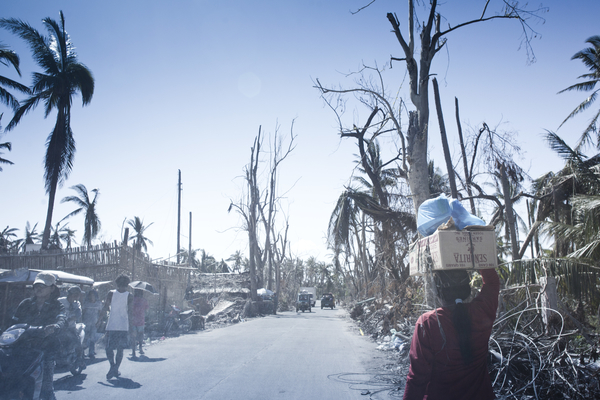
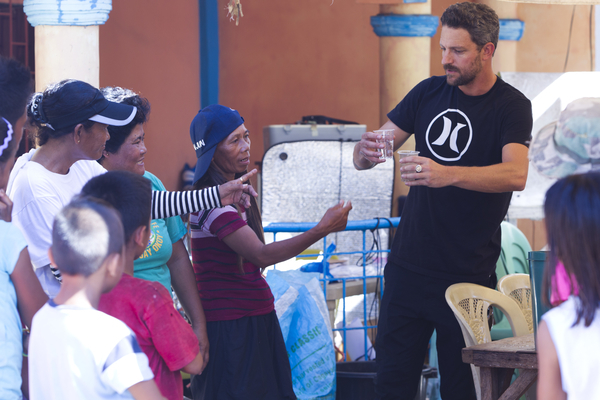
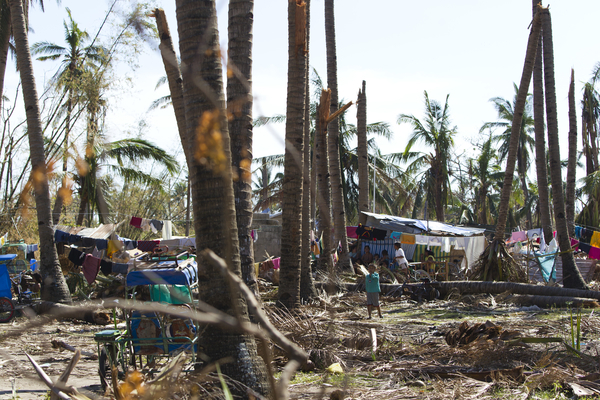
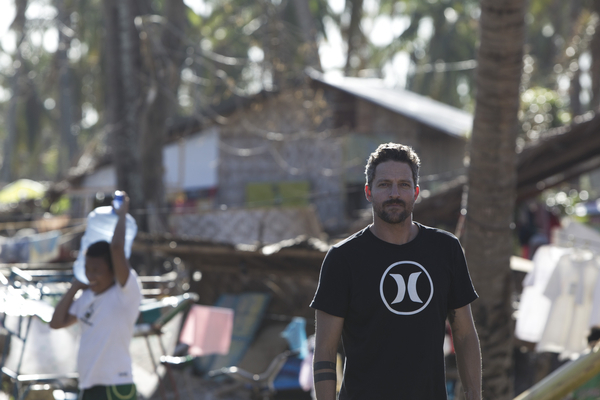
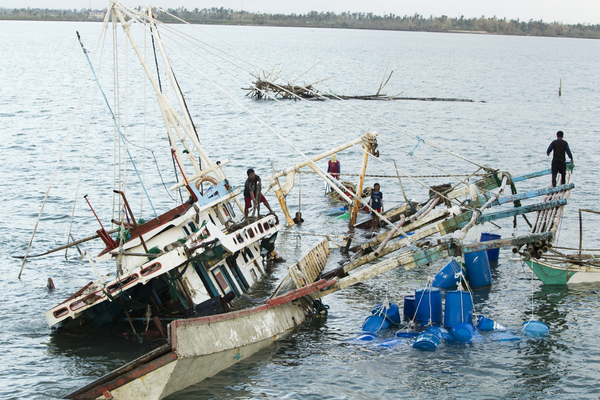
W4W began work in the Philippines in response to Typhoon Haiyan and continues to support areas with water shortages.
In 2013, the Philippines was hit by one of the most devastating typhoons ever recorded: Typhoon Haiyan. The natural disaster affected people throughout Southeast Asia and killed 6,300 people in the Philippines alone. Throughout the country, over 4.3 million people were affected. One major impact of the typhoon was its obstruction of access to clean water.
To address this problem, Jon Rose, founder of Waves for Water (W4W), arrived in the Philippines ready to distribute his organization’s water filters among “forgotten pockets,” communities that were not “the focal point of major relief efforts.” His method of distribution and relief relied on the “train-the trainer, local-based model” in which W4W organizers “empower” and “facilitate” for local people rather than decide “who gets what, when, where and how.” Two years after the typhoon, W4W established an office in the Philippines, where it is currently registered as a non-profit organization. Since 2015, W4W has built 66 rainwater catchment systems and provided over a million Filipinos with access to clean water. In December of 2021, the organization helped to address the devastation caused by Hurricane Odette in Siargao, Philippines through a partnership with Billabong. Currently, W4W is providing aid for those impacted by Tropical Depression Agaton, which has displaced 1.9 million people in Visayas and Mindanao, Philippines. You can contribute to this specific effort here.
W4W’s humanitarian efforts are not limited to the Philippines. Since its inception in 2009, the organization has made an impact in 44 countries, including Mozambique, Ecuador, Sierra Leone and Chile, and has helped 3.75 million people gain reliable access to clean drinking water. W4W currently has 24r active programs helping to address water access issues. These programs seek to provide aid to citizens of Ukraine, Australia, Haiti and Guatemala. You can learn more and help out here.
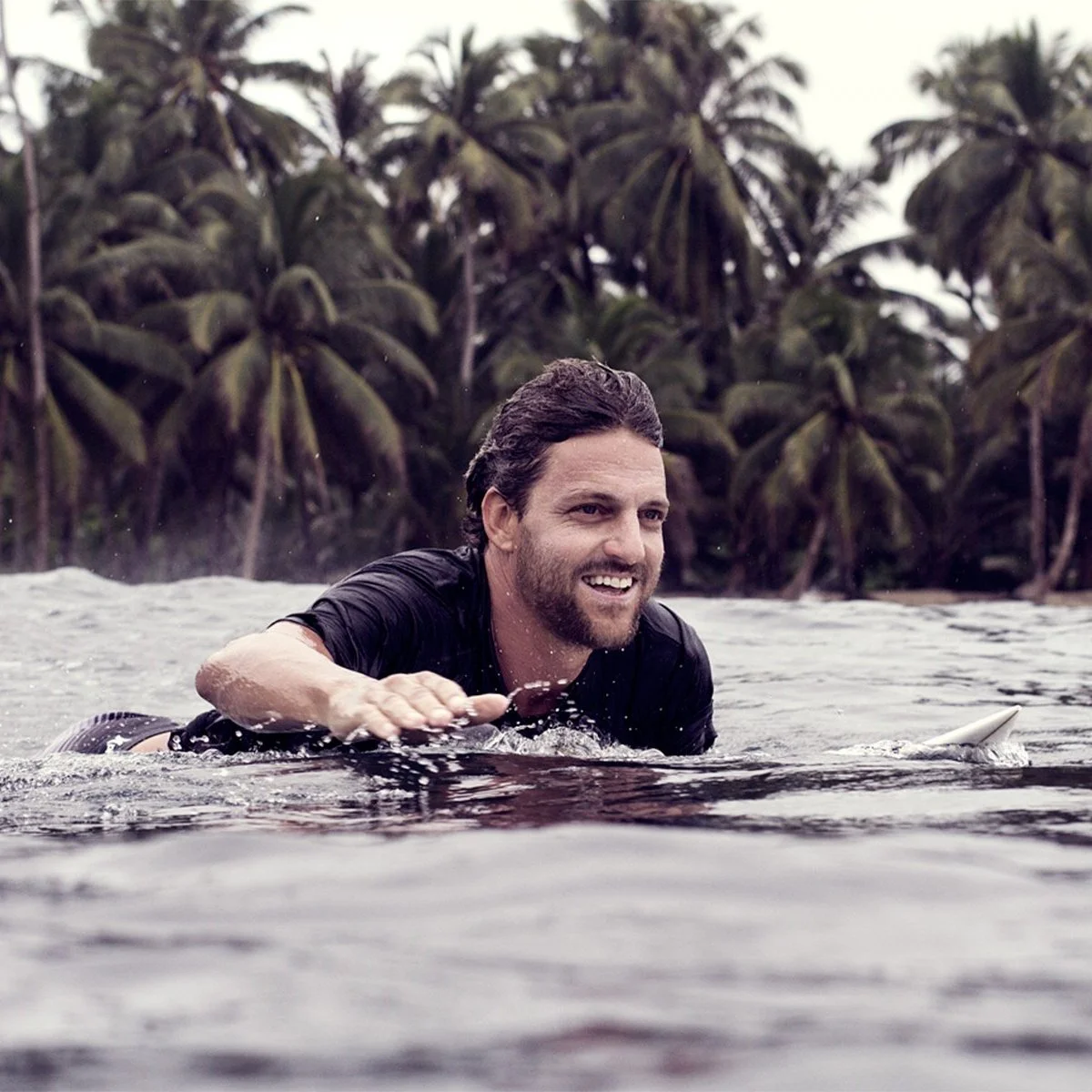
Jon Rose
As a pro surfer of 13 years, Jon Rose traveled the world in pursuit of perfect waves. It was this passion that led him to development of Waves for Water in 2009. He hopes to see W4W enlist and empower travers to help solve the world water crisis.
7 Stunning Caves Worth Exploring
Though caves often hold a fearsome reputation, they have a myriad of captivating natural features and intriguing histories.
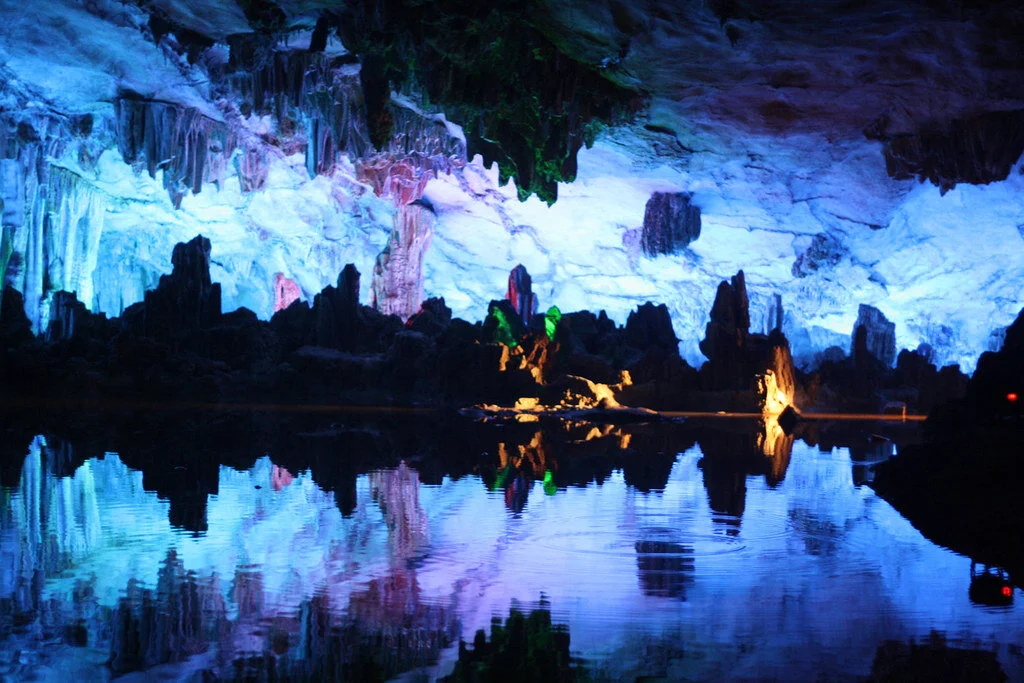
Caves often get a bad reputation: cold, dark, damp and uninteresting, or even frightening. In reality, caves offer snapshots of history, unusual natural structures, and examples of remarkable biodiversity. There are thousands of caves on Earth, and even more that are yet to be discovered. Each cave is unique, with specific natural formations that cannot be found anywhere else. Here are seven incredible caves to add to your list of must-see sights.
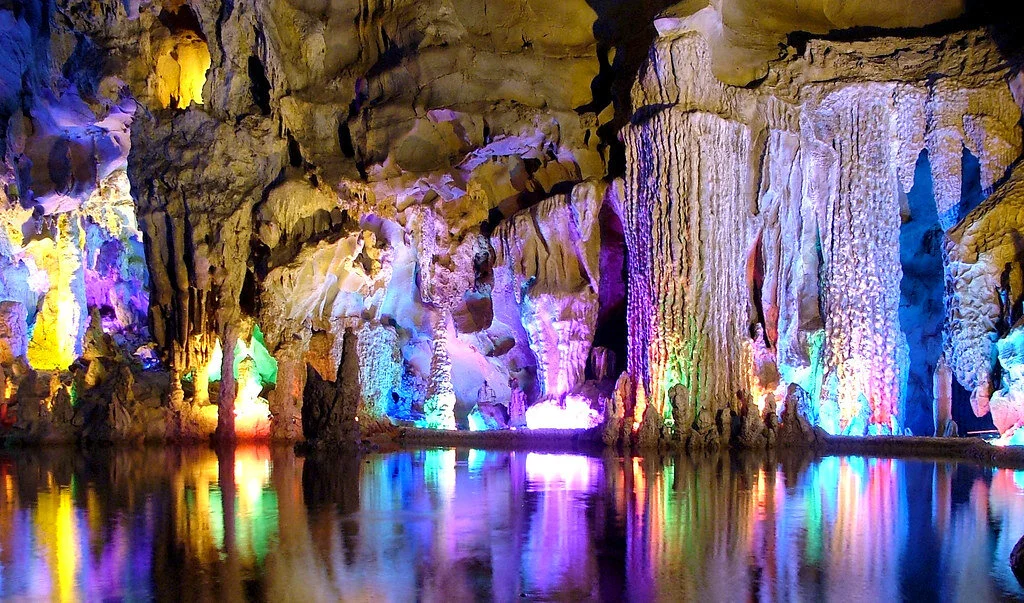
1. Reed Flute Cave, China
Called “the Palace of Natural Art,” Reed Flute Cave is known for its impressive stone curtains and pillars. Reed Flute Cave is located just 3 miles from downtown Guilin, China, and has been an attraction for centuries. Seventy-seven inscriptions of poems and travel descriptions can be found around the cave, and the oldest dates back to 790 A.D., the era of the Tang dynasty. There are inscriptions from the Tang, Song, Yuan and Ming dynasties, written by monks, poets, scholars and tourists from all over China. Today, the cave is lit by many multicolored lights hidden in its natural cracks and crevices, which cast a bright rainbow glow around the dark space, giving cave visitors a surreal and breathtaking experience. The cave was forgotten for years until its rediscovery in 1940, when a group of Chinese refugees stumbled upon it while fleeing from Japanese forces. During World War II, the cave’s large chamber, called the “Crystal Palace of the Dragon King,” was used as a bomb shelter. The cave regained popularity after its rediscovery at the end of the war, and was officially opened to the public in 1962.
2. Waitomo Glowworm Caves, New Zealand
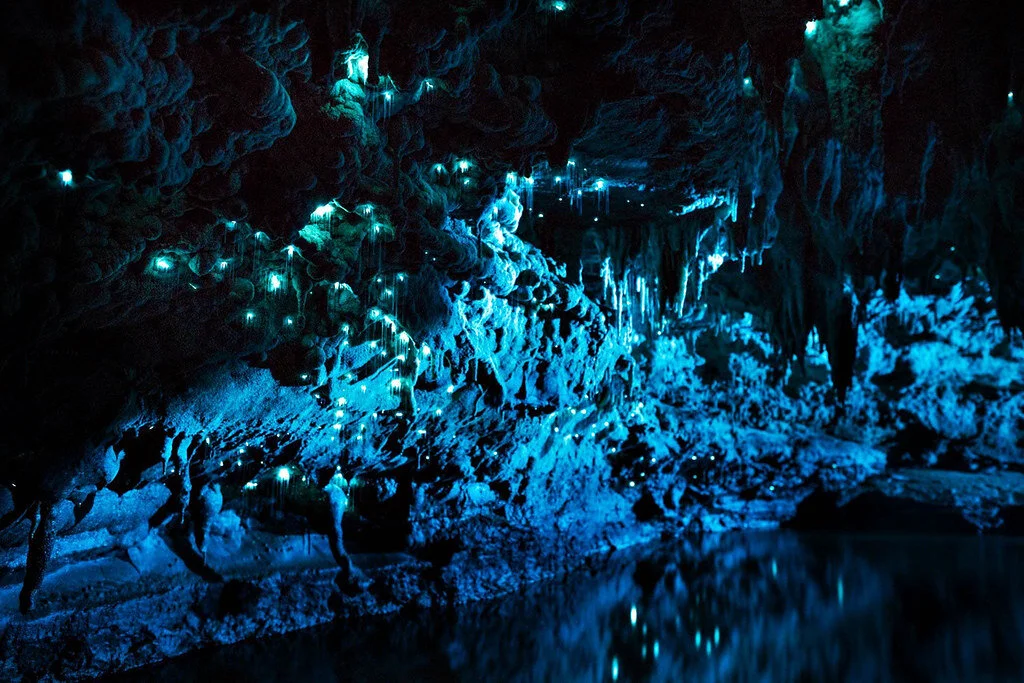
Visitors to the Waitomo Glowworm Caves will take a trip into the past by exploring a cave over 30 million years old. The cave, located in Waitomo on the North Island of New Zealand, is praised as one of New Zealand’s best natural attractions. It contains an underground river, towering rock formations, and thousands of shimmering glowworms. The Glowworm Caves have been an attraction for over 130 years. These limestone caves formed at the bottom of the ocean millions of years ago. Local Maori communities knew about the caves, but they were first explored in 1887 by Maori Chief Tane Tinorau and English surveyor Fred Mace. After discovering the natural beauty of the caves, Chief Tinorau opened the caves to tourists in 1889. Many of the guides for tours today are descendants of Chief Tinorau. Guides take visitors on walking tours through the caves, as well as boat tours through the glowworm grotto. These boat tours take visitors to the center of the grotto, where they can look up in awe at the luminescent glowworms covering the cave walls and ceiling.
3. Mendenhall Ice Caves, Alaska
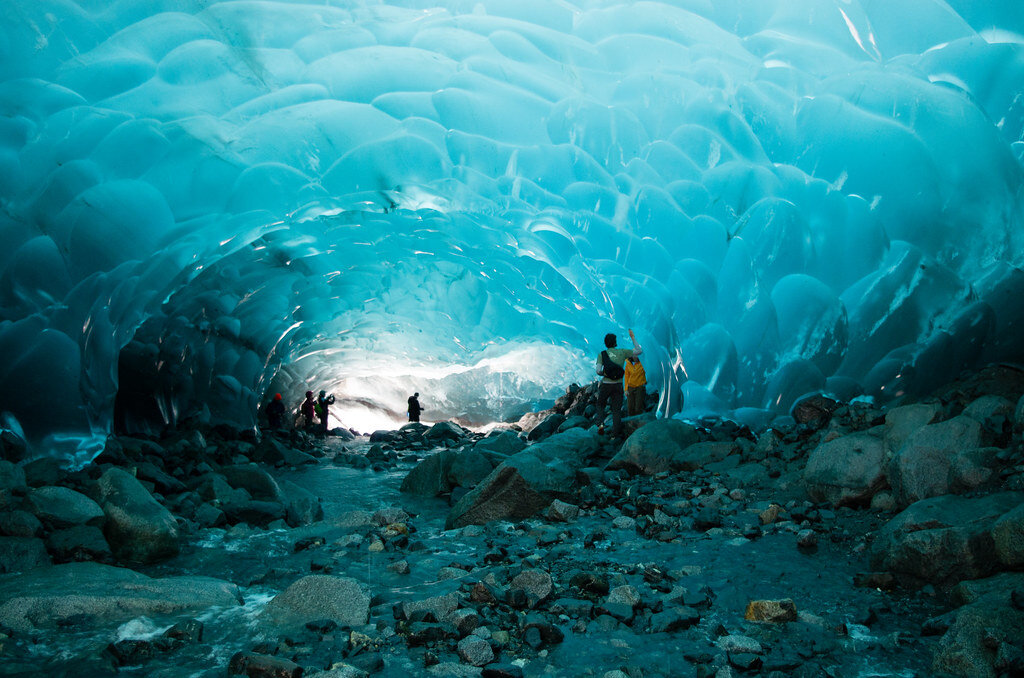
Just 12 miles outside downtown Juneau lies Mendenhall Glacier, known as the “Glacier Behind the Town.” Inside the glacier are the Mendenhall ice caves, passageways formed by water flowing through the glacier. These caves vary in size from tiny openings visitors have to squeeze through to giant caverns. Mendenhall Glacier was first explored in 1794 by Joseph Whidbey, a member of the British Royal Navy serving on Capt. George Vancouver’s 1791-95 expedition of the Pacific Northwest coast. To visit the caves, travelers can hike through the Tongass National Forest and then across the glacier, or they can canoe across Mendenhall Lake to the glacier. Both options offer breathtaking views of the glacier and surrounding landscapes, and both are somewhat strenuous but well worth the effort. Inside the caves, visitors are immersed in the cool blue shades of light coming through the glacier and can explore ever-changing ice formations. The caves change as the ice melts, so each visit to the Mendenhall ice caves is unique. The presence of the caves is also inconsistent and typically seasonal, so visitors should be sure to check on the status of the caves before planning a trip.
4. Barton Creek Cave, Belize
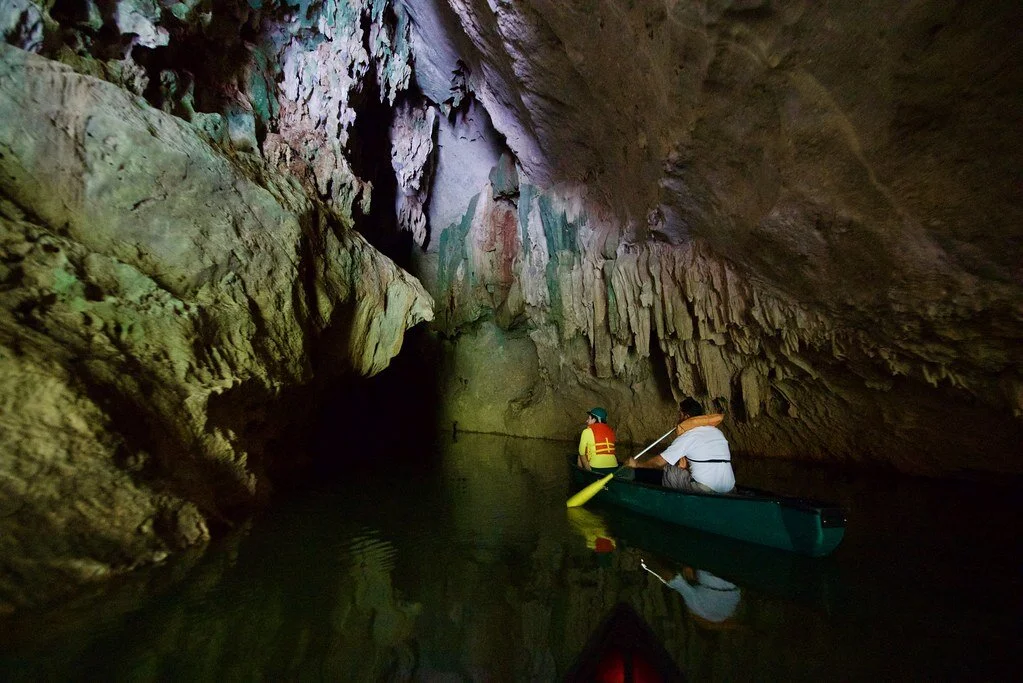
To discover the wonders of Barton Creek Cave, visitors will have to board a canoe. Barton Creek Cave is located east of San Ignacio along the western edge of Belize. It is a wet cave because it has a cave river running through it, and paddling along this tranquil river is the only way to take in the cave’s majesty and history. It is the largest river cave in Belize and contains evidence of ancient Mayan culture. The cave is natural, but archaeologists have identified a number of areas they believe were purposefully modified by the Mayans to improve access to the cave. These modifications include natural formations of flowstone broken to allow access to a rimstone pool and holes drilled by Mayan tools, likely to serve as handholds or to attach climbing ropes. Ten ledges made by the Maya line the cave walls, where archaeologists have discovered thousands of pottery shards, most of which are from large jars called ollas, and a number of stone tools. These discoveries have helped archaeologists determine the use of the cave during Mayan times; it was likely the site of ritual activity and worship. The Maya regarded caves as sacred sites, and the artifacts found in Barton Creek Cave reflect this view. Tours through the cave offer visitors the opportunity to witness incredible natural formations and to learn how the ancient Mayans interacted with the cave.
5. Hang Son Doong, Vietnam
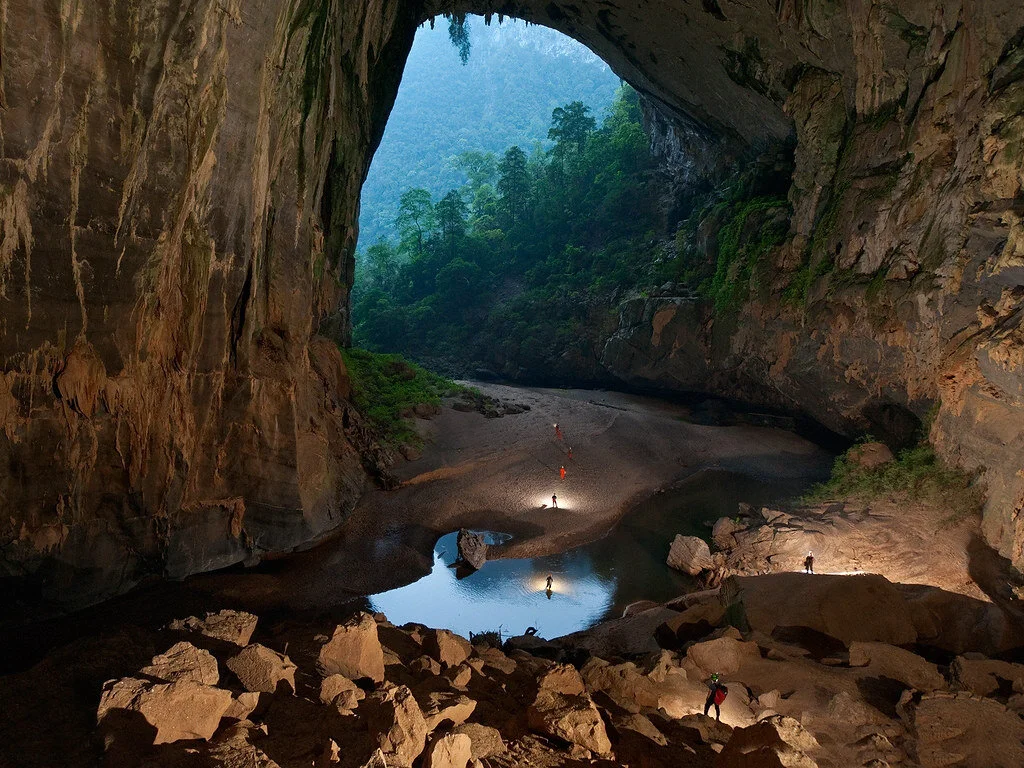
For travelers who want to explore a cave but worry about darkness and small spaces, Son Doong Cave in central Vietnam is the perfect place to visit. Son Doong has the largest cross section of any cave in the world, reaching over 5 miles long, 650 feet wide and 490 feet tall. In some areas, the limestone ceiling of the cave grew weak and collapsed, creating huge skylights and allowing areas of lush vegetation to grow inside the cave. It was formed millions of years ago by the Rao Thuong River eroding limestone. Son Doong Cave was initially discovered in 1990 by a local man named Ho Khanh, who stumbled upon the entrance while searching the area for food and timber. He then returned home and no further exploration of the cave occurred until Howard and Deb Limbert, members of the British Cave Research Association, heard Ho Khanh’s story and urged him to find the cave again. In 2008, he successfully rediscovered the cave, and a survey was conducted by Howard Limbert and a group of British cavers. The cave opened to the public in 2013. Visitors are sure to be impressed by the sheer size of the cave, as well as its natural formations, river and distinctive vegetation growth.
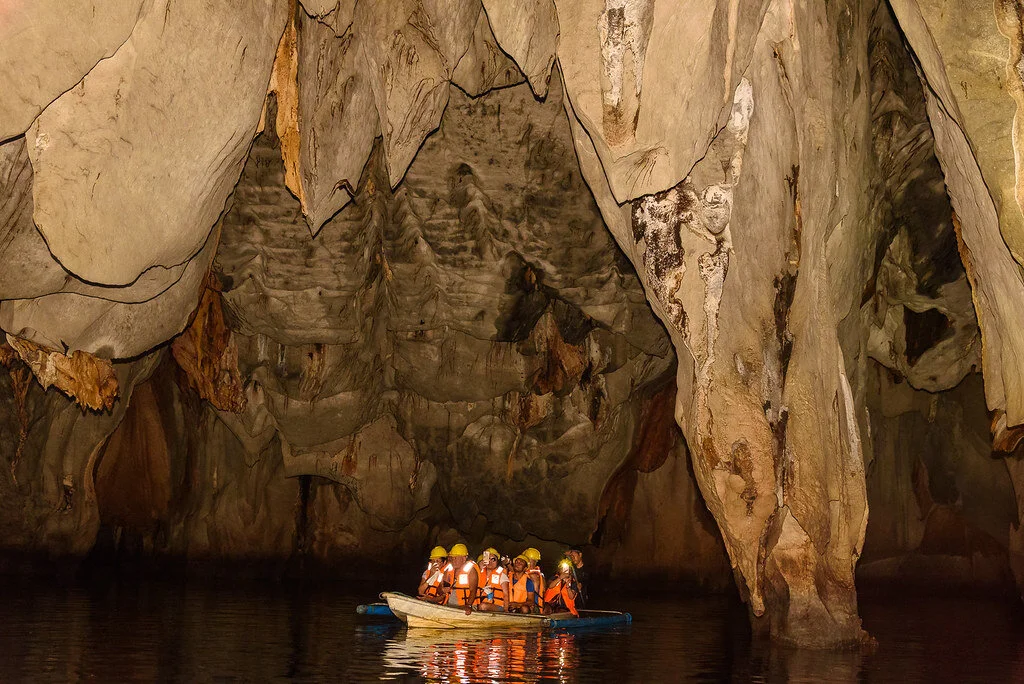
6. Puerto Princesa Underground River, Philippines
Located on Palawan, the westernmost island in the Philippines, Puerto Princesa Subterranean River National Park is home to old-growth forests, wildlife and an expansive limestone cave system. The Puerto Princesa Underground River, as it is commonly known, flows for over five miles through beautiful caverns and eventually meets the sea. Visitors can take underground river tours on paddleboats to see the stunning cave formations and limestone cliffs, as well as a variety of native animal species. There are records of the Puerto Princesa Underground River dating back to 1898, but it is believed to have been known to early inhabitants of the Philippines and investigated by foreign explorers prior to that time. The area was established as an official attraction in 1971, and the cave system is still being explored. In 2010, researchers discovered a large cave dome above the underground river, with more river channels and access to an even deeper cave. The Puerto Princesa Underground River offers an abundance of fascinating natural formations to explore.
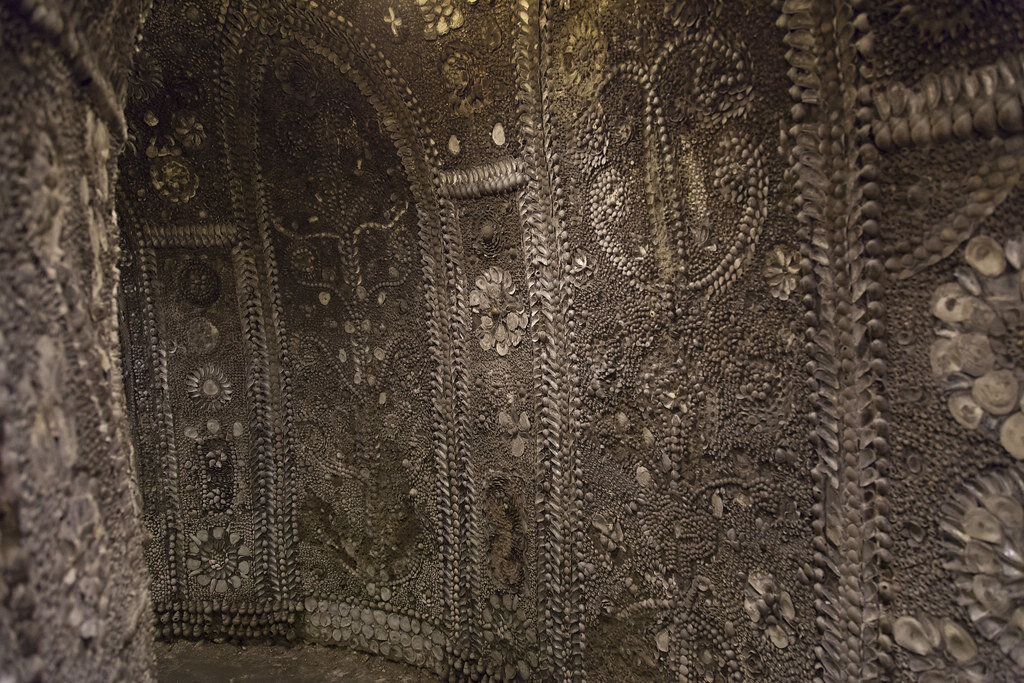
7. Shell Grotto, England
Shell Grotto is one of England’s most mysterious sites, encompassing over 70 feet of tunnels under the seaside town of Margate. These caves were discovered by chance in 1835, when a man excavating his new land stumbled upon them. Sprawling mosaics made of mussel, oyster, whelk and cockle shells cover every wall of the tunnels. Historians are unsure of who built Shell Grotto, or why. Theories range from Shell Grotto being a place of worship to a simple display of extreme wealth to the meeting room of a secret society. The elaborate shell designs offer little explanation, displaying swirling patterns that can be interpreted as a number of different things. Shell Grotto is a tremendous work of art, and the questions surrounding its origin and purpose add a layer of intrigue that draws visitors from around the world.

Rachel Lynch
Rachel is a student at Sarah Lawrence College in Bronxville, NY currently taking a semester off. She plans to study Writing and Child Development. Rachel loves to travel and is inspired by the places she’s been and everywhere she wants to go. She hopes to educate people on social justice issues and the history and culture of travel destinations through her writing.
A Sweet Stop: The Philippines’ Chocolate Hills
Yet again, Mother Nature has shown us that she is the most skilled artist. In the Chocolate Hills of the Philippines, she demonstrates a mastery of symmetry, balance and color theory.
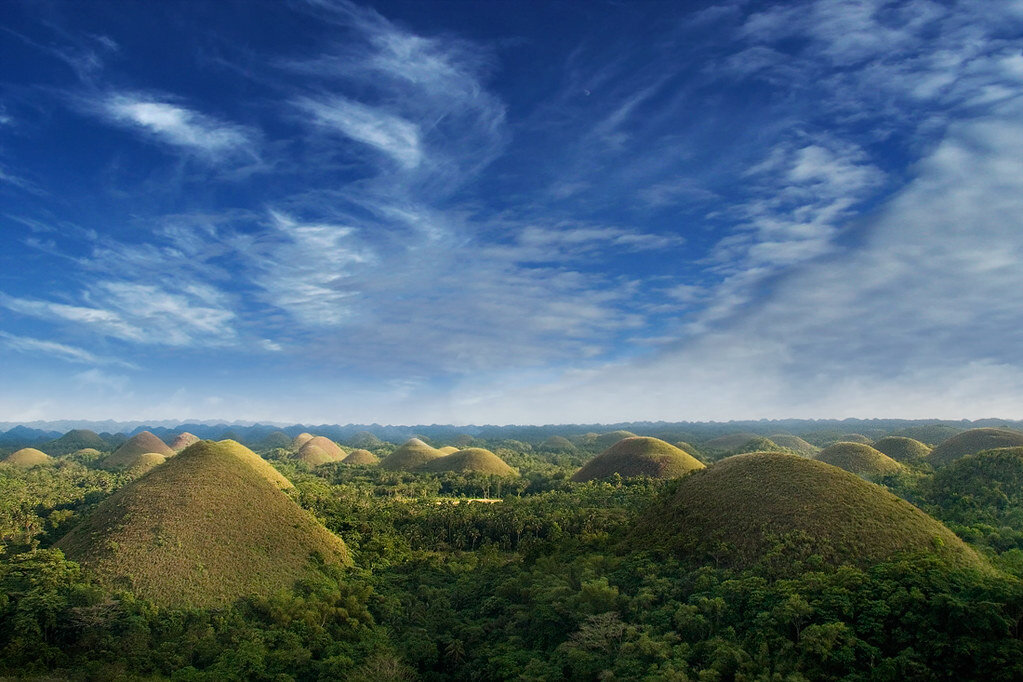
The Philippines’ Chocolate Hills. An diabhal glas. CC BY-NC-SA 2.0.
Spread out over the verdant landscape of Bohol, an island in the Philippines, lies a series of funky natural monuments called the Chocolate Hills. The hills cover about 20 square miles of dense forest, heading through the towns of Batuan, Carmen and Sagbayan. The range consists of well over 1,000 different hills, with some estimates claiming nearly 2,000 in total. Upon close examination, the hills appear to vary notably; most sit between 100 and 150 feet, while the tallest is almost 400 feet.
As sweet as it would be, the hills have no relation to real chocolate, but rather are called “chocolate” for their majestic shade-shifting. During the rainy season, the grassy hills appear soft; the lush layer of short grass gives them a bright, bouncy appearance. However, the dry season bleeds all vibrancy from the grass, washing over the land with a rich chocolate brown. The dry season mutes the vividness of the hills, but looks equally beautiful under the island’s semi-cloudy cobalt skies.
Up close, it is apparent that some of the hills display a more angular appearance, while others seem more compactly round. However, from far away, the hills look completely symmetrical. The result is a view of an expansive landscape marked by natural cones.
Legends of the Land
The abundant greenery finds a parallel in the local folklore; the rich legends of the Chocolate Hills attempt to answer the mysterious origins of the land. Some claim that the legends were purely conjured up as entertainment for children. Others say there’s some truth to the stories.
One story speaks of two giants who engaged in a ferocious fight, in which they threw rocks and sand at each other. The debris of their fight thus resulted in the peculiar sample of the hills seen today.
Another story speaks of immense heartbreak. It is said that a giant fell in love with a woman, who in her inevitable mortality, eventually died. Terribly broken, the giant cried countless tears that solidified into the array of hills.
Lastly, a less popular though comical legend claims that the hills are just piles of dried water buffalo manure.
The Science Behind the Hills
Scientists, too, disagree on how these hills came to be.
One theory claims that the hills are a result of the erosion of underwater limestone; tectonic shifts then broke up these seafloor plates and raised them to land.
The second theory states that the Chocolate Hills are shifted pieces of what was once a series of coral reefs.
Although people may never settle on one solution, it is fair to say that the Chocolate Hills make for a beautiful sight with an equally rich background.

Ella Nguyen
Ella is an undergraduate student at Vassar College pursuing a degree in Hispanic Studies. She wants to assist in the field of immigration law and hopes to utilize Spanish in her future projects. In her free time she enjoys cooking, writing poetry, and learning about cosmetics.
Philippines Moves to Protect Children from Sexual Abuse
The Philippines passed a new law to raise the age of consent. The change could go a long way toward protecting the country’s most vulnerable children.
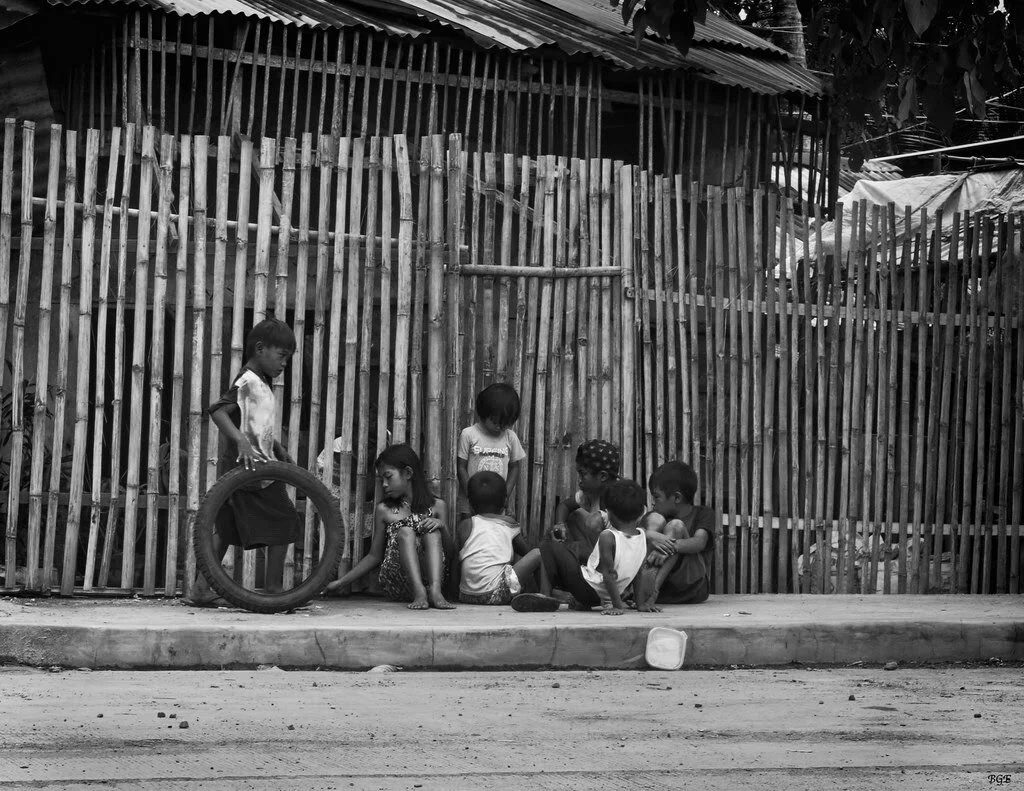
Children on the street. Beegee49. CC BY-ND 2.0.
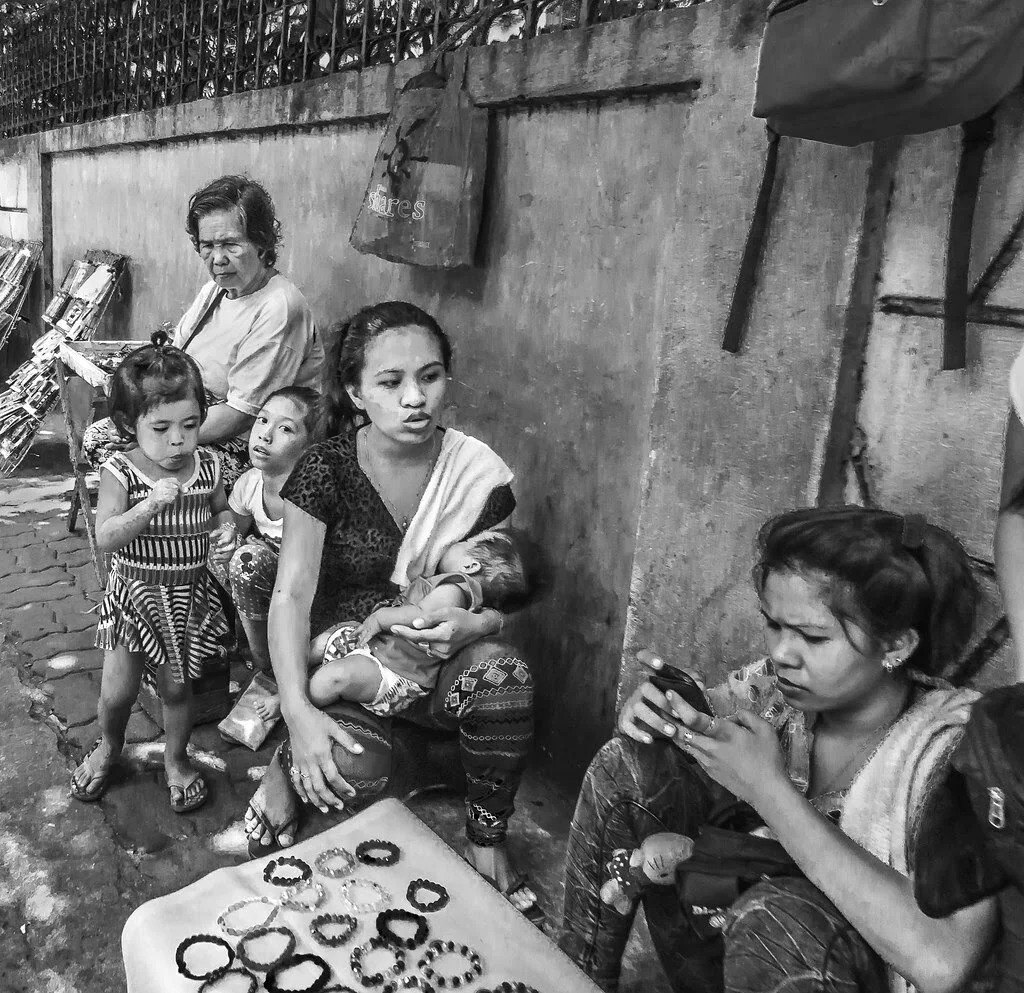
The Philippines’ House of Representatives recently passed a new law that would raise the age of consent from 12 to 16. Long among the world’s lowest ages of consent, lawmakers hope the change will protect children from sexual predation. In recent decades, the Philippines has become a global hub of child sexual exploitation. Though the new law will improve protections for victims of abuse, long-lasting effects of sexual predation will be felt for years to come.
The age of consent was decided in 1930 in the Revised Penal Code at 12 years old, the product of what is widely considered a culture of patriarchy. At such a low age, sexual acts against children were almost impossible to prosecute in court. Defendants could claim sex with a child was consensual because they were both above the age of consent. Under this code, defendants could escape a rape verdict if they offered to marry their victim.
In recent years, sexual abuse against minors has seen a massive increase across the Philippines. Experts say the number of IP addresses used for streaming child pornography has risen from 23,333 in 2014 to 81,723 in 2017, a 250% increase. Cases of HIV/AIDS among minors have been increasing steadily over a similar period of time. Of all rape victims, 70% are children, the vast majority girls. As a result, girls as young as 14 are becoming pregnant at higher rates.
Campaigners for the bill long argued that children needed far more protections than the Philippines’ legal system granted. The law that would raise the age of consent also contains measures to harshen penalties for rape, sexual exploitation and abuse as well as shift the burden of proof of consent from the victim to the offender. The new law passed the House of Representatives with 207 votes and only 3 opposing; it is expected to pass the Senate just as easily.
A family making ends meet. FotoGrazio. CC BY-NC-ND 2.0.
Increased data collection has painted a clearer picture of the issue in recent years. International advocacy helped focus lawmakers’ attention on the issue, but it also revealed the lack of resources the Philippines suffers from in combating sex crimes. Sixty-four percent of online abuse cases were initiated by foreign authorities who traced crimes back to the country.
Online sexual abuse afflicts more children today than it ever has. A combination of widespread poverty and COVID-19 lockdowns has rendered the practice rampant in recent months. Poor families were disproportionately harmed by lockdowns, causing a small number of families to resort to online abuse. Predators from foreign countries—mainly the United States, Canada, Europe and Australia—pay facilitators to sexually abuse children, directing the abuse themselves via a livestream.
The facilitators often include immediate and extended family. In 90 cases involving 381 victims from 2011 to 2017, 43 were abused from two months up to two years. Half were arranged by parents or extended family. The average age of victims was 11. The youngest victim was less than 1.
The Philippine government plans to implement additional measures to address the conditions that make child sexual abuse so prominent. The Philippine Plan of Action to End Violence Against Children, begun in 2017, campaigns for children’s rights and was partially responsible for raising the age of consent. The U.S. Department of State classifies the Philippines as Tier 1 for fully complying with the Trafficking Victims Protections Act. For the time being, raising the age of consent marks another crucial step in combating sexual exploitation.

Michael McCarthy
Michael is an undergraduate student at Haverford College, dodging the pandemic by taking a gap year. He writes in a variety of genres, and his time in high school debate renders political writing an inevitable fascination. Writing at Catalyst and the Bi-Co News, a student-run newspaper, provides an outlet for this passion. In the future, he intends to keep writing in mediums both informative and creative.
2016 Travel Guide for Global Citizens
Global Citizen
Travel is a beautiful thing. Journeys to unfamiliar places can inspire new customs, alter previously held perceptions, encourage big ideas, and evoke a newfound appreciation for things long underappreciated.
And the benefits of travel aren’t exclusive to the traveler. Tourism has become one of the main income sources for many developing countries, representing a key driver of socio-economic progress.
But too often tourism remains restricted to a small selection of hotspots. Too many Instagram accounts are displaying travel photos that differ only in their levels of brightness and saturation.
This type of trendy trip planning is having an unfortunate impact on these popular destinations. Constant crowds are eroding natural landscapes and overusing scarce resources. Tourists are being lured into areas where they are disturbing cultural customs and unintentionally exploiting local communities and wildlife.
In the age of mass tourism, travel has lost a bit of its beauty.
It’s time to give travel a makeover. This year, take the road less traveled. Challenge yourself to visit destinations undiscovered by your friends, and take the time to research how you can mitigate your negative impact on local landscapes and communities.
For a bit of inspiration, check out this list of destinations that could make great alternatives to those currently teeming with tourists (and their iPhones).
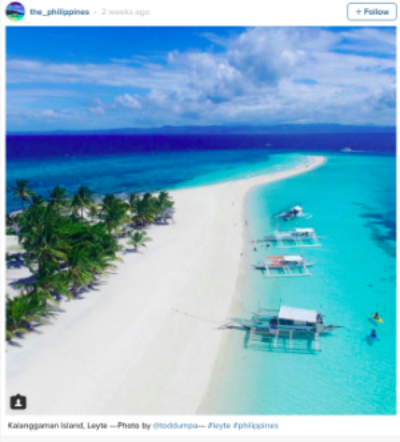
Instead of Thailand, go to the Philippines.
With beautiful islands, drool-worthy food, grand temples, Full Moon parties, and lush jungles, Thailand can seem like the perfect travel destination. It’s why Bangkok, Chiang Mai, and Phuket make it on the itineraries of many first-time travelers.
These days, too many travelers are getting caught in Thailand’s tourist traps (e.g., monkey islands, zoos filled with mistreated elephants and sedated tigers) and are missing out on the real cultural experience.
Take a break from Thailand, and plan a trip to the equally enticing Philippines instead.
Instead of the Galapagos Islands in Ecuador, go to the Pantanal swamp in Brazil.
It’s every science geek’s dream to see the species that inspired Darwin’s theory of evolution. It could also be argued that there’s no better place than the Galapagos to gaze at unique wildlife standing inches away from your face.
However, the region’s unique ecosystems may not be able to survive the pressure of mass tourism. And the annual influx of money from tourism isn't being fairly distributed among local residents who struggle with poverty.
If you want to see wildlife, visit the Pantanal swamp in Brazil, one of the world’s largest wetlands. If you’re lucky, you may even spot a jaguar!

Check out GLOBALCITIZEN.ORG for more tips!

CARYN CARVER
Caryn Carver is an Audio-Visual Content Creator for Global Citizen. Prior to working at Global Citizen, she worked for a nonprofit consulting firm where she learned a lot about what is and isn't working to help eradicate poverty. She then spent a year living and working in South America where she developed a deeper passion for global issues, especially human rights. Caryn also loves to sing about what she is doing, search for the best cheap eats, and daydream about the next place she will visit.