Amazon Trees Write Autobiographies – Preserving Human History in Their Wood

Tropical forests are one of the world’s largest carbon stores and they help regulate the global climate. But they’re being erased at a terrifying rate. Deforestation claimed an area the size of Belgium in 2018. These habitats are often cleared to make way for palm oil plantations and grazing pasture for livestock. For most forests, destruction on this scale is a fairly modern phenomenon.

Tropical forest ecosystems tend to have very high biodiversity, but often in the places you’d least expect. Research has found that there is often more wildlife in areas where there is an ancient history of human activity.

So how have indigenous people in tropical forests nurtured biodiversity in tropical forests while still domesticating tree species, building cities and growing crops? New research published in Trends in Plant Science suggests that the answer may be written in the trees themselves.

Ancient time capsules

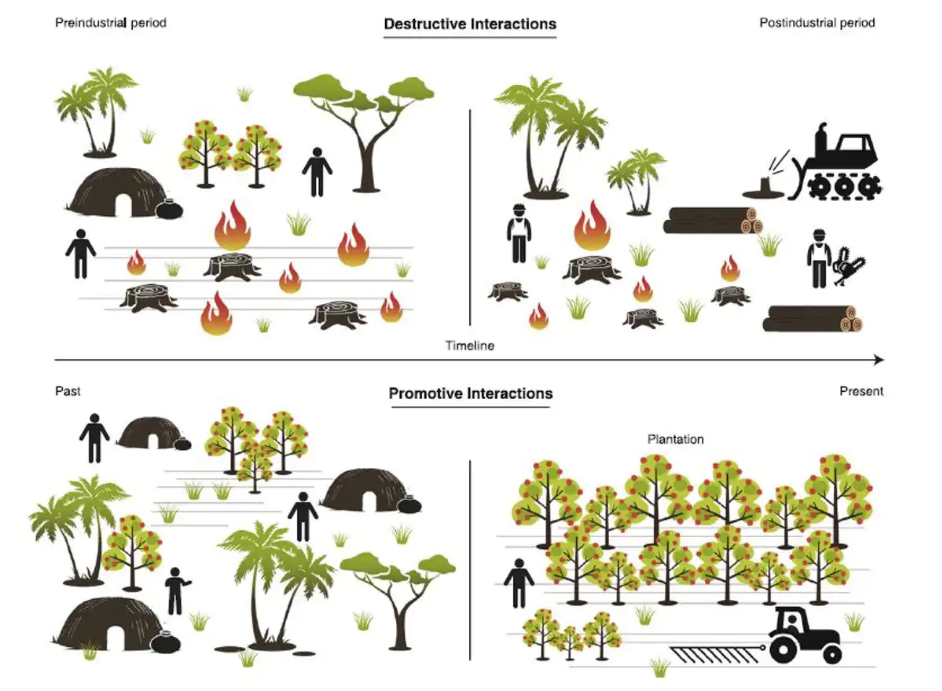
Over 50,000 years ago, people in Borneo managed tropical forest vegetation using fire. They burned the edge of advancing forests, and this targeted disturbance was enough to prevent a large number of tall tree species dominating. It allowed habitats to regenerate that were rich in wild food plants and attractive to the animals that people hunted.

Other traditional methods of forest management included opening the forest canopy by carefully selecting trees to cut down. The light that flooded to the forest floor could then encourage edible species such as wild yams to grow amid the regenerating vegetation. These practices are similar to the modern ideas of edible forests and agroforestry, which maintain relatively high biodiversity and retain soil carbon and nutrient stores. Much of this is lost upon conversion to industrial plantations or ranches.

Traditional forest management encouraged biodiversity, whereas modern methods erode it. Caeteno-Adrade et al. / Trends in Plant Science

In the past, vast areas of the world’s tropical forests were managed by indigenous peoples in this way. Trees keep their own accounts of this history in their wood. It has always been thought that tropical trees have short lifespans, usually less than 400 years. But recent research shows that many tropical trees live for a very long time, and can preserve over 1,000 years of history in their timber.

You’re probably familiar with the idea that you can measure how old a tree is by counting the rings beneath its bark. One ring usually equates to one year, so dendrochronology (the study of tree rings) offers a fairly easy way to understand the life of a tree. Thicker rings tend to denote a year when conditions were good for growth – ample sunshine and water – whereas thinner rings suggest a lean year of drought and competition with other trees.

Many tropical trees don’t lay down annual rings, but in the new study dendrochronologists identified over 200 species that do. Typically wider rings reflect higher rainfall, but many trees put on a growth spurt if light intensity rises. These are called release events and can happen if trees around them are cut down, allowing more light to break through the canopy. Finding these markers helps researchers to recognise and date past episodes of forest clearance. In the Amazon, these records help scientists understand the enormous extent of pre-Columbian agriculture and forest management.

Researchers extract a core of wood to measure the tree’s rings and find out its age. Victor Caetano-Andrade

The rings also preserve evidence of changes in the climate through the different isotopes (types) of oxygen and carbon laid down in the wood. Carbon isotopes tend to reflect light availability and other factors that control photosynthesis, whereas oxygen isotopes help scientists track changes in a nearby water source and annual rainfall. Isotopic studies showed that the abandonment of Angkor Wat in the 14th century coincided with severe drought.

Forest histories can also emerge from new DNA studies. Heavily logged species go through what we call “genetic bottlenecks”, where part of the genetic material of a species is lost as many individuals die or are unable to reproduce and pass on their genes. This leads to restricted gene pools.

Researchers would expect to see the same patterns in species which were strongly affected by logging or fires started by people in the past. Genetics can also identify species that were spread by ancient people, like the Brazil nut.

Living tropical trees record within themselves a history of human activity and the forest’s response to it. The regeneration of forests after disruption by people in the past offers some hope for the future, but only if current rates of deforestation can be halted, allowing the lungs of our planet to regenerate.

Chris Hunt is a Professor of Cultural Palaeoecology, Liverpool John Moores University

THIS ARTICLE WAS ORIGINALLY PUBLISHED ON THE CONVERSATION

Bushfires, Bots and Arson Claims: Australia Flung in the Global Disinformation Spotlight

In the first week of 2020, hashtag #ArsonEmergency became the focal point of a new online narrative surrounding the bushfire crisis. 

The message: the cause is arson, not climate change.

Police and bushfire services (and some journalists) have contradicted this claim.

We studied about 300 Twitter accounts driving the #ArsonEmergency hashtag to identify inauthentic behaviour. We found many accounts using #ArsonEmergency were behaving “suspiciously”, compared to those using #AustraliaFire and #BushfireAustralia. 

Accounts peddling #ArsonEmergency carried out activity similar to what we’ve witnessed in past disinformation campaigns, such as the coordinated behaviour of Russian trolls during the 2016 US presidential election

Bots, trolls and trollbots

The most effective disinformation campaigns use bot and troll accounts to infiltrate genuine political discussion, and shift it towards a different “master narrative”.

Bots and trolls have been a thorn in the side of fruitful political debate since Twitter’s early days. They mimic genuine opinions, akin to what a concerned citizen might display, with a goal of persuading others and gaining attention. 

Bots are usually automated (acting without constant human oversight) and perform simple functions, such as retweeting or repeatedly pushing one type of content. 

Troll accounts are controlled by humans. They try to stir controversy, hinder healthy debate and simulate fake grassroots movements. They aim to persuade, deceive and cause conflict.

We’ve observed both troll and bot accounts spouting disinformation regarding the bushfires on Twitter. We were able to distinguish these accounts as being inauthentic for two reasons. 

First, we used sophisticated software tools including tweetbotornotBotometer, and Bot Sentinel

There are various definitions for the word “bot” or “troll”. Bot Sentinel says:

Propaganda bots are pieces of code that utilize Twitter API to automatically follow, tweet, or retweet other accounts bolstering a political agenda. Propaganda bots are designed to be polarizing and often promote content intended to be deceptive… Trollbot is a classification we created to describe human controlled accounts who exhibit troll-like behavior. 

Some of these accounts frequently retweet known propaganda and fake news accounts, and they engage in repetitive bot-like activity. Other trollbot accounts target and harass specific Twitter accounts as part of a coordinated harassment campaign. Ideology, political affiliation, religious beliefs, and geographic location are not factors when determining the classification of a Twitter account.

These machine learning tools compared the behaviour of known bots and trolls with the accounts tweeting the hashtags #ArsonEmergency, #AustraliaFire, and #BushfireAustralia. From this, they provided a “score” for each account suggesting how likely it was to be a bot or troll account. 

We also manually analysed the Twitter activity of suspicious accounts and the characteristics of their profiles, to validate the origins of #ArsonEmergency, as well as the potential motivations of the accounts spreading the hashtag.

Who to blame?

Unfortunately, we don’t know who is behind these accounts, as we can only access trace data such as tweet text and basic account information

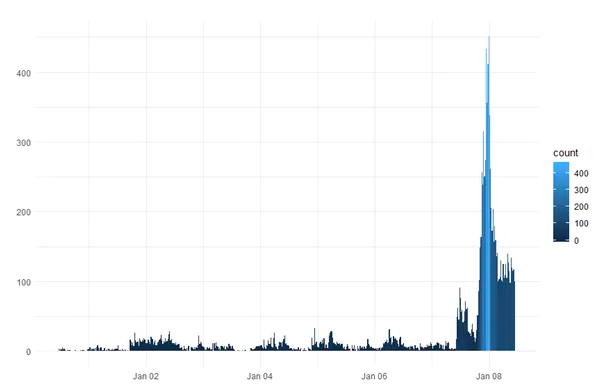
This graph shows how many times #ArsonEmergency was tweeted between December 31 last year and January 8 this year:

On the vertical axis is the number of tweets over time which featured #ArsonEmergency. On January 7, there were 4726 tweets. Author provided

Previous bot and troll campaigns have been thought to be the work of foreign interference, such as Russian trolls, or PR firms hired to distract and manipulate voters

The New York Times has also reported on perceptions that media magnate Rupert Murdoch is influencing Australia’s bushfire debate.f

Weeding-out inauthentic behaviour

In late November, some Twitter accounts began using #ArsonEmergency to counter evidence that climate change is linked to the severity of the bushfire crisis.

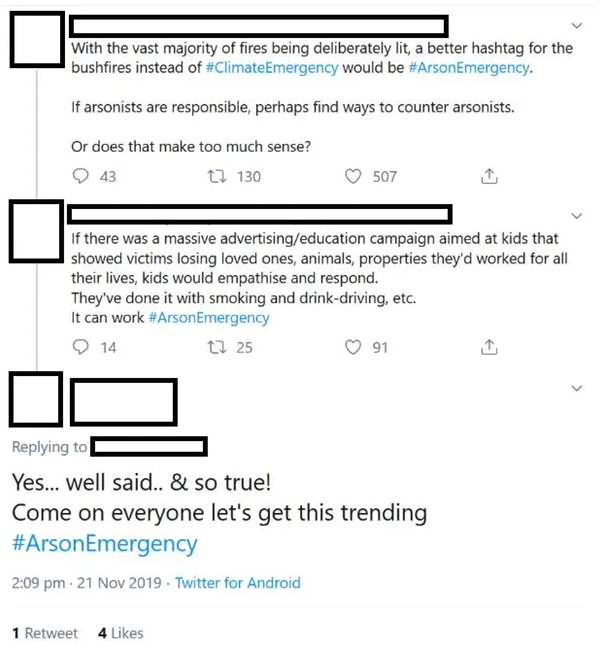
Below is one of the earliest examples of an attempt to replace #ClimateEmergency with #ArsonEmergency. The accounts tried to get #ArsonEmergency trending to drown out dialogue acknowledging the link between climate change and bushfires.

We suspect the origins of the #ArsonEmergency debacle can be traced back to a few accounts. Author provided

The hashtag was only tweeted a few times in 2019, but gained traction this year in a sustained effort by about 300 accounts.

A much larger portion of bot and troll-like accounts pushed #ArsonEmergency, than they did #AustraliaFire and #BushfireAustralia. 

The narrative was then adopted by genuine accounts who furthered its spread. 

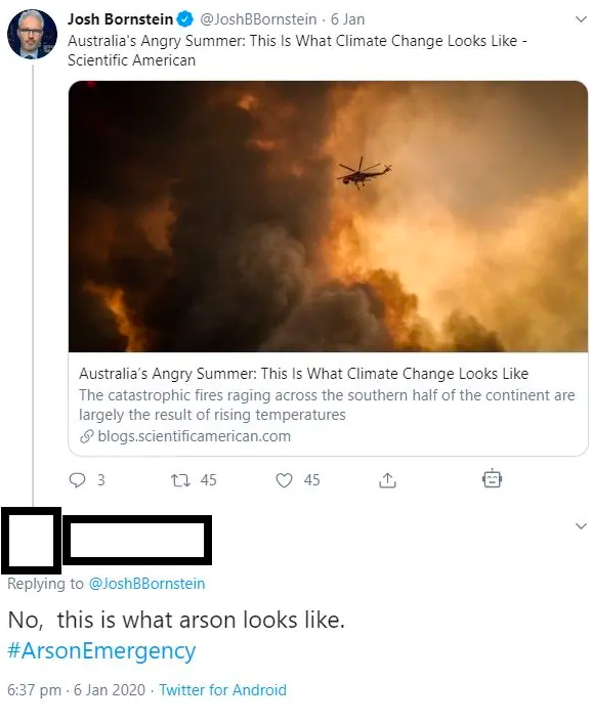
On multiple occasions, we noticed suspicious accounts countering expert opinions while using the #ArsonEmergency hashtag.

The inauthentic accounts engaged with genuine users in an effort to persuade them. author provided

Bad publicity

Since media coverage has shone light on the disinformation campaign, #ArsonEmergency has gained even more prominence, but in a different light. 

Some journalists are acknowledging the role of disinformation bushfire crisis – and countering narrative the Australia has an arson emergency. However, the campaign does indicate Australia has a climate denial problem. 

What’s clear to me is that Australia has been propelled into the global disinformation battlefield. 

Keep your eyes peeled

It’s difficult to debunk disinformation, as it often contains a grain of truth. In many cases, it leverages people’s previously held beliefs and biases. 

Humans are particularly vulnerable to disinformation in times of emergency, or when addressing contentious issues like climate change.

Online users, especially journalists, need to stay on their toes. 

The accounts we come across on social media may not represent genuine citizens and their concerns. A trending hashtag may be trying to mislead the public.

Right now, it’s more important than ever for us to prioritise factual news from reliable sources – and identify and combat disinformation. The Earth’s future could depend on it.

Timothy Graham is a Senior Lecturer, Queensland University of Technology

Tobias R. Keller is a Visiting Postdoc, Queensland University of Technology

THIS ARTICLE WAS ORIGINALLY PUBLISHED ON THE CONVERSATION