Confronting Houselessness Crisis Worldwide

With the 2023 Supreme Court case of City of Grants Pass, Oregon v. Gloria Johnson circulating the headlines and threatening the rights of 653,104 unhoused people in the United States, understanding how other countries are addressing the issue of houselessness can help provide perspective.
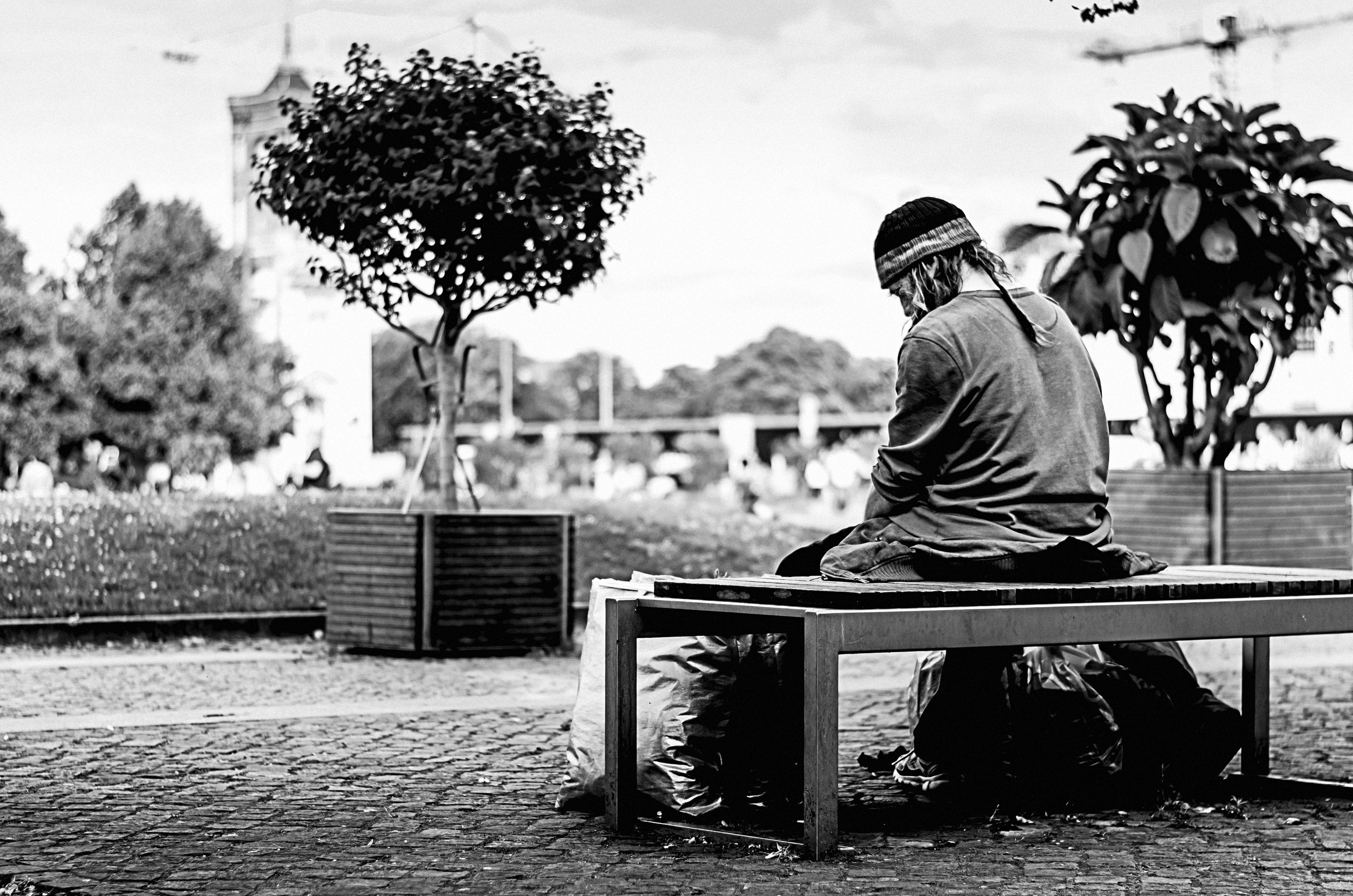
A black and white image in a city park of the back of a person sitting with their belongings on a bench

A person sits on a bench with their belongings. Grego. CC0 1.0

In 2020, the world denied an estimated 1.6 billion people the human right to adequate housing. Societies often stigmatize houselessness, leading to discrimination against unhoused people. This stigma often contributes to the criminalization of houselessness. 

Houselessness is criminalized when laws can punish people for partaking in life-sustaining activities in public spaces. Examples of these laws include prohibitions on panhandling or allowing the confiscation of personal property, often referred to as “sweeping.” 

The Supreme Court's decision in the City of Grants Pass, Oregon v. Gloria Johnson case will determine whether it is constitutional for states to fine or arrest people for sleeping outside, even when adequate shelter is unavailable. This comes at a time when houselessness is on the rise across the U.S., with a 12 percent increase between 2022 and 2023. Los Angeles and New York City are home to about a quarter of America's unhoused population. 

In the U.S., houselessness is a highly politicized issue. The 2020 Democratic platform endorsed a Housing First policy that prioritizes accessible permanent housing, stating that, “Having a stable and safe place to live is essential to helping a person tackle any other challenges.” In contrast, Republicans on the Joint Economic Committee released a report in 2022 criticizing Housing First policy for failing to “to address deeper problems that often drive homelessness”. The lawmakers proposed that Housing First policy be replaced with policy that prioritizes health and employment resources. The debate over solutions persists as houseless populations rise.

The City of Grants Pass, Oregon v. Gloria Johnson case is not the first time laws explicitly criminalizing houselessness have been on the global radar. In 2018, Hungary enacted a new constitutional provision that put houseless people sleeping in public spaces at risk of fines or arrest. Since the passage of this law, the number of houseless people in Hungary has not changed, with an estimated 30,000 houseless people in both 2018 and 2024

Hungary is far from the only country to combat houselessness with criminalization. Many governments have turned to this strategy, from the forced institutionalization of houseless children in Brazil to laws authorizing the arrest of people loitering in Sierra Leone and Nigeria. 

Other countries have taken a different route in tackling this crisis by increasing accessible housing and resources. Finland’s Housing First Policy focuses on providing people with housing and addressing underlying conditions and factors contributing to their houselessness. Since the Housing First policy began in 2008, the number of long-term houseless people in Finland decreased by more than 35 percent. Some policies combine punitive and welfare measures. The government in Tokyo, Japan has combined these strategies by punishing people for residing in public spaces while redirecting them to welfare resources.

Beyond policy, technological innovations present potential solutions for this issue. In India, Tvasta Manufacturing Solutions collaborated with Habitat for Humanity to create 3D-printed homes. These homes can be built in five days or less, are about 30 percent cheaper than traditional construction and create less waste. The 3D-printed homes industry is now present across the globe from Africa to Mexico

Beyond the world of policy and technology, everyday people can directly take action to help address houselessness. Destigmatization is an important step in addressing this issue. Experts recommend advocacy and creating public education campaigns to help people understand and empathize with unhoused people. Attending educational opportunities such as events hosted by the UN Working Group to End Homelessness is a great way to learn and engage with people fighting for the right to adequate housing.

For those looking to make an impact on a local scale, there are many volunteering opportunities with organizations such as CaringWorks or the National Coalition for the Homeless. With an estimated 1.6 billion people expected to be impacted by the housing crisis in 2025 and an estimated two billion people fearing climate-related displacement, the time to act is now.


Madison Paulus

Madison is a student at George Washington University studying international affairs, journalism, mass communication, and Arabic. Born and raised in Seattle, Washington, Madison grew up in a creative, open-minded environment. With passions for human rights and social justice, Madison uses her writing skills to educate and advocate. In the future, Madison hopes to pursue a career in science communication or travel journalism.
The Ethics of Kelp Farming in Alaska

From food, medicine, climate mitigation and preserving Indigenous traditions, kelp is the shape shifting superhero a polluted world needs.

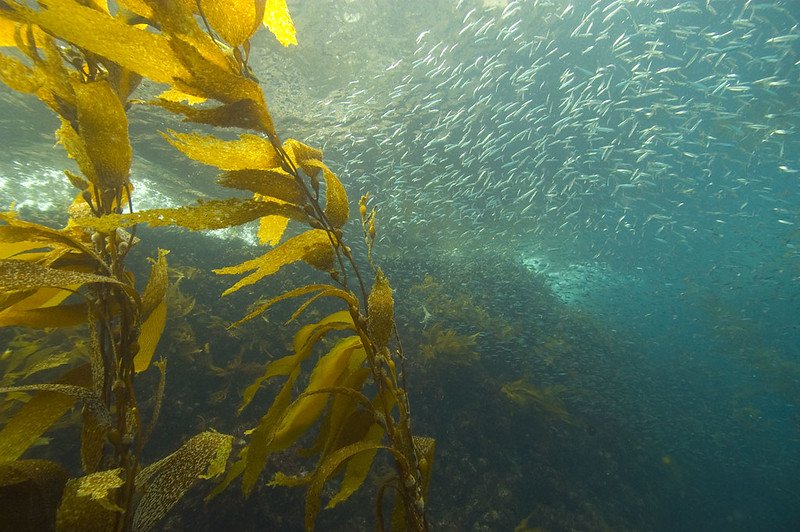
Kelp with sardines. National Ocean Service. CC By 2.0.

Ethereal and elusive, an unconventional forest grows in the ocean—not full of trees, but of kelp. These captivating, yet occasionally uninviting, greenish tendrils are classified as a type of brown algae that grow as coastal seaweeds; they are typically found in colder waters. In a way, the ethereal kelp borders on the mystical and magical. Kelp is a shapeshifter; a veritable phenomenon that can morph into a variety of forms. Kelp can be used as biofuel, an eco-friendly alternative to fossil fuels derived from renewable biological materials. This multi-talented algae can also be used to make utensils, soap and clothing as well as food—all manner of products people use in their daily lives. 

Beyond biofuel, food and everyday household items, the production and usage of kelp is a key debate amongst climate scientists and environmentalists alike. Farming kelp could be a solution in mitigating negative effects of climate change; it could also bolster coastal locations’ economies and positively affect the livelihoods of communities living in and around these shores. But, on the other hand, farming kelp is also fraught with bureaucratic convolutions and, in the long run, could potentially backfire and end up re-polluting oceans. In short, the implications of kelp farming are complex; they are enigmatic and double-edged, much like the kelp itself.

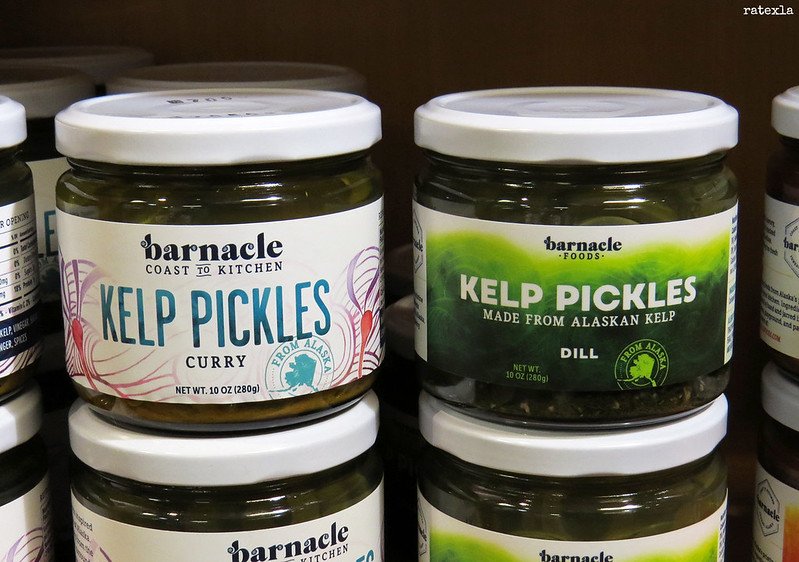
Alaskan Company Barnacle Foods’ Kelp Products. Josephine S. CC By 2.0.

The Eyak People of Alaska—and particularly one Dune Lankard—understand kelp farming. Lankard is the co-founder of The Eyak Preservation Council as well as the President and Founder of Native Conservancy, both of which are groups that support Alaska Native peoples’ efforts in preserving and conserving land and biodiversity on the Alaskan Coastline. People in Alaska and beyond have begun to farm kelp because of commercial, food security and climate change mitigation possibilities. And, because of its optimal climatic conditions, Alaska has become a hotspot for kelp farming.

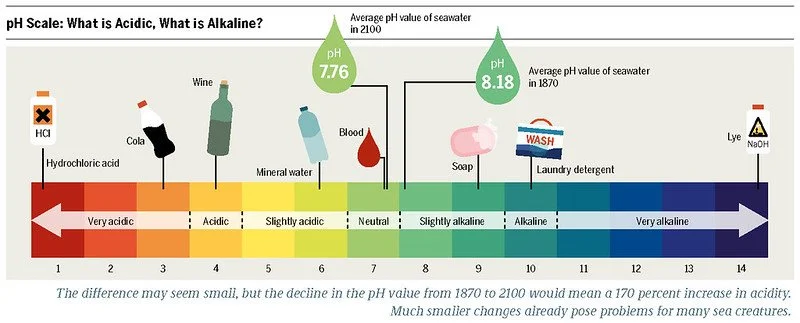
But why is kelp—this mysterious, gangly sept of seaweed—so valuable and beneficial for the environment? For humans consuming kelp, the benefits lie within its nutritional content: kelp contains calcium, magnesium, iron, vitamin C and potassium. But, perhaps more importantly, people like Dune Lankard and fellow Alaskan kelp farmers are more concerned with kelp’s ability to mitigate climate change. Kelp’s primary ability to mitigate climate change comes from its ability to sequester carbon dioxide. You may have heard of carbon dioxide because it is a greenhouse gas. But, what you might not know, is that carbon dioxide from the atmosphere can also enter the ocean, resulting in a mechanism called ocean acidification.

pH reference scale — Ocean Acidification lowers pH. Heinrich-Böll-Stiftung. CC by 2.0.

As more carbon dioxide enters the ocean and gets absorbed, the pH of the ocean itself decreases, meaning the ocean becomes more acidic. But, this is where Kelp the superhero rushes in and saves the marine phyla. Kelp require carbon to grow because of photosynthesis—they absorb sunlight as well as carbon dioxide to produce the sugar and oxygen they need to live—and, through their uptake of carbon, they leave oceans less acidic and marine organisms more happy. Additionally, when kelp float out to sea and die, sinking deep beneath the surface of the water, their carbon sinks into the depths along with them
Perhaps it makes sense that kelp, with its bewitching appearance, could be responsible for such intricate—almost magical—climate processes. While there are over 500 species of seaweed in Alaska, the three most-commonly grown species are bull kelp, sugar kelp and ribbon kelp. Bull kelp is strong, almost proud-looking—its thick stalk beholds a sense of authority in the water. Sugar kelp, on the other hand, is more delicately enchanting—its slightly-curled, yellow blades are like rays of sunlight spattering the sea. Ribbon kelp, with its thick spine and greenish appearance, are more reminiscent of a looming forest, or the shifting of willows in the wind.

Bull kelp bulb. James St. John. CC By 2.0.

These kelp, however, represent more than just their life cycle, climate mitigation abilities and appearance. Historically, the Eyak people—located on the Copper River Delta near Cordova, Alaska—have long used kelp for food, medicine and even tools. But, through colonialism and imperialism, some of these traditions were disrupted over decades. Today, however, the Eyak and other Indigenous peoples’ kelp farming has allowed them to reclaim these traditions. Additionally, there are immense economic benefits for any employees involved in kelp farming. The fall-to-spring growth cycle of kelp, as well as the need for regular visitation and observation of kelp farms, offer both seasonal and year-round employment opportunities. The increasing amount of kelp farms subsequently increases the number of job opportunities in Alaska, bolstering the state’s economy. Although mariculture in Alaska is currently a $1.5 million dollar industry, newly awarded $45 million in grants could potentially grow it to more than $1.85 billion in 10 years. 

Kelp farming and consumption, however, is not all sunshine and rainbows. One of the most difficult aspects of kelp farming is getting started in the first place—a kelp farm requires a permit. Most states require multi-step permit application through boards of aquaculture as well as departments of fish, wildlife and game. Luckily, on average Alaska has a lower permit processing time than most states. Beyond the bureaucratic complexities of even getting started, there are also questions being raised by environmental and climate scientists about the future of kelp farming. Although—as is outlined above—kelp farming is believed to help ocean acidification through carbon sequestration, some scientists are questioning the ability for kelp to continue to sequester carbon as ocean temperatures warm as a result of climate change.
While people should be mindful of the ambiguous future of kelp farming, for now it is safe to say that the more immediate outcomes of farming are helping kelp maintain a positive reputation. Kelp—delicate and mysteriously distant—is, in actuality, an aid toward a variety of more tangible, positive outcomes. Kelp is food. Kelp is medicine. Kelp can even represent community and prosperity. Of course, kelp can also be a huge factor in sequestering carbon in a post-industrial society. But, for many people, these scientific processes can feel overwhelming or unimportant simply because they seem intangible. This is why the effects of kelp that people can really see and feel—the sense of community, the positive economic impacts and the reclamation of tradition—are something to celebrate. Despite its unconventionality and elusivity, kelp can be a superhero.


Carina Cole

Carina Cole is a Media Studies student with a Correlate in Creative Writing at Vassar College. She is an avid journalist and occasional flash fiction writer. Her passion for writing overlaps with environmentalism, feminism, social justice, and a desire to travel beyond the United States. When she’s not writing, you can find her meticulously curating playlists or picking up a paintbrush.

Oppenheimer’s Critical Omission: The Relocation of Hispanic and Indigenous Populations

Intricate but incomplete, Christopher Nolan’s Oppenheimer disregards the true history of Hispanic and Indigenous populations in New Mexico.

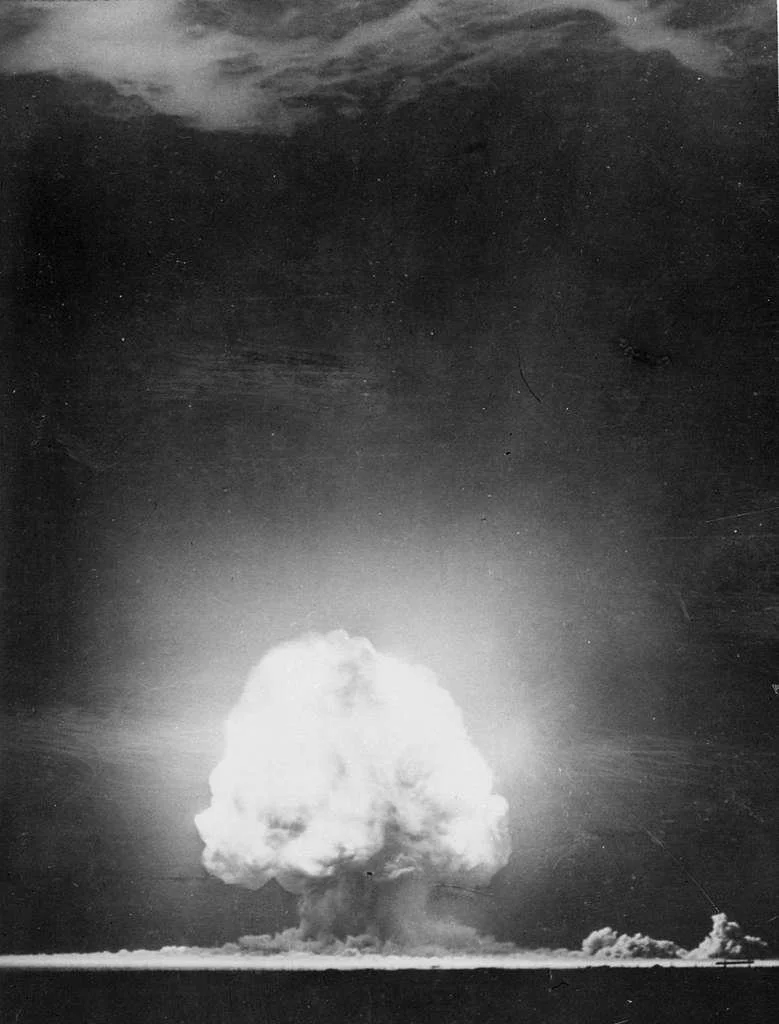
Trinity Nuclear Test. U.S. National Archives and Records Administration. CC0.

A picturesque aquamarine sky hangs lazily above a dusty, deserted New Mexico landscape. Through a tangle of brush, a lanky Robert Oppenheimer, played by Irish actor Cillian Murphy, emerges on horseback. His eyes feast on the remote plains and he declares that besides a local boys’ school and “Indian” burial grounds, Los Alamos will be the perfect site to construct the world’s first atomic weapons.

These momentous decisions and moral quandaries are explored in Christopher Nolan’s Oppenheimer. Grossing $450 million in its first fourteen days at the box office, the 1940s period piece has cemented itself as a somewhat unlikely cultural icon. Gone are the days of Nolan’s slightly fantastical films — notably Inception (2010) and Interstellar (2014). Recently, the Academy Award-nominated director has been dipping his toes in the realism of period pieces, beginning with Dunkirk (2017) and continuing with Oppenheimer.
Nolan’s portrayal of Oppenheimer — based on the biography American Prometheus: The Triumph and Tragedy of J. Robert Oppenheimer by Kai Bird and Martin J. Sherwin — is deliberately layered. The audience travels alongside Oppenheimer over the course of his life for three hours. On one hand, Oppenheimer’s humanity is a gut punch: viewers experience his mistress’s death, his tumultuous marriage, and his gradual realization of the death and destruction his scientific creation has wrought. On the other, viewers gaze upon the physicist with disgust: the man was, as he infamously declared himself, a destroyer of worlds.

J. Robert Oppenheimer. U.S. National Archives and Records Administration. CC0.

The use of the first atomic bomb by the United States to defeat Japan and win World War II is one of the signal events of the modern era, arguably helping to prevent a land invasion of Japan that could have killed millions. Despite the magnitude of this technical and geopolitical accomplishment, the legacy of the destruction of Hiroshima and Nagasaki will forever cast a negative light on the United States government and the team of nuclear physicists involved in the development of the atomic bomb. While Nolan acknowledges this complex legacy, his portrayal of key elements of the Manhattan Project and the Los Alamos Laboratory obscures another historical moral quandary. The remote sandy vistas in Nolan’s cinematography smother the true story of Los Alamos and the Trinity nuclear test.

The reality, omitted from Nolan’s film, is that during the Manhattan Project the U.S. Government forcibly relocated Indigenous and Hispanic populations that resided in Los Alamos, New Mexico. Contrary to the movie’s dialogue, there were two dozen homesteaders and a ranch occupying the land that was taken by the government for the project, in addition to the school mentioned by Oppenheimer. The government seized the land and offered the owners compensation based on an appraisal of the land — an amount of compensation that the government itself thought was fit. Some homesteaders, however, objected to the compensation offered by the government, considering it far too little. Many in the Federal Government would eventually come to agree with them; in 2004, decades after the original compensation, Congress established a $10 million fund to pay back the homesteaders. 
Moreover, it was difficult for the homesteaders to object in the first place due to the language barrier. Most homesteaders spoke Spanish, while government officials often only communicated in English. Some families were even held at gunpoint as they were forced to leave with no explanation, due to the project’s secrecy. Livestock and other animals on property were shot or let loose. Livelihoods were destroyed along with these animals.

Los Alamos Colloquium of Physicists. Los Alamos National Laboratory. CC0.

The element of secrecy surrounding the Manhattan Project and the Trinity nuclear test disrupted the lives of families living directly on Los Alamos land. But, for the 13,000 New Mexicans living within a fifty mile radius of the Trinity test (in Jornada del Muerto, New Mexico), the nuclear explosion truly seemed to be the end of the world. Because the mushroom cloud was visible from up to 200 miles away from the test site, and no civilians knew tests were being conducted, fear erupted in concert with the explosion. 

Nolan’s film not only fails to indicate that homesteaders on Los Alamos were forcibly relocated — it also fails to mention that civilians from northern to southern New Mexico were exposed to harmful radiation from the bomb. Radioactive fallout initially contaminated water and livestock, and in turn, civilians. There were no studies or treatment conducted on individuals exposed to radiation, which could have exposed the highly classified program. Those who were in the radius or downwind of the fallout became known as “downwinders,” and began to develop autoimmune diseases, chronic illness and cancer. 

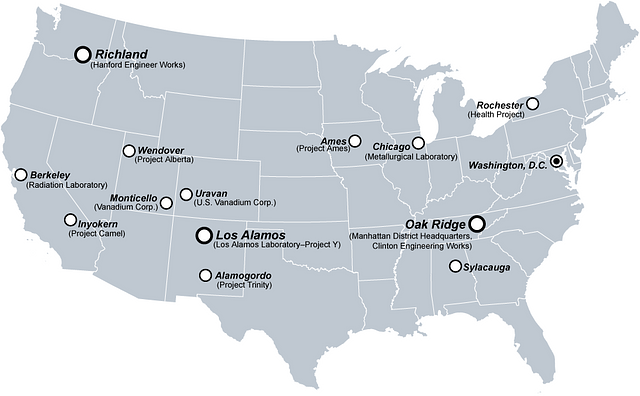
Manhattan Project U.S. Map. Wikimedia Commons. CC by 3.0.

Eventually, the Hispanic American and Indigenous populations who lived in the area returned to Los Alamos to work for the project without knowing its true nature or extent. They returned as maids or as construction workers, often handling radioactive and contaminated materials without knowledge of the harm and risk of exposure. Many became economically dependent on a laboratory that posed environmental and health risks for the greater Los Alamos population. This led to struggles with physical and mental health that have continued to the present time. 

The legacy of the Manhattan Project, the Los Alamos Laboratory and the Trinity nuclear test hangs in a state of limbo. It transcends time — becoming the past, present and future for Hispanic and Indigenous populations in New Mexico. Nolan’s failure to acknowledge these populations’ displacement and unwitting contamination silences their narratives and obscures this unique patrimony. J. Robert Oppenheimer’s depiction as a thumbtack in sandy nothingness is historically inaccurate — Nolan’s cinematic depiction of desolation glosses over a more complex reality. Los Alamos was, and is, living and breathing.


Carina Cole

Carina Cole is a Media Studies student with a Correlate in Creative Writing at Vassar College. She is an avid journalist and occasional flash fiction writer. Her passion for writing overlaps with environmentalism, feminism, social justice, and a desire to travel beyond the United States. When she’s not writing, you can find her meticulously curating playlists or picking up a paintbrush.

Frozen Glory: Inside the Eskimo-Indian Olympics

From cultural preservation to sheer athletic spectacle, the World Eskimo-Indian Olympics are a highlight of the Native Alaskan calendar.

An athlete competes in the blanket toss event at the WEIO. KNOM Radio. CC BY-SA 2.0

In the early 1960s, two non-Indigenous pilots who regularly made trips over Alaska’s rural communities kept observing the celebration of an interesting cultural event. This sporting event, as they later came to realize it was, dated back far beyond living memory and honored strength, resilience and endurance through a series of events meant to test the skills necessary to live in such an unforgiving environment. Given that Alaska had just recently become an American state in 1959, the early 60s saw the gradual encroachment of mainstream American culture into its more remote outlying communities, posing a serious threat to local traditions and practices. After the pilots shared their concerns with various groups in Fairbanks, the World Eskimo-Indian Olympics (WEIO) was officially born in 1961 and drew Native participants and spectators from around the Fairbanks area to participate on the banks of the Chena River.

The WEIO has grown significantly since then, with thousands of people traveling to watch the best of Alaska’s Indigenous athletes compete in the Big Dipper Ice Arena for four days each July. Aside from a minimum age limit of 12 years, there are no age categories for any of the events, which means that several generations of the same family can be seen competing against each other. It is also common for older and more experienced competitors to coach and advise the younger athletes during the competition: rather than trying to beat one’s opponents, the larger goal is to compete against and better oneself.

Athletes Sean O’Brien (left) and Chris Kalmakoff (right) compete in the Eskimo stick pull event. Erich Engman. CC BY-NC-ND 2.0

Many of the events, however, are still extremely competitive, and involve intimate face-offs between athletes. The Indian Stick Pull, for example, calls for athletes to wrench a short greased stick from their opponent, an event meant to replicate the grip strength necessary when trying to keep hold of a freshly caught fish by its tail. The Ear Pull is a contest of stamina to demonstrate the athletes’ ability to withstand pain, a valued trait in the often cruel conditions of the Alaskan North. In this event, string is looped around the opposite ears of two athletes as they face each other as they pull away in a tug-of-war with their ears until one cedes the match.

Other events are competed individually, but with just as much rigor and excitement. The Greased Pole Walk, as its name suggests, tests the balance needed for crossing creeks on slippery logs by having contestants walk as far as they can barefoot along a greased wooden pole. A favorite among both competitors and spectators alike, the Two-Foot High Kick requires competitors to jump vertically and kick a suspended ball with both feet before landing and maintaining their balance. Hundreds of years ago, villages along the coast would perform these kicks as a way to communicate to the village that a whale or some other game had been caught, and to prepare themselves to assist the hunters upon their return.

Athlete Ezra Elissoff competes in the Two-Foot High Kick final at the 2021 WEIO. Jeff Chen. CC BY-SA 2.0

Despite the popularity of basketball and ice hockey, the traditional sports seem to be gaining popularity among young children and teenagers, and are also contributing to the difficult task of preserving and passing on Native Alaskan culture. Miley Kakaruk, a 15-year-old athlete of the Inupiaq tribe of Northwestern Alaska, says that she imagines her ancestors competing in the same events centuries ago, vying to be chosen for their village’s next hunting party. Because each event is so heavily rooted in their history, younger competitors are able to learn the customs and stories that so heavily influence the culture and lifestyle of their people.

Equally important is the power of these games to forge a connection between athletes and society. Historically, studies have shown that Native Alaskans suffer from some of the highest rates of alcoholism and drug abuse in the US. A number of the people that the WEIO Board works with and recruits are young adults who are at risk of or actively battling addiction. According to Gina Kalloch, a board member and ex-athlete, discovering their culture through such a fondly practiced social tradition has allowed many of these people to develop a sense of pride in themselves and their culture, and helped to reorient their lives.

Native Alaskan women compete in the Miss WEIO Cultural Pageant alongside the athletic events each year. Danny Martin. CC BY-SA 2.0

While this year’s edition of the Olympics already took place between July 12 and 15, highlights of both the sporting events and the accompanying Miss WEIO Cultural Pageant are freely available on the internet.


Tanaya Vohra

Tanaya is an undergraduate student pursuing a major in Public Health at the University of Chicago. She's lived in Asia, Europe and North America and wants to share her love of travel and exploring new cultures through her writing.

Why You Should Visit the Makah Tribe on the Coast of Washington State

Visiting this region offers a unique opportunity to immerse yourself in a rich Indigenous culture that dates back thousands of years. 

View from Cape Flattery Bluff. Manuel Bahamondez H. CC BY-NC-ND 2.0

The Makah Tribe's reservation, resting on the extreme northwest tip of Washington State, boasts an ethereal landscape and thriving cultural practices. The land and the Tribe's community inspire and nurture ongoing engagement with nature and rich family connections. Despite its remote location, accessible by a single, winding route, the rich culture and natural beauty of this community offer a magical experience for curious travelers. 

The reservation sits at the farthest point north and west in the continental United States, cradled between gentle hills covered by tall Douglas Fir, Sitka Spruce, and Western Red Cedar trees on one side and the rugged Pacific coastline on the other. In the wake of a century-long fight against colonization the Makah continue to protect their sovereignty through the teaching of their Indigenous language, the celebration of cultural rituals and artifacts in their local museum and schools, and the preservation of the tribe’s traditional and sustainable reliance on native plants and animal species. The Tribe welcomes visitors from near and far to reflect on the reservations’ deep culture and lush natural landscapes. Hiking, surfing, and other outdoor activities are easily accessible from this scenic location and cultural hub. Visiting the Makah Tribe offers a unique opportunity to immerse yourself in a rich Native American culture that dates back thousands of years. The stunning natural beauty surrounding the Makah Tribe, including picturesque beaches and rugged cliffs, provides a breathtaking backdrop for your visit.

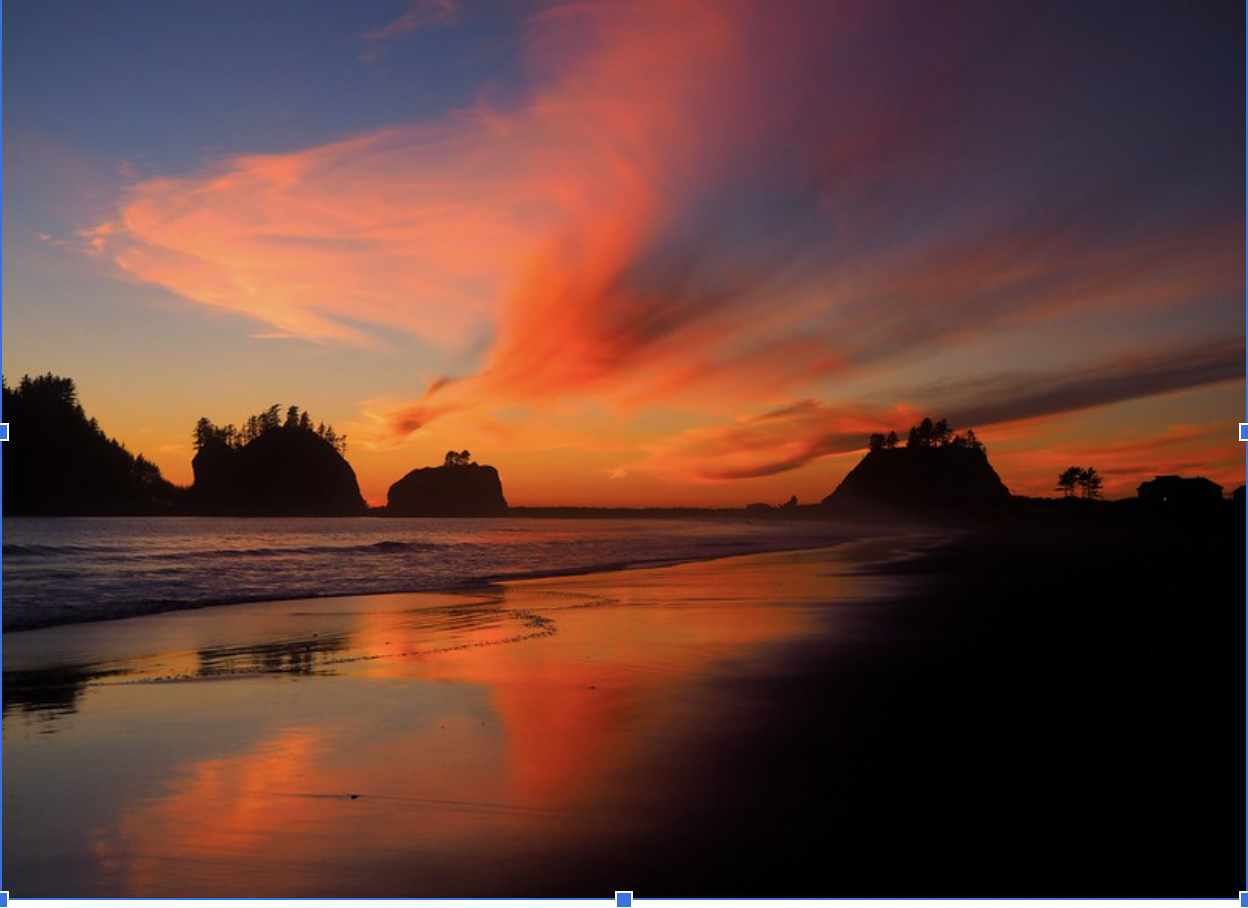
Sunset on First Beach. Jaisril. CC-BY-NC-ND 2.0

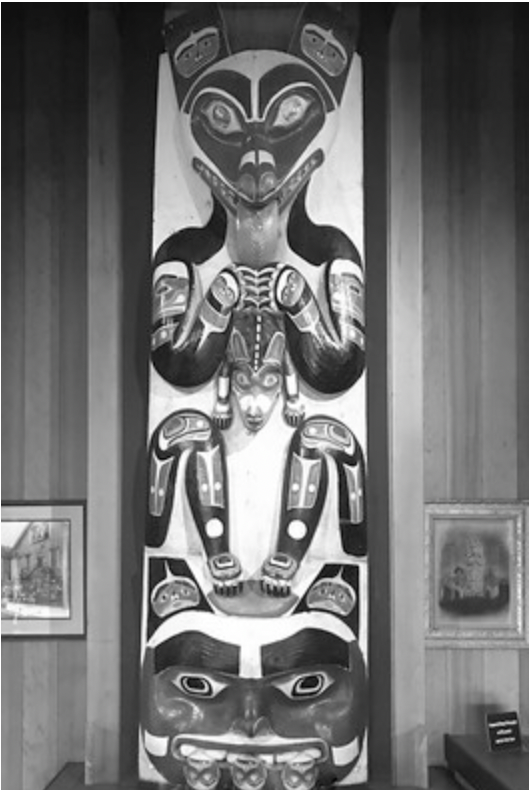
Generation after generation, the fabric of the Tribe’s community is woven through its cultivation of the natural world and artistic endeavors. Today, a significant number of Makah individuals thrive as artists, making a living through the sale of intricately crafted goods which are sold to galleries, shops, and collectors across the globe. A major source of income comes from the exportation of these artistic goods and is a key element of the Tribe’s livelihood. Carvings and masks in particular are a distinct feature of Makah art and have garnered the attention of tourists and art sellers alike for generations. The pieces often feature animals that hold deep cultural importance to the Makah. Whales, salmon, halibut, ravens, eagles, otters, herons, and wolves are commonly depicted in these designs. Each carving tells a story, chronicling the rich narratives of the origins and struggles which are passed down through generations within the community and amongst families.

The Makah are highly skilled woodworkers, capable of fashioning a wide array of items from the trees that thrive in their surrounding forests. While western red cedar is most frequently used, you can also find artists working with alder, yew, and spruce. Carvings range in size, from intricate jewelry to grand ocean-worthy canoes and towering totems. The incorporation of nature imagery and the sourcing of natural materials reinforces and honors the Makah’s reverence for their lands and waters.

Example of Makah style art. A. Davey. CC-BY-NC-ND 2.0 

Long before the advent of written language, the tribe used dance, song, and storytelling to receive and retain intergenerational knowledge. These melodic traditions are shared and reinforced on various occasions, including weddings, naming ceremonies, memorials, and other family or community celebrations. The Makah reservation museum hosts a compelling collection of artifacts, information guides, as well as a garden with plants labeled with the native language and traditional uses. 

For instance, the tribe once maintained five, thriving and permanent villages: Waatch, Sooes, Deah, Ozette and Bahaada. Their ancient way of life began to shift in the late 1770s, when Spanish explorers first settled in and around Neah Bay in 1779. The Spanish and other European groups were eager to exploit the natural resources of the Makah's land and brought in non-Indigenous modes of technology, among the most important of which were guns. The exploitation of the land's natural resources resulted in extinction of native plants and animals (e.g., otters and whales). Not only did the Europeans bring new technologies, they brought diseases, such as smallpox and measles, which plagued the less resistant indigenous communities. The Tribe's traditional ways of life were disrupted, and its inter-generational familial and domestic structures were gravely impacted as a result of death and the loss of land ownership. In the winter of 1855, Makah leaders and the American government signed theTreaty of Neah Bay, which stipulated that the Tribe give up ownership of much of its land, with the exception of rights for certain Indigenous practices, such as whaling, seal hunting, and fishing. The Makah were forced to cope with changes and shift to a more European lifestyle. In exchange, the United States government promised to provide public education and health care. To this day much of the tribe’s coastlines and forests are still under shared jurisdiction with the National Parks Service and the United States Government. 

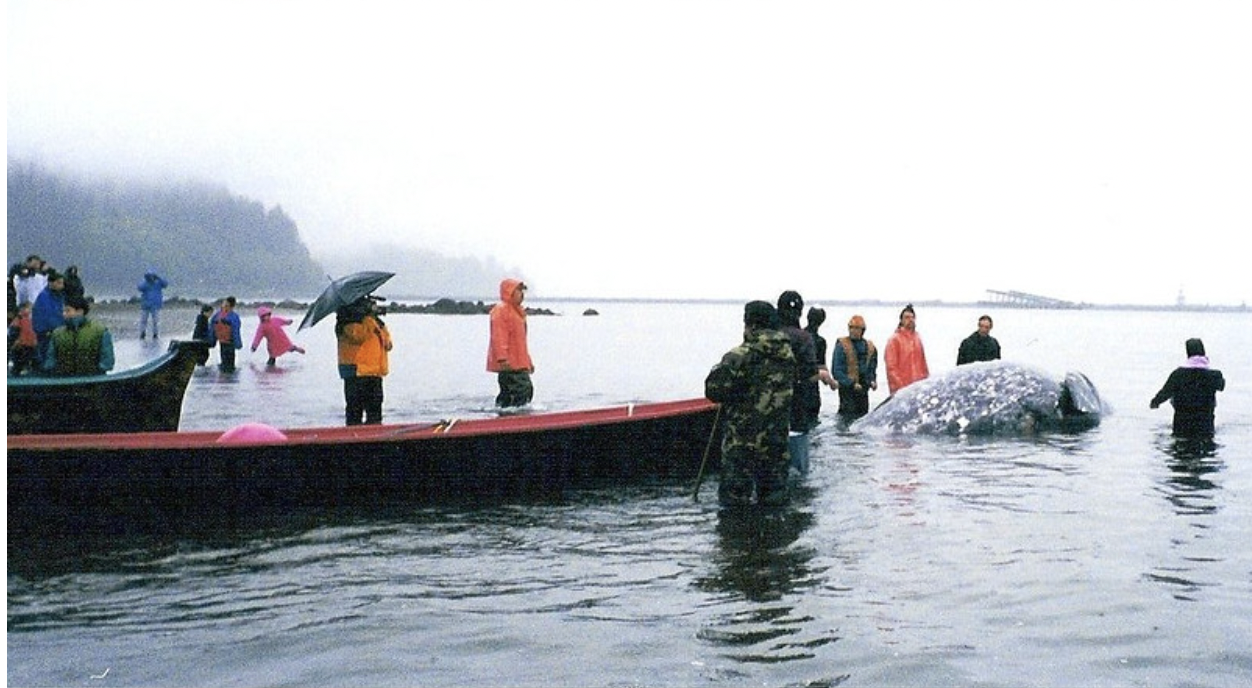
Makah Whale Hunting Ceremony. U.S. Forest Service- Pacific Northwest Region. CC0

As with so many Indigenous tribes across the country, the Makah have resisted the pull of corporate behemoths endeavoring to exploit the natural resources and cultural traditions that rightfully belong to the tribes. These tribes have fought to ensure their histories are not just archived but are alive and flourishing. One of the best ways to protect the ongoing strength of these communities is to visit these places and engage respectfully with the work and lifestyles of the Indigenous peoples, and to listen to and learn their histories. 


Avery Patterson

A rising junior at Vassar College in New York State, Avery is a Media Studies and French double major. She is an avid reader, writer, and traveler. She loves to immerse herself in new cultures and is an avid explorer who loves being in nature. She is passionate about climate and social justice and hopes to use her love of writing as a catalyst for positive change.

How Malaria Might Make a Comeback in the US

In order to prevent another pandemic so soon after the last one, US authorities need to stop this new malaria outbreak in its tracks.

The female Anopheles mosquito plays host to the disease’s parasite. CC BY-SA 2.0

Over the past two months, seven cases of locally acquired malaria have been identified in the US. These cases, six of which appeared in Florida and one in Texas, have drawn significant attention as the first time in 20 years the disease has been transmitted domestically. At present, the Center for Disease Control and Prevention (CDC) has reported that all five patients have received medical treatment and are recovering positively, and that the risk of malaria reappearing in a more widespread epidemic across the U.S. is extremely low. That being said, this is a good reminder for those in charge of American public health infrastructure to reflect on how best to shore up national defenses, especially in the wake of the recent Covid-19 pandemic.

Malaria is caused by parasites, which commonly infect Anopheles mosquitoes, and who in turn transfer the disease to humans when they inject their proboscises into our bloodstreams. There are several species of the malaria parasite, collectively known as Plasmodium, some of which cause more serious cases than others, but all of which require tropical climates to thrive. Regardless of the species, malaria is still extremely serious and symptoms such as high fevers, chills, and nausea begin to manifest in a few weeks. Most worryingly is that malaria, if left untreated, is fatal. As of 2021, the World Health Organization (WHO) believed that a grand total of 247 million cases of malaria occurred around the world, of which 619,000 were fatal. The majority of these deaths were children in various countries in Africa, where malaria is a constant present threat and contributes to a vicious cycle of social and economic poverty, taking a massive toll on countries in already precarious situations.

Malaria awareness in the US during the 1950s. Library of Congress. CC BY-NC-ND 2.0

At the beginning of the 20th century, malaria was considered an extremely serious issue in the US; the CDC was actually founded in 1946 to eliminate the disease. Over the next six years, various public health measures such as insecticide use and window screens were implemented to reduce the 15,000 cases reported in 1947, and in 1951, the CDC finally announced that malaria was in the US no longer. This remained the case for decades, until an incident in 2003 when eight locally acquired cases in Palm Beach, Florida were identified. Fortunately, the outbreak was quickly quashed thanks to an immediate response campaign that completely rid the area of mosquitoes to prevent transmission. Since then, malaria has remained fairly absent from the American healthcare landscape.

It is important to note, however, that malaria has never been completely extinct in the US; prior to the recent COVID-19 pandemic, roughly 2,000 cases of the disease were identified and reported annually in patients who had traveled to countries with high incidences of malaria in Southeast Asia and Africa. Additionally, once infected individuals return to the US, local mosquitos who feed on them can pick up the parasite and spread it further. Every so often, this may result in a small reintroduction of the disease and potentially even some limited transmission, but there has never been any worry of it resulting in a much widespread epidemic.

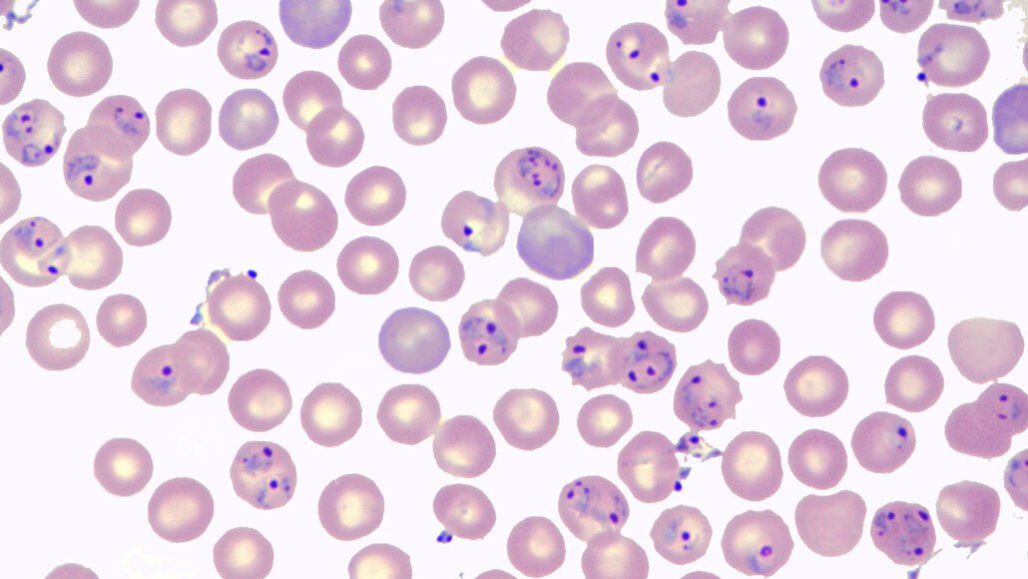
The malaria parasite pictured under a microscope. Joseph Takahashi Lab. CC BY-NC-ND 2.0

The reason these recent cases received so much attention were that all five were acquired locally within the US, which likely indicates that the parasitic mosquito population has made a resurgence as well. Thankfully, the species of parasite identified to have caused this small outbreak is known to transmit one of the milder forms of the disease, but that in no way detracts from the gravity of the situation. Matters of public health have become much more salient in regular discourse since the COVID-19 pandemic, and with it, some extreme opinions about containing and treating transmissible diseases. While America’s healthcare infrastructure continues to operate in largely the same way as it did during the 2003 outbreak, experts have agreed that public cooperation is now more important than ever if this re-appearance is to be nipped in the bud.

The RTS,S malaria vaccine. TheScientist. CC BY-SA 2.0

One particular area in which this agreement would go a long way, is that surrounding the efficacy of vaccines. In October of 2021, the WHO officially recommended the use of the RTS,S malaria vaccine developed by GlaxoSmithKline to prevent transmission in regions with high incidences of the disease. In addition to being logistically simple to store and administer, trials proved that the vaccine was beneficial to 90% of those treated, a staggering figure in the world of pharmaceutical development. Introducing the vaccine to the U.S. seems like an obvious step to take in the wake of these recent malaria cases, especially given the low price of a single dose at $9.30.

Vaccines have been a hotspot of controversy over the past few years, with many people denouncing both their safety and efficacy as a preventative treatment. Government authorities and healthcare professionals and academics around the world continue to release studies and evidence to show that vaccines are essential to build up individual and population-wide resistance  to a variety of diseases, but large groups of the public still remain unconvinced. Among the many lessons and important takeaways from the COVID-19 pandemic, the importance of vaccinations is among the most important, especially in the face of a potential re-emergence of a disease as deadly as malaria.


Tanaya Vohra

Tanaya is an undergraduate student pursuing a major in Public Health at the University of Chicago. She's lived in Asia, Europe and North America and wants to share her love of travel and exploring new cultures through her writing.

An Ethiopian’s Path to From Refugee Camp to College Campus

How a refugee survived genocide and rebuilt a life in the United States.

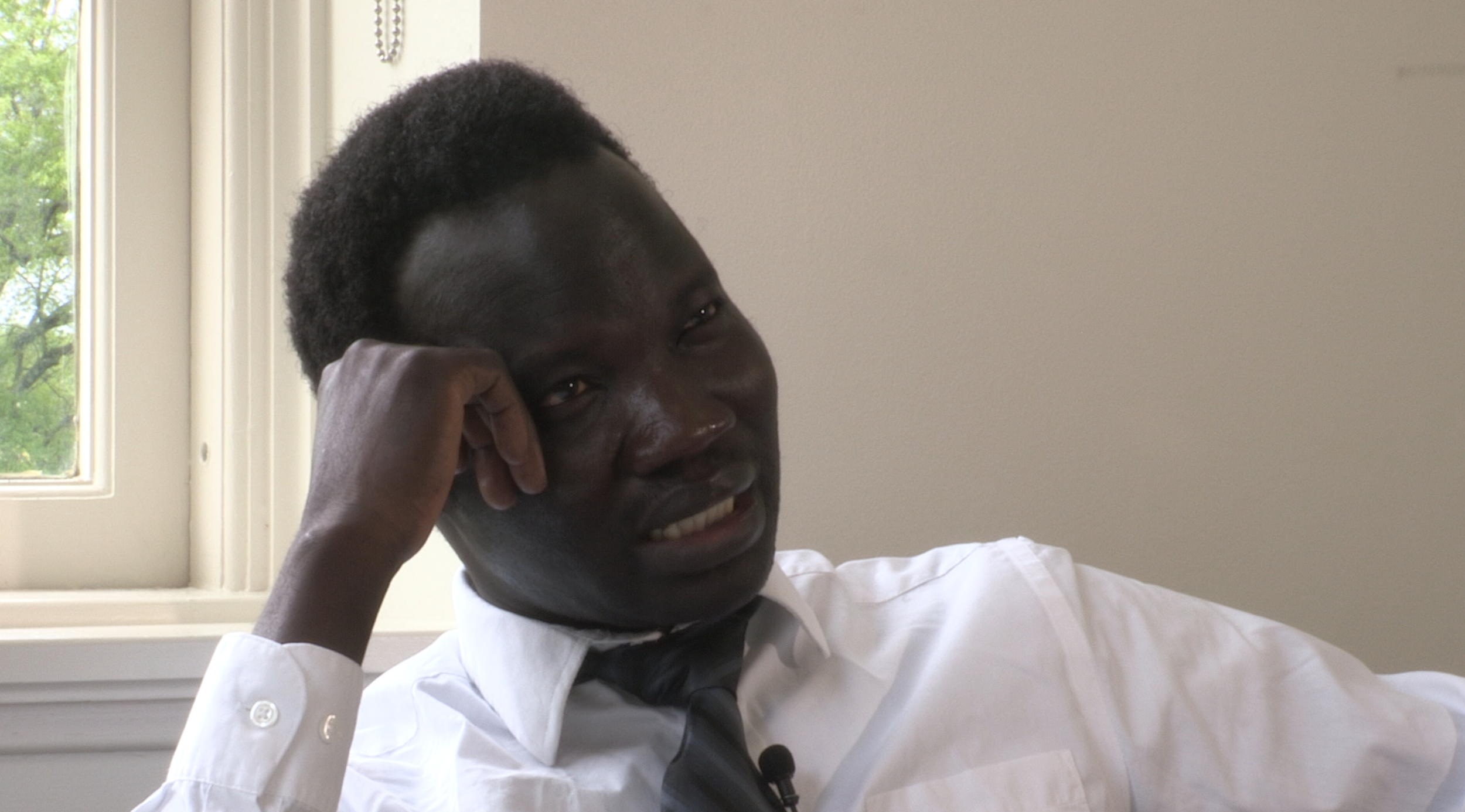
Omot retelling his journey coming to the U.S. during our interview. Image courtesy of Ojullu Omit.

This semester, I had the privilege of connecting with Ojullu Omot, whose life was forever altered by tragedy. On December 13, 2003, when he was just 14 years old, Omot experienced a massacre at his hometown in south-west Ethiopia. As part of a Wake Forest University project to raise awareness about the challenges faced by refugees, a team made up of me and my classmates produced a 10-minute advocacy film that aims to shed light on the often-overlooked struggles refugees encounter while adapting to life in the United States. Omot’s story is a testament to the blend of heartbreak and perseverance that characterizes the ongoing global refugee crisis, capturing the resilience and fortitude of those seeking haven away from home.

Omot’s story began with displacement, as he fled the 2003 massacre in the remote Gambella region of southwestern Ethiopia. From December 13-15, in a reprisal against a small ambush against Ethiopian federal government officials, ethnically Amhara, Oromo, and Tigrayan soldiers and rioters murdered hundreds of minority Anuak civilians. Human Rights Watch’s report suggests that these atrocities should be considered crimes against humanity. . The Ethiopian government claimed that only 57 were killed and that the violence resulted from ethnic tensions between rival Anuak and Nuer groups, in contrast to the claims of international human rights groups and the Anuak themselves.  Human rights NGOs have called for a thorough investigation into the incident, with concerns that others like it could occur. Despite facing deadly tragedy along with the immense challenges of settling into a new society as a refugee, Omot has found a new home in the United States, where he serves as a living witness to the egregious human rights abuses of his homeland. He remains committed to starting a new chapter in life.

By now Omot has gotten used to retelling the story of how he left his home in Ethiopia in the midst of genocidal violence, and his journey  from there to become an international politics student in the United States. The three-day-long massacre in Gambella town of southwestern Ethiopia was an outburst of ethnic conflict between the indigenous Anuak group and members of the Ethiopian military. As the situation in Ethiopia deteriorated, Omot moved to Sudan when he was a teenager, with the hope that things would get better in a year or two.

But they didn’t. The military confrontation neither started, nor ended with the massacre.  More than 10,000 Anuak people were forced to leave Ethiopia in 2004, the year after the massacre took place.

Omot left Sudan for Kenya after two years of waiting. The unrest had separated him from his family, and he lacked many colorful memories about his childhood in Ethiopia, Sudan and Kenya. What he remembered is playing football with his friends in refugee camps everyday; many of those eventually being sent to Canada, Australia and other developed nations. Omot remembers planes from the United Nation hovered above their heads in refugee camps, dropping food and supplies and people hurrying to grab them. “We were dependent on the refugee program,” Omot said, “Resettlement in the United States was not a typical solution for refugees living in the United Nations High Commissioner for Refugees(UNHCR) camp.”

Omot never dreamed about coming to the United States then. He was invested in the idea that everything will go back to normal in Ethiopia, and that he could then return home. Yet Omot’s life took a major turn in the year 2016. He was called for an interview, which he later found out was part of the application process by U.S. Citizenship and Immigration Services employees concerning whether he is eligible for resettlement in the United States as a refugee. The approval rate for a refugee status in the United States is 27%, according to World Data.  

Omot waited for roughly six months until he was called for a series of security checks, examinations and orientation. In February 2016, International Organization for Migration contacted Omot, telling him that his case is ready. He then boarded a plane to the United States on April 4th, 2016, his first ever flight. When he landed in Miami, Florida, it was like landing on a new planet- the shock of the novel language and lifestyle almost dazzled the then 28 year old. 

“There was something change, [such as] the day became longer, I was not even comfortable, and I cannot see where I come from, ” Omot recalled his initial exposure to the United States, “The first question I asked myself [was], is this the U.S. [as] I expected it?”

And the first few months continued to affirm to him that starting anew wasn’t easy. Omot often found himself alone in his house assigned by the government, since his roommates busied themselves working in the daytime, and went straight to sleep not long after walking in the door at night. Comparing the situation to the community life in Ethiopia, where everyone would sit down and share stories after a day’s work, filled Omot with homesickness at night. 

Language is also a major challenge to Omot. Going to a university was at the top of his wish list when he came to the United States, but he couldn’t even understand people’s accents when he asked for directions on his way to school. He had no idea how to open emails during his first semester at a community college. When one of his classmates finally taught him how to view the inbox, he found emails from professors flooded in there. In winter, the temperature dropped so low that Omot, who used to live near the equator, had to drop his English as Second language (ESL) classes to avoid traveling in freezing weather.

But Omot is determined to realize his dream. Instead of “wasting time” in ESL classes, he decided to push himself, taking the General Educational Development (GED) tests directly.  He works as a hospital janitor in the daytime for living; in the evening and before dawn, he dives into his study. Whenever he had free time, Omot would peruse his textbooks, went up to the library of the community college he attended everyday, asking every librarian what GED looks like, and tips and tricks to score higher. 

The global refugee population has reached crisis proportions, with more than 30 million refugees displaced in 2022, signaling a significant surge from the previous year's level. The United Nations High Commissioner for Refugees (UNHCR) has reported a staggering total of 103 million people forcibly displaced as of mid-2022. In response, President Joe Biden has committed to revamping America’s current “inhumane” immigration policy. However, the administration's effort to admit refugees has fallen significantly short of its goal, with only 25,465 individuals granted admission by the end of the previous fiscal year on September 30, 2022, a mere 20% of the objective. The number of refugees received by the United States still remains one of the lowest among all nations, and the number continues to decrease.

Refugees face a plethora of challenges when they resettle in a foreign country, with attaining secure housing among the most pressing. Asylum seekers in particular struggle to obtain temporary housing due to a lack of government support and unfamiliarity with the US housing system. Non-profit organizations and shelters provide vital assistance to these individuals. Despite this aid, refugee and asylum seekers are disproportionately at risk for health problems, both physical and mental. They are more susceptible to severe mental health conditions like PTSD and depression, while chronic illnesses like diabetes, hypertension, and cardiovascular disease exacerbate their already challenging circumstances.

In 2017, Omot took the GED for the first time. And hard work pays off — he passed the test.

“It [passing the test] gives me hope that I could continue to do all of them,” said Omot, breaking into a smile. And he did. After he finished with GED, Omot is currently pursuing a bachelor degree in international politics at University of North Carolina Greensboro. When asked why he could recall his story in astonishingly clear detail, Omot answered, “I think my story is important because if other people, other refugees heard about it, they would think, oh, this guy did that and starting his new life. Maybe I could do the same.”

To Get Involved:

While Omot is navigating through his new life in the United States, it is not without support from various refugee organizations, such as Every Campus a Refugee (ECAR), an organization aiming to mobilize colleges and universities to host refugees on campus grounds and support them in their resettlement. ECAR provided nearly 4 years free housing and accessories to Omot, and provides several other services to refugees in the North Carolina region. Learn more about ECAR here.


Hope Zhu

Hope is a Chinese international student at Wake Forest University in North Carolina studying sociology, statistics, and journalism. She dreams of traveling around the globe as a freelance reporter while touching on a wide range of social issues from education inequality to cultural diversity. Passionate about environmental issues and learning about other cultures, she is eager to explore the globe. In her free time, she enjoys cooking Asian cuisine, reading, and theater.
From Ocean Voyage to Space Travel

Reid Stowe has done a 1000+ day sea voyage, and now he’s focused on opening new possibilities for humans in space.

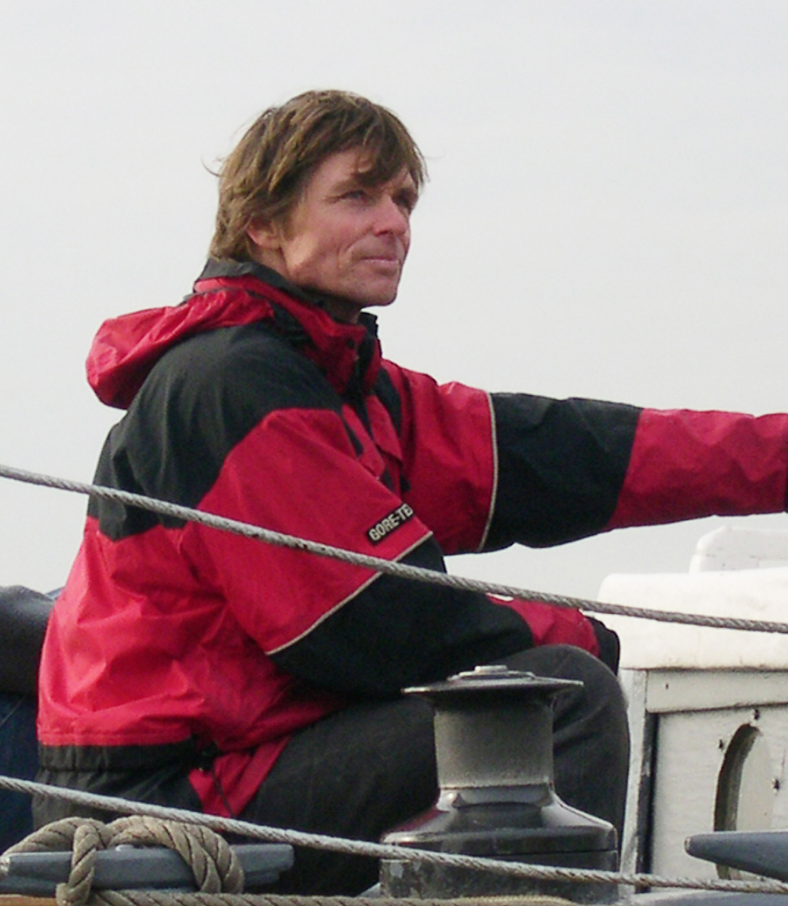
Reid Stowe. Desmond K. Shaw. CC BY-SA 4.0

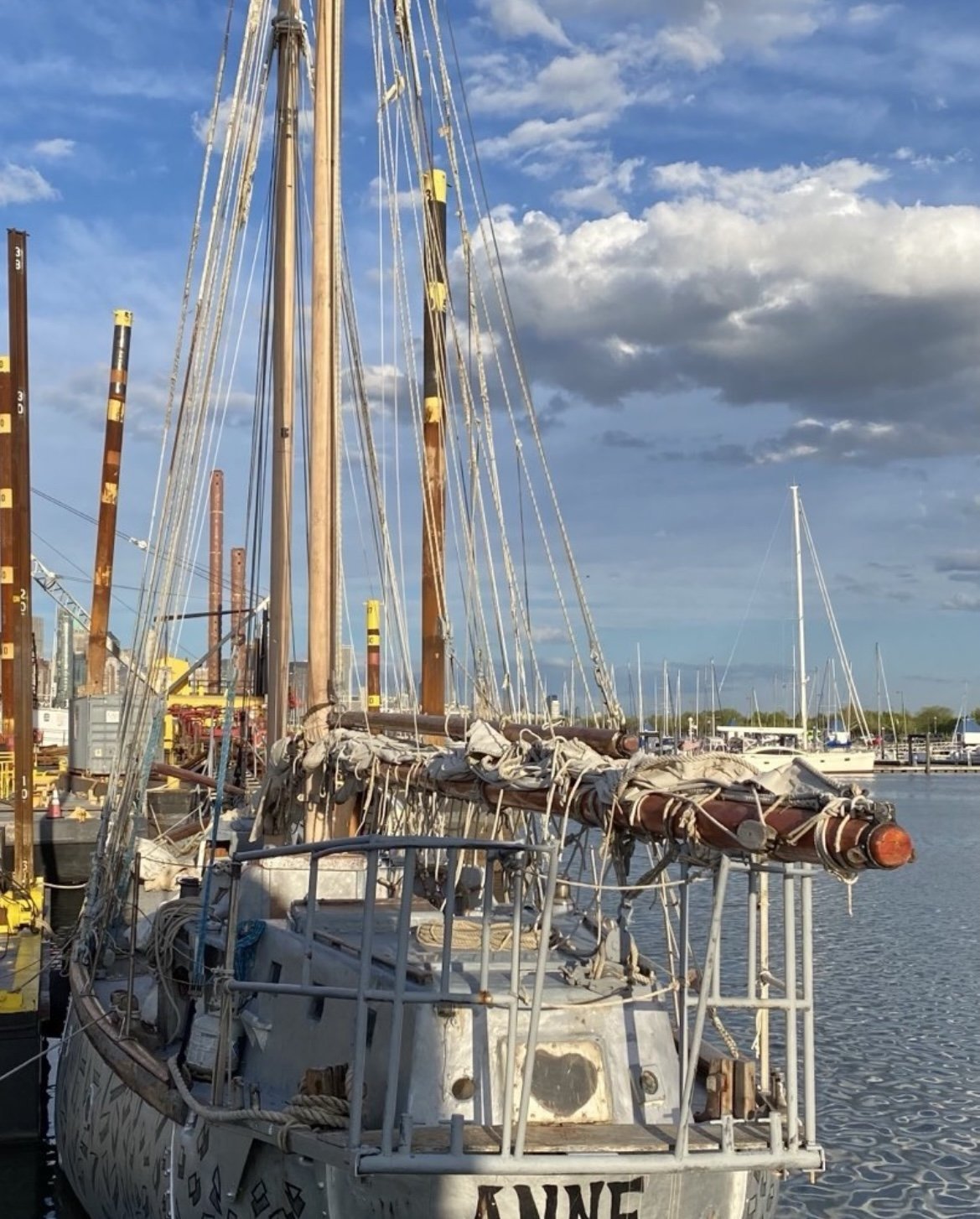
A lover of the ocean and all types of art, Reid Stowe is an American craftsman, sailor and adventurer, who completed a more than three year ocean voyage without stopping on land aboard the Anne, a gaff-rigged schooner Stowe built himself.

The iconic journey began on April 21, 2007 from the 12th St. Pier, Hoboken, New Jersey. One thousand one hundred and fifty-two days later, on June 17, 2010,Reid sailed his schooner up the Hudson River and docked at Pier 81 in Manhattan, New York  — a potential record for the longest continuous sea voyage without resupply or stepping on land. 

With all the experience Reid has built up on the ocean, the renowned sailor has started a new program, meant to help astronauts who are looking to go on a mission to Mars in the 2030s. As Reid has put it, “the deep models of today could provide a role model for space bearers tomorrow,” and plans to use his journey at sea as a blueprint of sorts to help guide these future astronauts.

Reid Stowe working on Anne. @reid_stowe_art. Instagram.

Because those going on the Mars mission will be finding themselves on the ship for almost three years, it brings the concept of “isolation” into perspective. What will they do to cope, being in an enclosed area for such a long period of time? Reid knows what that’s like. He never needed coping mechanisms to prepare himself for his sea journey. There was nothing to “cope” with, and he was always able to love what he was doing. Reid’s new program will tackle these issues and answer the question: “What kind of person will it take to survive a trip to Mars?” 

But this training initiative represents more than just valuable lessons for Reid. It didn’t matter that he was on his boat and “being turned upside down by storms,” because knowing that this journey would be worth it for everyone was more than enough.

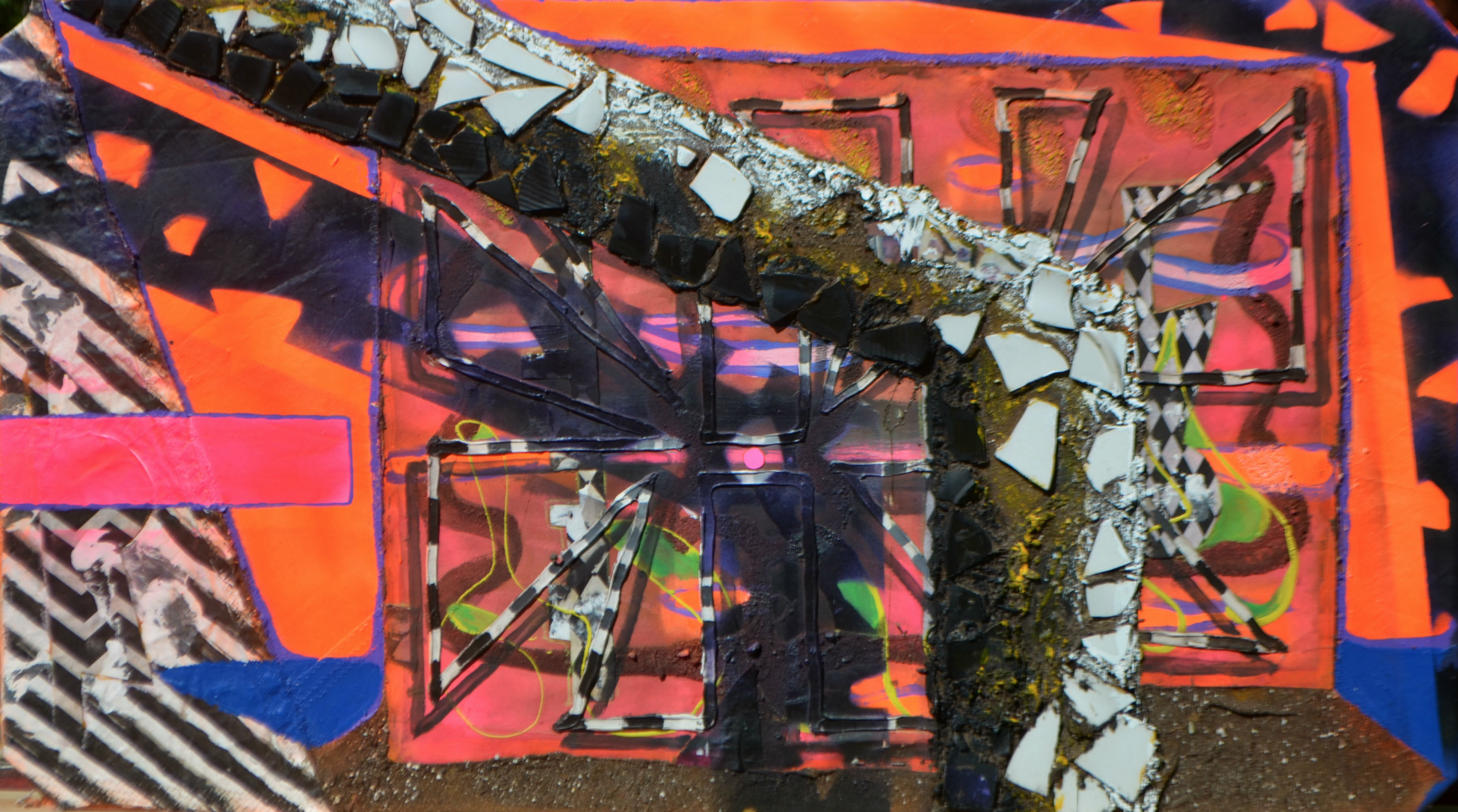
One of Reid’s recent artworks. @reidstowepaintings.com

“How did I keep myself happy and healthy?” Reid said. “Believing that what I was doing was good for all of creation. Because I was showing that humans could live in a place where I never imagined before and by opening new doors of perception for what we’re capable of.”

But sailing isn’t the only thing Reid finds passion and purpose in. His Instagram features many of his artworks in great detail. Ever since he was young, he would paint or draw boats or mariners, even before he knew he wanted to be a sailor. And as he grew up, his art became more and more integrated into his sailing — to the point where his artistic drive encouraged him to embark on the longest sea voyage in history.

Schooner Starship Anne. @reid_stowe_art. Instagram.

Each of Stowe’s paintings has layers of meaning and connection. Many of the artworks he made while at sea empowered his voyage, the same way the voyage empowered the artwork. Much more can be found on his own website.

A more than 3 year adventure at sea is an effectively unique accomplishment. But Reid Stowe was able to use his incredible feat to offer guidance, spread awareness and most importantly — tell his own unique stories to the rest of the world. 


Michelle Tian

Michelle is a senior at Boston University, majoring in journalism and minoring in philosophy. Her parents are first-generation immigrants from China, so her love for different cultures and traveling came naturally at a young age. After graduation, she hopes to continue sharing important messages through her work.

Eat for Under $15 at these 7 Global Cuisine Restaurants in NYC

Let your tastebuds travel without leaving the Big Apple.

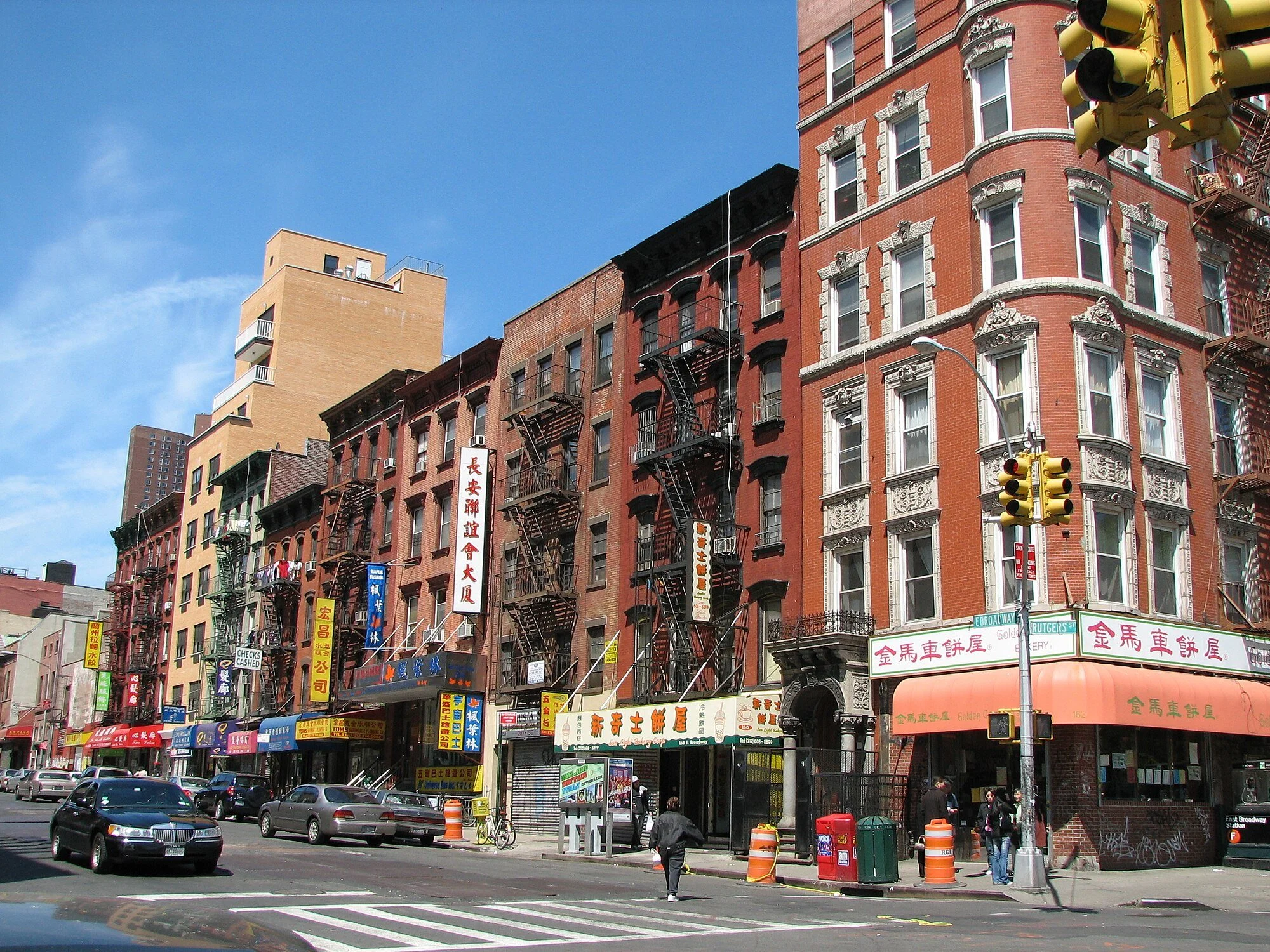
Chinatown in New York City. Norbert Nagel. CC by 3.0.

Beyond its famous museums and fashion, New York City is recognized as the food capital of the United States. Every year foodies flock to the city’s restaurants for unique menus and interpretations of global cuisine. But this top-notch culinary environment typically comes—quite literally— with a price. New York restaurants are often criticized for their exorbitant prices. But fear not, there are plenty of restaurants in the city that offer authentic international cuisine for a reasonable price. Whether you are a college student on a budget or a lifelong fan of global cuisine looking for food made with a lot of love, these restaurants will leave both your stomach and your wallet happy.  

1. Super Taste

Hand-Pulled Noodles with Lamb. Jason Lam. CC by 2.0.

Located in the famous culinary neighborhood of Chinatown, Super Taste may be the most well-known restaurant on this list. If you find yourself craving Chinese food, Super Taste is a classic, must-go stop. The most notable dish on the menu is their hand-pulled noodles. These silky and addictive noodles can be paired with chicken, beef, or mutton at the customer’s request. But if you aren’t in the mood for noodles, the five for $10 pork and chive dumplings drenched in sweet-spicy chili oil are always a crowd pleaser. Although there is limited seating inside, Super Taste is perfect for on-the-go enjoying. Their menu can be found here

2. Pyza

Borscht topped with sour cream. Liz West. CC by 2.0.

Warm and delicious, Pyza serves Polish food so good it could be mistaken for a home-cooked meal. Located in Greenpoint, Brooklyn, this restaurant specializes in plates piled high with food that makes you feel like family. Its menu features traditional dishes like stuffed cabbage, tongue in horseradish sauce, and various types of pierogies. A stand-out dish is their chicken cutlet, breaded and paired with a dollop of sour cream. Their soups range from a reasonable $5-$8, so tuck in with a bowl of borscht and enjoy the homey atmosphere. Additional items and prices can be found here

3. Birria-Landia

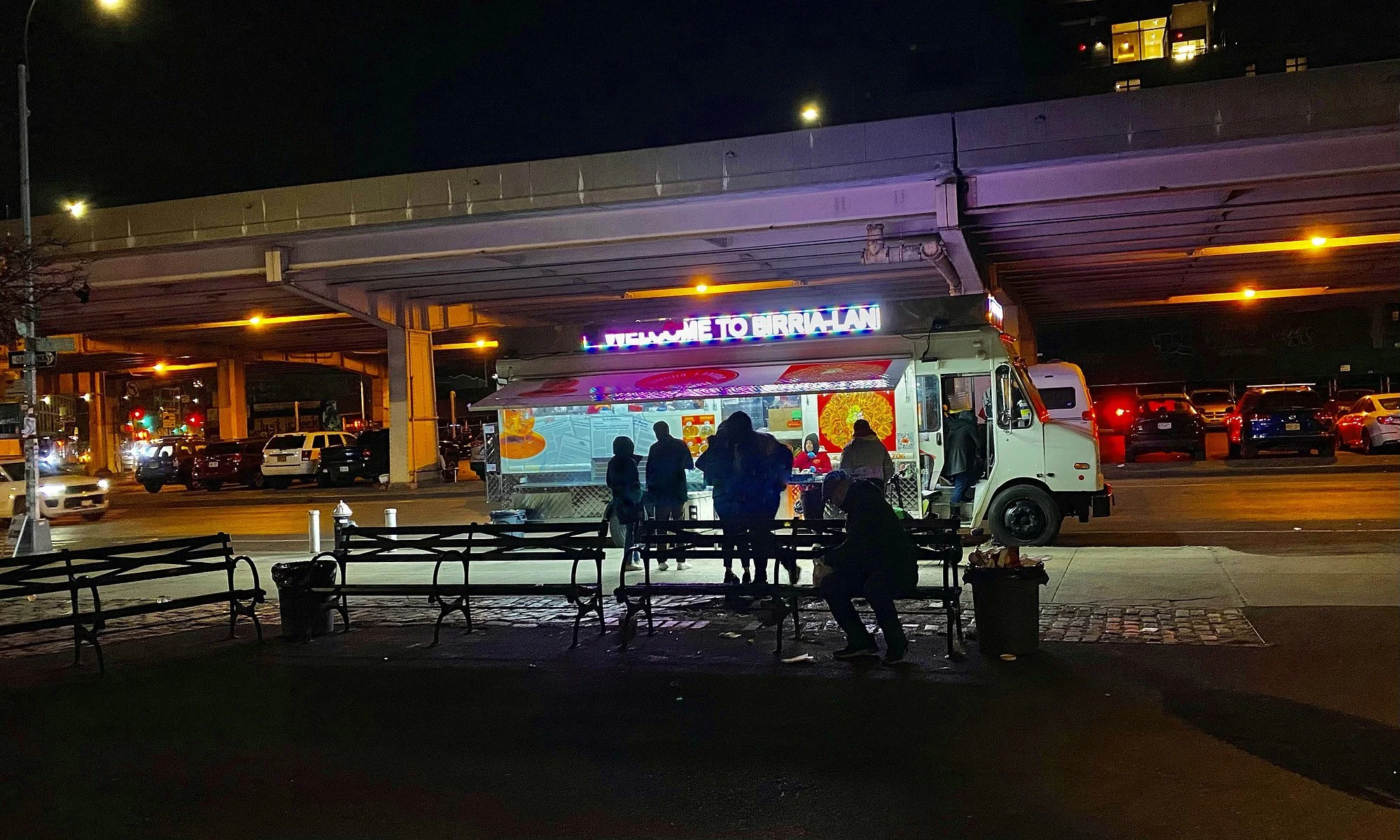
Brooklyn location of Birria-Landia. Andre Carrotflower. CC by 4.0.

This Mexican spot may differ from most foodies’ perceptions of a typical restaurant. Instead of a usual sit-down experience, Birria-Landia started as a single Jackson Heights food truck. The operation has since expanded to include additional trucks in the Lower East Side, the Bronx, Jackson Heights, and Williamsburg. Their specialty dish, birria, features tacos topped with fresh cilantro and salsa paired with a rich, smooth dipping broth. The meat of the tacos—often beef—is first marinated in mixtures of spices and dried chillies before being cooked low and slow in broth. This lengthy process creates mouth-watering and juicy tacos that can be enjoyed for only $4.50. In addition to their exceptional tacos, their consummé broths, tostadas, and quesadillas can be found here.

4. Kassim’s Bakery

Aalu Roti. Guarav Dhwaj Khadka. CC by 4.0.

Whether you prefer your dishes savory or sweet, there is something for everyone at this Queens restaurant. Kassim’s serves a wide variety of Caribbean lunch and dinner foods, but also offers a tasty variety of pastries and baked goods. One of the menu’s highlights is the selection of roti; each variation of the dish is under $10. Roti is a wheat flatbread that at Kassim’s is paired with beef, chicken, duck, goat, and pachownie (innards of lamb). After finishing a main dish, customers can explore Kassim’s dessert menu. Their cassava pone is perfect for those with a sweet tooth; cassava, also called yuca, has an edible root often used to make starchy desserts. More of Kassim’s sweet and savory treats can be found here.

5. Punjabi Grocery & Deli

Samosas paired with chutney. K Spoddar. CC by 4.0.

Can you claim to have visited New York if you didn’t find yourself in a deli at some point during the trip? Although it also doubles as a grocery store, this Lower East Side joint’s Indian food makes it stand out. Even better, the deli only serves vegetarian food, making it the perfect spot for travelers with this dietary restriction. At only 50 cents, Punjabi Deli might have the most affordable Samosas in the city. They also offer an assortment of rice dishes where customers can mix and match different vegetable options to create the perfect bowl for only $6 or $8, depending on if you want a small or large meal. The $2 chai is a perfect way to wash everything down. More exciting dishes and beverages can be found here

6. SVL Souvlaki Bar

Grilled kebabs. Glen Edelson. CC by 2.0.

From spanakopita to greek fries, SVL Souvlaki Bar combines tradition with innovation to create unique Greek food. They have two Queens locations, with one on Steinway Street and the other on Astoria Boulevard. Perhaps the most exciting aspect of this quick and fresh spot is their “build your own” options. You can customize salads and bowls, or even create entire plates filled with pita, kebabs, vegetables, and sauces. Their iconic SVL sauce combines sweet, tangy, and creamy flavors— it is the perfect way to top off any customized dish. Or, if the extent of customization is intimidating, you can always enjoy classic chicken souvlaki kebab for only $4.50. Even better, the Bar’s food is made with hormone-free meat and fresh produce. Read more about their ingredients, mission, and menu here

7. Bunna Cafe

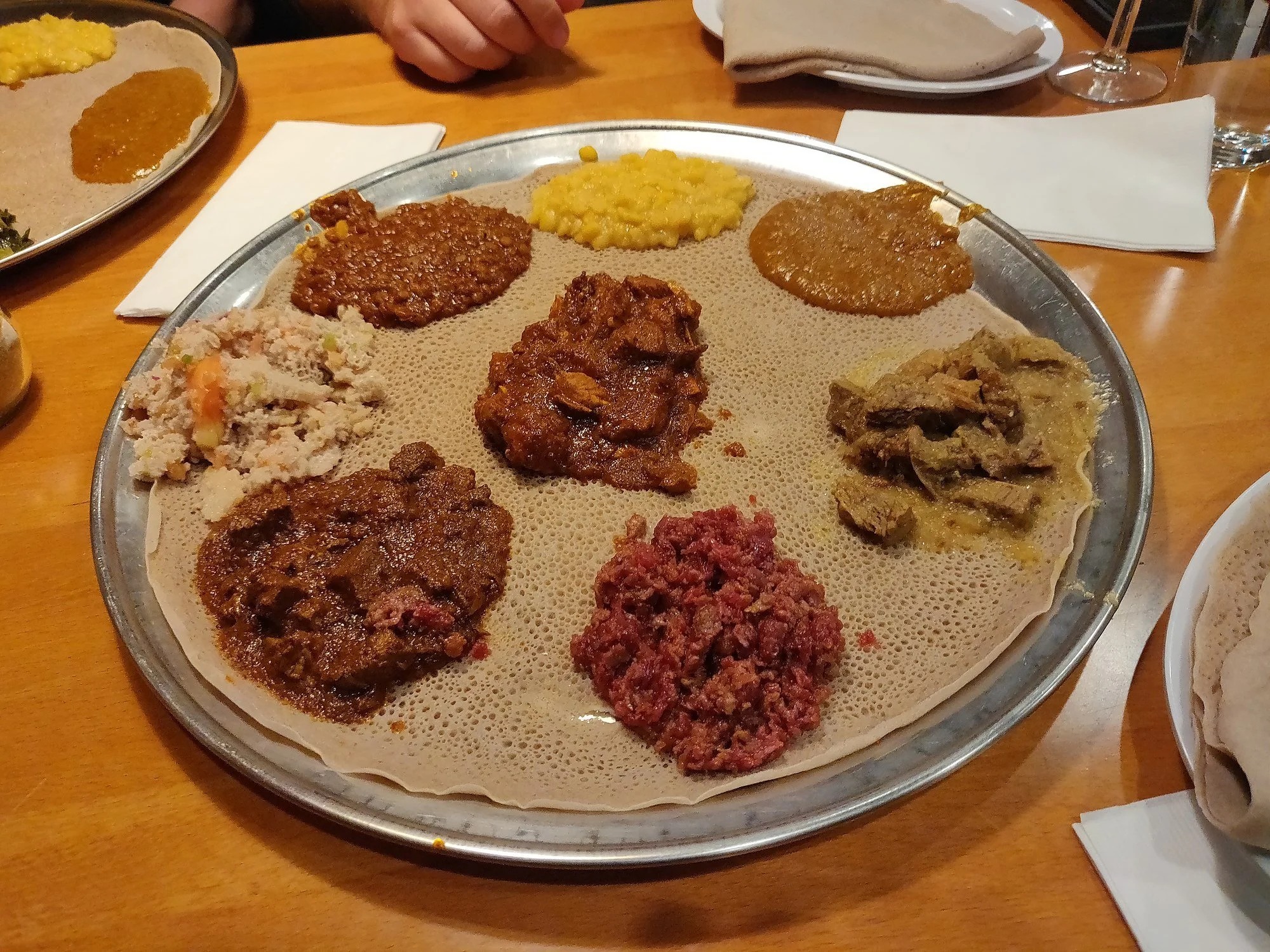
Injera topped with assorted vegetables. Kurt Kaiser. CC by 2.0.

If you’re looking for more of a sit-down experience, Bunna Cafe is the perfect destination. They are a Black-owned and vegan Ethiopian restaurant located in Bushwick, Brooklyn. The restaurant’s family-style meal environment creates the perfect atmosphere for hearty food paired with good conversation. Scoops of vegetables are served in piles on injera, a fermented sourdough flatbread. Customers can select a variety of different sides, mixing to create new flavors and combinations. Or, if you’re dining alone, the $12 lunch special comes with individual scoops of four different items. Although, with such generous portions, you may want to bring a friend to share. Further details about their menu and strong variety of sides can be found here.


Carina Cole

Carina Cole is a Media Studies student with a Correlate in Creative Writing at Vassar College. She is an avid journalist and occasional flash fiction writer. Her passion for writing overlaps with environmentalism, feminism, social justice, and a desire to travel beyond the United States. When she’s not writing, you can find her meticulously curating playlists or picking up a paintbrush. 

Mass Killings of the Gray Wolf near Yellowstone

With the 150th anniversary of Yellowstone, attention is drawn to the mass killings of the gray wolf. The park’s bordering states have no laws to protect this species, as the wolves reach a record low number. 

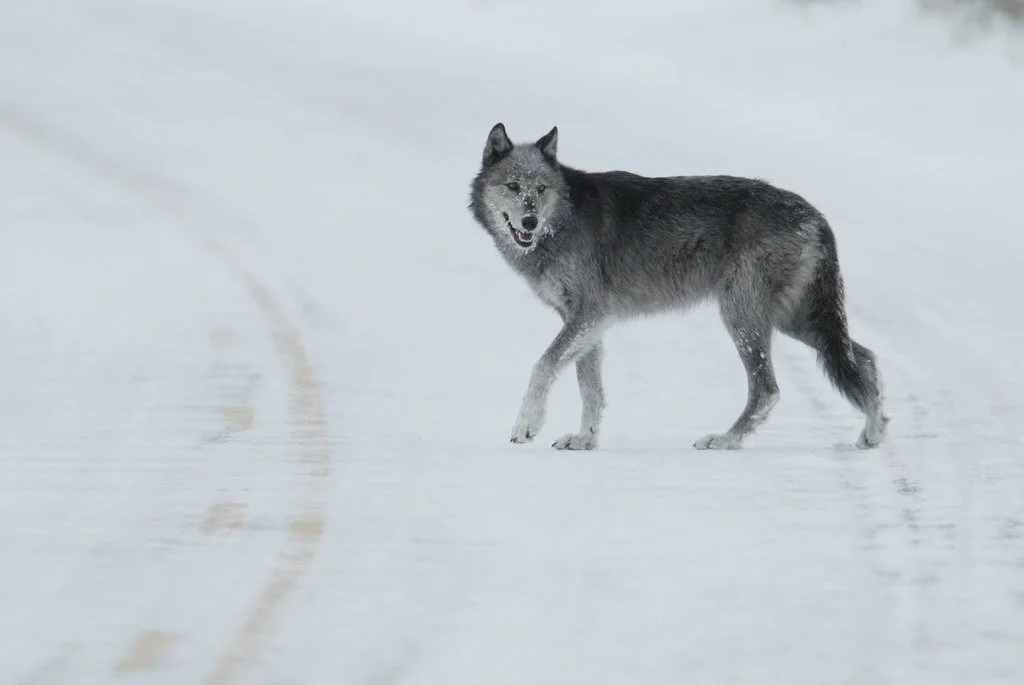
Gray wolf traveling. Yellowstone National Park. CC BY-SA 2.0.

March 1 marked the 150 years of Yellowstone National Park’s existence. However, a sad reality emerges regarding the hunting and killing of wolves. Although this event should be a time of commemoration for the park, an impending issue may finally be getting the necessary public attention. 

While hunting is illegal within Yellowstone, the boundaries of the park line states like Montana, Idaho and Wyoming, which offer no protection to what crosses into their private territory. As a result, the highest number of gray wolf killings has occurred within a century this season alone, which is less than halfway over. 

There are several reasons why this attack on the gray wolf has been escalating. In 2020, the Trump Administration abolished protection of the gray wolf species, meaning that they no longer receive protection as an endangered species. Two years later, though, the federal court worked to reinstate protection for the wolves. Although this preservation was successful in some states, those bordering Yellowstone were excused from this active protection. As a result, hunters in Montana, Idaho and Wyoming have brought the total population down to just 90 wolves

Although there are strict hunting rules within Yellowstone, they now hold little value due to the ways in which these bordering states support the war on wolves. These mass killings are not only exponentially growing for the first time in a century, but pose extreme risks for the balance of the ecosystem. The gray wolf plays a key role in the ecosystem, which further affects the physical environment the park is surrounded with, as well as the stability of other organisms. 

For example, the diminishing number of wolves negatively impacts the ecosystem as the species feeds on deer and elk populations, keeping them at a healthy population. When wolves eat deer or elk, they also leave their carcasses scattered which provides nutrients for other members of the system. Aside from the gray wolf affecting other species, they have large impacts on trees, plants and the physical environment at large. With the absence of the gray wolf working as predators, an abundance of elk would feed on different types of trees, which further translates into the stagnation of the species. 

The issue is growing rapidly, as the entire Phantom Lake Pack has been slaughtered due to the lack of protection. New laws in Idaho encourage these killings; the governor of Montana is an active hunter himself who recently trapped and killed a wolf without following protocol. As these states fail to protect the important wildlife that walks into their territory, it is increasingly concerning why there is little to no federal concern on this issue. 

Those who demand change are former members of the Fish and Wildlife Commission, who have seemingly followed the journey of the gray wolf, watching them go from full protection to total vulnerability. Although gray wolf deaths reach dangerous numbers, the problem is seemingly insular to the park itself, only being made known to the outside when action is demanded. When there is no personal connection between the park and the outside influences that have ability to make a change, protection is only considered when irreversible ecological damage to the park is noticed. Whether the federal government and commission chooses to protect the gray wolves or not is ultimately determined by their care for the environment, economics and the ecological community.  

GET INVOLVED

Citizens can put active pressure on the federal government and commission to keep the Endangered Species Act protections for gray wolves in 48 states throughout the Biden Administration. This pressure would also help the wolves have protection under federal law, rather than leaving responsibility to the surrounding states. 

Here, you can sign a petition to Secretary Haaland to promote this protection of wolves.


Talia Rueda

Talia is an English major and Marketing minor at Providence College. She works as a Staff Writer and Social Media Coordinator for their student-led newspaper, The Cowl. She is a lover of all things entertainment media and is happy to now grow her experience in writing about social action and travel. In the future, she hopes to work for a major entertainment magazine to continue the conversation about growing trends and popular culture.

7 Caves, Temples and Cities Carved in Mountains

These ancient sites were once carved into the surrounding landscape and continue to stand today.

Created at a time when construction vehicles and advanced building tools did not exist, these caves, temples and cities demonstrate the craftsmanship of their ancient peoples all over the world.  

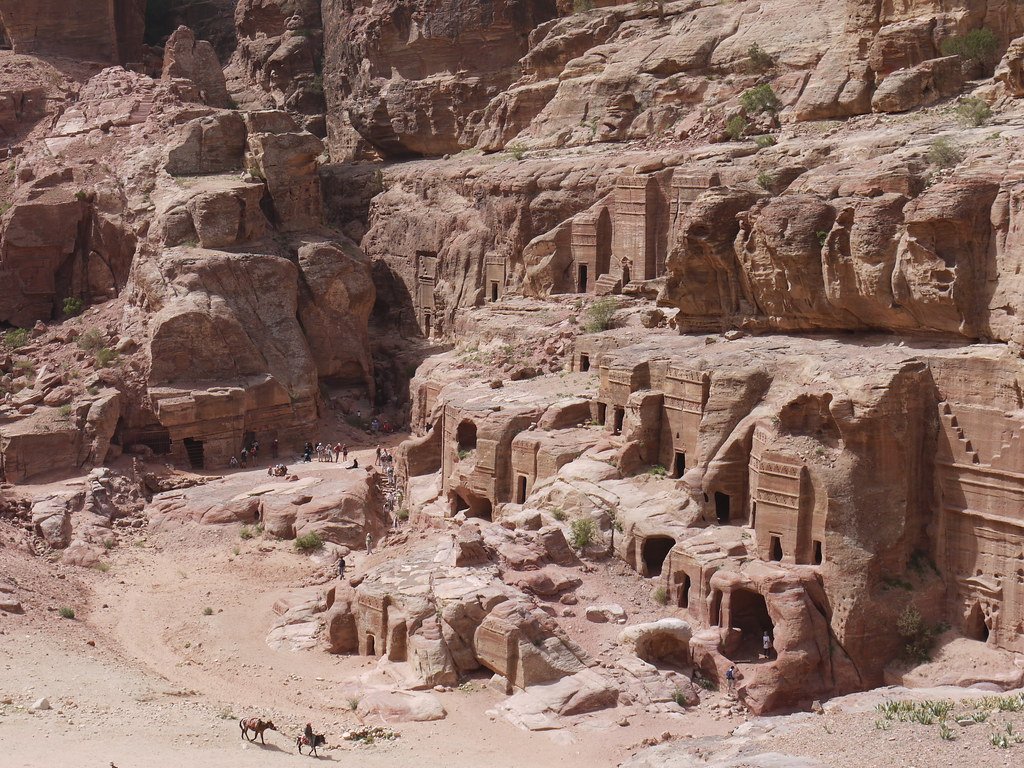
1. Petra 

Petra, Jordan

Petra, which is also known as “Rose city” for its pink-hued rock carvings, is located between the Red Sea and the Dead Sea in Jordan. The archaeological site is home to several rock-cut temples and tombs, including Al Khazneh, Al-Deir, the Palace Tomb and Urn Tomb. Today this carved site is both a UNESCO World Heritage Site and one of the New 7 Wonders of the World.

2. Longmen Grottoes 

Luoyang, China 

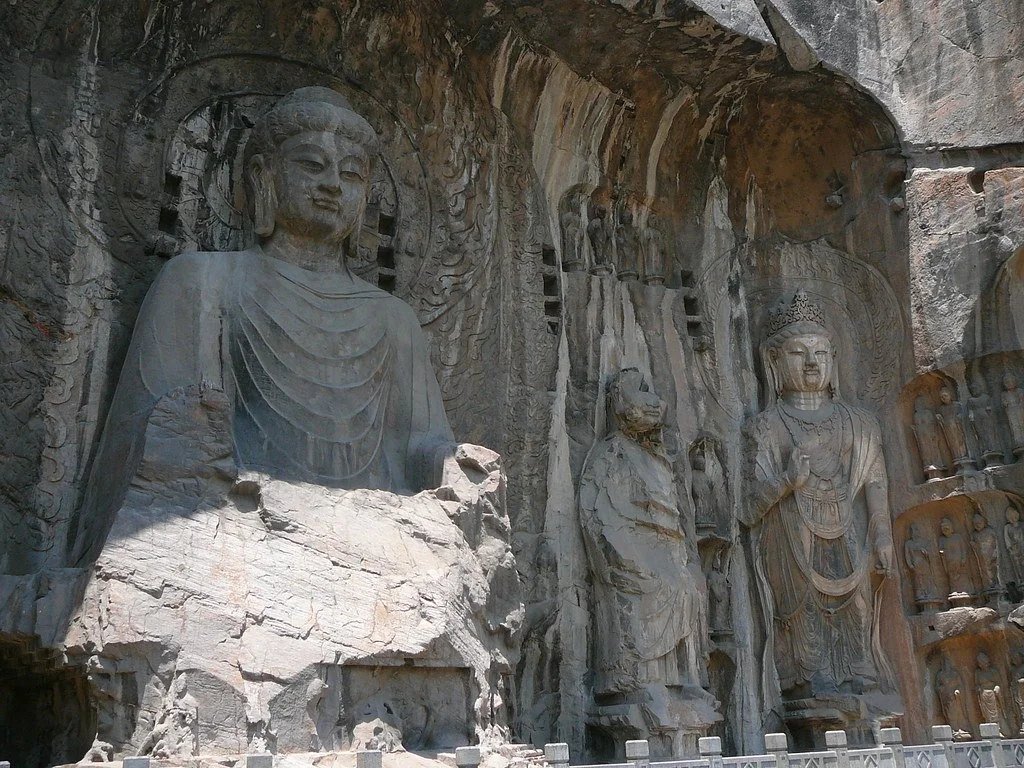
Longmen Grottoes. Dericafox. CC BY-NC-ND 2.0

Considered one of the best examples of Chinese Buddhist art, the Longmen Grottoes date back to the 5th century. The site contains more than 2,000 artificial caves and over 100,000 Buddhas carved into the limestone cliffs of the Xiangshan and Longmenshan mountains. The Longmen Grottoes cover an area of 30,000 square meters and the statues range in size (0.7 in- 53 ft). The site became a UNESCO site in 2000. 

3. Ellora Caves 

Maharashtra,India

Ellora Caves: Kailasanatha Temple. DdasedEn. CC BY-NC-ND 2.0

Stretching more than a mile long in distance, the Ellora cave temples date back to the 5th century. Located in Maharashtra, India the 34 caves are dedicated to Buddhism, Hinduism and Jainism. Designated a UNESCO World Heritage site in 1983, the Ellora Caves were hand carved into hillside rock.   

4. Mesa Verde National Park 

Montezuma, Colorado

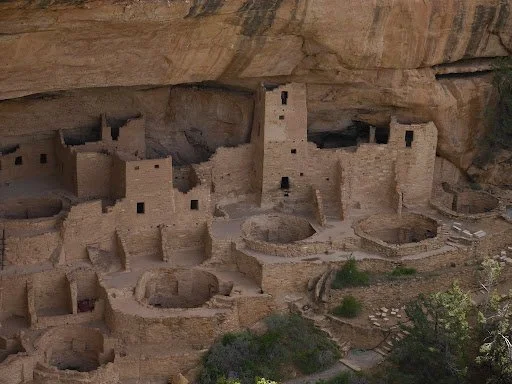
Mesa Verde National Park. Usareisetipps. CC BY-SA 2.0

Within Colorado’s Mesa Verde National Park you’ll find the largest archeological preserve in the US. Located in Montezuma County and occupying 81 square miles, the more than 4,000 Pueblo Indian sites date back to the 6th century. As well as 600 cliff carved dwellings including the famous Cliff Palace and Long House. It is frequently visited by mountain lions, elk and bears as well as lizards and snakes which roam the National Park. 

5. Goreme National Park 

Nevşehir, Turkey

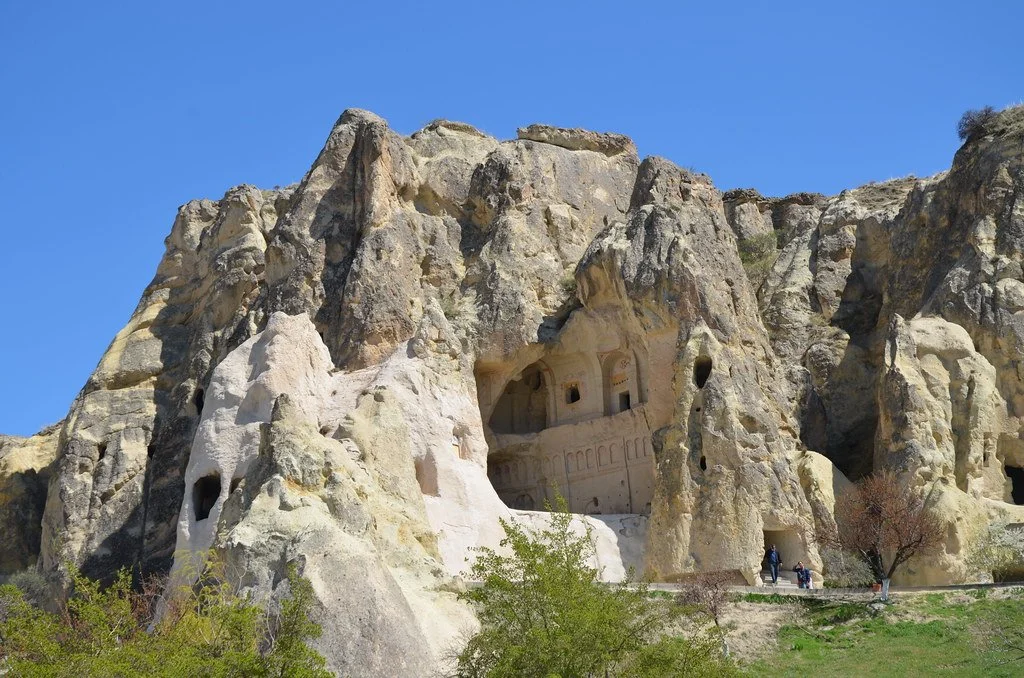
Sculpted by erosion, the Göreme National Park is in Cappadocia, Turkey and contains rock-hewn sanctuaries, houses, monasteries, churches and underground cities. These were inhabited and built in the 4th century, Neolithic pottery and tools found in Cappadocia attest to an early human presence in the region. Clay tablets recovered from the remains of an Assyrian merchant colony at Kanesh are among the oldest written documents discovered in Turkey. 

6. Abu Simbel 

Aswan, Egypt

An ancient temple complex, Abu Simbel was built by Egyptian King Ramses II to intimidate his enemies and seat himself amongst the gods. The 66-foot seated figures of Ramses are set against the recessed face of the cliff, two on either side of the entrance to the main temple. Carved around their feet are small figures representing Ramses’ children, his queen, Nefertari, and his mother, Muttuy. The temples were unknown to the outside world until their rediscovery in 1813 by the Swiss researcher Johann Ludwig Burckhardt. 

7. Lycian Tombs 

Anatolia, Turkey

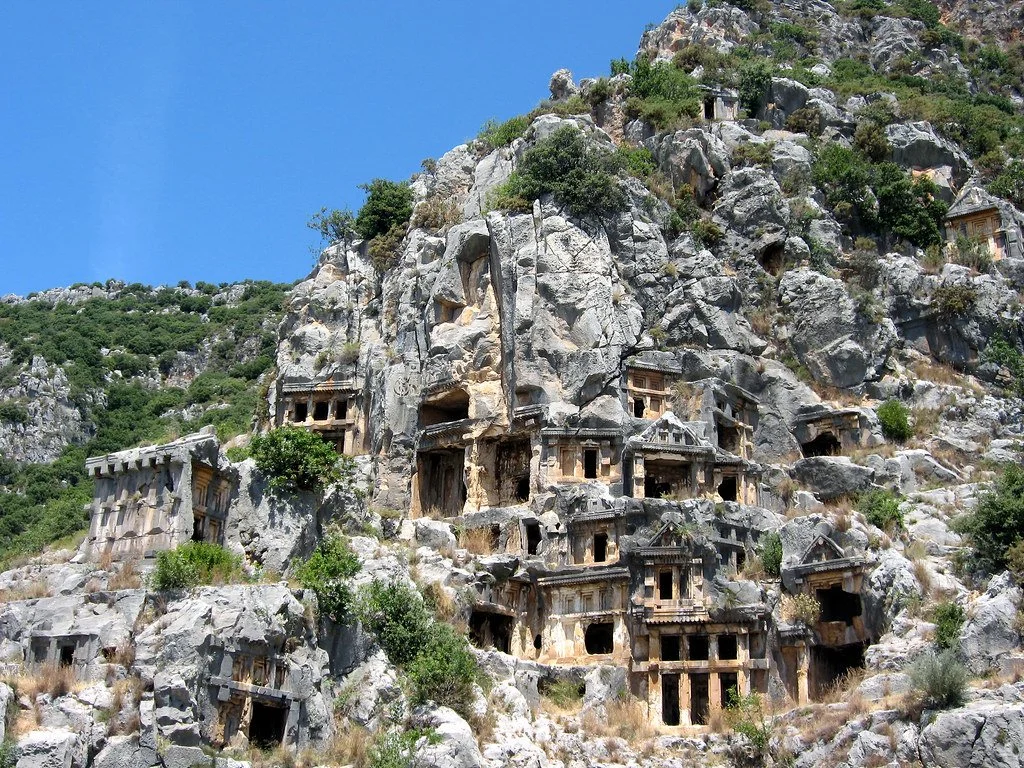
The 4th century Lycian tombs of Turkey contain carved tombs into the side of the region’s mountains, demonstrating a form of ancestral worship. More than a thousand tombs are there  today varying in many intricate styles. Some with Romanian columns and other decorative features. The Lycian people believed the dead were carried to the afterlife by winged creatures, hence helping the process by laying them to rest in high cliffside tombs. 


Jennifer Sung

Jennifer is a Communications Studies graduate based in Los Angeles. She grew up traveling with her dad and that is where her love for travel stems from. You can find her serving the community at her church, Fearless LA or planning her next trip overseas. She hopes to be involved in international humanitarian work one day.
Inside the Lives of the American Amish  

The Amish are known for their conservative beliefs and rejection of modern technology. Today, more than 300,000 Amish live in the United States.

Teen Returning Home From Work. Melnee Benfield. CC BY-NC-SA 2.0

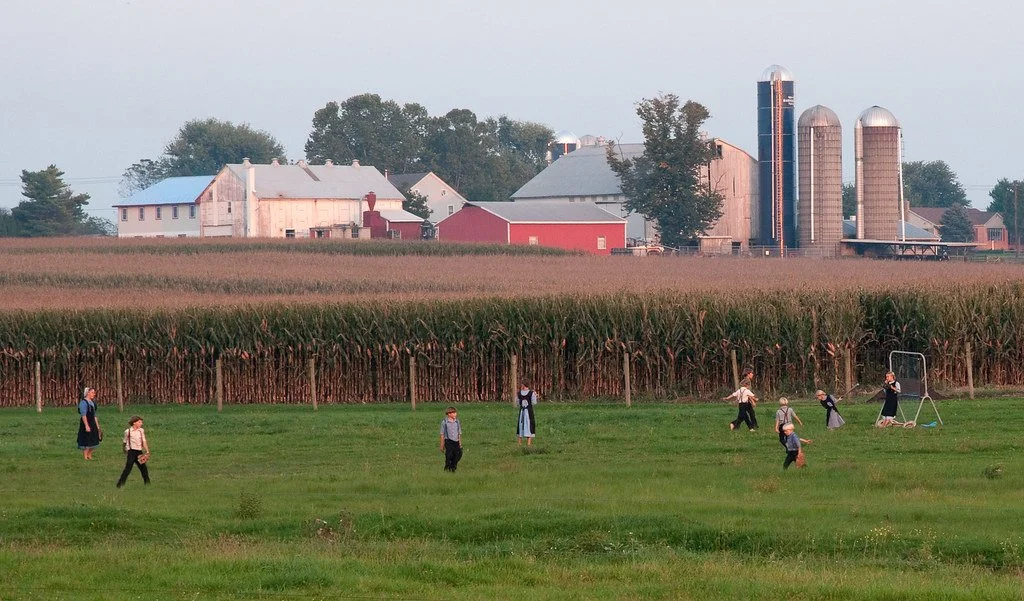
The Amish Church originated in Europe in the seventeenth century following a split from the Mennonite Swiss Brethren in 1692. This split was due to a disagreement about the treatment of members who had been found guilty in breaching the doctrine. To escape persecution, the Amish migrated to Pennsylvania in the 1730s. Today the population is an estimated 300,000 people in more than 30 states and is steadily growing due to the Amish belief that children are a blessing from God. The majority of the Amish community (62 percent) live in Pennsylvania, Ohio and Indiana. They are Christian believers who have isolated themselves from modern society and live in rural areas of the United States. They do this to keep their community from being influenced by outsiders, who they refer to as the “English.”

Family is the most important social unit in Amish culture. On average, families have seven children, although larger family units than this are common. Chores are divided traditionally by the gender binary, with girls staying and helping their mothers manage the home. If they decide to work outside the home, it is within the Amish community doing jobs like sewing, selling food in local stands or stores, waitressing, midwifing or nursing. Boys work alongside their father in farms, construction, crafting furniture, raising livestock and auctioneering. On days when they are not working, the Amish turn to sports like baseball, volleyball and basketball. Board games are also very popular among the Amish household, as well as fishing, hunting and being in community with friends and family. 

The Amish generally eat foods produced in their own gardens or on their farms. As a rule, they do not eat processed, store-bought foods. Homegrown fruits and vegetables, eaten fresh, canned or frozen, play an important part of the Amish diet. Vegetables often found in their meals include peas, corn, zucchini, beets, beans and rhubarb. Meals are designed to sustain hardworking lifestyles. The women in the community are known to bake cakes, pies, cookies and bread. An Amish dessert favored by many is Shoofly pie, typically composed of flour, brown sugar, water, spices and egg. The pie is topped with crumbs and served in a flaky pie crust. Shoofly pie is similar to coffee cake, but with a gooey molasses bottom. 

Kids of All Ages Playing Baseball. Bob Jagendorf. CC BY-NC 2.0

Education in the Amish community begins at the age of six (first grade) and culminates at 13 (eighth grade). Children are taught in a one-room schoolhouse, usually within walking distance of their home. The classroom is composed of 30-35 children, many of which are siblings or cousins. The day begins with Bible reading, hymn singing and reciting the Lord’s Prayer. At the end of the morning routine, the basics are taught: writing, math, history, arithmetic and English. The students’ first language is Amish German dialect, then English is learned at school. The teacher or teacher’s aide will circulate the room teaching individual grades while the other grades read or prepare for their time of teaching. Higher education is discouraged, as it could lead to leaving the Amish community and influencing others to do the same. Amish children are exempt from state compulsory attendance beyond the eighth grade based on religious principles.

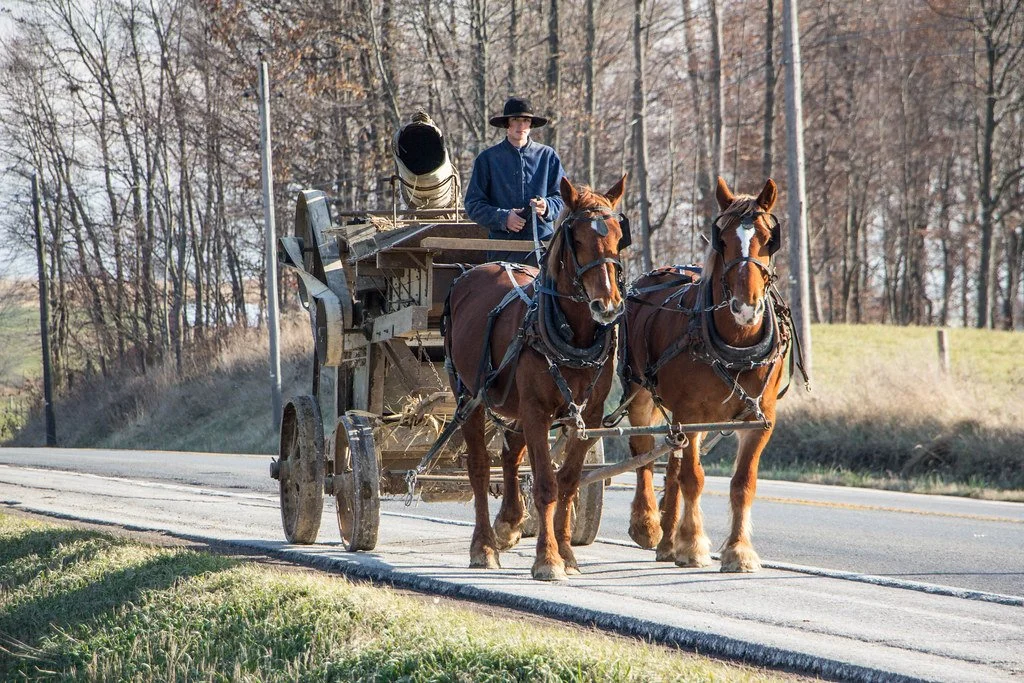
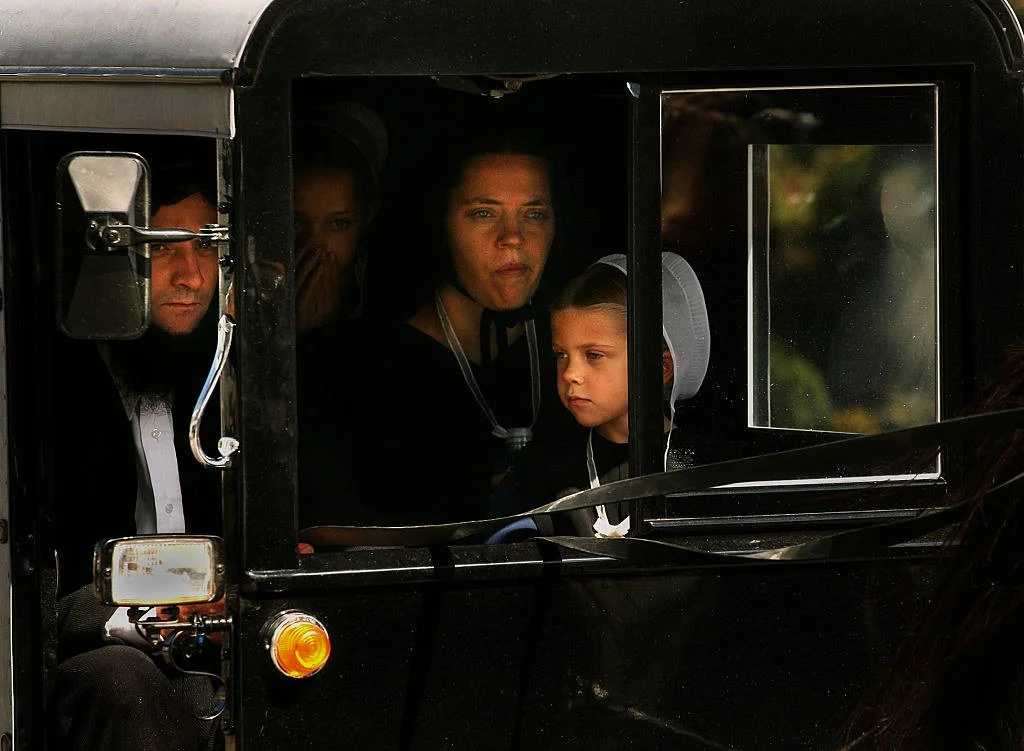
The Amish reject modern technology as it can open the door to temptations and change their traditional lifestyle. Instead, they choose to live simple lives and are self-sufficient. The Amish farm and produce everything they own and ride a horse and buggy or a bike to travel around the community. However, there is a time when Amish youth can decide whether or not they would like to continue living within the community. This is a season where rumspringa, a German term for running around, takes place. At the age of 16, parents allow the teens to fully experiment with the outside world and activities, which would otherwise be condemned and result in shunning. Due to the fact that individuals aren’t baptized, teens are not yet under the church authority. This is part of the reason why they are given a pass. This experience lasts two years and 90 percent of teens return home. 

Amish Family on a Horse and Buggy. Brucedetorres. CC BY-PDM 1.0

After arriving more than three centuries ago, the Amish have sustained a private life from the outside world. Not allowing many into their community has resulted in the preservation of their beliefs and isolation. The Amish continue to live in the US with two new recent settlements, Argentina and Bolivia.


Jennifer Sung

Jennifer is a Communications Studies graduate based in Los Angeles. She grew up traveling with her dad and that is where her love for travel stems from. You can find her serving the community at her church, Fearless LA or planning her next trip overseas. She hopes to be involved in international humanitarian work one day.

7 Stunning Caves Worth Exploring

Though caves often hold a fearsome reputation, they have a myriad of captivating natural features and intriguing histories. 

Caves often get a bad reputation: cold, dark, damp and uninteresting, or even frightening. In reality, caves offer snapshots of history, unusual natural structures, and examples of remarkable biodiversity. There are thousands of caves on Earth, and even more that are yet to be discovered. Each cave is unique, with specific natural formations that cannot be found anywhere else. Here are seven incredible caves to add to your list of must-see sights. 

1. Reed Flute Cave, China 

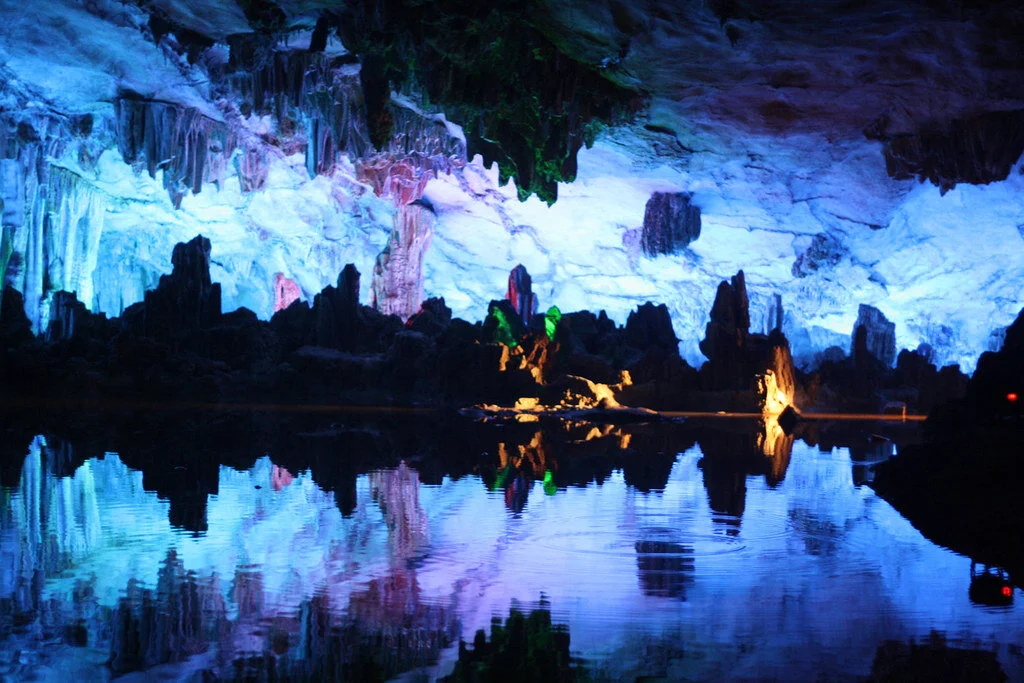
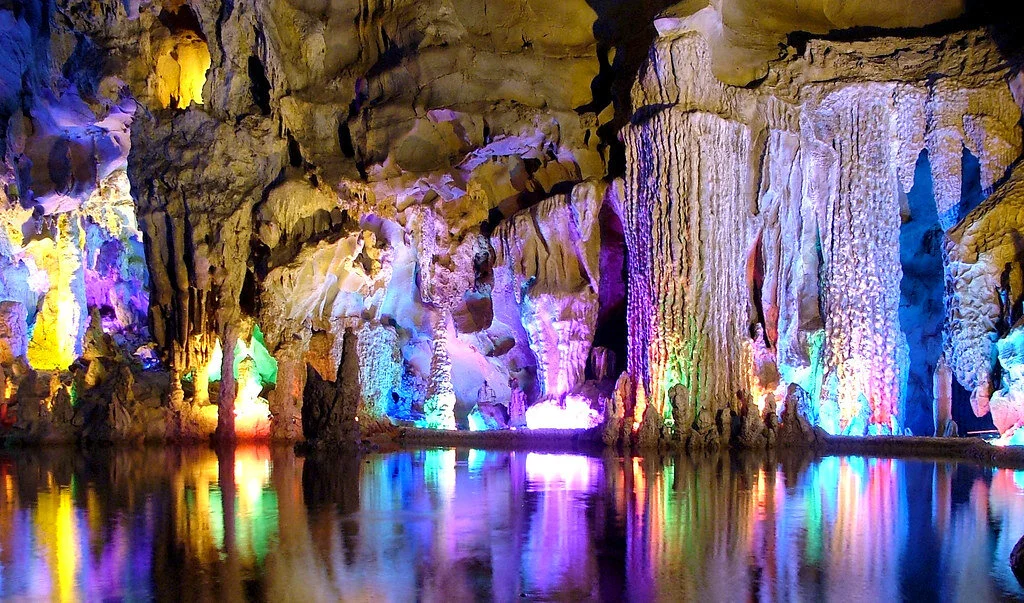
Called “the Palace of Natural Art,” Reed Flute Cave is known for its impressive stone curtains and pillars. Reed Flute Cave is located just 3 miles from downtown Guilin, China, and has been an attraction for centuries. Seventy-seven inscriptions of poems and travel descriptions can be found around the cave, and the oldest dates back to 790 A.D., the era of the Tang dynasty. There are inscriptions from the Tang, Song, Yuan and Ming dynasties, written by monks, poets, scholars and tourists from all over China. Today, the cave is lit by many multicolored lights hidden in its natural cracks and crevices, which cast a bright rainbow glow around the dark space, giving cave visitors a surreal and breathtaking experience. The cave was forgotten for years until its rediscovery in 1940, when a group of Chinese refugees stumbled upon it while fleeing from Japanese forces. During World War II, the cave’s large chamber, called the “Crystal Palace of the Dragon King,” was used as a bomb shelter. The cave regained popularity after its rediscovery at the end of the war, and was officially opened to the public in 1962. 

2. Waitomo Glowworm Caves, New Zealand 

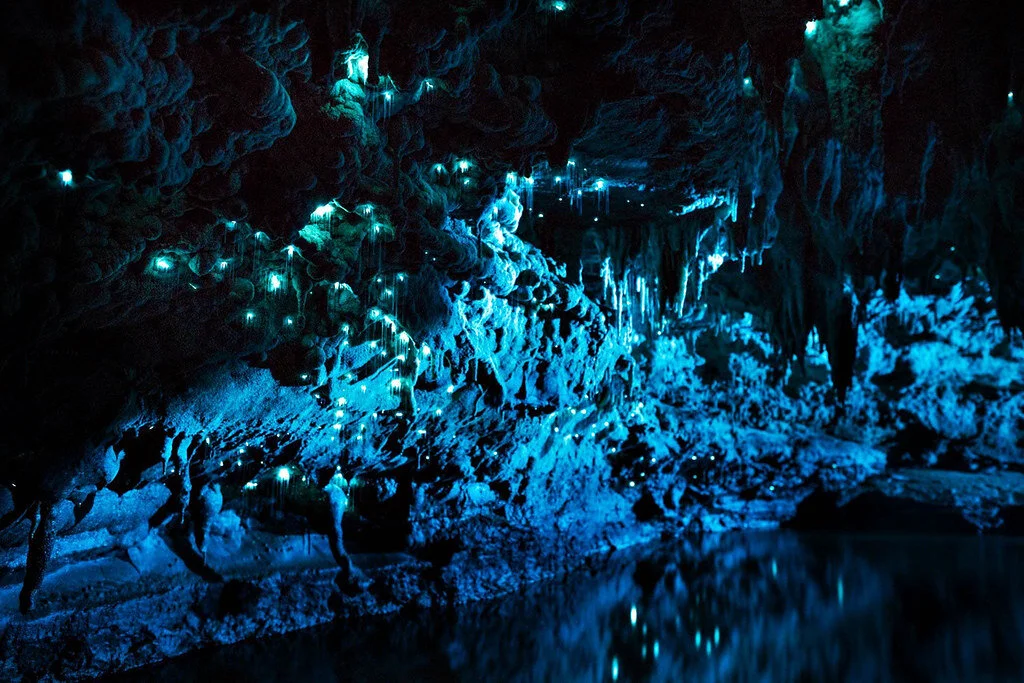
Visitors to the Waitomo Glowworm Caves will take a trip into the past by exploring a cave over 30 million years old. The cave, located in Waitomo on the North Island of New Zealand,  is praised as one of New Zealand’s best natural attractions. It contains an underground river, towering rock formations, and thousands of shimmering glowworms. The Glowworm Caves have been an attraction for over 130 years. These limestone caves formed at the bottom of the ocean millions of years ago. Local Maori communities knew about the caves, but they were first explored in 1887 by Maori Chief Tane Tinorau and English surveyor Fred Mace. After discovering the natural beauty of the caves, Chief Tinorau opened the caves to tourists in 1889. Many of the guides for tours today are descendants of Chief Tinorau. Guides take visitors on walking tours through the caves, as well as boat tours through the glowworm grotto. These boat tours take visitors to the center of the grotto, where they can look up in awe at the luminescent glowworms covering the cave walls and ceiling.  

3. Mendenhall Ice Caves, Alaska

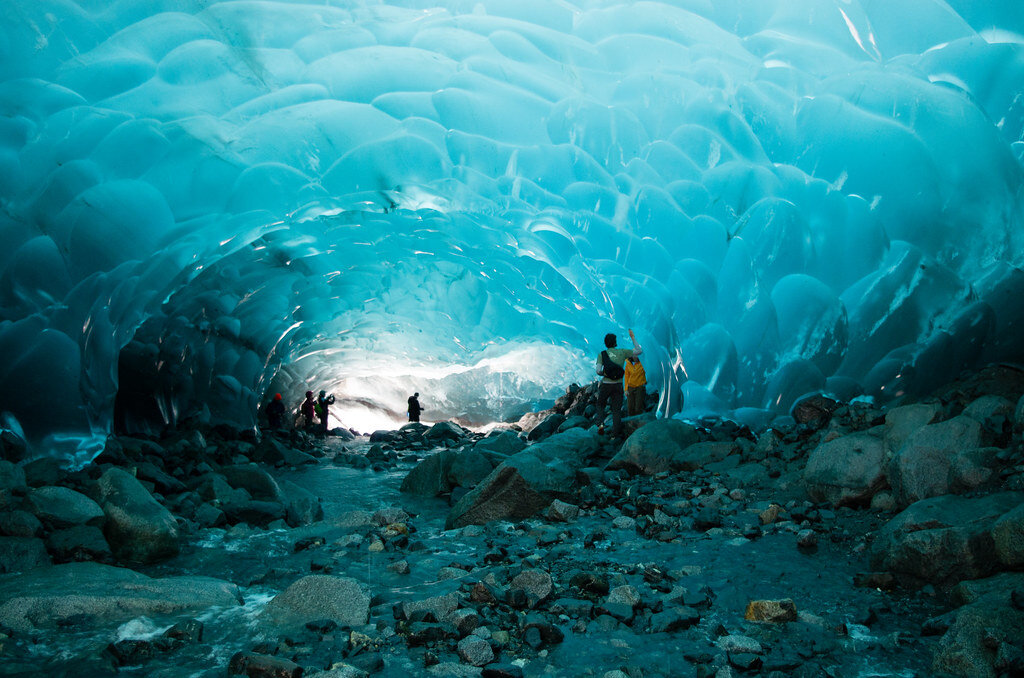
Just 12 miles outside downtown Juneau lies Mendenhall Glacier, known as the “Glacier Behind the Town.” Inside the glacier are the Mendenhall ice caves, passageways formed by water flowing through the glacier. These caves vary in size from tiny openings visitors have to squeeze through to giant caverns. Mendenhall Glacier was first explored in 1794 by Joseph Whidbey, a member of the British Royal Navy serving on Capt. George Vancouver’s 1791-95 expedition of the Pacific Northwest coast. To visit the caves, travelers can hike through the Tongass National Forest and then across the glacier, or they can canoe across Mendenhall Lake to the glacier. Both options offer breathtaking views of the glacier and surrounding landscapes, and both are somewhat strenuous but well worth the effort. Inside the caves, visitors are immersed in the cool blue shades of light coming through the glacier and can explore ever-changing ice formations. The caves change as the ice melts, so each visit to the Mendenhall ice caves is unique. The presence of the caves is also inconsistent and typically seasonal, so visitors should be sure to check on the status of the caves before planning a trip. 

4. Barton Creek Cave, Belize

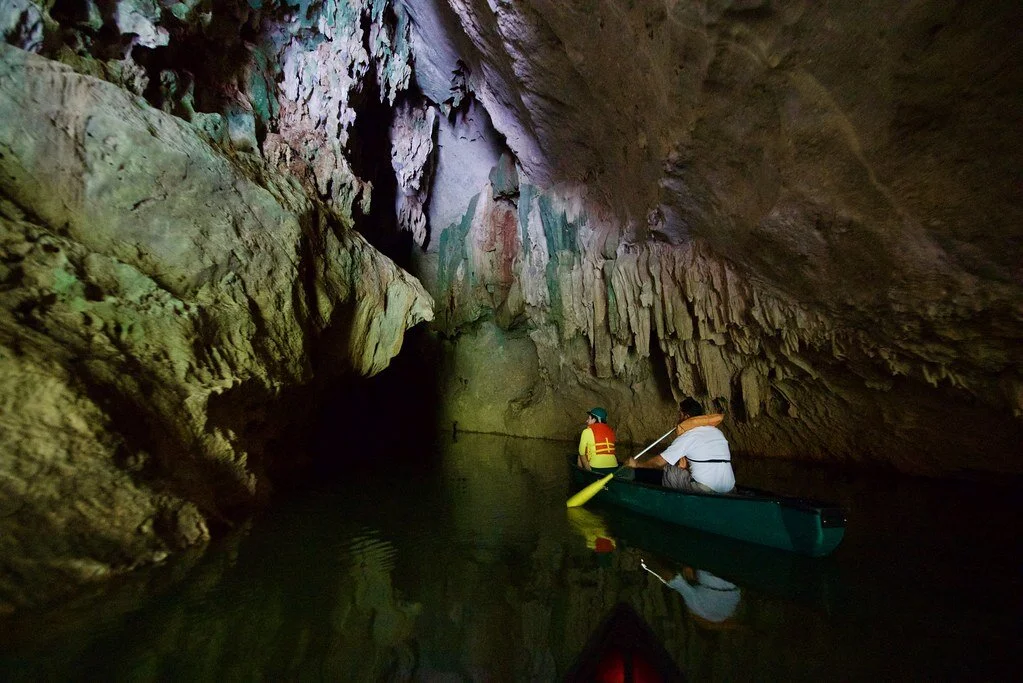
To discover the wonders of Barton Creek Cave, visitors will have to board a canoe. Barton Creek Cave is located east of San Ignacio along the western edge of Belize. It is a wet cave because it has a cave river running through it, and paddling along this tranquil river is the only way to take in the cave’s majesty and history. It is the largest river cave in Belize and contains evidence of ancient Mayan culture. The cave is natural, but archaeologists have identified a number of areas they believe were purposefully modified by the Mayans to improve access to the cave. These modifications include natural formations of flowstone broken to allow access to a rimstone pool and holes drilled by Mayan tools, likely to serve as handholds or to attach climbing ropes. Ten ledges made by the Maya line the cave walls, where archaeologists have discovered thousands of pottery shards, most of which are from large jars called ollas, and a number of stone tools. These discoveries have helped archaeologists determine the use of the cave during Mayan times; it was likely the site of ritual activity and worship. The Maya regarded caves as sacred sites, and the artifacts found in Barton Creek Cave reflect this view. Tours through the cave offer visitors the opportunity to witness incredible natural formations and to learn how the ancient Mayans interacted with the cave. 

 5. Hang Son Doong, Vietnam 

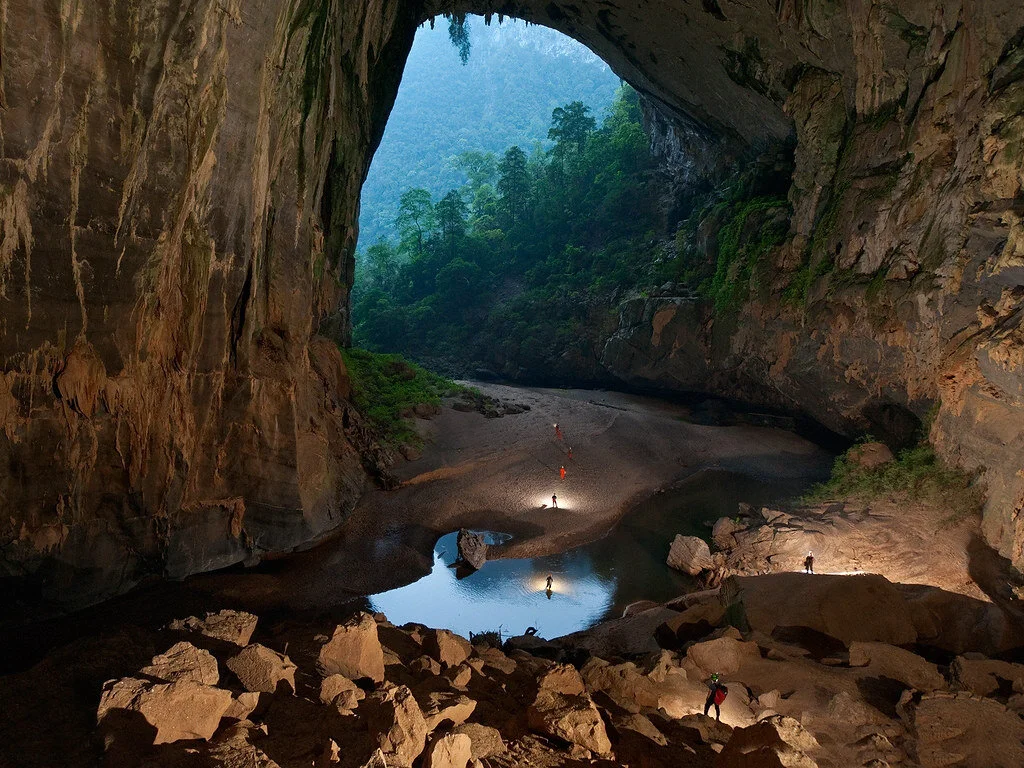
For travelers who want to explore a cave but worry about darkness and small spaces, Son Doong Cave in central Vietnam is the perfect place to visit. Son Doong has the largest cross section of any cave in the world, reaching over 5 miles long, 650 feet wide and 490 feet tall. In some areas, the limestone ceiling of the cave grew weak and collapsed, creating huge skylights and allowing areas of lush vegetation to grow inside the cave. It was formed millions of years ago by the Rao Thuong River eroding limestone. Son Doong Cave was initially discovered in 1990 by a local man named Ho Khanh, who stumbled upon the entrance while searching the area for food and timber. He then returned home and no further exploration of the cave occurred until Howard and Deb Limbert, members of the British Cave Research Association, heard Ho Khanh’s story and urged him to find the cave again. In 2008, he successfully rediscovered the cave, and a survey was conducted by Howard Limbert and a group of British cavers. The cave opened to the public in 2013. Visitors are sure to be impressed by the sheer size of the cave, as well as its natural formations, river and distinctive vegetation growth. 

6. Puerto Princesa Underground River, Philippines

Located on Palawan, the westernmost island in the Philippines, Puerto Princesa Subterranean River National Park is home to old-growth forests, wildlife and an expansive limestone cave system. The Puerto Princesa Underground River, as it is commonly known, flows for over five miles through beautiful caverns and eventually meets the sea. Visitors can take underground river tours on paddleboats to see the stunning cave formations and limestone cliffs, as well as a variety of native animal species. There are records of the Puerto Princesa Underground River dating back to 1898, but it is believed to have been known to early inhabitants of the Philippines and investigated by foreign explorers prior to that time. The area was established as an official attraction in 1971, and the cave system is still being explored. In 2010, researchers discovered a large cave dome above the underground river, with more river channels and access to an even deeper cave. The Puerto Princesa Underground River offers an abundance of fascinating natural formations to explore. 

7. Shell Grotto, England 

Shell Grotto is one of England’s most mysterious sites, encompassing over 70 feet of tunnels under the seaside town of Margate. These caves were discovered by chance in 1835, when a man excavating his new land stumbled upon them. Sprawling mosaics made of mussel, oyster, whelk and cockle shells cover every wall of the tunnels. Historians are unsure of who built Shell Grotto, or why. Theories range from Shell Grotto being a place of worship to a simple display of extreme wealth to the meeting room of a secret society. The elaborate shell designs offer little explanation, displaying swirling patterns that can be interpreted as a number of different things. Shell Grotto is a tremendous work of art, and the questions surrounding its origin and purpose add a layer of intrigue that draws visitors from around the world. 


Rachel Lynch

Rachel is a student at Sarah Lawrence College in Bronxville, NY currently taking a semester off. She plans to study Writing and Child Development. Rachel loves to travel and is inspired by the places she’s been and everywhere she wants to go. She hopes to educate people on social justice issues and the history and culture of travel destinations through her writing.

U.S. House Passes Bill Repealing Prevention of Abortion Abroad

A new U.S. State Department spending bill includes provisions that expand global abortion rights. The bill passed in the House on July 28 and requires Senate approval by Sept. 30. 

On July 28, the U.S. House of Representatives passed a Department of State, foreign operations and related programs budget bill for the 2022 fiscal year. If the bill passes in the Senate and becomes law, it will have major implications for the global health industry. 

The bill is the first of its type since 1973 to exclude language from the Helms Amendment, which blocks U.S. foreign aid money from funding health services abroad related to abortions. 

The Helms Amendment’s language specifically prevents U.S. funds from paying for abortions as a method of family planning—yet foreign aid organizations have interpreted the amendment much more restrictively, to ban funding for abortions in other cases, such as rape, incest and life-threatening pregnancies. USAID has used the amendment to enforce a ban on the purchase of equipment and drugs to aid in post-abortion care. 

Around 73 million abortions occur annually worldwide, even in countries where access to abortions is restricted. In fact, data shows that abortion rates are often higher in countries where abortion is restricted than in those where abortion is legal. Abortion restrictions, which the Helms Amendment helps to maintain, do not mean that pregnant people are not getting abortions—they just mean that access to safe abortions is severely limited. 

The World Health Organization defines an unsafe abortion as one carried out by a person lacking the necessary skills or in an environment that does not meet minimal medical standards. Out of the 73 million annual abortions, nearly 35 million are estimated to occur in unsafe conditions. Unsafe abortions account for 8% of maternal mortality worldwide; each year about 47,000 women die from unsafe abortions. 

Unsafe abortions occur overwhelmingly in developing countries, where U.S. funding could be crucial to removing obstacles for safe abortions.  

The recent bill also permanently repealed the 1984 Global Gag Rule, which prevented foreign non-governmental organizations that were receiving U.S. funding from providing assistance on anything related to abortions, including information, referrals, or services. The Global Gag Rule banned such foreign organizations from providing abortion-related assistance even if they used their own, non-U.S. funds. 

A 2019 study found that the Global Gag Rule effectively prevented NGOs from providing functional reproductive health services. The rule caused NGOs to reduce sexual and reproductive health and pregnancy counseling and stop providing information on legal abortion services. The Global Gag Rule also prevents NGOs from involvement in pro-abortion advocacy. 

The U.S. is the largest funder and implementer of global health worldwide, but for nearly 50 years, the Helms Amendment and the Global Gag Rule have meant that a large portion of the healthcare sector misses out on this funding. Rather than preventing abortions, this legislation has served as further obstacles for people seeking safe abortions. Therefore, their exclusion from the most recent U.S. foreign spending budget bill is monumental. 

In addition to the provisions regarding the Helms Amendment and Global Gag Rule, the bill allocated $760 million for family planning and reproductive health services, an $185 million increase from last year’s bill. 

The spending bill passed in the House by a slim majority of 217 to 212. To become law, the bill must pass the Senate in the same form. The final 2022 fiscal year budget needs to be approved by Sept. 30

If the bill passes the Senate without mention of the Helms Amendment and with the inclusion of the Global Gag Rule repeal, it will become a landmark piece of legislation for sexual and reproductive health rights around the world. 

To Get Involved: 

For more information about global reproductive health policy and how you can support initiatives to make safe abortions accessible, visit the Guttmacher Institute here or PAI here


Rachel Lynch

Rachel is a student at Sarah Lawrence College in Bronxville, NY currently taking a semester off. She plans to study Writing and Child Development. Rachel loves to travel and is inspired by the places she’s been and everywhere she wants to go. She hopes to educate people on social justice issues and the history and culture of travel destinations through her writing.