Students Across Europe Protest in Hopes of a Greener Future

After years of political gridlock surrounding climate change legislation, students emerge as a force for change.

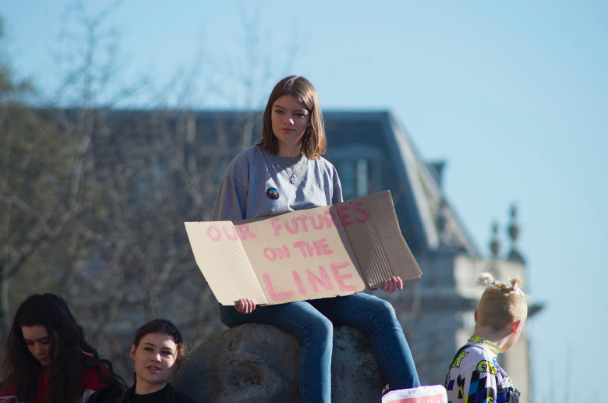
Photo of a student protester. By Josh Barwick on Unsplash.

Thousands of students across Europe left school on Friday, February 15 to protest the lack of action on climate issues in their countries. In what the New York Times called a “coordinated walk out for action on climate issues,” elementary, middle, high school, and undergraduate students came together to demand a greener future. In London, protestors held signs reading “The ocean is rising and so are we” and “Act now or swim later.”

The student-led movement for climate action that is currently taking Europe by storm began with 16-year-old Swedish activist Greta Thunberg. In September, Thunberg started skipping class to stage sit-ins at the Swedish parliament, demanding that her government seriously address climate change. Thunberg’s action inspired teens worldwide, some of whom created the global movement Youth Strike 4 Climate and began organizing protests and walkouts, using social media to coordinate efforts. According to the New York Times, demonstrations have been held in Belgium, Britain, France, Germany, Ireland, Sweden, and Switzerland, among others.

The New York Times writes that the new organization gained even more energy in October of 2018 when a report from the UN’s Intergovernmental Panel on Climate Change disclosed that the world has only twelve years to change its climate policy before the consequences of inaction such as food shortages, rising sea levels, floods and forest fires manifest themselves.

Thunberg remains a notable voice in the movement she inspired, and went on to speak at the global climate-change conference in Poland last December. “You say you love your children above all else — and yet you are stealing their future in front of their very eyes,” she told politicians at the conference. “Until you start focusing on what needs to be done rather than what is politically possible, there is no hope. We cannot solve a crisis without treating it as a crisis.”

In British schools, protesters received mixed reactions from teachers and staff. While some encouraged students, others threatened to punish them for skipping class. “My school was not supportive at the start. They said I would get detention for unauthorized absence,” Anna Taylor, the seventeen-year-old co-founder of the UK Student Climate Network told the New York Times.

Sixteen-year-old Bonnie Morely, who was attending the strike with friends from school, told the New York Times that a head teacher had taken down posters advertising the strike in her school’s common areas. “They’re treating us like we are doing something really wrong,” Morley said. “The future of our planet is looking really bleak, and all the politicians are asleep at the wheel. We have to wake them up, and I think thousands of kids on the streets will do just that.”

Like the teachers, European politicians displayed mixed reactions, with some supporting the students and others going so far as to suggest that the strikes were the product of a secret governmental organization.

According to the New York Times, a spokesperson for British Prime Minister Theresa May said that, “everybody wants young people to be engaged in the issues that affect them most so that we can build a brighter future for all of us. But it is important to emphasize that disruption increases teachers’ workloads and wastes lesson time that teachers have carefully prepared for.”

Thunberg tweeted in response: “British PM says that the children on school strike are ‘wasting lesson time.’ That may well be the case, but then again, political leaders have wasted 30 years of inaction. And that is slightly worse.”

“We don’t miss school because we’re lazy or because we don’t want to go to school,” Jakob Blasel, a high school student who assisted with the organization of an earlier protest in Berlin told the Washington Post. “We can’t go to school, because we have to strike. We have to deliver an uncomfortable message to our leaders that it can’t go on this way.”

Youth for climate is currently planning another round of protests and another global youth strike for March 15. The movement is growing and more students from nations across the world are expected to join.


Emma Bruce

Emma Bruce is an undergraduate student studying English and marketing at Emerson College in Boston. While not writing she explores the nearest museums, reads poetry, and takes classes at her local dance studio. She is passionate about sustainable travel and can't wait to see where life will take her. 

An Island Disappears off the Coast of Japan

It remained unnoticed until local fishermen investigated.

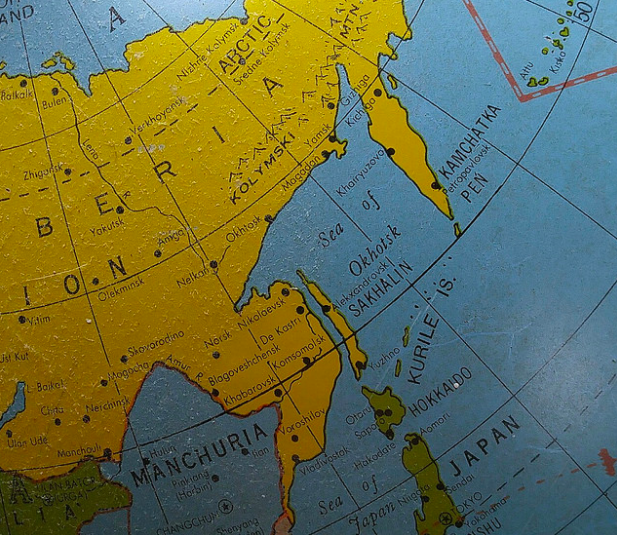
Vintage globe depicting the Sea of Okhotsk. Robin Ottawa. CC BY-SA 2.0

This fall, Esanbe Hamakita Kojima, a tiny island off the northeast coast of Japan dropped out of sight. The island’s disappearance went unnoticed by inhabitants of the nearby village of Sarufutsu, situated on the northern tip of Hokkaido island only 1,640 feet away.

It wasn’t until September, when author Hiroshi Shimizu traveled to Sarufutsu to gather inspiration for his picture book on Japan’s islands, that authorities were notified of the island’s disappearance. Shimizu had been looking for the island but couldn’t locate it. He informed local fisherman who went out to investigate and finally noted that Esanbe was missing.

When Japan’s Coast Guard last surveyed the island in 1987, it was only 4.5 feet above sea level. Authorities could not confirm how large the island had been before the sea rose around it.

Esanbe is west of Japan’s Northern Territories and part of a set of islands that has been long-contested between Japan and Russia. The islands, called the Kurils by Russia, were taken by the Soviets shortly after World War II, but ownership today remains unclear. According to CNN, Esanbe functions as a marker of Japanese ownership in contested waters. But the strategy of claiming islands to maintain the maritime space around them is not exclusive to Esanbe. In fact, according to the Washington Post, Japan owns 158 uninhabited islands that the country named in 2014 so that the sea surrounding them could remain in Japanese control.

Thus, the disappearance of the island may have a slight effect on Japan’s territorial waters, as according to international law, countries can only claim ownership of the sea around an island if that island is visible at high tide. Coast Guard officials in Japan confirmed that Esanbe’s loss, “may affect Japan's territorial waters a tiny bit.” With the island underwater, Japan will have lost approximately 1,640 feet of territorial water.

The island’s disappearance was likely due to erosion by the wind and drift ice common in the Sea of Okhotsk each winter. According to coast guard official Tomoo Fujii, “There is a possibility that the islet has been eroded by wind and snow and, as a result, disappeared,” Asahi Shimbun of the Japanese Daily reported.

According to the Smithsonian, disappearances of land masses in this area of Japan are not unlikely. The good news for Japan’s border, however, is that this phenomenon can occur in reverse. Five years ago, a 1000-foot long island rose out of the sea, prompted by a landslide.


EMMA BRUCE is an undergraduate student studying English and marketing at Emerson College in Boston. While not writing she explores the nearest museums, reads poetry, and takes classes at her local dance studio. She is passionate about sustainable travel and can't wait to see where life will take her. 

Death Toll Rises in Tijuana

A few miles south of San Diego lies Tijuana, a favorite weekend getaway for Americans. Some Californians have even taken to living in Tijuana permanently to escape their state’s rising housing costs. However, life in Tijuana has changed drastically over the last few years as conflicts between rival drug cartels have caused the city’s murder rate to skyrocket. The situation presents a new set of risks for those wanting to visit the ever-popular tourist trap.

Read More

Tides of Change : Japan to Resume Commercial Whaling

For more than thirty years, the island nation of Japan has fought to expand its commercial whaling operations. That fight has mostly been a losing one, with its efforts often being blocked by anti-whaling countries around the world and condemned by the International Whaling Commission, an organization whose members include Japan itself. However, Japan’s recently proposed exit from the commission will allow the country to reclaim one of its most time-honored traditions, and the move is drawing international criticism.

Two Minke Whales being loaded onto the Nisshin Maru. The ship has facilities on board which allow it to freeze and process whales while at sea. Australian Customs and Border Protection Service. CC BY-SA 3.0

In 1982 the International Whaling Commission, or IWC, imposed a global moratorium on all commercial whaling, save for subsistence whaling by Aboriginal communities. The moratorium went into effect in 1985 and was met with opposition from Iceland, Norway, and Japan, countries with strong whaling traditions. In Japan, whale meat generally served the same purpose that beef or lamb served in Western societies and this was especially true during hard times. In the 1940s as the country was recovering from World War 2, whale meat was the single most consumed meat among Japanese people, and it remained so through the 1960s. After the announcement of the IWC’s whaling ban, Japan petitioned for the right to continue whaling in the Antarctic for “scientific purposes” though the specific nature of its research remained unclear. Whale activists claimed that this “research whaling” was in fact, commercial whaling in disguise, and vessels like the Nisshin Maru, Japan’s largest whaling vessel and the world's only factory whaling ship, became a frequent target of animals rights groups, with some going so far as to board vessels of their own and try to disrupt the Maru’s whaling expeditions by obstructing its path. Earlier this year, Japan expressed a desire to develop new ships, fast enough to outrun those of the activists, but the plan appears to have been scrapped, as the Japanese government announced in late December that it will formally withdraw from the IWC, discontinue its operations in the Antarctic and resume commercial whaling operations in its own coastal waters. Though the demand for whale meat has diminished somewhat in Japan, the practice of whale fishing is still considered by many to be intrinsic to the country’s cultural identity.


Environmental conservation hinges on the idea that some of the Earth’s resources are non-renewable. Humans can hunt an animal to extinction, and that extinction creates an imbalance in the ecosystem that the animal once belonged to. The effects of that imbalance can, in turn, come back to haunt humans, either directly or indirectly. These are, however, relatively young ideas, and pitting them against hundreds of years of tradition is sure to be a test for all parties involved.


JONATHAN ROBINSON is an intern at CATALYST. He is a travel enthusiast always adding new people, places, experiences to his story. He hopes to use writing as a means to connect with others like himself. 


France Banned Food Waste in Supermarkets

Millions more meals can reach those who need them.

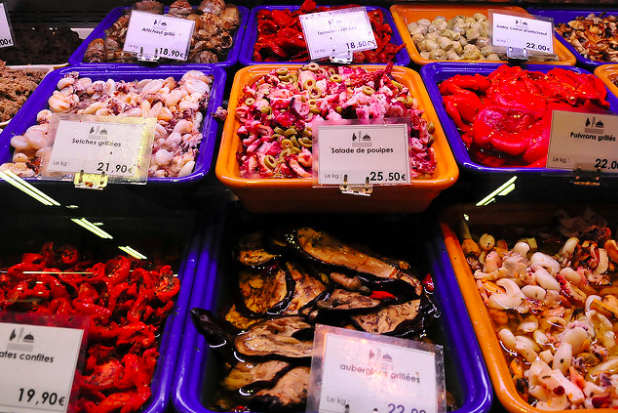
Produce at a market in Nice, France. M-Louis. CC BY-SA 2.0.

In 2016, France banned supermarkets from destroying or discarding unsold food products, requiring them to donate instead to food banks or local charities.

The law was written by Parliamentarian and former food industry minister Guillaume Garot, who believes that food waste is a national health and safety issue, akin to wearing a seatbelt. The campaign itself was the product of a grassroots movement by anti-poverty and food waste activists which eventually became a petition, lead by local councillor Arash Derambarsh.


Now that food waste has been outlawed in French supermarkets, Derambarsh has set his sights on European and ultimately global policy revisions around the issue. “Food is the basis of life, it is an elementary factor in our existence,” he told the Guardian.

While Derambarsh became a councillor to help people, he reports being called “naive and idealistic” because of the policy he hoped to implement surrounding food waste. “Perhaps it is naive to be concerned about other human beings, but I know what it is like to be hungry,” he said.

“When I was a law student living on about €400 a month after I’d paid my rent, I used to have one proper meal a day around 5pm. I’d eat pasta, or potatoes, but it’s hard to study or work if you are hungry and always thinking about where the next meal will come from.”

Now, grocery store managers in France with a 400 sq meter or larger footprint must sign contracts with local charities and food banks promising their edible expired items, or face a €3,750 ($4,500) fine per infringement.

According to Jacques Bailey, head of Banques Alimentaires, a network of french food banks, 5,000 charities rely on food banks, who in turn, receive almost half their donations from grocery stores. Under the law, these food banks are receiving larger amounts of better quality food products, enabling them to better reach the the people they serve. According to Bailey, an increase as small as 15% in donations from supermarkets will result in 10 million more meals served every year.


And yet, required donations are not the only way that France is fighting food waste. In 2014, Intermarche, one of the country’s supermarkets began selling produce that was deemed too “ugly” to sell at other markets. These “ugly” or misshapen produce are perfectly safe to eat, but have blemishes make them less marketable to consumers, resulting in their disposal before even seeing the grocery store isles. This initiative is particularly effective, as fresh fruits and vegetables are the most difficult items for charities and food banks to come by, and are necessary to a healthy diet. Intermarche’s initiative reached 13 million people after only one month of being implemented.


About a third of food produced is wasted worldwide. France has narrowed the food it wastes to 66 pounds per person every year. In comparison, Americans waste 200 billion pounds of food per year - 40% of all food produced in the country. The waste problem in America is partly due to the lack of regulation surrounding expiration dates, which are often selected at random and do not always reflect when items are safe to consume.


The rest of the world has a lot to learn from France’s policy. NPR writes that communities and governments worldwide are now reaching out to Garot, hoping for information that would help them reproduce France’s law in their own countries. Ultimately this change needs to be made, because, as Garot emphasized, supermarkets are not just businesses, they are places where humanity must be respected.


EMMA BRUCE is an undergraduate student studying English and marketing at Emerson College in Boston. While not writing she explores the nearest museums, reads poetry, and takes classes at her local dance studio. She is passionate about sustainable travel and can't wait to see where life will take her. 


Forgotten, but not Gone: Zika’s Return to the Media

Earlier this week the Duchess Sussex of Meghan Markle canceled a trip to Zambia, citing exhaustion and concerns over the presence of Zika virus in the country. The Zika virus had been rather dormant in the media over the last year, all but vanishing in the wake of Trump speeches, trade wars, and Brexit. It had, however, remained a constant concern for those living in certain countries or traveling to them. Markle’s encounter with the Zika virus and the subsequent headlines have helped to push it back into public view, and once again, questions are being raised about its origin, transmission, and what is being done to fight it.

The Duchess of Sussex. Office of the Governor - General - GG.govt.nz. CC BY 4.0.

The Zika virus was first discovered in the Zika Forest in Uganda in 1947. The first recorded carriers were monkeys, but the forest was also home to over 70 species of mosquitoes, and they became the primary source of viral transmission. The disease was eventually discovered in humans in 1952, but for the most part remained confined to animals until 2007, when the first human outbreak was documented on the Island of Yap in the Federated States of Micronesia. In 2015, the virus made international headlines when Latin America and the Caribbean saw an explosion of human-related cases. As was the case in Africa, mosquitoes were the main culprits of transmission. However, in 2016, the virus saw a sharp decline in new cases, and with it a decline in news coverage.

Adults infected with Zika often display no symptoms. Those who do usually report mild fevers, rashes and muscle pain. The impact on unborn babies is far more devastating. Zika infections during pregnancy have resulted in miscarriages and babies being born with microcephaly, a condition in which a child's head is much smaller than it should be (Markle and husband Prince Harry had recently announced that they were expecting a child, and concern for the child’s welfare was thought to be Markle's main concern when she opted out of her trip to Zambia).

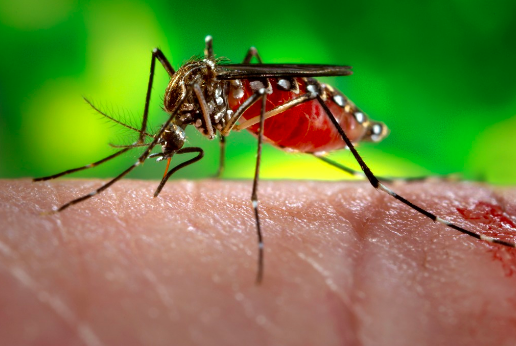
The Zika Virus is spread mainly through mosquito bites. James Gathany - https://phil.cdc.gov/phil/details.asp?pid=9257. Public Domain.

While a full-on cure for the virus remains elusive, health and government officials have been able to curb infections by going after the mosquitoes that carry and transmit the disease. In preparation for the 2016 Olympics in Rio de Janeiro, the Brazilian government launched a large-scale effort to fumigate the city for the insects, while in England a biotech company called Oxitec developed genetically modified mosquitoes, which, when released into the wild, would mate with infected mosquitoes and pass a gene on that would prevent those mosquitoes from reproducing. In the United States, The Centers for Disease Control made a point of advising those traveling to countries with high rates of infection to use insect repellants.

Microcephaly- a birth defect linked to the Zika virus. Centers for Disease Control and Prevention. Public Domain.

Many world issues persist despite the ebbing and flowing of news coverage. Though not the hot story it once was, the Zika virus is still a viable threat and will remain so until a vaccine is found. Those traveling to countries that have been deemed areas of risk should take all necessary precautions to prevent infection, or, like the Duchess of Sussex, simply the put the trip off until another time.


JONATHAN ROBINSON is an intern at CATALYST. He is a travel enthusiast always adding new people, places, experiences to his story. He hopes to use writing as a means to connect with others like himself. 
Mask off: How Beijing is Managing its Smog Problem

Earlier this month, California made national headlines when the worst wildfire in the state’s history covered parts of it in smoke, creating yet another worry for citizens already vexed by the high cost of living and rising homelessness. Some news stations, hoping to illustrate the seriousness of the matter, stressed that the air quality in California was “worse than Beijing’s,” an announcement that prompted many locals to don the air masks that one often sees in images of the Chinese capital. In media, locally, and abroad, Beijing has become synonymous with bad air. The internet is peppered with images of skyscrapers draped in brown or grey fog. But recent efforts by the government have made some headway in the battle with Beijing’s notorious smog and could give us insight into how to battle this problem at home.

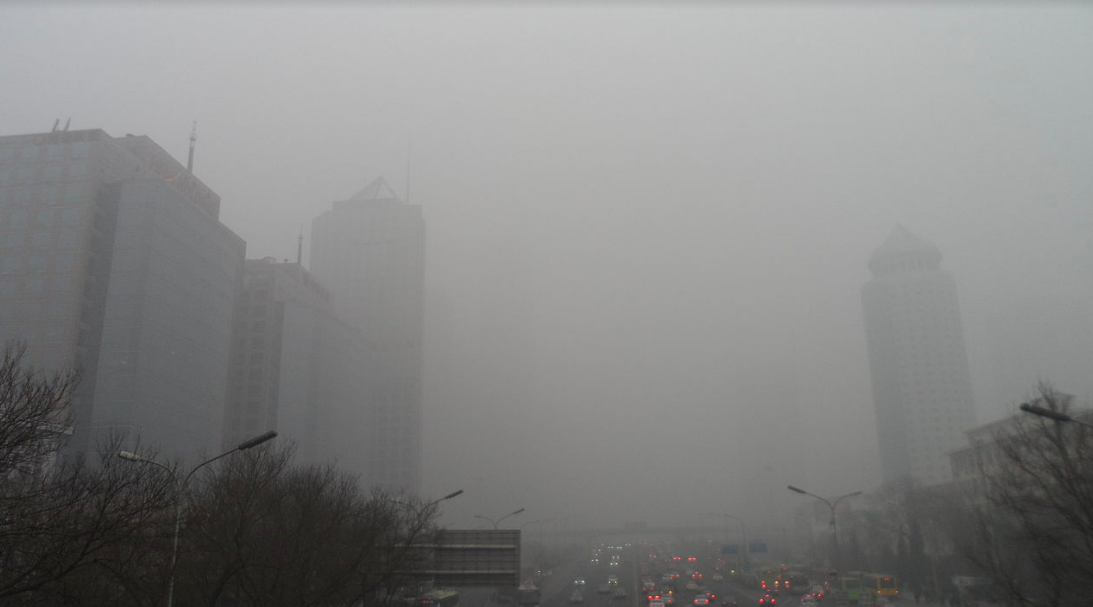
A smoggy day in Beijing. By 螺钉 - Own work, CC BY-SA 3.0, https://commons.wikimedia.org/w/index.php?curid=24944427

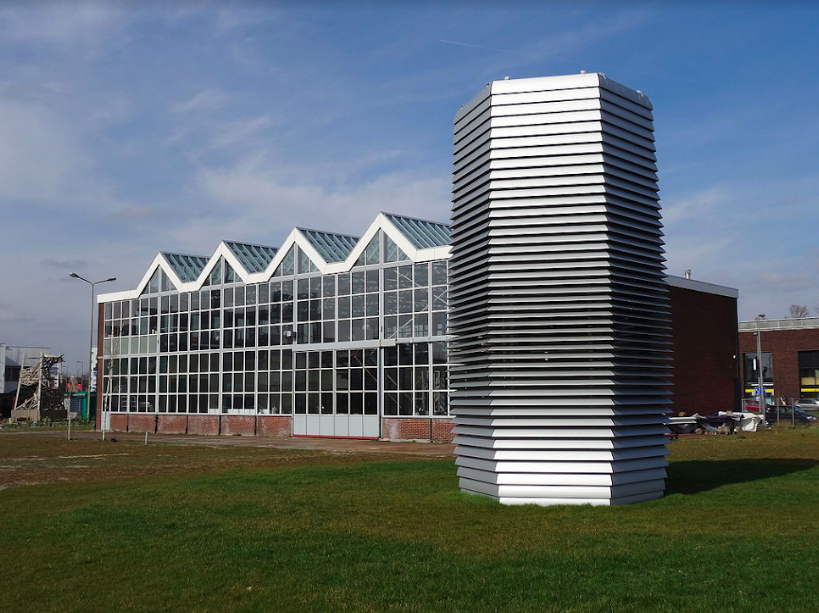
Those who have been to Beijing know that air quality is but one of many dangers; crossing an intersection can be like an action movie at times and drinking water out of the tap is generally a bad idea. Smog, however, is the issue most often associated with Beijing in the media. Fortunately, Beijing is aware of its reputation and has taken steps over the last few years to improve its air quality. The city has pledged to shut down 1000 manufacturing factories by 2020 to help reduce smog. It is also experimenting with new technology. Early last year Beijing employed the use a solar-powered air vacuum to help clean up the city’s air. Developed by Dutch designer Daan Roosegaarde, the Smog Free Tower sucks up 30,000 cubic meters of polluted air per hour. The air is then cleaned at a nano level and released back into the city. In a particularly bold move, Beijing's government is investigating the possibility of switching from coal to natural gas as the primary source of heating for millions of households. This shift will be implemented gradually, as concern for the well-being of Beijingers during the winter months supersedes the need for cleaner air.

Dan Roosegaardes's Smog Free Tower. By Bic - Own work, CC BY-SA 4.0, https://commons.wikimedia.org/w/index.php?curid=47801218

People can change, and ideally, their reputations will change as well. Beijing’s efforts to clean its air shows an environmental consciousness that contradicts its reputation as a dirty industrialized city. As smog becomes a more recurrent issue in cities and courtiers around the world, communities that once judged China for its smog may get to learn a thing or two about how to fight it.


JONATHAN ROBINSON is an intern at CATALYST. He is a travel enthusiast always adding new people, places, experiences to his story. He hopes to use writing as a means to connect with others like himself. 

Grappling with Sexism: Female Wrestlers in Mongolia

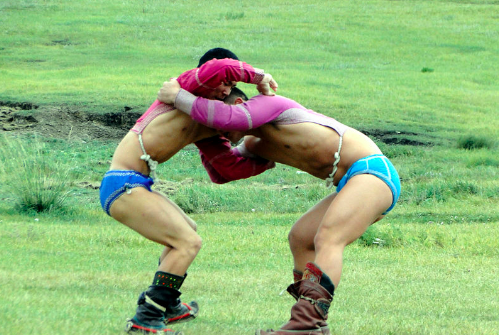
There’s an old legend in Mongolia: A woman wrestler once dressed up as a man and entered an all-male wrestling competition, defeating all challengers. She then pulled up her jacket and revealed her breasts, shocking everyone in attendance. From them on, all wrestlers were required to compete bare-chested, a failsafe to ensure that Mongolia’s prized “manly” tradition remained that way. While the legend may or may not be true, the practice of bare-chested wrestling in Mongolia is real, as is the practice of banning women from the sport. Despite achieving international fame in grappling, female Mongolian wrestlers are still unable to compete in their own native games.

Mongolian Wrestling. A. Omer Karamollaoglu. CC BY 2.0.

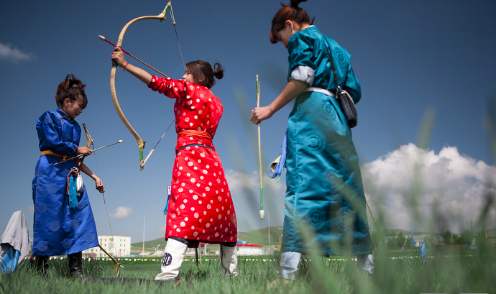
The Nadaam festival is held every year in July and is the single most anticipated sporting event in the country. Short for “Eriin Gurvan Naadam” (the three games of men), it is a celebration of the three traditional sports of Mongolia: wrestling, archery, and horseback riding. Nadaam dates back to the 13th century when Genghis Khan would throw celebrations for soldiers after successful military campaigns. After Kahn’s death, warlords continued the tradition, encouraging combat sports in order to prepare men for military service. Nadaam endured and developed throughout the centuries, and today, it is the Mongolian equivalent of the Super Bowl or World Cup. The games are typically held in July. Hundreds of small, county level events lead up to the main competition, which is held in the Mongolian capital of Ulaanbaatar. Wrestling is often featured as the centerpiece of the competition, and in Mongolian, is referred to as “Bokh,” which means “durability.”

Mongolia experienced a socialist revolution in 1921 that brought with it an emphasis on male-female equality and gradually these values led to women being allowed to compete in Nadaam, but only in archery and horse racing. To fill the void, female grapplers turned their attention to other grappling sports. Soronzonboldyn Battsetseg won a bronze medal for judo in the 2012 Olympics in London, while Sumiya Dorjsuren won a silver medal in judo in the 2016 Olympics and then went on to win gold in the World Judo Championships in 2017. Both women are national heroes in Mongolia, and yet, Nadaam remains closed to them.

Female archers preparing for Nadaam. Taylor Weidman. CC BY SA-3.0.

The fact that a sport has to be guarded against an entire group people suggests a fear that these people could be competent in the sport. Like the wrestler in the old legend, women grapplers like Soronzonboldyn and Sumiya are barred from competing in Bokh, not because they aren't capable, but because they are. Judo is a widely recognized grappling sport, practiced by professional athletes, law enforcement officials, and ordinary citizens in literally every country on the planet. It would not be a stretch to assume that the grit and skill required to master Judo would translate well to Mongolian Bokh, and that the current barring of women from Bokh in Mongolia seems to be more about maintaining a status quo than anything else. When female grapplers will have a chance to challenge this standard is anyone’s guess.


JONATHAN ROBINSON is an intern at CATALYST. He is a travel enthusiast always adding new people, places, experiences to his story. He hopes to use writing as a means to connect with others like himself. 
‘This is Africa’: Depictions of Black People in Mainland China

Earlier this year, Black Panther premiered in theaters around the world. The latest in a string of comic book-themed films turned out to be more of a cultural event than a mere movie. Black Panther broke records in the United States, as well as Great Britain, North and South Korea, and East and West Africa, dispelling the long-held Hollywood myth that “black films don’t travel.” Though fictional, the film struck a chord with audiences, as it featured a predominantly black cast and did not put them into the stereotypical roles often lamented by moviegoers. The film, however, was not as successful in Mainland China. Despite the fact that China is a major trading partner with the African continent, many Chinese moviegoers bristled at the idea of seeing Africans up close.

Chadwick Boseman, star of the movie Black Panther, appearing at Comic-Con in San Diego. Gaga Skidmore. CC BY SA-2.0

China was relatively closed to foreign trade until Deng Xiaoping's economic reform in 1978. Because of this, interactions with non-Chinese people are still a relatively new phenomenon. There is also a traditional standard in China that equates lighter skin with a comfortable, indoor lifestyle, and darker skin with peasantry, having to labor in fields under the hot sun. This combined with exposure to western media creates an environment that can be less than hospitable to blacks. Last year, an exhibit at the Hubei Provincial Museum in Wuhan titled, “This is Africa”, featured a portrait of a young African boy placed next to the portrait of a monkey. The exhibit was visited by over 100,000 people before criticism from the African community prompted museum officials to dismantle it, and the museum curator to take responsibility for the presentation. In February of this year, the same month Black Panther premiered, China’s Central China Television (CCTV) network came under fire when it aired a skit featuring a Chinese actor in blackface. Beijing issued a statement saying it was opposed to racism of any kind, but did not apologize for the skit.

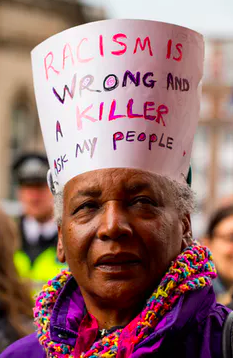
Western nations are by no means immune to racial prejudice. While the Civil Rights movement of the 1960’s attempted to resolve many of the racial schisms that split the United States, lingering prejudices remain in various parts of the country. In recent years, proponents of racism have become more desperate, and less discreet. In January, the president of the United States allegedly referred to El Salvador, Haiti, and various African nations as “shithole countries,” seemingly forgetting his role as chief diplomat. Perceptions of Africa, and by extension those of African descent, are still slanted by the media, and media still accounts for much of the world’s education. This creates a quandary for those who have to live day-to-day under the banner of these stereotypes.

The CCTV building in Beijing. Verdgris. CC BY SA-3.0


There are some things that we believe because it serves us to believe them. Racism today is more than mere ideology. Like sexism, racism has evolved into a cultural standard, feeding into a lifestyle standard that is enjoyed, or not enjoyed, by millions of people around the world. As we begin to tinker with the idea racism, we also tinker with the standards it creates in our societies-some people are bound to get upset. At the same time, this tinkering opens new possibilities for growth, for all the parties it applies to. It refutes old characterizations of people and cultures and encourages us to make connections that we may not have considered before. All change involves a degree of pain and uncertainty, but we can only move forward, confident that the benefits of our efforts will justify the challenges.


JONATHAN ROBINSON is an intern at CATALYST. He is a travel enthusiast always adding new people, places, experiences to his story. He hopes to use writing as a means to connect with others like himself. 


Indigenous Women in Canada Have Filed a Class Action Lawsuit Over Coerced Sterilization

This practice has affected over 60 women and is a product of racism in Canada’s medical system.

Royal University Hospital in Saskatchewan, Canada. Wendy Cooper. CC BY-NC-SA 2.0

While Canada is known for its progressive policies surrounding human rights and health care, this assumption can often lead to overlooking the country’s history of institutionalized discrimination against indigenous people.

Recently, sixty women have come forward to join a class action lawsuit against doctors in Saskatchewan demanding compensation for forced sterilization. According to a report in the Guardian, these women have had their fallopian tubes tied, burned, or cut, in public government funded hospitals when they were unable to properly consent. This practice not only violates medical ethics, but Canadian law. Although this practice was exposed in 2015, reported cases have continued up to 2017.

In an interview with NPR, Alisa Lombard, the lawyer representing the women said that, “while they were in the throes of labor, they would be approached, pressured, harassed to sign consent forms [for sterilization] in some cases. In other cases, there was no such signing of a consent form. And in yet other cases, they would revoke consent either on the operating table or shortly after they had actually signed.”

This new occurrence of forced sterilization follows a disturbing trend of forced or coerced sterilization that has disproportionately affected - if not only affected - women of color, women with disabilities, incarcerated women, and indigenous women. It stems from the eugenics movement of the nineteenth and twentieth centuries that used racist and ableist ideology to justify forced sterilization of people that were not seen as ‘fit’ to reproduce. The perpetuation of this warped and inhumane theory has become clearly evident in Canada’s upcoming lawsuit.

According to Lombard, “When Indigenous women go in for these health care services and reproductive health care services in the most vulnerable state, I think, a woman can be - having gone through childbirth myself, I can say that this is not the time to have a conversation about whether you ever want to do that again. There are other better times. And so why it happens in one simple word, I think we can just say discrimination - racism, quite plainly.”

Lombard and her team uncovered that Saskatchewan health cards are embossed with a capital R. She says that the R is part of a historic practice indicating that the person holding it is registered as an indigenous person. Thus, the patient’s identity is readily available to their doctor.

While the lawsuit has yet to be certified, Amnesty International said that they would lobby the UN Committee Against Torture in order to pressure the Canadian government to act. According to Amnesty’s Jacqueline Hansen, the organization has examined comparable instances of coerced or forced sterilization in Mexico, Chile, and Peru.

“It’s always done for a very specific reason. It is clear that it’s been linked to policies around wanting to ensure a group of people doesn’t reproduce,” Hansen told the Guardian. “Ultimately, this is about women who are supposed to have the right to make decisions about their bodies, having that right taken away from them.”


EMMA BRUCE is an undergraduate student studying English and marketing at Emerson College in Boston. While not writing she explores the nearest museums, reads poetry, and takes classes at her local dance studio. She is passionate about sustainable travel and can't wait to see where life will take her.