
A large portion of Ulaanbaatar’s population lives in traditional tent housing or gers and experiences some of the world’s worst pollution; sustainable energy may be the solution.
Read MorePaved Roads Not Necessary: Mongolian Road Trip
See temples, ride camels and enjoy desert views across the country.
Read MoreIn Mongolia, a Summer Festival for the Ages
For a few days in early July, the people of Mongolia eat, dance and play “the three games of men” during a storied festival called Naadam.
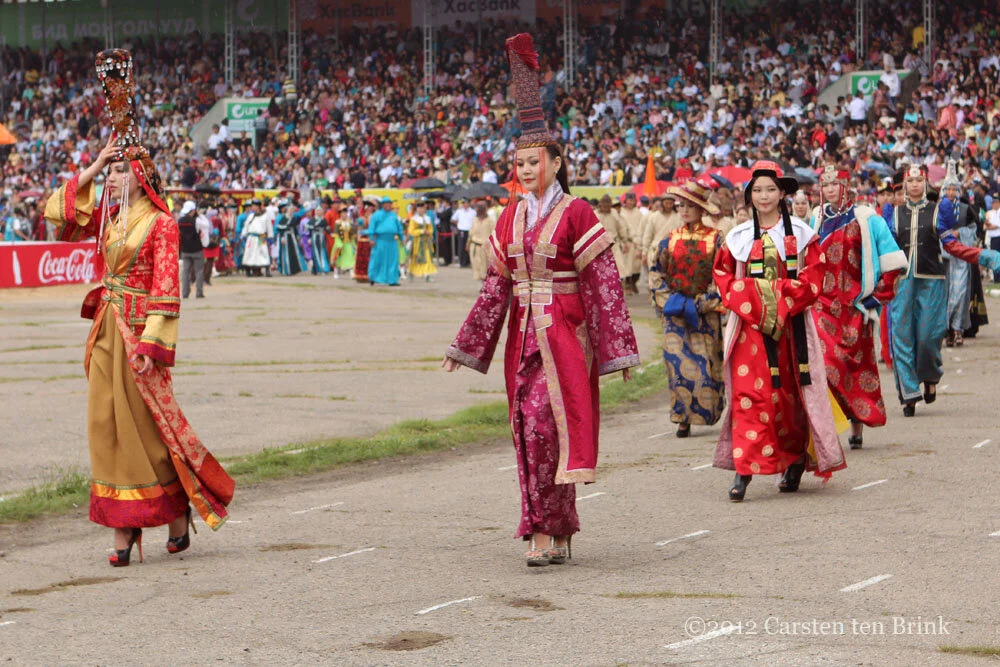
The 2012 Naadam opening ceremony in Ulaanbaatar. Carsten ten Brink. CC BY-NC-SA 2.0.
Mongolia is a country primarily known for its nomadic inhabitants and isolated location. Positioned between Russia and China, it is easily overlooked in the midst of these global giants. Its relative emptiness does not help matters; only 3.3 million people inhabit Mongolia’s 603,909 square miles , making it the least densely populated country in the world. But every summer, those 3.3 million come together in a celebration of sports, culture and Mongolia’s past. This celebration is called Naadam, and as far as festivals go, it is one of the last of its kind.
In ancient times, when Ghengis Khan and his horde of Mongols were inhabiting what would eventually become Mongolia, soldiers were selected for battle based on their skills in various sports. Wrestling, horse racing and archery in particular were activities that Khan believed a good soldier should, and would, excel at. Before and after battles, his battalions would organize and participate in sports competitions. These local competitions evolved into what Naadam is now.
As a consequence of the 1921 Mongolian People’s Revolution, which brought the nation independence from China, Naadam’s essence was altered. It was officially sanctioned as a national holiday, with a date set in the second week of July. Mongolia’s capital of Ulaanbaatar became the home of “National Naadam,” the biggest and most important celebration of the holiday. Most importantly, the festival became less of a violent competition and more of a national celebration; an emotional change which remains today.
Every celebration of Naadam features the three main sports of Mongolia; wrestling, horse racing and archery. All three sports have histories in Mongolia that are older than the country itself. For example: if a rock carving found in central Mongolia is anything to go by, wrestling competitions have been around in the county since the Bronze Age. Naadam features the grandest of all Mongolian wrestling competitions; up to a thousand or more take part in the Ulaanbaatar tournament. Before their matches, wrestlers often mimic local birds such as eagles, hawks and vultures. By doing well in the competition, wrestlers can receive titles based on these animals—“hawk of Ulaanbaatar,” for example, would be given to a wrestler who makes it to the final few rounds.
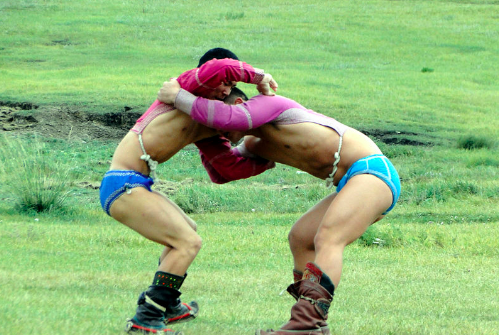
The final thing to note about Mongolian wrestling is the dress code, which is very particular. Wrestlers must don a four-sided hat, shorts, boots, and a shoulder vest that exposes the chest. The legend is that the open vest was put into practice after a woman snuck into the male-only wrestling competition in ancient times by pretending to be her father, and eventually won the competition. Such deceptions have been made impossible by exposing the chest of the wrestlers; to this day, Mongolian wrestling continues to be an exclusively male sport.
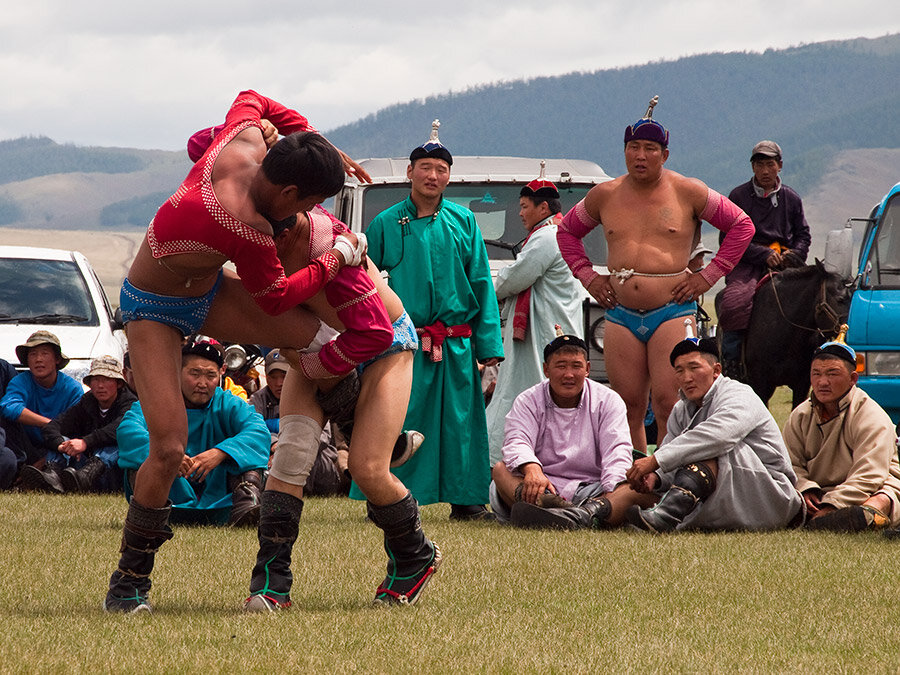
Naadam wrestling in the village of Tariat. Evgeni Zotov. CC BY-NC-ND 2.0
Horses are a large part of Mongolian life—nomadic tribes continue to depend exclusively on them for transportation. It follows that horse racing is extremely popular in the nation. According to Naadam’s official website, around 180,000 horses race during the holiday. All of Naadam’s races are very long in distance—at least in comparison to western competitions. The Kentucky Derby is about 1¼ miles long; a Naadam race can be up to ten times that.
Mongolian jockeys are incredibly wily and experienced; most Mongolians learn to ride a horse when they are just five years old. The jockeys treat their horses with incredible care. Before, after and even during the races, they are said to sing complimentary songs to their steeds.
The final sport of Naadam is archery, which is said to be even older than wrestling in Mongolia. Naadam’s official website hypothesizes that archery has been around in Mongolia since the Neolithic period, which ended in 4,500 BC. It was first used for hunting—later on, Ghengis Khan would employ it in his battles and sports competitions.
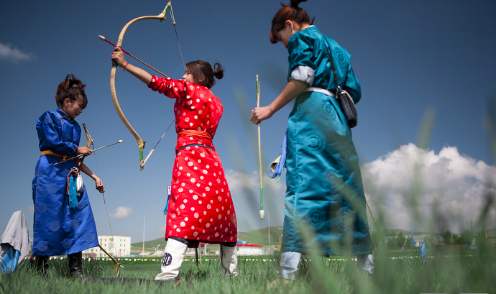
Male, female and child archers all compete at Naadam, wearing traditional costumes made of colorful cloth. There are three categories of the sport—Khalka, Buriat and Uriankhai—each of which come from different tribes and have different sets of rules. Only men are allowed to practice Uriankhai archery, for example.
While these three sports are the core of Naadam, the festival does not begin and end with them. There are smaller carnival games, singing and dancing. National cuisine is enjoyed; Khuushuur, a fried pancake with meat, is the most popular dish. Airag, a fermented, alcoholic drink made from horse milk, is also popular.
However, Naadam’s most important attribute is not the food, the history or the sports competitions. It is the fact that for a few summer days, the sparse vastness of Mongolia is filled. Whether in Ulaanbaatar or in a tiny village, Naadam brings Mongolians together to celebrate a culture that few in the world know anything about. This quiet happiness is the magic of Naadam; it is a magic that will continue long into the future.
Finn Hartnett
Finn grew up in New York City and is now a first-year at the University of Chicago. In addition to writing for Catalyst, he serves as a reporter for the Chicago Maroon. He spends his free time watching soccer and petting his cat
The Shamanistic Significance of the Mother Tree in Shaamar, Mongolia
This spiritual landmark represents the intersection between Buddhism and Shamanism within Mongolia.
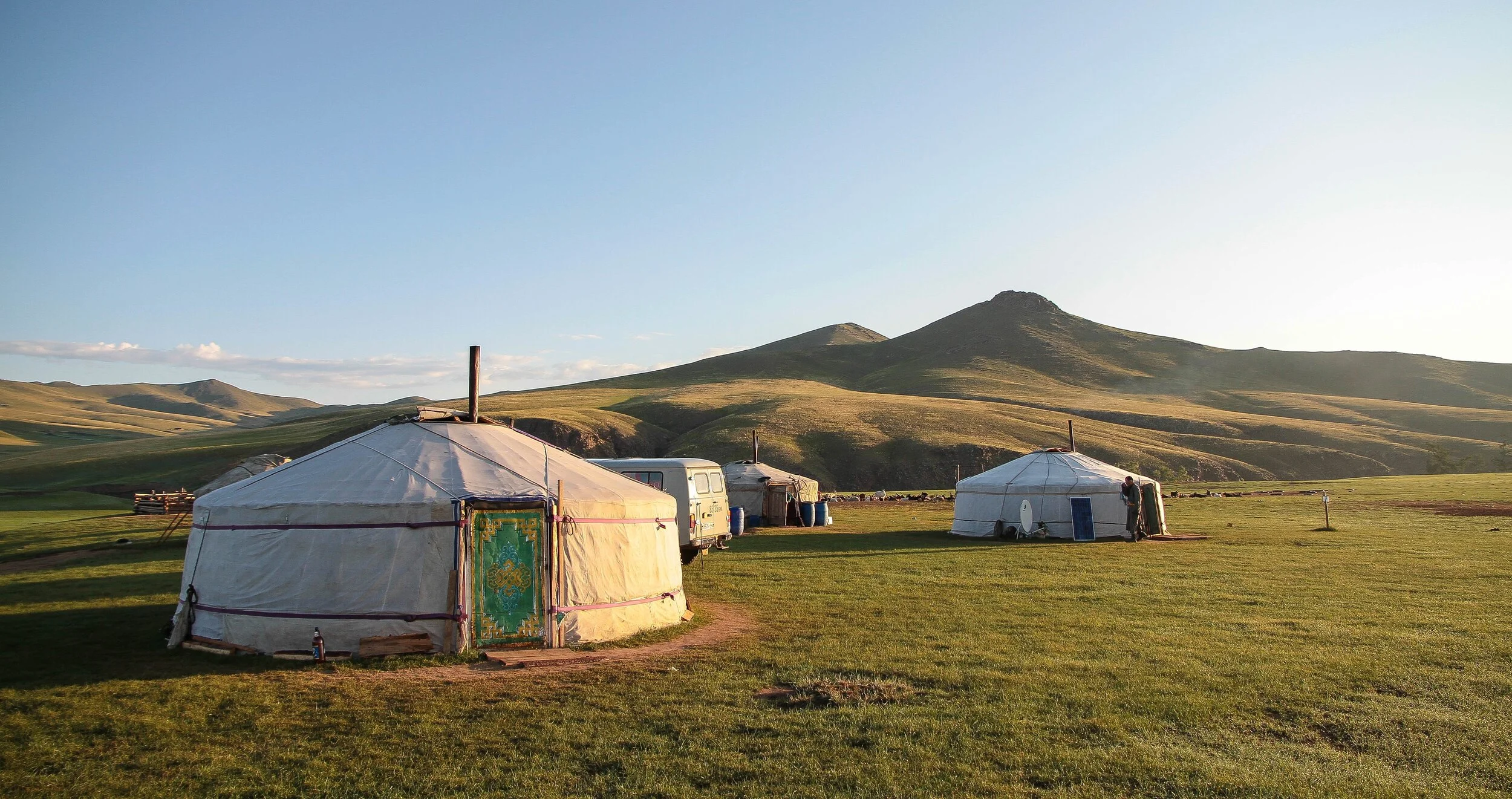
Sunrise over a cluster of Yurts in Mongolia. Vince Gx. Unsplash.
The Mother Tree is a spiritual landmark located in Shaamar, Mongolia that holds deep significance to those who practice Shamanism. Also known as the Eej Mod, the tree is believed to act as a gateway between the human and spiritual worlds. Many make the trek to the tree in hopes of having their prayers answered.
Shamanism is a religious practice that is centered around a shaman, an individual believed to communicate with the souls of the dead and heal others. A large part of shamanistic practices revolve around one’s profound connection to the abstract and spiritual. Thus, the Mother Tree serves as a means to channel and amplify that energy.
While Buddhism is the most commonly practiced religion in Mongolia today, Shamanism is one of the oldest, and still holds deep cultural significance in modern times. Many of those who practice Shamanism believe that the Mother Tree became a gateway to the spiritual world after being struck by lightning. It is believed that the Mother Tree marks the intersection between modern Buddhism and traditional Shamanism, like many monuments and sites in Mongolia tend to do. Rather than ignore the past, Mongolian traditions preserve it.
Trees have a profound significance in the Shamanism tradition—Sacred Trees were often placed in the center of a Shaman’s house to allow their spirits to be freed from the body. This was believed to send a Shaman into a deep trance that would let them ascend in spirit flight, or spiritual ecstasy.
The original Mother Tree was surrounded by a yurt, and it was very common for visitors to leave incense sticks near the site. However, in 2015, one visitor lit an incense stick too close to the tree, causing it to catch fire. Only a stump of the original tree was salvaged. Today, this stump is still visited by many and covered in ceremonial blue scarves to signify honor and respect and is soaked with milk and vodka
Finding the Mother Tree is no easy feat; it is located off of a main road in Shaamar with nothing but a small sign that reads “Eej Mod” to guide visitors. The Tree is located a few kilometers along tracks which split from the main road, but most visitors end up traveling with locals to ensure that they find it. Every year, visitors from as far as Japan, Korea and China make the trek to the Mother Tree to experience its spiritual powers and have their prayers answered.
Zara Irshad
Zara is a third year Communication student at the University of California, San Diego. Her passion for journalism comes from her love of storytelling and desire to learn about others. In addition to writing at CATALYST, she is an Opinion Writer for the UCSD Guardian, which allows her to incorporate various perspectives into her work.
VIDEO: Explore the Nomadic Lifestyle of Mongolia’s Kazakh People
To a typical western viewer, life on the Mongolian steppes is about as foreign as one could get. Training eagles to hunt, herding yaks and camels, and packing up your home into a saddlebag isn’t on a city-dweller’s itinerary. However, the nomadic culture of Mongolia is still very much alive, its people flourishing in the rugged grasslands of central Asia and preserving their traditions even as much of the world has moved away from a nomadic lifestyle. This video captures both the exhilaration and quiet intimacy of a group of families as they go about their daily lives. Though much of their day is spent on horseback, there is always time for rest, relaxation, and familial bonding– something everyone can relate to, nomadic or not.
Khoomei: Mongolian Throat Singing As Art and Action
Khoomei, otherwise known as Mongolian throat singing, enjoys a wide international audience thanks to inventive local artists looking for ways to share and save their culture.
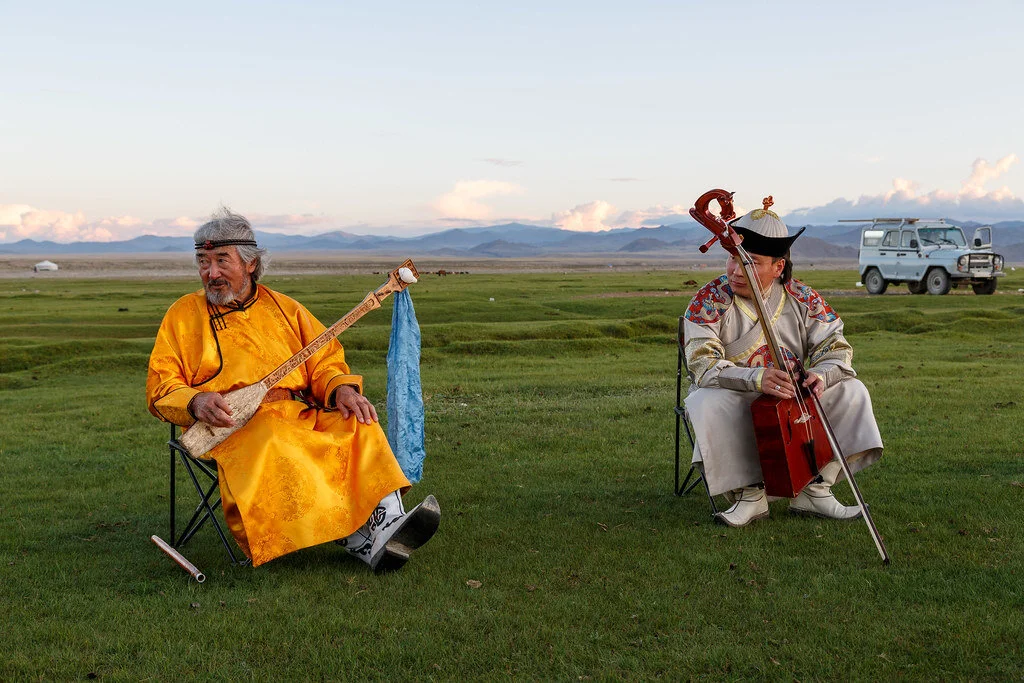
Mongolian throat singers holding a horsehead fiddle. Alan Fieldus. CC BY-NC 2.0.
Across the steppes of Central Asia, the almost eerie but melodic droning of “khoomei” still echoes. Khoomei, more commonly known as throat singing, is the practice in which a singer can produce two or more notes simultaneously. By utilizing the jaw and larynx, as well as precise lip movements, the singer can produce unique harmonies using only their body.
Khoomei, which translates to “throat” in Mongolian, has origins with the Tuva people, an Indigenous group found in parts of Siberia, Mongolia and China. A 1999 Scientific American article traced back both the techniques of khoomei and its rich history. According to Tuvan legends, throat singing was the first way humans learned to sing. Throat singing was also designed to mimic the natural sounds of the surrounding wind and water. Coupled with their animistic beliefs, the Tuvan people believed that throat singing also served a spiritual purpose. Khoomei eventually proliferated and evolved among the Turko-Mongol tribes.
During the first half of the 20th century, however, throat singing was restricted. Communist governments considered the art as “backward” due to its heavy ritual and ethnic legacies. It was not until the 1980s that throat singing was restored to its former glory and preserved as a national art form. In 2010, UNESCO inscribed khoomei on the Representative List of the Intangible Cultural Heritage of Humanity. This honor was conferred to officially acknowledge the unique oral histories and philosophies that khoomei harbors. Despite its difficult history and almost seemingly jubilant ascent, khoomei and its singers are still under threat.
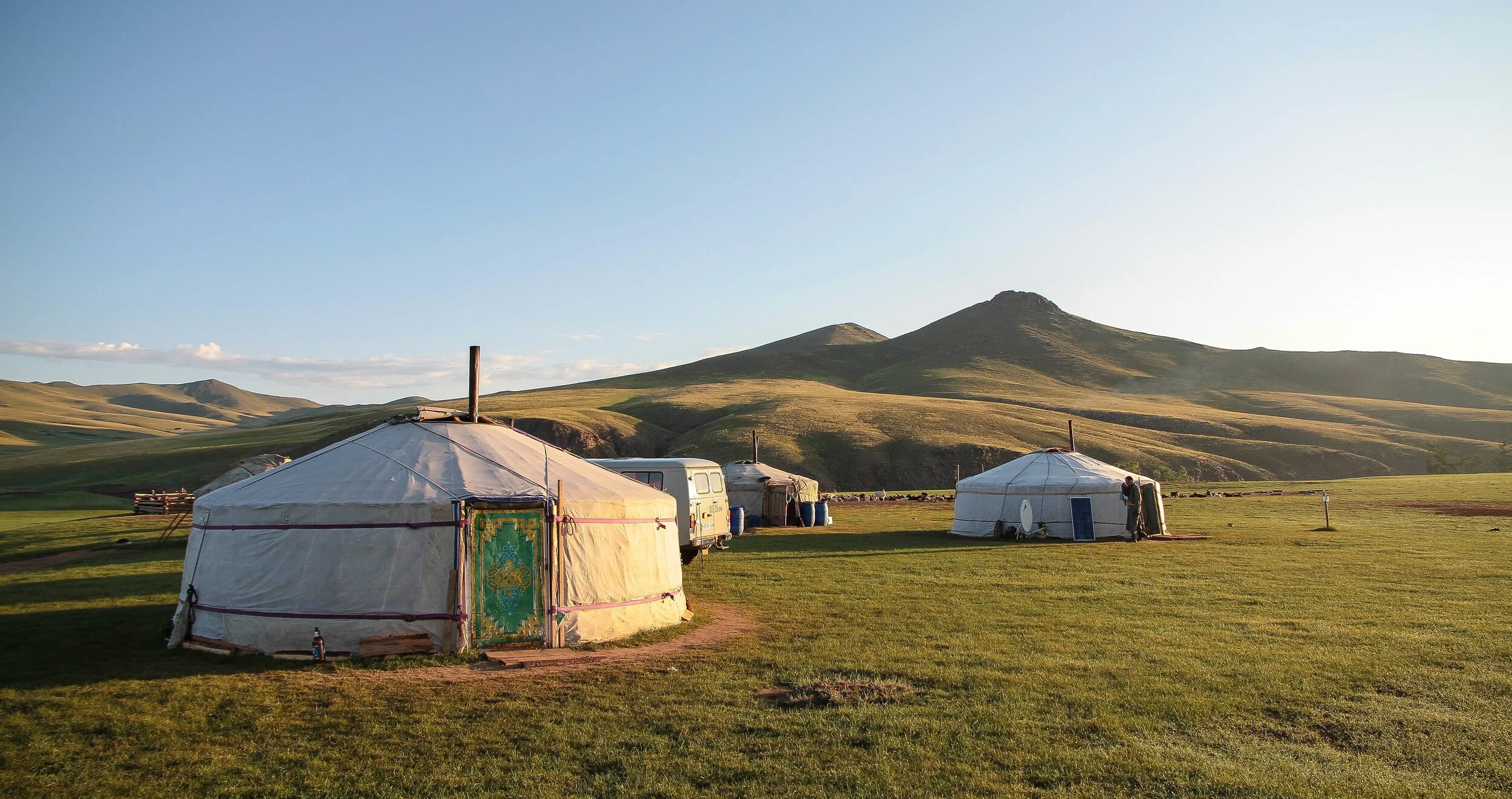
Mongolia’s wide-open steppes made it the ideal sound room for practicing and perfecting khoomei. Vince Gx. Unsplash.
Mongolia is a country that is landlocked between two geopolitical giants, China and Russia. The government has feared that both countries’ economic and diplomatic influences will overwhelm its own affairs. In 2010, Mongolian throat singers sought to defend the tradition against China. UNESCO mistakenly listed China as the sole country of throat singers, a misprint that angered the Mongolian community.
In 2013, China announced its ambitious Belt and Road Initiative, a plan meant to enhance infrastructure connectivity and deepen financial cooperation, among several other aims. While China poured billions of dollars into creating trade routes and industries, the Mongolian people remain unappeased.
With these economic gains also came renewed cultural conflicts. When visiting the Mongolian capital of Ulaanbaatar this past September, Chinese Foreign Minister Wang Yi was greeted by protesters who accused Beijing of suppressing the Mongolian language in China’s Inner Mongolia autonomous region. The former Mongolian president Tsakhiagiin Elbegdorj condemned the Chinese government’s policy that replaced Mongolian with Mandarin in school curriculums. Elbegdorj condemned the action as “cultural genocide” and urged Mongolians to persist in preserving their culture at home and abroad. A part of this resistance also includes using khoomei as a way to reclaim and reassert identity.
Enter The HU. Through music, this heavy metal band uses its Mongolian roots as a way to share the country’s culture with the world. Its most popular pieces, “Wolf Totem” and “Yuve Yuve Yu,” have garnered nearly 111 million YouTube views combined. The HU has charted millions of listeners on Spotify and even covered songs for the video game, Star Wars Jedi: Fallen Order. In an interview, The HU shared that its music stays true to form, mimicking natural sounds in certain tracks. The members hope that they can continue to be cultural ambassadors for their country and its culture. In 2019, The HU was honored with the Order of Genghis Khan, a presidential award recognizing special merits to society.
While music may not solve political conflicts, its influence and reach has given many Mongolians something to be proud of. Khoomei especially has proven to be both a restricted and a revolutionary form of art. As this contested expression continues to endure and flourish, it is clear that the people need their music as much as a song requires a voice.
Rhiannon Koh
Rhiannon earned her B.A. in Urban Studies & Planning from UC San Diego. Her honors thesis was a speculative fiction piece exploring the aspects of surveillance technology, climate change, and the future of urbanized humanity. She is committed to expanding the stories we tell.
8 Surprisingly Vibrant Desert Destinations
Deserts are much more than the beating sun and rolling sand dunes we often picture. These eight destinations showcase the incredible natural beauty of the desert, from salt flats and chalk formations to mountains and glaciers.
Though deserts are often thought of as just hot, dry expanses of sand, they come in a variety of climates and landscapes and hold some of the world’s most fascinating natural formations. Deserts “are areas that receive very little precipitation,” making them arid but not necessarily hot and sandy. Many deserts are mountainous, and others are large expanses of rock or salt flats. Though their arid environment makes water in deserts scarce, they are far from lifeless. Plants and animals, including humans, have adapted to desert life. One-sixth of the Earth’s population lives in deserts, which are found on every continent.
These eight desert destinations range from freezing to boiling in temperature and are all unique, with their own attractions and plant and animal life. Each of these stunning deserts is worth a visit, and they may change your opinion of the desert as a stark, lonely place to one of beautiful landscapes blooming with culture, history and life.
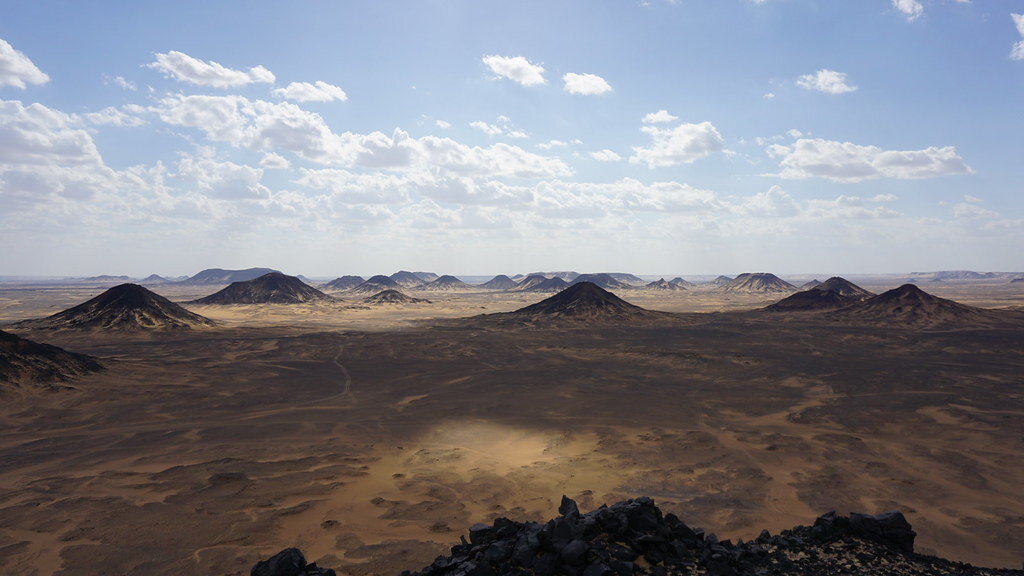
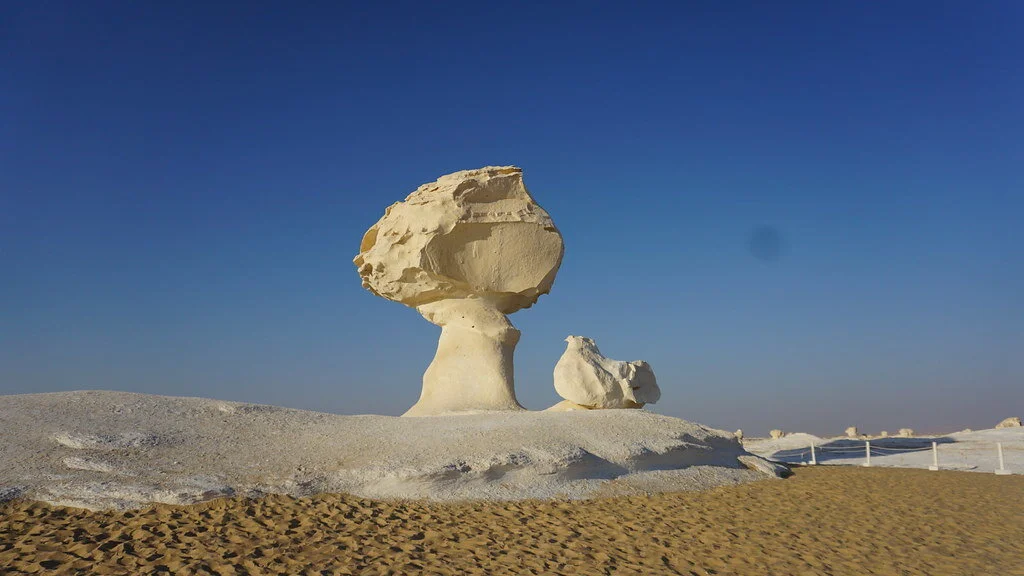
White and Black Deserts, Egypt
Located just a few hours from Cairo, Egypt’s White and Black deserts are two stunning and underappreciated visitor attractions. The White Desert is located in the Farafra Depression, a section of Egypt’s Western Desert, and boasts some of the most unique geological landscapes in the country. Incredible wind-carved white chalk formations rise from the sand in the shapes of towering mushrooms and pebbles, giving the White Desert its name. The White Desert stretches over 30 miles, and the most visited area is the southern portion closest to Farafra. To the north of the White Desert is the Black Desert, where volcanic mountains have eroded to coat the sand dunes with a layer of black powder and rocks. In the Black Desert, visitors can climb up English Mountain and look out over the landscape. The Egyptian Tourism Authority recommends booking a tour to explore the deserts in depth, and travelers can even stay in the White Desert overnight.
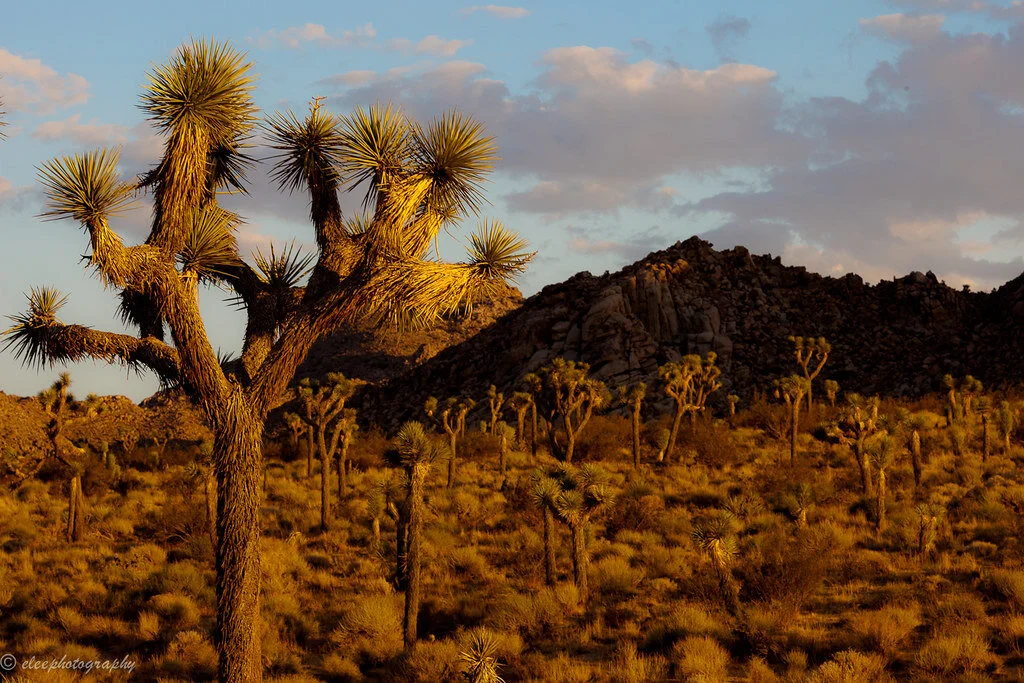
Joshua Tree National Park, California
Joshua Tree National Park in Southern California is where two different desert ecosystems meet. Parts of the Mojave and the Colorado deserts are both found in Joshua Tree, along with a distinctive variety of plant and animal life. The Joshua tree, the park’s namesake, is the most identifiable of the plants, with its twisted, spindly branches and spiky clusters of greenery. Some of the park’s most popular attractions are Skull Rock; Keys View, a lookout with views of the Coachella Valley and the San Andreas Fault; and Cottonwood Spring Oasis, which was a water stop for prospectors and miners in the late 1800s. Joshua Tree National Park has roughly 300 miles of hiking trails for visitors to explore. The park is open 24 hours and can be visited at any time of the year, but visitation rises during the fall due to the cool weather and is at its height during the wildflower bloom in the spring.
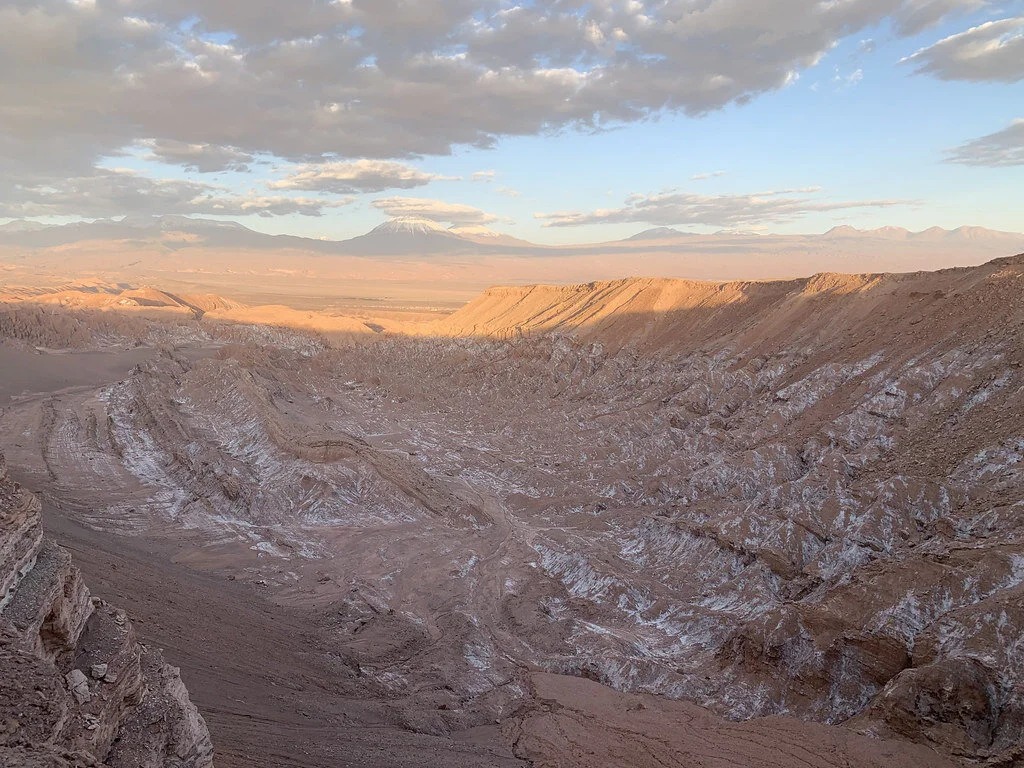
Atacama Desert, Chile
Trips to the Atacama Desert in northern Chile are likened to visiting Mars on Earth. The dry, rocky terrain is so similar to that of Mars that NASA tests its Mars-bound rovers here. The Atacama Desert, the driest desert on Earth, spans over 600 miles between the Andes and the Chilean Coastal Range. Some weather stations set up in the Atacama have never seen rain. Despite its dryness, the desert is home to thousands of people, as well as plants and animals. People have been living in the Atacama Desert for centuries; mummies were discovered in the Atacama dating back to 7020 B.C., even before the oldest known Egyptian mummies. Attractions in the Atacama Desert include El Tatio geyser field, the Chaxa Lagoon, the Atacama salt flats, and sand dunes over 300 feet tall. The Atacama Desert is also said to have some of the clearest night skies in the world, making it perfect for stargazing. It is best to avoid a trip to the Atacama during the summer months, as the high temperatures make for a sweltering visit.
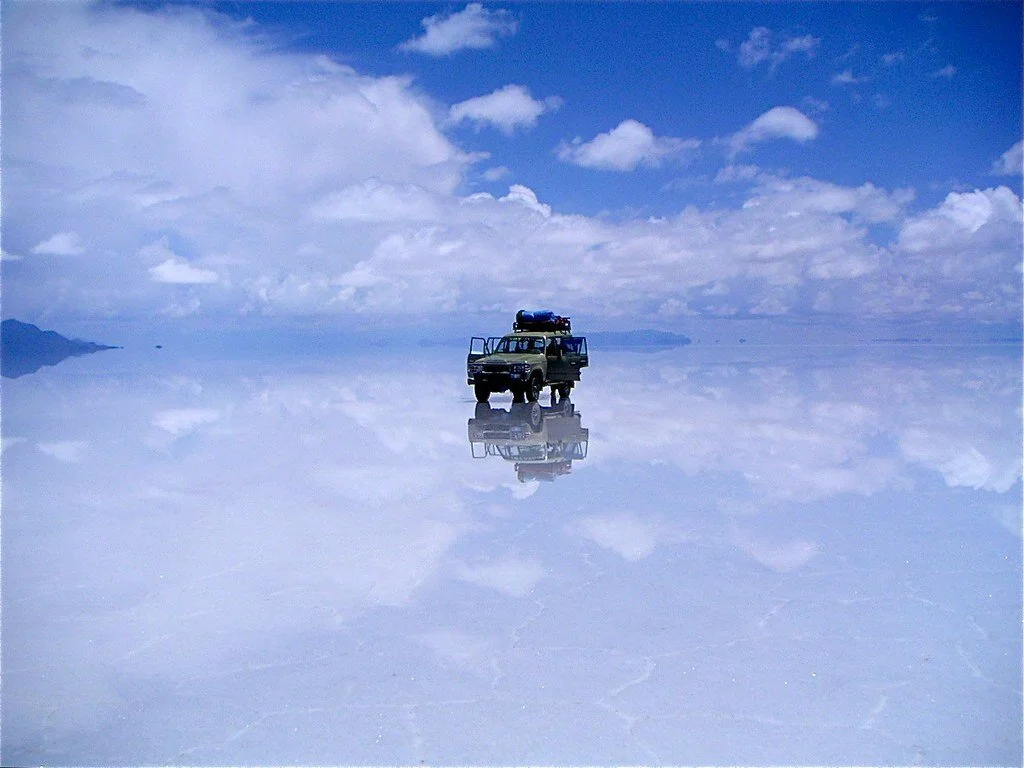
Salar de Uyuni, Bolivia
The world’s largest salt flat, Salar de Uyuni, covers 3,900 square miles in the southwestern corner of Bolivia. Salar de Uyuni is so large it can be seen from space and holds an estimated 10 billion tons of salt. Beneath the salt flat is approximately 70% of the world’s lithium reserves. This lithium is carefully extracted and used for powering laptops, electric cars and smartphones. Salar de Uyuni is surrounded by scenic lakes, geysers and rock formations, and is one of the world’s most beautiful and untouched natural landscapes. Tours of Salar de Uyuni take visitors to the Valley of Rocks; Morning Sun, which is home to geysers and mud pots; Colchani, a salt-processing village; and the Polques Hot Springs, where travelers can soak in warm thermal water. The landscape of Salar de Uyuni changes based on the seasons, so travelers should plan their visits around what they want to see. From July to October, access to all sites of Salar de Uyuni is unrestricted, but during the rainy season from December to April, visitors may be able to witness the salt flat’s famous mirror effect, where a thin layer of water over the salt transforms the land into the world’s largest mirror.
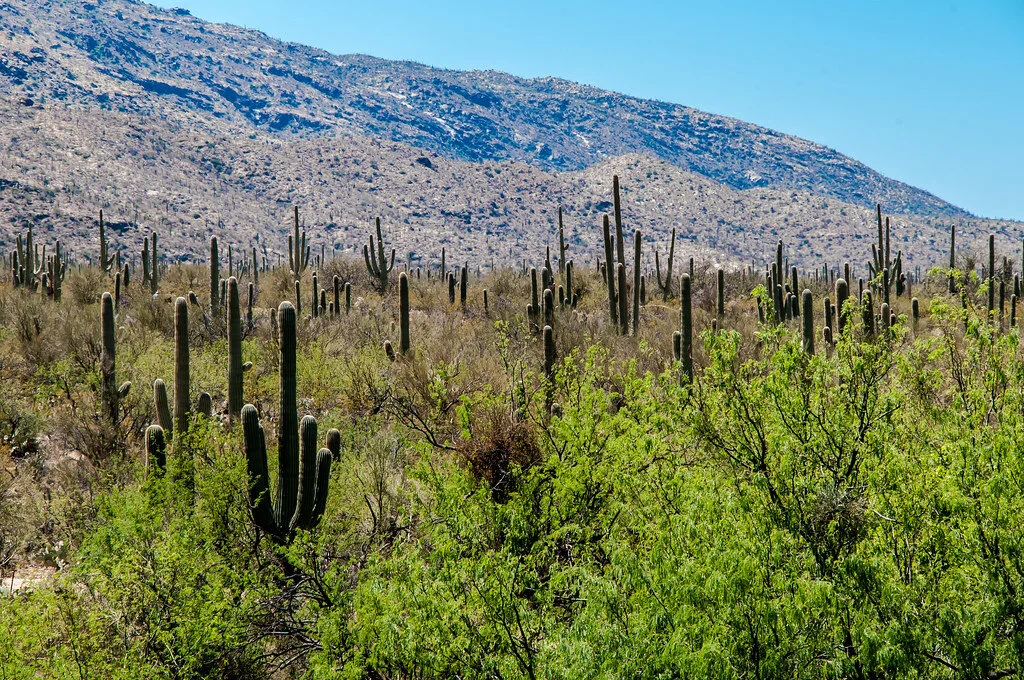
Tanque Verde Ranch, Arizona
Located just outside of Tucson, Arizona, near Saguaro National Park and the Rincon Mountains, Tanque Verde Ranch gives visitors “the ultimate dude ranch experience.” The ranch sprawls over 640 acres and stocks over 150 horses. Visitors to the ranch can get a real-life cowboy experience, including horseback riding and team penning. Riders of all experience levels will find something to do at Tanque Verde, where visitors can take beginning, intermediate and advanced lessons and then go on a sunrise or sunset trail ride through the Arizona desert. Tanque Verde Ranch offers kids’ riding activities too, as well as activities for non-riders such as yoga, mountain biking, fishing, swimming and pickleball. Visitors should pack long pants and closed-toe shoes if they plan to ride, and casual wear is appropriate for all non-riding times. Trips to the ranch usually last around four days, and visitors stay on the property. Tanque Verde Ranch is open to visitors year-round.
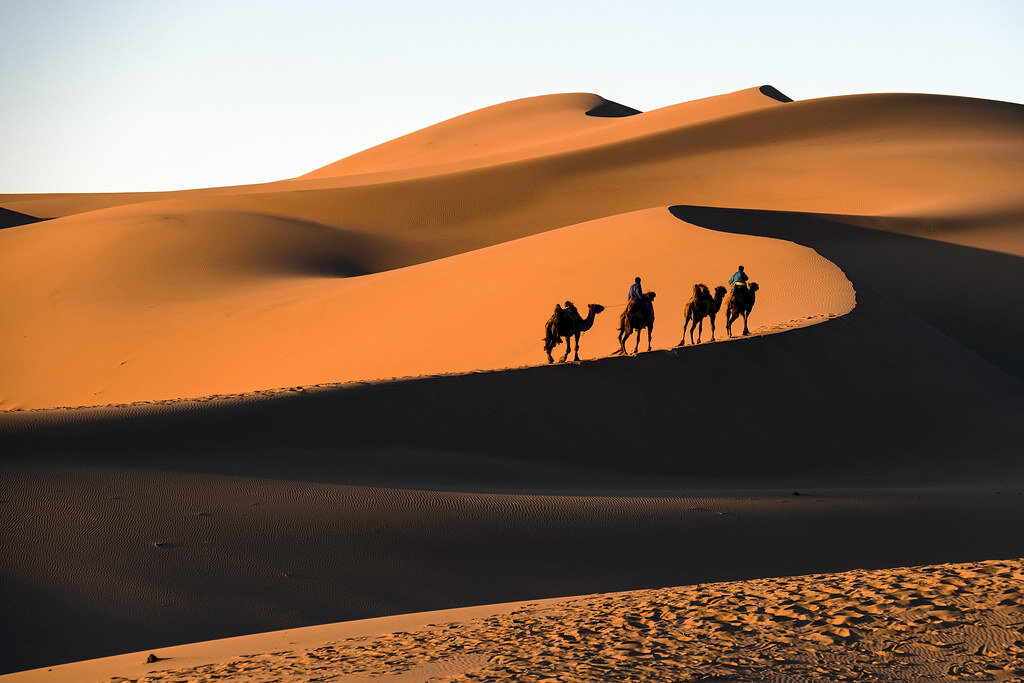
Gobi Desert, Mongolia
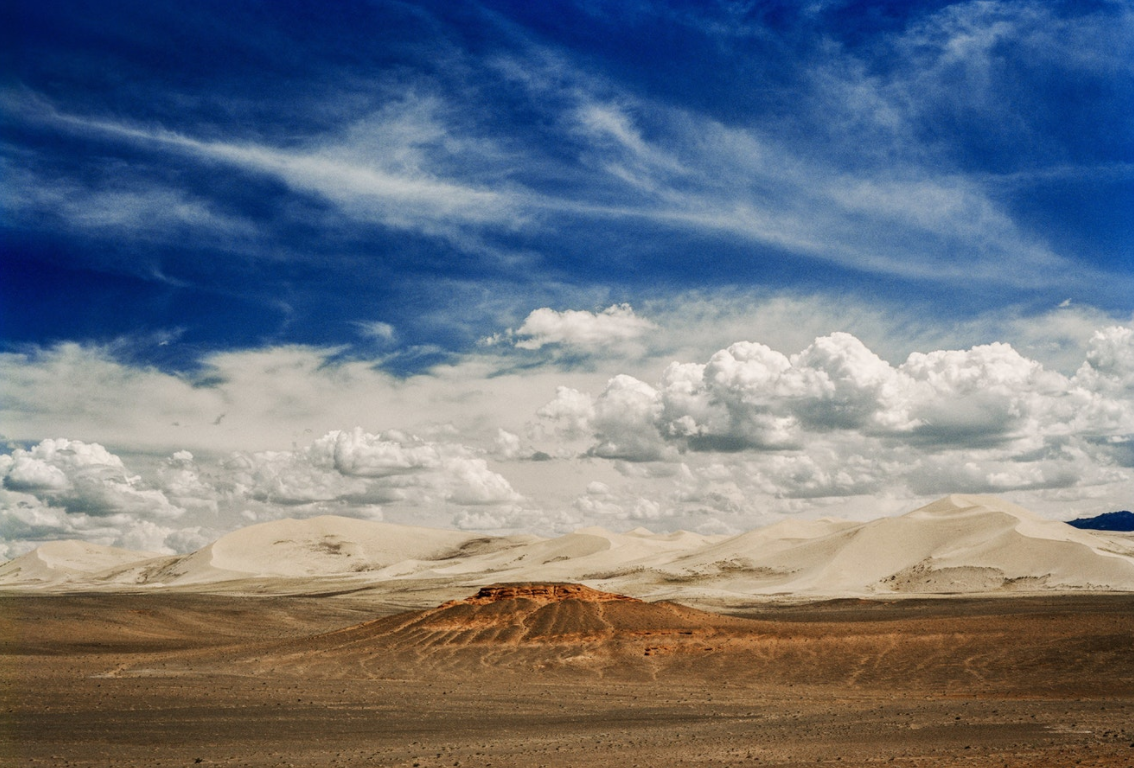
Spanning most of southern Mongolia and its border with China, the Gobi Desert contains stunning views and years of history. The region was once populated by dinosaurs, and some of the best-preserved fossils in the world were found near the Flaming Cliffs of Bayanzag. The Gobi Desert showcases a variety of natural beauty, from towering sand dunes to incredible white granite formations. Dry desert plants that come to life after rain make the Gobi unique, as well as ”saxaul forests” made up of sand-colored shrubbery. Visitors to the Gobi Desert should explore the Khongor Sand Dunes, an area that offers rocky and mountainous terrain in the south, dry and barren terrain in the center, and several oases in the north. Other major attractions are the Flaming Cliffs of Bayanzag, where red clay seems to glow in the sun, and the Gobi Waterfall, which looks like a city in ruins but is a completely natural formation. The best time to visit the Gobi Desert is either in late spring or in autumn, when the weather is neither too hot nor too cold.
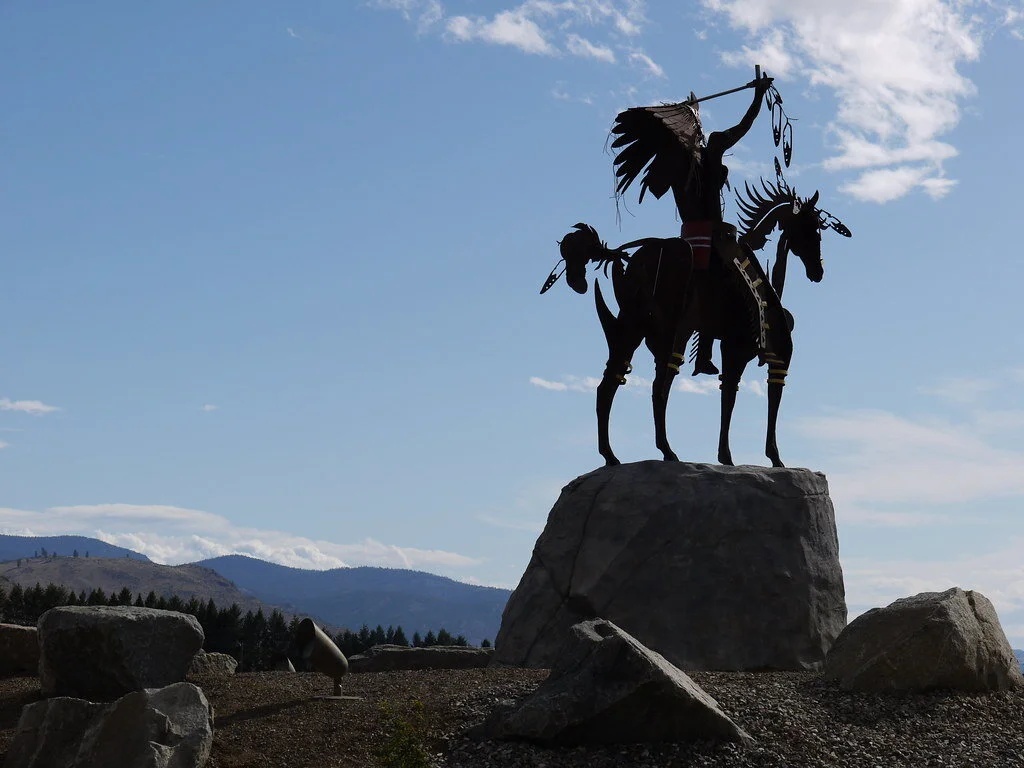
Nk’Mip Desert, Canada
Also called the Okanagan Desert, Canada’s Nk’Mip Desert contains the most endangered landscape in Canada. Located in Osoyoos in British Columbia, the Nk’Mip Desert Cultural Center is a 1,600-acre area of the Okanagan Desert managed by the Osoyoos Indian Band, and is the only fully intact area of desert in Canada. The desert is situated in a semiarid microclimate. The cultural center was designed to be eco-friendly and resembles the traditional winter homes of the Osoyoos Indian Band. Visitors can explore the desert on walking trails, which are surrounded by sage, prickly pear cactuses and antelope brush, as well as sculptures of desert creatures and native peoples by Smoker Marchand. The trails take visitors through a traditional Osoyoos village, where they will find a traditional sweat lodge and pit house. Many visitors prefer to explore Nk’Mip Desert in the summer due to the region’s relatively cold winters.
Patagonian Desert, Argentina and Chile
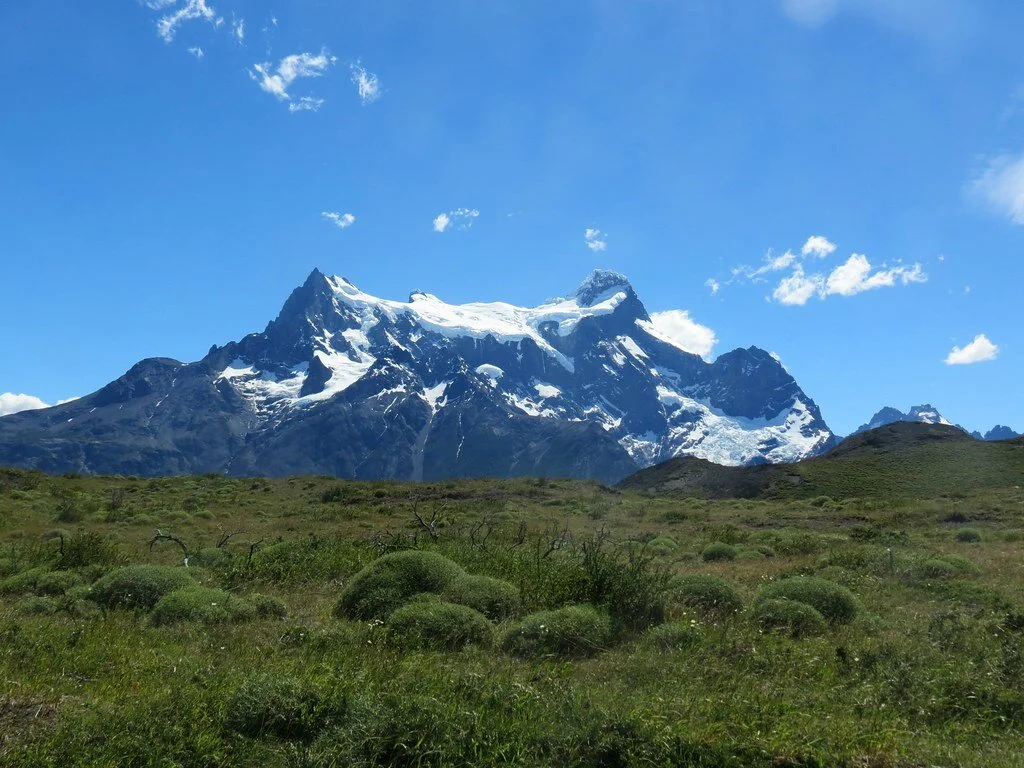
The Patagonian Desert is South America’s largest desert and the seventh-largest in the world. It covers parts of southern Argentina and Chile, and is a cold desert, sometimes reaching a high temperature of 68 degrees Fahrenheit. The Patagonian Desert is home to two national parks: Torres del Paine National Park in Chile and Los Glaciares National Park in Argentina. Torres del Paine and Los Glaciares aren’t typical desert environments, but since the Patagonian is a cold desert, its landscape is different from that of most deserts. Before the Andes were formed, the Patagonian Desert was likely covered by temperate forests, so the region containing the desert, Patagonia, is extremely ecologically and geographically diverse. Torres del Paine National Park is known for its towering granite structures, which were shaped by glaciers. Los Glaciares is home to large glaciers, as well as scenic mountains, lakes and woods. The Cueva de las Manos, or “Cave of Hands,” is a series of caves in Argentinian Patagonia which are filled with paintings of hands dating back to 700 A.D., likely made by ancestors of the Tehuelche people. Tehuelche people live in Patagonia today, some still following a nomadic lifestyle. The best time to visit Patagonia is generally said to be in the summer (December to February), when the days are warm and the fauna is in full bloom, but there are merits to exploring the area at all times of year.

Rachel Lynch
Rachel is a student at Sarah Lawrence College in Bronxville, NY currently taking a semester off. She plans to study Writing and Child Development. Rachel loves to travel and is inspired by the places she’s been and everywhere she wants to go. She hopes to educate people on social justice issues and the history and culture of travel destinations through her writing.
Grappling with Sexism: Female Wrestlers in Mongolia
There’s an old legend in Mongolia: A woman wrestler once dressed up as a man and entered an all-male wrestling competition, defeating all challengers. She then pulled up her jacket and revealed her breasts, shocking everyone in attendance. From them on, all wrestlers were required to compete bare-chested, a failsafe to ensure that Mongolia’s prized “manly” tradition remained that way. While the legend may or may not be true, the practice of bare-chested wrestling in Mongolia is real, as is the practice of banning women from the sport. Despite achieving international fame in grappling, female Mongolian wrestlers are still unable to compete in their own native games.
Mongolian Wrestling. A. Omer Karamollaoglu. CC BY 2.0.
The Nadaam festival is held every year in July and is the single most anticipated sporting event in the country. Short for “Eriin Gurvan Naadam” (the three games of men), it is a celebration of the three traditional sports of Mongolia: wrestling, archery, and horseback riding. Nadaam dates back to the 13th century when Genghis Khan would throw celebrations for soldiers after successful military campaigns. After Kahn’s death, warlords continued the tradition, encouraging combat sports in order to prepare men for military service. Nadaam endured and developed throughout the centuries, and today, it is the Mongolian equivalent of the Super Bowl or World Cup. The games are typically held in July. Hundreds of small, county level events lead up to the main competition, which is held in the Mongolian capital of Ulaanbaatar. Wrestling is often featured as the centerpiece of the competition, and in Mongolian, is referred to as “Bokh,” which means “durability.”
Mongolia experienced a socialist revolution in 1921 that brought with it an emphasis on male-female equality and gradually these values led to women being allowed to compete in Nadaam, but only in archery and horse racing. To fill the void, female grapplers turned their attention to other grappling sports. Soronzonboldyn Battsetseg won a bronze medal for judo in the 2012 Olympics in London, while Sumiya Dorjsuren won a silver medal in judo in the 2016 Olympics and then went on to win gold in the World Judo Championships in 2017. Both women are national heroes in Mongolia, and yet, Nadaam remains closed to them.
Female archers preparing for Nadaam. Taylor Weidman. CC BY SA-3.0.
The fact that a sport has to be guarded against an entire group people suggests a fear that these people could be competent in the sport. Like the wrestler in the old legend, women grapplers like Soronzonboldyn and Sumiya are barred from competing in Bokh, not because they aren't capable, but because they are. Judo is a widely recognized grappling sport, practiced by professional athletes, law enforcement officials, and ordinary citizens in literally every country on the planet. It would not be a stretch to assume that the grit and skill required to master Judo would translate well to Mongolian Bokh, and that the current barring of women from Bokh in Mongolia seems to be more about maintaining a status quo than anything else. When female grapplers will have a chance to challenge this standard is anyone’s guess.
JONATHAN ROBINSON is an intern at CATALYST. He is a travel enthusiast always adding new people, places, experiences to his story. He hopes to use writing as a means to connect with others like himself.

MONGOLIA: In Search of Warriors
LIKE ALL WORTHY QUESTS, MY FASCINATION WITH MONGOLIA BEGINS WITH A STORY. A STORY THAT TURNS ITSELF LIKE POLISHED STONE WITHIN MY FINGERS.
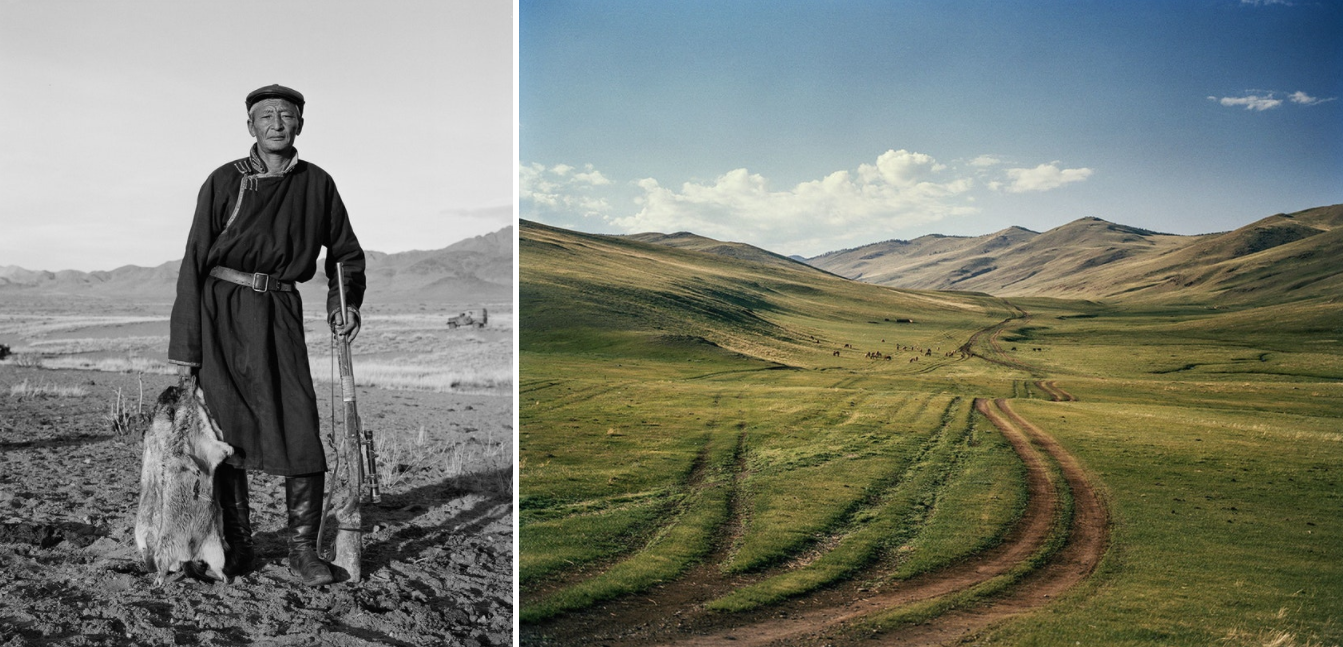
A hunter, old rifle by his side, returns with a few marmots, highly prized delicacies throughout the Mongolian countryside. / A simple road, common in Mongolia, calls to mind this native proverb, “If you endeavour, the fate will favour you.”
This is a tale I have replayed so often since childhood, that when I close my eyes, the characters appear, fully defined, as if I could touch them. At the center is my grandfather, Louis, a young French soldier fighting in World War II. I see him then in black and white, even though when he sat me on his knee, decades later, to tell his story, he was colorful in every way imaginable. It was as if my grandfather had grown up through a period of time when everything existed only in shades of black and grey, as if the entire world with its violence and scarcity had the color sucked right out of it.

Aerial view of Khvod (Ховд), blanketed by snow, in western Mongolia. / Immense landscapes on a 3,200 km drive through eastern Mongolia.
But then he would tell the part about the Mongol army. About how he was captured and sent to a German prison camp with British, American, and French soldiers. How the camp was eventually liberated, late in 1944, by a small and mighty troop fighting alongside the Allies against the Germans. They were the Mongolian People’s Army, established as a secondary army under Soviet command. As a young child, to hear my grandfather tell it, these liberators loomed large in vibrant, audacious color, a brilliant contrast to the stark landscape that surrounded them all.
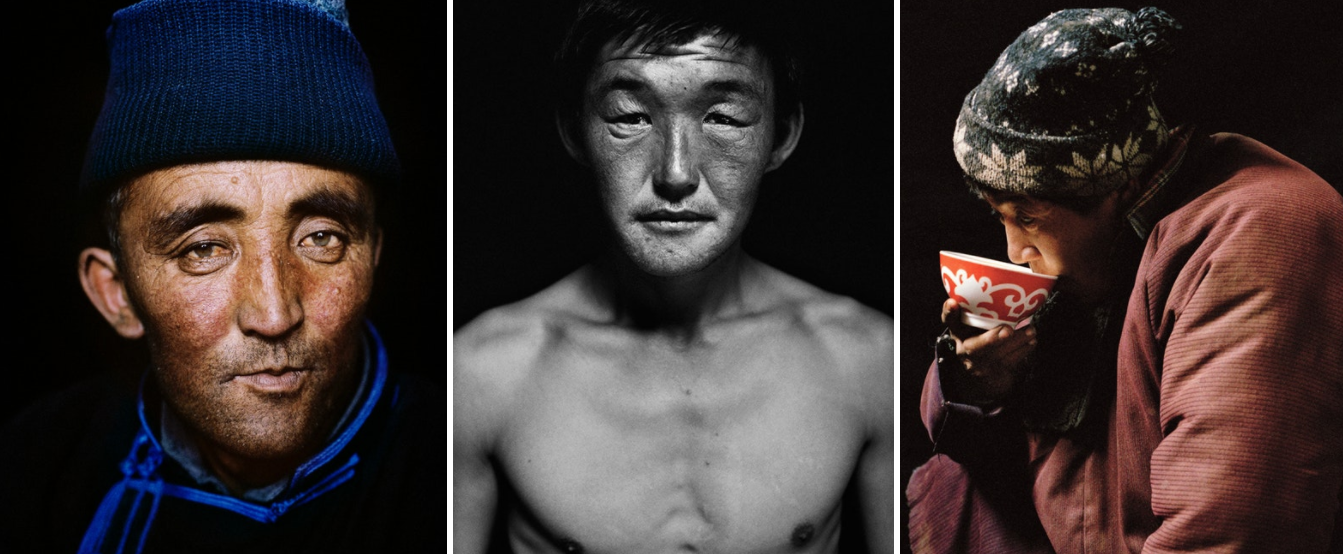
Herders from Ulaangom (Улаангом), the “Red Valley”. / Drinking Mongol tea, made with mare’s milk and salt, at Üüreg Lake (Үүрэг нуур).
I was seven or eight years old when my grandfather would tell me this story, and I remember the grin on his face and the tears in his eyes as he told his tale: “The Mongol army charged the prison and the Germans were scared to death at the sight of them. Never before had anyone seen a people like this. They were fierce and the Germans ran away. They ran for their lives.” He told me that afterwards the freed soldiers and the Mongols kept hugging one other and celebrated long into the night.
This is how my grandfather’s life was saved.
As a young boy this account had a massive impact on me. That mysterious Mongol Army of men who saved my grandfather’s life; they saved my life.

A young rider bathes with his horse at Buir Lake (Буйр Нуур). Mongolians call wild horses “takhi,” which means “spirit,” and horses are profoundly important to them. They believe that one rides to the afterlife on a horse.
Mongolia.
THE NAME HAS ALWAYS LINGERED IN MY MIND AS A COUNTRY WITH A MYTHICAL CONNOTATION.
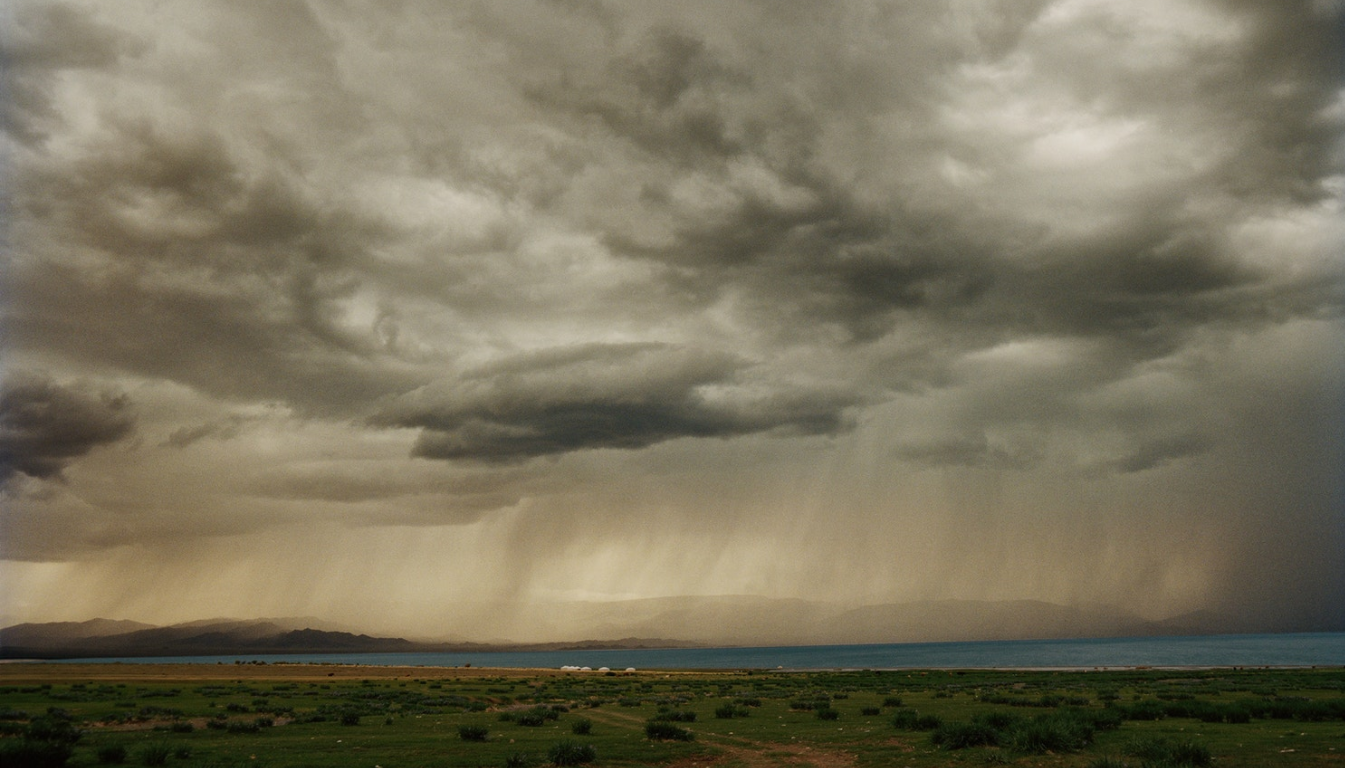
Illuminated bands of rain sweep towards a group of “ger” or yurts, huddled on the shores of Üüreg Lake (Үүрэг нуур) in western Mongolia.
When I got older, I worked as a photo assistant to a high-end fashion photographer in New York, learning the craft and saving a bit of money. For three years I was absorbed in that world of fashion, which was very glamorous and comfortable, but I was most attracted by the travel and began to long for more. At some point, I determined to go to Mongolia and see the place with my own eyes. In the summer of 2001, I took a month and set off.
While I brought my cameras on that first trip, a bit of equipment and film, I was mostly thrilled to put the experience of traveling first. This journey was more a pilgrimage. I have since returned almost annually for fifteen years, driven by a desire to capture the majesty and serene nature of the Mongolian landscape and inhabitants through my photography. At first I sought to discover the country of my imagination, but with every trip, my relationship with the land and its people deepened and became my own.

Timeless reflection. Surrounded by deserted, low mountains, Tolbo Lake (Толбо Нуур) in western Mongolia. / Stopping for tea, our hosts were caring for their grandchildren. Their nomadic home was quite rustic with carpets for side panels, a long-gone style rarely seen today.
“Even when quite a child I felt two conflicting sensations in my heart: the horror of life and the ecstasy of life.” — Baudelaire, Intimate Journals
On that first trip to Mongolia in 2001, I took a photograph of a mother and her infant son at their home on the shores of Üüreg lake, in the western part of the country. I traveled with an easy to pack, black piece of fabric. The light in this country is so beautiful and the fabric was capable of diffusing it to great effect, especially when shooting portraits of people.
Five years later, in 2006, I returned to the region where this family had once resided and sought them out. I often make small prints for the people I photograph and, if lucky enough to see them again, I like to give them as gifts. People in Mongolia, especially in the countryside, live great distances from each other and do not typically have access to this type of technology. I asked my guide to help me find this particular family as most in this area tend to be nomadic and the surroundings are constantly changing. We drove around the area asking people if they knew where we might locate them. Eventually, someone recognized the family and showed us the way.
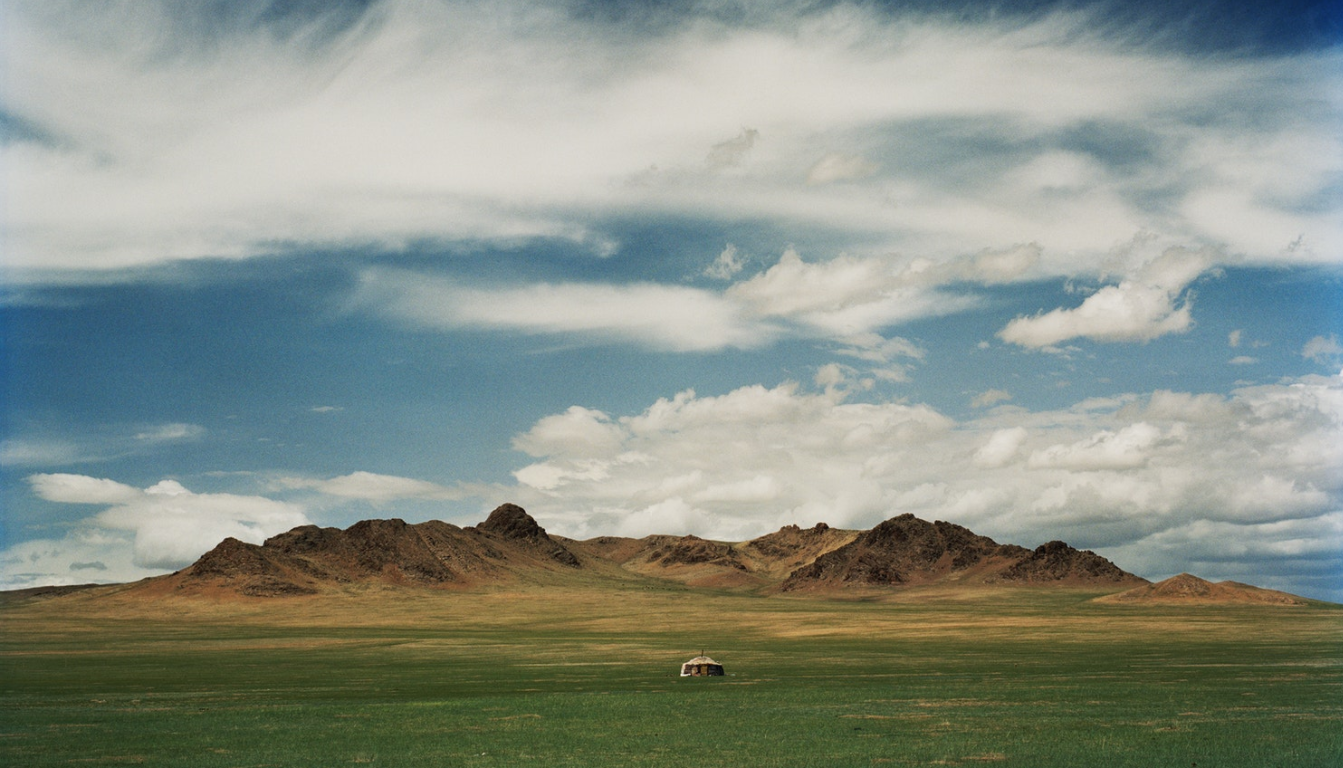
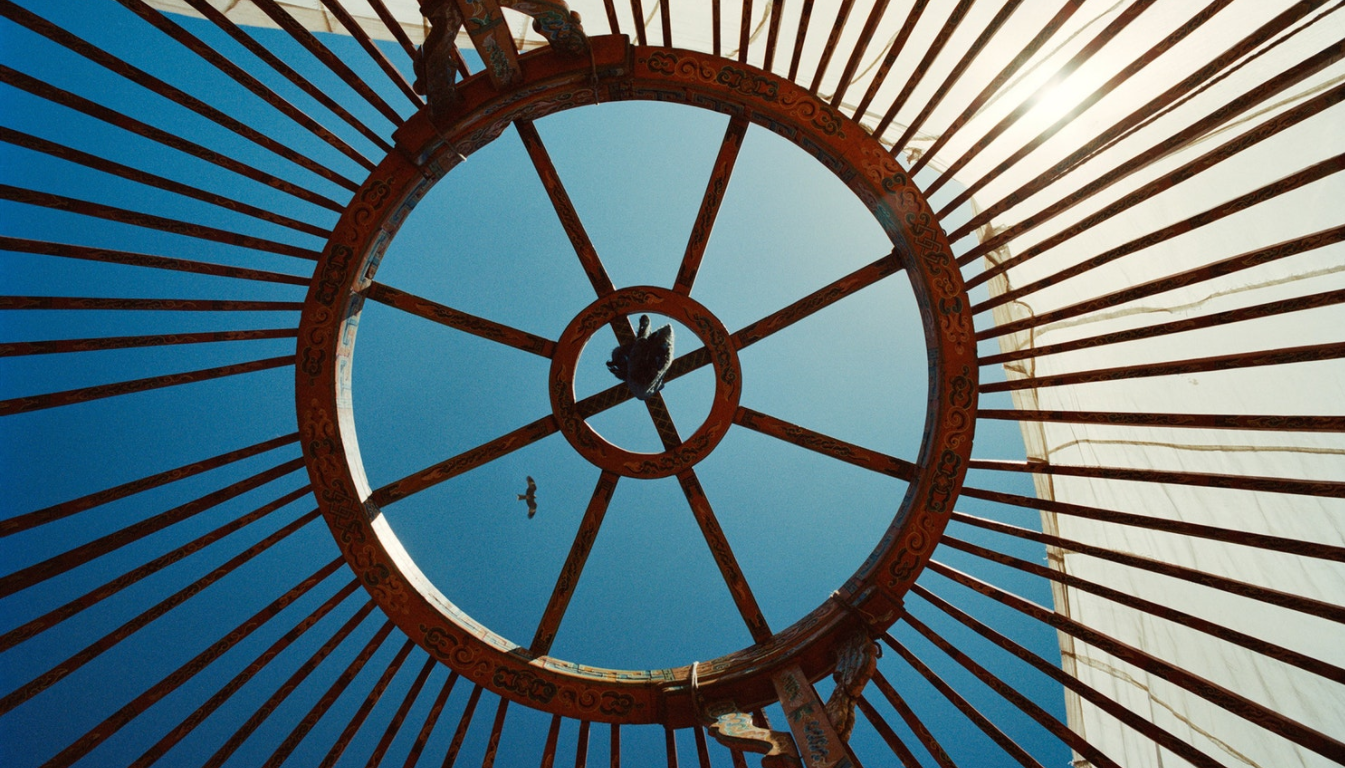
A Mongolian “ger” (гэр) or yurt, covered with skins and felt, the traditional home of nomads living on the expansive steppes of central Asia.
We arrived, as you do in this part of the world, completely unannounced. The family remembered me, gave us a warm greeting and served us a tea. After we had eaten, I pulled out the photograph and handed it to the couple.
The mother picked up the picture, looked at it and there grew a void, her face filled with great sadness as she left the room. Her husband picked up the photograph and stood, his eyes swelling with tears. Their baby, he explained, had died of a virus three weeks after our first visit. They had never seen any picture of him. Here was this image allowing a mother and father to reconnect to their lost son. For a moment, it was like a resurrection—that powerful. My guide and I drove the four hours back in complete silence, as if we were under the spell of what had just happened. It was one of the most profound moments I have ever felt, creating that deepest human connection.
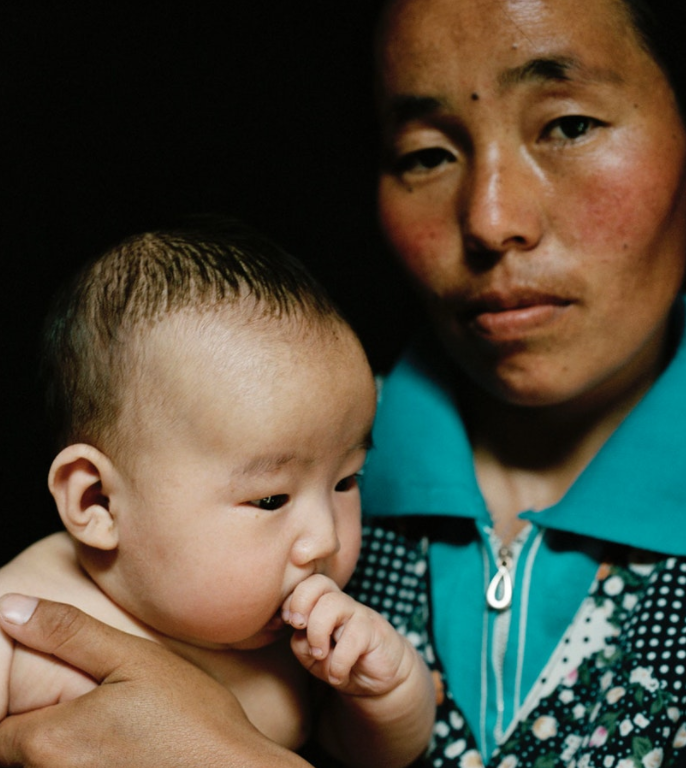
Mother and infant son, in their home on the shores of Üüreg Lake (Үүрэг нуур) in western Mongolia.
“There is not a particle of life, which does not bear poetry within it.” — Gustave Flaubert
While in the countryside, especially, you can feel the influence of Buddhism. In every ger, the Mongolian term for their traditional tents, you will find a small altar with a Buddhist icon. In each village there is a monastery. It is a subtle presence, one felt primarily in how people relate to life. Death is a passage, a journey. It happens, it is anticipated as part of the life cycle. Does death trigger sadness? Yes, but life goes on. The religious culture is something that seems to create an overall sense of morality. In my experience, Mongols are extremely fair people. You ask their point of view and they tell you precisely what they think.
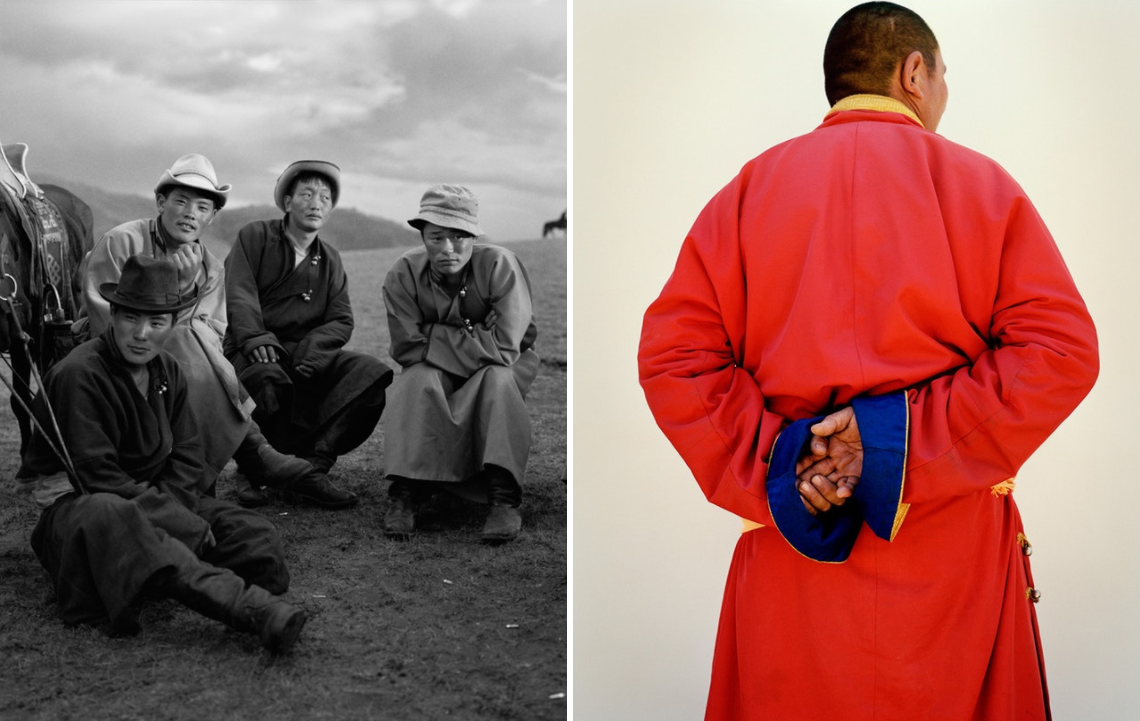
Horse riders at rest in Horkon, central Mongolia. / Baasan Lama, a monk at Bulgan Temple, a Buddhist retreat in the Gobi Desert.
In Mongolia, nothing happens the way you want or expect.
For me, coming from a western culture where everything is linear, this was an awakening. If you are traveling, you only know when you are leaving, never when you will arrive. I found that amazing. In a country as immense as this, the elements are so powerful there is no control. There may be a snow or sand storm. Things that can physically prevent you from moving forward on your journey. You cannot continue… until you can.
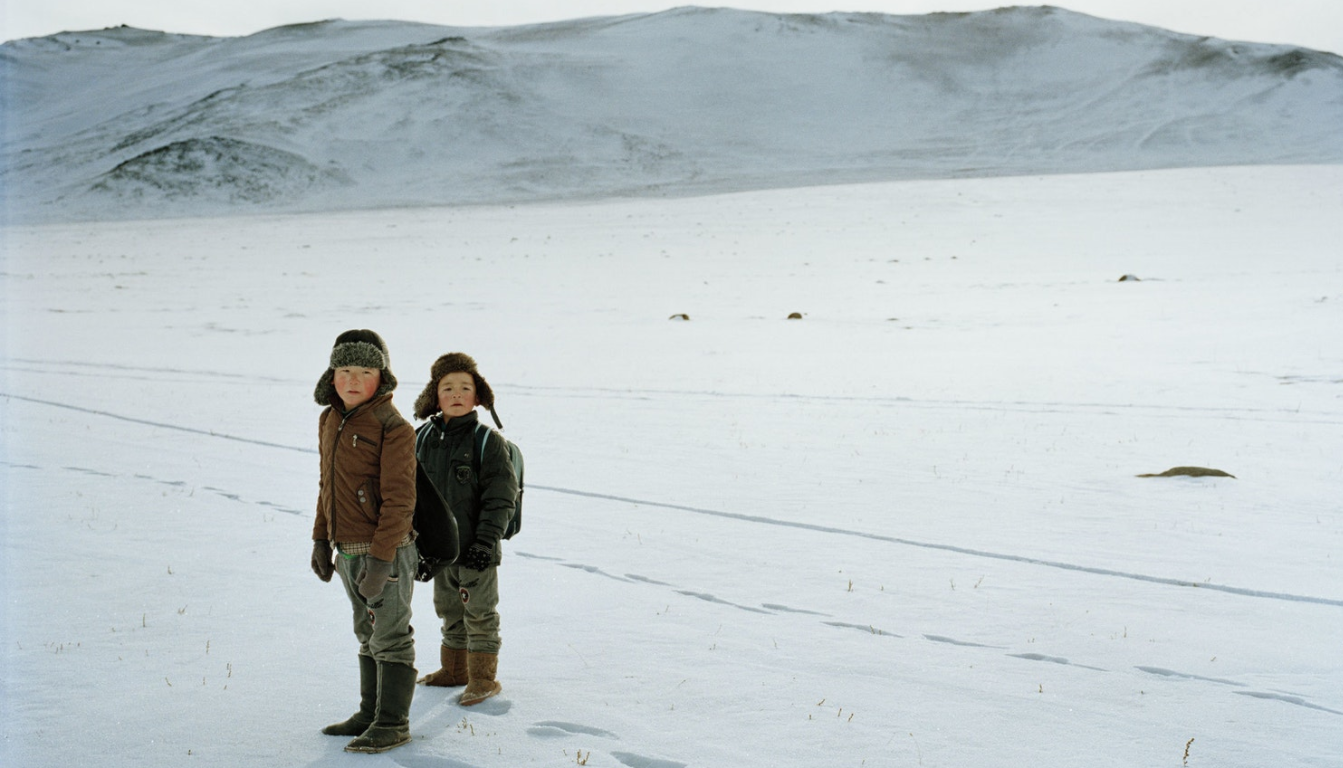
Two schoolboys, wearing fur-lined boots, walk home through the snow near the village of Altai (Алтай) in the far west of Mongolia.
I have learned that most of the time when things are not going as planned, that is often when the situation is the most visually exciting. We have to go a different direction than where we came from and stay one more night all because of a flat tire. But, that is when something special happens. We end up saying afterwards, “Wow. Mind blown.”
Take, for example, the following series of images, which illustrate exactly the type of unexpected scenarios that gift themselves to you while traveling through Mongolia. We had a plan to fly direct from the capital, Ulaanbaatar, to Tsaatan lands, to visit reindeer herders on the Russian border, but for some reason our flight got canceled. This happens a lot. We had to stay one more night in the city, get on a different flight to somewhere further away, then rent a car and drive back across this vast lake, Khövsgöl, one of the biggest lakes in Mongolia. This arduous journey, all to reach the town we were originally attempting to fly to directly. I was fuming. I had just three weeks for this trip and now I was losing two entire days.
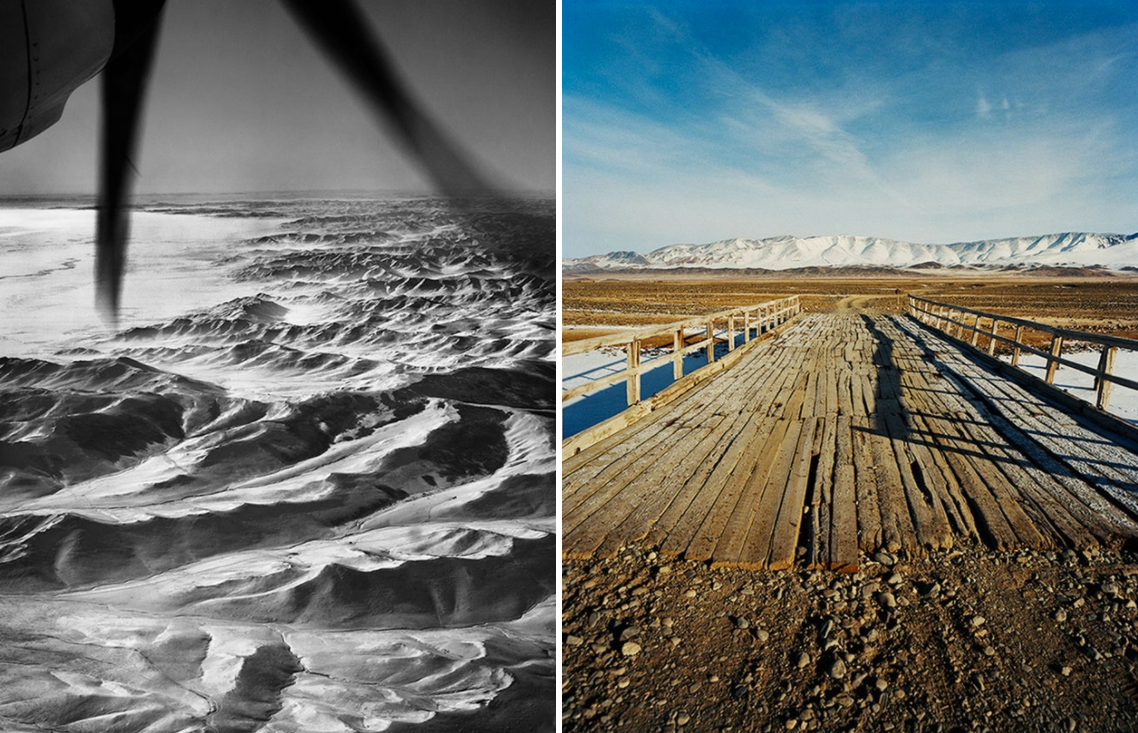
The Altai Mountains, seen on a flight from Ulaanbaatar to Ölgii. / A bridge near the village of Altai (Алтай), a few miles from China’s border.
During the winter months, this lake is completely frozen, often an ice layer of up to six feet, and instead of taking the dirt road, often filled with potholes and hard to navigate, trucks and cars travel directly across the iced over lake. There is a risk, of course. As the drive went on, the truck we were following suddenly began to collapse into the ice, without any warning.
A warmer wind from the south had been blowing in recent days, making the upper layer of ice more fragile. Everyone in our vehicle shouted out in shock “Arrgh!” and we stopped as far away as possible, as the ice in the epicenter was quite fragile. While we contemplated the situation, the owner of the truck, who had at first abandoned it, along with the other passengers, walked back to the vehicle to retrieve his belongings. While he was still in the truck, we heard a massive roar. A roar so deafening we were surrounded by the thunderous sound echoing from the ice.
We knew something was about to happen. Everyone ran from the truck, as it sunk even deeper, seemingly fixed into the ice. Immovable.

What happened next?
Well, the Mongols are impressively strong willed and determined. They called for help and a few hours later a couple of other trucks arrived.
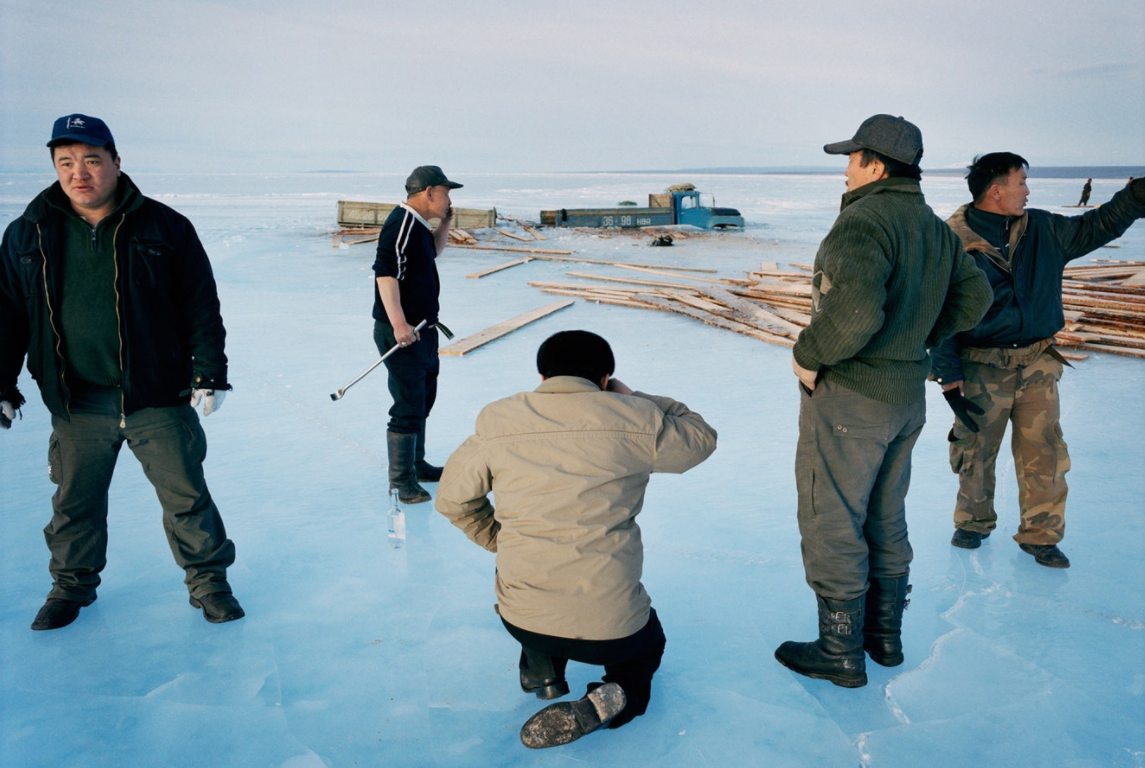
Together, the group waited for night to fall, so that the ice was again solid and reliable ground, and then they literally pulled it out of the ice. So badass.
That truck was filled with wood, likely bound for a construction site. There was too much potentially lost revenue trapped in that one ice circle. Fortunately, no one was hurt that day, but locals have told me stories of jeeps and trucks, loaded with occupants, disappearing entirely in the frozen lake after the ice had cracked, never to be heard of again. Only later did we realize how close we were to possibly meeting the same fate.
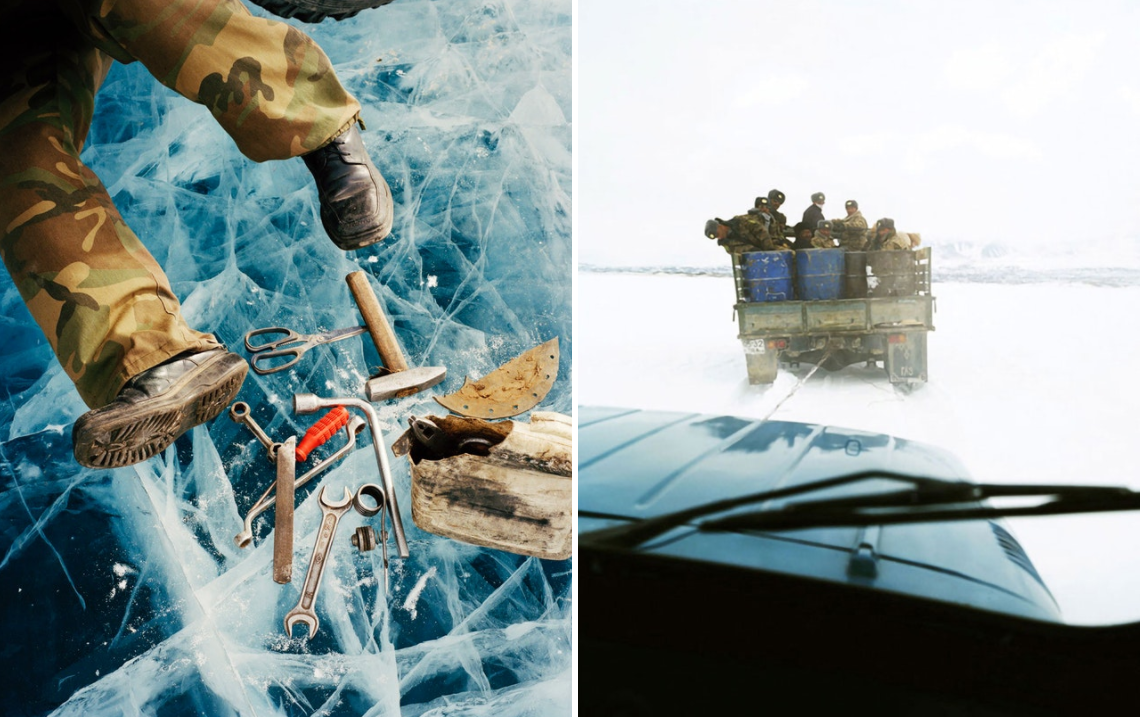
This lake was full of unusual surprises. Earlier the same day, we had come across two young men lying on the ice, in the middle of nowhere. We stopped the car and got out, but they did not move. They just stared. They were completely drunk, wasted. It was still morning! They were just lying there waiting for something.
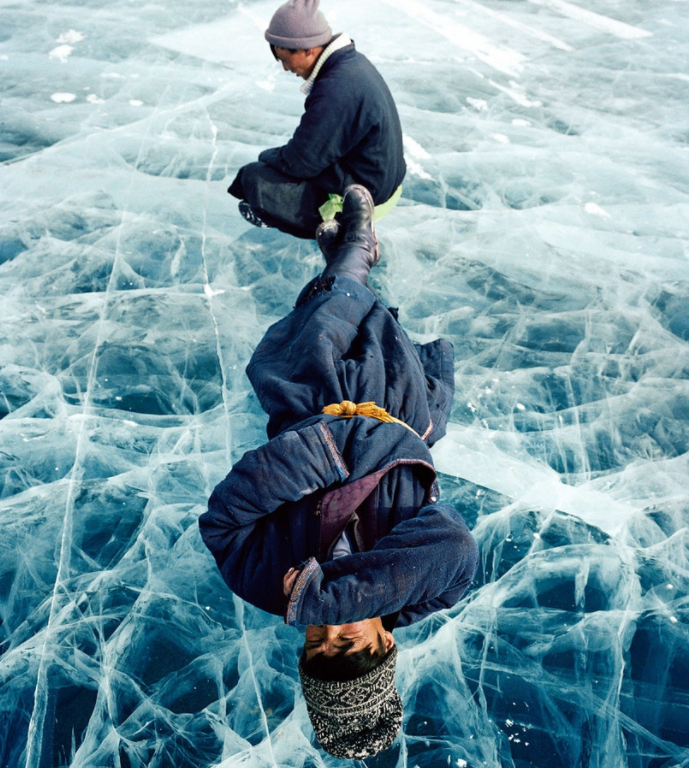
I love the perspective, the color, and texture of the ice in this image. Knowing the strange backstory makes it even better. I had not planned this particular journey, but some of the most powerful images I shot during that trip happened thanks to that canceled flight. In these types of consistently disruptive circumstances, an overall shift in perspective takes place. In retrospect, the entire experience turned out to be perfect.
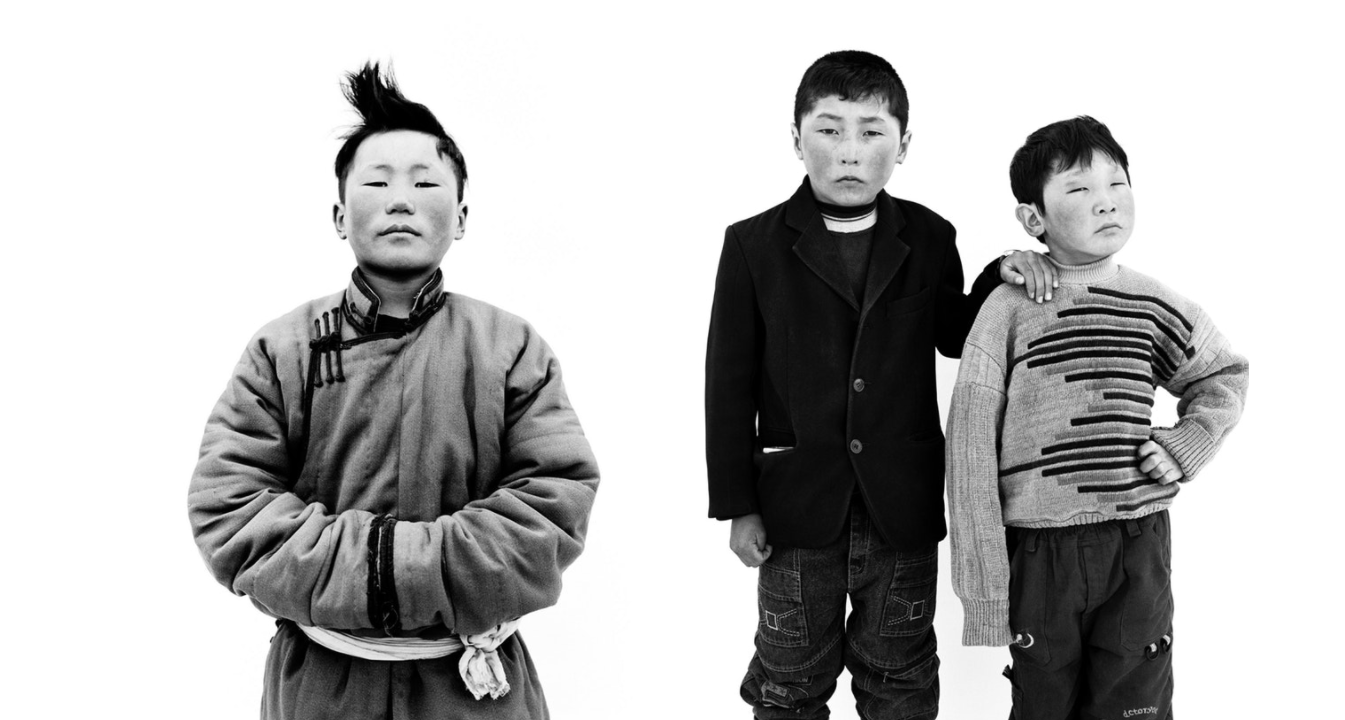
A boy from Kharkhorin (Хархорин) wearing a traditional “deel”or robe, with a silk sash. / Two brothers from Khövsgöl Lake (Хөвсгөл нуур).
Looking back, all my visits to Mongolia have been marked by unexpected moments like these. One place in particular is layered with memories. Many years ago, when I first arrived on the Trans Siberian railway, with no plans and little idea of a destination, I saw a tiny blue dot on the map, in the far west of the country. I could just make out the words, Üüreg Nuur, a lake. Somehow attracted to it, I decided that was where I was going to go. A few days later, I took the picture of the mother and her baby son, and over the years, I have returned many times, making friends and photographing most of the families living there. I have seen toddlers become teenagers, teenagers grow into young adults, and older men pass away. The full cycle of life.
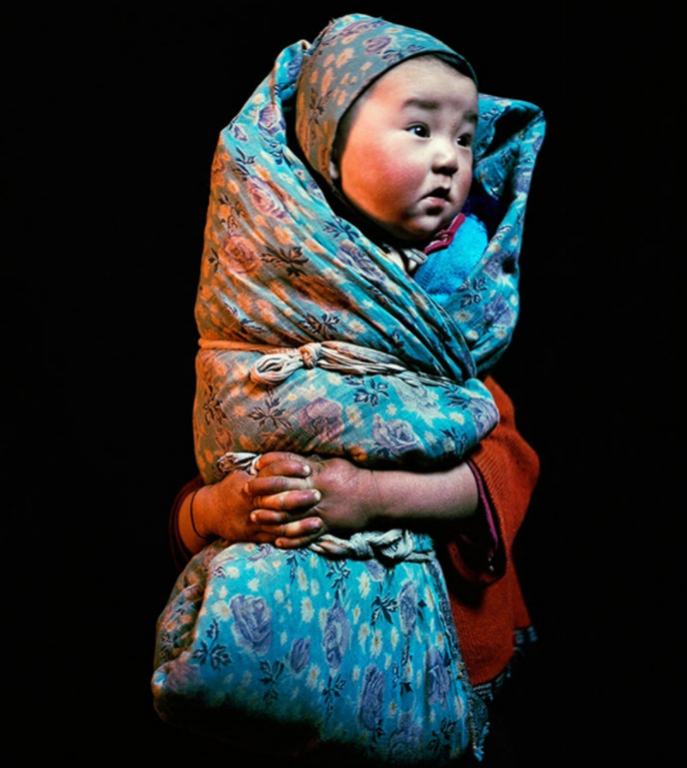
Wrapped baby, held by his sister, at Üüreg Lake in western Mongolia.
Last summer, I returned to Üüreg Lake once again, in June, traveling with two local guides. At some point we stopped because we came across a group of herders who had all of their sheep laid down by the water so they could shear them. When I pointed my camera towards this man, he lifted the sheep high up above his head. It was completely unexpected. Intrigued, I shot a few frames and then asked him, “Why did you do that?” He said, “I don’t know — it is something I have always wanted to do.” Often photography inspires a certain playfulness and spontaneity; there is something fundamentally human about posing for a camera.
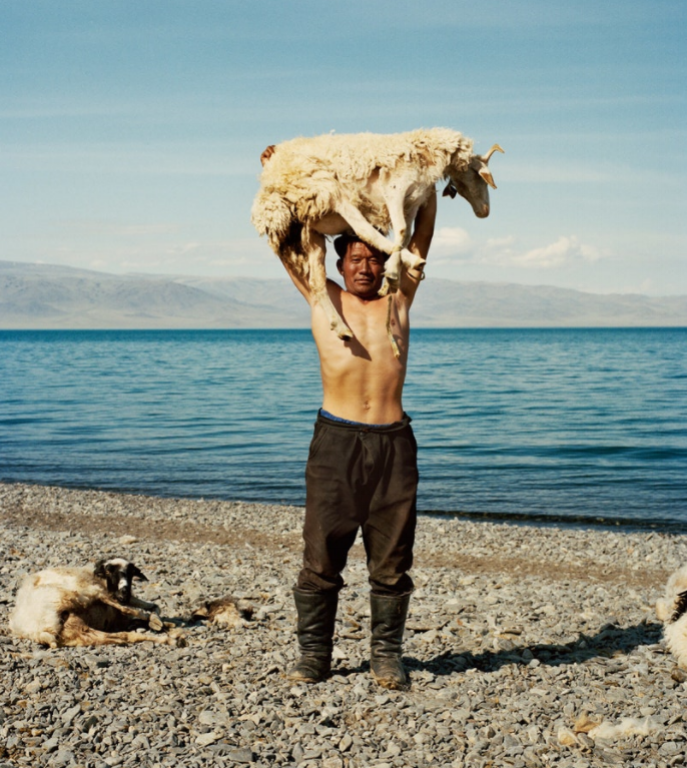
A local herder shearing his sheep on the shores of Üüreg Lake (Үүрэг нуур) in western Mongolia.
Perhaps, above all, in this country, I have learned how to adapt.
Nothing unfolds as you might first imagine, but these unanticipated moments bring rich and beautiful gifts. Traveling here has brought me a new perspective, even some wisdom, particularly as it relates to being attached to expectations and schedules. Over time, I have relaxed my grip on the rigidity of my own culture and let go enough to accept what will be. I have applied this in my everyday life. Even if I am on an intense shoot for a commercial job, I now trust that everything will eventually work out just fine.
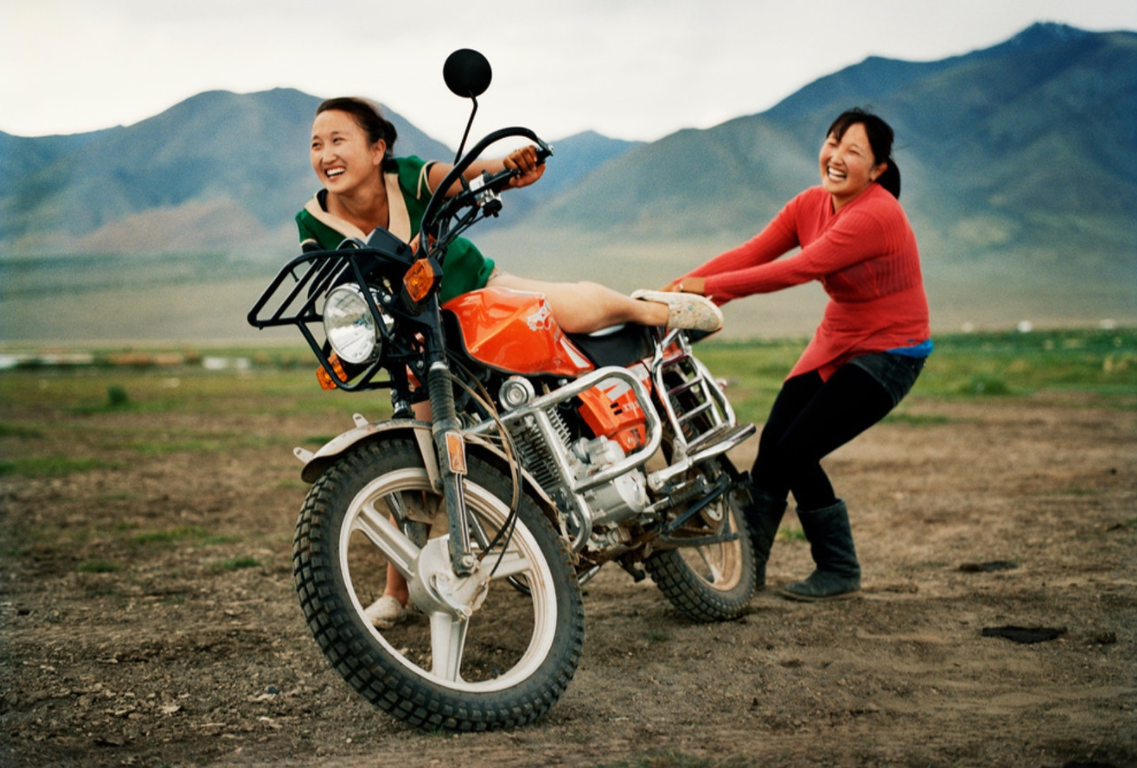
Two friends go out for a ride near their home by Üüreg Lake (Үүрэг нуур) in western Mongolia.
“A strong cold wind gets up from the W.N.W — that is to say, at our back — but we are on a desolate steppe, where we can find neither shrub nor anything else which can help to combat the cold that it is beginning to be unpleasant. On the other hand, we come upon some very pretty flowers, lovely wild pansies and edelweiss that would delight the heart of an Alpinist.”
FRENCH EXPLORER, GABRIEL BONVALOT
Across Thibet, The Mongols, 1891

Buddhist monastery in the summer months. / A frozen river winds through the stark landscape, on a flight from Ulaanbaatar to Ölgii.
You will find two contrasting dimensions in Mongolia, bound both by culture and geography. It is the 19th largest country in the world, yet there are only three million people living there. Close to half that population is located in the capital city of Ulaanbaatar, today the country’s industrial and financial heart, where technology has evolved considerably.
Meanwhile, the rest of Mongolia’s people are dispersed all over the country in small villages and towns, with some thirty percent still choosing a nomadic or semi-nomadic way of life, moving across the land with their horses. People may have a satellite dish or cell phone, but connection is erratic. Here, life is very slow; it hasn’t really changed over time.
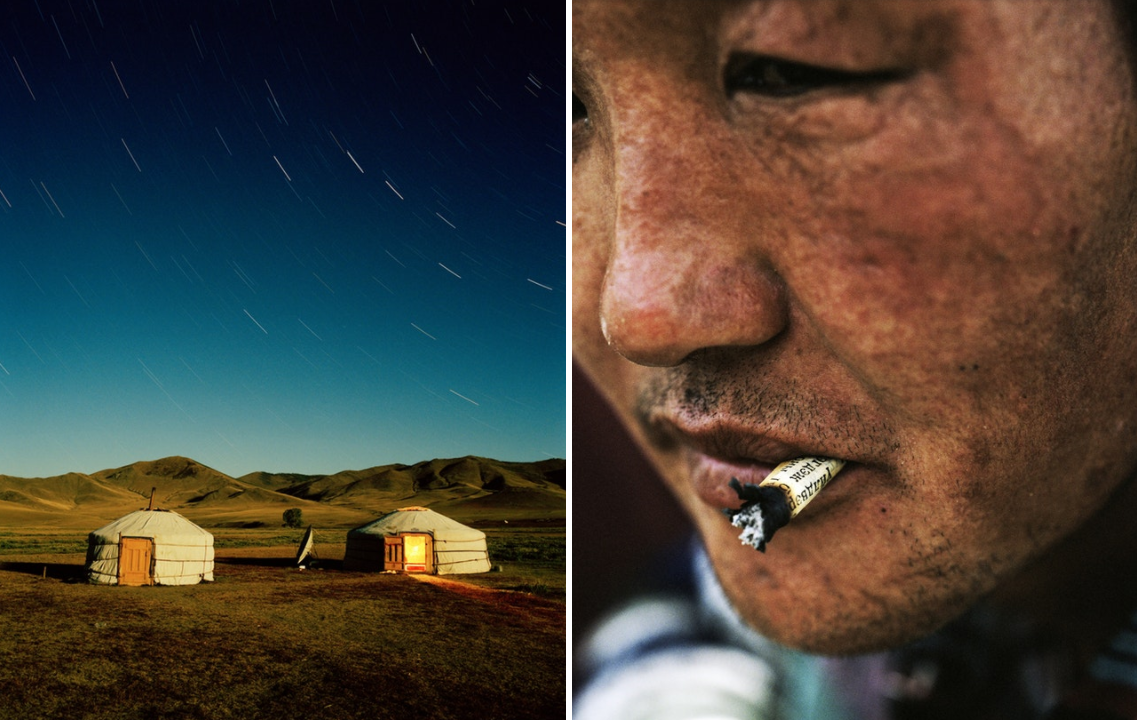
A remote satellite dish provides the evening’s entertainment. / A herder smokes a cigarette rolled from a scrap of newspaper.
Vast plains and beautiful landscapes are the hallmark of these remote lands. The air is pure. The food is very simple. Essentially, a meal is meat that has been taken from a sheep killed that morning and cooked with some flour. The customary tea is called suutei tsai and made with mare’s milk and salt. My initial physical experience in Mongolia is always an exponential energy increase from the combination of fresh air, vast open space, outdoor activity, and unprocessed food intake. It is amazing. It toughens you up — all that vitality and energy.

A herder, his wife, and their five young children make their way to winter pastures, transporting their “ger” or yurt and all their belongings.
There is a spiritual effect as well. Mongolia, overall, is a very flat country, and you can see for many kilometers. Nothing to obstruct you. Somehow, being able to see so far away brings you back to the moment, to where you stand right now. You float through that space. There is a reflection that delivers your own reflection directly back to you. This sense of place and of self, it centers you. In Mongolia, I am able to stay in the moment much more powerfully than other places. The strength and vibrance coupled with the spiritual energy from grounding in the present, is a restorative experience.
“Та өндөр бүтээхийг хүсэж байгаа бол, Хэрэв та гүн ухаж байх ёстой.” — If you want to build high, you must dig deep.
MONGOLIAN PROVERB
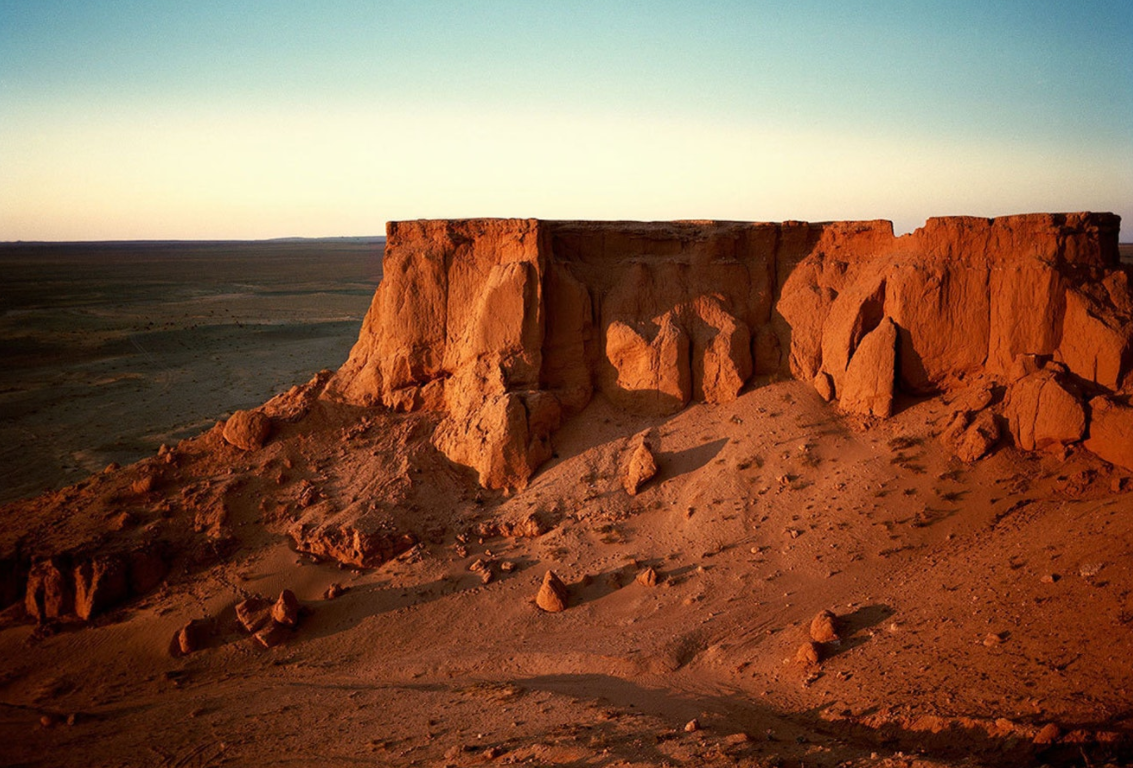
Bayanzag (Улаан Эрэг) or the “Flaming Cliffs” in Mongolia’s Gobi Desert are said to appear to be on fire as the sun sets.
For years, I wanted to photograph the Kazakh, a robust people living in the extreme western part of the country high in the Altai Mountains, who traditionally hunt on horseback with golden eagles. In December 2015, the opportunity finally presented itself. I had two weeks; everything was arranged. The eagle hunters are all ethnic Kazakh their ancestors having fled to neighbouring Mongolia during the mid to late 19th century, in the face of the advance of the Russian Empire troops during the communist era. Some speak Mongol; many don’t. They are Muslim, rather than Buddhist, and for most of the 20th century they remained an isolated, tightly knit community.
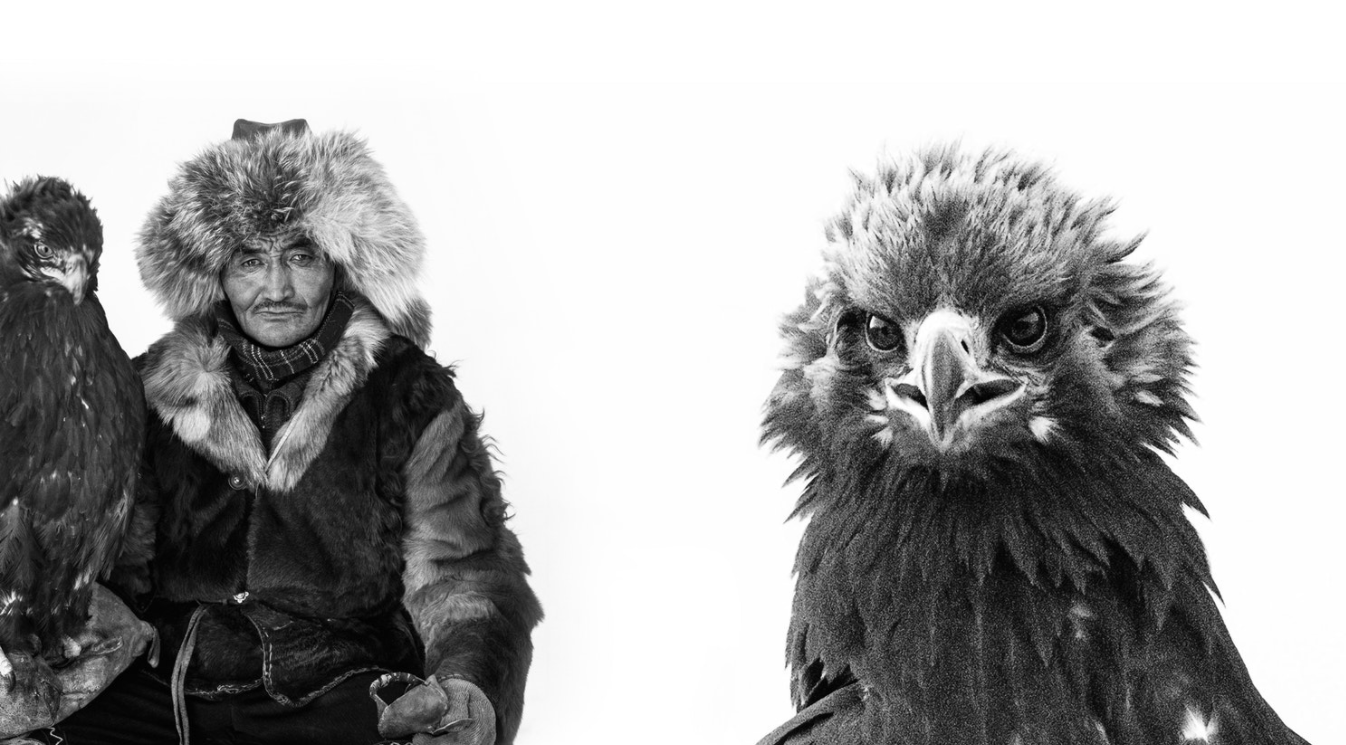
The hunter, Jaidarkhan, an ethnic Kazakh whose ancestors fled to Mongolia, and his eagle.
Living by the ancient art of eagle hunting, I found them to be very generous, kind people. In Kazakh, the word qusbegi, or falconer, comes from the words qus (“bird”) and bek (“lord”), translating as “lord of birds.”
These days, however, only a few Kazakh are still traditional hunters. Some continue primarily for show, as there is a new tourist economy that can support the fading art form, especially each October, when eagle hunting customs are displayed at the Kazakh’s annual Golden Eagle Festival.
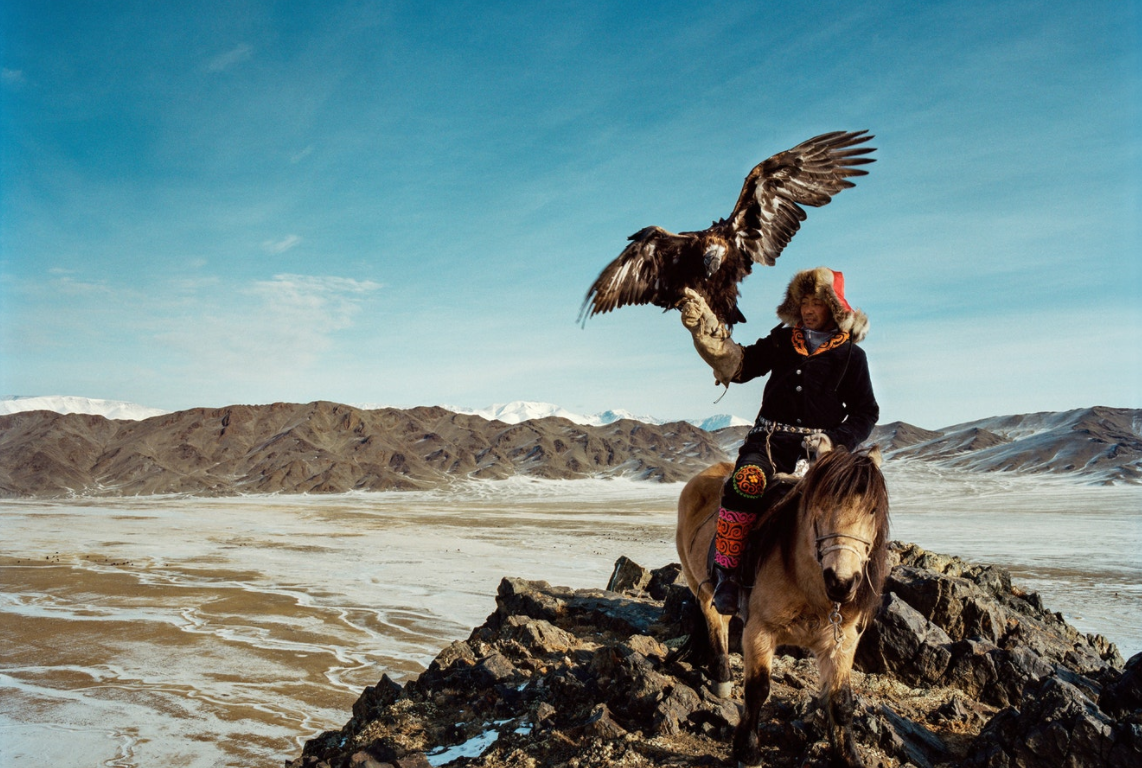
In good years, Kuantkhan Ologban and his eagle catch around 30 animals. Some years, none are caught at all due to extreme weather.
Winter in Mongolia often brings raw, biting winds, and extremely challenging conditions, so our journey to reach Kazakh lands was demanding. When we finally arrived, utterly exhausted, in temperatures of –30°C, I quickly became sick with a fever and was forced to stay in bed for seven days. I was deeply disappointed. My guide, and friend, Enkhdul, with whom I’ve crossed the entire country many times, in all seasons, from the Gobi Desert to Tsaatan lands in the extreme north, and from the eastern plains to the Altaii mountains in the far west, told me, “We are not leaving! You have been talking about coming here, to do this, for years.” So, I waited it out and got better. However, I had only three days to shoot everything.

Hunters value their eagles immensely. In winter, they sleep inside with the family. / Alpam, who is learning the art of hunting from his father.
The Kazakh community is quite incredible and their stories fantastic: how they proceed, scaling remote and cragged mountain peaks to find the eagle they will raise. The relationship that forms between the hunter and eagle has a special connection and symmetry that can only come from time and great care. Sometimes a hunter will work with an eagle for ten or twenty years.
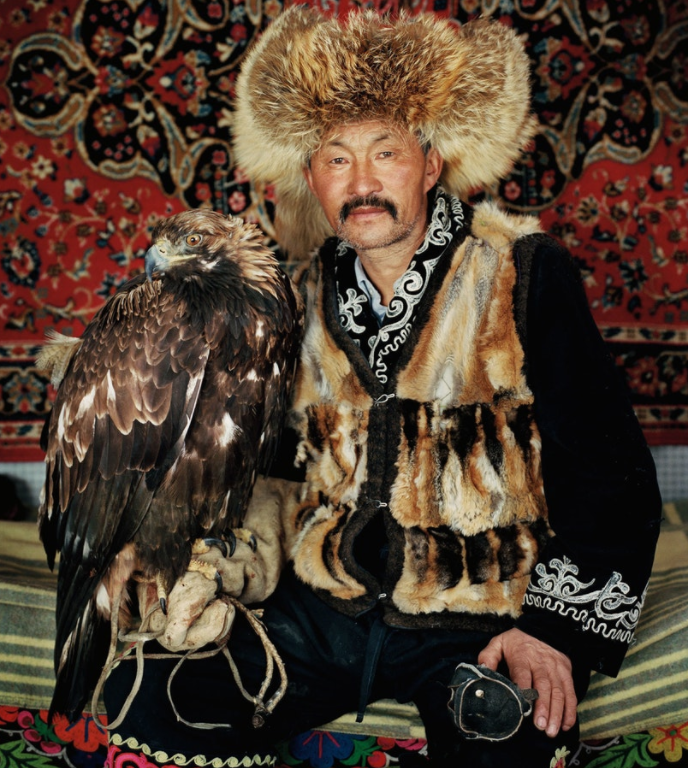
Dalaikhan, a champion hunter, with his 2-year-old eagle. He is wearing fox-skin clothes from previous successful hunts.
As we were so far north, in the middle of December, the hours of daylight were few. The sun was consistently low on the horizon, casting a golden, soft light on everything and everyone it touched. But once the sun disappeared, the temperatures plummeted to a frigid –20°C. My analogue camera would jam and stop working completely, forcing me to end for the day. Once again, gifts and challenges.
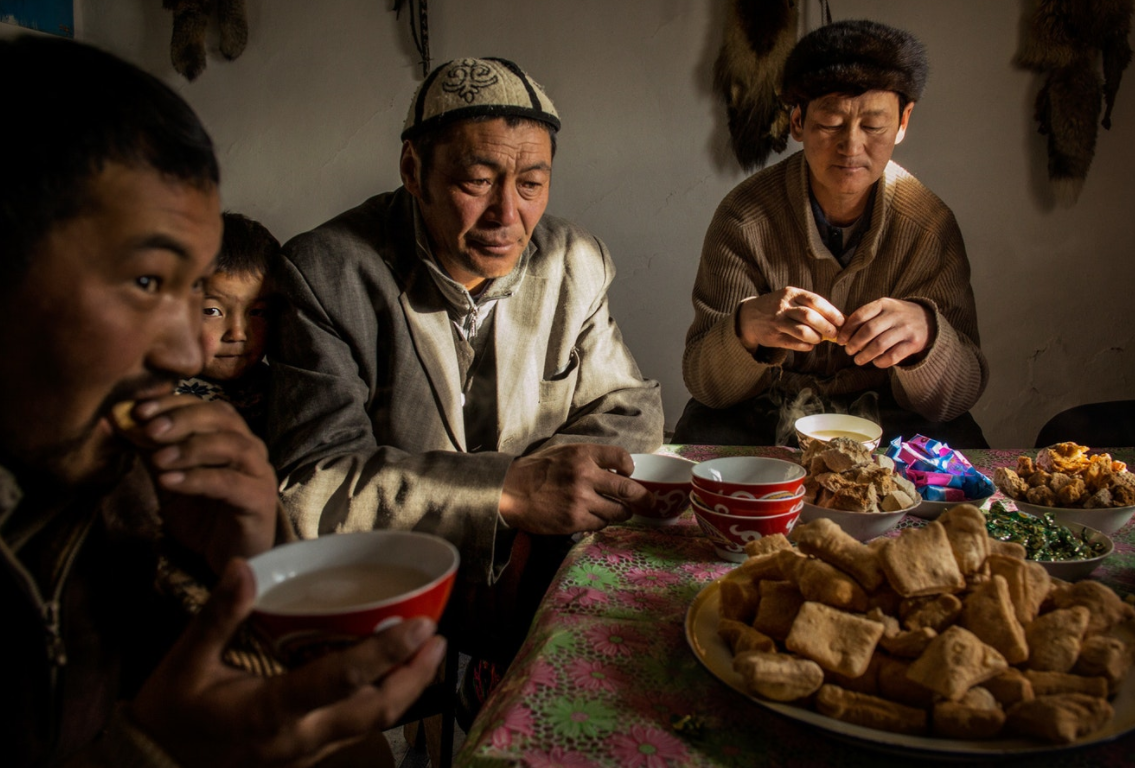
After just one day, my camera and I had become seemingly invisible, to all but the inquisitive eyes of the youngest child.
Like so many other times in this vast and windswept country, my expectations did not match the reality. I had planned for two weeks and received a mere three days. But, those brief days surpassed anything I could have hoped for in quality and depth of relationship. Their grace and exceptional strength was tangible. Here, among the sweeping landscape and rugged way of life that shapes the inhabitants of this part of the world, I could imagine the men who rescued my grandfather.
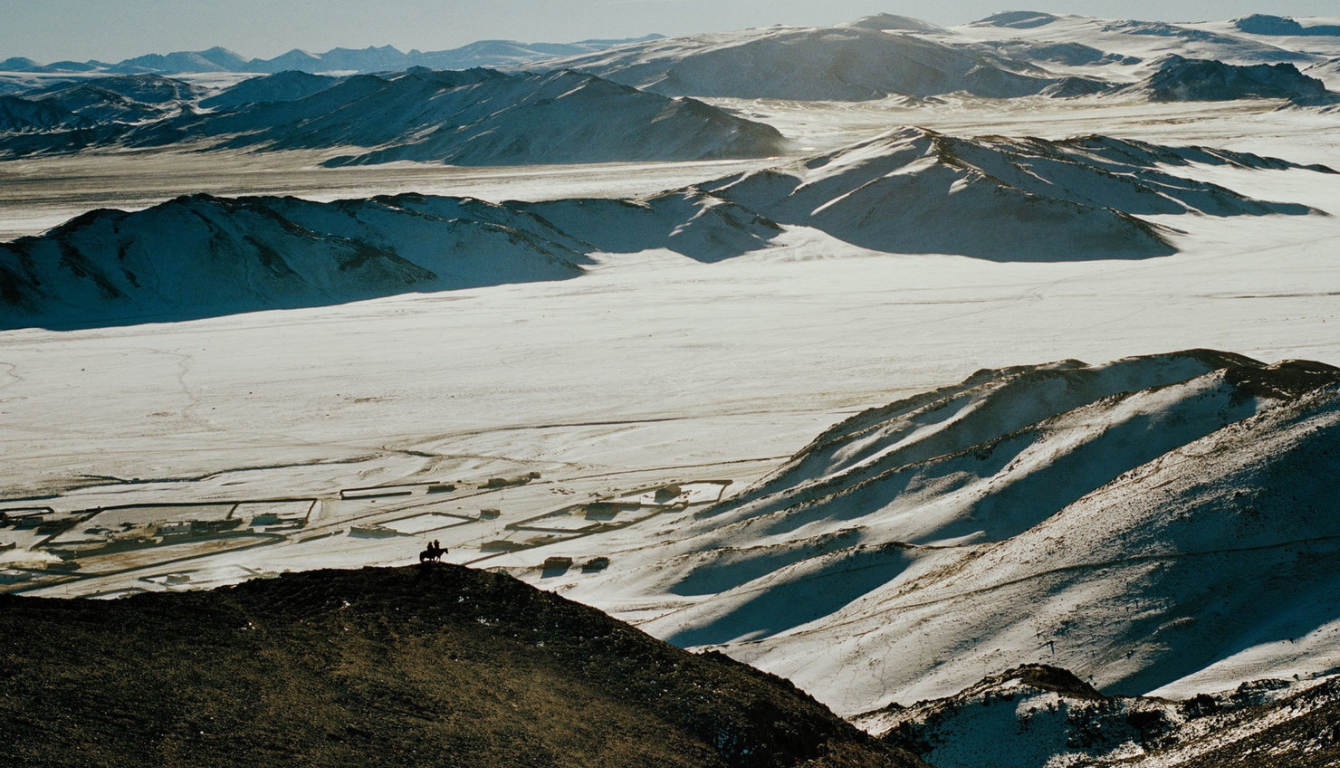
The mountainous landscape dwarfs two Kazakh hunters and their horses in the far west of Mongolia, near the village of Altai (Алтай).
While the heroic ferocity of my grandfather’s Mongol Army certainly inspired my obsession with this country, we are all products of our experience. Regardless of culture, each of us are indelibly shaped by the events and history of the generations that precede us. I may have first come to Mongolia in search of warriors, but I return again and again having discovered raw beauty and elegance in a country equally ethereal as it is grounded.
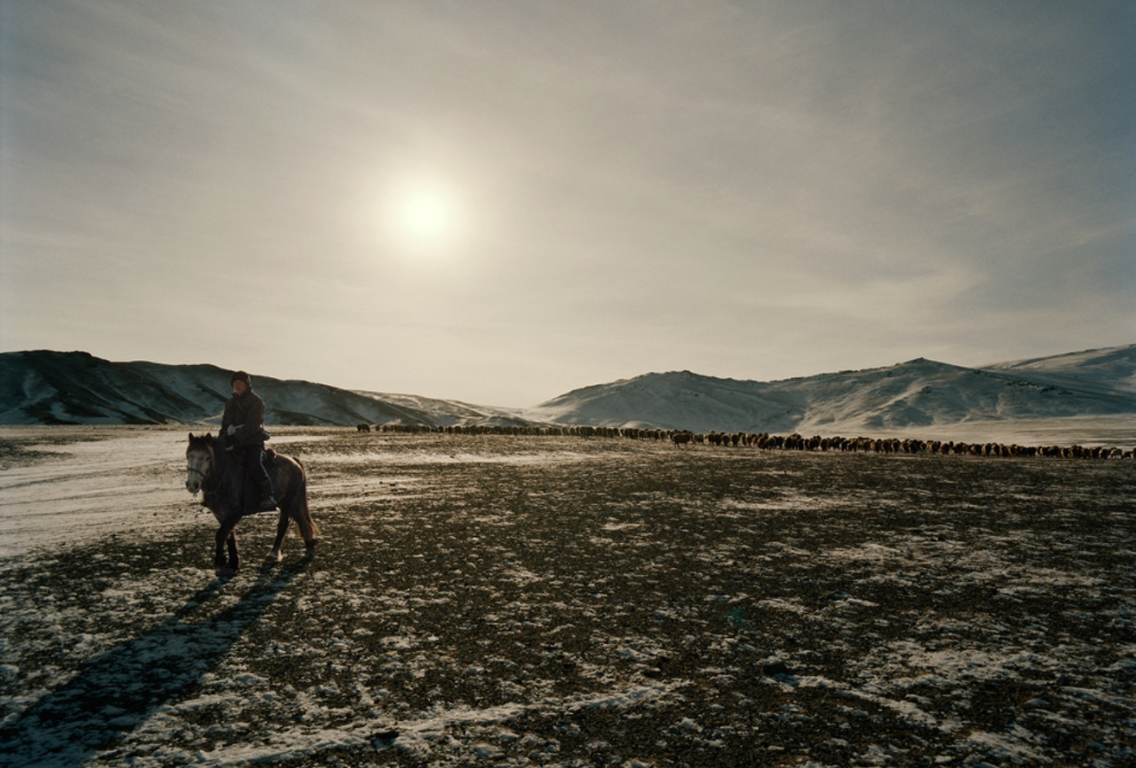
Casting a diffuse, shimmering light, the winter sun was low in the sky, as we watched this young herder and his cattle pass by.
Maybe it is the influence of my professional background, but I have grown attuned to noticing elegance, even in the wildest places in the world. There is always a glimpse of quiet splendor, an angle that calls out something beautiful. Perhaps the knotting of a silk cord along a side pocket or a belt that is latched around a robe, maybe hair done a certain way. I am attracted to these graceful elements and know when I see them that I will make a photo.
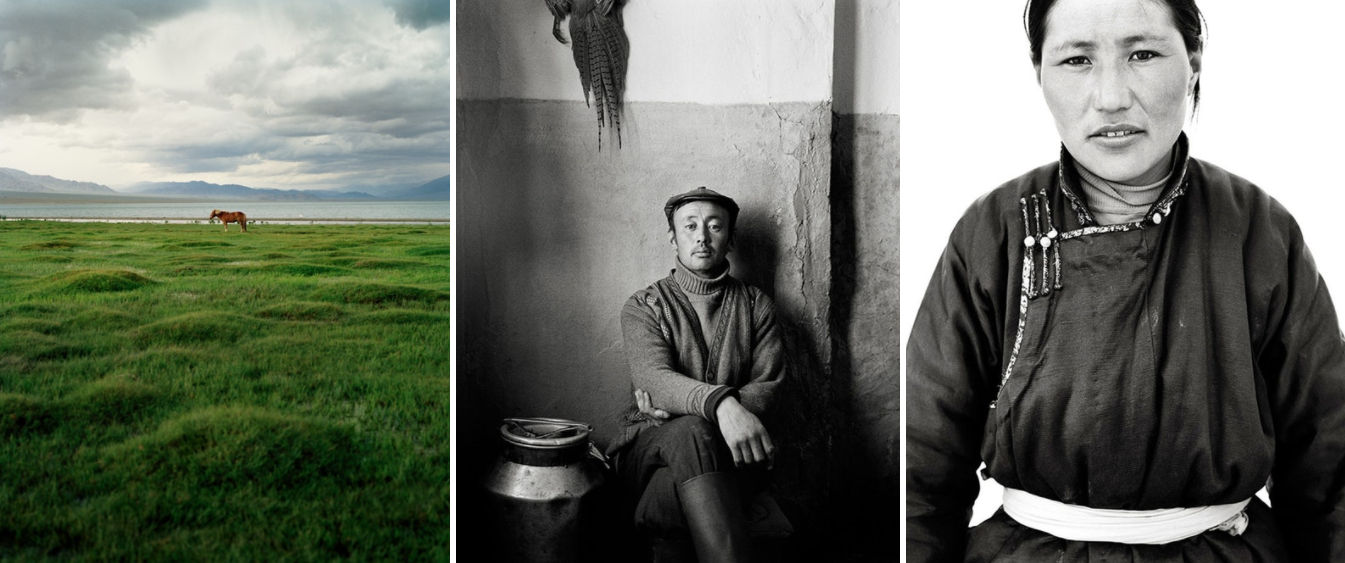
Summer rain clouds gather over the lush grazing pastures on the shores of Üüreg Lake (Үүрэг нуур). / A farmer, pausing for a moment, in his day’s work. / A young woman wearing a traditional “deel” or robe.
All of this is an odyssey. In Mongolia, this journey is most often about shooting in difficult places and seeking the elegant angle. I found photography very late in my life, but am thrilled to discover the range of perspective it offers. It is a learning process that requires great sensitivity. There are constant questions: How am I able to emotionally perceive what I see? What will it take to tell this story in a unique way? All of this fascinates me. This is my passion project. After fifteen years, I have a much better sense of what makes my work distinctive. My sense is that over time, my images have become more artful. Still, this is a work in progress.
I am always exploring.
—
COMING SOON
For years, I have been working to collect material for a retrospective book of my photographic work and experiences in Mongolia. In Fall of 2018, I will be publishing a limited collectible edition of 1,000 books in a large format (17 inches x 14 inches) with more than 250 pages. There will also be a handful of special editions that are offered with a signed print and a special book encasement. Follow along on my Instagram @fredericlagrange to keep up-to-date.
THIS ARTICLE WAS ORIGINALLY PUBLISHED ON MAPTIA.
FRÉDÉRIC LAGRANGE
Photographer & Director based in Brooklyn, NYC shooting for a diverse range of clients worldwide. Capturing nuanced human stories through evocative color & black and white photography.
Nomads of Mongolia
Life in Western Mongolia is an adventure. Training eagles to hunt, herding yaks, and racing camels are just a few of the daily activities of the nomadic Kazakh people. Filmmaker Brandon Li spent a few weeks living with them and experiencing one of the most unique cultures in the world. Saddle up and enjoy the ride.