
Explore unique Valentine’s Day traditions from around the world.
Read MoreGhanaians Knee Deep in Clothing Waste
Ghana is struggling with the overwhelming influx of textile waste from the fast fashion industry, with millions of garments dumped each week, much of it unfit for resale
Read More7 Sustainable Alternatives to Overtouristed Destinations
Discover seven sustainable alternatives to over-touristed destinations where you can enjoy nature and culture while supporting eco-friendly practices.
Read MoreDanish Cozy Culture
Explore the cozy, happiness-driven culture of Denmark, where hygge—an intentional pursuit of comfort and joy—has become central to daily life.
Read MoreLights, Camera, Action: 7 of the Best International Films
With the 2024-2025 movie awards season in full swing, let’s look at what filmmakers had the world watching — and discussing — last year. This article highlights seven international films from the past year, each transcending borders and language barriers to tell untold stories, raise global awareness, and reveal universal truths.
Read MoreChild Slavery in Congo’s Cobalt Mines
The world’s high demand for cobalt mining has led to the exploitation of child labor in the Congo.
Read MoreThe Ethics of Poverty Tourism in Brazil’s Favelas
Understand the implications of poverty tourism in Brazil, what a favela is, and how the growing tourist rates raise concerns about safety.
Read MoreSolo Female Travel: The Rise and Rage of Traveling Alone
Learn a few tips on how to stay safe as a solo female traveler.
Read More4 Destinations That Are a Bookworm’s Dream
Explore four enchanting destinations where book lovers can step into the pages of their favorite stories, from the misty hills of Hobbiton to the eerie halls of Dracula’s Castle. Whether retracing Mrs. Dalloway’s London stroll or riding the luxurious Orient Express, these literary-inspired journeys bring iconic settings to life.
Read MoreUS Declares Genocide in Sudan
After two years of famine, disease, and misery, the U.S. has given an official deemed the ongoing conflict in Sudan as genocide.
Read MoreSmall Towns Redefining Sustainable Tourism
Environmentally conscious values have made their way to the forefront of travel so lesser-known destinations can leap into the ecotourism limelight. Learn how small towns are redefining sustainable tourism.
Read MoreLive Like a Local in Madrid
Skip the tourist traps in this fantastic Spanish city with advice from a traveler who has food, wine, sunset, bars, and dancing recommendations in the city of Madrid.
Read MoreCelebrating Lunar New Year Across China
Falling on Jan. 29, 2025, the Lunar New Year is a time of celebration across China, commemorated by unique traditions found in each of its culturally diverse regions.
Read More5 Ancient Pilgrimages You Can Still Hike Today
Five ancient pilgrimages around the world you can still hike today! Visit them in Spain, Japan, Peru, the Middle East, and Sri Lanka.
Read More6 Tropical Countries To Escape the Winter Chill
Avoid the cold temperatures of winter by taking off to these six tropical destinations around the world, each offering a lush climate and magical adventures.
Read MoreA New Dawn for Syrian Refugees
The fall of Assad’s regime has left the world wondering about the future of Syrian refugees abroad who plan to return home.
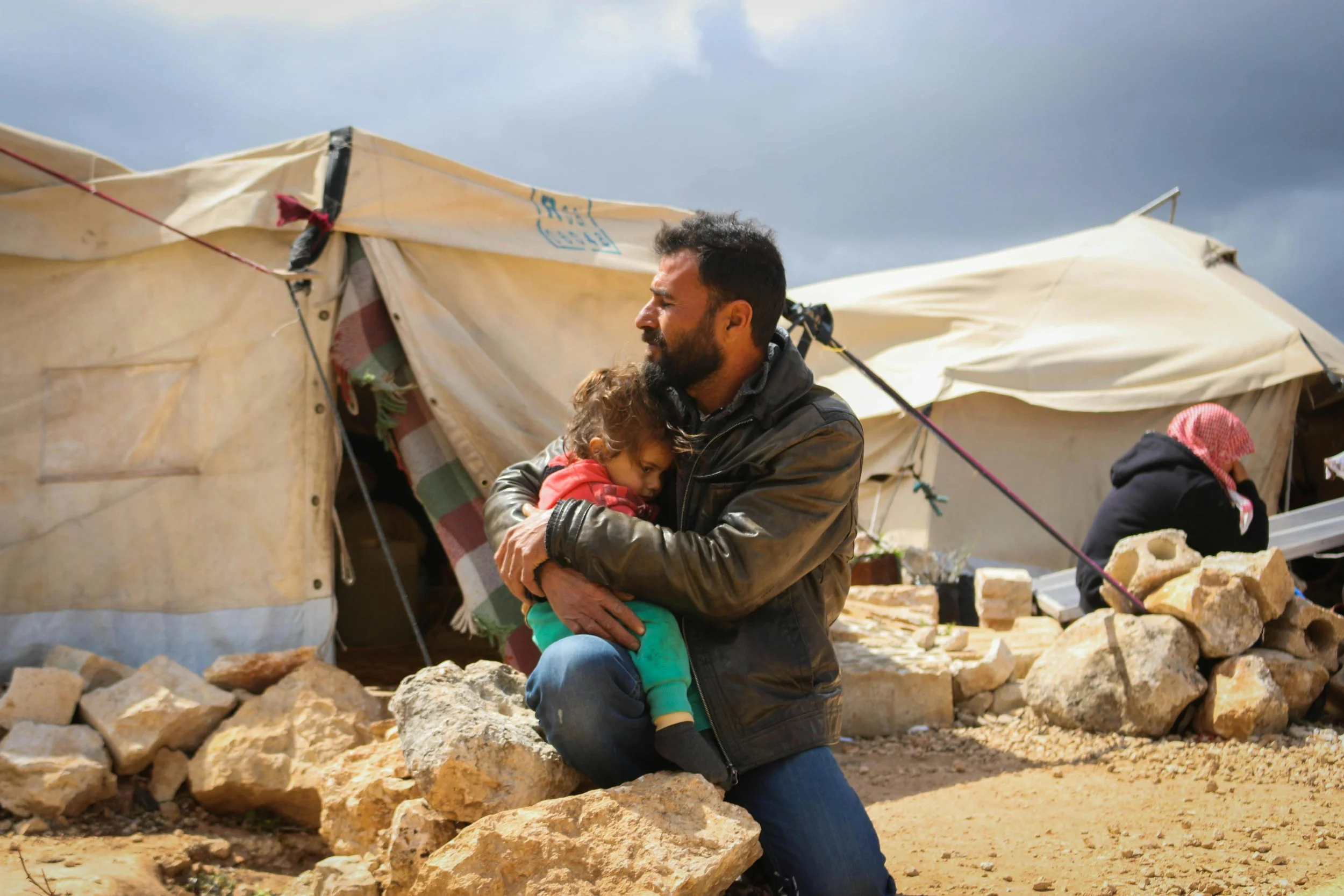
Man and daughter at Syrian refugee camp. Ahmed Akacha. CC0.
The Syrian Refugee Crisis is one of the largest humanitarian crises in history and the largest refugee crisis to date, with over 14 million people both internally and externally displaced. Over six million Syrians fled the country following the civil war that broke out in 2011; the majority of refugees currently live in Turkey, Lebanon, Jordan, Iraq, Egypt and Germany.
President Bashar al-Assad’s violent suppression of pro-democracy protests in 2011 provoked civil conflict, leading to the creation of oppositional militias and rebel groups that began to fight back by 2012. On Dec. 8, 2024, the civil war came to a head when rebel groups seized the Syrian capital, Damascus, forcing Assad to flee to Russia. Assad’s family had ruled Syria under a strict police regime since the 1960s, leading to widespread celebration across the capital as political prisoners were freed.
Despite rebel groups declaring the country free from the autocratic regime, considerable uncertainty remains about the future of the government and Syria’s stability. Some states have expressed a concern that toppling the government may make the country vulnerable to ISIS, whereas others have noted the encroachment of Israeli forces into Syrian buffer zones. The European Union issued a statement claiming that the conditions in Syria have not yet met the conditions for the safe return of refugees, as thousands have continued to flee following the rebel takeover. However, in the days following, videos swept across social media and news outlets featuring thousands of refugees returning home from Turkey, Jordan and Lebanon.
European countries hosting hundreds of thousands of Syrian refugees, including Germany and Austria, have jumped at the opportunity to tighten their asylum regulations. In December 2024, both Germany and Austria paused asylum applications, and Austria announced that they would issue a “return bonus” to Syrians who decided to return to Syria.
Providing incentives or forcing refugees to leave the country could adversely affect host countries, particularly Germany. Approximately two-thirds of employed Syrian refugees in Germany work in critical sectors of the labor force, including healthcare, transportation and food services. Whether forced or voluntary, any kind of mass exodus could negatively affect Germany’s economy by disrupting these industries and causing labor shortages.
Following an outcry from far-right German politicians to close the country’s borders and begin the expulsion of non-naturalized Syrians, current Chancellor Olaf Scholz said that Syrians who are “well-integrated remain welcome in Germany.” However, the Chancellor’s statement may prove unstable, presenting no active policy arrangements if the far-right parties gain control in the upcoming elections and creating further uncertainty for Syrians currently living in Germany.
The United Nations High Commissioner for Refugees advised that countries housing refugees should not forcibly deport them, as Syria is not yet deemed politically stable, and it is estimated that over one million Syrians will return to Syria of their own accord in the first few months of 2025.
Despite this monumental step forward, considerable humanitarian and governmental uncertainty remains surrounding the future of Syrians worldwide, a resolution that may take years to completely unfold.

Zoe Lodge is a student at the University of California, Berkeley, where she is studying English and Politics, Philosophy, & Law. She combines her passion for writing with her love for travel, interest in combatting climate change, and concern for social justice issues.
A Portable Solution to the World’s Water Crisis
Hydro Wind Energy’s Quench Sea device offers a portable solution to the global water crisis, providing communities with access to clean drinking water through innovative desalination technology.
Read More7 Must-See Festivals Across Asia
Visiting a country during a cultural festival can be an amazing experience. Once travel resumes, plan a trip to one of these top festivals in Asia. From the Bali Kite Festival to the Desert Festival of Rajasthan, and learn of many more.
Read MoreNorth-East India’s Women-Only Market
Manipur’s Mothers’ Market is a world of resilience and resistance, where tradition, activism, and community converge in unexpected ways.
I decide on the Ima frying whiteish dough balls over a stand-alone stove and gas canister. ‘Aloo,’ she smiles and gestures to the wooden bench next to a young man slurping a leafy soup. Seconds later, this plump woman serves me a lunch of grilled fish, unidentifiable green veg, those fried potato balls, banana leaf, rice, and then, despite my protests, several second helpings.
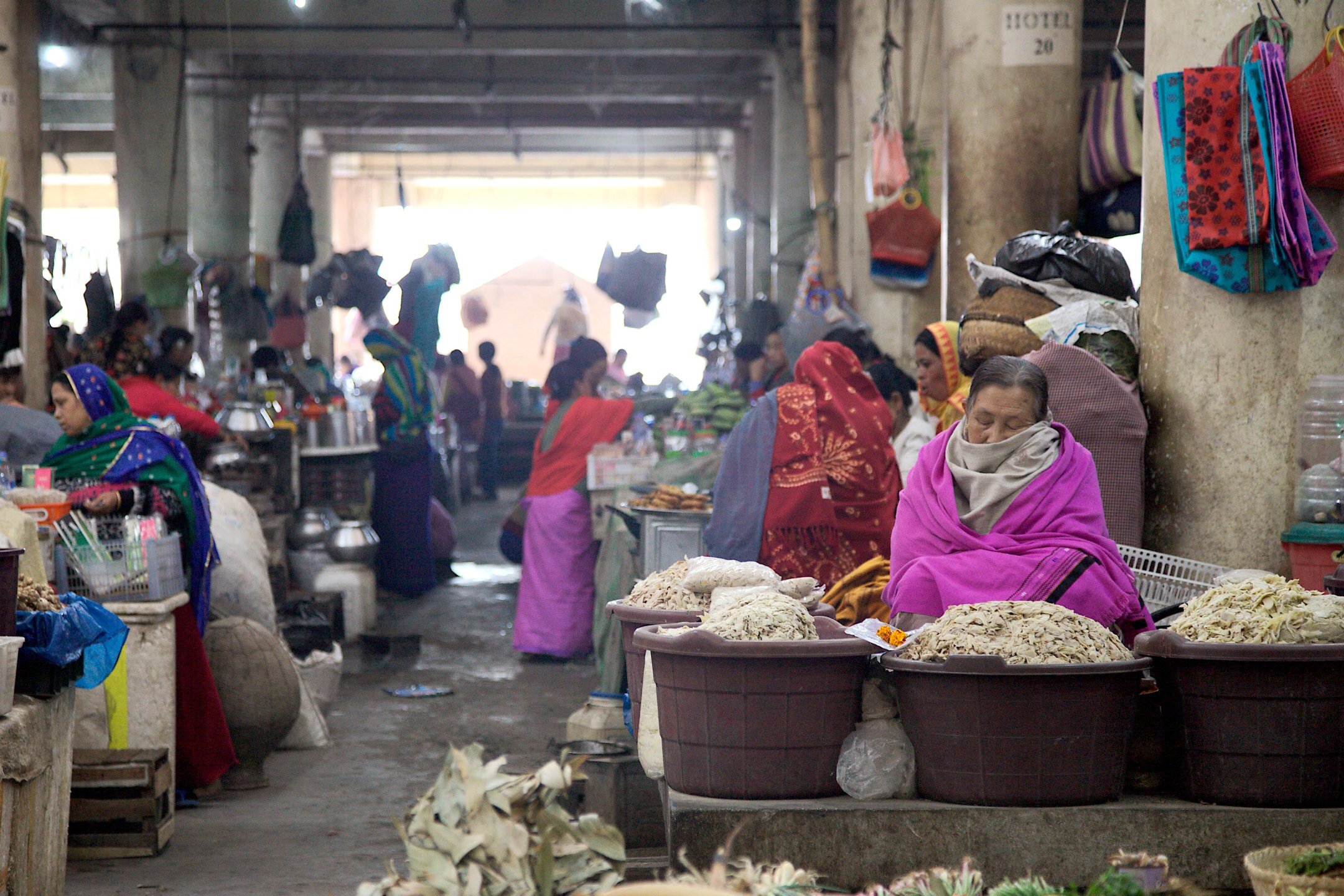
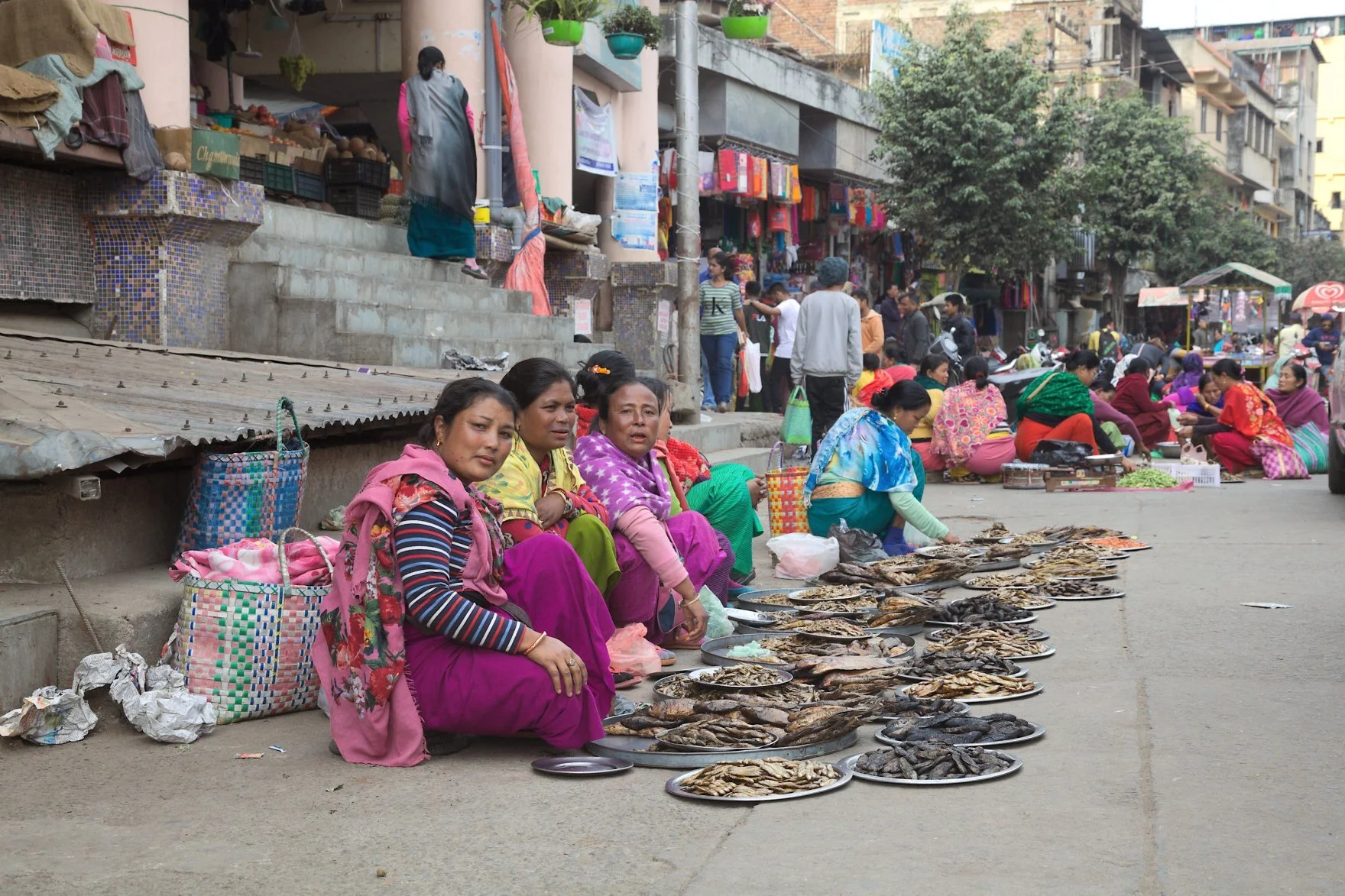
The Imas are lined up behind their gas stoves, enticing the locals with their jokes and salty fish dishes. Sitting opposite, in front of stacked ceramic pots, are two more, warming their hands over the burning embers of a square metal pot. My host, Suporna Devi, is one of over 4000 women who congregate daily, in Ima Keithel, Manipur’s main market, selling everything from temple paraphernalia to locally-caught eels.
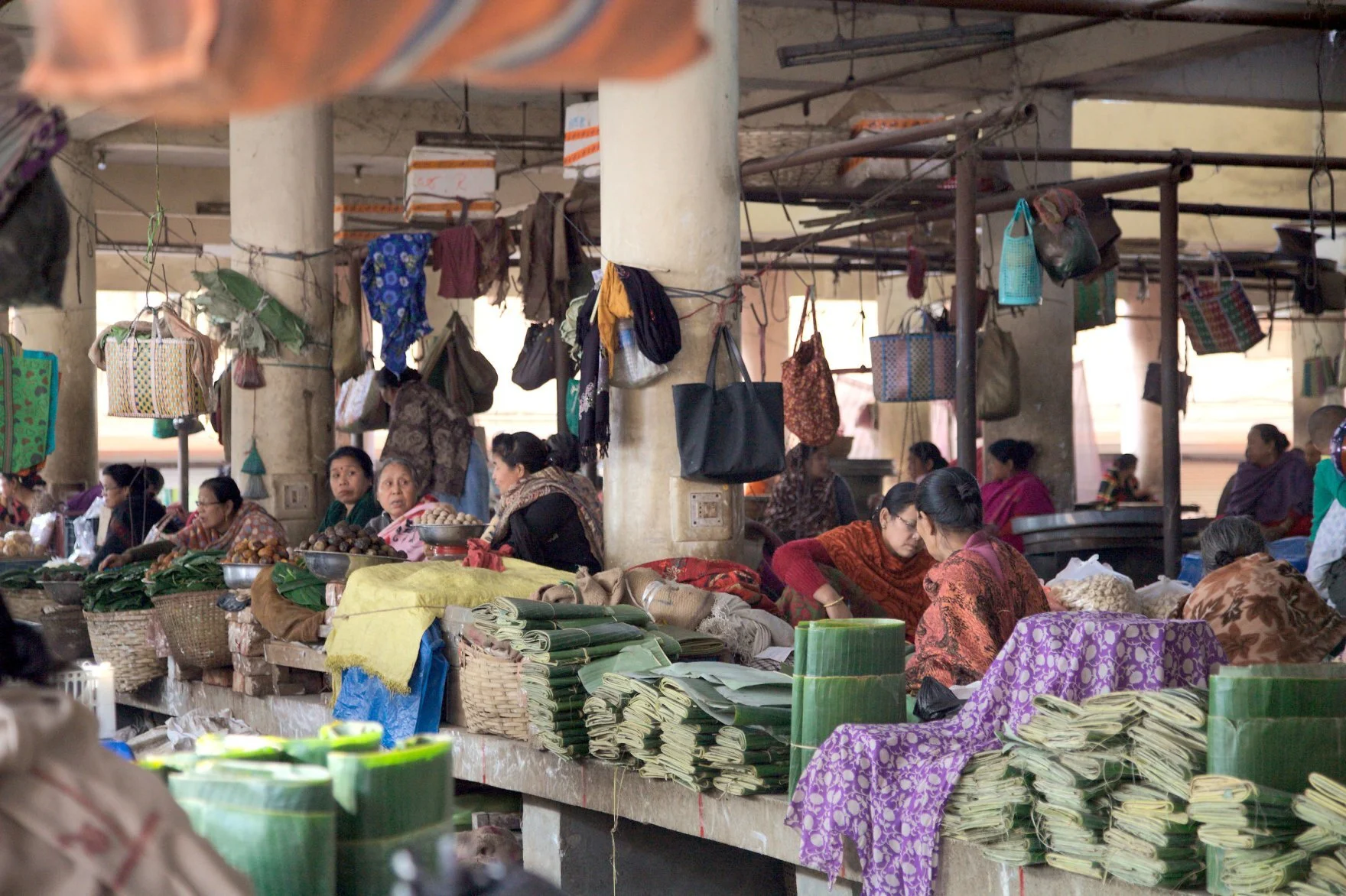
But, unlike the rest of India, here men are forbidden from trading. Passed down the generations, a stall at Ima Keithel, meaning ‘Mothers’ Market’, is highly coveted and provides the local Imas with an important source of income. Spilling out of the market buildings, encroaching on the roads, under the concrete flyovers, women are everywhere, selling produce. Some are eating, some reading, some sleeping. Many are chatting.
Believed to date back to the 16th century, the origins of Ima Keithel are unclear. Sandwiched between Myanmar and the Indian state of Assam, Manipur has long been forced to fight the Burmese and Chinese to retain its autonomy. A forced labour system, called Lallup Kaba, sent the men far from home to fight these wars, leaving the women at home to cultivate the land and sell the produce, possibly fostering this peculiar phenomenon.
For thousands of years Manipur remained an independent kingdom and a crossroads of trade and cultural exchange until it was conquered by the British in 1891. The golden, oval valley fringed by misty blue hills was famously called ‘the Jewel of India’ by India’s first prime minister. It is home to a diverse mix of tribes, who ethnically share more with groups in Burma than with the rest of India. Several hard day’s travel from Delhi, Manipur feels like a faraway land compared to India I’ve come to know; somewhat familiar, but yet not. A unique language and alphabet add to my disorientation.
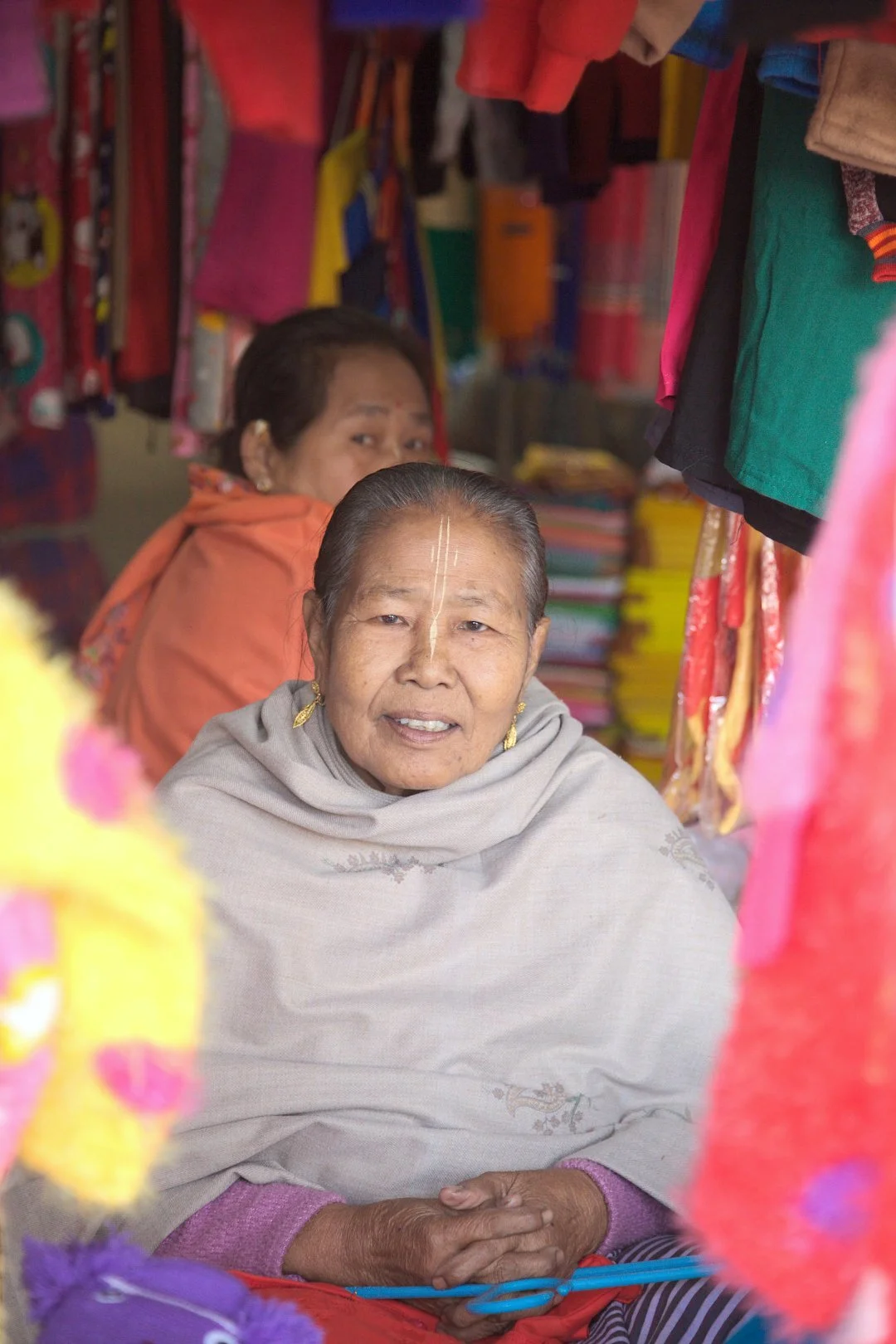
The two large market buildings sit in the commercial heart of Imphal, a dusty, grey city, home to as many motorbikes as people. Mornings see the city enveloped in a heavy, December mist, which she usually manages to shed by lunchtime. Most ladies are sitting under bright shawls: many baring two pale vertical lines on their foreheads, meeting on the nose: the mark of local Hindus. I feel the weight of eyes as I circle the floor. But smiles are soon reciprocated with smiles, and many proudly remove their glasses to strike a poise for my camera. Before long, I fall foul of the sly sales pitch of an unassuming mother and daughter. Several tea-towels later, I note to myself this is still India.
When I reach Suporna Devi’s stall, I am thankful for the rest, and we are soon conversing, in a broken fashion, through Hindi, her third language. She has worked here for over 20 years, she tells me, inheriting the pitch from her aunt. Pointing to a poster, emblazoned with hammer and sickle, she exclaims, “this is not just a marketplace, but also a place of protest!”
The revolutionary slogans spray-painted to the outer walls point to a more complex story, and I have started to research Manipur’s matriarchal society. Since at least the early 20th century, the Manipuri women have been wielding a strong influence over political and social matters of the state, with Ima Keithal at the centre of the movement. The market developed as a place not only of trade, but as a centre for gathering, a source of the latest news, a place to discuss ideas. The mothers of Ima Keithel started credit unions, lending to women who wanted to started businesses, and mentored them in the process.
As she ladles yet more rice onto my plate, Suporna suggests I visit the Nupi Lal (Women’s War) monument in another part of central Imphal. This is a memorial to Imas who fought the British rulers in the 1930s over attempts to export local rice to British battalions in other territories. Locally rice became scarce, the price spiralled and the Manipuris began to suffer. The Imas protested, peacefully, but were met with attempts to sell the market buildings. They refused to relent and eventually military and police forces were unleashed against the unarmed females. Although the export policy was eventually repealed, many women lost their lives in the struggle.
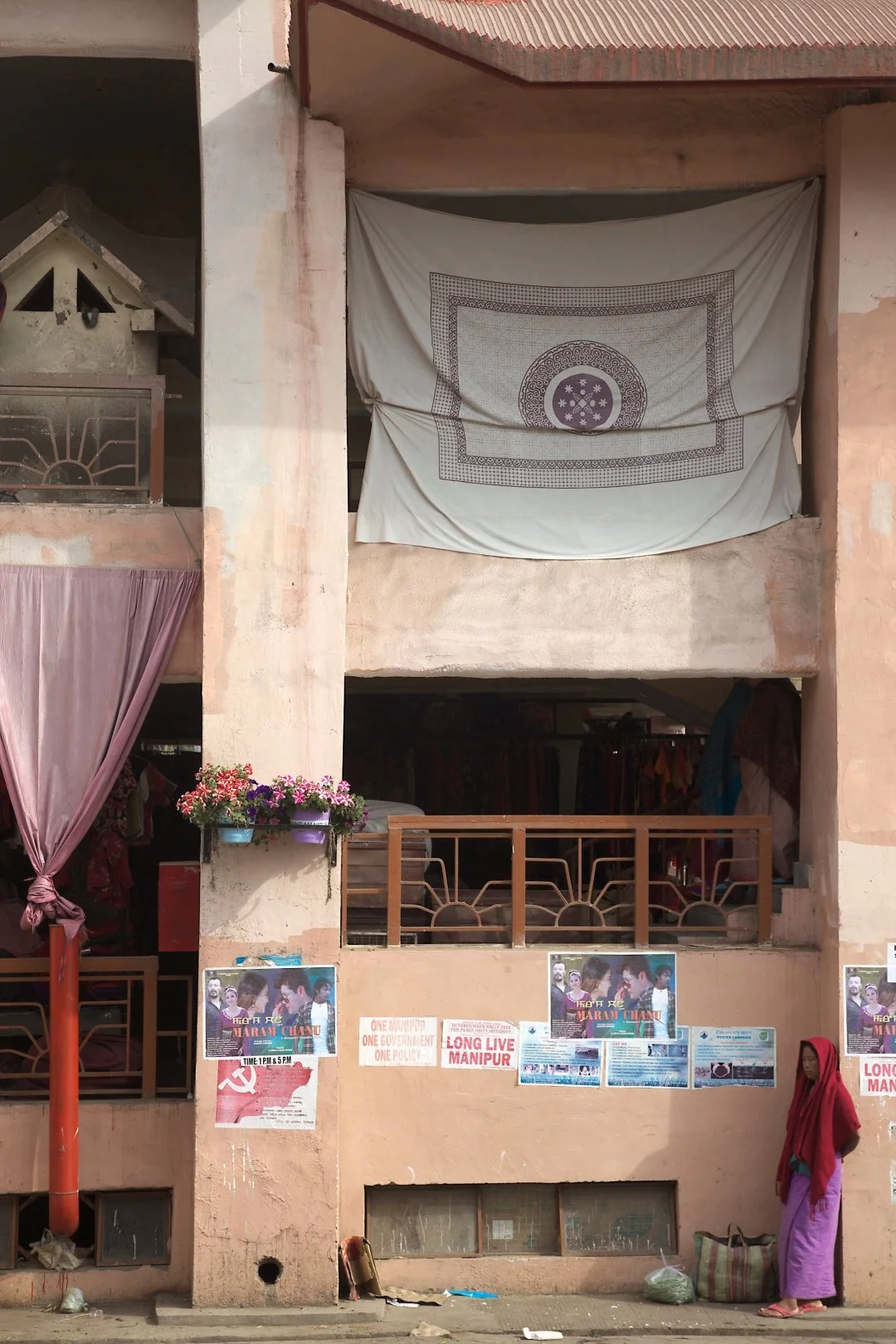
During the Second World War, Manipur became a battleground for the war between the British and Japanese: this part of India is scarred with war graves. With the independence of India, a ravaged Manipur was absorbed into the new country, unleashing a seemingly indefinite cycle of violence and insurgency as anti-Indian and ethnic groups fought over differing visions for the state’s future. From 1980 until today, most of the state has been classified as a ‘disturbed region’ by the Indian government, a ruling designed to give the Indian Army additional powers to help them maintain public order. In practice, it has granted them immunity from prosecution for a range of heinous crimes.
Despite the departure of the British, for the Imas of Manipur, the oppression continues and their imaginative responses evolve. From torching liquor stores and fining drunk men, to protesting, naked, outside an Indian army base against a case of rape and murder by the armed forces, their actions are undoubtedly radical in a country where the majority of women have little say in domestic or societal affairs. Today, they are continuing to hold out against the talons of globalisation: recent attempts by the local government to replace the market with a modern supermarket were derailed by round-the-clock sit-ins by the Imas. Again they succeeded.
After a few days of loitering around Imphal, chatting and drinking chai, I decide it is time to leave the Imas. Several check where I am going, who with, and most importantly, have I eaten yet? I gesture to the fish section at the back of the market and they nod approvingly. After my last meal, I ask Suporna if she enjoys her work in the market. She smiles and says, “This is not just my work. This is my life.” I tell her I am leaving. “Vapis ana,” (come again) she says, and goes on frying her potato balls. I heave on my backpack and head for the bus.
How to get there: I took the bus from Guwahati, Assam. It was an uncomfortable, although beautiful journey that crossed through the hills of Nagaland on the way. There are also direct flights from Delhi, Calcutta and Guwahati. Imphal makes a convenient stop if travelling overland from North-East India into Myanmar through the recently opened Moreh-Tamu border crossing.
Where to stay: The Hotel Nirmala has decent rooms starting at 850 INR. Aheibam Homestay is a good budget option.
Where to eat: The stalls of Ima Keithel, of course. And the Luxmi Kitchen does a mean thali.
Eileen McDougall
After a decade working in London, Eileen swapped flashy buildings for a notepad and camera and set off for Asia. She fell in love with India, and it was here she started to write about her travels and the culture she was becoming immersed in. She is at her happiest on a bus alone heading off to somewhere new but seems to spend most of her time near mountains, mainly the Himalayas.
Barring Basic Rights: Uganda’s Anti-Homosexuality Regulation
Modern anti-gay regulations continue to threaten the lives and safety of Ugandan LGBTQ+ individuals.
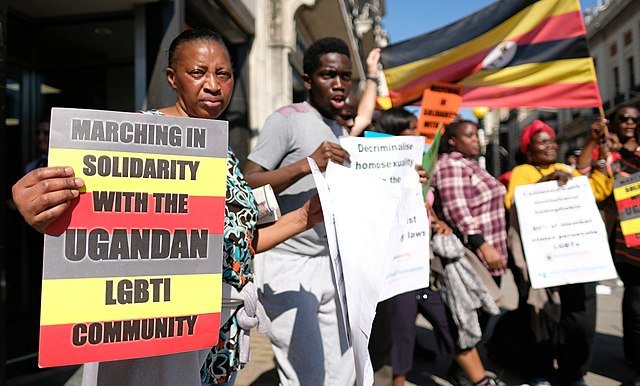
Group Marching in Support of Uganda’s LGBTQ+ Community. Alisdare Hickson. CC BY-SA 2.0.
Known for having one of the world’s harshest LGBTQ+ rights records, the Ugandan parliament has pursued longstanding efforts to diminish same-sex activity within the country. As a result of 19th-century British colonization, the severe criminalization of homosexuality set the stage for modern homophobic sentiments. This culminated in the Anti-Homosexuality Act of 2023, which was later upheld by the Ugandan parliament in April 2024.
The 2023 Anti-Homosexuality Act was signed into law by Ugandan President Yoweri Museveni in May 2023, enforcing strict restrictions against LGBTQ+ individuals. Implementing harsh penalties, the act demands life imprisonment for consensual same-sex activity and the death penalty in cases of “aggravated homosexuality,” a term that denotes any same-sex act that involves people under 18, older than 75, those with a disability, or when consent is not given or cannot be given. This act is not the first attempt to limit LGBTQ+ rights in Uganda. In 2010, the Ugandan parliament passed a bill introducing similarly anti-gay legislation that was eventually ruled illegal by the constitutional court due to its lack of necessary quorum. In 2021, however, the president succeeded in passing a sexual offenses bill that criminalized same-sex relationships and sex work in Uganda.
While the Ugandan government has praised such legislation as acting in the country’s best interest, the persistent condemnation of same-sex actions has negatively impacted the lives of LGBTQ+ Ugandans. This has not only promoted anti-gay views but has also threatened lives through the reduction of HIV prevention and perpetuation of societal abuse. In an interview with Amnesty International, Ugandan activist and founder of the gay and intersex rights organization Freedom and Roam Uganda (FARUG), Jacqueline Kasha described the new law’s impact on her community. She contends that advocacy and visibility for LGBTQ+ individuals have sharply diminished with the aggressive crackdown: “Several LGBTI persons have since gone underground which is now impeding all our efforts, especially in the health sphere in the fight against HIV, mental illness and economic disparities.” The 2023 Act has allowed anti-gay groups to accuse or arrest people with little evidence or reasoning. As such, LGBTQ+ individuals are vulnerable to attack when outside the safety of their homes, forced to hide their identities under the threat of violence. Furthermore, those in need of HIV services have become disproportionately vulnerable to health risks, driven away from receiving care due to fear of criminal punishment or discrimination.
The first case of “aggravated homosexuality” has already come into effect: 21-year-old Michael Opolot was arrested in August 2023 after allegedly participating in public sexual activity with another man reported to have a disability. While the new act permits this arrest, there has not been any evidence submitted by police to substantiate claims that the alleged victim is disabled and therefore could not give consent. Opolot’s case has provoked Ugandan activists to challenge the law's constitutionality, citing the act’s contradiction of citizens’ freedom from discrimination and rights to privacy and health. Moreover, they have noted that Opolot’s case demonstrates the senseless oppression of LGBTQ+ individuals. Ugandan activist Clare Byarugaba affirmed that this mistreatment not only violates human rights but also suppresses advocacy, as “activists, public health workers, and others face long prison sentences and hefty fines” for attempting to voice support.
As a result of such political, social and health persecution, the LGBTQ+ population in Uganda has been left unprotected and endangered by intimidating threats. Although Uganda’s government views the recent passing of anti-homosexual legislation as a “step forward” for the country, many in the LGBTQ+ community have experienced the opposite result in their daily lives. Several international organizations and governments have commented on the bill, with United States President Joe Biden describing the act as a “tragic violation of universal human rights,” and the Joint United Nations Programme on HIV/AIDS (UNAIDS) explaining that “criminalizing populations most at risk of HIV, such as the LGBTQ+ communities, obstructs access to life-saving health and HIV services.” Despite such international criticism, anti-homosexuality continues to loom largely over Uganda and LGBTQ+ existence within the country.
TO GET INVOLVED
Those looking to support LGBTQ+ communities in Uganda can do so by getting involved with organizations dedicated to supporting individuals inside the country as well as those who have fled. Such organizations include: Sexual Minorities Uganda (SMUG), an LGBTQ+ advocacy organization, Universal Coalition of Affirming Africans Uganda (UCAA - UG), a human rights organization advocating for human rights and marginalized people, and Global Black Gay Men Connect (GBGMC), a group collaborating with Uganda Key Populations Consortium (UKPC) and SMUG to launch an emergency response fund to support LGBTQ+ Ugandans.
Julia is a recent graduate from UC San Diego majoring in Sociocultural Anthropology with a minor in Art History. She is passionate about cultural studies and social justice, and one day hopes to obtain a postgraduate degree expanding on these subjects. In her free time, she enjoys reading, traveling, and spending time with her friends and family.