
At any given time, there are thought to be over 360,000 tons of loose fishing gear floating through our oceans. These disregarded pieces of debris are a danger to our aquatic ecosystems, trapping fish, turtles, birds and even whales. Kurt Lieber assembled the Ocean Defender Alliance, a group of volunteer divers cleaning California’s coasts of ghost nets and traps.
Turning Plastic Trash Into Cash in Haiti
What would our world look like without plastic? From life-saving medical devices to computers to Tupperware, it’s changed the way we live, work and understand the world around us. But the same wonder material that has revolutionized so much is choking our oceans. It’s estimated that, every minute, an entire garbage truck worth of plastic hits our oceans. Otherwise put, 8 million tons of once-useful items find their way to global waters each year. There, over time, they break into tiny pieces called “microplastics,” which end up consumed by marine life.
For David Katz, fighting plastic pollution should start long before a soda bottle hits the tide. What’s more, he believes the very plastic waste that litters our shores and seas is anything but waste. In 2014, David launched the Plastic Bank, “a global network of micro-recycling markets that empower the poor to transcend poverty by cleaning the environment,” according to its website. The organization currently operates in Haiti, the Philippines, Indonesia and Brazil, and works like this: community members collect plastic waste (much of it post-consumer products like milk containers, detergent bottles and plastic bags) and bring it to Plastic Bank centers where it’s weighed and exchanged for cash. In Haiti, for example, more than 2,000 collectors have recovered around 7-million pounds of plastic since the organization arrived in 2015.
What was once considered waste can now be sold to major brands like Marks and Spencer and Henkle, who will use it to package and distribute their products in a more sustainable manner. As David Katz puts it, this “social plastic” is “empowering and precious”—something that bonds collectors in places like the Philippines and Haiti to brands and consumers around the world.
Indigenous Communities in Brazil Protest Encroachment on Land Rights
The annual Free Land protest takes on a new sense of urgency under Bolsonaro’s far-right government.

Photo of the Brazilian flag by by Rafaela Biazi on Unsplash.
Last week, more than 4,000 indigenous people from over 300 tribes across Brazil gathered in Brasilia to set up camp in front of government buildings for three days of cultural celebrations and protest.
While the Free Land protest is an annual event, it has taken on a new significance this year under president Jair Bolsonaro and his far-right government’s encroachment on the rights of native people and their territories. Al Jazeera writes that according to The Articulation of the Indigenous People of Brazil (APIB), the central organizer of the gathering, this year the event occurs in a "very grave context".
Recently, Bolsonaro promised to stop the development of new indigenous reserves, and to revoke the protected status of established land reserves. Bolsonaro has even gone so far as to publicly question the need for indigenous reserves at all.
The Guardian writes that among the new far-right government’s projects is a movement to enable commercial farming and mining on indigenous reserves. One of the reserves targeted is the Yanomami territory, Brazil’s largest reserve which already experiences threats from illegal gold miners.
“We are defenders of the land, we are defenders of the Amazon, of the forest,” Alessandra Munduruku, one of the representatives of the Munduruku tribe told the Guardian. “The white man is [...] finishing off our planet and we want to defend it.”
Instead of directly handling the demarcation of Brazil’s indigenous reserves, the government has given the project to the agriculture ministry, a branch controlled by the farming lobby, a powerful organization which has been known to oppose indigenous land rights (Guardian). Joenia Wapichana, the first indigenous congresswoman in Brazil, told Al Jazeera that during her time in office she had become aware of just how deeply the government was to indigenous rights. “The government is completely anti-indigenous,” she said, “[Jair Bolsonaro] is only open to those who defend mining and land grabbing, which is his intention.”
After days of encampment outside government buildings, indigenous groups began their annual march last friday. Protestors wore body paint and feathered headdresses, while beating beating drums and holding bows and arrows (Reuters).
The Guardian writes that last week Bolsonaro’s justice minister Sérgio Moro, requested the presence of Brazil’s national guard at the event, foreshadowing possible clashes with protestors. While Moro said that the guard would be working to “secure the public order and the safety of people and patrimony,” the guard said in a statement to Al Jazeera that it would use force “if necessary” to protect the “safety of the patrimony of the Union and its servers.”
In response to growing concern, the APIB released a statement saying that “our camp has been happening peacefully for the past 15 years to give visibility to our daily struggles. [...] We are not violent, violence is attacking our sacred right to free protesting with armed forces.”
In a statement to Reuters, David Karai Popygua, a native person from the state of Sao Paulo, summed up what is at stake for protestors. “Our families are in danger, our children are under threat, our people are being attacked,” he said. “In the name of what they call economic progress they want to kill our people.”
EMMA BRUCE is an undergraduate student studying English and marketing at Emerson College in Boston. While not writing she explores the nearest museums, reads poetry, and takes classes at her local dance studio. She is passionate about sustainable travel and can't wait to see where life will take her.

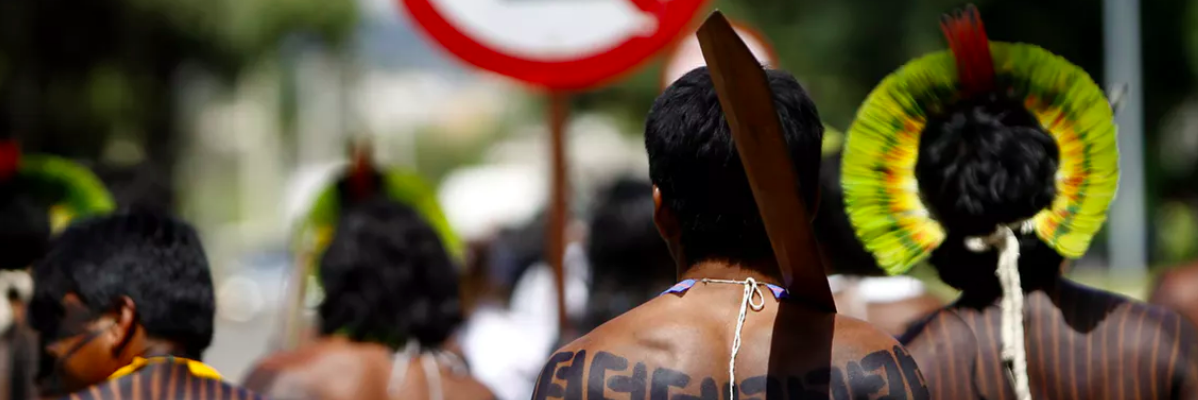
Fernando Bizerra Jr. / EPA
Only Local Amazonians Can Bring True Sustainable Development to Their Forest
The Brazilian government has earmarked a vast tract of Amazonian land for mining. The so-called “Renca” reserve sits in the last great wilderness area in the eastern Amazon and contains lots of unique rainforest wildlife. The controversial decision to allow mining has since been rewritten to clarify that development cannot take place on indigenous lands that lie within the “Renca”, and then put on hold by a federal judge, pending support from congress.
Protected areas such as the Renca are under threat right across the Amazon, and many have already been downsized or downgraded. Conservation is undermined by chronic underfunding of the national environmental protection agencies, the devolving of environmental enforcement to regional states that cannot cope, and by rural violence so severe that Brazil leads the world in assassinations of environmentalists.
The result of all this is an Amazon where 90% of logging is illegal and deforestation is increasing, where unprecedented wildfires burn each summer, and where large vertebrates are now going extinct for the first time since the Pleistocene.
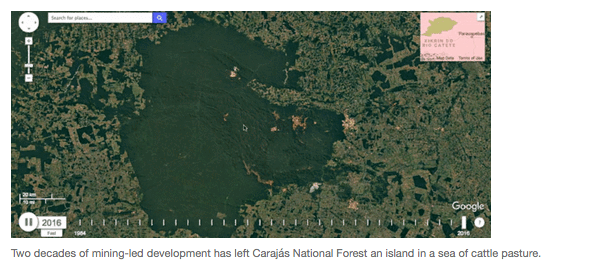
Brazil says mining and logging will boost national economic growth. Yet people in the Amazon remain some of the poorest and most marginalised in South America, and there is little evidence this kind of development has enhanced their quality of life. For example, the municipalities of Eldorado dos Carajás, Marabá, and Paraupebas, all of which surround large mining operations, have a human development index lower than that of Libya, a country stricken by civil war. And the construction of the controversial Belo Monte dam resulted in the regional capital of Altamira attaining the highest per capita homicide rate in all of Brazil, equivalent to 25 murders a day if scaled to a city the size of London.
Why has development failed Amazonians?
First, the companies driving the change are generally big multinationals based either in and around Rio and São Paulo (1,700 miles away) or abroad. Despite some municipal taxes, only a tiny portion of the profits remain locally.
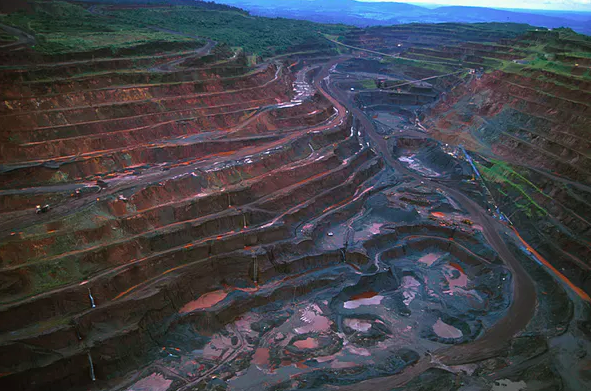
Carajás Mine, the largest iron ore mine in the world, is found within the Carajás National Forest (pictured above). T photography / Shutterstock
Development, as currently practised, also favours the wealthy over the poor. When protected areas are downgraded the chief beneficiaries are landholders who are able to log or mine their territory. Other social groups aren’t so lucky. Some are even actively attacked – either directly, as occurred in the assassination of ten landless movement squatters in a large Amazonian farm, or through legal changes, such as the downgrading of the rights of quilombolas, historical communities descended from African slaves, and indigenous peoples.
Brazil’s ongoing “car wash” corruption scandal has led to allegations of worrying links between large development projects in the Amazon, such as the Belo Monte dam, and the diversion of state funds to political parties. If the purpose of development is political gain, there can be little hope for regional citizens.
Are there alternative ways forward?
Both Amazonian people and forests would benefit if we stopped evaluating development schemes solely in terms of the profits they could generate. This sort of narrow, economic assessment cannot truly capture the value of the Amazon’s forests: how do you put a price on conserving unique species, or mitigating global climate change?
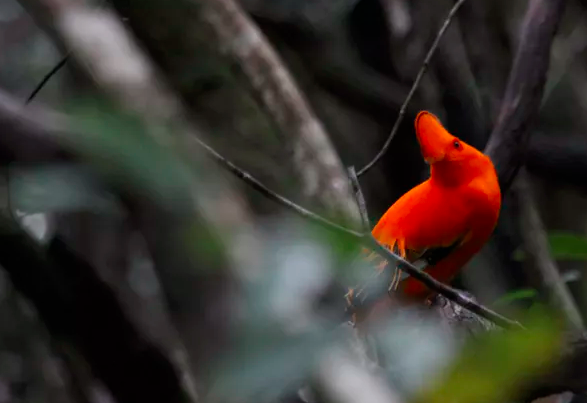
The Guianan Cock-of-the-rock (Rupicola rupicola) is one of northern Amazonia’s more spectacular inhabitants. Alexander Lees, Author provided
The forests of the Renca are some of the most dense and slow-growing in the Amazon basin. Even deforesting just 30% of the area would effectively emit more than four billion tonnes of CO₂ into the atmosphere – equivalent to Brazil’s entire fossil fuel emissions over the past ten years. Unless climate change forms part of the decision making process in the region, Brazil will fail to meet its international commitments such as the Paris agreement.
Development must also secure constitutional rights for everyone, not just those of the elites. Brazil currently has so called “differentiated citizenship”, where in practice there is a gradation of rights among citizens, depending on their race, social class or region.

Munduruku people map out their territory along the River Tapajos in Pará state. Larissa Saud, Author provided
Local action is often the only defence against the expansion of mining or dams. Recent examples of a grassroots success include the Munduruku indigenous people, who are forcing various concessions by resisting megadams on the middle Tapajós River. Another example is the practice of “counter-mapping” among indigenous peoples which entails them mapping their own territorial boundaries to defend their land from industrial agriculture, mining, dams and logging. These alternative approaches are the best way forward in the Renca too. Instead of opening up the area for mining multinationals, Brazil should recognise the rights of local people and empower them to lead decision-making. Brazil nut harvesting is already big in the local economy and, along with ecotourism and carbon-payments (being effectively paid to not chop down a forest), could deliver sustainable development, while leaving the minerals in the ground.
JOS BARLOW is a Professor of Conservation Science at Lancaster University.
ALEXANDER C. LEES is a lecturer in tropical ecology at Manchester Metropolitan University.
ERIKA BERENGUER is a Senior Research Associate at University of Oxford.
JAMES A. FRASER is a Lecturer in Political Ecology at Lancaster University.
JOICE FERREIRA is a researcher in Ecology at Federal University of Pará.
THIS ARTICLE WAS ORIGINALLY PUBLISHED ON THE CONVERSATION
How Small Science Is Creating Big Possibilities in Africa
Ofori Charles Antipem wears many hats—he’s an inventor, an entrepreneur and an advocate of STEM. Now, he’s bringing all his passions together, dedicating his life to bringing affordable science education to kids across Africa. The Science Set is Antipem’s creation, developed to give students access to a unique toolkit. Each set contains 45 scientific components and costs just $20. His next invention? Cheap and easy-to-assemble microscopes, carefully designed and built using 3D printed materials.
This Great Big Story was made possible by IBM Africa.
For Native Americans, US-Mexico Border is an ‘Imaginary Line’
Immigration restrictions were making life difficult for Native Americans who live along – and across – the U.S.-Mexico border even before President Donald Trump declared a national emergency to build his border wall.
Read More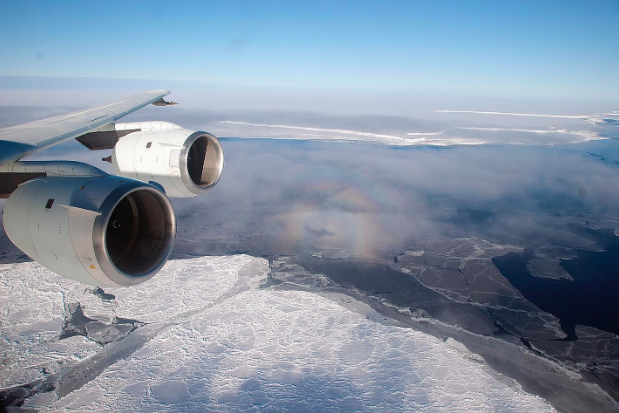
Flying over the Brunt Ice Shelf. NASA/Michael Studinger. CC 2.0 https://www.flickr.com/photos/nasa_goddard/5281037316/in/photolist-Up4XjE-8ZmvJ2-93EGpw
Iceberg Twice the Size of Manhattan Threatening to Break off Antarctica at any Moment
Antarctica’s Brunt Ice Shelf, the largest in the world, will soon lose a 660 square mile, almost 500 feet thick segment of ice—almost twice the size of the city of New York. The shelf is named for David Brunt, a British meteorologist and Physical Secretary of the Royal Secretary who organized the Royal Society Expedition to the Brunt Ice Shelf in 1955.
Two cracks in the shelf have been getting wider over the past few years. This process is known as calving: the splitting and shedding of ice chunks from the edge of a glacier. Glaciologists label these cracks or crevasses in the ice sheet as chasms. Chasm 1, the first fault line on the Brunt Ice Shelf, has been present and stable for over 35 years. But just lately, this crack has been edging north as fast as 2.5 miles a year. The second break, known as the Halloween crack, is upstream from what scientists call the McDonald Ice Rumples. These rumples form when the bottom of the ice shelf, which flows downhill toward the ocean, runs up against an underwater ridge. Chasm 1 is currently about 2.5 miles away from the McDonald Ice Rumples. Soon enough these two cracks will likely intersect, creating a massive iceberg that will begin to slowly float away from Antarctica.
Scientists closely observe the Brunt Ice Shelf with instruments measuring the distortion of the ice day by day. With the help of satellite images, ground penetrating radar and on-site drone footage, scientists have been able to track the progress of Chasm 1 and the Halloween crack.
This gigantic iceberg could elevate water levels enormously. According to National Geographic, rising sea levels could produce devastating effects on coastal areas, causing wetland flooding, aquifer and agricultural soil contamination with salt, destructive erosion, and habitat loss for fish, birds and plants. In the unlikely event that all the ice sheets and glaciers on earth melted, sea levels would rise by 216 feet.
This iceberg is not even the biggest to break off of the continent of Antarctica. In 2017, a glacier the size of Delaware broke off of the Larsen-C ice sheet:around 2,250 square miles in size. The biggestchunk to break off is Iceberg B-15. It measured around 4,200 square miles, larger than the island of Jamaica. It broke off from the Ross Ice Shelf in March 2000.
The Brunt Ice Shelf is not a stranger to cracks. Cracks that form during the summer have the potential to heal again over the winter months. Though cracks are common in ice shelves, the imminent calving of the Brunt Ice Shelf is unpredictable. The potential 660 square mile iceberg could raise sea levels drastically, impacting our coastal habitats and ultimately posing dangers to human health.

AMELIA BAUMANN is an aspiring writer and editor from New Jersey. I love to travel and am intrigued with the diversity of culture around the world. I am passionate about our environment and especially keeping our oceans clean.
The Eerie History and Uncertain Future of Japan’s Rabbit Island
Ōkunoshima and its imperiled bunny population remind us that wildlife and tourism don’t always mix.

A cluster of bunnies on Rabbit Island. Cindy Pepper. CC BY-NC-ND 2.0
From its many “cat islands,” which boast more feline than human residents, to Jigokudani Monkey Park, where visitors can observe macaques bathing in the naturally occurring hot springs, Japan seems to overflow with fantastical wildlife enclaves. Perhaps the most adorable of all is Ōkunoshima, or “Rabbit Island”—but the cotton-tailed denizens for which this island is known belie its sinister past and ambiguous future.
While Ōkunoshima, located in the Hiroshima Prefecture, is a popular tourist destination for those looking to get their kawaii fix, it was once hidden from maps due to its clandestine status as a World War II military location. Production of chemical weapons in the island’s poison gas factory began in 1929, and apart from factory workers and army higher-ups, few citizens were aware of its existence.
Ōkunoshima was chosen for its location: discreet enough for goings-on there to remain under the radar, and far enough from densely populated cities like Tokyo to prevent mass casualties in case of an accident. The factory there eventually produced more than 6,000 tons of gas—primarily mustard gas and the irritant lewisite—before its closure at the end of the war. Chemicals wereould be shipped to Kitakyushu in the Fukuoka Prefecture to be weaponized, eventually resulting in more than 80,000 casualties (including and more than 6,000 deaths) among Chinese soldiers and civilians.
Despite the fact that Japan was a signatory to the 1929 Geneva Convention banning the use of chemical weapons, none of the country’s citizens were prosecuted for employing poison gas. After Japan’s defeat in the war, most of the Ōkunoshima factory was destroyed, but laboratory buildings, the shell of a power plant, an army barracks, and a few other edifices remain. In 1988, local governmental entities and citizens opened the Poison Gas Museum to pay tribute to this dark and little-known facet of Japanese history. Displays include the ineffective protective gear worn by workers at the factory, which left them vulnerable to exposure and subsequent illness, as well as equipment used to manufacture the gases.
So where did the bunnies enter the equation? We know that a colony of rabbits was brought to the factory during its operational years to test the effects of poisons, but beyond that, theories diverge. Some suggest that the original crop of rabbits was destroyed along with the factory, while others claim that workers set the bunnies free after the war. Another theory asserts that schoolchildren brought eight rabbits to the island in 1971, where they bred until they reached their current population of approximately 1,000.
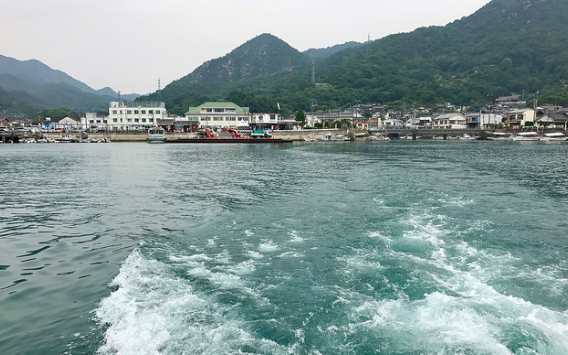
Tadanoumi Port viewed from the ferry to Ōkunoshima. Brian Shamblen. CC 2.0
Today, Ōkunoshima is easily accessible via a 15-minute ferry, and embodies peace, rest, and relaxation for tourists and locals alike. Visitors can easily explore it on foot (the island is less than 2.5 miles in circumference), collect souvenirs, dine, play tennis, swim in the ocean, and bathe in the hot spring—apart from communing with the wildlife, of course. Rabbit Island’s website describes it as a place to seek good fortune for your own family’s fertility, and advertises whipped ice cream and “original rabbit items” for sale, as well as octopus kelp rolls, a local delicacy known to pair well with sake.
Yet even the island’s thriving tourist industry and booming bunny population has a more sinister flip side. The wild rabbits depend on visitors for their food and water, but tourists often come bearing snacks that are harmful to the creatures’ delicate digestive systems—such as cabbage or vegetable peelings, which can cause fatal bloating. And while visitors are keen to share photos of their new fluffy friends online, social media has played a key role in destabilizing the rabbit population: Viral videos and articles have led to a vast influx of tourists in the past decade, and the resultant avalanche of snacks and treats has contributed to a breeding boom that the island’s ecosystem is unable to handle. These factors have combined to lower the bunnies’ life expectancy to only two years, compared to the three-to-five-year lifespan of the average wild rabbit.
The plight of the Ōkunoshima rabbits is just one example of the widespread harm social media has inflicted on wildlife populations across the globe: For instance, viral YouTube videos of slow lorises, wide-eyed nocturnal primates native to Southeast Asia, have led to people taking home lorises from the wild to keep as their own. Unfortunately, captivity is unhealthy for the animals, and they often end up relegated to props in tourist photos—or worse, sold into the illegal pet trade, and possibly slaughtered for use in cuisine or medicinals.

A curious bunny on Ōkunoshima seems to have mistaken the camera for a snack. Brian Shamblen. CC 2.0
Ultimately, bunny lovers need not be deterred from visiting Ōkunoshima, but following the rules is essential in order to treat the creatures kindly and foster their health and wellness. The Rabbit Island website lays out guidelines for responsible rabbit enthusiasts—including “refill water pans” and “check under your car,” as curious bunnies might hide underneath to escape the hot sun—and travelers can use their visit as an opportunity to educate friends and family about the unique perils posed to wildlife in the digital age. Approaching this mystical island mindfully is a small yet important step in helping the myriad diverse populations of the animal kingdom survive and thrive for many years to come.
TALYA PHELPS hails from the wilds of upstate New York, but dreams of exploring the globe. As former editor-in-chief at the student newspaper of her alma mater, Vassar College, and the daughter of a journalist, she hopes to follow her passion for writing and editing for many years to come. Contact her if you're looking for a spirited debate on the merits of the em dash vs. the hyphen.

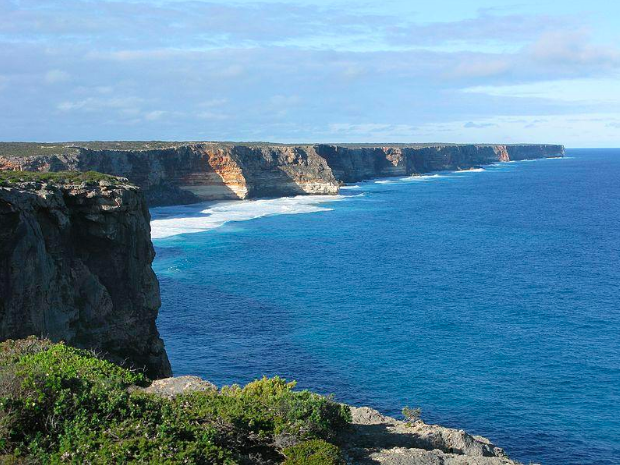
The Great Australian Bight, South Australia. Aussie Oc at English Wikipedia. CC 3.0
This is Not a Drill: Keep Australia’s Coasts Oil-Free
The Great Australian Bight is known worldwide for its beautiful oceanic environment,home to diverse forms of marine life, and its coastline lined by the longest sea cliffs in the world. A bight is a large open bay; this specific bay runs from Cape Carnot in South Australia, all the way to Cape Pasley in Western Australia: over 700 miles of ocean and sky that thousands of whales, seals, fish, birds, plants, and surfers call home.
Equinor, a Norwegian oil company, has plans to carry out a drilling operation in the Great Australian Bight, ultimately turning it into a deepwater oil field. This operation would devastate the 85% of rare marine life that exists in the Bight. Not only is it endangering the various species that live among the coasts, but the increase in pollution could disrupt the people of Australia. A potential spill in the Bight could result in the death of several endangered species: killer whales, southern right whales, blue whales, dolphins, endemic Australian sea lions, and many more. The Bight also supports multi-billion dollar fishery, aquaculture, and tourism industries. Drilling would, most likely, halt if not destroy this economy altogether. Not unlike BP’s drilling expedition, the proposal for drilling in the Great Australian Bight could have severe consequences, and ultimately the same catastrophic ending as BP’s drilling operation could incur. 8 years after the BP oil spill, the Gulf is still experiencing significant impacts, and scientists expect them to continue. Scientists say that they may not know for another 30 or 40 years the extent of the effects. If the Equinor drilling operation resulted in another massive oil spill in our current environmental state, our economy and Earth would take much longer to bounce back than the BP oil spill. If this were to occur in summer, it would also not only affect Australia but also places as far away as northeastern Europe. If it were to happen in winter, the oil would most likely impact Kangaroo Island, the Eyre Peninsula and the Spencer Gulf in South Australia. It could also potentially reach the Victorian and Tasmanian coastline, heading towards New Zealand. Known the remarkable economic and environmental values that would be put at risk from Equinor’s drilling operation in the Great Australian Bight, this project should not be considered.
Equinor’s drilling plan has led activists and surfers worldwide to strike and start a viral movement, ‘#Fightforthebight,’ to save this Australian coastline. Surfers have paddled out in peaceful protests displaying signs with slogans like “Big oil has no future” or “Kill the Drill.” Several worldwide famous surfers that call Australia home, like Stephanie Gilmore, Nat Young, Mick Fanning, and many more, have signed an open letter concerning the Equinor’s drilling proposition and its potential impact on their coasts. To take action and help keep Australia’s coasts oil-free you can sign a Statement of Concern or donate here: https://www.fightforthebight.org.au/take-action-1 .
AMELIA BAUMANN is an aspiring writer and editor from New Jersey. I love to travel and am intrigued with the diversity of culture around the world. I am passionate about our environment and especially keeping our oceans clean.

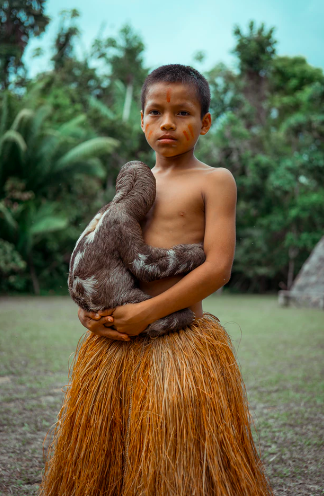
Deforestation threatens indigenous tribes living in the Peruvian jungle. Photo by Alexander Paul on Unsplash
Development and Deforestation Threatens Peru’s Indigenous Tribes
When we think of civilization, we think in Western terms: skyscrapers, factories, and automobiles. But as we progress, there is a growing need to live in tune with the natural world. While our affinity for the environments may seem relatively new, some civilizations have lived in such a way for centuries. The forests of Peru are home to 15 “uncontacted” tribes, groups who live in voluntary isolation and reject all connections to the outside world. However, the reverse is not true. Industrialization and deforestation threaten to take large pieces of territory from these indigenous peoples.
In December of 2017, the Congress of the Republic of Peru approved the construction of a road that would run along 172 miles of Peru’s eastern border with Brazil before connecting with the Interoceanic Highway, a 1600 mile stretch that links the two countries. The road was pitched as a way to jumpstart the economy in an area of Peru that was cut off from tourism and trade, but activists are worried. Clearing a way for the road would decimate 4 national parks and violate 5 protected areas belonging to the indigenous tribes. Activists also predict that the road will be a catalyst for more development, both legal and illegal. Drug traffickers are always looking for new opportunities to expand, and a road through the Amazon would provide just that.
Some smaller encounters are equally devastating to relations between the outside world and the indigenous tribes of the Peruvian forest. In April 2018, Sebastian Woodroffe, a Canadian scientist who traveled to Peru to study hallucinogenic medicine, was killed in an apparent lynching after he was accused of killing 81-year-old Olivia Arévalo, a local shaman to the tribal village of Victoria Gracia. Authorities launched an investigation after videos surfaced on social media of Woodroffe being dragged along the jungle floor by assailants. They later exhumed Woodroffe’s body from an unmarked grave. The incident has proven to be disastrous to public perception of the tribes.
When asked why they choose to remain isolated, members of these tribes often point to encounters their people had with colonists in the past and the violence and disease that resulted. Today, history seems to be repeating itself as modern society reaches further into an untouched and irreplaceable ecosystem.
JONATHAN ROBINSON is an intern at CATALYST. He is a travel enthusiast always adding new people, places, experiences to his story. He hopes to use writing as a means to connect with others like himself.

Students Across Europe Protest in Hopes of a Greener Future
After years of political gridlock surrounding climate change legislation, students emerge as a force for change.
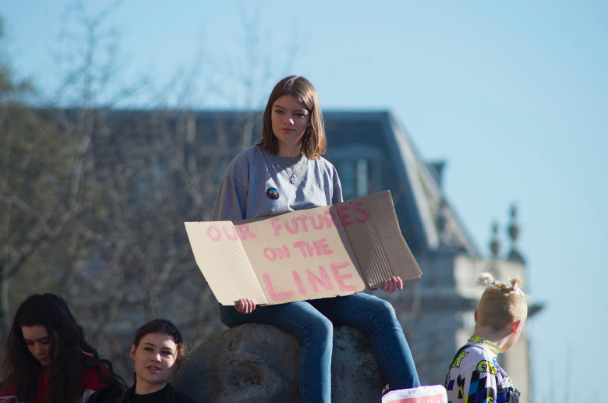
Photo of a student protester. By Josh Barwick on Unsplash.
Thousands of students across Europe left school on Friday, February 15 to protest the lack of action on climate issues in their countries. In what the New York Times called a “coordinated walk out for action on climate issues,” elementary, middle, high school, and undergraduate students came together to demand a greener future. In London, protestors held signs reading “The ocean is rising and so are we” and “Act now or swim later.”
The student-led movement for climate action that is currently taking Europe by storm began with 16-year-old Swedish activist Greta Thunberg. In September, Thunberg started skipping class to stage sit-ins at the Swedish parliament, demanding that her government seriously address climate change. Thunberg’s action inspired teens worldwide, some of whom created the global movement Youth Strike 4 Climate and began organizing protests and walkouts, using social media to coordinate efforts. According to the New York Times, demonstrations have been held in Belgium, Britain, France, Germany, Ireland, Sweden, and Switzerland, among others.
The New York Times writes that the new organization gained even more energy in October of 2018 when a report from the UN’s Intergovernmental Panel on Climate Change disclosed that the world has only twelve years to change its climate policy before the consequences of inaction such as food shortages, rising sea levels, floods and forest fires manifest themselves.
Thunberg remains a notable voice in the movement she inspired, and went on to speak at the global climate-change conference in Poland last December. “You say you love your children above all else — and yet you are stealing their future in front of their very eyes,” she told politicians at the conference. “Until you start focusing on what needs to be done rather than what is politically possible, there is no hope. We cannot solve a crisis without treating it as a crisis.”
In British schools, protesters received mixed reactions from teachers and staff. While some encouraged students, others threatened to punish them for skipping class. “My school was not supportive at the start. They said I would get detention for unauthorized absence,” Anna Taylor, the seventeen-year-old co-founder of the UK Student Climate Network told the New York Times.
Sixteen-year-old Bonnie Morely, who was attending the strike with friends from school, told the New York Times that a head teacher had taken down posters advertising the strike in her school’s common areas. “They’re treating us like we are doing something really wrong,” Morley said. “The future of our planet is looking really bleak, and all the politicians are asleep at the wheel. We have to wake them up, and I think thousands of kids on the streets will do just that.”
Like the teachers, European politicians displayed mixed reactions, with some supporting the students and others going so far as to suggest that the strikes were the product of a secret governmental organization.
According to the New York Times, a spokesperson for British Prime Minister Theresa May said that, “everybody wants young people to be engaged in the issues that affect them most so that we can build a brighter future for all of us. But it is important to emphasize that disruption increases teachers’ workloads and wastes lesson time that teachers have carefully prepared for.”
Thunberg tweeted in response: “British PM says that the children on school strike are ‘wasting lesson time.’ That may well be the case, but then again, political leaders have wasted 30 years of inaction. And that is slightly worse.”
“We don’t miss school because we’re lazy or because we don’t want to go to school,” Jakob Blasel, a high school student who assisted with the organization of an earlier protest in Berlin told the Washington Post. “We can’t go to school, because we have to strike. We have to deliver an uncomfortable message to our leaders that it can’t go on this way.”
Youth for climate is currently planning another round of protests and another global youth strike for March 15. The movement is growing and more students from nations across the world are expected to join.

Emma Bruce
Emma Bruce is an undergraduate student studying English and marketing at Emerson College in Boston. While not writing she explores the nearest museums, reads poetry, and takes classes at her local dance studio. She is passionate about sustainable travel and can't wait to see where life will take her.
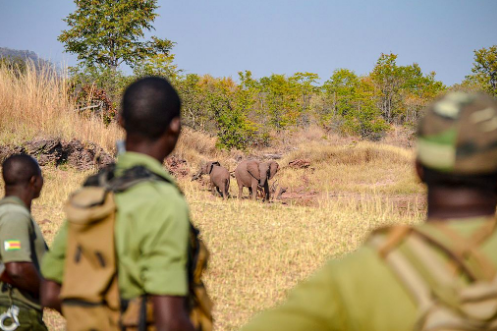
A group of rangers on patrol in Zimbabwe. Bumihillsfoundation.CC BY-SA 4.0
Wildlife War: Africa's Militaristic Approach to Animal Conservation
The plight of endangered elephants and rhinos in Africa is fairly well known to the world: Elephants are hunted by poachers for their tusks, which are carved into jewelry while rhinos are hunted for their horns which are believed in many cultures to carry medicinal value. The widespread poaching of these animals has pushed their population numbers back, causing a ripple effect in local ecosystems and presenting the possibility of extinction for the animals themselves. There is a very real chance that future generations may not grow up with these animals present as the current generation did. What is not as well known is that for years now, Africa has taken a militarized approach to prevent this outcome from becoming a reality, with armed conservation groups authorized to impose the harshest penalties on would-be poachers.
Poaching in Africa reached its zenith in the 1970s and 80s. In 1989 Kenyan President Daniel Arap Moi appointed famed paleoanthropologist Dr. Richard Leakey as head of Kenya’s Wildlife Conservation and Management Department, and Dr. Leaky created the first armed anti-poaching units. He then implemented a “shoot to kill” policy for dealing with poachers that drastically reduced environmental crime in the region. Several African nations followed suit and the practice of using arms to protect animals expanded throughout the continent, becoming more sophisticated over the years. Today conservation in Africa is a well known and a viable career path, with militarized conservation groups being trained by ex-soldiers from around the world. Nir Karlon, a former Israeli commando, manages the Maisha Group, a private security firm that focuses on preventing environmental crime in the Congo. In Zimbabwe, a nerve center of the African elephant population, Damian Mander of the Australian Royal Navy heads up the first all-female ranger team called “Akashinga” which means, “Brave Ones”. The group initially faced criticism from male conservationists who doubted that women would be able to perform the arduous physical tasks associated with the job. The Brave Ones, however, proved to be as capable as any man when it came to military conservation. New recruits to ranger units often go through several days of rigorous training before being offered a position. Some groups accept volunteers in unarmed positions, but most conservationists still carry weapons and are still authorized to use deadly force.
The job is not without risks. In the last decade, 1000 rangers have been killed while on duty. Death can come from the poachers they pursue or the animals they protect. Much of Africa’s poaching is carried out by crime syndicates and local militants who have found that ivory can be used as currency to buy weapons and fund campaigns. Encounters between conservationists and poachers have on occasion erupted into full-on firefights, and some critics have expressed concern that the rangers' methods may be too brutal. With this in mind, many ranger groups have made community outreach an even greater priority than battling poachers, as support from the locals will always be more effective than a gun. Education seminars at local schools help the rangers strengthen their relationships with people living in protected areas, with a long term goal of increasing awareness and surveillance of animal poaching in Africa.

JONATHAN ROBINSON is an intern at CATALYST. He is a travel enthusiast always adding new people, places, experiences to his story. He hopes to use writing as a means to connect with others like himself.
An Island Disappears off the Coast of Japan
It remained unnoticed until local fishermen investigated.
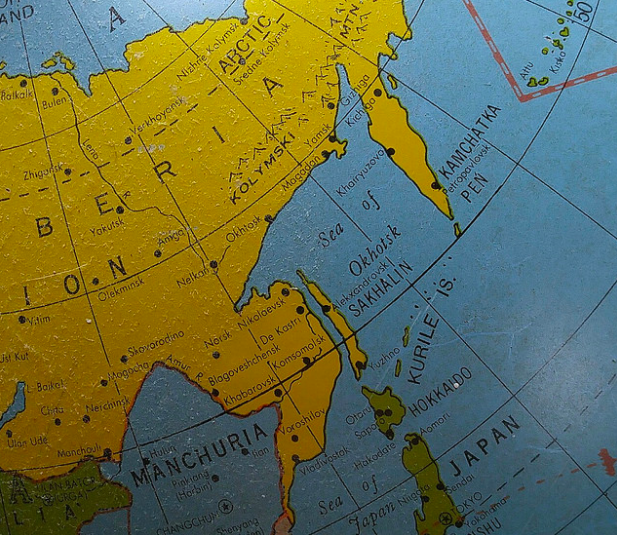
Vintage globe depicting the Sea of Okhotsk. Robin Ottawa. CC BY-SA 2.0
This fall, Esanbe Hamakita Kojima, a tiny island off the northeast coast of Japan dropped out of sight. The island’s disappearance went unnoticed by inhabitants of the nearby village of Sarufutsu, situated on the northern tip of Hokkaido island only 1,640 feet away.
It wasn’t until September, when author Hiroshi Shimizu traveled to Sarufutsu to gather inspiration for his picture book on Japan’s islands, that authorities were notified of the island’s disappearance. Shimizu had been looking for the island but couldn’t locate it. He informed local fisherman who went out to investigate and finally noted that Esanbe was missing.
When Japan’s Coast Guard last surveyed the island in 1987, it was only 4.5 feet above sea level. Authorities could not confirm how large the island had been before the sea rose around it.
Esanbe is west of Japan’s Northern Territories and part of a set of islands that has been long-contested between Japan and Russia. The islands, called the Kurils by Russia, were taken by the Soviets shortly after World War II, but ownership today remains unclear. According to CNN, Esanbe functions as a marker of Japanese ownership in contested waters. But the strategy of claiming islands to maintain the maritime space around them is not exclusive to Esanbe. In fact, according to the Washington Post, Japan owns 158 uninhabited islands that the country named in 2014 so that the sea surrounding them could remain in Japanese control.
Thus, the disappearance of the island may have a slight effect on Japan’s territorial waters, as according to international law, countries can only claim ownership of the sea around an island if that island is visible at high tide. Coast Guard officials in Japan confirmed that Esanbe’s loss, “may affect Japan's territorial waters a tiny bit.” With the island underwater, Japan will have lost approximately 1,640 feet of territorial water.
The island’s disappearance was likely due to erosion by the wind and drift ice common in the Sea of Okhotsk each winter. According to coast guard official Tomoo Fujii, “There is a possibility that the islet has been eroded by wind and snow and, as a result, disappeared,” Asahi Shimbun of the Japanese Daily reported.
According to the Smithsonian, disappearances of land masses in this area of Japan are not unlikely. The good news for Japan’s border, however, is that this phenomenon can occur in reverse. Five years ago, a 1000-foot long island rose out of the sea, prompted by a landslide.

EMMA BRUCE is an undergraduate student studying English and marketing at Emerson College in Boston. While not writing she explores the nearest museums, reads poetry, and takes classes at her local dance studio. She is passionate about sustainable travel and can't wait to see where life will take her.
Fighting to End Child Marriage in Lebanon
Ghassan Idriss knows firsthand the harmful effects of child marriage on society. Having married at a young age to a woman even younger than himself, Idriss and his wife faced struggles that so many other couples in his home country of Lebanon grapple with. Now, with three daughters of his own, Idriss is doing everything he can to educate those around him about the dangers of this antiquated institution. By hosting talks, he’s using his voice to spark change within his community.
Death Toll Rises in Tijuana
A few miles south of San Diego lies Tijuana, a favorite weekend getaway for Americans. Some Californians have even taken to living in Tijuana permanently to escape their state’s rising housing costs. However, life in Tijuana has changed drastically over the last few years as conflicts between rival drug cartels have caused the city’s murder rate to skyrocket. The situation presents a new set of risks for those wanting to visit the ever-popular tourist trap.
Read More
America’s public schools were meant to bring together children from all walks of life. Monkey Business Images/www.shutterstock.com
America’s Public Schools Seldom Bring Rich and Poor Together – and MLK Would Disapprove
Five decades after the assassination of Martin Luther King Jr., many carry on his legacy through the struggle for racially integrated schools. Yet as King put it in a 1968 speech, the deeper struggle was “for genuine equality, which means economic equality.” Justice in education would demand not just racially integrated schools, but also economically integrated schools.
The fight for racial integration meant overturning state laws and a century of history – it was an uphill battle from the start. But economic integration should have been easier. In the mid-18th century, when education reformers first made the case for inclusive and taxpayer-supported education, they argued that “common schools” would ease the class differences between children from different backgrounds.
As Horace Mann, the most prominent of these reformers, argued in 1848, such schools would serve to counter the “domination of capital and the servility of labor.” Learning together on common ground, rich and poor would see themselves in common cause – a necessity for the survival of the republic.
More than 150 years later, the nation has yet to realize this vision. In fact, it has been largely forgotten. Modern Americans regularly scrutinize the aims and intentions of the Founding Fathers; but the early designs for public education – outlined by Mann, the first secretary of education in Massachusetts, as well as by leaders like Henry Barnard, Thaddeus Stevens, and Caleb Mills – are mostly overlooked. Today, the average low-income student in the U.S. attends a school where two-thirds of students are poor. Nearly half of low-income students attend schools with poverty rates of 75 percent or higher.
Education historians, like myself, have generally focused their research and attention on racial segregation, rather than on economic segregation. But as income inequality continues to deepen, the aim of economically integrated schools has never been more relevant. If we are concerned with justice, we must revitalize this original vision of public education.
Shared community
Early advocates of taxpayer-supported common schools argued that public education would promote integration across social classes. They thought it would instill a spirit of shared community and open what Horace Mann called “a wider area over which the social feelings will expand.”
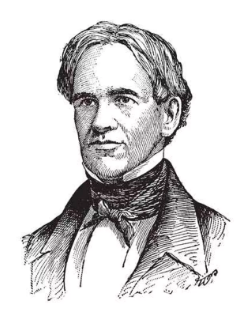
Horace Mann (1796-1859) was an early advocate of public education in the U.S. Fotolia/AP
And, generally speaking, it worked. The ultra-rich mostly continued to send their children to private academies. But many middle- and upper-income households began to send their children to public schools. As historians have shown, economically segregated schools did not systematically emerge until the mid-20th century, as a product of exclusionary zoning and discriminatory housing policies. Schools weren’t perfectly integrated by any means, particularly with regard to race. They were, however, vital sites of cross-class interaction.
Many prominent Americans – including U.S. presidents – were products of the public schools. Commonly, they sat side by side in classrooms with people from different walks of life.
But over the past half-century, students have been increasingly likely to go to school with students from similar socioeconomic backgrounds. Since 1970, residential segregation has increased sharply, with twice as many families now living in either rich or poor neighborhoods – a trend that has been particularly acute in urban areas. And segregation by income is most extreme among families with school-age children. Poor children are increasingly likely to go to school with poor children. Similar economic isolation is true of the middle and affluent classes.
Contemporary Americans commonly accept that their schools will be segregated by social class. Yet the architects of American public education would have viewed such an outcome as a catastrophe. In fact, they might attribute growing economic inequality to the systematic separation of rich and poor. As Horace Mann argued, it was the core mission of public schools to bring different young people together – to consider not just “what one individual or family needs,” but rather “what the whole community needs.”
Many parents do continue seek out diverse schools. A number of school districts have worked to devise student assignment plans that advance the aim of integration. And some charter schools are reaching this market by pursuing what has been called a “diverse-by-design” strategy. As demonstrated by research, diverse schools can and often do improve achievement across a range of social and cognitive outcomes, such as critical thinking, empathy and open-mindedness.
Largely overlooked, however, has been the political benefit of integrated schools. One rarely encounters the once-common argument that the health of American democracy depends on rich and poor attending school together. This is particularly surprising in an age of tremendous disparities in wealth and power. Members of Congress, on average, are 12 times wealthier than the typical American. Moreover, lawmakers are increasingly responsive to the privileged, even at the expense of middle-class voters.
If elites are isolated from their lower- and middle-income peers, they may be less likely to see a relationship of mutual commitment and responsibility to those of lesser means. As scholars Kendra Bischoff and Sean F. Reardon have argued, “If socioeconomic segregation means that more advantaged families do not share social environments and public institutions such as schools, public services, and parks with low-income families, advantaged families may hold back their support for investments in shared resources.”
What can be done?
Today more than 100 school districts or charter school chains work to integrate schools economically. Cambridge, Massachusetts, for instance, has four decades of experience balancing enrollments by social class, seeking to match the diversity of the city as a whole in each school.
This, of course, is only possible in a diverse place. Median family income in Cambridge is roughly US$100,000, while 15 percent of city residents live below the poverty line. It is also made possible through heavy investments in public education in the city. After all, it is far easier to convince middle-class and affluent parents to send their children to the public schools when per-pupil expenditures rival the highest-spending suburbs, as they do in Cambridge.
But not every district has Cambridge’s advantages. Nor does every district have similar political will.
The latter of those two constraints, however, may soon begin to change. Faced with a growing divide between rich and poor, Americans may begin to demand schools that not only serve young people equally from a funding standpoint, but also educate them together in the same classrooms.
Common schools by themselves are not enough to solve the problem of economic inequality. Yet if Americans seek to create a society in which the rich and the poor see themselves in common cause, common schools may be a necessary – and long overdue – step. We must come to see, in the words of Martin Luther King, that, “We are caught in an inescapable network of mutuality, tied in a single garment of destiny.”
Jack Schneider is an Assistant Professor of Education at the University of Massachusetts Lowell.
THIS ARTICLE WAS ORIGINALLY PUBLISHED ON THE CONVERSATION
Tides of Change : Japan to Resume Commercial Whaling
For more than thirty years, the island nation of Japan has fought to expand its commercial whaling operations. That fight has mostly been a losing one, with its efforts often being blocked by anti-whaling countries around the world and condemned by the International Whaling Commission, an organization whose members include Japan itself. However, Japan’s recently proposed exit from the commission will allow the country to reclaim one of its most time-honored traditions, and the move is drawing international criticism.

Two Minke Whales being loaded onto the Nisshin Maru. The ship has facilities on board which allow it to freeze and process whales while at sea. Australian Customs and Border Protection Service. CC BY-SA 3.0
In 1982 the International Whaling Commission, or IWC, imposed a global moratorium on all commercial whaling, save for subsistence whaling by Aboriginal communities. The moratorium went into effect in 1985 and was met with opposition from Iceland, Norway, and Japan, countries with strong whaling traditions. In Japan, whale meat generally served the same purpose that beef or lamb served in Western societies and this was especially true during hard times. In the 1940s as the country was recovering from World War 2, whale meat was the single most consumed meat among Japanese people, and it remained so through the 1960s. After the announcement of the IWC’s whaling ban, Japan petitioned for the right to continue whaling in the Antarctic for “scientific purposes” though the specific nature of its research remained unclear. Whale activists claimed that this “research whaling” was in fact, commercial whaling in disguise, and vessels like the Nisshin Maru, Japan’s largest whaling vessel and the world's only factory whaling ship, became a frequent target of animals rights groups, with some going so far as to board vessels of their own and try to disrupt the Maru’s whaling expeditions by obstructing its path. Earlier this year, Japan expressed a desire to develop new ships, fast enough to outrun those of the activists, but the plan appears to have been scrapped, as the Japanese government announced in late December that it will formally withdraw from the IWC, discontinue its operations in the Antarctic and resume commercial whaling operations in its own coastal waters. Though the demand for whale meat has diminished somewhat in Japan, the practice of whale fishing is still considered by many to be intrinsic to the country’s cultural identity.
Environmental conservation hinges on the idea that some of the Earth’s resources are non-renewable. Humans can hunt an animal to extinction, and that extinction creates an imbalance in the ecosystem that the animal once belonged to. The effects of that imbalance can, in turn, come back to haunt humans, either directly or indirectly. These are, however, relatively young ideas, and pitting them against hundreds of years of tradition is sure to be a test for all parties involved.
JONATHAN ROBINSON is an intern at CATALYST. He is a travel enthusiast always adding new people, places, experiences to his story. He hopes to use writing as a means to connect with others like himself.


Genking, a male-born Japanese TV personality and ‘genderless’ pioneer. _genking_/Instagram
Japan’s Gender-Bending History
I’m an anthropologist who grew up in Japan and has lived there, off and on, for 22 years. Yet every visit to Tokyo’s Harajuku District still surprises me. In the eye-catching styles modeled by fashion-conscious young adults, there’s a kind of street theater, with crowded alleyways serving as catwalks for teenagers peacocking colorful, inventive outfits.
Boutiques are filled with cosmetics and beauty products intended for both males and females, and it’s often difficult to discern the gender of passersby. Since a gendered appearance (“feminine” or “masculine”) often (but not always) denotes the sex of a person, Japan’s recent “genderless” fashion styles might confuse some visitors – was that person who just walked by a woman or a man?
Although the gender-bending look appeals equally to young Japanese women and men, the media have tended to focus on the young men who wear makeup, color and coif their hair and model androgynous outfits. In interviews, these genderless males insist that they are neither trying to pass as women nor are they (necessarily) gay.
Some who document today’s genderless look in Japan tend to treat it as if it were a contemporary phenomenon. However, they conveniently ignore the long history in Japan of blurred sexualities and gender-bending practices.
Sex without sexuality
In premodern Japan, aristocrats often pursued male and female lovers; their sexual trysts were the stuff of classical literature. To them, the biological sex of their pursuits was often less important than the objective: transcendent beauty. And while many samurai and shoguns had a primary wife for the purposes of procreation and political alliances, they enjoyed numerous liaisons with younger male lovers.
Only after the formation of a modern army in the late-19th century were the sort of same-sex acts central to the samurai ethos discouraged. For a decade, from 1872 to 1882, sodomy among men was even criminalized. However, since then, there have been no laws in Japan banning homosexual relations.
It’s important to note that, until very recently, sexual acts in Japan were not linked to sexual identity. In other words, men who had sex with men and women who had sex with women did not consider themselves gay or lesbian. Sexual orientation was neither political nor politicized in Japan until recently, when a gay identity emerged in the context of HIV/AIDS activism in the 1990s. Today, there are annual gay pride parades in major cities like Tokyo and Osaka.
In Japan, same-sex relations among children and adolescents have long been thought of as a normal phase of development, even today. From a cultural standpoint, it’s frowned upon only when it interferes with marriage and preserving a family’s lineage. For this reason, many people will have same-sex relationships while they’re young, then get married and have kids. And some even later resume having same-sex relationships after fulfilling these social obligations.
Contentious cross-dressing
Like same-sex relationships, cross-dressing has a long history in Japan. The earliest written records date to the eighth century and include stories about women who dressed as warriors. In premodern Japan, there were also cases of women passing as men either to reject the prescribed confines of femininity or to find employment in trades dominated by men.

‘Modern girls’ (‘moga’) stroll along the Ginza, Japan’s Fifth Avenue, in 1928. Wikimedia Commons
A century ago, “modern girls” (moga) were young women who sported short hair and trousers. They attracted media attention – mostly negative – although artists depicted them as fashion icons. Some hecklers called them “garçons” (garuson), an insult implying unfeminine and unattractive.
Gender, at that time, was thought of in zero-sum terms: If females were becoming more masculine, it meant that males were becoming feminized.
These concerns made their way into the theater. For example, the all-female Takarazuka Revue was an avant-garde theater founded in 1913 (and is still very popular today). Females play the parts of men, which, in the early 20th century, sparked heated debates (that continue today) about “masculinized” women on stage – and how this might influence women off the stage.
However, today’s genderless males aren’t simply weekend cross-dressers. Instead, they want to shatter the existing norms that say men must dress and present themselves a certain way.
They ask: Why should only girls and women be able to wear skirts and dresses? Why should only women be able to wear lipstick and eye shadow? If women can wear pants, why shouldn’t men be able to wear skirts?
Actually, the adjective “genderless” is misleading, since these young men aren’t genderless at all; rather, they’re claiming both femininity and masculinity as styles they wear in their daily lives.
In this regard, these so-called genderless men have historical counterparts: In the late 19th and early 20th centuries, cosmopolitan “high collar” men (haikara) wore facial powder and carried scented handkerchiefs, paying meticulous attention to their Westernized appearances. One critic – invoking the zero-sum gender attitudes of the era – complained that “some men toil over their makeup more than women.” Conservative pundits derided the haikara as “effeminate” by virtue of their “un-Japanese” style.
On the other end of the masculinity spectrum were the nationalistic “primitive” men (bankara) who wore wooden clogs (geta) to complement their military-style school uniforms. Ironically, like their samurai predecessors – and unlike the foppish haikara – the macho bankara would engage in same-sex acts.
Japan’s ‘beautiful youths’
Probably the biggest contemporary inspiration for today’s genderless males are a spate of popular androgynous boy bands. Cultivated and promoted by Johnny & Associates Entertainment Company, Japan’s largest male talent agency, they include boy bands like SMAP, Johnny’s West and Sexy Zone.
Johnny’s West performs their song ‘Summer Dreamer.’
There’s a term for the type of teenage boy that Johnny & Associates cultivates: “beautiful youths” (bishōnen), which was coined a century ago to describe a young man whose ambiguous gender and sexual orientation appealed to females and males of all ages.
Similarly, Visual Kei is a 1980s glam-rock and punk music genre that features bishōnen performers who don flamboyant, gender-bending costumes and hairdos. In its new, 21st-century incarnation as Neo-Visual Kei, the emphasis on androgyny is even more pronounced, as epitomized by the prolific career of the androgynous Neo-Visual Kei pop star Gackt, who enjoys an international fan following.
Since the word “genderless” is misleading, a better term might be “gender-more,” in the sense that young men – especially in Tokyo – are insisting on the right to present and express themselves in ways that contradict and exceed traditional masculinity. In the long span of Japanese cultural history, there have been many things that were – and are – new under the sun. But genderless males aren’t among them.
JENNIFER ROBERTSON is a Professor of Anthropology and Art History at the University of Michigan.
THIS ARTICLE WAS ORIGINALLY PUBLISHED ON THE CONVERSATION
This Mega Kitchen Serves 40,000 People Each Day
With one of the largest kitchens in Asia, the Shri Saibaba temple in Shirdi, India, prepares, cooks and serves quantities of food that are nearly unimaginable. The kitchen dishes out as many as 40,000 meals per day, every day, all year long. It takes 600 people working in two daily shifts to prepare all this food. Yet despite all the effort, meals are free to the public. Why? The temple believes that those who are hungry deserve to be fed, and those who are thirsty deserve to be given a drink.
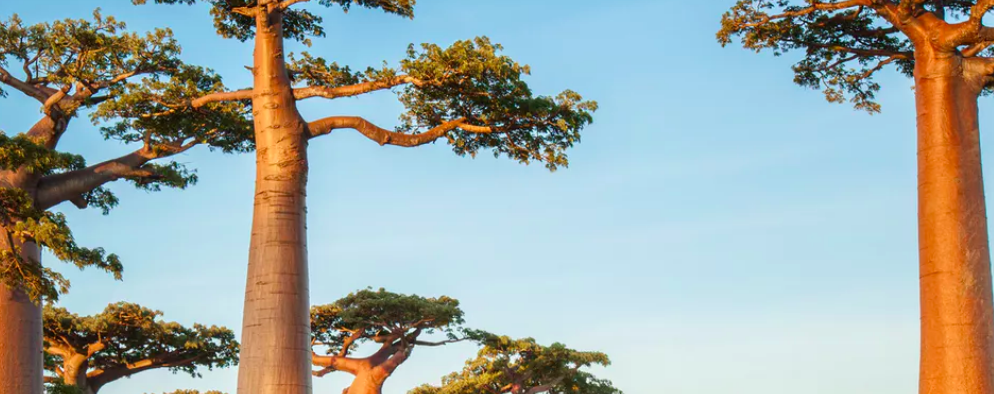
Like Dr. Seuss’ imaginary truffula trees, baobabs are endangered. Dudarev Mikhail/Shutterstock.com
Why Companies Should Help Pay for the Biodiversity That’s Good for Their Bottom Line
In the “The Lorax,” an entrepreneur regrets wiping out all the make-believe truffala trees by chopping them down to maximize his short-term gains. As the Dr. Seuss tale ends, the Once-ler – the man responsible for this environmental tragedy – tells a young child that “Unless someone like you cares a whole awful lot, nothing is going to get better. It’s not.”
Likewise, many corporations that profit from nature’s bounty, such as Unilever, Patagonia and Interface, appear to be reaching a similar conclusion. They are realizing that it’s time for the business world to do more about conservation.
We, two economists who have extensively researched natural resources and development, are proposing a new way to solve the problem of species and ecosystem loss. Corporations that benefit from biodiversity could forge what some are calling a “new deal for nature” by paying part of the tab for biodiversity conservation.
Biodiversity
Biodiversity, the variety of all natural ecosystems and species, is being lost at an unprecedented rate. According to the recent World Wildlife Fund Living Planet Report, the populations of mammals, birds, fish, reptiles and amphibians have fallen by an average of 60 percent in just over 40 years. The scientists Gerardo Ceballos, Paul R. Ehrlich and Rodolfo Dirzo have dubbed this decline and an impending wave of extinctions a “biological annihilation.”
We argue that many businesses are threatened by the loss of species and ecosystems, such as declining bee populations and dwindling stocks of fish, forests, wetlands and mangroves. Without an array of ecosystems and species, it’s tough for farmers to grow crops or ranchers to raise animals.
The pharmaceutical industry needs them to make and create drugs. For example, one team of U.S.-based researchers estimates that the pharmaceutical value of marine biodiversity for anti-cancer drug discovery could range from US$563 billion to as much as $5.7 trillion.
Insurance companies depend on coastal wetlands to minimize the impact of big storms. For example, an international group of researchers estimated that preserving one hectare of mangroves in the Philippinesyields more than $3,200 in flood-reduction benefits each year.
A global treaty, the Convention on Biological Diversity does set worldwide conservation targets. But we believe they may not be ambitious enough. Cristiana Pașca Palmer, who serves as the UN’s biodiversity chief, is considering raising the treaty’s targets to conserve at least half of terrestrial, inland water, coastal, and marine habitats to preserve biodiversity.
But the existing efforts to preserve biodiversity are not only inadequate. They’re underfunded.
New way to pay
Global biodiversity protection requires $100 billion annually, according to a previous study one of us conducted, yet the international community spends up to $10 billion each year on biodiversity conservation.
Much of the world’s biodiversity is in developing countries, which lack the financial wherewithal to adequately conserve it.

The Lorax could speak for the trees, but he lacked the cash to preserve them. Random House Children's Books
As we have explained with our colleague Thomas J. Dean in Science magazine, we believe that involving businesses in an international environmental agreement could help bridge a chronic funding gap.
A key part of this new deal for nature would be making the corporations that depend on the health of natural ecosystems and species help foot the bill to preserve biodiversity.
Benefiting the bottom line
Why would corporations want to get involved?
First off, it may benefit their bottom line. Big companies depend on robust natural ecosystems systems and individual species.
We calculate that the increase in revenue and profits from biodiversity conservation could generate between $25 billion and $50 billion annually to fund global conservation efforts.
The seafood industry stands to gain $53 billion annually from an increase in marine stocks. This could generate $5 billion to $10 billion each year to spend on preserving biodiversity.
The insurance industry could see an additional $52 billion from increasing the area of protected coastal wetlands with a similar investment.
Agriculture also has an incentive to protect habitats of wild pollinators, who along with managed populations enhance global crop production by an amount a global group of scientists estimates to be worth between $235 billion to $577 billion annually.
What’s more, there is growing evidence that when corporations engage in environmental stewardship, they become more attractive investmentsand their borrowing costs decline.
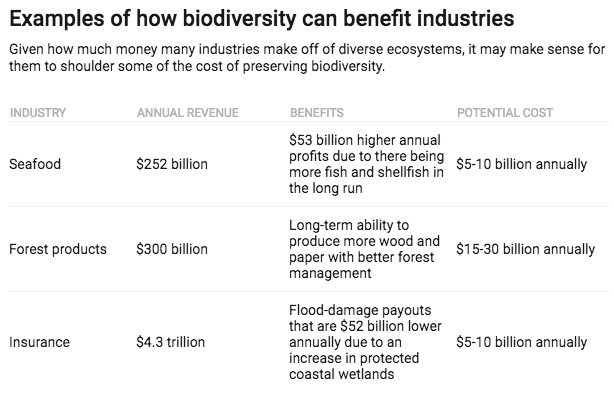
Chart: The Conversation, CC-BY-ND Source: Edward B. Barbier, Joanne C. Burgess and Thomas J. Dean Get the data
Corporate social responsibility
There is a second reason why big companies are sometimes willing to take action and pay to conserve biodiversity: corporate social responsibility, an ethos that builds into business models a commitment to protect the environment and benefit society.
Danone is a leader in this regard. It established the first partnership agreement between a global environmental convention and a private company over 20 years ago.
Since then, the multinational corporation best known for its yogurt and bottled water has promoted and supported the sustainable use and management of wetlands.
Danone, for example, worked with local partners to replant mangroves in approximately 500 Senegalese villages. We believe this reforestation project shows that investments in nature can be sustainable and scalable business models.
Danone, which earned $3 billion in profits in 2017, has its own $80 million “Ecosystem Fund.” It’s just one of an increasing number of companies taking concrete steps toward biodiversity protection, even though they are not required by any law or national policy.
More than 21 national and regional initiatives have been established to encourage partnerships between business and biodiversity conservation. For example, 10 of the 13 biggest seafood companies that control up to 16 percent of global marine catch and 40 percent of the largest and most valuable fisheries have come together to support an ocean stewardship initiative.
Similarly, the International Council of Forest and Paper Associations, which represents the global forest products industry, now engages in sustainable forest management certification.
The total area of forests worldwide deemed to be subject to sustainable practices supplying the industry increased from 62 million hectares, 12 percent of the total global forest area, in 2000, to 310 million hectares in 2015, according to the industry group. That’s more than half of the total global forest area. The annual revenue of the world’s 100 largest global forest, paper and packaging companies is over $300 billion.
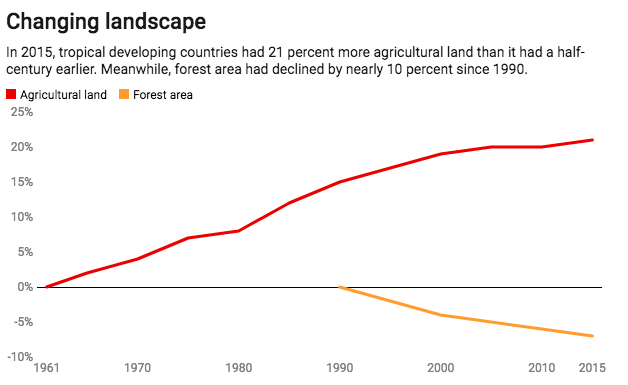

Chart: The Conversation, CC-BY-ND Source: World Bank Get the data
A new deal for nature
In addition to creating marine reserves, protecting forests, preserving the habitats of wild pollinators and conserving coastal wetlands, the private sector could also help finance conservation efforts in developing countries.
Based on our calculations, if the seafood sector were to set aside up to 20 percent of the increase in profits it gets from sustainably managing marine biomass stocks, it could conceivably spend up to $10 billion annually for marine biodiversity conservation.
And we estimate that by channeling up to 10 percent of the gains from sustainable forest management, the forest products industry could raise as much as $30 billion each year for investment in increasing protected forest area.
An agricultural sector contribution of around 10 percent of the benefits it derives from wild pollination services would amount to about $20 billion to $60 billion per year in additional financing for the conservation, creation and restoration of wild pollinator habitats.
All told, this business-world support could help close the $100 billion gap in global biodiversity conservation funding. This would go a long way toward slowing, and potentially reversing, biodiversity loss.
There are, of course, barriers to corporate conservation. The costs may be high. It may be hard for to businesses to assess the long-term value of biodiversity conservation benefits and integrate them into investment decisions. And it is possible that some of the corporations that take this step could be at a competitive disadvantage, especially in the short term.
But a number of companies are already showing that they believe investing in ecosystem preservation is worth it. In our view, corporate support for international biodiversity conservation is essential to prevent “biological annihilation.”
JOANNE BURGESS is an Assistant Professor of Economics at Colorado State University and EDWARD BARBIER is a Professor of Economics at Colorado State University.
THIS ARTICLE WAS ORIGINALLY PUBLISHED ON THE CONVERSATION