Brazil’s Black Lives Matter Movement 

Brazil, the last South American country to abolish slavery in the late 1800s, struggles to uplift their nation’s Black lives. Through pay gaps, urban designs, government representation and policing, Brazil’s society threatens the Black community. 

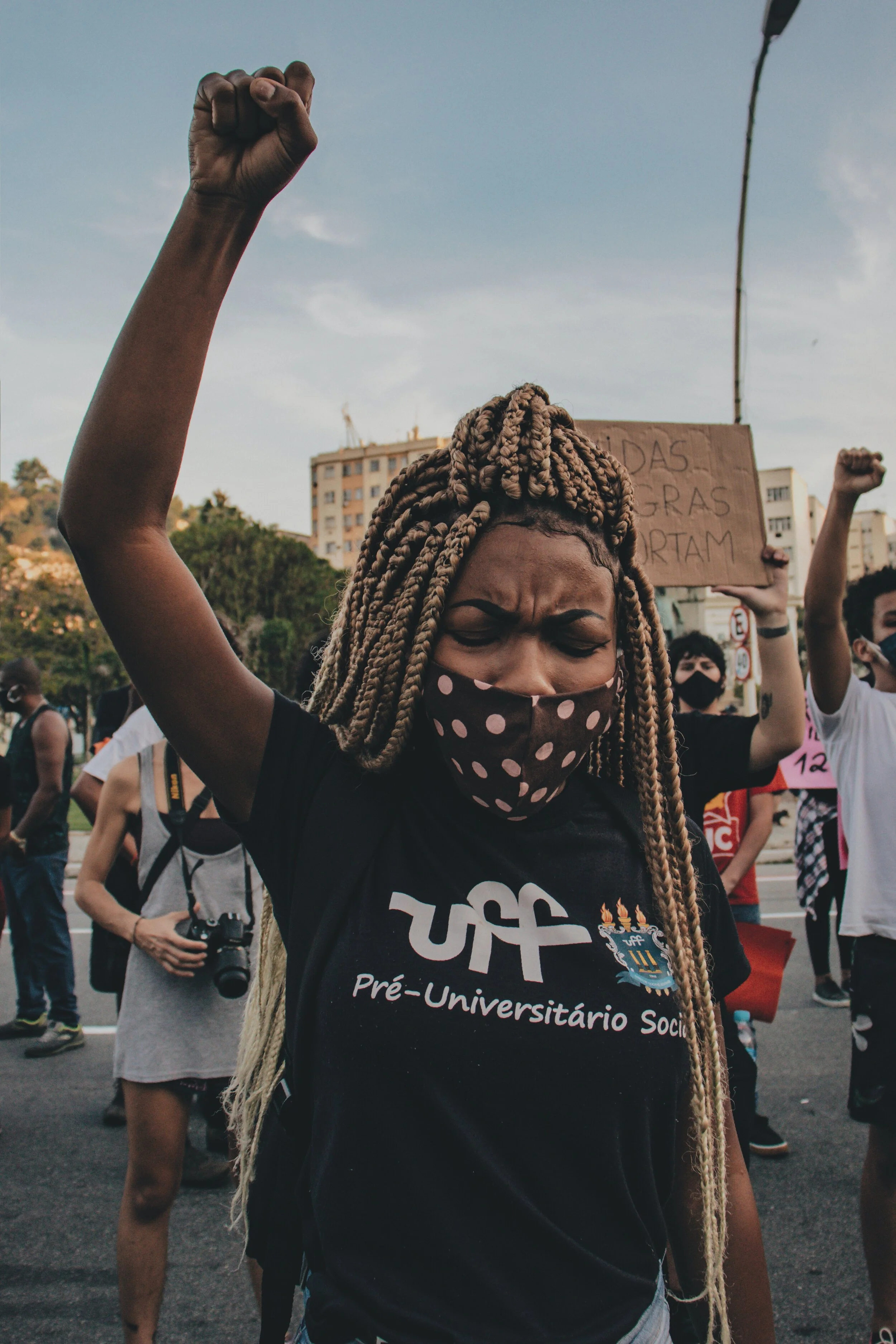
A protester on the streets in Brazil. Michelle Guimarães.

Over the course of 300 years, approximately four million Africans were taken to Brazil as slaves. Today, Brazil’s racial demographics are  47.7 percent white, 43.1 percent multiracial and 7.6 percent Black. The average income for white Brazilians is almost double that of the average income for Black or multiracial Brazilians, according to the Brazilian Institute of Geography and Statistics. Also, 78.5 percent of people in Brazil who are receiving the lowest rate of income (equivalent to $5.50 U.S. dollars per day) are Black or multiracial people.

This May, Black Lives Matter protests filled the streets of Rio de Janeiro, Sao Paulo and Brasília after 28 people died during a police raid. Human rights activists said that the officers killed people who wanted to surrender and posed no threat. The raid took place in Rio de Janeiro, where heavily armed officers with helicopters and vehicles went into Jacarezinho, a poor neighborhood. Thousands of residents were subject to nine hours of terror.

Organizers said that 7,000 people took to the streets in Sao Paulo. Protesters painted the Brazilian flag with red paint and held up a school uniform stained with blood. In Rio de Janeiro, protestors chanted, “Don’t kill me, kill racism.”

As Brazilian author and activist Djamila Ribeiro said, “The Brazilian state didn't create any kind of public policy to integrate Black people in society," and that "although we didn't have a legal apartheid like the U.S. or South Africa, society is very segregated—institutionally and structurally."

In 2019, the police killed 6,357 people in Brazil, which is one of the highest rates of police killings in the world—and almost 80 percent of the victims were Black. 

During COVID-19, Black Brazilians were more likely than other racial groups to report COVID-19 symptoms, and more likely to die in the hospital. Experts attributed this disparity to high rates of informal employment among Black people, preventing them from the ability to work from home, and a higher prevalence of pre-existing conditions. Specifically, in 2019, Black Brazilians already accounted for the majority of unemployed workers (64.2%); therefore, they already lacked economic support even before the pandemic.

An artist’s photoshoot with Brazil flag covering their bodies. Eriscolors. 

Only a quarter of federal deputies in the lower chamber of Brazil’s Congress and a third of managerial roles in companies were Black people, according to the IBGE statistics from 2019.  

Brazil’s President, Jair Bolsonaro, said during his campaign in 2018 that descendants of people who were enslaved were “good for nothing, not even to procreate,” while using the slogan “my color is Brazil.”

Keisha-Khan Y. Perry, a professor at the University of Texas, conducted an ethnographic study looking at how Black women in Gamboa de Baixo—a city culturally and historically tied to Black Brazilians—are leading the community towards social activism against racist politics. Specifically, these racist policies include political urban revitalization programs that push out Black and poor people. Perry said that these policies are a political tactic continually utilized in Brazilian cities. 

However, recently in May, Milton Barbosa, one of the founders of the most notable Black civil rights organization in Brazil, Unified Black Movement, said, “There’s been an increase in awareness nationally… We still have to fight, but there have been important changes.” 


Kyla Denisevich

Kyla is an upcoming senior at Boston University, and is majoring in Journalism with a minor in Anthropology. She writes articles for the Daily Free Press at BU and a local paper in Malden, Massachusetts called Urban Media Arts. Pursuing journalism is her passion, and she aims to highlight stories from people of all walks of life to encourage productive, educated conversation. In the future, Kyla hopes to create well researched multimedia stories which emphasize under-recognized narratives.


Report Finds W.H.O. Workers Sexually Exploited Women During Ebola Mission

Women were sexually exploited and abused by aid workers in order to obtain or keep jobs during the Ebola Crisis in the Democratic Republic of Congo.

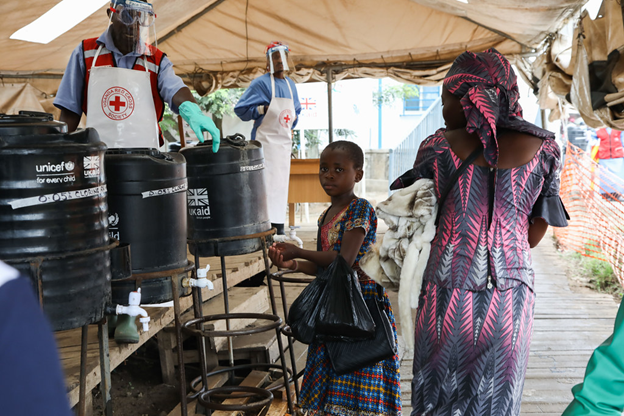
A young girl washes her hands at a checkpoint at the border between Uganda and the DRC. UK Department for International Development. CC BY 2.0

According to a report commissioned by the agency’s head, World Health Organization workers sexually abused women while in the Democratic Republic of the Congo to aid the Ebola outbreak from 2018 to 2020. The report found that 83 people participated in the abuse, and in 21 cases, those involved were confirmed to be WHO officials. The investigation started in September 2020 when The New Humanitarian and the Thomas Reuters Foundation published a report investigating abuse claims. The report found that 31 out of 50 women interviewed reported abuse and exploitation from men working for the WHO. In response, leadership in the World Health Organization ordered an independent commission to investigate. After working in Beni, one woman interviewed by the commission stated, “To get ahead in the job, you had to have sex … Everyone had sex in exchange for something. It was very common.” In addition, women reported that they were sexually harrassed and faced exploitation in order to keep their jobs, get paid or get a promotion. In some cases women were dismissed from their jobs when they refused to have sex with supervisors.

The commission established that the majority of the victims were already vulnerable because of precarious social and economic status, and women with more education and economic power were less vulnerable to abuse. The report found that there was a “systematic tendency to reject all reports of sexual exploitation and abuse unless they were made in writing”. While the WHO has training in place to prevent sexual abuse, the report found that training for employees did not happen until November 2019, months after the outbreak had been declared an emergency. Only 371 out of 2,800 workers attended the training. Additionally, men make up the vast majority of employees during the crisis, averaging 73.4% overall. The report cites that men held 77.49% of leadership positions and 91.52% of operations support and logistic positions.

The WHO was not the only organization accused of abuse, The New Humanitarian’s investigation found that there were allegations against workers at World Vision, Unicef and Alima, among others. Additionally, the investigation found that underreporting was prevalent in these cases, with one woman stating, “Why would you even ask if I reported it?” The New Humanitarian found that many women were unaware of how to report abuse or exploitation at all. Most aid agencies claimed they had received no reports of abuse, and the WHO stated they had received only a small number of complaints. ​​Dr. Tedros Adhanom Ghebreyesus, the Director-General of the WHO, apologized to victims and said it was his top priority to hold perpetrators accountable during a press conference after the report’s publication.


Dana Flynn

Dana is a recent graduate from Tufts University with a degree in English. While at Tufts she enjoyed working on a campus literary magazine and reading as much as possible. Originally from the Pacific Northwest, she loves to explore and learn new things.

8 Animals Recently Declared Extinct

Anywhere from 24 to 150 animal species go extinct daily, with human activity as a primary cause. Here are eight animals that have recently gone extinct.

Many animal species have recently gone extinct at the hands of humans, which should be a wake up call about how our actions can harm wildlife and the environment. Learn about these eight recently extinct animals to see what you can do to help.

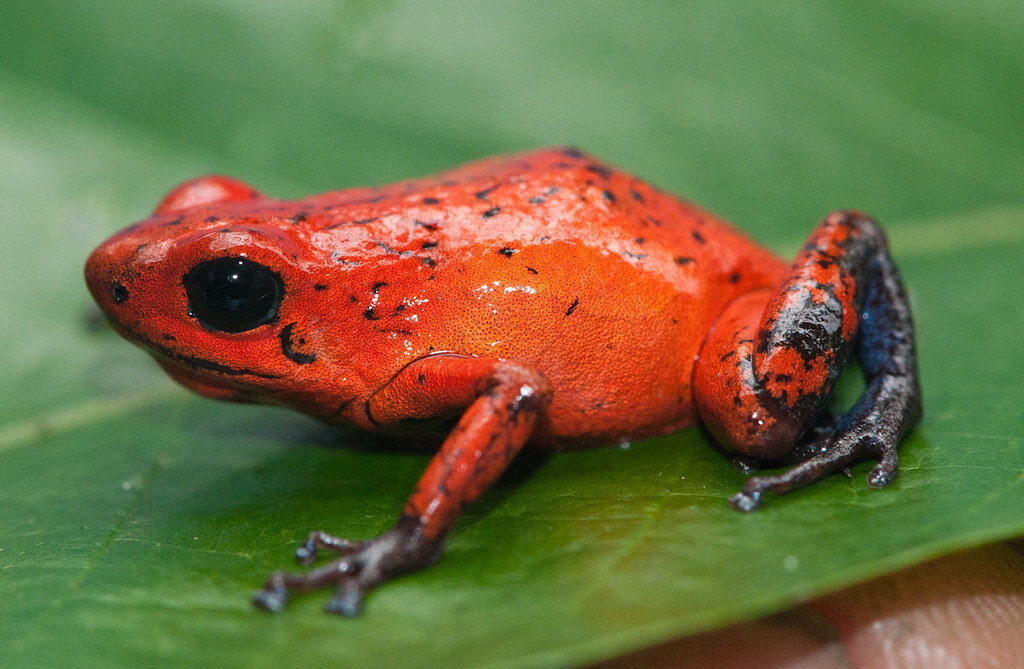
Poison Arrow Frog (Dendrobatidae). Jerry Kirkhart. CC BY 2.0.

1) Splendid Poison Frog

The IUCN added the splendid poison frog to the Red List of Endangered Species in 2004 and officially declared the species extinct in 2020, making it one of the most recently extinct species on the planet. These frogs are often referred to as poison arrow or poison dart frogs, and they are the brightest colored frogs in the world. Splendid poison frogs’ diets cause them to secrete toxins from their skin, and their bright colors warn predators of their toxicity. While the species lived in the humid lowlands and forests of western Panama, deforestation and habitat degradation severely harmed these areas and threatened the frogs. Human invasion such as with logging and construction in the area decreased the species’ population significantly.

Paddlefish, his mouth firmly shut. Shankar S. CC BY 2.0.

2) Chinese paddlefish

Like the baiji dolphin, the Chinese paddlefish (also known as the Chinese swordfish) was most commonly found in the Yangtze River and was one of the largest freshwater fish in the world. This ancient fish species has lived since the Lower Jurassic period and survived the mass extinction that killed off the dinosaurs and many reptiles. Yet, the biggest threat to their existence was human activities. In the 1970s and 80s, overfishing and construction severely decreased the species’ population size. By 1993, this disruption caused the fish to become functionally extinct, which meant that the species lacked the numbers to meaningfully reproduce. The species has not been spotted since 2003, and it was officially declared extinct in 2020.

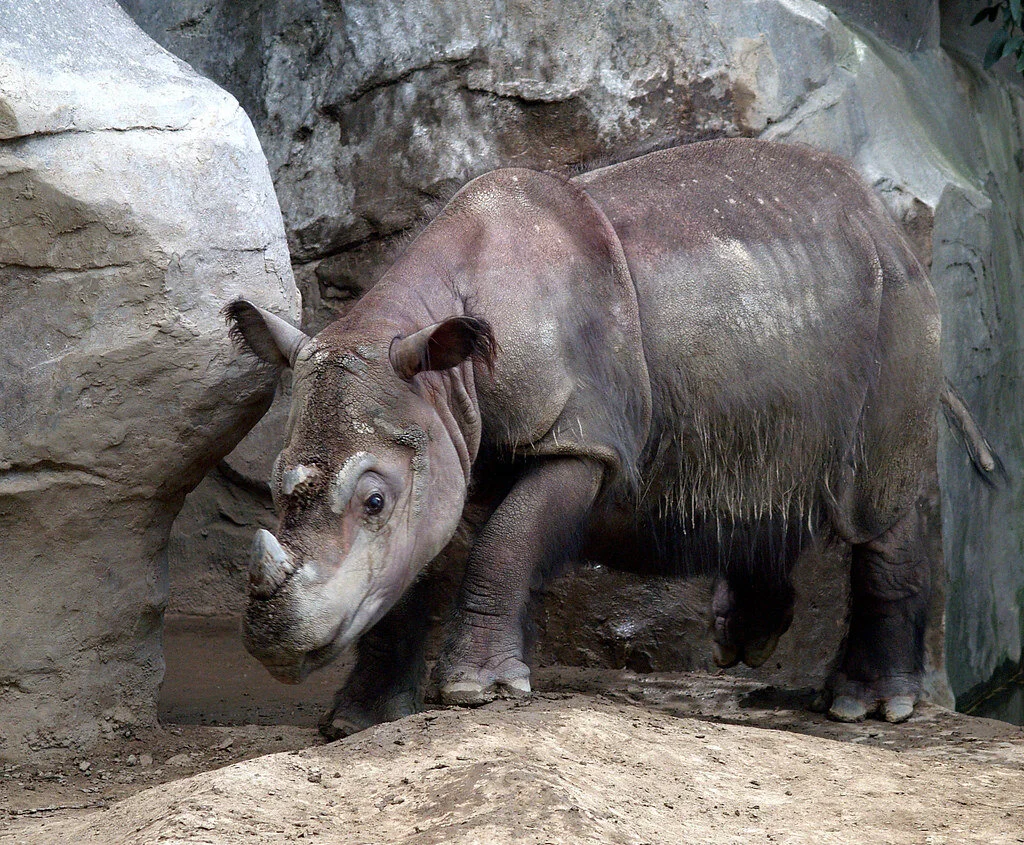
Sumatran rhino. David Ellis. CC BY-NC-ND 2.0.

3) Sumatran Rhino

Sumatran rhinos—also known as Asian Two-Horned Rhinos—are the smallest and most endangered rhino species in the world. They generally live for between 35 and 40 years, and their habitat is the  dense tropical forests mainly on the Indonesian island of Sumatra. Due to poaching, the species’ numbers have decreased more than 70% over the last 20 years. The Sumatran rhino was officially declared extinct in mainland Malaysia in 2015 and in Malaysian Borneo in 2019. The last Sumatran rhino died in 2019.

Lonesome George. A.Davey. CC BY 2.0.

4) Pinta giant tortoise

In 2012, “Lonesome George,” the world-famous tortoise, passed away at the estimated age of 100 years. George was the last remaining land tortoise from Pinta Island, a northern island in the Galapagos, and lived at the Charles Darwin Research Station since he was found in 1971. Most of his species went extinct because they were used as an onboard food source for 19th-century whalers, as well as due to habitat destruction. The Galapagos National Park searched for a mate for George for over three decades to try to save the Pinta subspecies, but they could not find one. When George passed away in 2012, the Pinta subspecies passed with him.

5) Western black rhino

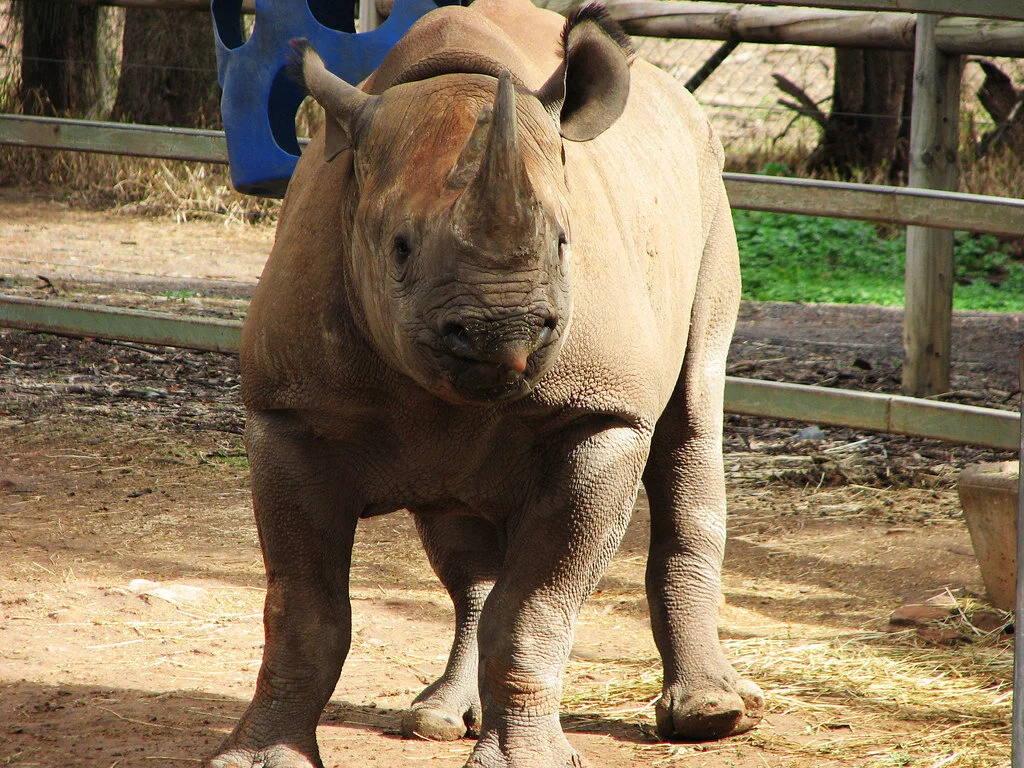
The western black rhino, which was the most uncommon of the black rhino subspecies, went extinct in 2011. In the past, the species had a large range across central and western Africa, but it was not able to survive in the 20th century. Hunting for sport quickly decreased rhino populations, and industrial agriculture cleared rhino habitats to make fields and settlements. In addition, between 1960 and 1995, 98% of black rhinos were killed by poachers. By 1980, the western black rhino’s range had shrunk to only two countries: Cameroon and Chad. The species’ population had fallen to about 10 rhinos by 1997. Due to this, the International Union for Conservation of Nature added the species to the critically endangered species list in 2008, and declared them extinct in 2011.

Baiji, Lipotes vexillifer. CC BY-SA 4.0

6) Baiji

Commonly referred to as the Yangtze River dolphin, Baiji is the first dolphin species to become extinct because of human activity. The Yangtze River was the Baiji’s home for 20 million years, and it only took humans 50 years to completely wipe them out. The Baiji’s ability to communicate, navigate, avoid danger and find food became very challenging as the river became noisier and noisier due to humans. In 2006, researchers embarked on a six-week journey on the river for over 2,000 miles to search for the Baiji, but they were not able to detect any existing dolphins. They were declared extinct in 2007.

7) Cryptic treehunter

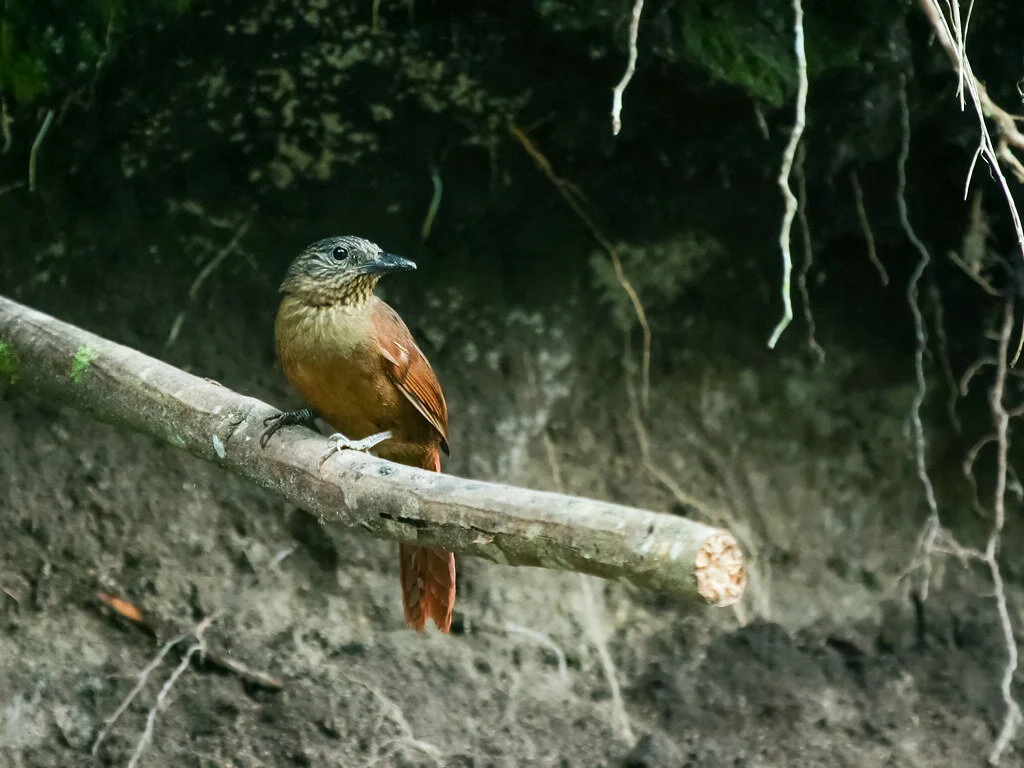
There have been no records of the cryptic treehunter since 2007, mainly due to extensive habitat loss in its region, Brazil. Cryptic treehunters were usually found in grasslands, woodlands and humid forests. Logging and conversion of forest to sugarcane plantations and pastureland was a major reason for the species’ decline. Some scientists believe that the species has not completely vanished due to their incredible hiding abilities, but since one has not been seen since 2007, it is unlikely.

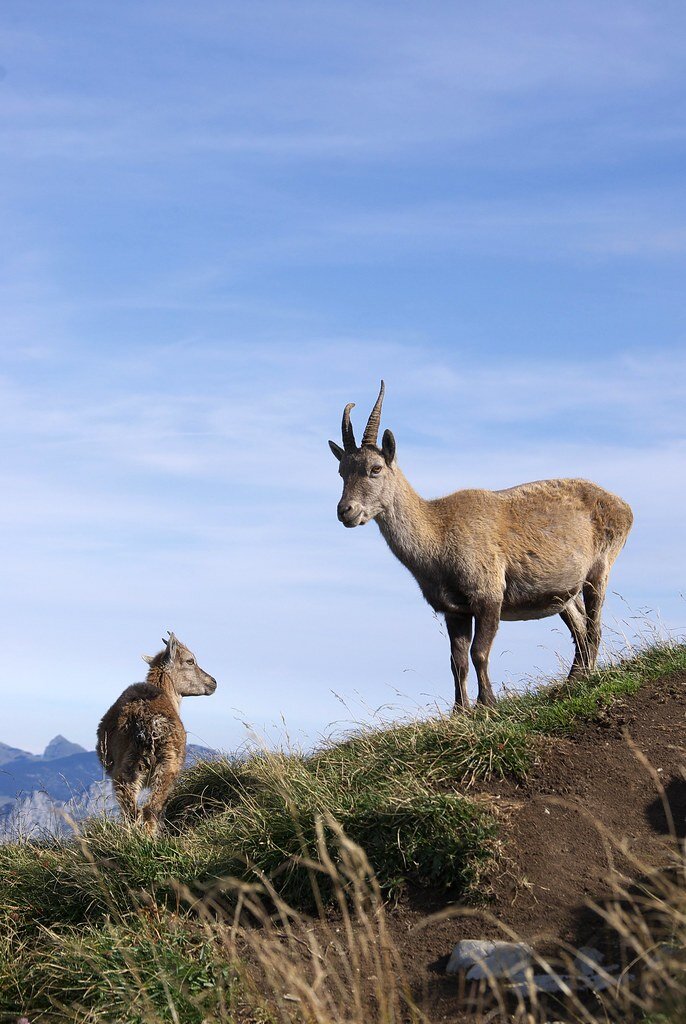
Bouquetin—the French name for Pyrenean ibex. Jean-Raphaël Guillaumin. CC BY-SA 2.0.

8) Pyrenean ibex

Once a large population which roamed across France and Spain, the Pyrenean ibex is one of two subspecies of the Spanish ibex that was declared extinct in 2000. The last Pyrenean ibex died in January of 2000 when a falling tree killed her. After she died, scientists took skin cells from her ear and preserved them in liquid nitrogen. In 2003, her DNA was cloned into a new ibex, becoming the first species to be “unextinct.” However, the clone died minutes after it was created due to lung issues. Scientists suspect that the species went extinct due to poaching, disease and competition for food.


Isabelle Durso

Isabelle is an undergraduate student at Boston University currently on campus in Boston. She is double majoring in Journalism and Film & Television, and she is interested in being a travel writer and writing human-interest stories around the world. Isabelle loves to explore and experience new cultures, and she hopes to share other people's stories through her writing. In the future, she intends to keep writing journalistic articles as well as creative screenplays.

U.S. House Passes Bill Repealing Prevention of Abortion Abroad

A new U.S. State Department spending bill includes provisions that expand global abortion rights. The bill passed in the House on July 28 and requires Senate approval by Sept. 30. 

On July 28, the U.S. House of Representatives passed a Department of State, foreign operations and related programs budget bill for the 2022 fiscal year. If the bill passes in the Senate and becomes law, it will have major implications for the global health industry. 

The bill is the first of its type since 1973 to exclude language from the Helms Amendment, which blocks U.S. foreign aid money from funding health services abroad related to abortions. 

The Helms Amendment’s language specifically prevents U.S. funds from paying for abortions as a method of family planning—yet foreign aid organizations have interpreted the amendment much more restrictively, to ban funding for abortions in other cases, such as rape, incest and life-threatening pregnancies. USAID has used the amendment to enforce a ban on the purchase of equipment and drugs to aid in post-abortion care. 

Around 73 million abortions occur annually worldwide, even in countries where access to abortions is restricted. In fact, data shows that abortion rates are often higher in countries where abortion is restricted than in those where abortion is legal. Abortion restrictions, which the Helms Amendment helps to maintain, do not mean that pregnant people are not getting abortions—they just mean that access to safe abortions is severely limited. 

The World Health Organization defines an unsafe abortion as one carried out by a person lacking the necessary skills or in an environment that does not meet minimal medical standards. Out of the 73 million annual abortions, nearly 35 million are estimated to occur in unsafe conditions. Unsafe abortions account for 8% of maternal mortality worldwide; each year about 47,000 women die from unsafe abortions. 

Unsafe abortions occur overwhelmingly in developing countries, where U.S. funding could be crucial to removing obstacles for safe abortions.  

The recent bill also permanently repealed the 1984 Global Gag Rule, which prevented foreign non-governmental organizations that were receiving U.S. funding from providing assistance on anything related to abortions, including information, referrals, or services. The Global Gag Rule banned such foreign organizations from providing abortion-related assistance even if they used their own, non-U.S. funds. 

A 2019 study found that the Global Gag Rule effectively prevented NGOs from providing functional reproductive health services. The rule caused NGOs to reduce sexual and reproductive health and pregnancy counseling and stop providing information on legal abortion services. The Global Gag Rule also prevents NGOs from involvement in pro-abortion advocacy. 

The U.S. is the largest funder and implementer of global health worldwide, but for nearly 50 years, the Helms Amendment and the Global Gag Rule have meant that a large portion of the healthcare sector misses out on this funding. Rather than preventing abortions, this legislation has served as further obstacles for people seeking safe abortions. Therefore, their exclusion from the most recent U.S. foreign spending budget bill is monumental. 

In addition to the provisions regarding the Helms Amendment and Global Gag Rule, the bill allocated $760 million for family planning and reproductive health services, an $185 million increase from last year’s bill. 

The spending bill passed in the House by a slim majority of 217 to 212. To become law, the bill must pass the Senate in the same form. The final 2022 fiscal year budget needs to be approved by Sept. 30

If the bill passes the Senate without mention of the Helms Amendment and with the inclusion of the Global Gag Rule repeal, it will become a landmark piece of legislation for sexual and reproductive health rights around the world. 

To Get Involved: 

For more information about global reproductive health policy and how you can support initiatives to make safe abortions accessible, visit the Guttmacher Institute here or PAI here


Rachel Lynch

Rachel is a student at Sarah Lawrence College in Bronxville, NY currently taking a semester off. She plans to study Writing and Child Development. Rachel loves to travel and is inspired by the places she’s been and everywhere she wants to go. She hopes to educate people on social justice issues and the history and culture of travel destinations through her writing.

Wildfires Burn Through Turkey as Climate Crisis Worsens 

Hundreds of wildfires have blazed across Turkey as the Mediterranean experiences extreme heat this summer. At least eight people have died in the fires and thousands have fled as firefighters and residents struggle to extinguish the fires.

Mountains in the smoke of fires in Turkey, on the Turkish coast in Marmaris, 2021. Photo by Vitolda Klein on Unsplash

Wildfires have been spreading across Turkey since July 28, terrorizing residents, hospitalizing dozens, and killing at least eight people and more than 2,000 farm animals. Around 200 wildfires have burned through more than 40 Turkish provinces, destroying more than 500 square miles of forest, in addition to villages, homes and farmland. Thousands have been forced to leave their shelter and livestock behind just to make it out alive. 

The fires started in Manavgat in the Antalya province, and the majority have broken out along the coasts of the Mediterranean and Aegean Sea. Antalya and Mulga, among other beach districts, have been hit the hardest, with a total of 21 wildfires and 14 wildfires respectively, more than double the number of wildfires in other districts. While popular tourist destination Antalya is accustomed to averaging near the mid-30s Celsius over the summer, the district has experienced highs of more than 40 degrees Celsius this summer. Cizre, a southeastern Turkish town, broke the country’s 60-year-old temperature and set the new record at 49.1 degrees Celsius on July 20. Experts believe the wildfires in Turkey and the Mediterranean may have been caused by extreme heat that hailed from North Africa. High winds—around 31 mph—have also facilitated these fires by making them difficult to extinguish and easier to spread. 

Turkey is not alone in this, as southern European nations including Greece, Spain, Italy and Lebanon have also been affected by blazing wildfires and soaring temperatures over the past few weeks. However, Turkey has experienced the bulk of the destruction and the worst wildfires in the nation in decades. President Recep Tayyip Erdogan has been criticized for failing to fight the inferno and for the nation’s lack of firefighting planes. Meanwhile, government officials have attempted to offset the blame from Erdogan by accusing political opponents and saboteurs of igniting the fires to get international intervention and undermine the current government. Some help has come in the form of  international assistance from the Middle East, Europe and some of Turkey’s neighbors, such as Azerbaijan and Iran, , but many residents were still left to fight the fires in their backyards alone.

Politics and conspiracies aside, Turkey’s recent wildfires are representative of a larger trend of worsening climate change and an increase in extreme weather events around the world. While the majority of wildfires can be attributed to human activities such as lighting campfires and throwing lit cigarettes on the ground, severe heat and drought make forests drier and more prone to catching on fire. Additionally, the average wildfire season has increased by three and a half months due to winter snowpacks melting about a month earlier than they did in the past. Scientists are comfortable linking these environmental circumstances—and Turkey’s recent extreme weather conditions in particular—to climate change, which is accelerating “dangerously close” to irreversible change. 

As one of six countries that has not ratified the Paris Climate Agreement, Turkey’s commitment to climate policies is weaker in comparison to that of other nations. Without the necessary fire-combatting equipment, including a usable fleet of water-dropping planes, Turkey is struggling to overcome this natural disaster. Despite the government and its supporters’ claims that Turkey can fight this alone, many residents continue to ask for increased international assistance. 

Get Involved

While Russia, Ukraine and other nations send tangible assistance to Turkey, there are ways for individuals to help as well. The World Wide Fund for Nature works to reduce human impact on the environment and preserve wildlife around the world, and is constantly looking for donors to monetarily contribute to the fight against climate change.

More specifically, Turkish Philanthropy Funds has set up a Wildlife Relief Fund to supply Turkey with the equipment necessary to rebuild and recover affected communities. Individual GoFundMe pages are also circulating across social media to facilitate Turkey's relief efforts.

To not only help Turkey but to help push forward the climate agenda in general, individuals can contribute by regulating and lowering their carbon footprint and voting for officials who will prioritize the environment. 


Mia Khatib

Mia is a rising senior at Boston University majoring in journalism and minoring in international relations. As a Palestinian-American, Mia is passionate about amplifying the voices of marginalized communities and is interested in investigative and data-driven journalism. She hopes to start out as a breaking news reporter and one day earn a position as editor of a major publication.

Deforestation in Myanmar Amid Political Unrest

While deforestation has been a major issue in Myanmar for decades, recent data shows a surge in deforestation that could be linked  to the nation’s recent coup and ongoing internal conflict. 

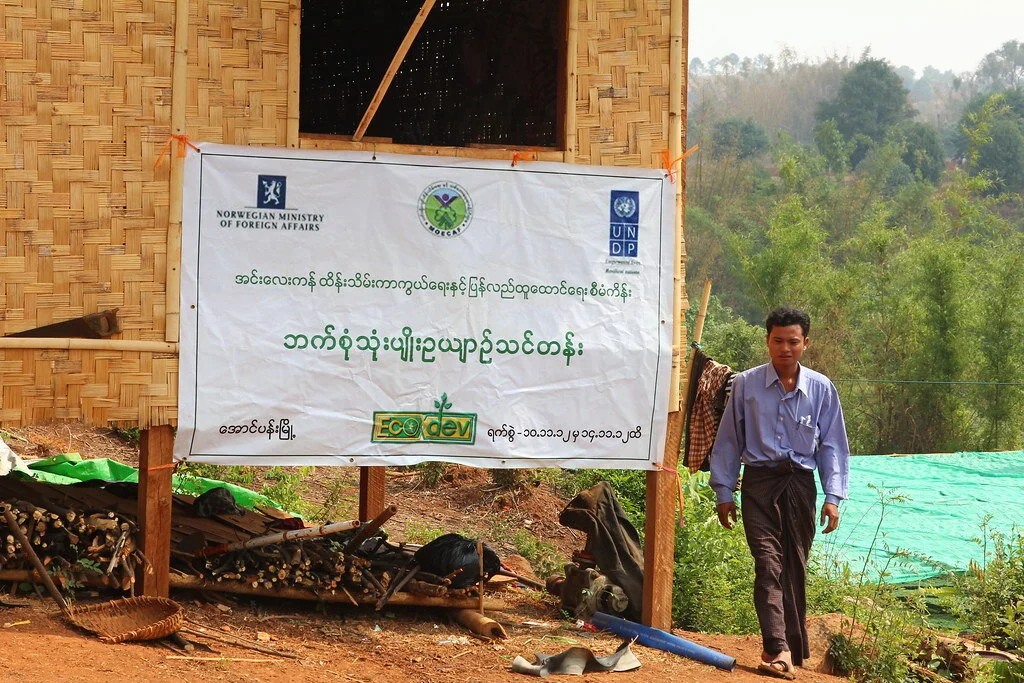
Environment and Food Security in Myanmar. United Nations Development Programme. CC BY-NC-ND 2.0.

On February 1, a coup took place in Myanmar. The Tatmadaw, Myanmar’s military, overthrew many democratically elected members of the National League for Democracy , the ruling party in Myanmar following the November 2020 general elections. After  the coup, the Tatmadaw enforced a year-long state of emergency, transferring power from the elected democratic authorities to the Commander-in-Chief of Defense Services Min Aung Hlaing. The military assumed control of the nation and invalidated the November vote on the premise that the elections were fraudulent; however, many question the legitimacy of this premise. Some believe that this reasoning was a cover for the Tatmadaw to step in because many members of its party lost in the election. 

Interestingly, the coup took place the day before the Parliament of Myanmar swore in the newly elected members from the November 2020 election, preventing the election. Unsurprisingly, residents did not welcome the control of the Tatmadaw with open arms—many protested the coup and experienced grave, and sometimes deadly, consequences. Citizens who spoke out against the Tatmadaw authorities were punished, as freedom of speech and the press are not guaranteed by law in Myanmar. Since the conflict began, over 900 civilians have been killed by military or police forces and at least 5,000 people have been arrested, charged or sentenced. Additionally, three prominent members of the NLD have died while under police custody in March.

 While this political situation in Myanmar is new, its environmental situation is not. When the nation achieved its independence from the British in 1948, Myanmar, previously known as Burma, had a landscape that was  70 percent forest. In 2014, there was around 48 percent forest cover, as the nation lost around 19 percent of its forests between 1990 and 2010. Although Myanmar’s deforestation rate is less than some of its neighbors, including Indonesia and Vietnam, deforestation is still a major concern in the region. Deforestation in Myanmar is often attributed to three major factors: unsustainable and illegal logging, unresolved land disputes and agricultural development. Despite deforestation, Myanmar has the largest tropical forest in mainland Southeast Asia that is home to more than 80 endemic species. Despite the size of Myanmar’s forests, only around six percent of its land is protected by law while the rest is susceptible to deforestation. 

 Myanmar’s Tanintharyi region exemplifies the consequences deforestation can have on Myanmar’s wildlife. Satellite data from the University of Maryland shows that deforestation is increasing in the nation, especially in the Mergui and Kawthoung districts of the Tanintharyi. According to UMD, Mergui and Kawthoung lost around 15 percent of their tree cover between 2001 and 2019, and recent data from UMD’s Global Analysis and Discovery lab suggest that this number may be higher in 2020 and beyond. 

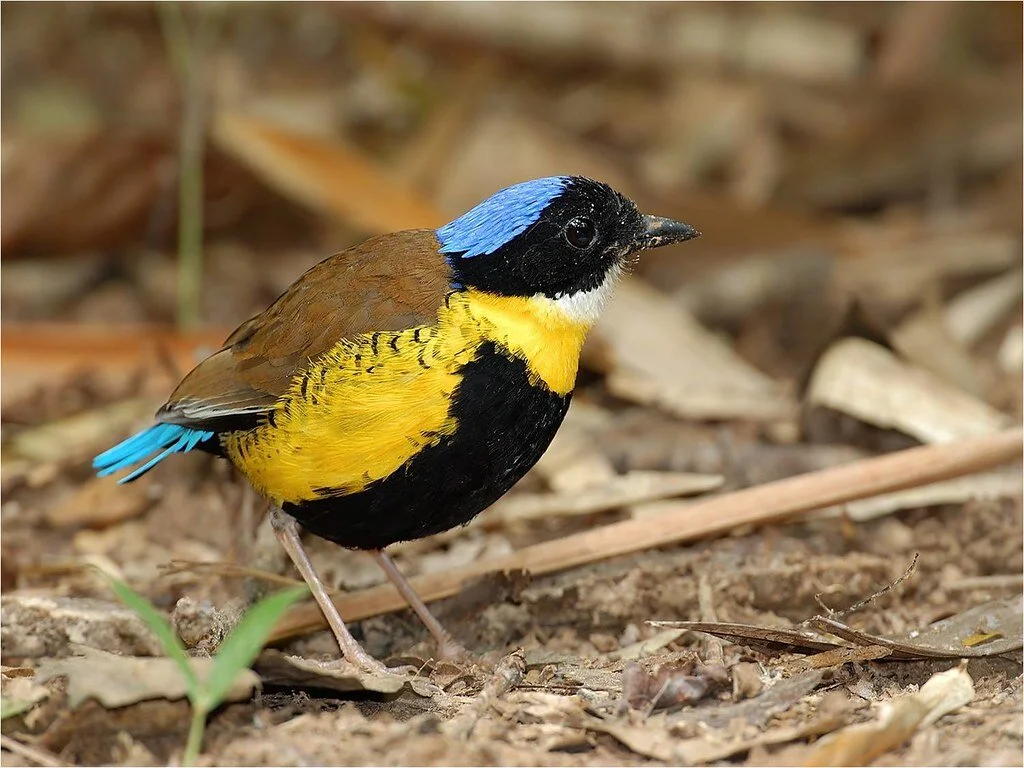
Gurney’s pittas, small birds with a stubby tail, live in the area between Mergui and Kawthoung in the Tanintharyi. These birds were thought to be extinct until they were rediscovered in the 80s. According to the International Union for Conservation of Nature, the Gurney’s pitta is a critically endangered species with only between 1,000 and 2,500 remaining in 2019, a drastic decline from the 10,300 to 17,000 that were alive 15 years earlier. Habitat loss is the reason behind this decline. 

 Gurney pitta. darwin_initiative. CC BY-NC-SA 2.0.

Beyond threatening extinction for wildlife that has been around for decades, deforestation in Myanmar is also threatening the advancement of science in studying biodiversity. New species have recently been discovered in the Tanintharyi region. In 2015 and 2016, researchers discovered two species of geckos, genus Cyrtodactylus, that are known for their bent toes. In 2019, another group of researchers discovered an Asian rock gecko known as Cnemaspis tanintharyi. Some scientists are worried that continued deforestation in the Tanintharyi region could mean the extinction of undiscovered and recently discovered species, in addition to well-known species.

 Myanmar’s political climate has implications for its environmental situation. With Myanmar’s 70-year-long and ongoing internal conflict as well as the recent coup, displaced individuals have turned to its forests for support. Many have taken up farming in the Tanintharyi to make a living and others have sought refuge in surrounding forests—both of which have contributed to increased deforestation in the Tanintharyi region and the decline of unique, local species.

In addition to the environmental consequences of displacement, experts speculate that the coup has opened the nation to increased illegal deforestation as international oversight and trade partnerships deteriorate. With other nations increasing sanctions against Myanmar and refusing to cooperate with the country because of the coup, Myanmar is more susceptible to illegal deforestation and the selling of illegally obtained wood to foreign partners who neglect to question its legitimacy. Satellite data by Planet Labs, Google Earth and Global Forest Watch show that large patches of forest have been removed between January and April of this year. Despite this incriminating data, there is no clear evidence that directly links the recent deforestation to illegal activities conducted by the Tatmadaw.


Mia Khatib 

Mia is a rising senior at Boston University majoring in journalism and minoring in international relations. As a Palestinian-American, Mia is passionate about amplifying the voices of marginalized communities and is interested in investigative and data-driven journalism. She hopes to start out as a breaking news reporter and one day earn a position as editor of a major publication.

Water Protests Erupt in the Middle East

Droughts have caused agricultural collapse and water shortages across several Middle Eastern countries, with recent protests erupting, calling for governments to take action.

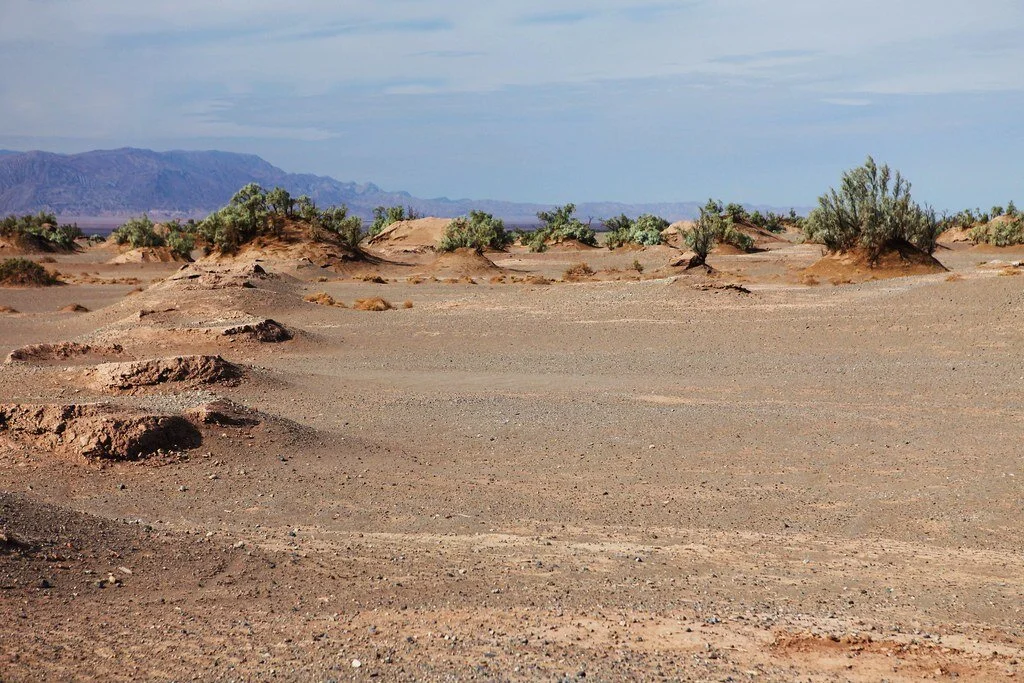
Lut Desert, Iran. Ninara. CC BY 2.0.

The recent  protests in Iran over water scarcity were a part of unrest and rebellion across the entire Middle East after droughts caused agricultural collapse and water shortages in several countries.

The protests began in the oil-rich southwestern province of Khuzestan after accusations that the Iranian government is diverting water to drill for oil. At least eight protestors were killed in different cities.

Climate change is partly responsible for the protests, due to droughts and sandstorms but years of government inefficiency have also largely contributed to the problem. Many development projects put forth in Khuzestan over the years have caused environmental damage and water shortages, including the construction of hydroelectric dams, water transfers to neighboring provinces and irrigation schemes that have only fed agriculture.

According to Khuzestan lawmaker Mojtaba Youssefi, more than 700 villages in the province do not have drinking water and many farmers’ livestock have died of thirst.

Authorities in the area have reacted to the water protests with violence and have cut internet access.

Drought is one of the most significant drivers of conflict not just in Iran, but also everywhere in the Middle East. For example, agricultural collapse and droughts caused many rural Syrian families to migrate to cities and fight for resources and jobs.

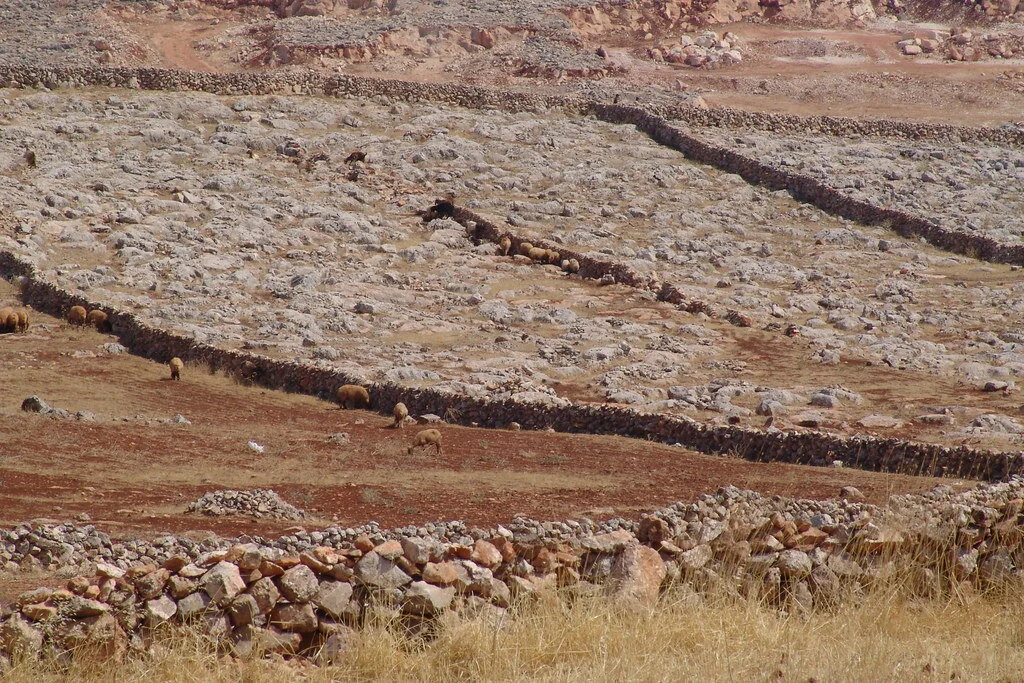
The northern Syrian countryside in high summer. Charles Roffey. CC BY-NC-SA 2.0.

Droughts have been a historical constant in the Middle East, but water shortages are becoming even more intense and are present for greater lengths of time due to longer dry seasons and higher temperatures which are driven by global warming.

Yet, politicians and government corruption are also to blame for the droughts. Water shortages only continue to point toward unrest and rebellion, prolonging the social and political trouble that climate change has already caused. Also, the ineffectiveness of water dams in Iraq have caused acute and chronic water shortages there as well.

To make up for these water shortages, farmers and governments are pumping huge amounts of groundwater, which risks turning fertile land into deserts. In 2015, NASA satellites mapped water losses in the region since 2002 and found that parts of Iran and Iraq had lost from 6 to 10 inches of groundwater due to human activity.

As the conflict progresses in Iran, there are risks of violence between neighboring states competing over water resources.

GET INVOLVED

The Borgen Project is a nonprofit that addresses global poverty and hunger and works towards ending them. With their project on the water crisis in the Middle East, they offer internships and volunteering opportunities as well as accept donations. 

Water for People is another organization which brings water, sanitation and hygiene services to those in need. People can get involved with this nonprofit by fundraising, partnering with the company and volunteering.


Isabelle Durso

Isabelle is an undergraduate student at Boston University currently on campus in Boston. She is double majoring in Journalism and Film & Television, and she is interested in being a travel writer and writing human-interest stories around the world. Isabelle loves to explore and experience new cultures, and she hopes to share other people's stories through her writing. In the future, she intends to keep writing journalistic articles as well as creative screenplays.

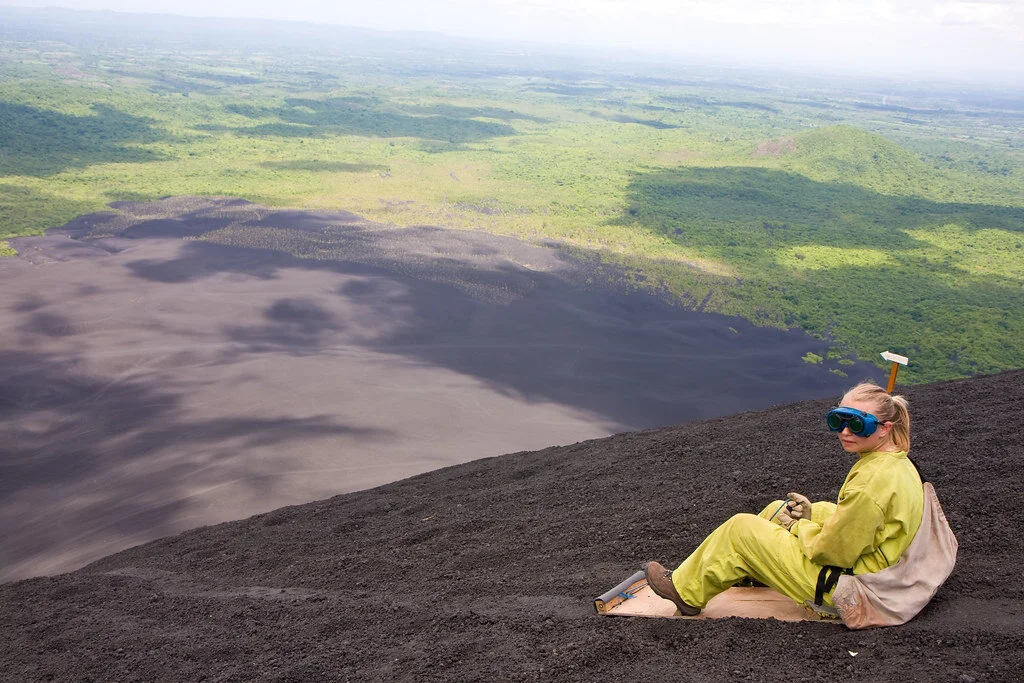
Volcano Boarding in Nicaragua

Looking for an adrenaline rush? Slide down the side of an active volcano at up to 60 miles per hour during your stay in Nicaragua.

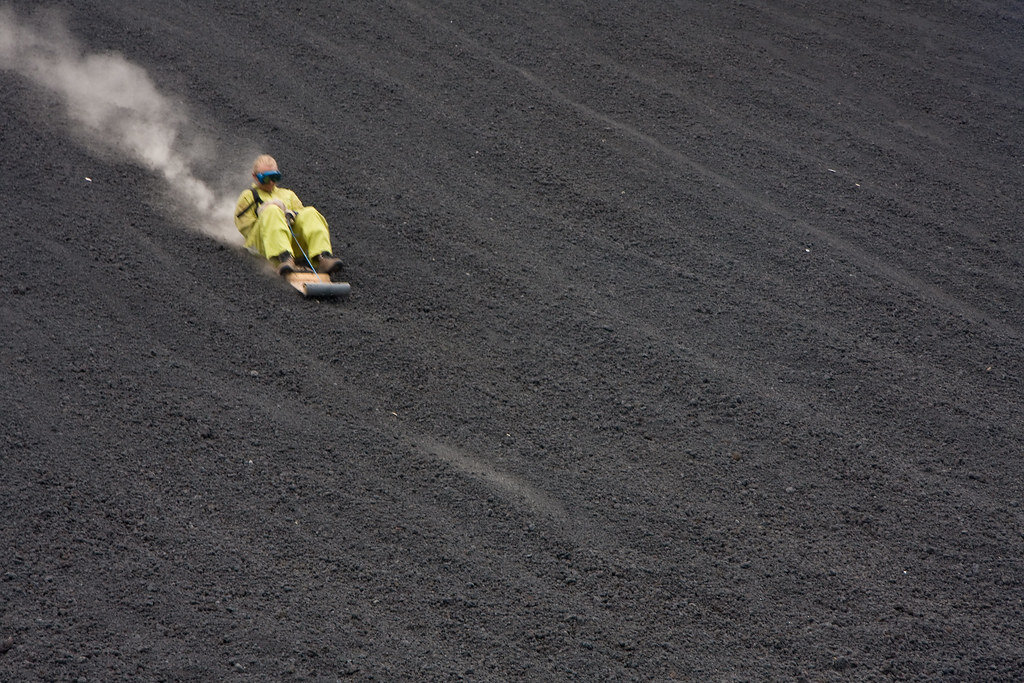
Volcano boarding on Cerro Negro, Nicaragua. Garrett Ziegler. CC BY-NC-ND 2.0.

Bigfoot Hostel in Leon, Nicaragua is one of the only places in the world where you can go volcano boarding. According to their website, volcano boarding is the “thrill of a lifetime.” The hostel’s original owner, Daryn Webb, created the extreme sport, where those brave enough to try it can speed up to 60 miles per hour down the side of an active volcano.

Webb and his crew tested various objects for sliding down the volcano, and after some trial and error, they created a sit-down toboggan made of metal and plywood. The hostel offers daily tours beginning at 9 a.m., with prices at $25 per person. Tours return at 3 p.m.

The Cerro Negro volcano is the youngest volcano in Central America, and is also one of the most active volcanoes in Nicaragua, erupting nearly every 20 years.

Bigfoot Hostel has sent over 20,000 people down Cerro Negro slope at up to  62 miles per hour, and it is known for attracting many sports enthusiats  and adrenaline junkies. One of the most famous people to attempt the extreme sport was Eric Barone, who rode down the volcano on a bike at 107 miles per hour in 2002.

Volcano boarding on Cerro Negro. Garrett Ziegler. CC BY-NC-ND 2.0.

It is possible to slide down the Cerro Negro because the volcano is made of small grain-like volcanic rocks, which came from the crater. In addition, there is almost always a very strong wind hitting the volcano, so it’s the perfect surface for boarding.

Those who have visited before say that they could feel the heat radiating from the volcano and could even cook their meals in a hole dug out in the volcano.

All visitors must wear closed toe shoes and comfortable clothing. Those who have boarded down the volcano before recommend wearing hiking boots (since it takes about 45 minutes to reach the summit) and a multipurpose head wrap to cover your nose and mouth while boarding. Also, take a large water bottle and a GoPro if you want to record the experience.

The hostel offers dorm-style rooms, with rooms with fans at $6 and rooms with air conditioning at $10. There are also private rooms with double, triple, or quadruple beds.


Isabelle Durso

Isabelle is an undergraduate student at Boston University currently on campus in Boston. She is double majoring in Journalism and Film & Television, and she is interested in being a travel writer and writing human-interest stories around the world. Isabelle loves to explore and experience new cultures, and she hopes to share other people's stories through her writing. In the future, she intends to keep writing journalistic articles as well as creative screenplays.

6 Interesting Facts about the Egyptian Pyramids

There is still so much we don’t know about the history and structure of the Egyptian pyramids. Here are six things that you may not have known about the pyramids and ancient Egypt.

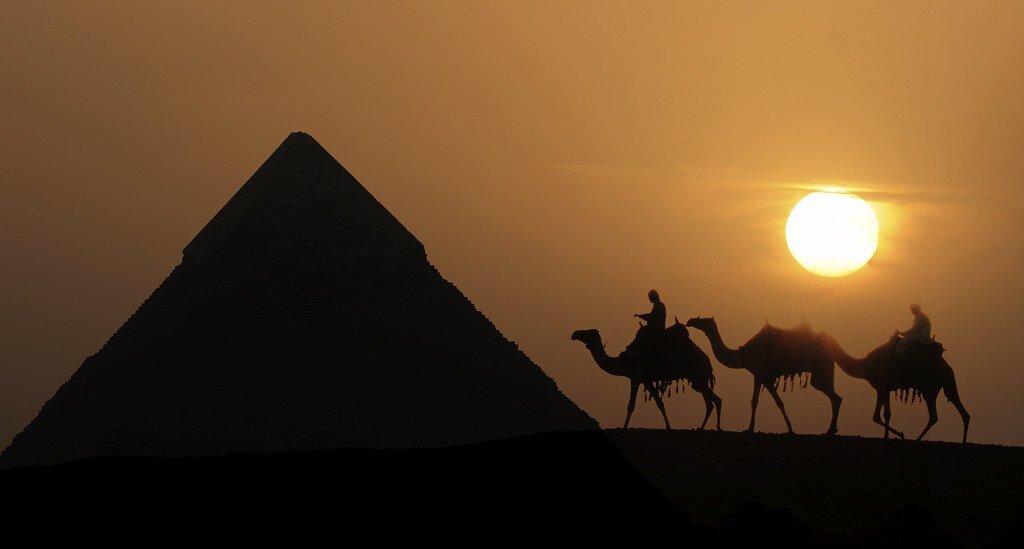
Egyptian pyramids in the sunset. Club Med UK. CC BY-NC 2.0.

The Egyptian pyramids are famous for their buried mummies and treasures, but there are still many secrets waiting to be uncovered about their history. Take a deep look into the ancient pyramids’ past with these six interesting facts.

The seven wonders of the world, Egyptian pyramids. Boston Public Library. CC BY 2.0.

1. Once upon a time, they sparkled.

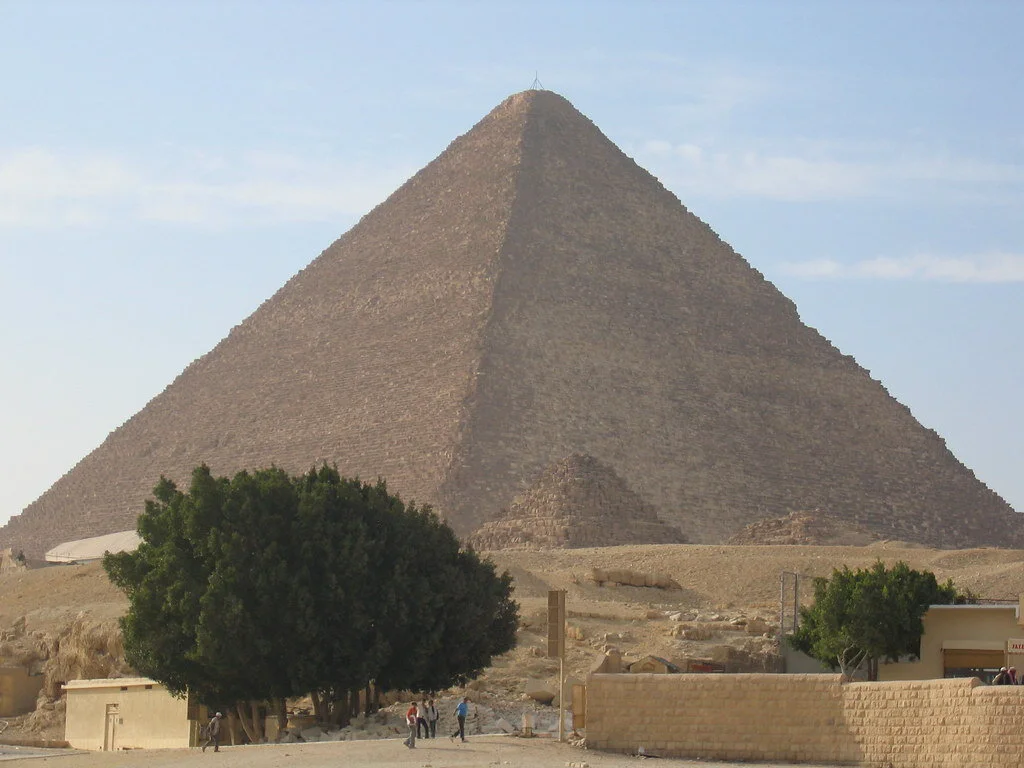
According to research on ancient texts and found evidence, it is thought that the Great Pyramid of Giza used to shine like glass and sparkle in the sunlight. Ancient Egyptians even called the pyramid “Ikhet,” which translates to “glorious light.” This is mainly because the pyramid was originally covered in polished limestone which reflected light like a mirror and made the pyramids visible from anywhere nearby. What is even more interesting is that the speed of light—299,792,458 m/s—are also the exact coordinates of the Great Pyramid of Giza, which is at 29.9792 degrees north, 31.1342 degrees east. Spooky? Definitely.

Entering the pyramid. Trey Ratcliff. CC BY-NC-SA 2.0.

2. Many of them were robbed.

A lot of the unknown history of the pyramids can be blamed on tomb robbers. Tomb robbing was a serious problem in ancient Egypt because robbers targeted the tombs for looting—even Kings’ tombs were broken into. It was the Egyptian belief that everything buried with you was taken into the afterlife, so Kings and Queens were buried with unimaginable amounts of riches. It was also very common for people to steal from their ancestors’ tombs —some even dumped the body and stole the sarcophagus. Egypt was a cashless society until the Persians came in 525 BCE, so those who stole from the tombs would have had to trade their stolen goods to higher, corrupt officials. Those caught would be executed for the offense.

The Great Pyramid of Cheops. Boston Public Library. CC BY 2.0.

3. We still don’t know how they were built.

Although the pyramids are over 4,000 years old, professionals still don’t understand how the ancient Egyptians managed to build the pyramids without advanced technology. The most accepted theory is that they used ramps to bring materials to the top, which has been proven by a recent discovery. Researchers in Egypt discovered a 4,500-year-old ramp used to haul alabaster stones out of a quarry. The ramp system dates back to Pharaoh Khufu, who built the Great Pyramid of Giza. However, the way in which the ancient Egyptians built the pyramids is still a mystery because the pyramids were not made of alabaster, which is what the discovered ramp helped to move.

Khufu’s Great Pyramid. Bernt Rostad. CC BY 2.0.

4. There is a secret chamber in the Great Pyramid of Giza (Khufu’s Pyramid).

Weighing in at 5,750,000 tons, the Great Pyramid is simply a feat of architecture. To add further to the mystery, a previously unidentified chamber in the Great Pyramid was discovered in 2017 when physicists used the by-products of cosmic rays to reveal an at least 100-foot long void. The mysterious space’s dimensions are similar to the pyramid’s Grand Gallery, which is the corridor that leads to the burial chamber of Pharaoh Khufu. What lies within the space is still unknown, as well as its purpose. Scientists hope to find out more about this newly discovered area and what it was used for.

Tomb of Perneb, carving of offering bearers. Peter Roan. CC BY-NC 2.0.

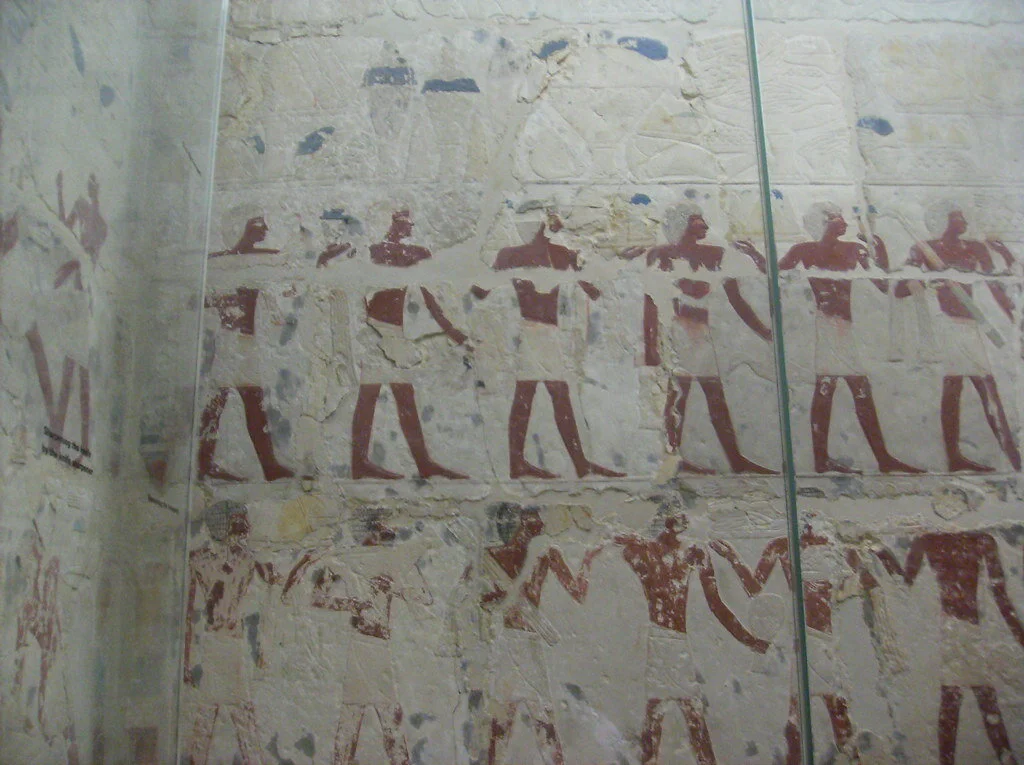
5. It was tradition for the living to share food with the dead.

Ancient Egyptians believed that tombs were eternal homes for the mummified bodies and the ka spirits that lived within them. Each tomb had a tomb-chapel where families and priests could visit the deceased and leave offerings for the ka, while a hidden burial chamber protected the mummified bodies from potential harm. Visitors offered food and drink to the dead daily, and once the offerings were consumed by the ka, the living were free to eat and drink their offerings. The Beautiful Feast of the Valley was an annual festival of death and renewal where families spent the night in the tomb with their ancestors and feasted with them in celebration of their lives.
A statue ofNefertiti in the Altes Museum in Berlin. George M. Groutas. CC BY 2.0.

6. Egyptian women and men had equal rights.

In ancient Egyptian times, men and women of the same social class were treated as equals in the eyes of the law. Women could sell, own, earn, buy and inherit property. If widowed or divorced, women could raise their own children. Women could also bring cases before a court. Overall, women could legally act on their own and were responsible for their own actions. Although everyone in ancient Egypt was expected to marry, wives still had an important, equal and independent role in their marriage. 


Isabelle Durso

Isabelle is an undergraduate student at Boston University currently on campus in Boston. She is double majoring in Journalism and Film & Television, and she is interested in being a travel writer and writing human-interest stories around the world. Isabelle loves to explore and experience new cultures, and she hopes to share other people's stories through her writing. In the future, she intends to keep writing journalistic articles as well as creative screenplays.

Siberia's Lake Baikal, One of the Deepest Lakes in the World

Recognized as one of the few remaining ancient lakes in the world, Lake Baikal has preserved natural history and housed thousands of animal species for centuries.  

Lake Baikal surrounded by greenery. Markus Winkler. Unsplash.

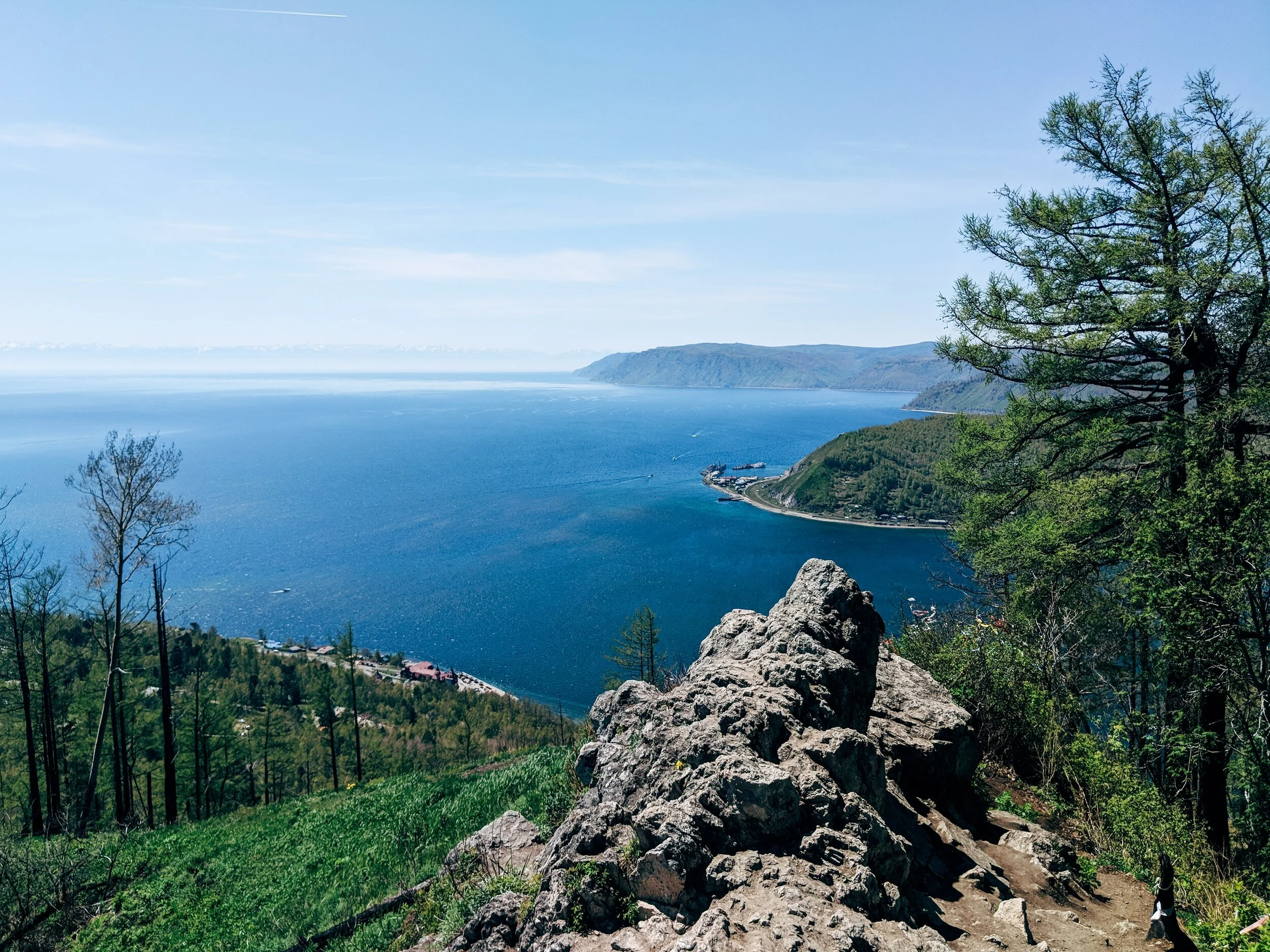
In Siberia, just north of the Mongolian border, sits Lake Baikal, one of the deepest lakes in the world. The lake houses 22 percent of our planet's fresh water and measures over 5,300 feet deep. Furthermore, its location between mountains allows for over 330 rivers and streams to connect to it, and the lake is made up of three basins. While Lake Baikal only equates to around half the surface area of Lake Michigan, measuring in at about 12,200 square miles, its magnificence lies in its history. 

Experts have estimated that the lake is between 25 and 30 million years old, making it one of the few remaining ancient lakes on the planet. This is because it lies in an active rift zone due to its plate tectonics, unlike most other lakes which have a history of being covered by ice sheets in previous glacial periods. Most ancient lakes are formed when the Earth's plates begin to move apart from each other, creating a rift valley that is deepened over time by erosion. Eventually, the rift widens so much that it begins to fill with fresh water. Around 75 percent of Earth's ancient lakes have been formed through this process, with the exceptions having been formed by meteor impacts and volcanic action.

 Therefore, not only does Lake Baikal preserve years of Earth's history, but it is exclusively home to around 2,000 unique animal species. Although the lake is protected as a UNESCO World Heritage Site, that hasn’t stopped climate change from affecting the lake, as the surface temperature has increased by 1.5 degrees Celsius over the past 50 years. In conjunction with increasing chemical pollution, the ecosystem is believed to be rapidly changing for the first time in decades.  

Throughout the COVID-19 pandemic, locals have been taking advantage of the lack of visitors populating the lake, many beginning to trek out to visit the body of water themselves. Especially during the fall and winter months, many visitors enjoy skating, hiking, or even skiing over the  ice and snow. 

Ice formed over Lake Baikal. Daniel Born. Unsplash. 

Located near one of Russia's largest cities, there has been a constant tug-of-war between developers, locals and environmentalists to seek a balance between encouraging tourism which benefits the local economy, and protecting the deteriorating ecosystem. While the momentary break in visitors has undoubtedly allowed the ecosystem to begin to recover, ultimately its fate lies in the hands of its visitors.


Zara Irshad

Zara is a third year Communication student at the University of California, San Diego. Her passion for journalism comes from her love of storytelling and desire to learn about others. In addition to writing at CATALYST, she is an Opinion Writer for the UCSD Guardian, which allows her to incorporate various perspectives into her work.

Islamic Architecture in Spain 

While many can forget that Arab and North African Muslims controlled parts of Spain for almost 800 years, longstanding Spanish architecture is a testament to the Muslim reign. Arabesque patterns, Islamic motifs and sandy colors have been preserved in some of Andalusia’s most famous palaces and fortresses. 
Arab and North African Muslims conquered the Iberian Peninsula in the eighth  century. Ruling for almost 800 years in Al-Andalus (currently Andalusia), Muslims inevitably left traces of their presence in the region. Everything from language and religion to architecture and art was adopted by Spain during the Muslim reign. Around 4,000 Spanish words which are still in use today originated from Arabic. The majority of these words are nouns related to food, animals, nature and science. For example, the Spanish word for “olive” is “aceituna” and is derived from the Arabic word “zaytünah.”

While aspects of the Arabic language can be found in Spanish, Islamic architecture is the true evidence of the Arab and North African Muslim reign in Spain. Certain sites in modern-day Andalusia make you feel like you’re in Morocco or Syria. Today, Islamic architecture is most prevalent in Cordoba, Seville and Granada—Spanish cities in Andalusia—with their palaces and holy sites. 
 Cordoba 

Desert colored walls in the Great Mosque of Cordoba. Waqqas Akhtar. CC BY-NC-SA 2.0

Cordoba was the capital of Al-Andalus when it was first conquered in 711 A.D. The Great Mosque of Cordoba is a testament to the Arabic and Islamic influence in the city. Elaborate building programs and agricultural projects were sponsored by Prince Abd al-Rahman I from Damascus, Syria. The prince imported plants from Damascus, some of which still stand in the yard of the Mosque of Cordoba today. 

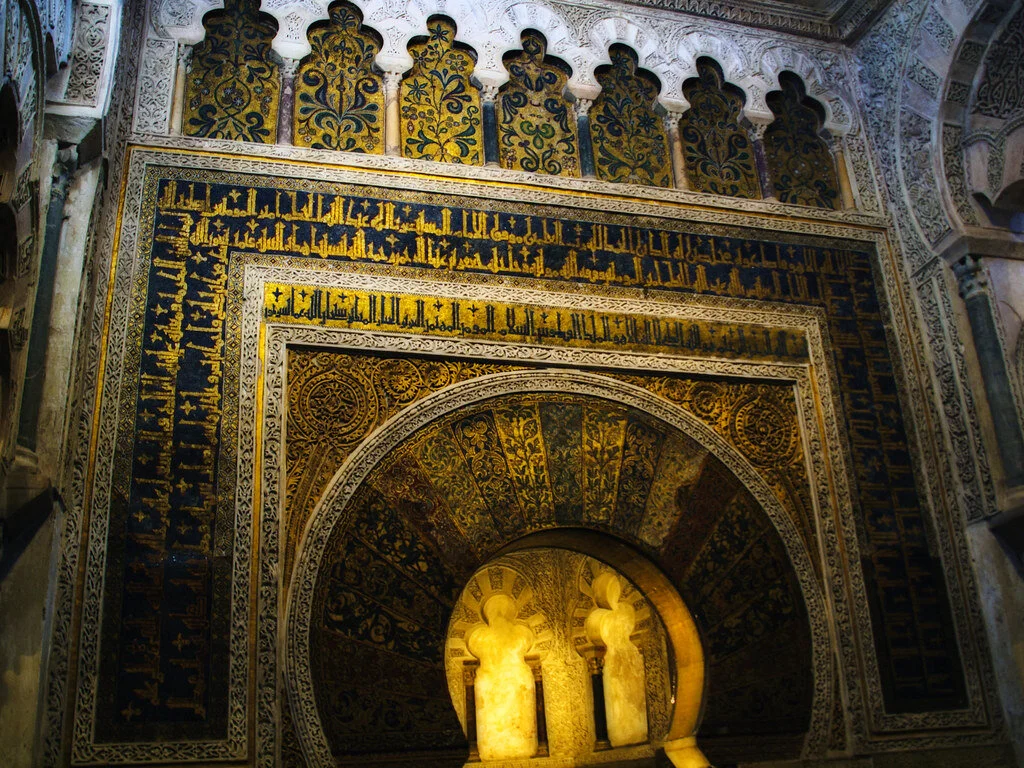
Previously operating as a mosque and church at different points in history, the captivating structure includes a hypostyle prayer hall, a beautiful courtyard with an extravagant fountain, a colorful orange grove, a walkway circling the courtyard and a minaret which is now a bell tower. Islamic calligraphy and verses from religious scriptures fill the sandy, red and white colored columns. Geometric shapes dominate the structure—in everything from design to entryways. One major Islamic motif that is evident in this structure is the horseshoe shaped “mihrab.” The mihrab identifies the wall that faces Mecca—Islam’s holiest city that features the home of God, the Kaa’ba—and indicates which direction to face while praying. The mihrab is decorated in gold and brown detailing. Above the mihrab sits a mesmerizing dome filled with pointed gold arches and radial patterns fill the ceiling. 

The mihrab, Great Mosque of Cordoba. Kevin Poh. CC BY 2.0.

The dome above the mihrab in the Great Mosque of Cordoba. mitopencourseware. CC BY-NC-SA 2.0.

Seville 

The Royal Alcazar in Seville is one of the world’s oldest palaces that is still in use today. This palace has been awarded status as a UNESCO World Heritage Site. The Alcazar was first built in the 11th century when the Arabs moved in and sought to create a secure, residential fortress. Since then, Alcazar has been home to the many monarchs who have taken control of Seville. The initially Islamic structure was renovated by its following rulers; however, the palace’s Islamic roots shine through as many of its Islamic components have been preserved. 

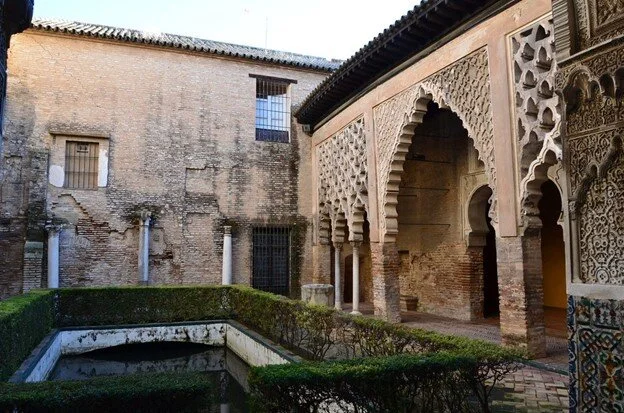
One of the palace’s courtyards, the Patio del Yeso, was created in the 12th century when the region was still under Muslim control. The courtyard features a large pool in the middle—a common theme in Islamic architecture. Water is at the heart of Islamic architecture for both practical and spiritual reasons. Considering that the Arabs and North Africans came from dry climates and desert landscapes, it was important for them to have easy access to reliable sources of water. Furthermore, in Islam, water symbolizes life and purity. Water in gardens, specifically, symbolizes the sacred lake in paradise that is reserved for only the righteous. 

Other recurring Islamic motifs that are found in the Alcazar include keyhole or horseshoe shaped arches, doors and windows; traditional Islamic plasterwork and latticework; Islamic writings; and a heavy presence of plants. The horseshoe arch is known as an “alfiz” and the Islamic-style window screens are known as “mashrabiya.” These, in addition to the icicle-like droppings from ceilings and domes, are common components of modern-day mosques and other traditional Islamic structures. 

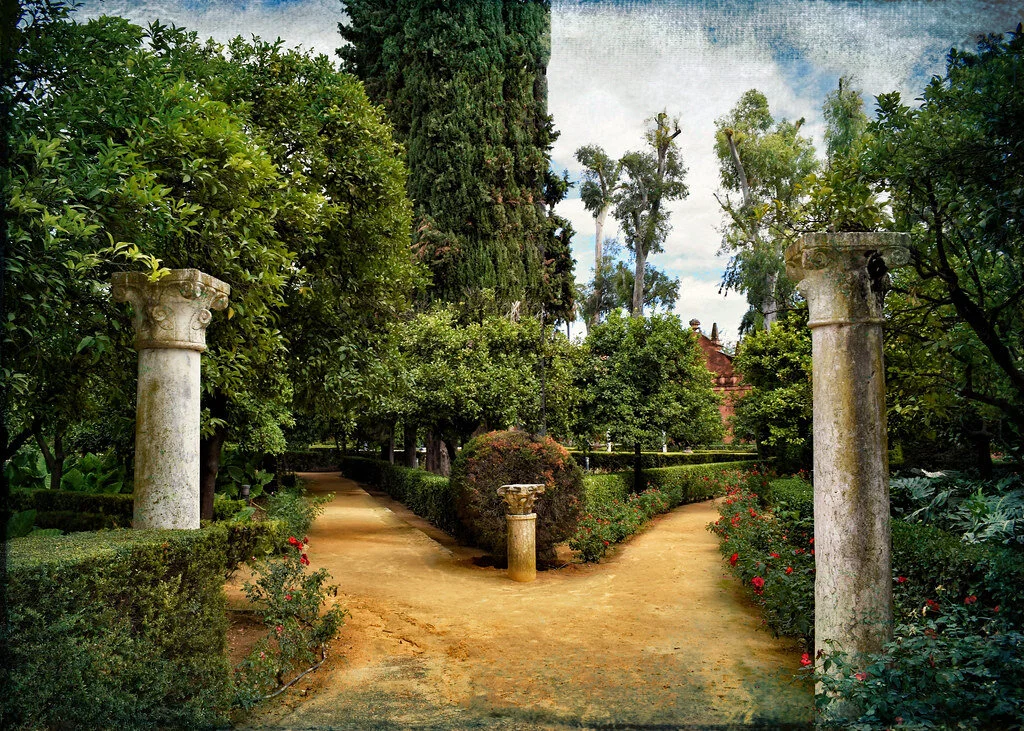
The gardens of the Alcazar were used not only for aesthetic purposes, but also for functional purposes. While the plants and trees were grown in the palace’s gardens for beauty, the plants were also used to feed members of the court. The gardens themselves were strategically structured to resemble what Muslims imagined paradise to look like based on the descriptions in the Quran. 

Garden in the Royal Alcazar, Seville. Jocelyn Erskine-Kellie. CC BY-SA 2.0.

Granada

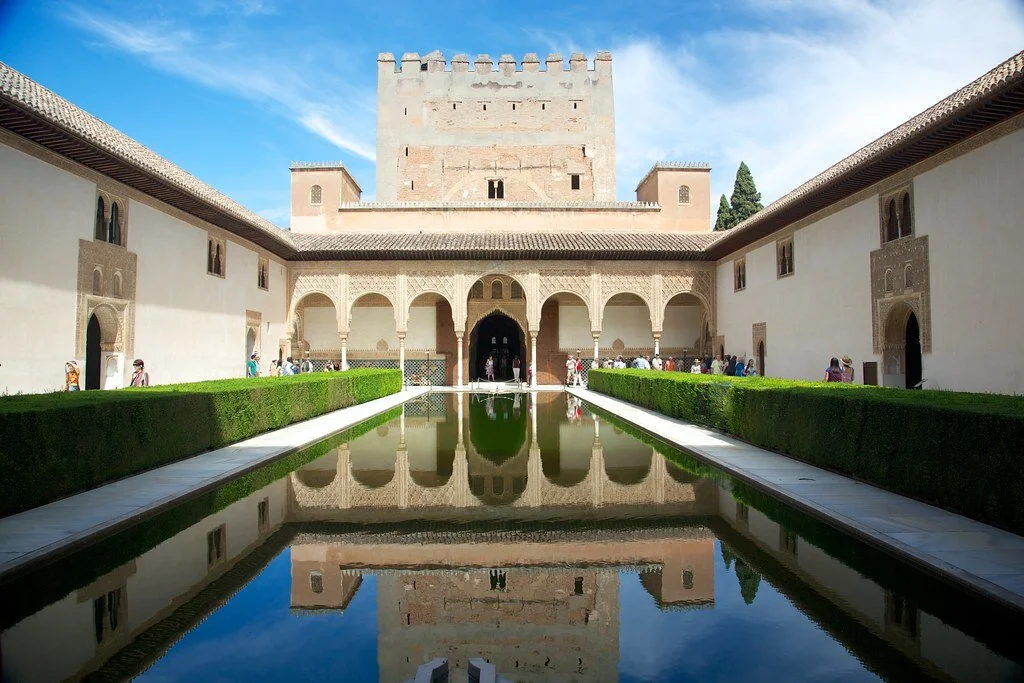
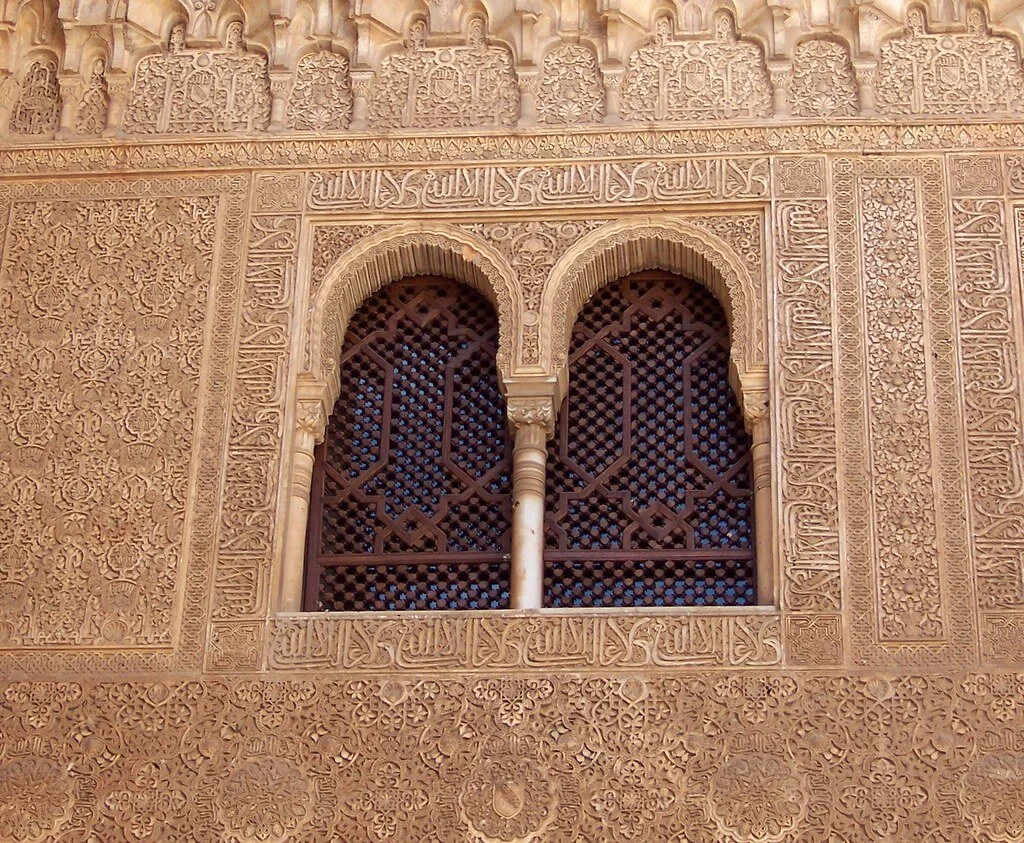
The Alhambra Palace in Granada is further evidence of the Islamic rule in Spain. The name Alhambra itself derives from the Arabic word “Al-Hamra” which means “red.” The palace was given this name for its reddish bricks and walls which can be seen from afar. Alhambra’s layout mimics that of many other palaces for Muslim princes. Three main floor plans dominate the site: the “mexuar” was open to all and the room where sultans received their subjects, the “diwan” is the throne room where receptions were held, and the “harem” is the prince's private quarters. Islamic inscriptions and verses from the Quran flood the walls, while the gold detailing accents the writings. 

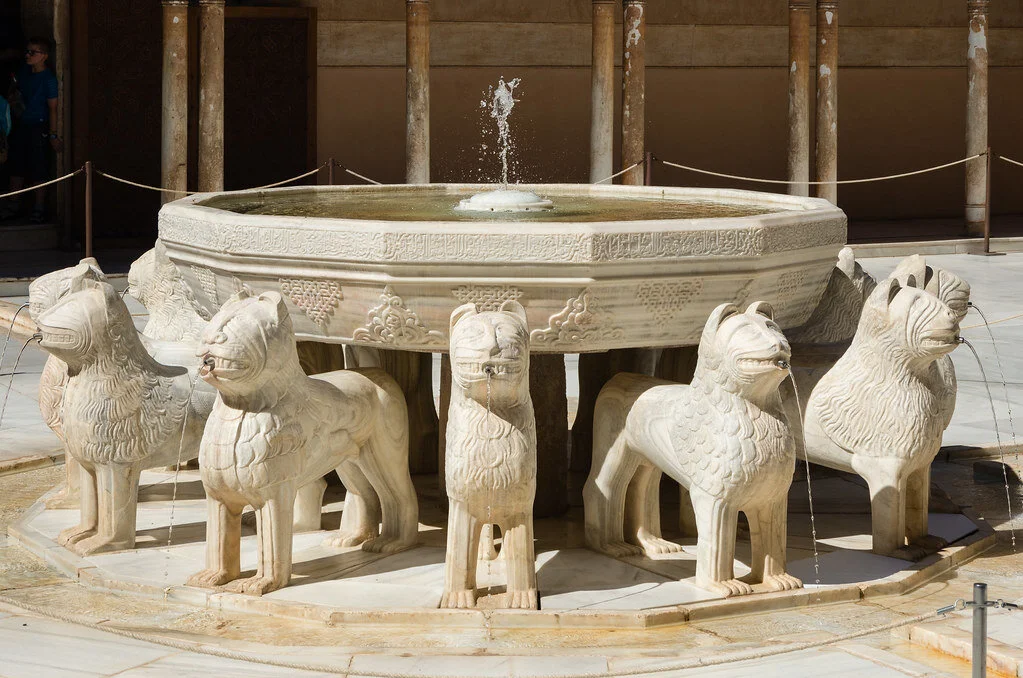
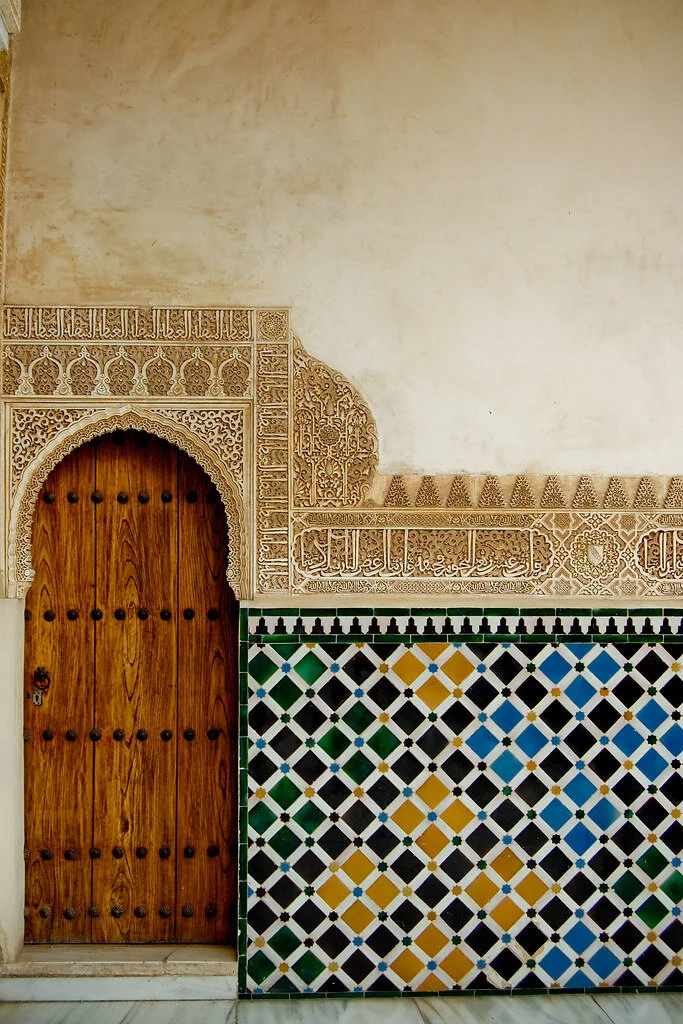
 Mosaics and colored tiles in geometric and plant-like shapes, referred to as “alicatado,” are also in certain quarters. The mosaics are not only decorative but also contain strategically chosen tiles to cool the structure in the summertime. Plant motifs align with Islamic principles, as the depiction of human images is often frowned upon. The Fountain of the Lions in Alhambra is one of the most photographed features of  the palace, with 12 lions spewing water in the middle of the courtyard. Other famous aspects of Alhambra which are covered in arabesque patterns and constructed to resemble the gardens in heaven, include the Generalife and El Partal, two of the quieter locations in the palace. 

Keyhole shaped windows with arabesque patterns in Alhambra. Güldem Üstün. CC BY 2.0.

Geometric mosaics in Alhambra. Víctor. CC BY-NC-ND 2.0.


Mia Khatib 

Mia is a rising senior at Boston University majoring in journalism and minoring in international relations. As a Palestinian-American, Mia is passionate about amplifying the voices of marginalized communities and is interested in investigative and data-driven journalism. She hopes to start out as a breaking news reporter and one day earn a position as editor of a major publication..