

In the language of modern economics, the small island nation of Vanuatu in the South Pacific is labeled one of the world’s ‘least developed countries’. At the same time, Vanuatu has ranked number one on the pioneering Happy Planet Index. This incongruity points to major issues with today’s standard measures of human progress, and has many policymakers rethinking notions of wealth and how they shape development policy.
Vanuatu: Another Kind of Wealth
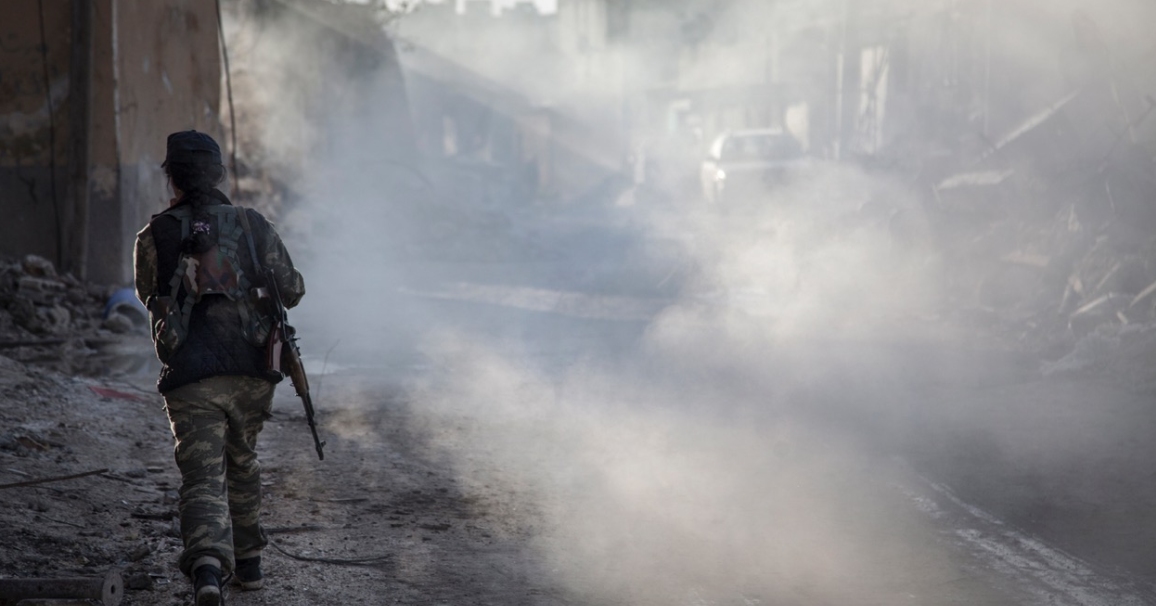
SYRIA: Raising Among Ruins, Dancing Amid Bullets
The Syrian Civil War has torn apart homes, families, and entire cities.
From September 2014 to January 2015, the Syrian city of Kobanî, on the northern border with Turkey, and more than 350 villages in the Kobanî district, were held under siege by militants of the Islamic State of Iraq and the Levant (also known as ISIL, ISIS, or Daesh). The fighting left the city utterly destroyed and by January more than 400,000 displaced Kurds had fled the region for neighbouring Turkey.
Yet the courageous women fighters of the Kurdish YPJ (Women’s Protection Units) stayed behind, taking up arms alongside their male comrades in the Kurdish YPG (People’s Protection Units), as part of an ongoing and dedicated effort to overcome the Islamic State militants in the region, and to rebuild and reclaim their lives.
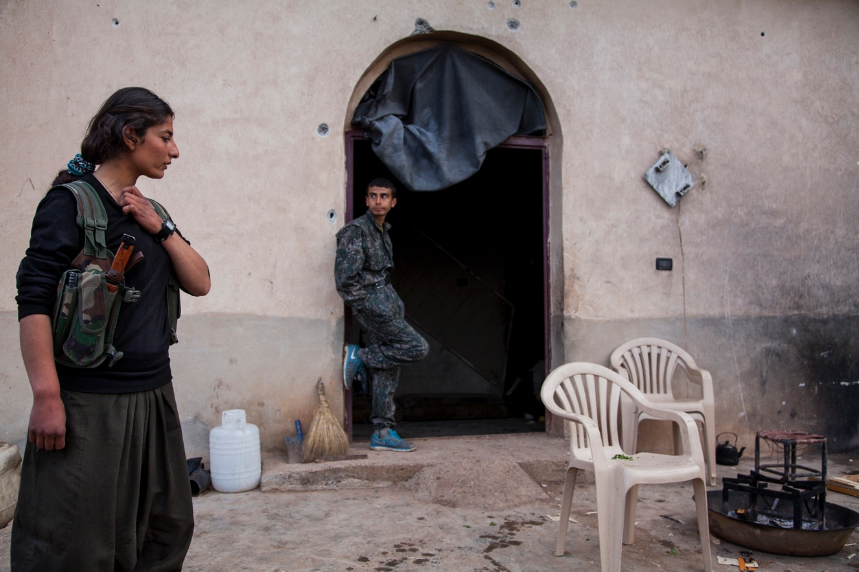
Serda, a YPJ fighter, with her fellow male comrade from YPG, in Baghdak village, near Kobanî.
Finally, on 26th January 2015, the Kurdish fighters — alongside reinforcements from the Free Syrian Army and supported by US-led airstrikes — began to retake the city, driving ISIS into a steady retreat. The following day, on 27th January 2015, in a historic and strategic defeat that was reported around the world, the city of Kobanî was fully recaptured. The flag of the Kurdish resistance flew once again on the hill above the city.
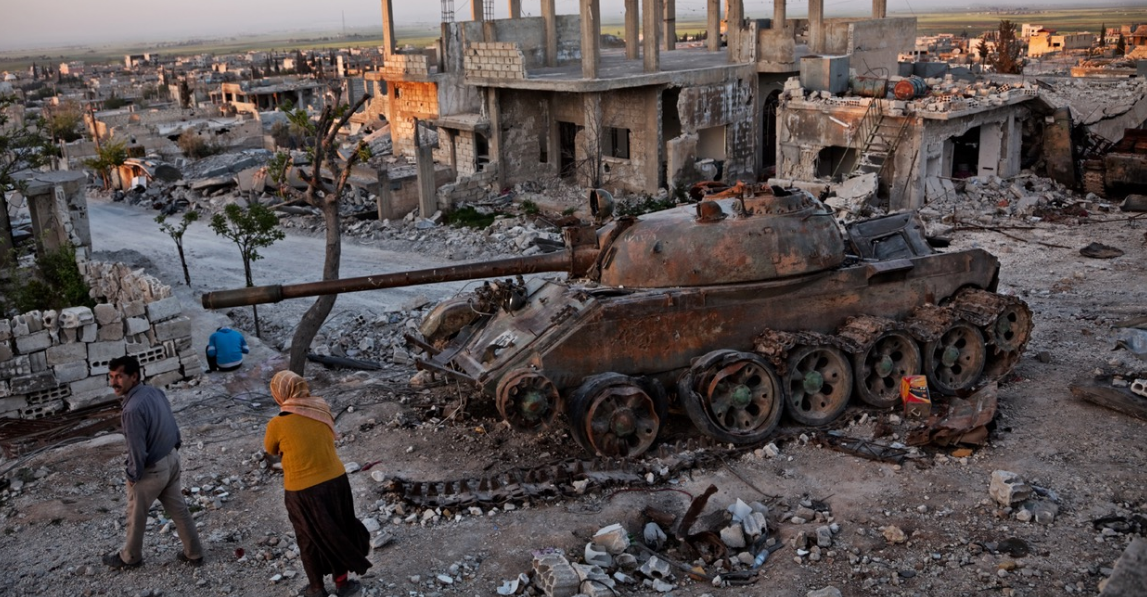
A destroyed tank stands amid the rubble in the devastated city of Kobanî.
In the weeks and months following the liberation of Kobanî, and as the Kurdish fighters continued to advance, taking back many of the villages ISIS had captured during the siege, the families of Kobanî have begun to return to what was left of their homes. With hopes of rebuilding their lives, their homes, and their city, the people cleared the streets of dead bodies and buried the fighters who lost their lives.

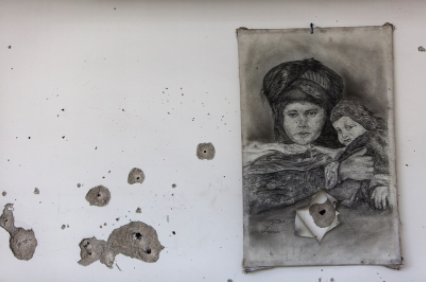
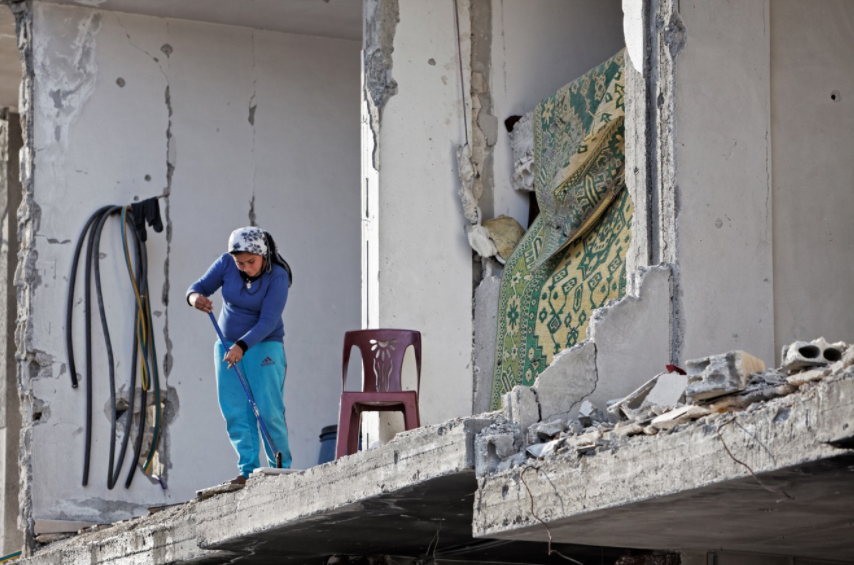
Travelling to the Kobanî region in March 2015, less than eight weeks after the city had been recaptured from the Islamic State, I lived with a group of Kurdish fighters for almost a month.
I was able to witness their pain and their sorrow, their joy and their triumphs, as they continued to fight for their freedom.
In part, this trip was a continuation of my ongoing project documenting the lives and experiences of Kurdish women fighters, which began back in 2012, when I spent time with the female soldiers living in military camps in Iraqi Kurdistan. I realized that these women are fighting more than one battle. Not only are they fighting the oppression and violence of the Islamic State, they are also determined to prove their role as women in a male-dominated society — a difficult yet promising battle.
After the liberation of Kobanî, the world’s attention was finally focused, for a time, on this region, and many cameras were pointed towards the women who had fought alongside their male comrades. Sadly I realized that not many people knew about the long history of female fighters’ involvement in previous battles — as if during the war in Syria, they had picked up a gun for the first time!
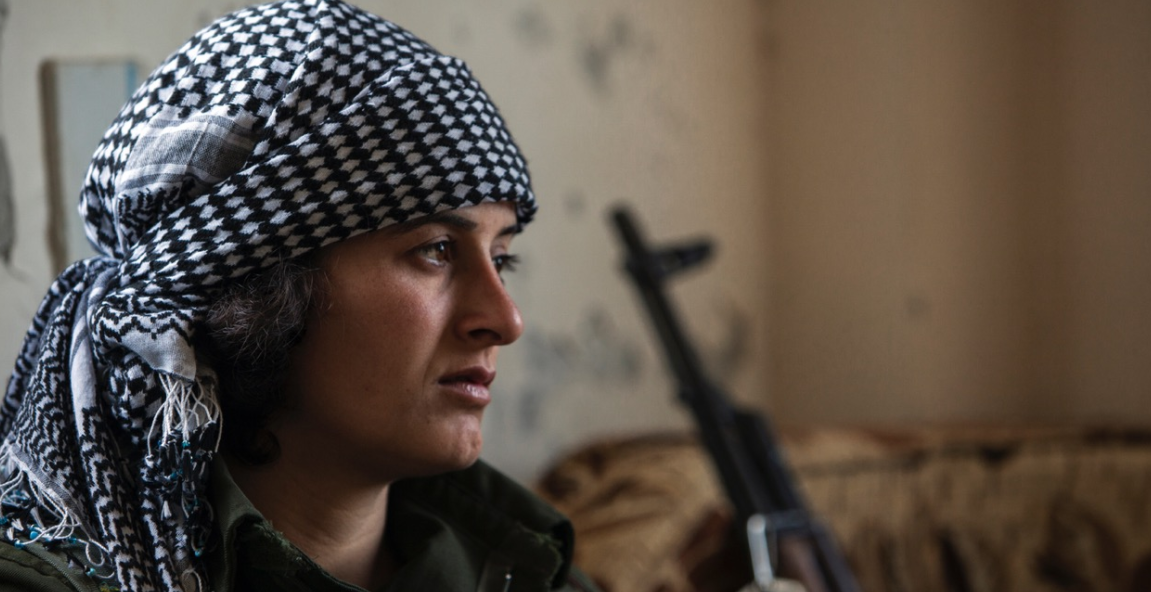
Portrait of a young Kurdish YPJ fighter.
To reach what was left of Kobanî, I had to cross illegally through the Turkish border like many other journalists and activists. We passed through the city of Suruç on the Turkish side of the border, where I spent a week waiting. A few months later, on July 20th 2015, an ISIS suicide bomber, identified as a 20-year-old student, killed more than 30 people and wounded more than 100 at a Turkish cultural centre in Suruç.
Finally one night we crossed the border and entered Kobanî. On the same way back a month or so later, I was arrested by the Turkish police and after a few hours was released. Since it was my first time, they let me go with the promise of not making this “mistake” again.
While in Kobanî I stayed part of the time at a house for journalists or often with people from Kobanî whom I met and got to know. The 35 days I spent in and around this shattered city was an unforgettable and moving experience. Seeing the people returning to what little was left of their homes was sobering, but encouraging as well.
The story of Kobanî is not only about war and its horrific consequences, it is also about the power of humanity, courage, and solidarity.
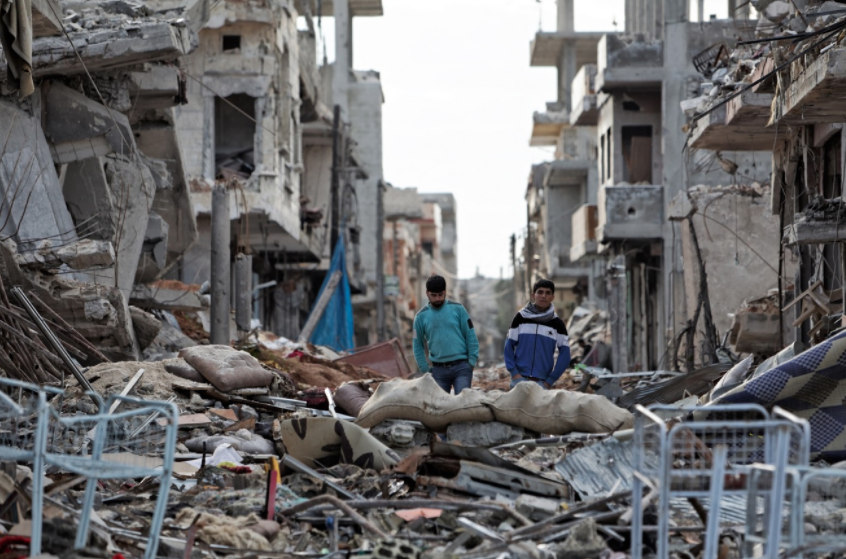
Having returned to the city, Kurdish men walk through the destroyed buildings in Kobanî.
Kobanî is in fact part of Rojava, or Western Kurdistan — a de facto autonomous region in northern Syria. The region gained its autonomy during November 2013, as part of the ongoing Rojava Revolution, and aims to establish a society based on the principles of direct democracy, gender equality, and sustainability.
And while Kurdish women have gained some equality in recent years, for most of these women, fighting with the military forces is their first opportunity for independence and empowerment in their traditionally male-dominated society. The more I spent time with women of different ages and backgrounds, the more I realized the significance of this story.
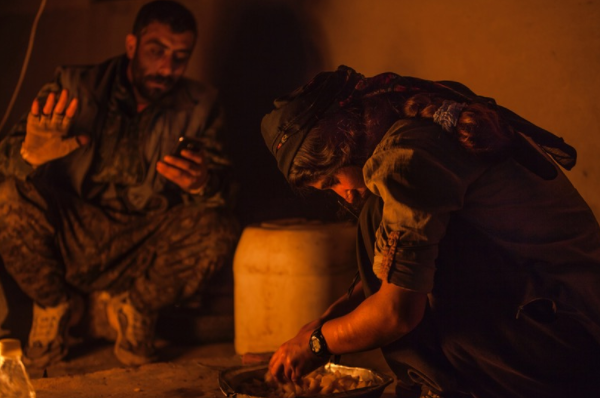
26 March 2015, Roonahit, a YPJ fighter prepares dinner for the fighters in Baghdak village.
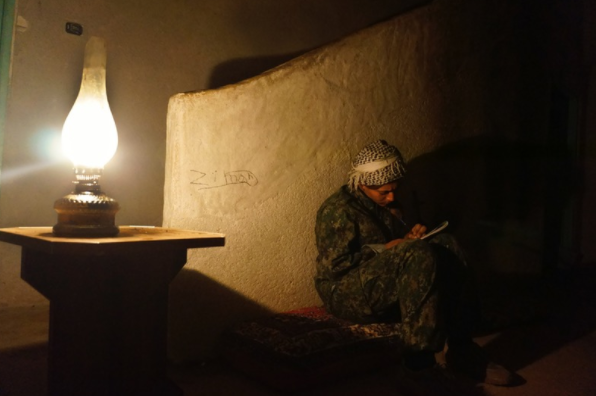
27 March 2015, newly joined YPJ fighter writes her diary by gas light in Baghdak village.
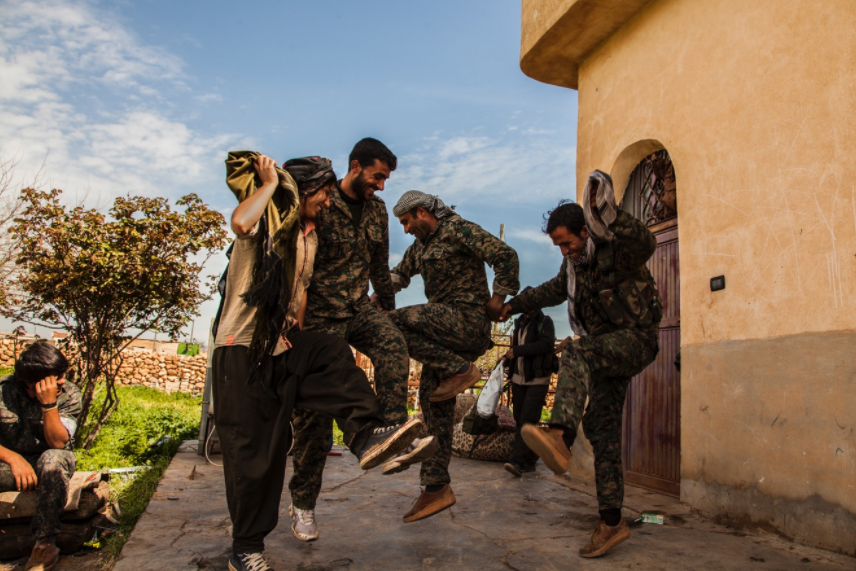
Too many images of people fighting create an “us” and “them” dynamic in the mainstream media. Portraits of daily life, or times of great emotion, give us moments that we can feel and relate to, perhaps opening the doors of understanding. There were some moments of joy, too.
Below you see a group of young YPG and YPJ fighters dancing in the village of Baghdak, outside the city. Each day a truck passed by, bringing food and other basic supplies for the fighters. During the few minutes while the truck unloaded, they took advantage of the music coming from the radio. Such moments were seized with abandon, bringing momentary relief and release from the hard reality of the ongoing fight.
I can only hope that each reader will be able to put themselves in the place of the women, and men, in these images, remember their faces and surroundings, and understand the plight of these brave people.
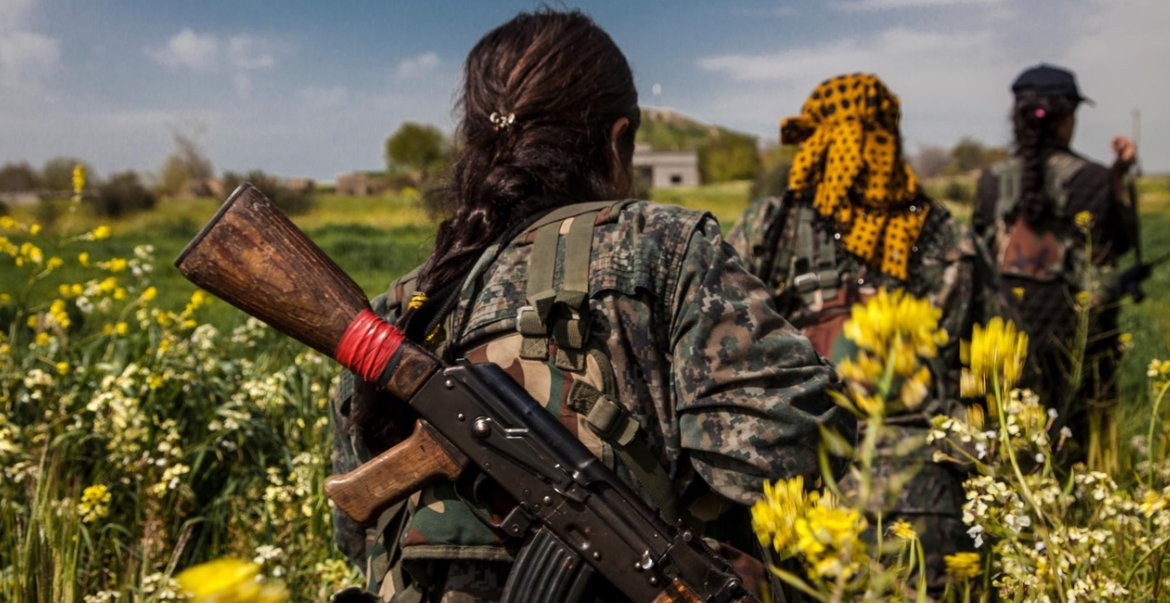
Three fighters from the YPJ walk through fields on the western front-line near the city of Kobanî on April 7, 2015.
Even though Kobanî had been liberated, every two days during my stay, there was a funeral for more of the fighters on the front-lines who were still defending the city. At the time of my visit the Kurdish fighters had reclaimed 160 villages, and by late April 2015, ISIS had lost almost all of the villages it had captured during the siege. During May and June of 2015, the YPG, along with allied reinforcements, continued to fight and captured huge swaths of territory in northern Syria, linking the district of Kobanî with another Kurdish region, Jazira.
Below, in a cemetery in Kobanî, you see family and fellow fighters sit by the graves as they mourn their loved ones, YPG and YPJ fighters, who were killed during clashes with ISIS on these front-lines outside the city.
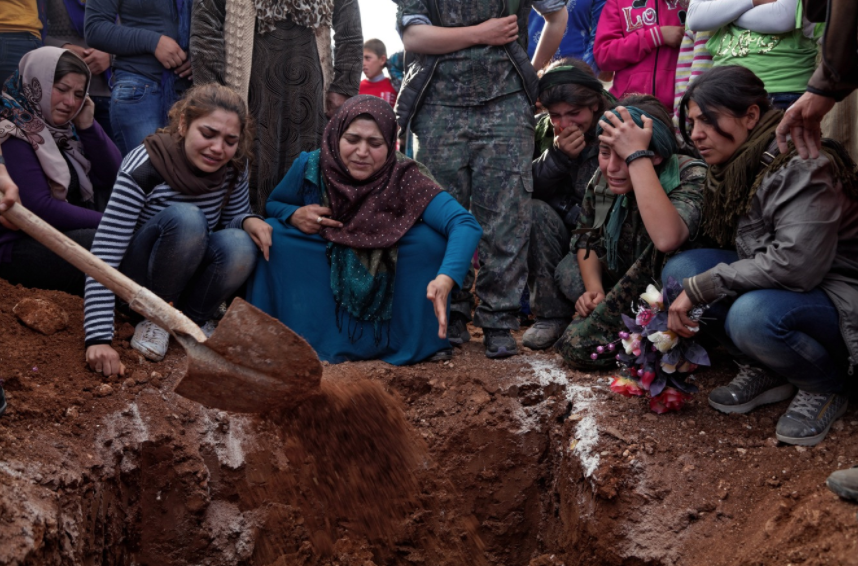
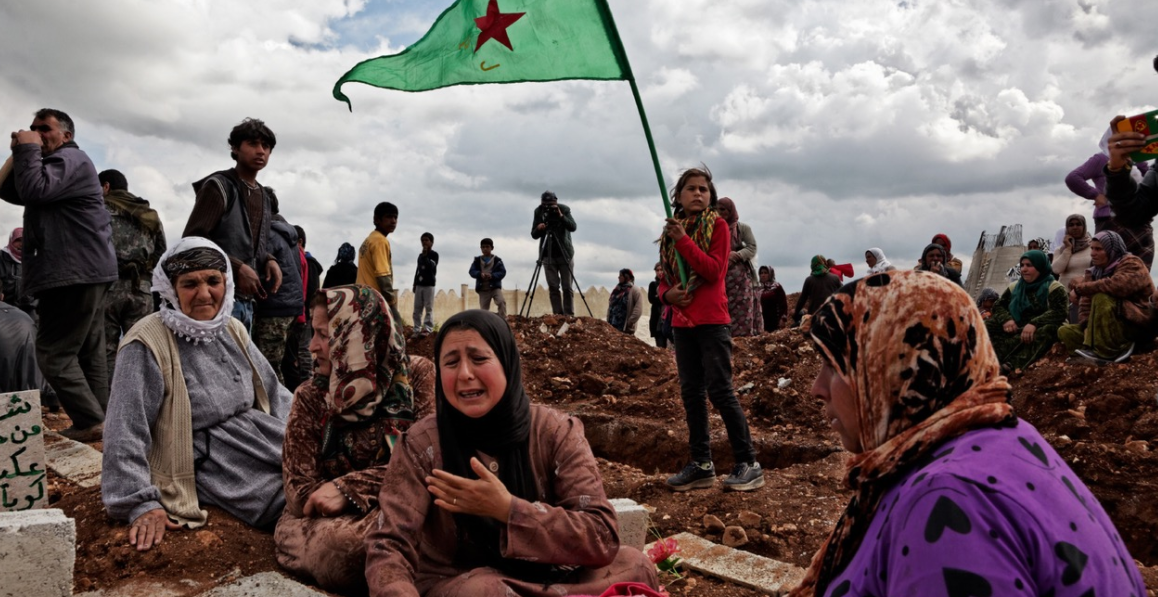
And here, you see a group of YPJ and YPG fighters carrying coffins and mourning their fellow Kurdish fighters, one of whom was called Ageri, killed during fierce clashes with ISIS on eastern front-line near Kobanî.
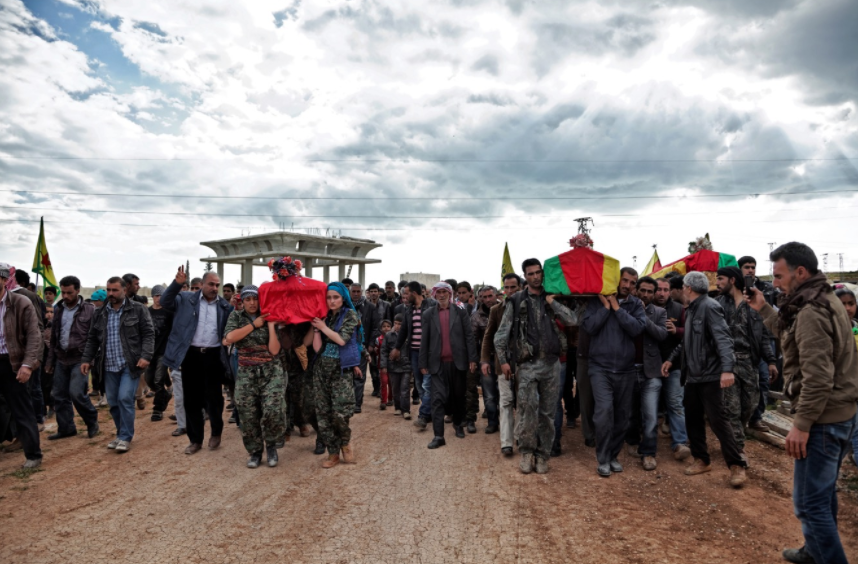
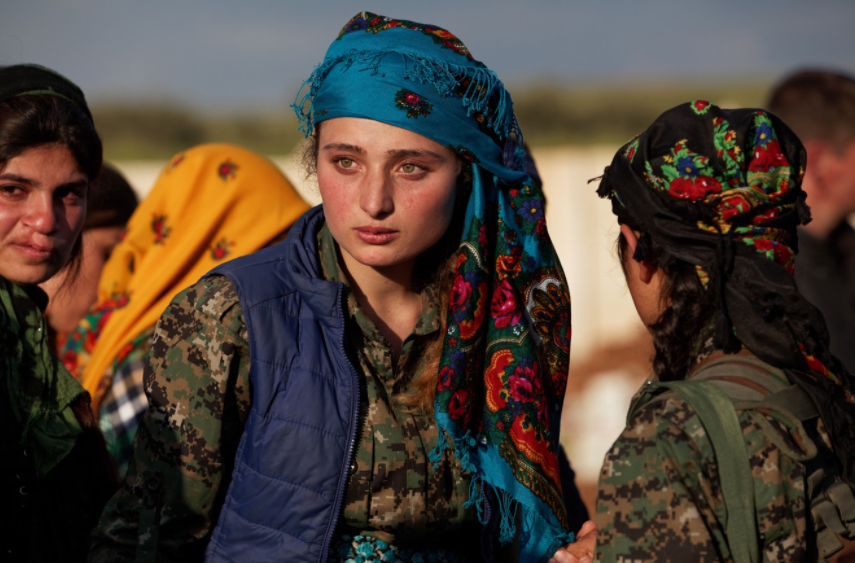
During the siege of Kobanî, in times of heavy fighting with ISIS who still controlled part of the city, the bodies of Kurdish fighters who were killed in action were buried between the houses in a part of the city that was under Kurdish control. Below you see a family, who have just returned to the city to rebuild their lives, passing by this temporary cemetery.
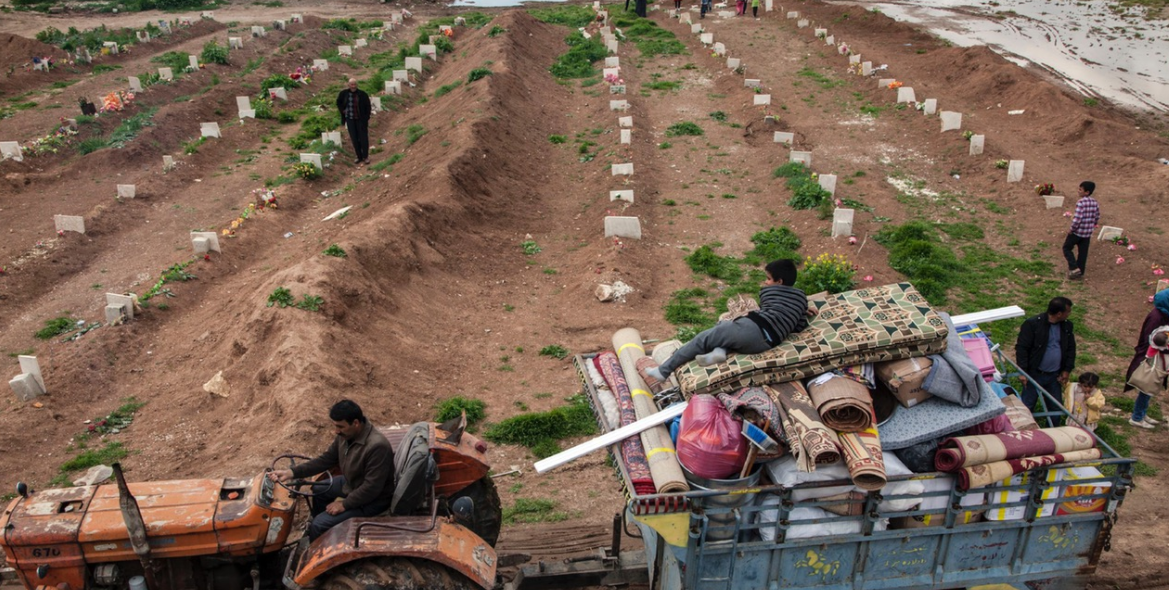
Even now, before and after their victories defending the villages and regions outside the city, there is a constant threat of death or serious injury to the Kurdish fighters, especially during firefights and patrols. They must be constantly on the move, setting up makeshift camps in old structures, like this abandoned school you see below, in Baghdak.

At the time of my visit, two hospitals were open inside the city, but the lack of medicine and equipment made it extremely difficult for even the most trained nurse or doctor to provide basic treatment. Just a few days before I crossed back over the border to Turkey, some of the first small shops began to open again, allowing people to purchase basic necessities.
With only two schools open in Kobanî, there was little access to proper education, and no psychological support for the children of returning families, who have suffered immensely during the war. Instead, they were spending much of their time playing in the rubble. Below you see a young Kurdish boy going through some books left in a destroyed building in Azadi (Liberation) Square, during April 2015.
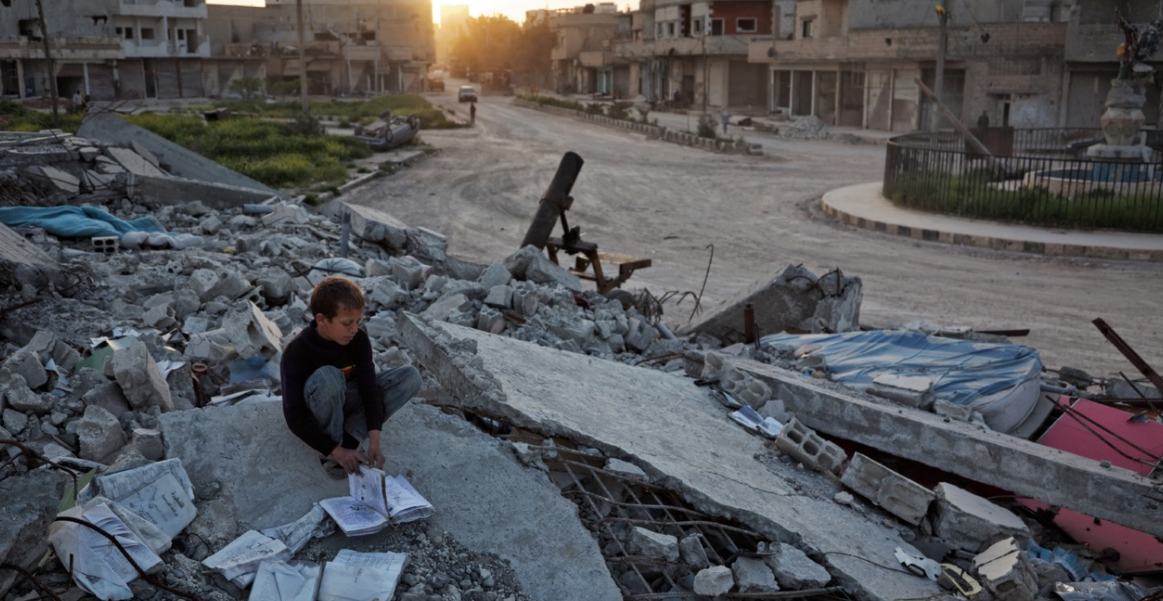
During recent months, although more progress is slowly being made towards rebuilding life in the city — for instance, in March 2016, electricity returned to Kobanî and some surrounding villages after three years of outage, due to ISIS control of the Tishreen dam and main power station — the civilians who have returned are still struggling with difficult living conditions. Food prices are escalating and there are very few opportunities for work, so that they can support their families.
While I was in Kobanî, the Turkish government had only opened the border one way, allowing families who want to go back to Kobanî to pass through, but for international organizations and people who wish to help with rebuilding Kobanî, the only way to reach the city was to cross over illegally. Today, Turkey continues control the border tightly, allowing only some materials to reach the city. For instance, in January 2016, Turkish border guards prevented an aid convoy from entering the city, confiscating its contents, and arresting aid workers. Returning to Kobanî again last month, in May 2016, I found the border still officially closed.
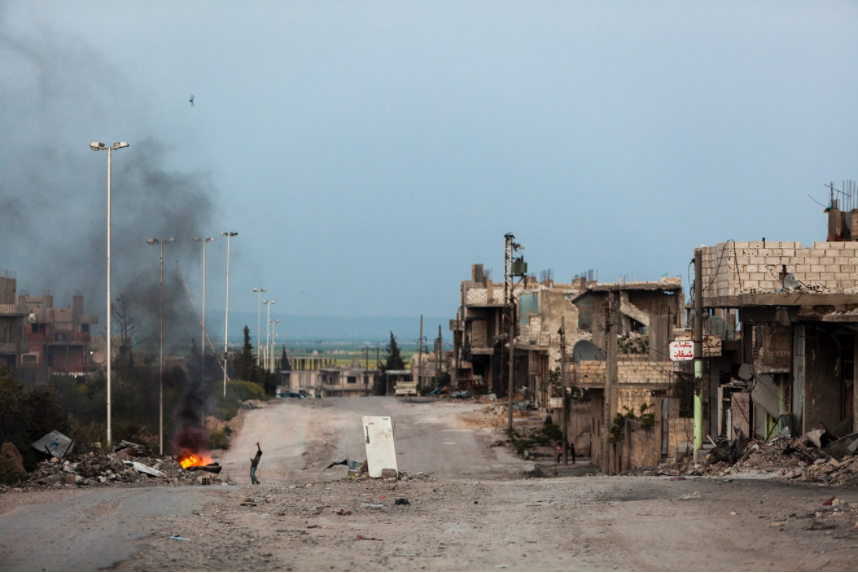
Kurdish children play by a fire in the streets of Kobanî.
And still, the battle is not over. The women fighters of the YPJ, and their male comrades, continue to defend the slowly regenerating city from ISIS attacks, and engage in mutual bombardment and fierce clashes, as they protect other villages and towns in the Kobanî region. At the end of March 2016, ISIS militants launched an offensive ahead of the important Kurdish celebration of ‘Newroz’. Shelling areas in western Kobanî with homemade rockets, they targeted residential buildings in the village of al-Qibba, killing and injuring civilians, including women and children. This brought back memories of the devastating massacre carried out by ISIS suicide bombers a few months after my visit, who infiltrated Kobanî on 25-26th June 2015, killing over 500 civilians and few Kurdish fighters.
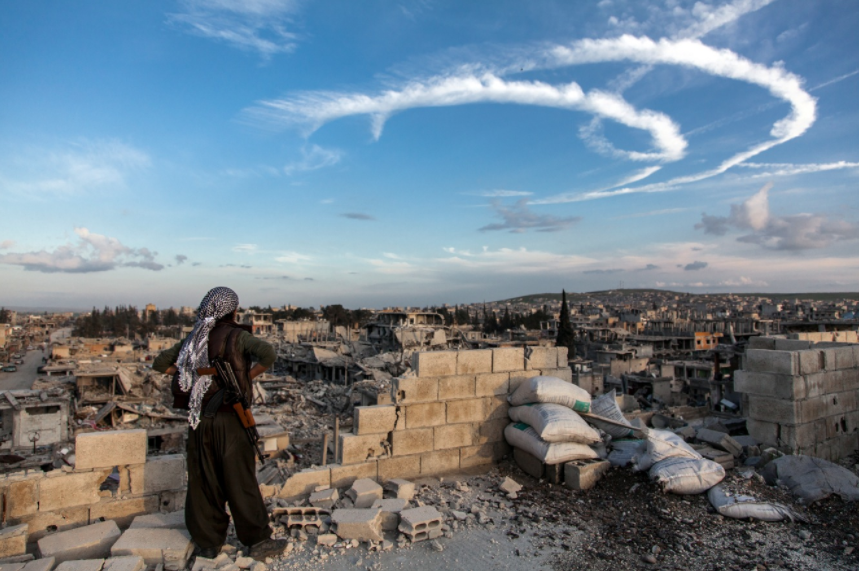
Notwithstanding the recent attacks, with the border to Turkey still tightly controlled, and international aid struggling to pass through, the people of Kobanî are left isolated, facing both the psychological trauma of conflict and the challenge of rebuilding their houses alone. Many also remain at risk from the explosive remnants of war, such as the hidden handmade bombs and landmines left behind by ISIS militants.
The lengthy after effects of war on the innocent civilian population are often quickly forgotten by those of us living in a safer world.
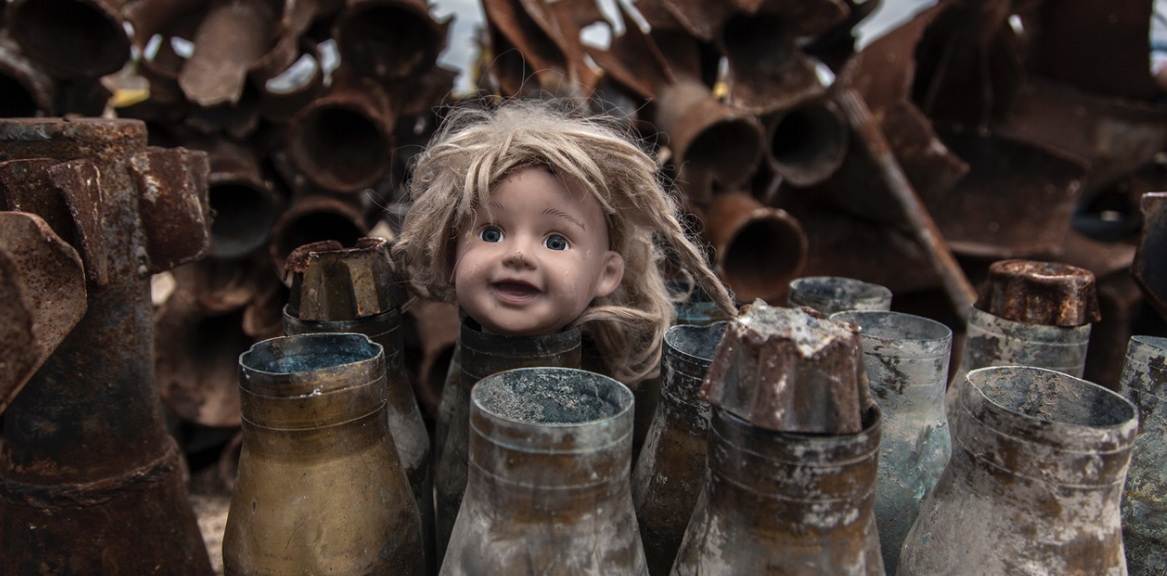
At some point, I could not help but feel angry when I saw the amount of suffering these women fighters, and their male comrades, are enduring in Northern Syria, and the little aid and support they are receiving from the outside world. It was an incredibly frustrating experience to witness so much suffering and yet not enough help getting through. The Turkish government is threatened by the independence of the Kurdish people, and so the fighters face threats on both sides of their borders, from the Islamic State and Turkey. In many ways, they are alone and vulnerable.
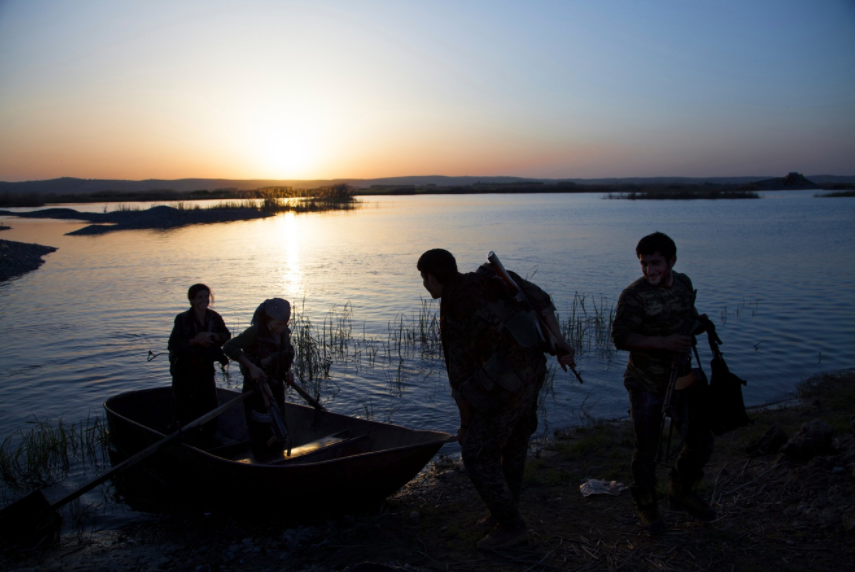
A group of YPJ and YPG fighters crossing the Euphrates river on the western front-line near Kobanî.
Below you see Chiman, a member of the YPJ and one of the Kurdish female fighters I got to know, walking through the wreckage in the parts of the city where she and her fellow fighters battled and eventually overcame ISIS, following the siege. Chiman, who is originally from Iraqi Kurdistan, was one of the commanders during this fight. Looking back over those hard times, she tries to keep the memory of those who passed away alive, and continues their important work protecting the city.
For Chiman and her fellow fighters, defending Kobanî is not just a matter of defending a city and its people, but of defending humanity.
THIA ARTICLE WAS ORIGINALLY PUBLISHED ON MAPTIA

Photo by Quinn Dombrowski
Should one use an airbnb?
From the consumer’s side, the sharing economy is pretty fucking rad. Anyone who grew up riding in taxis and then suddenly switched to Uber knows why: getting into a cab used to be like stepping into a scene from Mad Max: Fury Road, with drivers who were very frequently about as sane as the War Boys.
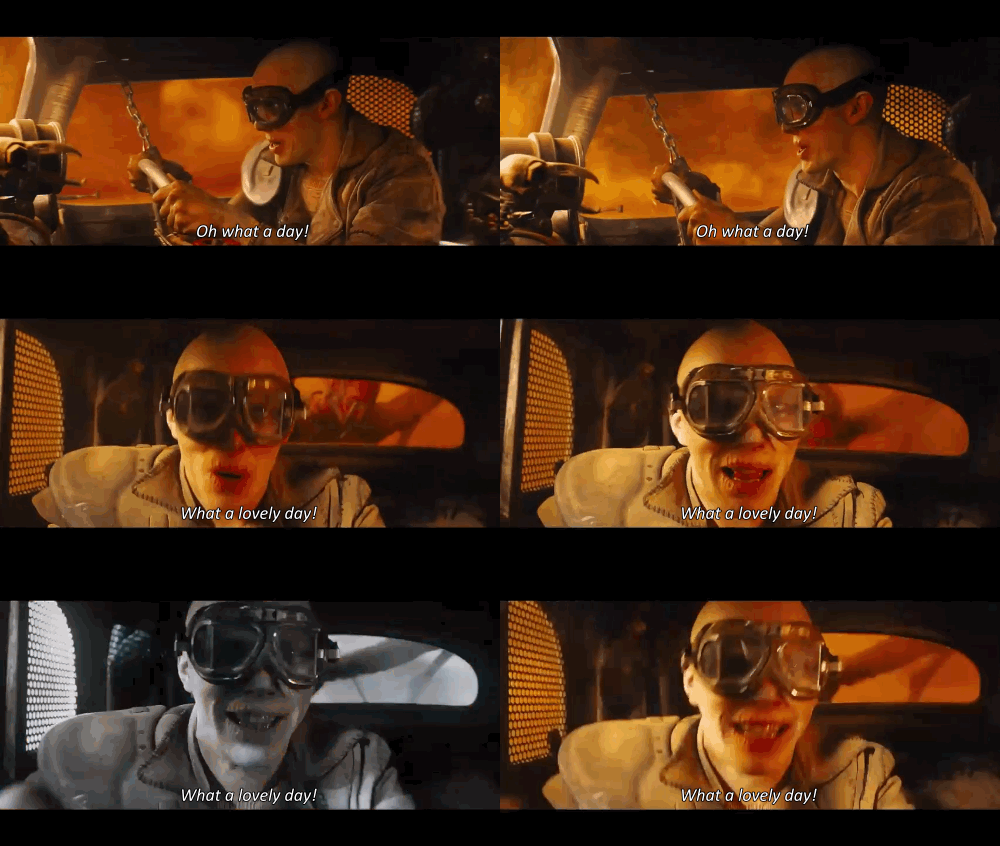
Uber drivers, however, depend on good ratings from those riding with them, and as such, have an incentive to not drive like lunatics. Likewise, you as the consumer get rated, so you have an incentive to be on your best behavior.
Consumers get the same sort of benefit with Airbnb: it’s not free, like traveler favorite Couchsurfing, so it doesn’t have the same sketchy feel, and it grants customers the opportunity to stay in actual homes in the neighborhoods they’re visiting, rather than in a generic hotel room.
The problem is that the “sharing economy” manages to conveniently undercut decades of labor laws, housing laws, and civil rights laws in ways that the legal system hasn’t caught up to just yet, which is causing some pretty ugly side effects. Uber deserves attention — it dodges and fights regulations that would apply to other cab companies, underpays its drivers, and leave cities that set a higher standard for them — but for now, we’re just going to focus on Airbnb.
What’s wrong with Airbnb?
Airbnb has two really big problems with it that ultimately stem from the same issue. And to be fair, these aren’t necessarily issues that were created by Airbnb, so much as they are issues that stem from the entire concept of the “sharing economy.”
1. Airbnb is playing by a different set of rules.
I live in the seaside town of Asbury Park, New Jersey, and Airbnb is a thing here: a lot of people will rent out their homes for a weekend to get some extra money, and Airbnb and its competitor VRBO are the simplest ways to do it. This is a tourist town, so the town encourages people to invite tourists into their homes. But some of the larger businesses in town are hotels, and there’s a good number of boutique hotels and BnB’s as well. And while they are large for the town, they aren’t mega-conglomerates like Hilton or Marriott. They’re small businesses. So it’s easy for them to be undercut by Airbnb. A homeowner’s profit margin doesn’t need to be as big as a hotelier’s — they aren’t running a full operation, they’re just trying to make some extra cash.
All of this would be fine — competition makes the market work, etc., etc. But users of websites like Airbnb and VRBO often don’t submit to fire safety and coding regulations that would be required of hotels and regular BnB’s, despite being legally required to. It’s also relatively easy for the Airbnb hosts to dodge paying their taxes, as they’re small enough to fly under the radar. This puts the Airbnb users at an unfair advantage, and it pisses a lot of hotel and BnB owners off.
Airbnb presents themselves as scrappy underdogs fighting big mean corporate hotel chains. When New York hoteliers claimed Airbnb was cutting into their business, Nick Papas, an Airbnb spokesperson told Bloomberg News:
“In fact, without Airbnb many of these travelers wouldn’t be able to visit New York City at all or would have cut their trip short. While the big hotels have been clear that they are concerned about losing the opportunity to price gouge consumers, we hope they will disclose the percent of their profits that stay in New York City and the percent they send to corporate headquarters outside of New York and, even, outside of the country.”
But Airbnb is not an underdog — last year, it was valued at $20 billion. That’s in the same league as Hilton ($27.8 billion) and Marriott ($22.9 billion). Since Airbnb isn’t responsible for making sure it’s users are paying taxes and are up to code, it’s basically just playing with the bumpers up.
By presenting themselves as a mere platform connecting people in the “sharing economy,” rather than as the manager of a huge network of small vendors, Airbnb is skirting regulations and making out like bandits.
2. Airbnb may be the reason “the rent is too damn high.”
The publication Grist explained the basics of this problem in a recent article, using the example of Tarin Towers, a resident of a rent-controlled building in San Francisco. Her building was bought by a real estate developer who wanted to charge way more for the rooms, so he offered the residents buyouts. Towers did the math and realized that even with the buyout, she wouldn’t be able to afford a new apartment in the city’s absurdly inflated rental market. From Grist:
“Towers held out as her old neighbors left and new tenants started moving in. Unlike the old neighbors, these new people were young, mobile, transient. And there were a lot of them. [Her landlord] O’Sullivan, it turned out, had leased the building to a startup called the Vinyasa Homes Project. Towers soon discovered that Vinyasa had listed her building on Airbnb, advertising it as a ‘co-creative house.’ The listing made it sound almost like a commune. ‘You want to join a community of like-minded peers who are doing inspirational things?’ it read. ‘This is the place for you.’ Unlike in the communes of yesteryear, however, each bed is going for more than $1,500 a month — and these are bunk beds in shared rooms. That means each apartment could now be bringing in $10,000 a month in rent.”
Towers eventually was forced out of her apartment, and took the buyout. She can’t afford a new rental in the city, so she’s housesitting until she figures something out.
This is a problem everywhere, though: in Barcelona, in Berlin, in New York, in New Orleans. It’s particularly tragic in the Big Easy, as it’s forcing out the last long-term residents who held on in neighborhoods devastated by Hurricane Katrina.
It’s the worst for cities with tight housing markets and a heavy flow of tourists. Remember the New York City mayoral candidate whose platform was “the rent is too damn high”? It may have gotten that high in part because of services like Airbnb — it’s way easier to wait for someone who will pay $2 grand a month for an apartment when you can rent the apartment out for exorbitant prices to travelers in the short term.
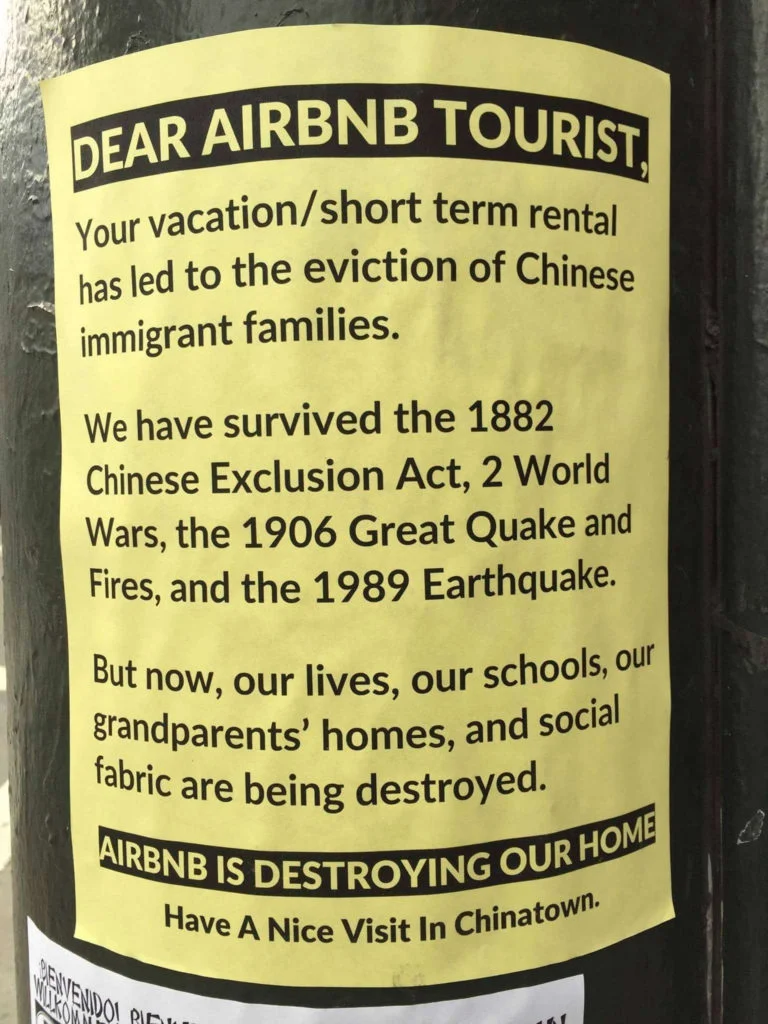
Photo by Leigh Blackall
You could argue that Airbnb isn’t responsible for the misuse of its service. But they aggressively fight any measure that would put the onus of responsibility on them. When San Francisco tried to pass a measure that would restrict the number of nights a year a unit could be used for short-term rentals, Airbnb spent $8 million fighting against it. When San Francisco tried to pass a rule that would force Airbnb to ensure its hosts were up-to-code, they donated hundreds of thousands of dollars to local political campaigns.
Some cities have fought back effectively. Barcelona has seen a population drop in its historic neighborhoods thanks in large part to its tourism industry, and as a result, have started slapping Airbnb with fines for offering apartments that weren’t registered with the city, and Berlin and Paris and even New York have been fighting back as well. But this is a problem that’s far from solved.
3. It’s not totally Airbnb’s fault.
In Airbnb’s defense, there’s no good business reason they would voluntarily take responsibility for policing their users. It’s not a charity, and it would be very expensive for them to check up on every single host. It would be a guaranteed way to decrease profits, which, incidentally isn’t legal — companies are required by to take actions that benefit their shareholders.
But this is why we have regulation. Airbnb isn’t tasked with doing what’s best for the local communities: our governments are. So this is a problem that’s fixed not by Airbnb being benevolent, but with good policies and effective enforcement. Which means it’s a battle that needs to be had on a city-by-city and country-by-country basis.
The problem is that we simply don’t know how serious the problem is yet — there’s been a little bit of research, but it’s far from conclusive, and has possibly been biased against services like Airbnb. There’s no reason to think that good policies couldn’t help solve the problems that Airbnb and its “sharing economy” counterparts cause. But more work needs to be done.
So what can we as travelers do?
Let’s be up front: staying at an Airbnb is a cooler experience than staying at a hotel. I have a friend who stayed in a goddamn castle in Italy. I know people who have stayed in treehouses in Oregon and igloos in Norway. In the Netherlands, you can stay in an honest-to-god windmill. And it’s cool that we’re giving regular people this platform to make some extra money, host out-of-town guests, and maybe try something new. So I won’t say “don’t ever stay at an Airbnb or a VRBO.” This is the future, and the solution to its problems will be through systemic change, not through any single individual’s actions. But it’s also time to call bullshit:
There is no such thing as the sharing economy. It’s just called the economy, and it’s been around for millennia.
Are you trading goods and services for cash? Yeah — that’s the economy. You’re just doing it in a different place. Airbnb and Uber haven’t reinvented the economy, they’ve just used the internet to create a new space in which economic transactions can happen.
So with that in mind, here are a couple of things you can to be a part of the solution:
1. Support fair regulation of Airbnb & VRBO in your hometown.
If your town has a lot of tourists, try to be supportive of government attempts to regulate businesses like Airbnb and VRBO. The companies will do shitty ad campaigns about how your city is turning it’s back on money and innovation, but that’s just a scare tactic. Anyone who has lived in a tourist town knows that, even if the economy is dependent on tourist dollars, what’s good for the tourists isn’t always good for the locals. Try and push your local governments to strike a balance between making money and supporting the local community. Get involved. Get organized. This is pretty much always the best solution to anything.
2. Try to avoid the shitty Airbnb hosts.
You can take steps to avoid giving money to the douchebags who are misusing the service. Think of it as another thing you want to research, along with “safety,” “service,” and “cleanliness.” In short, you want to seek out spots that the current owners actually live in.
Becky Caudill over at Casa Caudill has some great tips for spotting the shitty hosts using the platform itself. Here’s what she suggests looking for when you’re checking out the photos of the location provided by the host:
"
- Seek out properties that are decorated like you or your friends would decorate your own homes.
- Look for plants (not just fresh flowers).
- Check out the art. Is everything from Ikea or another mass market supplier? Or are there original prints or photographs on the wall? On shelves? Is there any artwork at all?
- Does the kitchen come with basic supplies like salt, pepper, olive oil, etc? People who live somewhere will have these things on hand. (Although maybe not in NYC? It’s my understanding from friends there that people eat out every night and never cook so maybe they don’t need these things?)
- Do the owners read? Are there books other than travelogues visible in the pics? (And for goodness sake, if you see hundreds of travel brochures that’s a dead giveaway this place is operated solely as a vacation rental property).
- Stay in real neighborhoods, not tourist areas."
It also helps to delve into the comments a bit. Can you get a sense from the comments as to whether this is actually someone’s home, or is it more of an “operation”? Are there big discrepancies between the reports of the rooms? That could be a sign that there are multiple rooms that are lived in by different people in your building, indicating that this is being done by a landlord, not an owner or a tenant.
And of course, if you end up in one of these “operations” in spite of your best efforts, it’s okay: just go onto Airbnb and mention it in the comments. Helping others identify exploitative hosts is as important as helping them identify bigots or creeps. And that’s what the review process is for.
As always, the name of the game is damage control — try your best to support the local communities you’re visiting. Sometimes you’ll fail. Other times you won’t. And don’t assume that all things that are shiny and new are inherently good.
THIS ARTICLE WAS ORIGINALLY PUBLISHED ON DON'T BE A DICK TRAVEL.
MATT HERSHBERGER
Matt Hershberger is a writer and blogger who focuses on travel, culture, politics, and global citizenship. His hobbies include scotch consumption, profanity, and human rights activism. He lives in New Jersey with his wife and his Kindle. You can check out his work at the Matador Network, or over at his website.
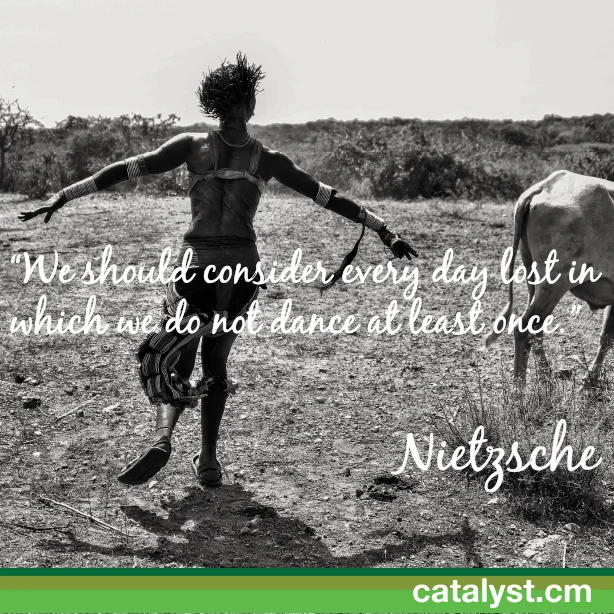
We should consider every day lost in which we do not dance at least once.
Northbound: Skateboarding on Frozen Sand
Ice, driftwood, foamy waves and … skateboards? Four skaters head north to the cold Norwegian coast, applying their urban skills to a wild canvas of beach flotsam, frozen sand and pastel skies. The result is a beautiful mashup — biting winds and short days, ollies and a frozen miniramp.
Skaters: Hermann Stene, Didrik Galasso, Henrik Lund, Karsten Kleppan
Director: Jørn Nyseth Ranum
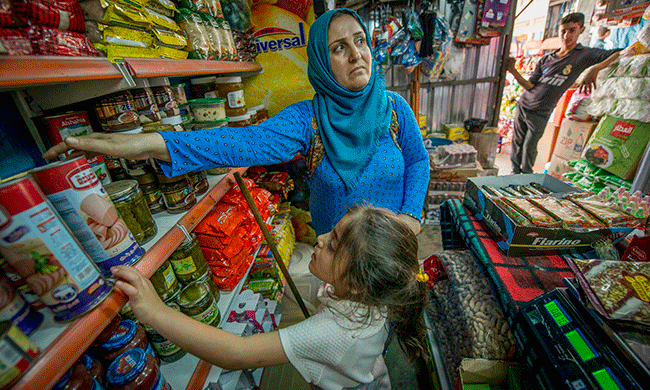
The Refugee Crisis Is a Sign of a Planet in Trouble
We must shift the structures of society to ensure the Earth remains healthy and everyone has access to a decent livelihood.
The plight of immigrant families in the United States facing threat of deportation has provoked a massive compassionate response, with cities, churches, and colleges offering sanctuary and legal assistance to those under threat. It is an inspiring expression of our human response to others in need that evokes hope for the human future. At the same time, we need to take a deeper look at the source of the growing refugee crisis.
There is nothing new or exceptional about human migration. The earliest humans ventured out from Africa to populate the Earth. Jews migrated out of Egypt to escape oppression. The Irish migrated to the United States to escape the potato famine. Migrants in our time range from university graduates looking for career advancement in wealthy global corporations to those fleeing for their lives from armed conflicts in the Middle East or drug wars in Mexico and Central America. It is a complex and confusing picture.
There is one piece that stands out: A growing number of desperate people are fleeing violence and starvation.
I recall an apocryphal story of a man standing beside a river. Suddenly he notices a baby struggling in the downstream current. He immediately jumps into the river to rescue it. No sooner has he deposited the baby on the shore, than he sees another. The babies come faster and faster. He is so busy rescuing them that he fails to look upstream to see who is throwing them in.
According to a 2015 UN Refugee Agency (UNHCR) report, 65.3 million people were forcibly displaced by conflict or persecution in 2015, the most since the aftermath of World War II. It is the highest percentage of the total world population since UNHCR began collecting data on displaced persons in 1951.
Of those currently displaced outside their countries of origin, Syrians make up the largest number, at 4.9 million. According to observers, this results from a combination of war funded by foreign governments and drought brought on by human-induced climate change. The relative importance of conflict and drought is unknown, because there is no official international category for environmental refugees.
The world community will be facing an ever-increasing stream of refugees.
Without a category for environmental refugees, we have no official estimate of their numbers, but leading scientists tell us the numbers are large and expected to grow rapidly in coming years. Senior military officers warn that food and water scarcity and extreme weather are accelerating instability in the Middle East and Africa and “could lead to a humanitarian crisis of epic proportions.” Major General Munir Muniruzzaman, former military advisor to the president of Bangladesh and now chair of the Global Military Advisory Council on Climate Change, notes that a one-meter sea level rise would flood 20 percent of his country and displace more than 30 million people.
Already, the warming of coastal waters due to accelerating climate change is driving a massive die-off of the world’s coral reefs, a major source of the world’s food supply. The World Wildlife Federation estimates the die-off threatens the livelihoods of a billion people who depend on fish for food and income. These same reefs protect coastal areas from storms and flooding. Their loss will add to the devastation of sea level rise.
All of these trends point to the tragic reality that the world community will be facing an ever-increasing stream of refugees that we must look upstream to resolve.
This all relates back to another ominous statistic. As a species, humans consume at a rate of 1.6 Earths. Yet we have only one Earth. As we poison our water supplies and render our lands infertile, ever larger areas of Earth’s surface become uninhabitable. And as people compete for the remaining resources, the social fabric disintegrates, and people turn against one another in violence.
The basic rules of nature present us with an epic species choice. We can learn to heal our Earth and shift the structures of society to assure that Earth remains healthy and everyone has access to a decent livelihood. Or we can watch the intensifying competition for Earth’s shrinking habitable spaces play out in a paroxysm of violence and suffering.
THIS ARTICLE WAS ORIGINALLY PUBLISHED IN YES MAGAZINE.
DAVID KORTEN
David Korten wrote this opinion piece for YES! Magazine as part of his series of biweekly columns on “A Living Earth Economy.” David is co-founder and board chair of YES! Magazine, president of the Living Economies Forum, a member of the Club of Rome, and the author of influential books, including When Corporations Rule the World and Change the Story, Change the Future: A Living Economy for a Living Earth. His work builds on lessons from the 21 years he and his wife, Fran, lived and worked in Africa, Asia, and Latin America on a quest to end global poverty. Follow him on Twitter @dkorten and on Facebook.

When should one boycott a country?
WHEN I WAS A SOPHOMORE in college, I went on Semester at Sea. It was a 4-month study abroad program that sailed around the world. Shortly after I was accepted into the program, I was sent an email with two pretty big surprises in it: first, Nobel Peace Laureate Desmond Tutu would be sailing with us for the entire voyage. Second, as a precondition of Tutu joining us, we would now be skipping our planned stop in Burma and would be going to Malaysia instead.
Tutu had insisted on this change because his friend, Burmese leader (and fellow Nobel Peace Laureate) Aung San Suu Kyi had called for a tourism boycott to Burma. Tutu had cut his teeth in the South African anti-apartheid movement, which conducted a similar international boycott over the course of several decades. The international solidarity, Tutu claimed, was essential for bringing apartheid to an end.
This led to a huge debate on the ship: a lot of people really wanted to go to Burma, and argued that the cultural exchange was valuable and worthwhile. They also argued that we could visit Burma in a way that wouldn’t be supportive of the oppressive military regime that Aung San Suu Kyi and her National League for Democracy were fighting against. We could, they argued, make sure our money would go to the right places.
In the end, we didn’t go to Burma. Several years later, Suu Kyi and her NLD lifted their call for a tourism boycott as the country started to transition towards democracy. But since then, I’ve heard a lot of calls for tourism boycotts to certain countries. It’s a question worth examining: when is it right to boycott a country? When is it wrong? When is it just pointless?
When are boycotts pointless?
During the Bush years, I heard conservative friends and family members say more than once, “I’ll never visit France after how they bailed on us in Iraq.” It was usually uttered by people who were using patriotic fervor as an excuse to skip a country they were never planning on going to in the first place, but sometimes, conservatives who might otherwise have enjoyed a trip to Paris decided that they needed to make a moral stand. No France for them. That’d teach France to bail on America, “and after we did so much for them in World War II.”
The correct response to this type of crap is “ugh,” but lefties and liberals shouldn’t get too smug: I’ve heard plenty of my activist friends suggest they were boycotting a country as well, whether it was of Japan (because of their treatment of dolphins and whales), of Thailand (because of their Tiger Temple), or of Russia (because of the Russian government’s oppression of journalists).
Boycotts can be well-meaning and still be useless. The one case in which they are always useless is in the case of the personal boycott. If you are boycotting a country for moral reasons, that’s just fine, but don’t delude yourself into thinking you’re making any sort of difference. Boycotts are an expression of political (and sometimes economic) power. By saying, “I refuse to engage with you,” you are basically saying you don’t think that country is legitimate, and that it does not deserve your support.
The truth is that, unless you are a very high-profile person, a single person boycott of a country is meaningless. It’s just not a large enough expression of power to make a noticeable difference and to affect any change. Had Rosa Parks been the only person to boycott the Montgomery, Alabama bus system, the gesture would have been noble but totally futile. It was when hundreds of people (including high-profile leaders like Martin Luther King, Jr.) joined that the boycott really did what it was meant to do. A boycott, to be done effectively, must be done collectively.
When is a travel boycott effective?
I’ve developed three tentative rules to when you should consider a travel boycott.
1. You must have power over whomever you’re boycotting.
You can’t boycott something you don’t have any power over. This is why, for instance, it would be impossible for Americans to arrange a travel boycott of North Korea (1): we simply don’t go there enough for the withdrawal of our tourist dollars to make any difference. It’s only countries that we have a healthy relationship that we can effectively boycott.
A boycott is effectively saying is, “You’re not playing by rules that we accept, so we refuse to play with you.” You can’t threaten to walk off when you weren’t playing in the first place.
2. Money isn’t enough: You must have the ear of the media.
The economic results of boycotts are tough to gauge. The Boycott, Divest, and Sanction (BDS) (2) movement against Israel has been going for over 10 years, but hasn’t necessarily resulted any tangible economic loss for Israel (3). The boycott of South Africa, on the other hand, is widely considered to have been a success in economic terms.
But ultimately, whether the BDS movement or the cultural boycott of South Africa had any real economic effect isn’t the point. The point is in getting enough media coverage to draw attention to the injustice and, presumably, to shame the perpetrators. As I write, this is happening in North Carolina, where a recent anti-LGBTQ law has resulted in New York Governor Andrew Cuomo boycotting travel to the state on official business, in Paypal pulling jobs from the state economy, and in rocker Bruce Springsteen canceling a NC concert (which, for me personally, is literally the worst punishment I could imagine).
Yes, these moves may cost North Carolina money here and there, but more importantly, they build a political and social momentum behind the movements they support. It was not, in the end, economics that ended apartheid. It was external pressure worldwide (pressure which had to come from the grassroots, as leaders like Ronald Reagan supported apartheid), and volatile internal politics which brought about the end of that regime. Boycotts can be a powerful symbol that raise awareness of an issue and turn public opinion. If they succeed in this regard, whether or not they’re effective economically is beside the point.
3. Boycotts have to have an internal element.
Boycotts have more moral clout when they’re done in solidarity with people from within the place you’re boycotting. In other words, if local people say, “don’t boycott us,” then don’t (4). So when the ANC and leaders like Desmond Tutu called for the rest of the world to boycott South Africa, it gave the boycott legitimacy. When Aung San Suu Kyi called for tourists to not visit Burma, it gave the boycott legitimacy. When Palestinians or liberal Israelis support the BDS movement, it gives the movement legitimacy.
Boycotts that are done entirely externally — as in you and your friends unilaterally deciding to boycott France because reasons — aren’t effective, and can be perceived as bullying, because you’re attempting to impose your morality on another country. If you don’t agree with someone’s morals, it’s usually better to talk to them and try and find common ground than it is to simply shut them out. But if you and your allies within that country are within agreement, and your allies think a boycott’s a good idea, then it may be worth giving a try.
So should I participate in travel boycotts?
The answer to this, I’m sorry to say, is annoyingly ambivalent: Sure. If you want. In some rare cases. Boycotts just too rarely achieve that rare combination of effectiveness and legitimacy to be worthwhile (5). Philosopher Peter Singer told Traveller.com.au of travel boycotts:
“A boycott may be one way of getting some leverage on [political issues] when nothing else seems to work. But I don’t think that there is a general obligation to boycott all countries that are doing something unethical.”
The reason, he said, is because boycotts are only really effective when they’re accompanied by a public campaign. And it’s worth noting that there’s no such thing as a totally ethical country. You should definitely not boycott a country that there’s not already an organized boycott against unless you want to undertake the gigantic effort of organizing the boycott yourself. And in all honesty, there may well be much better ways of pushing your agenda politically than through a boycott: frequently, you may be able to push your government to act instead.
Boycotts really only make sense when they’re an attempt to undermine your government’s action: in South Africa and Israel, the US Government has acted in response to perceived geopolitical interests rather than in response to human rights standards, so those places make sense to organize boycotts around. In North Carolina, Indiana, and other states that have enacted anti-LGBT laws, the boycotts are in response to actions by the government itself. In these cases, participating in boycotts may be the just and right thing to do.
That said, there are totally legitimate arguments for not participating in boycotts, from supporting locals who may be unfairly harmed by a boycott, to simply pursuing other forms of protest and resistance that you believe would be more effective. Paul Simon’s breach of the UN-approved cultural boycott of South Africa during the making of his album Graceland was extremely controversial, but in the end, he used the breach to give an international platform to black South African musicians like Ladysmith Black Mambazo and Miriam Makeba. While it may not personally have been my choice — and indeed was not the choice of many activist musicians, from Springsteen to Bono to Queen — it is conceivably justifiable.
It’s worth noting, though, that Paul Simon’s breach was at least thought-out and intentional. He didn’t simply ignore the cultural boycott for personal profit: he attempted to make things better for South African musicians. So if there’s a movement that you find yourself aligned with, and they are calling for a travel boycott to a country you want to visit, you certainly may decide to go anyway, but going will only really be justified if you engage in some other political act.
In the end, the only real sin, if you believe something wrong is being done, is silence. If you feel your voice is best heard through a boycott, go for it. If you feel you can speak out in a better way, feel free to do that instead. Just don’t do nothing.
Footnotes
1. Americans shouldn’t travel to North Korea anyway: they frequently charge American visitors with barely-supported crimes and then hold them as bargaining chips.
2. Something quick I should mention: the BDS movement hasn’t really singled out travel as a priority in their boycott movement. They’ve focused more broadly on academic boycotts, culture boycotts, divestment, and the boycotting of certain Israeli businesses. I mention them here because it’s the highest-profile active boycott movement.
3. This is totally debatable, but the lack of consensus on whether or not the boycott has worked kinda proves my point.
4. This gets tricky, of course, when you have multiple groups saying different things. At that point, you have to listen to arguments and side with the group you agree with the most.
5. Excellent ethical travel sites like Responsible Travel don’t advocate travel boycotts except in rare exceptions like Burma.
THIS ARTICLE WAS ORIGINALLY PUBLISHED ON DON'T BE A DICK TRAVEL.
MATT HERSHBERGER
Matt Hershberger is a writer and blogger who focuses on travel, culture, politics, and global citizenship. His hobbies include scotch consumption, profanity, and human rights activism. He lives in New Jersey with his wife and his Kindle. You can check out his work at the Matador Network, or over at his website.

Lessons from My Time in Standing Rock
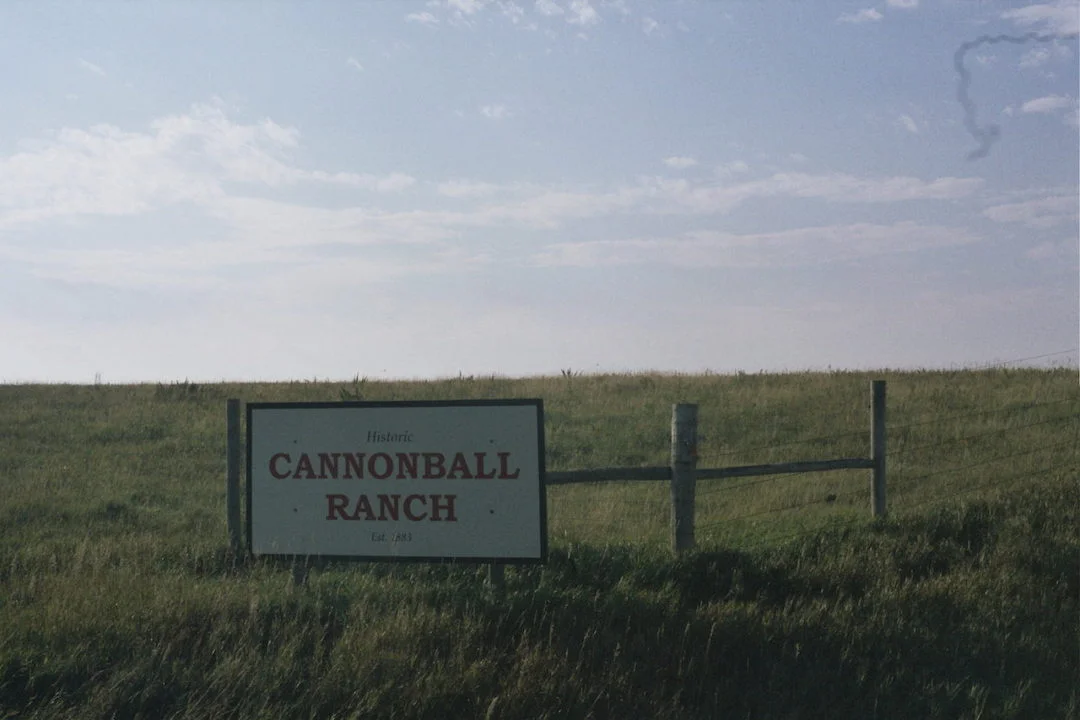
The chaos of that day was vivid. In the morning, I remember strolling around Oceti Sakowin, the main camp of Standing Rock, and asked if anyone had been arrested at the new frontline camp. My friends had camped there the night before in an effort to help protect the space from the police, whom many rumored were prepared with riot gear and paddy wagons.
The newly established camp had been set up to block the next part of the construction for the Dakota Access Pipeline and the people residing there were building the infrastructure to survive the incoming winter months. By the evening, elders were shouting over the microphones at Oceti Sakowin, “We need you on the frontlines! The police have arrived!”
Vans and trucks speed out of the main entrance of the camp, all packed with people in masks and scarves. Highway 1806 was lined with cars, cameras, and people. Grey smoke billowed in the distance as a car burned. The chaos could be felt. I rushed into the frontline camp and began helping wherever I could. A indigenous woman and I carried things out of her tent as police closed in with their batons. Dark tanks stood in the distance and snipers on hilltop.
The more that I saw, the more that my heart began to race. Bulldozers began to plow through sacred burial grounds before my very eyes. Men were dragged out of teepees in their underwear. People pulled their bruised and bleeding friends array from the barrage of tear gas and rubber bullets. I grabbed my own friend as we slipped through the crowd after police shot at a horse.
With distance from my month spent in Standing Rock, I still find myself waking up in the middle of the night and thinking of the thousands of people that devoted so much time and pain to establish one of the most powerful modern cases of resistance against corporate greed. I think of the main fire at Oceti Sakowin, where people would gather every night with soup or cornbread or rice cooked by volunteers in the kitchen. I think of the children running around during recess and of the sun setting in the background as I walked back to my tent. I think of the moments experienced there, devoured by terror at the hands of the state.
Standing Rock, like many things in life, was a lesson in pain and endurance. It was also a lesson in how to love and demand a new world in one scarred by violence. There were many times that I wished to turn away and turn away from the horror, but as an activist, writer, and lover of freedom, I could not. As a black person in America, I have faced my own ordeals because this country has refused to wash away the oppression of present social institutions.The indigenous tribes that gathered deserved more and still do after centuries of surviving colonialism.
But the question still remains - what do we do next to help the environment? The answer arrives when we build spaces, like Standing Rock, that aim to show another way, a better way to relate to each other and treat the Earth. The answer arrives when we begin to understand that all of our lives are on the line if we do not act now. The answer arrives when we choose to not turn away.
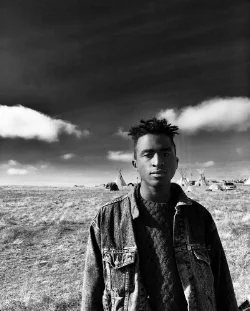
RYANT TAYLOR
Ryant Taylor is a writer and activist from Cleveland, Ohio. He has participated in protests in France, Ferguson, and Standing Rock. He is the creator of Decolonize The Mind, a travel blog, and is currently freelance writing in the Philippines.
I Am Congo
I Am Congo takes viewers through the Democratic Republic of Congo, from urban city life and the people that live in D.R. Congo’s cities, to the natural forest and the beauty of the Democratic Republic of Congo. Told from the perspective of a tour guide in D.R. Congo, the video aims to show viewers all aspects of the Democratic Republic of Congo and their people.
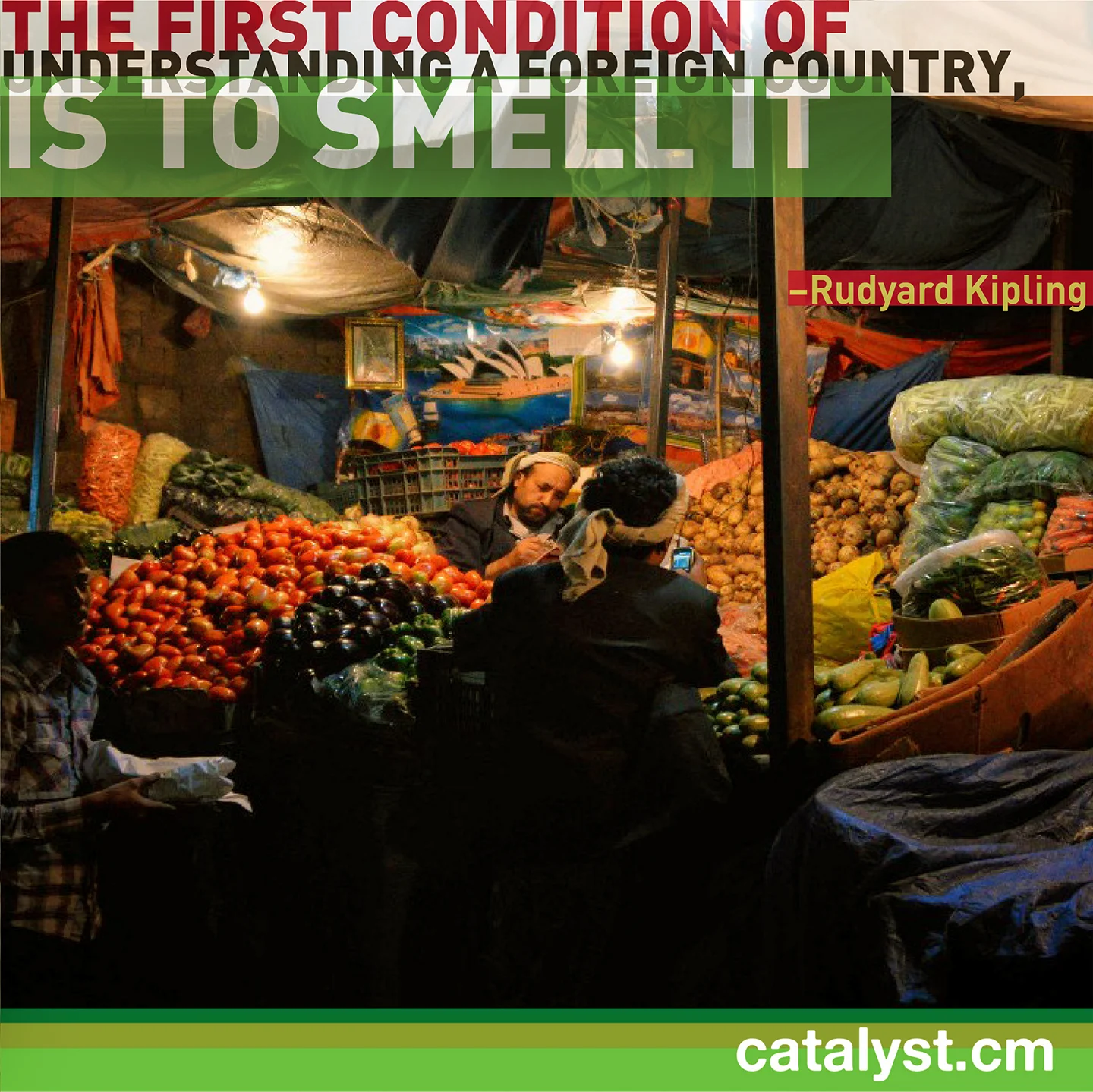
The first condition of understanding a foreign country is to smell it.
No matter how you travel, it's still you going.
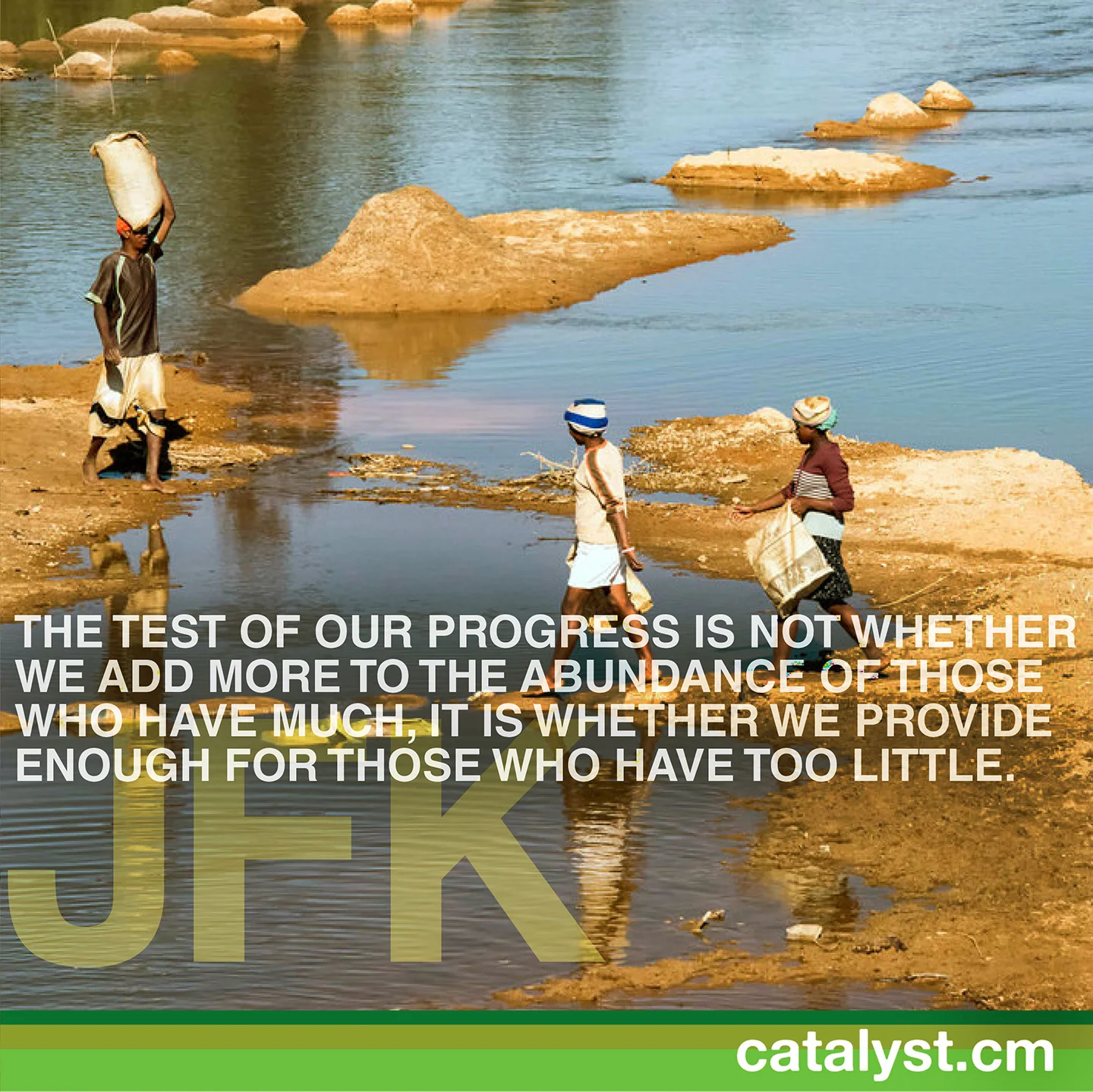
The test of our progress is not whether we add more to the abundance of those who have much, it is whether we provide enough for those who have too little.
Life on the Margins
During the northern summer of 2001 thousands of Chinese security personnel, backed by an army of labourers armed with sledgehammers, massed at the entry of the Larung Gar Tibetan Buddhist Institute. In this almost impossibly remote place, sitting high on the Tibetan Plateau, 9,000 monks and nuns had found a home, defying decades of China’s aggressive atheist policies to learn from its charismatic and avowedly apolitical founder, Khenpo Jigme Phuntsok.
PRC authorities had long been skittish about the institute’s remarkable growth, and particularly alarmed by its growing appeal to ordinary Han Chinese. By 2001 over 1,000 Han also called Larung Gar home.

The Larung Gar Five Sciences Buddhist Institute.
Both Larung Gar and Yarchen Gar (gar translates as camp) have remained largely hidden from the outside world, as much because of their inaccessible geography as the tight controls on freedom of movement put in place by the Chinese government. Both sit at elevations of over 4,000 metres, sunk deep into hidden valleys of the Hengduan mountain range, which cuts across China’s south-western Sichuan province.
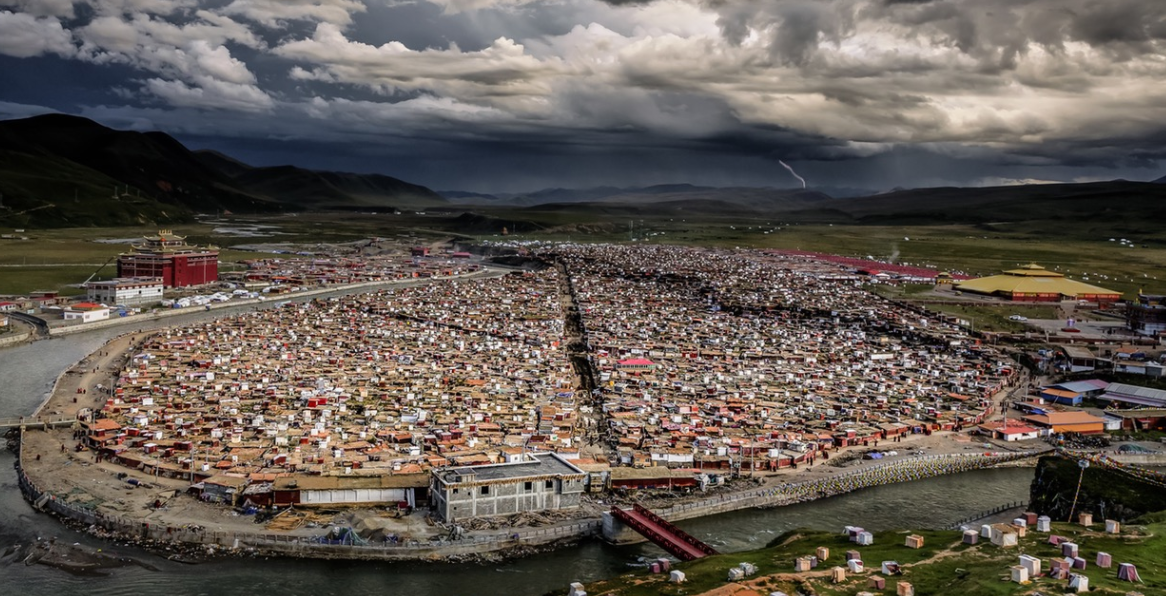
Yarchen Gar sits hard against the border of the TAR and is home to roughly 9,000 nuns.
Both Yarchen and Larung Gar are part of what is known as the Garzê Semi Autonomous Prefecture, where 77 percent of the inhabitants — some 800,000 people — claim ethnic Tibetan heritage. As is the case in the similarly named Tibetan Autonomous Region (TAR), the people’s future has long been out of their own hands.
In theory, to move around Garzê as a foreigner, one only needs a Chinese tourist visa and bucket loads of time, patience and fortitude. This is in stark contrast to the neighbouring TAR, at the border of the lands known to the wider world as ‘Tibet’. Visitors to the TAR are required to first negotiate a complex and shifting permit process, before joining an organised and highly controlled tour of the region.
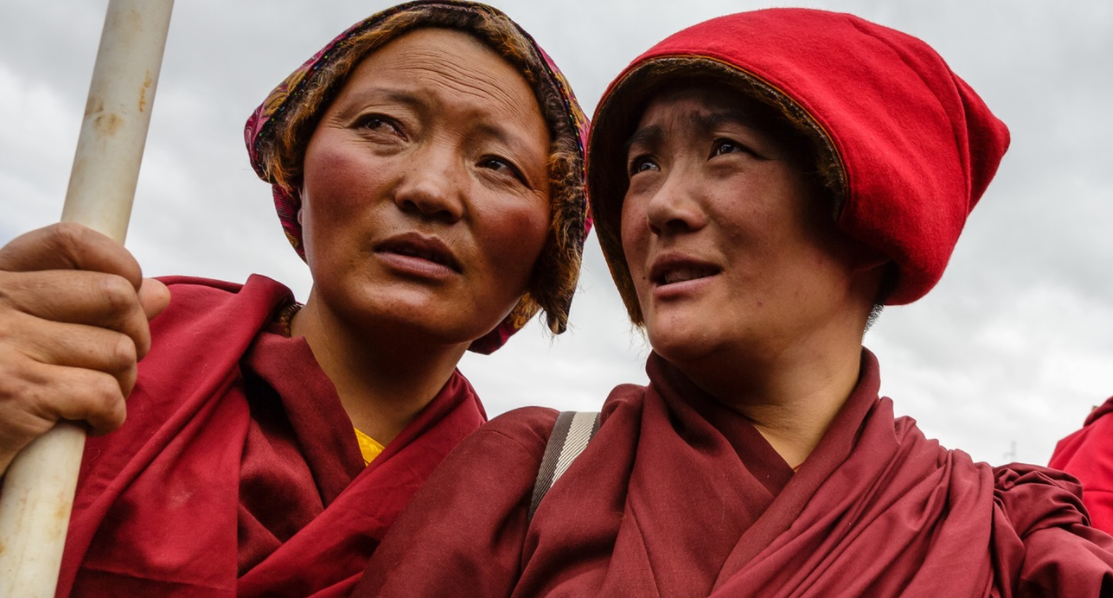
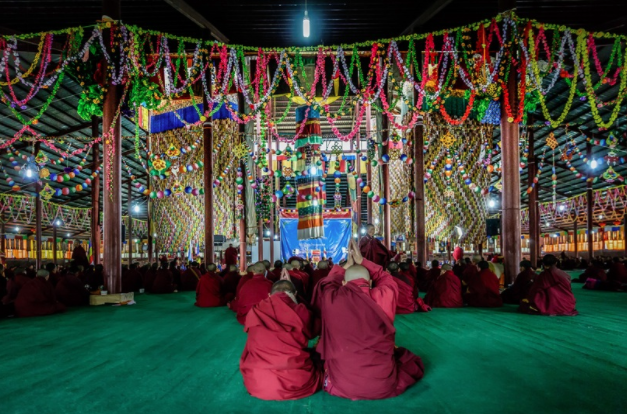
Nuns at a ceremony at Yarchen Gar in which almost the entire population of the camp leaves for a month of meditation in the surrounding hills.
Yet Garzê and nearby Qinghai are also restive. Tibetans here have openly protested against Chinese control, most notably as part of a violent uprising in 2008. Referred to by the Chinese as the 3-14 riots, unrest had spread from the TAR into Sichuan. This unrest effectively slammed the door shut to the region’s hidden treasures until 2013. Today, despite relative calm, nuns and monks continue to take the extreme measure of self-immolation in towns and villages. Reports of random arrests and the disappearance of accused activists are common. Recently Garzê has been open, yet regulations can change overnight and information is scarce.
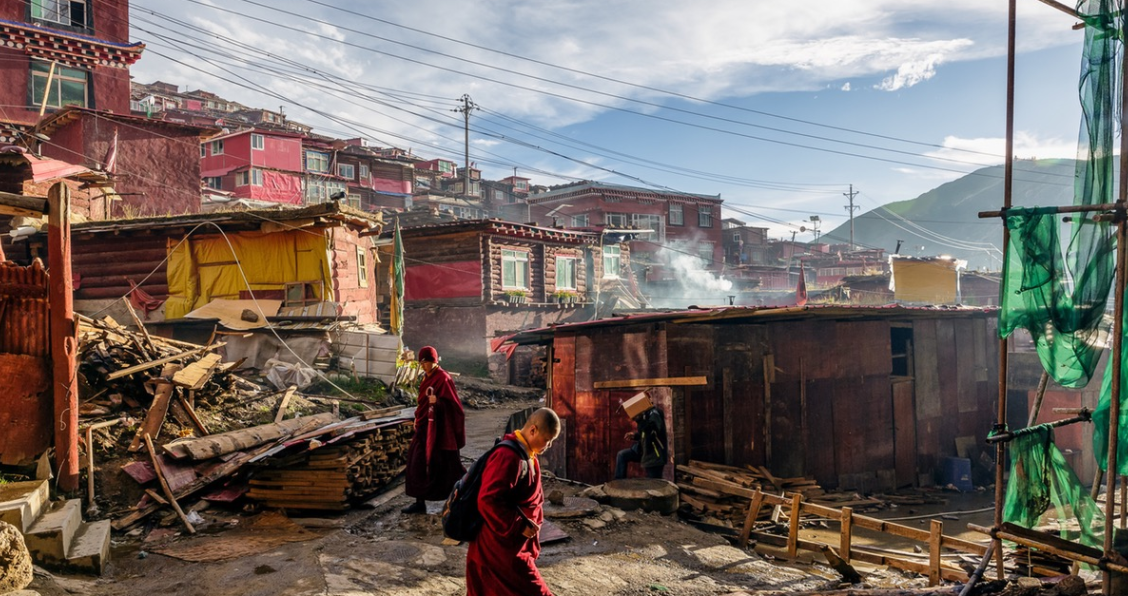
The narrow, winding alleyways of Larung Gar.
During China’s breakneck boom the mountainous Garzê region represents ground zero in the great ‘go west’ campaign — viewed by the People’s Republic as integral to the rapid growth of the Chinese economy.
The wealth of natural resources found here, as well as the nation-building railway into Tibet (completed in 2006) have been the catalyst for extraordinary development. In the regional town of Sertar, which sits astride the Larung Gar complex, the reality of the security situation quickly hits home. I was challenged in the main square and taken to police headquarters to sign in and face a barrage of questions.
Mercifully, one officer spoke English and took my story of being a history teacher at face value. This would be just one of my almost daily encounters with the local police force over the coming weeks.
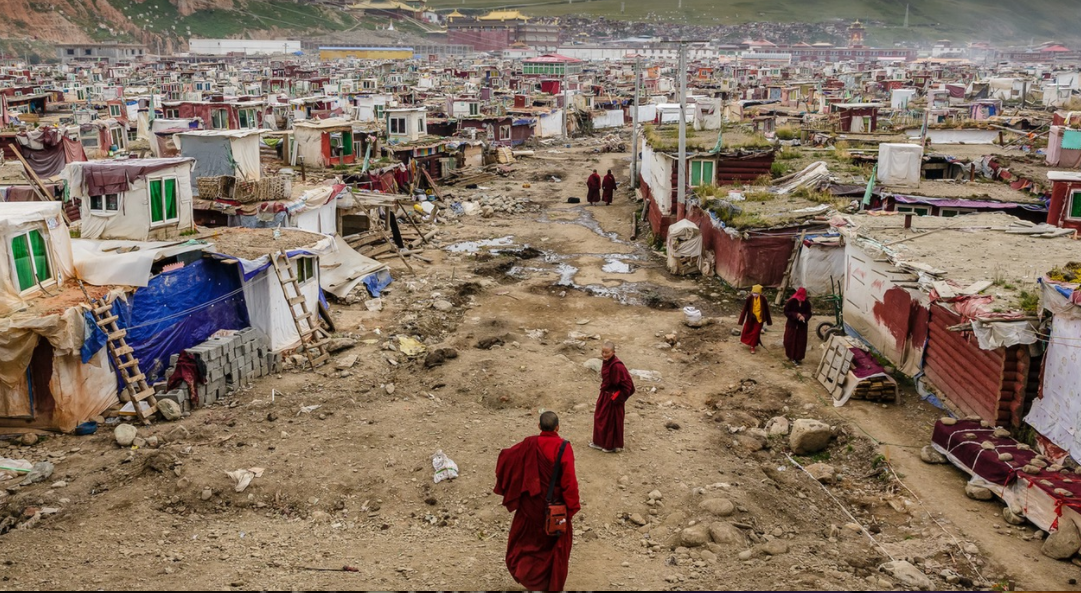
The main street through Yarchen Gar

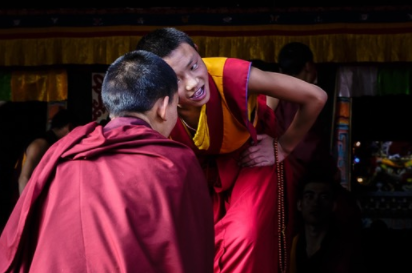
Monks debating at Larung Gar.
During the following days I was left free to explore the vast warren of huts, temples and study houses that surround the complex. One morning I witnessed a loud monks’ debate; where the men and boys almost come to blows over competing theological arguments.
The monks and nuns live their lives separated by the main road which slices Larung Gar camp down the middle. I found both groups to be generally welcoming and curious, and the tinderbox atmosphere and police presence of Sertar is replaced by the constant hum of worship, with the sound of prayer and Tibetan horns a constant.
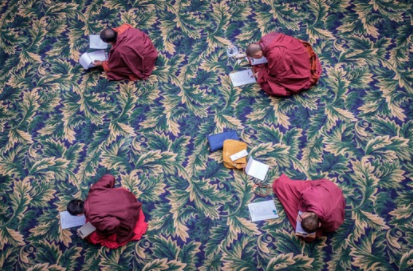
Monks in study and debate at Larung Gar.
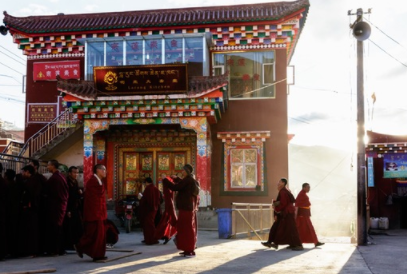
Many Chinese tourists visit Larung too. The biggest draw for them turns out to be the opportunity to witness a traditional Tibetan ‘Sky Burial’. At 1pm every day, the Rogyapa (“body breaker”) arrives to dismember recent human remains, which are then fed to aggressive flocks of resident vultures on a hillside set back from the complex.
Macabre to some, this ancient ritual is both a practical way of disposing of human remains whilst also adhering to jhator, the principle of kindness to all living things, which includes feeding these huge carrion creatures. Few of traditional these sky burial locations remain operational, mainly due to religious marginalisation, urbanisation and the decimation of vulture populations.
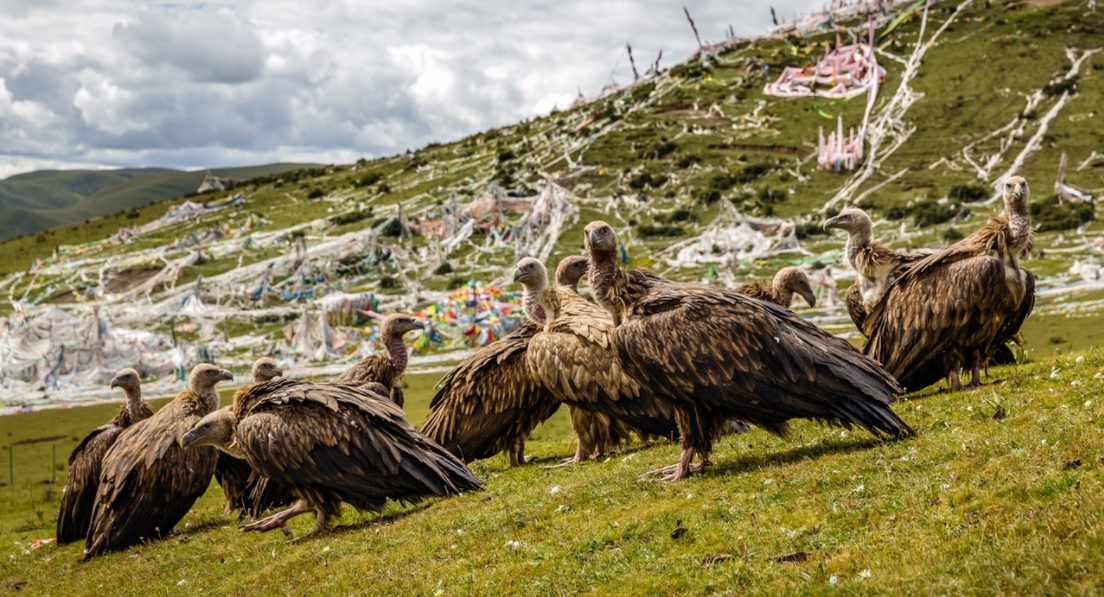
The vultures who are fed during the traditional ‘Sky Burial’ on the hillside above Larung Gar.
The institute at Larung Gar currently attracts followers of Tibetan Buddhism from all over China. Its regrowth after the 2001 evictions was swift; students began to illegally return and rebuild almost immediately. After Jigme’s death in 2004, countless followers made a pilgrimage to Larung Gar to pay homage to their spiritual master. Many stayed and contributed to the already rapid regrowth of the population. Today, Larung Gar is home to an estimated population of 50,000 people.
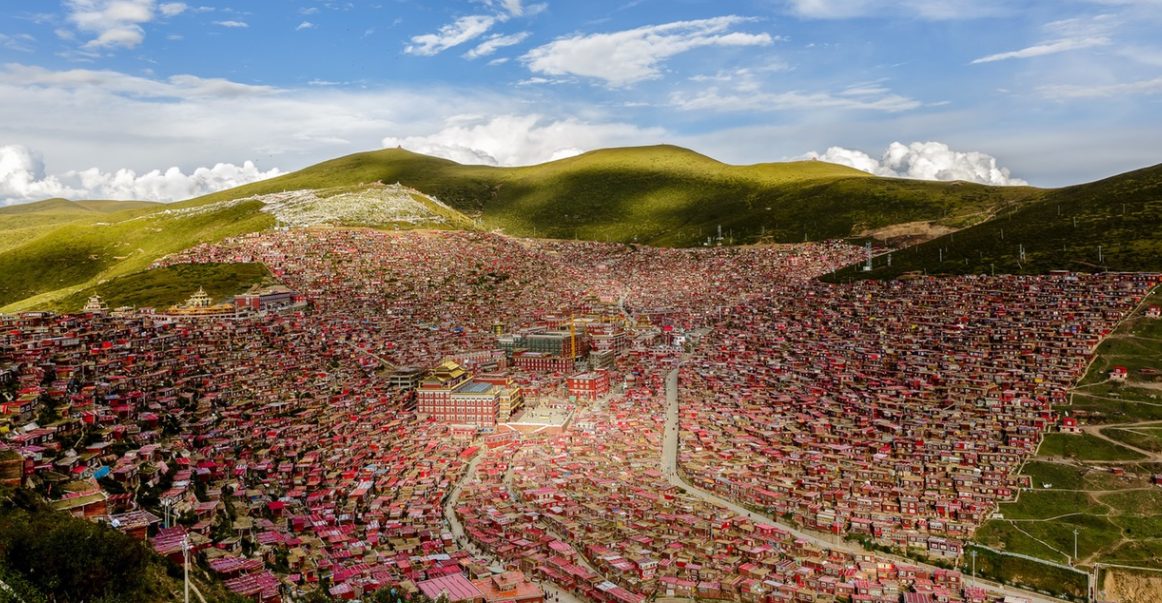
Gar camp from above, on rare clear day.
Yarchen Gar, founded in 1985 hard against the border of the TAR, has deplorable living conditions. Without even basic sanitation, every corner of the complex is permeated by a breathtakingly toxic smell. Around 9,000 nuns live in ramshackle huts on an island, while the more solidly built monks’ quarters sit more favourably on the surrounding hills. Monsoon rains bring regular flooding; on my visit ankle-deep raw sewage flowed into the streets on more than one occasion.
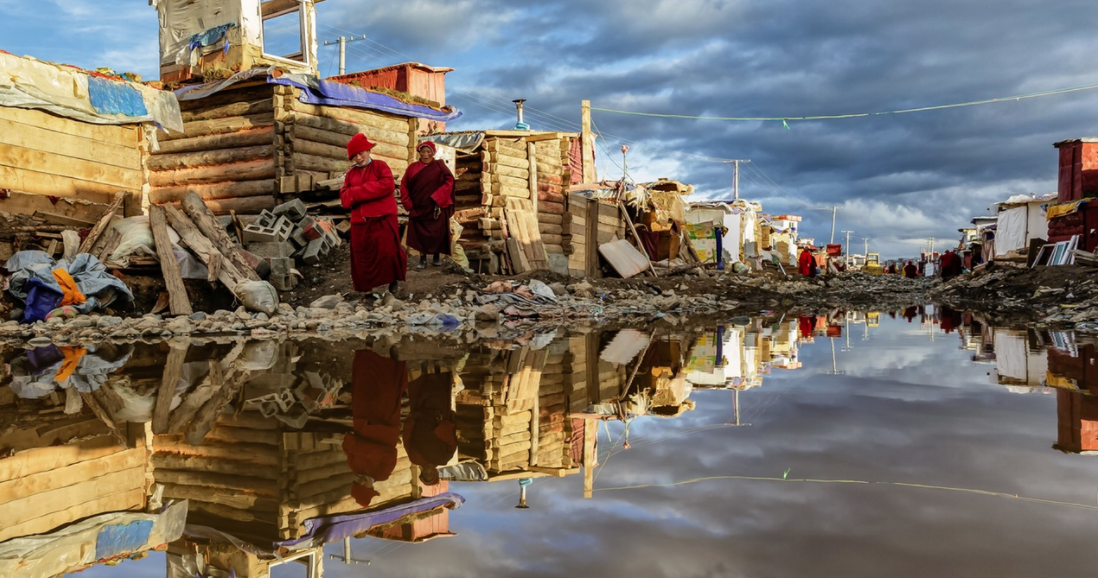
Rains in Yarchen Gar flood the streets with raw sewage.
No electricity runs to the island where the nuns live. Cholera and typhoid outbreaks are a daily threat. In winter, the temperatures plunge to a life-threatening minus 25 degrees. Yet this does not deter the nuns. Winter meditation sessions, referred to as the “direct crossing”, can last for days, with nothing more than a blanket to shield worshippers from the cold.
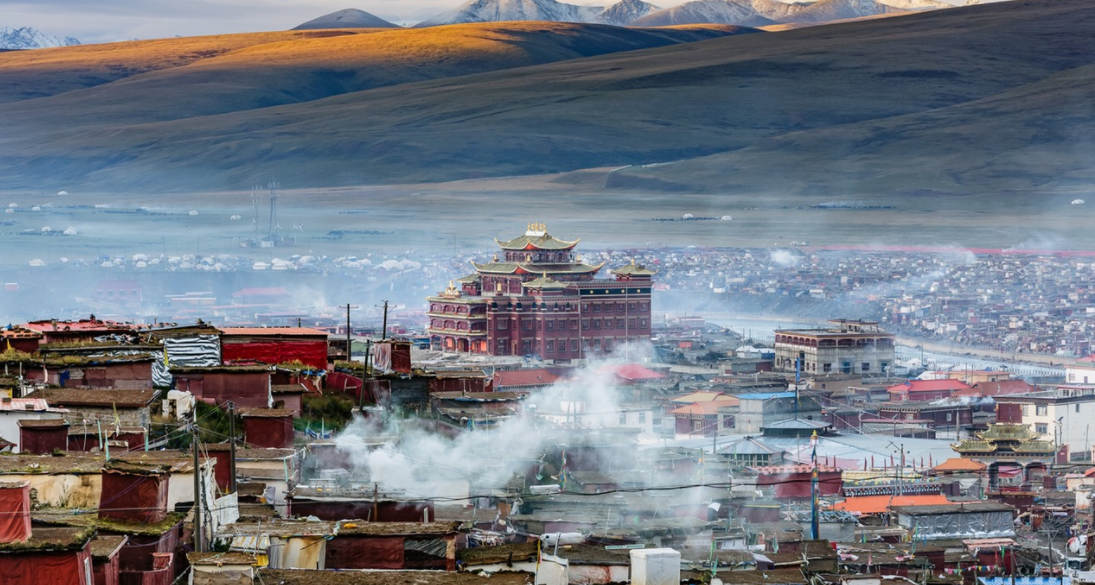
Sunrise at Yarchen
The reward for this remarkable display of self-deprivation is the chance to learn first-hand from some of the most revered figures in Tibetan Buddhism. The current leader in residence is Asong Tulku. ‘Tulku’ is a title given to a person who has reached the highest level of spiritual enlightenment, and Asong is considered a living Buddha by his followers. To assist in his teaching at Yarchen, Asong is aided by senior nuns, called khenmos. Many nuns begin their life here at the age of just six.
Worshippers inside one of the temples at Yarchen Gar.
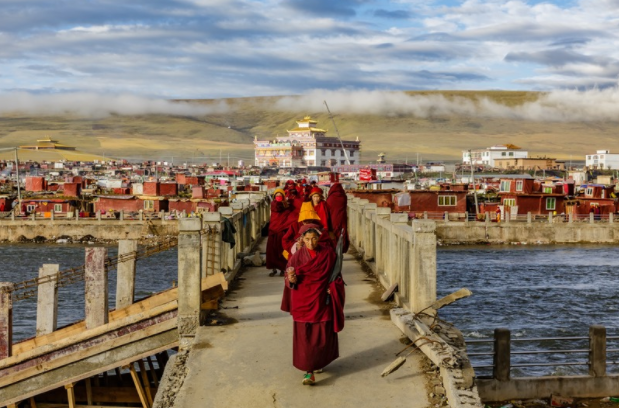
The bridge over to the island where the nun’s live.
Not only do the nuns dedicate themselves fully to their studies, they are also responsible for almost all physical labour at Yarchen, constructing houses, unloading trucks or building roads. The monks, who rarely participate in physical labour here, seem to have it easy in comparison.
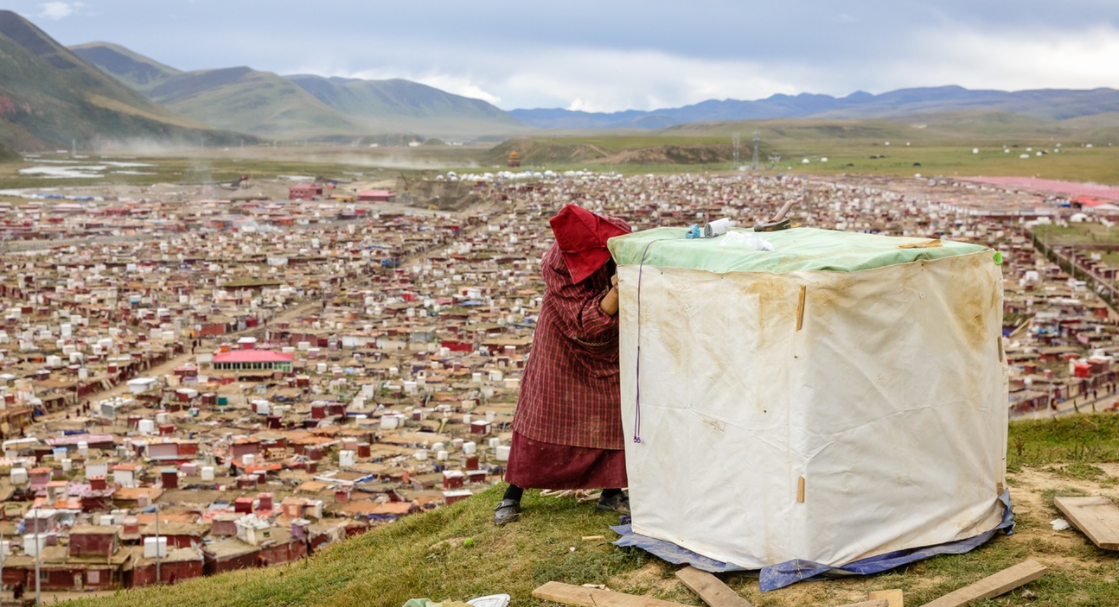
Building a basic meditation hut on the hills overlooking the nun’s encampment.
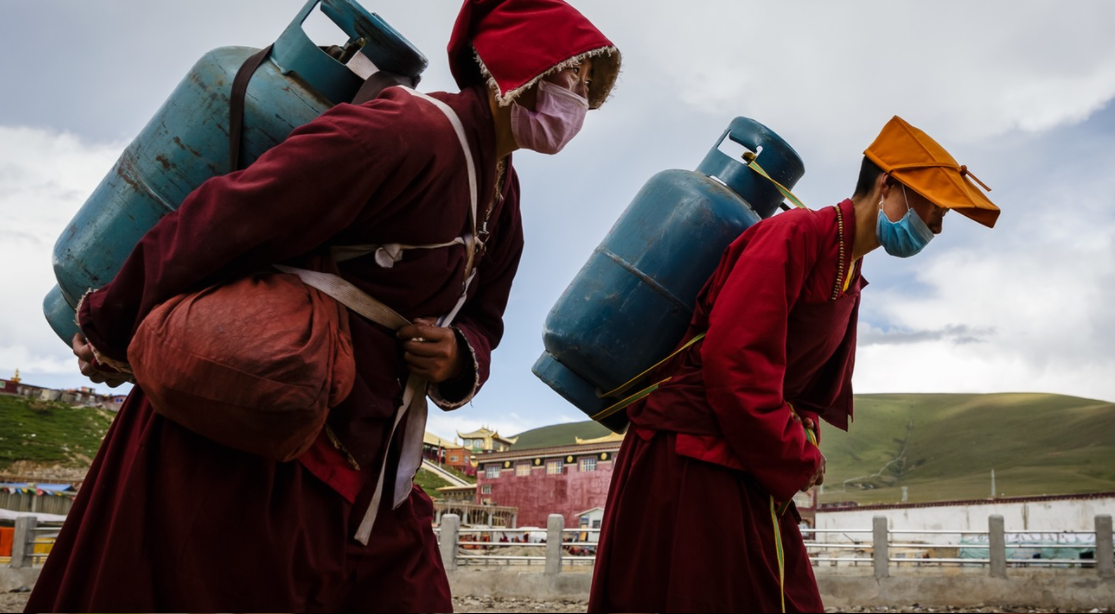
The nuns carry out most of the hard physical labour at Yarchen.
Despite the challenging living conditions, vast amounts of money are being funnelled into gigantic, ornate temples and monuments in the heart of the camp, while the surrounding slums continue to crumble.
Han Chinese money has poured into this region, with relatively wealthy converts to Tibetan Buddhism bringing much needed funds to the camps. These wealthy benefactors, hoping to improve their karma for the next business deal, or through a “cover all bases” spiritual mentality, have sparked a huge construction boom on the far western Chinese frontier.
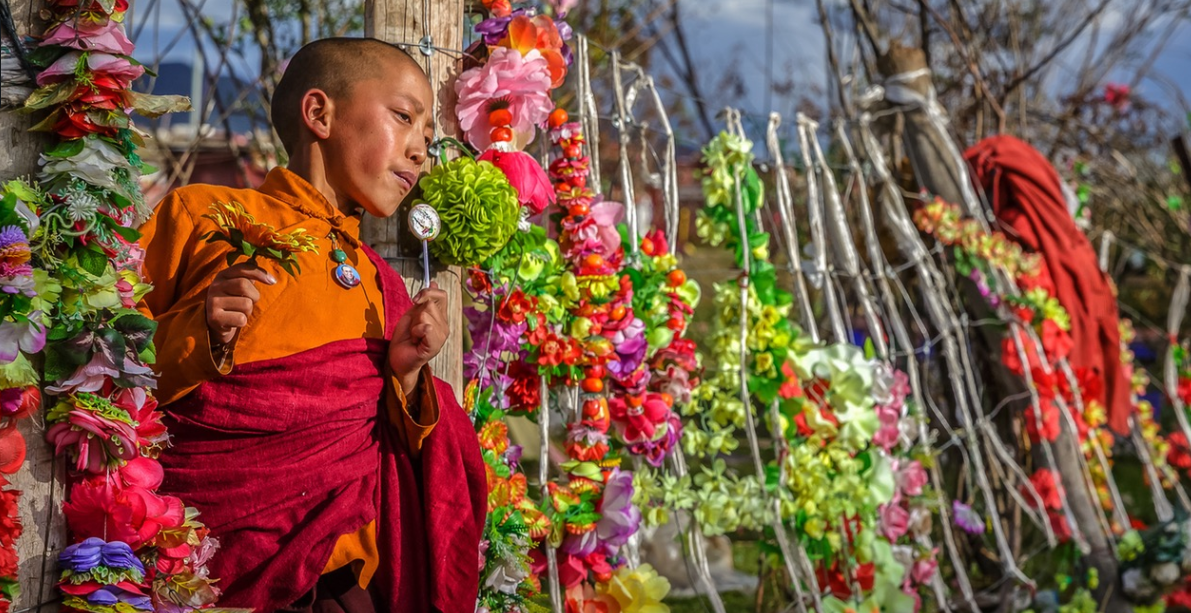
A young nun exits an area reserved for eating and socialising in the centre of Yarchen.
During my time in Yarchen I had several memorable brushes with the revered leader, Asong Tulku. As he piloted his gleaming white Lexus around the slum, our paths would meet on my early morning photo shoots. Watching people fall into the putrid mud at his feet wherever he walked, all rushing to pay tribute with cash and gifts, I found myself wondering if the money for the Lexus couldn’t be better spent elsewhere.
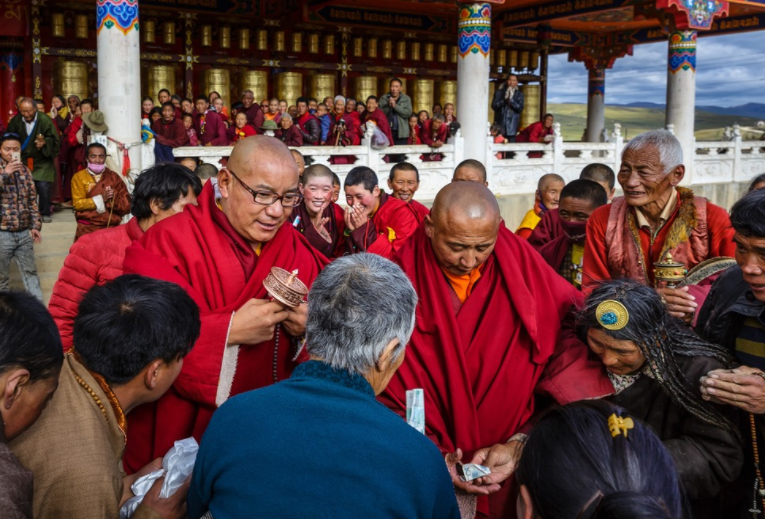
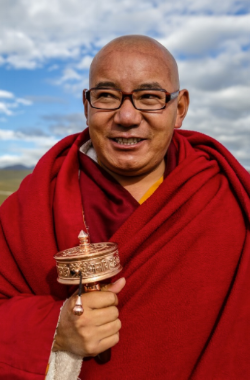
Asong Tulku is considered a living Buddha by his followers
The abrupt change from the monsoon season to the biting cold of winter was a fortuitous time to be visiting Yarchen. A ceremony in which almost the entire population of nuns empty from the confines of their island home for a month of meditation in the hills was due to take place. For days, preparations for this ritual, translating roughly to the “circle of life”, had provided a preview of what was to come.
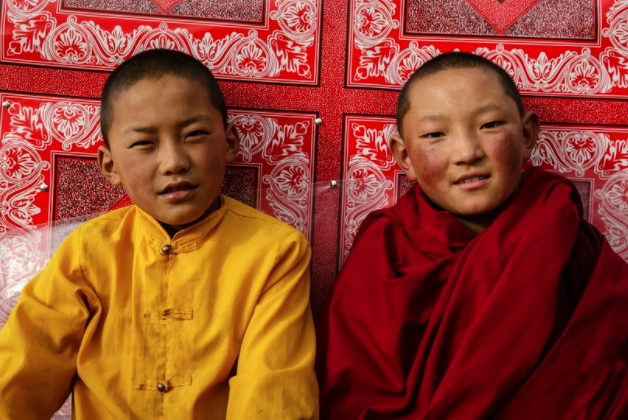
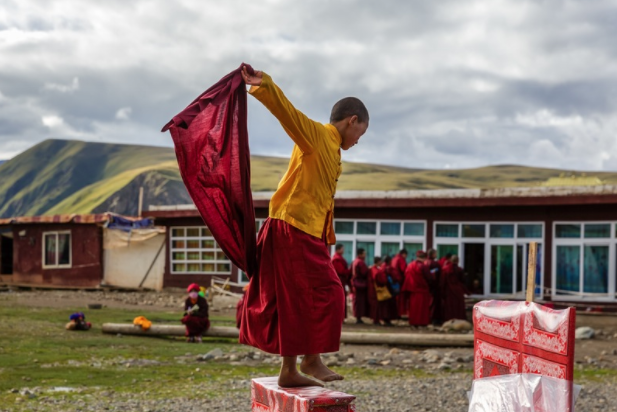
Young monks taking a break from daily classes at Yarchen.
Basic supplies were taken by foot to a hidden nook outside the complex, the location of which was strictly off limits to outsiders. When the fortuitous day finally arrived, the sight of 9,000 nuns in their bright red robes streaming into the hills was a privilege to see.
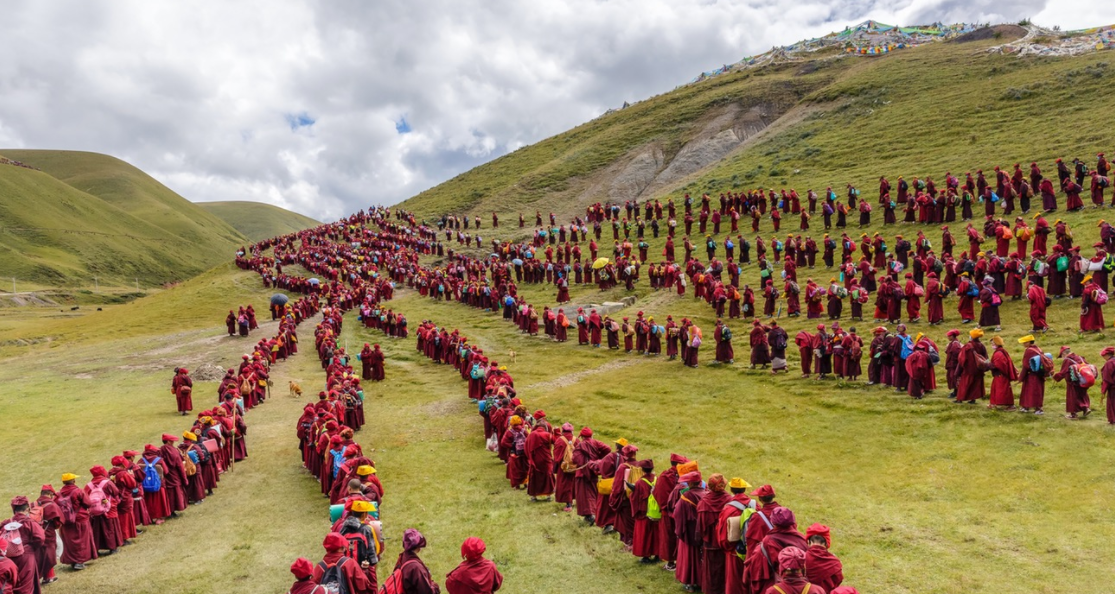
The nuns of Yarchen Gar prepare to walk into the hills for a month of meditation.
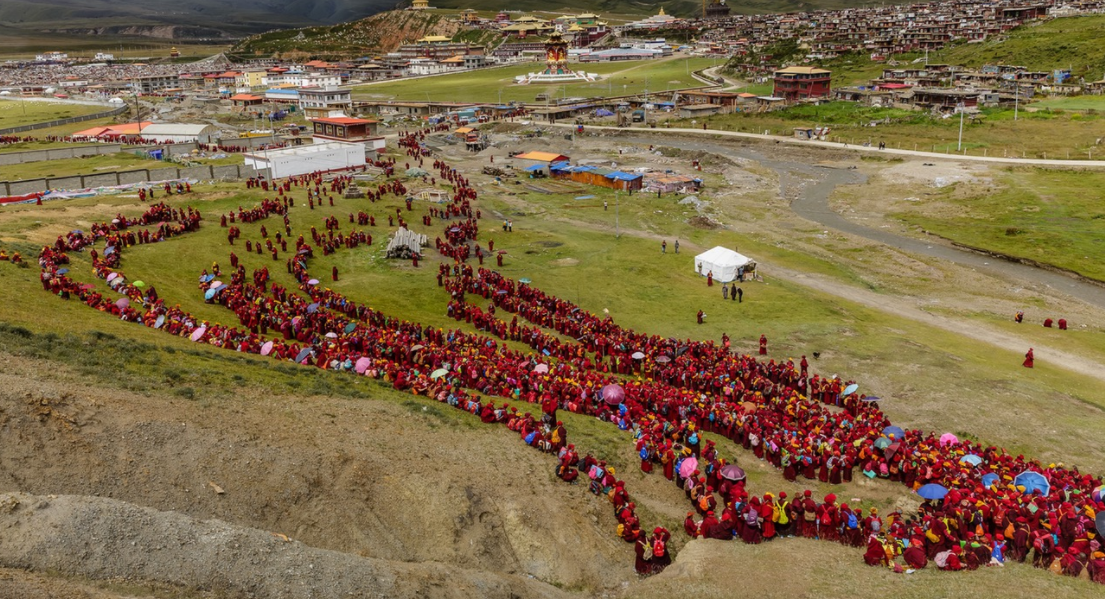
At the entrance to the valley I reached a sign hammered into the ground, with a message written in bold letters, announcing that any man who followed the nuns on their trek would return blind. With this, I knew that my luck had held out for long enough; it was time to go.
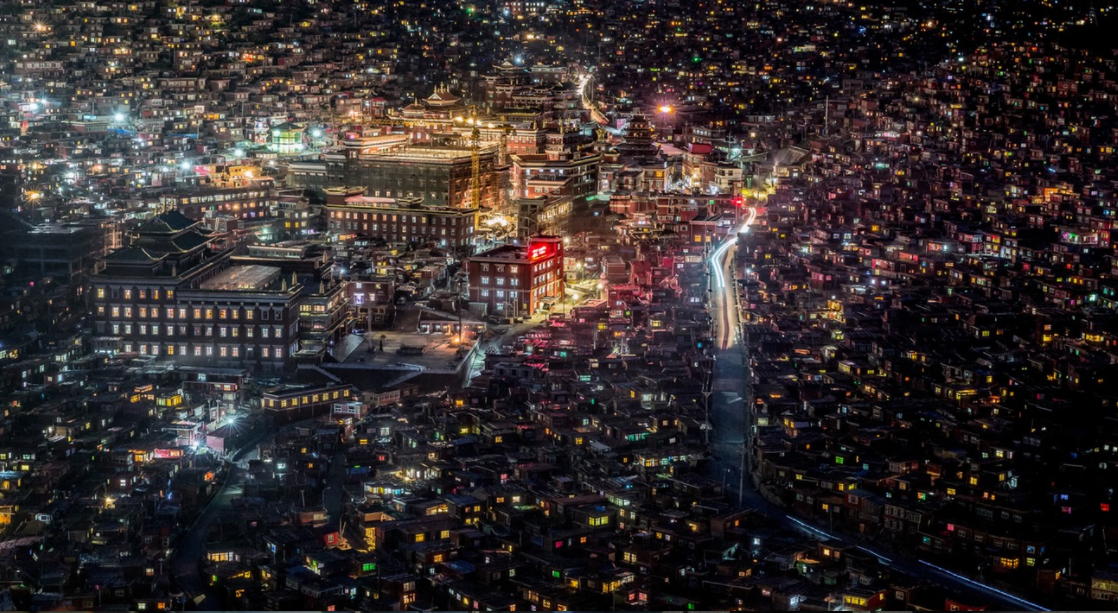
Larung Gar camp by night.
By rights Larung Gar and Yarchen Gar shouldn’t exist, and at different times the authorities have tried to sweep them away. Draconian restrictions on the freedom of movement and religious practices in the TAR itself means that nothing exists there to rival these two sites.
Quite possibly, the future leadership of Tibetan Buddhism rests not within the more recognisable white-washed walls of Lhasa’s hillside fortresses, or within the Dalai Lama’s inner circle, but within China itself.
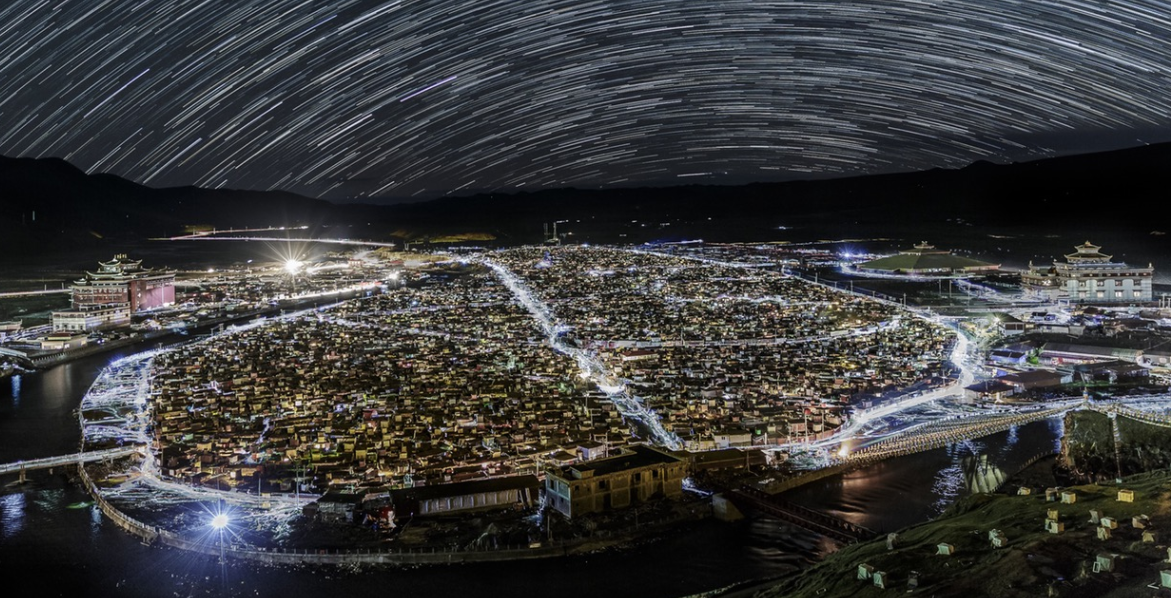
Star trails arching over Yarchen Gar.
THIS ARTICLE WAS ORIGINALLY PUBLISHED ON MAPTIA.
BROOK MITCHELL
Brook Mitchell is a photographer + writer with Getty & The Sydney Morning Herald.
Visions of Kenya
A long time went by before I was able to understand this trip. Sometimes, the present is not understood until it becomes the past. Kenya belongs to a continent of origins, remote and distant, and for now, for better or worse, many of its vast and beautiful rural areas remain far from the globalised world.
In a matter of two weeks I had organised everything. Bought the tickets from Buenos Aires to Mombasa, got the necessary vaccines, packed my things and let my friends know I was leaving. “I’m going to Kenya for a month, alone, just my backpack and camera, nothing else.” It was a long flight to Mombasa. I was very tired and somewhat nervous about it all. At the airport in Mombasa the image of a rhino gave me goosebumps. I had arrived.
— Mombasa —
The first morning I was woken by the heat and the unrelenting racket made by the many crows that inhabit Mombasa. I looked outside the window to see Africa for the first time: bonfire smoke on the sides of the street, women selling fresh fruit right outside our building, next to them, I saw other women with beautiful braids in their hair, and a little further away, a man selling plants. Here, life takes place on the streets.
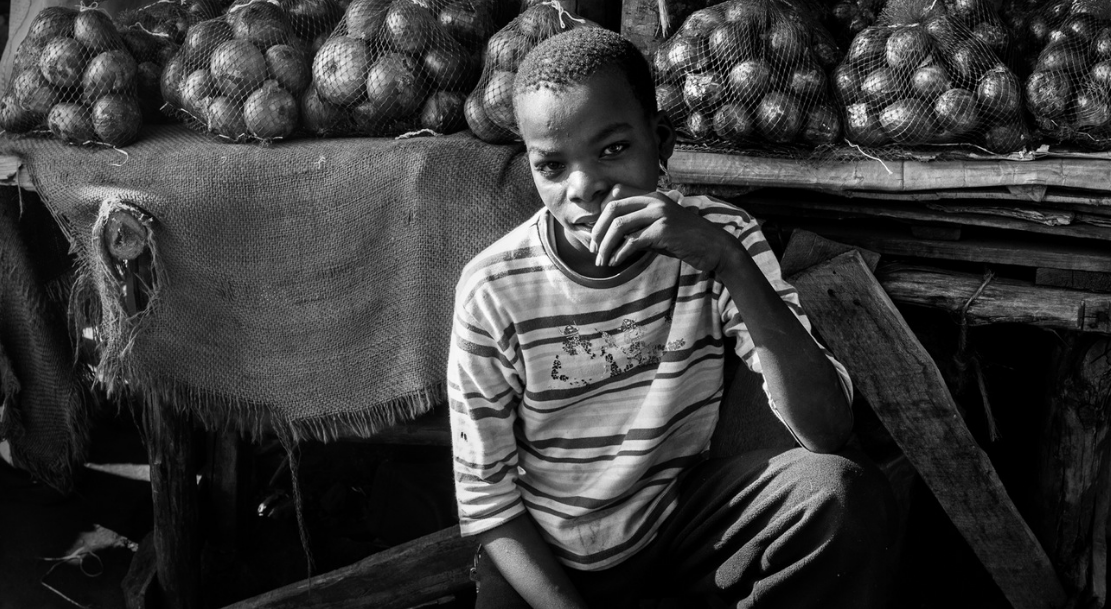
He was selling onions on the side of the road to Nairobi
I enjoy travelling alone and getting to know different cultures, in the most simple and genuine way possible, simply by being there, and merely observing. Trying not to alter what I see, to be inconspicuous. But in Mombasa, I was noticed right away. I am a white Argentinian, in a city where almost everyone is black. It was impossible to remain unseen.
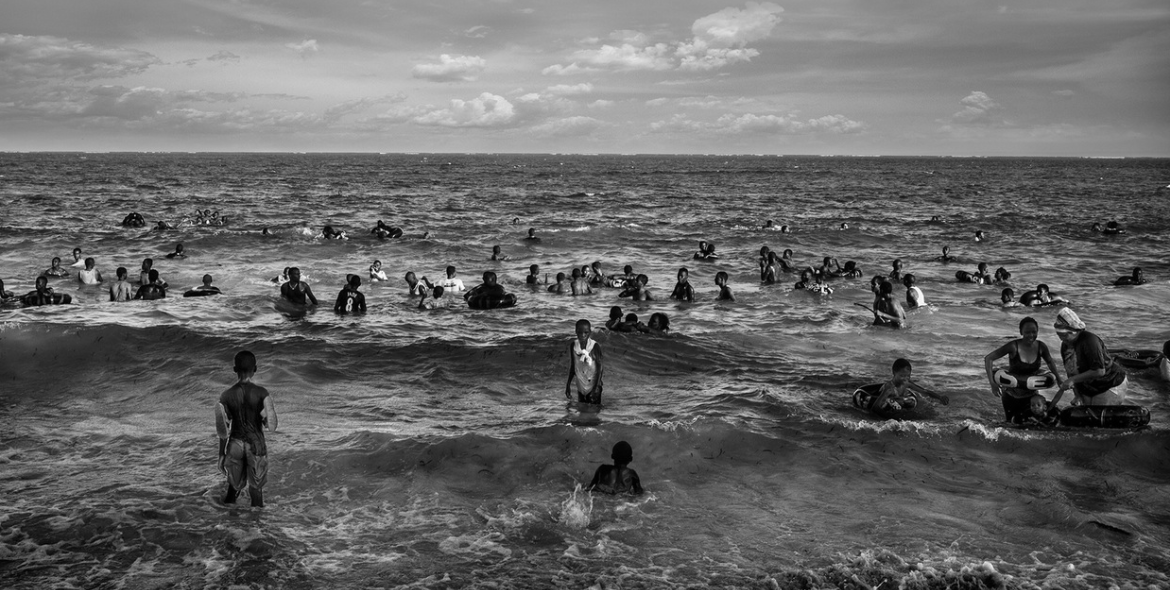
Sunday morning is a social time for families at the public beach
The first few days were filled with nervousness and anxiety. I was alone in a place completely different to my own, full of tension and expectations about what the trip might become. Was I going to be able to adapt to Africa? I just wanted to let go, come to know the locals, let down my resistance, and give myself up to whatever had to happen.
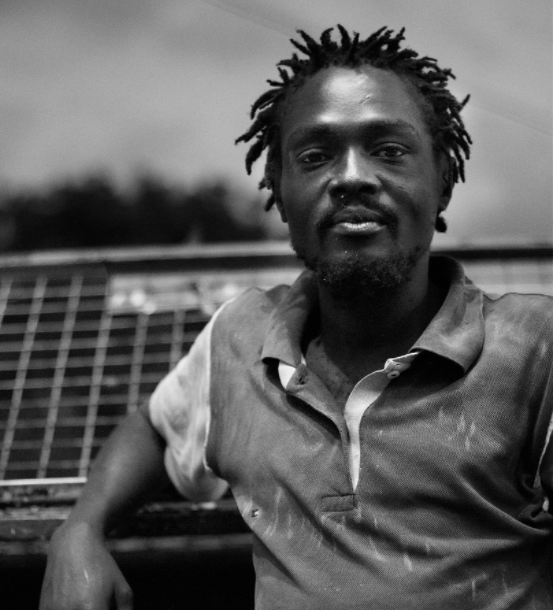
Eddie lives inside a garbage container in Mombasa. The day I left Kenya, I gave Eddie all of my clothes.
Two days went by and I decided it was time to get out of the city. Venturing into the more rural areas of Kenya would be better than staying in Mombasa. Leaving my big backpack behind, I grabbed my camera, my flip flops, swimming trunks, and my kikoy — a traditional man’s wraparound worn on the Swahili coast of East Africa, especially in Kenya. It protected me from the sun and from the stares too. I took a tuk-tuk to the south of town, then a ferry, and then a three-hour matatu — one of Kenya’s colourful buses. My destination was Wasini Island, a small island in the south, where people usually snorkel for a few hours and then leave. I wanted to stay, at least for a few days.
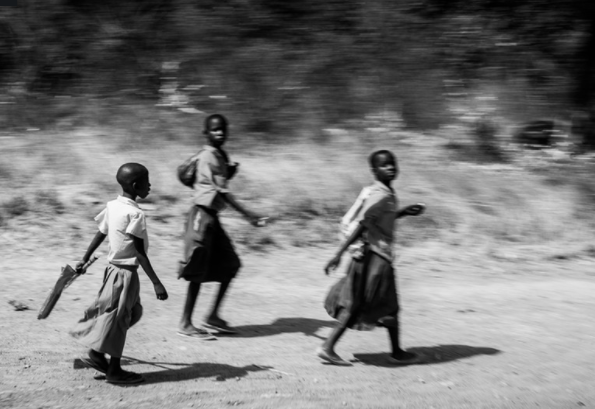
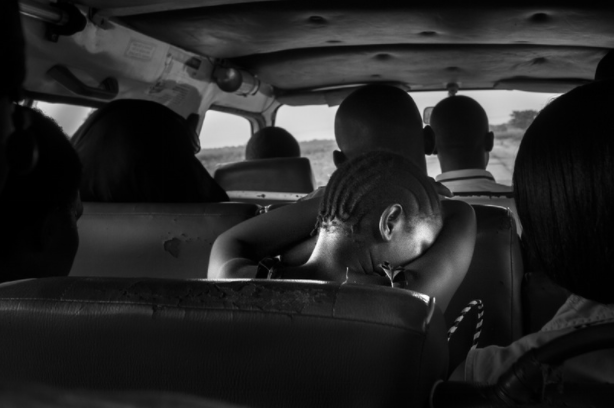
School children on the road from Mombasa to Kilifi / She was sleeping in the matatu along the way.
I was greeted by Abdullah, who was surprised to meet a foreigner who wanted to stay longer than a few hours. I got on a small boat and crossed the island with two guys who were carrying huge machine guns, which they used to absentmindedly scratch their feet and faces — I had never seen such big weapons.

Baobab tree lit up at night
— Wasini —
Wasini is a coral rock island that during its hey-day was a popular summer destination for retired and wealthy Europeans who wanted to enjoy the heat and beaches of Kenya. The day I arrived, there was just one dutchman and me, and the rest of the island was a small fisherman’s village. Abdullah cooked a fish for me with great care, and later made me visit the “tourist attractions,” which meant very little to me.

Coral stones in the Indian Ocean
I met someone who said he would take me over to the other side of the island along a path that would pass through the mangroves. I told him I had very little to tip him with, as I had left all my money in Mombasa. He gently insisted on taking me and I followed him. We walked through the island for a long time and I started to worry, thinking about where this stranger was actually taking me. The sun had started to set and as is common in many places in Kenya, there was no electric light.
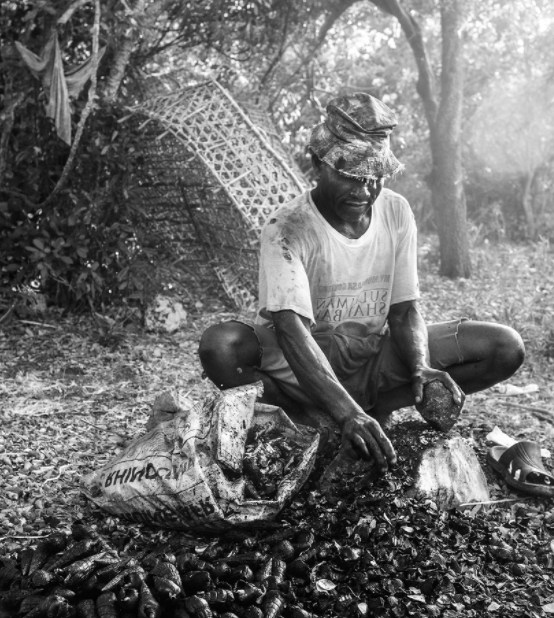
We were crossing the path with this guy, while a fisherman was preparing his bait. I asked to take a picture of him, and he accepted.
We kept on walking until we finally reached the other side of the island. The mangrove trees continued all the way into the sea, and it was a very beautiful sight. I calmly took a breath, my guide had not deceived me. At that moment I felt that if I had managed to get to such a remote place with a complete stranger, then it meant that the rest of my trip would turn out alright. It was a feeling I had. Complete trust.
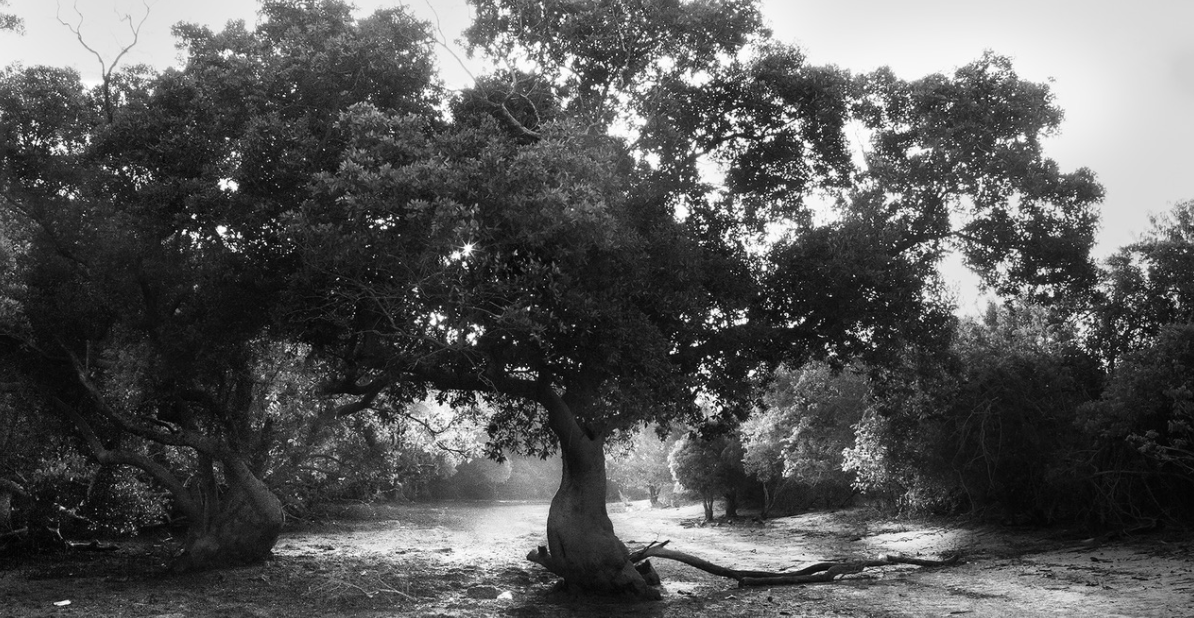
Among the mangroves
— Kilifi —
I spent a few days in Wasini and then returned to Mombasa to continue northwards along the coast, towards Kilifi. In Kilifi there was a very impressive hostel, but when I entered I had the feeling of being out from what I have been seeing. Luckily, I decided to walk towards the beach, where I found a beautiful sunset.

Little sisters playing together in a tree near their home.
The beach was deserted. It was actually an estuary, very serene. I loved rural Kenya, so far away from the cities. As I sat with my camera I saw a kid walking in the distance. As he approached me I waved, then he waved back and continued to walk. A few hours later, the kid returned and I went over to have a chat. He responded by asking me if I knew how to hunt crabs. His name was Buda.

Portrait of Buda
We became friends and I met all of his brothers and sisters as well. They were many, and lived on the coast with their aunts and cousins. Most families in Kenya live with their extended family, and the women are in charge of the houses. Men are absent most of the time, often spending time with friends, away from their homes.

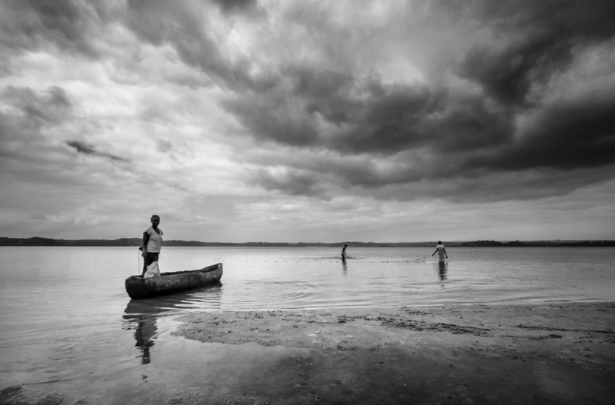
Full of joy in the ocean / Fishermen and family in the early morning
I quickly became very fond of Buda and his siblings, and they became fond of me. Every time I came down to the beach, they would arrive to greet me. I spent whole days on the beach, sometimes helping them gather wood for making fires, or finding things their mother had asked for — I learnt a lot about their culture and way of life, which was not always easy. Buda and Nuzrah were the eldest siblings and spoke better English. They taught me a lot of words in Swahili, their native tongue.

Portrait of Nuzrah
One of the days we spent together I brought them a football, a water gun and a jumping rope. We played with them, they taught me beach games, and every now and then we would all go for a swim. It was with great grief that I said goodbye to these children, as I had to continue travelling towards the west of the country. They stayed with me until I left, and their mother also came to say goodbye.

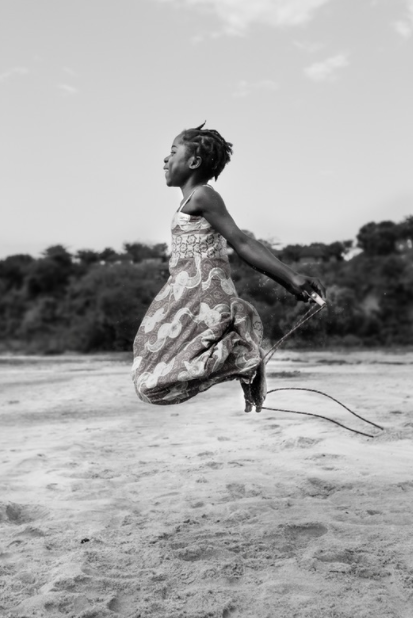
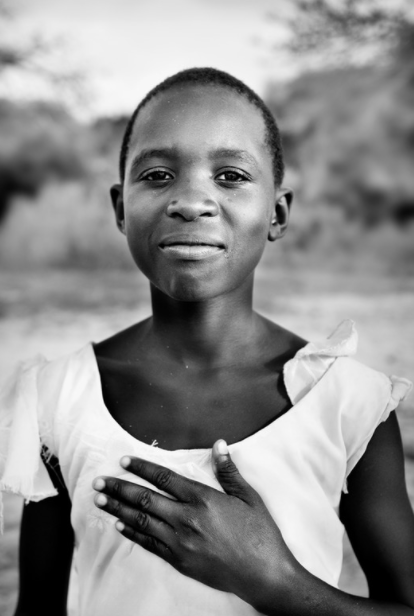
Portrait of Buda / Jumping rope / Portrait of Mwanaisha
— Amboselli —
I took a tuk-tuk back to Mombasa, thinking about everything I was experiencing. It felt so powerful and different, making me reflect on my own life, and how grateful I was for the opportunity to travel. The following dayay I left for Amboselli National Park. Enormous and open, there were no fences around it. Animals are not easy to see. You might spend a whole day walking around and only encounter a few zebras.
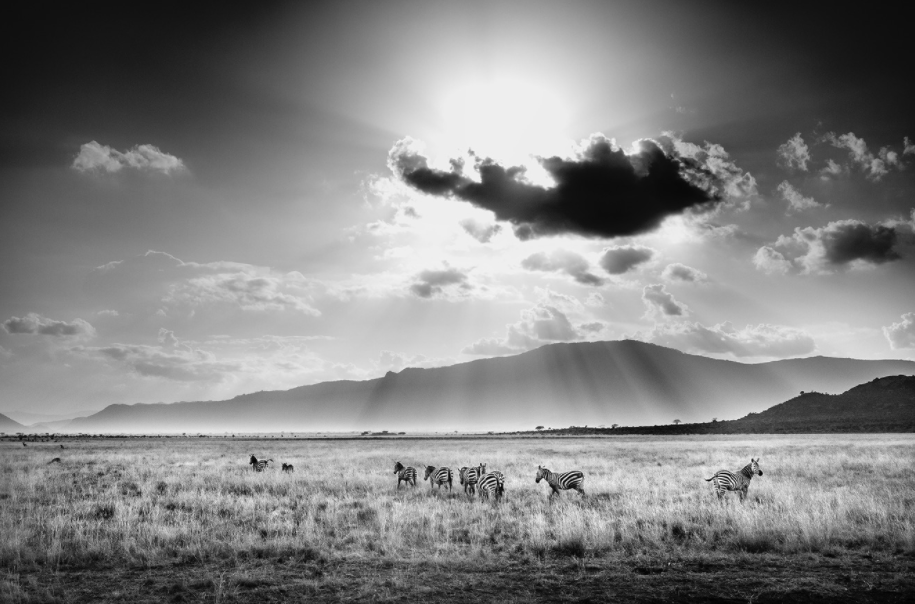
Morning of the Zebras
But the immensity and beauty of the landscape was truly dazzling to me, sometimes reminding me of my native Patagonia, similarly wild and empty in its own way. I also thought about the devastation humans have caused to the natural environment, and the complex challenges local and international communities face as they attempt to tackle and reverse this.
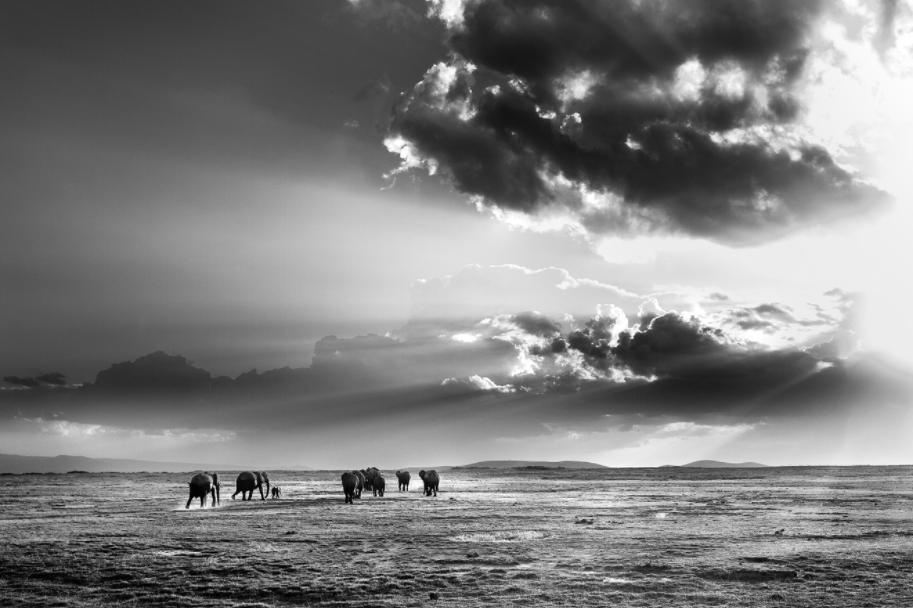
Afternoon of the elephants
I spent my whole childhood fascinated by documentaries on Animal Planet, or Discovery Channel. I could not quite believe I was there, in these vast landscapes. The animals were so big, so strong. They had very little to do with the image I had of elephants in zoos or television. And the trees, they were so magical, I really have no words to describe them.

Masai walking in the early morning / Just a beautiful tree, in my first moments in the park

A long time went by before I was able to understand this trip. Sometimes, the present is not understood until it becomes the past.
When I travel, I seek to explore places that will surprise and challenge me, and from that surprise create beautiful experiences and photographic visions of what I have witnessed. Kenya belongs to a continent of origins, remote and distant, and for now, for better or worse, many of its vast rural areas remain far from the globalised world.
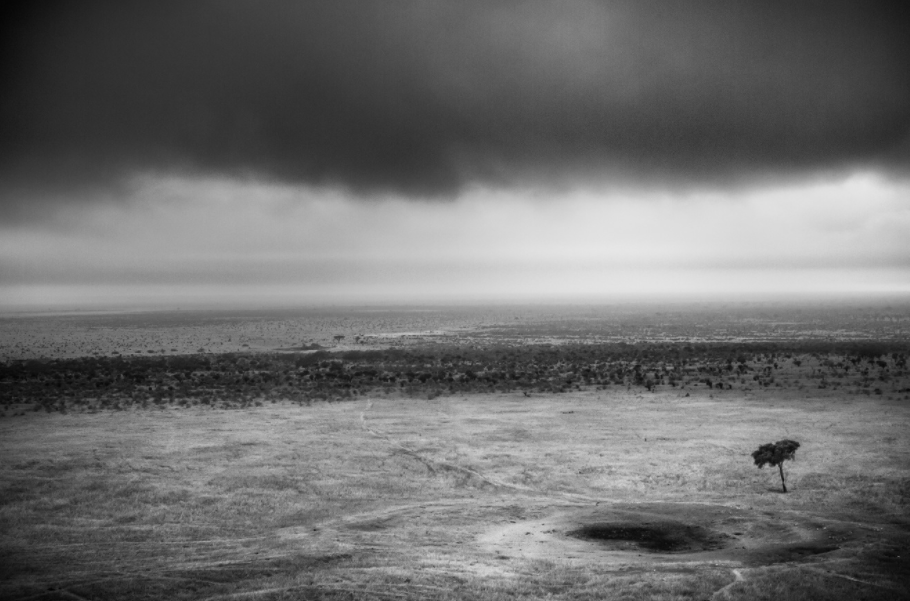
Early morning at Tsavo. There is always magic in the first hours of the day.
THIS ARTICLE WAS ORIGINALLY PUBLISHED ON MAPTIA.
FRAN PROVEDO
Fran Provedo is a photographer and Architect from Argentina. Passionate about nature, and what is invisible in it.

People don't take trips. Trips take people.

What are ALL voluntourists good at?
In recent years Voluntourism it has gotten a bad name. There are a lot of valid reasons that people have been turned off by voluntourism, including:
- voluntourism’s potential to foster colonialist attitudes and cause harmful side effects (as in Illich’s thoughts on Peace Corps)
- projects which place unskilled foreign travelers in jobs requiring skilled laborers or taking away local jobs
- short term interactions with children without proper child protection policies (Some argue that English teaching is a great way to engage English-speaking travelers in volunteer work, and perhaps sometimes it is, but I feel that even this is not always a good fit. Often times native speakers know the language, but are not trained teachers and repeated short-term interactions can have harmful side effects for children.)
- volunteer placement agencies charging exorbitant fees from their overseas offices with little to no money reaching the development projects themselves (no need to link to a lot of them for examples, just google “volunteer abroad”!)
These reasons are some of the reasons that I too am skeptical of voluntourism initiatives. I have seen some damaging results of travelers philanthropy which did not embody effective voluntourism or development practices and ended up causing more harm than good. At PEPY, we have made many mistakes ourselves, especially in our first few years of operations where we designed trips for tourists to “teach and give” rather than “learn and support” and where we designed trips around the needs and demands of travelers rather than those of the communities we were working with. Many of our initial mistakes are highlighted in the documentary “Changing the World on Vacation” by Deeda Productions. Although watching some of your mistakes on TV and seeing yourself say some ridiculous things you no longer believe in is not a fun pass time, I appreciative that filmmaker Daniela Kon’s work will serve as a learning tool for many others and reminder to me about the lessons we have learned.
As we have examined at the hands-on service portions of our trips looking to find the most useful way to engage tourists in something they are skilled at, we asked ourselves: What ARE all tourists experts at?
The answer we came up with is this: All tourists are experts at being tourists! Of course!
They know what THEY want when they travel, and that knowledge is often the missing key to successful community based tourism initiatives. Now of course, you and I don’t share the same wants/needs as every tourist and living in Cambodia with a huge child sex tourism industry, I surely wouldn’t want to take the opinions of all tourists to heart when developing new programs. I do though believe that if we find similar minded people looking for an eco-friendly and responsible adventure, one very useful skill they all can bring is the ability to give their feedback and ideas about how to design such a trip.
Tourists can use these skills to help local communities who have a tourism product to offer but are perhaps lacking the experience to market or tailor the trip to tourists. They can also help promote positive environmental practices by highlighting their desire to see natural environments and physical and cultural preservation in the countries they visit.
By matching travelers up with community based tourism initiatives, we hope to improve the whole adventure tourism supply chain by:
- giving thorough feedback and ideas for improvement to community based tourism initiatives and groups looking to offer such products
- offering marketing advice
- promoting positive environmental practices and preservation initiatives
- creating informational and promotional material for the organizations we believe in from signs helping travelers find their way to the site to English language placards or hand-outs describing the locations highlights in areas where English speaking guides might not be available
- Physically helping to improve offerings in the area (constructing signage, cleaning surroundings, beautifying local infrastructure, building safety or protective tools such as fencing or walkways, etc)
We believe that, by designing trips which improve the local adventure tourism supply chain, we can place travelers in a position where both their time and funding are valuable while also helping to ensure that tourism dollars support local initiatives.
We have done some of this in the past, but had not embraced the concept of “using voluntourists as tourists” as much as we currently are in our upcoming tours. Our updated website (coming soon!) will highlight these offerings. In the meantime… what do you think? No, it’s not building a house for a family nor petting kids in an orphanage, so it might not have the same appeal as other offerings, but we believe that if we highlight the added value travelers can bring to responsible (aka. well-vetted) community tourism programs, people will be excited to support these programs.
What do YOU think?
THIS ARTICLE WAS ORIGINALLY PUBLISHED ON LESSONS I LEARNED.

DANIELA PAPI
Daniela is the Deputy Director of the Skoll Centre for Social Entrepreneurship. She has spearheaded student programming initiatives at Saïd Business School including the Leading for Impact programme and had taught on MBA courses including the Entrepreneurship Project and a course on high-impact entrepreneurship. Daniela is a graduate of Saïd Business School's MBA programme and was a Skoll Scholarship recipient.
Prior to coming to Oxford, Daniela spent six years in Cambodia where she grew a youth leadership organization, PEPY, an educational travel company, PEPY Tours, and an advocacy organisation, Learning Service. Daniela is co-authoring a book advocating for a 'Learning Service' approach to philanthropic and volunteer travel and has worked as a consultant to other social impact organizations, typically supporting their strategy redesign by incorporating her experience in social marketing and user-centered programme design. She recently wrote a report called 'Tackling Heropreneurship' focused on fuelling collective impact through an 'apprenticing with a problem' approach.
Check out Learning Service for more.
Rewriting the Code in Africa
Vulnerable girls and young women in Africa are being given a unique chance to learn vital technology skills in a safe space through an innovative pilot project launched by the charity Theirworld.
Code Clubs are low-cost, sustainable and scaleable safe spaces where girls can build, learn and create through technology, creativity and coding.
Theirworld - the charity behind A World at School - is launching Code Clubs in partnership with Kano, Codeacademy and Africa Gathering.
Voluntourism: What Could Go Wrong When Trying to Do Right?
Here are some of the common problems I have seen in the voluntourism market and some tips for travelers on how to choose the right program.
Read MoreTogether: Ending Child Marriage in Zambia
Mirriam is a 17-year-old who, like any other teenager, has ambitions and dreams. She wants to become a doctor. However, where Mirriam lives, child marriage and poverty threaten her chances of getting the education she needs and the future she dreams of.
Together: Ending Child Marriage in Zambia is a short documentary that asks what can be done to enable girls like Mirriam to avoid child marriage and fulfil their potential?
It tells the story of partnership, of how civil society activists, girls, traditional leaders, and the government are coming together to make sure that no girl is married as a child.
If a movement can gain momentum in a country where rates of early marriage are among the highest in the world, then perhaps we can pave the way for change not only in Zambia but far beyond.
Together: Ending Child Marriage in Zambia shows how by working in partnership we can put an end to child marriage in one generation, and ensure that every girl, like Mirriam, can have a bright future.
This film features the work of Girls Not Brides members in Zambia including the Forum for African Women Educationalists Zambia (FAWEZA), Population Council and YWCA Zambia.