• Travel Features
  • Global Action
  • Take A Trip
  • Travel Guides
    • Podcast
    • Courses
    • Bookshop
  • About
  • Sign Up
Menu

CATALYST PLANET

  • Travel Features
  • Global Action
  • Take A Trip
  • Travel Guides
  • Discover
    • Podcast
    • Courses
    • Bookshop
  • About
  • Sign Up

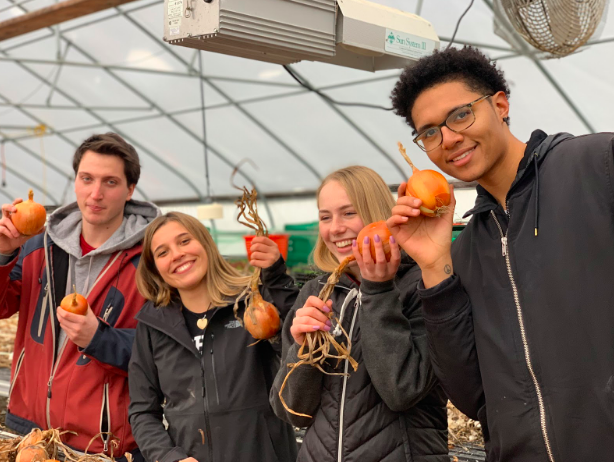
Eco-Gap Participants in the Greenhouse. Photo provided by Eco-Gap.

Take a Gap Year to Learn about Yourself and the Environment

June 4, 2019

Gap years are on the rise. More and more, young adults are being encouraged to defer their acceptance to college to take a break from the grind of school, mature, and learn more about themselves. For some, taking a gap year serves as an introduction to living away from home. For others, a gap year provides work experience, and the opportunity to make extra cash to pay for college and other expenses. Articles and opinion pieces are frequently being published, attesting to a gap year’s ability to provide crucial preparation for college.

But gap years can serve a purpose other than bettering oneself. Some gap year programs have been created with the goal of fostering a generation of environmentally aware young adults. These programs have an eco-focus, encouraging their participants to live socially and environmentally conscious lifestyles.

International School for Earth Studies

The Cushing family runs the International School for Earth Studies in Southern Alberta. According to Co-Founder, CEO, and Director of Operations Geoffrey Cushing, he and his family were, and remain, “Eco-tourism pioneers.” The International School for Earth Studies run programs that educate and connect people to the environment. They accepted their first gap year student in 2005, and they have maintained a vibrant program ever since.

At the core of their gap year program are four pillars:

  1. Environmental Literacy

  2. Self Defense

  3. (Non Motorized) Outdoor Recreation

  4. Animal connection

The International School for Earth Studies runs two sessions of gap year programs: an Autumn and a Winter session. In addition to living and learning on the institution’s immense property that includes a private lake, diverse animals, and a stable, participants travel to other important places such as the Great Lakes, and the largest concentration of power plants in North America. The gap year students will learn from knowledgeable and experienced staff and speakers, including first nation biologists.

Geoffrey explained that students experience an “immersion into an outdoor lifestyle,” as students spend six to eight hours a day working outdoors. A typical day is split up into morning, afternoon, and evening sessions. In the morning and afternoon, participants will learn how to work and connect with animals, or develop outdoor survival techniques. Evening sessions are more discussion based. Sometimes, participants will stargaze. Other times, a participant will lead a discussion. Geoffrey said that the discussions can get particularly deep and emotional.

Geoffrey hopes that participants will leave this program as more educated global citizens, and will feel the urgency of Earth’s environmental situation. “We feel that the world is in crisis environmentally,” Geoffrey said. “We try to use animals, the voiceless, as the platform for our students to realize how desperate the situation is.”

Eco-Gap at EcoVillage at Ithaca

Ecovillage at Ithaca, NY is comprised of three neighborhoods organized as housing cooperatives. Learn@ecovillage’s gap year program is brand new, they just initiated their first cohort last year.

Liz Walker, Director and Co-Founder of EcoVillage explained that Eco-Gap is unique, as it is set in the Ecovillage, a community that is completely environmentally oriented. Participants live with families in the communities.

There are two opportunities for gap year students:

  1. The Eco-Gap immersion program

  2. The Eco-Gap internship program

The Eco-Gap immersion program is an eight-week structured program in the fall, for a small cohort of eight participants. Liz outlined the major, and varied, components of the Eco-Gap immersion program:

  1. Agriculture: local food and farming. Participants will work on the Ecovillage’s four organic farms, and learn to prepare food for themselves and for the needy.

  2. Health and Wellness: Participants will learn yoga and meditation skills, as well as tap into their own artistic creativity,

  3. Building Skills: Participants will learn about green building, and learn carpentry skills to build their own small shed.

  4. Living and leadership skills: Participants will learn how to express themselves fully, and how to deal with conflict through non-violence.

For those that want more work experience, or a more flexible timeline, the Eco-Gap internship program offers individual mentoring.

Through Eco-Gap’s programming, Liz aims to teach from a “context of environmental and social sustainability and social justice.”  Her goal is that her participants “obtain practical skills for transforming oneself and the world.”

These are just two examples of environmentally focused gap year programs. There are more out there, all around the world. Additionally, gap year students can volunteer for the environment independently, without an organized program.


Eliana Doft

Eliana Doft loves to write, travel, and volunteer. She is especially excited by opportunities to combine these three passions through writing about social action travel experiences. She is an avid reader, a licensed scuba diver, and a self-proclaimed cold brew connoisseur. 

In World and Travel, Outdoor Adventure and Wildlife Tags gap year, nature, learn, sabbatical, leadership, skills, program, Environment, Future Forward
Comment

What are ALL voluntourists good at?

March 29, 2017

In recent years Voluntourism it has gotten a bad name.  There are a lot of valid reasons that people have been turned off by voluntourism, including:

  • voluntourism’s potential to foster colonialist attitudes and cause harmful side effects (as in Illich’s thoughts on Peace Corps)
  • projects which place unskilled foreign travelers in jobs requiring skilled laborers or taking away local jobs
  • short term interactions with children without proper child protection policies (Some argue that English teaching is a great way to engage English-speaking travelers in volunteer work, and perhaps sometimes it is, but I feel that even this is not always a good fit. Often times native speakers know the language, but are not trained teachers and repeated short-term interactions can have harmful side effects for children.)
  • volunteer placement agencies charging exorbitant fees from their overseas offices with little to no money reaching the development projects themselves (no need to link to a lot of them for examples, just google “volunteer abroad”!)

These reasons are some of the reasons that I too am skeptical of voluntourism initiatives. I have seen some damaging results of travelers philanthropy which did not embody effective voluntourism or development practices and ended up causing more harm than good.  At PEPY, we have made many mistakes ourselves, especially in our first few years of operations where we designed trips for tourists to “teach and give” rather than “learn and support” and where we designed trips around the needs and demands of travelers rather than those of the communities we were working with.  Many of our initial mistakes are highlighted in the documentary “Changing the World on Vacation” by Deeda Productions. Although watching some of your mistakes on TV and seeing yourself say some ridiculous things you no longer believe in is not a fun pass time, I appreciative that filmmaker Daniela Kon’s work will serve as a learning tool for many others and reminder to me about the lessons we have learned.

As we have examined at the hands-on service portions of our trips looking to find the most useful way to engage tourists in something they are skilled at, we asked ourselves: What ARE all tourists experts at?

The answer we came up with is this: All tourists are experts at being tourists!  Of course!

They know what THEY want when they travel, and that knowledge is often the missing key to successful community based tourism initiatives. Now of course, you and I don’t share the same wants/needs as every tourist and living in Cambodia with a huge child sex tourism industry, I surely wouldn’t want to take the opinions of all tourists to heart when developing new programs. I do though believe that if we find similar minded people looking for an eco-friendly and responsible adventure, one very useful skill they all can bring is the ability to give their feedback and ideas about how to design such a trip.

Tourists can use these skills to help local communities who have a tourism product to offer but are perhaps lacking the experience to market or tailor the trip to tourists.  They can also help promote positive environmental practices by highlighting their desire to see natural environments and physical and cultural preservation in the countries they visit.

By matching travelers up with community based tourism initiatives, we hope to improve the whole adventure tourism supply chain by:

  • giving thorough feedback and ideas for improvement to community based tourism initiatives and groups looking to offer such products
  • offering marketing advice
  • promoting positive environmental practices and preservation initiatives
  • creating informational and promotional material for the organizations we believe in from signs helping travelers find their way to the site to English language placards or hand-outs describing the locations highlights in areas where English speaking guides might not be available
  • Physically helping to improve offerings in the area (constructing signage, cleaning surroundings, beautifying local infrastructure, building safety or protective tools such as fencing or walkways, etc)

We believe that, by designing trips which improve the local adventure tourism supply chain, we can place travelers in a position where both their time and funding are valuable while also helping to ensure that tourism dollars support local initiatives.

We have done some of this in the past, but had not embraced the concept of “using voluntourists as tourists” as much as we currently are in our upcoming tours. Our updated website (coming soon!) will highlight these offerings.  In the meantime… what do you think?  No, it’s not building a house for a family nor petting kids in an orphanage, so it might not have the same appeal as other offerings, but we believe that if we highlight the added value travelers can bring to responsible (aka. well-vetted) community tourism programs, people will be excited to support these programs.

What do YOU think?


THIS ARTICLE WAS ORIGINALLY PUBLISHED ON LESSONS I LEARNED.


DANIELA PAPI

Daniela is the Deputy Director of the Skoll Centre for Social Entrepreneurship. She has spearheaded student programming initiatives at Saïd Business School including the Leading for Impact programme and had taught on MBA courses including the Entrepreneurship Project and a course on high-impact entrepreneurship. Daniela is a graduate of Saïd Business School's MBA programme and was a Skoll Scholarship recipient. 

Prior to coming to Oxford, Daniela spent six years in Cambodia where she grew a youth leadership organization, PEPY, an educational travel company, PEPY Tours, and an advocacy organisation, Learning Service. Daniela is co-authoring a book advocating for a 'Learning Service' approach to philanthropic and volunteer travel and has worked as a consultant to other social impact organizations, typically supporting their strategy redesign by incorporating her experience in social marketing and user-centered programme design. She recently wrote a report called 'Tackling Heropreneurship' focused on fuelling collective impact through an 'apprenticing with a problem' approach.

Check out Learning Service for more. 
 

In World and Travel, News and Social Action, Education and Empowerment Tags voluntourism, tourism, social action, social justice, helping people, skills, teaching, English, teaching English, Education, Travel, Volunteering, USA
Comment

Also check out...

Featured
Vietnam’s Floating Markets Are Disappearing
The Supernatural Role of Masks in Nigeria’s Yoruba Tribal Culture
Opening the World to Deaf Travelers with Lily Yu

Featured trips

Featured
Offer NGO Support While Visiting Quito
Experience Life as a Mongolian Nomad
Help Grow Organic Costa Rican Coffee

Sign up for the CATALYST newsletter

Sign up for our newsletter to get the scoop on international travel, global social impact insights, our latest podcast releases, and more from around the world, all delivered right to your inbox!

We respect your privacy.

Thank you!
Newsletter Sign Up | Advertise | Careers + Internships | Privacy Policy | Submissions | Contact Us

Copyright © 2025, MISSION MEDIA LLC. All rights reserved.