

An estimated 100 million older people are living on less than $1 a day. Older people are among the poorest and most marginalized in many countries. Older people, especially older women, play key roles as caretakers in support of people with HIV/AIDS and orphaned grandchildren. The nonprofit HelpAge is a network of organizations promoting the right of all older people to lead dignified, healthy and secure lives.
VIDEO: Age Demands Action
VIDEO: Investing in Abuse in India
The Korea-based POSCO Corporation is pursuing a project in Odisha, India, that is resulting in the violation of human rights. If the project proceeds as planned, some 22,000 people risk being forcibly evicted from their lands and dispossessed from their means of livelihood. POSCO's investors have responsibilities to ensure that the company respects human rights, and to ensure that abuses to not take place in their name.
VIDEO: Mothers Fight Against Monsanto in Argentina
Sofia Gatica led a grassroots movement of mothers to protest the spraying of monsanto pesticide products on genetically modified soy crops in her region of Ituzaingo, Argentina. Their efforts led to a study that determined the cancer rate in their area was 40x the national average. After 10 years, they succeeded and laws changed. Now they cannot spray within 2500 meters of homes. She is the winner of the Goldman Environmental Prize.
Kicking the Habit: Air Travel in the Time of Climate Change
Air travel is neither just nor sustainable. So how can environmental justice activists make a global difference?
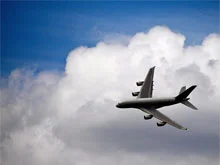
We live in a time of far-flung relationships, our families, colleagues, and friends often spread out across continents. These relationships mirror the global nature of many of our most pressing problems, such as global climate change—and they also contribute to those problems.
In Eaarth: Making a Life on a Tough Planet, Bill McKibben likens the biosphere to “a guy who smoked for forty years and then he had a stroke. He doesn’t smoke anymore, but the left side of his body doesn’t work either.” This new world, he says, requires new habits.
And, no doubt, many of us have adopted new habits—trying to use public transportation, buying local foods, rejecting bottled water. But the “savings” from such practices are wiped out by a habit that many of us not only refuse to kick, but also increasingly embrace: flying, the single most ecologically costly act of individual consumption.
Flights of Privilege
A round-trip flight between New York and Los Angeles on a typical commercial jet yields an estimated 715 kilos of CO2 per economy class passenger, according to the International Civil Aviation Organization.
Only 2-3 percent of the world’s population flies internationally each year, but the climate impacts are felt by a much larger—and poorer—population.
But due to the height at which planes fly, combined with the mixture of gases and particles they emit, conventional air travel has an impact on the global climate that’s approximately 2.7 times worse than its carbon emissions alone, says the Intergovernmental Panel on Climate Change. As a result, that roundtrip flight’s “climatic forcing” is really 1,917 kilos, or almost two tons, of emissions—more than nine times the annual emissions of an average denizen of Haiti (as per U.S. Department of Energy figures).
Only 2-3 percent of the world’s population flies internationally on an annual basis, but the climate impacts of air travel are felt by a much larger—and poorer—population. It is difficult to illustrate the meaning of such numbers in terms of who among the planet’s citizens pays the costs.
But this is exactly what the 2009 German short film The Bill does in powerfully demonstrating the ecological privilege and disadvantage embodied by flying. In doing so, it shows aviation to be a classic example of how the comparatively well-off privatize benefits of environmental resource consumption (the ability to travel quickly and afar) while socializing the detriments. By making a disproportionate contribution to climate destabilization and associated forms of environmental degradation—biodiversity loss, rising sea levels, and desertification, for instance—air travelers exacerbate the precarious existence of the most vulnerable. In doing so, they contribute to unjust hierarchies (e.g. racism and imperialism) that reflect a world of profound inequality.
Global Organizing—Without Planes
Clearly this presents a huge challenge to social and environmental justice advocates, activists, and organizers from the planet’s relatively wealthy areas who often connect to distant peoples and places by flying. Because the institutions and individuals most responsible for our global predicaments typically exercise mobility and exert their power across great distances, those of us who want to challenge their practices often must also do so. So what to do?
One option is to use transportation that stays on the Earth’s surface, to accept traveling more slowly, and to make flying a very rare exception instead of the rule. Throughout North America, buses—and, in many places, trains—are viable options. And for transoceanic voyages, ships (including freight ones) are a possibility—albeit not typically inexpensive or as common as they need be.
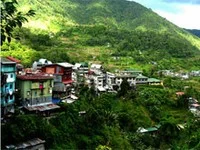
In an increasingly vulnerable world, we’re searching for rooted communities—and what we can learn from them.
Another option—indeed an obligation in a time of growing ecological destruction and a degraded resource base—is to stay home more often. Given that “jet travel can’t be our salvation in an age of climate shock and dwindling oil,” McKibben writes, “the kind of trip you can take with a click of a mouse will have to substitute.” In other words, we have to become much better at exploiting the “trips” that the Internet and related technologies afford—by videoconferencing, for example.
While such options present numerous challenges, not least logistical ones, perhaps the biggest obstacle is the particular way of seeing and being common to the small slice of the world’s population that flies regularly. Traveling long distances by bus, train, or ship, for example, necessitates time—and a willingness to expend it in manners that those from the world’s privileged parts and sectors are not used to doing. It doesn’t necessarily entail doing less, but it does mean doing things in different ways.
A New Normal
It also calls for new mechanisms and institutions—and some organizing to bring them about. Take long-distance travel by ship. Less than a century ago, many regular folks traversed the seas—think of immigrants to Angel and Ellis islands. And many well-known organizers and activists—Gandhi, Helen Keller, and W.E.B. Dubois, to name just three—journeyed extensively by ship.
To do so today, of course, is far more difficult as jet travel has greatly weakened the passenger ship option. But what if, for instance, U.S. and Canadian activists and advocates going to Denmark for the Dec. 2009 climate summit had, instead of booking individual flights, organized to travel together by ship—with all promising to get to and from their ports of call by surface-level transportation? And what if they had publicized this effort as a way of setting an example for, and challenging, others?
That such a suggestion will seem unrealistic, if not foolhardy, to many illustrates the way that what we’re used to thinking of as normal can stifle our imaginations, and let us off the political, ecological, and ethical hook. The option is as “realistic” as we make it. In this regard, we need to push and support one another in the effort to make far-reaching alternatives viable.
What we’re used to thinking of as normal can stifle our imaginations, and let us off the political, ecological, and ethical hook. The option is as "realistic" as we make it.
Climate science tells us that we need a 90 percent cut in greenhouse gas emissions over the next few decades to keep within a safe upper limit of atmospheric carbon. In light of the great changes such a reduction demands, what is unrealistic and foolhardy is the notion that we can continue flying with abandon.
Interested?
• We thought we had 20, 30, 50 years to take on the climate crisis. We were wrong. The scary science, smart policies, and critical actions that could still avert disaster.
• Bill McKibben imagines himself in the year 2100, looking back at a century of climate chaos and asking: What did it take to save the world?
THIS ARTICLE WAS ORIGINALLY PUBLISHED ON YES MAGAZINE.

JOSEPH NEVINS
Joseph Nevins wrote this article for YES! Magazine, a national, nonprofit media organization that fuses powerful ideas with practical actions. Joseph is a geography professor at Vassar College. Among his books is Dying to Live: A Story of U.S. Immigration in an Age of Global Apartheid (City Lights Books/Open Media).
Flip Your Map and Up Your Impact
Part 1 of a 2-part series on Maps
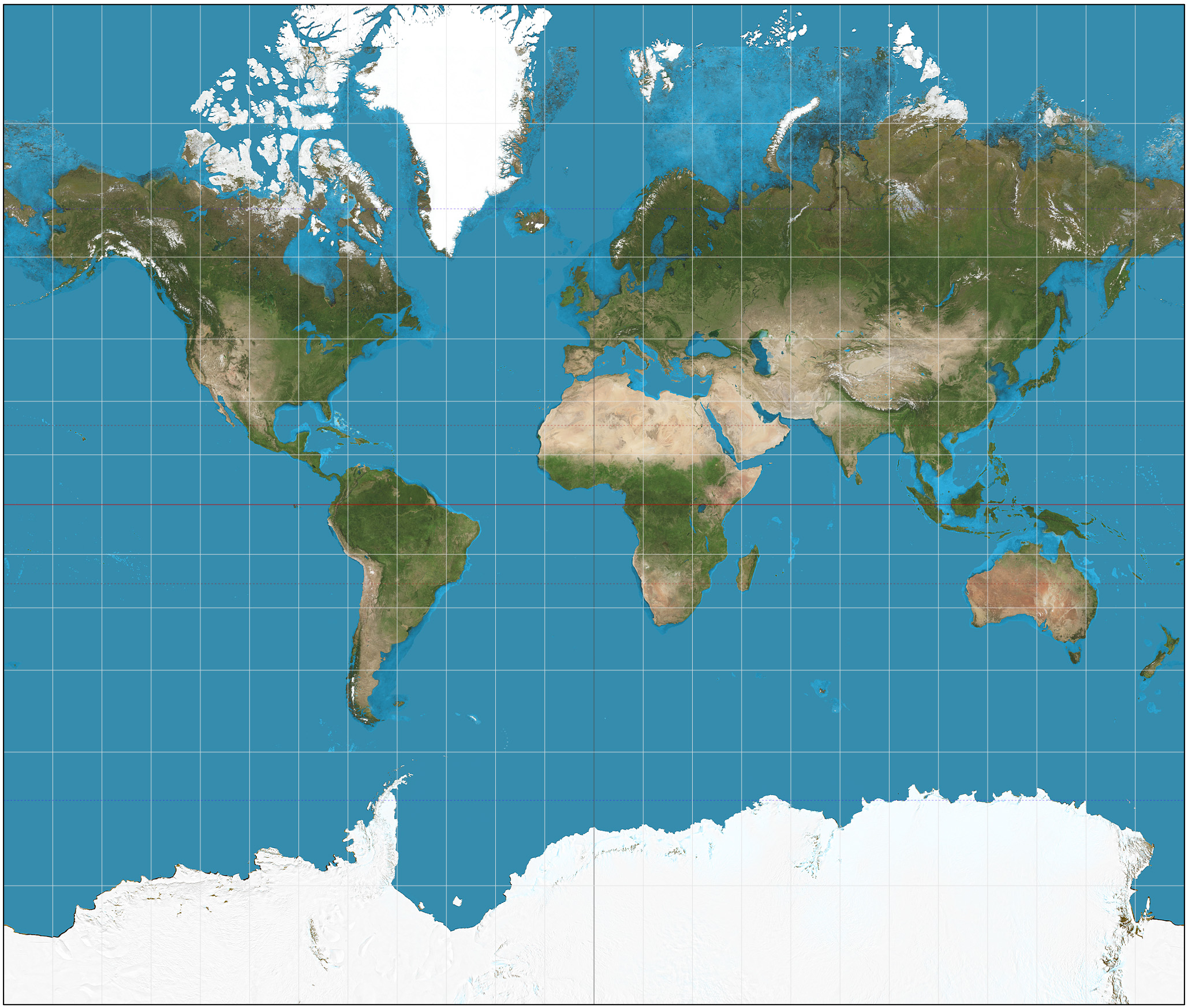
The map of the world.
When we look at the most commonly-seen map of the world, we assume that it depicts the earth as it truly is. But this particular projection of the world, like all others in existence, isn’t completely accurate, as it is impossible to avoid distortions when translating three dimensions into two. Known as the Mercator projection, this map was designed for navigation but distorts relative size, artificially enlarging land masses further from the equator. The result is more severe than you might imagine: Africa appears smaller than Greenland, when it is actually fourteen times larger. See this for yourself here.
There are many other, less common projections which you can explore here. Some are equal area projections, such as Gall-Peters, which manage to avoid the relative size distortion of Mercator but are then much less useful for navigation and less accurate with regard to shape. While the Mercator projection has been abandoned by atlases in favor of projections with more balanced distortion profiles, it is still used by popular online navigation tools such as Google Maps given its navigational prowess (unless you happen to be exploring one of the poles, where it is practically useless).
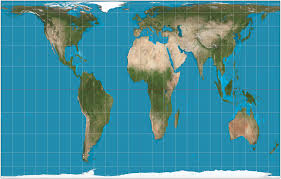
Gall-Peters Projection
The most commonly-seen map of the world also has a particular orientation and center: north-up and the Atlantic. Yet this framing is neither inevitable nor inherently more correct. Medieval maps were often East-up, Pacific-centered maps pop up in Asia, and a National Geographic feature on the world’s oceans opted to carve up continents instead of bodies of water.
As a result of the complex politics of map-making over time and the inertia of convention, the north-up, Atlantic-centered Mercator projection is the most prevalent, making it not only a navigation tool, but also the image of the world in our mind’s eye. But why does this matter? If all projections are distorted in some way, and orientation, although heavily influenced by historical political jockeying, is ultimately arbitrary, can’t we just continue using it?
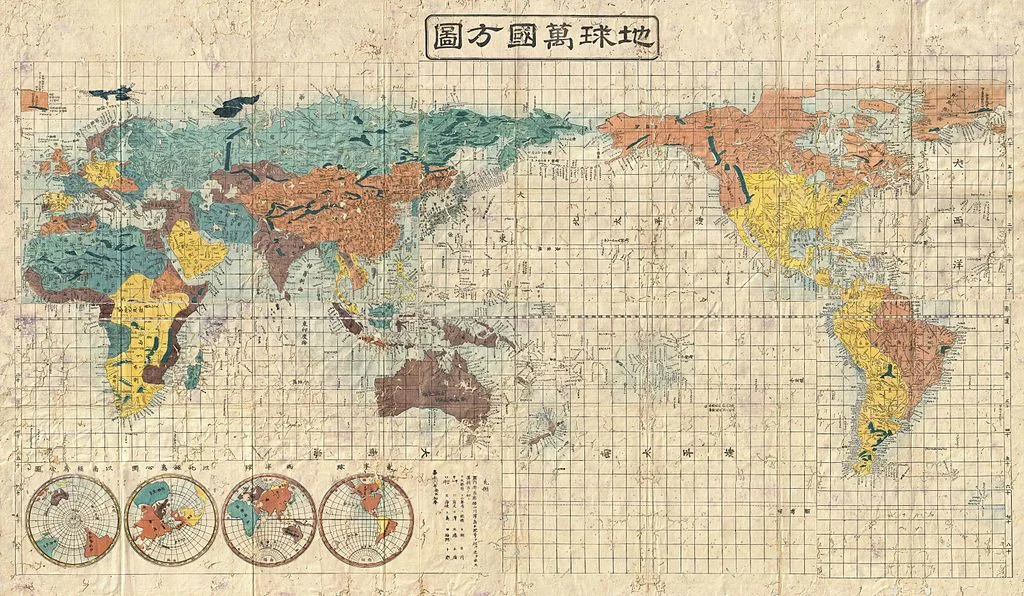
There is a big reason why this is not such a great idea: where things are on the map and how big they are in relation to other things affects what we think of them.
Research has shown that we (English-language users) tend to associate up with goodness and down with badness; think about upper and lower class, movement along the socio-economic ladder, “started from the bottom now we’re here”, the assumed location of heaven and hell, and the connotations of uptown and downtown. It has also shown that we tend to associate up with north and down with south (“up north”, “down south”) despite the fact that up/down is an orientation to gravity while cardinal direction is an orientation to the poles. When we are repeatedly exposed to the north-up world map, it reinforces the association of up with north and down with south, and therefore strengthens the association of north with the positive qualities associated with up, and south with the negative qualities associated with down. The popularity of the north-up map makes us more readily associate positive things with northern places.
We also tend to associate things in the center of an image with importance, and large objects with importance and strength. Overall, this means that we tend to equate things that occupy large, upper (northern), central places on the map with goodness, importance and strength; and things that occupy smaller, lower (southern) and peripheral places with badness, insignificance and weakness. It is therefore not surprising that some Australians, Asian states, geographers, educators, and even people on The West Wing have pushed for south-up, Pacific-centric and non-Mercator maps.
Now you might be thinking, but I know that those things don’t always match up! Rwanda has a higher percentage of female Members of Parliament than any other country on earth even though it’s in the Global South! China is hugely important in the global economy even though it’s on the periphery of the map! Israel is powerful even though its relatively small size is exaggerated by its proximity to the equator!
But these mental links, also called implicit associations, are mostly unconscious, and they show up in many areas of our lives even when we consciously know and believe that they aren’t correct. In other words, stereotypes and generalizations affect our decisions and behaviors even though we know they aren't always true. This insight comes from implicit association tests, which show that we are quicker and more accurate at sorting things into bins when the bins match up with unconscious associations in our brains, even when we report not having these associations. For example, when sorting words or images that are often perceived as fitting into just one of four categories - fat, skinny, good, bad - we tend to be faster and more accurate when we are putting items that we perceive as fat or bad into one box, and items that we perceive as skinny or good into the other box. We are on average slower and more likely to mess up when we instead have to sort into a box for skinny or bad items, and a box for fat or good items. And this happens even when we report that we don’t believe fatness is inherently associated with badness, or skinniness with goodness. See this for yourself by taking multiple versions of this test.
The most probable explanation for this phenomenon is that it's an evolutionary remnant, which in the earlier days of humanity helped to keep us alive by allowing us to quickly distinguish between safe and unsafe through stereotyping. But the modern-day implication is clear: even if we don't explicitly think that northern, central, or large countries are better, stronger and more important, associations between these categories probably lurk in our psyches. Where things are on the map and how big they are in relation to other things affects what we think of them regardless of whether or not we realize it’s happening. We don’t just shape maps, maps shape us.
These mental links may seem harmless, but researchers have suggested that implicit associations in general contribute to everything from childcare expectations for different genders to police brutality against people of color. They affect decisions like whether or not to cross the street when we see someone walking towards us, where to travel, and which deaths from terrorist attacks to change our profile pictures for.
The particular mental links created and reinforced by this map aren’t harmless either, as they correlate with current and historical global patterns. And when these mental links line up with what’s happening in the world, they perpetuate each other. Although it is sometimes quite handy that associations from our dominant map match reality, it is also limiting, as we tend to see characteristics of certain places as natural and normal, and the resulting global power dynamic as inevitable. For instance, this map and the associations it fortifies make it harder for us to imagine a world where the West (a confusing term generally used to refer to Northwestern Europe, the US and Canada) isn’t the most powerful and important group of countries. When we see things as inevitable and can’t fathom a different reality, we are less likely to intervene to change the course of history. We cannot go somewhere that we have not first traveled in our minds, and with maps reinforcing the status quo instead of igniting our imagination of how the world could be, we are more likely to perpetuate global systems of oppression.
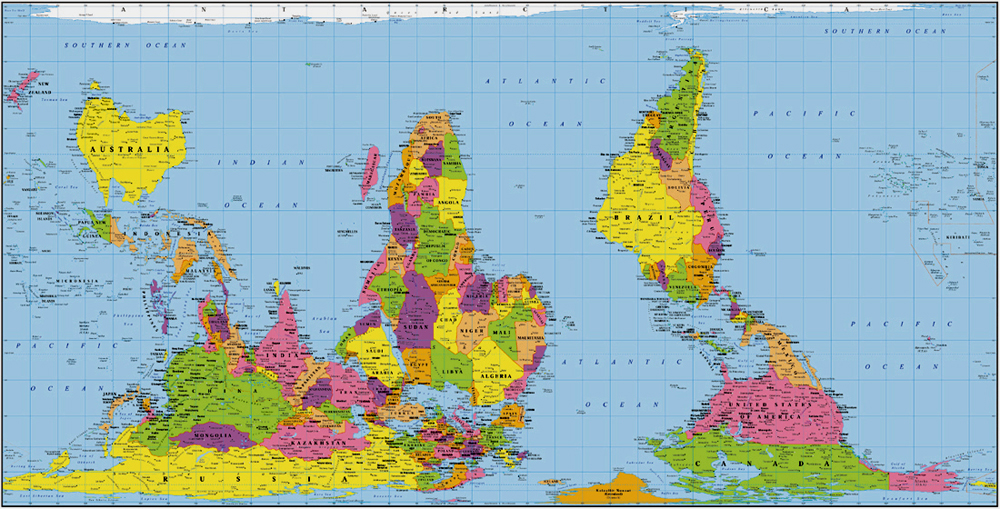
The mental links reinforced by repeated exposure to this map don't just prevent us from taking action, they can also lead us to take part in less-than-ideal action. For example, this particular map reinforces the belief that the West is inherently good and that all countries should strive for our way of life. This belief then informs actions in many sectors, from foreign policy to international development, often resulting in detrimental outcomes for people and planet. Individually, we are encouraged to engage in well-intentioned efforts such as teaching English, which, instead of indisputably beneficial, can be seen as an effort to make “them” more like “us”. Beliefs arising from the associations this particular map reinforces don’t just prevent us from changing things, they support harmful things happening right now.
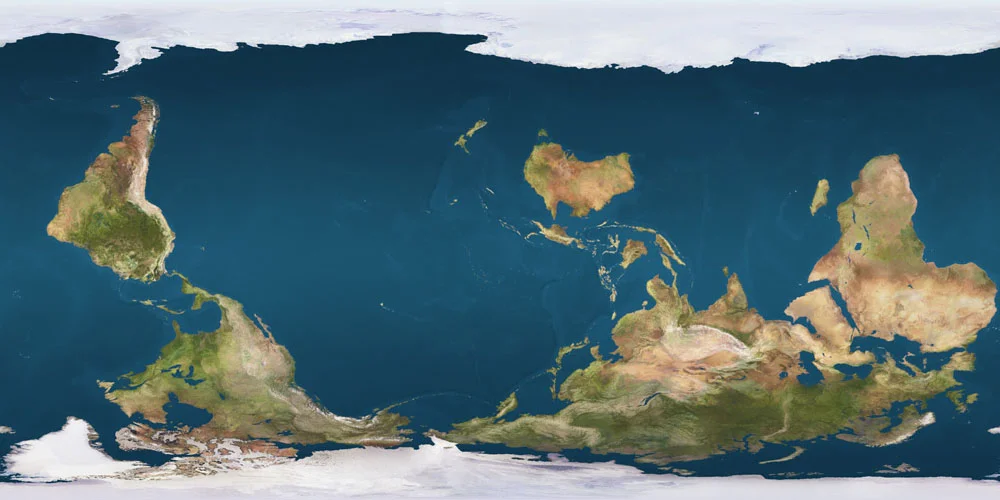
Instead of being held back by exclusive familiarity with only one of an infinite number of possible projections of earth, we can improve our chances of having a genuinely positive impact by changing our maps. We can continue to use Mercator projections for navigational purposes, but we should switch it up for non-navigational purposes. When hunting down the exact location of a current event you’re reading about, scroll over a pole in Google Earth to flip the world upside down. If you’re buying a world map poster to plan your next trip or track where you’ve been, consider a Gall-Peters projection, south-up or Pacific-centered map; all are relatively easily to find online.
Over time, as you expose yourself to different maps, your mental maps will shift, decreasing the power of certain associations and helping you combat your unconscious internal bias. While daily exposure to our culture and language makes it very hard to de-link up from good, and large and center from important and powerful, changing your maps can delink north from goodness, Africa from weakness, and Small Island States from insignificance (they are, after all, a key climate change frontline). Switching between maps will also remind you that the map is not the territory, and that all maps simultaneously obscure and illuminate. We can also expose ourselves to stories and other media that contradict these associations, a tactic which has been shown to reduce bias when measured with implicit association tests. Purposefully and regularly exposing yourself to other perspectives is also a good life practice, especially for people of privilege, and one of the things travel is perfect for.
SARAH LANG
Instigated by studies in Sustainable Development at the University of Edinburgh, Sarah has spent the majority of her adult life between 20+ countries. She is intrigued by the global infrastructure that produces inequality and many interlocking revolutionary solutions to the ills of the world as we know it. As a purposeful nomad on a journey to eradicate oppression in all its forms, she has worked alongside locals from Sweden to Zimbabwe. She is a lover of compassionate critique, aligning impacts with intentions, and flipping (your view of) the world upside down.
VIDEO: Migration vs. Traveling
“Migration vs Traveling” explores the double standards in the way we stereotype migrants as “something negative” and travelers as “something positive,” and proposes an idea on how to overcome them. This video was awarded the Prix de l'EYP 2015, the European Youth Press's award, for the best journalism on media freedom (category video), during the European Youth Media Days 2015 at the European Parliament in Brussels. It was also invited to be continuously screened to EU officials during the Dutch EU Presidency in the Netherlands in 2016.
Recording the Sounds of Extinction
Bernie Krause has been recording wildlife sounds, or "soundscapes," for over forty years. He's amassed the largest archive in the world, and in doing so, can chart how wildlife sounds have changed over the course of climate change. Listen for yourself: the rising silence speaks volumes.
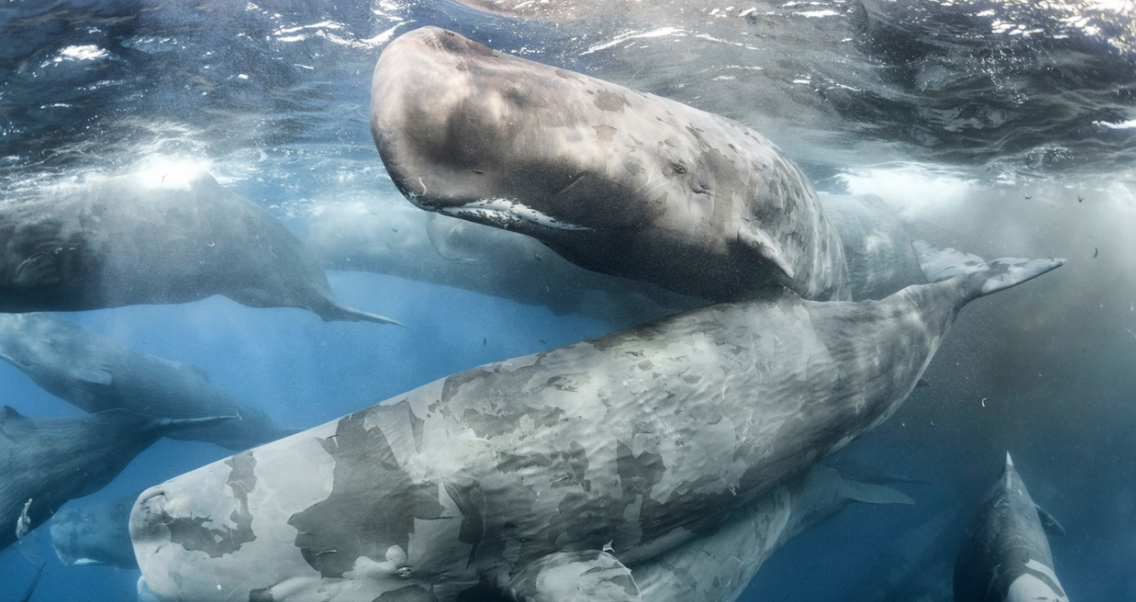
A Gathering of Giants
It was late afternoon and the sun was low in the sky.
I had spent the entire day, and many days prior, scanning the horizon for signs of life. My small boat bobbed up and down in the swell. Every now and then, a wave crest slapped its fiberglass hull, creating a resounding clap and shooting a curtain of spray skyward.
The shimmering glare of reflected tropical light was overwhelming. I squinted and rubbed my eyes, as a haze of brine and dissolved SPF 50 blurred my vision. When a faint puff of condensation shot into the air on the horizon, I thought it was a mirage, an artifact of fatigue and my compromised senses. But when I saw a second, I knew there was only one thing it could be—the exhalation of a surfacing whale. Excitedly, I counted a third, then a fourth, a dozen… no, hundreds!
That’s how I came to witness a phenomenon few have ever seen before. Skimming over the waves, I stopped the boat a short distance from where I had seen the whales’ last blow and slipped quietly into the sea.
I could scarcely believe my eyes.
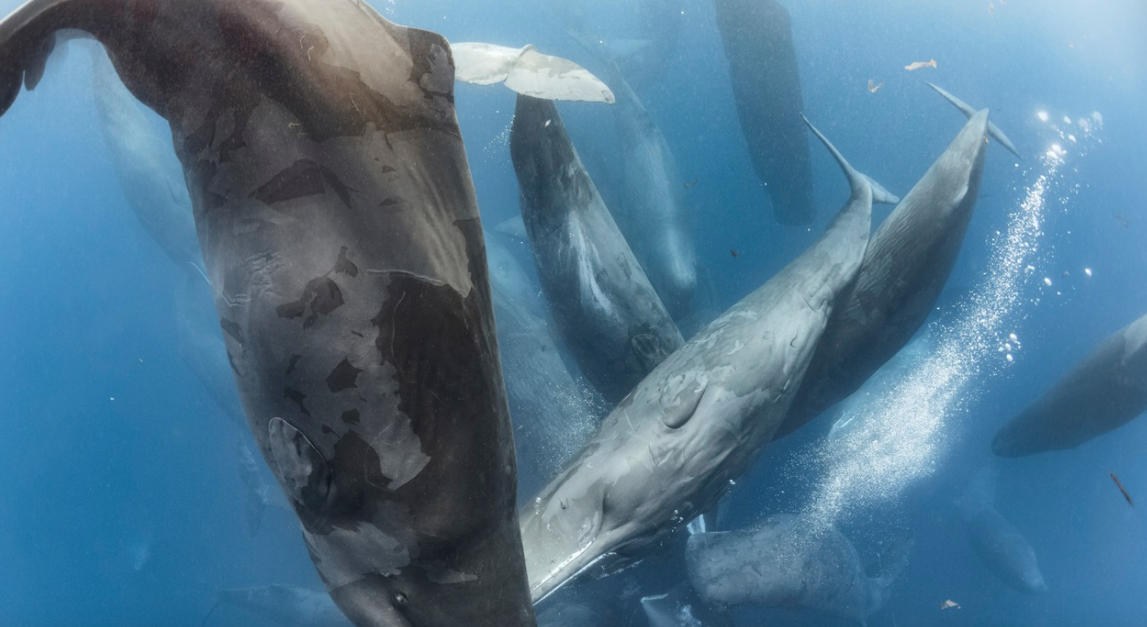
Spread across many square kilometers, this large cluster of sperm whales was part of an enormous gathering of hundreds, if not thousands, of individuals and family groups that were actively engaged in a frenzy of physical contact and biosonar communication.
Hundreds of sperm whales (Physeter macrocephalus) swam to and fro, their huge bodies elegantly twirling and twisting through the water as they socialized and communicated. Bumping, jostling, and rubbing themselves against one another, they were exuberantly tactile — their behavior appeared almost euphoric. I felt rather like a gatecrasher at a wedding, so obvious was their delight in each other’s company.
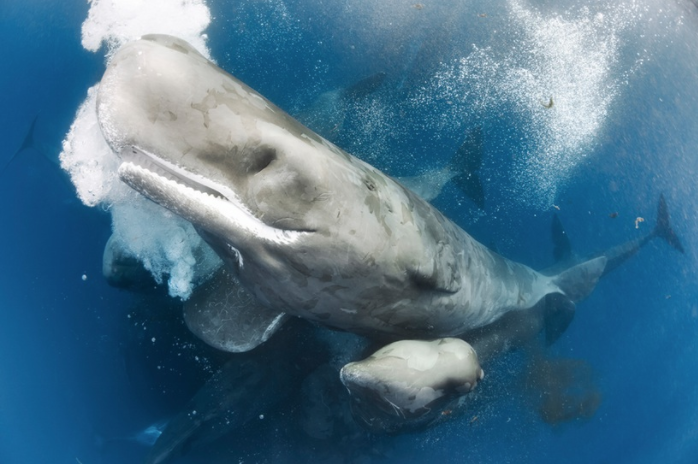
Part of the vast gathering of sperm whales, this family group made up of dozens of individuals clicked, blew bubbles, rubbed their bodies against one another, dived to forage for food, and defecated almost continuously.
As my eyes took in this secret spectacle, my ears were assaulted by a cacophony of excited whale chatter. Creaking and crackling, clicks, buzzes, and pops permeated the water as the whales pinged one another with sound. Pulsating rhythms pregnant with meaning penetrated the fibres of my body. I “felt” the connection between the congregated cetaceans as powerfully as I heard it. Moving together in groups several dozen strong, the whales occasionally descended to deeper water, but largely stayed near the surface, giving me a privileged view.
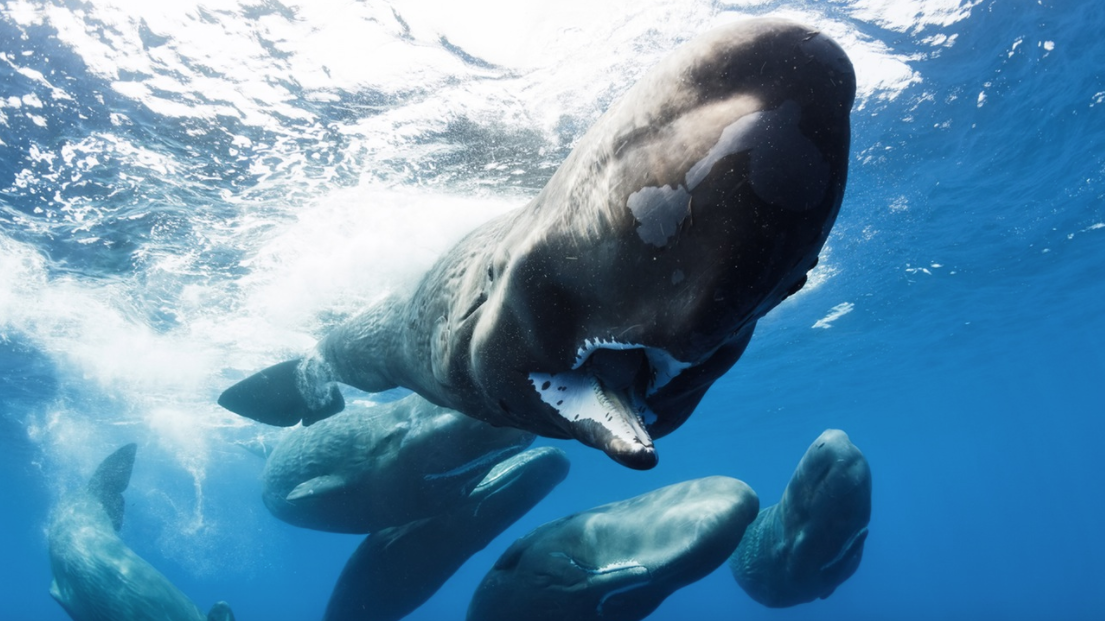
An inquisitive sperm whale calf approaches, buzzing me with biosonar. The calf was part of a family group of several adult females and three juveniles.
Watching carefully, I noticed that two other activities added to the commotion — sloughing of skin and defecation. Like other whales, sperm whales shed skin on a regular basis. It is thought that this may be a mechanism to reduce the risk of infection and to rid the animals of external parasites. As the whales rubbed against one another, the physical contact dislodged flakes, sometimes entire sheets, of skin, which floated in the water like a blizzard of translucent dandruff.
Group defecation also seemed to play a prominent role at this gathering. When a dozen or more whales defecated simultaneously, it created a cloud of poop that engulfed the ensemble, obscuring them from view and turning the seawater into an oily soup.
Although the reason for such behavior is not entirely understood, recent research suggests defecation by large marine mammals plays a vital role in the ocean’s nutrient cycle. Sperm whales, for instance, consume deep-dwelling squids. They then defecate near the ocean surface, releasing iron and other nutrients. This, in turn, supports plankton blooms that help to mediate the accumulation of carbon in the atmosphere.
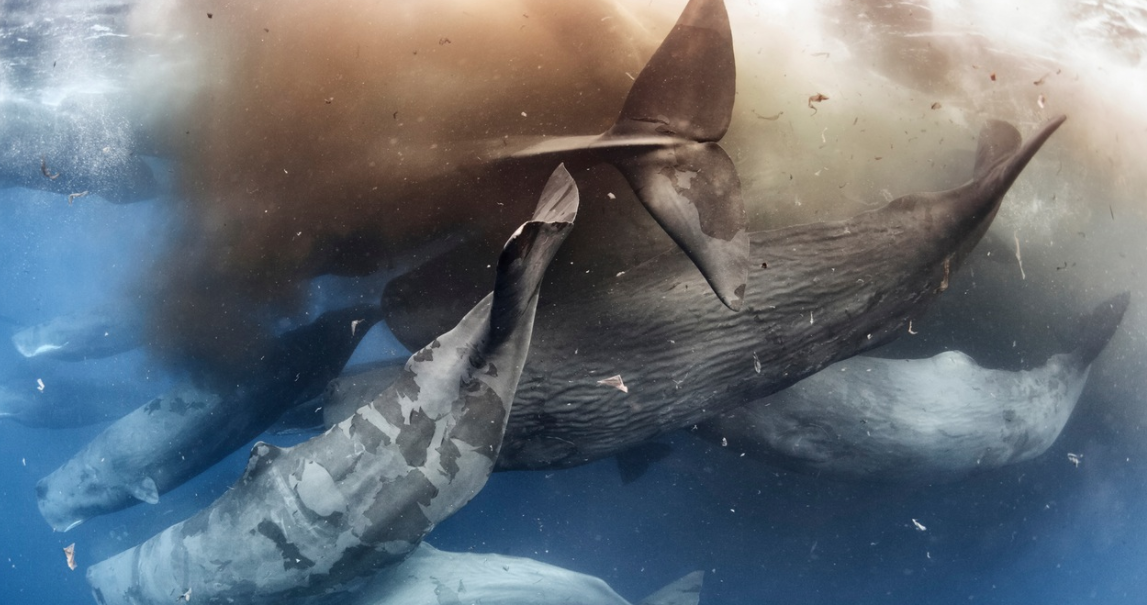
Sperm whales defecating while engaged in a massive social gathering. Defecation like this is common in sperm whale social gatherings, as is the shedding or ‘sloughing’ of skin, which further clouds the water in this shot.
To gain a deeper understanding of the factors that contribute to such spectacular aggregations of sperm whales, we need first to consider some basics of the species’ biology and social structure.
Sperm whales are mammals and live in almost every major ocean, including tropical and temperate waters. They breathe air and are warm-blooded. Yet they spend the majority of their lives in deep, dark, cold water foraging for food, often diving to depths of 800 meters or more in the process. It helps to think of them not as air-breathing animals that dive, but as creatures of the deep that occasionally visit the surface to breathe. In other words, the opposite of how humans relate to the ocean.
Unlike other whales, such as humpbacks, whose existence as it relates to food is best described as feast or famine, sperm whales forage constantly. But the ocean is a big place, and much of it is a nutritional desert, so they are most often found where there is abundant prey. They dine primarily on squid, although they have been known to eat fish and octopuses. These days, they also occasionally mistake plastic for prey.
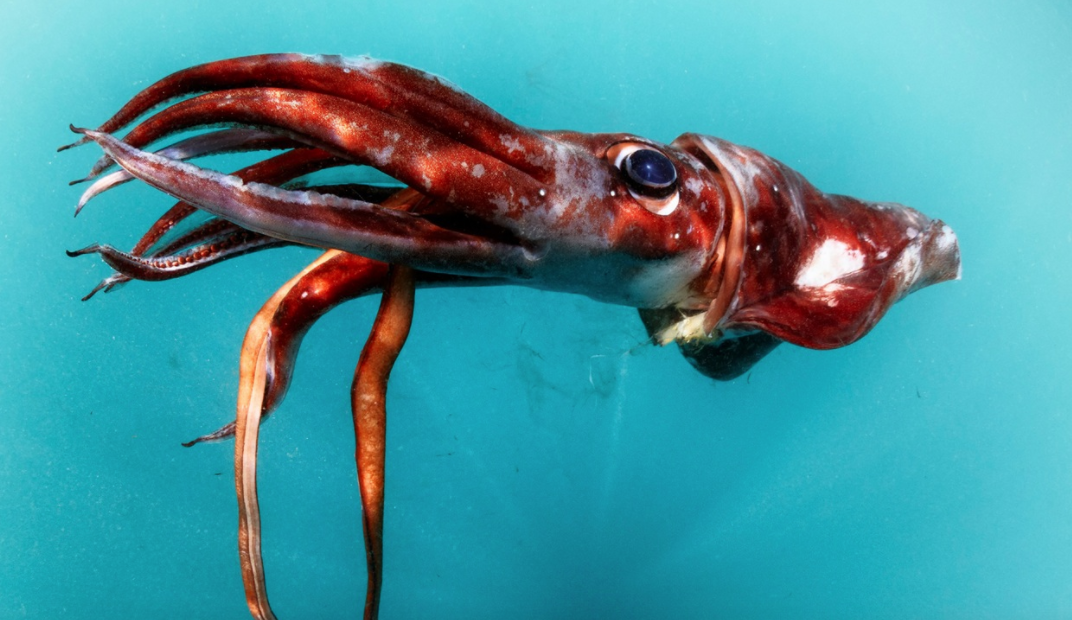
A dead Ancistrocheirus lesueuri squid, a cephalopod typically found at depths between 200 and 1000 meters. An important part of the sperm whale’s diet, this specimen was found at the surface, floating upside down, but it’s not known what killed this individual.
Sperm whale society is structured along matrilineal lines, with adult females and their offspring forming the basis of a social unit. Such units typically comprise a dozen or more individuals, though average numbers and unit structures vary across ocean basins. Female offspring generally stay with their social units, while males leave as they mature, striking out to form loose groups with other young males. Together, they seek out prey in the nutrient-rich waters of higher latitudes.
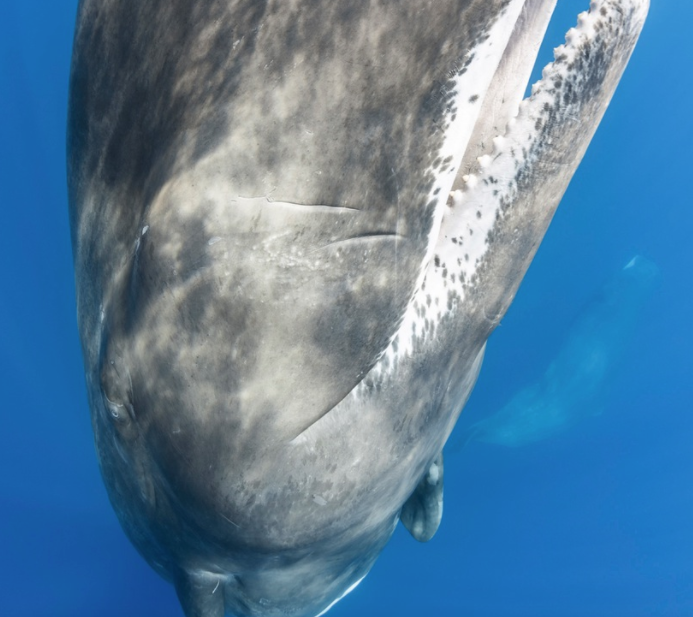
A curious adult sperm whale hanging just below the ocean surface, with two other members of her family group just visible. Note the whitened area around her mouth, typical of sperm whales, and also the teeth of her lower jaw. They do not have teeth in their upper jaw.
Recent research suggests that sperm whales organize their societies and keep tabs on one another using sound. Each individual uses its own “voice,” or acoustic signature, to identify itself, and each social unit uses a set of unique sounds, called codas, that are distinct from those used by other units. Going even further, multiple sperm whale social units that have similar codas, or “vocal dialects,” and socialize from time to time, are known as clans. These larger groupings of sperm whales, which can comprise many thousands of individuals scattered across vast regions of ocean, maintain a sense of extended group identity and long-term association through the use and recognition of similar codas.
Sperm whales appear to use acoustical hierarchy to establish identity on at least three levels — self, family, and extended group.
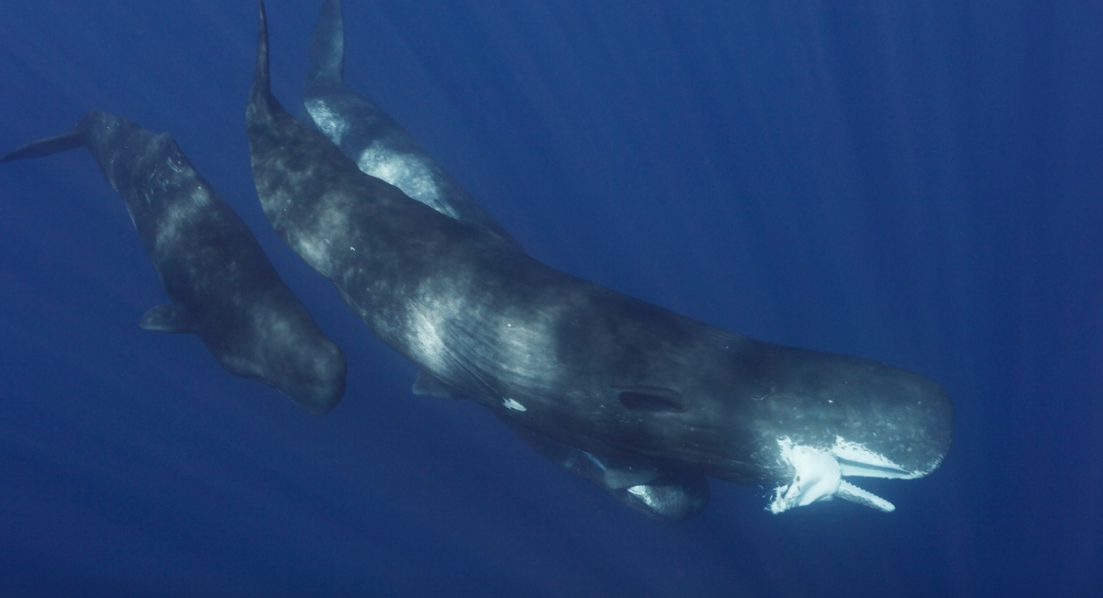
An adult female sperm whale—the dominant member of this group—carries a large piece of a giant squid brought up from the deep trench below. Members of the family played with leftover bits of the squid, shredding their meal, perhaps part of weaning the calf.
In light of these insights around communication and social structure, the factors that likely contributed to the incredible congregation of sperm whales I encountered that day become easier to understand.
Sperm whales tend to be found wherever the hunting is good—and so, predictably, I spotted the aggregation in a location with abundant squid prey. They are also highly social—and so an encounter involving multiple social units in a given clan produces a riot of sound and energy. It was, in a sense, a vast reunion with plenty to eat and communicate about. But why was a cetacean convention of such magnitude being held?
The short answer is, we don’t know.
Other social animals also engage in occasional, large, communal gatherings. Elephants, for example, have matrilineal social units and extended clans similar to those of sperm whales. During the dry season, large numbers of elephants aggregate around sources of water and families may take the opportunity to socialize.
But while there are many potential parallels between sperm whale gatherings and those of elephants, there isn’t enough data or even anecdotal observation at this stage for scientists to draw meaningful conclusions about sperm whale get-togethers.
Their exact purpose remains a mystery.

A family of sperm whales engaged in intense social activity, including a great deal of physical contact between individuals, and biosonar communication.
It is tempting to speculate that sperm whale gatherings like this may have been much more common in the days before industrialized whaling decimated their numbers. W.D. Boyer reported coming across an enormous gathering of sperm whales in Peru in 1945, just before the escalation of large-scale whaling. He wrote: “… the entire ocean, to all visible limits of the horizon, seemed spotted with them. The sum total was a school of gigantic proportions… It took the vessel nearly an hour to travel through the main body of the school…”
Although commercial hunting of sperm whales began in the 18th century, the majority of reported kills took place between 1950 and 1980 when harpoon guns became more widely used. Whaling records show that more than 638,000 sperm whales were killed during this period. Today, population estimates for sperm whales fall in the range of 300,000 to 400,000, significantly down from more than a million whales worldwide before large-scale hunting began in the last century. Sperm whales are currently classified on the IUCN’s Red List as Vulnerable.
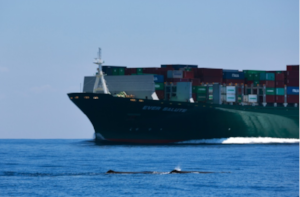
Two sperm whales surface in close proximity to a large commercial container vessel traveling at speed through a commercial shipping lane. Despite important gains in whale conservation efforts, lethal ship strikes continue to take a heavy toll on many whale populations.
Large-scale industrialized whaling ended relatively recently. Because sperm whales reach sexual maturity at a late age—around 10 years for females and up to 20 years for males—and because they produce few young, their recovery has been slow. But perhaps given time and steadily increasing populations, these large aggregations will occur and be documented more often.
Today, although widespread hunting is no longer an issue, sperm whales still face a litany of threats. Ship strikes cause terminal injuries, fishing gear strangles and entangles them, and ingested plastics block their guts, causing them to starve with full stomachs.
Earlier this year, when thirteen sperm whales beached themselves in Germany, researchers found plastic garbage in the stomachs of four of the dead whales. Trash ingested by the dead sperm whales included a nearly 13-meter-long (43-foot-long) shrimp fishing net, a plastic engine cover, and the remains of a plastic bucket. Though most people have never seen a sperm whale, the byproducts of our modern societies often reach marine mammals without our knowledge, and can have devastating effects.
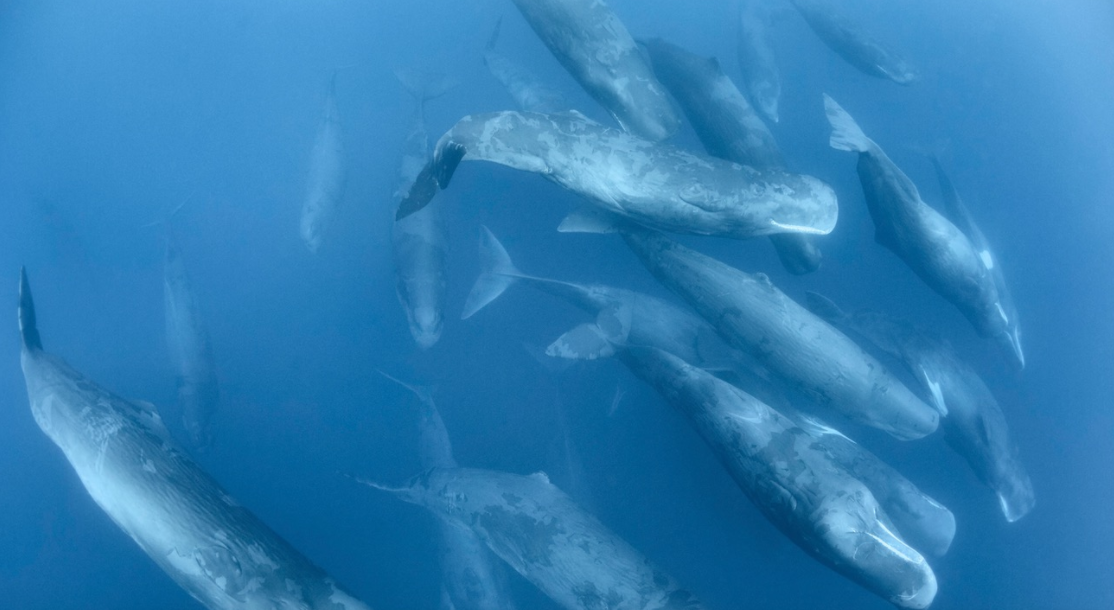
An aggregation of sperm whales engaged in social activity. This large gathering persisted for two days.
Humans have a long and checkered history with sperm whales. In the past, we feared them. We hunted and killed them. It is only relatively recently that we have taken the time to try to get to know them.
What we have learned is that far from being fearsome monsters intent on destroying ships, sperm whales are in fact highly intelligent creatures with complex social and cultural bonds, mediated by behavioral nuances that rival our own. And yet so much about them remains a mystery, including their spectacular and secret mass gatherings.
The fact that we understand so little about such large and magnificent animals as the sperm whale, despite our shared history and planet, leads one to wonder what else we don’t know about life in the ocean.
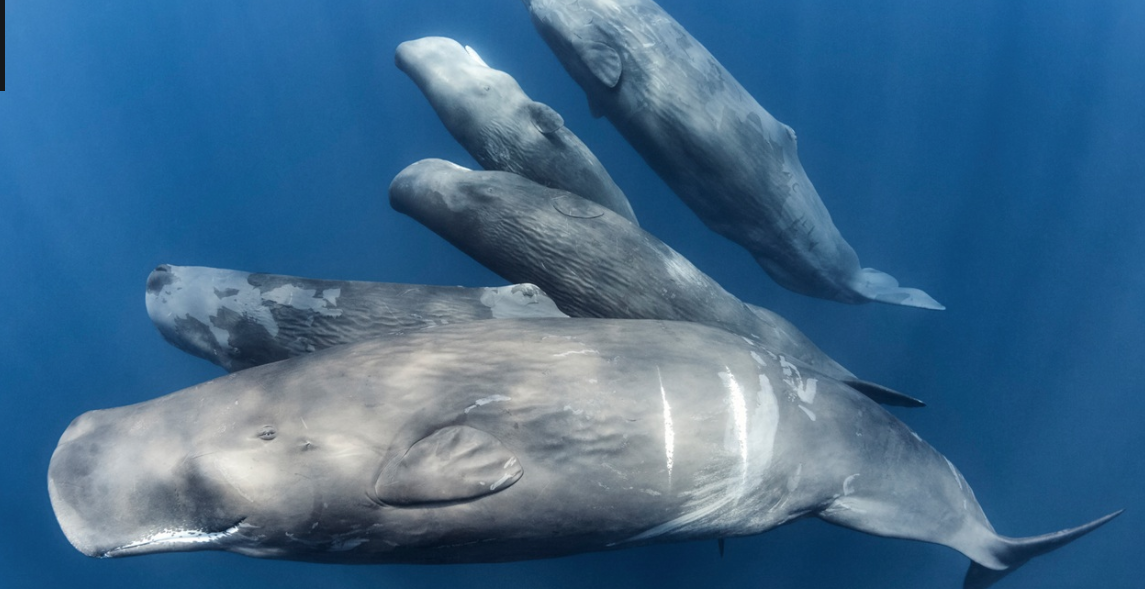
A curious family of sperm whales, comprising several adult females and three juveniles. The prominent white stripes on the surface of the adult in the foreground made it relatively easy to distinguish this family unit from the many dozens of others gathered nearby.
PARTING THOUGHT
It is probably obvious that sperm whales have been, and continue to be, an important part of my life. From my first encounter, when a sperm whale hit me with biosonar and then took me into its mouth, I have been hooked.
That whale changed the course of my life.
I am always keen to share the experiences that I have had, the things that I have learned, and to discuss the questions and mysteries that remain.
I am deeply troubled however, by the rapid increase in people who lead and go on trips to seek encounters with whales, without having any knowledge about the animals, or any demonstrable concern for the animals’ welfare.
In March 2016, I watched an armada of speedboats chase a social unit of sperm whales that had just surfaced from a deep foraging dive. The boats zoomed around each other, throwing tourists in willy-nilly, while other boats raced to do the same, paying no heed to the people already in the water.
After an extended deep dive, the sperm whales needed to replenish their air supply. Instead they were forced down after only 10 breaths by the swarm of reckless boats, carrying ignorant, selfish trip leaders who were happy to choke the whales for the sake of a photo and bragging rights. Interfering with a whale’s breathing cycle causes the animal considerable distress. Yet each time the whales surfaced to breathe, the boats cut them off. Over and over.
Wanting no part of the mayhem and harassment, my friends and I moved our boat to another location and waited. The whales eventually showed up, electing to escape the hordes, as I had thought they might. I asked my friends to count the number of breaths the whales took when they were not disturbed. The first one that came up from a deep dive took 54 breaths.
10 versus 54. That is quantification of harassment.
Please do not be one of those ugly tourists.
Should you decide to watch whales from a boat, or to enter the water where permitted, do your homework on the operator, consider the ethics carefully, and above all, please behave with the best interests of the animals at heart.
THIS ARTICLE WAS ORIGINALLY PUBLISHED ON MAPTIA.
Learn more about responsible whale watching here.
A version of this story was originally published over on Biographic, with help from Sophie Stafford.
Explore more of the author's work at tonywublog.com
TONY WU
Internationally recognized professional underwater photographer. Equal parts nature/marine biology geek, visual art lover, technophile, hopeless dreamer, vagabond, and photography nut.
Less than Two Gallons a Day in Ethiopia
In rural Ethiopia, water is so scarce that many families survive on less than two gallons per day and walk up to four hours to find it.
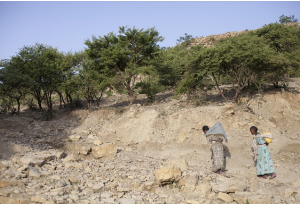
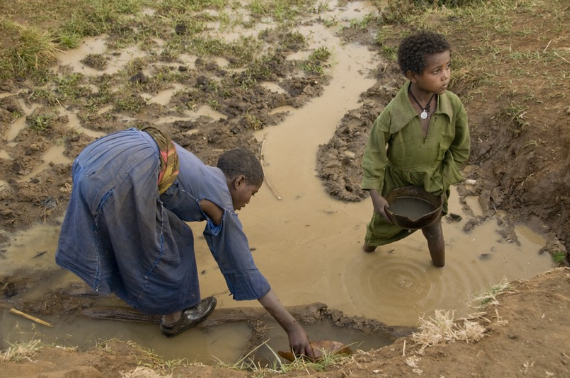
Their water sources, often nearly-dry river beds or muddy holes that communities have dug together, offer water that sometimes needs to be poured through cloth to filter out leeches and debris.
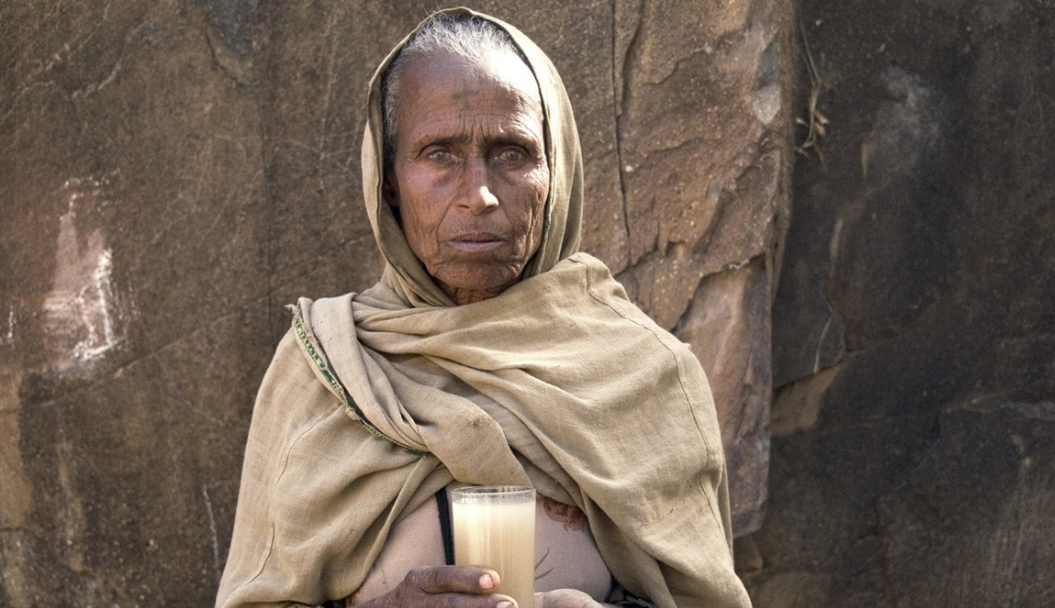
Since 2007 charity: water has been working in the Tigray region of Ethiopia with the government and local water partners working towards a vision of 100% clean water coverage.
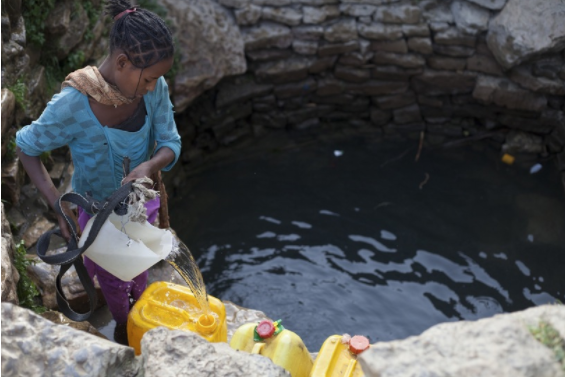
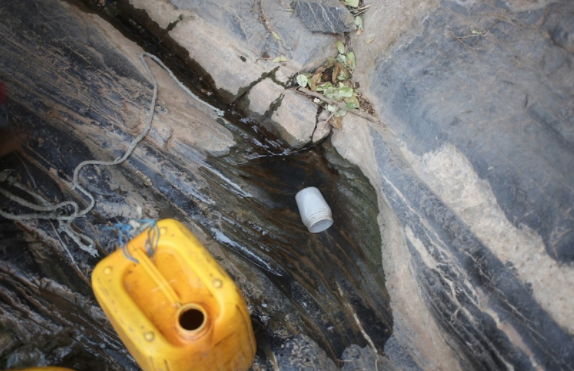
With the help of hundreds of thousands of supporters from around the world — like Noah, who taught his classmates how to weave and sold enough hand-made art to fund hand-dug wells — we’ve now funded more than 3,000 water projects in Tigray that will serve over 1.1 million people with clean and safe water near their homes. Not only that, but the community has also been trained by our local partners on safe hygiene practices and basic maintenance of their water project.
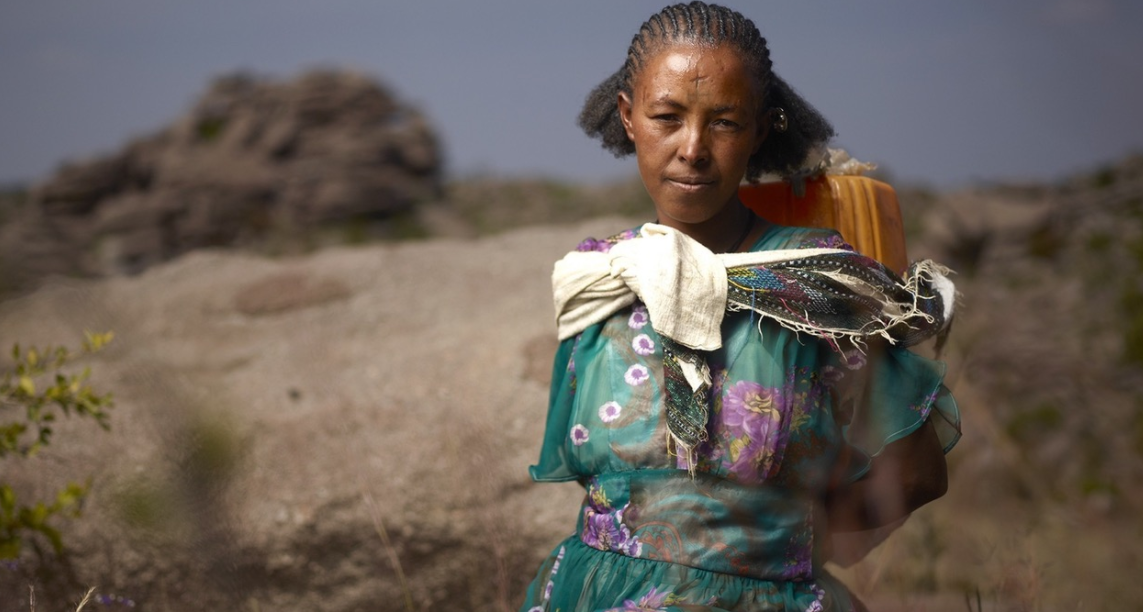
Take yourself on the charity: water journey into the heart of Ethiopia in this video series following our Content Strategist, Tyler, as he experiences life without water and meets the incredible people of Ethiopia.
THIS ARTICLE WAS ORIGINALLY PUBLISHED ON MAPTIA.
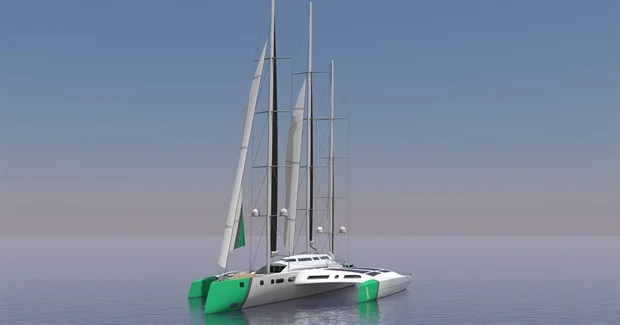
A design of the 110 meter long ocean-going vessel of change
A Carbon Neutral Alternative to Flight
VoyageVert, a Bristol, UK based company, is raising funds to begin a transatlantic ferry service that will operate entirely under sail and renewable energy.
The pilot project will ferry 26 passengers from Bristol to Boston in around seven days, with the eventual aim of scaling up to 200 passengers at a time on custom built catamarans.
“Quite simply, there is absolutely nothing like this at all,” says Ross Porter, VoyageVert's founder, “which is really, really exciting, and quite daunting.”
The company aims to attract those who are looking for a sustainable alternative to flying, as well as those looking for adventure. Passengers will also have the opportunity to participate in a unique experience, living on board as part of a community and taking their place as part of the crew if they wish. They can learn about navigation, meteorology, marine biology and more. Guest speakers will lecture on aspects of the marine environment, one of the world's last remaining wildernesses.
Ross Porter began sailing in Torbay at the age of eight. He spent many years working on boats throughout Greece, the Caribbean and New Zealand. By his own count he has notched up enough miles to take him around the world more than one and a half times. He then returned to England to set up a company delivering yachts for clients. This led to him being contacted so many times by people asking if he could take them from one place to another that he realised there was a market for transporting not just boats but people too.
“I thought: I’m a marine engineer, a captain and a project manager. I could deliver a project that would mean that people could buy a ticket on a sailing boat and get themselves from A to B. All I need is a sailing boat,” says Porter.
The past few years has seen a growing movement for transporting goods under sail. There are now more than ten large boats and many smaller ones in Europe and North America, trading everything from chocolate to rum, from cider to salt cod, in a way which is completely carbon free. With 120,000 available seats on planes, every day, to cross the Atlantic, Porter believes that there is a very viable market for passengers looking to make the crossing by other means.
VoyageVert has one month to raise the funds to launch the pilot project, which would mean that the first trip could come as early as 2018. “The vision is for a truly global passenger transport network, one that’s totally sustainable and high speed,” says Porter. “Cheap and fast has had its day, and it's now really becoming a problem. We’ve got to do away with cheap and fast, and start travelling with intention. If the public wants this, then it’s going to happen.”
To see how the project is getting on, go to: http://www.crowdfunder.co.uk/voyagevert-crowdfunder
Nomads of Mongolia
Life in Western Mongolia is an adventure. Training eagles to hunt, herding yaks, and racing camels are just a few of the daily activities of the nomadic Kazakh people. Filmmaker Brandon Li spent a few weeks living with them and experiencing one of the most unique cultures in the world. Saddle up and enjoy the ride.
Rare Glimpse into Antarctic Underwater World
An underwater robot has captured a rare glimpse beneath the Antarctic sea ice, revealing a thriving, colorful world filled with coconut-shaped sponges, dandelion-like worms, pink encrusting algae and spidery starfish.
The footage was recorded on a camera attached to a Remotely Operated Vehicle (ROV) deployed by Australian Antarctic Division scientists under the sea ice at O’Brien Bay, near Casey research station in East Antarctica.
VIDEO: The Rhino Guardians in South Africa
In 2016 I travelled to South Africa to visit The Black Mambas - the worlds first all female anti-poaching unit operating in the Balule Game Reserve in South Africa. Coming from disadvantaged communities and breaking strong patriarchal tradition, these courageous women focus on eliminating illegal wildlife trade through conservation, education and the protection of wildlife, helping to ensure the long term survival of threatened and endangered species in the area. Each day they patrol up to 20km, unarmed, looking for poachers, wire-snares, and break-ins along the fence line. Their lives are at constant risk from poachers and the dangerous wildlife they protect.
It is their belief that the war on poaching will not be won with guns and bullets, but through education within their local communities.
VIDEO: Introduction to Women's Status is Cambodia
This video was produced by Promotion of Women's Rights project (2002-2011), predecessor to Access to Justice for Women project. The video comprises an overall introduction to women's status in Cambodia as well as the main actions undertaken by the Ministry of Women's Affairs -with the support from GIZ- in order to tackle gender inequalities and gender-based violence in Cambodia.
VIDEO: Dirt Court Dreams in Africa
Just outside the southern wall of Kibera, the largest urban slum in Africa, is Sadili Oval Sports Academy. Meaning "well-being" in Swahili," Sadili is a social enterprise that uses sports as a means to reach out to children and young people in need - both in the slums and from across East Africa.
"Dirt Court Dreams" centers on Flo - a Kibera resident and tennis coach - and reflects how Sadili has made her life better and through her has, and is, improving the lives of many others.
VIDEO: Samuel in the Clouds of Bolivia
In Bolivia, the glaciers are melting. Samuel, an old ski lift operator, is looking out of a window on the rooftop of the world. Through generations his family lived and worked in the snowy mountains, but now snow fails. While scientists are discussing and measuring ominous changes Samuel honors the ancient mountain spirits. Clouds continue to drift by.
VIDEO: Inner Me
While following Jemima, a little curious girl who wanders through dusty roads, crowded markets, slaughterhouses, furnaces and bat hunters, we get acquainted with three women who describe the harsh realities of being born female and deaf in a society that discriminates against both women and people with disabilities. The stories of Immaculée, Sylvie and Stuka are stories of everyday struggle against marginalization, abuse, and oppression, but despite the insurmountable obstacles imposed on them by society, the protagonists show us how their strong and undefeated will allows them to take hold of their fate every single day and reveals the beautiful resilience of the human spirit.

I Was Called The N Word in The Philippines
It was only my second day in the Philippines and my Couchsurfing host invited me to watch a basketball game that he was playing in. Granted, the Philippines was a completely new country to me. I never thought that 2017 would bring me to Southeast Asia, but it has. In the Philippines, the heat makes you sweat relentlessly and you have to take numerous showers a day. Stray dogs and cats search for food in the streets, and trees are a beautiful invasion in the cities I’ve visited thus far. So much of it reminds me of my childhood visits to see family in Jamaica.
I head to the game around six pm and sit with my Couchsurfing host’s friend. It is only day two, but I’ve already become accustomed to one thing here. People stare at me. A lot. I know it’s because I’m black and traveling. The questions are always the same when I meet a new person here.
Do you play basketball? Do you know Lebron James? Is your father tall, just like you? Do you have a girlfriend?
Although traveling is about leaving your comfort zone, there is something to be said about how the identities that we are given in this world will affect us when abroad. I would never wish that I were white so that I could travel and feel more comfortable in this sense. I simply wish my representation in the media wasn’t controlled by people like who me and not white CEO’s.
The game starts and I notice little children gathering near me. They stare, whisper to one another and giggle before running away. After a few minutes, one little boy comes up to me and smiles.
“What’s your name?” he shouts.
I smile and tell him, “My name is Ryant. How old are you?”
He holds up seven fingers and then runs off. His friends greet him with an explosion of laughter. I am sure he will get the award for Bravest Boy in the Neighborhood later. Soon all of the kids are surrounding me, climbing onto my lap and asking questions. I’m invigorated by all of the energy, but I can’t help, but feel like a weird toy that one of them found and can’t wait to show off. More questions are fired off, an auction of how much information I can spit out. Then it happens.
“You’re a n----!”
My Couchsurfing host’s friend is sitting nearby and doesn’t bat any eyelash. On the outside, I nod awkwardly, but on the inside, I don’t quite know what to think. Since starting and graduating college, I’ve filled my mind with the words of many famous black freedom fighters. Angela Davis, a famous black activist born in Birmingham, Alabama in 1944 and who later faced an unfair trial for crimes she didn’t commit, wrote about the children she met while in Cuba:
Despite the language barrier, the children accepted us as members of the family. They helped me with my Spanish lessons each day. I was extremely embarrassed that I had not learned a little Spanish before the trip, for it is an affront to a people to visit them before having attempted to learn their language. Because I spoke Spanish so poorly, never having studied it, I felt less inhibited with the children. They were patient, corrected me and helped me find words when no dictionary was available.
It was a sad day indeed when we had to pack up our things and board the bus, ready to move on to the next stage of our journey. All of us cried — men and women alike, in our delegation as well as on the Cuban side. The hardest part for me was saying good-bye to the children. A young boy of about nine or ten, who had always been the toughest one of his group, seemed reluctant to come up and say good-bye. I thought that it was his natural shyness. Just before I got into the bus, I went over to him and gave him a kiss on the cheek. He tore away from me and ran as fast as he could. But once in the bus, I saw him standing behind a tree, trying to conceal himself as his body shook with sobs. The tears that had been flooding my own eyes slid down my face.
I think of her often when I can’t immediately find the words to respond to an ignorant comment from an acquaintance or when I need a push to live out my ideals for social justice. I’m looking at the faces of these cute Filipino kids and wondering how I can possibly unravel to them my life, my pain, and what it takes for a twenty two year old gay, Caribbean American boy to uproot his life and buy a one way ticket to Southeast Asia.
I realize it’s impossible.
“You shouldn’t say that word,” I tell them. “In the United States, it’s very bad.”
Immediately the kids start to frown and look at each other in confusion.
“Why?” the first boy who ran up to me asks.
I tell them the basics. In the United States, black and brown people have been treated badly for a long time. That word was used by white people to make people that look like me feel bad.
“Oh… That word means gangster fighter in Tagalog.” the kid replies.
I laugh as the coach in the game blows the whistle on a foul. The serious part of me doesn’t want to laugh, but I can’t help it. One problem leads to another of a different shade I suppose. I can’t break down racial stereotypes to a group of elementary aged children just yet.
“Teach me some Tagalog.” I request.
They all giggle and teach me phrases. When the game is over, they pull me onto the court and beg me to shoot a basket. Inside I’m rolling my eyes and wishing this wasn’t happening this way, but my heart is still melting. They run around me, teach me how to dribble and all jump in excitement when I shoot a basket after a million tries.
On my walk home, they all ask to add me on Facebook and I am laughing more. I’ve accepted that these moments may be a reality wherever I go, but acceptance does not mean I won’t struggle towards a more loving way of life. Travel opens the eyelids, pumps blood into the heart and fills the body with moments of awe. I felt that awe as those kids stared at me with their curious eyes and interacted with me so openly. I knew that I could strive to do the same in return and attempt to shed light on confusing, yet present truths as well.
Yes, I was called the n-word in the Philippines, but I do not define myself by the rules that society sets for a black person, a traveler, or 22 year old who is just trying make sense of a messy world. Instead, I keep going forward with conviction, sure that I’ll speak up whenever is necessary along the way.

RYANT TAYLOR
Ryant Taylor is a writer and activist from Cleveland, Ohio. He has participated in protests in France, Ferguson, and Standing Rock. He is the creator of Decolonize The Mind, a travel blog, and is currently freelance writing in the Philippines.
Explore Aotearoa with Ludovic Gilbert
Aotearoa is the Maori name for New Zealand. Ludovic Gilbert and his wife spent 3 weeks there for their honeymoon, and traveled more than 4,000 miles through Christchurch, Akaroa, Lake Tekapo, Te Anau, Wanaka, Fox Glacier, Punakaiki, Kaiteriteri, Wellington, Tongariro, Taupo, Whengamata and Auckland. Here are the fantastic landscapes, beautiful people and lakes with amazing colors they found.