
The Black Lives Matter movement in the United States has encouraged many to speak up against the racism that continues to plague the world. Along with addressing present injustices, people are starting to take a look at the past.
Read More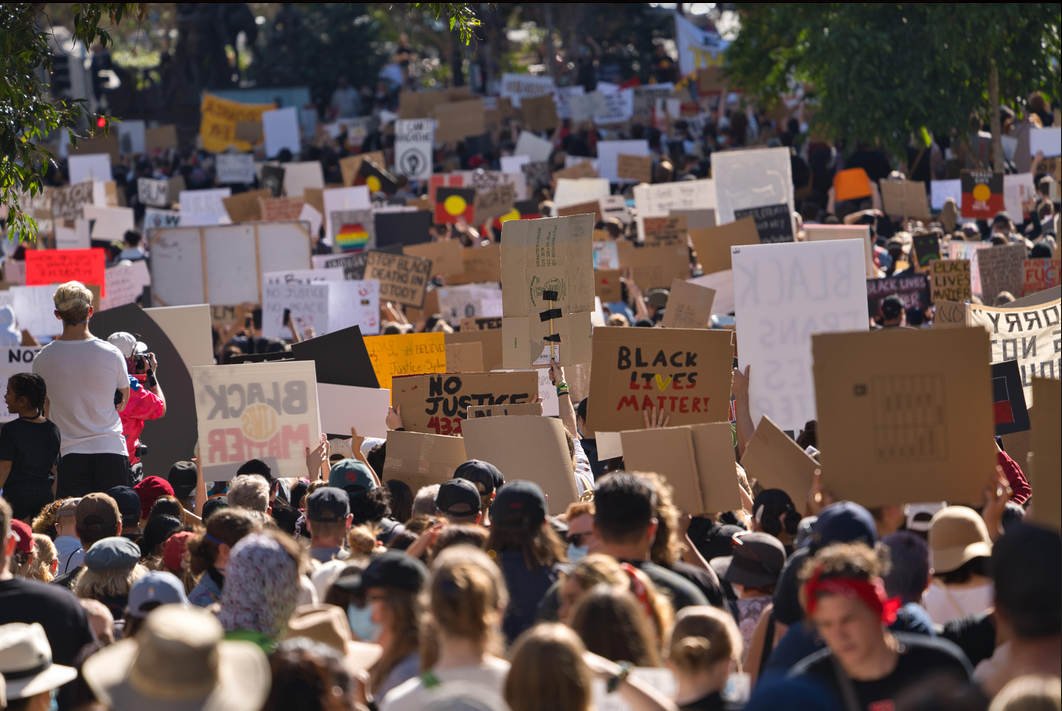
A June 6 anti-racism protest in Brisbane, Australia. Andrew Mercer. CC BY-SA.
‘Same Story, Different Soil’ as Police Brutality Hits Home for Indigenous Australians
Joining millions of activists around the globe, tens of thousands of Australians have taken to the streets over the past two weeks to stand in solidarity with the Black Lives Matter movement. However, for many of these protesters, the demonstrations are about more than standing in solidarity with their American counterparts — Australian activists have used the movement to place an international spotlight on Indigenous Australian deaths in police custody.
According to The Guardian’s database on Indigenous Australians’ deaths in custody from 2008 until today, 164 Aboriginal and Torres Strait Islander people had died while in police custody. As of June 2018, Aboriginal and Torres Strait Islander people made up 28% of Australia’s prison population, despite making up 2.8% of the country’s total population as of the 2016 census.
This widespread issue draws parallels to police brutality against African Americans in the United States. While no official data has been released on deaths in police custody in the U.S. despite the passage of the 2013 Death in Custody Reporting Act, African Americans in 2019 were 2.5 times more likely than white Americans to be killed by police officers. Broken down, 24% of all police killings in the U.S. in 2019 were of African Americans, despite only 13% of the nation’s population identifying as black.
Many Australian activists were further galvanized to take to the streets after a video surfaced of a Sydney police officer slamming an Indigenous boy to the ground on June 1. This video is similar to the countless ones in the United States which have documented instances of police brutality.
These activists have expressed how the issues in the United States and in Australia are one and the same. “It’s the same story on different soil,” 17-year-old activist Ky-ya Nicholson Ward said during a June 6 rally in Melbourne.
Justin Grant, an activist who attended the Melbourne rally, spoke on the historical relationship between the police and Indigenous Australians in an interview with Al-Jazeera. “[The police] are breaking our trust and scaring our people ... they [don't] respect our culture, our laws or our practices."
These parallels have been emphasized during the protests, with chants such as “I can’t breathe” taking on new meanings outside of their American context. Several protesters’ signs have echoed this sentiment, with phrases such as “Same Story, Different Soil” popping up on protest materials throughout the country.
However, others have diminished the similarities between the motivations behind the Black Lives Matter movement and Indigenous Australian deaths in police custody. Prime Minister Scott Morrison said during an interview with local Sydney radio station 2GB that: “There’s no need to import things happening in other countries here to Australia … Australia is not the United States.”
Black Lives Matter protests both within Australia and around the world are expected to continue throughout the coming weeks. As of this article’s publication, there have been no major responses to the protests within the Australian Parliament House to address Indigenous deaths in police custody.
Jacob Sutherland
Jacob is a recent graduate from the University of California San Diego where he majored in Political Science and minored in Spanish Language Studies. He previously served as the News Editor for The UCSD Guardian, and hopes to shed light on social justice issues in his work.
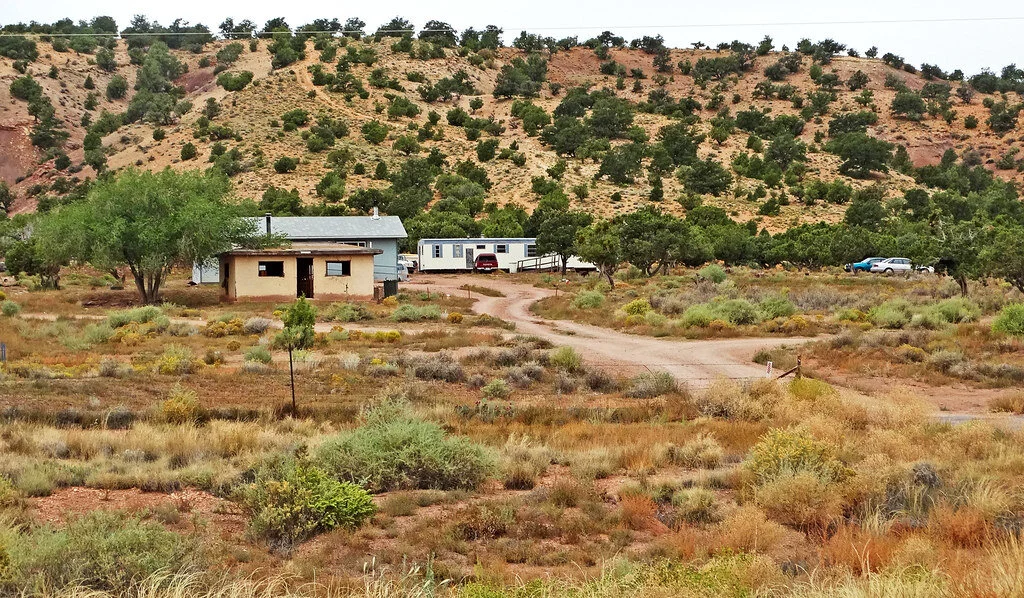
A family compound in the Navajo Nation. Don Graham, AZ 9-15
History Repeats Itself as the Navajo Nation Faces COVID-19 Neglect
In the coronavirus pandemic, the Navajo Nation has seen the highest per capita rate of COVID-19 infection rates in the U.S., surpassing densely populated, urban hotspots. As of May 31, there have been 5,348 positive cases and 246 deaths out of 173,000 residents. These infections stem from governmental neglect and underfunding, as many in the Navajo Nation lack running water, COVID-19 resources and federal assistance. Additionally, preexisting health conditions and lifestyle factors prominent within the Navajo Nation render its residents especially vulnerable to the virus. Homes are often cramped with several generations of families, and lack of food access elicits widespread dietary illnesses on the reservation.
"You got the feds, you got everybody saying, 'Wash your hands with soap and water,' but our people are still hauling water,” said Navajo Nation President Jonathan Nez in a digital town hall meeting on May 12. Roughly 40% of Navajo homes do not have running water, and 10% do not have electricity. This conflicts with guidelines from the Centers for Disease Control and Prevention which call for the thorough washing of hands. Although the Navajo Nation government has called for mask wearing and issued lockdown curfews, it cannot implement all preventative measures ordered by the CDC. Respiratory complications are also brought on by indoor pollution, as Navajo homes are often heated with wood and coal.
The largest Native American reservation in the U.S., the Navajo Nation contains 173,000 people. Its 27,413 square mile semi-autonomous territory spans across parts of Arizona, New Mexico and Utah. Like all Native Americans, the Navajo people have faced generations of genocide, dispossession, and forced relocation that came with colonization. Mark Charles, a Native American activist and U.S. presidential candidate, traces disproportionate infection and death rates to the inequities caused by settler colonialism. “It's a problem 250 years in the making, going back to how this nation was founded. The ethnic cleansing and genocidal policies … that's where the problem lies. Health care is poor, treaties are not being upheld,” he told Al-Jazeera.
Indeed, the COVID-19 outbreak parallels previous epidemics, such as smallpox, the bubonic plague, and Spanish flu that devastated indigenous peoples. The Navajo Treaty of 1868, signed by the Navajo and U.S. government, promised federal support to the Navajo Nation, including health care, infrastructure and water access. The U.S. government has since then failed to uphold this treaty. The $8 billion relief package for Native American communities, prompted by the COVID-19 stimulus bill, was only put to use by mid-May, long after the initial outbreak. This delay in funding left essential workers without protection, and led to a shortage of critical resources in health facilities.
Preexisting health conditions brought on by reservation lifestyle habits highlight the social determinants of health that have been continuously exacerbated in communities of color. Specifically, European colonization hindered Native Americans’ agricultural methods and eating practices, resulting in current diet-related illnesses. Since the mid-1900s, reservation bound Native Americans have experienced problematic blood sugar levels, obesity, diabetes and cardiac stress. American Indian adults are over three times more likely than non-Hispanic white adults to be diagnosed with diabetes, and over 50% more likely to be obese. According to CDC data, about half of the hospitalized coronavirus patients are obese, and face higher risks of severe illness.

Anna Wood
Anna is an Anthropology major and Global Health/Spanish double minor at Middlebury College. As an anthropology major with a focus in public health, she studies the intersection of health and sociocultural elements. She is also passionate about food systems and endurance sports.
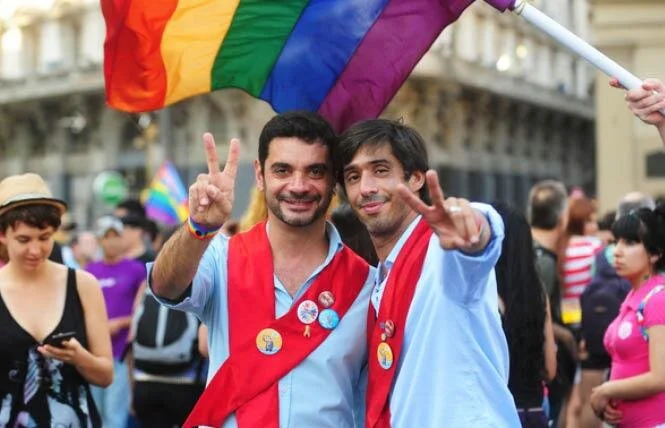
March for marriage equality in Costa Rica. Courtesy Gay Community News. CC 2.0
Costa Rica Becomes the First Central American Country to Legalize Same-Sex Marriage
On May 26, 2020, same-sex marriage was legalized in Costa Rica, ending years of discrimination and struggle to get the same rights as heterosexuals.
In 2018, Costa Rica’s Supreme Court ruled same-sex marraige to be constitutional. To enforce the ruling, the country’s Legislative Assembly had 18 months to either enact it or have the decision overturned. There was even a failed attempt by 20 politicians to get an 18-month extension to further delay marriage equality. Two years later, though, marriage equality became legalized with the first marriages officiated in May of 2020. At midnight on May 26, same-sex marriage was legalized. To celebrate, marriages were also televised across the country due to the COVID-19 pandemic postponing many in-person events.
Marriage equality was a key campaign promise by President Carlos Alvarado Quesada. According to Quesada, “Together, under the same flag, we will build a better nation.” His 2018 presidential campaign highlighted Costa Rica’s commitment to bettering human rights and social actions. Quesada’s presidency helped the nomination of the first openly-gay congressman, Enrique Sanchez, who emphasized that this has been a long battle for activists across the nation.
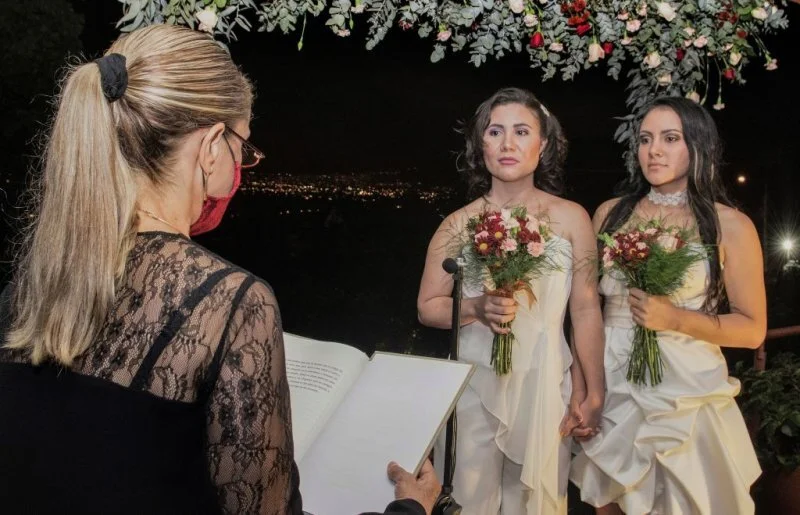
Alexandra Quirós and Dunia Araya become first homosexual couple to be married at midnight on May 26. Ezequiel Becerra. CC 2.0
Sanchez was correct in this statement. Costa Rica has pushed for equality for homosexuals since 2016. It first advocated for equal protections and rights to privacy for LGBTQ+ individuals under the American Convention on Human Rights (ACHR) with assistance from the Inter-American Court of Human Rights. Through the convention, all countries within the Americas were pushed to recognize gay marriage. It was then decided in 2017 that all rights of heterosexuals and couples must be applied to every Costa Rican.
This was not an easy feat. Many across the country protested against this decision. For instance, 20 politicians tried to get another 18 months to delay the ruling but ultimately failed. There also has been strong pushback from religious groups that deny that homosexuality has grown considerably in Costa Rica. Catholicism is recognized as the official religion of the state, so lawmakers such as Eduardo Cruickshank felt the need to “defend the family as established and pleasing our Heavenly Father.” Up until now, marriages of same-sex couples were not recognized by the state and would automatically be annulled.
A research study by Sin Violencia LGBTI shows that more than 1,300 members of the LGBTQ+ community have been killed over the past five years across Latin America and the Caribbean. This group has become the leading coalition that pushes for governments to take action to better protect the LGBTQ+ community.
This historical achievement makes Costa Rica the first country in Central America and the 28th U.N. member state to recognize same-sex marriage and to legalize marriage equality. It is the sixth Latin American country to do so, following Argentina, Ecuador, Brazil, Colombia, Uruguay and parts of Mexico. The Costa Rican government hopes this will not only encourage change in Central America but throughout the entire world.
Eva Ashbaugh
is a Political Science and Gender, Sexuality, and Women's Studies double major at the University of Pittsburgh. As a political science major concentrating on International Relations, she is passionate about human rights, foreign policy, and fighting for equality. She hopes to one day travel and help educate people to make the world a better place.

Greek police clash with migrants at the border with Turkey in Kastanies. Dimitris Tosidis/EPA
Tensions Mount at Greek border with Turkey Amid Contested History of Migration in the Aegean
The ongoing refugee and migrant crisis in the Aegean has taken a dramatic turn in recent days with an escalating humanitarian situation on the land and sea borders between Greece and Turkey.
After Turkey removed its border restrictions with Greece on February 29, thousands of people began to make their way across the country to the Greek border. They have been met with tear gas, and warning shots fired by the Greek coastguard at boats trying to cross the Aegean sea.
The latest “crisis” started suddenly – yet migration in the region has been going on for many years, if not millennia. As an ancient route of cultural and trade interchange, the Aegean has always been a sea of overlapping waves of migrations – and the rich history of this criss-crossing is ever-present in the region today.
My ongoing research in the Greek islands and mainland suggests the living memory of previous experiences of displacement forms a vivid background to the current arrival of refugees, who have been coming since the Syrian civil war intensified in around 2015.
On February 29, Turkey woke up to the news that at least 30 of its soldiers had been killed in an air attack at an army base in Idlib in northern Syria. Turkish political leaders responded by promising to retaliate in what is another escalation of the military conflict in the region.
But the Turkish president, Recep Tayyip Erdoğan, also made good on a previous threat and declared that no migrant attempting to leave the country via the border with Greece would be stopped. This was a major shift in policy since the signing of a 2016 deal between Turkey and the EU, under which Erdoğan agreed to regulate and reduce the migrant flows to Europe in exchange for financial support.
In a matter of two days, tens of thousands gathered at the main checkpoints at the land and sea borders, only to find that the Greek side was closed. In response, the government announced that Greece would not accept any more irregular migrants, nor would it process any asylum applications for a month.
Despite criticism from humanitarian agencies and European parliamentarians over the legality and legitimacy of such measures, the Greek government stood firm. On March 3, the EU Commission’s president, Ursula von der Leyen, travelled to the border city of Evros and thanked Greece “for being our European aspida.” By using the Greek word for shield, and reiterating that the Greek borders were European borders, she gave the Greek prime minister a strong message of unity and support.
Half open, half closed
Those who wish to believe that a half-closed border is still half open continue to wait for their ever-slimmer chances to enter Greece. Thousands of people are spending days and nights in near freezing temperatures in the buffer zone between the two borders with only limited humanitarian assistance provided by locals and NGOs.
In the Aegean islands, the situation is even thornier. As of January 31, 2020, there were 115,600 refugees and migrants in Greece, according to the UNHCR. So far, there have been 8,432 arrivals in 2020. While the numbers are not at the levels they were in 2015, when Greece was caught off guard in the initial phases of refugee flows, it’s not the quantity of the migrants but the changes in the quality of their reception that matters.
In the past five years, the irregular flow of refugees arriving in Greek shores with dinghies has continued with some fluctuations. Greece established five migrant hotspots in its Aegean islands, yet these have not addressed the needs of those arriving. With multiple accounts documenting the appalling conditions in various refugee camps, especially at the Moria camp on the island of Lesvos, this has led to criticism of Greece’s ability or willingness to deal with the migration issue.
The new government of Kyriakos Mitsotakis, the Greek prime minister, vowed to take drastic measures and passed a new migration law in November 2019 which came into effect in January. This was followed by a plan to build closed reception centers in the islands of Chios, Samos and Lesvos which would replace the current open camp structures of the hotspots.

New asylum seekers, arriving on the island of Lesvos, waiting to be transferred to mainland Greece on March 3. Orestis Panagiotou/EPA
These measures have been presented as effective solutions to accelerate the asylum procedures and to “decongest the islands”. But they have been met with anger by locals, who protested extensively against the central government’s decisions, leading to a general strike on February 25.
The rising tension has heightened the ideological polarisation among the locals on the Aegean islands. Anti-migrant protesters, alongside far-right extremists, have demonstrated that they are prepared to use violent means to protect their borders. In early March, some angry protesters tried to block refugee boats from arriving into harbours and block roads. Cars and buildings have been burnt and journalists attacked.
The opposing camp condemns the use of refugees as bargaining chips for political ends. They are appealing to concepts such as hospitality, civilisation and humanity to underline their stance in solidarity with the migrants, using slogans such as “open the borders” and “no human is illegal”.
Evoking history
Both anti-migrant groups and those in solidarity with migrants are using the region’s history to promote their own ideological positions.
Those in solidarity claim that migration is not a crime, but rather an element of the human condition that has occurred repeatedly throughout the region’s history. They recall how during the second world war, thousands of Greeks crossed the Turkish border to escape the German occupation and seek refuge in the Middle East.
The Aegean islands were also where boats filled with Greek Orthodox residents of Asia Minor came in the wake of the Convention of the Forced Exchange of Populations of 1923 between Greece and Turkey, signed after the first world war. Following the arrival of more than 1.5 million people in Greece, the population of the islands almost doubled to the extent that many locals still have family members from among the group originally and still known as the “Asia Minor refugees”.
The ongoing tensions in the region have once again made it into a place where complex negotiations take place over ideology and identity. The shifting way the past is being imagined stands as a testimony to how the history of overlapping migrations is currently being kept alive in the Aegean.
Ilay Romain Ors is a Research Affiliate, Centre of Migration, Policy, and Society, University of Oxford.
THIS ARTICLE WAS ORIGINALLY PUBLISHED ON THE CONVERSATION
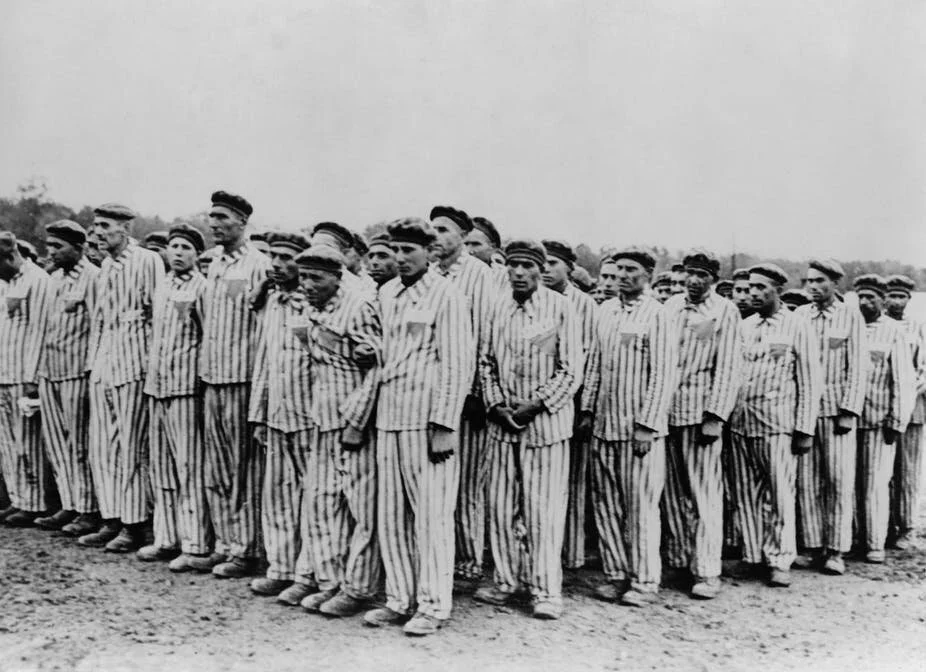
Roll call at the Buchenwald concentration camp. Everett Historical/Shutterstock.com
Why Legislation Is Needed to Make Holocaust Education More Prominent in Public Schools
1. Why is the ‘Never Again Education Act’ needed?
Research shows that adults and millennials in the United States have significant gaps in what they know about the Holocaust.
For instance, while 6 million Jews were killed in the Holocaust, 41% of millennials believe the number is 2 million or fewer.
The Never Again Education Act will seek to address these kinds of gaps in knowledge by making Holocaust education a bigger and more important part of education in various middle and high schools across the country. The legislation provides US$2 million a year, for five years, to be given to the United States Holocaust Memorial Museum. The museum will distribute the money to various teachers and educational leaders who apply for grants to teach kids about the Holocaust.
Schools without any Holocaust education in place will get top consideration. The museum must also increase digital and print educational resources, do more to help teachers and future schoolteachers become more knowledgeable about the Holocaust and teach it more effectively, and conduct research on the impact of Holocaust education.
2. Why can’t schools just teach Holocaust history without a special law?
History in general is not a tested subject like math, reading and writing. And the Holocaust itself is often limited, as I found in forthcoming research, to one or two class periods a year – usually as part of a lesson about World War II more broadly.
As a result, teachers rely heavily on textbooks when teaching about the Holocaust and end up spending a minimum amount of class time on the subject. I have found that teachers can be uncomfortable teaching about the Holocaust because they worry about their lack of knowledge on the subject. They may also be uncertain of how to relay such intense information to their students.
3. How big a problem is Holocaust denial and distortion?
Holocaust denial and distortion do similar things.
Holocaust denial denies that the Holocaust ever happened. Holocaust distortion minimizes the events that took place. While both have long been present in both American and global conversations, recently these have been at the forefront of discussions in new ways.
For instance, Holocaust denial has taken place in schools. It has even occurred at schools with state-mandated Holocaust education, such as Florida, where a principal told a parent that he wasn’t permitted as a district employee to say the Holocaust was a “factual, historical event.” In New Jersey, the first state to require Holocaust education, a teacher urged students to question the Holocaust.
Unfortunately, social media enables denial and distortion to proliferate in unprecedented ways.
4. Why doesn’t the act deal with atrocities that took place on US soil?
The short answer is that this proposed law is intended to improve the quality of Holocaust education, specifically.
A skilled teacher can, and should, make connections between the Holocaust and other genocides and mass atrocities by looking at recurring historical themes including – but not limited to – racism, xenophobia and nationalism. Additional legislation, as well as a hard and honest look at America’s complicated history, would be helpful next steps.
5. What evidence is there that Holocaust education can reduce racial hatred?
There is some evidence that Holocaust education will reduce anti-Semitism in particular and all kinds of bias in general.
This work may not be easy, but helpful practices include using precise language in classrooms, having a clear set of goals in teaching and using age-appropriate lessons.
Jennifer Rich is an Assistant Professor; Director, Rowan Center for Holocaust and Genocide Studies, Rowan University.
THIS ARTICLE WAS ORIGINALLY PUBLISHED ON THE CONVERSATION

Hip-hop officially became the most popular music genre in 2018 and continued its reign in 2019, according to Nielsen Music. Lev Radin/Shutterstock.com
Why Hip-Hop Belongs in Today’s Classrooms
When Cassie Crim, a high school math teacher in Joliet, Illinois, introduced herself to her advanced algebra students in 2017, she did it through a rap video.
Using a rendition of Cardi B’s “Bodack Yellow,” renamed “Codack Yellow,” Crim referenced math terms and laid down classroom expecations:
“These exponents, these is ratios, these is power rules Algebra and a lil’ trig, I don’t wanna choose And I’m quick to take a couple (points) off so don’t get comfortable”
With rap music continuing to rule as America’s most popular music genre for a second straight year in 2019, according to Nielsen Music’s annual report, it makes sense for educators to use rap music to reach students who might otherwise not find a subject relevant. And Crim is by no means the only teacher who is doing just that.
In Pasadena, California, Manuel Rustin, a social studies teacher at John Muir High School, uses rap songs to get students to make meaning of current events and history through a course entitled “Urban Culture and Society.”
At Detroit’s Frederick Douglass Academy, Quan Neloms has students search the lyrics of their favorite rap songs for “college-level vocabulary and references to key events and concepts from American history.”
Collectively, the three teachers represent part of a new generation of educators who embrace a form of teaching known as Hip Hop Pedagogy. It’s a form of teaching that takes the most popular genre of music in the U.S. and uses it to foster success in the classroom.
But is it paying off?
As one who has taught Hip Hop Pedagogy courses to K-12 teachers and instructors in higher ed for the last 10 years, I believe hip-hop has the potential to connect students to important subjects they might otherwise dismiss. But it all depends how it is done.
In my Hip Hop Pedagogy courses, K-12 teachers and college instructors learn how to tap into the richness of hip-hop culture to engage students in topics that range from Shakespeare to neuroscience. But I also stress the need to be authentic – in other words, don’t lie about where you are from – and steer clear of gimmicky hip-hop instructional strategies, such as parroting hip-hop lingo out of context, or showing a random rap video that has nothing to do with the course subject.
Hip-hop through the years
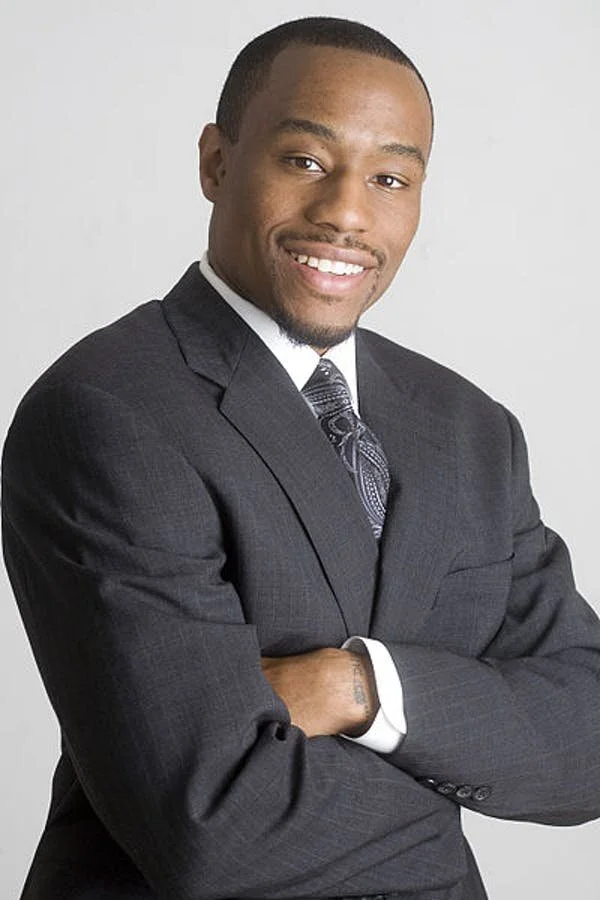
Hip-hop scholar Marc Lamont Hill. Wikimedia Commons
Hip-hop in America’s classrooms is not new. For the past decade or two, scholars such as Marc Lamont Hill, Chris Emdin and Jeff Duncan-Andrade have explored the impact and effectiveness of hip-hop in educational settings.
Collectively, their research has found that hip-hop can be used to teach critical thinking skills, critical literacy, media literacy skills, STEM skills, critical consciousness and more.
Hip-hop has made significant inroads into higher education as well.
Hip-hop in higher ed
Hip-hop academic scholarship goes back at least as far as Tricia Rose’s groundbreaking 1994 book, “Black Noise: Rap Music and Black Culture in Contemporary America.” Since then, numerous hip-hop education books have been written. More than 300 colleges and universities have offered courses on hip-hop. The University of Arizona offers a minor in Hip Hop Studies, and McNally Smith College in Saint Paul, Minnesota, offers a hip-hop diploma, which includes 45 credits and three semesters of hip-hop music production, language and history courses.
These developments are no light feat. In order for hip-hop to reach the level of prevalence that it enjoys on today’s educational landscape – at least 150 educators at the K-12 level were using hip-hop in their class in 2011, the last time a hip-hop education “census” took place – it had to overcome the skepticism of critics who questioned its validity in educational spaces. How would hip-hop explain its controversial history of glorifying violence, consumption and misogyny? Is hip-hop music appropriate for classrooms?
But hip-hop, despite what some may view as its flaws, is a mirror of the complexity of society. Hip-hop did not invent violence, excessive consumerism and mistreatment of women. What it does is provide a platform to talk about these issues.
Breaking it down
That’s what Rustin, the social studies teacher in Pasadena, did when he used rapper Childish Gambino’s provocative video “This is America” to get students to critically analyze the state of affairs in American society. As one student stated in an article about watching the video in class, “It relies on the shock value of violence and capitalizes on our society’s growing numbness to seeing black bodies being brutalized – it’s exploitative.”
Drawing conclusions from hip-hop lyrics requires a certain level of critical analysis, one of the course expectations. Thus, in line with state education standards, Rustin’s course requires college-level writing, reading and critical thinking. Alums of Rustin’s class have indicated that discussions in the class not only increased their critical thinking skills but prepared them for college courses.
Other teachers who use hip-hop in the classroom have achieved similar results. For instance, Crim, the Joliet math teacher, said she noticed improved student engagement after her video, as well as “an increase in performance from one unit test to the next.”
Neloms, the Detroit educator who had his student search rap songs for college level vocabulary, did so after only 33 percent of his students passed a vocabulary exam. After he introduced his class to Rhymes with Reason, an “interactive online series that teaches college-level vocabulary and U.S. history concepts using hip-hop lyrics” rooted in African American speech, Neloms documented a “dramatic increase” in his students’ test scores.
I think similar results could be achieved by more teachers if they tap into the richness of hip-hop culture to reach today’s students. Many students are already forming their views of society and the world based on the lyrics of their favorite rap artists. It only makes sense to infuse what they’re already listening to into the class so that – at the very least – there’s a common point of reference.
Nolan Jones is a associate Adjunct Professor, Mills College.
THIS ARTICLE WAS ORIGINALLY PUBLISHED ON THE CONVERSATION
Academic Freedom: Repressive Government Measures Taken Against Universities in More Than 60 Countries
Universities around the world are increasingly under threat from governments restricting their ability to teach and research freely. Higher education institutions are being targeted because they are the home of critical inquiry and the free exchange of ideas. And governments want to control universities out of fear that allowing them to operate freely might ultimately limit governmental power to operate without scrutiny.
My recent report, co-authored with researcher Aron Suba for the International Centre for Not-for-Profit Law, has found evidence of restrictive and repressive government measures against universities and other higher education institutions in more than 60 countries.
This includes government interference in leadership and governance structures to effectively create state-run institutions that are particularly vulnerable to government actions. It also includes the criminalisation of academics for their work as well as the militarisation and securitisation of campuses through the presence of armed forces or surveillance by security services. We also found evidence that students have been prevented from attending university because of their parents’ political beliefs, while others have been expelled or even imprisoned for expressing their own opinions.
Some of the more shocking examples of repressive practices have been widely publicised, such as the firing of thousands of academics and jailing of others in Turkey. But much of what is happening is at an “administrative” level – against individual institutions or the entire higher education system.
There are examples of governments that restrict access to libraries and research materials, censor books and prevent the publication of research on certain topics. Governments have also stopped academics travelling to meet peers, and interfered with curricula and courses. And our research also found governments have even interfered in student admissions, scholarships and grades.
Repression, intimidation
Hungary provides a particularly glaring recent example of government interference with university autonomy. The politicised targeting of the institution I work at –- Central European University –- has been well documented. But the government has also recently acted against academic life in the country more broadly. It has effectively prohibited the teaching of a course (gender studies) and taken control of the well-regarded Hungarian Academy of Social Sciences.
What makes the Hungarian example especially disturbing is that it is happening within the European Union – with seemingly no consequences for the government. This is despite the EU Charter of Fundamental Rights which states that: “The arts and scientific research shall be free of constraint. Academic freedom shall be respected.” Meanwhile the Hungarian government still has all the privileges of being an EU member state, which includes receiving large sums of EU money.
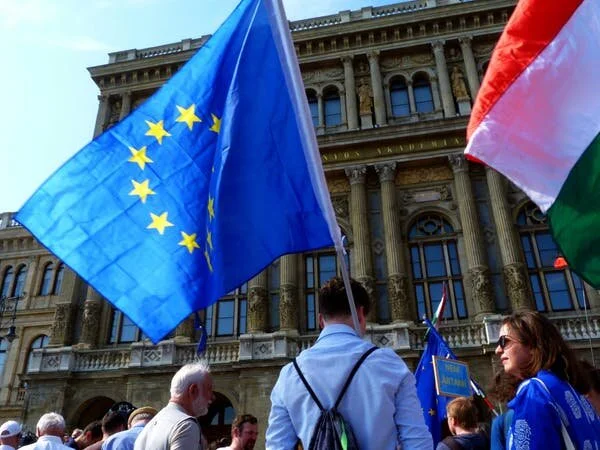
Public demonstration in front of the Hungarian Academy of Science building against the removal of the Academy Science Research Institute’s autonomy. Istvan Balogh/Shutterstock
The inexplicable failure by the EU to enforce its own standards is particularly troubling and helps to normalise this behaviour. Indeed, there are clear signs such repressive practices are spreading. Anti-human rights legislation, policy and practice that begins in one country is frequently copied in another. Anti-civil society legislation recently adopted in Hungary and Israel, for example, which aims to stop protests and minimise the number of organisations receiving funds from abroad, was previously adopted in Russia.
Repressive practices against universities are starting to spread in Europe. Earlier this year it was reported that the Ministry of Justice in Poland planned to sue a group of criminal law academics for their opinion on a new criminal law bill.
Academics in distress
The freedom of academics and university autonomy is not entirely without scrutiny. There are some excellent organisations, such as Scholars At Risk and the European University Association who actively monitor this sector. But, at an international level, university autonomy is rarely raised when governments’ human rights records are being examined. And there is no single organisation devoted to monitoring the range of issues identified in our recent report.
Without proper monitoring, universities, academics and students are even more vulnerable because there is little attention paid to these issues. And there is little pressure on governments not to undertake repressive measures at will.
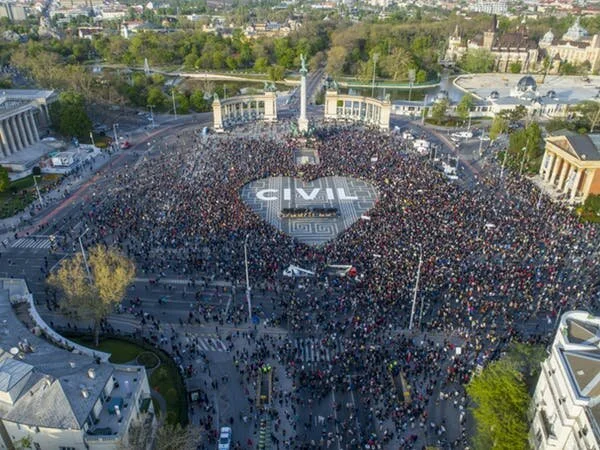
Thousands demonstrate in central Budapest against higher education legislation seen as targeting the Central European University. Drone Media Studio/Shutterstock
A global monitoring framework is needed, underpinned by a clear definition of university autonomy. The UN and EU institutions also need to pay more attention to the dangers that such attacks on universities pose to democracy and human rights. A stronger line against governments who are acting in violation of existing standards should also be taken.
Universities should be autonomous in their operations and exercise self-governance. These institutions are crucial to the healthy functioning of democratic societies. Yet academic spaces are closing in countries around the world. This should be a concern for all. The time for action is now, before this trend becomes the new norm.
Kirsten Roberts Lyer is a Associate Professor of Practice, Acting Director Shattuck Centre, Central European University.
THIS ARTICLE WAS ORIGINALLY PUBLISHED ON THE CONVERSATION
Pope Affirms Catholic Church’s Duty to Indigenous Amazonians Hurt by Climate Change
The Catholic Church “hears the cry” of the Amazon and its peoples. That’s the message Pope Francis hopes to send at the Synod of the Amazon, a three-week meeting at the Vatican that ends Oct. 27.
Images from Rome show tribal leaders in traditional feather headdresses alongside Vatican officials in their regalia. They are gathered with hundreds of bishops, priests, religious sisters and missionaries to discuss the pastoral, cultural and ecological struggles of the Amazon.
The densely forested region spans nine South American countries, including Brazil, Colombia and Peru. Its more than 23 million inhabitants include 3 million indigenous people.
The Amazon meeting is part of Pope Francis’s efforts to build a “Church which listens.” Since taking office in 2013, Francis has revitalized the Catholic Church’s practice of “synods” – a Greek word meaning “council” – expanding decision-making in the church beyond the Vatican bureaucracy to gather input from the entire church, including from laypeople.
Voting on synod decisions, however, remains restricted to bishops and some male clergy.
The Amazon synod is the first such meeting to be organized for a specific ecological region. Media coverage of this event has emphasized its more controversial debates – such as the possibility of easing celibacy requirements in the rural Amazon, where priests are in extremely short supply.
But its focus is much broader: listening to the suffering of the Amazon – particularly the environmental challenges facing the region – and discerning how to respond as a global church.
Amazon in crisis
After more than a decade of environmental policies that successfully slowed deforestation in the Amazon, logging and agricultural clearing have begun to increase rapidly again. The fires in the Brazilian rainforest that captured headlines in early September are symptoms of much broader destruction.
Up to 17% of the Amazon rainforest has already been eliminated – dangerously close to the 20% to 40% tipping point that experts say would lead the entire ecosystem to collapse.
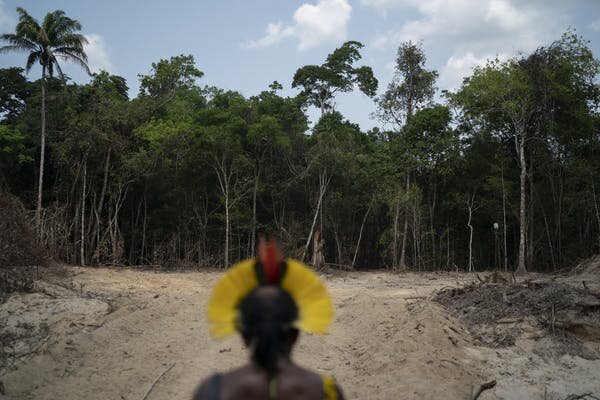
Deforestation of the Amazon is rapidly approaching the tipping point that, experts say, could lead to total collapse of the rainforest ecosystem. AP Photo/Leo Correa
Stories of deforestation can seem insignificant against the vastness of the Amazon, a region two-thirds the size of the lower 48 United States.
But for the 390 indigenous ethnic groups who inhabit the region, each burned forest grove, polluted stream or flooded dam site may mark the end of a way of life that’s survived for thousands of years.
Deprived of their land, many indigenous Amazonians are forced into an exposed life on the edge of frontier towns, where they are prey to sex trafficking, slave labor and violence. In Brazil alone, at least 1,119 indigenous people have been killed defending their land since 2003.
The Catholic Church recognizes that it still has to address the “open wound” of its own role in the colonial-era violence that first terrorized the indigenous peoples of the Americas, according to the synod’s working document. The church legitimated the colonial confiscation of lands occupied by indigenous peoples and its missionaries often suppressed indigenous cultures and religions.
For this reason, according to the Vatican, organizers of the synod have sought input through 260 listening events held in the region that reached nearly 87,000 people over the past two years. Indigenous leaders have been invited as observer participants in the meeting itself.
Learning from indigenous peoples
As a theologian who studies religious responses to the environmental crisis, I find the pope’s effort to learn from the indigenous people of the Amazon noteworthy.
The Vatican sees that the Amazon’s traditional residents know something much of humanity has long forgotten: how to live in ecological harmony with the environment.
“To the aboriginal communities we owe their thousands of years of care and cultivation of the Amazon,” the 58-page synod working document reads. “In their ancestral wisdom they have nurtured the conviction that all of creation is connected, and this deserves our respect and responsibility.”
Pope Francis has expressed his respect for indigenous peoples before.
At a meeting of indigenous leaders in Peru in January 2018 he said, “Your lives cry out against a style of life that is oblivious to its own real cost. You are a living memory of the mission that God has entrusted to us all: the protection of our common home.”
Global problems, local solutions
Environmental destruction isn’t the synod’s only concern.
Catholicism – long the dominant religion in Latin America – is rapidly losing members to evangelical Protestantism. Evangelicals are projected to eclipse Catholics in Brazil by 2032.
One advantage evangelical churches have in Amazonian countries is that they can appoint local indigenous pastors to minister to their communities. Meanwhile, with less than one priest per 8,000 Catholics in the Amazon, some isolated communities might see a priest only once a year.
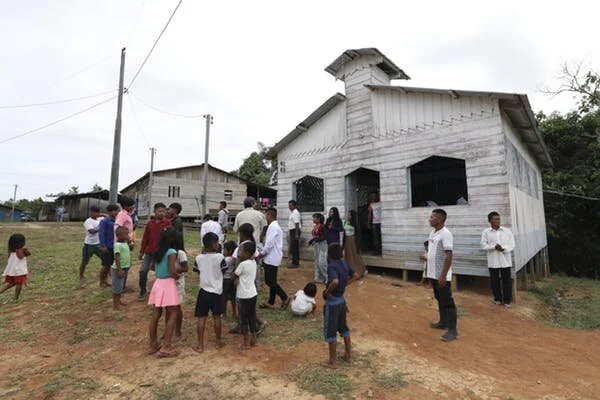
Catholic churches are in short supply in rural Brazil, where many people will go a year without seeing a priest. AP Photo/Fernando Vergara
The scarcity of priests in rural Latin America is behind a proposal to the synod to ordain older married men as priests in isolated Amazonian communities.
In the the U.S., the celibacy question is easily mapped onto a familiar divide. Progressive Catholics argue that clerical celibacy should be optional, while conservative Catholics insist this discipline is fundamental to the faith.
The issue is far less politicized in the Amazon, where, in the words of one bishop, the Catholic Church remains a “visiting church” with limited day-to-day presence in indigenous communities.
Some might dismiss this synod as just a meeting. But, in my judgment, it is an attempt to apply Francis’ vision of a “listening Church” to the environmental crisis. The Synod of the Amazon marks a significant shift from high-minded papal exhortations about taking climate action to a global religious community that gives voice to those living on the front lines of ecological destruction.
Vincent J. Miller is a Professor of Religious Studies, University of Dayton
THIS ARTICLE WAS ORIGINALLY PUBLISHED ON THE CONVERSATION
Following the Removal of Evo Morales, Anti-Indigenous Sentiment Explicit in Bolivia
In the aftermath of the ouster of former President of Bolivia, Evo Morales, many suspected a right-wing coup had taken place. Now, a month later, the status of Indigenous peoples in Bolivia hangs in the balance.
Read More
African Countries Can’t Industrialise? Yes, They Can
Narratives are essential. Humans are, after all, “helpless story junkies”. Business and economic success depend much more than is commonly acknowledged on getting the narrative right. And if there is a narrative where getting it right or wrong matters hugely, it is the narrative about Africa’s industrial development.
Africa is the poorest continent. It is likely to be the most affected by climate change. It is the continent where terrorist groups are spreading fast.
Therefore, African industrialisation is essential. Unfortunately, the dominant narrative is that Africa has been de-industrialising, even prematurely. In this narrative, it is also questioned whether Africa can ever industrialise. African countries have even been advised not to try. The World Bank’s “Trouble in the Making”report concludes that manufacturing is becoming less relevant for low-income countries.
Fortunately, a very different narrative is possible. In a recent paper, I argue that Africa can industrialise because of three factors. These are “brilliant” new technologies enabling digitisation, smart materials and 3D-printing; a more vibrantentrepreneurship scene; and Africa’s growing middle class (as measured by the share of households that earn between $11 and $110 per person per day), which supports the continent’s first generation of indigenous tech-entrepreneurs.
Consider therefore the following narrative: More than 300digital platforms, mostly indigenous, are operating across the continent. There are also more than 400 high-tech hubs, and more are being added. In addition, venture capital funding into African tech start-ups increased ten-fold between 2012 and 2018.
Moreover, manufacturing has more than doubled in size in real terms since 1980. And since 2000, manufacturing value added has grown at more than 4% a year. That is double the average between 1980 and 2000 (numbers from the Expanded African Sector Database).
As a result, total employment in manufacturing in 18 of the largest African economies (for which there is data) grew from roughly 9 million in 2004 to more than 17 million by 2014. That is an 83% increase in ten years. The proportion of labour in manufacturing for Africa as a region grew from roughly 5% in the 1970s to almost 10% by 2008.
So, how will these trends shape the future? I argue that they will result in three varieties of industrialisation.
Three varieties
The first variety can be labelled “acquiring traditional manufacturing capabilities”. This variety is implied by Overseas Development Institute researchers Karishma Banga and Dirk Willem te Velde. It will be experienced by countries and sectors where technological change is too fast and complex to benefit immediately. These countries and sectors will need time to first put complementary investments in place, while at the same time continuing to promote traditional labour-intensive manufacturing.
The second variety, “fostering sectors with the characteristics of manufacturing”, is elaborated in a recent UNU-WIDER book. Here it is argued that service sectors can take up “the role held by manufacturing in the past”. In many countries, services such as ICT and telecoms, tourism and transport, financial and farming services can lead to productive development.
The third variety, “resurgent entrepreneurship-led industrialisation” is based on my earlier work. I point to the growing list of achievements of African countries in terms of high-tech manufacturing. For example South Africa leads in advanced manufacturing in having one of the world’s largest 3D-printers, used to manufacture parts for the aviation industry.
Different combinations of these varieties will dominate in different countries. For example, Kenya is already experiencing the simultaneous development of high-tech financial services alongside growth in traditional manufacturing, such as food processing and textiles, as well as clusters of advanced manufacturing. While every country’s pathway will be a unique combination of these varieties, what they will have in common is that progress will require that they deal with the impact of new technology, especially digitisation, on manufacturing.
To ensure momentum is maintained, the narrative about industrialisation has to change. As Israeli historian Yuval Noah Harari pointed out, neither land – the core resource of feudalism – nor physical capital – the core resource of 20th-century capitalism – will be decisive for competitiveness in the future. Instead, data and data science, free information flows, ICT (data) skills, and decentralisation of decision-making will be the decisive factors.
What needs to be done
With an outdated story that gives up on manufacturing, Africa will fail to close the huge digital gap it still faces. The gap is reflected in the fact the continent contributes less than 1% of world’s digital knowledge production. To reduce this gap, African countries will have to start by expanding internet access and use. If internet use across the continent can be expanded to the same rate as in high-income countries, 140 million new jobs and US$2,2 trillion could be added to GDP.
What must be done to change the narrative? What do African governments need to do? The first is that its leaders need to start telling more stories about the future than about the past. Perhaps, like China’s leaders, they can even be inspired by science fiction. British best-selling author Neil Gaiman relates how China started to embrace science fiction after sending a delegation to
“the US, to Apple, to Microsoft, to Google, and they asked the people there who were inventing the future about themselves. And they found that all of them had read science fiction when they were boys or girls.”
Helping to imagine the future of African industrialisation, South African President Cyril Ramaphosa recently stressed that fact that Africa is one of the early adopters of mobile telephony and moreover that the continent needs to aspire to more:
We need to focus on the new technologies that are going to revolutionise the world, and we need to be ahead of the curve.
This is the right narrative. It is necessary, although not sufficient for African industrialisation. For this, words need to lead to actions. And some consistent actions, at least for a start, would be for African governments to refrain from creating stumbling blocks for their brave new tech-entrepreneurs, such as curbing access to the internet, restricting digital information flows, under-investing in science, technology, engineering and mathematics education, neglecting data-privacy legislation, and restricting the rights of women to work in manufacturing.
Wim Naudé is a Professorial Fellow, Maastricht Economic and Social Research Institute on Innovation and Technology (UNU-MERIT), United Nations University
THIS ARTICLE WAS ORIGINALLY PUBLISHED ON THE CONVERSATION
In Hong Kong Protests, Technology Serves as a Tool of Both Expression and Repression
While activists have used the internet as a powerful organizing tool, web coverage on the Chinese mainland is defined by mass blackouts and systematic silencing.
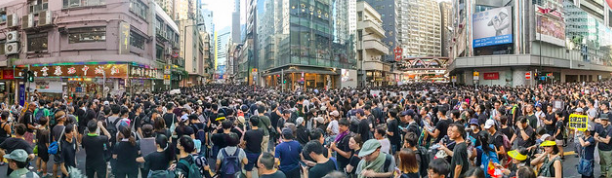
Protesters in Hong Kong. Studio Incendo. CC BY 2.0
The most widely attended protest in recent American memory, the Women’s March, brought about 1 percent of the population onto the streets. Last month’s protests in Hong Kong brought 25 percent.
By any standards, the anti-extradition campaign in Hong Kong, spurred by a proposed China-backed amendment that would allow for the extradition of Hong Kongers to mainland China, was an astronomical success, engaging huge swathes of the population and eventually leading to the death of the proposal. Images of the demonstration depict unfathomable numbers of citizens exercising their right to peaceful protests, but something remains invisible in those photos: the constantly active, multilayered and multifaceted presence of the internet, which—through messaging apps, social media, and LIHKG (Hong Kong’s answer to Reddit)—allowed protestors to turn ideology into concrete action.
On June 12, the protest reached a milestone when tens of thousands of citizens surrounded the Hong Kong legislative building, spurring an initial suspension of the bill. In order to mobilize without attracting unwanted attention, activists created online events inviting people to a “picnic” in nearby Tamar Park, a cover-up for their actual intentions. Messaging services, too, helped with planning efforts. Particularly popular was the encrypted app Telegram—although the arrest of Ivan Ip for “conspiracy to commit a public nuisance” set efforts back, given that Ip was leading a group on the platform of 30,000 users. Still, Ip’s group was far from the only one: In a Baptist University poll of protestors, more than half of respondents reported using Telegram for broadcasting information and participating in discussion groups.
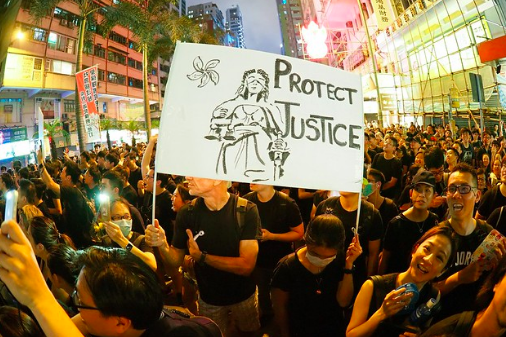
Protestors in the streets. Etan Liam. CC BY-ND 2.0
The survey also revealed the protestors’ widespread use of LIHKG, which lived up to its reputation of supporting free speech by subtly assisting activist efforts: Administrators removed ads from their site for about two weeks in June to shorten loading time and upped the number of replies allowed on some threads from 1,001 to 5,001, citing a need “for more convenient discussions.”
For protestors, the utility of social media and messaging platforms was far from over once planning progressed into action. During the demonstration on June 12, attendees broadcast real-time updates through countless Instagram stories and an hour-long livestream on the Twitter-owned service Periscope. In addition to spreading the word to Hong Kongers not attending the demonstration, protestors were able to communicate amongst themselves, using apps to request supplies, share the locations of food and water stations, and disseminate hand signals that would allow for discreet communication. Technical difficulties, however, thwarted efforts to some degree: Poor mobile signals made accessing the internet a challenge and threatened to spur chaos. “Without Telegram and WhatsApp, people did not know what they had to do,” Laura, 18, a student who volunteered as a first-aid staffer, told the South China Morning Post.
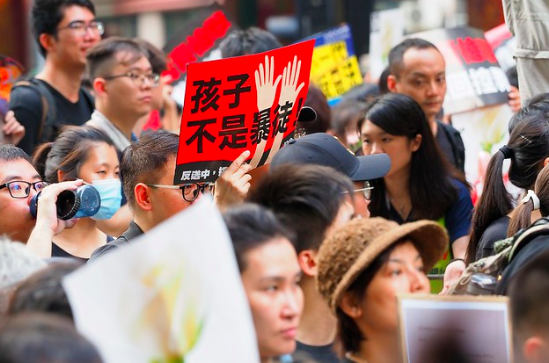
Holding a sign that reads “kids are not rioters.” Etan Liam. CC BY-ND 2.0
Limited connectivity was not the only tech-related hurdle facing protesters. Tech-savvy activists cautioned against using public Wi-Fi or swiping their Octopus public transit card, actions that could put users at risk of having their personal information picked up and employed to incriminate them. And protestors made sure to turn off Face ID and fingerprint ID on their phones so that police could not unlock their devices without consent, as well as enabling encryption on apps where it was not already automatic.
Across the border in China, however, such internet-driven activism would have been impossible. Hong Kongers have the privilege of a much more open internet—a dichotomy that has manifested starkly in mainland media coverage of the protests. As part of the mass censorship and limited access that has long defined the Chinese internet and that is sometimes dubbed the “Great Firewall of China,” the Communist Party has enacted a total blackout on protest coverage in newspapers and on TV, with television screens simply going dark when foreign news outlets show images of the demonstrations. Video footage of Hong Kong Chief Executive Carrie Lam apologizing for her attempt to push through the extradition law never lasted long on social media, as censors would immediately delete the content each time it was reuploaded. And even a song that activists sang during the protests, “Can You Hear the People Sing” from “Les Miserables,” was inexplicably missing from QQ, a popular musical streaming site.
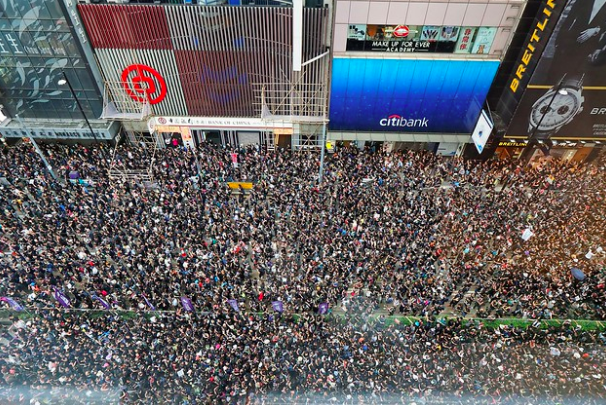
Protestors filled the streets on June 16. Etan Liam. CC BY-ND 2.0
On social media platforms like WeChat and Weibo, users devised strategies to get around the firewall, like distorting images of the protests or blocking parts of the image with giant smiley-face logos. In some cases, however, China’s tech power was simply too strong: Telegram reported on June 12 that it was experiencing a distributed denial of service (DDoS) attack, which means that a number of computers were attempting to overload its servers with bogus requests, resulting in service slowdowns or outages. Telegram’s CEO, Pavel Durov, said that the IP addresses behind the attack were coming mainly from China, potentially suggesting a concerted effort by authorities.
By systematically silencing the voices of activists, China is able to spread its own narrative of the protests, which it portrays as violent events provoked by foreign elements amining to undermine Hong Kong and the “one country, two systems” policy. The policy was formulated in the 1980s for the reunification of China by Paramount Leader of the People’s Republic of China Deng Xiaoping; in the interest of furthering Hong Kong’s status as a global financial center, it guarantees freedom of speech and protest for citizens. Yet Hong Kongers have long feared an erosion of their autonomy, a concern that most recently boiled over in the form of the 2014 Umbrella Movement, during which streets in the city’s business district were flooded by demonstrators for nearly three months. Throughout that time, mainland China busily erased all mention and images of the protests from its internet.

Protesters were unsatisfied by the original postponement of the bill. Etan Liam. CC BY-ND 2.0
On July 8, Lam publicly stated that the bill was finally dead, describing the proposed amendment as a “total failure.” Yet Hong Kongers were not entirely satisfied, as questions remain about whether Lam will officially withdraw the bill or whether it might be revived in future. Either way, the anti-extradition movement of 2019 will stand as a landmark protest for the digital age: one whose scale and power could have only coalesced in an era of instant connectivity, and one that throws into stark relief the power of technology—for expression and repression alike.
TALYA PHELPS hails from the wilds of upstate New York, but dreams of exploring the globe. As former editor-in-chief at the student newspaper of her alma mater, Vassar College, and the daughter of a journalist, she hopes to follow her passion for writing and editing for many years to come. Contact her if you're looking for a spirited debate on the merits of the em dash vs. the hyphen.

From North Carolina to Norway, Fossil Fuel Divestment Hits Headlines
Whether motivated by practical or ideological means, institutions around the world are pulling their finances out of oil, gas, and coal.
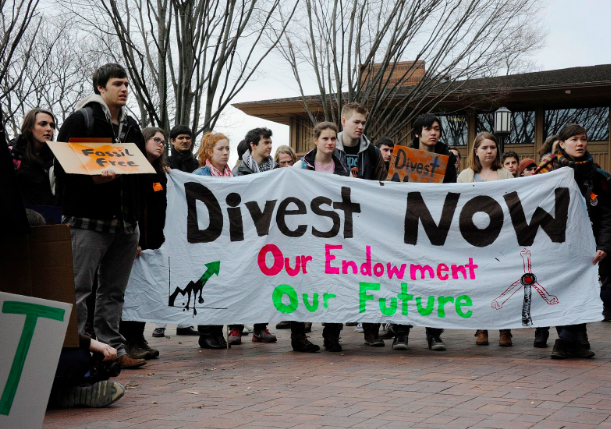
Divestment protest at Tufts University. James Ennis. CC BY 2.0
Upon receiving the news in 2017 that our planet is in the midst of its sixth mass extinction event, spurred partly by rampant climate change, stunned denizens of Earth everywhere struggled to process the implications and searched for concrete ways to mitigate the damage. In the months since, countless climate proposals have rolled out across the globe, and U.S. citizens have watched as 2020 presidential hopefuls laid out their plans—all while the current president decried the very existence of climate change. In the flurry of rhetoric and policy aimed at addressing the climate crisis, one strategy continues to hold strong: fossil fuel divestment, which has hit the headlines this summer with particular force.
On July 4—Independence Day in the United States—Britain’s largest membership organization declared independence from fossil fuel investments. The National Trust, which stewards 780 miles of coastline; 612,000 acres of land; and more than 500 historic houses, castles, monuments, and parks, announced that it would divest its £1 billion portfolio from fossil fuels in a bid to address the worsening climate crisis.
Previously, the trust had invested £45 million into oil, gas, and mining companies, despite having made earlier pledges to cut down on its own use of fossil fuels. The vast majority of those investments will be withdrawn in the next 12 months, the trust promises, and 100 percent within three years. The freed-up funds will be diverted to alternative energy options: CFO Peter Vermeulen told The Guardian, “Now we will seek to invest in green startup businesses and other suitable portfolios that deliver benefits for the environment, nature and people.”
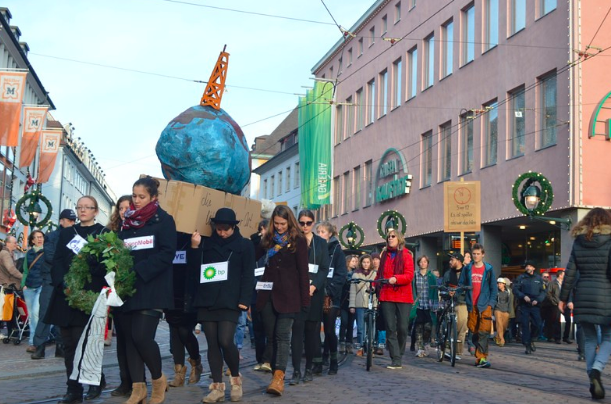
Fossil Free Freiburg divestment protest. 350.org. CC BY-NC-SA 2.0
Five hundred miles away in Norway, another high-profile institution is also preparing to drop fossil fuels: the Government Pension Fund Global (GPFG), which was founded in 1990 to oversee the integration of petroleum revenues into the national economy, and which invests in more than 9,000 companies worldwide, including Apple, Amazon, and Microsoft. On June 21, Norway’s parliament, the Storting, approved plans for the GPFG to divest more than $13 billion of the $1.06 trillion it manages from investments in oil, gas, and coal. The decision comes with some caveats: GPFG will only divest from companies that are exclusively involved with fossil fuels, but not oil companies that also have renewable energy units, such as BP and Royal Dutch Shell. And the fund maintains that financial considerations, not ideological ones, are behind the divestment, given the risk posed by fluctuations in oil prices. Nevertheless, environmental advocates can appreciate the fact that GPFG will earmark up to 2 percent of its funds—or about $20 billion—for investments in renewable energy.
In some cases, not only individual institutions are divesting, but also entire regions. At the beginning of June, the city council of Charlottesville, Va., voted 4-1 to divest the city’s operating budget investments from any entity involved with the production of fossil fuels or weapons. Supporters explain that the divestment—which will be carried out within 30 days of the decision—aligns with the city’s strategic plan goals, including being responsible stewards of natural resources. Charlottesville joins various other college towns across the United States, including Ann Arbor, Mich., and Berkeley, Calif., in pledging to divest.
At some universities, however, the prospect of divestment has long brewed controversy, which is coming to a head in light of the climate crisis. During Al Gore’s speech at Harvard University on May 29, the former vice president turned environmental activist called on his alma mater to divest, stating that climate change is “a threat to the survival of human civilization as we know it” and framing divestment as “a moral issue” for the university. In recent years, student activists at Harvard have ramped up demands on the school to divest, and the student newspaper reversed its formerly opposed position in May, acknowledging that Harvard’s reluctance to entertain the possibility of divestment “compromises its efforts to position itself as an academic institution at the forefront of the fight against climate change.” On the administrative side, more than 300 faculty members have signed a petition calling for divestment of fossil fuel stocks. Nevertheless, this number represents less than 14 percent of all faculty, and the university maintains the opinion that it should impact public policy through research rather than through its endowment.
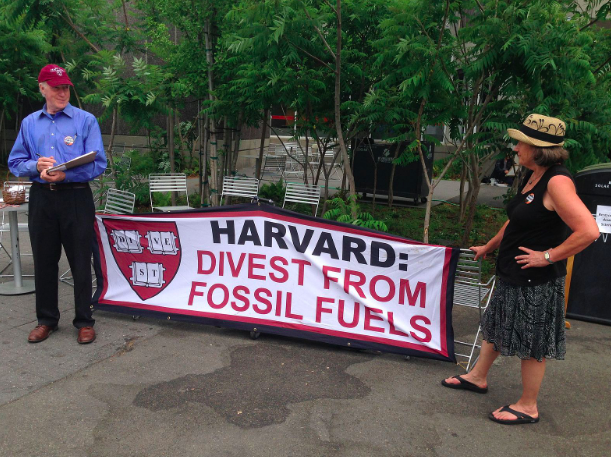
Advocates for divestment at Harvard. victorgrigas. CC BY-SA 3.0
Across the country, 47 U.S. colleges and universities have chosen to divest, although the number has dropped off in recent years, with only 10 making the decision since 2017. Most recently, the Board of Trustees at the University of North Carolina, Asheville, voted on June 21 to divest a portion of their $50 million endowment from fossil fuels. The unanimous vote, which will make the Asheville campus the first in the UNC system to divest, builds on a resolution spearheaded by student activists. In concert with administration and the Board, these activists researched new funds in which the university could invest about 10 percent of its capital, eventually landing on Walden Asset Management, which focuses on investing using environmental, social, and governance criteria.

Botanical gardens at Asheville. David441491. CC BY-NC-ND 2.0
Meanwhile, earlier this month, the University of California—another sprawling and well-regarded state university system—saw 77 percent of its voting faculty agree “to divest the university’s endowment portfolio of all investments in the 200 publicly-traded fossil fuel companies with the largest carbon reserves.” The decision is now in the hands of the University Regents. Should the Regents choose to divest, the news would make waves on the national level due to U Cal’s significant size and prestige—and in the fight against fossil fuels, ideological statements, even if they have negligible bearing on the industry’s financial resources, are of the utmost importance.
Individuals in academic circles, therefore, are beginning to take their own stands to support divestment. In a piece for the Chronicle of Higher Education, climate activists Christiana Figueres and Bill McKibben explain that they have begun refusing to accept honorary degrees from colleges that have not divested, writing, “[e]ach of us has already turned down these honors at institutions that remain committed to coal, gas, and oil.” Meanwhile, members of the younger generation are also weighing in—such as Jamie Margolin, a rising high school senior and prominent environmental activist with more than 11,000 Twitter followers. In a piece for Teen Vogue last month, Margolin wrote, “I have serious concerns about how my future school might be investing in fossil fuels and, if they can’t be convinced to divest by student activists like me, how that might render my college education useless.” From Norway to Britain to Asheville to Cambridge, from Ivy-educated vice presidents to those still awaiting their high school degrees, the world is beginning to agree that taking action is not optional.
TALYA PHELPS hails from the wilds of upstate New York, but dreams of exploring the globe. As former editor-in-chief at the student newspaper of her alma mater, Vassar College, and the daughter of a journalist, she hopes to follow her passion for writing and editing for many years to come. Contact her if you're looking for a spirited debate on the merits of the em dash vs. the hyphen.

Blue Out on Insta
Blue Out on Instagram: Support for Sudan through Social Media Awareness
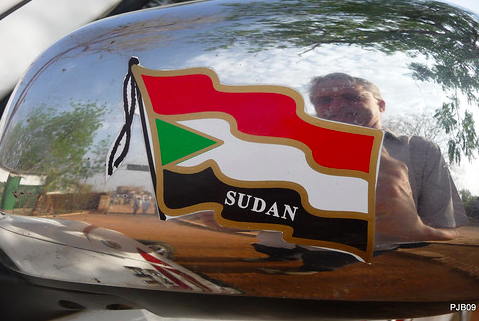
Sudan Flag Sticker on a Car. pjbury. CC BY-NC-ND 2.0
Recently, a specific shade of blue has been popping up around Instagram in the form of profile pictures. This Blue Out was started by Instagram influencer Shahd (@hadyouatsalaam). She is a Sudanese-born, New York City-based activist—or how she likes to identify herself, “a political scientist by degree and a social media influencer by interest”, according to her recent Insta post, introducing herself to her new followers.
Shahd created this movement for the sole purpose of raising awareness to what is currently going on in Sudan. Protests in Sudan began in December of last year, when there was a price-spike in basic commodities (i.e. bread). It was not until April 11th, after a mass, multi-day sit-in, that the Sudanese people did see the change they wished for. The current President, a man named Omar al-Bashir, and his party were being jailed or put on house arrest. The protestors believed this to be a victory. They were wrong. General Awad Ibn Auf, the Vice President, soon gave a televised statement explaining the new governmental system that was going to be put in place—one run by three separate military factions called the Transitional Military Council (TMC). He stated that they intended to remain in power for two years until the country could elect a new President, also claiming a three-month state of emergency and curfew. The people did not accept these conditions and in under 24 hours, Ibn Auf resigned and General Abdelfattah al-Burhaan become the new chairman.
Since General Abdelfattah al-Burhaan’s new appointment, negotiations between the people and the TMC have been chaotic. Once again being fed up, the Sudaneese people, with the people of the Sudanese Professionals Association (SPA), organized a mass strike from the 28th of May to the 29th. These strikes immediately became violent and the TMC used these mass demonstrations to portray the SPA in a vicious light. On June 3rd, government forces began shooting at the protestors which, reportedly, left 118 dead and many more injured. Since then, an Internet black out has been in place and thus sparked social media outcry.
But why should this matter to us? The answer is simple: because we have the power and the privilege of accessing the Internet with the capable means of shouting loud enough that somebody will listen. Over the past two weeks, because of the uproar on social media, there have been an influx of articles written about what is going on, how long it has been going on, what is the important information that we need to know about the revolution in Sudan. One Instagram user, Rachek Cargle (@rachel,cargle), with the help of “an incredible group of activists” has even composed a masterlist of articles ranging from immediate updates to fundraising efforts, according to her post that calls for any more information to add.
Unfortunately, with the uproar, there have also been people who cruelly want to capitalize on the movement for clout reasons. Just last week, a post went viral that claimed for every re-post to a page or story, the originators of the account would donate meals to the Sudanese people. Very soon, the page was labeled as a hoax given curious peoples’ inquiries into how they would provide the food, where is the funding coming from, and other questions which the page either did not answer or gave vague responses to. From these instances, it is important to remember that when trying to get information out, there needs to be a more thorough and conscious effort on the part of other social media users to not just mindlessly click-and-post, but rather, do a quick search about what the post is, and then determine whether or not it is legitimate.
Using the privilege we have—whether it be from simply having the means to repost an article or getting in contact with local government officials so they can talk about what is going on—is a butterfly-effect that will change how the Sudanese revolution will go. Being complacent or a bystander is just as harmful as supporting the violence because inaction is not action, inaction does not bring about change but lets things remain as they are, because they are not directly affecting us. I encourage those of you reading this article to look at the Instagram influencers I have mentioned as well as the hashtag #Iamsudanrevolution. There you will find countless posts, articles, links, and organizations that can inform you, help you, and guide you on how you can help. For immediate action, check out Cargle’s post which is a picture of protestors with SUDAN in bold, blue letters and the subtitle of Information & Support Round Up. There you will find the link to the master document which will provide the beginning of any information you want to know.
I must repeat—acting as a bystander perpetuates the actions that are harming individuals because it is neglecting them the action they need. Use your privilege for something productive.
OLIVIA HAMMOND is an undergraduate at Emerson College in Boston, Massachusetts. She studies Creative Writing, with minors in Sociology/Anthropology and Marketing. She has travelled to seven different countries, most recently studying abroad this past summer in the Netherlands. She has a passion for words, traveling, and learning in any form.


Palestinians protest German athletics company Puma for sponsoring the Israeli Football Association (IFA). The IFA’s six national teams have been playing in Israeli settlements on traditional Palestinian land, thus violating International Law. MustangJoe. CC0.
Palestinians Protest Puma
Palestinian activists, organized by the Palestinian Campaign for the Academic and Cultural Boycott of Israel (PACBL), protested and boycotted German athletics company Puma the weekend of June 15. They targeted stores in 15 different countries as a way of spreading information about the boycott. As of last year, Puma began sponsoring the Israeli Football Association (IFA). The IFA hosts games in Israeli settlements held on traditional Palestinian land. This is in violation of both international law and FIFA (football’s governing body) rules. The protesters feel that Puma is profiting off this situation, as well as normalizing it for the rest of the world.
Six teams play in this section of the West Bank. In 2018, Puma began sponsoring the IFA as part of a 4-year deal to provide equipment, including kits, for Israel’s national football teams. Adidas had been the IFA’s sponsor for the last 10 years, until they ended their sponsorship over a similar boycott campaign in July 2018.
In December 2016, the UN Security Council reaffirmed the position that Israeli settlements in Palestinian territories are a violation of international law. In 1961, FIFA suspended apartheid-laden South Africa, but has said little about Israel and Palestine’s current problem. The Palestinian Football Association (PFA) called for a vote on Israel’s FIFA membership in 2014 and 2015, but ultimately backed down both times. In June 2019, FIFA’s Ethics Committee launched an investigation in PFA President Jibril Rajoub regarding statements and actions against Israel.
PACBL appealed to both Puma and Adidas on the basis of social justice. Puma launched a social justice campaign called #REFORM last year, inspired by American sprinter Tommie Smith, who raised his fist at the 1968 Olympic games in protest of racism. However, according to the Palestinian protesters, this hypocrisy in regards to justice shows that money is still the ultimate factor with sports sponsorships. There is always an element of calculation as to how beneficial the social justice commitment will be.
Ultimately, Puma’s decision—regardless of the protests—will come down to reputation. Meanwhile, the protests and boycott against Puma are supported by over 200 Palestinian sports associations and clubs, as well as prominent Palestinian athletes such as Aya Khattab, who is on the women’s national football team.
Mahmoud Sarsk, a Palestinian footballer who used to play on the national team, said, “Endless restrictions on freedom of movement, access to resources and fundamental civil liberties make engaging in sport a constant struggle for Palestinians—these violations of rights are totally incompatible with the principle of sport being accessible to all,” according to Aljazeera. Sarsk was imprisoned for three years by Israeli authorities without charges or a trial. This ended his career as a professional player.
In a statement last year, Adidas said they ended their sponsorship of the IFA for political reasons, as they upheld human rights and agreed with FIFA that a decision needed to be made regarding the state of the settlements. The protest included complaints from over 130 Palestinian football clubs, according to the Palestine Chronicle. Regardless, it was claimed afterwards that Adidas ended the sponsorship for non-political reasons, particularly since the sponsorship term was ending
The Boycott, Divestment, and Sanctions movement (BCD) is a Palestinian-led organization with a larger sports component, which is what the Puma boycott is part of. The sports component has been steadily growing since 2011.
The international response has also been growing. According to Mondoweiss, in February 2017 six NFL players withdrew from a PR trip to Israel, which serves as a prominent win for the BDS movement. Argentina also called off a friendly match with an Israeli team in Jerusalem last June.
FIFA’s response has been lacking, but the international disdain has made it clear that Israel may soon start to run out of sponsors for its sports teams if something is not done about the settlements held on Palestinian land that violate International Law.
NOEMI ARELLANO-SUMMER is a journalist and writer living in Boston, MA. She is a voracious reader and has a fondness for history and art. She is currently at work on her first novel and wants to eventually take a trip across Europe.

The LGBTQ Migrant Caravan that Sought Asylum in the US
LGBTQ migrants from Central America seeking asylum in the US faced hardship and discrimination not only from gangs that prey on migrants as they travel, but also from their fellow travelers. They were a part of a “caravan” of 3,600 asylum seekers that started to journey from San Pedro Sula, Honduras, in October 2018, traveled through Mexico, and reached the Northern Mexican city of Tijuana, bordering the US, in November 2018. The members of the caravan were escaping all kinds of violence in their home countries of Honduras, Guatemala, and El Salvador.
Read More5 Social Action Songs about the Most Pressing Issues of 2019
Musicians Use Their Lyrics as Calls to Action

John Legend, singer of “Preach.” Lauren Monaco. CC 2.0.
Throughout the ages, some musicians have used their song lyrics as a tool to impart their political, social, and spiritual beliefs. Musicians have a unique opportunity to reach audiences with their words because unlike politicians and speechmakers or television, radio, or published personalities, musicians have their words sung over and over again by their audience. Their words—and subsequently, their ideas—are repeated with a catchy tune, until they are ingrained in the memories of their listeners.
Think about how John Lennon’s 1971 piece, “Imagine”, or Bob Marley’s 1973 hit “Get Up, Stand Up,” are still being played on the radio, and on playlists, for over 40 years. Their messages live on, even after they have both passed away.
In 2019, there is still much to protest and sing about. Musicians are still taking advantage of their platform to write and produce songs with a mission, or a call to action. Here are some powerful songs written in 2019 by famous musicians:
Madonna makes a statement about protest and gun control in her new single, “I Rise.” The song opens with a clip from a speech that Emma Gonzalez delivered to a gun control rally in Fort Lauderdale, Florida in 2018. Gonzalez became an advocate for gun control after surviving the Marjory Stoneman Douglas High School shooting in 2018.
In her song, Madonna encourages her audience to act like Gonzalez, and “Rise,” in the face of adversity. She sings, “There's nothing you can do to me that hasn't been done
Not bulletproof, shouldn't have to run from a gun.” She recognizes as humans, we are vulnerable, but we also have the power to take action as a group. This is demonstrated by her switch from “I Rise,” to “We Rise,” at the end of her song.
The Killers, “Land of the Free”
In “Land of the Free” The Killers make a scathing critique of American society. Their music video contains clips of migrants trying to cross the border from Mexico to the United States. The video does not omit the barbed wire, security guards, and fences that will greet them. The Killers sing, “Down at the border, they're gonna put up a wall, Concrete and Rebar Steel beams (I'm standing crying), High enough to keep all those filthy hands off, Of our hopes and our dreams (I'm standing crying),People who just want the same things we do, In the land of the free.”
Like Madonna, The Killers also mention gun control. “So how many daughters, tell me, how many sons, Do we have to have to put in the ground, Before we just break down and face it
We got a problem with guns? (Oh oh oh oh), In the land of the free.” They also bring up race and privilege, “ When I go out in my car, I don't think twice, But if you're the wrong color skin (I'm standing, crying), You grow up looking over both your shoulders.”
The Killers are holding up a mirror to their audience and asking them: Is America really the land of the free and home of the brave? How can we change?
Ironically, in “Preach,” John Legend sings about how it’s not enough to simply write songs, speak out, or “preach” to an audience. It is more important to take action when things are wrong in society.
He sings, “Every day I wake and, Everything is broken, Turning off my phone just to get out of bed. Get home every evening, And history’s repeating, Turning off my phone cuz it’s hurting my chest.” His music video features clips of police brutality against African Americans, and violence at the border with Mexico, as issues that deeply hurt him.
Yet, Legend knows that action speaks louder than words. “I can’t just preach, baby, preach. And heaven knows I’m not helpless, What can I do? Can’t see the use in me crying
If I’m not even trying to make the change I wanna see.”
In “One of Us,” rock band Fever 333’s rage is contagious. They are angry about the state of society today. They sing about the people in power, “They gotta isolate, they gotta segregate this. Just to keep us down, to keep us broken down.”
Instead of breaking down under oppression, Fever 333 sends the message that we are all united in taking responsibility for change. In their music video, the band marches on the street among protesters for many types of causes—from environmental, to social.
They scream at their listeners, as a wake up call, to “Stand up or die on your knees.” If we don’t stand up for ourselves, nobody else will.
The desperation and pessimism at an out-of-touch leadership is palpable in Yungblud’s “Parents.” He writes about he, and people in the LGBTQ communtiy suffer at the hands of intolerant and closed-minded people. He sings, “My daddy put a gun to my head
Said if you kiss a boy, I'm gonna shoot you dead. “
Even though Yungblud’s “high hopes are getting low,” he sings, “I'll never be alone
It's alright, we'll survive. 'Cause parents ain't always right.” Yungblud is hopeful in a new generation of ally leaders.
In 2019, just as in the past, artists continue to try and inspire change, action, and introspection through their words. Who knows which activists and movements they will inspire?
ELIANA DOFT loves to write, travel, and volunteer. She is especially excited by opportunities to combine these three passions through writing about social action travel experiences. She is an avid reader, a licensed scuba diver, and a self-proclaimed cold brew connoisseur.

Nuns in Uganda are fighting against human trafficking, seeing it as an extension of the slave trade that plagued Africa for centuries. Sammis Reachers. CC0.
Ugandan Nuns Protest Trafficking, Seeing it as an Extension of the Slave Trade
Ugandan nuns are protesting human trafficking as part of the 6,000 member organization Association of the Religious in Uganda. They understand trafficking to be a basic human rights and dignity issue, seeing it as an extension of the slave trade. Their inspiration to fight the issue comes from a variety of sources including Biblical stories, African proverbs, Scripture, and the lives of the saints, notably St. Catherine of Siena, who said that silence kills the world. Groups of nuns have met with government representatives to implore them to combat the issue further.
At a three-day workshop in November 2018 organized by the Africa Faith and Justice Network, nuns examined the global issues facing Africa today, as well as the effects that the centuries of the slave trade have had upon the continent. The issue of human trafficking was seen in a much harsher light following that discussion, as the Africans participating in trafficking are essentially perpetuating the slave trade.
After the workshop, 32 nuns visited the Ministries of Internal Affairs; Foreign Affairs; Gender, Labour and Social Development; and the Uganda Human Rights Commission. These are departments that deal with travel outside Uganda, labor organizations, and citizens’ human rights.
The speaker of the Parliament of Uganda, Rebecca Kadaga, met with 13 Association-affiliated nuns after they petitioned her against abroad workers’ cases of slavery and torture. She said that she blames members of government for faltering on the issue. “Unfortunately, a number of people in government own labour export companies and I am told it is very lucrative so they continued,” Kadaga said, according to the Daily Monitor. Some of the workers who go abroad don’t come back. The nuns are also requesting that the government at least halt the employment of girls, because they are common targets for trafficking and sexual abuse. They also asked for law changes via harsher penalties for those caught trafficking.
"Human trafficking is dehumanising. It exposes our sisters and brothers to untold torture, sexual abuse and slavery. Some of our daughters are trafficked abroad and forced to have sexual intercourse with animals, while some are killed for organ transplant. For those lucky to return home, the trauma they have suffered incapacitates them and makes them social misfits," Sister Teresa Namataka, from Kenya, was quoted as saying in AllAfrica.
In all the meetings, a common point was expressed: a need for collaboration in fighting human trafficking. The nuns made a statement and called for a press conference, both of which caused the fight to gain more media attention. The nuns are currently working on setting up a joint meeting between stakeholders and collaborators to search for a way forward out of this human rights and dignity tragedy.
The religious international anti-trafficking organization Talitha Kum celebrates its 10th anniversary this year, and also recently launched the Nuns Healing Hearts campaign, beginning with a photography exhibition documenting the work the organization does around the world to combat trafficking.
Other issues facing Africa today include the devaluation of currency, as well as the adverse effects of globalization. Those are particularly felt through the destruction of local economies by the buildup of discarded objects like computers and refrigerators and the importation of poisonous objects. Africa has many social ills, but the nuns are starting with human trafficking, seeing it as the most alarming.
NOEMI ARELLANO-SUMMER is a journalist and writer living in Boston, MA. She is a voracious reader and has a fondness for history and art. She is currently at work on her first novel and wants to eventually take a trip across Europe.
New Zealand’s “Headscarf for Harmony” Effort
Women wear headscarves to stand in solidarity with New Zealand Muslim community.

Photo of headscarves by 𝚂𝚒𝚘𝚛𝚊 𝙿𝚑𝚘𝚝𝚘𝚐𝚛𝚊𝚙𝚑𝚢 on Unsplash
This week, women in New Zealand are wearing hijabs to stand in solidarity with the Muslim community following the shooting of 50 people at two mosques in Christchurch.
The effort, called “Headscarf for Harmony”, was created by Auckland doctor Thaya Ashman. After hearing a Muslim woman say that she was afraid to leave her house wearing a hijab, Ashman wanted a way to show her support and solidarity. “I wanted to say: We are with you, we want you to feel at home on your own streets, we love, support and respect you,” she told Reuters.
Ashman spoke with the Islamic Women’s Council of New Zealand and the Muslim Association of New Zealand before putting the effort into action. She told the New Zealand Herald that she used the word headscarf instead of hijab to recognize the cultural difference present for non-Muslims.
The Headscarf for Harmony hashtag continues to spread across social media. where New Zealanders are posting pictures of themselves in headscarves accompanied by captions offering their support for the Muslim community.
"These people are New Zealanders, just like I am,” twenty four-year-old Cherie Hailwood told CNN. “I understand that one day is very different to wearing it all the time, but I am honored to be given the permission of the Muslim community to walk in their shoes. Even just for a day.”
Prime Minister Jacinda Ardern wore a black headscarf when meeting with members of the Muslim community. Even news anchors and reporters joined the effort, wearing headscarves on live television. At an open prayer at the Al Noor mosque where the attack had taken place, New Zealand women wore head scarves as a gesture of respect and solidarity.
“Being a Muslim, I’m overwhelmed,” one man tweeted, “I have never seen this kind of solidarity in my entire life—the vigils, the Haka performances, the scarves. It’s just amazing and heartwarming.”
Not all supported the effort. On Stuff.co.nz a Muslim woman published an unsigned article saying that while the movement may mean well, it is no more than “cheap tokenism”.
She wrote that the effort, “stinks of white savior mentality, where Muslim women need to be rescued by (largely) white folk. This type of ideology plays a part in the pyramid of white supremacy and must be acknowledged so people can stop virtue signaling and understand the impact of their actions.”
She went on to say that the attack, “was not just about Muslims, it was against any person of colour in a 'white' country so this focus on hijabs is derailing the examination of white supremacy, systematic racism, orientalism and bigotry. We don't want to be turned into a caricature.”
EMMA BRUCE is an undergraduate student studying English and marketing at Emerson College in Boston. While not writing she explores the nearest museums, reads poetry, and takes classes at her local dance studio. She is passionate about sustainable travel and can't wait to see where life will take her.

Fighting to End Child Marriage in Lebanon
Ghassan Idriss knows firsthand the harmful effects of child marriage on society. Having married at a young age to a woman even younger than himself, Idriss and his wife faced struggles that so many other couples in his home country of Lebanon grapple with. Now, with three daughters of his own, Idriss is doing everything he can to educate those around him about the dangers of this antiquated institution. By hosting talks, he’s using his voice to spark change within his community.