
Timoteo Minas grows coffee in the shadow of an active volcano in Guatemala. Volcán de Fuego has been erupting more frequently in recent years, but Timoteo is not stressed at all. In fact, there’s no place he’d rather be. Both the high altitude—his farm sits 6,300 feet above sea level—and the nutrient-rich volcanic soil are good for his plants and give his coffee a special taste.
The West African King in Canada
Eric Manu lives in Langley, British Columbia. He's a landscaper. But across an ocean, he's also a king. See, Manu is the chief of his tribe in Ghana, and he works in Canada to help raise money and supplies for his village. A king who puts his people first? Long live Eric Manu!
Gateway to the Ganges
Daily life in the Indian holy cities of Rishikesh, Haridwar, and Devprayag. This region lies in the foothills of the Himalayas where the Ganges River descends from the mountains. I visited not knowing what to expect, and I was both awed and saddened by the experience. The beauty of nature and the Hindu ceremonies contrasted with the poverty and suffering on the streets. The people I met had a high-spirited resilience that seemed to stem from surviving and maintaining their devotion through a challenging life.
SRI LANKA: Island of Dharma
Located at a maritime crossroad, the island of Sri Lanka has been influenced over thousands of years by cultures throughout Asia, largely including its neighbor, India. Home to spectacular riverscapes, numerous Hindu temples, and an array of wildlife, the island is truly something to behold. Here, videographer Piotr Wancerz, captures the people who reside in Sri Lanka going about their daily lives; from schoolchildren to fieldworkers. Explore the island's peaceful beaches, unique cuisine, ancient temples and busy city streets like you've never seen them before in this video.
In Iran, a Lost Generation Raises its Voice
Over the past decade, Iranians at home and abroad in the United States have faced internal turmoil and external oppression—and with unrest once again brewing between America and the Middle East, upheaval threatens to return in full force.
Read MoreExplore the Melting Ice Caves of Alaska’s Mendenhall Glacier
Mendenhall Glacier is a spectacular 12-mile-long glacier near Juneau, Alaska. Ice caves make up its surreal interior. Only the truly adventurous can access its icy walls, as the trip to see them requires a kayak trip, an ice climb and—once you're inside—the faith that the glacier’s melting walls won't give way. But this natural wonder is under threat. The glacier has been retreating incredibly quickly in recent years due to warmer temperatures and rising sea levels. Since 1958, it has receded by almost two miles. What remains, however, is an utterly breathtaking fantasyland.

Nuns in Uganda are fighting against human trafficking, seeing it as an extension of the slave trade that plagued Africa for centuries. Sammis Reachers. CC0.
Ugandan Nuns Protest Trafficking, Seeing it as an Extension of the Slave Trade
Ugandan nuns are protesting human trafficking as part of the 6,000 member organization Association of the Religious in Uganda. They understand trafficking to be a basic human rights and dignity issue, seeing it as an extension of the slave trade. Their inspiration to fight the issue comes from a variety of sources including Biblical stories, African proverbs, Scripture, and the lives of the saints, notably St. Catherine of Siena, who said that silence kills the world. Groups of nuns have met with government representatives to implore them to combat the issue further.
At a three-day workshop in November 2018 organized by the Africa Faith and Justice Network, nuns examined the global issues facing Africa today, as well as the effects that the centuries of the slave trade have had upon the continent. The issue of human trafficking was seen in a much harsher light following that discussion, as the Africans participating in trafficking are essentially perpetuating the slave trade.
After the workshop, 32 nuns visited the Ministries of Internal Affairs; Foreign Affairs; Gender, Labour and Social Development; and the Uganda Human Rights Commission. These are departments that deal with travel outside Uganda, labor organizations, and citizens’ human rights.
The speaker of the Parliament of Uganda, Rebecca Kadaga, met with 13 Association-affiliated nuns after they petitioned her against abroad workers’ cases of slavery and torture. She said that she blames members of government for faltering on the issue. “Unfortunately, a number of people in government own labour export companies and I am told it is very lucrative so they continued,” Kadaga said, according to the Daily Monitor. Some of the workers who go abroad don’t come back. The nuns are also requesting that the government at least halt the employment of girls, because they are common targets for trafficking and sexual abuse. They also asked for law changes via harsher penalties for those caught trafficking.
"Human trafficking is dehumanising. It exposes our sisters and brothers to untold torture, sexual abuse and slavery. Some of our daughters are trafficked abroad and forced to have sexual intercourse with animals, while some are killed for organ transplant. For those lucky to return home, the trauma they have suffered incapacitates them and makes them social misfits," Sister Teresa Namataka, from Kenya, was quoted as saying in AllAfrica.
In all the meetings, a common point was expressed: a need for collaboration in fighting human trafficking. The nuns made a statement and called for a press conference, both of which caused the fight to gain more media attention. The nuns are currently working on setting up a joint meeting between stakeholders and collaborators to search for a way forward out of this human rights and dignity tragedy.
The religious international anti-trafficking organization Talitha Kum celebrates its 10th anniversary this year, and also recently launched the Nuns Healing Hearts campaign, beginning with a photography exhibition documenting the work the organization does around the world to combat trafficking.
Other issues facing Africa today include the devaluation of currency, as well as the adverse effects of globalization. Those are particularly felt through the destruction of local economies by the buildup of discarded objects like computers and refrigerators and the importation of poisonous objects. Africa has many social ills, but the nuns are starting with human trafficking, seeing it as the most alarming.
NOEMI ARELLANO-SUMMER is a journalist and writer living in Boston, MA. She is a voracious reader and has a fondness for history and art. She is currently at work on her first novel and wants to eventually take a trip across Europe.
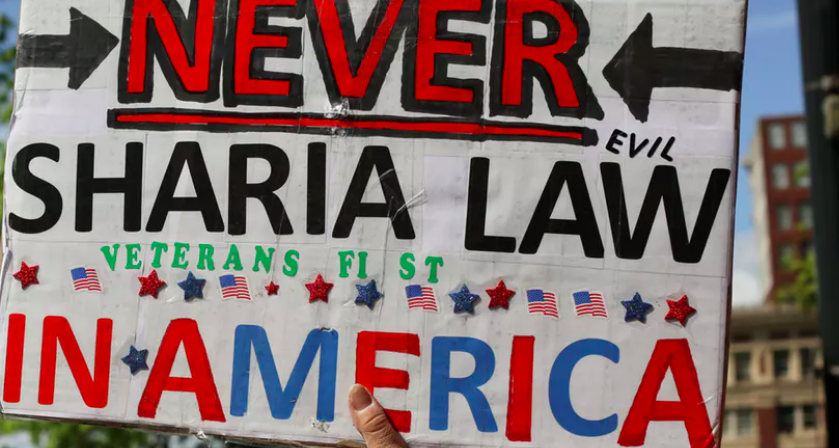
Conservative lawmakers in dozens of U.S. states have raised fears that Islamic fundamentalists want to impose Sharia on Americans. Reuters/David Ryder
Don’t Blame Sharia for Islamic Extremism – Blame Colonialism
Warning that Islamic extremists want to impose fundamentalist religious rule in American communities, right-wing lawmakers in dozens of U.S. states have tried banning Sharia, an Arabic term often understood to mean Islamic law.
These political debates – which cite terrorism and political violence in the Middle East to argue that Islam is incompatible with modern society – reinforce stereotypes that the Muslim world is uncivilized.
They also reflect ignorance of Sharia, which is not a strict legal code. Sharia means “path” or “way”: It is a broad set of values and ethical principles drawn from the Quran – Islam’s holy book – and the life of the Prophet Muhammad. As such, different people and governments may interpret Sharia differently.
Still, this is not the first time that the world has tried to figure out where Sharia fits into the global order.
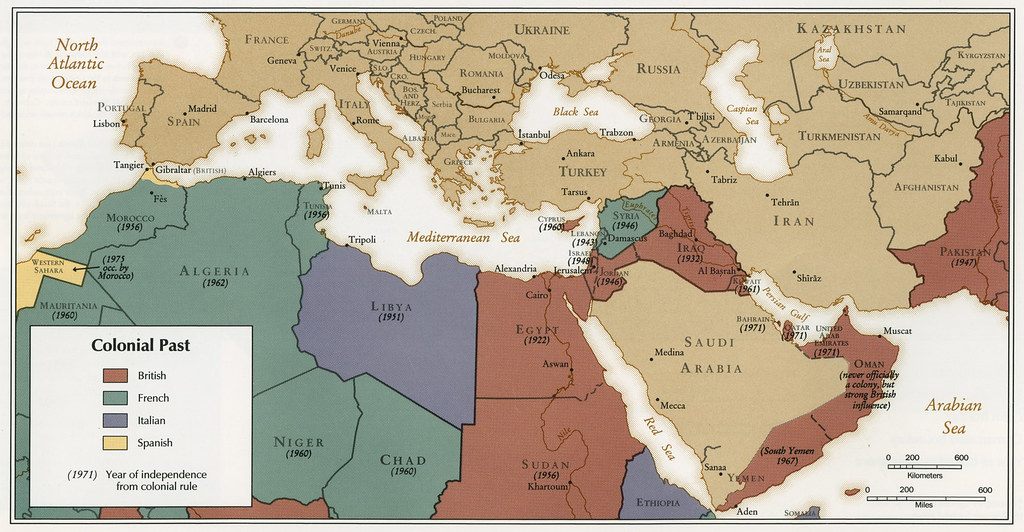
In the 1950s and 1960s, when Great Britain, France and other European powers relinquished their colonies in the Middle East, Africa and Asia, leaders of newly sovereign Muslim-majority countries faced a decision of enormous consequence: Should they build their governments on Islamic religious values or embrace the European laws inherited from colonial rule?
The big debate
Invariably, my historical research shows, political leaders of these young countries chose to keep their colonial justice systems rather than impose religious law.
Newly independent Sudan, Nigeria, Pakistan and Somalia, among other places, all confined the application of Sharia to marital and inheritance disputes within Muslim families, just as their colonial administrators had done. The remainder of their legal systems would continue to be based on European law.
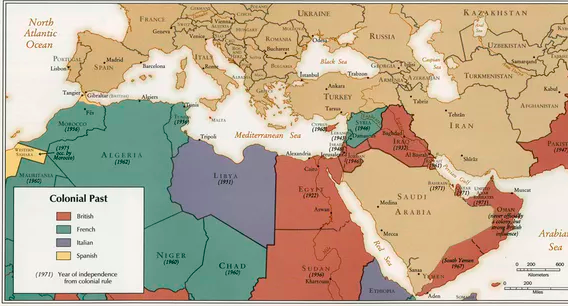
France, Italy and the United Kingdom imposed their legal systems onto Muslim-majority territories they colonized. CIA Norman B. Leventhal Map Center, CC BY
To understand why they chose this course, I researched the decision-making process in Sudan, the first sub-Saharan African country to gain independence from the British, in 1956.
In the national archives and libraries of the Sudanese capital Khartoum, and in interviews with Sudanese lawyers and officials, I discovered that leading judges, politicians and intellectuals actually pushed for Sudan to become a democratic Islamic state.
They envisioned a progressive legal system consistent with Islamic faithprinciples, one where all citizens – irrespective of religion, race or ethnicity – could practice their religious beliefs freely and openly.
“The People are equal like the teeth of a comb,” wrote Sudan’s soon-to-be Supreme Court Justice Hassan Muddathir in 1956, quoting the Prophet Muhammad, in an official memorandum I found archived in Khartoum’s Sudan Library. “An Arab is no better than a Persian, and the White is no better than the Black.”
Sudan’s post-colonial leadership, however, rejected those calls. They chose to keep the English common law tradition as the law of the land.
Why keep the laws of the oppressor?
My research identifies three reasons why early Sudan sidelined Sharia: politics, pragmatism and demography.
Rivalries between political parties in post-colonial Sudan led to parliamentary stalemate, which made it difficult to pass meaningful legislation. So Sudan simply maintained the colonial laws already on the books.
There were practical reasons for maintaining English common law, too.
Sudanese judges had been trained by British colonial officials. So they continued to apply English common law principles to the disputes they heard in their courtrooms.
Sudan’s founding fathers faced urgent challenges, such as creating the economy, establishing foreign trade and ending civil war. They felt it was simply not sensible to overhaul the rather smooth-running governance system in Khartoum.
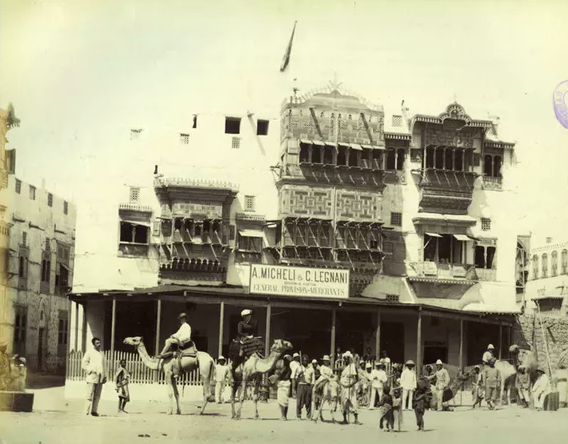
The Sudanese city of Suakim in 1884 or 1885, just prior to British colonial rule. The National Archives UK
The continued use of colonial law after independence also reflected Sudan’s ethnic, linguistic and religious diversity.
Then, as now, Sudanese citizens spoke many languages and belonged to dozens of ethnic groups. At the time of Sudan’s independence, people practicing Sunni and Sufi traditions of Islam lived largely in northern Sudan. Christianity was an important faith in southern Sudan.
Sudan’s diversity of faith communities meant that maintaining a foreign legal system – English common law – was less controversial than choosing whose version of Sharia to adopt.
Why extremists triumphed
My research uncovers how today’s instability across the Middle East and North Africa is, in part, a consequence of these post-colonial decisions to reject Sharia.
In maintaining colonial legal systems, Sudan and other Muslim-majority countries that followed a similar path appeased Western world powers, which were pushing their former colonies toward secularism.
But they avoided resolving tough questions about religious identity and the law. That created a disconnect between the people and their governments.
In the long run, that disconnect helped fuel unrest among some citizens of deep faith, leading to sectarian calls to unite religion and the state once and for all. In Iran, Saudi Arabia and parts of Somalia and Nigeria, these interpretations triumphed, imposing extremist versions of Sharia over millions of people.
In other words, Muslim-majority countries stunted the democratic potential of Sharia by rejecting it as a mainstream legal concept in the 1950s and 1960s, leaving Sharia in the hands of extremists.
But there is no inherent tension between Sharia, human rights and the rule of law. Like any use of religion in politics, Sharia’s application depends on who is using it – and why.
Leaders of places like Saudi Arabia and Brunei have chosen to restrict women’s freedom and minority rights. But many scholars of Islam and grassroots organizations interpret Sharia as a flexible, rights-oriented and equality-minded ethical order.

Women in Saudi Arabia have campaigned for gender equality, including the right to drive cars. Reuters/Faisal Nasser
Religion and the law worldwide
Religion is woven into the legal fabric of many post-colonial nations, with varying consequences for democracy and stability.
After its 1948 founding, Israel debated the role of Jewish law in Israeli society. Ultimately, Prime Minister David Ben-Gurion and his allies opted for a mixed legal system that combined Jewish law with English common law.
In Latin America, the Catholicism imposed by Spanish conquistadors underpins laws restricting abortion, divorce and gay rights.
And throughout the 19th century, judges in the U.S. regularly invoked the legal maxim that “Christianity is part of the common law.” Legislators still routinely invoke their Christian faith when supporting or opposing a given law.
Political extremism and human rights abuses that occur in those places are rarely understood as inherent flaws of these religions.
When it comes to Muslim-majority countries, however, Sharia takes the blame for regressive laws – not the people who pass those policies in the name of religion.
Fundamentalism and violence, in other words, are a post-colonial problem – not a religious inevitability.
For the Muslim world, finding a system of government that reflects Islamic values while promoting democracy will not be easy after more than 50 years of failed secular rule. But building peace may demand it.
MARK FATHI MASSOUD is an Associate Professor at the University of California, Santa Cruz.
THIS ARTICLE WAS ORIGINALLY PUBLISHED ON THE CONVERSATION
The Earth Group Aims to Change the World Through Education and Nourishment
Newly Certified B Corp Collaborates with UN World Food Programme to Help Children Around the Globe.
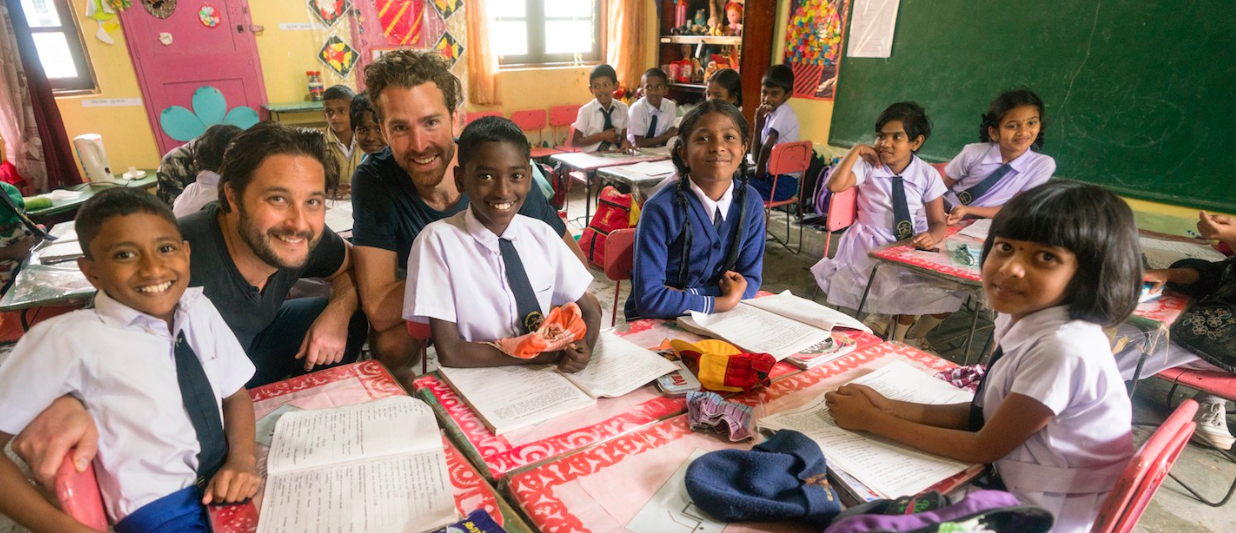
Kori Chilibeck and Matt Moreau at work for The Earth Group and World Food Programme in Sri Lanka. “Becoming a B Corp is an affirmation of what we’ve worked to achieve for so many years.”
The Earth Group is a Certified B Corporation that supports the United Nations World Food Programme (WFP) through donations that provide school meals, drinking water and education to children in the most troubled areas of our world.
To date, The Earth Group has helped fund more than 3.6 million meals to young school kids while helping them get an education in places like Tajikistan, Madagascar, Sri Lanka, Kenya, Bolivia and the Philippines. The B Corp is dedicated to informing consumers everywhere about the power of their everyday marketplace choices. For example, the simple purchase of a bag of Earth Coffee, one of three consumer products sold by the company, provides a schoolchild with meals for an entire week.
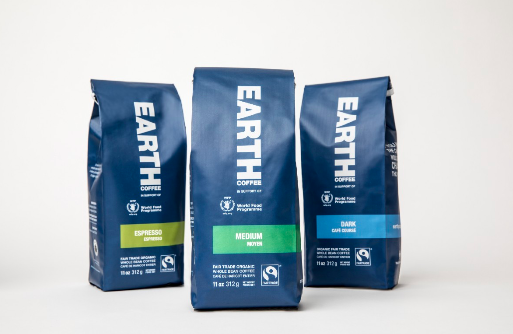
Purchase one bag of Earth Coffee online or in-store to feed one child for one entire week.
When Earth Group founders Matt Moreau and Kori Chilibeck met as fellow employees of a ski shop near the Rocky Mountains 14 years ago, they likely never imagined what lay ahead for them as individuals, new business owners or as proud supporters of the WFP.
Just forging this critical relationship with the WFP seemed daunting enough, but the maze-like process took far longer to realize than anyone could imagine. Eventually, they launched their social enterprise onto the large and complex world stage of fighting hunger, providing clean drinking water and building schools for children where none existed before.
It was at this point that Moreau and Chilibeck realized the real work had begun in earnest for their Canadian B Corp based in Edmonton, Alberta. Seeking to confirm that the aid they worked so diligently to fund would actually make the journey to the end-users, they traveled to Sri Lanka, Bolivia, Tajikistan and the Philippines to see for themselves.
As the photos and videos produced from these expeditions clearly testify, Moreau and Chilibeck landed in their natural element, surrounded by the children and co-workers they had been working so hard to support since creating The Earth Group. The expressions on the faces of not only the children and teachers but of Moreau and Chilibeck and the WFP country managers tell a tale of unselfish dedication.
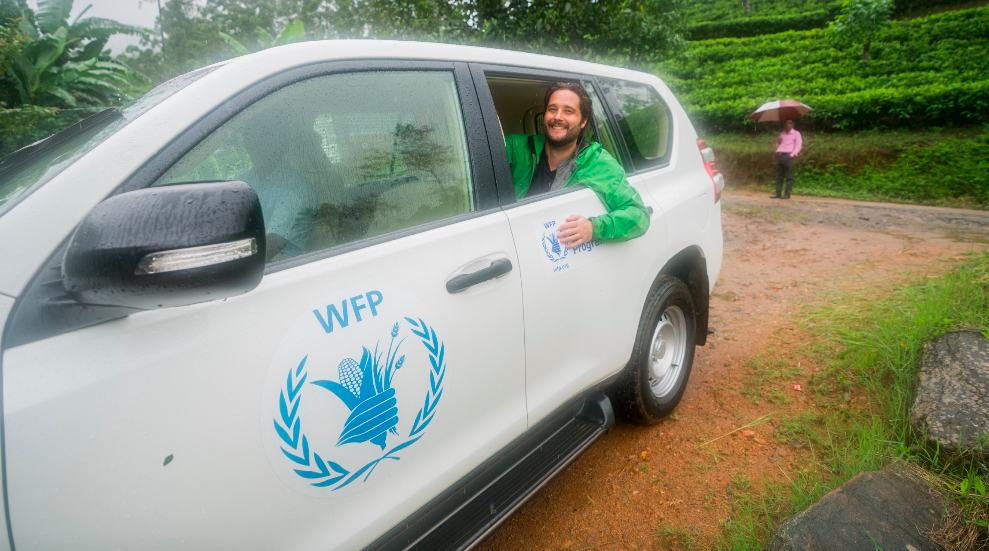
Kori Chilibeck in Sri Lanka hosted by the UN World Food Programme.
Seeing the Progress
The Earth Group maps its path to success through respect for the cultures they are trying to help. In many of these destinations, it is still frowned upon for female children to attend school. By respecting that posture yet also using the intellectual tools at hand, the company funds projects that often furnish female students with an extra helping of food to take home if they attend school, thereby allowing them to obtain an education, the family to benefit from the food, and the attitudes about females attending school to soften.
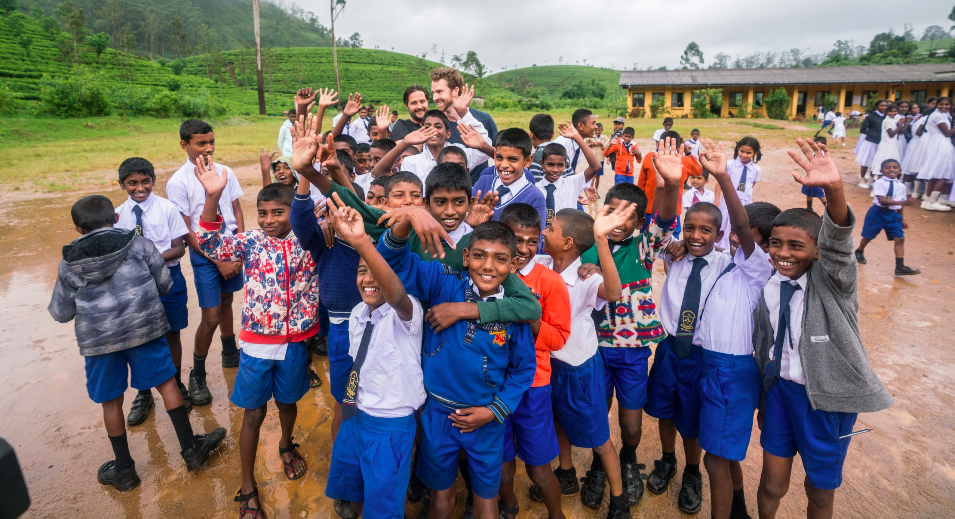
Schoolyard antics in Sri Lanka with Matt Moreau and Kori Chilibeck of The Earth Group.
The exhilaration of such remote expeditions reached its peak when the duo traveled to the Philippines, arriving in a volatile region where insurgents had blasted grenades and explosives just the day before. Their in-country WFP handlers changed safety tactics at once, and what was scheduled to be a multi-day trip ended up being a shortened-but-packed day of visiting the children in their classes, touring the school facilities, meeting the support staff and then continuing safely out of this troubled zone.
Back home in Edmonton, Moreau and Chilibeck rolled up their sleeves and focused on making their simple products-with-impact list: Fair Trade coffee from Eastern Africa, Indonesia, Central and South America; glacier-sourced drinking water from Whistler, British Columbia, and Rocky Mountain House, Alberta; and organic Alberta-grown teas, available in as many outlets as possible across Canada and around the world. Their online sales are activewith their triple bottom line—people, planet, profit—always remains in focus.
The Earth Group obtains its drinking water from Canadian glacier spring sources near the communities of Rocky Mountain House and Whistler, and their low-weight recyclable plastic bottles are landfill biodegradable. The Earth Group is also partnered with and supports Plastic Bank efforts to reduce ocean plastic.

Paying their dues during long negotiations with large corporations, Moreau and Chilibeck have now succeeded in signing major chain stores in Canada such as IKEA, Safeway, Sobeys, Whole Foods, Save On Foods, IGA and Metro. They also launched their product line in Japan, another major feat for any business run by two people, one employee and a group of dedicated volunteers.
Chilibeck is just back from the unrivaled adventure of presenting The Earth Group products in Japan to the largest food and beverage show in Asia called FOODEX. A receptive audience was excited to hear Earth Water is already available in their marketplace, with more Earth Group products sure to follow.
Path to Success
During certification in 2018 as a B Corporation, B Lab’s independent Standards Advisory Council confirmed The Earth Group’s three essentials: 1) social and environmental performance, 2) transparency and 3) accountability.
“B Corps values are synonymous with ours and embedded in our culture, so working toward the certification was both a pleasure and a reminder of being mindful of the numerous ways in which our work affects people and planet.”
And so it goes for these two young Canadian entrepreneurs and their “overnight success,” which has only taken them 14 years of collaboration, dedication, no-pay and near bankruptcy to arrive at a point where they can now see the results of their work. Having the blessings of understanding spouses has made it all possible, plus a bit of luck at critical moments.
Business gurus will tell start-up entrepreneurs timing is everything, and while this adage does have merit, the hard work and determination to succeed cannot be underestimated.
When Moreau and Chilibeck hatched their road map to success in a ski shop near the Rocky Mountains 14 years ago to create The Earth Group, at the same time Ben Cohen and Mal Warwick’s book Values-Driven Business: How to Change the World, Make Money, and Have Fun was synthesizing best practices and socially responsible business goals and laying the foundation for what would become the first B Impact Assessment, a process still used to certify B Corps.
B the Change gathers and shares the voices from within the movement of people using business as a force for good and the community of Certified B Corporations. The opinions expressed do not necessarily reflect those of the nonprofit B Lab.
GREGORY B. GALLAGHER is a Writer, Filmmaker, Musician and Producer.
THIS ARTICLE WAS ORIGINALLY PUBLISHED ON MEDIUM
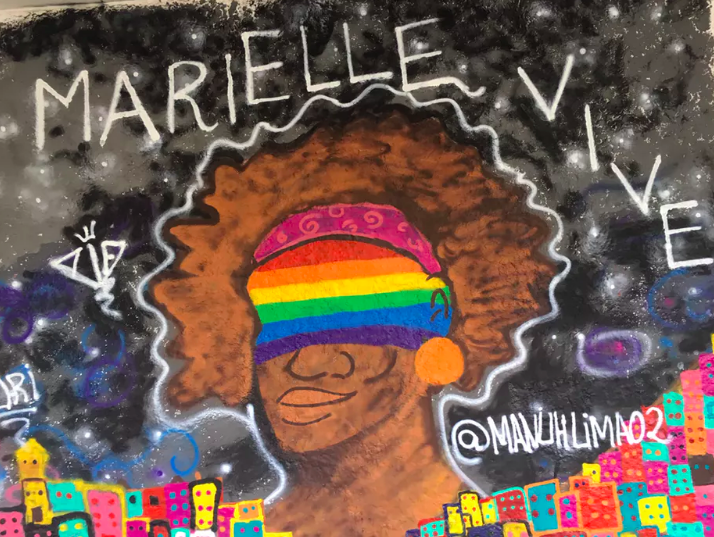
Graffiti commemorating Rio de Janeiro city councillor Marielle Franco who was shot dead in an apparent assassination. Emanoelle Lima/photo by Catherine McNamara, Author provided
How LGBTQ People are Resisting Bolsonaro’s Brazil Through Art
Jair Bolsonaro was elected president of Brazil in October 2018 and took office in January 2019. Since then, the Ministry of Women, Family and Human Rights has chosen to remove the legal protection status of lesbian, gay, bisexual, trans and queer (LGBTQ) people. Some politicians are now pushing for a ban on talking about gender diversity and sexual orientation in schools.
Bathroom laws pertaining to which toilet facilities trans people are allowed to use and bills defining what constitutes a family, same sex marriage and laws enabling trans people to change their legal name are also seen to be under threat.
Brazil has a reputation as one of the most violent countries in the world and is known as the LGBT “murder capital” – 167 trans people were reported murdered between October 1, 2017 and September 30, 2018 alone. In the lead up to and since Bolsonaro’s election, LGBT hate crime has increased.
No wonder that many Brazilian LGBTQ people are worried that they are becoming isolated from the rest of the world. Marielle Franco – a young politician who took a strong stance against police violence – was murdered in Rio de Janeiro in March 2018.
She was a bisexual black woman who grew up in the Maré favela and pushed for social justice for marginalised people in the city. She was reportedly targeted by professional killers.
In Brazil, military police patrol the streets and are independent from the municipal police who carry out investigations. In March 2019, a year after her murder, it was reported that two ex-military police had been arrested for the killing.
Theusa Passareli – a 21-year-old art student who identified as genderqueer or non-binary – was murdered in April 2018, killed on their way home from a party.
Their work was incomplete in Universidade do Estado do Rio de Janiero’s design studio when I visited in November 2018 and will stay to commemorate their memory, as the university and the trans community mourn the murder of another young person.

Resin on glass by Theusa Passareli. Catherine McNamara, Author provided
A safe place to protest
I was in Rio for a short residency with the TransArte festival – a three day art show that explores gender identity and sexuality. The festival brings together trans people and allies to exchange ideas, make and share work, and celebrate the strengths of the LGBT community in Brazil within a place of safety.
It’s not easy to protest when faced with violence, nor is it easy to enjoy culture – particularly for people living in poverty where basic needs are difficult to meet. Trans artists have said that being trans is a barrier to participating in the arts, but “safe spaces” such as the TransArte festival allow protest art to flourish and create opportunities for LGBTQ people to express themselves.
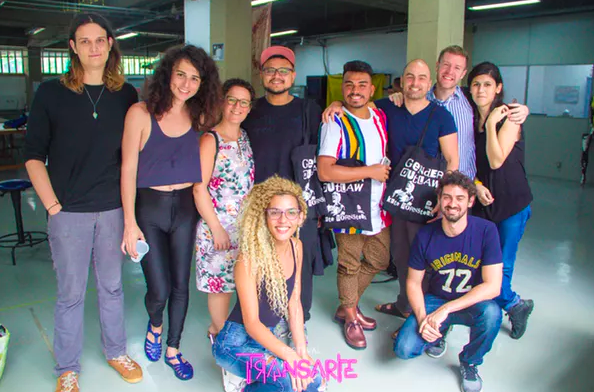
Trans and LGB artists, activists and educators from Rio de Janeiro and London. TransArte Festival Team, Author provided
Trans and LGB artists, activists and educators from Rio de Janeiro and London. TransArte Festival Team, Author provided
A theatre company led by trans people created Come As You Are – a series of autobiographical stories with physical theatre and improvisation. The stories were about family – supportive and loving family as a source of strength, and familial rejection as a result of being trans.
They explored life as trans men and women in a culture of toxic masculinity, normativity and police brutality. A photography exhibition of several artists included Bernardo de Castro Gomes, whose work also explored his identity as a black trans man facing intimidation, harassment and violence.
Queer drag artists such as Le Circo de la Drag spoke about their political performance – using their bodies to resist toxic masculinity and defy the threats of violence they often receive.
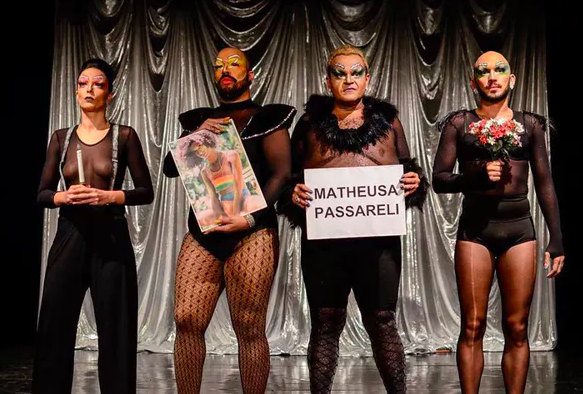
Le Circo de la drag pay tribute to Marielle Franco and Theusa Passareli. Marianna Cartaxo, Author provided
The show Monster, Whore, Bitch – Waldirene’s Dreams, directed by Dandara Vital, compiled the everyday experiences of Brazilian trans people interwoven with a re-telling of the story of Waldirene – the first trans woman to undergo gender reassignment surgery in Brazil in December 1971, at the height of the military dictatorship.
Resistance is clearly flourishing in Brazil against the odds and not only within festivals like TransArte. A Portuguese translation of Jo Clifford’splay The Gospel According to Jesus, Queen of Heaven was due to open in Londrina, a city in southern Brazil, but the venue cancelled at the very last moment.
The lead, a trans woman called Renata Carvalho, received death threats. The company moved to a semi-derelict space where they performed by torchlight instead, despite injunctions from both Pentecostal and Catholic groups to stop the production.
My own experiences working with the TransArte festival team in Rio have shown me the value of safe places free from judgement and hostility. The people we worked with told us that being there in solidarity with the trans communities of Rio felt like a powerful action in itself, resisting the culture of violence that thrives in Bolsonaro’s Brazil.
CATHERINE MCNAMARA is Head of School (Art, Design and Performance) at the Faculty of Creative and Cultural Industries at the University of Portsmouth.
THIS ARTICLE WAS ORIGINALLY PUBLISHED ON THE CONVERSATION.
The Abandoned Whaling Station Nature Reclaimed
Rusty boats and barrels dot the shore of the British Island of South Georgia. They’re relics of a whaling station known as Grytviken that ceased operation in 1966 after the whale population had been nearly depleted by hunting. Today, the remote island, which sits 1,500 miles from the foot of Argentina, is home to millions of penguins and as well as seals. What was once the scene of one of the worst wildlife massacres in history is now a space that nature itself has reclaimed.

Khalida Brohi sitting at a table, smiling. Joi Ito. CC 2.0
Honor in its Most Dishonorable Form
“Even if I have nothing, I should have honor”. But what does “honor” mean for Khalida Brohi, now thirty-one years of age and continuously fighting to redefine the word. Brohi is a Pakistan native and women’s activist currently fighting to end honor killings in her small village just outside Balochistan, Pakistan. She is well-known for her numerous campaigns, the most notable being WAKE UP, Youth and Gender Development Program, and Sughar. She has been featured in multiple newsletter articles such as Newsweek 25 Under 25, Forbes 30 Under 30, and Forbes 30 Under 30: Asia for her accomplishments and hard work. Brohi started her activism at just nine years old when she discovered her cousin had been murdered in an “honor killing”, a decision made from the family that is in no way honorable.
In her captivating memoir titled I Should Have Honor, Brohi tells us her thrilling story of her fight to end the practice of “honor killings” in her tribal village. Her memoir details her story, from the beginning to now, showing the birth of her many organizations and what sparked her passion for dismantling this horrible practice.
But what are honor killings? Honor killings are in no way honorable – they are power grab and a way to mend someone’s pride. Many cultures in Northern Africa, the Middle East, and South Asia conduct these lawful murders which affect around 93% of women in these areas. They are brutal, unjustified, and tear families apart – all for the cause of “honor”. Honor killings happen when someone rebels against what their family deems appropriate. Thousands of individuals are losing their lives every year because they just wanted to live the life that they preferred over their families judgments.
When Brohi was only 14-years-old, she found out her cousin, Khadija, was murdered by her father. The reason? Khadija did not marry the man her father choose for her, rather eloping with the man that she loved instead. Brohi, upon learning this news states, “people often become poets when they fall in love, but I became a poet when hate entered my heart” (Brohi 71). Brohi knew then, at only 14-years, that no one should go through what her cousin did.
Using the strength she found within herself that day, Brohi transformed her anger into poetry, writing and eventually performing for her father’s nonprofit organization titled Participatory Development Initiatives. Brohi’s father made her master of ceremonies, and she wowed every crowd with her passion and her words. This exposure allowed her to be discovered by a local organization called WE CAN End Violence Against Women. After being contacted by them, she collaborated and brought the organization to her local village. Brohi knew that the woman in the village would be hesitant to come to any meetings, so being clever, she framed the meetings in another light. Once all the attendees that were coming arrived, Brohi eased in conversation about “honor killings” and how to go about stopping them. The crowd got silent once she mentioned her real agenda, but soon enough, people being telling their stories and sharing their thoughts and feelings on the matter.
From that tense first meeting, Brohi used the WE CAN organization to kick start her organization, Youth, and Gender Development Program (YGDP) which focused on “educat[ing], empower[ing], and strengthen[ing] youth against cultural restrictions, enabling them to speak up about customs like honor killings” (Brohi 87). Her new organization also gave the women in her village a platform and space were they could air their grievances and address what they believed needed to be addressed. In Brohi’s words: “Until [then], they’d simply had no resources to bring them up to par” (Brohi 89).
Though her personal organization gained more traction, she also unfortunately gained unwanted attention. The work Brohi was doing threatened the power structure and patriarchy around her. Not only was Brohi, herself, being threatened, but her family as well. It was not easy for Brohi to go through the decision that she did because since she was gaining momentum and a following, she was also gaining a following of people who do not like her. They did not like her speaking out on what she believed in. Their threats did not stop Brohi, though.
Brohi, with the momentum WE CAN and YGDP was getting, traveled to Australia and America to speak at multiple conferences and events, some including Clinton Global Initiative, Women in the World, and MIT Media Lab. At those events, she railed the crowd and gave more publicity to what was happening in her tribal village back home.
In 2009, she founded the Sugar Foundation, “a non-profit dedicated to providing tribal and rural women in Pakistan with opportunities to evaluate their abilities and nurture their leadership skills in an environment of growth and development” (quote taken from her “about me” page on "her" blog, khalidabrohi.com). From there, she has also founded The Chai Spot in Arizona with her husband, David Barron. The Chai Spot, is a forum where Americans cannot only help fund her cause, but also learn the lively and enriching culture and lifestyle that Brohi, herself, grew up in. Advertisements on her blog show that she is set to open a new Chai Spot in New York City soon.
Brohi, through her activism and sympathy, created organizations and gave a platform to people who believed they could not even acknowledge their experiences. She shows the power and agency women have and how they can use it to their own advantage. She is an inspiration for all of us. If you would like to support her, visit sugharfoundation.org and click the Donate tab to fund her important and impactful nonprofit. Let Brohi continue to define and redefine what “honor” truly is.
OLIVIA HAMMOND is an undergraduate at Emerson College in Boston, Massachusetts. She studies Creative Writing, with minors in Sociology/Anthropology and Marketing. She has travelled to seven different countries, most recently studying abroad this past summer in the Netherlands. She has a passion for words, traveling, and learning in any form.
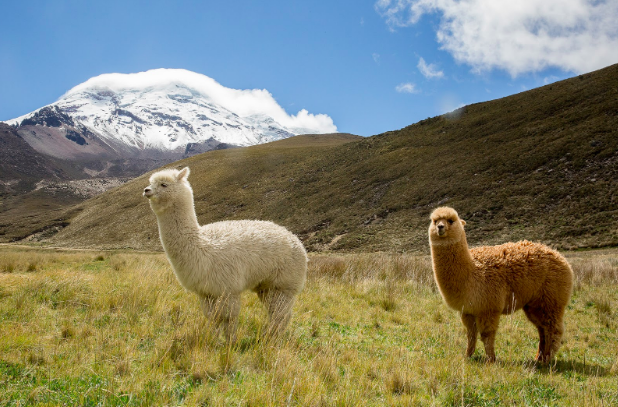
Native alpacas graze near the Chimborazo Volcano during Purposeful Nomad’s trip to Ecuador where the group learns about local non-profit, Paqocha’s, mission to restore alpaca populations and meets the community who sheers, cleans, and spins the fleece. Caitlin Murray. Purposeful Nomad.
Revolutionizing Ethical Travel for Women: Meet Purposeful Nomad
When Caitlin Murray met Alejandro and Agostina, conservationists and owners of Ecuadorian Mashpi Artisanal Chocolate Farm, she’d been living in South America for two years after a solo trip that inspired her to stay. They showed her how their commitment to regenerating Ecuador’s cloud forest focuses on sustainable farming practices and educating others. They also gave her a taste of their handcrafted Arriba Cocoa bar that won first place in 2016’s International Chocolate Awards. Inspired by their story and commitment to the environment, Caitlin wanted to bring others to their farm.
Volunteering abroad, solo backpacking, and working in the tourism industry, Caitlin realized in order to access culture and be socially responsible, she must find measurable ways to directly give back to local communities. Driven to create opportunities for women to collectively experience this, she founded Purposeful Nomad. Purposeful Nomad is a travel company that crafts deeper, safer, more ethically responsible travel for women. They attract women from a variety of backgrounds and ages seeking a different kind of experience. “I wanted to use tourism as something positive in the world and not just a consumerism ‘let’s take my life and emulate my life somewhere else’ ethos,” Caitlin explains.
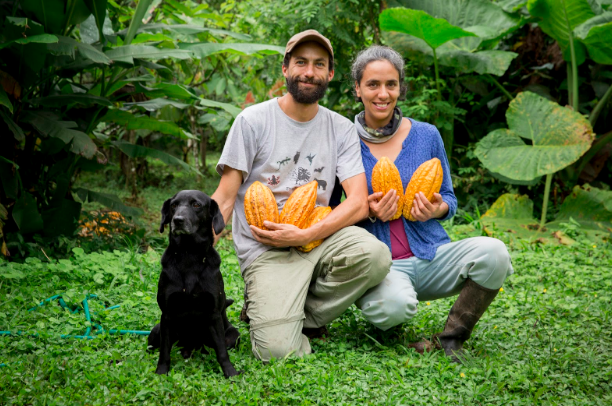
Alejandro and Agostina, conservationists and owners of Ecuadorian Mashpi Artisanal Chocolate Farm educate Purposeful Nomad travelers about sustainable farming while sharing their award-winning handcrafted Arriba Cocoa bars. Jessica Scranton. Purposeful Nomad.
Two years after her visit to Mashpi Farm, Caitlin launched her first women-only sustainable social impact travel program in Ecuador - called Food, Farm, Fleece. The 14-day itinerary integrates local experience and education. Early on, the group meets with grassroots organization founders of Paqocha, Felipe Segovia and Lorena Perez to learn about their efforts to revive the alpaca population. Next, they learn from Ecuadorian women how to shear, clean and spin the fleece with the opportunity to purchase handwoven wares directly from the makers.
Going through a transitional time in her life, Sara Carter signed up with Purposeful Nomad to “fulfill her desire to immerse herself in Ecuador's culture, food, and people, while affording her the chance to do it with like-minded women.” Within a few short years, Purposeful Nomad has grown to eight new locations and diversified itineraries - including Cuba, Morocco, India, and Guatemala.
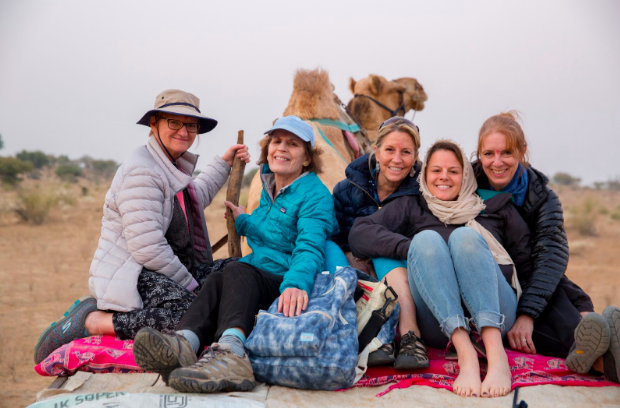
Purposeful Nomad Founder, Caitlin Murray, (second from right) and women’s sustainable travel group gather after a village homestay and camel trek in the Thar desert, India. Jessica Scranton. Purposeful Nomad.
According to the World Tourism Organization as explained in CNBC’s article “Eco-Friendly Tourism” eco-travel is expected to climb to 1.8 billion by 2030. Since 2000, worldwide destination seeking has jumped by more than 50 percent. As socially responsible travel continues to grow “we make sure our dollars stay local. We’re not a luxury tour company,” says Caitlin. According to McColl of Ethical Traveler, the best way to travel sustainability is to get to know the local people so the “money stays in the local economy, rather than getting extracted by foreign corporations … as a bonus, it’s a more genuine experience, and a better chance to connect with local people.” Purposeful Nomad prioritizes local from lodging and cuisine to hiring knowledgeable guides. Caitlin builds partnerships by talking to locals and finding ways to help. She doesn’t assume to know what a place needs. She asks. Would you like to work with us? How can we help?
According to MarketWatch, more than 1.6 million people volunteer on vacation each year, paying more than $2 billion annually to help out while traveling. Nevertheless, it brings into question how much lasting impact they are generating.
Purposeful Nomad focuses on tapping into established grassroots organizations that are already happening on the ground and are a proven success to help measure their impact. “Bigger volunteer organizations, can create incredible infrastructures in developing countries, but once they pull out, the schools are empty. We don’t want that,” Caitlin explains.
With the mounting popularity of conscious travel, terms like responsible, sustainable and ethical can often be overused or misused in the tourism industry. Epicure & Culture contributor, Daniela Frendo explains, “In the travel industry, greenwashing refers to tour operators which make eco-trips seem more sustainable and ethical than they actually are.” Travelers can mitigate this by asking travel companies whether they employ local people and buy locally-sourced products as well as learn more about how invested the company actually is in community-based projects. Aware of greenwashing, Caitlin says, “If you take shortcuts, people are going to know.” She thoroughly vets organizations and individuals to ensure there is transparency in where the money goes.
Back at the Masphi Farm, Alejandro and Agostina’s passion for conservation and keeping the Ecuadorian traditions of the cacao crop alive balances well with dishing out delicious artisanal chocolate. So, for your next trip, consider traveling with a purpose—it doesn’t get much sweeter than that.
JULIA KRAMER is a New York-based writer and avid traveler who addresses systems changes to social challenges through storytelling and community building. When she’s not writing or on the road, you will find her cooking something from her urban garden or hiking. Read more of her articles on travel and social impact at julia-roos.com.
Preserving Prehistoric Lizards With the 'Iguanero'
Ramón Medina Archundia: the iguana guy. Archundia loves iguanas so much that he fosters hundreds of them in his front yard in Manzanilla, Mexico.
Read MoreSRI LANKA: Singha Vihara
Sri Lanka, officially the Democratic Socialist Republic of Sri Lanka, is an island country in South Asia, located in the Indian Ocean to the southwest of the Bay of Bengal and to the southeast of the Arabian Sea. The videographers took a road trip in Sri Lanka and this video documents their travels.
Memories of Myanmar
Myanmar (formerly Burma) is a Southeast Asian nation of more than 100 ethnic groups, bordering India, Bangladesh, China, Laos and Thailand. The videographers spent two weeks traveling in Myanmar and fell in love with the country. There are many cultural practices still alive due to the fact that the country was closed off to most of the world for some time.
Protecting Our Oceans from Ghost Traps
At any given time, there are thought to be over 360,000 tons of loose fishing gear floating through our oceans. These disregarded pieces of debris are a danger to our aquatic ecosystems, trapping fish, turtles, birds and even whales. Kurt Lieber assembled the Ocean Defender Alliance, a group of volunteer divers cleaning California’s coasts of ghost nets and traps.
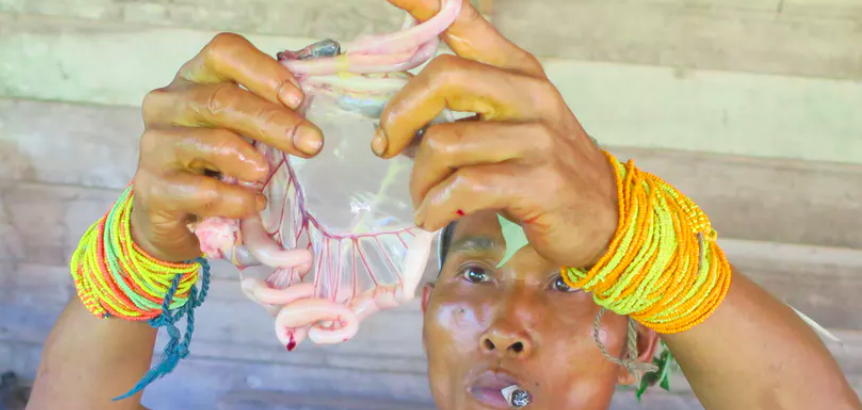
Examining chicken intestines, reading the tea leaves, watching the markets – people turn to experts for insight into the mysteries that surround them. Manvir Singh, CC BY-ND
Modern Shamans: Financial Managers, Political Pundits and Others Who Help Tame Life’s Uncertainty
Aka Manai explains that there are two kinds of people in the world: simata and sikerei.
I am a simata. He is a sikerei. Sikerei have undergone transformative experiences and emerged with new abilities: They alone can see spirits.
I’ve experienced a lot since that night in Indonesia when Aka Manai told me this. I was there when an initiate first saw spirits, when he and the other sikerei wept as they saw their dead fathers swirling around them. I’ve attended seven healing ceremonies, witnessing the slaughter of dozens of pigs to accompany nights of dancing. But that chat with kind-faced Aka Manai, more than any other experience, grounded my understanding of sikerei in particular and shamanism more generally.
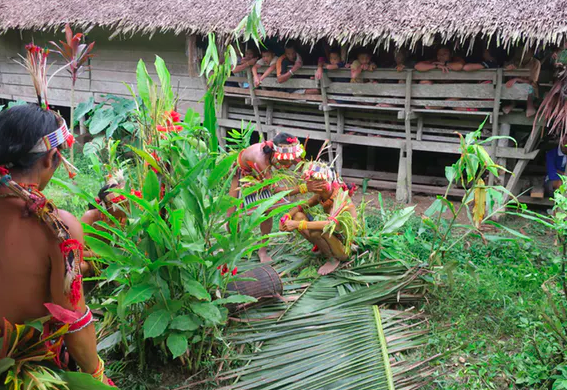
A sikerei treats an initiate’s eyes so he, too, can see spirits. Manvir Singh, CC BY-ND
I’m a cognitive anthropologist who studies why societies everywhere develop complex yet strikingly similar traditions, ranging from dance songs to justice to shamanism. And though trancing witch doctors may sound exotic to a Western reader, I argue that the same social and psychological pressures that give rise to healers like Aka Manai produce shaman-analogues in the contemporary, industrialized West.
What is a shaman?
Shamans, including the sikerei I’ve known in Indonesia, are service providers. They specialize in healing and divination, and their services can range from ending a drought to growing a business. Like all magical specialists, they rely on spells and occult gizmos, but what makes shamans special is that they use trance.
Trance is any foreign psychological state in which a practitioner is said to engage with the supernatural. Some trances involve complete immobilization; others appear as tongue-lolling convulsions. In some South American groups, shamans enter trance by snorting a hallucinogenic powder, transforming themselves into crawling, unintelligible spirit-beings.
Being a shaman often carries benefits, both because they get paid and because their special position grants them prestige and influence.
But these advantages are offset by the ordeals involved. In many societies, a wannabe initiate lacks credibility until he (and it’s usually a he) undergoes a near-death experience or a long bout of asceticism.
One aboriginal Australian shaman told ethnographers that, as a novice, he was killed by an older shaman who then replaced his organs with a new, magical set. When he woke up from the surgery and asked the old shaman if he was lost, the old man replied, “No, you are not lost; I killed you a long time ago.”
A long time ago, a short time ago, here, there – wherever you look, there are shamans. Manifesting as mediums, channelers, witch doctors and the prophets of religious movements, shamans have appeared in most human societies, including nearly all documented hunter-gatherers. They characterized the religious lives of ancestral humans and are often said to be the “first profession.”
Why are there shamans?
Why is it that when we lanky primates get together for long enough, our societies reliably give rise to trance-dancing healers?
According to anthropologist Michael Winkelman, the answer is wisdom. Drugs and drumming, he’s argued, link up brain regions that don’t normally communicate. This connection yields new insights, allowing shamans to do things like heal sickness and locate animals. By specializing in trance, shamans uncover solutions inaccessible to normal brains.
Based on my fieldwork, I’ve argued against Winkelman’s account. Rather than all integrating people’s psychologies, trance states are wildly diverse. Chanting, sipping psychoactive brews such as ayahuasca, dancing to the point of exhaustion, even smoking extreme quantities of tobacco – these methods produce profoundly different states. Some are arousing, others calming; some expand awareness, others induce repetitive thinking. In fact, the only element shared among these states is their exoticness – that once altered, the shaman’s experience stands apart from those of his onlookers.
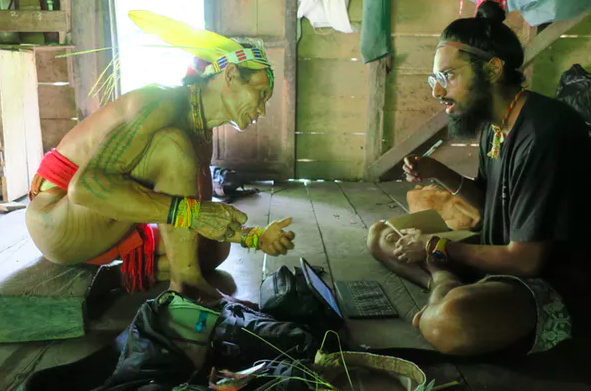
As part of his anthropological fieldwork, author Manvir Singh speaks with an Indonesian shaman. Luke Glowacki, CC BY-ND
Not only are shamans’ experiences exotic, their very beings are, too. As Aka Manai emphasized to me, people understand shamans to be different kinds of entities, made “other” by their ordeals. The Mentawai word for a non-shaman, simata, also describes uncooked food or unripe fruit; it implies immaturity. The word for shaman, in contrast, means a person who has undergone a process: one who has been kerei’d and come out the other side a sikerei.
This otherness is crucial. Convinced that shamans diverge from normal people, communities accept that they have superhuman abilities. Like Superman’s alien origins and the X-Men’s genetic mutations, shamans’ transformations assure people that they deviate from normal humanness, making their claims of supernatural engagement more believable.
And once people trust that a specialist engages with gods and spirits, they go to them when they need to influence uncertainty. A sick child’s parent or a farmer desperate for rain prefers to nudge the forces responsible for their hardship – and a shaman provides a compelling conduit for doing so.
This, I suggest, is why shamans recur around the world and across time. As specialists compete in markets for magic, they fuel the evolution of practices that hack people’s intuitions about magic and special abilities, convincing the rest of us that they can control uncertainty. Shamans are the culmination of this evolution. They use trance and initiations to transcend humanness, assuring their clients that they can commune with the invisible beings who oversee uncertain events.
Who are the shamans of the industrialized West?
Most people assume that shamanism has disappeared in the industrialized West – that it’s an ancient tradition of long-lost tribes, at most resurrected and corrupted by New Age xenophiles and overeager mystics.
To some extent, these people are right. Far fewer Westerners visit trance-practitioners to heal illness or call rain than people have elsewhere in the world or throughout history. But they’re also wrong. Like people everywhere, contemporary Westerners look to experts to achieve the impossible – to heal incurable illnesses, to forecast unknowable futures – and the experts, in turn, compete among themselves, performing to convince people of their special abilities.
So who are these modern shamans?

A specialist you can turn to for help divining the mysterious forces at work in financial markets. Matej Kastelic/Shutterstock.com
According to the cognitive scientist Samuel Johnson, financial money managers are likely candidates. Money managers fail to outperform the market – in fact, they even fail to systematically outperform each other – yet customers continue to pay them to divine future stock prices.
This faith might come from a belief of their fundamental otherness. Johnson points out that money managers emphasize their differences from clients, exhibiting extreme charisma and enduring superhuman work schedules. Managers also adorn themselves with advanced mathematical degrees and use complicated statistical models to predict the market. Although money managers don’t enter trance, their degrees and models assure clients that the specialists can peer into otherwise opaque forces.
Of course, money managers aren’t the only experts to specialize in the impossible. Psychics, sports analysts, political pundits, economic forecasters, esoteric healers and even an octopus similarly sate people’s desires to tame the uncertain. Like shamans and money managers, they decorate themselves with badges of credibility – an association with the White House, for example, or a familiarity with ancient Tibetan medicine – that persuade customers of their special abilities.
As long as hidden forces shape our fates, people will try to control them. And as long as it’s profitable, pseudo-experts will compete for desperate clients, dressing in the most credible and compelling costumes. Shamanism is not some arcane tradition restricted to an ancient past or New Age circles. It’s a near-inevitable consequence of our human intuitions about special abilities and our desire to control the uncertain, and elements of it appear everywhere.
MANVIR SINGH is a PhD Candidate in Human Evolutionary Biology at Harvard University.
THIS ARTICLE WAS ORIGINALLY PUBLISHED ON THE CONVERSATION
Off the Grid on a Homemade Island
Floating off the coast of Vancouver Island, a 45-minute boat ride to the nearest town, is a sustainable island fortress complete with a dance floor, art gallery and garden. For artists Catherine King and Wayne Adams, this is home: a labor of love 24 years in the making.
In Peru, a 'Foggy' Solution to a Water Shortage
Millions of people in Peru lack access to safe water and sewage services. But Abel Cruz Gutiérrez has a solution. Gutiérrez, president of the "Peruvians Without Water" association, uses an ingenious system of "fog catchers" to make water accessible to residents of Lima's low-income neighborhoods. The fog catchers resemble large rectangular sailboat sails, which are composed of nylon nets that trap microdroplets of water. The nets are set up along the foggy areas of coastal Peru and are connected to pipes, which collect the water for larger storage tanks. Residents can then use this water as irrigation for crops or to raise animals. And while the water isn't currently drinkable, Gutiérrez is working on a solution to that as well.