
People flock to Kamchatka in Russia to surf every year. The best place to surf in Kamchatka is Khalaktyrsky beach because of its black volcanic sand and several monumental volcanoes in a background. The waves size can get up to 5.5 meters, and there are volcanic lava rocks in the bottom. The water temperature usually does not rise about 10 degrees Celsius; therefore, a wetsuit is highly recommended for surfing there.
These Aussies Live In A Town Underground
Coober Pedy is a small desert town in Australia where the entire population lives in underground homes. With outside temperatures hovering over 100 degrees, residents made permanent homes in the cooler temperatures of old mine shafts.
South Sudan Continues to Face Starvation Crisis
100,000 are starving in the worst humanitarian crisis since 1945
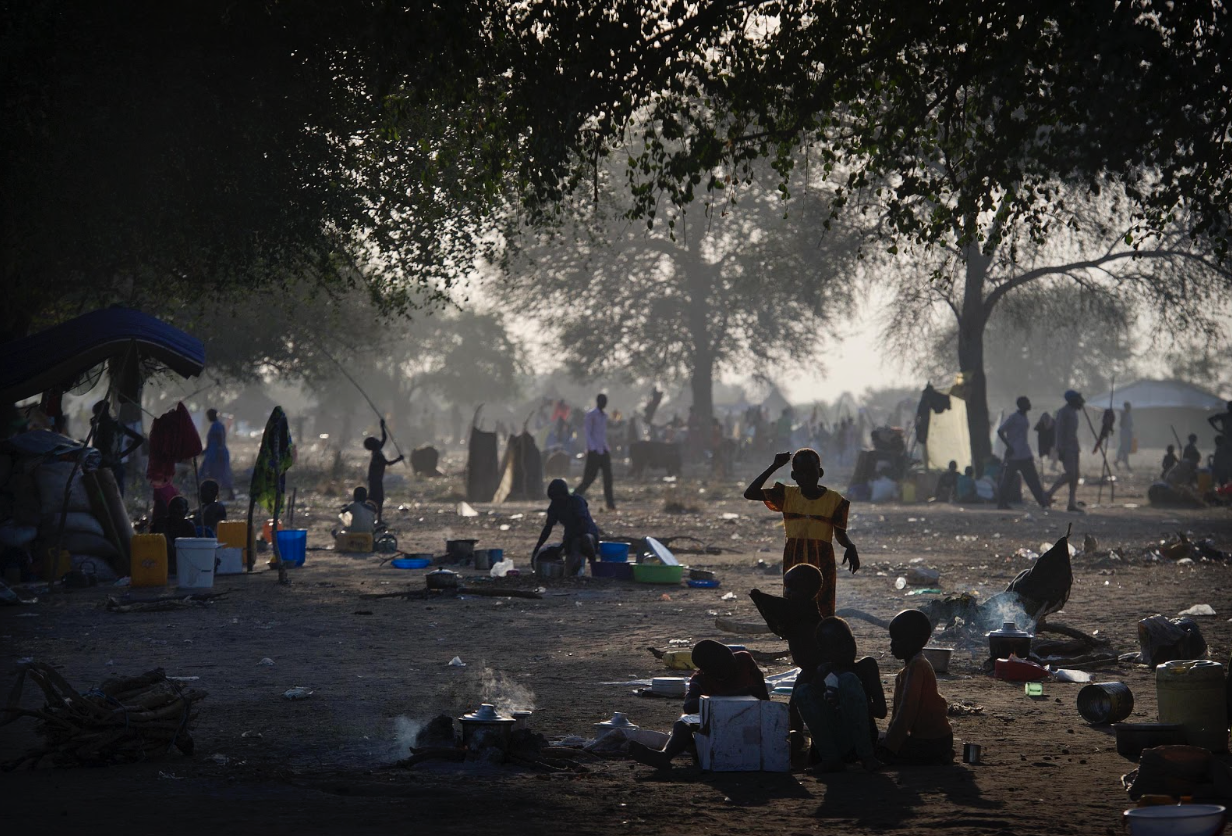
A refugee camp in Minkaman, Awerial County, home to those who have fled due to fighting in Bor. Geoff Pugh 1/13/2014.
In 2011, South Sudan declared independence from Sudan, following over 50 years of civil war. Despite what were then high hopes for the new nation, South Sudan fell again into civil war, only two years after its new-found independence. The conflict experienced a brief respite do to a peace agreement in 2015, only to be followed by more violence as president Salva Kiir clashed with vice president Riek Machar. The conflict continues to have an incredibly destructive presence in the lives of everyday South Sudanese citizens, many of whom have been caught up in the conflict, forced to leave their country, or joined the 3.5 million displaced from their homes.
Because of these circumstances, South Sudan is currently experiencing what has been called the worst famine since World War II. Due to scarcity, food has become almost completely unaffordable, making it incredibly difficult for people to buy the bare minimum of nutrition necessary for survival. Poor roads, more than half of which become inaccessible during South Sudan’s rainy season, make it difficult for aid agencies to reach people by ground via trucks or barges. This means that aid must be delivered by airdrop, which is considerably more expensive and less affective, not to mention hazardous for those receiving it. Patricia Danzi, head of operations for Africa of the International Committee of the Red Cross, estimates that humanitarian aid is seven times more expensive in South Sudan then in nearby Somalia.
This makes it increasingly difficult for aid agencies to reach the 100,000 people currently experiencing starvation. The UN estimates that 5 million more people (42% of the population) lack adequate access to food, and have no knowledge of when they will be able to eat, or where their next meal will come from.
Despite the severity of the crisis in South Sudan, awareness and media coverage in the US and globally is incredibly low. Ashley McLaughlin, media and communications officer for the International Organisation for Migration (IOM) South Sudan writes that “in America, in all of 2015, there was no mention of South Sudan in the weekly evening news shows.” It is not difficult to trace the lack of media attention to the lack of humanitarian aid. In fact, as of 2016 the UN reported that only 3% of it’s appeal for humanitarian aid to South Sudan had been met. What funding has been provided is largely reactionary, despite what Zlatko Gegic, country director for Oxfam South Sudan cites as the “need to shift from a short-term approach to a more sustainable and transformative one.” In short, it is impossible to address South Sudan’s starvation crisis without also dealing with the violence and displacement that prove major factors in its existence. While funding is desperately needed, it must be applied holistically. The Department for International Development, for instance, is moving toward a “multi-year” funding model that enables the aid agencies it funds to offer better long-term support to those without adequate access to food.
This is a crisis that can no longer be ignored. In a world where one third of the food produced is never eaten, and around six billion pounds of fruits and vegetables go unharvested in the US alone, it is clear that we can do better.
EMMA BRUCE is an undergraduate student studying English and marketing at Emerson College in Boston. She has worked as a volunteer in Guatemala City and is passionate about travel and social justice. She plans to continue traveling wherever life may take her.

This Rapper Wants to Challenge Your Asian Stereotypes
Dumbfoundead (real name Jonathan Park) is a Korean American rapper who has never backed down from a battle—rap or otherwise. He sings about the Asian American experience in his work and is vocal about the lack of Asians in popular culture. Once he took the mic, he never looked back.
The Zambia Project
Janssen Powers had the pleasure of shooting this piece for World Vision. He said "to say it was an eye opening trip would be an understatement. As crazy as it is to imagine drinking contaminated water everyday, it's even crazier when you realize that so many people spend the majority of their time just looking for it."
World Vision is an amazing organization doing great things in Zambia and all over the world. To learn more about their effort to bring Zambia clean water, visit worldvisionwater.org.
CANADA: The Push
A Winter Journey into the Canadian Arctic
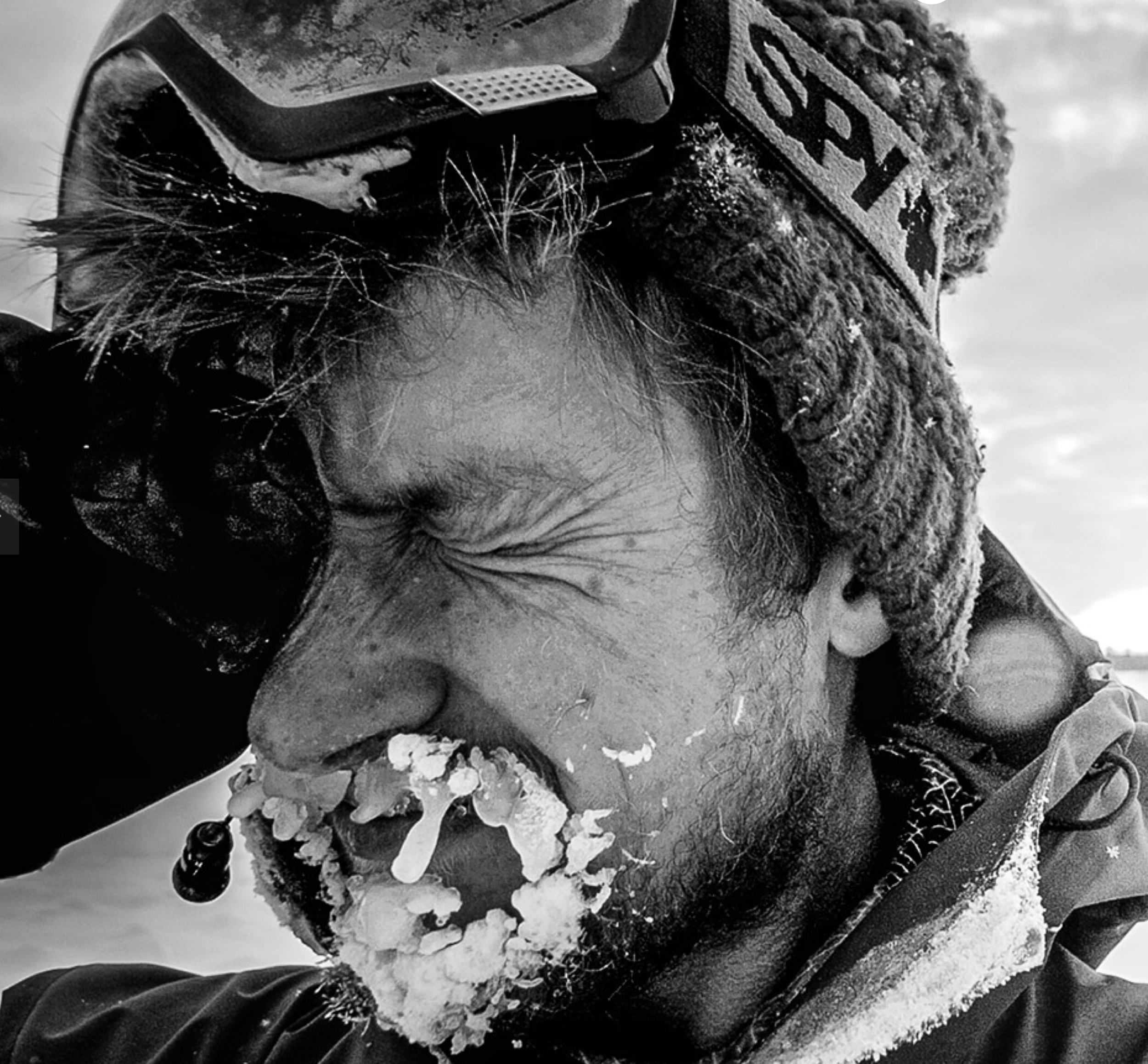
I twisted around, trying to free my arms from inside my jacket and bring them up to my head. The two hats I’d been wearing had fallen off and the cold night air now gnawed painfully at my ears. Fumbling inside my sleeping bag, awkwardly moving countless batteries, bottles, and fur boots from underneath me, I eventually found the hats and pulled them down over my ears. Through the numbness of gloved hands, I tried to locate the toggle at the hem of my bag. Several frustrated attempts later, I seized it and pulled the sleeping bag in tighter around me. It was 1.00am and I hadn’t slept a wink.
The sun had set hours earlier and the northern lights had begun their nightly dance across the sky. A glittering green hue shimmered over the pale snow that lay beyond my open tent door. I switched on my head torch and its beam flashed against walls that were stiffened and brittle, encased in a hard veneer of ice. The thermometer showed -30˚C, or maybe just a touch below. Despite my tiredness, this was an incredible place to be: high in Canada’s Northwest Territory, up above the Arctic Circle, camping on a frozen river. I’d spent the past year travelling from the southern tip of South America to this point, now just a few days’ ride away from the frozen shores of the Arctic Sea marking the halfway point to my bike ride around the world. I was following nature’s frozen highways, taking to the ribbons of white that spill out across the land this far north; the rivers that are lifeless until spring when the ice gives way to the thaw.
But lying in that tent, alone, was a scary place to be. The walls began to quiver and shake and, adjusting my hats once more to clear them of my ears, I caught the unmistakable sound of a storm coming in. The gathering violence of the wind crescendoed in a deep, rumbling, basso growl as my tent sprung to life, buckling under the growing pressure. I peered out of the door to see no more green light dancing, no more stars shining overhead. Clouds had already gathered and I struggled to make out the banks of the river from where I lay. I quickly zipped the door closed, crawled into my bag and lay there, eyes wide open, listening to what was coming.
The roar was overwhelming – chillingly thunderous and seemingly intent on tearing apart my diminutive shelter. Ice and snow shook free from the walls, showering me, pulsating and shivering likes motes in a snow globe. I lay utterly still, gripping the insides of my bag. I closed my eyes, trying not to imagine just how far away from help I was. I knew then that this storm, which had been forecast to hit some days from now, would be a game-changer. The thin cut of clear navigable ice I’d been cycling on down the river would be swamped. I knew I was stuck.
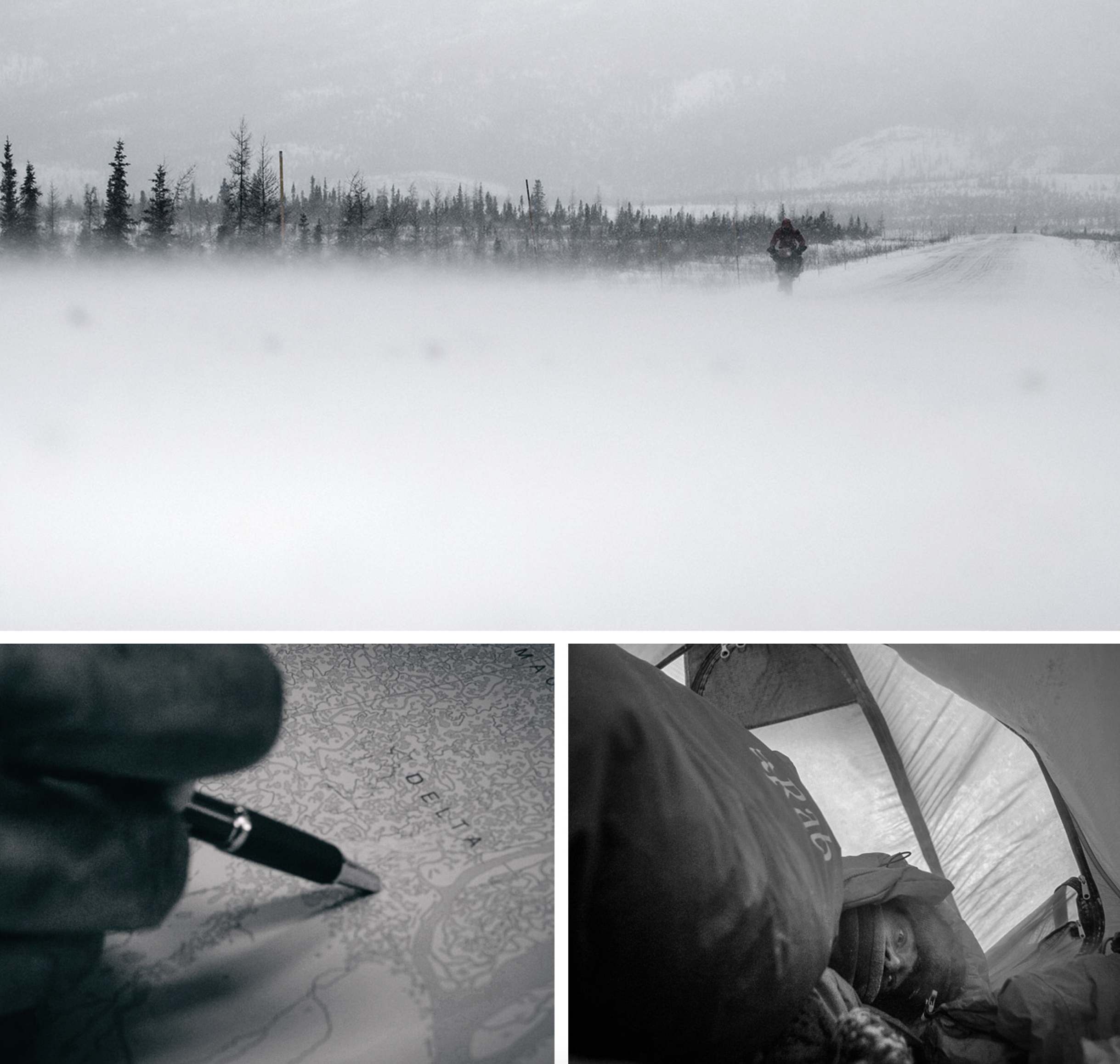
At some point in the early hours of the morning the storm passed, leaving in its savage wake a tent battered and bruised, and hanging limply from buckled poles. I turned over, shifting into a more comfortable position, waiting for sleep to wash over me once more, but in the eerie silence that hung over the landscape I caught a faint, far-off sound. Somewhere in the trees that towered over the river came the unmistakable sound of a wolf’s howl. Shit.
I’d passed through the small village of Fort McPherson the day before and there I’d been approached by a man. He’d heard about my ride and had come to impart some advice: be careful of those damn wolves, he told me. It’s been a long winter and they’ll be getting hungry. He then offered me his gun, but I couldn’t tell if he was being serious or not, so politely refused. He slapped me hard on the back and went on his way, but the image of wolves prowling the snow and ice ahead lingered. Now, the howls clung to the night air, first intensifying and growing louder, then joined by yet more cries. I fixed shut my eyes, willing the noise away, berating my mind for leaping to all sorts of unpalatable conclusions. I was gripped by a cold, dark fear, but eventually, mercifully, the baying faded.
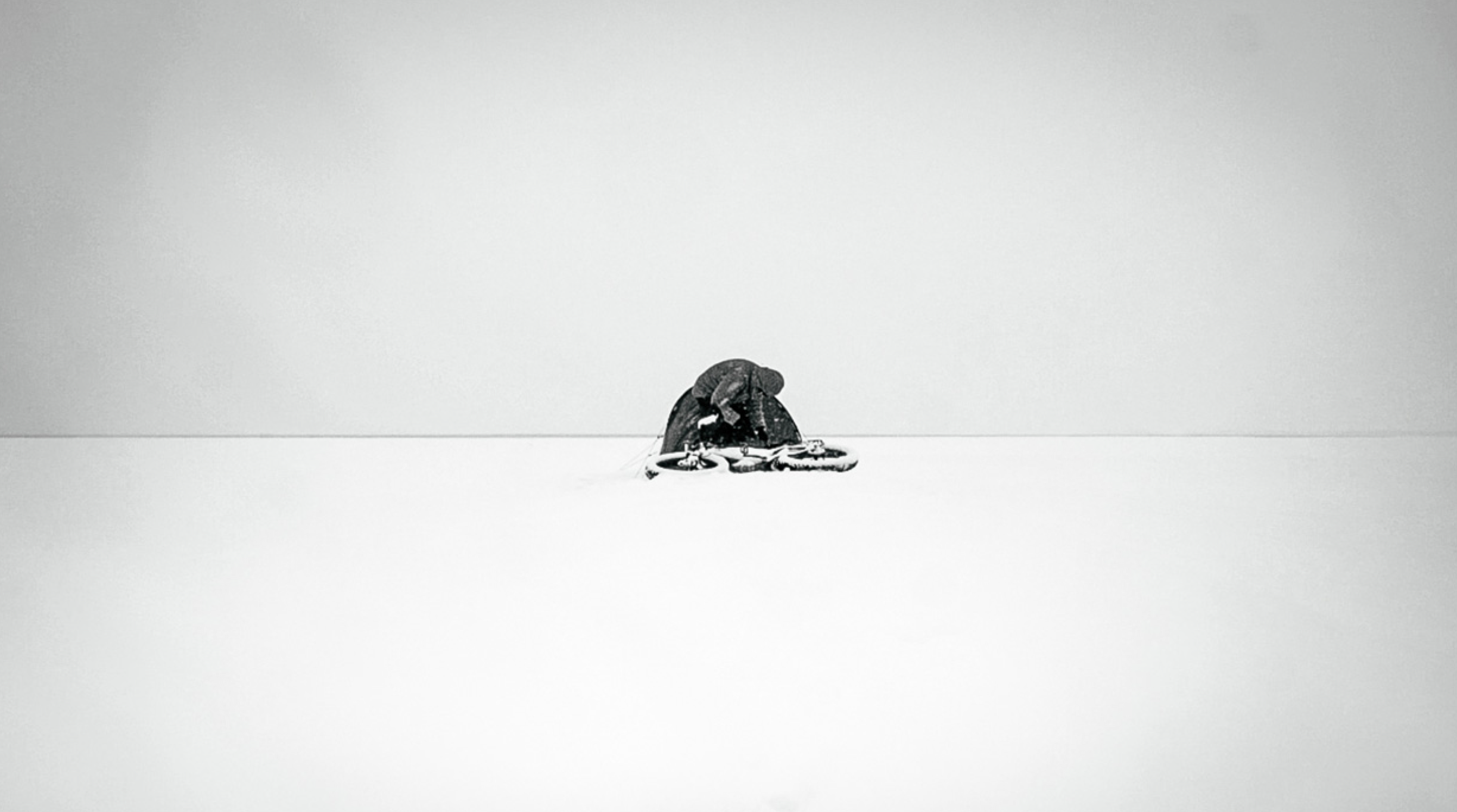
When morning finally arrived, and my eyes flashed open, I knew what lay ahead of me. I’d ridden roughly 100km from that last village, and the next one was about 60km further on. My ride down the river was supposed to be for only two days. I’d packed food for three, just to be sure. Crawling out of my tent I squeezed my feet painfully into frozen boots, old, second-hand army things, and took a few steps. My feet broke through the barely frozen crust and plunged into deep, crystalline snow beneath. Where bare ice had been the previous day, the only possible passage I had down the river had been swallowed up in the night, engulfed in thick, pillow drift snow; the wilderness had asserted its authority once more. I began melting snow to make breakfast and took stock of my situation. I had two days’ of food, 60km remaining distance to cover, and a 50kg bike. The snow was deep and soft; I knew I wasn’t going to be breaking any speed records. I grabbed a handful of oats and threw them in my pot – it didn’t look like much, but it was time to start rationing. I guessed I’d be pushing for four days, so unless I happened to stumble upon a miraculously well-stocked winter cabin, I had to make two days’ worth of food stretch.
It was tough to get going that morning, to get the tent packed away onto the bike, to leave my warm sleeping bag knowing what lay ahead. I won’t lie: I was unnerved by my situation, perhaps even scared. I knew how far out of my depth I was – a couple of lapses in concentration, exposing my fingers, face, or feet for too long, would be disastrous out here. I picked up the bike and stood it in the snow. It was time to start pushing.
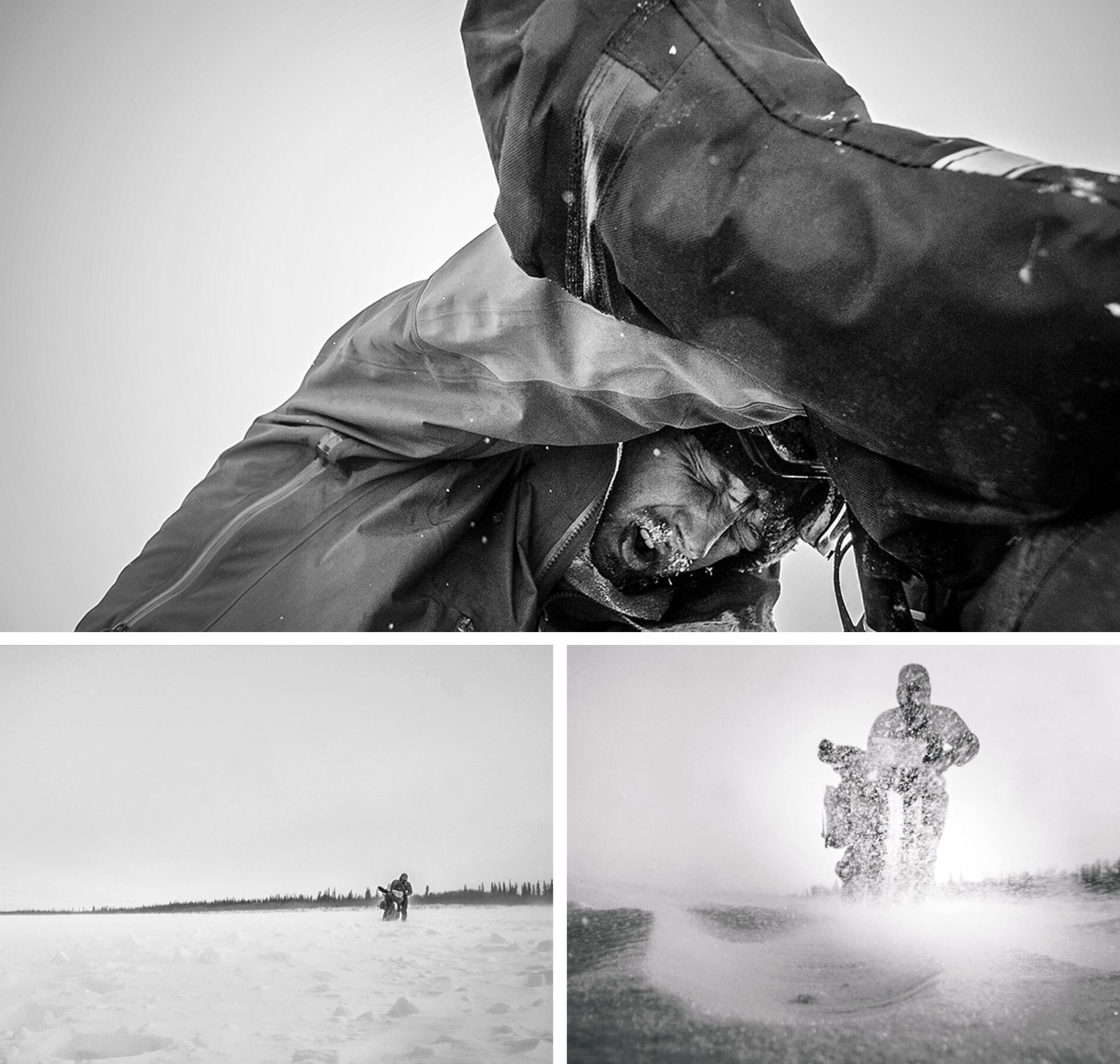
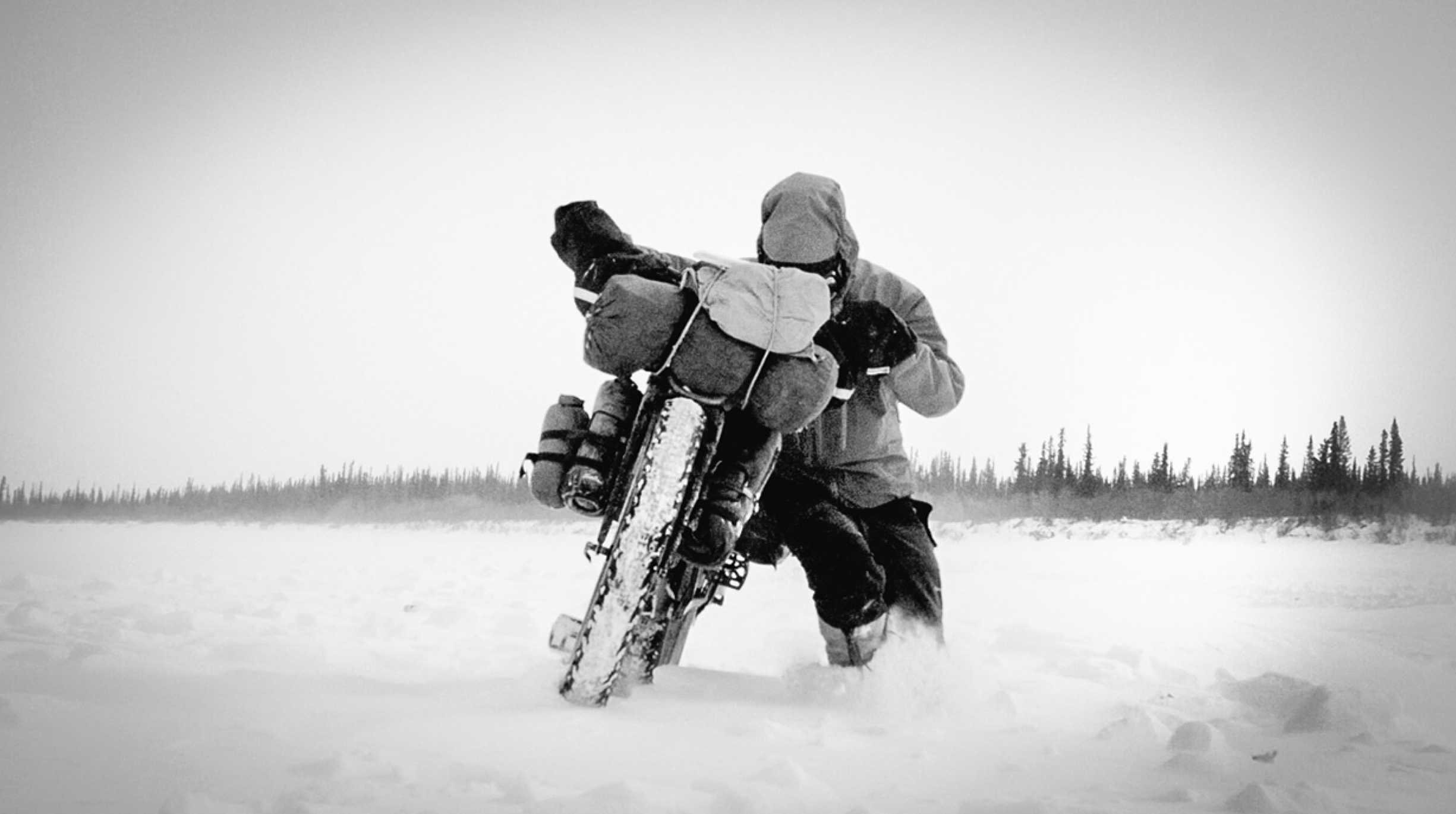
That first day went by surprisingly easily. I made slow progress through the snow, but it was progress nonetheless. Somehow I managed to flick the ‘positive’ switch in my brain; I was overwhelmed neither by the cold, nor the hunger, not even by the relentless fear of wolves. But when that first day was done, when I was again tucked up in my sleeping bag, that switch turned off. Adrenaline seeped away. Those fears bloomed fresh and savage again and a sense of hopelessness washed over me. I’d come to the Arctic in winter to challenge myself, and to see a place few get the opportunity to experience. I had come in search of romantic solitude, to live within the pages of a Jack London novel; to travel through a land so culturally prominent in our ideas of adventure and heroism. Stuck on this desolate river, far away from friends and family, I realised that rather than experiencing sweet solitude, I was desperately lonely. All that had compelled me to come here, the emptiness, the beauty, the challenge, now towered over me and threatened to crush me into submission. Words jumped from Jack London’s pen that I instantly knew to be true: ‘The unending vastness crushed him into the remotest recesses of his own mind, pressing out all the false ardours and undue self values until he perceived himself finite.’
For three days I pushed my bike, by inches closer and closer, painfully slowly against a backdrop so vast I felt like an inadvertent drop of paint on a pure white canvas. Late on that third day, tired, lost, and seized by loneliness, I made out two bobbing lights closing in on me. I lifted the goggles from my face to make sure I wasn’t imagining it. Yet there they were, two lights approaching, and with them two men on snowmobiles. I waved and pushed my bike forward. They pulled alongside, switched off their engines, and beamed at me. I was confused. I couldn’t figure out what they were doing there. ‘We’re the local Search and Rescue team,’ one said. ‘We came to find you’.
I was stunned. I later discovered that news of my journey had reached the town of Aklavik and, worried I’d not been seen since before the storm, the local police had dispatched a local Search and Rescue team to find me. They radioed back to the village and their words almost made me laugh: ‘We’ve found the guy here on Husky River, we’ll see if he wants a ride.’ They told me that the village was only a couple of kilometres away and that I’d pretty much made it. I didn’t think twice about jumping on the back of their snowmobiles. I wanted nothing more than to get off this river that had trapped me for three days as quickly as possible. As I stowed my bike and the rest of my kit, I caught sight of the gear they themselves had brought and I realised then the seriousness of my situation. They carried a gun for the wolves, and a body sled, just in case.
BEN PAGE is a multi-award winning filmmaker, adventurer and photographer based in Yorkshire. He has spent the past few years travelling to some of the world’s remotest corners in search of wild and diverse adventures and experiences, usually on two wheels.
THIS ARTICLE WAS ORIGINALLY PUBLISHED ON SIDETRACKED
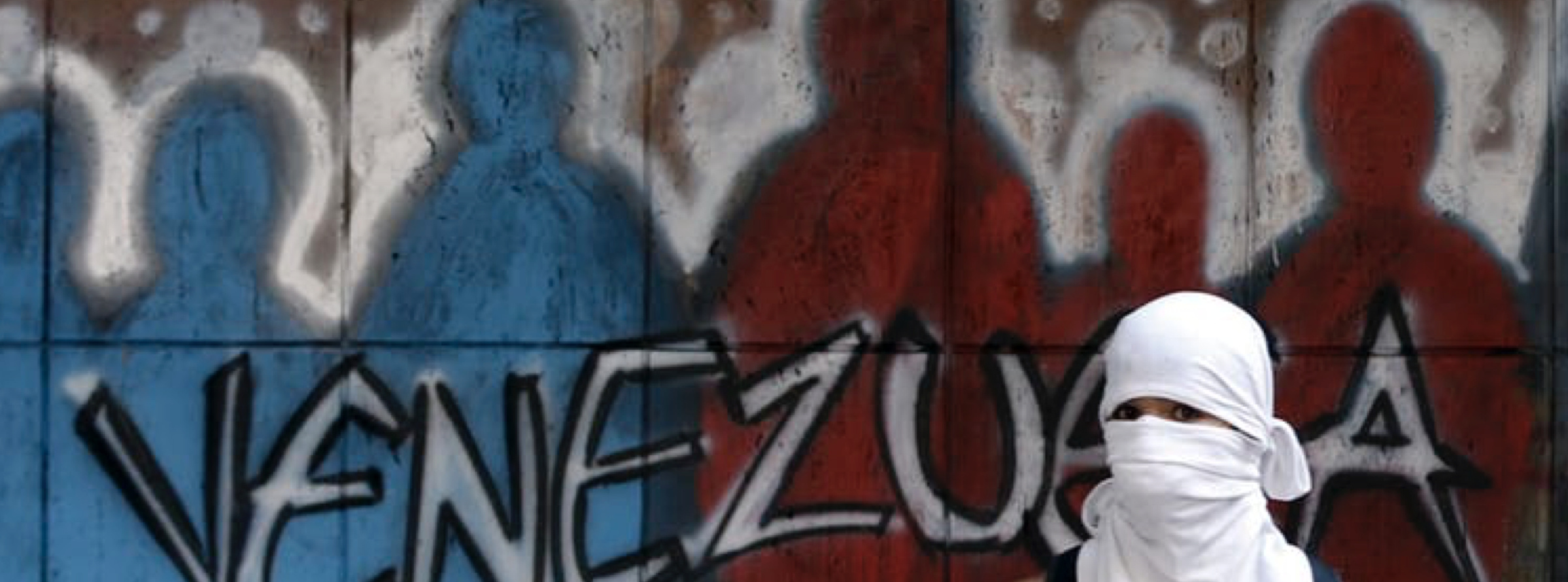
Venezuelans were once among the world’s happiest people. Then the country descended into economic chaos and humanitarian crisis. Jorge Silva/Ruters
Why Venezuelans are some of the Unhappiest People in the World
Venezuelans used to be among the happiest people on the planet.
In 2012, they voted themselves into fifth place in a global Gallup survey on happiness. In 2013, this South American country ranked 20th out of the 156 countries included in the United Nations’ annual World Happiness Report, which assesses well-being worldwide based on measures like wealth, life expectancy and corruption.
My home country used to be a prosperous, cheerful place. People were proud to be from Venezuela – a place known for its friendly citizens and beauty queens: Venezuela has produced six Miss Worlds and seven Miss Universes.
Not anymore. This year, Venezuela plunged to 102nd place of 156 countries in the World Happiness Report. By comparison, Denmark topped the list and the United States came in 18th.
What happened?
Terrible leadership
Venezuela has changed dramatically in recent years.
President Nicolás Maduro – who was elected to succeed the popular late leader Hugo Chávez in 2013 – has turned out to be a kind of King Midas in reverse. Everything he touches seemingly turns to garbage.
Venezuela’s economy was already going south in Chavez’s last years. But under Maduro it has collapsed. Venezuela is drowning in debt, with annual inflation of 15,565 percent.
Once poor people are now starving. On average, Venezuelans have lost 24 pounds each since food shortages began in 2015.
Meanwhile, the middle class is disappearing. According to the labor union UNETE, 75 percent of Venezuelan workers no longer earn enough to support their families.
Maduro’s government censors crime data, but citizen groups estimate that 28,479 Venezuelans were killed in 2016, up from 16,549 in 2014. Those are conflict zone-level casualties.
Fleeing these unbearable living conditions, thousands of Venezuelans have begun pouring across the border into neighboring Colombia and Brazil every day.
Rigged elections
Amid all this, Venezuelans must choose their next president on May 20 in an election that international democracy monitors consider a farce.
Maduro has systematically persecuted his opponents, sending them to jail or into exile. The regime has also used the state apparatus to boost its electoral prospects, trading food for votes, suppressing turnout in dissident districts and crushing anti-regime protests.
As a result, this wildly unpopular president is running for reelection without meaningful opposition and is likely to win.
Despair
Venezuelans live in terror. People fear falling ill, because medicine is scarce. They fear being murdered. They fear political repression.
It’s hard to be happy under a dictatorship.
Many Venezuelans have lost any hope of political change. Maduro has crippled Venezuela’s independent institutions, stacking the Supreme Court with loyalists and stripping the National Assembly of its legislative powers. Freedom of speech is long gone.
And if all that’s not bad enough, the 2018 Miss Venezuela pageant has been suspended after allegations of prostitution among its contestants.
MIGUEL ANGEL LATOUCHE is an Associate Professor at Universidad Central de Venezuela
THIS ARTICLE WAS ORIGINALLY POSTED ON THE CONVERSATION
A Portrait of Iraq
If you Google image search “Iraq” looking for photos of anything other than soldiers and war then you're in for some serious scrolling...
Since the spring of 2016 Janssen Powers has been traveling back and forth to Iraq working on a longer form doc with Nations Media. The Iraq he has come to know and love over the course of these visits is a drastically different place than version of the country Janssen Powers grew up seeing in the news.
On his most recent trip, he brought a 16mm film camera, one lens and a few cans of film to capture portraits of people I met along the way.
PERU: Living Afloat on Man-Made Islands
Lake Titicaca in Peru is a lagoon made up of approximately 70 man-made islands. The central island serves as a hub, home to over 500 residents. Living afloat isn’t for everyone, but the Uros, a small South American tribe, have created and maintained this unique lifestyle for many years. The platforms are made using dried reeds and can be moved away from the mainland at any time. Home to the old and the new worlds, Lake Titicaca is a floating paradise welcoming visitors from around the globe.
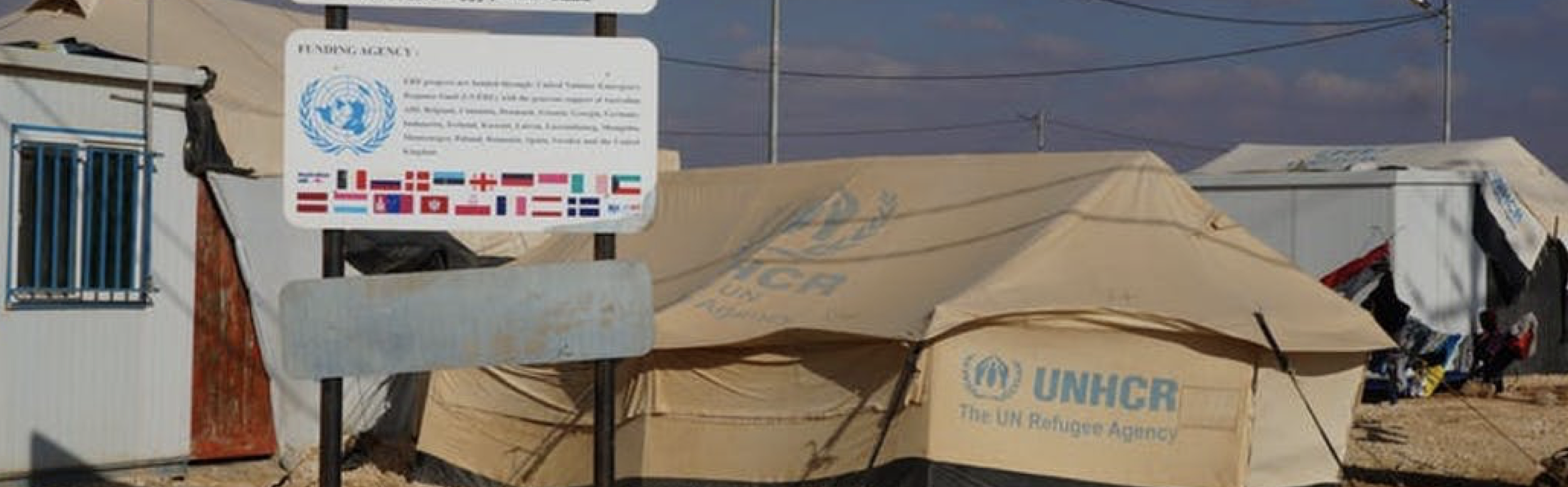
A scene from Zaatari refugee camp, Jordan. Brian Tomaszewski
I Teach Refugees to Map their World
I first visited the Zaatari refugee camp in early 2015. Located in northern Jordan, the camp is home to more than 80,000 Syrian refugees. I was there as part of a research study on refugee camp wireless and information infrastructure.
It’s one thing to read about refugees in the news. It’s a whole different thing to actually go visit a camp. I saw people living in metal caravans, mixed with tents and other materials to create a sense of home. Many used improvised electrical systems to keep the power going. People are rebuilding their lives to create a better future for their families and themselves, just like any of us would if faced with a similar situation.
As a geographer, I was quickly struck by how geographically complex Zaatari camp was. The camp management staff faced serious spatial challenges. By “spatial challenges,” I mean issues that any small city might face, such as keeping track of the electrical grid; understanding where people live within the camp; and locating other important resources, such as schools, mosques and health centers. Officials at Zaatari had some maps of the camp, but they struggled to keep up with its ever-changing nature.
An experiment I launched there led to up-to-date maps of the camp and, I hope, valuable training for some of its residents.
The power of maps
Like many other refugee camps, Zaatari developed quickly in response to a humanitarian emergency. In rapid onset emergencies, mapping often isn’t as high of a priority as basic necessities like food, water and shelter.
However, my research shows that maps can be an invaluable tool in a natural disaster or humanitarian crisis. Modern digital mapping tools have been essential for locating resources and making decisions in a number of crises, from the 2010 earthquake in Haiti to the refugee influx in Rwanda.
This got me thinking that the refugees themselves could be the best people to map Zaatari. They have intimate knowledge of the camp’s layout, understand where important resources are located and benefit most from camp maps.
With these ideas in mind, my lab teamed up with the United Nations High Commissioner for Refugees and Al-Balqa and Princess Sumaya universities in Jordan.
Modern maps are often made with a technology known as Geographic Information Systems, or GIS. Using funding from the UNHCR Innovation Fund, we acquired the computer hardware to create a GIS lab. From corporate partner Esri, we were obtained low-cost, professional GIS software.
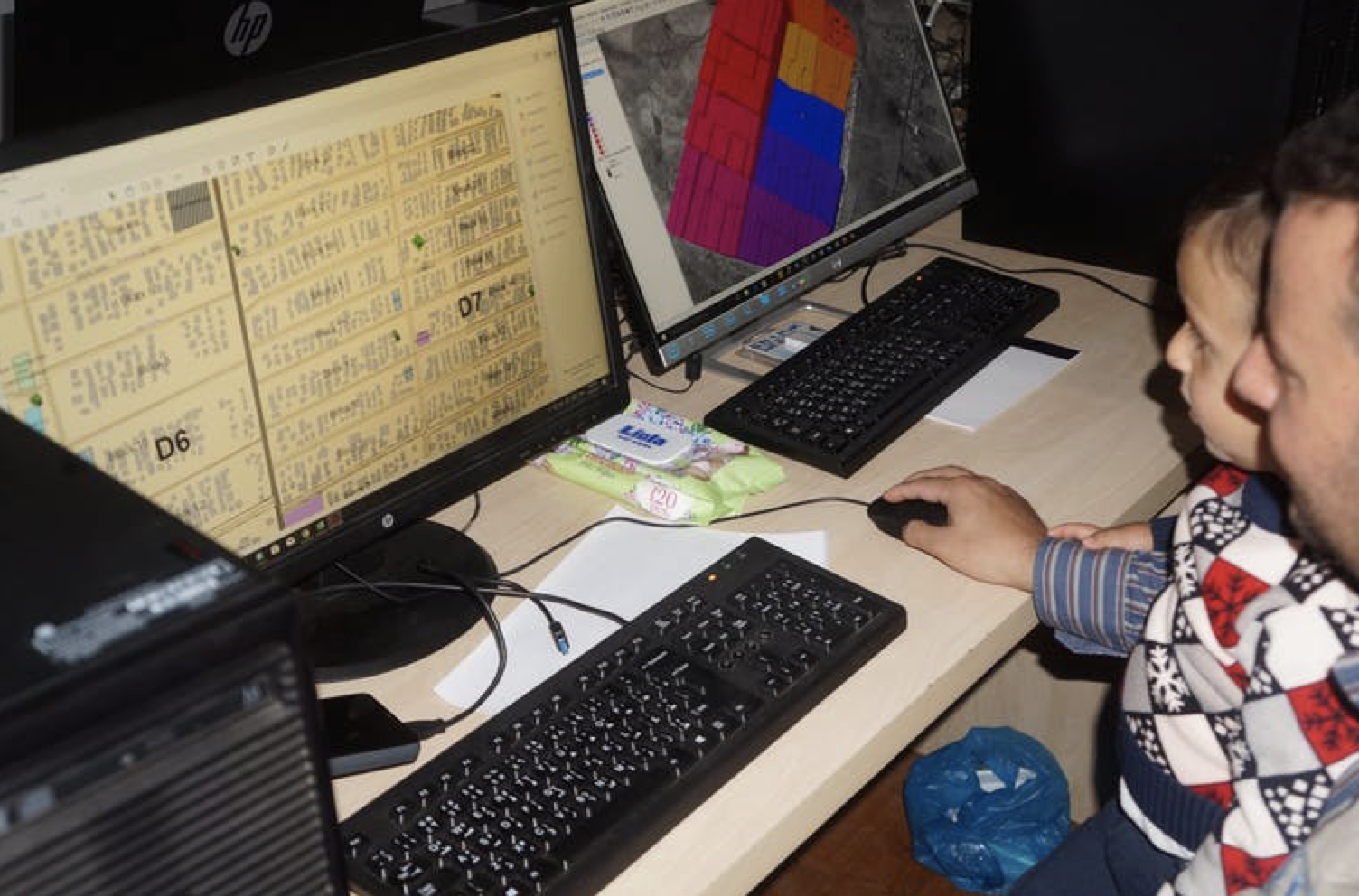
RefuGIS team member Yusuf Hamad and his son Abdullah – who was born in Zaatari refugee camp – learning about GIS. Brian Tomaszewski, CC BY
Over a period of about 18 months, we trained 10 Syrian refugees. Students in the RefuGIS class ranged in age from 17 to 60. Their backgrounds from when they lived in Syria ranged from being a math teacher to a tour operator to a civil engineer. I was extremely fortunate that one of my students, Yusuf Hamad, spoke fluent English and was able translate my instructions into Arabic for the other students.
We taught concepts such as coordinate systems, map projections, map design and geographic visualization; we also taught how to collect spatial data in the field using GPS. The class then used this knowledge to map places of interest in the camp, such as the locations of schools, mosques and shops.
The class also learned how to map data using mobile phones. The data has been used to update camp reference maps and to support a wide range of camp activities.
I made a particular point to ensure the class could learn how to do these tasks on their own. This was important: No matter how well-intentioned a technological intervention is, it will often fall apart if the displaced community relies completely on outside people to make it work.
As a teacher, this class was my most satisfying educational experience. This was perhaps my finest group of GIS students across all the types of students I have taught over my 15 years of teaching. Within a relatively short amount of time, they were able to create professional maps that now serve camp management staff and refugees themselves.
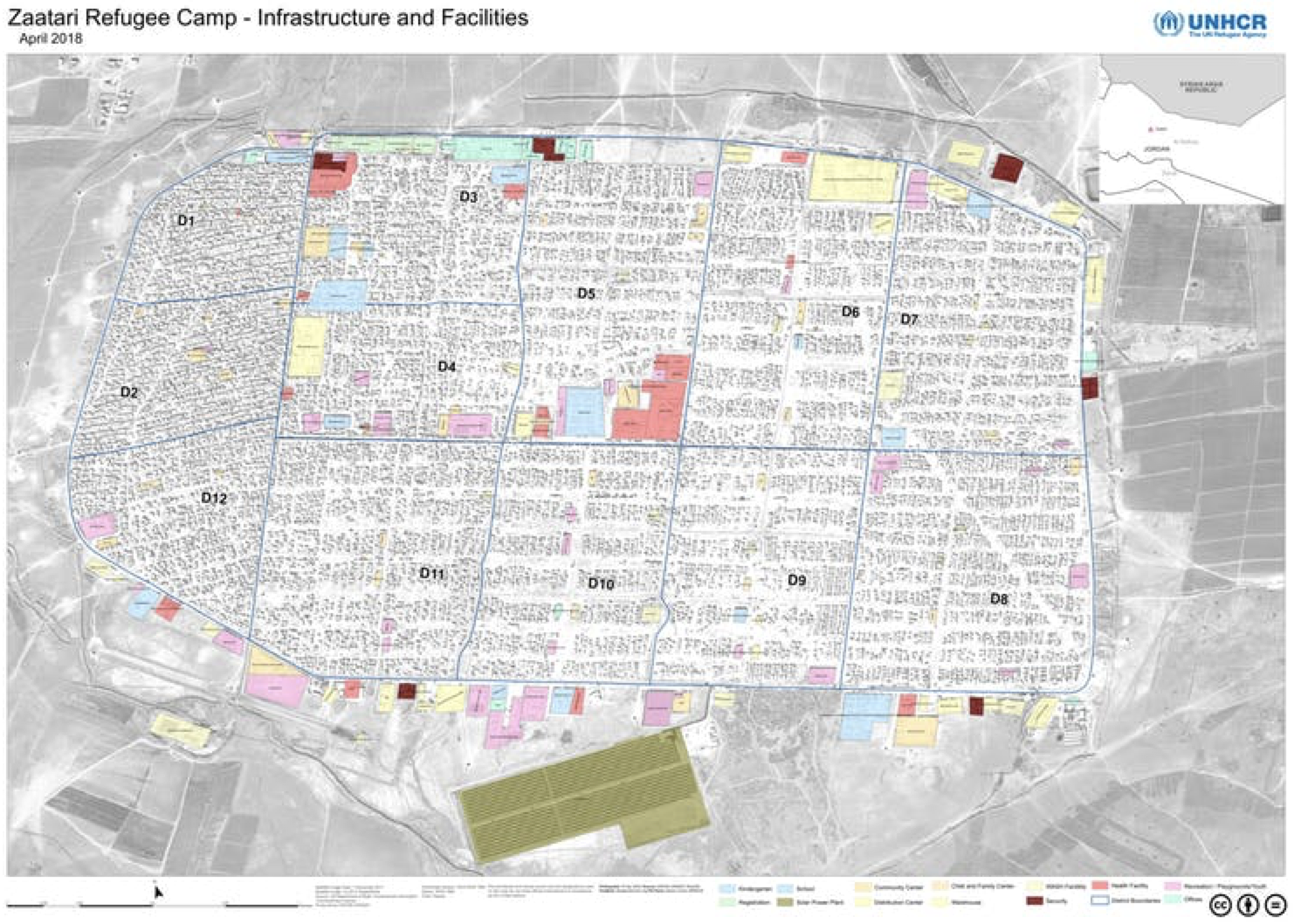
A map created with geographic information collected by students in the RefuGIS program. UNHCR, CC BY
Jobs for refugees
My experiences training refugees and humanitarian professionals in Jordan and Rwandahave made me reflect upon the broader possibilities that GIS can bring to the over 65 million refugees in the world today.
It’s challenging for refugees to develop livelihoods at a camp. Many struggle to find employment after leaving.
GIS could help refugees create a better future for themselves and their future homes. If people return to their home countries, maps – essential to activities like construction and transportation – can aid the rebuilding process. If they adopt a new home country, they may find they have marketable skills. The worldwide geospatial industry is worth an estimated US$400 billion and geospatial jobs are expected to grow over the coming years.
Our team is currently helping some of the refugees get GIS industry certifications. This can further expand their career opportunities when they leave the camp and begin to rebuild their lives.
Technology training interventions for refugees often focus on things like computer programming, web development and other traditional IT skills. However, I would argue that GIS should be given equal importance. It offers a rich and interactive way to learn about people, places and spatial skills – things that I think the world in general needs more of. Refugees could help lead the way.
BRIAN TOMASZEWSKI is an Associate Professor of Information Sciences and Technologies at Rochester Institute of Technology.
THIS ARTICLE WAS ORIGINALLY PUBLISHED ON THE CONVERSATION
Meghan Markle and What She Means for People of Color
A Beacon of Light from the Royal Family

The royal wedding; an event celebrated far and wide. The union of a prince and a princess in holy matrimony is something the world stops and stares at in awe each time it occurs. This past royal wedding however, is a bit different than those that have come before it. This year, Meghan Markle has married Prince Harry, and Meghan is biracial. Once the news of Harry and Meghan’s engagement went live, the first thing to be talked of was that Meghan is the daughter of a white man and a black woman.
Meghan Markle has never shied away from her background. At her wedding this past Saturday, she made sure to represent her status as a woman of color. One article written for the Guardian by Afua Hirsch, called the wedding a, “rousing celebration of blackness” in the title of her article.
While the celebration was rich with praise and excitement for the new princess and her proud heritage, complete with photos being shared of her and her overjoyed mother after the ceremony, an all-black gospel choir performing, the beautiful performance of Sheku Kanneh-Mason, and more; there were those who took to Twitter to bash the new princess and the ceremony. A tweet from the verified account of Katie Hopkins showed two pictures, one of princess Kate in her wedding dress and the other of now princess Meghan in hers, captioned, “No competition. You can’t buy class. #RoyalWedding2018” Clearly meaning to say that Kate was the “classier” bride and insulting Meghan. This tweet got tons of backlash and very little support, but the tweets with negative connotation and outright insults towards Meghan were not hard to find.
While the tone was mostly upbeat about the ceremony, but the insults being thrown brought another conversation to light; what does Meghan Markle’s blackness mean to and for the royal family? Well, according to an article in Newsweek, some who are celebrating Meghan’s arrival into the family as a woman of color are going to be sorely disappointed. In an article from Newsweek published on November 27th of 2017, a professor of sociology at Birmingham City University is quoted saying, “She won’t be allowed to be a black princess. The only way she can be accepted is to pass for white” she then goes on to call the people celebrating her “naïve”. This was written before the wedding took place, and the clear representation of Meghan’s background was shown during the celebration front and center. Many people of color are coming forward saying how excited they are to see a woman of color in the royal family, and there is becoming less and less criticism of the situation, but it is not completely gone.
Nobody knows what will happen in the future, but seeing a woman of color in such a powerful family could be an amazing thing. Meghan is by no means the first black princess, but she is, as of now, the most talked of one in current events. This could mean great things for people of color in the United Kingdom, with the possibility of Meghan using her now lofty platform to advocate for marginalized communities and shine lights on injustices that are swept under the rug or ignored. The hope is that Meghan will stand tall as a forward step for the royal family, and that only good will come of this beautiful union.
ANNA LOPEZ is a rising sophomore at Ithaca college. She is a writing major with aspirations of heading to law school after completing her undergraduate years. She loves animals, art, and travel; she can't wait to see where writing takes her!
Four Days with a Rohingya Family in Exile
Ranjuma was nine months pregnant when she and her family escaped violent persecution in Myanmar. They arrived in Bangladesh, where hope turned to tragedy. This is their story.
Tagging Germany with Love
For the past three decades, Irmela Mensah-Schramm has made it her mission to eradicate hate in the world. Armed with a spray can, a scraper and a bottle of nail polish remover, the 71-year-old activist takes to the streets of Berlin to remove and cover up Nazi imagery and racist graffiti. After visiting a concentration camp for the first time, Schramm was moved to do her part to build a better future. Today, she’s removed over 77,500 neo-Nazi stickers all over Germany, and she has no intentions of stopping. Wherever there is hate in the world, Schramm will be there, can in hand.
Venezuela's Inflated Vision of Beauty
In Venezuela, women are confronted with a culture of increasingly enhanced physiques fueled by beauty pageants and plastic surgery. The culture makes it so women feel pressured to be beautiful at any cost. For many in Venezuela, beauty means perfection, and despite economic struggles the country faces, women of all social classes seek out plastic surgery.
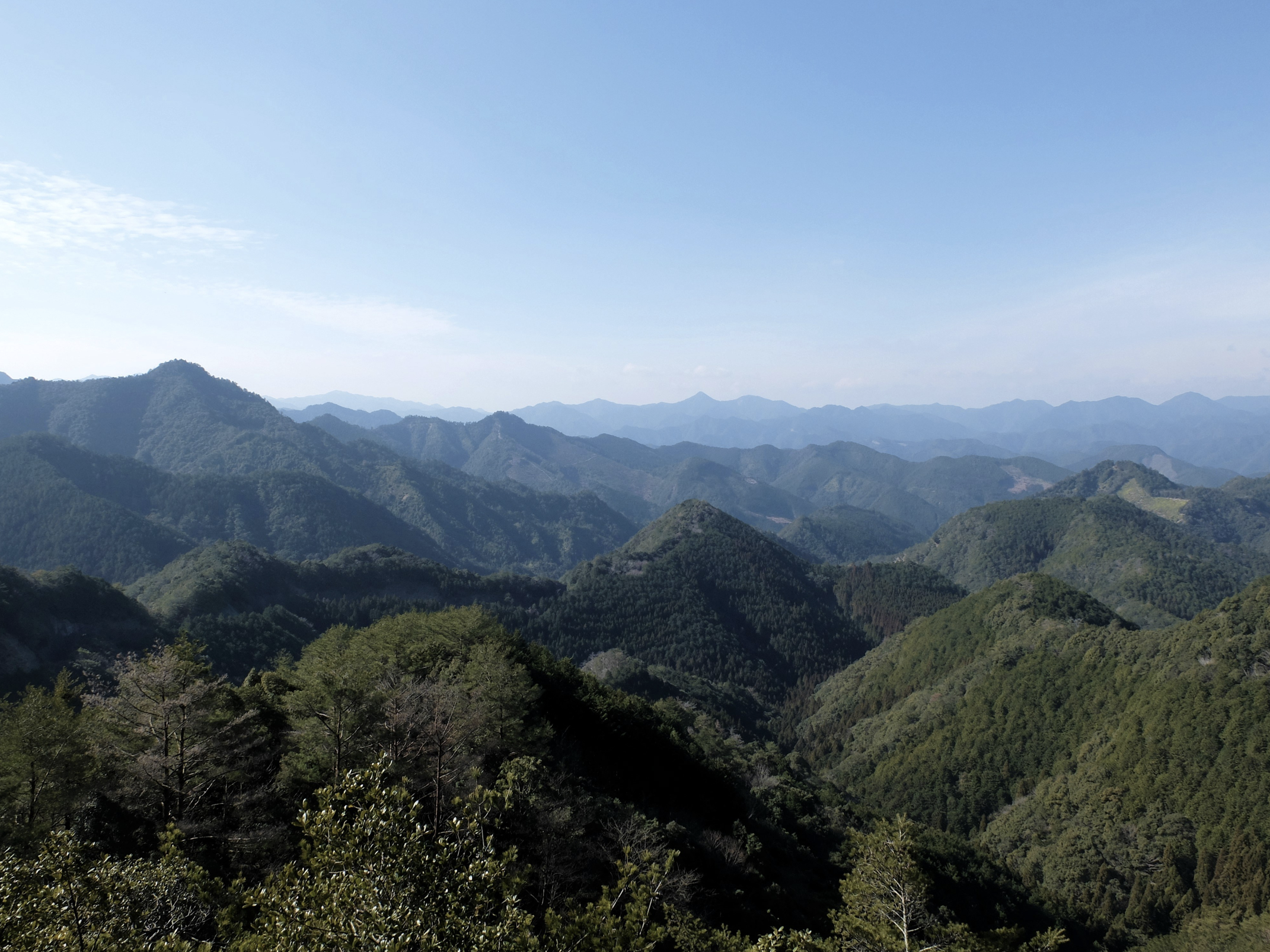
Places of the Mind | Kumano Kodo Pilgrimage Trail, Japan
In the mountains, the weather changes so quickly it can feel as if you are experiencing all four seasons in as many days. This was our experience when my partner and I walked the Kumano Kodo pilgrimage trail in Japan’s Kii peninsula a couple of years ago.
When we got off the tiny bus at the sharp curve in the road that indicated the bottom of the mountain pass, the sky was full of wispy scudding clouds. The climb was steep and the path was almost obscured by drifts of dry autumnal leaves, even though it was already January. At one point, we pushed our way through a tiny crack in a rock face. The passage is meant to be a charm for good fortune in child birth. Despite being deeply uncomfortable in confined spaces, I thought it worth a try.
That evening, we lounged in the scalding thermal baths in our ryokan (a traditional Japanese inn). The baths had views of the mountains opposite, which were bare and brown but were quickly covered by darkness. Compared to the bone-warming heat of the baths, the dining room was distinctly chilly, and we shivered as we ate our way through several courses of locally sourced vegetarian food. The flavours were crisp and surprising; I didn’t recognise a single vegetable on my plate.
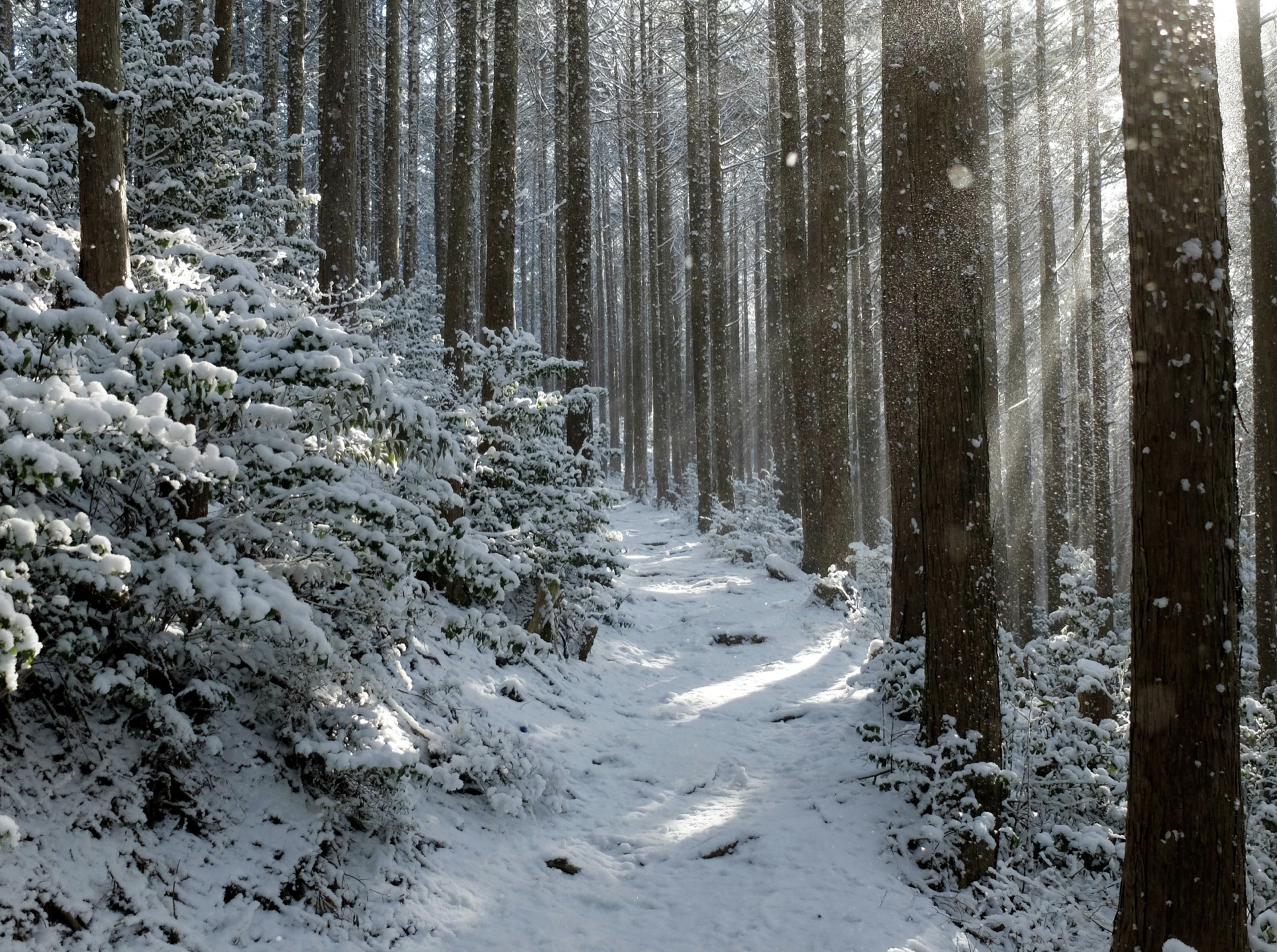
We woke up on our tatami mats the next morning to a surprise: it had snowed overnight. The world that had seemed so autumnal in the sunshine of the day before had now been bathed in midwinter. We marvelled at the icy gleam as we ate our breakfast (more unidentifiable vegetables) and packed a bento box for lunch.

The other three guests at our ryokan had only hiked up to spend a single night in the mountains, and were preparing to trek back down to the bus stop. We were the only ones going on to the next valley. Our journey took us through woods of tall, perfectly straight pine trees. The path – carved out by the passing feet of pilgrims over hundreds of years – was mercifully easy to follow, despite being covered with six inches of perfect, untrodden snow.
The snowfall deadened the usual sounds of the forest. The rustlings of animals were replaced with the tinkle of a shower of snowflakes giving in to gravity and releasing the bent branch of a tree. The crisp crunch of yesterday’s dry leaves gave way to the creak of snow compacting under our boots.
We walked quickly in the cold, unable to pause and sit down because everything was shrouded in snow. Occasionally a small red shrine would loom out of the whiteness, punctuating our route and breaking up the uniformly straight trunks of the trees.
It was a day of discoveries. We watched a monkey scamper down a branch, eating a fruit with yellow flesh. We followed deer tracks over a ridge and found a natural theatre in the hillside, with an altar set against a snow bank and a semi-circle of tree stumps that served as seats. What such a place might have been used for, we couldn’t fathom.
Unexpectedly, the next day dawned with a pale misty light, bringing with it a mild breeze that soon had dollops of snow falling from the trees. As our icy surroundings thawed, the ground revealed spring-like green shoots that had previously been hidden under the mantles of leaves and snow.
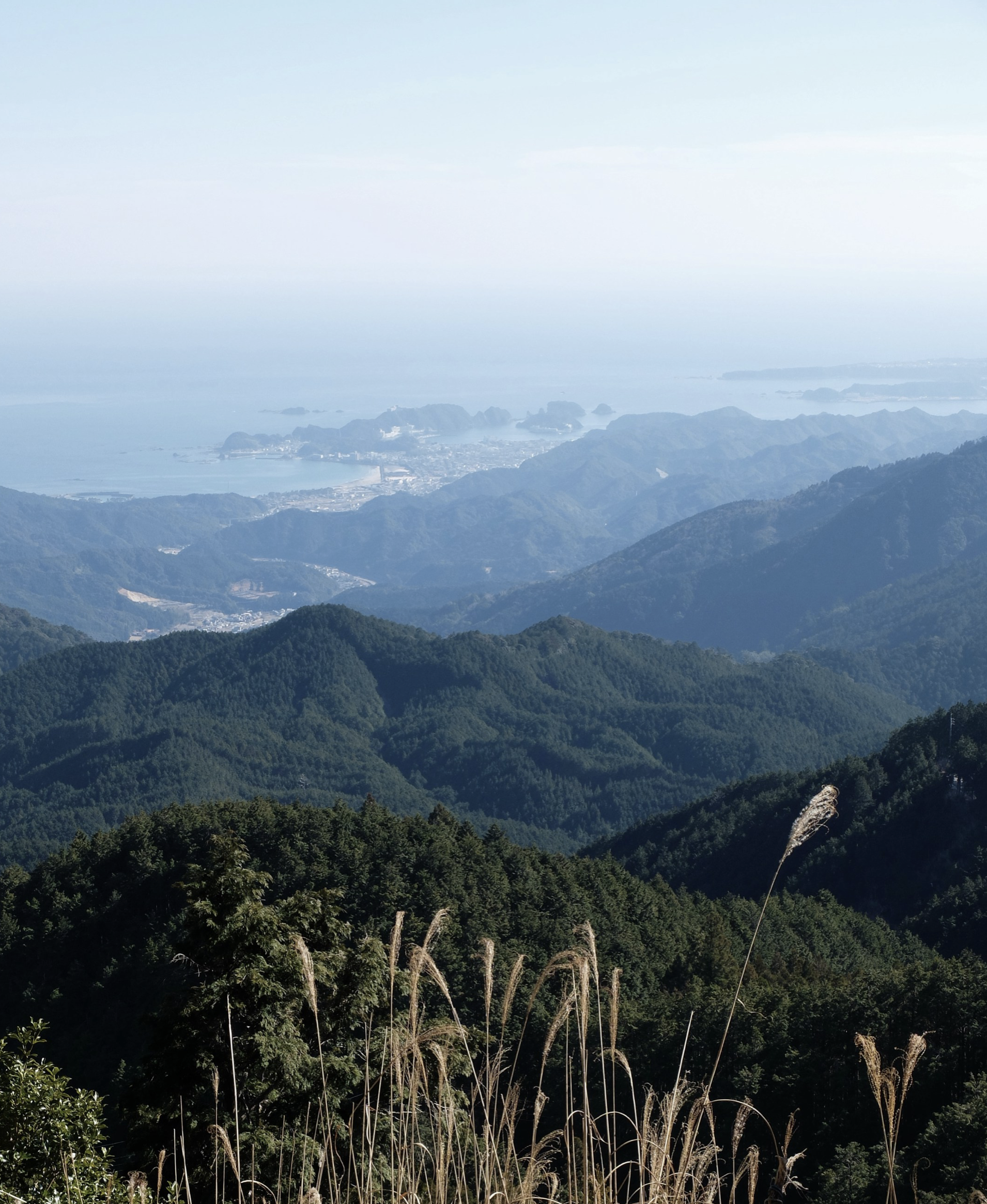
By the time we had reached the first temple on our route, the snow had almost completely disappeared, lingering only in corners of cool shadow. By the following day, the sun was travelling through a cloudless sky and we were sweating in our thermals and fleeces. The ground had dried out and we were able to sit and eat our bento boxes in the sunshine, looking out at unimpeded views that had been obscured by drifting snow and mist for the last couple of days.
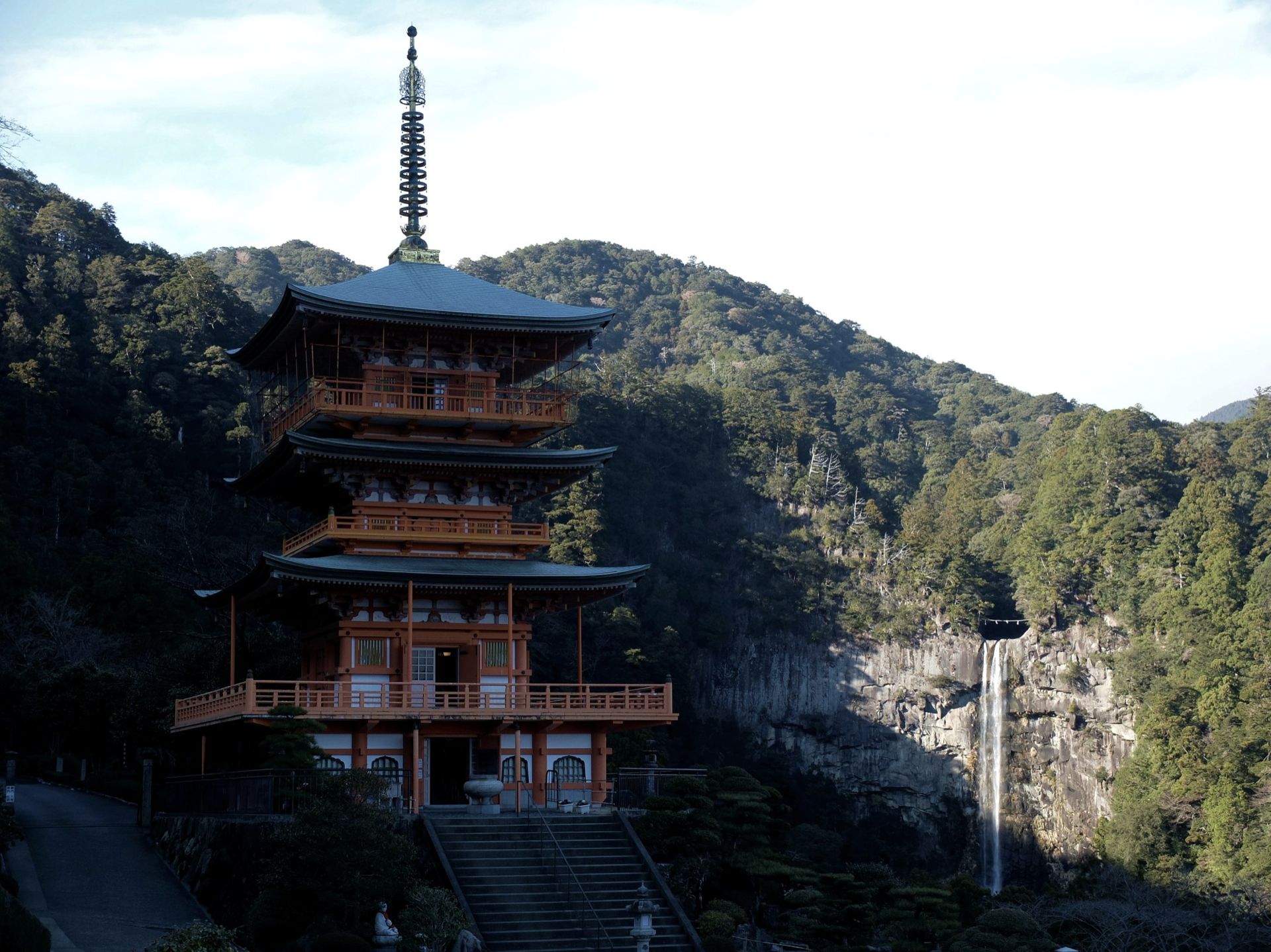
The final destination of our journey was a temple set against the backdrop of Japan’s tallest waterfall, a setting worthy of the Romantic poets and Edmund Burke’s understanding of the sublime. After several days spent almost entirely alone in the forest, it was something of a shock to see other people here, eating ice cream and browsing the souvenir shops. In our opinion, it was still too cold for ice cream, and we hurried back to our final inn, where we were the only guests. That evening, as we sat in our room, there was a small earthquake that caused the windows to rattle; with this most unsettling of experiences, we prepared to return to reality.
To be a pilgrim is a strange thing. Whatever your reasons for making a pilgrimage, the experience of walking for miles across several days makes you acutely aware of the deeply personal and previously unchallenged spaces of your mind and body, as well as of the fact that your experience is shared in some way with all of the pilgrims, known and unknown, who have walked the route before you. The process of walking through a landscape towards a chosen destination allows you space for contemplation and reflection.
At the time, however, very little of this actively crosses your mind. While I was walking the Kumano Kodo, I thought a lot about how cold I was, how hard work it was to tramp through the snow, and what we might be given to eat at the next ryokan. Now those aspects have faded for me; I still remember how my body felt after a day of cold and tiring walking, but I remember it more as a feeling of satisfaction at having worked hard to achieve a goal.
And while some of the individual details of the journey have faded, others have only become clearer: the monkey, for instance, and the perspective-bending vistas that opened up between lines of brown-barked pines in the snow. My sense of place connected to the Kii peninsula has become stronger, especially since returning to the UK and the routines of everyday life in London.
In some ways, physical and temporal distance allow an experience of place to grow in the mind, until the place almost becomes a conceptual metaphor for the subconscious mental processes you went through there. For me, the physical and spatial experience of walking the Kumano Kodo pilgrimage trail has become a mental metaphor for contemplation and reflection, and now if I ever need to find a moment of calm or reflection, I can think myself back there. I realise now that I sorted out some important psychological issues in my mind during that trip, even though I rarely actively thought about them while I was walking, and this helps me to approach other challenges.
You don’t have to go on a pilgrimage to achieve this on a smaller scale. A walk in the countryside or a visit to a park can have a similar effect on your mentality, even weeks or years afterwards. Through this process of being and walking in landscape, a place – experienced through physical motion as much as through the eyes – can become a valuable space in your mind which you can inhabit when you need a momentary break from everyday life.
ANNA SOUTER is a writer and editor based in London. Her research interests include contemporary art, landscape and walking.
THIS ARTICLE WAS ORIGINALLY PUBLISHED ON ROAM MAGAZINE
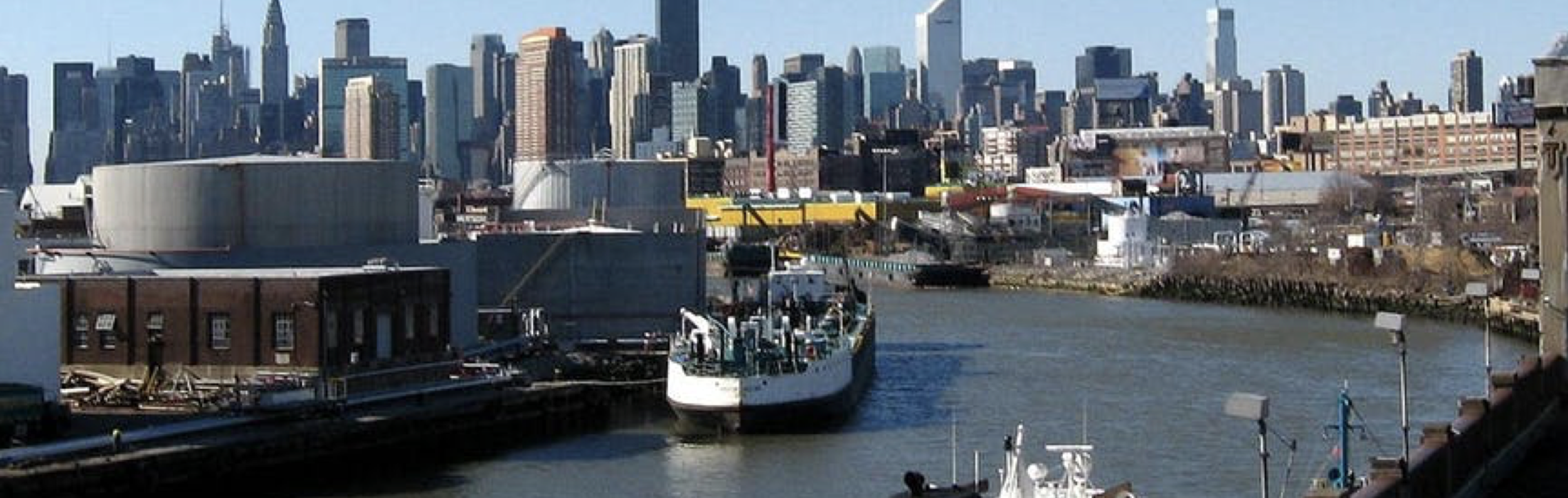
Small tankers unload along New York’s Newtown Creek in 2008.
Sustainable Cities Need More than Parks, Cafes and a Riverwalk
There are many indexes that aim to rank how green cities are. But what does it actually mean for a city to be green or sustainable?
We’ve written about what we call the “parks, cafes and a riverwalk” model of sustainability, which focuses on providing new green spaces, mainly for high-income people. This vision of shiny residential towers and waterfront parks has become a widely-shared conception of what green cities should look like. But it can drive up real estate prices and displace low- and middle-income residents.
As scholars who study gentrification and social justice, we prefer a model that recognizes all three aspects of sustainability: environment, economy and equity. The equity piece is often missing from development projects promoted as green or sustainable. We are interested in models of urban greening that produce real environmental improvements and also benefit long-term working-class residents in neighborhoods that are historically underserved.
Over a decade of research in an industrial section of New York City, we have seen an alternative vision take shape. This model, which we call “just green enough,” aims to clean up the environment while also retaining and creating living-wage blue-collar jobs. By doing so, it enables residents who have endured decades of contamination to stay in place and enjoy the benefits of a greener neighborhood.
‘Parks, cafes and a riverwalk’ can lead to gentrification
Gentrification has become a catch-all term used to describe neighborhood change, and is often misunderstood as the only path to neighborhood improvement. In fact, its defining feature is displacement. Typically, people who move into these changing neighborhoods are whiter, wealthier and more educated than residents who are displaced.
A recent spate of new research has focused on the displacement effects of environmental cleanup and green space initiatives. This phenomenon has variously been called environmental, eco- or green gentrification.
Land for new development and resources to fund extensive cleanup of toxic sites are scarce in many cities. This creates pressure to rezone industrial land for condo towers or lucrative commercial space, in exchange for developer-funded cleanup. And in neighborhoods where gentrification has already begun, a new park or farmers market can exacerbate the problemby making the area even more attractive to potential gentrifiers and pricing out long-term residents. In some cases, developers even create temporary community gardens or farmers markets or promise more green space than they eventually deliver, in order to market a neighborhood to buyers looking for green amenities.
Environmental gentrification naturalizes the disappearance of manufacturing and the working class. It makes deindustrialization seem both inevitable and desirable, often by quite literally replacing industry with more natural-looking landscapes. When these neighborhoods are finally cleaned up, after years of activism by longtime residents, those advocates often are unable to stay and enjoy the benefits of their efforts.
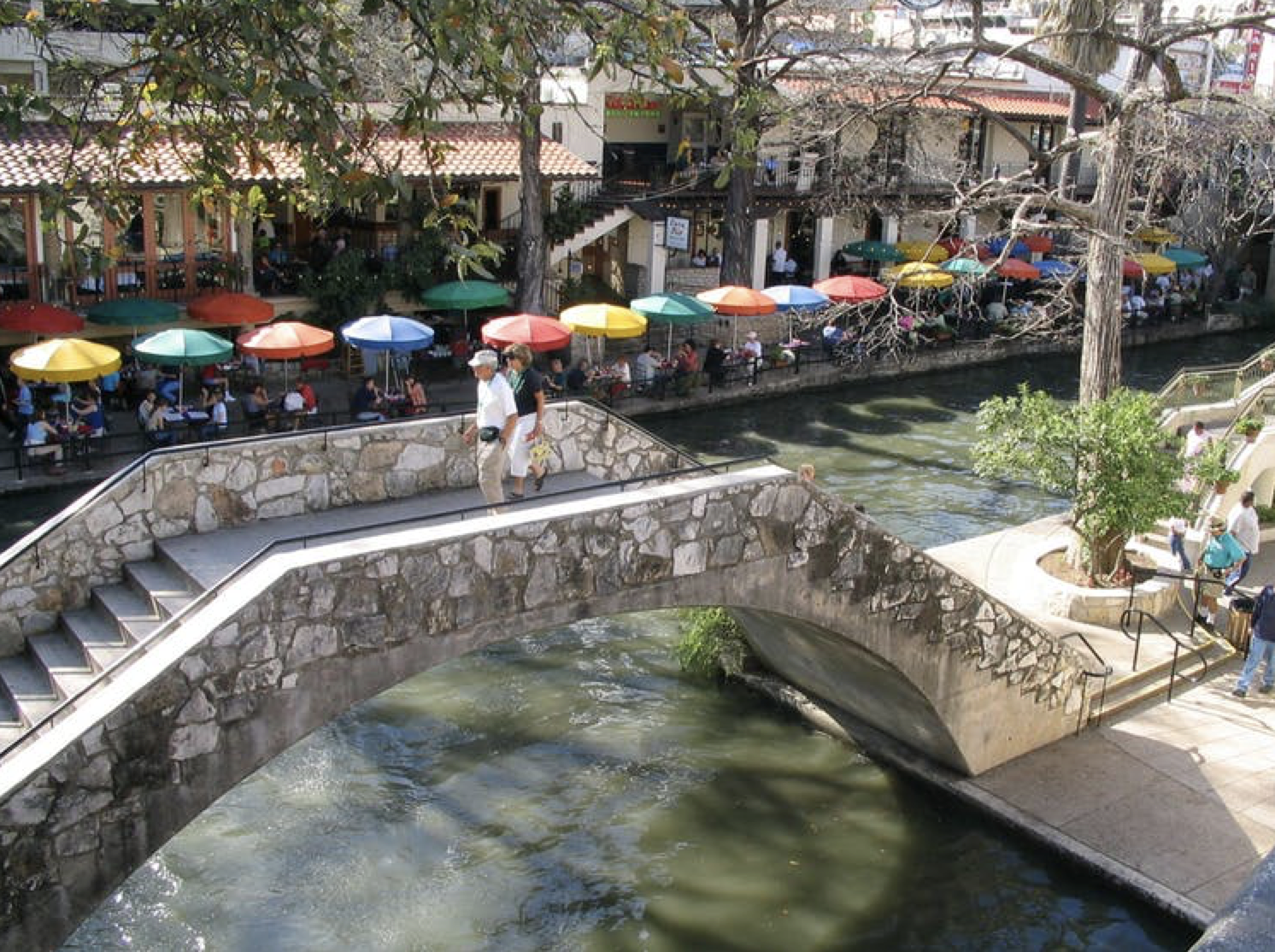
The River Walk in San Antonio, Texas, is a popular shopping and dining area catering to tourists
Tools for greening differently
Greening and environmental cleanup do not automatically or necessarily lead to gentrification. There are tools that can make cities both greener and more inclusive, if the political will exists.
The work of the Newtown Creek Alliance in Brooklyn and Queens provides examples. The alliance is a community-led organization working to improve environmental conditions and revitalize industry in and along Newtown Creek, which separates these two boroughs. It focuses explicitly on social justice and environmental goals, as defined by the people who have been most negatively affected by contamination in the area.
The industrial zone surrounding Newtown Creek is a far cry from the toxic stew that The New York Times described in 1881 as “the worst smelling district in the world.” But it is also far from clean. For 220 years it has been a dumping ground for oil refineries, chemical plants, sugar refineries, fiber mills, copper smelting works, steel fabricators, tanneries, paint and varnish manufacturers, and lumber, coal and brick yards.
In the late 1970s, an investigation found that 17 million gallons of oil had leaked under the neighborhood and into the creek from a nearby oil storage terminal. The U.S. Environmental Protection Agency placed Newtown Creek on the Superfund list of heavily polluted toxic waste sites in 2010.
The Newtown Creek Alliance and other groups are working to make sure that the Superfund cleanup and other remediation efforts are as comprehensive as possible. At the same time, they are creating new green spaces within an area zoned for manufacturing, rather than pushing to rezone it.
As this approach shows, green cities don’t have to be postindustrial. Some 20,000 people work in the North Brooklyn industrial area that borders Newtown Creek. And a number of industrial businesses in the area have helped make environmental improvements.

Just green enough
The “just green enough” strategy uncouples environmental cleanup from high-end residential and commercial development. Our new anthology, “Just Green Enough: Urban Development and Environmental Gentrification,” provides many other examples of the need to plan for gentrification effects before displacement happens. It also describes efforts to create environmental improvements that explicitly consider equity concerns.
For example, UPROSE, Brooklyn’s oldest Latino community-based organization, is combining racial justice activism with climate resilience planning in Brooklyn’s Sunset Park neighborhood. The group advocates for investment and training for existing small businesses that often are Latino-owned. Its goal is not only to expand well-paid manufacturing jobs, but to include these businesses in rethinking what a sustainable economy looks like. Rather than rezoning the waterfront for high-end commercial and residential use, UPROSE is working for an inclusive vision of the neighborhood, built on the experience and expertise of its largely working-class immigrant residents.
This approach illustrates a broader pattern identified by Macalester College geographer Dan Trudeau in his chapter for our book. His research on residential developments throughout the United States shows that socially and environmentally just neighborhoods have to be planned as such from the beginning, including affordable housing and green amenities for all residents. Trudeau highlights the need to find “patient capital” – investment that does not expect a quick profit – and shows that local governments need to take responsibility for setting out a vision and strategy for housing equity and inclusion.
In our view, it is time to expand the notion of what a green city looks like and who it is for. For cities to be truly sustainable, all residents should have access to affordable housing, living-wage jobs, clean air and water, and green space. Urban residents should not have to accept a false choice between contamination and environmental gentrification.
Trina Hamilton: Associate Professor of Geography, University at Buffalo, The State University of New York
Winifred Curran: Associate Professor of Geography, DePaul University
THIS ARTICLE WAS ORIGINALLY PUBLISHED ON THE CONVERSATION
Child Slavery in Ghana
Thousands of children like Godson, Gideon and Foli* in Ghana live in slavery on Lake Volta, working up to 18 hours a day in the fishing industry. For these young children, the only way out of slavery is to drown or be rescued. The International Justice Mission (IJM) is finding these boys, bringing them to safety and arresting the cruel boat masters who abuse them.
Roads of Argentina
In August 2016, Guillaume Juin went to Argentina to explore two parts of the country: the north part, Salta's region and its incredible desertic landscapes, and the south part, El Calafate, its glaciers, and beautiful mountains.
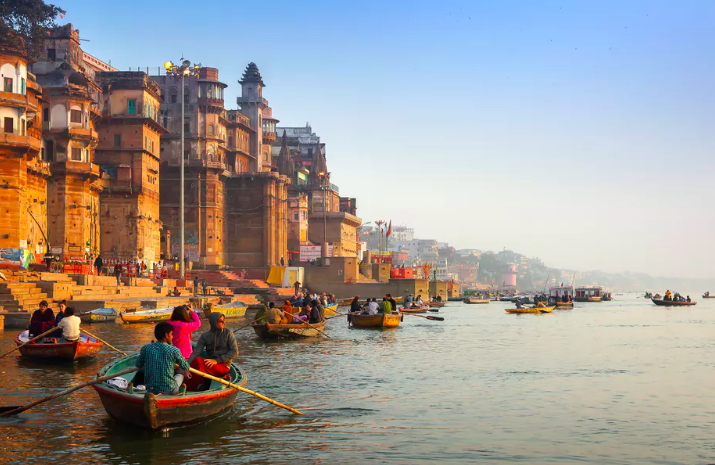
India’s Holiest City Tried ‘Pro-Poor’ Tourism
Anmol, 17, slips 500 rupees into his pocket as he swaggers down the stairs on bowed legs, after escorting American tourists to the pizzeria in Assi. Anmol reads faces to survive. If a tourist has a good face, he approaches, tests the waters in his broken English, and buys them a chai. “Trust is most important because tourists don’t trust you fast,” explains Anmol.
In Assi, a neighbourhood of bustling cafes and temples in Varanasi – India’s most holy city – most people depend on tourism to make a living: building up that trust allows them to eat. According to the Uttar Pradesh Department of Tourism in 2017, over 300,000 foreign and 5m domestic travellers visited Varanasi. During the peak tourist season between October and March, Anmol earns between 2,000 to 7,000 rupees as a guide (that’s £22 to £77). In the low season, he earns little or nothing.
“I also know how to do ceremony,” says Anmol, pulling out his smartphone to show shots of himself waving a lamp in front of a goddess. For a few hours, he helps his father, a priest, at a shrine, earning 50 rupees a day. Now, he has hatched another plan with advice from his Peruvian friend on Facebook – to learn how to play traditional tabla drums, so that he can make a little money teaching tourists keen on Indian culture. If all else fails, he will get a driver’s license.
Who benefits?
Like many others his age, Anmol is struggling to claw his way out of poverty. The average monthly income he cobbles together is just above the World Bank’s poverty line of US$1.90 a day. Anmol is trying to acquire valued skills, and he is not among the “abject poor”, nor accounted for in government statistics about poverty. Yet he remains vulnerable, at constant risk of slipping backwards.
When Anmol moved to Varanasi nine years ago from Bihar, his family circumstances were so strained that he had to choose between education and food. The locals have a cautionary saying about Biharis like him: “Ek bihari sau pe bari” – one Bihari is shrewder than hundred local people. Largely disdained by locals for corrupting their culture, most Bihari migrants in Assi work in the informal economy.
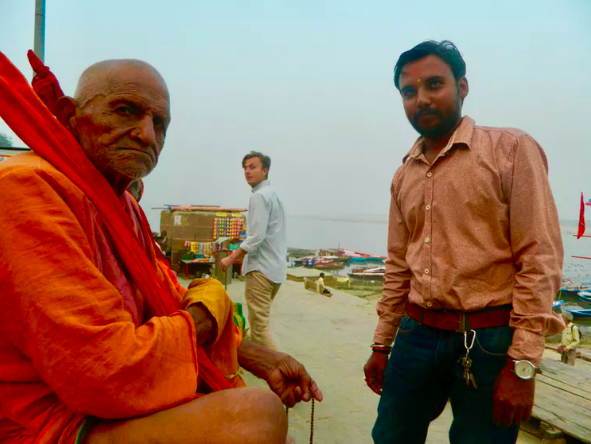
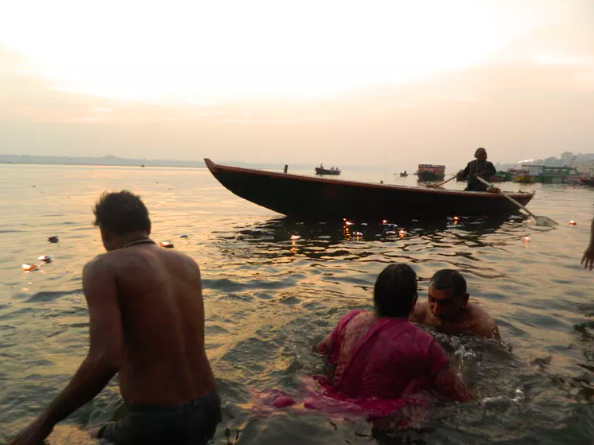
When I ask Anmol who benefits from economic development, he replies, “Everybody benefits, but especially the hotel-wallah, restaurant-wallah, boat-wallah”. Those who own prime real estate, or are directly tied to the tourist industry – such as the boatmen who ferry visitors to watch the sunrise – have gained the most. But there has been no systematic effort to document who benefits from tourism, and in what ways.
Pro-poor tourism
Across India, tourism accounts for nearly 10% of the GDP, and is the third largest foreign exchange earner. One advantage of the tourism industry is that it can absorb even unskilled workers. The UN World Tourism Organisation has long held that tourism can be a key agent in the fight against poverty. But some experts are more sceptical, arguing that tourism’s value is overstated: it creates menial, seasonal jobs and mainly benefits the skilled elite.
Inclusive “pro-poor” tourism, which creates employment for vulnerable residents is a priority in the government of Uttar Pradesh’s 2016 tourism policy and India’s 12th five-year plan. Yet there is a lack of clarity around what “pro-poor” tourism should actually achieve. For Avinash Mishra, joint director of Uttar Pradesh Tourism, it means building skills for those in the sector. For others, tourism is only “pro-poor” if it reduces absolute poverty or inequality.
The local government has not thoroughly mapped how much money from tourism goes to the poor in Varanasi, or other areas. Nor has it identified the bottlenecks preventing the poor from earning a greater share, which vary from one destination to another. A “value chain analysis” – which describes the full range of activities required to bring goods or services from conception to completion – could help the government decide whether to invest in skills development or marketing, strengthen local food supply chains or reform local laws.
Dreaming big
Research by the Overseas Development Institute, an international development think tank based in the UK, suggests that there are many ways to help spread benefits of tourism. In general, the poor do better when tourists spend on local products, rather than “big ticket” items such as accommodation and tour operators. They also benefit when tourist establishments buy supplies locally, and when they can get jobs where the wages are set relatively high. Enforcing a minimum wage can ensure the benefits are more widespread.
According to Mishra, in Varanasi nearly half of foreign tourists come through package tours, so much of the profit will never reach local communities. Foreigners travelling independently are more helpful to locals. It is hard to regulate private sector development, says Mishra, but government intervention comes with its own issues.
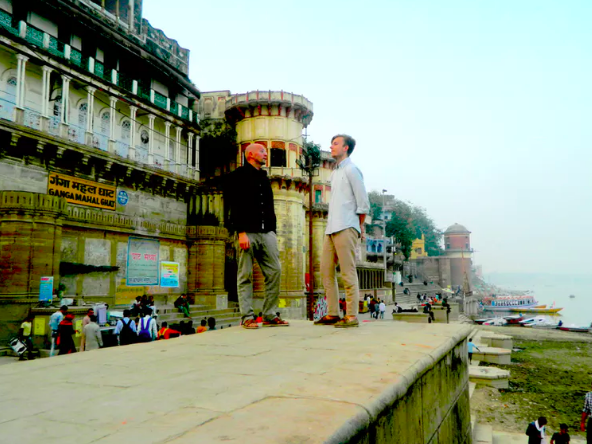
“Once the government comes in, there’s corruption. So we have the principle of the survival of the fittest,” he told me. A family of upper-caste priests, who own much of the local land, are well-equipped for competition. But young people such as Anmol must fend for themselves; if they survive, it’s because of their own ingenuity, resilience and risk-taking.
Many of the young men who came of age in the wake of India’s economic liberalisation now find that the opportunities and lifestyles represented on the internet and television linger just beyond their reach. They are often more educated than their parents, yet they lack the connections and money which could enable them to fulfil their aspirations.
Globalisation and tourism has opened up their imaginations to a world beyond Assi. One day Anmol hopes to go Australia. “I like Australia because the weather is good there. They also play cricket. I can survive there, but it will take a little time to adjust. I used to be scared when I first moved here too.”
THIS ARTICLE WAS ORIGINALLY PUBLISHED ON THE CONVERSATION
Faces of Turkey
In travel or in our daily lives we pass by others, forgetting that all the people we interact with are just like us... human: full of happiness and pain and hope. In Turkey, The Perennial Plate tried to take an extra moment to "see" some of the food producers that make up this wonderful country.